On the anniversary last June, the regime arrested eight people, several of them for protesting against the blackouts in Guanabacoa.
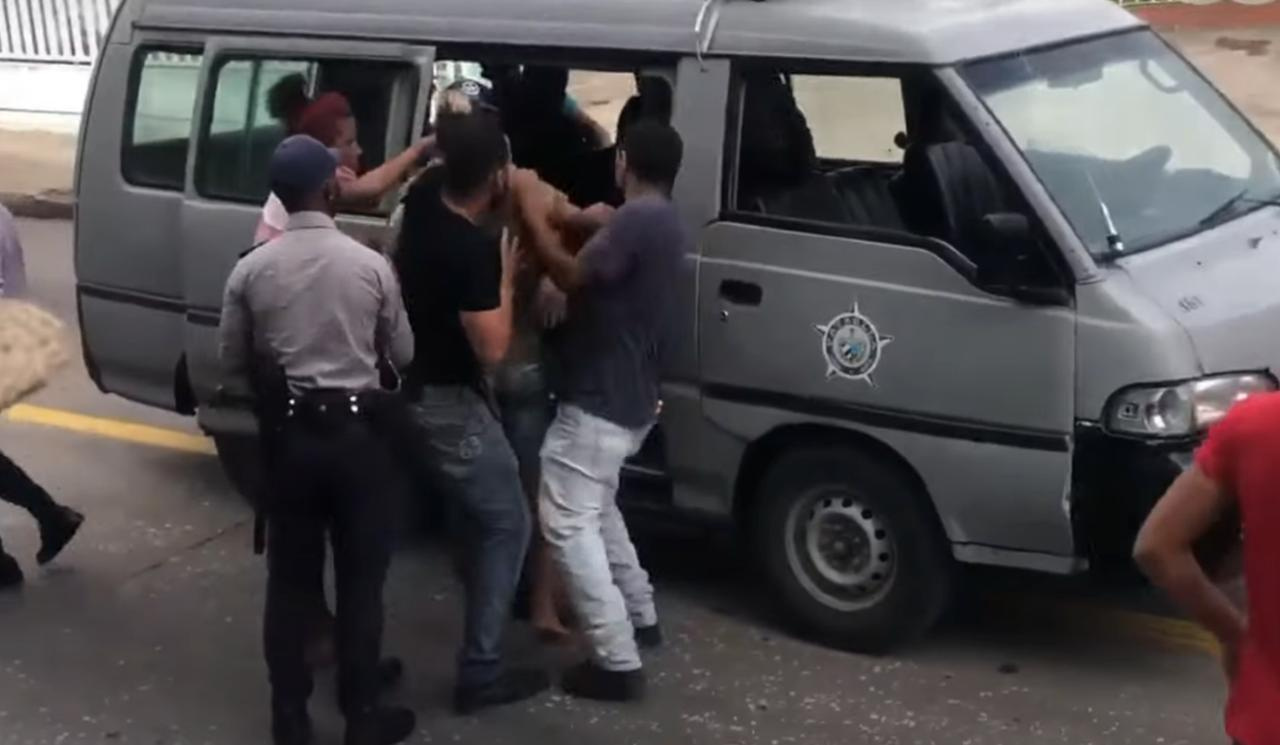
 14ymedio, Havana, 10 July 2025 — On the eve of the fourth anniversary of the mass demonstrations of 11 July 2021, Prisoners Defenders (PD) has published a report denouncing that, of the 1,158 political prisoners serving sentences on the island, 65% (752) were arrested during those protests. Since then, the regime has continued to imprison its opponents with impunity—at a rate of 10 per month over the last 12 months, although several have been released. There were eight new arrests in June, at least half of them during the protests on the 29th in Guanabacoa.
The platform’s list includes only Deyanira López, Dónovan López, Hiromi Moliner, and Sunamis Quintero García, who protested against the blackouts in a neighborhood protest that ended with a fire, a dozen arrests, and an atmosphere of growing tension.
“The situation since 11 July 2021, has not only not improved: it has substantially worsened. However, the massive and brutal repression suffered then is the only factor holding the population back from further mass demonstrations, which are occurring sporadically throughout the country, albeit with much smaller gatherings due to the terror created among the population on 11 and the situation of these prisoners in Cuba,” PD reports.
The platform, in collaboration with Consorcio Justicia and the Center for a Free Cuba, has prepared a document that encapsulates updated data on the repression unleashed by the authorities during 11 June. Since then, nearly 2,000 protesters have been criminally prosecuted, of which 421 remain in Cuban prisons, with 202 of them sentenced to between 10 and 30 years. Another 331 are serving sentences outside of prison.
The organization also reported that, of the 73 women arrested during the protests, 18 remain in prison.
The organization also reported that of the 73 women arrested during the protests, 18 remain in prison. It highlighted the names of the Ladies in White, Sissi Abascal and Sayli Navarro, who are serving their sentences in La Bellotex prison in Matanzas; as well as María Cristina Garrido Rodríguez, sentenced to 7 years in El Guatao prison in Havana; and Lizandra Góngora Espinosa, who received a 14-year sentence in Los Colonos Forced Labor Prison on Isla de la Juventud, “far from and unable to receive visits from her family and her 5 children (4 of whom are still minors).”
PD also denounced the torture to which the 11J prisoners are subjected, including the prison authorities’ refusal to provide medical care. Of the July 2021 protesters who remain imprisoned, 325 have “serious medical conditions” and 34 have mental health problems “incompatible with prison.”
“A still immense number of political prisoners are seriously ill and should benefit from extra-penal parole, which the Cuban regime continually and arbitrarily denies,” the platform said, citing the case of Alexander Díaz Rodríguez, sentenced to five years in prison in Pinar del Río and suffering from “terminal throat cancer, as well as hepatitis B, anemia, and malnutrition.”
In a similar situation is Amalio Álvarez González, who has been sentenced to 15 years and suffers from “psychiatric disorders, cognitive disability, and vision loss.” He has attempted suicide four times.
On July 7, political prisoner Yan Carlos González died after a hunger strike of more than 40 days.
On July 7, political prisoner Yan Carlos González González died after a hunger strike of more than 40 days. He had been incarcerated for over a year in Santa Clara’s La Pendiente prison. Accused of setting fire to a sugarcane field, the 44-year-old faced 20 years in prison at the request of the prosecutor’s office. At the time of his death, González was in the Arnaldo Milián Provincial Hospital in Santa Clara, with a reserved prognosis.
PD also denounced the revocation by the regime of the extrapenal license of four of the 219 11J prisoners released after negotiations with the Vatican last January: Jose Daniel Ferrer, Jaime Alcide Firdó, Félix Navarro Rodríguez, and Donaida Pérez Paseiro. It added that of the political prisoners included in the agreement, 91% “had been entitled by law to an open regime, conditional release, or immediate release, including for more than a year.”
The situation of prisoners is not the only issue of concern to civil society organizations. This month, the Cuban Observatory of Human Rights (OCDH) published a tally of the “repressive actions” carried out by State Security in June. According to the report, 253 such cases were recorded, 61 of which were arbitrary detentions.
“Among the main violations are the sieges of activists’ homes, abuses against political prisoners, threats, and harassment,” the text states, adding that women “are the most affected by the repression.”
____________
COLLABORATE WITH OUR WORK: The 14ymedio team is committed to practicing serious journalism that reflects Cuba’s reality in all its depth. Thank you for joining us on this long journey. We invite you to continue supporting us by becoming a member of 14ymedio now. Together we can continue transforming journalism in Cuba.