The first batch includes engines, tires, and batteries to perform “major repairs” on dozens of vehicles.
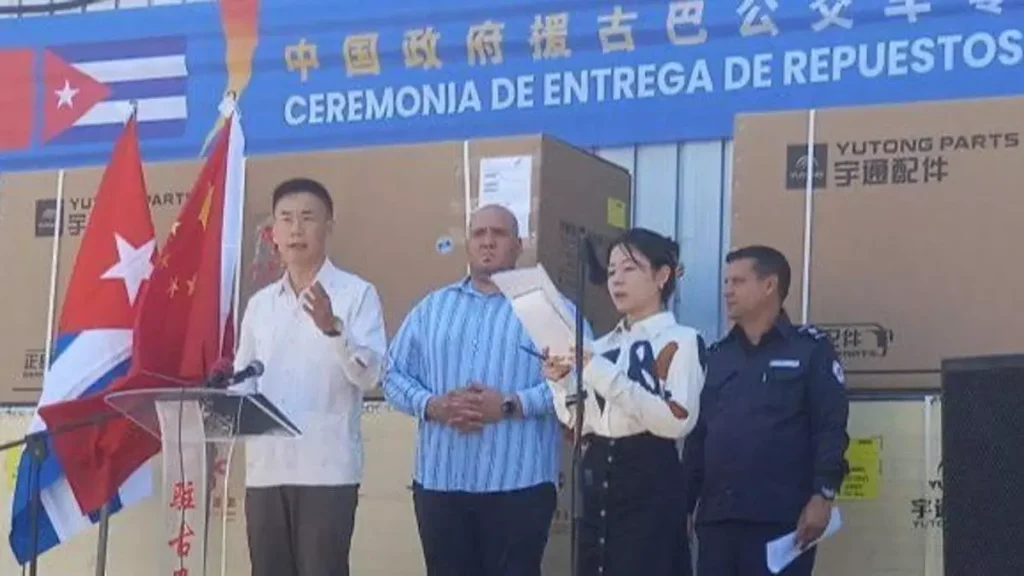
 14ymedio, Havana, 1 August 2025 — China continues to involve itself in the Cuban economy, providing resources that, while vital to Cuba, are practically crumbs compared to the scale of the crisis. The new collaboration, which adds to the decades the country has been sending vehicles to the island, especially the new Foton gazelles, includes the shipment of parts, components, and equipment to put into service buses for public transportation.
The first batch, the official press reported Friday, was delivered Thursday to the Evelio Prieto Bus Production Company—which has several vehicles parked, “dozens,” according to Xinhua —in Guanajay, Artemisa. The new buses arrived on the island through the China International Development Cooperation Agency.
The aid, the company executive explained, includes engines, tires, and batteries, and will be distributed among mechanical, electrical, and quality control work. As a final step, the interiors of the buses, some of which needed “major repairs,” will be reconditioned so that “they regain the capabilities with which they began operating.”
The idea, he added, is to repair up to five vehicles per month and, by the end of the year, deliver between 40 and 50. However, Cubadebate stated that Chinese aid could help repair up to 100 buses, although shipments remain to be made “which will gradually arrive in the country by sea.”
The island’s authorities, for their part, limited themselves to receiving the parts and applauding the good relations between the two countries.
The expected improvements in transportation—provided the necessary fuel is available to operate the buses—would primarily benefit the capital. This was stated during the aid delivery ceremony by Chinese ambassador Hua Xin, who emphasized that Beijing’s plan is to “inject new momentum into the Cuban capital’s transportation system.”
The island’s authorities, for their part, simply accepted the parts and applauded the good relations between the two countries, which will allow them to reestablish high-demand routes, “connecting hospitals, schools, and communities.”
The fact that almost all of the vehicles and parts arriving for public transportation are destined for the capital has already sparked controversy among Cubans in other provinces, who are demanding more attention from the authorities. Last June, when Transport Minister Eduardo Rodríguez Dávila announced the arrival of a fleet of Foton minibuses from China, internet users protested because the 100 vehicles were destined for Havana. In the face of public criticism, it was decided to keep only 50 in the capital city and distribute the other half to various provinces.
Although Havana’s population requires more vehicles, the transportation situation in the rest of the island is also precarious. During the reports from each ministry to Parliament last July, the Ministry of Transportation revealed alarming figures: in 2024, local bus services only met 35% of the transportation plan, failing to serve nearly 350 million passengers during that period.
The ministry acknowledged that of the 2,500 routes managed by provincial companies in the sector, 47% are paralyzed.
The ministry also recognized that of the 2,500 routes managed by provincial companies in the sector, 47% are paralyzed—mainly due to a lack of spare parts and fuel—and, of those that continue to operate, 90% only make two trips daily, one in the morning and one in the afternoon.
The ministry’s report also highlighted the worst conditions on rural routes and in hard-to-reach areas, with only 26% and 19% of the plan fulfilled, respectively. By 2025, 894 million passengers (68%) had been transported on the island through April, and 412 million were lost, 114 million fewer than the same period a year earlier.
On the other hand, the poor quality of Chinese vehicles is striking. As this newspaper recently reported, Foton vehicles are beginning to fail, just two months after entering service.
Chinese vehicles, including taxis, buses, and minibuses, are a significant part of the Transportation Department’s fleet. In the last 20 years alone, China sent more than 10,700 Yutong buses to the island. However, the limited transportation currently operating on the island falls far short of these figures, with no one able to clarify—whether due to quality or lack of resources—where the Chinese vehicles are.
____________
COLLABORATE WITH OUR WORK: The 14ymedio team is committed to practicing serious journalism that reflects Cuba’s reality in all its depth. Thank you for joining us on this long journey. We invite you to continue supporting us by becoming a member of 14ymedio now. Together we can continue transforming journalism in Cuba.