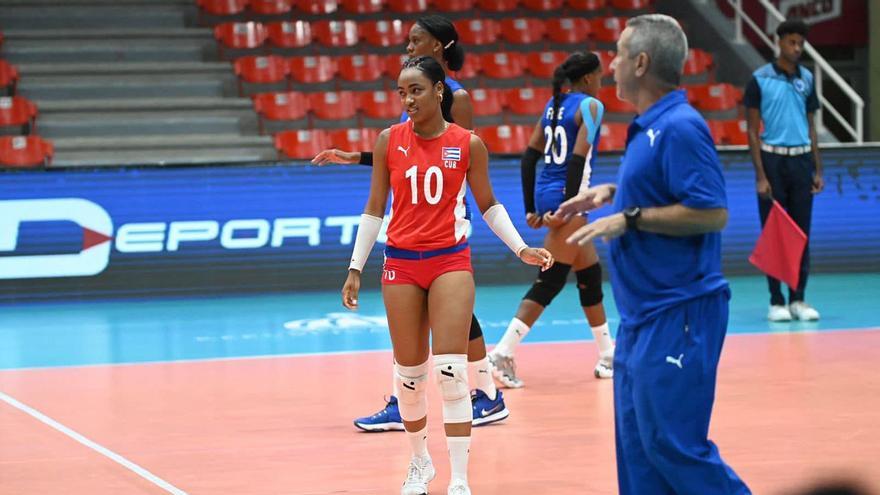
Ellemay Santa Miranda has university studies in Physical Culture and Sports Sciences. (Facebook/Ellemay Santi Miranda)
14ymedio, Havana, 7 September 2023 — Cuban volleyball player Ellemay Santa Miranda left the national team in Quebec, Canada, after losing the bronze medal in the Norceca Continental tournament, which ended last Sunday.
The news was given by the specialized site CubanSp1ke. “We respect your decision and wish you good luck in this new adventure,” was the comment on their social networks. They also said that it is very “difficult” for liberos (receivers), Santa Miranda’s position, to get contracts abroad.
According to Radio Habana, the Cuban Volleyball Federation (FCV) has secured 51 contracts with 14 clubs abroad for players, 21 of them for women. Among the agreements are those of Dezirett Madam and Ailama Cesé with teams from the Italian League. Manager Osvaldo Martínez said that the important thing is that this international contact will benefit the sports growth of Cubans.
The volleyball player was the most outstanding player of the national team and during the Pan American Cup that was held in Santo Domingo was designated the best receiver
The volleyball player was the most outstanding player of the national team, and during the Pan American Cup Final Six of Norceca, which was held in Santo Domingo, Dominican Republic, was designated the best receiver. continue reading
The departure of Santa Miranda comes a month after the National Volleyball Commission dismissed the coach, Nicolás Vives Coffigny, at the request of the players, according to the official press. Those changes also included the removal of the women’s team coach, Tomás Fernández Arteaga.
Santa Miranda decided to stay in Quebec after losing the bronze medal in the Norceca Continental tournament. (Facebook/Ellemay Santi Miranda)
The arrival of Leivys García as the technical director of the Cuban team did not seem to convince Ellemay Santa Miranda, who in the last match of the tournament in Quebec against Canada was absent and did not manage to contribute any points to the scoreboard for the Island’s team.
Santa Miranda participated in the Under-20 World Championship held in 2019 in Mexico, and she also joined the team for the Central American and Caribbean Games in San Salvador.
Currently, the women’s volleyball team is ranked number 24 in the world ranking of this sport, and is in crisis. Its most recent achievements are the three gold medals won consecutively in Sydney (2000), Atlanta (1996) and Barcelona (1992).
Translated by Regina Anavy
____________
COLLABORATE WITH OUR WORK: The 14ymedio team is committed to practicing serious journalism that reflects Cuba’s reality in all its depth. Thank you for joining us on this long journey. We invite you to continue supporting us by becoming a member of 14ymedio now. Together we can continue transforming journalism in Cuba.
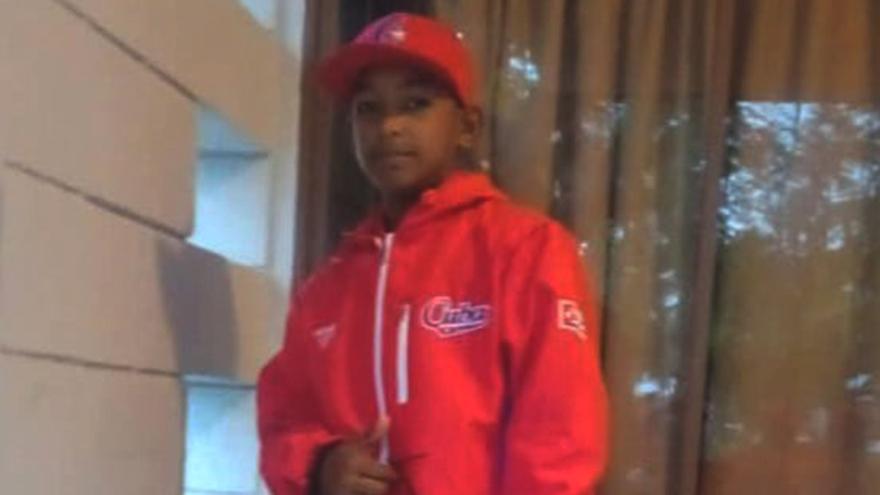
Eduardo Mustelier, 11 years old, is in the Dominican Republic to play baseball. (@francysromeroFR)
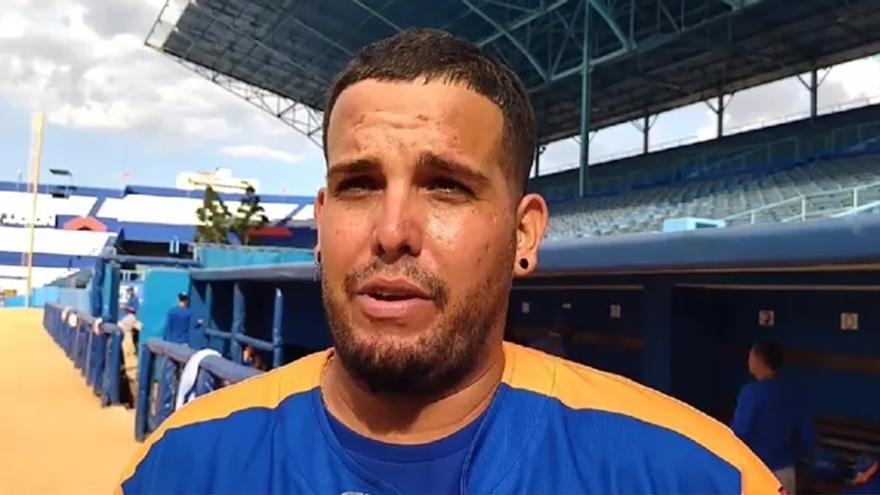
14ymedio, Havana, 8 September 2023 — The regime still hadn’t digested the escape of volleyball player Ellemay Santa Miranda in Quebec when it became known that Cuban catcher Yunior Ibarra also decided to stay in Canada. Journalist Francys Romero reported on his social networks that the native of Sancti Spíritus broke with the Cuban Baseball Federation (FCB) after finishing his season in the Intercondados Semi-professional League of Ontario. Behind Ibarra’s decision, according to the sports media Swing Completo, could have been his “exclusion” from the national team that participated in the last V World Baseball Classic.
This Thursday Ibarra, 28, was due to be with the Cuban pre-selection that trains at the Latin American Stadium in Havana for the Pan American Games in Chile 2023. However, he decided not to board the plane back to the Island, a decision that was also made by his colleagues Raúl González, Yamichel Pérez and Yadián Martínez.
The four athletes arrived in the North American country as part of the players hired last May by the Kitchener Panthers team. Ibarra was on the list of 25 players whose participation in foreign teams had already been negotiated last May by the FCB. His abandonment is in addition to that of Javier Mirabal, who last July decided to continue his career as an independent baseball player with the Mexican club Toros de Tijuana. continue reading
With the Kitchener Panthers, Yunior Ibarra participated in 43 games, the last of them on September 5 against the Canadian team Barrie BayCats. In his personal record he achieved a batting average of .276, had 22 runs and 26 runs batted in, in addition to connecting three home runs.
Catcher Yunior Ibarra was hired last May by Kitchener’s Panthers team. (Escambray)
Ibarra was with the Gallos de Sancti Spíritus in ten National Series on the Island and the Ganaderos team in the Elite League. His batting average was .219; he drove in 135 runs and got six home runs.
This Thursday, reporter Francys Romero said that, at only 11 years of age, baseball player Eduardo Mustelier is in the Dominican Republic. Last May, the boy participated in the Under-12 World Cup that was held in Aguascalientes (Mexico).
“This demonstrates the desperation with which one lives in Cuban society,” the journalist stressed. “The emigration of baseball players to Quisqueya (Dominican Republic) thus touches one of its youngest players since it became systematic.”
Despite his young age, Mustelier’s long swing has caught the attention of the headhunters. “You have to keep in mind that he’s only a child, but he looked superior to the rest in skills such as defense, runs and arm,” Romero said.
The frequent loss of professional players and promising young baseball players in Cuba keeps the FCB in crisis, which no longer knows how to prevent the escape of its athletes who are looking for better contracts in foreign leagues. During the last year, 15 of the 20 players who made up the national team for the Under-15 World Cup left the Island.
Translated by Regina Anavy
____________
COLLABORATE WITH OUR WORK: The 14ymedio team is committed to practicing serious journalism that reflects Cuba’s reality in all its depth. Thank you for joining us on this long journey. We invite you to continue supporting us by becoming a member of 14ymedio now. Together we can continue transforming journalism in Cuba.
CIMEX, the corporation managed by the military sets the pace of much of the trade on the island. (Screen capture)
14ymedio, Havana, 9 September 2023 — Those who go to the branch of the Cimex mercantile corporation in Habana del Este, in search of the jobs they advertised with great fanfare on their social networks, will be disappointed. Only one of the monthly salaries of the available jobs – all manual trades that require “aptitude, experience and certification” – exceeds 3,000 pesos, a figure that is barely enough to buy half a box of chicken or a carton of eggs in Havana.
The corporation managed by the military, which sets the pace of much of the trade on the Island and whose managers understand first-hand the severity of inflation in the country, can only offer an electrician 2,960 pesos, while a maintenance worker will be paid 2,420. A carpenter with the rank of master will be able to opt for a payment of 2,960 pesos; a welder and a plumber, 2,540, the same amount provided for a painter.
Only refrigeration and air conditioning technicians will be paid 3,410, much more than the rest but just as useless to face the greed of Cuban businesses, both state and private.
The barrage of negative comments caused Cimex to delete the ad hours after publishing it. “This is a joke that makes you want to cry,” commented continue reading
one user, calling on the managers to be realistic, since “on the street everything costs three times more than those salaries.”
The barrage of negative comments caused Cimex to delete the ad hours after publishing it
“He who knows any of those trades can earn in one day the salary offered for a month, doing a particular job,” insisted another reader, while another warned that, as long as wages are not improved, all Cimex stores will continue to be “destroyed.”
“This is why the Revolution is advancing,” another commentator said with irony, while most reminded advertisers how much food cost on the Island, in which buying anything “needs several months” of savings. Another reader summarized the options of Cubans: with those salaries, it is more profitable to “continue without working.”
Cimex is not the only state company that is desperately looking for workers. The newly created Department of the Ombudsman’s Office, in the Directorate of Justice of Cienfuegos, published a call in the local press for people to work in the legal field. Although they list a series of requirements – not every lawyer is eligible for the job – including enjoying a “good public concept” and needing the approval of the Ministry of Justice, the announcement does not reveal how much they will pay those who are approved.
The crisis has even reached Cubadebate, the regime’s foremost propaganda medium, which tries to recruit “passionate journalists” for its team. As long as they are “committed” to the Revolution, they do not need to be graduates in that profession but only to have a “journalistic vocation” and “reside in Havana.”
To sweeten the proposal, they not only promise “open hours” and “a quality internet connection,” but also the fact of working for “a renowned news platform.” The salary, however, deflates the offer: just 5,060 pesos and – if the worker earns the good favor of the team led by the prominent Cuban TV host Randy Alonso – a “monthly stimulation payment.”
Translated by Regina Anavy
______________________
COLLABORATE WITH OUR WORK: The 14ymedio team is committed to practicing serious journalism that reflects Cuba’s reality in all its depth. Thank you for joining us on this long journey. We invite you to continue supporting us by becoming a member of 14ymedio now. Together we can continue transforming journalism in Cuba.
A study has revealed that in 21% of Cubans who live below the poverty line often go without breakfast, lunch or dinner due to lack of money. (14ymedio)
14ymedio, Elías Amor Bravo, Economist, 9 September 9, 2023 — The two refrains that the Cuban communists repeat ad nauseam fall apart in a spectacular way. The first, that “the United States crushes us with the embargo” sounds more and more like a hollow shell. The US sends Cuba more than 8 billion dollars a year in remittances, so no one can believe the “persecution,” and if they do it’s for political reasons.
The other thing that is repeated like a broken record is that “in Cuba no one is left helpless or abandoned to their fate.” This is even more difficult to believe once the bases of collectivism have been broken since the entry into force of the so-called Ordering Task.* In a nutshell, the Cuban communists are running out of excuses.
Not many days ago, Cuban President Díaz-Canel promoted a meeting to evaluate the progress of social programs aimed at the care of people who are in a vulnerable situation. The state press at the service of the regime has not missed a single opportunity to build a false reality.
The meeting was attended by, among others, First Vice President, Valdés Mesa, Prime Minister Marrero and the Minister of Labor and Social Security, Marta Elena Feitó. The latter was in charge of a speech to update everyone on the state of implementation of each of the programs of care for the vulnerable and to highlight what still has to be done in each of them, “to give continuity and preserve the social accomplishments achieved.”
The propaganda message of this meeting is that it was the so-called revolution that was responsible for the “main achievements with the universalist approach to social policy.” Specifically, those in Education, Health, Social Assistance, Social Security, and others were cited. Obviously, the minister of labor can say what she believes, but surely she would be surprised if instead of being the informant, she uses public opinion, the expressions of Cubans, about the state of these services. Maybe she knows continue reading
them, and that’s why this meeting says just the opposite. The more the communist leaders distance themselves from the people, the greater the rejection they will receive.
The alleged social equity of the Cuban communist regime is going at great speed down the drain of history. And without that fundamental basis, little more can be done on that unfortunate Island, where every day the leaders launch new experiments to gain a time that they no longer have.
The minister made an express mention of the “children’s programs” whose family nuclei deserve attention, or those destined for “communities.” In both cases, these are “experiments” of the regime that do not have the slightest justification except to maintain and reinforce control over a population that lacks resources to improve their life prospects.
These experiments continue to bet on collectivism “in a multidisciplinary way,” because the programs include the ministries of Public Health, Education, Higher Education and Culture, as well as the National Institute of Sports, Physical Education and Recreation. Imagine the cost of these useless programs and the impact they have on the budget, since the situation of Cubans does not improve.
The communist leaders emphasize that they want family and community participation, but in reality this participation is “directed” and “controlled” by the single party that thus instrumentalizes social segments to consolidate political, bureaucratic and ideological structures. Meanwhile, who is producing and what do they produce?
Hence, absurdities are raised such as offering Cuba’s ninis — a term used to describe young people in vulnerable situations who do not study or work — jobs in the neighborhoods in which they live and also for the benefit of the community itself. They don’t realize that those young people, frustrated with their reality, leave the country as soon as they can to build alternative and prosperous lives in other countries, where they quickly leave the status of nini behind. Perhaps Cuban communists should ask themselves why, in an economy as social and collectivist as the one they say they have created, these ninis even exist.
Castro policies do not solve these problems, just as they don’t serve to achieve a prosperous economy. In reality, those “benefits and services,” which have been created by the so-called “revolution,” do not help vulnerable families to overcome their situation. The budget resources allocated to these activities artificially inflate an unsustainable public deficit, which is at the origin of the lack of monetary control that exists in the country and causes double-digit inflation of the highest in the world.
In fact, many of these programs could be eliminated and things would not change significantly, except for the plethora of officials, communist politicians and bureaucrats who live from their implementation. The minister emphasized that the cost is 6 billion pesos, but in reality it is much more if Education and Health items are added. More than 60% of the public budget is committed to collectivist programs, the results of which are well known. In Cuba, groups at risk of social exclusion are flourishing and increasing, and I’m not the only one saying this: the communist leaders themselves say the same thing.
That failure of the policies of benefits to families and vulnerable people is symptomatic of other structural ills that afflict the Cuban economy, placing it close to total bankruptcy. The situation of collective vulnerability spreads and increases incessantly, and the government is unable to face the process.
Basically, there are not enough resources to meet those needs and they have to be financed. Nothing is free. Mobilizing billions of pesos for the vulnerable means that the money cannot be used, for example, to build hotels, and the political priorities have become very clear in recent years. The economic resources available can’t be stretched, even when it comes to those segments of the population who are vulnerable, which, according, to official sources, have been increasing in recent years. Apparently there are no policies for this situation.
The communists are worried because the State can’t handle it anymore and has to make cuts in certain benefits, which breaks the collectivist vision of the revolution. Problems grow and the tourists observe poverty in the Cuban streets, not only in the distressed buildings but in the people, and time is running out. That is why they affirm that “it is important not only to demand of the State, but also of the families who have the obligation to take care of those people, because it is a collective responsibility to take care of them.” Things are getting quite complicated. They have already begun putting the responsibility on others, and for that they use the family code.
The Minister of Labor said that “we are going to begin to better update the population on all the services that exist and where to go to receive them.” She did not talk about reducing expenses and improving management efficiency. Everyone left happy from the meeting convened by Díaz-Canel to talk about the disadvantaged groups. The regime is getting further and further away from social reality.
*Translator’s note: The Ordering Task is a collection of measures that include eliminating the Cuban Convertible Peso (CUC), leaving the Cuban peso (CUP) as the only national currency, raising prices, raising salaries (but not as much as prices), opening stores that take payment only in hard currency, which must be in the form of specially issued pre-paid debit cards, and a broad range of other measures targeted to different elements of the Cuban economy.
Translated by Regina Anavy
____________________
COLLABORATE WITH OUR WORK: The 14ymedio team is committed to practicing serious journalism that reflects Cuba’s reality in all its depth. Thank you for joining us on this long journey. We invite you to continue supporting us by becoming a member of 14ymedio now. Together we can continue transforming journalism in Cuba.
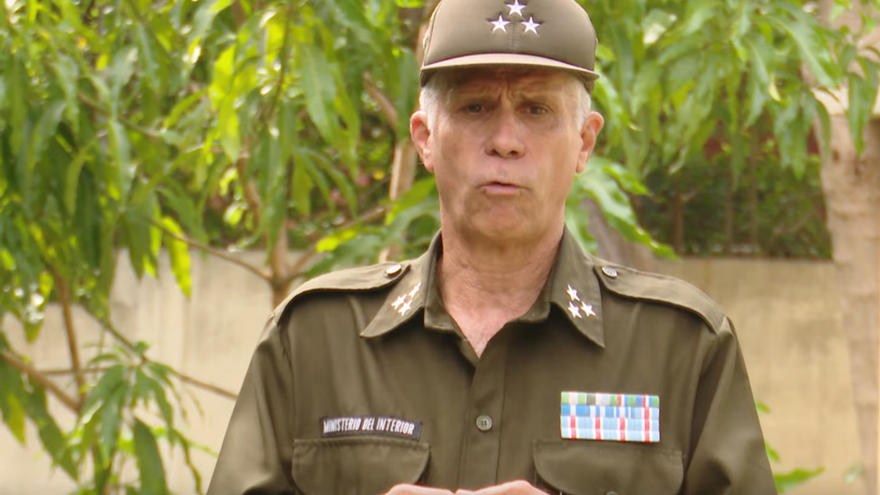
Colonel César Rodríguez gave more details in the Razones de Cuba program. (Screen capture)
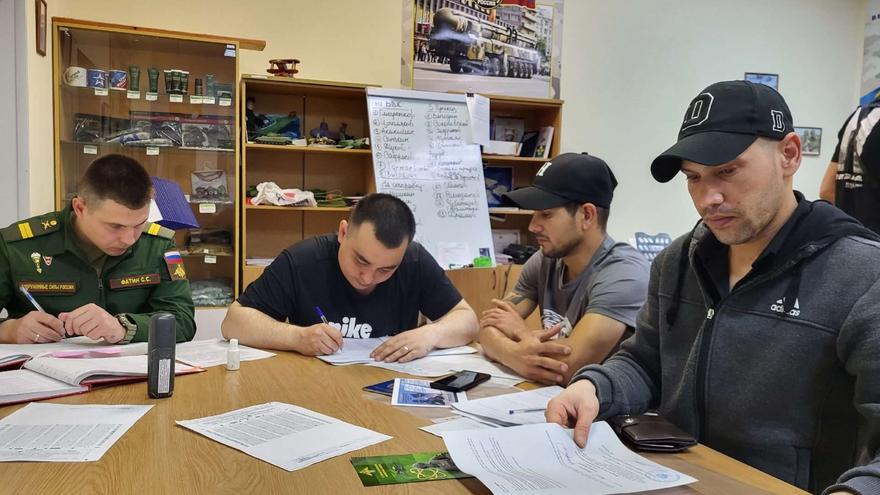
14ymedio, Madrid, 8 September 2023 — The security forces of the Cuban Ministry of the Interior have arrested 17 people linked to the “trafficking network” for the recruitment of nationals to fight on the Russian side in the war in Ukraine. Those involved will be accused of the crimes of human trafficking, trafficking and/or mercenarism according to each case.
Two days after the statement from the Ministry of Foreign Affairs in which an operation against this alleged network was reported, several officials of the General Directorate of Criminal Investigation were interviewed in the Razones de Cuba program, presented by a regime spokesman, Humberto López, to present details that were being demanded from the ruling party itself.
However, there was little that was new in addition to the number of people, of whom three are linked to recruitment and the remaining 14 are those interested in joining the invasion, described as a “military operation” by official media, “in exchange for residence in the Eurasian country and a substantial monetary remuneration,” which according to the head of the Cuban troops in Russia, interviewed by América TeVé this week, amounts to $2,000 per month.
Three are linked to recruitment and the remaining 14 are those interested in joining the invasion, described as a “military operation” by the official media
It follows from the words of the officials that at least one of the people they recruited was a woman, as the main evidence mentions “the confessions made by the detainees and the communications established by the (female) ringleader at the internal level of the criminal network.”
The authorities affirm that the network “enhanced the search” for “people with a criminal record, from dysfunctional families, to incorporate them into the mercenary system,” although they have not provided more details about the detainees and whether or not they had that profile, which the regime usually uses to define those accused of common and political crimes. continue reading
The program specified the classification of each crime for which those involved will be accused. On the one hand, that of human trafficking for those who “promote, organize, incite or execute the recruitment, transportation, transfer, reception or reception of people (…) taking advantage of a situation of vulnerability of the victim,” with the use of coercion, violence, deception or bribery.
On the other hand, the trafficking of people, for those who facilitate or promote the “entry or exit of people from the national territory, in order for them to emigrate to another country.”
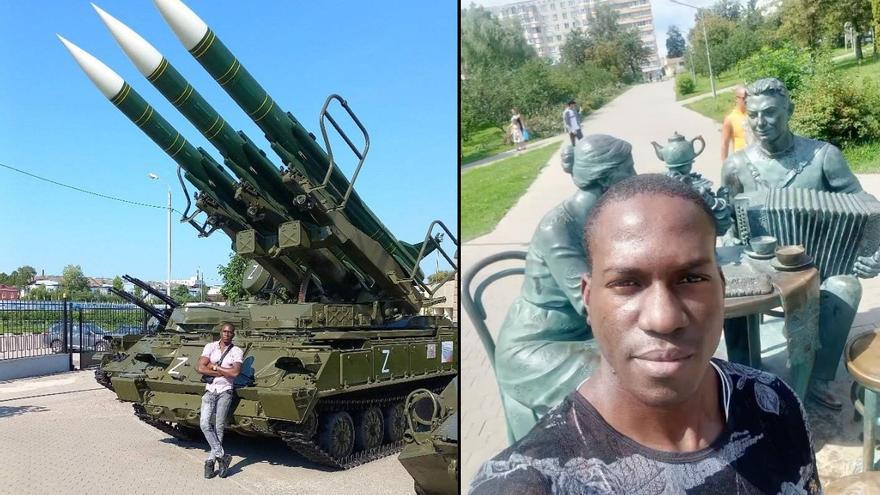
One of the Cuban recruits posing next to a Russian tank. (informnapalm)
And finally that of mercenarism, which would be attributable to the alleged recruits, for those who join military formations or private military companies made up of citizens of a State other than the one in which they are expected to act, and in exchange for a salary or personal benefit. For this crime, attributable to the majority of the detainees, very serious sanctions were specified, ranging from 10 to 30 years of deprivation of liberty, life imprisonment or the death penalty.
José Luis Reyes Blanco, Chief Prosecutor of the Supervision Department of the Directorate of Criminal Proceedings of the Attorney General’s Office, added that the investigations will determine the involvement and crime for each accused, while Eva Yelina Silva Walker, director of International Law of the Ministry of Foreign Affairs, spoke of the “historic position of Cuba against mercenarism, of which it has been a target on several occasions,” as well as international treaties and the promotion of initiatives in the United Nations carried out by the Cuban Government.
“Cuba is not part of the military conflict in Ukraine. It is acting and will act energetically against anyone who, from the national territory, participates in any form of human trafficking for the purpose of recruitment or mercenarism so that Cuban citizens make use of weapons against any country,” they said.
For this crime, attributable to the majority of the detainees, very serious sanctions were specified, ranging from 10 to 30 years of deprivation of liberty, life imprisonment or the death penalty
The father of two alleged recruits also intervened in the program, one of whom is, according to his testimony, already in Russian territory, while the other was intercepted by State Security, which prevented his departure.
“I have to thank the colleagues of the MININT (Ministry of the Interior), because they took him that day and changed his mind. I don’t know what they told him, but it worked, because he reconsidered and chose to stay here,” said Pedro Roberto Camuza Jovas, who regretted not knowing anything about his other son, who hid the reality of “work contract” to avoid affecting the health of his father, who has high blood pressure.
The information comes a day after the documentation regarding the Cubans recruited in Cuba was leaked, after a hack by the Ukrainian activists Cyber Resistance, who gave Inform Napalm lists, passports and other files. The group of mercenaries, according to this information, is made up of 199 Cubans.
“Immigrants and the poor of the former Soviet states are the most logical choice. Consequently, the exploitation of foreign citizens allows the Kremlin to attract additional human resources for its military operations, to cope with the growing losses,” the report says.
Translated by Regina Anavy
____________
COLLABORATE WITH OUR WORK: The 14ymedio team is committed to practicing serious journalism that reflects Cuba’s reality in all its depth. Thank you for joining us on this long journey. We invite you to continue supporting us by becoming a member of 14ymedio now. Together we can continue transforming journalism in Cuba.
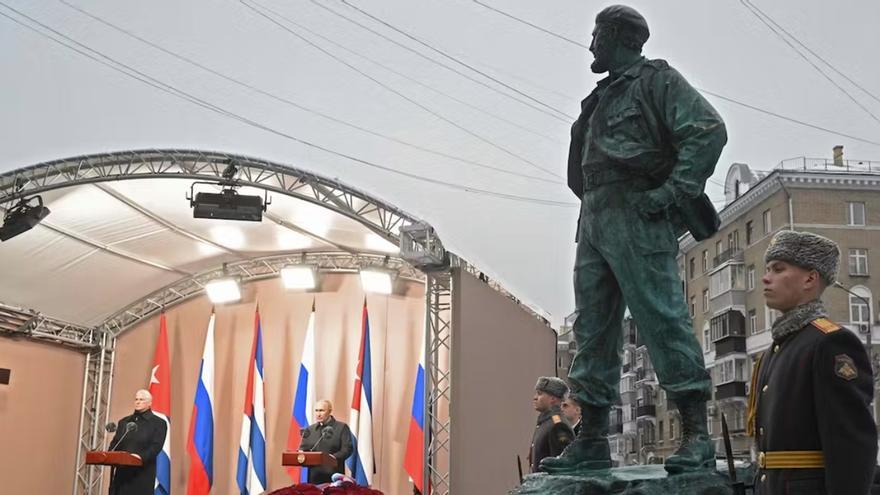
Cuban president Miguel Diaz-Canel and Vladimir Putin beside a statue of Fidel Castro in Moscow. (Sputnik Kremlin)
14ymedio, Yunior Garcia Aguilera, Madrid, 5 September 2023 — In the last few hours, several international media outlets have reported that Cuba has uncovered an illegal scheme to recruit Cuban citizens to fight in Ukraine. But the truth is that the regime has uncovered absolutely nothing. It has only reacted — and very late at that — to a scandal that has been brewing on social media for several days. The recent statement by the Ministry of Foreign Affairs is an attempt to wash its hands of the matter and provide cover for a dictatorship that has been Putin’s faithful lackey since the start of the war.
It was the influencer Alain Paparazzi who uncovered this Pandora’s box when two young men contacted him to report their situation. Alex Vegas and Andorf Velázquez, both 19-years-old, signed contracts allegedly to do construction work in Russia. Their willingness to move there under the current circumstances is a reflection of just how desperate young Cubans are to leave their country, no matter the cost. Once on Russian soil, they were relieved of their documents, forcibly inducted into the military and transferred to the front lines in Ukraine.
Diaz-Canel is a pawn who thinks he is a bishop. His outward moves seem deferential to Putin while under the table he is playing footsies with Biden
During the Cold War, Fidel Castro also behaved like a Kremlin pawn but the bearded one had his own way of moving around the chessboard. It was he who popularized a Cuban rhyme that might be translated as “Nikita, my little ladybug, you can’t steal what’s already been given to you.” The Soviet leader would later sideline him from negotiations during the Cuban Missile Crisis before ultimately withdrawing offensive missiles from the island. They say that the homophobic Fidel employed his cigars as anti-kissing shields on his trips to Moscow to discourage his Soviet comrades from engaging in this particular display of affection. When perestroika was unleashed, he had no qualms condemning his favorite general to death by firing squad to send and clear and unequivocal message to those in Cuba’s own nomenklatura who were sympathetic to Gorbachev’s reforms. For this and other reasons, the Cuban regime survived the fall of the Soviet bloc. The Cuban pawn knew he was a pawn but aspired to get to the other end of the board so he could become queen. continue reading
Diaz-Canel, on the other hand, is a pawn who thinks he is a bishop. His outward moves are deferential to Putin but, under the table, he is playing footsies with Biden. Despite all the pro-Putin propaganda from official media in Cuba, to say nothing of foreign outlets such as TeleSur and Russia Today, most Cubans reject such a blatantly imperialist military invasion. And yet the government has not voted in favor of any of the resolutions condemning the war. Not even the one sponsored by the World Health Organization (WHO) decrying the almost 1,000 attacks against Ukrainian hospitals and healthcare centers.
The famous Molière character, Tartuffe, is one the world’s most archetypal hypocrites, which makes the Cuban regime the quintessential Tartuffian dictatorship. For decades it has condemned invasions, wars of aggression, annexations of territories and mercenary escapades. But now it finds itself trapped in its own moral back alley. That is why the Foreign Ministry’s statement is so disgusting. It reads like the script for an energy drink commercial.
They are looking for what every nation at war needs: political and military support. In this regard, the only thing Cuba can offer them is cannon fodder
Diaz-Canel has shown no qualms about flying to Moscow to pay homage to his tsar-in-chief. His last visit broke Putin’s near total isolation at a time when even Xi Jinping could not be bothered to pick up the phone. A squad of high-ranking Russian officials have also been parading through Cuba. They are hoping to not only collect on their debts but to expand their Cuban investment portfolio. They are also hoping Cuba can serve as the front man for their interests in Latin America and Africa. And they are looking for what every nation at war needs: political and military support. In this regard, the only thing Cuba has to offer is cannon fodder.
It is no coincidence that Cuba has so many military personnel at its embassy in Moscow. And it is no coincidence that, during a meeting with the head of the Department of International Military Cooperation in Minsk, Colonel Mónica Milián Gómez — Cuba’s military, naval and air attaché for Russia and Belarus — that let slip a possible indiscretion as we know from her Twitter account. Or that Belarus’ Deputy Defense Minister Valery Revenco wrote that “the main focus of attention the was training of Cuban military personnel.”
So the regime has nothing to do with recruiting young people to go to war? Really? Tell that to Orgon or Madame Pernelle. No one with half a brain would take the statements of such a Tartuffian regime seriously.
____________
COLLABORATE WITH OUR WORK: The 14ymedio team is committed to practicing serious journalism that reflects Cuba’s reality in all its depth. Thank you for joining us on this long journey. We invite you to continue supporting us by becoming a member of 14ymedio now. Together we can continue transforming journalism in Cuba.
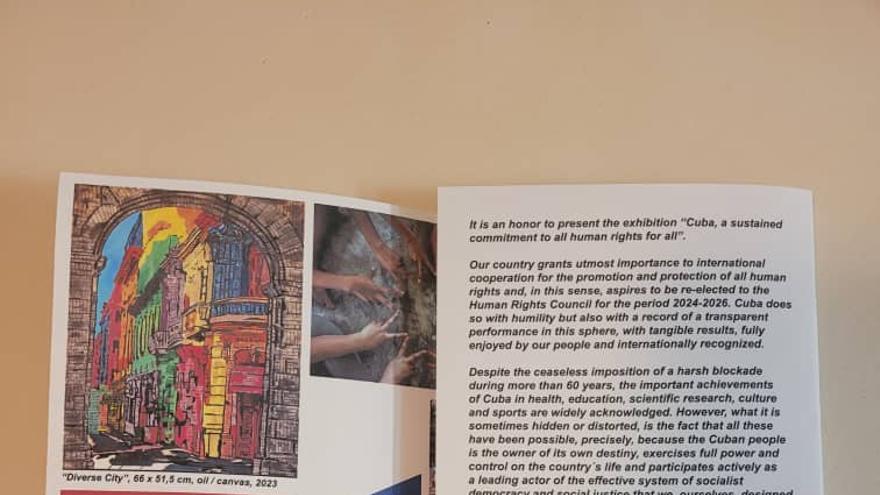
Triptych of the exhibition, “Cuba, a sustained commitment to human rights for all,” with which the regime promotes its re-election to the Human Rights Council. (@GerardoPPortal)
EFE (via 14ymedio), Havana, 8 September 2023 — About 20 Cuban opposition organizations and 30 individual dissidents, mostly based abroad, signed a statement that rejects the recently announced candidacy for the re-election of Cuba to the UN Human Rights Council for the period 2024-2026. The document, published this Thursday, states that the Cuban State “does not comply with its human rights obligations, as highlighted in several reports presented this year within the framework of the Universal Periodic Review of the Republic of Cuba.”
They consider that this “non-compliance” has caused “an extreme setback” in the effective exercise of human rights on the Island.
The letter is signed by organizations such as the opposition platform D’Frente, the Council for the Democratic Transition in Cuba, Cuba Próxima and the Institute of Artivism Hannah Arendt
The group emphasizes that in the Cuban Constitution approved in 2019, “the one-party system is maintained and free elections are not allowed,” and emphasizes that Cuba has not ratified international pacts on civil and political rights and economic, social and cultural rights, nor their optional protocols.
“This prevents the binding effect of the decisions and pronouncements of the treaty bodies and those derived from the visits of independent experts to verify the real situation of the country in terms of human rights,” adds the statement, disseminated by the Argentine initiative Demo Amlat. continue reading
As another reason for their rejection, they cite the increase in repression after the anti-government protests of July 2021 on the Island, the largest in decades, in which more than 1,000 people were arrested and 700 convicted.
They point out that the people arrested for political reasons “were tried and sanctioned without due process, as a result of the lack of independence of the courts.”
In announcing its candidacy, the Cuban Government said that it “is committed to advocating for full respect for the principles of universality, indivisibility, objectivity, non-politicization and non-selectivity,” and it promotes “the strengthening of international cooperation.”
The Cuban Foreign Ministry announced on September 1 that it will seek re-election on October 10 and began an online campaign to promote its candidacy and appeal to the vote
The Cuban Foreign Ministry announced on September 1 that it will seek re-election on October 10 and started an online campaign to promote its candidacy and appeal to the vote.
Various independent groups, NGOs such as Human Rights and Amnesty International and some States have criticized the Cuban government by accusing it of repeated human rights violations.
They have denounced, among other things, “arbitrary detentions,” “trials without minimum guarantees” and arrests and convictions “for exercising the right to freedom of expression.” They have also demanded the release of those convicted for political reasons, who, according to NGOs such as Prisoners Defenders, total more than 1,000 people.
Translated by Regina Anavy
____________
COLLABORATE WITH OUR WORK: The 14ymedio team is committed to practicing serious journalism that reflects Cuba’s reality in all its depth. Thank you for joining us on this long journey. We invite you to continue supporting us by becoming a member of 14ymedio now. Together we can continue transforming journalism in Cuba.
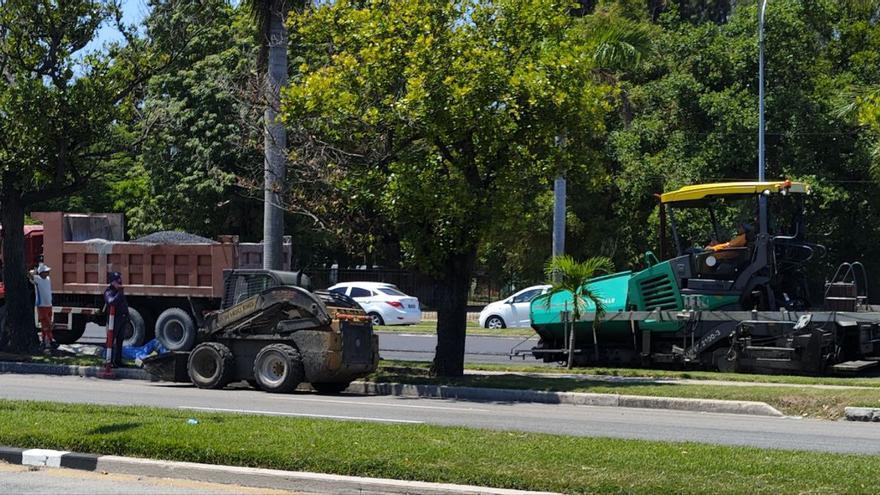
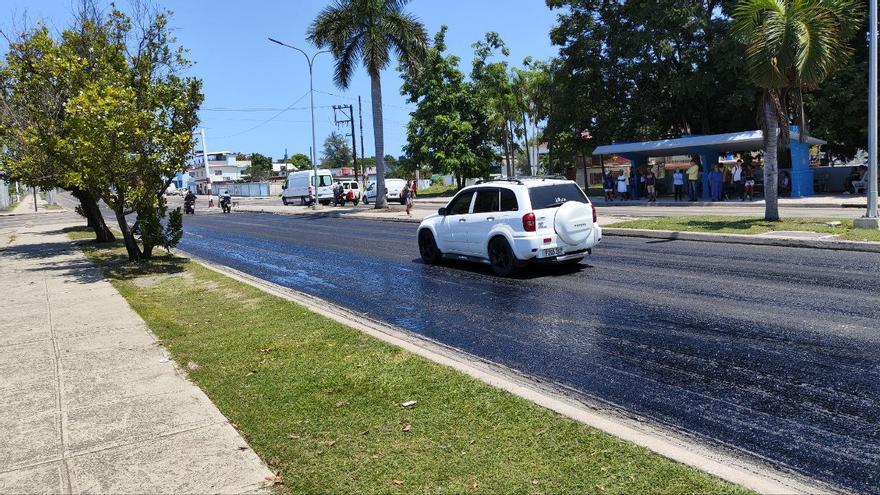
A fleet of tractors and asphalt rollers is already circulating in the city, which will serve as a “background” for the summit. (14ymedio)
14ymedio, Juan Diego Rodríguez, Havana, September 8, 2023 — The phrase with which Cubans mock the partial restoration of Havana every time the visit of a foreign president is expected is accurate: “Put some makeup on the old woman,” that is, hide the potholes and paint the facades of certain “strategic” streets, while the rest of the city faces one collapse after another. This is precisely what is happening on the eve of the summit of the Group of 77 plus China, which the Island regime will host on September 15 and 16.
Traditional allies, such as Brazilian President Luiz Inácio Lula da Silva and Comrade Ralph Gonsalves, Prime Minister of Saint Vincent and the Grenadines, will not suffer the slightest setback on Rancho Boyeros Avenue – freshly repaired and embellished – that goes from José Martí International Airport to the city center.
“It is the circuit of prosperity”, finish off those who walk the emblematic 23rd street today. (14ymedio)
Neither the president of Honduras, Xiomara Castro, nor that of Argentina, Alberto Fernández, will see the grotesque garbage piles that accumulate in the streets of Centro Habana or Luyanó. “The mountains of garbage are about to give each other a kiss and a hug,” the residents of Nuevo Vedado, an area of the capital, once well-off and now abandoned, ironize in front of two “neighboring” landfills. Miguel Díaz-Canel will not dare to take Antonio Guterres, Secretary General of the United Nations, through this area. continue reading
However, for the limited portion of the city that will serve as a “background” for the summit, a fleet of tractors, rollers, cleaning vehicles and contingents of workers, sweepers and supervisors is already circulating. “It’s the circuit of prosperity,” conclude those who travel today along the emblematic 23rd Street, which is also receiving its dose of “makeup,” before adding that “only the Pope is missing” from the city.
The leaders, gathered in Havana to talk about “development, science, technology and innovation,” will leave without going through the bitter experience of being stopped by a tense traffic police officer, imported from the neighboring province of Mayabeque to support the summit.
“They are ending the fines these days,” summarized a taxi driver this Friday, while muttering under his breath something similar to a prayer to the Virgin of Charity. His desire: that the policemen leave Havana as quickly as the the world leaders.
Taxi drivers have already started complaining about the increased fines to keep them “under control”. (14 and a half)
Translated by Regina Anavy
____________
COLLABORATE WITH OUR WORK: The 14ymedio team is committed to practicing serious journalism that reflects Cuba’s reality in all its depth. Thank you for joining us on this long journey. We invite you to continue supporting us by becoming a member of 14ymedio now. Together we can continue transforming journalism in Cuba.
Cubans are traveling to the Russian city of Riazan, according to several of them, including former Revolutionary Armed Forces sub-lieutenant Lázaro González. (RyazanGazette)
14ymedio, Madrid, 7 September 2023 — The opacity of the Cuban government on the subject of the recruitment of young people from the Island to fight with the Russian Army in Ukraine has aroused suspicion in its own ranks. The magazine close to the ruling party, La Joven Cuba [Cuban Youth], dedicated an editorial to the situation on Wednesday, demanding “information transparency” with the citizenry.
The text refers to the statement of the Ministry of Foreign Affairs in which, without giving a single detail, there was talk of a government operation against a “trafficking network of people” for which “criminal proceedings” have been initiated. La Joven Cuba asks that the modus operandi be explained about “its contractors in Russia, its facilitators in the national territory, what positions they occupy and the final destination of the Cubans who are currently in a war zone.”
The text considers that clarifying those doubts is relevant not only for national security and the lives of some of its citizens, but also to “generate awareness about the dangers that similar actions may involve in the future.” It refers to the trip to Kiev of Orlando Gutierrez-Boronat – whom they refer to as an “extreme-right Cuban-American opponent, supporter of a military invasion of the Island” – who claimed to have gone to Ukraine out of solidarity, while the regime accuses him of going to promote the exclusion of the Island (along with Russia) from international forums, including the United Nations.
Despite the obvious geopolitical alliance of the Cuban government with Vladimir Putin, Havana has never broken diplomatic relations with Ukraine
“This action is far from contributing to a peaceful solution of the conflict and could have serious political consequences, because despite the obvious geopolitical alliance of the Cuban government with Vladimir Putin, Havana has never broken diplomatic relations with Ukraine,” continues the editorial. It concludes, using a carrot and a stick, by saying that they demand clarity as much as they want Cuba to stay out of the war. continue reading
In the text there is a paragraph dedicated – like the title – to focusing attention on the use of the word “mercenaries” applied to those who fight on the Russian side, “a term so far reserved exclusively for the activities of sectors opposed to the Cuban government,” in the face of the “euphemism of ’private military company’ [used] by the state media on the Island.” However, LaJoven Cuba limits itself to highlighting it, without making conjectures.
From the other side of the ideological trench, the demand for transparency is common ground. The Cuban Electoral Defense Commission (COCUDE) issued a statement on Wednesday urging the Government to immediately intercede with the authorities of Russia and Belarus to repatriate those who were deceived into fighting, “following the ’internationalist’ tradition that is instilled in Cubans from elementary school and throughout their lives.”
The organization calls for the cessation of all military collaboration with Russia and points out, in addition, that it is absolutely impossible that in a controlled state such as Cuba “the security services of the regime have just discovered a plot that obviously takes months, at the least, organizing itself in both Cuban and Russian territory.”
In this, the Ukrainian politician Oleksandr Merezhko agrees, and on Tuesday he rejected the statement of the Cuban Foreign Ministry, which he accused of lying. “The Cuban communist regime pretends that it has nothing to do with this “trafficking of people.” In reality, this totalitarian regime is on the side of the aggressor,” he shouted, asking the European Union to stop financing the Island because of its “pro-Russian” status.
But there are many doubts about this case. Last Tuesday, the journalist from América TeVé, Juan Manuel Cao, interviewed an alleged Cuban soldier who denied some of the complaints made by recruits Alex Vegas Díaz and Andorf Velázquez.
Identified as Lázaro González, second lieutenant of the Revolutionary Armed Forces (FAR), he said he spoke from Russia, where he is at the head of a company of about 90 Cubans, all of them with military knowledge, according to his testimony, for having completed their military service and being trained daily in the Eurasian country, with shooting classes included.
González said that the task of his troop is to support the Russian army as it occupies areas of Ukraine, that they all earn $2,000 and undergo medical examinations upon arrival in the country. The contracts, which the young recruits said they had seen only in Russian, are also in Spanish, the soldier said.
Everyone here has their passport and the immigration letter,” he said, adding that he could not reveal who had recruited him because it was “confidential” information
“Everyone here has their passport and the immigration letter,” he said, adding that he could not reveal who had recruited him because it was “confidential” information.
The press talks about Elena and Dayana, a Russian and a Cuban who allegedly carry out the operation. However, some media maintain the theory that it is a simulation using Artificial Intelligence, especially after an audio was leaked in which the answers were not only succinct but hardly understandable. “Can I quote your answer on this subject? We would like to know your version of the story,” asks the journalist, to which the voice replies: “There is reality and that is different.”
While doubts persist, among the relatives of the recruits who have reported being victims of the situation, the concern does not cease. Cary Díaz, mother of Alex Rolando Vegas Díaz, sent a video this Wednesday to journalist Mario Vallejo, in which she asks for help from anyone who can intercede, including the Catholic Church.
“He is 19 years old. He supposedly left with a work contract, and it turns out not to be true. A few unpleasant things happened but that’s not why they left, which was to work and earn a little money for their families in Cuba. Everything has changed, and their lives are in danger because they are being sent to the front line of combat,” she said with obvious anguish.
Translated by Regina Anavy
____________
COLLABORATE WITH OUR WORK: The 14ymedio team is committed to practicing serious journalism that reflects Cuba’s reality in all its depth. Thank you for joining us on this long journey. We invite you to continue supporting us by becoming a member of 14ymedio now. Together we can continue transforming journalism in Cuba.
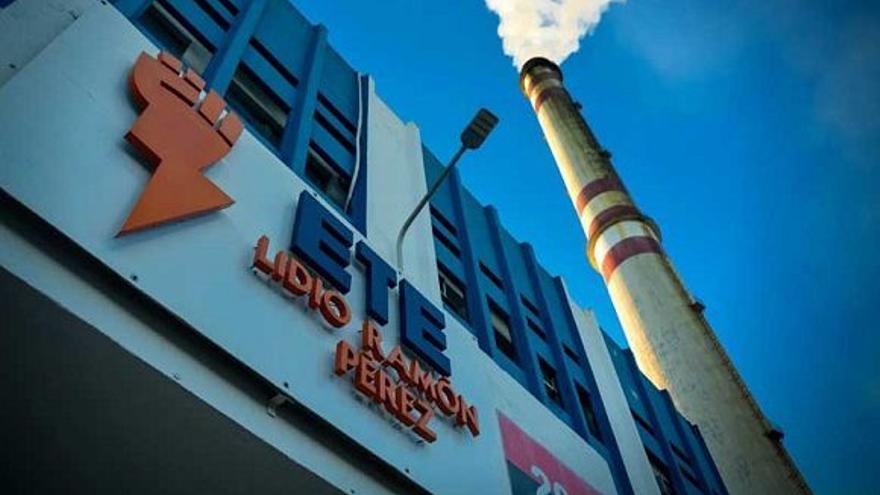
Unit 2 of the Lidio Ramón thermoelectric plant, known as Felton, is one of those that are out of operation this Thursday. (Cubadebate)
14ymedio/EFE, Havana/Moscow, 7 September 2023 — Russia and Cuba addressed, on Thursday, the construction of new generating capacities for power plants on the Island, as reported by the Russian Ministry of Energy in a statement echoed by the Spanish agency EFE. “Electric energy plays a decisive role in the economy of the Republic of Cuba and must become the basis for the development of all industries,” said the Russian Deputy Minister of Energy, Yevgeny Grabchaka, during a meeting with the Cuban Minister of Energy and Mines, Vicente de la O Levy.
According to the report, both officials also discussed bilateral cooperation in the oil and gas sector, including issues related to crude oil extraction.
At the end of last month, De la O Levy met in Moscow with the Russian Deputy Foreign Minister, Sergey Riabkov, to discuss energy cooperation between the parties.
According to the statement released by the Russian Government, “during the meeting, which took place in the atmosphere of friendship and mutual understanding inherent in the Russian-Cuban dialogue, the strengthening of bilateral cooperation was addressed, particularly in the field of energy, in a spirit of strategic cooperation.” continue reading
Both officials also discussed bilateral cooperation in the oil and gas sector, including issues related to crude oil extraction
Russian aid in the field of energy is essential in the midst of the current crisis, which does not subside, taking into account, in addition, the frequent breakdowns suffered by Cuban power plants. This same Thursday, according to the Electric Union of Cuba, unit 2 of the Felton (in Holguín), unit 6 of Energas Boca de Jaruco (in Mayabeque), unit 1 of Santa Cruz (in Matanzas) and unit 6 of the Renté (in Santiago de Cuba) are out of service.
Nor do the refineries have an encouraging outlook. This Tuesday, the Ñico López stopped working again, in the Havana municipality of Regla, put into operation on August 25 after being stopped for a year and responsible for the smell of gas spread throughout the capital last week.
According to 14ymedio, Professor Jorge Piñón, a specialist in the oil sector at the University of Texas (USA), Ñico López’s problem “is not a lack of crude oil to process” but rather “it seems to be technical.”
The plant is “the most sophisticated of the three Cuban refineries,” says the expert, for being “the only one with a catalytic cracking unit, a leading unit in gasoline production. Like the thermoelectric ones,” it shows signs of aging “after its 67 years of operation with a low level of capital maintenance.”
Translated by Regina Anavy
____________
COLLABORATE WITH OUR WORK: The 14ymedio team is committed to practicing serious journalism that reflects Cuba’s reality in all its depth. Thank you for joining us on this long journey. We invite you to continue supporting us by becoming a member of 14ymedio now. Together we can continue transforming journalism in Cuba.
The authorities say that it is difficult to control the nearly 7,000 ranchers in the province. (ACN)
14ymedio, Havana, 5 September 2023 — The authorities of Ciego de Ávila pointed out on Monday that the annual milk production in the province had a deficit of 1 million gallons, according to calculations made in July. Although the plan is to produce 5.8 million before the end of the year, the leaders predict that by then there will be a shortfall of 1.2 million – almost a million less than there was in 2022 – and they have begun to look for culprits: the producers who falsify their records and the inspectors who consent to the situation.
According to the local newspaper Invasor, officials suspect that there is cheating not only in the declaration of the producers – about 7,000 throughout the province – but also in the livestock control processes. “The counts carried out recently reveal considerable shortages of cattle, so a logical concern of the authorities of the territory revolves around who should count the cattle and how it should be done,” the newspaper says.
During this new campaign, the region will implement a “control plan” that includes other associations, such as the veterinarians, since the Livestock Control Center “lacks the necessary infrastructure that this task demands.” The authorities seek to create working groups that act with “speed and quality” and hire producers with “rigor” “to look at the rancher’s livestock, with the control and requirements of the political authorities.” continue reading
After executing more rigorous controls, “it is very likely that the new measures will report more milk in the future than is being collected now
The governor of Ciego de Ávila, Alfre Menéndez, expressed an even more explicit suspicion about the situation, saying that, after carrying out more rigorous controls, “it is very likely that the new measures will report more milk in the future than is being collected now.”
The outlook for the winter agricultural campaign doesn’t seem hopeful either. Officials asked that the same thing not happen this year as in the previous one, when the shipment of yuca seeds to the province was spoiled.
However, some municipalities already have a serious deficit. This is the case of Morón, which has not managed to complete any of the fruit, meat, vegetable or grain productions of the plan for the first planting of the year.
According to the authorities, Ciego de Ávila promised to plant, throughout the year, 12,355 acres of yuca, but four months after the end of the year and six months after the completion of the winter planting, fulfilling that plan demands a “growth of more than 4,942 acres in the immediate future.”
The missing lands will be “recovered” from the land that was delivered to 99 state agencies and small businesses
The missing lands will be “recovered” from the lands that were delivered to 99 state agencies and micro, small and medium-sized businesses, 44 of them in recent months, which, in the opinion of the authorities, are being underutilized. We are going to “evaluate the use they make of them, but the prevailing perception is that the results are far from the potentialities,” they warned, although they did not offer details about the process.
Without a clear plan, many of these lands were delivered without calculating the real possibilities of profits that companies could make for the province. Nor were the “limitations” or the “scarce and slow financial remuneration of some entrepreneurs” taken into account, the leaders now say.
But, more than the production, the concerns of Avileño officials fall on the fact that producers and entrepreneurs appropriate what belongs, they say, to the State. “How are we going to get them to contribute and not be enriched under the facade and the consent of the Board of Directors (of the province)?” was the question that closed the meeting, during which no one referred, however, to the multiple complaints of ranchers about the lack of inputs to achieve a stable production.
Translated by Regina Anavy
____________
COLLABORATE WITH OUR WORK: The 14ymedio team is committed to practicing serious journalism that reflects Cuba’s reality in all its depth. Thank you for joining us on this long journey. We invite you to continue supporting us by becoming a member of 14ymedio now. Together we can continue transforming journalism in Cuba.
A street in the Carlos Rojas village, in Matanzas. (Mapcarta/Captura/Archivo – Radio Televisión Martí)
14ymedio, Havana, 6 September 2023. – – Dozens of residents in Carlos Rojas village, in the province of Matanzas, protested in the streets this Wednesday because of the lack of water supply. The local people demanded the restoration of the service and criticised the apathy of the officials, according to statements to 14ymedio by the dissident Martha Beatriz Roque.
According to the dissident, an ex-prisoner of the Black Spring the water supply problem has affected the area for several days. Roque, who was able to talk by phone with the activist Ania Zamora, a Carlos Rojas resident, explains that local anger has increased in the last few hours.
“Apart from the fact that we have been without water for days, now they want to take away the transformer because there is no electricity in Perico [a nearby village] and the head of the electricity company came to take it away to re-establish service there, but if they take it away then the problem we have with the water will last much longer,” said Zamora in a call to the dissident.
“They tell us lies and more lies”, complains Zamora about the actions of the officials. In the recording of the call, to which this newspaper had access, the activist adds that along with the electricity company’s directors and several party officials, the police have also arrived in the village “to frighten” the residents.
“Not only have we been left for days without water, now they want to take away the transformer because there is no electricity in Perico.” continue reading
“There are a lot of people involved, they are in front of their houses and in the streets, we are not going to move until we get water and so that they don’t take away the transformer. The people are great, they’re not quiet, they’re shouting at the officials,” says Zamora. Attempts by this newspaper to contact Martha Beatriz Roque were unsuccessful, her mobile phone was “switched off or out of range”.
The village of Carlos Rojas has a population of approximately 6,000 inhabitants and is located on the road that connects the town of Cárdenas with the municipality of Jovellanos.
This is not the first time that the village residents have staged a protest to demand the restoration of water services or the reestablishment of the electricity supply. In November 2020, they received several officials and military personnel shouting “Liars!” after several hours of blackout.
“We are tired of lies,” warned activist and Lady in White Sissi Abascal Zamora, Annia’s daughter, currently in prison and sentenced to six years’ imprisonment for painting ’Patria y Vida’ on a sheet during the protests of 11 July 2021.
“There are a lot of people involved, they are in front of their houses and in the streets, they are not going to move until we get water and so that they don’t take away the transformer.”
In those images, taken in the dark and only visible by the light of the mobile phones, one can see the officials confused and overwhelmed by the avalanche of complaints and criticisms of their management.
In September 2017, in the aftermath of Hurricane Irma, local residents also took to the streets to demand the repair of power lines and a food supply.
The name of the village is a tribute to the pro-independence general Carlos María Rojas Cruzat, who was elected mayor of Cárdenas during the Republican period. The community has traditionally been involved in the cultivation of sugar cane and livestock, which is why in recent years it has been greatly affected by the decline of the sugar industry on the island.
Translated by GH
____________
COLLABORATE WITH OUR WORK: The 14ymedio team is committed to practicing serious journalism that reflects Cuba’s reality in all its depth. Thank you for joining us on this long journey. We invite you to continue supporting us by becoming a member of 14ymedio now. Together we can continue transforming journalism in Cuba.
Yasmani Parra Peña was 28 years old and left two small children as orphans. (Facebook)
14ymedio, Havana, 6 September 2023 — The village of Mir, with fewer than 7,000 inhabitants, in the municipality of Calixto García in Holguín, was already in mourning when, on Monday, a lightning strike killed a young man and injured several others. All the victims were at the cemetery, at the burial of two other boys who had drowned in a well in the Monte Alto area, identified in social networks as Alexey Pantoja Ventacurt and Rafael Zamora. According to various media reports, the circumstances of this latest incident, which occurred at the weekend, are still being investigated, and it is only known that the victims are also young men who went down the well and drowned.
Yasmani Parra Peña was killed by the lightning strike, as confirmed to 14ymedio by an employee of the Ernesto Guevara polyclinic. He was 28 years old and left two young children orphaned. “This has been terrible here in Mir,” said the shocked worker, who said that all but one of the injured had already been discharged.
“This has been terrible here in Mir,” said the shocked worker, who said that all but one of the injured had already been discharged
On the Facebook group Friends and Neighbours of Mir, where news of the tragedy broke, condolences to those close to them immediately multiplied. Some seemed to know Parra Peña very well and referred to him as the “son of Mariela, Cheo’s wife”. continue reading
His sister, Yaquelin Parra Peña, thanked everyone for their comments. “My brother, you turned me into dust, you took my heart, I love you with my life. I fought for you until the last day and now I will fight for your children; I no longer have three children but five, my children, you will always be present in my life”, said the young woman, with a lot of pain. “My soul brother, he finished me off, he buried me alive.”
Translated by GH
____________
COLLABORATE WITH OUR WORK: The 14ymedio team is committed to practicing serious journalism that reflects Cuba’s reality in all its depth. Thank you for joining us on this long journey. We invite you to continue supporting us by becoming a member of 14ymedio now. Together we can continue transforming journalism in Cuba.
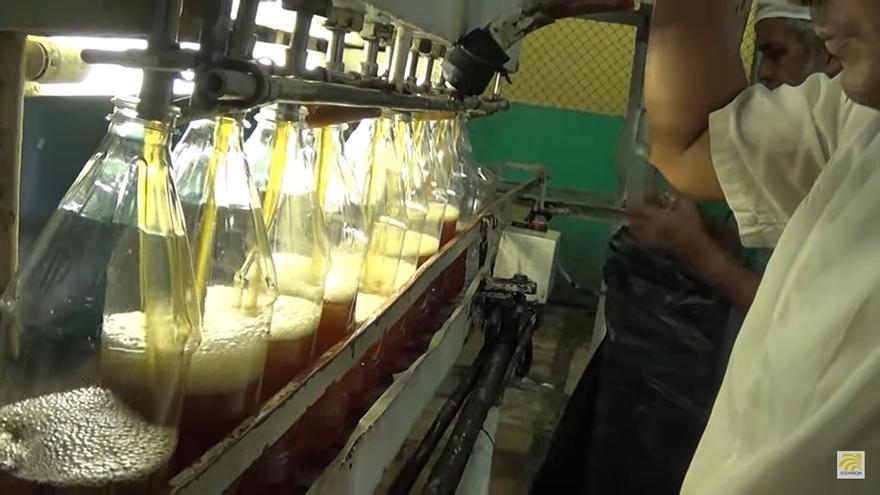
In Baracoa, the local soft drink factory bottles 3,000 two-liter jars of syrup daily. (TVSolvision/YouTube/Capture)
14ymedio, Havana, 31 August 2023– Cuban children between the ages of seven and 13 have begun to receive syrup instead of the milk and yogurt that the state used to sell on a rationed basis. Although the authorities have been discreet with the announcement of the change, the official press has alluded to the manufacture and sale of the product, which contains several highly dangerous additives.
According to the label, the syrup, which has already begun to be distributed in two-liter bottles throughout the country, is made with substances that are harmful, especially for children. This is the case of dye E-102 (tartrazine), the preservative E-211 (sodium benzoate) and the sweetener E-952 (cyclamate) considered toxic by world health organizations. Acids E-330 and E-338, which are suspect as to their chemical origin, are also added.
The shortage of sugar is one of the problems faced by the production of the liquid on the Island. “In Ciego de Ávila, it has been replaced by neotame,” a powerful sweetener, one of the workers at the vinegar, soft drinks and syrup factory in that province explains to 14ymedio. “Each kilogram of neotame replaces 4.2 tons of refined sugar,” he details.
“Flavors, which are the concentration of syrup without sugar, have also been sold. At home, consumers have to prepare a glass of water with sugar and add the syrup,” he explains. The liquid – which can be strawberry, orange, tangerine or pineapple – contains various substances, in addition to the sweetener, which are “manufactured from essential oils purchased outside of Cuba.” continue reading
“Flavors, in the form of a concentration of syrup without sugar, have also been sold. At home, consumers have to prepare a glass of water with sugar and add the syrup”
In Baracoa, Guantánamo, the local soft drink factory packages 3,000 two-liter tubes of syrup daily to “replace” the dairy products that “are no longer distributed” to the children of the province. The workers of the factory, which has occasional blackouts, assure that if there are power cuts “they will have to run the work schedule” and continue the process manually. The authorities, affirm the directors of the factory, “have guaranteed the raw materials,” but the syrup has had to be made with raw sugar in the absence of refined.
The debacle of the basic food basket has been worsening in recent months and has already reached products intended for children. Even in Sancti Spíritus, one of the provinces that had a stable supply of milk, the delivery of the product to those who had medical diets was suspended in March. Instead, they began handing out flavored milk.
A month earlier, the authorities recognized that the supply in the province was “intermittent” due to delays in deliveries from ranchers, who faced a notable drought in addition to the lack of raw materials and funds for their work.
State production of cow’s milk has plummeted in Cuba, with a 95.2% drop between 1989 and 2020, while the private sector showed a growth of 105.9%. However, it is not enough to compensate for the collapse of national plants, which is why milk production in Cuba has fallen 59.3% in the last 21 years when it went from producing more than 1.12 million tons to 455,300.
Translated by Norma Whiting
____________
COLLABORATE WITH OUR WORK: The 14ymedio team is committed to practicing serious journalism that reflects Cuba’s reality in all its depth. Thank you for joining us on this long journey. We invite you to continue supporting us by becoming a member of 14ymedio now. Together we can continue transforming journalism in Cuba.
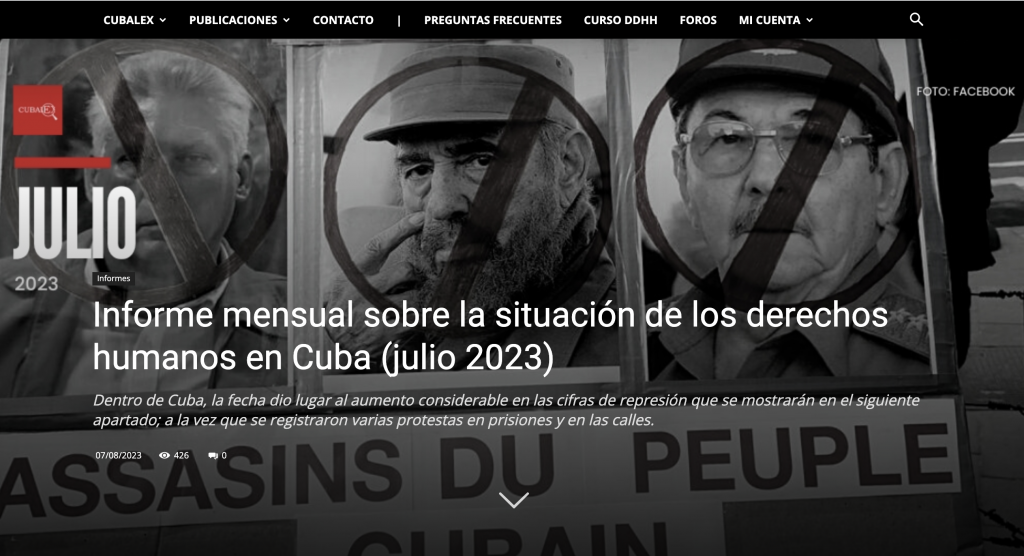
Cubalex, 8 August 2023 — The month of July was marked by the second anniversary of the 11 July 2021 (11J) anti-government protests and the internal and external reactions it generated.
Inside Cuba, the date provoked a considerable increase in the level of repression, which will be detailed below; there were several protests in prisons including posters and chanting anti-government slogans, fasting, hunger strikes, shaving of heads and refusal to use mattresses, sewing up mouths, requests for transfer to punishment cells, wearing white clothes, and other forms of peaceful protest. On the streets some people remembered 11J with fasts, walks and individual protests in front of government buildings. During the month there were three street closures in Havana by people protesting against power cuts, lack of water and neglect by the authorities.
In mid-July, the National Assembly of People’s Power (ANPP) met and approved the Military Penal Code Law, which establishes two to five years in prison for anyone who tries to evade military service, which is compulsory in Cuba for male citizens. In presenting the law to the ANPP, the president of the People’s Supreme Court (TSP) Rubén Remigio Ferro defended the continuation of the death penalty in Cuban law as “an element of defence of the Revolution”. ANPP president Esteban Lazo also referred to fines, confiscations, withdrawal of licences and prosecutions of self-employed workers who violate state price control regulations.
Internationally, Cuban President Díaz-Canel headed the Cuban delegation that took part in the European Union-Celac Summit, where, under pressure from the bloc of Latin American countries allied with Russia, the meeting’s declaration did not openly condemn Russia for its invasion of Ukraine. Furthermore, one of the clauses of the document condemned the US embargo against Cuba and denounced the inclusion of the Cuban regime on the list of state sponsors of terrorism. Members of Cuban state and public organisations participated in the People’s Summit, which ran parallel to this event. During the Summit, the Cuban leader held meetings with the President of the European Council and the United Nations High Commissioner for Human Rights.

 14ymedio, Havana, 7 September 2023 — Cuban volleyball player Ellemay Santa Miranda left the national team in Quebec, Canada, after losing the bronze medal in the Norceca Continental tournament, which ended last Sunday.