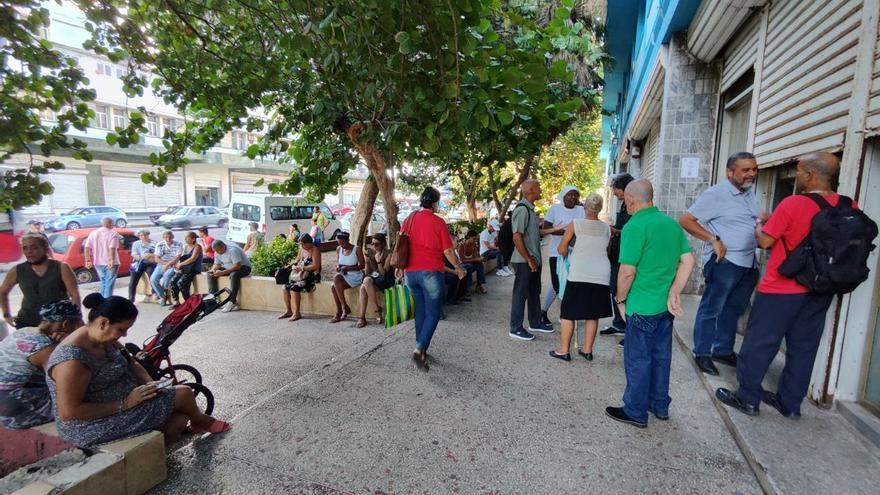
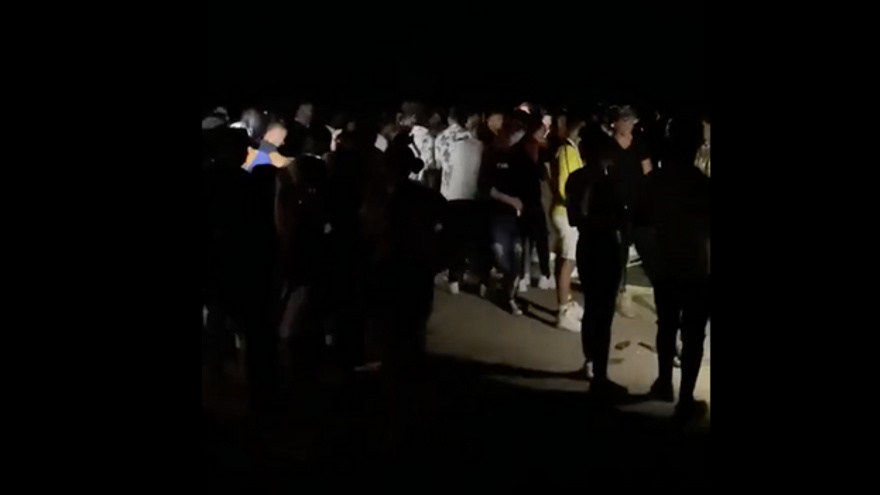
Images of the protests in Nuevitas in 2022, in the middle of a blackout. (Screen capture)
14ymedio/EFE, Havana, 7 September 2023 — At least 17 people who participated in the protests in the town of Nuevitas, Camagüey, in August 2022 remain in prison waiting to be tried, the NGO Justicia 11J said on Thursday.
After protesting the blackouts and shortages, the prisoners have been accused of “public disorder, attacks, damage, contempt, resistance and incitement to commit crimes,” and therefore remain “in precarious condition” awaiting trial.
The organization mentioned the specific case of 21-year-old Mayelín Rodríguez, arrested for recording and disseminating images of the protest on social networks.
“In Nuevitas it was possible to observe a repressive strategy that would be applied in subsequent protests: arresting demonstrators or alleged leaders of the marches both during the events and after them, as part of operations and raids, or after they appeared in response to summonses for interrogations,” the organization said, although Cuban counterintelligence had already used similar methods with the participants in the protests of July 11, 2021. continue reading
Months after the protests, the regime was still looking for the “guilty” of the demonstrations in Nuevitas
Months after the protests, the regime was still looking for the “guilty ones” of the demonstrations in Nuevitas because, despite the fact that it “understood the inconvenience and difficulties of the people due to the frequent blackouts,” nothing “justifies” the protests.
Justice 11J added that “from the beginning of 2022 to date there have been at least 254 public protests of different types and scale.”
It indicated that it has registered “the arrest of 241 people in connection with protests, even if the victim had not participated in protest events in the public space.”
Justice 11J is a working group that records “the government’s response to public demonstrations of different types, in public space and in detention centers,” after the 11J protests.
Translated by Regina Anavy
____________
COLLABORATE WITH OUR WORK: The 14ymedio team is committed to practicing serious journalism that reflects Cuba’s reality in all its depth. Thank you for joining us on this long journey. We invite you to continue supporting us by becoming a member of 14ymedio now. Together we can continue transforming journalism in Cuba.
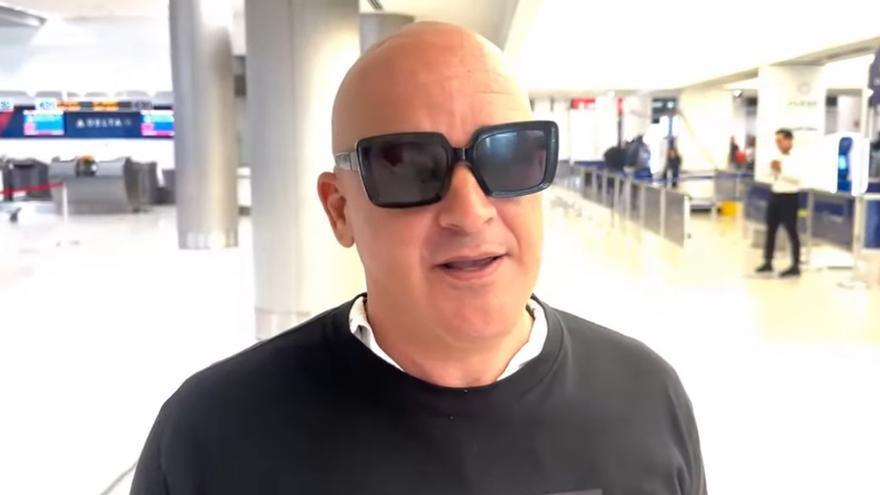
Cuban Activist Ktivo Disidente made his first statement at Miami International Airport. (Mario J. Penton/YouTube/Screen Capture)
14ymedio, Havana, 8 September 2023 — Cuban activist Carlos Ernesto Díaz González, known as ’Ktivo Disidente’, arrived in Miami this Friday thanks to the humanitarian parole program. The opponent was sentenced at the end of November 2022 to two years and six months in prison for the crimes of disobedience and contempt, but last June the regime granted him parole.
Ktivo Disidente was already outside Cuba before flying to South Florida, the activist Nacho Rocha told journalist Mario Pentón, who said that the opponent had left the Island for Nicaragua and then in Mexico received the travel permit to be able to enter the United States with humanitarian parole.
In a video shared by Pentón on his social networks, Ktivo Disidente made his first statement in Miami International Airport, thanking the América TeVé reporter and saying he felt “happy” to be on American soil.
After Ktivo’s release last June, no message had been received from the activist, who was held in the Ariza prison, in Cienfuegos. He requested freedom for political prisoners by climbing on the wall of a playground, on San Rafael Boulevard in Havana last year in April. continue reading
During his action, Ktivo launched a harangue in which, in addition, he claimed the right to respect the ideas of others. “There doesn’t have to be violence, there doesn’t have to be bloodshed, but they have to let us participate in the political life of the country. The ones who should not be respected are the communists,” he shouted during his protest, which lasted a few minutes until he decided to get down and the agents who looked at him from below handcuffed him and arrested him.
Previously he also had problems for demonstrating on several occasions in December 2020, asking for the release of Luis Robles, known as “the young man with the placard,” who was sentenced to four years in prison for demonstrating peacefully on the same boulevard of San Rafael.
Valle Roca, who was convicted of the crimes of “enemy propaganda of a continuous nature and resistance,” told Radio Televisión Martí this Friday that he is in poor health. “I’m deaf, I have memory loss, I’m losing my sight, I’m skinny,” he said and described that in the prison where he is located, “the humidity level is very high and the heat, mosquitoes, bedbugs, mice, rats come out” through the hole in the latrine.
“I now have conditional freedom; these people [the Cuban regime] have not wanted to give me this,” he denounced.
Valle Roca, 62, is the nephew of opposition leader Vladimiro Roca, recently deceased, and the grandson of communist leader Blas Roca Calderío. In the time he has been imprisoned, the reporter has suffered the 15 types of torture described by the Madrid-based organization Prisoners Defenders (PD), which presented a document to the UN denouncing patterns of ill-treatment in Cuban prisons.
Translated by Regina Anavy
____________
COLLABORATE WITH OUR WORK: The 14ymedio team is committed to practicing serious journalism that reflects Cuba’s reality in all its depth. Thank you for joining us on this long journey. We invite you to continue supporting us by becoming a member of 14ymedio now. Together we can continue transforming journalism in Cuba.
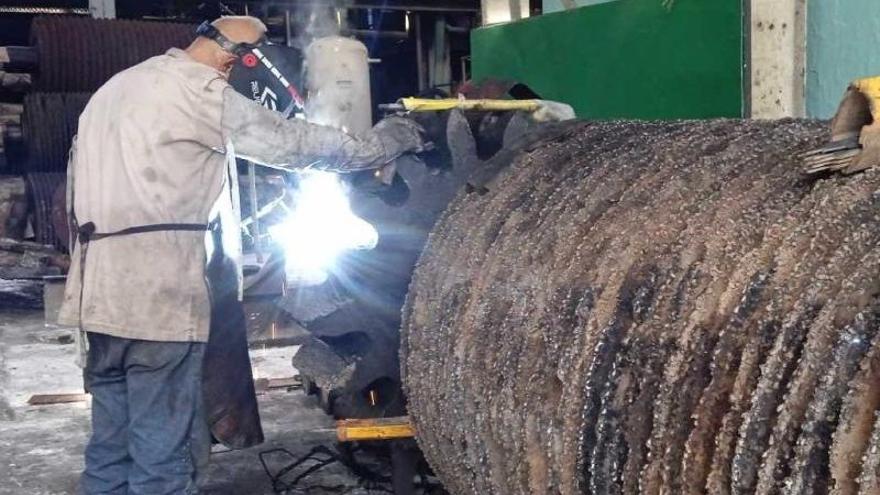
Due to the delays of the last campaign, the Melanio Hernández sugar mill faces major repairs. (Escambray)
14ymedio, Havana, 11 September 2023 — The directors of the Melanio Hernández sugar mill, in Sancti Spíritus, predict that the harvest of the current period will be worse than that of 2022-2023. As they admitted in statements to the official press, they will grind a volume of cane similar to that of the previous campaign because they will now cut the plants that they could not collect at the time due to lack of fuel.
Antonio Viamontes, director of the mill, revealed to the Escambray newspaper that, as happened last year, Melanio Hernández will be the only one in charge of the grinding. The Uruguay mill, from which 65% of the cane for this grinding comes, is currently dedicated only to cultivation.
The shortage of basic inputs for planting has also affected production. “Despite having the land ready, due to the lack of fuel, the planting plan has not been fulfilled for two years, so we do not plant cane for grinding, it has barely been sown for seed,” he regrets.
The directors of Melanio Hernández predict that during this campaign the mill will grind to 60% of its capacity for a period of about 100 days from the second half of December. However, they cannot guarantee that this plan will be fulfilled in time, since the necessary maintenance works “are larger than the previous year,” and they have just over two months to complete them. So far, only 27% of the work has been carried out. continue reading
They cannot guarantee that this plan will be fulfilled in time, since the necessary maintenance works “are larger than the previous year,” and they have just over two months to complete them
“The greatest magnitude is concentrated in the area of mills, specifically in the tandem, which has to be completely disassembled from below,” added Viamontes, who estimates that, in order for the plant to comply with what was established, it would have to be repaired in record time.
With these forecasts, the authorities have extended the working days and will recruit workers from the Uruguay plant, one of the largest in Cuba, which has been closed for two campaigns, since a Russian company took over the plant to “repair” it last October.
The then-director of the factory, Eddy Gil Pérez, showed his enthusiasm to Escambray with the possible Russian management: “We are among the nine mills of the country chosen for these businesses,” he revealed, but a year later the new administrators announced that the Colossus of Jatibonico could not be counted on for the harvest of that period.
This June, the media also announced that in Sancti Spíritus, barely 30% of the harvest plan of the more than 123,553 acres available had been fulfilled. The cause of the delay, it said, was the rains that had prevented the start of planting. During those months there were also delays in the attention to the cane that the newspaper attributed to the lack of inputs and the “difficult economic situation that Cuba faces.”
In other provinces the outlook is no different. In March, it was reported that the Majibacoa mill, the main one in Cuba, located in Las Tunas, had milled 56% of the cane planned for that harvest. Artemisa, which began grinding 30 days late, reported having milled only 58.4% of the planned raw material and produced only 44.9% of the planned sugar.
The directors of Melanio Hernández made an effort to specify that at least the distribution for the basic basket has been assured since the last spring campaign. The statements, however, contradict a report by the official media Invasor, which warns that the regulated sugar, due to the shortage, will go from four pounds to three per person per month throughout the country.
Translated by Regina Anavy
____________
COLLABORATE WITH OUR WORK: The 14ymedio team is committed to practicing serious journalism that reflects Cuba’s reality in all its depth. Thank you for joining us on this long journey. We invite you to continue supporting us by becoming a member of 14ymedio now. Together we can continue transforming journalism in Cuba.
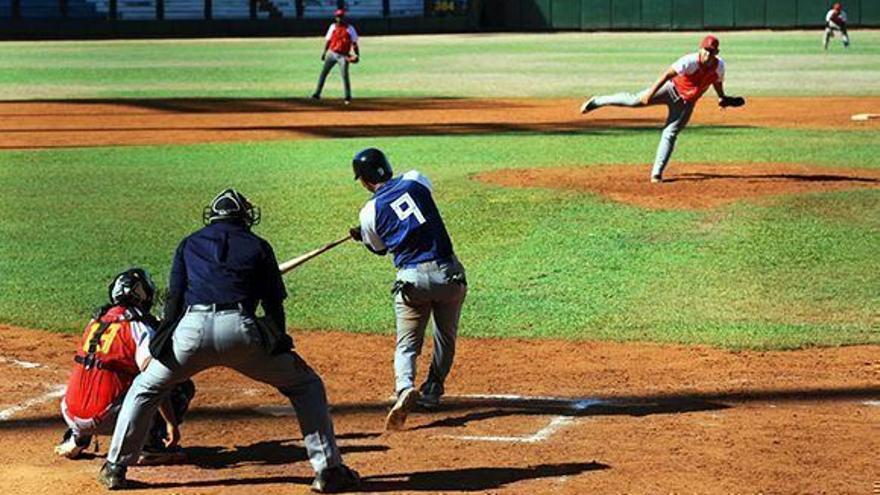
Headhunters for the Japanese teams Softbank, Yomiuri Giants and Seibu Lions and for the Korean Lotte Giants observed the Cuban baseball players. (Facebook/Guillermo Rodriguez Hidalgo)
14ymedio, Havana, 11 September 2023 — The Island is offering Ecuador, a country where baseball is developing, its players from the national pre-selection and from the Under-23 and Under-18 categories. According to the list of talent scouts that appeared this Monday at the Latin American Stadium in Havana, Paulo Hernández attended Ecuador as development director of the Pichincha Baseball Sports Association to observe the athletes he might contract at an event organized by the Cuban Baseball Federation (FCB).
Hernández has a direct link with the Island. Last year, according to a publication by PrensaLatina, he was the representative of Cubadeportes in Ecuador.
Baseball in Pichincha is in development. Until two years ago in the Ecuadorian capital, Quito, the game was practiced on soccer fields. The teams Águilas del Diamante, Lobos de Páramo and Bárbaros gave way to the Pichincha Baseball Association. The stadium that was announced in 2021 is being planned.
The option does not seem very encouraging for Cuban players who are looking for development and improvement in the average salaries on the Island. With a current tabulator of 2020, a member of the national pre-selection who participates in the National Series receives 3,725 Cuban pesos (19 dollars) monthly. A member of the Reserve of the National Pre-selection and National Series receives 2,400 (12 dollars). continue reading
The event in Havana was also attended by Luis Enrique Consuegra, director of the Dominican academy of the same name. “The idea of Academies like Consuegra’s is to take players between 18-20 years old and if they don’t sign with an MLB organization, move them through Caribbean Leagues,” according to journalist Francys Romero. “This will be the first time since professionalism was abolished in Cuba in 1962 until 2010, when emigration began to become systematic.”
The FCB’s strategy to prevent the escape of talents turned this Monday into a catwalk of 80 players at the Latin American Stadium. The call was attended by 15 scouts of teams from Japan, South Korea and visitors from the Dominican Republic and Ecuador with whom the Island has agreements and representatives of the World Baseball-Softball Confederation (WBSC).
The so-called first international baseball tryout represents a source of income for the Island and develops just when it was revealed that the sports authorities suspended the National Under-23 Baseball Series due to the “difficult economic situation facing the country.” The precarious situation also forced the cancellation of the national championship 9-10 years, the final stage of Baseball 5, the National Women’s Baseball Cup. The Under-18 National Championship was not even concluded.
The options for Cubans are focused on the Japanese clubs Softbank Falcons, Yomiuri Giants and Seibu Lions, and the Korean team Lotte Giants.
Until last January, Yomiuri Giants had six players in their ranks in different stages. The most recent was the Cuban pitcher Yoan López, but he did not arrive through the FCB. The player was hired after leaving the New York Mets. Before him were Leslie Anderson, Frederich Cepeda, Héctor Mendoza, José Adolis García and Alexander Guerrero.
In the morning, the players carried out 60-yard running tests and from home to first base with swing; fielding practice in the infield, work in the bullpen to detect their throwing power, in addition to the strength of their batting, proclaimed the official medium Jit.
The Latin American Stadium opened its doors to the public in the afternoon for the national pre-selection match. The tests will continue this Tuesday and Wednesday.
The closing will be with a game between the national pre-selection against Granma, which will represent the Island in the WBSC Champions League.
Translated by Regina Anavy
____________
COLLABORATE WITH OUR WORK: The 14ymedio team is committed to practicing serious journalism that reflects Cuba’s reality in all its depth. Thank you for joining us on this long journey. We invite you to continue supporting us by becoming a member of 14ymedio now. Together we can continue transforming journalism in Cuba.
More and more Under-23 players must replace those lost to emigration, although the youngest are also leaving. (Trabajadores)
14ymedio, Havana, 11 September 2023 — Cuban sports authorities have suspended the National Under-23 Baseball Series “due to the difficult economic situation facing the country,” according to Cuban Television journalist Pavel Otero on his Facebook account on Monday.
The reporter adds that this is the same reason why the national championship for 9-10 year olds, the final stage of Baseball 5, and the National Women’s Baseball Cup have not been developed this year, in addition to the Under-18 National Championship, which was left unfinished.
“This suspension of the annual competitive calendar doesn’t happen only with baseball,” he adds. “There are several sports that cannot complete their planned competitions in the year due to logistical and budget difficulties,” he added without providing more information about other competitions that will be affected by the severity of the crisis facing the Island. continue reading
Although the journalist does not mention it, the lack of players is added as a relevant problem, which is increasingly severe
In addition, although the journalist does not mention it, the lack of players is added as a relevant problem, which is increasingly severe. In mid-August, sports journalist Elsa Ramos wrote an opinion article in Escambray in which she admitted that the miserable salaries received by the greatest talents on the Island do not even serve to guarantee family sustenance, which is why athletes leave Cuba to seek luck in countries where they can earn fortunes for the same job.
In the text, the author already warned that the shortage of players had a direct impact on the Under-23 League and the youth, who had to mobilize to cover the losses and whose players did not have “sufficient and logical maturity.” This, together with the escapes within the category, meant that these tournaments could not even be held or were held badly, like the aforementioned Under-18, which could not finish.
There has been disturbing news recently. The young baseball player Jaider Miguel Suárez, only 14 years old, went to the Dominican Republic to test his skill. His departure was the confirmation of the drama that exists in the lower categories: of the 20 players who participated for Cuba in the Under-15 World Cup in 2022, 15 have emigrated, which means that those young promises will never compete for the country.
Last week, Yunior Ibarra, just 11 years old, joined the long list of athletes who leave the Island when he decided to stay in Canada after finishing his season in the Ontario Intercondata Semi-Professional League. From there, he moved to the Dominican Republic.
In 2021, one of the most spectacular escapes occurred precisely in this category, when 12 of the 24 called up for the Under-23 World Championship held in Aguascalientes, Mexico, left the Cuban national team. In January 2022, the official newspaper Trabajadores placed at 635 the number of players who had left the Island in the previous six years. Counting the whole decade, 862 athletes from all kinds of disciplines have left and, since 2012, 2,344 coaches have fled, 85 of them of a very high level.
“Yes, it is true that the current economic situation is depressing, but I consider that the lack of will of our political direction towards our national sport is evident”
“In this way it will be impossible for Cuba to enjoy good baseball again,” one user responds to Pavel Ortiz’s informative post. “Yes, it is true that the current economic situation is depressing, but I consider that the unwillingness of our political direction towards our national sport is evident; not everything is the fault of the everlasting blockade. The leaders of INDER (National Institute of Sports, Physical Education and Recreation) and especially those of baseball must come down to earth and stop the many banal exhibitions and so much empty talk,” he said.
Some commentators have emphasized the idea of professionalizing baseball and introducing private capital into it. “Sanctioned countries as well as Nicaragua have their professional league. We could consult with them and explore the new market that opens with the creation of the Saudi Arabian league. You have to get your act together; this is hitting rock bottom,” proposes another user.
The Professional Baseball League was born in Cuba on December 29, 1878, but the current model dates back to 1962, when Fidel Castro inaugurated the first National Baseball Series and announced “the triumph of the free ball over the slave.” “In order for the national sport to have a future, let’s hand it over to the private companies,” says a fan more than 60 years later.
Translated by Regina Anavy
____________
COLLABORATE WITH OUR WORK: The 14ymedio team is committed to practicing serious journalism that reflects Cuba’s reality in all its depth. Thank you for joining us on this long journey. We invite you to continue supporting us by becoming a member of 14ymedio now. Together we can continue transforming journalism in Cuba.
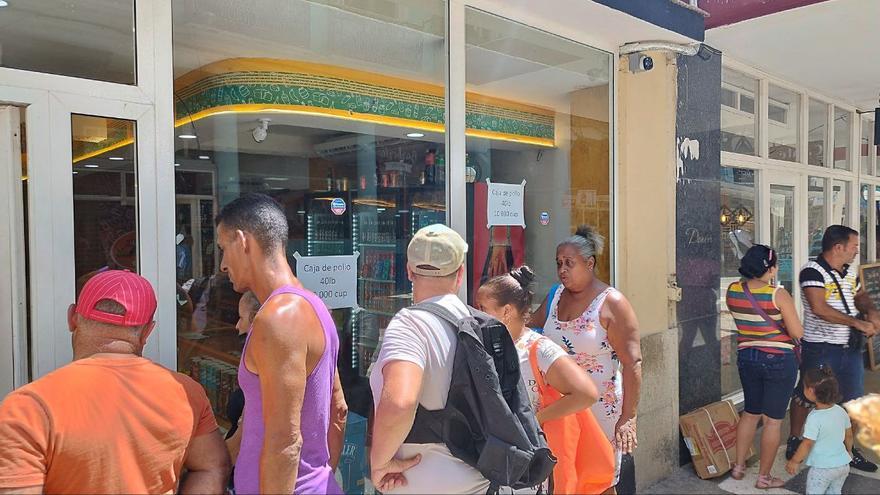
Customers lining up to buy chicken at a private business in San Rafael, Havana. (14ymedio)
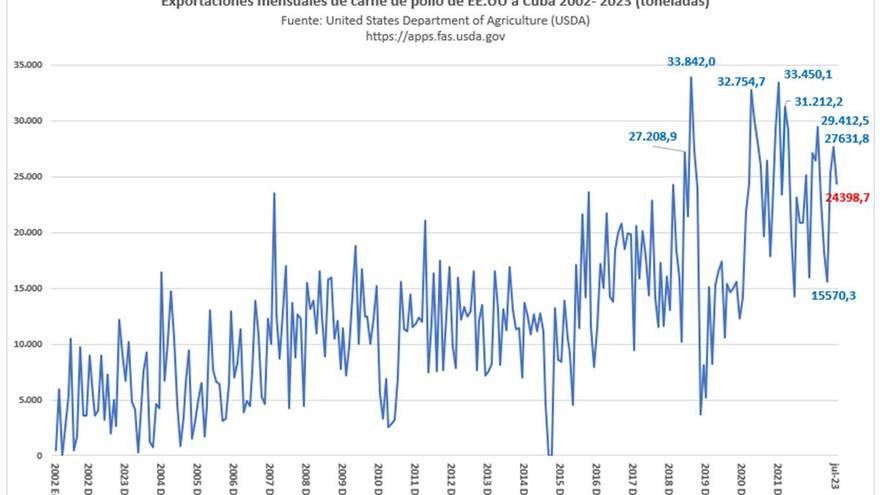
14ymedio, Madrid, 8 September 2023 — The price of a kilo of chicken that Cuba imports from the United States continues to rise and stood at $1.23 USD in July, 3.4% more than the previous month ($1.19) and 38% more than in May, when it barely cost $0.89. In this context, imports were reduced compared to the previous month both in quantity, for a total of 24,398 tons, and in value, at an expense of 30 million dollars. In June, the Island had imported 27,631 tons from the neighboring country for $32.8 million.
The increase in price “perhaps did not have much influence,” reports Cuban economist Pedro Monreal, who nevertheless points out that the tendency to import poultry meat from the United States is increasing if looked at with perspective. Beyond the monthly fluctuations, the time graph shown by the expert, which covers purchases since 2002, reveals an ascending line that is especially clear since 2019.
“The figures are sourced from the US Department of Agriculture and include all exports of chicken meat to Cuba contracted by all types of final clients (state and MSMEs*),” adds Monreal, who expects to see later the effect that the limitations of banking may have on these purchases.
Evolution of chicken imports from the US between 2002 and 2023.
In recent months, Cubans had noticed a slight drop in the prices of chicken, as well as in those of cooking oil, which, along with poultry, is the item most imported by the new private companies that have flourished in Cuba. continue reading
However, the announcement at the beginning of August of new measures to increase electronic transactions [being referred to as bancarización] and reduce the circulation of cash threaten to once again overload the cost of the only protein of animal origin that Cubans can now aspire to on a daily basis, due to the scarcity and surveillance of pork and, even more so, beef.
Concern about how private companies, which buy in foreign currency but sell in pesos, are going to import, in the absence of a realistic official exchange market, is among Cuban’s first concerns and has been reflected in several articles in the state press in this country of this same week, one month after the announcement of the banking reform measures by the Central Bank of Cuba.
The Cuban economist Óscar Fernández, very critical of bancarización, warned from the first moment of the deviations that it could impose on the purchases of these products. “There will be a severe reduction in the supply of private imports” and, consequently, the rise in prices of products “that had begun to fall.”
“Chicken, cooking oil and detergent are purchased by many people who are very far from being in a high income percentile, who find in this private supply a better alternative to the black market, both in price and safety, and incidentally many times cheaper than the stores’ offer (in) MLC (freely convertible currency),” he explained. “On the other hand, when the private supply of chicken disappears, higher-income people will generate a demand that will be met by the chicken ’of the poor’ [distributed in the ration market]. And they will divert and buy the chicken from the poor. It’s that simple.”
*Translator’s note: MSME = Micro-, Small and Medium-sized Enterprises, which are privately operated.
____________
COLLABORATE WITH OUR WORK: The 14ymedio team is committed to practicing serious journalism that reflects Cuba’s reality in all its depth. Thank you for joining us on this long journey. We invite you to continue supporting us by becoming a member of 14ymedio now. Together we can continue transforming journalism in Cuba.
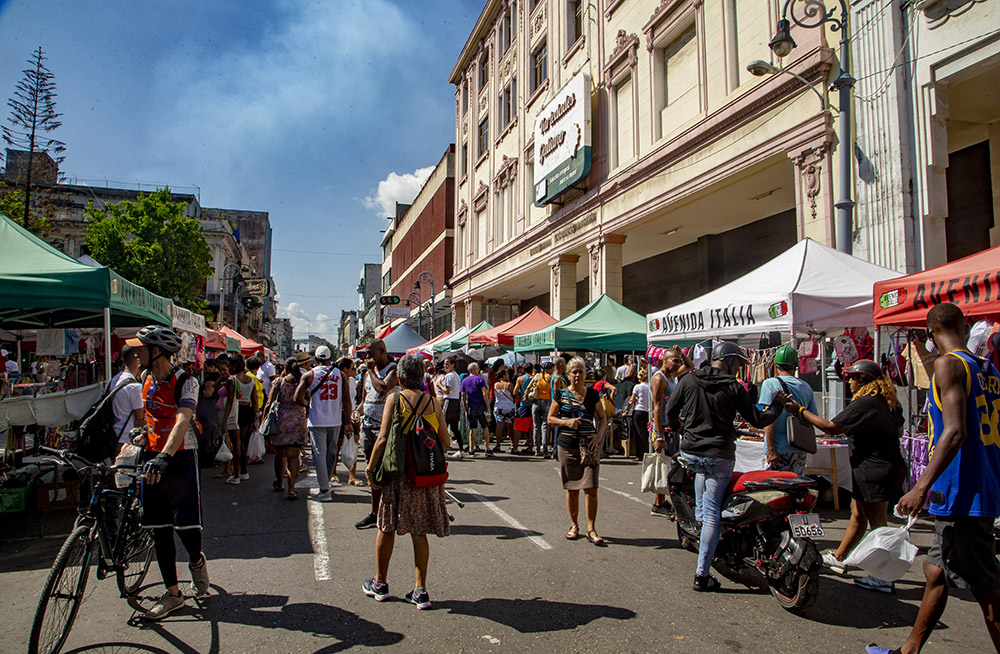
The fair, which began at eight in the morning, had among its offers the sale of meat, clothing, footwear, among others. Photo: Ismael Francisco/ Cubadebate
14ymedio, Elías Amor Bravo, Economist, 11 September 2023 — Cuba’s communist regime seems hell-bent on phasing out the use of cash and replacing it with electronic payment platforms, specifically Transfermóvil and Enzona. To these ends, it organized a “trade fair,” a kind of Saturday street market along Galiano Street in Central Havana, where all transactions had to be done electronically. Cash was not accepted. To some extent, it was an absurdity since this type of fair, which has widespread popular acceptance, including in major European capitals, typically relies on cash, not electronic payments, given the itinerant nature that many of them have. As always, Cuban communist exceptionalism quickly takes it from the sublime to the ridiculous.
From the moment it opened, Havana residents were surprised by the relative abundance of products — different varieties of meats, clothing, footwear, produce, mobile phone accessories and cleaning products— for sale at prices lower than those at the better stocked informal markets.
And as is often the case at these kind of events, the government made sure Cuba’s sole political party the star. Employees from Xetid, Etecsa, the Youth Computer Club and other entities were called upon to inform and advise customers on the use of electronic payment gateways. In other words, to make sure the regime’s objective — obedience — was fulfilled.
This mousetrap of a fair was all about recruiting customers for electronic payments. Banks offered 10% bonuses on the purchase of goods and services through POS terminals and QR codes using Transfermóvil and EnZona apps. In other words, the same song and dance the communist regime has been performing since it launched what it is calling bancarización* – banking reform. continue reading
The state-run press gave the event extensive coverage. The deputy-minister from the Ministry of Communications, Wilfredo Gonzalez, declared, “What is happening here is very good, especially because it demonstrates in a physical space the usefulness of digital payment platforms, a viable alternative for the public due to the issues we are having these days with cash and ATMs.” He had only to say that what is happening is good to make sure the mandate from on high was obeyed. The rest didn’t much matter. If everyone follows orders, everything should be fine. Or maybe not?
Onsite observers of the fair, especially those who witnessed transactions, highlighted two aspects that deserve consideration. First, the event was not well attended despite the wide variety of items for sale at good prices. Second, a significant portion of the transactions were done in cash. The deputy-minister’s argument that the use of electronic payment platforms will become more viable as they become more common, and as the public sees that they work well and grows to trust them, was not borne out. Based on Saturday’s results, this seems more like propaganda and manipulation than anything else.
This Galiano Street trade fair was organized by the municipal government and led by the local branch of the communist party. Open-air markets and street fairs certainly do not seem to play any role in communist doctrine. Yet party leaders were unsparing in their praise, saying that it was “a good, useful experience that we should systematize, not treat as a one-off, and begin little by little to promote this type of event.” The truth is that, for communists stuck with a ideology completely at odds to commercial life, these fairs and markets must seem like an insult.
Though the communists may be licking their wounds, most people view street fairs and pop-up markets favorably, even if their purpose is to promote electronic payment systems. Some private-sector vendors reported that sales were good, with most being done through electronic transfers (though a not insignificant number were still cash transactions). Still, an average of twenty transfers seems relatively little for an entire day’s work but it is what it is.
The communist party tried to lure customers by offering inexpensive food items like croquettes, or basic foods like bread with oil. Electronic payment apps have been a disaster for minor transactions like these so people paid for them with cash.
The government’s partner in bancarización — the Defense Information Technology Company (Xetid), the developer of EnZona, as well as EnZona and Etecsa themselves — spent the morning offering advice to attendees on the benefits of their electronic payment platforms which, contrary to what government officials believe, the public knows little about and which arouse widespread misgivings and fear. So, between all the self-congratulatory messaging and crowd-pleasing sales, some attendees noticed foreign tourists were nowhere to be seen.
At European markets like these, tourism generates a large percentage of earnings. It was at a much lower level at the Galiano Street market, where the population was segmented, something communists typically do to achieve their objectives, never to improve living conditions.
Thought private-sector vendors were especially hard hit by the lack of tourists, they are already looking forward to participating in future of events of this type, if they are allowed to do so.
*Translator’s note: “Bancarización” is a term used in Cuba and other Latin American countries that refers to government efforts to reduce the role of cash through a greater reliance on banks’ digital payment options. The term does not seem to have a counterpart in English so the Spanish term is used throughout this translation.
____________
COLLABORATE WITH OUR WORK: The 14ymedio team is committed to practicing serious journalism that reflects Cuba’s reality in all its depth. Thank you for joining us on this long journey. We invite you to continue supporting us by becoming a member of 14ymedio now. Together we can continue transforming journalism in Cuba.
First graduates from the Central University of Las Villas, wearing gowns and carrying diplomas, in 1952. (UCLV)
14ymedio, Xavier Carbonell, Salamanca, 10 September 2023 – No one tells you how much more your place in life will depend on luck, chance or traps, than by any vocation or plan. No one is told that one thing is the subject they study – over four or five years with intermittent punctuality and driven by coffee – and the other thing is what they’ll actually end up doing: seldom anything executed with any passion, more often with reluctance – in the subsequent period between graduation and retirement. Few of us are lucky to have a benevolent cousin or philanthropic uncle that would dare to explain what our parents – victims themselves of the scam – concealed: that the degree certificate, that white rectangular piece of paper that adorns the walls of so many living rooms and caused so many tears to be shed and countless third degree burns in the eyelashes, is just a poor and useless talisman.
Seeing a university degree on the wall always seemed to me to be a rather macabre thing. It always had something of the gallows or autopsy about it, as though the only thing we were allowed to keep from our youth was this imitation parchment with its gothic lettering.
I think – but often I’ve kidded myself – that my generation doesn’t suffer from this superstition. Tired of the cult of the certificate, none of my friends or acquaintances goes around showing it off as a trophy nor teaches their kids – if they have any – to follow this curious religion. But clearly, very few of us play the role for which they supposedly prepared us. The mismatch has created some odd creatures: historian mechanics, waiter agriculturalists, photographer chemists, teacher masseuses, philologist prostitutes, nun electricians and psychiatrist swimming pool cleaners.
If we get something useful from the university, some training or way of seeing life, we do not owe it to the classroom or the curriculum, but to the conversations, the night, the books, the walks, the smoke and again to the coffee. continue reading
Maybe it was always like this. Perhaps real life and, even more so, underground or secret life depends on the gap between what one wanted and what is. I think, without going any further, of the writers I like to read and what they studied. Javier Marías studied English philology and Ricardo Piglia studied history, but Ernesto Sabato was a physicist and Carpentier was an architect. Lezama was a lawyer and Eliseo Diego abandoned his law degree to study pedagogy. I have never been very clear about what Borges studied or how much Cabrera Infante – a fugitive, like Severo Sarduy, from medicine – learned at the School of Journalism. The classic case is Roberto Bolaño, who before his novels finally gave him some money he was – if we believe him – a taxi driver, peddler, stevedore, farmer, dishwasher and night watchman.
It is not strange that in order to be able to write – or dance or play the trumpet like Gillespie, it does not matter – one has to find a profession that lets you eat, which does not have to be detestable because it is routine. The job is treated gently, no matter if it gives you bad times. Although, in truth, one would always like more time and fewer distractions and duties, the end of adulthood and the return of childhood, when the secret life was also the only one, and as simple as a battle of little soldiers.
The seriousness of the issue does not hit one’s own life so much – despite personal frustration – as that of the entire nation. How will a country that disrupted the plans of those who wanted to be translators or surgeons be able to function, twenty or thirty years from now? Who is going to occupy a Latin chair when the few who still know how to read it die? Where will the masters of restoration, the painters, the orchestra conductors, the chess players, the writers come from? Who will return from exile to tell those who stayed that the world continued to advance, while the Island became a garbage dump of diplomas and medals, which have always been better at the back of the display cabinet?
The truth is that few will return. Those with the superior faith or the forgetful, those who see a good opportunity or the very nostalgic. I don’t know if this will be my case, or if the return – which any emigre, no matter how cynical, dreams of – will come little by little, like someone who is afraid to open a door or draw a curtain. I don’t know if, as we did undoubtedly with the title, the most prudent thing is to keep the country in the drawer.
____________
COLLABORATE WITH OUR WORK: The 14ymedio team is committed to practicing serious journalism that reflects Cuba’s reality in all its depth. Thank you for joining us on this long journey. We invite you to continue supporting us by becoming a member of 14ymedio now. Together we can continue transforming journalism in Cuba.
There are 300 people from Cuba, Venezuela and Honduras in the Migrant House. (EFE)
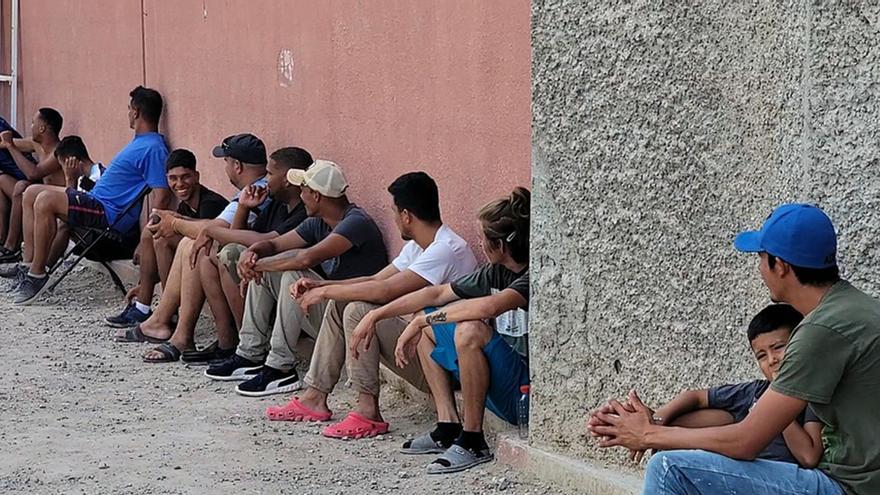
14ymedio/EFE, Mexico/Honduras, 6 September 2023 — Between January and September 3, 29,987 Cubans have entered Honduras irregularly, according to figures from the National Migration Institute. The flow of undocumented people from Africa, Asia and America totals 257,885 people. Given this increase in immigrants, the coordinator of the National Human Rights Commission (Conadeh), Liliana Reyes, called for “respect for the human rights of migrants, who must be seen and cared for as subjects of law.”
In recent years, Honduras has become a transit point for migrants crossing Central America to reach the United States. During the journey, people turn to coyotes, who take them through so-called “blind spots.” Cubans have denounced that as they pass through this country they are victims of extortion by police, who demand that they pay 20 dollars at checkpoints, and the collection of fines by the immigration authorities.
Reyes considered it necessary to involve the National Migration Institutes, foreign ministries, Health Secretariats and Public Ministries, because many migrants suffer crimes and abuses on their migratory route. Given the emergency and the migration crisis that is being experienced in the country, solidarity, humanitarian and medical assistance and temporary accommodation are required for migrants transiting through Honduras.
Of the 257,885 migrants entering Honduras, 92% did so through the eastern zone, which includes the municipalities of Danlí and Trojes, in the department of El Paraíso, bordering Nicaragua, according to EFE. Of these, 41,164 were children.
Venezuelan migrants make up the greatest number of those traveling through Honduran territory, totaling 115,588, followed by Ecuadorians with 31,119, Cubans with 29,987 and Haitians with 24,450. continue reading
On the journey of hundreds of thousands of migrants to the United States, Mexico is another point of conflict. Faced with the wave of people from Cuba, Venezuela, Honduras, Nicaragua, China, India, who are arriving at the border Ciudad Juárez (Chihuahua), the mayor of the city, Cruz Pérez Cuéllar, launched an SOS to the Federation and the state to help control and manage the arrival of people in transit.
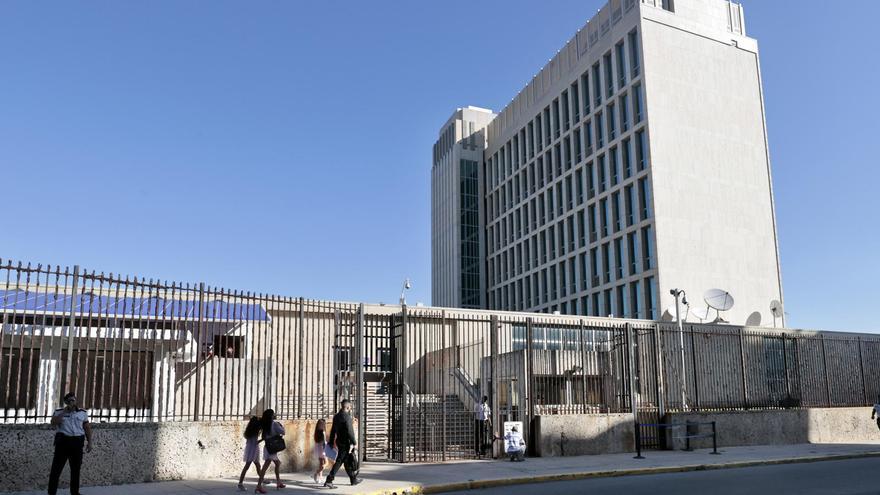
The US Embassy in Havana is issuing visas for some of its Cuban employees in light of exceptional circumstances. (EFE)
14ymedio, Natalia Lopez Moya, Havana, September 7, 2023 — It started off as a minor cough that later turned thunderous. Ibrahím was not moving. His family shook him several times but a bluish color spread across his face. This summer, at the age of 67, the bricklayer died. It had been just a month since he had received a tentative diagnosis of lung cancer after having spent more than a decade working on what was then known as the U.S. Interests Section.*
After shedding their tears at a hasty funeral, Ibrahím’s family tried to find answers for the cause of his illness. The doctor who treated him first blamed his lung problems on smoking but then came to a different conclusion. “Had his work involved longterm exposure to cement?” the doctor asked. A decade spent on construction brigades in the 1980s and almost twenty years making repairs to the Interests Section turned out the be the cause.
“His work killed him,” the doctor decided. However, that was all water under the bridge to his family, who once benefited from Ibrahím being a maintenance man hired by the state contracting agency Cubalse to work on what is now the United States Embassy in Havana. How would they be compensated for their loss? The response did not come in the form of money but rather as a visa to emigrate.
He won’t be able to enjoy seeing his grandchildren grow up in the ’land of liberty’ even though they owe it all to him. continue reading
More than twenty former Cuban employees and their families are on an embassy waiting list for an immigration visa. Their status as former embassy personnel allows them to apply for the visa, which will then allow them to reside in the United States, due to exceptional circumstances.
“He first worked on government projects and later at the Interests Section,” says Ibrahím’s brother. “Those were the days when people weren’t aware and didn’t have the information they should have had to stay safe. They didn’t have gloves, goggles or anything to keep them from inhaling the dust. He didn’t even know he was sick until he started coughing right before he died.”
“Of course, when he started working at the Interests Section, he talked about how great it was. Even though they had a foreman from the Cuban company who kept a close eye on them and treated them badly, he said he had never felt better,” the brother adds. “The lunches, the benefits they got, the attention to the staff. He even went on vacation to Florida a couple of times with his family… “At that time, he had no plans to emigrate, so he died here.”
A few weeks ago Ibrahím’s family filled out the U.S. immigration paperwork, extolling his dedication to his work at the embassy. The process is going smoothly. His children are already liquidating their properties in Cuba because they believe their visa applications will soon be approved. “He won’t be able to enjoy seeing his grandchildren grow up in the ’land of liberty’ even though they owe it all to him,” his brother adds.
At least two other bricklayers from Ibrahím’s crew are going through the same process. One of them, who was employed by Cuba State Security in the early 2000s, has applied for a residency visa. His history is somewhat different from Ibrahím’s.
An active Communist Party member until a few years ago, René (his name has been changed for this article) played both sides for a long time. While working as a security guard at what is now the U.S. Embassy, he was also part of a hardcore band the ideological extremists in his neighborhood.
While working as a security guard at what is now the U.S. Embassy, he was also part of a hardcore band the ideological extremists in his neighborhood.
He was responsible for everything from organizing acts of repudiation against government critics to preventing the national phone company, Etecsa, from installing landlines in the homes of dissidents. “He was a true believer until his kids left for the U.S.,” ironically notes a neighbor whom René reported for buying goods on the black market.
The list of those who fell victim to his denunciations and his extremism grew long. They now watch with astonishment as he sells off his properties and prepares to “jump the puddle.” As for his Communist Party activities, he no longer talks about them and no one knows what he wrote on his visa application when asked about his ties to the Cuban regime.
He gets encouragement from his friend and former colleague Ñico, now on the other side of the pond, who rose through the ranks until he came to work directly for senior American diplomats in their official residence. It was like a game of mirrors. Everyone knew that he might very well be an informant. But at the same time his job was to be a trusted employee, whether it involved serving coffee or being present during conversations between an American diplomat and a Cuban official or dissident.
Now living in West Palm Beach with his entire family, Ñico likes to give advice to his old colleagues, according to one of them. “Don’t worry,” he tells René. “It’s not a gift. You’re entitled to it because you worked for the Americans.” Laughing, they ask themselves, what embassy employees would be willing to work for the Cubans? There are only two options, says Ñico: “Those who don’t last long in the job because what they really want is to emigrate, and those looking for lifetime security by finding out what’s going on inside but who are bad bricklayers.”
*Translator’s note: The de facto American embassy during the years when the U.S. and Cuba did not have diplomatic relations. Though housed in the former and current American embassy and staffed by U.S. State Department personnel, it operated under the protection of the Swiss embassy.
____________
COLLABORATE WITH OUR WORK: The 14ymedio team is committed to practicing serious journalism that reflects Cuba’s reality in all its depth. Thank you for joining us on this long journey. We invite you to continue supporting us by becoming a member of 14ymedio now. Together we can continue transforming journalism in Cuba.
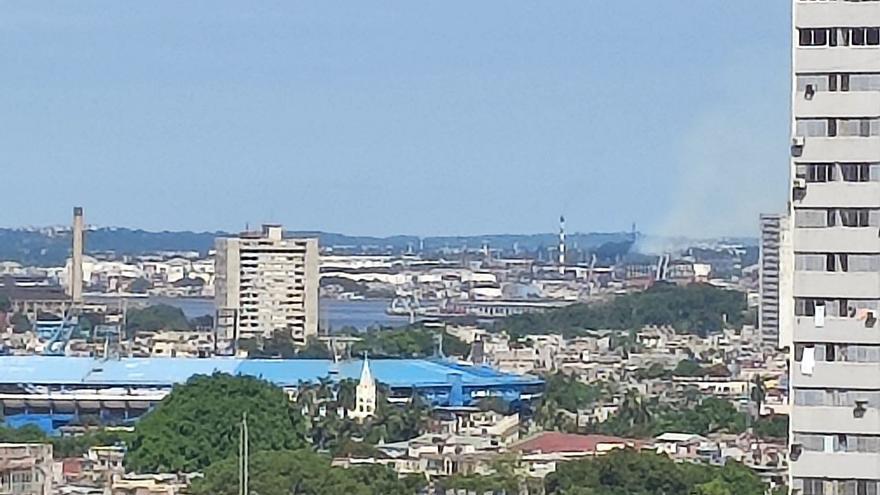
The chimney of the Ñico López refinery, painted with red and white stripes, was seen on Wednesday to be effectively switched off. (14ymedio)
14ymedio, Havana, 6 September 2023 – The operation of the Ñico López refinery in Havana didn’t last for very long after it was switched on last Wednesday after a year out of operation; the refinery has been responsible for the smell of gas across the capital this week. It stopped operating yesterday.
If, on Monday, Cupet, the Cuba Petroleum Union attempted to calm the population – which still has strong memories of the recent Hotel Saratoga explosion and the fire at the supertanker base in Matanzas – by saying that the unpleasant smell was simply the “product of combustion in the plant’s torch”, on Wednesday it put out a further statement in which it said, “On 5 September there weren’t any complaints from the public, which could be a result of the stopping of Plant 1 of the Ñico López refinery, having completed, for the moment, its refinement work.” That is to say, it has no more fuel to refine.
With great fanfare in the official press it appeared that Ñico López was going to be late in shutting down
The chimney, which from the 14ymedio editor’s point of view seems effectively shut down, was shown with some pomp by the refinery itself on 25 August when it expressed that “the symbol was switched on”. A few days later, vice minister Ramiro Valdés supervised the firing up of Ñico López, which, with great fanfare in the official press, seemed to have had its final shutting down delayed.
There is no let up in the shortage of fuel on the island. The country continues to receive petroleum donated principally by Venezuela, which sent 65,000 barrels a day in August (more than the previous month, at 53,000). In filling stations like the ones in Santiago de Cuba, where these days the queues stretch to kilometres long, this increase hasn’t been noticed.
Translated by Ricardo Recluso
____________
COLLABORATE WITH OUR WORK: The 14ymedio team is committed to practicing serious journalism that reflects Cuba’s reality in all its depth. Thank you for joining us on this long journey. We invite you to continue supporting us by becoming a member of 14ymedio now. Together we can continue transforming journalism in Cuba.
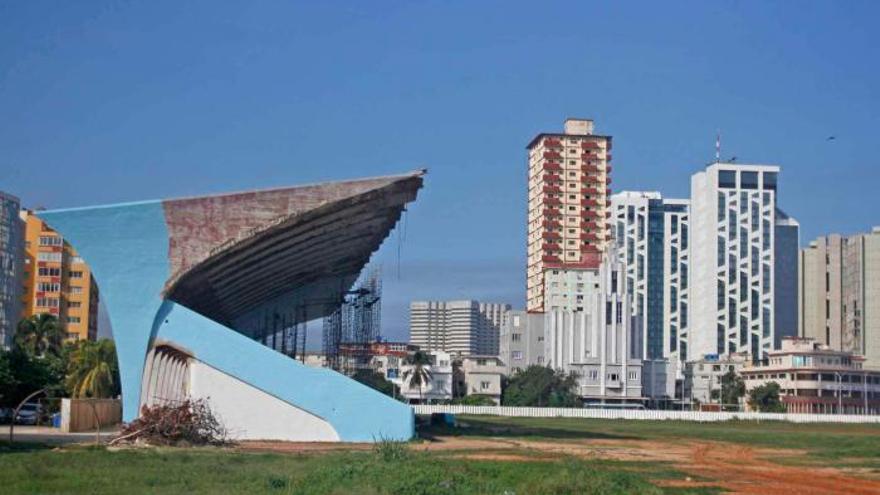
At the back of the park stand the two towers of the Grand Aston hotel, located on 1st and D, in El Vedado. (Tribuna de La Habana)
14ymedio, Havana, 7 September 2023 — More than half of Cuba’s sports areas are not considered suitable to offer services after being evaluated as bad or average by the National Institute of Sports, Physical Education and Recreation (INDER), according to the official press on Wednesday. The agency admits its responsibility for the deterioration but points to another culprit, the Ministry of Education, which has neglected the sports facilities of the schools on the Island.
A photo report published in the official Tribunade La Habana gives an account of the seriousness of the situation in the José Martí sports park, located in the vicinity of the Malecón, in El Vedado. As for the schools in the capital, for which the report does not include images, the space dedicated to physical education is limited to a yard with rusted basketball courts.
“Sometimes the teaching classrooms are repaired but not the physical education classrooms. That must take a different direction”
Ariel Darias, provincial director of Sport, told the media that the schools are under the jurisdiction of the Ministry of Education, so, he believes, that institution must be responsible for their maintenance. “Sometimes the teaching classrooms are repaired but not the physical education classrooms. That must take a different direction (…). The idea is that the schools next to the sports facilities be repaired,” the official said.
The destruction, according to the official press, is widespread. In Martí Park, the stands are the most dilapidated area. With part of the structure fallen down, several scaffoldings attempt to shore up the imminent collapse of the “petals” that make up the roof. The seats, still with traces of blue paint, have already lost their staggered shape. continue reading
Despite the disaster, “the Martí,” as it is popularly known, is still one of the main areas used by nearby residents to exercise. On its irregular and grassy track, it is common to see single people or groups of friends running, warming up their muscles and squatting. The custodians cannot prevent people from entering because the outer fence barely exists in long sections.
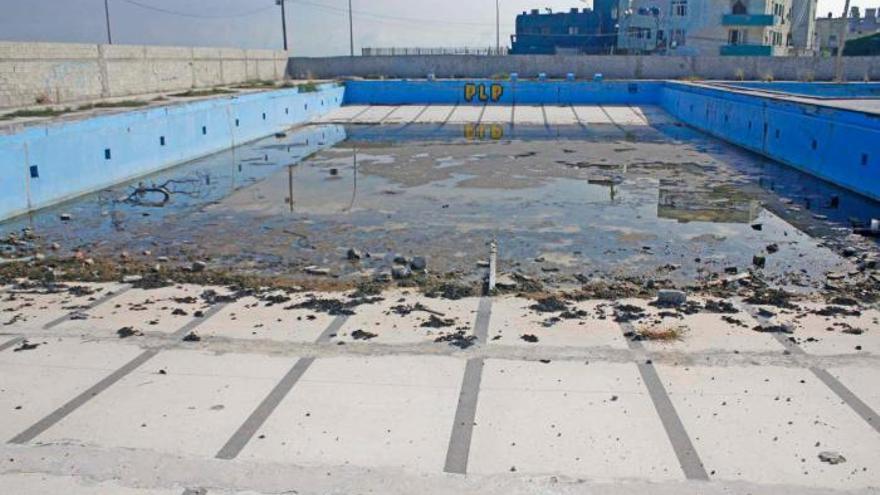
The pool, empty and with traces of stagnant water, is even more deteriorated than seven years ago. (Tribuna de la Habana)
The soccer and basketball courts are described by the media as “unused and in sharp deterioration, and the grass on the athletics track continues to grow.” As for the pool, empty and with traces of stagnant water, it is even more deteriorated than seven years ago, when 14ymedio published a photo gallery of the facilities. Then, the walls already warned visitors: “Don’t pass. Collapse.”
The faded buildings contrast with the horizon of shiny buildings. At the bottom of the park stand the two towers of the Grand Aston hotel, located on 1st and D, in El Vedado, which has a luxurious gym for its customers and a refreshing pool with a sea view.
In an effort to mitigate their statements to the official press, the authorities assured that many sports complexes are being restored. Martí Park itself is being repaired by a mipyme [private business] – whose name is not revealed – and the School of Sports Initiation (EIDE) has managed to recover the fencing gym and the soccer, hockey and baseball fields. According to its managers, it will soon also recover the judo area.
Last July, the official newspaper ¡Ahora! denounced the conditions in which the Olympic swimming pool of Gibara, in Holguín, is located, which has become a “macro garbage dump.” The provincial authorities, such as those of Havana, assure that the responsibility for the state of the facilities, in which they once trained the national water polo team and numerous swimmers, is held by someone else: the provincial Tourism company.
Translated by Regina Anavy
____________
COLLABORATE WITH OUR WORK: The 14ymedio team is committed to practicing serious journalism that reflects Cuba’s reality in all its depth. Thank you for joining us on this long journey. We invite you to continue supporting us by becoming a member of 14ymedio now. Together we can continue transforming journalism in Cuba.
The right-handed pitcher Lemay Portal will be represented by ThOr Representations. (Facebook/Lemay Portal Jr.)
14ymedio, Havana, 10 September 2023 — Cuban baseball player Lemay Portal has been in Mexico for days. The right-handed pitcher is looking for an opportunity with one of the teams of the Major Leagues of the United States. According to journalist Francys Romero, this athlete will be represented by ThOr Representaciones, the same agency that has managed “players like Loidel Chapellí Jr. with the Chicago White Sox and Earle Rafael Zulueta with the St. Louis Cardinals.”
Portal’s route is similar to the one used last March by the 16-year-old pitcher, Earle Rafael Zulueta. That habanero settled in Yucatan (Mexico) after leaving the Island, and after some conversations he agreed to join the American team the following year, which gave him a bonus of $400,000.
Although Lemay Portal has not offered details about where he is in Mexico, it could be in Yucatan, the state in which several Cuban players have settled after arriving on Aztec land, as Randy Arozarena and Zulueta did.
This 20-year-old athlete has a good physique and has recorded pitches that exceed 90 miles per hour. “Portal has the potential to make an impact on headhunters,” the reporter said. The next step is to apply for admission “to the free agency and be eligible for a contract within the United States Major League system.” continue reading
Lemay Portal was part of the Mayabeque Hurricanes team in the 62nd National Series. (Facebook/Lemay Portal Jr.)
Lemay Portal was part of the Mayabeque Hurricanes team in the 62nd National Series. During this stage he threw 5.2 innings and had an effectiveness of 4.76. “Arms like that of Emmanuel Chapman of Holguín, two young people from Camagüey and three pitchers from Mayabeque have emigrated in recent months,” Francys Romero recalled. “Among those in the land of Mayabeque are Marlon Vega, Yulián Quintana, Roger Bolaños and now Portal.”
The escape of players is alarming. Last Friday it was confirmed that the Cuban receiver Yunior Ibarra, who completed his contract with the Canadian team Panteras de Kitchener, disassociated himself from the Cuban Baseball Federation and decided to remain independent.
Cuban baseball has also lost numerous names among the new generations. The same day that Ibarra was made official, it was reported that Eduardo Mustelier, just 11 years old, was in the Dominican Republic, where he will seek to perfect his game in search of an opportunity with a U.S. team.
COLLABORATE WITH OUR WORK: The 14ymedio team is committed to practicing serious journalism that reflects Cuba’s reality in all its depth. Thank you for joining us on this long journey. We invite you to continue supporting us by becoming a member of 14ymedio now. Together we can continue transforming journalism in Cuba.
Valeria, a Cuban woman, together with the manager of the nightclub Marinero Men’s Club, which is located in Tapachula (Chiapas). (EFE)
14ymedio, Mexico, 7 September 2023 — Yumara has been stuck for 22 days in Tapachula, in the Mexican state of Chiapas, on the border with Guatemala. This Thursday she went to the offices of the Mexican Commission for Refugee Assistance (COMAR) to find out if she was approved for the “supplementary protection” that guarantees being able to stay in Mexico while requesting an asylum appointment for the United States through the CBP One application.
“They asked me to wait at least 15 days because they have received thousands of applications,” she tells 14ymedio. “I can’t leave this state; the Immigration agents warned me that if I do and am detained, they will return me to Guatemala.”
According to figures from COMAR, 53,698 irregular migrants have entered through Tapachula. According to official records, as of September 4, they had received applications from 10,192 Cubans. “The officers tell you about thousands, about 16,000, but I haven’t seen those Cubans,” she says. “The people who are now here are mostly from Haiti and Venezuela.”
Yumara, 29, left a nine-year-old daughter on the Island. “The money runs out and you have to find out how to get it,” she says. Due to her status as a migrant, the work options are limited to cleaning or being a waitress in some inn, “where they pay you 90 Mexican pesos (4 dollars) a day and give you food.” continue reading
She says that due to the lack of opportunities, many migrant women go to bars and nightclubs, where “they are roped into prostitution.” The young woman, who shares a room with Mileidis, another Cuban who works in a nightclub, says that they had a Venezuelan friend. “One night she went out with some men,” and they didn’t hear from her again
According to the official records of Comar, up to September 4 they had received requests from 10,192 Cubans
The head of the Street Brigade Community Center, Cristian Gómez Fuentes, told Diariodel Sur on Tuesday that there are more than 2,000 women, mainly from the Island, who work in bars as companions of clients, some even practicing prostitution.
On the other hand, the head of the Marinero Men’s Club, Antonio Armas Hernández, assured the EFE news agency last week that they offer employment to women while making their asylum applications. “Approximately 98% of those who have gone through this business to work are Cubans. We have had one or two Venezuelans and some here who are Honduran. The migrants themselves are Cubans, and we have tried to give them that opportunity with advice, including about migration,” said the businessman.
Mileidis, Yumara’s roommate, is just 22 years old and says that in these night clubs the managers offer the waitresses between 50 and 100 pesos, depending on the bottle that the customers consume. “In one night you can get 400 pesos, but the jineteras leave with 2,400″ because of their customers, she says.
Yumara and Mileidis pay 2,700 pesos for the room they rent, which has two single beds, a grill, two benches and a table. “We share the bathroom, the laundry area and the patio.”
The activist and director of the Center for Human Dignity A.C., Luis García Villagrán, told us this Thursday that there are more than 40,000 migrants in the state waiting for answers from COMAR. Between January and December 2022, about 100,000 people sought to be recognized as refugees.
Translated by Regina Anavy
____________
COLLABORATE WITH OUR WORK: The 14ymedio team is committed to practicing serious journalism that reflects Cuba’s reality in all its depth. Thank you for joining us on this long journey. We invite you to continue supporting us by becoming a member of 14ymedio now. Together we can continue transforming journalism in Cuba.
Line to withdraw cash at the ATMs of the Metropolitan Bank of 23, between Malecón and P, in El Vedado, Havana. (14ymedio)
14ymedio, Havana, 8 September 2023 — Cuba will once again manufacture high-denomination banknotes that will circulate this month to alleviate the cash crisis that the Island suffers. The data was revealed to the official press by an official of the Banco Popular de Ahorro (BPA) of the town of Santa Fe, on the Isla de la Juventud, who also said that the ATMs will reissue bills “24 hours a day.” Interviewed by the Victoria newspaper, Ronald Molina, commercial manager of the BPA in that community, explained that the authorities were taking “a group of measures” to “stabilize the situation” of banknote shortages throughout the Island.
However, on a tour of the banks and ATMs located in the areas of El Vedado and Nuevo Vedado in Havana, 14ymedio asked several customers and workers if they were aware of the issuance of new banknotes in September. The answer was negative in all cases.
I haven’t heard anything about new banknotes, and I don’t think they would do that to us, because there wouldn’t be enough for the population
“I haven’t heard anything about new banknotes, and I don’t think they would do that to us, because there wouldn’t be enough for the population,” said one of the employees of the Metropolitan Bank, located at 23, between Malecón and P. “There are still long lines every day at the ATMs.”
The ignorance that prevails in the Havana bank branches contrasts with the confidence of Molina, who guaranteed that the new banknotes will soon be available. However, he did not specify if they will have the same format as the 100-peso notes printed this April. Although they retained the characteristics of the previous ones, they have a different paper without the reliefs or the Braille system for the blind, so their printing could have been less expensive. continue reading
However, he added that the country tries at all costs not to “resort to the printing of very high denominations,” but will continue to manufacture those that already exist, where the largest bill is the 1,000-peso one.
Although the official did not clarify the cause of this reticence, recent statements by the Central Bank of Cuba (BCC) and the Ministry of Economy and Planning indicate that it could be the difficulties presented by the State to cover the high cost of the production of the currency, since the higher the denomination of the banknote, the higher its manufacturing cost.
With the increase in electronic transactions “the currency used in the manufacture of physical currency can be allocated to other priorities
This August, in a broadcast of the Roundtable program, the president of the BCC, Joaquín Alonso, alluded to the advantages of the country’s banking and pointed out that with the increase in electronic transactions “the hard currency used in the manufacture of physical money can be used for other priorities.”
Similar comments were also made by the Minister of Economy, Alejandro Gil, last May, when he admitted in front of Parliament that printing and taking care of money was extremely expensive and that there was little capacity to meet the population’s demand for cash.
Cuban economist Pedro Monreal then explained on his X (Twitter) account that “with the ’shipwreck’ of the Cuban peso since 2021, in principle there should be a change in the denominations of the banknotes.” He recommended the printing of paper money of 2,000, 5,000 and 10,000 pesos.
“With inflation and devaluation, more banknotes are needed to buy the same product or service, or new banknotes with higher denominations,” said Monreal, who pointed to the cost of printing as a problem for an economy as precarious as the Cuban one.
Asked by Victoria about the low liquidity of ATMs and whether this situation responded to a national experiment or a “strategy” of the Government to force users to resort to electronic means of payment, Molina was elusive. He responded that, with the inclusion of the mipymes [MSMEs, or micro, small and medium-sized enterprises] in the economic panorama, the high-denomination banknotes of the Island have stopped returning to the banks.
According to the manager, these companies “manage large amounts of cash and need it to buy from other economic actors,” so they have had to hoard more money that the State has not been able to replenish. He also added that with bancarización [banking reform] this problem is alleviated for the MSMEs, which “balance” many problems of daily life, although he acknowledged that the new measure does not “improve their businesses.”
Among the habaneros interviewed by 14ymedio, many agreed that for months the banks have only operated with low-denomination banknotes that don’t usually exceed 100 pesos. This Friday, at the 23 and J branch of the Metropolitan Bank, a client complained that she had been given 3,000 pesos in 20-peso bills. The cashier, a little impatient, explained that those were the bills they had available. “And you don’t know how difficult it is to get big bills. I wish we had them so we wouldn’t have to come in on Sundays to fill in the ATMs,” the official said.
In another branch on the corner of Marino and Conill, in Nuevo Vedado this Friday, customers could only withdraw 1,000 pesos at the only ATM that worked and the same amount if they used the cashier service. The bills that were being issued were 10 pesos, and annoyance ran through the long line that began to form before dawn.
A man who deposited 15,000 pesos was a relief for the employees because “the money was already running out and at least with that we can pay more customers,” said a worker. To top it off, the ATM had a problem with the zero number key, which lengthened the entire process and canceled many operations.
Despite the fact that for months the press and the Government have been promoting bancarización as a relief from several economic problems on the Island, Cubans continue to show distrust of the transition to virtual payments and prefer to manage their assets in cash.
Translated by Regina Anavy
____________
COLLABORATE WITH OUR WORK: The 14ymedio team is committed to practicing serious journalism that reflects Cuba’s reality in all its depth. Thank you for joining us on this long journey. We invite you to continue supporting us by becoming a member of 14ymedio now. Together we can continue transforming journalism in Cuba.
 14ymedio/EFE, Havana, 7 September 2023 — At least 17 people who participated in the protests in the town of Nuevitas, Camagüey, in August 2022 remain in prison waiting to be tried, the NGO Justicia 11J said on Thursday.