
Legacy of Cuban Artist Nicolas Landrian Resurfaces in Venice

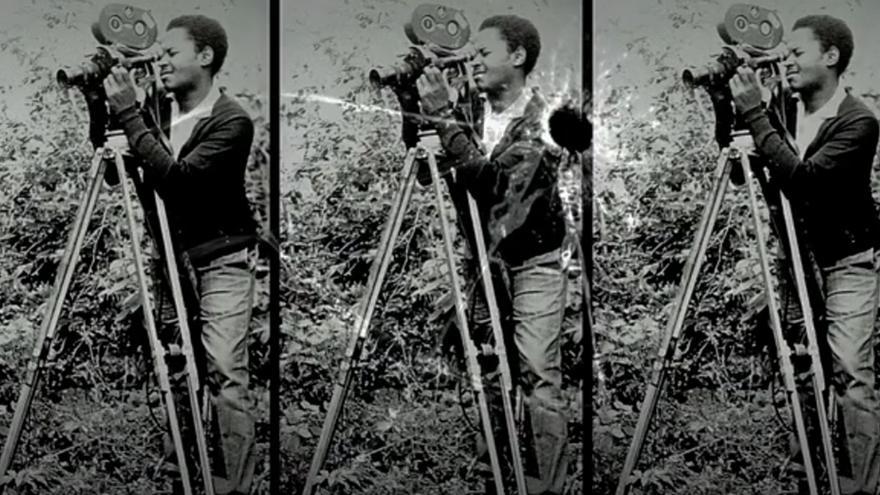
Still from the documentary Landrián by Ernesto Daranas.

14ymedio biggerEFE (via 14ymedio), Gonzalo Sánchez, Venice, 3 September 2023 — Nicolás Landrián was a visionary of Cuban cinema but post-revolutionary censorship ultimately marginalized his work. His films have now been taken out of storage, giving the general public access to his legacy thanks to a documentary, which recently premiered at the Venice International Film Festival, that bears his last name.

“In his time, he was probably Cuba’s best-known filmmaker after Tomas Gutierrez, Alea Titón and Humberto Solás but he remains unknown to the general public,” says the producer of Landrián, Ernesto Daranas Serrano.

The documentary, which was presented as part of the festival’s Venice Classics series, follows the search through Havana’s film archives for cans of footage shot by the director, who was Cuba’s first black filmmaker and whose work was largely forgotten due to censorship.

Landrián (1938-2003) was the nephew of the poet Nicolás Guillén. Though he actively opposed the Batista dictatorship, after the revolution he was accused of having a “licentious attitude” and for comments “not in keeping with a young revolutionary” according to files shown in the documentary.

His camera captured the folklore and idiosyncrasies of Cuban society while questioning the widespread propaganda and fervor following the triumph of Fidel Castro’s Revolution in 1959. (His 1968 documentary Coffea Árabiga even satirized coffee production.) continue reading

Landrián (1938-2003), was the nephew of the poet Nicolás Guillén. Though he actively opposed the Batista dictatorship, he was accused of having a “licentious attitude” after the 1959 Revolution 

“I have never fit in anywhere except in my work,” he often said.

Thus, “ideological deviation” became his cross to bear and a permanent part of his record. He was subjected to perennial incarceration, then to electric shock in psychiatric clinics, until he managed, along with many others, to go into exile in Miami.

It was there that he would die of pancreatic cancer in 2002. Meanwhile, back on the island, the public’s memory of him began to fade as his films rotted away on archive shelves.

But two decades later, the idea of restoring his legacy came about almost by accident. In 2019 Daranas was snooping around the Cinemateca de Cuba while working on another project and noticed the “unfortunate” state of conservation of the film heritage he found stored in its archives.

One of Landrián’s films that came to have great sentimental value for Daranas was Ociel del Toa (1965). During his childhood he saw this film, a story about people living along the Toa River, countless times in movie theaters because it was used as filler during screening interruptions.

“Half the film was lost and the other half very badly damaged. I wondered about the rest of Landrián’s works. All of them were more or less in the same condition and no one knew where some of them were,” he said.

With a go-ahead from the president of the Cuban Institute of Cinemagraphic Art and Industry (ICAIC), Daranas began searching for the negatives in hopes of restoring them.

Daranas is critical of the role censorship plays in Cuban cinema, a hot topic among Cuban filmmakers, who are currently demanding government officials meet with them to discuss it.

“I am not the only one to condemn censorship in Cuban cinema. It’s an issue for all the members of the union of Cuban filmmakers, who right now are demanding our government have discussions with us about censorship,” says Ernesto Daranas

Little by little, ten of these lost films were found. They include Los del Baile (The Dancers, 1965); En un Barrio Viejo (In an Old Neighborhood, 1963), winner of the Krakow Film Festival; and Ociel del Toa itself,  which won an award at SEMINCI, the Valladolid Film Festival.

Daranas’ documentary recounts efforts to first recover the lost films in Havana and then to send them to Madrid for restoration.

Ladrián comes across as a Christ-like figure who was said to have been born “with his eyes wide open.” He is described in film by those who knew him, such as his wife, Gretel Alfonso Fuentes, and his director of photograph, Livio Delgado.

“With the ten films we have restored and with this documentary, we are hoping to introduce this exceptional filmmaker to a wider audience. He faced a problem that unfortunately many Cuban filmmakers are still facing today, which is censorship,” says Daranas.

“Censorship still hangs like a sword of Damocles over Cuban cinema,” he adds.

“I am not the only one to condemn censorship in Cuban cinema. It’s an issue for all the members of the union of Cuban filmmakers, who right now are demanding our government have discussions with us about censorship and how it has harmed so much cinema and so many lives,” he says.

The screening of his documentary at the prestigious Venice Festival is doubly valuable for Cuban filmmakers like Daranas.

First, it recognizes an “exceptional and virtually unknown” filmmaker like Landrián, says Daranas, who won the King of Spain Journalism Award for his documentary The Last Pipers of Havana. Second, it is validates “the struggle that Cuban filmmakers are still waging today against censorship and exclusion.”

____________

COLLABORATE WITH OUR WORKThe 14ymedio team is committed to practicing serious journalism that reflects Cuba’s reality in all its depth. Thank you for joining us on this long journey. We invite you to continue supporting us by becoming a member of 14ymedio now. Together we can continue transforming journalism in Cuba.</p
An Official Describes the Cuban Ministry of Tourism’s Information Policy as ‘Machiavellian’

Dayamis Sotolongo Rojas, of “Escambray”, complains about the difficulties with immediacy faced by the press in Cuba (Vicente Brito/Escambray)

14ymedio bigger14ymedio, Madrid, 28 August 2023 — It is not the first time the provincial daily in Sancti Spíritus, Escambray, is at the vanguard of the most daring official press in its critique of the authorities, and the column published on Monday is, perhaps, one of its milestones to date.  The article, signed by one of its most well-known voices, Dayamis Sotolongo, is sharp against the measures that present obstacles to the objective of immediacy in reporting. “Failing to report on time is the same as remaining silent,” says the journalist.

In the article, titled, ¿Callo, después informo? [Keep quiet and then inform?], Sotolongo explains that days ago, professionals were called to a meeting during which the provincial tourism directorate announced a new mechanism for accessing information, which she describes as Machiavellian, implemented by the ministry itself. The procedures they proposed will elicit more than perplexity among editors of any country with a free press.

“To draft anything, from an informative article on the Meliá Trinidad Península hotel to a short piece on Campismo Popular Planta Cantú, journalists must make a formal request where they must provide, in addition to their personal information, the dates in which they plan to conduct their work, the facilities that will be visited, the objectives, whether photos or videos will be taken, the outlets in which the communications products will be publish and, after being analyzed by the Ministry of Tourism’s Directorate of Communication — a lapse which can take days — it will be communicated to the provincial leadership whether or not the work can proceed,” she explains.

Sotolongo made it clear that immediacy is intrinsic to journalism and news cannot wait, because it then stops being news. But, above all, this type of technique is, in fact, contrary to the Social Communication Law approved this year on the Island, the text of which — though it is not yet in effect — is already known. continue reading

Article 25 states that responses to media requests for information should be responded to with “timeliness, transparency, and veracity” so that the press can exercise its social function while article 33 forces the media to “act with immediacy, timeliness, and strategic foresight.”

Thus, the columnist believes that the Law is being violated even in spirit. “Information on paper and leaks to the communications media? The law on one side and the discourse on the other? (…) At first glance, many decision makers seem oblivious to these duties. As if putting up barriers to information could then be hidden,” she states.

The article opens with several cases in which Escambray has circumvented the rigidity of the rules to offer information, from the first cases of COVID-19 in Cuba, to the rise of the Zaza river, which almost ended in tragedy, or the real reason for which a 2014 baseball game was canceled by an outbreak of diarrhea. Sotolongo celebrates that the new daily does not expect the authorization of the Ministry of Public Health, Civil Defense or the National Baseball Commission, for these and other cases or “Cuba nor the world would have known” any of that.

The article does not mince words, “Every attempt to trip up access to information is one more step toward censorship.” “If anything has been sadly articulated by Cuban communications is that the media is late to publish what the vox populi has been confirming to to the four winds.” “Discrediting always weighs on everyone.” “This does not only apply to journalists, because failing to tell the truth is not just a crime against journalism.”

The criticism, despite its ferociousness, is not aimed at revindicating a free press, nor does it empathize with independent journalists, who are boycotted and oppressed by the regime. Sotolongo demands good working conditions within the legal margins in Cuba, that is, she only recognizes the official press and launches criticism. “Each time the press loses an opportunity to say, they gain one in lying or in distorting others,” she alludes in writing on social and alternative media.

Sotolongo won the Juan Gualberto Gómez National Journalism Prize in 2019 and is one of the most reputable journalists in the country, specializing in social issues. That same year, she was at the center of a great controversy when the Press and Society Institute (Ipys) decided to award several communicators on the Island during a contest called Cubacron, among them the Escambray journalist and two from the state media, but most were from independent media.

The situation bothered the Union of Cuban Journalists (Upec) and the cuban leadership who described the prize as “U.S. intervention” and accused Ipys of being linked to the “counterrevolution.” Sotolongo rejected the nomination and expressed her distaste for having been included in an award to which she did not apply. “I don’t sell my soul to the devil; they can go to. . .”, said the reporter, without specifying where she wanted to send those who dared issue her the prize.

Translated by: Silvia Suárez

____________

COLLABORATE WITH OUR WORKThe 14ymedio team is committed to practicing serious journalism that reflects Cuba’s reality in all its depth. Thank you for joining us on this long journey. We invite you to continue supporting us by becoming a member of 14ymedio now. Together we can continue transforming journalism in Cuba.

The Russian Ministry of Education Funds Free Online Language Courses for Cubans

The courses are aimed at residents of the Commonwealth of Independent States, Central and Southern Asia, Cuba, Latin America and Africa. (Maximum Education/Captura)

14ymedio bigger14ymedio, Madrid, 5 September 2023 — Ads to learn Russian are proliferating on the Island as relations between the two countries become closer. The most recent comes from the company Maximum Education, which offers free online courses for Cubans from September to December.

According to the report to 14ymedio via email, the project, called “Maximum. Govorim po-russki” (“Maximum. We speak Russian”), is funded by the Russian Ministry of Education. Its objective is to “teach Russian to foreign citizens residing abroad” (sic).

However, in an attached promotional document, the company indicates that the courses are aimed at residents of the CIS countries (the Commonwealth of Independent States: Armenia, Azerbaijan, Belarus, Kazakhstan, Kyrgyzstan, Moldova, Russia, Tajikistan, Turkmenistan, Ukraine and Uzbekistan), Central and South Asia, Cuba, Latin America and Africa. It is also open, they clarify, to “immigrants residing in Russia interested in learning the language.”

Classes are taught online with a teacher and at different levels, from beginner to advanced, and even for those who want to take the Unified State Exam to access Russian universities

Classes are taught online with a teacher and at different levels, from beginner to advanced, and even for those who want to take the Unified State Exam to access Russian universities. Registration can be made through the Maximum website, which has a section in Spanish, until September 10. continue reading

The interactive platform they use is based, they explain, on the methodology of Maksimum Obrazovaniye, which has developed “courses of various formats and directions for more than 10 years” and which, since last year, “has also been implementing international educational projects.”

The truth is that the firm has a large entry in Russian on Wikipedia, where it is presented as a company that “operates in the market of educational technologies” and has become the third most important of its kind in the country. Its owners, the text says, are Russia Partners, CapMan, Skolkovo Ventures and Proobraz, and they employ 1,500 teachers.

According to the collaborative encyclopedia page, Maximum Education was founded in Moscow in 2013 by Mikhail Myagkov, who had worked for the American consulting firm Boston Consulting Group, and the international education company Kaplan. The name under which it is registered does not appear on Wikipedia: Umax LLC (Limited Liability Company).

According to the collaborative encyclopedia page, Maximum Education was founded in Moscow in 2013 by Mikhail Myagkov, who had worked for the American consulting firm Boston Consulting Group

This firm, according to a Russian commercial information page in English, receives funds from the Russian State University for the Humanities, the St. Petersburg State University, the Moscow State Pedagogical University, the Russian Technological University and the Moscow Institute of Energy Engineering.

The announcement of Maximum Education, in any case, joins the one made by Vladimir Shkunov, member of the Council of Experts of the Putin Government, last July, of a series of Russian classes for Cubans through the Educational Channel since November.

The Island’s authorities have not mentioned them and seem to be cautious about about their relationship with Russia. An example was the late pronouncement of the regime, this Monday, on the alleged dismantling of a human trafficking network that recruited Cubans residing in Russia and on the Island to join as mercenaries in the war against Ukraine.

Despite this, the harmony between the two countries – one in need of cash, the other in need of international allies after the invasion of Ukraine – is a fact at this point, as indicated by Putin’s praise of the “special relationship with the Isle of Liberty” in front of Prime Minister Manuel Marrero, to whom he promised more help for Cuba.

Translated by Regina Anavy

____________

COLLABORATE WITH OUR WORKThe 14ymedio team is committed to practicing serious journalism that reflects Cuba’s reality in all its depth. Thank you for joining us on this long journey. We invite you to continue supporting us by becoming a member of 14ymedio now. Together we can continue transforming journalism in Cuba.

In One Year, 15 of the Team’s 20 Players Left Cuba for the Under-15 World Cup

Alejandro Cruz has been in the Dominican Republic since Sunday. (Facebook/Moisés M Vázquez)

14ymedio bigger14ymedio, Havana, 5 September 5, 2023 — Cuban baseball player Alejandro Cruz refused to be part of the list of more than 40 athletes that the Cuban Baseball Federation (FCB) formed to present to the headhunters at an event to be held in Havana between September 11 and 13. Instead, the 16-year-old preferred to board a flight to the Dominican Republic, where he has been looking for an opportunity with one of the U.S. Major League teams since last Sunday.

Cruz was part of the Sancti Spíritus team in the last Under-18 National Championship. In the competition he recorded six doubles, two triples and achieved 10 stolen bases. The strength of his arm, his speed and the batting of the player from Sancti Spíritus are his weapons to be eligible in the next period of international signing.

The FCB’s strategy has failed in its attempt to stop the flight of young players. Since 2012, there has been “a systematic exit” of athletes who have been members of the U-15 and U-18 teams, says journalist Francys Romero. However, with the abandonment of Cruz, the list of baseball players who won the silver medal last year in Taipei (China) and who have left the Island has now reached 15, “which represents a record,” the journalist said.

Although it has not recognized it, the FCB looks for the talent scouts of professional leagues in America, mainly Mexico, and Asia to recruit their players. In return, it takes a percentage of the agreement if it is finalized. continue reading

Since 2012 there has been “a systematic exit” of athletes who have integrated the U-15 and U-18 teams, says journalist Francys Romero

Ricardo Eizméndiz, a member of the National Commission, told the official media Jit in August that among those interested in hiring Cuban athletes are several teams from South Korea, without specifying which ones, in addition to the Japanese team Falcons from Softbank. “We expect new confirmations in the next few days,” he said.

The publication Play-Off Magazine said that the most important baseball circuit is in the United States, but unfortunately, in the new strategy of the FCB, it continues “to veto the players of the Island who are under the protection of the Federation.”

In addition to Alejandro Cruz, the list of dropouts includes Alex Santiago, Pedro Danguillecourt, Jaider Suárez, Dulieski Ferrán, Ernest Machado, Yosniel Menéndez, Roberto Peña, Segian Pérez, Alejandro Prieto, Danel Reyes, Ronald Terrero, Jonathan Valle, Yunior Villavicencio and Cristian Zamora.

Young players are not attracted to staying on the Island, where in recent years there has been a shortage of uniforms, balls and bats. The food for the athletes has been reduced, and the salaries they receive are depressing. The current payment scale dating from 2020 for players in Cuba depends on their category. A member of the national pre-selection who participates in the National Series receives 3,725 Cuban pesos per month (19 dollars); one from the Reserve of the National Pre-Selection and National Series receives 2,400 (12 dollars).

The athletes prefer to migrate, many to the Dominican Republic, in search of better training and contracts. Juan Álvarez signed a contract with the Arizona Diamondbacks with a bonus of $100,000. John Valle signed with the New York Mets and received a $150,000 bonus. Christian Saéz has a pre-agreement with the Cardinals of San Luis that guarantees him $150,000. These are just some of the young Cubans who achieved their dream this year.

Translated by Regina Anavy

____________

COLLABORATE WITH OUR WORKThe 14ymedio team is committed to practicing serious journalism that reflects Cuba’s reality in all its depth. Thank you for joining us on this long journey. We invite you to continue supporting us by becoming a member of 14ymedio now. Together we can continue transforming journalism in Cuba.

Venezuelan Oil Exports Are Plummeting, but Cuba’s Supply is Guaranteed

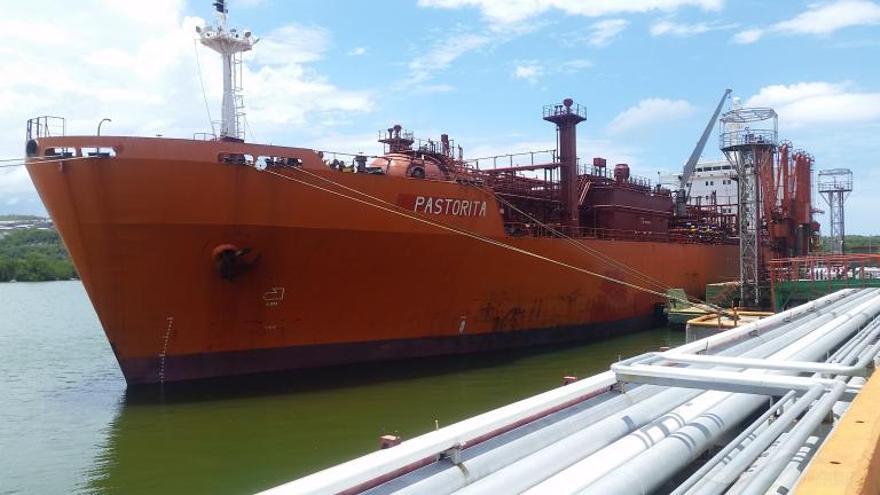
The Cuban tanker Pastorita appeared anchored in the port of Havana without it being possible to determine, using maritime tracking applications, from which foreign terminal it had sailed. (Vesselfinder)

14ymedio bigger14ymedio, Havana, 5 September 2023 — Venezuela sent 65,000 barrels per day (bpd) of oil, fuel oil, gasoline and diesel to Cuba during the month of August, an amount higher than the previous month, when the Island received 53,000 bpd. The supply, stable compared to that of the rest of the year, coincides with a resounding drop in Venezuelan fuel exports of 38% compared to July, a figure that breaks with the growth trend that Caracas had maintained for three and a half years.

Of the 554,000 bpd that the country sold to its partners in August – 333,000 less than in July, when it exported 877,000 bpd – most of it went to China, although the exact amount is not known, the British agency Reuters reported. For its part, the United States bought through the Chevron company, the only one authorized by the Treasury Department since 2022 to do business with Venezuela, less than 147,000 bpd.

The terrible state of the country’s oil infrastructure and the lack of capital of the state-owned PDVSA have limited, according to Reuters, the possibilities of exporting Venezuelan crude oil. In addition, breakdowns have been recorded in important fuel improvement units, several of them financed by Caracas partners such as Beijing or Moscow.

The official press discreetly announced this Friday that the Alameda-2 oil well, located in Matanzas, was in a position to be exploited

The movement of tankers from Venezuela through Cuban ports has not stopped in recent months. In addition, the official press discreetly announced this Friday that the Alameda-2 oil well, located in Matanzas, was in a position to be exploited by the Australian company Melbana Energy. continue reading

Osvaldo López, head of Exploration of the Cuba-Oil Union (CUPET), then told Cubadebate – which claimed to have the intention of resolving the “doubts and expectations” of Cubans on the subject – that Melbana had the right over the well in a “shared” way, thanks to a contract signed with the Cuban Government in 2015.

Since that year, Melbana has examined 19 possible wells, without publishing clear results so far. In 2020, in addition, the Angolan company Sonangol, which pays for 70% of Melbana’s oil activities on the Island, was added to the equation, López reported. The following year, one of the analyzed wells was dredged, but it was useless for any activity that was not “exploration,” the company alleged.

After investigating other sites, which ended up being “dry,” Melbana said that it has managed to get about 1,100 bpd from Alameda-2 during the month of July. Crude has also been taken out, “lighter and with lower sulfur content” than usual on the Island, it added. However, the extraction is still just an “experimental exploitation” project, and López does not hide CUPET’s lack of enthusiasm for the “new discovery,” which he values just as “positive.”

Since 2015, Melbana has examined 19 possible wells, without publishing clear results so far

On the other hand, Havana continues to pay more interest to ships that, from Caracas and Mexico, bring fuel to the Island. This Tuesday, the Cuban tanker Pastorita appeared anchored in the port of Havana without it being possible to determine, using maritime tracking applications, from which foreign terminal it had sailed.

The oil tanker Alicia – with a Cuban flag – arrived in Matanzas on August 25 from the Venezuelan port of Amuay, while the Aquila, with a Panamanian flag, arrived this Sunday at the same terminal from Mariel.

The Finnstraum, with a Norwegian flag, is expected to arrive in Moa on September 15 from Finland, where another freighter is already anchored, the Praire Tulip, which sails with the Portuguese flag from Curaçao.

Translated by Regina Anavy
________________________________

COLLABORATE WITH OUR WORKThe 14ymedio team is committed to practicing serious journalism that reflects Cuba’s reality in all its depth. Thank you for joining us on this long journey. We invite you to continue supporting us by becoming a member of 14ymedio now. Together we can continue transforming journalism in Cuba.

Delta and United Follow in the Footsteps of JetBlue and Reduce Their Flights to Cuba Due to Lack of Passengers

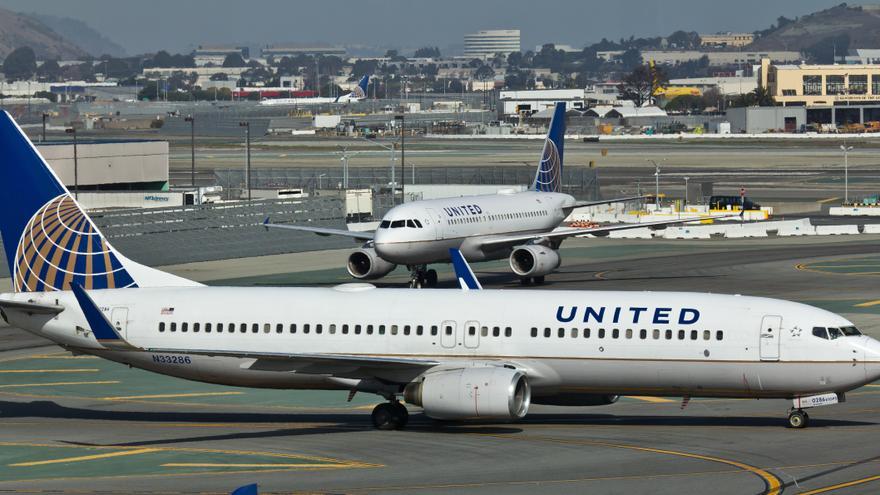
United Airlines requested on June 8, 2023 the suspension of its services between Newark and Havana. (Wikimedia)

14ymedio bigger14ymedio, Madrid, 4 September 2023 — The US airlines Delta Air Lines and United Airlines will reduce their flights to Cuba from October 29. Both companies are awaiting authorization from the United States Department of Transportation (USDOT) for a temporary exemption from their routes.

In the case of Delta, the company has requested a suspension until March 30, 2024, for the seven routes it has between Atlanta, where it has its headquarters, and Havana, in addition to a reduction by half – seven of the 14 – of its flights between Miami and the Cuban capital. The airline alleges that the route is underused, although it hopes that the demand can be recovered to resume travel.

The company, which already achieved a suspension for the same reasons in the summer, expects the situation to be repeated and that the USDOT will grant it the license until demand is revived.

Cuba would cease to be served by direct flights from Newark

For its part, United Airlines, based in Chicago, requested on June 8, 2023 the suspension of its services between Newark (New Jersey) and Havana due to “economic circumstances,” so Cuba would cease to be served by direct flights from this airport, a neighbor of New York, also from October 29, 2023. continue reading

The airline said that it “does not want prolonged downtime for these frequencies,” so it plans to focus on the route it has between Houston and Havana, as its only route beginning in November.

The news, published by AviacionOnline.com, comes a few days after the suspension of JetBlue’s connections with the Island from September 17, attributed to “changes in the regulatory landscape and restrictions on the ability of our customers to enter Cuba,” according to a statement from the company.

“We hope to resume our service to Havana and continue looking for opportunities within Cuba in case travel is more accessible in the future,” said the company, which in 2016 was the first airline to operate regular flights to the Island after 50 years of suspension.

As of July, the last month for which there are official data, Cuba received 1,489,286 international visitors, still far from the forecasts and highlighting the difficulties of reaching 3.5 million by the end of the year. Of the passengers, 99,012 were Americans and 210,019 were Cubans living abroad, most of whom reside in the United States.

Of the passengers, 99,012 were Americans and 210,019 were Cubans residing abroad, most of whom reside in the United States

The increase in these groups compared to the previous year is significant, since the former rose by 188% and the latter by 114%. However, the increase has not met expectations. A year ago, Delta and United had not restarted the flights since the 2020 suspension due to the pandemic, and only American Airlines and JetBlue flew to Cuba.

The two companies returned strongly to the Island from the end of 2022 and the beginning of 2023, but the supply has turned out to be excessive for the demand, and the request of both coinciding with the high season is revealing about the lack of confidence in Cuba as a destination.

Translated by Regina Anavy

____________

COLLABORATE WITH OUR WORKThe 14ymedio team is committed to practicing serious journalism that reflects Cuba’s reality in all its depth. Thank you for joining us on this long journey. We invite you to continue supporting us by becoming a member of 14ymedio now. Together we can continue transforming journalism in Cuba.

Late and Without Giving Details, the Cuban Foreign Ministry Denies It Is Sending Mercenaries to Russia

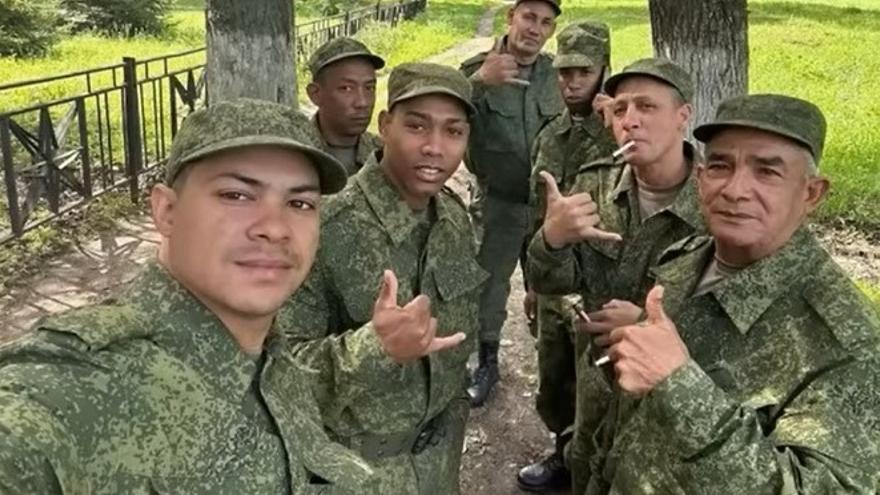
Young Cubans in Ukraine hired by Russia, according to the ’influencer’ Alain Pararazzi Cubano. (YouTube)

14ymedio bigger14ymedio, Havana, 5 September 2023 — Cuba’s Ministry of Foreign Affairs announced on Monday the dismantling of a human trafficking network based in Russia that recruited Cubans residing in that country and on the Island to join as mercenaries in the war in Ukraine, which the report calls a “war operation.” The information comes after weeks of speculation about an alleged recruitment sponsored by the regime to send young Cubans to fight for Russia.

“Attempts of this nature have been neutralized and criminal proceedings have been initiated against people involved in these activities,” the report indicates without giving further details.

The report emphasizes that “Cuba is not part of the military conflict in Ukraine” and acts “strongly against those who, from the national territory, participate in any form of human trafficking for the purpose of recruitment or mercenarism so that Cuban citizens make use of weapons against any country.”

The report emphasizes that “Cuba is not part of the military conflict in Ukraine” and acts “strongly against those who, from the national territory, participate in any form of human trafficking for recruitment purposes”

In addition, it says that Cuba has always been actively against mercenarism and that its position is firm and clear, as demonstrated by the “initiatives that are approved” at the United Nations. continue reading

In the document, reproduced in the official press, the Government dissociates itself from all the information that has increased recently about an alleged collaboration with Russia in its invasion of Ukraine. “Cuba’s enemies promote distorted information that seeks to tarnish the image of the country and present it as an accomplice of these actions, which we categorically reject,” it emphasizes.

Last week, two young Cubans, Alex Vegas Díaz from Santa Clara, and Andorf Velázquez García from Havana, appeared in a video published by the Cuban influencer Alain Paparazzi in which they explained in detail how they ended up in Russia without their passports, not being able to return to the Island.

The boys claimed that they had been victims of a scam and that they signed two contracts in Russian without the possibility of translating them into Spanish thinking they would leave Cuba to earn a living and help their families. The promise was a job in the reconstruction of homes and other infrastructure devastated by the war in exchange for salary, rights and citizenship, and even the ability to take their relatives to the country later.

After signing the document, they showed up at the Varadero airport and, when they arrived in Russia, they found that their task was to join a military training center to fight at the front. Both claimed to have escaped by being ill, while other Cubans are fighting on the Russian side.

The recruitment, according to family members, took place through social networks, where a Cuban woman, acting as an intermediary,  assured them that they would never be in the line of fire.

The interview was dissected last Thursday on the Guerrero Cubano program broadcast on YouTube, an account at the service of the regime dedicated to “dismantling hoaxes and slander” of what it calls “haters” of Cuba

The interview was dissected last Thursday on the Guerrero Cubano program broadcast on YouTube, an account at the service of the regime dedicated to “dismantling hoaxes and slander” by the “haters” of Cuba. In the video, the interview accused different Miami media influencers of lying to spread false ideas, highlighting that the young people themselves admitted to being economic emigrants who left the Island in order to help their families, and they were deceived by people outside the Government.

Since last May, when Vladimir Putin signed a decree by which he would expressly grant Russian citizenship to individuals — and their relatives — who signed a contract for the provision of military service for a year, rumors about a possible collaboration of Havana with Moscow grew. Many then feared that the regime would end up sending its military or young people who perform compulsory military service to fight against Ukraine, something that did not seem to materialize. But doubts about shadow recruitment have not stopped circulating on social networks.

The Cuban government supports Russia in the invasion of Ukraine and has deployed a wide propaganda campaign in its media aimed at installing the idea that there is a Nazi regime in Kiev supported by NATO with the aim of encircling Russia, which Putin is fighting in self-defense. In most of the resolutions against the war at the United Nations, Cuba has abstained or even voted against some actions, such as when member states were asked if Volodimir Zelensky could attend by videoconference at the General Assembly.

Translated by Regina Anavy

____________

COLLABORATE WITH OUR WORKThe 14ymedio team is committed to practicing serious journalism that reflects Cuba’s reality in all its depth. Thank you for joining us on this long journey. We invite you to continue supporting us by becoming a member of 14ymedio now. Together we can continue transforming journalism in Cuba.

Prosperity in the Cuban Countryside or Don’t Count Your Chickens Before They Hatch

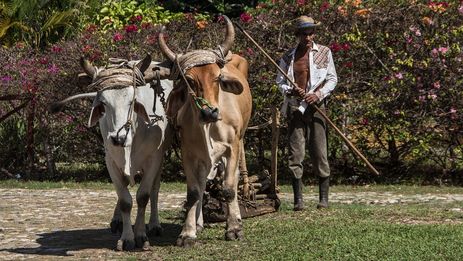
Cuba farmer working the land with oxen

14ymedio bigger14ymedio, Elías Amor Bravo, Economist, 4 September 2023 — The Stalinist doctrine that has governed the Cuban economic and political system for 64 years spares no effort in trying to prove the impossible. They have pulled out of a hat a story that intends to show that with a correct direction and collective effort, it is possible to weed out unproductivity in an agrarian cooperative that was practically abandoned, dead. The example is intended to be extended to the Cuban agricultural sector in that forward flight to produce food in which the regime finds itself.

It is unfortunate that Cuban communists continue to believe in this kind of thing, when experience says otherwise. Collectivism is the direct road to poverty, misery and hunger. This doctrine comes from the rules of scientific communism, and it has led Cuba to the current disaster, which seems to have no solution. Inventing stories, in these conditions, is reckless. This is not the path that Cuban agriculture needs to take to be efficient and produce more and better.

What happened in the Antonio Maceo Agricultural Production Cooperative (CPA) in Granma Province is a unique story, but how many similar experiences currently exist in the Cuban economy? In any case, the elements that have facilitated the supposed success of this project are usually difficult to find in others. Collectivist formulas with the design applied by the Cuban regime have never worked when it comes to producing more and better.

The story is still surprising. As stated in the article, “on the verge of being dissolved about two years ago due to its low production, non-payments to workers and financial losses, the Antonio Maceo CPA, of the municipality of Guisa in Granma, currently shows a very different panorama in which productivity is harvested.” And the rest of the booklet is a cult of communist propaganda intended to present the case as a success. However, there are some dark spots.

With the epic that characterizes Castro’s prose, everything seems to have happened thanks to the commitment of a young peasant, Rudisney Roselló Arévalo, who came to lead the aforementioned cooperative a few years ago. The first thing he observed was a panorama described as pitiful: “empty lands, others half cultivated, disgruntled workers … financial debts and defaults,” a magnificent description of the Cuban agrarian panorama today. continue reading

Rudisney, seeing that “there was a desire to change direction,”  says that there was nothing magical in the radical transformation shown today by those lands dedicated to various crops and fruit trees. He had no choice but to turn to the communist organization for support. Nothing in Cuba is done without it.

The cooperative was dominated by losses that amounted to more than two million pesos and was about to be dissolved, with debts to companies and payments owed to workers. Of the original  workforce of 37 workers, only 16 cooperative members remained. The available land, 90 acres, was depressed, and only 10 were in production, less than 10%. In those conditions, producing was a chimera.

And it is here that the state press dashes for home and puts in Rudisney Roselló Arévalo’s mouth words that cannot be true, such as when he emphasizes that “collective work has been the key that has allowed them to achieve, in just over two years, the visible productive transformations that the Antonio Maceo CPA shows today.” It’s good that they force him to say certain kinds of things, but in the end if they end up believing them, that’s their problem.

Without owning the land, which would have been enough to move production, Rudisney had to entertain himself with what the communists let him do, such as “drawing up strategies to pay the debts that existed with the cooperative members” or holding cooperative meetings for everything, such as, “carrying out the actions of land preparation and planting of the papaya and guava voluntarily. The money that the CPA would save would be used to honor the debts with the workers.”

Think about the workload up to this point, especially the planting, and there is nothing at all. It’s all administrative bureaucracy. But behold, the CPA managed to get out of the productive rut into which it had fallen, and, as if by magic, “the land will respond with better harvests, and the income would allow it to start paying salaries monthly and distributing profits every three months, a reality that encouraged other workers to reintegrate into the cooperative.”

Honestly, doesn’t it remind you of the chickens and the eggs?

Not content with narrating the facts so far, the article cited the case of Yusdel Reyes Pérez, a worker reinstated to the CPA, after having left in 2018 because he failed to receive his salary. Yusdel said that “a year ago I found out that the coop was taking another path, and I recently returned to try my luck. The truth is that the change has been great.”

And he clarifies: Where before there used to be weeds, now there is cassava, sweet potato, corn, melon, cucumber, guava, garlic, onion, sesame … and all this with improvements for the workers who have returned to occupy the 37 places that in some cases have paid 20,000 pesos or more when a harvest is completed, double what a provincial inspector earns, which is almost nothing.

They have managed to function as a family, and they have attracted others to devote themselves to agricultural tasks, which has led to the recovery of the CPA. Of course, “several organizations have also intervened, with the support to carry out voluntary work in the preparation and planting of the land.” You can already imagine which organizations and under which principles (the popular council and various organizations and entities) helped. So it’s the same as always.

What they don’t talk about in the state press is the issue of land. Efforts to return it to production have been important, and the threat of pests is there due to the lack of inputs. But the most important thing is that the CPA land is the same amount; they do not allow it to grow in dimension, much less reach some formula for private ownership. The land still belongs to the state, the owner of all the land in Cuba, which cedes it on a whim, especially when the weeds become impossible to control.

This story would have a better ending if the CPA land really belonged to the cooperative members. Not only would they produce more, but they would also obtain higher yields. State ownership of land slows down the expansion of the Cuban agricultural sector and limits its chances of feeding all Cubans. As an example, of the 89 cultivable acres that the CPA has, only 10 are between sowing and being ready to sow. The eternal drama of always: the land is not taken advantage of 100%.

The case of Rudisney and the Antonio Maceo CPA, if it is true, is an exception in the Cuban countryside. In order for our protagonist not to throw in the towel, the communist regime has to understand the influence of motivation on production. No one doubts that the Antonio Maceo CPA, from the municipality of Guisa, can have a favorable moment for future campaigns. But this can only be done by moving away from boring collectivist practices, which do not lead anywhere.

Translated by Regina Anavy

____________

COLLABORATE WITH OUR WORKThe 14ymedio team is committed to practicing serious journalism that reflects Cuba’s reality in all its depth. Thank you for joining us on this long journey. We invite you to continue supporting us by becoming a member of 14ymedio now. Together we can continue transforming journalism in Cuba.

Argentina Will Make a New Attempt To Collect the 2.8 Billion Dollars Owed by Cuba

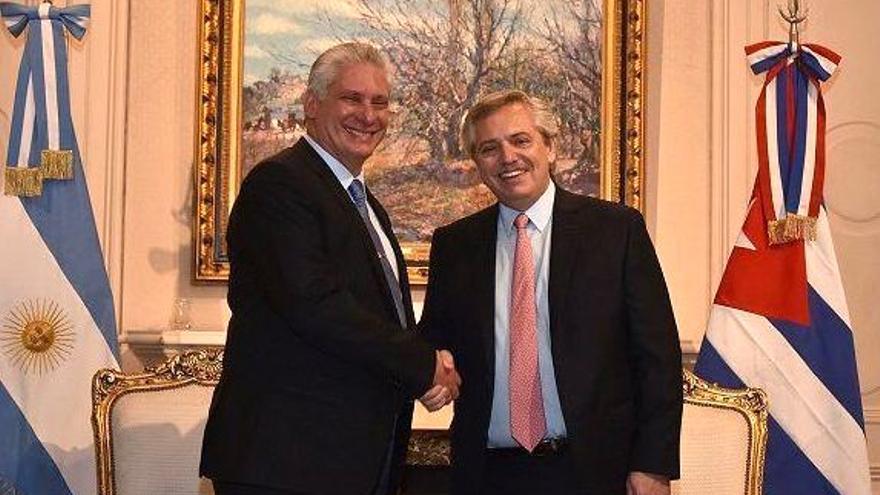
Fernández will arrive in Cuba with a new proposal to collect the debt under his arm. (Cubadebate)

14ymedio bigger14ymedio, Madrid, 4 September 2023 — The Argentine president, Alberto Fernández, will travel to Cuba for the G-77 plus China Summit, which will be held on September 15 and 16, with a proposal for the Cuban authorities to solve the historic debt that the Island has with the South American country. According to La Política Online, Buenos Aires will ask for tax benefits for Argentine companies that decide to set up on the Island in exchange for the amount that Havana owes.

“We want to solve this, then we will see if we sell strawberries or bananas,” one of the technicians working on the proposal told the newspaper. For its part, the Cuban Embassy in Buenos Aires refused to give details to the media. “In Cuba, the tax pressure is low because they are in a rather disorderly process of economic transformation,” said a diplomat close to the situation.

The amount of the debt with Argentina stands, according to this media, at about 3 billion dollars, far from the 15 billion indicated by Infobae in January of this year. La Política Online estimates the exact amount at 2.816 billion dollars, attributed to a loan that originated in 1974 under the direction of Peronist Minister José Bel Gelbard.

At that time, the head of the economy agreed with Fidel Castro on a loan of 1.278 billion dollars for the acquisition of 1,000 tractors, agricultural machinery, 5,515 Fiat heavy trucks and 6,000 Fiat 125 cars, in addition to thousands of Renault 12, Ford Falcon, Citroën Ami 8, Peugeot 404 and 9,000 Argentine Dodge 1500 vehicles. continue reading

In January, Infobae placed the sum at 15 billion dollars that included the 1974 loans plus interest and penalty for non-payment

The debt was totally paralyzed during the military dictatorship that governed Argentina between 1976 and 1983, which maintained excellent relations with the Cuban regime. Raúl Alfonsin was the first Argentine president to visit Cuba and also, according to the local press, the only one who managed to extract a small return of those amounts from Havana.

During Alfonsín’s term, the Island paid about 200 million dollars (102 million in 1988 and 98.6 million in 1989), but the situation was again paralyzed coinciding with the fall of the Soviet Union and during Cuba’s so-called Special Period, after the collapse of the Soviet Union and the loss of its support for Cuba. In 1995, President Carlos Menem attempted a renegotiation of the payment through several missions for an amount that then amounted to about 1.278 billion dollars, including interest.

Foreign Minister Guido di Tella then tried the same thing that Fernández proposes to do in the coming weeks, so that the regime would facilitate investments in public works and tourism. But not even the conversation at the highest level, between the president and Fidel Castro, unblocked the situation.

Under the mandate of Argentine president Néstor Kirchner, also — and later of his wife, Cristina Fernández — an attempt was made to collect the historic debt, in this case through a proposal by Foreign Minister Rafael Bielsa that would consist of a forgiveness of 75% and the payment of the remaining 25% in medical missions, Cuban pharmaceuticals and a cash deposit of the interest. But despite the number of agreements signed between both nations during that time and the solid friendship of the governments, nothing was achieved.

In 2018, then Argentine president Mauricio Macri made the umpteenth collection attempt by sending his Chief of Staff, Marcos Peña, and his Secretary of Strategic Affairs, Fulvio Pompeo, to negotiate.  A year later he tried again with the Secretary of International Economic Negotiations, who met, unsuccessfully, with the Minister of Foreign Trade and Foreign Investment of Cuba, Rodrigo Malmierca.

QUOTE: Last week, Malmierca met with senior officials of the Paris Club to renegotiate the debt he has with several member countries of that group, which currently amounts to 4.827 million dollars

In 2017, according to La Política Online, the debt amounted to 1.278 billion dollars in consolidated capital and 1.273 billion dollars in accrued interest, a total of 2.552 billion that “arose from a debt conciliation and consolidation agreement as of March 31, 1995 between the BICE (Bank of Investment and Foreign Trade) and the National Bank of Cuba ratified by the act of August 24, 1995.” Up to the current amount, more interest on arrears would have accumulated, predictably.

In January, Infobae placed the sum at $15 billion, which included the 1974 loans plus interest and penalty for non-payment.

Argentina’s debt is, according to La Política Online, the largest that Cuba has with another country that is in an inactive state.

Last week, Malmierca met with senior officials of the Paris Club to renegotiate the debt he has with several member countries of that group, which currently amounts to $4.827 billion. According to official information, a new payment schedule emerged from those meetings, after failing to meet since 2020 the deadlines agreed on in 2015, when Cuba was granted a reduction of about $8.5 billion.

In 2021, the regime also agreed with Russia to defer a debt related to state export credits that Moscow granted between 2006 and 2019, in an amount of 2.3 billion dollars. At the time of signing the pact, the non-payment deficit was 57 million, in addition to another 11 million for default interest, which must be returned between 2022 and 2027.

Havana also has among its largest creditors Mexico, Japan and the CRF I Limited fund, as part of the London Club. The foreign debt declared as of 2020 – which has grown by an unknown amount – is almost 20 billion dollars.

Translated by Regina Anavy 

____________

COLLABORATE WITH OUR WORKThe 14ymedio team is committed to practicing serious journalism that reflects Cuba’s reality in all its depth. Thank you for joining us on this long journey. We invite you to continue supporting us by becoming a member of 14ymedio now. Together we can continue transforming journalism in Cuba.

Without Books, Uniforms or Teachers, Cuba’s Students Return to Class Under Painful Conditions

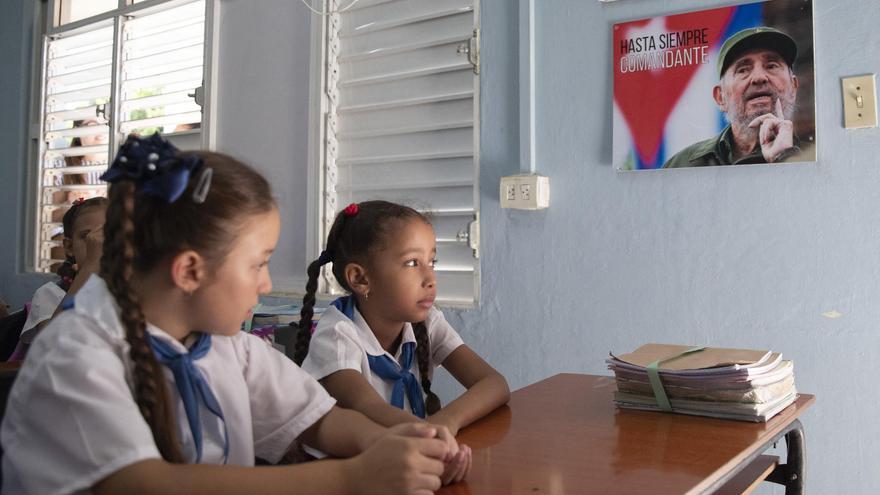
Two girls on the first day of the school year at the Vo Thi Thang primary school in Havana this Monday. (EFE/Yander Zamora)

14ymedio bigger14ymedio, Juan Diego Rodríguez, Havana, 4 September 2023 — The school year that began this Monday in Cuba will be the first to follow the regular calendar after the interruptions and incomplete academic years due to the Covid-19 pandemic. However, few starts of the school year as painful as this one are remembered on the Island. The shortage of books, uniforms and teachers, together with the high cost of materials, worries both parents and students.

“The fact that there are no notebooks or pencils was already a problem… but there are no books! How are children supposed to study at home?” laments María, a resident of Old Havana whose children have not been able to receive the necessary course material. “Not even in the 90s, when I studied, was there this disaster,” she says, referring to the crisis of the Special Period.

Getting school uniforms is also a problem. María’s cousin, whose children are in elementary school, had to ask a relative in Miami to buy the clothes from there. “It is true that for a few years there have been online sites that sell them of much better quality than those in state stores, but now there is no other possible option,” laments the young woman.

Yanelis, another mother from Havana, who lives in the municipality of Diez de Octubre with a daughter in secondary school, says that the biggest problem in her school is the lack of teachers. “They have to wait for the municipality to send a teacher to teach them Spanish, because the teacher they had in other years left,” she says.

That there are no notebooks or pencils was already a problem… but that there are no books! How are kids supposed to study at home?

Another complaint this morning, in the parents-teachers meeting after the morning assembly (the daily ceremony loaded with ideology and political demands), was the heat in the classrooms. Yanelis reports what the teacher answered: “Well, that’s up to the parents, if you want to bring an old fan or anything, that’s up to you.” continue reading

With temperatures approaching 80 degrees Fahrenheit in the shade and few windows, many classrooms become veritable ovens where it is impossible to teach a subject without a cooling device. The fans hardly feature in the official investment figures, but they are vital on a day-to-day basis.

For the rest, the woman assures, “the study material is complete, five notebooks for seventh grade students and six for eighth and ninth graders, and they say that the books, although they are used, are good,” which differentiates some Havana municipalities from what happens in the province, where scarcity is the norm. As she also explained, “these books are only going to be used for a few weeks. At the end of the month they are going to change the books for new ones, because they are going to start a different study system, which they call ‘improvement’.”

That’s how it will be, she continues, for first, fourth and seventh grade students, “because they changed the planning of those courses.” Yanelis refers to something that the Minister of Education, Naima Ariadne Trujillo, explained, with the usual official crypticism in an appearance on State TV’s Roundtable program last Tuesday. “We say that the educational system is always being perfected due to its characteristics, due to its contextual and socio-historical nature. Everything that happened specifically with respect to the pandemic could be faced in a more favorable way and in a position of success, because, one was able to work with more teachers in the preparation,” were the words of Trujillo.

The minister, who on the same program warned of the shortage of books and teachers, attributed the difficulties this Monday, during the official act marking the beginning of the school year, to the “complex international reality” and the “intensification” of US sanctions against Cuba. At the same time, and despite everything, she assured that there are “many reasons” for the country “to be celebrating today.”

Similarly, she mentioned the “problems with teaching coverage,” although without mentioning the unprecedented exodus that the Island has suffered for two years  

Along the same lines, Cuban President Miguel Díaz-Canel tweeted: “The happy day has arrived. Back to the classroom, to classes, to friends, to the certainty that all efforts and sacrifices are worth it to see the future filled with light. Congratulations, Cuba, because, whatever it takes, all your schools are still open.”

On the Roundtable program, the minister had recognized that classes for 1.7 million students between the ages of 5 and 17 would not start in the best conditions. Thus, Trujillo assured that “notebooks and pencils” would be guaranteed, although the semester would be “adjusted” and that “alternatives would be sought to solve the insufficiency of textbooks.” Similarly, she mentioned the “problems with teaching coverage,” although without mentioning the unprecedented exodus that the Island has suffered in the last two years, largely of young people and professionals.

The provinces most affected by the lack of teachers are, the minister explained, Havana, Artemisa, Mayabeque, Sancti Spíritus, Camagüey and Ciego de Ávila. “In the East there is a much more favorable situation than in the Central and Western provinces,” she specified. “In fact, the eastern provinces have become territories that send professionals to the rest of the provinces.”

To solve the shortage of personnel, Trujillo said that they would use “all contracting variants,” such as hourly contracts, “additional loads on a professional manager” or calling on the Educating for Love “contingents” of the University Student Federation (FEU).

On the other hand, the enormous economic burden due to the high cost of materials is something that almost all families already suffer. In Ciego de Ávila, Yeisi had to buy the books and notebooks for her children because, she says, “they did not get a complete set. They were going to distribute what was in very poor condition, one per head.”

“Out of curiosity I have paused to make calculations of what it costs to dress a child for school and I have reached the figure of 30,000 (thirty thousand pesos!), without getting into the subject of snacks and extras for lunch,” explained María Padilla, posting on the networks, who continues: “This number increases as our children grow. We criticize the ‘individuals’, but the State is incapable of providing. Children whose parents do not have economic solvency feel excluded, the teasing children endure is very cruel and marks them for life. Happy back to school? I don’t think so!”

____________

COLLABORATE WITH OUR WORKThe 14ymedio team is committed to practicing serious journalism that reflects Cuba’s reality in all its depth. Thank you for joining us on this long journey. We invite you to continue supporting us by becoming a member of 14ymedio now. Together we can continue transforming journalism in Cuba.

Two Cuban Journalists Arrested While Seeking To Report on the Trial of an Activist in Camagüey

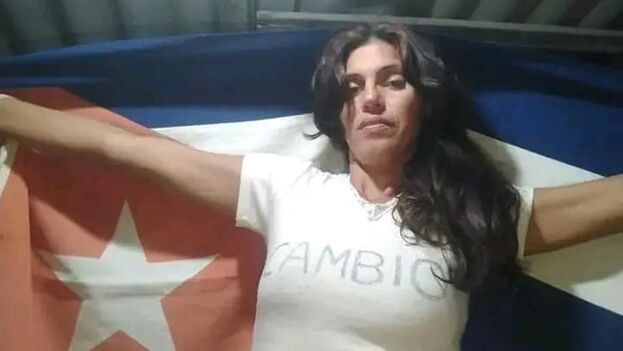
The activist Lenelis Delgado Cué is known on social networks as Mambisa Agramontina Her T-shirt reads “CHANGE.” (Facebook)

14ymedio bigger14ymedio, Havana, 4 September 2023 — Henry Constantín, director of the independent newspaper La Hora de Cuba, is missing. The journalist from Camagüey was arrested along with his colleague José Luis Tan Estrada, this Monday, when both tried to attend the trial against the Cuban activist Lenelis Delgado Cué, who is being prosecuted for the crime of contempt before the Popular Municipal Court of Camagüey.

Tan Estrada was released in the afternoon after spending more than five hours “locked in a dungeon with the most inhumane conditions that can exist,” according to what he himself denounced on Facebook . The reporter was fired at the end of last year from his position as professor of Journalism at the University of Camagüey for, according to the academic authorities, being a “negative influence on the students.”

As for Constantín, his phone continues to be off this Monday afternoon and this newspaper has not been able to contact him or his relatives. La Hora de Cuba reported it was unable to reach the court because “from the early hours of the morning” it was “surrounded by police and State Security agents.”

Lenelis Delgado, known on social networks as Mambisa Agramontina, has been in prison since April 4, when she was arrested at her home and transferred to the State Security headquarters in Camagüey known as Villa María Luisa. She is currently being held at the Kilo 5 Women’s Prison.

“She is in good health and firm in her convictions. My daughter is my pride and she will never fail her ideas and her fight for the freedom of Cuba”

Last October, Delgado had been fined 3,000 pesos under Decree Law 370, after “exercising her freedom of expression on Facebook,” La Hora de Cuba published when interviewing her. At that time, she was “accused of disobedience, with the risk of imprisonment, for not responding to a police summons.” The activist, a mother of three children, was intimidated after making several live broadcasts criticizing the island’s regime. continue reading

More recently, she denounced on social networks the repression against her friend also activist Aniette González, who was tried for the crime of “insulting patriotic symbols.” González, 43, was arrested on March 23 in Camagüey for posting photos on social networks of her body covered with the Cuban flag. Delgado, on the cover of her Mambisa Agramontina Facebook page, has a collage with González’s photos next to the flag.

“She is in good health and firm in her convictions. My daughter is my pride and she will never fail her ideas and her fight for the freedom of Cuba,” the activist’s mother, Leticia Cué, told La Hora de Cuba. Last July, through the Cuban Observatory for Human Rights based in Madrid, Cué denounced “the arbitrary repression against my daughter, who was prevented from using the telephone to make calls to family and friends for two months.”

From prison, Delgado also warned that she suffered from scabies and did not have medical attention from prison health personnel. José Luis Tan Estrada, who received a call from the opposition, made public Delgado’s medical situation: “The doctor does not know that I exist,” Delgado told the journalist.

____________

COLLABORATE WITH OUR WORKThe 14ymedio team is committed to practicing serious journalism that reflects Cuba’s reality in all its depth. Thank you for joining us on this long journey. We invite you to continue supporting us by becoming a member of 14ymedio now. Together we can continue transforming journalism in Cuba.

Cuba: If Gas Stations Eliminate Payment in Cash, What Will Happen Next?

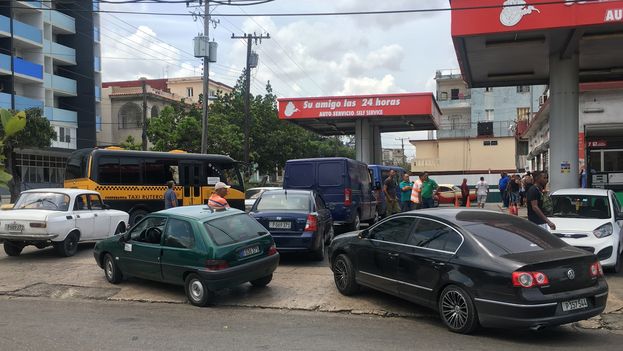
Gas stations all over Cuba often have long lines of vehicles are waiting their turn. (14ymedio)

14ymedio bigger14ymedio, Elías Amor Bravo, Economist, 3 September 2023 — With the Cuban economy suffering the acute effects of stagflation (economic stagnation and inflation), from which the authorities are unable to extract themselves, the demand to give continuity to the banking reform being referred to as bancarización* and the elimination of cash in payments for different goods and services continues with renewed force. Cubans continue to encounter initiatives of the regime that, far from facilitating things, make them more and more difficult. All this was discussed in a recent edition of State TV’s Roundtable program, in which the issue of electronic payments in the Cimex and Tiendas Caribe shops and at gas stations was raised. The first two have always been worried about being first in line for the digitization process required by the regime, so they are taking steps to reinforce that position. Gas stations seem to be forced, likewise, to demand cards from their customers for payment and to stop accepting cash. And they said it was going to be a gradual process.

However, these Roundtable programs end up becoming a space in which initiatives that are related to what happens in reality are announced by the attendees, so that, once again, the attendees defended bancarización in their respective areas of action, without revealing the background data that are really related to it.

Because if the CIMEX  Corporation and Tiendas Caribe are intended to be meant as key players in the development of digital commerce experiences that drive the bancarización process, they should indicate what percentage of the Cuban population has access to their products and services. For this it is necessary to mention the informal exchange market, which, as Minister Gil acknowledged in the Assembly a few months ago, barely reaches 30% of the retail sector.

The rest of Cubans, existing in the area of poverty and loss of purchasing power because they only have Cuban pesos, have it much worse. So everything said in this edition of the Roundtable has to do with a limited part of the Cuban population, a scenario of deep and serious economic and social inequalities that the regime accepts, and even promotes, because it needs to dispose of those currencies that circulate in the population, at any price. continue reading

And since in these Roundtables we are never amazed by what is said, it turns out that one of the attendees, Yamil Hernández, manager of Fincimex**, explained that his entity has been charged by a monopoly regime with managing the only financial card processing center that exists in the country, presenting this as “an idea of Fidel Castro concretized in the 90s that allowed us to conform to international standards of being able to process international cards and create the bases of national issuers and domestic cards in the country.” Yes, unbelievably, Fidel Castro personally decided who made the plastic money in Cuba. Just Imagine.

After this “tribute” to the dictator, Hernández pointed out that in recent years there has been a “quantitative and qualitative leap in the processing of international and national cards, demonstrated by the technological transitions we have been able to undertake, the volume of transactions managed and the number of POS operations in the nation.” And he pointed out that the deployment of the IP network in the country did not take place until a date as recent as 2018.

In this regard, he indicated that 18,530 point-of-sale terminals are currently operating in the country, with an annual growth of 39%, clearly unbalanced and asymmetrical, since notable territorial inequalities are observed, with the provinces with the lowest increase being Guantánamo, Mayabeque and the Special Municipality of the Isla de la Juventud (Island of Youth). He also acknowledged that as the number of transactions grew, “difficulties still persist in the use of POS, since there are about 3,000 terminals that have not been used in the last quarter. In sum, 23% of the network, almost a quarter of establishments, have no operations.

The director pointed out that they have the objective of achieving the disaggregation of the network, since currently 70% of the network is focused on the organizations with the best connectivity conditions belonging to the tourism sector, CIMEX, TRD and the Bank. Other actors such as ETECSA, Mincin, airlines and non-state actors also have a number of POS in their establishments, but in the rest of the Cuban economy, the segment of poverty and the Cuban peso, these percentages are not given. And it doesn’t look like that’s the way it’s going to go.

Because, in addition to this development, the existence of recurring complaints in the population is recognized, of which the most relevant is the connectivity and the absence of an infrastructure that guarantees the connectivity of Fincimex and the response of the issuer. And here were cited several cases that really affect the process of bancarización of operations, such as local disconnections or problems with the platform that require a continuous level of investments, which the regime does not guarantee, given the concentration of investments in hotels.

Another no less important complaint from the population has to do with the requirement to capture the client’s personal data when an operation is carried out. People still do not trust service providers despite the fact that banks or businesses are obliged to validate identities. The fear of control is a real brake on operations.

Likewise, the director reported that 77% of Cimex establishments accept the QR code for payment, which is operated by the largest POS network in the country, and he announced the intention to “create new added values, re-analyze the commissions applied to customers, personalize the service, incorporate Android technology and wireless POS, as well as sustain the quality of the network.”

Regarding the QR code, he said that two types have been developed, one issued by the equipment itself and 127 units where the QR code is issued by the cashier, which allows two payment variants, by national and international cards and by QR codes. He announced the intention to expand the number of wireless POS terminals with all modalities such as those recently incorporated into the restaurants of the historic center.

Next, Marta Mulet, commercial specialist of Tiendas Caribe, intervened, and pointed out that since March 2022 they added different payment channels, which allowed sales to triple after starting in a single store and gradually extending the process to the rest, such as on the beaches of eastern Havana or at “electronic fairs that are organized with different organizations and actors in the provinces.”

Regarding the operation of electronic payment in the country’s services, Yamil Hernández said that there is a culture in that sense, that it was making its way from transactions with business cards and that seven million transactions with cards of this type have already been processed. In any case, given the small size of the fleet of cars and private vehicles in Cuba, the impact of these transactions is limited, and, once again, it brings notable economic and social inequalities.

Among the means of payment that were studied to carry out the operations were disposable cards, a product designed for eventual consumers (tourists, for example), who can purchase them in more than a thousand Cimex establishments, with telecommunications agents in Cimex and in Cadecas. He reported that more than 19 million disposable cards have already been sold to date and that the process has been modified, according to the needs of consumers. For example, the possibility of linking up to five cards at one time and the development of a mobile application that allows customers to check the balance of their cards, to see if they are active, etc.

Electronic pins are also available to customers, a modality developed in conjunction with Transfermóvil, and through this application, customers can buy a fuel coupon. When they go to the gas station, Transfermóvil shows a QR code, which the clerk scans and charges through that route. And here it was said that the “most innovative option is the rechargeable chip card, designed for customers who do not necessarily bank, since it is a modality that does not require connection, and as long as there are credits on the chip, the operation is authorized.

The card is free of charge, distributed in the Fincimex offices located in the provincial capitals. In the case of Havana, it is also available in 23 Cimex establishments. To create a credit on the balance, Yamil Hernández reported that there are 433 points where it can be done, by bank card transfer or in cash.

The Roundtable attendees concluded that the gas stations are an “avant-garde institution in the use of digital payment in Cuba” and that this transformation implies a challenge in terms of attention to the consumer and the need to instruct him. Lázaro Ayala, director of Servicentros of Cimex, said that “a work schedule was designed to implement the transition to digital payment gradually, so that the cash sale of fuel in all gas stations is eliminated.”

Some 99% of the gas stations have an IP connection, except for two in Matanzas where the rechargeable chip card can be used. For three years they have given seminars to workers, so that they can give their customers clear explanations about the various means of payment they can use.

And at this point it was announced what was feared by some spectators who survived the Roundtable at that late hour, which is that those customers who don’t have an online payment method but have the physical money will be able to purchase the rechargeable chip cards in an area adjacent to the service providers. No one escapes the hierarchical order of the regime. And cash is seriously running out in the gas stations.

So the message was very clear: “Beginning September 1 and until October 31 we will gradually eliminate the sale of fuel in cash in the gas stations. This process will be accompanied by our Cimex directors and officials, to resolve any eventuality.” The statement is not exempt from sarcasm: “in case of complaints or suggestions, the administrators of the services can be contacted, and, if the problem is not resolved, there is a unique number established for customers to address their concerns (80000724), the Cimex profiles on social networks or the email atencionalcliente@cimex.com.cu.” No more paying for gasoline in cash.

Translator’s notes:

*”Bancarización” is a term used in Cuba and other Latin American countries that refers to government efforts to reduce the role of cash through a greater reliance on banks’ digital payment options. The term does not seem to have a counterpart in English so the Spanish term is used throughout this translation.

**Financiera Cimex S.A. (FINCIMEX) is a financial investment and remittance company owned by GAESA and incorporated in Panama. Grupo de Administración Empresarial S.A. (GAESA) is a Cuban military-controlled umbrella enterprise with interests in the tourism, financial investment, import/export, and remittance sectors of Cuba’s economy. GAESA’s portfolio includes businesses incorporated in Panama to bypass CACR-related restrictions.

Translated by Regina Anavy

____________

COLLABORATE WITH OUR WORKThe 14ymedio team is committed to practicing serious journalism that reflects Cuba’s reality in all its depth. Thank you for joining us on this long journey. We invite you to continue supporting us by becoming a member of 14ymedio now. Together we can continue transforming journalism in Cuba.

The Free Visa Offered by Nicaragua to Cuba and Belarus Opens the Door to ‘Undesirables’

The latest countries to which Ortega has granted a free visa, with marked political interest, have been Cuba, Belarus and Kazakhstan. (EFE)

14ymedio bigger14ymedio, Havana, 31 August 2023 — Nicaragua and Belarus agreed to establish the free visa reciprocity, a gesture that consolidates the alliance that both regimes have been strengthening for months. The agreement, signed this July and announced on August 22 by the Nicaraguan press, has aroused criticism from citizens and opponents of the Government of Daniel Ortega, who fear the entry into the country of “undesirable” visitors.

An expert in international relations, quoted anonymously by the newspaper La Prensa, described the resolution as “illegal” and pointed out that mismanagement of trafficking between countries with “political instability” could not only “cover up illegal migration to third countries – an experience that Nicaragua had with the stampede of migrants from Cuba – but also “the transit of drug traffickers and terrorists.”

The newspaper recalled that the last countries to which Ortega  granted a free visa have been Cuba and Kazakhstan, societies that live “under authoritarian regimes like Nicaragua,” and that are far from generating beneficial tourism for the Central American nation.

“The free visa aims to facilitate the transit of citizens of a country for tourist, business or family purposes.” However, the sources consulted by La Prensa say that the reasons for the Ortega regime point to the political and economic benefits it can obtain from its allies. continue reading

The alliance between Nicaragua and Belarus has been justified before the press with numerous cooperation projects

“From a perspective of rapprochement with the Caribbean,” it would make sense for Nicaragua to soften immigration controls for Cuban travelers, Nicaraguan political scientist Félix Maradiaga explains to the media. However, taking into account the inability of Cubans to “save money and travel abroad,” as well as their low wages, it’s obvious that the rapprochement is thanks to “the ideological affinity with the Cuban regime,” he says.

In the case of Belarus, “a satellite state” that responds to the interests of Russia, the free visa is “even less justifiable,” said Maradiaga, who fears that Nicaragua will become involved in the Russian invasion of Ukraine.

The alliance between Nicaragua and the European country has been justified to the press by the numerous cooperation projects in which Belarus pledged to provide machinery for the agricultural sector and credit for the purchase of urban transport and construction equipment.

Ortega’s opponents, for their part, allege that it is a strategy to ensure the support of the Nicaraguan government for Russia in its campaign, a method that has also been used in Cuba, which receives perks from Vladimir Putin’s regime in exchange for offering him international support.

At the summit between the Community of Latin American and Caribbean States and the European Union, held in Brussels in mid-July, Nicaragua refused to sign a declaration against the war in Ukraine, as did Cuba. Both countries, with the support of Venezuela, prevented the Ukrainian president, Volodymyr Zelensky, from attending the event.

Translated by Regina Anavy

____________

COLLABORATE WITH OUR WORKThe 14ymedio team is committed to practicing serious journalism that reflects Cuba’s reality in all its depth. Thank you for joining us on this long journey. We invite you to continue supporting us by becoming a member of 14ymedio now. Together we can continue transforming journalism in Cuba.

The Supreme Court of Mexico Demands Data on the Expired Doses of Cuba’s Abdala Covid Vaccine

At least 335,244 doses of the Cuban Abdala vaccine, which was bought by Mexico, expired in August. (@SSaludCdMx)

14ymedio bigger14ymedio, Ángel Salinas, Mexico, 1 September 2023 — The Supreme Court of Mexico has ordered the Federal Ministry of Health on Thursday to reveal the number of vaccines against COVID-19, including the Cuban Abdala, which expired before their application, as well as the manufacturer and batch of origin. In a statement, the Court stressed that this information “does not put national security at risk” nor the fight against the pandemic, as argued by the Government, which did not want to reveal the data.

14ymedio learned that at least 335,244 doses manufactured on the Island expired in August and that they had been distributed in the states of Coahuila, Chihuahua, Jalisco, Puebla and Oaxaca. Of these, 70,000 were authorized in Coahuila to be applied as a booster against the virus for another 18 months.

The Government of Mexico also defined as “classified,” for five years, all the information related to the hiring of Cuban specialists, as well as the agreements and payments made for the shipment of 9,000,000 doses of the Abdala vaccine. The Judicial Counsel blocked the information, claiming that offering details about the process of confidentiality agreements could be taken advantage of by criminal groups.

An intensive care nurse, Vannesa Ordoñez, who denounced the use of expired Cuban doses in Coahuila, told 14ymedio that in the state of Zacatecas, 400 doses of the Pfizer vaccine, expired since November 2022, were injected into children who went to the Francisco Esparza health center. continue reading

COFEPRIS authorized the use for another 18 months of the 70,000 doses of the Cuban Abdala vaccine that expired in August. (Facebook/Coahuila Ministry of Health)

“There is concern in health personnel because this was made known just after COFEPRIS (the Federal Commission for Protection against Health Risks) authorized the use of expired Cuban doses in Coahuila. In Zacatecas there was an anonymous complaint, which we were able to verify,” she explains. Ordoñez warned that “children are a vulnerable sector, and every medicine given to them must be made transparent. The parents are the ones who give consent, and they must be informed.”

Last January, expired doses of Pfizer were also used under the argument that they could be administered up to 12 months after the expiration date, October 31, 2022, as indicated on the bottle. On that occasion, the authorities of the state of Guerrero assured that “there was no problem” and that the drugs “served and could be administered until February” of 2023.

In September of last year, it was shown that the Government of Mexico had disposed of 5,041,050 doses of anti-covid vaccines, of which 3,409,440 were from the British AstraZeneca vaccine and 1,631,610 from the Russian Sputnik, which were in a warehouse of the Birmex company and in the National Institute of Virology.

Mexico has acquired anti-covid vaccines of different brands from several countries, such as Pfizer, Cansino, Covax, Sputnik-V, AstraZeneca, Janssen, Moderna and Abdala. According to official figures, out of 129 million Mexicans, some 90% of the country’s population has been immunized.

Despite the fact that the Abdala vaccine has been rejected by the population because it does not have the endorsement of the World Health Organization, COFEPRIS, in charge of the control of medicines, authorized the use of the Sovereign 02 and Sovereign PI doses, manufactured on the Island.

Translated by Regina Anavy

____________

COLLABORATE WITH OUR WORKThe 14ymedio team is committed to practicing serious journalism that reflects Cuba’s reality in all its depth. Thank you for joining us on this long journey. We invite you to continue supporting us by becoming a member of 14ymedio now. Together we can continue transforming journalism in Cuba.

Cuba’s Umpteenth Negotiation With the Paris Club for Non-Payments, Meanwhile Luxury Hotels Multiply

The Paris Club asks Cuba for a new payment schedule to meet its debt. (Latin Press)

14ymedio bigger14ymedio, Madrid, 31 August 2023 — The future of Cuba’s 4.827 billion dollar debt with its Paris Club creditors is at stake today in Havana. According to the official press, William Roos, co-president of the institution, proposed establishing a new calendar in accordance with Cuba’s ability to pay after expressing that “there is understanding towards the difficulties that the island is going through.”

The official traveled to Havana this Tuesday together with Fabien Bertho, secretary of the Paris Club, to meet on Wednesday with Ricardo Cabrisas Ruiz who, in addition to being vice prime minister and head of Foreign Trade and Foreign Investment, has been the main actor of the foreign debt renegotiation agreements with its different creditors.

In the talks, which culminate today, the Cuban side argued that “the political criminal and the illegitimate inclusion” of Cuba in the list of State sponsors of terrorism hinders access to sources of financing and foreign investment, “when in the midst of the rise in prices Cuba needs foreign currency for its economic and social development and to fulfill its obligations.”

Cuba will obtain a new payment schedule to pay a debt that continues to be the second highest in the region, only surpassed by Venezuela, whose debt exceeds eight billion dollars

If Cabrisas manages to convince the Paris Club that in order to pay the debt the constant Russian and Chinese investments in the Island or those that the Government itself allocates to the construction of hotels are not continue reading

enough, Cuba will obtain a new payment schedule to pay a debt that it has negotiated twice in the last eight years, a debt that continues to be the second highest in the region, only surpassed by Venezuela, whose debt exceeds eight billion dollars.

Cuba’s creditors within the Paris Club are Australia, Austria, Belgium, Canada, Denmark, Spain, Finland, France, Italy, Japan, the Netherlands, Sweden, Switzerland, and the United Kingdom. Until 2015, the debt amounted to 10.66 billion dollars. That year, a reduction traditionally calculated at 8.5 billion was negotiated, although the documentation for the years 2016 and 2017 is not archived on the institution’s website.

In 2018, the amount amounted to 5.56 billion dollars, which was reduced to 5.211 billion in 2019. But with the arrival of the pandemic, Cuba stopped paying the installments and, at the end of that year, the amount had increased to 5.667 billion dollars.

Cabrisas held several meetings in 2021 to improve the conditions for payment of installments. At that time, they also noted the “unprecedented tightening of the economic, commercial and financial blockade of the United States and the impact of phenomena associated with climate change and the covid-19 pandemic.” The authorities promised that, after the worst of the pandemic, tourism would recover and the money would come again and they obtained new relief, with a moratorium until 2022.

What the regime had not calculated is that the tourists would not return as expected. Last year, of the 2.5 million international travelers expected, the number did not even reach 1.7 million. An adverse international economic context together with a terrible management of the so-called Ordering Task* finished off an economy battered for decades and that has plunged the Island into the worst crisis in living memory, at the level of the Special Period of the 90s.

The payment schedule, therefore, becomes impossible, which is why the Government is focused on obtaining a new extension, which it will also try to encourage with the visit of the Paris Club representatives to various bilateral collaboration projects, with financing from the French Development Agency and the Franco-Cuban Contravalor Fund, which are part of the agreements.

In its latest Statistical Yearbook, corresponding to 2023 and published this August, Cuba declared almost 20 billion dollars in foreign debt, but the data refer to 2020

In its latest Statistical Yearbook, corresponding to 2023 and published this August, Cuba declared almost 20 billion dollars in foreign debt, but the data refer to 2020, confirming suspicions that the 18.2 billion dollars it owed in 2016 would have increased.

In 2021, Cuba also agreed to a deferral of the payment of its debt with Russia, which it had stopped paying in 2020. In this case, the amount is relative to state export credits that Moscow granted between 2006 and 2019, with a total amount of 2.3 billion dollars. At the time of signing the pact, the default deficit was 57 million, in addition to another 11 million for late-payment of interest, which must be returned between 2022 and 2027.

Years ago, Raúl Castro had already managed to get Moscow to forgive 90% of the 35 billion dollars of the debt contracted during the time of the USSR.

Other minor creditors are Mexico, which in 2013 forgave 70% of the 487 million dollars it had lent to the island, and Japan, which a year later in 2014 granted a one billion dollar debt relief. Vietnam and China have also forgiven an unknown amount to the Island.

The palm, however, goes to the historical debt of 15 billion that Cuba owes to Argentina. Several of its leaders, including the current one, Alberto Fernández, have urged the Island to return it or to negotiate an exchange for it – an exchange for vaccines was even negotiated, which did not prosper – but every attempt has been unsuccessful.

A separate case is that of the debt with the London Club, which has reached the courts and is still far from being resolved. This April the trial was held to determine whether the CRF I Limited Investment Fund was the holder of the 72 million euro debt that Cuban financial institutions signed with entities later acquired by it.

The ruling confirmed that the CRF was the legitimate owner, although the consequences are nothing more than an offer from its president to now negotiate a payment schedule. “[We must] find a solution with Cuba that (has) zero impact on its budget for at least five years, recognizing the difficult economic situation the country is going through,” it said.

*Translator’s note: The “Ordering Task” [Tarea Ordenamiento] is a collection of measures that include eliminating the Cuban Convertible Peso (CUC), leaving the Cuban peso as the only national currency, raising prices, raising salaries (but not as much as prices), opening stores that take payment only in hard currency which must be in the form of specially issued pre-paid debit cards, and a broad range of other measures targeted to different elements of the Cuban economy. 

____________

COLLABORATE WITH OUR WORKThe 14ymedio team is committed to practicing serious journalism that reflects Cuba’s reality in all its depth. Thank you for joining us on this long journey. We invite you to continue supporting us by becoming a member of 14ymedio now. Together we can continue transforming journalism in Cuba.