
Our Intellectual Stupidity

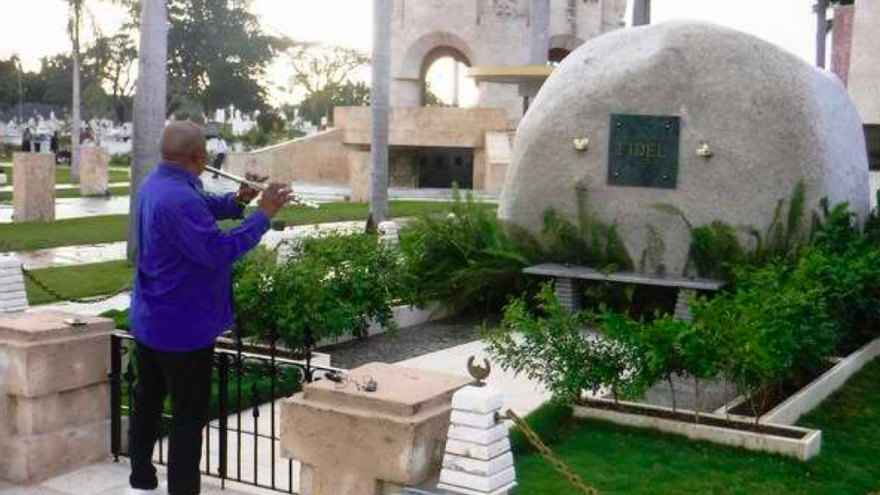
Like dozens of other artists and intellectuals, flutist José Luis Cortés (a.k.a “El Tosco”) pays homage at the tomb of Fidel Castro. (Juventud Rebelde)

14ymedio bigger14ymedio, Yunior García Aguilera, Madrid, 7 February 2024 — No one is stupider than the idiot who thinks he is an intellectual, myself included. When I started becoming politically active, I arrogantly believed that, where others had failed, I would succeed. I thought that the higher the collective IQ a movement had, the better its chances of success. I figured that the more illustrious the names on the list, the more people would be willing to join. I had forgotten that most of our mambises* were illiterate.

For the last two years, the resistance and the fight for change in Cuba have been led primarily by the poorest, least enlightened people, not by some egghead. The most significant aftershocks of the mass demonstrations on 11 July 2021 have occurred in marginalized areas, far from provincial capitals. The very few scholars who have displayed a courageous, dignified attitude have had to deal with a very harsh isolation, beyond the metaverse.

On the other hand, the dictatorship knows it can rely on the support of tens of thousands of ambidextrous artists and intellectuals who, yes, do offer some criticism from time to time, following the mantra “a little positive, a little negative.” But they still sign loyalty oaths, attend marches and official events, and remain active in the National Writers and Artists Union (UNEAC) or the Hermanos Saíz Association (AHS), organizations which exist expressly and openly to monitor and control their members, not to promote their work in any way. continue reading

Why do exceptional cases, like members of the Filmmakers Assembly, run around in circles, ruminating on the same statements and making the same speeches?

So what’s going on? Why have Cuba’s cultural and academic unions not known how, not been able, or not wanted to effectively articulate ways to bring about change? Why do exceptional cases, like members of the Filmmakers Assembly, run around in circles — ruminating on the same statements and making the same speeches — like cattle heading inexorably to the slaughterhouse, never leaving the corral?

By the time Fidel Castro issued his ultimatum**, “Words to the Intellectuals,” State Security had already meticulously planned how to keep us subjugated. They would employ our own egos against us, our very enlightened banalities, our jealousies and envies, our desire to be in the spotlight, our ambiguities, our contradictory herd mentality. Their tactics and strategies ranged from flattery — designating sacred cows and golden calves — to public sacrifices which would serve as a lesson. We normalize the use of masks and the misuse of allegories.

It is so sad and so naive when an artist boasts of having defended himself against his inquisitors by saying, “That is not what my work says. You are just interpreting it that way.” It is so very painful to have to hide behind an alter-ego to say what we dare not say aloud  to ourselves.

It is so very painful to have to hide behind an alter-ego to say what we dare not to shout ourselves

When a state-supported intellectual asks to speak at a meeting, he first asks himself if it will be the right time and place to say what he thinks. He then starts his speech by clarifying that he (or she) is indeed a true revolutionary and that his criticisms are, of course, from within. In common parlance, this is referred to as putting on a patch before there is a hole. When the person in question finally finds the courage, he launches into a stern criticism of himself. Never against the disease, only against the symptoms.

Those with experience in this type of public venting know all too well that the the big shots really enjoy attacks like this, which are directed at low-ranking officials. It is the perfect opportunity to display power, demagoguery and populism. They will make a fool of the little guy even if his misstep is the result of an order from above or something endemic to the system.

This sacrifice — the fall from grace, the exile of one’s contemporaries — benefits the mediocre intellectual. It presents an opportunity to attain what had previously been out of reach. That is why almost all the country’s top prizes and awards ignore Cubans living overseas. Their colleagues on the island do not want the competition. They should have eliminated the National Prizes’ absurd categories long ago but the topic is never even mentioned at their conferences.

The Spanish word necedad, a term the regime’s defenders use to explain their actions, can mean stubbornness or obstinancy. But if you look it up in a dictionary, the first synonyms you find are simply stupidity, imbecility, idiocy and nonsense.

José Martí and Reinaldo Arenas would be disgusted by all these supposed intellectuals who believe themselves to be superior for knowing how to disguise their cowardice as intelligence.

Translator’s notes:
*Afro-Cuban insurgents who fought for Cuba’s independence from Spain in the 19th century.
**”Within the Revolution everything, outside the Revolution nothing.”

__________________

COLLABORATE WITH OUR WORKThe 14ymedio team is committed to practicing serious journalism that reflects Cuba’s reality in all its depth. Thank you for joining us on this long journey. We invite you to continue supporting us by becoming a member of 14ymedio now. Together we can continue transforming journalism in Cuba.
‘They Threw Us Out Like Dogs’, Say the People Evicted From Factoria 70 in Havana

Those thrown out have a month to collect their things from the warehouse where the local authority put them.

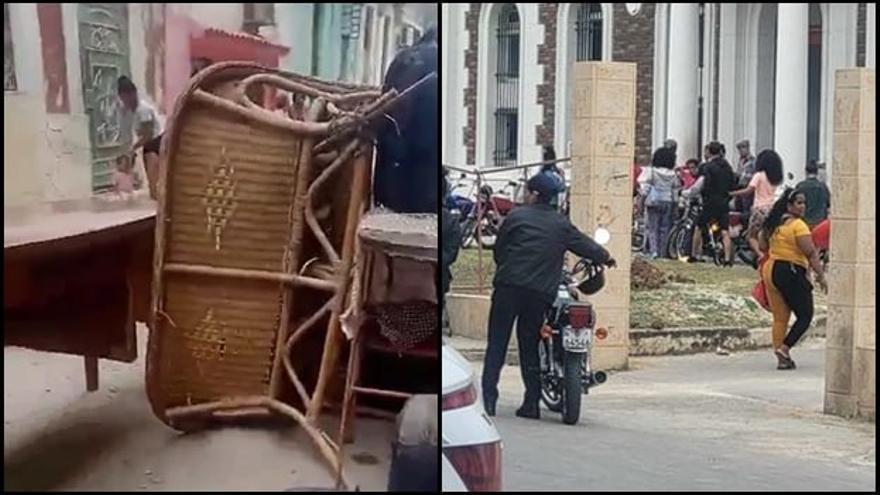
14ymedio bigger14ymedio, Juan Diego Rodríguez, Havana 7 February 2024 — “Easterners, gay AIDS patients, the elderly, women with their husbands, children and people who have nowhere to live,” is how Yunier, one of those evicted from Factoría 70 between Corrales and Apodaca in Old Havana, described the situation of the people who were evicted on 31 January because the building was in danger of collapsing. “They dragged us all out of the place like dogs”.

The nearly one hundred people who were illegally occupying some 26 rooms in the building were evicted by the police and several local government officials, Yunier says. They were mistreated and given no assurances, although not all versions of what happened coincide. “They told everyone to find by themselves places to stay. They told them to go back to where they came from. The only thing they set up was a warehouse to store things while we found a place”, says the Havana native.

The evictees’ belongings can only stay there for a month, Yunier explained. The young man remembered how, about three years ago, people began to move into the the building, which had been declared uninhabitable by the authorities. “The people who were moving in began to put up windows and doors, and to organise the rooms a bit. Almost all were from Santiago de Cuba and Guantánamo, although there were some from Havana”. The former inhabitants of the building, he said, had previously been moved to shelters. continue reading

He said that none of the people living in Factoría 70 received any eviction notices. The police arrived on 31 January, asked the residents for their ID cards and took them to Dragones station. “They handed out fines and let us go, and said they were going to come back another day, but they showed up the same day at five in the afternoon,” Yunier recalled. “The police wanted to finish before dawn, so that none of this would get out and people wouldn’t notice. The one who said we had to leave was a policeman from Dragones”, saids the young man. “Agents on motorbikes and other vehicles arrived,” as well as a government superintendent from Old Havana who did not identify himself. Five other officials with him also did not give their names..

The eviction was tense, said Yunier. “They threatened us. They said that if we didn’t leave they were going to do bigger things”. Homosexuals got the worst of it and were threatened by the officers: “You shut up. You are birds and we don’t want your comments. Similar things were said to the people from Santiago and Guantánamo, who were told that they “should go back to the East”.

Now the evictees are worried about what will happen to their belongings in the “goods warehouse” where the local government stored them. “So far nothing has been lost,  but they might be,” he said.

The person who stands to gain most from the emptying of the building is, Yunier guessed, the president of the Committee for the Defence of the Revolution (CDR) on the block where Factoría 70 is located. The Havana native identifies him as Santiago, owner of a hostel and a pink convertible car, with “a lot of power and money”.

Yunier thinks that the person who stands to gain most from the departure of the building’s occupants is the president of the Committee for the Defence of the Revolution

Santiago offers tourists rooms in his early 20th-century mansion, as well as providing tours of Havana and other parts of the country in his vehicle. On his social networks, a photograph taken in mid-January shows the crumbling façade of the building, still inhabited, as evidenced by the sheets spread out on its balconies, as a backdrop to his shiny convertible.

Yunier mentioned a rumour circulating among neighbours, that Santiago has enough influence over the government and the local police to speed up the eviction. His goal: to have a free hand to expand a car workshop he owns on the ground floor of the building. “He was the one who provided the materials to close the door of the building, cement, blocks and so on. Now he has started to store more cars.

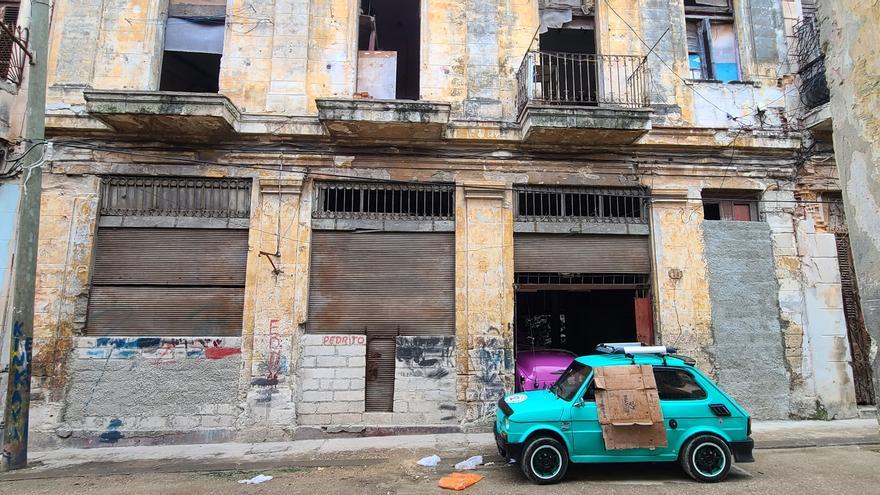
The Factoría 70 building, which was formerly a stately three-storey building, with ochre walls stained by damp

Other nearby residents also point to his desire to “calm the block” as one of the main motivations for the prosperous businessman to push the authorities to act. Although it is  within touristy Old Havana, the Jesús María neighbourhood where the building is located does not see many tourists due to the poor state of its infrastructure — which has barely benefited from renovations — and its crime level.

At the Factoría 70 building, formerly an imposing three-storey building, the walls remain ochre and stained by damp. Inside the ruin, families lived in overcrowded conditions and there were lots of issues between neighbours.

Recent rains have battered the now abandoned building even more, and the only thing with any colour in the area is the pink convertible. Those who left Factoría 70 are still looking for somewhere to sleep, in a city that is getting rougher every day for newcomers as well as for locals. Yunier’s diagnosis is pessimistic. “There is nowhere to live in Havana. They don’t say anything. They don’t help anyone. Nobody gives you any hope.

Translated by GH

____________

COLLABORATE WITH OUR WORKThe 14ymedio team is committed to practicing serious journalism that reflects Cuba’s reality in all its depth. Thank you for joining us on this long journey. We invite you to continue supporting us by becoming a member of 14ymedio now. Together we can continue transforming journalism in Cuba.
A Cuban Court Alleges that Otero Alcantara Is Not Ready for ‘Social Reintegration’

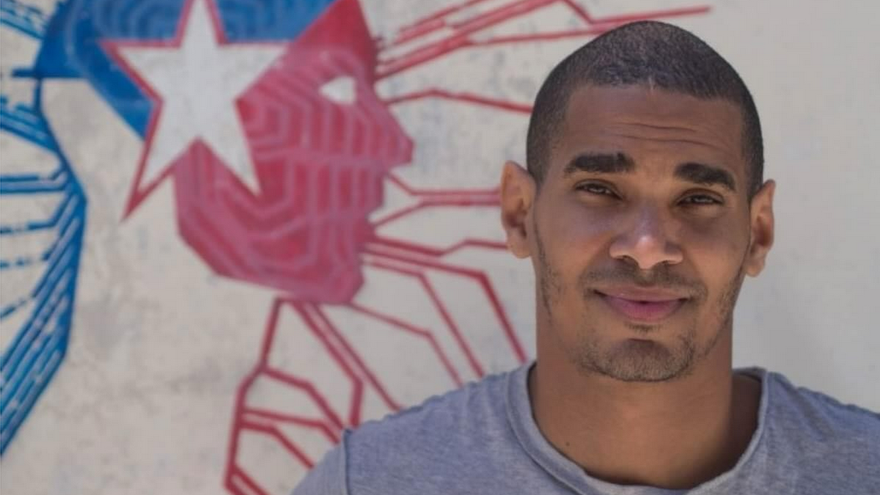
Luis Manuel Otero Alcántara has been in prison since July 2021 and has served half of the five-year sentence imposed on him. (IG/ Claudia Genlui)

14ymedio bigger14ymedio, Havana, 8 February 2024 — The Provincial Court of Artemisa rejected an application for parole for the Cuban artist and political prisoner Luis Manuel Otero Alcántara, as revealed on Wednesday by art curator Claudia Genlui on her social networks.

The leader of the San Isidro Movement was imprisoned in July 2021 and sentenced in June 2022 to five years in prison for the crimes of insulting the symbols of the homeland, contempt and public disorder. Despite the fact that he was not legally eligible to apply for parole, the reason, according to Genlui, is not related to those regulations.

According to the resolution, “The purposes of the penalty have not been achieved, and he is not in a position to face social reintegration in a positive way before family and society. The maximum penalty, having to remain in prison, applies for crimes under Instruction 273 of the Council of Government of the Popular Supreme Court.” continue reading

In this sanction, “the purposes of the sentence have not been achieved, and he is not in a position to face social reintegration in a positive way before family and society”

Genlui, the artist’s partner and one of his main spokespersons since he entered prison, said that Otero Alcántara’s family and friends will continue to denounce the violence of the system, which never ceases to intimidate citizens. “Those who are not in a position to face society or their own relatives are all the Castro judges, prosecutors and military who are part of the fascist and macabre game of the dictatorship,” she wrote.

The law specifies that any prisoner who has served a third of his sentence, in the case of children under 20 years of age at the time of imprisonment, or half the penalty for primary sanctions and two-thirds in the case of repeat offenders, is able to apply for parole. The latter would be the case of the artist, who since 2017 has suffered a multitude of arrests, the first that year for “illegal possession of construction materials” related to the 00 Biennial, an alternative art exhibition to the official Biennial of Havana.

It is unknown if the court states in its resolution that the artist does not meet any formal requirement, but it does point out reasons related to an alleged inability to live in society. In addition, it expressly alludes to Instruction 273, approved by the Supreme Court in 2022 and called the “policy of rigor in the face of the most harmful behaviors that affect society and the population.” It lists a long series of crimes that affect “citizen tranquility” including “altering public and constitutional order.”

Instruction 273, approved by the Supreme Court in 2022, is called the “policy of rigor in the face of the most harmful behaviors that affect society and the population”

The State considers that those who have committed crimes of this type, as is the case of Otero Alcántara, must compulsorily serve two-thirds of their sentence in order to be able to apply for parole and, in addition, conform to a “good behavior” that will be evaluated by officials. The instruction also penalizes those who use social networks to “foment crime.”

Alcántara has been in the maximum security prison of Guanajay, in Artemisa, since 11 July 2021, when he was arrested before he could join the massive anti-government protests of that day. The artist was tried along with his friend, the protest rapper Maykel Osorbo Castillo; with the former sentenced to 9 years in prison and the later sentenced to five years of deprivation of liberty.

Amnesty International named him as a prisoner of conscience in May 2021 and has not stopped asking for his release, as the visible head of hundreds currently in Cuba.

Translated by Regina Anavy

____________

COLLABORATE WITH OUR WORKThe 14ymedio team is committed to practicing serious journalism that reflects Cuba’s reality in all its depth. Thank you for joining us on this long journey. We invite you to continue supporting us by becoming a member of 14ymedio now. Together we can continue transforming journalism in Cuba.
Representatives of the United States and Cuba Meet in Washington to Discuss Security

Orlando Gutiérrez Boronat, coordinator of the Assembly of the Cuban Resistance, appears on the list of “terrorists” wanted by the Cuban regime. (Twitter/@jmayord)

14ymedio biggerEFE (via 14ymedio), Havana, 8 February 2024 — Representatives of the United States and Cuba met this Wednesday in Washington to improve the channels of police and judicial coordination between the two countries, the U.S. Department of State reported.

According to Washington, this dialogue increases the national security of the United States through “better coordination of law enforcement,” in order to protect American citizens and bring criminals to justice.

Cuba, for its part, gave the United States “information” about “people based” in that country allegedly linked to “terrorism, illegal human trafficking and other illicit activities.” continue reading

Cuba, for its part, gave the United States “information” about “people based” in that country allegedly linked to “terrorism, illegal human trafficking and other illegal activities

In a statement released by the Foreign Ministry, the regime said that both parties “agreed that there are transnational crimes that threaten the security of the two countries and that require cooperation for their confrontation.”

Last December, the Island made public a national list of terrorists, which included activists, historical leaders of exile, YouTubers and influencers, mostly based in the United States.

According to the regime, the people mentioned in the list have been subjected to “criminal investigations and are sought by the authorities” for their involvement in the “promotion, planning, organization, financing, support or commission” of terrorist acts.

The US State Department stressed yesterday that, in all its interactions with the Cuban Government, it puts on the table “the defense of human rights” and also reaffirmed its commitment to hold “constructive conversations” with Cuba “whenever it is appropriate, to promote American interests.”

According to Washington, this dialogue increases the national security of the United States through “better coordination of law enforcement,” in order to protect American citizens and bring criminals to justice.

The Cuban delegation in Washington was made up of representatives of the Ministries of the Interior and Foreign Affairs, the Prosecutor’s Office and the General Customs Administration of the Republic, according to the statement from the Foreign Ministry.

The American side was headed by representatives of the departments of State, National Security, Justice and the U.S. Embassy in Havana, according to the State Department.

Last November, the U.S. Government decided to keep Cuba on the list of countries sponsoring terrorism for another year

Last November, the U.S. Government decided to keep Cuba on the list of countries sponsoring terrorism for another year. In this regard, the Cuban Foreign Ministry stated that the “realization of this exchange” does not “contradict the most absolute rejection of the unjustified and arbitrary inclusion of Cuba on the list” prepared by Washington.

The Biden administration has led a timid rapprochement with the Cuban Government, especially on immigration issues, with some meetings and visits by leaders of both countries.

However, the relationship remains far from the thaw that occurred during Barack Obama’s terms (2009-2017), and Biden has refused to review the inclusion of Cuba on the list of terrorist-sponsoring countries ordered by the former Republican President Donald Trump (2017-2021).

Translated by Regina Anavy

____________

COLLABORATE WITH OUR WORKThe 14ymedio team is committed to practicing serious journalism that reflects Cuba’s reality in all its depth. Thank you for joining us on this long journey. We invite you to continue supporting us by becoming a member of 14ymedio now. Together we can continue transforming journalism in Cuba.

Friends of the Cubans Who Died in Guatemala Raise Money To Repatriate Their Bodies

Marleny Hernández Alfonso and Ihanosky López Pérez died in an accident one week after leaving Cuba. (Facebook)

14ymedio bigger14ymedio, Havana, February 7, 2024 — Friends of the Cubans Marleny Hernández Alfonso and Ihanosky López Pérez, animal rescuers, and computer engineer Arletis Velázquez Ramírez, three of the nine migrants who died in a traffic crash in Guatemala, ask for help to repatriate their bodies to the Island.

Their initiative is due to the delay of the Cuban Embassy in Guatemala, which, according to Cuban Foreign Minister Bruno Rodríguez, began the return procedure on February 4. “Officials are providing consular assistance to the families for the repatriation of the victims’ bodies,” he said on his X account.

However, Canadian animal rescuer Joanne Howard commented on Facebook that several relatives of Hernández, 46, and López, 38, “now face the expense of repatriating their bodies to Cuba and taking care of the four dogs and cats they left behind.” For this they need $10,000, which they are collecting through the GoFundMe platform. Up to this Tuesday, they have collected just over $4,000.

Howard said that Hernández worked for 16 years at the Tryp hotel, in the Cayería Norte de Ciego de Ávila, “where she was known and loved for her care of some 80 cats.” The couple who died in Guatemala, she said, undertook a rescue campaign and the transfer of these animals from the resorts to a safe place in Morón, in Ciego de Ávila.

Arletis Velázquez Ramírez se graduó en 2016 en la Universidad de las Ciencias Informáticas (Facebook/Orland Cruz)
Arletis Velázquez Ramírez graduated in 2016 from the University of Information Sciences (Facebook/Orland Cruz)

Hernández, originally from Camagüey, “organized two sterilization campaigns in the resorts of Cayo Coco, which allowed the sterilization and castration of 55 cats, a lasting impact on wild cat populations.”

Arletis Velázquez, another of the Cubans who died in Guatemala, also left for the United States. Orland Cruz, a friend of the 31-year-old woman, said that in the town of Velasco (province of Holguín), where she was originally from, her mother and grandparents are devastated.

The family is trying to return Lety’s body, but the cost is more than 5,000 dollars, money they don’t have. Cruz mentioned that a campaign was started to raise the money.

The crash also killed Daicel Arzola Herrera, 37, Javier Pérez Toledo (31), Luis David Baños Lamadrid (25) and Luisa Reinosa Castillo (57), from Havana, in addition to Osmani Broche González (54), of Villa Clara, and ⁠Disney Alejandro Sandin Hernández (23), of Santiago de Cuba.

Translated by Regina Anavy

____________

COLLABORATE WITH OUR WORKThe 14ymedio team is committed to practicing serious journalism that reflects Cuba’s reality in all its depth. Thank you for joining us on this long journey. We invite you to continue supporting us by becoming a member of 14ymedio now. Together we can continue transforming journalism in Cuba.
Nicaragua Receives a Record $4.66 Billion in Remittances, More Than Double What Cuba Receives

In Cuba, remittances from the USA are temporarily halted. (14ymedio)

14ymedio biggerEFE/14ymedio, Managua | 8 February 2024 — Nicaragua received a new record $4.66 billion in family remittances in 2023 – representing 29.7% of its gross domestic product (GDP) – of which $3.841 billion came from the United States, the Nicaraguan Central Bank reported Wednesday in Managua.

Nicaraguans received $1.4352 billion more than they did in 2022, when they received $3.2249 billion in remittances, 23 per cent of GDP and 44.5 per cent more, the state-owned bank said in a report.

The main sources of remittances in 2023 were from the United States with 82.4 per cent ($3.8411 billion), followed by Costa Rica with 7.1 per cent ($331.9 million), and Spain with 5.9 per cent ($276.6 million), the monetary entity highlighted. Remittances from these three countries together accounted for 95.4 per cent of the total.

Remittances from the US, Costa Rica and Spain together accounted for 95.4 per cent

Remittances from the United States totalled a record $3.8411 billion in 2023, $1.3714 billion more than received in 2022, when they totalled $2.4697 million, or 55.5 per cent more, the source stressed. In addition, the $3.8411 billion received from the United States exceeded the $3.2249 million sent in 2022 from all countries, according to official data. continue reading

Those from Costa Rica totalled $331.9 million, up 20.3 per cent over 2022 ($275.9 million), and those from Spain totalled $276.6 million, for a year-on-year increase of 2.4 per cent ($270.1 million in 2022).

Nicaragua increased its economic growth projection to a maximum of 5% in 2023 and 4.5% in 2024, “based on the behaviour of a set of variables (exports, tax collection, credit, remittances, tourism, among others), as well as the positive evolution of the country’s main trading partners”, according to the Central Bank, which does not yet provide this indicator.

The International Monetary Fund (IMF) forecasts a 4 per cent growth of Nicaragua’s economy in 2023, driven by record remittances, and 3.5 per cent growth rate in 2024.

The IMF expected family remittances to reach about 28% of Nicaragua’s GDP by the end of 2023, double their level at the end of 2021, driven by the rapid increase in Nicaraguan emigrants.

Cuba, although it has a similar percentage of exiles, only received $1.973 billion  last year, the same amount as in 2010

About 20% of the total Nicaraguan population, estimated at 6.7 million, live abroad, mainly in the United States and Costa Rica, and it is estimated that half of them are undocumented.

The data on remittances to Nicaragua contrasts with those of Cuba, which although it has a similar percentage of exiles, only received $1.973 billion last year, the same amount as in 2010 and a decrease of 3.31% compared to the amount in 2022.

According to a report by the Havana Consulting Group, the collapse shows that many exiles prefer to invest money in getting their relatives off the island rather than sending them foreign currency. “It is a strong warning sign that the country is losing one of its main lines of income,” they said.

Currently, money transfers to Cuba through various agencies are at a standstill following an alleged Fincimex cybersecurity incident.

Translated by GH

____________

COLLABORATE WITH OUR WORKThe 14ymedio team is committed to practicing serious journalism that reflects Cuba’s reality in all its depth. Thank you for joining us on this long journey. We invite you to continue supporting us by becoming a member of 14ymedio now. Together we can continue transforming journalism in Cuba.
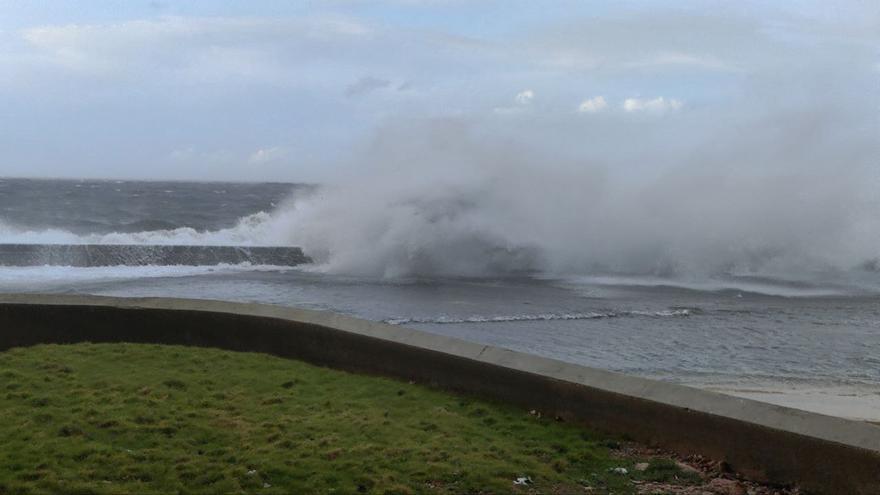
The Storm Caused Flooding in Low-Lying Areas and Waves Several Feet High in Havana

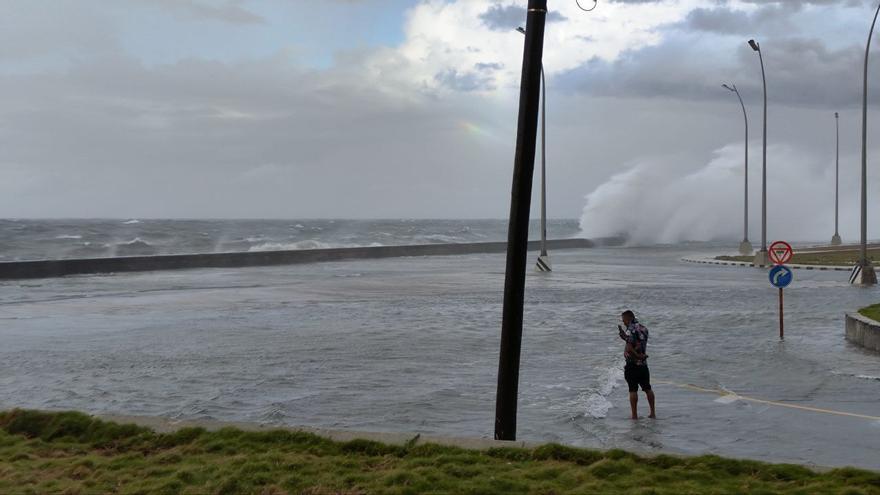
Along some sections of the Malecón, the waves crashed over the wall onto the road. (14ymedio)

14ymedio bigger14ymedio, Natalia López Moya, Havana, 5 February 2024 — Although the government of Havana had urged measures to be taken in the face of possible flooding in some sections of the Malecón, waves rose over the wall and flooded the road, and the traffic on Monday afternoon was cut off.

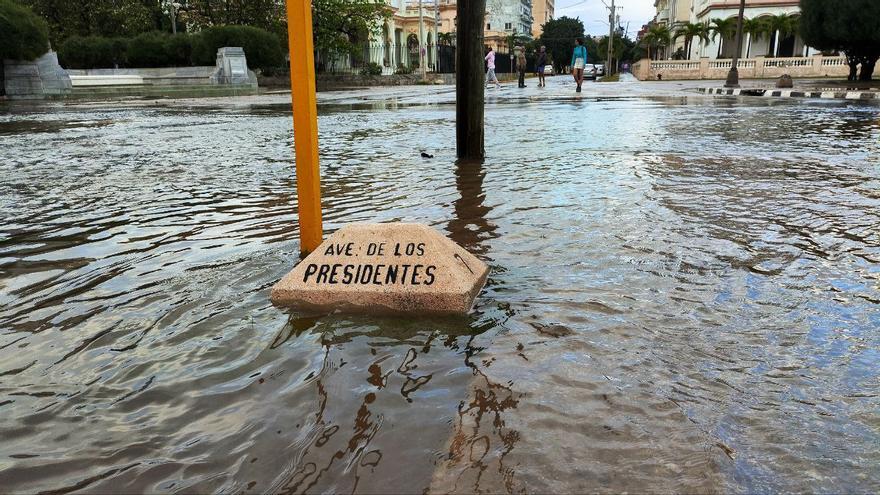
In the lower areas of El Vedado the waters began to rise around five in the afternoon, and part of the Avenida de los Presidentes in the area closest to the sea began to flood.

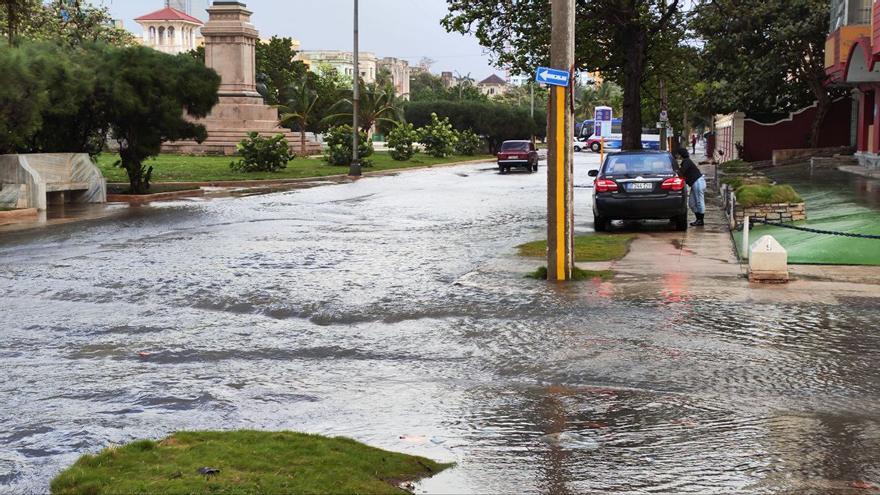
Few people remained on the streets, and the wind dragged garbage containers for some distance. Users on social networks, residents along the Malecón, shared images that illustrated how the waves burst over the wall and inundated several streets in El Vedado.

After increasing deterioration of weather conditions on the north coast of Havana, the local government determined “the closure of circulation on Malecón Avenue” after 5 pm. “The call to stay alert and comply with the measures established in the face of this type of hydrometeorological event is reiterated,” the Government of Havana posted on its Facebook page.

Around five in the afternoon, part of the Avenida de los Presidentes in the area closest to the sea began to flood. (14ymedio)

The Institute of Meteorology predicted for Monday winds of 16 to 25 miles per hour in Havana, which would cause penetrations by the sea. The day was preceded by storms on Sunday that caused the collapse of roofs and electric poles in the neighborhood of Lawton.

There were few people on the streets in this area of the capital. (14ymedio)

The institute said that on Monday afternoon in Pinar del Río, there were gusts of winds of more than 62 miles per hour. In the Casa Blanca station, in the capital, the wind reached 57 mph, and in provinces such as Villa Clara, Camagüey and Sancti Spíritus, the gusts ranged between 45 and 55 mph.

After the increase in the deterioration of weather conditions on the north coast of the capital, the local government determined “the closure of traffic on Malecón Avenue.” (14ymedio)

Numerous showers and thunderstorms were common throughout of the day in almost the entire country. The strong winds in the capital kept some streets deserted, with people sheltering at home waiting for the end of the storm, which was predicted to last part of the night and into the early morning of Tuesday in the western part of the country.

Translated by Regina Anavy

____________

COLLABORATE WITH OUR WORKThe 14ymedio team is committed to practicing serious journalism that reflects Cuba’s reality in all its depth. Thank you for joining us on this long journey. We invite you to continue supporting us by becoming a member of 14ymedio now. Together we can continue transforming journalism in Cuba.
Less Venezuelan Oil and More Power Cuts From January for Cubans

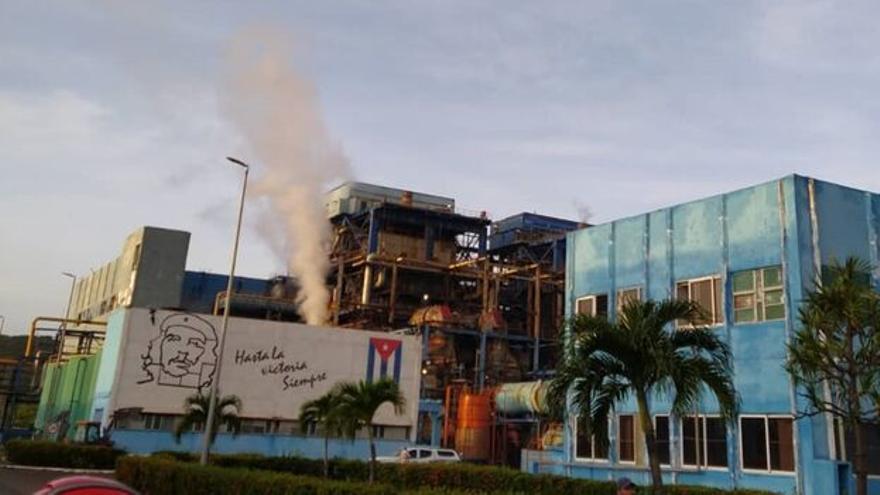
The Renesto Guevara thermoelectric power station in Santa Cruz del Norte, Mayabeque. (PresidenciaCuba/Twitter)

14ymedio bigger14ymedio, Havana, 5 February 2024 – While Reuters reports a reduction to 32,000 barrels a day of Venezuelan oil for Cuba in January, the Unión Eléctrica (UNE) forecasts a reduction of 945 megawatts (MW) at peak hours for Monday, which is equivalent to a third of the estimated national demand for the day. The population, however, fears that the reality will be even worse and that this Sunday’s situation will be repeated, when a deficit of 940 MW was declared and 1,109 MW were affected.

According to the state-owned company, unit 2 of the Santa Cruz thermoelectric plant (Mayabeque), unit 6 of Diez de Octubre (Camagüey), unit 2 of Felton (Holguín) and units 5 and 6 of Renté, in Santiago de Cuba, are out of order. In addition, units 8 of Mariel (Artemisa) and 4 of Cienfuegos are under maintenance, despite the shortcomings of the National Electricity System (SEN).

According to Reuters, Venezuelan fuel exports fell by 25 per cent overall in January from the previous month, to about 624,000 barrels per day (bpd), due to “power outages” affecting the main oil export terminal. What Havana received from Caracas in the same period – 32,000 bpd of crude, gasoline and fuel oil – was slightly above December’s amount, Reuters reports, but below last year’s average (56,000 bpd). All this amid US threats to re-impose sanctions on Nicolás Maduro’s regime if it does not comply with an agreement to promote a fair presidential election. continue reading

Another internet user, more sarcastic, claimed that “training for the summer blackouts started early”

Cubans, who are used to facing the worst blackout seasons during the summer due to the increase in consumption and the overloading of the SEN at that time of year, are worried when they see that the same thing happens in the middle of winter. “When summer arrives, it will be the end of us Cubans, because now, with lower temperatures,  the deficit is increasing every day,” said one user after the company’s announcement. Another, more sarcastic internet user claimed that “training for the summer blackouts started early.”

Many customers attribute the almost 1,000 MW deficit to the storm that hit the west and part of the centre of the island on Sunday, which caused part of the power and telephone lines to fall in some municipalities in the capital and even flooded streets in some provinces, such as Sancti Spíritus. However, the authorities have not reported any consequences in any of the thermoelectric plants in these regions.

The weather also does not justify what happened on January 26, when dozens of users reported blackouts across the island due to a shortfall of 1,010 MW.

According to an article published a few days ago in ’Granma’, electricity generation in Cuba consumes 61% of “the fuel available in the country”

With an obsolete infrastructure that has lacked investment and maintenance for decades and continually reports breakdowns and massive blackouts, the Ministry of Energy and Mines has claimed that it is working to reverse this situation. Its plan, however, convinces hardly anyone: by 2030, the SEN forecasts that 29% of energy will come from renewable sources, a figure it expects to be 100% by 2050, a totally unattainable goal due to the backlog in this sector, which currently covers less than 5% of energy demand.

According to an article published a few days ago in Granma, electricity generation in Cuba consumes 61% of “the fuels available in the country.” With domestic crude oil and natural gas, the UNE covers 54% of the demand, but the remaining 46% requires the import of fuel oil and diesel, which is equivalent to millions of dollars in foreign currency that the state does not have.

In addition, since 2014, when the regime took on the “strategy” of promoting clean energy generation and began to offer investment plans in its business portfolios to install photovoltaic parks, the implementation of clean generation sources has been minimal.

In parallel, fuel-fired generation has been declining in recent years with no other means to counter the shortfall. According to data published last May by the Office of Statistics and Information (Onei), between 2019 and 2023, domestic power generation fell by 24.5 per cent and the government has barely managed to contract a few Turkish patanas, (mobile power plants supplied from Turkey) which do not manage to compensate for the shortcomings of the SEN.

Translated by GH

____________

COLLABORATE WITH OUR WORKThe 14ymedio team is committed to practicing serious journalism that reflects Cuba’s reality in all its depth. Thank you for joining us on this long journey. We invite you to continue supporting us by becoming a member of 14ymedio now. Together we can continue transforming journalism in Cuba.
A ‘Mule’ Who Made 45 Trips to Cuba in Less Than a Year Is Arrested in Tampa With $100,000

During the random check-in of the luggage, $30,000 in cash was found in Ocaña’s luggage, and $70,000 more in her clothes. (Tampa Bay Times)

14ymedio bigger14ymedio, Madrid, 7 February 2024 — A Cuban resident of Tampa, Florida, was accused on Tuesday by the United States Federal District Prosecutor’s Office of illegally transferring $100,000 from the Island to the United States. According to an official statement, Mirtza Ocaña, 38, faces a sentence of up to five years in prison if she is found guilty.

Ocaña was arrested last Monday, February 5, when she landed at Tampa International Airport on an international flight from Cuba and did not declare carrying money for an amount greater than 10,000 dollars, which requires the submission of the relevant forms. However, during a routine inspection, Department of Homeland Security agents found $30,000 in cash hidden in three packages of her luggage.

When they subjected her to a body search, the agents found another $70,000 in her clothes, and, in the interrogation after the discovery, Ocaña admitted that she flew between two and three times a month between Cuba and the United States to smuggle cash. The Cuban’s travel history revealed that, since May 2023, the woman had taken 45 trips from the Island. continue reading

The statement emphasizes that the procedure is ongoing and Ocaña has been accused of violating federal laws, but “that every accused is innocent unless and until guilt is proven

The case will be taken over by a National Security Investigation Unit and the U.S. Border and Customs Patrol, while the deputy federal prosecutor, Michael J. Buchanan, will formulate the accusation. The statement emphasizes that the procedure is ongoing and Ocaña has been accused of violating federal laws, but “that every accused is innocent unless and until guilt is proven.”

The case happened the same day that this newspaper learned, through Western Union headquarters, that the sending of remittances to Cuba could remain paralyzed until April. “There are problems with the banks in Cuba, and that has caused us to stop sending money. They are still working to solve the problem,” they said.

The sending of money through several agencies from the United States has been suspended since last Wednesday, January 31, hours before the increase in fuel prices was to come into effect. According to the version of the Cuban authorities, the state company Fincimex suffered a computer attack from abroad.

Meanwhile, the price of the dollar in the illegal market grows unstoppably and is about to reach 300, where the euro has been since yesterday. The currency thus detaches itself abysmally from the official exchange rate, which is set at 1 x 120 for the population.

Translated by Regina Anavy

____________

COLLABORATE WITH OUR WORKThe 14ymedio team is committed to practicing serious journalism that reflects Cuba’s reality in all its depth. Thank you for joining us on this long journey. We invite you to continue supporting us by becoming a member of 14ymedio now. Together we can continue transforming journalism in Cuba.
The Cuban Government Defends Waste in Tourism Even if It Doesn’t Benefit Other Sectors

Tourists ride through Havana in an ’almendrón’ [classic American car]. (14ymedio)
14ymedio bigger14ymedio, Madrid, February 7, 2024 — A few hours before the start of State TV’s Round Table program, where the Minister of Tourism, Juan Carlos García Granda, was scheduled to attend, the Cuban economist Pedro Monreal asked a very direct question on the social platform X. “Could the Minister of Tourism report the rates of tourism in Cuba that justify it as the locomotive of growth?” In case the Minister had doubts about how to perform the calculation, the expert attached an image of the matrix.

Monreal, like most Cubans, wonders why the Government continues to consider tourism as “the locomotive of the Cuban economy” when there is not a single fact to support this. He asked for the figures to be made available that illustrate how much the development of other sectors is helped by investments in tourism and vice versa. Of course, if the Cuban tourism authorities have the figures, they won’t facilitate this or release them, although they keep repeating the mantra.

“Tourism cannot advance or survive without the national economy. There we include everyone who participates in some way, providing supplies and services so that operations and investments can take place,” said María del Pilar Macías, general director of Operations and Quality of the Ministry of Tourism, who accompanied García Granda and provided some generic figures. continue reading

According to her accounts, 69% of the sector’s purchases are made from the national industry. “We see the productive chain with a greater vision. It sells itself and satisfies other sectors’ needs.” The official said that there are 259 tourist facilities linked to 1,111 “productive forms,” which contain 379 private producers “who have even designed their growth to guarantee hotel facilities; that is, they consider tourism.”

Her assessment is positive, since, in addition, it avoids imports and their costs. “You get it faster and you don’t fall into the issue of shipping companies, which to get to Cuba  must practically go around the world, which causes many delays,” she stressed. Among the novelties of those “chains” is the development of recycling industries, an issue that was previously ignored but that gains importance for international hotel companies, such as Meliá and Iberostar, which are subject to environmental commitments.

“We are starting a program to replace overused plastic. There is also productive chaining, and we have industries responding, such as Ciego Montero, in the production of soft drinks”

“We are starting a program to replace overused plastic. There is also productive chaining, and we have industries responding, such as Ciego Montero, in the production of soda.” The same happens, she added, with dispensers that will replace cans and bottles, reducing the use of plastics and waste. “Los Portales made its line for concentrated soda, and Bucanero expanded to dispense beer,” she said.

The Government seems interested, possibly, in the prospect of being part of the network of Smart Tourist Destinations – with Cayo Largo del Sur as the first declared goal – by meeting the sustainability objectives required to earn the seal. Last night on television, a rural tourism plan to transform farms for agrotourism was also presented.

The goal is, in any case, to reactivate a sunken sector, since, as García Granda himself acknowledged, “at a global level, the tourism industry is recovering, with a tourism boom in countries such as Spain, Europe and the Caribbean.” He does not feel unsuccessful, despite the poor data of the Island – which closed 2023 with 2,436,980 international visitors, 42.8% less than in 2019 and 31% below its aspirations – since, he said, “no other country develops its tourist activity in the same conditions as Cuba.”

The minister summarized the list of damages of the US embargo, including the most recent measure to suspend the ESTA (visa waiver program) of those who have traveled to Cuba since 2021, although the only one of the aforementioned affronts that seems to have repercussions based on data is the ban on cruises from the United States. The rule was approved by Donald Trump’s administration in June 2019 and maintained by Biden. It prevents, according to García Granda, the arrival of at least 1.2 million tourists. The data is exaggerated considering that in 2018, an excellent year for the sector on the Island, approximately 850,000 Americans were received in this way, although the hole in the accounts is real.

Other problems exist, the minister said, in the lack of resources that prevent adequate promotion, as well as the scarce availability of fuel for internal flights and excursion boats. Despite everything, Cuba invested money in airport improvements, as published this Wednesday in Granma. The amount spent, ranging from improving the runways to safety devices and facilities, is not specified.

The low occupancy rate indicates not only a large excess of capacity but also a monumental waste of investment

“The official statistics indicate an inconsistency between the very high relative weight of investment associated with tourism that has a low occupancy rate and that coexists with the low and decreasing weight of agricultural investment in a country with food insecurity,” Monreal reproached in his analysis. The figures, summarized in a graph that reflects the obvious disproportion between spending and the decline in tourism, are overwhelming. “The low occupancy rate indicates not only a large excess of capacity but also a monumental waste of investment. What is the rationality of having invested billions of pesos to continue creating an excessive supply of hotel rooms?” he asks.

For 2024, the Government proposes to have 3.2 million tourists and an increase in flights to the Island. The minister indicated that “it has been possible to establish air connections with 32 countries through 50 airlines, with an average of 579 weekly frequencies. In 2019, there were 764 weekly frequencies, although a large part of them corresponded to flights from the United States.” If those numbers are true, Cuba now has 24.21% fewer frequencies than in 2019, faced with the fall of tourism by 42% with the same year.

Later, however, he pointed out that the improvement in the number of travelers is due to the increase in flights “despite having only 47% of the frequencies that existed in 2019.” There doesn’t seem to be anyone who can calculate Leontief’s index* for Monreal.

*Leontief’s input-output models divided the economy into sectors where each sector’s production helped the others.

Translated by Regina Anavy

____________

COLLABORATE WITH OUR WORKThe 14ymedio team is committed to practicing serious journalism that reflects Cuba’s reality in all its depth. Thank you for joining us on this long journey. We invite you to continue supporting us by becoming a member of 14ymedio now. Together we can continue transforming journalism in Cuba.
‘We Will Have To Wait Until April 1 for the Resumption of Remittance Services to Cuba’

The Metropolitan Bank made a statement on Tuesday about the suspension of remittance services, but without any details. (14ymedio)

14ymedio bigger14ymedio, Havana/Miami, 6 February 2024 — Western Union plans to resume the remittance service to Cuba on April 1. That is the date they gave to 14ymedio in calls to two offices in the United States. The employees did not know how to answer why it will take so many months to restore the transfers. “There are problems with the banks in Cuba, and that has caused us to stop sending money; they are still working to solve the problems,” they said.

The Metropolitan Bank made public on Tuesday a statement that alludes to the suspension of remittance services, bur without details. “If you have been sent money (from abroad) through a remittance agency, we suggest you contact Fincimex, an agency that manages that service in Cuba,” reads the short text disseminated on their social networks.

Last Thursday, the same banking institution warned of “technical difficulties that affect branch services and those associated with technological payment channels,” without referring to transfers from abroad. continue reading

By telephone, a Fincimex employee told this newspaper that “the breakdown is still being worked on but there is nothing yet”   

These cannot be done, as this newspaper verified, at least as of January 29, although some comments on the bank’s Facebook post this Tuesday allude to the impossibility of doing them earlier.

On Wednesday the 31st, a day before the main economic measures agreed by the Government last December came into force, the authorities decided to cancel them. The reason given was “a cybersecurity incident in computer systems for the selling of fuel, whose origin has been identified in a virus from abroad.”

The widespread suspicion about the hacking, which, according to official sources, has affected the marketing system of Cimex, a corporation belonging to the Gaesa military conglomerate, increased among Cubans when the Minister of Economy, Alejandro Gil Fernández, was dismissed last Friday.

Although at Western Union they provide a clear date to normalize remittances, the same does not happen with Fincimex. By telephone, an employee of the state financial system told this newspaper that “work is still being done on the breakdown but there is nothing yet.”

Translated by Regina Anavy

____________

COLLABORATE WITH OUR WORKThe 14ymedio team is committed to practicing serious journalism that reflects Cuba’s reality in all its depth. Thank you for joining us on this long journey. We invite you to continue supporting us by becoming a member of 14ymedio now. Together we can continue transforming journalism in Cuba.
A Mechanic’s Workshop, the Only Sign of Life After the Eviction of Dozens of Families

On the ground floor of the building, a mechanics workshop remain’s open that seems to defy the risks. (14ymedio)

14ymedio bigger14ymedio, Pedro Espinosa, Havana, 5 February 2024 — The bustle coming out of number 70 Factoría Street between Corrales and Apodaca, in Old Havana, has stopped for days. Last Wednesday, the almost hundred people who lived in the building were evicted due to the danger of collapse, a threat they had been living with for years after illegally occupying the building.

With the façade blackened by humidity alongside some areas of yellow ocher color that remind us of its former splendor, the three-story building with its stately bracing barely preserves part of the original ceilings. “This had been declared uninhabitable for a long time but the need is great,” acknowledges Carmita, a neighbor who from the opposite sidewalk fears every day “that this ruin will fall forward and cause misfortune.”

According to the woman, “all these bricks that you see down here in the doors and windows were to wall up the entrance.” In this way, the authorities of the Housing Directorate wanted to prevent the building from filling up with inhabitants again after the neighbors who lived there were evacuated when the structure became very unstable. “But they didn’t do it well, people found a way to get in.” continue reading

The majority of those who settled came from the provinces, homeless people and without an identity card with an address in Havana

Despite the balconies without railings, the orphaned door and window thresholds lacking blinds, necessity meant that in a short time the hubbub of families, the cries of children and the barking of the occasional dog once again populated the place. The majority of those who settled came from the provinces, homeless people and without an identity card with an address in Havana.

Fleeing from the misery of eastern Cuba, in the hallways of the old palace they were heard talking about mushrooms, hammering a board to prevent the rain from seeping into the babies’ cribs, playing dominoes when the daytime blackout paralyzed life, and fighting, when the neighbor on one side took advantage of a distraction and moved the dividing wall a few centimeters towards the other person’s house.

Now they are gone. According to Armando, an old retiree, who this Monday wore his pants rolled up to avoid the puddles that splashed all over the street, “they took them to various shelters in San Agustín, Altahabana and Santiago de las Vegas.” Others “were returned to their provinces of origin,” he adds, although he would not be surprised if “they are taking time for things to calm down and return.”

The smell of waste wet with the rains of recent days reinforces the feeling of abandonment and decrepitude of the property. (14ymedio)

At first, when they took over the demolished building, solidarity prevailed, but as the months passed, overcrowding and neighborhood problems raised the temperature inside the quarters. The fights and continuous scandals led Factoría 70 to earn the reputation of a confrontational place, a place to avoid and cross the sidewalk when walking down the block. Being located in the Jesús María neighborhood, fame like this multiplies.

The neighbors alternate feelings. “If it’s not for the toughest necessity, no one goes into such a place where you can’t even sleep a wink in case the roof falls on you,” says a woman who lives around the corner, on Corrales Street. “The poor people, who knows what they’ve been through, but it’s true that it got ugly here and the fights were constant.”

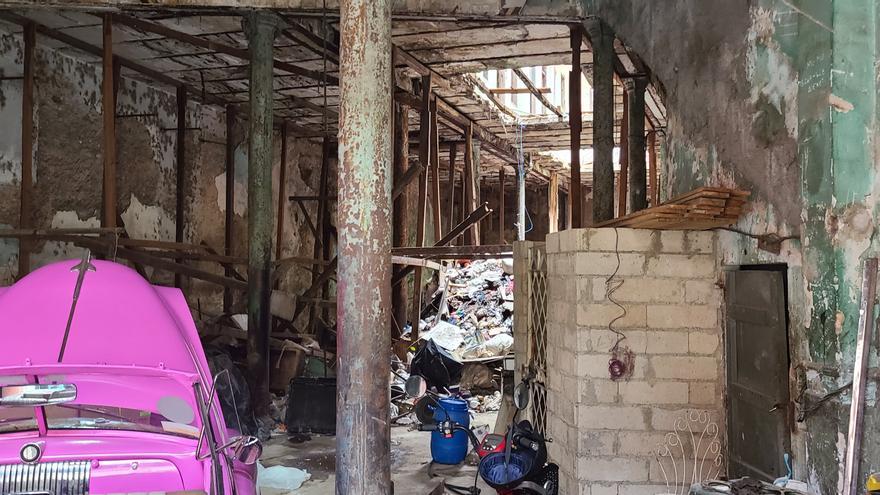
On the ground floor of the building, a mechanics workshop remains open that seems to defy the risks. “No, this area is not in danger of collapsing,” summarizes one of the store’s employees before entering back into an area where an impeccably restored antique vehicle in a deep pink color alternates with the wood that supports the upper floor and a immense mountain of waste and debris coming from the floors above.

The smell of waste wet with the rains of recent days reinforces the feeling of abandonment and decrepitude of the property. Outside, the old folding metal doors that once gave way to a thriving business stand with some dignity against the surrounding destruction. They no longer go up or down and they no longer safeguard bags of beans, various preserves or chocolate. They have been paralyzed by the improvised brick barrier that should have prevented people from sneaking into the building.

On the rough wall there is a name: Pedrito. Could it be one of the neighbors evicted last week? Where will he be now?

____________

COLLABORATE WITH OUR WORKThe 14ymedio team is committed to practicing serious journalism that reflects Cuba’s reality in all its depth. Thank you for joining us on this long journey. We invite you to continue supporting us by becoming a member of 14ymedio now. Together we can continue transforming journalism in Cuba.

Anabel Ruiz, the Cuban Nun Who Gave Up Her Habit To Be an Artist, Exhibits in Miami

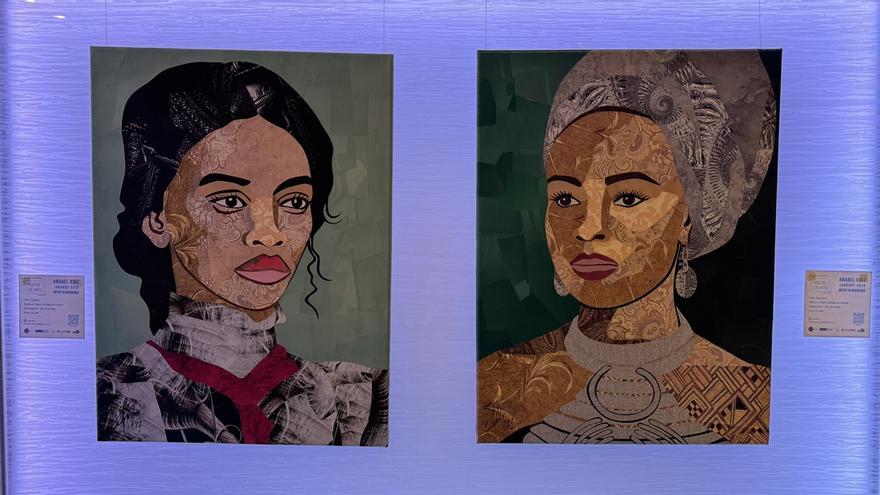
Reinas de ébono’ (Ebony Queens), is a tribute to the women that Ruiz met in Havana and who marked the first stage of her childhood. (14ymedio)

14ymedio bigger14ymedio, Clara Riveros, Miami, 4 February 2024 — The Intercontinental hotel in Miami opened its doors during January to welcome Anabel Ruiz as a visiting artist. Ruiz, of Cuban origin, exhibited her collection De ella Reinas de ébano (Ebony Queens), in tribute to the women she met in Havana and who marked the first stage of her childhood. A well-executed exhibition that reflects the femininity, delicacy, neatness and care of the artist. In conversation with 14ymedio, Ruiz spoke about art and politics, but also about religion, love, sexuality, gender and biology and the destinies and experiences that have shaped her character and outlined her life path.

The work of ARuiz (as she signs her artworks) is a creative process that gives an account of life, humanity and its faces, multiplicity, diverse individualities, as her paintings attest. The artist focuses on facial expressions, very vivid and colorful, and what is conveyed by the looks of those women who do not go unnoticed.

The painter is preparing a new exhibition for the end of 2024, dedicated to a group of notable artists of the 20th century and their self-perceptions, she concerns herself with their representations. Anabel paints, but her passion and commitment has been collage, her obsession is working with paper. continue reading

The artist bets on facial expressions, very vivid and colorful, and what is transmitted by the looks of those women who do not go unnoticed

She carries Havana in her veins, in her blood and in those childhood memories, crossed by the experience of those first years under a totalitarian system where many normal and everyday things for her were part of those fantastic stories that her mother read to her. Madrid holds a special place in her heart, she arrived there with her family when she was nine years old, in 1983.

Her education and training were religious, influenced at school and at home, which helps to understand the reason for her later decisions. When she was a teenager, her family moved to Miami, where she finished high school and studied Business Administration, although her inclination and vocation since she could remember was art.

Upon completing her studies, with more doubts than answers, she opted for religious life, became a nun and entered a community here in Miami. She later changed congregations and countries, moving to Portugal where she stayed for three years. In those ups and downs of her life love presented itself to her as that kind of quicksand that destabilized all of her structures.

After nine years of religious life and committed to her vows of chastity, obedience and poverty, she hung up her habits.

She left Portugal and returned to Miami with the idea of ​​spending more time with her parents and dedicating herself to art and her individual interests.

The artist recognizes the importance of political representation for the gay community of which she is a part. However, when consulted, she admits that her opinions are divided around the transsexual issue and the gender agenda. Rights and freedoms are not synonymous with defiance of biology.

Those interested in getting to know the artist and her work can visit “Anabel Ruiz” Art Studio any afternoon, located in the sector known as “the Bird Rd. Arts District,” 4257 SW 72nd in Miami. The ART inscription, logo and registered trademark will be found on the door.

____________

COLLABORATE WITH OUR WORKThe 14ymedio team is committed to practicing serious journalism that reflects Cuba’s reality in all its depth. Thank you for joining us on this long journey. We invite you to continue supporting us by becoming a member of 14ymedio now. Together we can continue transforming journalism in Cuba.

While the Euro Reaches 300 Cuban Pesos, the Government Keeps Going in the Same Direction

The MSMEs (micro, medium and small-sized enterprises) will no longer be exempt from paying taxes at the beginning of their creation. (EFE)

14ymedio bigger14ymedio, Havana, 6 February 2024 — The regime’s concern about the current crisis has led the official newspaper of the Communist Party of Cuba to once again publish the Economy section, which will appear in Granma on a weekly basis.

Its first article, signed by Joel Ernesto Marill Domenech, author of several texts with proposals to stabilize the economic and financial situation of the country last September, is nothing more than an exhibition of what needs to be improved – everything – without the concrete steps to do it. This contrasted with the brainstorming launched last night by the also Cuban economist Pedro Monreal, focused on taxation and the structure of the private sector.

Marill Domenech opens the new section by describing the well-known panorama that remains at the dismissal of the former Minister of Economy and Planning, Alejandro Gil. In summary: year-on-year inflation that exceeds 30% in the formal market, depreciated wages, exports 30% lower in 2022 than in 2019, imports 25% more expensive, four consecutive years of double-digit fiscal deficits with respect to gross domestic product (GDP) and devastated national production. continue reading

The production of the agricultural and livestock sector was, in 2022, 37.2% lower than in 2019, the manufacturing industry 32% lower, and electricity generation 25% lower, according to official data

A few brief brushstrokes are enough: the production of the agricultural and livestock sector was, in 2022, 37.2% lower than in 2019, the manufacturing industry 32% lower, and electricity generation 25% lower, according to official data.

How to solve it? “With internal efficiency,” says Marill Domenech in a simplistic text that contrasts with his previous articles by being more concrete. In this case, the economist speaks of two groups of “distortions” that exist in the Cuban economy and includes high fiscal deficits, dollarization and the lack of exchange rate unity.

In his opinion, that is the first of the areas that must be addressed, since a fiscal deficit of more than 147 billion pesos such as the one planned for 2024 is being solved with monetary issuance – obviously, without support – that increases the money in circulation and, in turn, raises prices in the free market due to the insufficiency of the supply of goods.

That spiral continues because the national currency has lost value in the face of currency competition. The consequence is a tremendous lack of incentives for domestic production in the face of the attractiveness of export. From there we reach the situation of the informal foreign exchange market – triggered today, when the euro reached 300 pesos – that “conditions unequal access to the currencies that enter the country via remittances and tourism, privileging non-state economic actors many times with low added value, while excluding access to state companies and all their installed productive potential,” the expert summarizes.

According to his balance sheet, it is an urgent matter to correct this distortion, but his proposal of how to do it is not very concrete, although it supposes a call to the Central Bank of Cuba to take real command of economic policy and stop responding to political decisions.

“The recovery of the official foreign exchange market should be a first step in a more substantive and comprehensive exchange transformation, which sets its final objective in the definitive exchange unification, and, together with fiscal stability and de-dollarization, allows finally making the national currency the center of the country’s economic and financial system,” he says.

His proposal to address macro changes rather than microeconomic changes clashes again with the ideas that Pedro Monreal puts on the table, focused on the taxation of small and medium-sized enterprises

His proposal to address macro changes rather than microeconomic ones clashes again with the ideas that Pedro Monreal puts on the table, focused on the taxation of small and medium-sized enterprises. While Marill Domenech talks about transforming the “regulatory schemes, incentives, functioning of the markets and the business fabric” to boost productive activity, Monreal asks for tax incentives for private individuals just when one of them, the main one enjoyed by the MSMEs – exemption from the payment of taxes for two years – comes to an end.

The official argument for eliminating it is, in the opinion of the independent economist, questionable, based on political demands and not on the criteria of officials of the Ministry of Economy. “The explanation that two years have passed since the exemptions for the benefited companies were adopted does not deny that new companies should not be helped, nor that this is not beneficial for the national economy. Does any data prove otherwise?” he asks rhetorically.

Monreal asks for the stimulation of the newly created MSMEs with initial exemptions and reduced rates, as is done in other countries, in addition to taxing net profits and not income, an anomaly in the international panorama. The economist also puts his finger on the sore point of a specific sector: food production, which if it is really the priority, as the Government has stated, should retain tax privileges, at least temporarily.

“It is striking that, despite recognizing the need to increase the percentage of MSMEs with internal resource processing activities, exemptions are not applied, even if they were limited to those activities,” he highlights in his analysis on social network X.

On the contrary, Monreal maintains that the privileges that should end are those of foreign investment companies: “More taxes would be collected than those that will be obtained by eliminating exemptions to new MSMEs.” In his opinion, it is not even proven that tax exemption is effective to attract foreign investment, nor is it debated.

Monreal maintains that the privileges that should end are those of foreign investment companies: “More taxes would be collected

Monreal’s concreteness is diluted in the text of Marill Domenech, who also talks about incentives and regulatory rigidities without pointing out proposals, and launches ideas on what to do, but not about how to do it. Among them he cites “transformations in the socialist state enterprise, especially its governance mechanisms, incentive schemes, organizational structure, as well as bankruptcy and reorganization procedure, up to modifications in the planning mechanisms, which contribute to a true decentralization in access to resources through the establishment of formal and orderly markets of currencies and inputs that gradually replace centralized distribution as a fundamental allocation mechanism and help a true financial and economic autonomy of the business fabric.”

The text has, ultimately, suggested measures similar to those proposed by Monreal but something invites us to think that there is fear when verbalizing the proposals – “on the way to recovery it will undoubtedly have to assume difficult moments,” he warns – and it is not surprising. The latest economic reforms proposed in the National Assembly in December – and to which the text itself refers – have remained stuck, allegedly due to cybersecurity problems.

Nothing has been revealed about that alleged external virus that attacked the Fincimex system and forced, according to the official version, the postponement of the rise in fuel prices without setting a date for implementation. However, Cubans do not doubt that there is something more behind the forced departure of former minister Alejandro Gil. There is talk of a struggle between the two “souls” (factions) of the Communist Party – the reformist and the orthodox. For the latter, the changes that had to be made in 2024 were inadmissible. As long as this dispute is not settled, Cuba is condemned to immobility and the unstoppable degradation of the standard of living of its population.

Translated by Regina Anavy

____________

COLLABORATE WITH OUR WORKThe 14ymedio team is committed to practicing serious journalism that reflects Cuba’s reality in all its depth. Thank you for joining us on this long journey. We invite you to continue supporting us by becoming a member of 14ymedio now. Together we can continue transforming journalism in Cuba.
Even Cuban Dogs Arrive Illegally in the United States

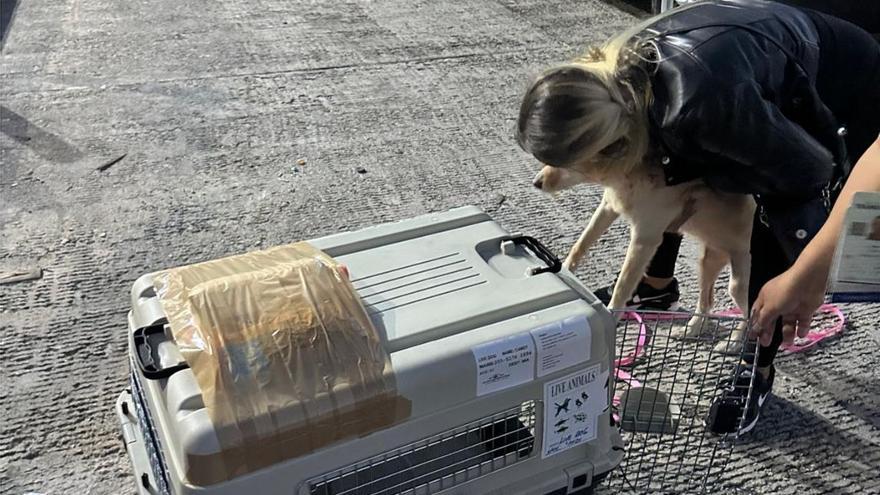
A cargo airline called Estafeta is in charge of sending pets from Mexico to the United States. (Cortesía)

14ymedio bigger14ymedio, Havana, 6 February 2024 — From Santa Clara to Havana, from Havana to Cancun, from Cancun to Miami. The trip of Brandy, a five-year-old Creole dog, was not very different from the one its owners made twelve months ago. But the reunion had a price: tensions, bribes to process the documentation and $3,000 in expenses.

“We left Brandy in Cuba with some friends, and I promised them that it would not take me more than a few months to bring her to the United States. It ended up being a year, but now she’s here with me,” Lorena, a 52-year-old from Santa Clara, tells this newspaper. “We became very fond of her after taking her off the street, and although people think I’m crazy to spend so much money on a pet, I decided to bring her to Miami,” she says.

There are many people who perform this service and charge between 2,100 and 2,800 dollars, depending on the size of the animal and the price of the plane tickets

The procedures were quite cumbersome, says the Cuban. “While I was saving, I was investigating ways to bring the dog. I discovered that there are many people who perform that service and charge between 2,100 and 2,800 dollars depending on the size of the animal and the price of the plane tickets at the time,” explains Lorena. At almost 30 pounds, Brandy is considered medium weight. continue reading

By the “legal” way, she resumes, the United States requests the internal and external deworming of the pet and several vaccines, including rabies, which must be given. Then you have to wait a month and take blood from the animal, centrifuge it and send it frozen to a laboratory in Kansas, which is the only one capable of doing that type of analysis. Then you must wait a few months for the institution to respond and only then, with the vaccination card ready, can pets travel to the United States.

“These requirements are from the CDC (Center for Disease Control) in the United States, which lists Cuba among the countries at high risk for canine rabies. Cubans, however, have already found ways to circumvent those controls,” says Lorena.

The first trick, she continues, “is to send the pet to a third country. Mexico, because of its proximity and how easy it is to then send the animals to the United States, has been the perfect stopover. The Mexican authorities don’t know the origin of the pets or whether the veterinarians in charge of examining them have been paid to falsify the vaccination certificates. This procedure has become a business that all Cubans use, which circumvents the several months of waiting imposed by the lab in Kansas.” For Brandy, she says, they even put on vaccine labels dated 2020. “They have everything ready, you just have to pay.”

“The total amount I paid for the trip, including the papers, was $2,600, since Brandy is a medium-sized dog and had to travel in the hold of the plane. For a small dog, which can sit with its owner, the cost is $2,500. That price also includes the ticket of the person who took her to Mexico, which I had to pay here by Zelle. For the rest of the money, they came to get it in Miami at my house,” Lorena explains.

Once Brandy got to the airport she was put on the plane in a crate and sent to Cancun with the Viva Aerobus airline

Lorena had to add the purchase in Miami of a crate to transport Brandy and its shipment to Cuba through the parcel agencies. She also  purchased a leash and other accessories and paid for Brandy’s trip to Havana in the company of its temporary caregivers. “All that came out to about 550 dollars, because I sent some extra for them to eat something on the trip to the airport. The car cost 40,000 Cuban pesos, and the snacks, ham at 400 and a soft drink at 150,” she says.

Once Brandy arrived at the airport, she was put on the plane in a crate and sent to Cancun with the Viva Aerobus airline. “Not all companies allow you to travel with pets,” says Lorena.

After a night in Mexico, Brandy boarded a second flight to Miami through the cargo airline Estafeta. An hour later, her owner picked her up at one of the warehouses at the Fort Lauderdale airport. “All the airport workers stopped to see me take Brandy out of the crate and how happy she was to see me. It was an exciting moment and made me think about how much animals are loved in the world, unlike in Cuba, where some went so far as to suggest that I kill the dog, and others abandon their pets on the street as soon as they can leave the country. It’s a shame that even Cuban dogs have to arrive illegally in the United States,” Lorena laments. “In that they’re like us.”

Translated by Regina Anavy

____________

COLLABORATE WITH OUR WORKThe 14ymedio team is committed to practicing serious journalism that reflects Cuba’s reality in all its depth. Thank you for joining us on this long journey. We invite you to continue supporting us by becoming a member of 14ymedio now. Together we can continue transforming journalism in Cuba.