Cuban artists Luis Manuel Otero Alcántara and Maykel Osorbo / Facebook From 14ymedio
14ymedio, Havana, 21 June 2024 — On Monday, June 24, Amnesty International will hold a virtual meeting for the freedom of Cuban artists Luis Manuel Otero Alcántara and Maykel Osorbo.
The event will have the participation of Raudiel Peña Barrios, lawyer of Cubalex; the art curators, activists and human rights defenders Claudia Genlui and Anamely Ramos González; and Johanna Cilano, regional researcher for the Caribbean of Amnesty International..
COLLABORATE WITH OUR WORK: The 14ymedio team is committed to practicing serious journalism that reflects Cuba’s reality in all its depth. Thank you for joining us on this long journey. We invite you to continue supporting us by becoming a member of 14ymedio now. Together we can continue transforming journalism in Cuba.
Days of waiting at Havana’s Villanueva bus terminal to get transportation
Those who arrive here have to sign up on a list and wait for the buses from the National Bus Terminal / 14ymedio
14ymedio, Juan Diego Rodríguez, Havana, 21 June 2024 — If there is a place in Cuba where the transportation crisis becomes apparent, it is the Villanueva station in Havana. Periodically, and coinciding, as now, with school holidays – in December or the months of June, July and August – the networks and independent media are filled with images of hundreds of people crowded together – adults, children and the elderly – sitting on their suitcases, sleeping on the floor, between the heat and the flies, waiting for days and days to board a vehicle that will take them to the province.
The state-owned Empresa Viajero has designated this terminal for its “waiting list.” Those who arrive here have to sign up on a list and wait for the buses from the National Bus Terminal that have a free seat to pass, either because a ticket has not been sold, or because the traveler has not shown up. Given the scarcity of fuel, the number of vehicles decreases and, therefore, the option of getting a seat. Thus, in Villanueva the crowd gathers, increasingly tired, increasingly sweaty, in a picture typical of Calcutta.
This is what happened this Wednesday, when the line for signing up did not move. Those who were tired of waiting had two alternatives: either leave or travel in uncomfortable trucks without air conditioning at an astronomical cost when compared to bus prices. By bus, the trip to Santiago de Cuba was 6,000 pesos, the trip to Holguín, 5,000 pesos.
A more than considerable difference if one thinks about the prices of official buses: 717 to the first destination and 615 to the second. “We’re on board,” one man lamented to another, who was also waiting and who refused to get on those old, dilapidated vehicles: “Chico, I don’t have any money. And, frankly, if I had it I wouldn’t pay it to leave under those conditions either.”
The state-owned Empresa Viajero has designated this terminal for its “waiting list” / 14ymedio
Between the departure bays, walking with a cigarette in his hand, an old man dressed in military green was shouting: “Long live the Revolution, Díaz-Canel and I rule here, you don’t rule here.” The people, exhausted, laughed at him. In the terminal, only one of the bathroom sinks had a continue reading
trickle of water. As for the snacks that can be purchased, they are not cheap either: a milkshake or a soft drink, 250 pesos; pizza, 120.
Why are there citizens who lower themselves to these conditions, without even obtaining a minimum benefit, for example a cheaper ticket? The general response is that it is very difficult for them to acquire it the formal way, through the Viajando app . “It is an almost impossible mission online because the application collapses and the tickets disappear in seconds,” explains Lucía, who also says that she lives far from a ticket sales agency. “Maybe buying them there also means sleeping there because of the few opportunities. It’s all the same: very few buses and seats available.”
Those who got tired of waiting had two alternatives: either leave or travel in uncomfortable trucks / 14ymedio
Traveling also requires updating your phone’s operating program, something that is not available on all mobile phones and that has left many customers out. That was one of the complaints that users left on the official on-line press release that included the content of this Wednesday’s Round Table State TV program, dedicated to transportation.
Because, in effect, while citizens face the disastrous situation every day, the Government tries by every possible means to make it seem kinder. Thus, in the last Round Table, where in the midst of figures that sought to praise the Automotive Business Group – such as that it is “made up of 18 companies divided into four large blocks,” that the company is “one hundred percent Cuban” and that it has 16,487 workers and more than 12,000 “automotive vehicles,” which makes it “leaders within the sector in the country” – nothing at all could hide the reality.
The Villanueva terminal information board / 14ymedio
“Today we are hit with technical aspects related to vehicle stability, steering, suspensions, clutch systems and access to lubricants. All of this affects transportation levels,” lamented Aidel Ramón Linares León, director of the National Bus Company, appearing on television. The data provided are eloquent: “In 2019 the company transported 13.2 million passengers, while at the end of last year 7.1 million passengers were transported.”
On the other hand, Walter Luis Duverger, general director of the Viajero Company, said on the TV show that “one of the greatest dissatisfactions” expressed by customers was “how unscrupulous elements have manipulated the online reservation service for their own benefit.” He did not give details of what he was referring to or how the problem was going to be solved.
____________
COLLABORATE WITH OUR WORK: The 14ymedio team is committed to practicing serious journalism that reflects Cuba’s reality in all its depth. Thank you for joining us on this long journey. We invite you to continue supporting us by becoming a member of 14ymedio now. Together we can continue transforming journalism in Cuba.
To many mothers “God seems deaf” because they don’t see a way out and they become desperate
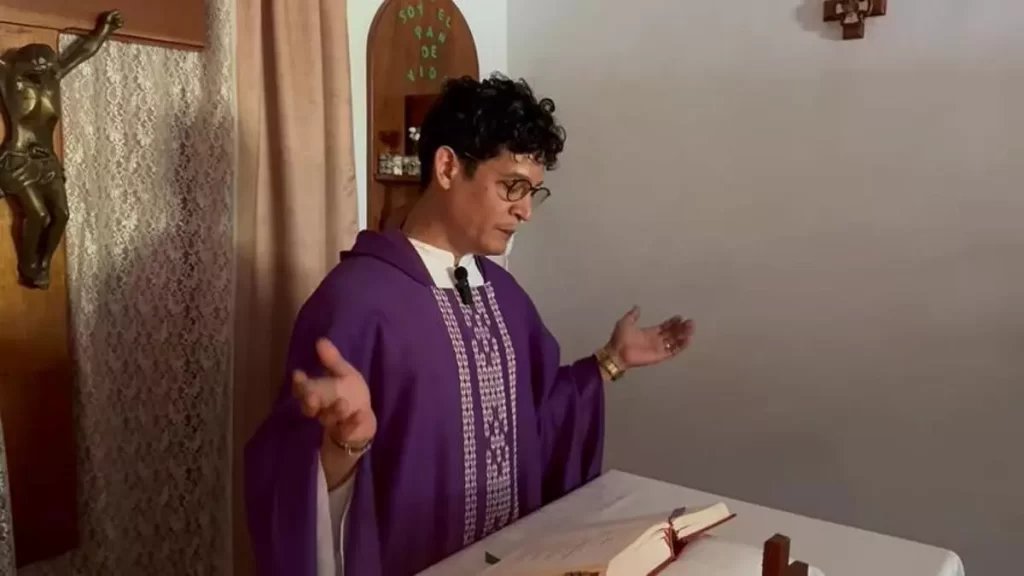
Fr. Leandro Naun, a Catholic Priest, saying Mass on February 18, 2024 / Leandro NaunHung/YouTube/Captura
14ymedio, Havana, 16 June 2024 — Leandro Naun, a Catholic priest, ministers to a handful of rural communities in Santiago de Cuba. With the end of the month fast approaching, word is spreading that delivery of the basic monthly allotment of rationed goods is delayed. Some here worry it may never arrive. No matter. Fr. Naun hops into a gray Toyota and drives off at full speed to distribute spaghetti, flour and sugarcane juice. He has a course on how to bake bread with few limited resources, oversees a squad of children who make jam, and recommends May rainwater as a remedy for bellyaches.
No one knows where he gets the energy. The money comes from former parishioners who now live overseas but who still help out. Few priests have provided such thorough accounts of what life is like in the mountains of Santiago. The videos he posts online show real, journalistic skill, not unlike that of a war correspondent. He watches, records and reflects. If it were up to him, he says, he would have spent all this time in a clearing in the Darién jungle, giving encouragement to the Cubans making their way through the undergrowth to reach the North.
Naun was born in Cobre, a mining town that is home to the shrine of Our Lady of Charity. It is an odd mix, a place where Catholicism and Afro-Cuban beliefs converge. In spite of all the tourists and pilgrims making their way to the shrine of the country’s patron saint, it remains one of the poorest places in Cuba.
“Violence will continue to increase, and in direct proportion to the frustration, powerlessness and discontent the public is experiencing”
Naun still lives in the eastern mountains, where he grew up. He is concerned about the direction the country is headed, both the entire island and the area where he lives. He describes a recent tense situation in which he encountered a burglar, a “poor man,” in his orchard. “It left me cold, petrified,” he says. “He told me,’You’re well-off and I’m not.’ He thought that, because I was in a better situation than him, he had the right to rob continue reading
me. Others will say,’You travel by car while I have to travel on foot!’ But I’m not responsible for their situation!”
The key, he says, is in understanding Cubans’ “repressed helplessness.” In some cases, frustration is expressed through violence. It can be seen in people’s expressions, in the stern looks on their faces. Violence can erupt even among neighbors and family members. One does not have to go far to find examples. Exactly one year ago, three masked men broke into his parents’ house on the outskirts of Santiago. During their getaway, they beat his mother and attacked his father with a machete.
“My father survived the attack but it almost cost him his life,” recalls Naun, who warns that violence will continue to increase, and in direct proportion to the frustration, powerlessness and discontent the public is experiencing.
“Pubic morale is at rock bottom,” he observes. “Holidays and alcoholic benders might provide a break from the suffering, like when black slaves at sugarcane mills would get one day off. ’Our master is good to us!’ they would say, dancing like there was no tomorrow. The poor have a weak memory of yesterday.”
“People almost always get their news from Facebook. Or they watch Youtube. It’s hard to separate objective fact from the subjective opinion of someone who is informing you or trying to inform you. Murders, robberies, assaults, missing persons, accidents… we see all these on the rise on social media. On the street, however, it’s a different reality, another version of life. In places without internet access it is a world as told by the official press.”
Mothers who have children in prison do not talk about it. Naun likens them to Job, the biblical character who loses everything but stifles his anguish. “God seems deaf to them,” he says, because they see no way out of their situation and they become desperate. “Why does it have to be like this?” asks the priest.
That is why he believes churches have to be places of tolerance. “Sitting in the same pew, you will find the head of the Federation of Cuban Women, the head of the Committee for the Defense of the Revolution and a mother whose son has been in prison since 11 July.” He believes the Church has the duty to speak for everyone, “like the sun that rises every morning on both the just and the unjust.”
And what about the Conference of Bishops? What is it doing and why does it seem to be paralyzed. “Only God knows what they are really doing at that level, what’s being promised… Everything else is conjecture. High-level conversations and negotiations are always secret and very few of us really know what they are talking about,” he explains. Of course, he misses the days when the Church had two interlocutors — Archbishop Pedro Meurice in Santiago and Cardinal Jaime Ortega in Havana — waging war against the regime on two fronts: one combative, the other diplomatic.
“Every day is an adventure. In my videos I try to chronicle what I am experiencing. It’s like an archive of memories of what people are going through, what they do, how they live.”
Though many priests and nuns have fled the poverty of Cuba, Naun does not criticize them for it. “Cuba is not the center of the world,” he says. After all, anyone who feels called to be a missionary, as is the case with many of Cuba’s religious, must travel. Leaving does not free you from Cuba, he explains. There is a kind of nostalgia memory chip that every emigrant carries, not to mention the family left behind, which no one can ignore.
He admires those like Sr. Nadieska Almeida and Fr. Alberto Reyes who have stayed in spite of pressure from the government and State Security. “He describes them as “voices crying out in the wilderness” — or in the darkness, as Reyes himself puts it — who have to put up with “misunderstandings by one side or the other, from one shore or the other.”
To have options is to be free,” says Naun. His option was not to leave, not even for Darién, but to stay in the mountains of Santiago. “Every day is an adventure. In my videos I try to chronicle what I am experiencing. It’s like an archive of memories of what people are going through, what they do, how they live… Every day we must improvise, change and readjust our course.”
“Everything in my work environment is unstable. Everything is as fragile and ephemeral like the grass in the field. Everything — saying, thinking, acting — is dangerous.” It is not an idyllic life but one that must be lived, Naun believes, with all the joy in the world. “There is nothing more subversive than living and being happy while others are barely surviving.”
____________
COLLABORATE WITH OUR WORK: The 14ymedio team is committed to practicing serious journalism that reflects Cuba’s reality in all its depth. Thank you for joining us on this long journey. We invite you to continue supporting us by becoming a member of 14ymedio now. Together we can continue transforming journalism in Cuba.
The province’s fishing company was only able to catch half of the fish it had planned for the semester
Many of the company’s boats are out of service / Periódico 26
14ymedio, Havana, 20 June 2024 — The Fishing Company of Las Tunas, Pescatun, is back in the news this Thursday for its disastrous production. In addition to the deficient capture, with a debt of 501 tons of fish so far in 2024, it has problems with fuel and the constant blackouts, which have forced its municipal branches to salt the fish to be able to preserve it or cook it with wood. Almost six months have gone by, but the directors of the state company already estimate that production will fall to critical levels compared to other periods.
The plan for 2024 was 2,025 tons, more or less what fishmongers need to have all year round, but of the approximately 1,000 tons that they should have for this semester, only half has been achieved. Of this amount, barely 50 tons have arrived at the shops as finished products (such as croquettes, picadillo or hamburgers).
The company does not believe that it can achieve the figure corresponding to the second semester, much less go back to balance the numbers. The cause: “the deterioration of the 22 vessels dedicated to platform fishing, of which only 11 work, and the lack of fuel, power cuts and the absence of a correct strategy in the production process,” the entity’s director, Denia Castillo, told Periódico 26. continue reading
The company does not believe that it can achieve the figure corresponding to the second semester, much less go back to balance the numbers
The direector delved into the most serious problems facing Pescatun, which currently receives only 50% of the fuel it needs for the boats. This is delivered in the second half of the month, so fishermen often lose the best catch cycles – fish runs – during the full moon, new, quarter crescent and quarter waning phases.
“Even when the catches miss the targets, the industries do not stop and make alternative lines, such as croquettes, hamburgers, picadillos and sausages, made with vegetables, MDM [boneless meat] and flour that they import and buy from non-state management forms,” says Periódico 26.
On the other hand, blackouts cause losses to the company’s 13 stores and keep the refrigerators off. For the air-conditioned warehouse of the municipal capital, Pescatun acquired a power plant, but the rest of the municipalities, which have not had the same luck, salt the fish, cook with firewood and make the products manually.
Aquaculture, the fishing that is carried out in reservoirs, also suffers from the onslaught of the crisis. “Fishing gear is scarce in a general sense and in particular what is needed for capture in full reservoirs,” the media summarized.
It is not the first time that Pescatun appears this year in the official press with bad news
It is not the first time that Pescatun appears this year in the official press with bad news. At the beginning of May, a report by Periódico 26 explained that of the 23 boats that made up the fishing fleet at that time, only eight were operating – they managed to repair three and lost one definitively – because they did not have enough spare parts to start engines and batteries. The media then clarified that due to the difficult periods suffered by the province they had gone to other territories to acquire ocean and freshwater products.
Fishing has been experiencing bad streaks throughout the country, which forced the State last March to allow private fishermen to freely sell their catch, except for lobster. The measure had already been provisionally approved a year earlier, but in that period there was no improvement in production. In fact, according to data from the Ministry of Food, fish consumption in Cuba fell from an annual average of 18 kilograms per person three decades ago to less than 3.8 kilograms in 2022.
Another example of a fishing disaster was what happened this year at the Zaza dam, in Sancti Spíritus, which has lowered the volume of water to critical levels due to drought, forcing fishermen to make a frantic catch, which will have a long-term impact on the quantities of fish that the reservoir can offer.
In an attempt to rescue the sector, state authorities scheduled for this week, throughout the country, a seminar on food and fertilization of aquariums (breeding areas) as part of their food sovereignty policy. However, the technique will be of little use if fishermen do not even have nets for capture.
Translated by Regina Anavy
____________
COLLABORATE WITH OUR WORK: The 14ymedio team is committed to practicing serious journalism that reflects Cuba’s reality in all its depth. Thank you for joining us on this long journey. We invite you to continue supporting us by becoming a member of 14ymedio now. Together we can continue transforming journalism in Cuba.
The political police warned him that they could seize his work equipment
Independent journalist Julio Aleaga Pesant in one of the videos he publishes on social networks / YouTube/Screen capture
14ymedio, Havana, 21 June 2024 — Independent journalist Julio Aleaga Pesant was fined 3,000 pesos this Thursday for the alleged crime of enemy propaganda. After attending a police summons, State Security questioned the reporter about his constant publications on digital platforms, in which he criticizes the lack of rights in Cuba and the repression that the regime exercises against its citizens.
The interrogation took place at the Zapata and C police station, in El Vedado, Havana, and lasted three hours, Aleaga said in an audio shared with several colleagues and friends. At first, the reporter was reprimanded by agents of the Ministry of Communications for his “work on the networks,” especially for his short videos with analysis on current issues of the Cuban reality.
In the second part of the interrogation, which Aleaga described as “childish,” he was threatened by three State Security agents who called themselves Maikel, Frank and Rodrigo, and warned him that they could seize the equipment he works with, especially his mobile phone, computer and other computer devices. continue reading
He also said that the Cuban law itself authorizes the political police “to persecute people” who raise their voices against the arbitrariness committed by the Cuban regime
The journalist said that he was threatened with “greater reprisals” if he remains active in his reporting spaces on Facebook and YouTube. He also said that the Cuban law itself authorizes the political police “to persecute people” who raise their voice against the arbitrariness committed by the Cuban regime.
Since Decree-Law 370 began to take effect, known as the “whipping law,” there have been many complaints that have circulated about the imposition of fines for publishing certain content on social networks, but most of those who report these reprisals are activists, opponents or independent journalists. An indeterminate number of citizens who have been punished in the same way choose to remain silent.
Decree-Law 370 is not the only regulation that has tried to stop citizen criticism on the Internet. In August 2021, Decree-Law 35 came into force, which penalizes those who give voice to fake news in Cuba, disseminate it, publish offensive messages or defamation that harm “the prestige of the country” and the “ethical and social damage or incidents of aggression” on social networks.
The regulations include a long list of cybersecurity incidents ranging from computer attacks and physical damage to telecommunications systems to the access and dissemination of child pornography, which only deserve the medium or high level of danger. On the other hand, the category of “social subversion,” described as actions that intend to alter public order, is considered very high risk.
Last March, Aleaga was the victim of a robbery with force in his home. A security camera located in a private cafeteria recorded the moment when a man broke into his apartment on 1st Street, between C and D, in El Vedado. About 40 minutes later, the individual left, leaving behind the broken entrance door, and taking the reporter’s personal laptop, a tablet and a bicycle.
Translated by Regina Anavy
____________
COLLABORATE WITH OUR WORK: The 14ymedio team is committed to practicing serious journalism that reflects Cuba’s reality in all its depth. Thank you for joining us on this long journey. We invite you to continue supporting us by becoming a member of 14ymedio now. Together we can continue transforming journalism in Cuba.
The professor apologizes to other victims for not having believed until today that the regime was capable of such violence
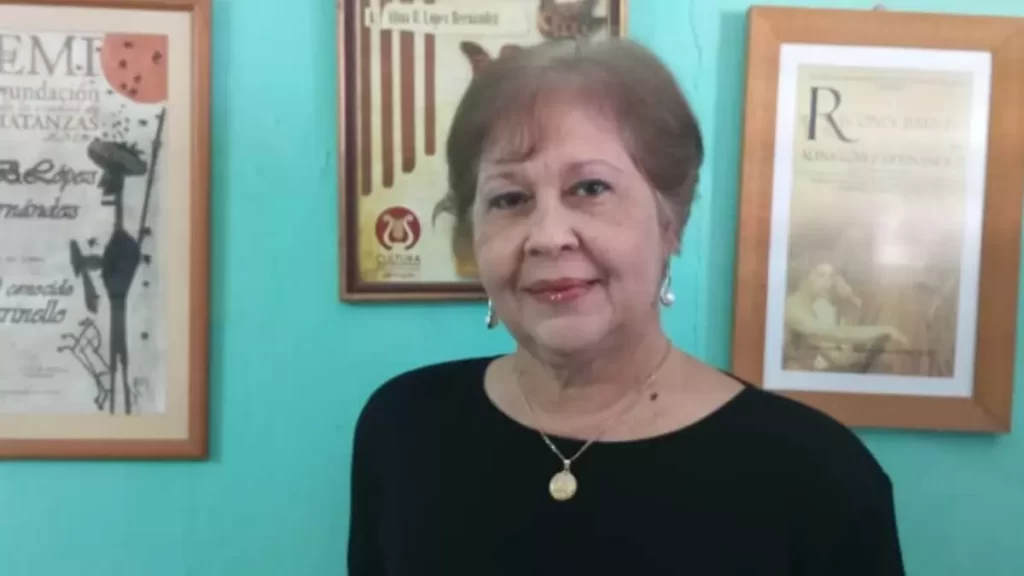
Professor Alina Bárbara López is now accused of assault./ Facebook
14ymedio, Madrid, 20 June 2024 — Almost 24 hours after arriving at her home following her arrest on Tuesday, professor and activist Alina Bárbara López Hernández has released a video on the YouTube channel of the Cuba X Cuba Civic Thinking laboratory that she co-directs, in which she denounces the violence of her arrest and the escalation in the persecution she suffers by the Cuban regime, which now accuses her of a crime of assault, the most serious one attributed to her.
The intellectual has explained in detail how an arrest took place in which she defended herself from the violent methods the agents used against her to accuse her of an ordinary offense. “The evident intention with this case is to involve me in a new ordinary process because all this comes out as an ordinary criminal offense, not a political crime. At no time do they charge me for trying to express myself, not at all. Now it turns out I assaulted an agent, “she says.
López Hernández was heading to Havana on Tuesday, accompanied by anthropologist Jenny Pantoja Torres, to demonstrate, as she has been doing since March 2023 on the 18th of each month. This date refers to the centenary of the Protest by the Thirteen Intellectuals against the corruption of the then Alfredo Zayas’s Government. Both were intercepted at a checkpoint by an agent who, with “very rude” manners according to the professor, told her to get in the patrol car. continue reading
“The evident intention with this case is to involve me in a new ordinary process because all this comes out as an ordinary criminal offence, not a political crime. “
The events were precipitated when López requested the arrest warrant or, at least, the reason for an arrest, and the agent refused. Thus, the situation ended when the official executed “a martial arts technique” by pushing her legs. This destabilized the 59-year-old professor, who fell on her back and hit her head. “I did not lose consciousness, but I was very disoriented because it was a strong blow,” she recalls. The teacher recalls a distortion in her senses that made her fear brain damage, so she refused to get up when the officer ordered her to.
At that moment two officers appeared in another patrol car and dragged her to a car while her friend took off her glasses to avoid further damage. However, that caused her, coupled with the confusion of the moment, not to see well and instinctively to cling to something that turned out to be an epaulet from the police uniform. “It looks like I ripped it off or, at the very least, loosened it, I didn’t keep it in my hand,” she explains. The accusation of assault that now weighs on her is based on that event.
López Hernández goes over other violent moments, including when they grabbed her hair and jerked her head. This caused severe pain in her neck, already damaged due to age and poor posture typical of her profession. As a result, the medical examination she underwent on Friday showed post-traumatic labyrinthitis – an inflammation of an area of the inner ear that regulates balance and that should improve in about three months. In addition, she mentions how the agent climbed on top of Jenny Pantoja, squeezing her chest tightly while she was screaming she could not breathe.
“I grabbed some of her hair, but I didn’t have the strength to pull it, because my head was twisted forward. Then Jenny also somehow grabs the officer to defend herself, that’s all we did: instinctively try to save ourselves, “she confirms. Due to these events, Pantoja will also be accused of assault.
As a result of this, a post-traumatic labyrinthitis was found in the medical examination she underwent this Friday
Another violent moment was still to come. When the vehicle was already heading to the station, the professor decided to lie down in the car to calm her discomfort and rested her feet on the door. “When she saw that I did that, she stopped the car, said to the other officer: ‘You drive.‘ She got in the back with me, and took out a pair of handcuffs,” she describes. The agent, who squeezed her handcuffs considerably and increased her pain, told her she would go like this to the station: “So you can learn.”
Upon her arrival, the agent was checked by a doctor for the”aggression” charge on which they will support the case that, according to the then detainee, did not conveniently occur in front of the cameras to prevent everything from being filmed and to be able to make “a false accusation.” The professor recalls that in June 2023, when she was arrested and accused of disobedience, the events occurred in a public place, with witnesses, which forced the political police to withdraw the charge of assault, but this time they did it better, she observes.
López Hernández praises her friend Jenny Pantoja, who never wanted to leave her alone. “She was a great person, very good friend and very brave, and she stayed. Now, although we are both co-accused, my statements help her and her statements help me, ”she adds. Both will be represented by the same lawyer, who was present at the interrogations of the two activists.
“Be honest, just admit that Cuba is being governed as a state of exception, outside the Constitution
“We were attacked savagely, in a sadistic way, without any justification. Simply put, what they want is for us not to exercise our rights, “she adds. López Hernández is proud of having said two things in front of State Security’s cameras that set her stand. Firstly, she regretted that the same camera had not been used to film her arrest; secondly: “Be honest, you just have to admit Cuba is being governed as a state of exception, outside the Constitution.”
The intellectual adds that she now has an order of “house confinement” that prevents her from moving to Havana. “Well, that does not matter. In Matanzas, the Parque de la Libertad is still in the same place and they won’t be able to move it from there,” she warns.
The professor announced the posting of the video apologizing for her time defending the regime. “What you will hear is very serious, they are things that years ago I myself would not have believed. My apologies to all those who have suffered something like this and were not properly accompanied.”
Her statements close with a call for harmony and dialogue, despite the brutality with which she is treated. “What has happened neither discourages me nor frightens me nor will it make me an entrenched person, a person who does not want dialogue. I do want to continue the dialogue. I want the way out for Cuba to be peaceful, it is the Cuban Government that does not want it. But I’m not going to get tired of demanding it. ”
Translated by LAR
____________
COLLABORATE WITH OUR WORK: The 14ymedio team is committed to practicing serious journalism that reflects Cuba’s reality in all its depth. Thank you for joining us on this long journey. We invite you to continue supporting us by becoming a member of 14ymedio now. Together we can continue transforming journalism in Cuba.
With the economy on the rocks and the usual voluntarism, nothing will stop the province from celebrating July 26 in style.
The “grandparents” of the municipality’s nursing home are, in many cases, the same age or younger than Valdés who is 92 / Sancti Spíritus Provincial Health Directorate
14ymedio, Havana, June 20, 2024 — A delegation of ministers and senior officials arrived in Sancti Spíritus this Wednesday to carry out a government visit that soon turned into a hunt for “illegal MSMEs” The star of the day was Ramiro Valdés, who handed out scoldings and invited people to “put their boots down” against “the reseller, the opportunist, the middleman and the supposedly ’clandestine’ store.”
The 92-year-old commander and deputy prime minister, who was in the municipality of Cabaiguán, reported that, in the construction sector alone – throughout the country – there are more than 8,000 MSMEs that declared a principal “object” but carry out “secondary activities,” as a real occupation. Furthermore, they have “altered templates, they sell at very high prices, they do not take cost sheets into account, and a high number of workers are not unionized,” he alleged.
Valdés, whom the official press describes as “entertaining, very interactive and pedagogical,” said that he was aware that there are economic “difficulties,” but that the Revolution has never thought “about what it has lacked,” but rather has “gone all in with what is has.” The leader himself, however, admitted that the bad data from the province has set off alarm bells in Havana. However, in the serious economic situation of the country, Sancti Spíritus achieved several results that earned it the venue of the official events for the 26th of July celebrations. continue reading
The best Acopio plan for the harvest and distribution of food in the province was that of Cabaiguán, he exemplified, which only fulfilled it by 87%
The best Acopio* plan for the harvest and distribution of good in the province was that of Cabaiguán, he exemplified, which only fulfilled it by 87%. And he does not even trust that number, he clarified, since “many times what is outlined or reported does not coincide with what is actually achieved, much less with what each place demands.”
His recipe for prosperity, which he already proposed in Santiago de Cuba, is to resurrect the microbrigades to promote construction – and with it the other economic aspects – an old “teaching of Fidel.” With this, however, there is a new problem and it is the lack of materials.
Deputy Prime Minister Jorge Luis Tapia Fonseca also put MSMEs in the crosshairs of his inspection. The leader believes that they must “talk” with the “illegal economic actors,” as he calls both those who work without a license and those who carry out activities for which they do not have permission.
“Why do the forklift drivers have more food than the State? They arrive first because we are not checking them. We have to know how much food the 42 cooperatives in the territory buy. We are not against the forklift drivers, but we want the State to sell more and cheaper food,” he argued. Tapia said that, as far as MSMEs are concerned, the Government works with “permanent dissatisfaction” with the current results.
“Why do the forklift drivers have more food than the State? They arrive first because we are not checking them”
Meanwhile, Valdés also traveled to the Sergio Soto refinery to “expedite solutions,” but the press was tight-lipped about the content of his visit to the place. The plant, apparently, has a “situation” with the extraction of asphalt liquid that “impacts its results,” about which they did not provide details.
Valdés asked the leaders for explanations for the “high prices” in all areas, which surprised him – reported the State newspaper Granma – and he also wanted to know the state of energy consumption. He cast a “particularly critical look” at housing officials, due to the situation of theft of materials and corruption. The projects, they let him know, “continue at very low execution rates and the figures for properties included in the plans, in many cases, are very low.”
Valdés shrugged his shoulders at the report: “If there are no materials,” he stated, “there can’t be housing either.” His visit ended at the Cabaiguán nursing home. The “grandparents” in the photos are, in many cases, of equal or younger age than the 92-year-old Valdés, but their physical deterioration cannot be compared with that of the soldier.
For the government visit, the usual express repairs were made. The most significant was that of a short section of the National Highway – towards Cabaiguán, where Valdés would pass – which “has been crying out for years” for a fix. The repair is “far from what the territory would like,” admits the official press, but at least it was carried out. “I wish there were conditions” for more, requested Granma, which reported the use of 290 tons of asphalt to cover the road, “despite the hot sun and if the electrical service allows it.”
The delegation of ministers, among whom were the heads of Culture, Public Health and Tourism, toured other municipalities and areas of the provincial capital. There was not much to congratulate the local officials for, judging by the minute by minute diary of the journey published by Escambray. There are difficulties with the water supply, tensions with producers, problems with food and a lot of crime.
With the economy on the rocks and the usual voluntarism, nothing will prevent Sancti Spíritus from celebrating the most important anniversary for the regime in style, with carnivals and political events. The people of Sancti Spiritus, however, believe that there is nothing to applaud.
“Even the ’integrated’ people are saying the same thing: with how bad everything is, how are they going to give the province the leading role on July 26,” Mirta, a housewife from the provincial capital, tells 14ymedio. Online the people of Sancti Spiritus have not stopped commenting on their discontent about the congratulations that the state entities offer for the “honor.” “Hunger and misery,” they point out, is the only thing the province excels at.
*Translator’s note: ACOPIO is Cuba’s State Procurement and Distribution Agency
____________
COLLABORATE WITH OUR WORK: The 14ymedio team is committed to practicing serious journalism that reflects Cuba’s reality in all its depth. Thank you for joining us on this long journey. We invite you to continue supporting us by becoming a member of 14ymedio now. Together we can continue transforming journalism in Cuba.
The atmosphere of desperation and paralysis of life generated by blackouts has been the subject of multiple complaints
It is affirmed that Raúl Castro ordered the confiscation of Valdés’ properties, his removal from the companies he supervised from office, and the strengthening of the authority of the current leadership / Cubadebate
14ymedio/YucaByte, Havana, 19 June 2024 — Blackouts set the pace of life in Cuba, heating up tempers and triggering protests of a different caliber in a summer that is just beginning. With an increasingly unstable country on their hands, the higher-ups observe how the historical leadership is crumbling. The death of the last generals – such as Raúl Castro [age 93] or Ramiro Valdés [age 92] – will mark, according to the rumors that collaborators with 14ymedio and YucaBite have collected in May, the beginning of a bloody dispute for power.
The signs pointing to warring factions within Castroism are already visible, say many users, who see in President Miguel Díaz-Canel’s trip to Moscow an attempt to win Vladimir Putin as a “godfather,” in the absence of Raúl. However, rumors indicate that the Kremlin is not getting along with the hand-picked Cuban president and there is talk of a cut in aid to Havana.
The key arguments are that Putin no longer trusts that Díaz-Canel is capable of maintaining control of the social tension on the Island, along with the old age of the historical leaders and, above all, the very high level of corruption of the current leaders, the majority appointed or ratified by the current president.
It was also suggested that not even a high-ranking official like Valdés is exempt from a possible purge. If last month there was speculation about his death – false information, as it turned out – it is now stated that Raul Castro ordered his properties to be confiscated, and the companies he supervised to be removed from his office, such as the military corporation Cimex, and the authority of the current leadership to be reinforced.
There were also comments that Díaz-Canel’s wife, Lis Cuesta, had also been detained in a police operation similar to the one that brought down the continue reading
former Minister of Economy, Alejandro Gil, whose current situation is also unknown. Cuesta – according to rumors – is accused of organizing much of the business corruption in Havana.
Elián González, the “child star” of Fidel Castro’s propaganda, took advantage of his position in the Cuban Parliament to defenestrate Susely Morfa, according to a rumor
A series of minor rumors, about the corruption and stampede toward the United States of local leaders, includes the information that Elián González – the “child star” of Fidel Castro’s propaganda – took advantage of his position in the Cuban Parliament to defenestrate Susely Morfa, former first secretary of the Communist Party in Matanzas. A video also circulated that allegedly showed a group of officials and politicians at a party. In the middle of the celebration someone gives a warning: “Don’t record it so they don’t upload it to Facebook.”
In May, all kinds of rumors circulated about the exodus of prosecutors, police and State Security agents heading to the United States. The “volcano route” and the US Humanitarian Parole program, which Cubans have been resorting to for years to escape the system that these agents represent, is now the route that the former repressors choose to abandon ship. Several social media sites – often of victims – offer photos and testimonies from the journey of those who either beat or led summary legal proceedings in Cuba, and now aspire to seek asylum in the United States or other countries.
This is the case of Francisco Hernández Tejeda, who supposedly served as second chief of a Rapid Response Brigade in Sancti Spíritus, and who is said to have left the Island for Brazil, where his wife already lived, having “deserted” from a mission as a doctor. Another rumor claims that thousands of members of the Armed Forces and the Ministry of the Interior have requested discharge, but that their superiors refuse to give it to them so that they will not leave the country.
The atmosphere of desperation and paralysis of life generated by the blackouts has been the subject of multiple rumors and complaints. Among them, several photos of children stand out who, according to the descriptions of the images, sleep outdoors because they cannot stand being inside their homes during power outages. Some of the photographs show how other people travel with their mosquito nets to protect themselves from mosquitoes in the streets.
Information about alleged acts of sabotage, in addition to protests, have not been long in coming
Information about alleged acts of sabotage, as well as protests, have not been long in coming. A forest fire in Minas, Camagüey, was attributed by several users to the Clandestinos organization or some other opposition group, as a protest against electrical shortages and instability.
It was also rumored in May that special troops, police officers and Army personnel in the municipality of Palmira, in Cienfuegos, are “barracked” waiting for a social outbreak due to the blackouts. The increase in surveillance in several areas of Havana is attributed to the arrival of summer. Two patrols and a bus with special troops travel through El Vedado from time to time, says a social media commenter.
And like the rest of the months, there are recurring rumors about el químico (the chemical), the trendy drug in Cuba. It, or one of its variants, has also been called el papelito. What does not stop circulating are rumors, often confirmed by the independent press, about the escalation of violence in the country. A decomposed corpse found in the Versalles area, in Santiago de Cuba; the murder of a minor in Bayamo and the stabbing of another in Contramaestre; and the multiple murders in which violent action by the Police is suspected are arguments – at least in the digital imagination of Cubans – that the Island is an increasingly insecure country.
____________
COLLABORATE WITH OUR WORK: The 14ymedio team is committed to practicing serious journalism that reflects Cuba’s reality in all its depth. Thank you for joining us on this long journey. We invite you to continue supporting us by becoming a member of 14ymedio now. Together we can continue transforming journalism in Cuba.
The newspaper Sierra Maestra assures that the child labor cases are the childrens’ own exceptions to “the complexity of context”
Children and adolescents who work are treated in the article as the children’s own exceptions “to the complexity of context” / 14ymedio
14ymedio, Havana, 19 June 2024 — One of the pillars of social welfare that for years the Cuban regime has defended as one of its greatest conquests collapsed this Monday, when the official press recognized that in Santiago de Cuba – as in the rest of the Island – there are cases of child labor. Children and adolescents in this situation are treated in the article as the children’s own exceptions to “the complexity of context” – a new euphemism for the economic crisis – and, although on no occasion are figures or statistics mentioned, officialdom insists that there are few.
The Sierra Maestra newspaper begins by talking about Luis, a sixth grader (between 10 and 11 years old) who sells bread in the mornings to help his mother and is also in charge of his three-year-old brother. The international regulations and charters that speak of children’s rights, of which Cuba is a signatory, speak of categorically proscribing child employment, but the newspaper says that “currently there are some cases, typical of the complexity of the context, that deserve to be evaluated differently, as a preventive policy and effective action.”
The idea, however, is nothing more than a suggestion that does not delve further into the problem and remains half-baked.
The article, which addresses a problem that is often ignored by officialdom, also cuts through the debate with a string of documents and articles that regulate work at an early age. On the Island, in the case of adolescents who continue reading
finish compulsory education and want to start working, the State has rules and permits so that they can access jobs suitable for their age.
Among the most common jobs are the sale of bread, gardening work or remuneration for tasks such as throwing away garbage
Attention to employees between 15 and 18 years of age is strict, and it is always required that the work is not carried out in difficult or stressful environments. However, and although Sierra Maestra recognizes that these are ages in which social pressure begins to arise because the adolescent assumes certain responsibilities, the issue is still not addressed thoroughly.
The official press focused on the work of educational institutions and mass organizations – such as the Committee for the Defense of the Revolution – which, it says, often discover cases of child labor when children and adolescents begin to miss school. Among the most common jobs are the sale of bread, gardening work or remuneration for tasks such as throwing away garbage.
For those who hinder the development of minors, the penalties can range from fines to prison. Families were also identified as the main ones responsible for the care of minors.
However, some “educational” policies that parents and students have been complaining about for decades, such as the so-called Schools in the Countryside or early entry into Military Service, are not included in the report although many consider them forms of “exploitation.”
On the contrary, the article talks about less pressing issues, such as university students who work and study at the same time. Although having both responsibilities can take these students away from their studies, the situation is not seen as harmful by society or the laws.
In fact, the State itself often promotes the employment of higher education students to fill teacher positions or other occupations in key sectors that suffer the stampede of professionals, and it pays these substitute teachers less than the conventional salaries of the sector.
At the beginning of the 2023-2024 academic year, several newspapers on the Island announced the formation of “quotas” of students to fill empty places in schools throughout the country. Likewise, it is common that in times of “crisis” students of health-related careers are asked to carry out vector control – Hygiene and Epidemiology tasks – as part of their work practices.
Many students also manage their own job search and end up prioritizing employment that gives them economic independence over options would define a career. According to Israel Riverón Sánchez, provincial deputy director of Employment in Santiago de Cuba, at the end of May more than 400 university students were working, of which only 120 did so in the state sector.
Translated by Regina Anavy
____________
COLLABORATE WITH OUR WORK: The 14ymedio team is committed to practicing serious journalism that reflects Cuba’s reality in all its depth. Thank you for joining us on this long journey. We invite you to continue supporting us by becoming a member of 14ymedio now. Together we can continue transforming journalism in Cuba.
The project, financed by Unicef and the Government of Extremadura, was also intended for Haiti and the Palestinian territories
Part of the donation to Cuba from Unicef and Aexcid were 21 incubators / Unicef Spain / Screen capture
14ymedio, Madrid, 19 June 2024 — Up to nine neonatal care units have been given to Cuba from a project of the United Nations Children’s Fund (UNICEF) in Spain and the Extremadura Agency for International Cooperation (AEXCID). These were also given to Haiti and Palestine (both Gaza and the West Bank).
The three territories, UNICEF said in a press release, are considered “debilitated” after the Covid-19 pandemic and are “areas affected by natural disasters and conflicts.”
The agreement, signed in July 2022 and finalized a few months ago, indicates that the total cost of the operation was 1,259,666 euros. Of these, 9,666 were contributed by UNICEF and the bulk, 1,250,000 euros, by the Junta de Extremadura, on which AEXCID and one of the poorest Autonomous Communities in Spain depends. The Island received one third, that is, 419,889 euros, the same as each of the parties.
UNICEF shared an inventory of what was donated to the provinces of Pinar del Río, Havana; Mayabeque, Ciego de Ávila; Holguín, Granma, and Santiago de Cuba. Among all the hospitals, such as the Abel Santamaría Cuadrado and the Pepe Portilla of Pinar del Río, and the Manuel Fajardo of Havana, 21 incubators, 8 neonatal cardiomonitors, 2 “non-invasive” ventilators continue reading
and 8 portable monitors of vital signs were distributed, as well as digital scales, thermal blankets, oximeters and antiseptic cloth. This is, the text says, something “critical for the care of the newborn at risk.”
Training workshops were also given to about 5,000 specialists
Training workshops were also given, explains UNICEF Spain, to about 5,000 specialists, on care for newborns in critical condition and nutritional follow-up “during the first thousand days of life, which contributes to raising the quality of health care for pregnant women, girls and boys from the early stages.”
Infant mortality is one of the health measures that has worsened most dramatically in recent years in Cuba, which for decades has boasted of being a medical power. From 2018 to 2021 it grew by no less than 91.77%, from 3.9 children per 1,000 live births to 7.6 dying by twelve months of age, according to official data. Although in 2023 there was a slight improvement, with 74 fewer babies dying than the previous year, the rate at the end of the year remained ominous: 7.1 deaths per 1,000 live births. (For many years, even before the triumph of the Revolution, it remained at a rate of 5 per 1,000).
According to an article published by Escambray, the “stability in infant mortality rates” was precisely one of the reasons to name Sancti Spíritus as the headquarters of the upcoming celebrations for 26 July. The province has a current rate of 3.8 deaths per 1,000 live births, slightly lower than that in 2023, of 4.7 per 1,000.
“Improvisation, which allows surprising results to be composed on the fly, has nothing in common with strategic Cuban Health services, such as neonatal care and other factors that directly affect the infant mortality rate,” says the official newspaper.
The article emphasizes that the “growing adversities” were “aggravated” by Covid-19, precisely the reason for the subsidized action of UNICEF and AEXCID. The pandemic, the organizations say in their joint statement, highlighted “the fragility of health systems in many countries, overwhelmed by a health crisis that was added to existing ones, such as humanitarian or natural disasters.” One of those countries is, officially and internationally, Cuba.
Earlier this month, UNICEF published its report on serious child poverty, in which it included the Island for the first time. The document pointed out that 9% of minors up to five years of age suffer from severe poverty; that is, that they have a maximum of only two of the eight foods considered necessary for a healthy life. In addition, it pointed out that 33% of children suffer from moderate poverty, which means they have between three and four of these eight foods available to them.
Translated by Regina Anavy
____________
COLLABORATE WITH OUR WORK: The 14ymedio team is committed to practicing serious journalism that reflects Cuba’s reality in all its depth. Thank you for joining us on this long journey. We invite you to continue supporting us by becoming a member of 14ymedio now. Together we can continue transforming journalism in Cuba.
The property seems abandoned, but more than a dozen families live inside.
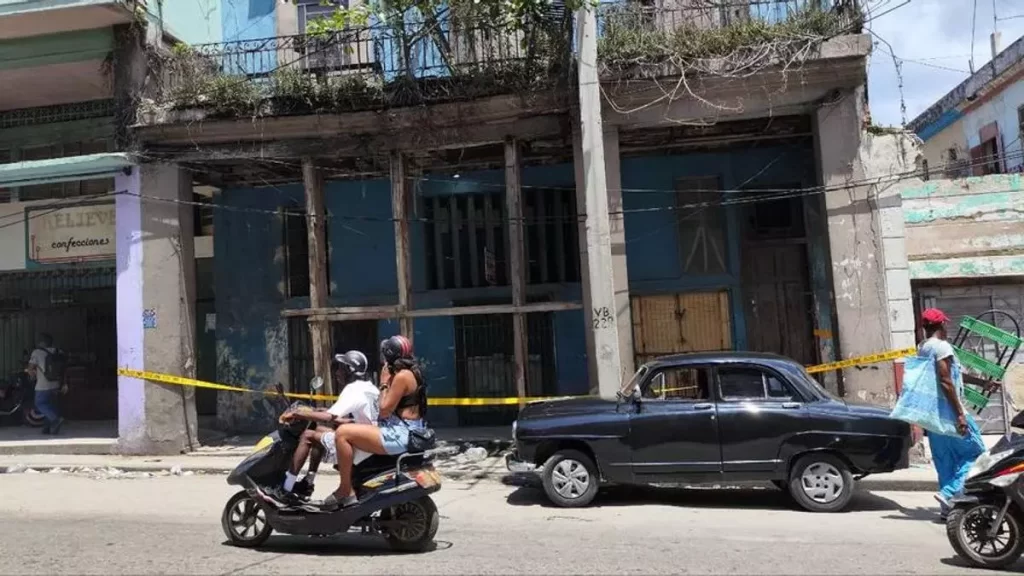
Number 425 of Monte Street, between Ángeles and Águila, in Old Havana, this Wednesday / 14ymedio]
14ymedio, Natalia López Moya, Havana, 19 June 2024 — At noon this Wednesday, a yellow tape blocked the passage to the entry of the building at 425 Monte Street, between Ángeles and Águila, in Old Havana, where last night a partial collapse left a young woman injured. The adjacent property at number 423 had claimed the life of a man three years ago, when one of its side walls collapsed.
“We can’t even sleep here, all of us who live on this piece of street are in danger,” a neighbor who went to the place to get information about the injured woman tells 14ymedio. “We don’t know anything; we have called the Emergency Hospital [General Freyre Andrade], but they say that they don’t treat patients in Old Havana and they don’t have a trauma ward either.”
This newspaper’s attempts to know the state of the young woman, through the information numbers of the Calixto García Clinical Surgical Hospital, were also unsuccessful. A video of the moment she was evacuated shows the woman passed out and being put into a police patrol in the absence of an ambulance for her transfer. This Wednesday, among the neighbors, her situation was still a question mark.
“It’s been raining for many days and tragedy could be smelled in the air”
With the door closed, the facade in a calamitous state and the roof of the entrance propped up with thick wooden beams, the building where the collapse occurred seems abandoned, but inside there are still more than a dozen families crammed into small apartments. For years, the residents have feared that a wall or one of the middle floors will collapse. This Tuesday, part of the nightmare became a reality. continue reading
“It’s been raining for many days and tragedy could be smelled in the air,” said an old man who lives on Ángeles Street. In December 2021, the residents in the surrounding area heard a roar and, when they looked out of their doors, they saw that the side wall of the first floor of number 423, which is on the corner, had fallen, filling the entire passage with debris. Under those bricks, the body of a passer-by who lost his life was recovered.
The section of Monte Street where both affected properties are located is a very busy area and one of the most important commercial routes in the Cuban capital. Despite the “Don’t Pass -PNR*” signage that surrounds the building where the most recent collapse happened and the images of the accident that have been circulating for hours on social networks, this afternoon vehicle traffic and pedestrian crossing on the avenue were maintained.
The balcony of the collapsed building is full of vegetation that has grown between the cracks
Above the heads of passersby, the balcony of the collapsed building is full of vegetation that has grown between the cracks and through the bars. The trunks of bushes and weeds extend throughout the terrace. On the facade of the ground floor a colorful sign announces “Cell phone repair,” and there is often a line of people waiting to access the service.
After the previous collapse, less than three years ago, the corner building, 423, has been left with only a flat floor where there is currently a small sale that exhibits its goods on a table at the door. Moisture stains rise on the walls and columns of all the buildings on the block, and in the air the most persistent smell is that of sewer water.
The neighbors of the area fear that the deterioration is now so advanced that repair is not an option for some properties, most of them from the first half of the twentieth century but showing decades of neglect, lack of resources to carry out restoration and the overpopulation of families of up to three generations, who have had to divide the space with improvised walls and lofts that have added weight to the structures. [A set of photos of the site is here.]
In December 2021, 14ymedio interviewed several neighbors of nearby buildings and talked to some of the inhabitants of numbers 425, 427 and 429 of Monte Street. Aramirta Castan then warned that the danger continued: “Here in my dining room pieces of the roof are falling, everything is shaking, it seems that we are in an earthquake,” complained the woman, then 77 years old. “That door out there is in the air, everything is falling.”
*Partido Nacional Revolucionario
Translated by Regina Anavy
____________
COLLABORATE WITH OUR WORK: The 14ymedio team is committed to practicing serious journalism that reflects Cuba’s reality in all its depth. Thank you for joining us on this long journey. We invite you to continue supporting us by becoming a member of 14ymedio now. Together we can continue transforming journalism in Cuba.
Casla Institute requests proof of life from Cuban musician and activist Maykel Castillo Osorbo
Facade of Kilo 5 y Medio prison, in Pinar del Río, Cuba / Instagram
14ymedio, Havana, June 19, 2024 — The prison authorities of the Kilo 5 y Medio prison, in Pinar del Río, Cuba, are making life impossible for political prisoners serving their sentences in this prison. According to Cubalex, Jorge Luis Rodríguez Valdés Tangallo was again denied the delivery of food, medicines and other essential items.
The legal NGO also said the activist has not been able to receive his regular visits for three months. Since Tangallo has no close relatives, Eduardo Díaz Fleitas, also an activist and former political prisoner of the Black Spring, attends these meetings, but he is repeatedly denied access to the prison.
The restriction on receiving external aid, even to cover basic needs, “shows the use of deprivation of liberty as a form of reprisal based on political motives,” Cubalex said, adding that the prisoner has even been restricted from receiving phone calls.
Since Tangallo has no close relatives, Eduardo Díaz Fleitas, also an activist and former Black Spring political prisoner, attends these meetings
Tangallo was sentenced in April 2022 to four years in prison for the crime of “contempt” and previously accused of “enemy propaganda” for painting the phrases “Díaz-Canel singao”(Díaz-Canel Motherfucker), “Abajo el continue reading
comunismo”(Down with Communism), “Abajo los Castro”(Down with the Castros) and “Viva el 27 de Enero”(Long Live January 27) on the train station walls in the town of Entronque de Herradura. In Kilo 5 y Medio prison, he also faces constant threats of being transferred to a punishment cell for denouncing the living conditions inside the prison.
Cuban musician and activist Maykel Castillo, known as Osorbo, is serving his sentence in the same prison. The Venezuelan Casla Institute, which monitors the state of democracy in Latin America, requested proof of life for him last Friday.
Through social media, its executive director, lawyer Tamara Suju, warned that the artist, a member of the San Isidro Movement, denounced that “they are trying to kill him in prison,” that “he is being punished and the dictatorship has him incommunicado.” On April 18, the rapper was assaulted by four ordinary inmates in complicity with the prison authorities.
The Observatory for Cultural Rights denounced last month physical and psychological aggressions against Osorbo, who receives “no or defective medical care” in the face of the multiple ailments he has presented. Likewise, they protested against the concealment of the medical records from his family. The rapper is confined to solitary confinement and visits have been cancelled as a punishment for sending messages or repeatedly refusing to be transferred to another prison. In addition, they accused him of planning “an uprising” inside the prison, so they even installed a security camera to monitor him.
The rapper is confined to solitary confinement and visits have been suspended as a punishment for sending messages or recurrently refusing to be transferred to another prison
Osorbo, one of the authors and performers of the song Patria y Vida, a winner of two Latin Grammys, was arrested two months before the historic protests of 11 July 2021 — known as ’11J’ — and sentenced to nine years in prison. He was accused of “attack,” “public disorder” and “prisoners or detainees’ escape,” although he was held in prison for a whole year without trial, until May 2022.
The musician was declared a prisoner of conscience by Amnesty International in August 2021 and earned the Freedom Award from Freedom House in May 2022.
Translated by LAR
____________
COLLABORATE WITH OUR WORK: The 14ymedio team is committed to practicing serious journalism that reflects Cuba’s reality in all its depth. Thank you for joining us on this long journey. We invite you to continue supporting us by becoming a member of 14ymedio now. Together we can continue transforming journalism in Cuba.
14ymedio, Mexico, June 17, 2024 — Daniel Ortega’s regime denied Cuban activist Bárbaro de Céspedes – known as “El Patriota”- entry into Nicaragua. “While on the bus to the [Havana] airport, they sent me a message saying that the Government of Nicaragua denied my entry into that country,” he denounced on social media in a live video.
The activist explained from Camagüey, where he resides, that he had managed to buy an expensive plane ticket with several stops for June 13th with the intention of emigrating.
“State Security has tried to make life impossible for me and my family in Cuba,” said De Céspedes, who spent two years in prison for demonstrating peacefully on 11 July 2021. “I made the hardest decision of my life, to emigrate from this country that I love and defend. It is not for fear of death – I no longer have a life – but for fear of being a nuisance to my family,” he added in a broken voice.
The Camagüey native denounced that his daughter, some time ago, was also denied entry into Nicaragua and that, on this occasion, the airline ticket manager sent him a similar message to the one she got: “We inform you that we have been notified by the Nicaraguan immigration authorities that they have not authorized your entry into the country, so you will not be able continue reading
to board your flight,” says the document that De Céspedes showed and where the logo of the Colombian airline Avianca can be seen.
“These people have punished me to life imprisonment on this island prison”
“The crying is not because of the refusal, the crying is because of the decision I have had to make. Everyone who knows me knows that my homeland is above everything, above my feelings. And these people [the Cuban regime] have punished me to live in prison for life on this island prison,” he said.
In April 2021, he was detained for several days after making a pilgrimage to the Nuestra Señora de la Merced church in Camagüey. De Céspedes was released with a precautionary measure of house arrest and a fine of 2,000 pesos for not wearing a mask.
The Camagüey activist arrived at the church on Good Friday carrying a huge cross that said 62 years of dictatorship, with his torso shirtless and painted with a Cuban flag. He was detained by uniformed officers when leaving the temple.
A few months earlier, the police also arrested him in the middle of a crowd when he was handing out leaflets in the historic center of the city of Camagüey printed with texts by José Martí. On that occasion, he managed to hand out dozens of flyers to passersby and sang the national anthem. He also shouted several times: “Viva Cuba libre”(Long live free Cuba).
This is not the first time Managua has denied Cuban activists entry. Before De Céspedes, journalists Héctor Luis Valdés Cocho and Esteban Rodriguez, members of the San Isidro Movement, and doctor Alexander Figueredo, for example, were prevented from entering.
Translated by LAR
____________
COLLABORATE WITH OUR WORK: The 14ymedio team is committed to practicing serious journalism that reflects Cuba’s reality in all its depth. Thank you for joining us on this long journey. We invite you to continue supporting us by becoming a member of 14ymedio now. Together we can continue transforming journalism in Cuba.
A documentary by specialist Kirby Allison reveals details and curiosities of “the Commander’s favorite tobacco”
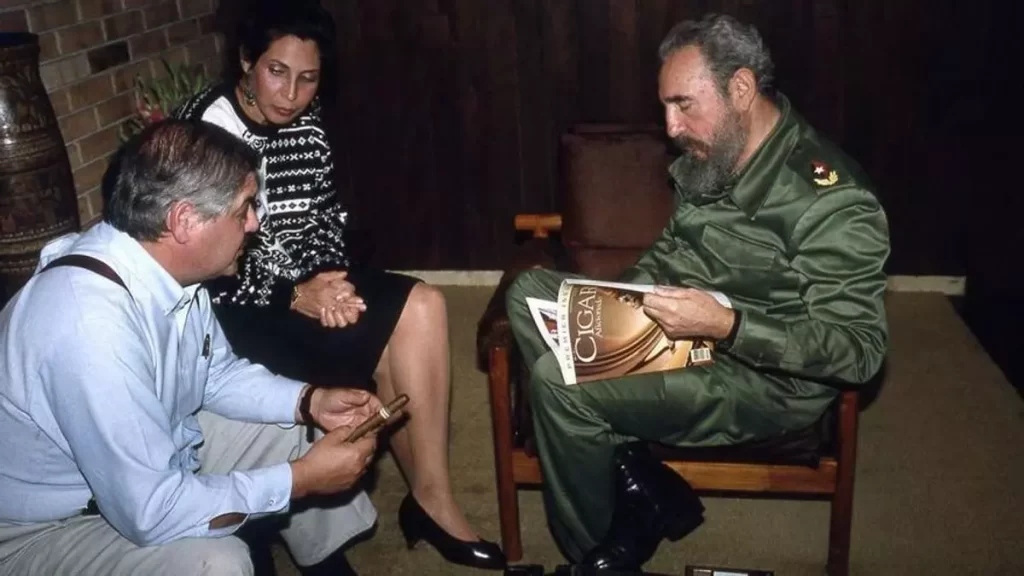
Marvin Shenken, editor of Cigar Aficionado, interviews Castro in 1994 / Cigar Aficionado
14ymedio, Juan Izquierdo, Havana, 18 June 2024 — In 1994, Fidel Castro gave an interview to the American Marvin Shenken, editor of the prestigious Cigar Aficionado magazine. “We know that there is a cigar called Trinidad and that it is only obtained in Cuba as a gift,” he said bluntly. According to rumors, the brand had been secretly manufactured since 1969 without a band, but Castro had denied its existence several times. With a smile, his answer was: “I don’t know what you’re talking about.”
That year, during the so-called Dinner of the Century – a luxurious banquet of millionaires held in Paris while Cubans went hungry in the Special Period – several boxes of Trinidad with the signature of Castro were officially auctioned, which were served after the meal with a 1982 Château Mouton Rothschild wine.
Born to dethrone the Cohiba, the story of how the “Commander’s favorite cigar” began to be sold was revealed by David Savona, current director of the magazine, to the specialist Kirby Allison during a miniseries about the brand that has just been uploaded to YouTube. In 1991, Shenken made a trip to Cuba on the trail of the Trinidad. He was about to publish the first issue of Cigar Aficionado magazine, and no one wanted to give him information about the “best kept secret” of the Island
“We were all a family. We thought the same thing: we all wanted to make a cigar for Fidel.”
He had to settle for a small article, which was enough to whet the appetite of the millionaires. When the terrain was prepared and everyone wanted to smoke a Trinidad, Castro admitted that the cigars existed and that they were for sale. continue reading
Ultimately, the Trinidad failed to dethrone the Cohiba, which is still the best-selling cigar on the Island. But the state corporation Habanos S.A. does not give up: Allison’s series is part of a promotion package, with new cigar bands and tools of the trade, in tribute to the 55th anniversary of the brand.
For Allison, if Cohiba is the flagship of Cuban cigars after 1959, Trinidad is the “special jewel in the crown” for its “unparalleled mystical aura.” The golden cigar with a blue band was given to diplomats and ordinary guests, but the triple T was reserved for very high officials, who were required not to disclose their consumption beyond the “corridors of diplomacy,” says the expert.
Trinidad, the Cuban city that the brand evokes, is for Allison the summary of everything the tourist seeks: colonial architecture, the convergence between Spaniards, Africans and “natives” and quality tobacco, whose cultivation method was perfected by Canarian immigrants in the central provinces of the Island.
The series points to the utmost secrecy in which Castro maintained the El Laguito factory since 1959, where the Trinidad and the Cohiba are manufactured. The president, he believes, “gave the diplomats the opportunity to show Cuban cultural wealth to the world.” Juana Ramos Guerra, one of the first cigar rollers of the factory, explained to Allison that all the employees entered the factory thanks to a family tie with the regime, since it was Celia Sánchez who was in charge of the selection process in 1972.
Before its launch, the Trinidad was marketed without a name or cigar band. Fidel Castro’s signature was on the very luxurious boxes / Screen Capture
“The cigar that was made here was the one made for Fidel,” Ramos adds. “We were all a family. We thought the same thing: we all wanted to make a cigar for Fidel.”
The greatest tribute that Ramos received from his bosses had to do with the Trinidad: the best cigars of the brand came out of his hands in 1998. The Trinidad, he recalls, “was the cigar that Fidel gave to presidents and important people who came to Cuba. It had no mark or bands, it was very simple but very tasty. Everyone wanted Fidel to give him one.”
The person who received the cigar found out from Castro what kind of cigar he was smoking, so that if the specimen left Cuba, no external sign would reveal it. “The Trinidad is our ambassador to the world,” says Ramos. By 2003, the brand had expanded to create new shapes and calibers: Founders, Colonials, Kings, Robusto Extra.
The worldwide relaunch of the brand took place in London that year, sponsored by Hunters & Frankau. Now, two decades later, Habanos has declared a “Trinidad tasting time,” with tastings in several places, so that millionaires can get excited again about cigars and their new brand, Cabildo, whose name evokes the relationship between tobacco and the “primary forms of government” of the colonial era. A link that recalls the principle formulated by Fernando Ortiz: “Whoever rules in Cuba, rules in cigars.”
Translated by Regina Anavy
____________
COLLABORATE WITH OUR WORK: The 14ymedio team is committed to practicing serious journalism that reflects Cuba’s reality in all its depth. Thank you for joining us on this long journey. We invite you to continue supporting us by becoming a member of 14ymedio now. Together we can continue transforming journalism in Cuba.
The place intended to preserve health is, paradoxically, a source of potential infections for neighbors
Down the slope, a dark river with greenish parts carries waste from the Public Health department / 14ymedio
14ymedio, Natalia López Moya, Havana, 18 June 2024 — Where there was hygiene, sewage remains. Those who walk in front of the Héroes del Moncada University Polyclinic on 23 Street, between A and B, in El Vedado, Havana, have been repeating the same ritual for days: go down the sidewalk, take risks among traffic on the avenue and avoid a spill through which flows waste from the health center’s bathrooms. The place intended to preserve health is, paradoxically, a source of potential infections for neighbors.
“At first, the stench didn’t let us live, but now I don’t even feel it,” admits a neighbor from A, where a dark river with greenish chunks drains downhill, carrying waste from the Public Health Department. “Children can no longer play on the sidewalk, and in many houses, people have had to put damp blankets with bleach by the door to clean their shoes before entering.” The grass in the nearest flowerbeds has grown “fed” by the sewage and a trash can seems about to float in the dark lake that has formed around it.
The disgusting current knows no limits or locks. It passes under the stately fence that surrounds the polyclinic, extends along the most important avenue of the modern center of Havana and sticks to the wheels of the shopping carts of those who await in line at the nearby rationed market warehouse. Everyone who passes by takes away something of its essence, be it part of the stench, some fragment of waste carried by the current, or the look of disgust on their face. continue reading
“At first the plague didn’t let us live, but now I don’t even feel it anymore” / 14ymedio
“In the mornings, people who come to get their blood drawn for some lab analysis line up right here”, says another resident nearby. “There are pregnant women, children, people with chronic illnesses and old people who can barely lift their feet to walk and they carry all of that stuff stuck to their shoes. Anyone who falls into those waters will come out with an infection, for sure.”
The property’s employees are also at risk. In the morning, they dodge the stinky puddles to get to their jobs and in the afternoons, they gain momentum again and jump so as not to take the detritus home.
On the bright green façade of the building, a sign warns that it is a University Polyclinic, a reference location for training new doctors in direct patient care. In addition to preparing them for clinical diagnoses, the place is designed to train them to practice the profession in the midst of hygienic and epidemiological chaos.
Translated by Norma Whiting
____________
COLLABORATE WITH OUR WORK: The 14ymedio team is committed to practicing serious journalism that reflects Cuba’s reality in all its depth. Thank you for joining us on this long journey. We invite you to continue supporting us by becoming a member of 14ymedio now. Together we can continue transforming journalism in Cuba.

 14ymedio, Havana, 21 June 2024 — On Monday, June 24, Amnesty International will hold a virtual meeting for the freedom of Cuban artists Luis Manuel Otero Alcántara and Maykel Osorbo.