Three Years Later, What Has Become of the Repressors of 11J?

The change that has taken place in thousands of people has been so profound and rapid that, in other circumstances, it would have taken several decades.
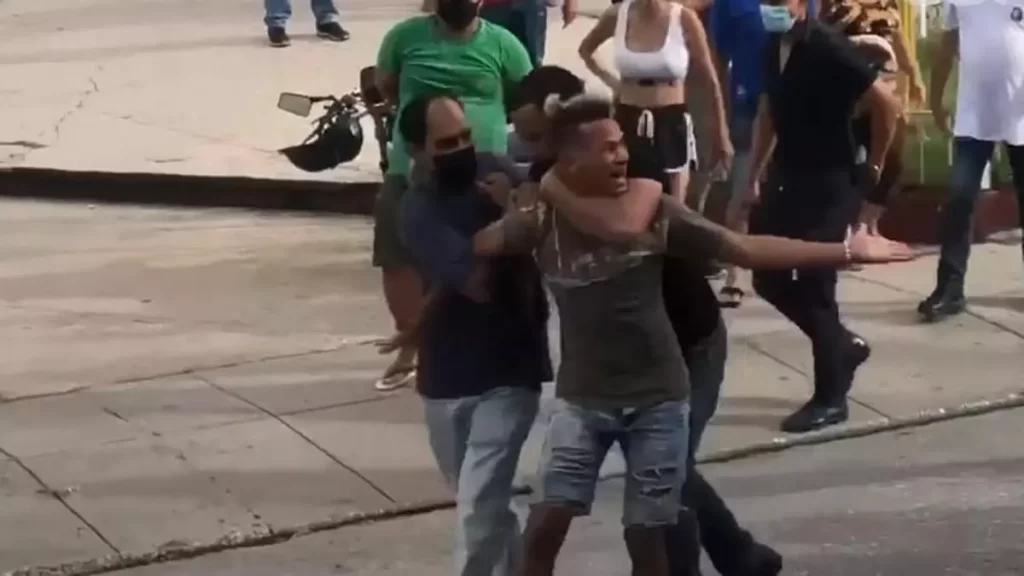

Demonstration on 11 July 2021 repressed in Villa Clara / Capture/Archive

14ymedio bigger14ymedio, Yoani Sánchez, Havana, 11 July 2024 —  Three years have passed since the historic protests that shook the Cuban streets on 11 July 2021, but it seems like more time has passed. The change that has taken place in thousands of people on this island has been so profound and rapid that, in other circumstances, several decades would have been needed to achieve a similar effect. If the transformation experienced by the protesters, their families and, especially, those imprisoned for that day has been rapid and significant, a metamorphosis has also taken place among the ranks of the repressors.

Angela was 76 years old on 11J and, when she heard the first echoes of the demonstrations, she wanted to go out with a stick and confront the young people who were shouting their discontent in the streets of the city of Camagüey. A member of the Communist Party, a staunch follower of every official campaign that shaped her life – from volunteer work to missions abroad – she felt absolute contempt for those “ungrateful kids” who wanted to “overthrow the Revolution.”

Now, 36 months later, she curses angrily every time there is a blackout, has raised the tone of her criticism of President Miguel Díaz-Canel, asked to leave the ranks of the Cuban Communist Party (PCC) and is packing her suitcase to go to Spain through the Law of Democratic Memory, after dusting off an Asturian grandfather.

Yuri was one of those who carried out attacks near the Havana Capitol. Years as an informant for State Security in the Jesús María neighborhood made him close to those agents of the political police who always carry pseudonyms like Ernesto, Camilo or Alejandro. That day, one of them warned him that “los gusanos” — the worms — wanted to “take over the headquarters of the National Assembly and overthrow the Government.”

continue reading

At 23  and with his long sessions at the gym, it was “a cakewalk,” he would later boast when telling how he broke heads, punched stomachs and helped put several of the protesters in the paddy wagons that carried off hundreds of detainees. Months ago he deleted his Facebook account where he boasted of his excesses, obtained ‘Humanitarian Parole‘ to emigrate to the United States and, from Jacksonville, Florida, he now insists that he will not return to Cuba “not even tied up.”

Months ago he deleted his Facebook account where he boasted of his excesses, he obtained ‘Humanitarian Parole’ and insists that he will not return to Cuba “not even tied up”

Paloma, 19, was one of those summoned to the act of redress for the popular protests organized by the government days after 11J on the Havana coast. At dawn, the young university student arrived at the place, passed through the metal detector placed for the occasion and chanted some slogans in a tone of eternal victory. At her school she promised to join the Rapid Response Brigades to defend “the country from falling into the hands of the enemy.”

Already a graduate of her specialty, she now joins the ranks of the unemployed who do not want to work for the State for a miserable salary but have not managed to get into a prosperous MSME that guarantees them a living. Her parents have put the family home of “capitalist construction, ready to move in” up for sale and with that money they hope to finance the three tickets to Managua that will get them off the Island as soon as possible.

Three repressors, three stories of disillusionment that could be multiplied by thousands, by hundreds of thousands. None of them is at this moment willing or available to return to the streets to defend the Cuban regime. Between emigration and disillusionment, their revolutionary energy has been reduced or buried. Some could even swell the ranks of those who shout “Homeland and Life!”, “We are not afraid!” and “We want change!” if indignation were to fill the streets again. Does this mean that another explosion is near? If disappointment with the political model has increased in the ranks of the “faithful” themselves, is another 11J approaching?

This July, the reasons for social protest are greater than they were three years ago. There has been growing discontent with the worsening economic crisis, with the inflation that has plunged millions of Cubans into poverty, with the electricity shortage that has plunged us into long hours of darkness, and  with the official blunders when it comes to applying solutions to get out of the quagmire. But the legal, judicial and police mechanisms have been greatly reinforced to avoid an uprising. The long prison sentences against the protesters, not only three years ago, but also in subsequent protests, have worked as a deterrent and the exodus has reduced the number of potential protesters.

But not everyone can board a plane. Among those who are condemned to remain in the country due to a lack of resources and contacts is the ferment of another possible 11J. On which side will Angela, Yuri and Paloma who are still in Cuba, find themselves when that day comes?

____________

COLLABORATE WITH OUR WORKThe 14ymedio team is committed to practicing serious journalism that reflects Cuba’s reality in all its depth. Thank you for joining us on this long journey. We invite you to continue supporting us by becoming a member of 14ymedio now. Together we can continue transforming journalism in Cuba.


Miraculous Fishing in the Zaza Reservoir Thanks to the Drought or How To Turn a Setback Into Victory

The fishermen caught 500 more tons of fish than in 2023, when the situation in Zaza was stable / Cubadebate]]

14ymedio bigger14ymedio, Mercedes García, Sancti Spíritus, 12 July 2024 –After weeks of “miraculous fishing” in the exhausted Zaza reservoir, the Sancti Spíritus Fishing Company obtained 1,980 tons of fish, which represents an overcompliance of 113% in its semi-annual plan and 28% of what was collected throughout Cuba.

With a very bad memory, the official press celebrates the result – “in greeting to July 26,” (the province is the site of the upcoming anniversary celebrations) – and omits the alarming situation of the reservoir, weighed down by the drought. Only now, months after Escambray announced the frenetic “aquatic harvest” that was carried out in Zaza so as not to “miss” the very low level of the largest reservoir on the Island – at 13% of its capacity in May – the authorities admit that they were pursuing a fishing record within the framework of the official celebrations for the largest anniversary of the regime.

The protagonists of these six months have been the brigades – fleets – Sierra, Pantera, Pitirre, Liudmila and Tuinucú, whose employees did not have to be told to continue taking fish even if the plan was already fulfilled. It was a “state commission,” Escambray explained this week, stirred by the promise that they were also “fishing for more salary.” A ton was paid at 4,000 pesos. continue reading

The local newspaper then recognized its concern for Zaza, where fish “can be caught by hand”

The local newspaper then recognized its concern for Zaza, where fish “can be caught by hand,” an opportunity that the hungry fishermen in the area did not miss, with constant embellishments like the report this Thursday by Cubadebate. The overflowing boats; the crowded nets; entire fleets in the navigable part of the reservoir; the workers of the state Acuiza exhibiting large tilapia; and the scenes of “abundance” after a “tense battle” against the dam fill the idyllic report, which does not say a word about the drought.

They took out 500 tons more than in 2023 – according to Cubadebate – when the situation of Zaza was stable and the species that populate it could be fished without danger of extinguishing the prey ecosystem, composed of carp, brill, tilapia and catfish.

The authorities admit that there was an “intense drought” and that the spring rains have been “elusive,” which keeps water levels in Zaza “low.” That reference, however, is interpreted as good news because it “catalyzes the catch.” “Contributing food” is the currency, for which they were given a small “improvement in working conditions”: the company gave them 20 more boats; two have motors.

“Contributing food” is the currency, for which they were given a small “improvement in working conditions”

They fished so hard that Cubadebate has the luxury of joking about the “strengths and skills” that the muscular fishermen developed in pulling out their nets, full of “good specimens.” Crammed with the “precious cargo,” the flotillas returned to the shore with great difficulty. The boss of the Tuinucú brigade – who is the best – revealed his secret: to exceed the daily plan – from 5 to 6 tons – even if it is in small quantities. This is how the “prominent campaign” was achieved, which hasn’t stopped.

Last May, Cubadebate gave details about the panorama of Zaza, which, with its capacity to house 1.02 billion cubic meters of water, is the largest reservoir in the country. There were only 132,600 cubic meters at that time. The fishermen then anticipated that a large number of fish would die, so they had received the approval of Acopio – whose trucks opened their doors on the shore so that there were no tricks when delivering to the State what the State asks for – for an “accelerated fishing.”

The opinion of one of the fishermen, Armando García, was that Zaza was “agonizing,” and that you could only work in “small streams and puddles.” The media also recognized that the fish were not sufficiently developed to face, without risk to their population, such a campaign.

Nor was the Zaza very clean: the dirt and excess vegetation impeded the navigation of the fishermen and allowed the fish to hide. Created in 1975, 264,000 people live in the vicinity of the dam – many of them also carry out an illegal and small-scale fishery in its waters.

For five years the dam has not opened its spillway because it hasn’t been filled, and cows now graze in many of the nooks and crannies left by the drought. This was confirmed by 14ymedio, who visited the dam in June and saw that many farmers have plucked up their courage: if you can’t fish, at least the thin cattle can take advantage of the green weeds that grow where there once was water.

Translated by Regina Anavy

____________

COLLABORATE WITH OUR WORKThe 14ymedio team is committed to practicing serious journalism that reflects Cuba’s reality in all its depth. Thank you for joining us on this long journey. We invite you to continue supporting us by becoming a member of 14ymedio now. Together we can continue transforming journalism in Cuba.

Exiles and Legislators in the United States Call for the Release of Cuba’s Political Prisoners Three Years After 11J

The Assembly of the Cuban Resistance echoed the letter entitled “Nosotros Somos Plantados,” written by three prisoners

The image of political prisoner Juan Enrique Pérez holding a poster that says “We were so hungry that we ate our fear” was one of the most iconic of the 11J protests.

14ymedio biggerEFE (via 14ymedio), Washington, 12 July 2024 — Members of Congress and Cuban exile organizations in the United States asked this Thursday, on the third anniversary of the historic anti-government demonstrations of 11J in Cuba, for the release of all political prisoners on the Island. Republican members of Congress Carlos Giménez and María Elvira Salazar, and their Democratic colleagues Debbie Wasserman Schultz and Bob Menéndez, demanded the release of the more than 1,000 political prisoners arrested “for demanding freedom from the murderous regime.”

“The 11J movement is a series of peaceful protests throughout the Island of Cuba, which capture the attention of the world, against the brutal and murderous regime of Castro and the Communist Party of Cuba. The regime has responded with extreme brutality,” said Giménez, born in Cuba.

“The 11J movement is a series of peaceful protests throughout the Island of Cuba, which capture the world’s attention, against the brutal and murderous Castro regime”

In turn, the Democratic Party of Florida stated that three years ago the Cuban people took to the streets in “the largest demonstration in decades” to demand freedom.

“Since 11 July 2021, the Cuban regime has kept hundreds of peaceful protesters in prison and has continued its efforts to silence Cubans, intimidate protesters and arrest political prisoners,” said Florida Democratic Party president Nikki Fried. continue reading

Fried called for the release of prominent leaders of the Cuban opposition, such as José Daniel Ferrer, Luis Manuel Otero Alcántara, Félix Navarro Rodríguez, coordinator of the Pedro Luis Boitel Party for Democracy, and his daughter Saylí Navarro, in addition to Maikel Castillo Osorbo, one of the composers and performers of the song Patria y Vida, which has become the anthem of the historic marches.

Senator Marco Rubio from Florida said that since the protests of three years ago, things “have gotten worse” in Cuba, not only because of the number of prisoners and the long sentences, but also because of the “broken” national economy that has led to 5% of the population leaving the Island.

“Marxism doesn’t work, the dictatorship doesn’t work, and they are destroying a beautiful country that deserves freedom,” added the senator, born in Miami to Cuban parents.

The Assembly of the Cuban Resistance echoed the letter “Nosotros Somos Plantados,” which three Cuban political prisoners signed and released from prison clandestinely

The exile group M.A.R. for Cuba called on democratic governments and the international community to place themselves on the “side of Cubans who fight for homeland, life and freedom.”

For its part, the Assembly of the Cuban Resistance echoed the letter “Nosotros Somos Plantados*,” which three Cuban political prisoners signed and got out of the prison clandestinely, and in which they ask the people to “continue to oppose the dictatorship inside and outside prison.”

The signatories of the letter, Arianna López Roque and the married couple, Donaida Pérez Paseiro and Loreto Hernández García, reported that they reaffirmed themselves in their status as “plantados” after refusing to participate “in the program of ‘education’ and ‘indoctrination’ imposed on prisoners who oppose the dictatorship.”

*Translator’s note: Literally “We are planted”; Plantados are political prisoners who resist their imprisonment in many ways.

Translated by Regina Anavy

____________

COLLABORATE WITH OUR WORKThe 14ymedio team is committed to practicing serious journalism that reflects Cuba’s reality in all its depth. Thank you for joining us on this long journey. We invite you to continue supporting us by becoming a member of 14ymedio now. Together we can continue transforming journalism in Cuba.

BioCubaFarma Extends Its Activities in China and Russia

The State group recently opened a company in the Chinese province of Hebei

Visit of a delegation from Shijiazhuang to the BioCubaFarma facilities in August 2023 / X / BioCubaFarma

14ymedio bigger14ymedio, Havana, 12 July 2024 –After 10 months of “connection,” the state group BioCubaFarma established a company with 100% Cuban capital in the city of Shijiazhuang, in the Chinese province of Hebei. This Monday, the company, with a fund of $500,000, completed its registration and is ready to start its operations, ranging from the import and export of pharmaceutical products to consulting services.

For the Chinese press, which released the news this Thursday of the definitive settlement of the Cuban corporation in the High Technology Zone of Shijiazhuang, the company represents one more foreign investment among many. For the Cuban side, on the other hand, it is an important step in the expansion of its medical-pharmaceutical activities and an opportunity to form other agreements with China that are beneficial for the Island.

According to the online media “Sina,” it is expected that in the near future BioCubaFarma will establish another center, this time dedicated to biomedicine, which will “further deepen the cooperation” between the two countries. continue reading

According to the online media “Sina,” it is expected that in the near future BioCubaFarma will establish another center

The Shijiazhuang High Technology Zone also has a special interest in the establishment of the Cuban business group in the region, and during the months of accommodation, there were several exchanges between those responsible for the area and the Cubans. The representative of BioCubaFarma in Beijing, Su Li, in addition to several Cuban technicians and specialists and members of the Embassy of the Island in that country, were invited on a tour of the area.

The Chinese representative also visited Cuba last August on a tour that included the Cuban Center for Genetic Engineering and Biotechnology, the AICA laboratories – which manufactured the Abdala vaccine against COVID-19 – and a working meeting with Mayda Mauri Pérez, who assumed the presidency of BioCubaFarma last February.

The expansion into China of the conglomerate, which produces 50% of the Island’s pharmaceutical products, and the countless agreements it has signed in recent months with Russian companies seem to be part of a plan of expansion and search for State autonomy in the sector, about which the Government gave clues this Tuesday in the Cuadrando la Caja [Squaring the Box] TV program.

In the program, Antonio Vallín, director of AICA, addressed the “tortuous process” of asking for permits from the State every time a step is taken or a foreign investment is approved. Many times, he admitted, investors despair and give up on putting their money into a State-owned company because the approval of the leadership has not yet arrived. “The investor doesn’t wait,” the manager warned.

The lead in a long section of the program, Vallín had time to present his own economic ideas

The lead in a long section of the program, Vallín had time to present his own economic ideas. “Cuba, with its economy and size and with its few energy and mineral resources, cannot build a self-based economy,” he said. “It has to build an economy where Cuba is a subsystem of a much greater integration with the outside world,” and that is precisely where the two most powerful allies of Havana fit together: Beijing and Moscow.

This Thursday, the Russian innovation center Skolkovo approved the collaboration with BioCubaFarma for five pharmacological projects. According to Prensa Latina, the agency estimates that “the five proposals involve the first innovative molecules of their kind in the world,” and one of them – designed to combat Parkinson’s – has been receiving Russian funding since 2018.

In June, the Russian Direct Investment Fund (RDIF) announced that it would deliver, in an initial phase, 11.3 million dollars for BioCubaFarma to develop medicines against geriatric and oncological diseases. The investment is part of the cooperation agreements signed between the RDIF and a consortium made up of the Cuban firm and Russian pharmaceutical companies during the International Economic Forum that was held that month in the Russian city of St. Petersburg.

The general director of the Fund, Kiril Dmitriev, explained at the time that the volume of the investments can be increased to 113 million dollars. He also specified that the RDFI is focused on attracting the best pharmaceutical manufacturers in the world to the Russian market in order to locate the research and production of medicines, replace imports and create its own production base.

Translated by Regina Anavy

____________

COLLABORATE WITH OUR WORKThe 14ymedio team is committed to practicing serious journalism that reflects Cuba’s reality in all its depth. Thank you for joining us on this long journey. We invite you to continue supporting us by becoming a member of 14ymedio now. Together we can continue transforming journalism in Cuba.
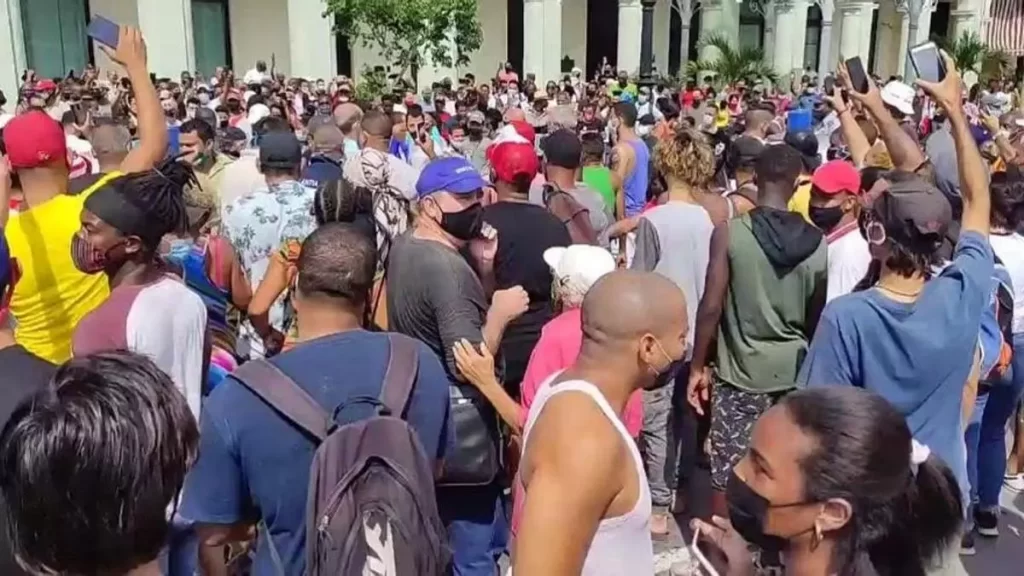
Two Books Point Out That the ’11J’ Protests Put an End to the Idyllic Vision of the Cuban Revolution Abroad

For the Regime, “nothing happened” that day, not even in Beijing’s Tiananmen Square in 1989, said Francis Matéo, sarcastically

People protesting on July 11, 2021 in Havana / 14ymedio

14ymedio bigger14ymedio, Xavier Carbonell, Salamanca, 10 July 2024 — Three years after the massive protests of 11 July 2021 (’11J’), many Cuban readers wait to read two books: a historical study that defines the caliber and meaning of the demonstrations and an anthology of the chronicles, reports and photographs that – regardless of ideological position – were published during those days. Now, on the eve of its third anniversary, bookstores have received valuable personal testimonies and many studies about the event that changed the citizen landscape of the Island.

One is the Spanish edition of Cuba… Homeland and Life! (Ecúmene Ediciones), by the French reporter Francis Matéo, whom 14ymedio interviewed about his “chronicle of a revolt.” A year after that conversation, Mateó explains to this newspaper the need to “not forget what happened” on 11J.

“It has been weeks, months and years (we should add: days and hours) of suffering and agony for the victims of the repression that followed these demonstrations. Thousands of families were mistreated, violated and destroyed by the harassment inflicted on their loved ones. Innocent victims were imprisoned or condemned to exile, if not to the despair that continues to worsen on the Island,” he says.

“Innocent victims were imprisoned or condemned to exile, if not to the despair that continues to worsen on the Island”

The situation, he says, “has only become worse.” Many of those who were arrested in those days “continue to languish in prison” and “almost 600,000 Cubans have emigrated since the summer of 2021.” continue reading

In his book, the journalist undertakes a study of the root causes of the crisis that led to the eruption, including the erosion of the methods of control of the Cuban regime, the indebtedness of the leadership and the collapse of the economy.

According to the press release that accompanies the launch, the book recounts a series of events for which citizens “paid dearly. For the first time in more than sixty years, the Castro dictatorship is openly condemned in the streets of the entire Island, and the fear imposed by the repression of any form of protest yields to the courage of the peaceful but determined demonstrators,” he summarizes.

Matéo traveled to Cuba after the coronavirus pandemic and collected the testimonies of dozens of demonstrators, including several from the Havana neighborhood of La Güinera, one of the main focuses of the protest and where Diubis Laurencio Tejeda was shot dead at the hands of the police. He also came into contact with journalist Iliana Hernández, who at that time lived in the capital under strict police surveillance.

Matéo’s book represents a critical trend within European journalism that, according to the author himself, seeks to counteract the idyllic vision that many have of the Island. Annihilating the “romanticism about the Revolution” is the declared objective of Cuba… Homeland and Life!, which takes its title from the song that became the soundtrack of the protests.

Matéo traveled to Cuba after the coronavirus pandemic and collected the testimonies of dozens of demonstrators, including several from the Havana neighborhood of La Güinera

In 2022, a few months before his death, the Uruguayan journalist Carlos Liscano wrote about the idealization of the Island, which crumbled for many foreigners on 11J, and the silence over Cuba’s reality. In his book, Cuba: Better Not to Talk About It (Fin de Siglo), he settled accounts with a Revolution to which he himself dedicated much enthusiasm; he was a Tupamaro guerrilla in his country and a political prisoner, in addition to covering the invasion of Playa Girón [Bay of Pigs]. He defined the complicity of Latin American intellectuals about the Island in one sentence: “We didn’t know because we didn’t want to know.”

The demonstrations of 11J broke the silence for many “ideological tourists,” a term with which Liscano defines those who travel to a Havana that is decorative and prepared by the regime, diametrically opposed to the real life of the Cubans who protested. Cutting the internet, arresting journalists, beating citizens and imprisoning thousands of people are among the methods that made the difference – according to the Uruguayan – between silence and denunciation.

An attempt at an academic approach to 11J was made by Alexander Hall, compiler of Cuba 11J: Counter-hegemonic perspectives of the protests (Marx21.net). The volume brings together a group of voices, mostly left-wing or with some degree of commitment to officialdom, who in recent years have radicalized their positions on the Regime. This is the case of the historian Alina Bárbara López or the economist Miguel Alejandro Hayes. The volume also includes essays by intellectuals of such disparate approaches as Julio César Guanche, Mauricio de Miranda, Zuleica Romay, José Antonio Fernández Estrada, Dmitri Prieto and Leonardo Romero Negrín.

The book, which aimed to point out the birth – or at least the awakening – of a “critical left” on the Island, lamented the country’s poverty but subscribed to some of the causes that the regime attributes to it, such as the US blockade.* It was right, however, to define the economic triggers of the protest – the package of measures imposed in January 2021, accelerated inflation and the financial defenselessness of citizens in the face of the pandemic – and to diagnose the moral bankruptcy of the Regime.

The value of the book lies in the fact that it collects documents issued by the Regime during those days, which attest to the calls for repression by Miguel Díaz-Canel

The Cuban government itself promoted the drafting of an official history of the protests – Cuba 11J. Protests, responses, challenges (Elag) – in which it totally blamed Washington for the outcry and washed its hands of the debacle by pointing to the person responsible: Donald Trump. The value of the book lies in the fact that it collects the documents issued by the Regime during those days, which attest to the calls for repression by Miguel Díaz-Canel.

In addition, there are the speeches given by the president, “with Raúl Castro by his side,” in the so-called acts of revolutionary reaffirmation after the protest; the messages of several writers and artists in defense of the regime; an interview with Silvio Rodríguez in which he criticizes the demonstrators; and the opinions of citizens close to the leadership.

For July 11, the Government had a slogan from the beginning: “Nothing happened.” Nothing happened in Beijing’s Tiananmen Square in 1989, says Francis Matéo, sarcastically. “It is true that nothing seems to have changed in Havana, apart from this palpable and increasing sense of despair,” he admits. The reality, however, is different: there is growing “anger and resentment” towards the Government of Díaz-Canel, Patria y Vida has become an alternative national anthem and the country is ready – with the spirit that began on 11J – to achieve its liberation.

*Translator’s note: There is, in fact, no US ‘blockade’ on Cuba, but this continues to be the term the Cuban government prefers to apply to the ongoing US embargo. During the Cuban Missile Crisis the US ordered a Naval blockade (which it called a ‘quarantine’) on Cuba in 1962, between 22 October and 20 November of that year. The blockade was lifted when Russia agreed to remove its nuclear missiles from the Island. The embargo had been imposed earlier in February of the same year, and although modified from time to time, it is still in force.

Translated by Regina Anavy

____________

COLLABORATE WITH OUR WORKThe 14ymedio team is committed to practicing serious journalism that reflects Cuba’s reality in all its depth. Thank you for joining us on this long journey. We invite you to continue supporting us by becoming a member of 14ymedio now. Together we can continue transforming journalism in Cuba.

Cuba’s Population Drops 18 Percent between 2022 and 2023 According to an Independent Study

The island’s current number of residents stands at 8.62 million, a loss of almost 1.8 million in one year

Among the consequences of mass migration is a growing number of homes for sale / 14ymedio

14ymedio biggerEFE (via 14ymedio), Havana, July 9, 2024 — Cuba’s population fell 18% between 2022 and 2023, due mainly due to migration, and now stands 8.62 million people according to an independent, soon-to-be released demographic study to which EFE had access.

The figure is based on the number of Cubans arriving in the United States between October 2021 and April 2024, a total of 738,680 people according to information released by U.S. officials. This includes those entering the country through visas, family reunification (the so-called “humanitarian parole” program) and irregular means.

The figure is based on the number of Cubans arriving in the United States between October 2021 and April 2024, a total of 738,680 people

This figure was used to extrapolate the total number of Cuban migrants, taking into account the percentage of Cubans traveling to the United States relative to the total number of people who leave the country for other destinations. Based on historical precedents, the author estimates this to be 33% for 2022 and 2023.

That would amount to 1.79 million people in one year, an unprecedented number in recent Cuban history. continue reading

By comparison, previous large waves of emigration following the Cuban revolution — these include the initial wave (the so-called freedom flights), the Mariel boat lift and the rafter crisis — produced a total of 620,000 people leaving the island according to various estimates.

When mortality rates are taken into account — in 2022 as in 2023, there were many more deaths on the island than births — the author comes up with a population figure of 8.62 million people.

Albizu-Campos calculates a different number of inhabitants than the National Office of Statistics and Information (ONEI), whose reports indicated 11.11 million were living in the country as of December 31, 2021.

The author believes this number to be “fictitious” based on his own calculations, which relied on the 2013 and 2023 electoral rolls as a point of reference. In his opinion, the figure should be 10.48 million.

“Hundreds of thousands of people, often with the financial support of family members overseas, notably in the United States, have accepted the challenge. They have joined the uncontrollable flow of migrants trying to escape poverty, political intolerance or both,” says Albizu-Campos.

“Hundreds of thousands of people. . . have joined the uncontrollable flow of migrants trying to escape poverty, political intolerance or both

Official figures do little to shed light on the recent migratory phenomenon because the government does not currrently consider someone to be an emigrant until he or she has been out of the country for at least twenty-four months.

The country’s ongoing economic crisis has also caused the 2022 population census to be postponed The pandemic and the fuel crisis are other reasons the government has cited for successively delaying the date.

The deputy director of ONEI, Juan Carlos Alfonso, claimed in a recent interview with EFE that his department is committed to carried out the census in 2025. He acknowledged that they have emigration estimates but that ONEI has not published them.

____________

COLLABORATE WITH OUR WORKThe 14ymedio team is committed to practicing serious journalism that reflects Cuba’s reality in all its depth. Thank you for joining us on this long journey. We invite you to continue supporting us by becoming a member of 14ymedio now. Together we can continue transforming journalism in Cuba.
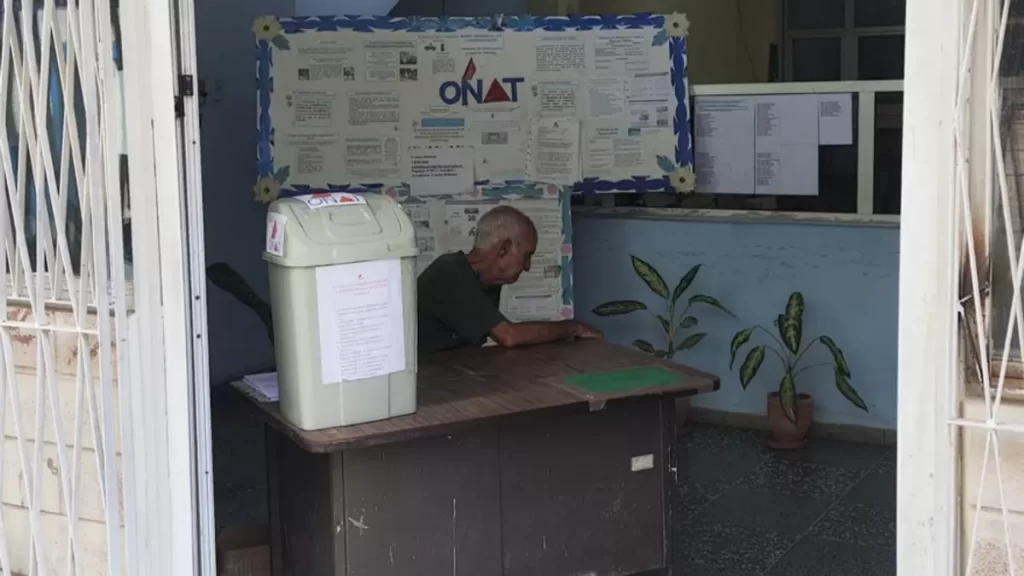
Cuban Tax Authorities Close 15 ‘MSMEs’ and Punish 323 Self-employed Workers for ‘Irregularities”

Diplomarket is suspected of being closed, like others, for tax evasion

So far this year, 24 alleged cases have been reported to the ONAT in Havana, nine of which have ended in complaints / 14ymedio

14ymedio bigger14ymedio, Madrid, 10 July 2024 — The Cuban State does not know how much money it fails to receive due to tax evasion, although only until June it had already identified more than 162 million pesos, which, without a doubt, falls short. This Wednesday, the official press dedicated two dense articles to characterize this type of crime, thanks to which it is known that until the end of March, 210 reports of complaints were issued, of which 117 have been analyzed.

There are, however, only six final sentences: two in Ciego de Ávila, two in Camagüey, one in Santiago de Cuba and another in Holguín. “We are still dissatisfied and, above all, we have to be more agile when working on these procedures”, said Belkis Pino Hernández, first deputy head of the National Tax Administration Office (ONAT).

Among the details provided by ONAT, one stands out that could be the one that led to the closure of Diplomarket a month later, known as the Cuban Costco, supposedly intervened by the authorities at the end of June, who arrested the owner, Frank Cuspinera, and his wife for “tax evasion, currency trafficking and money laundering.”

Pino Hernández said that at the end of May there were already 15 MSMEs closed due to “accounting irregularities.” Some of these cases can lead to tax evasion crimes. “The MSME that does not keep its accounting in order and, in addition, does not correctly pay its tax obligations, demonstrates an intention to evade, so we have the right to proceed with the complaint,” she said. Also, up to the same date, the authorization of 323 self-employed workers was withdrawn – temporarily or permanently – and 2,253 bank accounts of physical persons were seized.

The ‘MSME’ that does not keep its accounting well and, in addition, does not correctly pay its tax obligations, demonstrates an intention to evade

In Cubadebate, tax authorities dedicate ample space to detailing the types of evasion, which in Cuba tend to be the under-declaration of income, the omission of income obtained outside the country by a business or the use of third parties to “hide the existence of several businesses, split the tax base and hide the concentration of wealth”, something that Cuban law does not permit.

They also detail some evasion methods that set off alarms in ONAT. One of them is the lack of accounting records or an automated system for this. It is common, said Judith Navarro Ricardo, a specialist in the organization, for self-employed workers not to declare all their employees, as well as to declare lower salaries to reduce taxes and contributions to Social Security.

Other techniques of some MSME owners are more refined “who use self-employed workers, who have three months of exemption to make imports that are not for them, but for the MSME. There, we see a fraudulent way of paying less.” The same happens in the artistic sector, where there is a one-year payment exemption for recent graduates, which allows tricks, such as making transactions through their accounts to avoid paying taxes.

There are, the expert counted, at least 600 MSMEs that reported losses in which “accounting mismanagement” occurred, including “the accounting of equipment purchases as direct expenses instead of inventories, which artificially decreases the company’s profits.”

The focus has been placed on Havana, the province with the most taxpayers, where an estimate of the figures has been made. Yoandra Cruz Dovale, director of ONAT in the capital, explains that there are around 860 cases per month of inconsistencies between the data provided by companies as salaries and by workers as personal income.

“If we compare this number with the number of registered self-employed workers, around 121,000, we would be inferring that 0.7% are possible under reporters. However, if we review the contribution not made to the State budget, in 2023,148 million pesos were recovered by these reviews, an amount that is the expenditure budget for one month of a medium-sized municipality”, she said.

In 2023, 104 intensive inspections were carried out in Havana, in which 241 million evaded pesos were determined

But not all non-payments detected are crimes of tax evasion. “At the end of May, more than 80,000 control actions had been carried out, determining debts in the amount of 819 million pesos,” Pino Hernández told the State newspaper Granma, referring to the total number of cases in the country.

The official highlighted that when a non-payment is determined, the taxpayer can correct the error or omission and pay the money under the “principle of opportunity.” Only if there was intentionality is it evasion and goes to trial. In this sense, he cites as an example a private company that “did not include in the calculation the stimulation paid to workers, which led to the determination of the debt, with the corresponding surcharge and fine,” however, it was exempt from a process since it was considered proven that it was a misinterpretation of the tax regulations.

Fiscal problems have led to 8,764 people being banned from leaving Cuba, although it is unknown what percentage they represent of the total number of regulated people – another fact hidden – for “political” reasons.

Finally, the authorities have provided data on the presentation of the personal income tax return, which this year improved, since only 0.8% of taxpayers (4,744) failed to comply with their obligation, the majority in Havana, Villa Clara, Matanzas and Camagüey. Meanwhile, in the agricultural sector, compliance was 100%.

Regarding the profit tax, only 34 taxpayers did not declare (0.2%) and in the dividend tax, 116 partners (1.5%) failed to do so, the majority from the province of Granma.

In Cuba there are currently just over 1,109,000 taxpayers, the majority of them physical persons (1,074,000), of which 527,000 are self-employed; and 35,448 legal entities, of which 9,084 are MSMEs.

Translated by Norma Whiting

____________

COLLABORATE WITH OUR WORKThe 14ymedio team is committed to practicing serious journalism that reflects Cuba’s reality in all its depth. Thank you for joining us on this long journey. We invite you to continue supporting us by becoming a member of 14ymedio now. Together we can continue transforming journalism in Cuba.

Cuba Draws Close to an Unprecedented Social Catastrophe

The only living founders of the Dissident and Human Rights Movement in Cuba, created in 1983, make an appeal in view of the grave situation in the country on the anniversary of the 11J protests.

Hundreds protest on May 17, 2024 in Santiago de Cuba / Facebook

14ymedio bigger14ymedio, Miami, 10 July 2024 — Cuba is rapidly accelerating towards a turning point where any event could occur, including a major social catastrophe of unprecedented magnitude, before which the lynchings and looting at the end of the Machado regime could appear to us as mere childish brawls.

We are not exaggerating. On January 1, 2021, both signatories published and warned that government leadership, in what we called Conclusions from a balance sheet on Cuba at the end of 2020, that if radical changes were not made immediately, the discontent “could explode massively with serious irreparable consequences.” And yet, instead of following that advice, they made the situation even worse with measures that aggravated the already deplorable state of the people.

Then, the demonstrations of July 11 of that same year, with thousands and perhaps tens of thousands of people — if we add all the participants from the different cities of the country– were peaceful. The violence was then initiated by the repressive forces.

But now we have enough reasons to fear that this time, the protest will not only not be peaceful but, most likely, catastrophic. There is already too much suffering and resentment among the population to believe that new reforms as inefficient as those already implemented will solve the country’s serious problems. “Reform,” as the word itself indicates, means only a change in form and not in the essence of these problems. continue reading

The argument of this leadership to deny radical changes is that they would mean the end of the “revolution.” The answer to be given them, once and for all, is that this revolution has not existed for more than fifty years, if we are to use the term as defined by the Royal Spanish Academy – “profound change, generally violent, in the political and socio-economic structures of a national community”- because in 1968, when they finally ended up expropriating the people themselves in the so-called revolutionary offensive, confiscating all the small landowners, including the most humble independent workers such as shoeshine boys and hamburger sellers. There was no longer, since then, any other profound change.

So what has there been in Cuba for more than fifty years? The political and socioeconomic system that was the product of that revolution, was a totalitarian dictatorship that imprisoned or took by arms former comrades in arms who tried to prevent the betrayal of failing to fulfill the democratizing goals they themselves had promised — restoration of the constitution and free elections — to impose by force a regime that made real the darkest fears that José Martí had harbored almost a century before in a letter to Máximo Gómez. He wrote about a possible “caudillo” (authoritarian) who, “at the head of an enthusiastic and grateful people, with all the trappings of victory,” would turn the Republic into a command-and-control camp.

The suffering and resentment of the population is already too great to believe that new reforms as inefficient as those already implemented will solve the serious problems of the country.

Let us speak properly: there is no longer a single revolutionary in the ranks of the Communist Party or the State. The true revolutionaries are demonstrating in the streets, or in prisons, like Luis Manuel Otero Alcántara, José Daniel Ferrer and Maykel Castillo Osorbo, who, like hundreds of other prisoners, only expressed peacefully their yearnings for a better Cuba, a right enshrined in the Universal Declaration of Human Rights.

However, they were sentenced to longer prison terms than those received by the assailants of the Moncada barracks, who carried firearms and left many dead. And more than that, the Moncada assailants were amnestied two years later.

That economic-social system, which in spite of everything is still called a “revolution,” has been responsible for the destruction of the whole country. Because that leadership, like Frankenstein, created a monster that it was not able to control, a corrupt and inefficient bureaucracy of thousands of officials elected not by their ability but by political trustworthiness, with no real interest in productivity; a model, therefore, that only generates a permanent crisis.

That crisis is only alleviated when there is an external ally capable of subsidizing it, and when that ally is missing, that is when the system really shows itself as it is. It is in those cases when they resort to mass exoduses to alleviate internal social tensions, a resource that only serves to buy time while they look for a new ally capable of supplying the resources the country needs to stay on its feet. And that is precisely what they are desperately looking for since the collapse of the Venezuelan economy.

But that ally has not yet appeared and, if it does not, the system will collapse definitively. In general, the magnitude of these exoduses is directly proportional to the magnitude of the crisis, and this last exodus has been the largest ever, which indicates that they are facing the deepest crisis in their entire history and the tensions relieved by this great exodus tend to be reproduced in the very short term, while the international situation would not allow, in such a short time, another exodus like the previous one.

All together they would constitute a moral force with enough convening power to peacefully and harmoniously displace that failed leadership.

We have arrived, then, at a definitive and decisive point where the alternatives present themselves very clearly: either that leadership makes a profound change in the immediate future, or the desperate multitudes will sweep away that leadership in the worst fashion.

But if this leadership continues to turn a deaf ear to the demands that have been made to it to make these changes, if it has neither the interest nor the courage to face the serious conflicts of the country in a radical manner, there is no other alternative but to appeal to the most serene and fair-minded sectors of the people so that they may become the guides of these crowds.

We therefore call for dissidence, for a unity of all those alliances that have been taking place in the last few years; we likewise exhort many the honest and sensible intellectuals to exert their influence. All together they would constitute a moral force with sufficient convening power to peacefully and harmoniously displace that failed leadership to avoid tragedy, and to lead the people, for the good of all, including the physical integrity of those same current leaders, without revenge or vindictiveness, towards a profound process of social transformations.

Cuba will rise from its ashes, and will be, for the world, a paradigm of freedom, peace and prosperity.

Translated by Hombre de Paz

____________

COLLABORATE WITH OUR WORKThe 14ymedio team is committed to practicing serious journalism that reflects Cuba’s reality in all its depth. Thank you for joining us on this long journey. We invite you to continue supporting us by becoming a member of 14ymedio now. Together we can continue transforming journalism in Cuba.
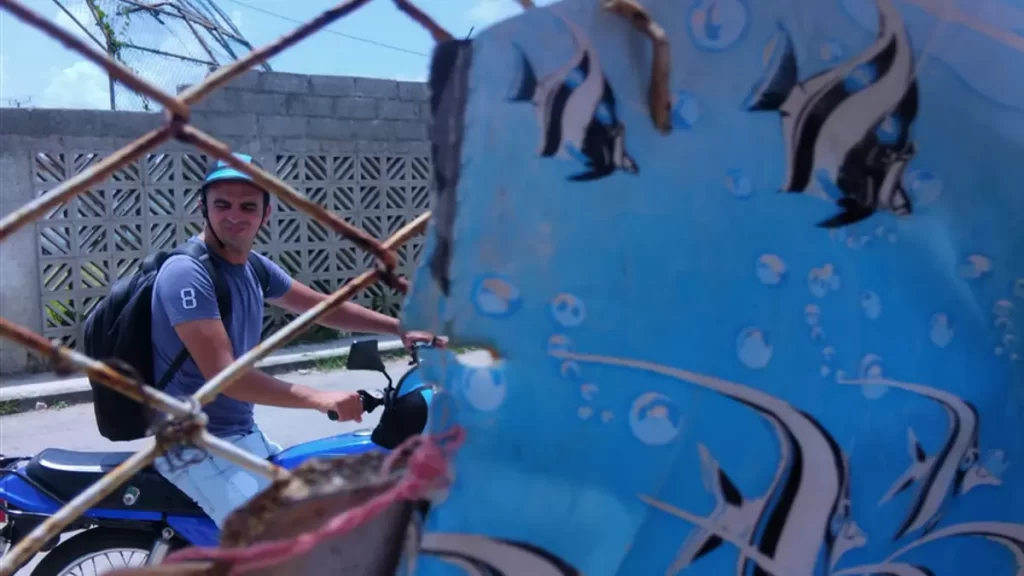
Cuban State Security Warnings for the Anniversary of the 11J Protests Reflect “The Power of the Date”

Independent journalist Yunia Figueredo has been on guard at the door of her house since Tuesday. / Yunia Figueredo

14ymedio bigger14ymedio, Havana, July 11, 2024 — The third anniversary of the massive protests of 11 July 2021 (11J) takes place for the Police and State Security like the previous ones: with the harassment and surveillance of activists, dissidents and independent journalists. Since the day before, the editorial staff of 14ymedio has been incommunicado, as have many other Cubans who have expressed in one way or another their disagreement with the regime.

Among the cases, that of Dagoberto Valdés stands out, who was summoned on Tuesday for an interrogation this Wednesday at 9 in the morning. The director of the Center for Coexistence Studies was summoned to State Security headquarters in Pinar del Río, where he waited five hours for the officer, Major Lázaro, who gave him a warning citation.

The objective was to inform Valdés that he could be charged with six crimes defined in the Criminal Code, including “incitement to violence, association to commit crimes, destabilization of international peace and violation of constitutional precepts,” he explained on his departure. The officer indicated to him that there was “nothing to celebrate” on 11J because “the 2021 demonstrations were violent acts,” and the activist rejected both the possibility of committing any of the aforementioned crimes and any other, in addition to signing the citation. continue reading

The officer told him that there was “nothing to celebrate” on 11J because “the 2021 demonstrations were violent acts”

Then Major Ernesto, who “takes care of [the group] Coexistence,” joined the interrogation and insisted, in the same vein, about the inconvenience of Valdés attending any activity scheduled for this Thursday or Friday, recalling the anti-government protests that also continued on July 12, 2021.

Both agents told the activist that he should not be “influenced by people and associations from inside and outside Cuba that intend to involve him in the organization of events against the Government,” and they complained about his attendance at the reception on July 4 organized at the US Embassy in Havana, because, they said, “it was a meeting place for people financed by the enemy to destabilize” the country.

Raymar Aguado Hernández, writer and activist, was another of those who raised his voice this Wednesday over a summons from State Security, which urged him to appear at the Cayo Hueso Council, located at 55 Infanta Street for an “interview.” Thirty minutes later he was in the Key West Council Sector of the National Revolutionary Police (PNR).

As he said on his departure, First Lieutenant Rogelio and Officer Mía asked him what he planned to do this Thursday, to which he answered with another question: “What can’t I do tomorrow?”

The agent replied: “Do you remember what happened a few years ago? That’s what you can’t do tomorrow.” The rest of the interview took place with questions about his absence from Pride, how his friends’ families were in Gaza or if he had met with the La Joven Cuba team, but nothing was as relevant as what surrounded the anniversary.

“Do you remember what happened a few years ago? That’s what you can’t do tomorrow”

Aguado Hernández points out that these facts indicate the “powerfulness” of the date, turned into an “emblem that makes the authoritarianism of the Cuban State nervous,” and although he says he does not know his plans are for today, he warns: “In the face of an explosion from below: proletarian, popular, anti-authoritarian… I don’t know, I won’t be able to resist.”

Among the activists who have had the internet cut off are Manuel Cuesta Morúa, of the Plataforma Nuevo País, activist Marthadela Tamayo; María Elena Mir, of the Independent National Workers’ Confederation of Cuba and rapper Osvaldo Navarro (Navy Pro).

Independent journalist Yunia Figueredo has reported on social networks that she has been on guard at the door of her house since Tuesday. “Why, instead of repressing and guarding and putting us under house arrest, don’t they release all political prisoners on 11J? They are such rats that the only thing they show is fear,” she wrote this morning, tired of the threats. The agents approached, she says, to tell her that if she leaves her house before the 14th she will incur a crime of contempt.

In addition, journalist José Luis Tan Estrada was already called on July 6 for an interrogation in which he was warned that he must refrain from making any publication on his social networks, as well as attend public places, under threat of being imprisoned for disobedience and contempt.

Also on June 28, Roberto Álvarez, one of the founders of the Democracy Movement, was prevented from entering Cuba. The activist was going to travel to Villa Clara from Miami to visit his father, who was very ill.

Meanwhile, Marta Perdomo, mother of the prisoners of 11J, Nadir and Jorge Martín Perdomo, denounced on Facebook that she has not heard from the latter for two weeks. “This is one more crime, like so many others. What they are doing is torturing Jorgito and the whole family for the simple fact of raising our voices for all the injustices that have been done to them and continue being done to them,” she proclaimed.

Translated by Regina Anavy

____________

COLLABORATE WITH OUR WORKThe 14ymedio team is committed to practicing serious journalism that reflects Cuba’s reality in all its depth. Thank you for joining us on this long journey. We invite you to continue supporting us by becoming a member of 14ymedio now. Together we can continue transforming journalism in Cuba.

Remodeled for July 26 Celebrations, the Zaza Hotel Has No Shortage of Workers or Fuel

More than 250 workers have been hired, including brigades from two MSMEs from Morón and Trinidad

Repairs include the facade, rooms, bars, disco and swimming pools / Escambray

14ymedio bigger14ymedio, Havana, 10 July 2024 — After Manuel Marrero’s visit at the end of June, the Zaza de Sancti Spíritus hotel underwent a marathon to restore it before the July 26 celebrations, whose main act will be held in this province. With a “progressive deterioration” and “very bad condition” from years of disuse, the authorities intend to revitalize the facility in less than a month, not without the criticism of the people of Sancti Spíritus. The restoration of its 124 rooms – 32 will be prioritized for the holiday and then the others will be repaired – the change of the waterproofing, the repair of the facade, the remodeling of the swimming pools, the construction of the villa – which was demolished – and other minor tasks such as the installation of the perimeter fence: this is what the builders must accomplish in the few remaining days.

However, the authorities have not skimped on resources and a “large investment” – of which the official press does not reveal the origin – has made it possible to bring more than 250 workers from five provinces: Matanzas, Villa Clara, Ciego de Ávila, Sancti Spíritus and Havana. Brigades of builders from two MSMEs have also been hired: D’Obras (from Morón) and Génesis (from Trinidad).

“So far we have not had serious problems with the resources or with the fuel to ensure the work, and when an obstacle has arisen, it has been cleared,” the logistics managers of the works told Escambray, which is surprised, like the workers, that the works are beginning at a good pace, contrary to the usual experience. continue reading

The workers insist that they have lacked nothing while rebuilding the hotel.  / Escambray

The workers insist that they have not lacked anything while rebuilding the property / Escambray

“Generally, we have not had problems with building materials nor with food, despite the difficult situation that, as we all know, the country is going through. I think that anyone who complains does it because he wants to,” concludes one of the employees. “The intervention being made to the Zaza hotel is very useful and necessary because it will bring back to life this facility that for so many years was distinguished in this province. Upon arrival we found it in a degree of total deterioration, but I assure you that when it is concluded it will look like new,” says another of the workers. The citizens of Sancti Spíritus, however, are not so sure that the remodeling is as beneficial as the authorities promise.

In the comments section of an article in Escambray a few days ago, many readers highlighted the irony of “letting a hotel be lost and then spending millions to restore it,” money, by the way, that could benefit other facilities in the province that were not included in the “touch-ups” for July 26. In addition, Internet users point out, the speed of the work leaves doubts about its quality. They fear that they form part of the makeup that is traditionally put on the host cities of the event.

The official press glosses it over: “In the Zaza you have to do everything well, out of elementary respect for the work, for those who this summer will partially enjoy it again and, above all, for the territory to guarantee materials that are as as scarce as they are expensive, which several works and projects would appreciate no less in sectors such as health, education and others of high social impact as well.” Even so, doubts persist.

The property experienced several repair attempts and served as an isolation center during the pandemic

“What will they do to market it? The hotel was destroyed as a result of its decommercialization when the hunting and fishing tourism on which it depended ended, and it is not attractive for national tourism due to the competition from Rancho Hatuey and Los Laureles, with similar offers and a closer location. What are they going to do to make it attractive and at the same time profitable?” asked another user, to which commentators responded with sarcasm: “Soon it will be filled with foreign tourism because surely the price will not be within the reach of the ordinary Cuban.”

For their part, Escambray and Granma insist that the hotel, in its years of splendor, was the insignia of the province and one of the most demanded by the inhabitants. However, they do not clarify whether the “national” character of the facility will be maintained, to which – suspiciously – too many resources have been dedicated in record time.

The property has undergone several attempts at repair. In 2023, the local government promised an investment of 80 million pesos for the Zaza, which had been used as an isolation center during the pandemic. However, by March, the deadline, the work was still unfinished and only a quarter of the money had been spent. The mass of socialist architecture was not lucky either that February, when a Russian company came to manage the Jatibonico plant. The workers, they said at the time, would stay at the hotel, which was closed to the public. The “capital repair” that was promised did not take place.

A week ago, 14ymedio portrayed in an article the adornment of the capital city for the event on July 26. The facades of pharmacies and ration shops, painted in bright colors, contrasted with the ruined interiors and the empty shelves of the stores. Many of the remodeled shops remained closed, and the 10 kilometers of road whose repair was completed was all in the section that the officials will travel when they arrive in the province.

Translated by Regina Anavy

____________

COLLABORATE WITH OUR WORKThe 14ymedio team is committed to practicing serious journalism that reflects Cuba’s reality in all its depth. Thank you for joining us on this long journey. We invite you to continue supporting us by becoming a member of 14ymedio now. Together we can continue transforming journalism in Cuba.

Layers of Paint and Hype in Sancti Spíritus, Cuba to Celebrate July 26th

The residents, meanwhile, only hope that the city buildings will benefit from the paraphernalia of the event.

Newly painted pharmacy in Sancti Spíritus due to the events of July 26 / 14ymedio

14ymedio bigger14ymedio, Mercedes Garcia, Sancti Spíritus, 4 July 2024 — Even in the midst of the most painful crisis that the Revolution has faced, the Cuban regime insists on remembering its “rebellious lineage” every year by granting one province primacy in the events for July 26. Since last June 14, Sancti Spíritus has held the headquarters, an “acknowledgement” that Cubans see more as an opportunity to renovate the city than to honor the assailants of the Moncada barracks.

The authorities “put their foot down” – as Ramiro Valdés recommended in the province days ago – and, since the announcement that the central event of the anniversary will take place in Sancti Spiritus, the problems seem to have disappeared. 100% of its taxpayers paid their taxes in 2023, infant mortality in the first half of this year is – suspiciously – the second lowest in the country, and Construction, one of the worst sectors on the Island, advances thanks to mini-industries.

That is, at least, the Sancti Spíritus that the official press is selling, decked out to receive senior government officials and, with luck, Raúl Castro himself.

The entrance road to the province was also paved / Escambray

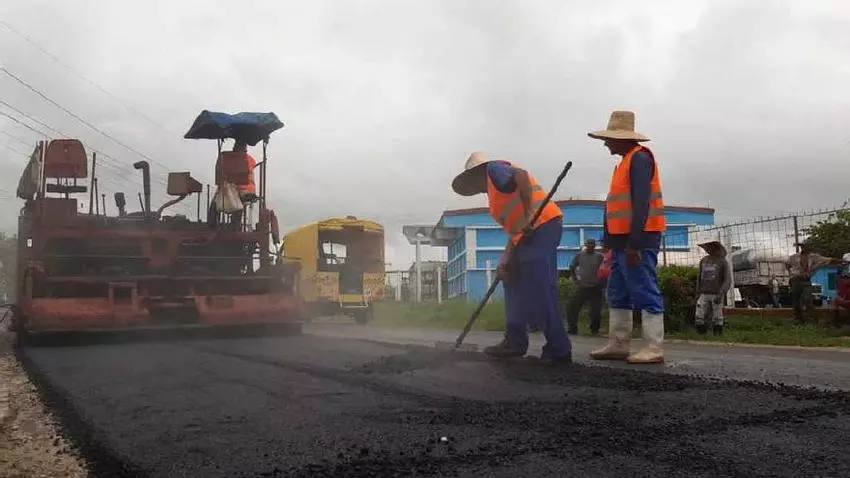
From the interior of its streets, however, a different reality is felt. The 10 kilometers of asphalt that were dedicated to repairing the province’s roads are all focused on a single section: the road that connects the municipality of Cabaiguán and the capital city, and that also connects with the National Highway. That is, a brand-new tar carpet through which the ministers and officials will enter the city for the event.

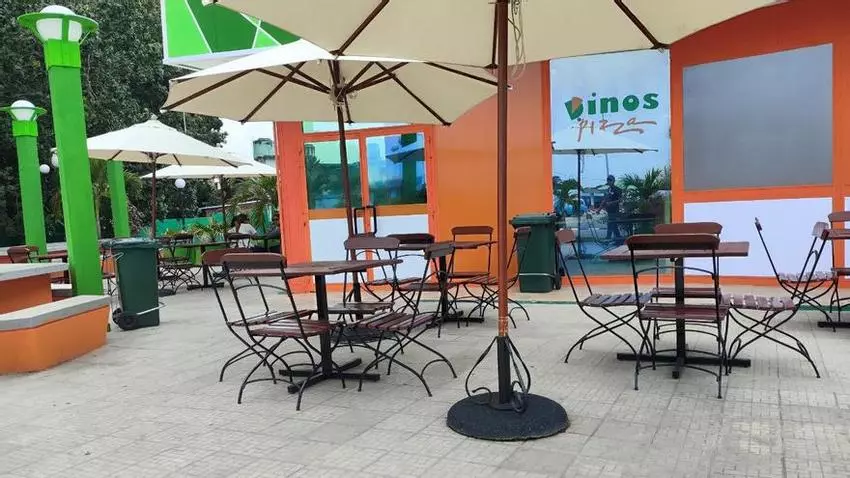
The same has happened with the facades of state restaurants, such as Dinos Pizza, to which they added umbrellas and seats in the doorway, but inside, the bottles on display are empty and the prices do not drop below 200 pesos.

They added chairs and umbrellas to Dinos Pizza, but the rest remains the same / 14ymedio

Other “beneficiaries” of state paraphernalia have been pharmacies and bodegas (the ration stores). Those closest to the center and, of course, to the routes that the officials will take, boast blue, pink and red colors on their facades that still smell of fresh paint. The leaks from the interior and the shortage of products, however, have not changed. “Paint, a lot of paint. But no supplies,” a resident of Garaita, one of the “retouched” establishments, complained to 14ymedio.

Many state establishments, some of them on the boulevard, remain closed to preserve the touches until the 26th, when their doors will open with offers of food and entertainment that the people of Sancti Spiritus have not had at their disposal for a long time, and which is doubtful will be kept after the festivities.

Some grocery stores have their facades painted again, but they are still without food / 14ymedio

The local press has also not been shy about granting a certain “joy” to the “people of Sancti Spiritus,” alleging that the Central Committee of the Party has granted a great “honor” to the province for “the work that its cadres, management structures, workers and people in general, as an expression of the popular will to move the country forward in the midst of a particularly complex economic situation.”

Many leisure and gastronomy venues remain closed / 14ymedio

To commemorate the distinction, on the same day of the announcement, local leaders celebrated the event with the people of Sancti Spiritus, who “spontaneously” carried drums and Cuban flags.

For the Sancti Spíritus residents, however, being the venue for the July 26 events is only equivalent to avoiding blackouts for a few days or finally seeing public transportation working. For the rest, the arrangements seem few and superficial compared to those obtained by other provinces in previous years.

Translated by Norma Whiting

____________

COLLABORATE WITH OUR WORKThe 14ymedio team is committed to practicing serious journalism that reflects Cuba’s reality in all its depth. Thank you for joining us on this long journey. We invite you to continue supporting us by becoming a member of 14ymedio now. Together we can continue transforming journalism in Cuba.
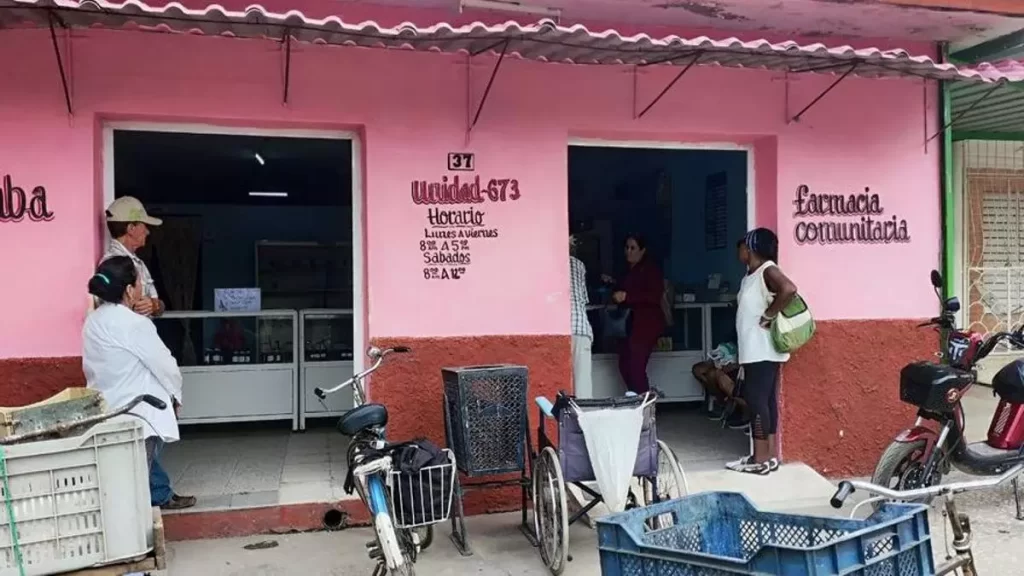
Capped Prices in the Private Shops in Holguín, Anarchy in Havana

Many stores do not have any of the six items for sale with established prices.

Pelican, a private business in Holguín, this Tuesday / 14ymedio

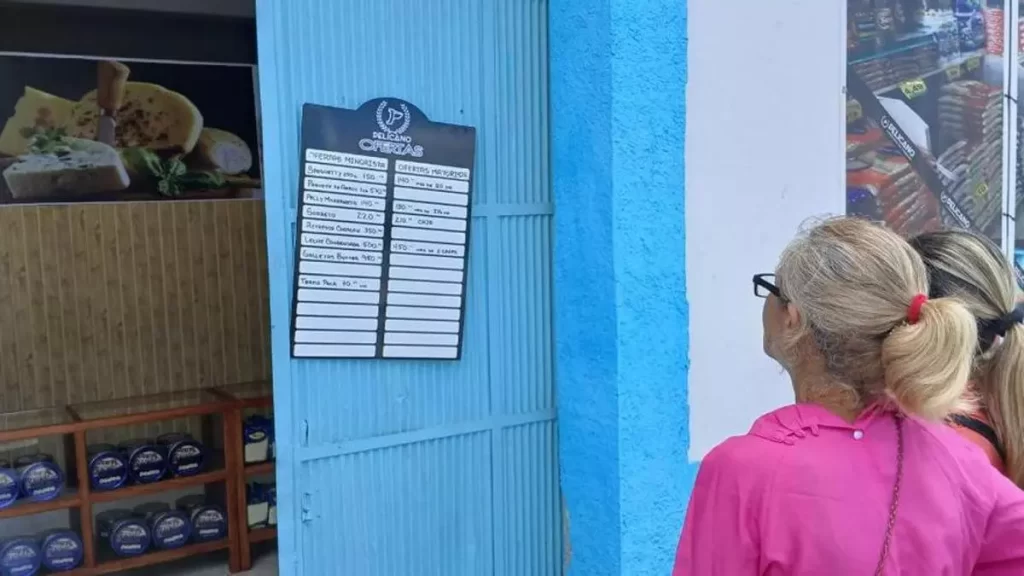
14ymedio bigger14ymedio, Miguel García/Juan Diego Rodríguez, Holguín/Havana, 9 July 2024 — Curiosity and need come together in the private shops of Holguin, which this Tuesday have had a greater influx of customers than on other days. At the entrance to the premises, a board showed the new prices, which have been capped for basic products since July 8.

In one of the many points of sale visited by 14ymedio, the employees had just learned about the new regulation and changed, in view of the buyers, the numbers written next to each item . Although the oil and pasta were below the new amounts, the powdered milk went above the 1,675 pesos per kilo established by the Official Gazette.

In the kiosk managed by the MSME Bodegón Holguín, the line filling the sidewalk in front of the premises did not respond, however, to any of the six products that have been exempted from taxes on imports and which have capped prices. The crowd, in fact, was waiting to acquire the newly discounted instant soft drink packages, which are mainly intended for the school snack.

The capped price “is not going down because if that’s what’s legally allowed why sell it cheaper?”

This Monday, vegetable oil at 990 pesos per liter was now in line with the new regulation. But the price, instead of satisfying consumers, raised criticism among those who believe that once set at that limit, “it will not go down because if that is what is legally allowed, why sell it cheaper?” asked an elderly woman who arrived at the Bodegón. continue reading

With a pension of 1,420 pesos per month, she can’t benefit from the new prices. “There is a lot of disorganization with this measure. At the Chinese Fair there were several kiosks that have not even heard about it and still have cooking oil at more than 1,000 pesos per liter,” the woman complained. “I found chopped chicken at 370 and 380 pesos per pound in several places; it seems that they have not realized that it’s at 340.

In Havana, the panorama has not been very different. Some central businesses have opted for caution, while several places in El Vedado and the neighborhood of Cayo Hueso did not even have for sale what popular humor has already baptized as “the magnificent six.” Others displayed the new prices on their boards.

The EJT market shelves of 17 and K, in El Vedado, returned to their usual appearance / 14ymedio

On Reina Street, in the municipality of Centro Habana, on Monday the line was extended in front of a private business that announced a pound of chicken at 310 pesos. What was saved in money was lost in time, because the line could take up to two hours between getting a number and accessing the counter. The main cause of the delay, according to an employee, was that “we have to wait for them to bring more supplies.” They were exhausted due to the multiplied demand.

In Havana, the shelves of the Youth Labor Army [EJT] market at 17 and K, which last week appeared surprisingly empty in the face of the confusion due to the entry into force of the capped prices, returned to their usual appearance. However, they didn’t sell chicken. “The chicken is still kidnapped,” an old woman said with a sneer.

The prices in the informal market, through home delivery applications on social media groups that market everything from spaghetti to beef, were the same as a few days ago, unrelated to the new official guidelines.

“The big chicken thighs: I’m not lying. If you want quality, this is your option at 380 pesos per pound and we charge home delivery separately,” said an ad in a WhatsApp thread dedicated to food and cleaning products. In the photo that accompanied the ad you could see a package with the colors of the American flag and three letters: USA.

Translated by Regina Anavy

____________

COLLABORATE WITH OUR WORKThe 14ymedio team is committed to practicing serious journalism that reflects Cuba’s reality in all its depth. Thank you for joining us on this long journey. We invite you to continue supporting us by becoming a member of 14ymedio now. Together we can continue transforming journalism in Cuba.
Close to 40,000 Cubans Applied for Spanish Nationality at the Havana Consulate

As of April, the majority – some 40% – of the 301,121 applications were from Argentina. The Council of Ministers extended the deadline for the procedure by one year.

Cubans line up in front of the Spanish Consulate in Havana. (14ymedio)

14ymedio biggerEP/14ymedio, Madrid, 9 July 2024 — Consulates in Argentina and Cuba account for 50% of the 300,000 applications for Spanish nationality submitted between October 2022 and March 2024 under the Democratic Memory Law, which allows descendants of exiled Spaniards to enjoy this benefit, according to data revealed by the Ministry of Foreign Affairs, European Union and Cooperation. As explained by the Ministry of Foreign Affairs in a statement, since the law entered into force on October 22, 2022 and until March 31, 2024, the Consular Civil Registry Offices had received 301,121 applications for the option of Spanish nationality by origin. In the first year of the measure, according to the data collected at the time by Europa Press, more than 102,000 Spanish nationalities had been granted.

More than 95% of these applications were received at the consulates in Ibero-American countries, as well as at the Consulate General of Spain in Miami. In the specific case of Argentina, the five consulates general in the country accumulated 40% of the applications, and if those received by the Consulate General in Havana are added, the figure rises to 53%. This puts the petitions on the Island at 13% of the total; that is, 39,145 up to that date.

The Council of Ministers authorized this Tuesday, as already announced in February by the Minister of Territorial Policy and Democratic Memory, Ángel Víctor Torres, the extension by one year of the period to exercise the right to qualify for Spanish nationality contained in the eighth additional provision of the Law of Democratic Memory, which gave two years. continue reading

In all consular offices “there are a number of applicants who can’t be summoned and attended to before the end of the planned two-year period”

The Department of Foreign Affairs, headed by José Manuel Albares, has explained that in all consular offices “there are a number of applicants who can’t be summoned and attended to before the end of the two-year period provided for” by law.

For that reason, the Government has decided to extend the deadline by one year “in such a way that all appointment requests already submitted and pending requests can be met, as well as all applications that are submitted and cannot be met in the first two years of application initially provided for in the law,” said Albares.

Specifically, the aforementioned additional provision of the Law of Democratic Memory guarantees that Spanish nationality can be applied for by those born outside Spain to a father or mother, grandfather or grandmother, who would have originally been Spanish, and who, as a result of having suffered exile for political, ideological or reasons of belief or sexual orientation and identity, would have lost or renounced Spanish nationality.

It also includes sons and daughters born abroad of Spanish women who lost their nationality by marrying foreigners before the entry into force of the 1978 Constitution as well as the sons and daughters of legal age of those Spaniards who were recognized for their nationality of origin by virtue of the Historical Memory Law of 2007.

Translated by Regina Anavy

____________

COLLABORATE WITH OUR WORKThe 14ymedio team is committed to practicing serious journalism that reflects Cuba’s reality in all its depth. Thank you for joining us on this long journey. We invite you to continue supporting us by becoming a member of 14ymedio now. Together we can continue transforming journalism in Cuba.
The Four Stages of Peaceful Transition to Democracy

Initially, the so-called dissidents or civic activists seem to be acting alone

Creating a unified front to defy a dictatorship or to promote democratization does not require a shared ideology but a shared strategy. / Marcos Evora

14ymedio bigger14ymedio, Ariel Hidalgo, Miami, 6 July 2024 — The stages of peaceful resistance to totalitarian rule vary from country to country. However, by analyzing liberation movements we can identify common characteristics because, in every case except that of Yugoslavia, there was a centralized economy in which the state held the reins of economic production. This required the creation of a huge bureaucracy that had no real interest in producing things and was incapable of effectively controlling the process. This led to structural economic crises, which led to public discontent.

In the first stage, dissident groups can expect only minimal support from the public. For the most part, the so-called dissidents or civic activists seem to be acting alone. They are, as Vaclav Havel would say, “generals without soldiers.” However, they represent a large silent majority afraid to say publicly what the dissidents are saying. During this period, the vast majority might participate in massive public rallies in support of the government or even join organized mobs besieging the homes of dissidents in public acts of repudiation.

The main task for dissidents at the beginning of their struggle is to denounce the violations perpetrated by the regime as defined in the Universal Declaration of Human Rights or the Helsinki Accords. However, it later becomes clear that, rather than just denouncing the oppressors’ violations, it is more important to create an awareness of human rights in the minds of the oppressed. This is the first step in the peaceful struggle against a totalitarian regime, to create in the public’s mind an awareness of civil rights, not just because these rights have been proscribed but because they, the people, are entitled to them as human beings.

The main task for dissidents at the beginning of their struggle is to denounce the violations perpetrated by the regime

Dissidents also begin circulating leaflets or clandestine statements. They then move on to staging lightning-strike demonstrations, though not often and usually with no more than twenty or thirty people. Curious onlookers take note but are not willing to participate and the demonstrations usually end in arrests a short time later. continue reading

Little by little, the public begins to become aware of the dissidents’ existence (or in the case of Cuba, of “the human rights people”) — usually through shortwave foreign radio transmissions — and the concept of human rights. One could say this is the beginning of the second stage.

In this period, when someone becomes the object of abuse by authorities, there are often accusations of human rights violations or, in the case of some eastern European countries, of the Helsinki Accords. This is a sign that what the dissidents have been preaching is beginning to sink in. A larger number of people begin joining the various dissident groups.

Little by little, people stop playing by the government’s rules. They skip meetings and public gatherings but do not openly challenge the status quo. They become less and less fearful as the number of like-minded people increases. They are now in the prelude to non-cooperation, still proceeding but with great caution and not yet ready to completely abandon the pretense that they support the regime.

At this stage the vast majority of the population is not willing to engage in acts of civil disobedience. Many are, however, willing to make legal appeals or apply pressure in the name of socialism or, in the case of Cuba, in the name of the Revolution. They call upon the regime to follow the rule of law, or abide by the constitution, which the government presents to the world as evidence that it is democratic but which, in reality, it is not inclined to follow.

At this stage the vast majority of the population is not willing to engage in acts of civil disobedience

In the third stage, a large portion of the public has lost its fear. Though the regime might continue holding mass rallies, it has lost its ability to summon as many people as it did before. It compensates by exerting pressure at workplaces and schools, encouraging attendance during working hours or class times.

It is also not as easy for authorities to drum up public support for acts of repudiation against dissidents and it is forced to use its own plainclothes security forces instead. In fact, it is common for such repressive police actions against individual citizens to be met with widespread public rejection. Public protests also begin occurring when authorities impose unpopular measures. These could include, for example, strikes or riots by transportation workers, or sit-ins in front of public buildings, and even acts of solidarity with a group of dissidents who are engaged in some type of protest such as a hunger strike. Something similar happened in Cuba with strikers of the San Isidro Movement in November 2020.

This is also when the first public demonstrations begin. They start spontaneously, without dissidents having to organize them. Generally, they are violently repressed by authorities. The demonstrators demanding change do not number in the dozens but rather in the hundreds or even the thousands, which destroys the myth that everyone supports the regime. This helps raise awareness even more among other segments of the population, which heralds the start of what we could consider to be the fourth and final stage.

At this point, we begin to see more dialogue among dissident groups as they begin to coalesce. We could even see a discreet rapprochement between dissidents and some reformist elements within the regime. To create a united front against a dictatorship, or to promote a process of democratization, the various factions do not need to be aligned ideologically, only strategically. This is akin to two people walking in the same direction even though their destinations may be different or they may ultimately go their separate ways. It is not terribly important if they are social democrats, conservatives or liberals. What draws them together is their goal of democracy and a shared strategy of non-violence. Together they can now call for demonstrations with a preconceived plan.

In Romania, a group of older die-hard communists who were part of the Ceaucescu regime was defeated by a coalition of parties of different stripes. We have also seen this happen with dictatorships on the other end of the political spectrum. In Chile opposition groups joined forces against the Pinochet regime to campaign for a plebiscite and free elections despite the fact that there were subtle ideological differences among them. Ultimately, they won.

This is also the stage at which activists draft manifestos and many people sign letters demanding the release of political prisoners

This is also the stage at which activists draft manifestos and many people sign letters demanding the release of political prisoners. Ultimately, amid new and much larger marches, a new united civic front emerges and calls for a general strike.

It is at this point, under these conditions, when a dialogue can be begin to either agree on a transition or to present an ultimatum to the regime. The opposition is confident that it has widespread public support and that the regime cannot manipulate them. The duration and timing at which these stages occur differ depending on conditions in each country.

In Czechoslovakia, for example, Charter 77 was the first important initiative that brought dissidents together to form united front, which greatly increased their chances of victory, which Civic Forum achieved twelve years later. In Poland, however, it took only five years from the emergence of Coss-Kor till the birth of the Solidarity trade union movement because there already existed in this country a deep-rooted Catholic faith that was incompatible with Marxism’s atheist ideology. At this time there also happened to be a Polish-born pope pope, John Paul II, who instilled a strong will for change with his phrase “Do not be afraid.”

________________________

Editor’s note: This article is an excerpt from El libro de la Liberación [The Book of Liberation]. 14ymedio is publishing it with the author’s permission.
____________

COLLABORATE WITH OUR WORKThe 14ymedio team is committed to practicing serious journalism that reflects Cuba’s reality in all its depth. Thank you for joining us on this long journey. We invite you to continue supporting us by becoming a member of 14ymedio now. Together we can continue transforming journalism in Cuba.
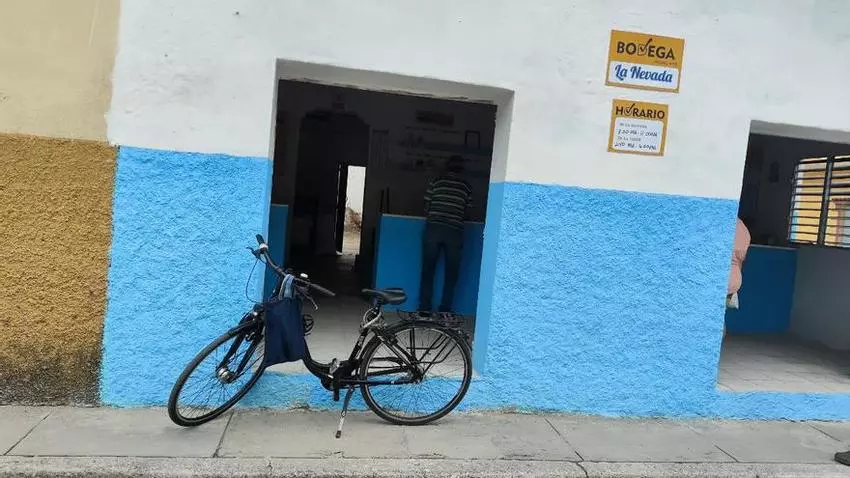
An NGO Requests Acquittal for Those Convicted by Cuban Judge Melody González, Who is Now Requesting Asylum in The United States

Amnesty International (AI) designates Professor Pedro Albert Sánchez of Prisoners Defenders (PD) as a prisoner of conscience and urges the German Government to intercede for its citizen detained in Cuba

Former Cuban judge Melody González Pedraza / OCDH

14ymedio bigger14ymedio/EFE, Madrid, 8 July 2024 —On Monday, the Cuban Observatory of Human Rights (OCDH) requested the acquittal of those convicted by Judge Melody González Pedraza, who is currently in a political asylum process in the United States. In a statement made public the same day OCDH — an NGO headquartered in Spain — reported on an interview with González Pedraza by Diario de Cuba, in which the judge herself claimed to have received instructions from the president of the Provincial Court of Villa Clara and the president of the Security Chamber to convict Andy Gabriel González Fuentes, Eddy Daniel Rodríguez Pérez, Luis Ernesto Medina Pedraza and Adain Barreiro Pérez.

All of them were sentenced by the Popular Municipal Court of Encrucijada, Villa Clara, which González Pedraza presided over, for the crime of attack. The first three were sentenced to four years in prison and the fourth to three years.

The Observatory believes that the judge’s statements give “new grounds for acquittal and revocation of the sentence”

“They gave me precise indications; I said that the defense lawyers had presented important evidence, especially from witnesses. But the order I received was that the evidence of the Prosecutor’s Office was sufficient and had more value. We had to maintain pre-trial detention and sanction them,” said the former official in her interview with the Madrid-based Cuban newspaper.

The Observatory believes that the Judge González Pedraza’s statements give “new reasons for acquittal and revocation of the sentence,” since “it is evident that it was not legal and just to pronounce a criminal sentence.”

The NGO’s report, with six recommendations, is addressed to the appellant appointed lawyers of the ruling of the Municipal Court of Crossroads, issued last January, and to the members of the Governing Council of the Provincial Court in Villa Clara, among other institutions. continue reading

“There was a violation of guarantees and fundamental rights to the detriment of those convicted, as well as the absence of a crime and serious judicial misconduct without the least minimum of evidence. We believe that there are sufficient elements for imminent release measures to be adopted in favor of the appellants, as a definitive and just measure,” says the OCDH.

Amnesty International urged the Government of the Island to release Pedro Albert Sánchez “immediately and unconditionally”

In addition, Amnesty International (AI) — an NGO based in London — designated Cuban professor and activist Pedro Albert Sánchez as a prisoner of conscience on Monday. It urged the Cuban Government to release him “immediately and unconditionally,” along with all the “unjustly imprisoned people” in the country.

The NGO stated that in December a judge revoked the sanction of “limitation of freedom” – the fulfillment of the sentence out of prison – that weighed against the activist for having participated in the massive anti-government protests of 11 July 2021 (’11J’).

The 68-year-old professor, who also suffers from cancer, had been sentenced to five years on charges of “contempt” and “public disorder.” Last November he was arrested when he tried to go to the headquarters of the European Union in Havana to deliver a letter to the High Special Representative of the European Union for Human Rights, Eamon Gilmore, who was in Cuba on a working visit.

The Government’s “repressive tactics” have also increased with practices such as “criminalization, arbitrary arrests and harassment”

“Since this imprisonment, Pedro Albert has been confined for more than 50 days in punishment cells and has been denied adequate medical care, including access to medicines,” AI reproached.

In addition to Sánchez, the AI recognizes as prisoners of conscience in Cuba the opponent José Daniel Ferrer, the artists Luis Manuel Otero Alcántara and Maykel Castillo Osorbo, and the Yoruban officiants Loreto Hernández García and Donaida Pérez Paseiro.

AI also stressed that on the Island, which is on the eve of the third anniversary of 11J, the protests “have not only continued, but have increased.”

However, AI continued, the Government’s “repressive tactics” have also increased with practices such as “criminalization, arbitrary arrests and harassment of activists, journalists and human rights defenders, along with general and selective internet cuts.”

AI added that in the last three years, organizations such as Justicia 11J, Prisoners Defenders (PD) and the OCDH have documented “that between 963 and 1,113 people are detained for political reasons” and that at least “671 remain in prison for their participation in the protests of 11 July 2021.”

AI asked the Cuban Executive to repeal the articles of the Criminal Code, which went into effect in December 2022, which “criminalize dissent and violate the right to freedom of expression.”

“It is unacceptable that the Cuban authorities continue to use repressive tactics to silence those who dare to raise their voices in defense of their human rights. This constant repression to try to stifle any form of dissidence must be stopped once and for all,” said Ana Piquer, AI Director for the Americas, cited in the document made public on Monday.

“It is very important that the German Government first becomes aware of what is happening”

Also this Monday, and from Berlin, Prisoners Defenders urged the Government of Germany to become aware of the situation of Luis Frómeta Compte, with dual Cuban and German nationality, sentenced to 15 years in prison for the crime of sedition, for filming the demonstrations of 11J with his cell phone.

“It is very important that the German Government first becomes aware of what is happening” and “that it takes responsibility for its duty with respect to German citizens,” the president of the Spanish NGO, Javier Larrondo, told EFE.

The German Government can argue that as Frómeta has dual nationality and has committed crimes in Cuba, Germany cannot do much, he said after a press conference in Berlin focused on the recent unprecedented condemnation of the UN Working Group on Arbitrary Detention (WGAD) for the arbitrary arrests of 11J.

“But when the United Nations certifies with an opinion and condemns Cuba to release him, to compensate him and to remedy all the problems it has caused to Mr. Frómeta, the German Government already has a debt to Mr. Frómeta” that it has to fulfill as with every German citizen.

He stressed that Frómeta, 61, who has been living in Germany since 1985 and who was arrested on 17 July 2021, is not convicted in that country in a legal way, “but illegally, as if he were kidnapped by a mafia or a mafia clan.”

“Luis Frómeta has been kidnapped; Luis Frómeta is being tortured and killed by criminals, according to the United Nations,” he said when referring to the WGAD ruling.

“Luis Frómeta has been kidnapped; Luis Frómeta is being tortured and killed by criminals, according to the United Nations

In addition, while the Spanish Government is a priority for Cuban politics, Germany is very relevant at the political level and has an important capacity for influence, just as do Italy and France.

“There are four countries that have a lot to say about Latin American politics and in particular Cuba’s policy,” he said in a clear appeal to the respective governments.

PD emphasizes that, in its ruling, the UN strongly condemns the arrests of 11J in Cuba and demands compensation and the release of the 17 accused of “sedition” in a single sentencing, something unprecedented for Cuba.

Among the seven most common patterns in the 520 criminal cases studied between 2022 and 2023, the NGO cites deprivation of liberty without judicial protection; lack of independent lawyers; dependence on government prosecutors and judges; experts and witnesses of the State as the only sources of accusation; criminalization of the exercise of fundamental rights; insufficient crimes; military courts used against civilians; and summary proceedings.

Larrondo believes that this opinion can be of great help “because the dictators are aware of the political cost of these opinions against them and that political cost restricts the freedom of repression that they would like to exercise.”

In addition, he added, in case of fruitful negotiations for the release of political prisoners, these people who according to the opinion must be released and compensated would be on the list.

Translated by Regina Anavy

____________

COLLABORATE WITH OUR WORKThe 14ymedio team is committed to practicing serious journalism that reflects Cuba’s reality in all its depth. Thank you for joining us on this long journey. We invite you to continue supporting us by becoming a member of 14ymedio now. Together we can continue transforming journalism in Cuba.