Eggplant, a Food That Evokes Memories and Completes the Dish

In just one year, eggplant, little liked on the Island, has doubled in price


Eggplant for sale at a vegetable stand in Havana / 14ymedio

14ymedio bigger14ymedio, Natalia López Moya, Havana, 17 November 2024 — A few years ago, eggplant was one of the few crops that did not have to be protected from thieves. While the farmers, with machetes hanging from their belts, guarded the garlic crops, the bananas and the furrows loaded with bean pods, the eggplant, with its smooth purple skin, was not in the sights of the vandals who devastated the plantations on the Island. But that has changed.

A large fruit, with a firm and soft whitish interior with numerous edible seeds, eggplant can be consumed in many ways. Among Cubans it is mainly roasted, sliced and fried, baked, sautéed or added to a broth. Less known on home tables but increasingly present in the kitchens of private restaurants, when made with cream it serves as an accompaniment in numerous combinations.

“I have a special affection for eggplant but in my house no one eats it, only me,” Damaris, a 48-year-old resident of Marianao, tells 14ymedio. “I spent the hardest years of the Special Period as a pre-university scholarship student in Güira de Melena. Among the local crops was eggplant, and we worked in the fields weeding and harvesting it.”

In the women’s dorm, the students tried to relieve the roar of hunger that came out of their stomachs

In the women’s dorm, the students tried to relieve the roar of hunger that came out of their stomachs. “We made all kinds of preparations with corn, continue reading

condensed milk and anything that appeared, but as we ran out of ingredients we began to take what we found in the fields so as not to go to bed with empty stomachs.”

Thus was born a dish that Damaris adores: grilled eggplant. “We had one of those old clothes irons that weighs a lot. We cut the eggplant into slices, put them on the top of a locker and ironed them, pressing hard so that they were very golden.” A preparation of “lemon, cilantro and salt” pressed on top with the hot iron made a dish “that tasted like glory.”

Culinary preferences are greatly influenced by memories: the smell of the red bean stew in the corridor of the quarters when returning from school, the funny tentacles of the squid that peeked out on the children’s plate, and that malanga cream that grandmother made by crushing the food with a fork and adding some milk. Memory shapes the palate and defines the dishes that make us salivate.

But millions of Cubans do not share Damaris’s appetizing memory of the eggplant. “My children can’t even look at it and my husband doesn’t like it, so I hardly buy any because they are big, and for one person it’s not worth it. I cut a piece, cook it, and the rest almost always spoils because I’m the only one eating it.” The family of the once-scholarship holder belongs to that majority of Cubans who see this food as “something that tastes like nothing and absorbs a lot of oil, a real food for fools.”
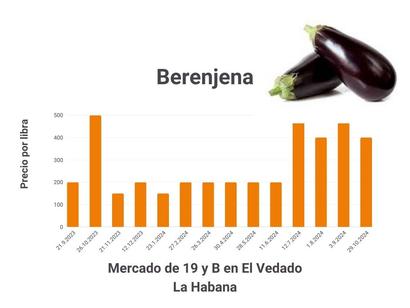
In September of last year, a pound of eggplant cost 200 Cuban pesos in the 19th and B market / 14ymedio

However, not even that generalized impression of the fruit, which has a high percentage of water and a great versatility for combining with other foods, has put the eggplant on the sidelines of inflation. If in September of last year a pound of the product cost 200 Cuban pesos in El Vedado’s 19th and B market, by this November it had already doubled in price.

“It serves to complete a dish, and if it is prepared with enough garlic, onion and lemon it replaces meat, which is so expensive,” said Catalina, an elderly woman who approached the platform of a cart driver in the Cerro neighborhood. “I dip it in a good Creole mojo, bread it and cool it, and my grandchildren ask me where I got the steaks,” the woman says in a mischievous tone. “I also put it on rice, and that’s how I make it stretch.

“A few days ago, a friend taught me how to make eggplant lasagna. It tastes delicious; the problem is that cheese is very expensive. Not to mention that tomato and now eggplant are both more expensive, so it’s not a cheap recipe either.” At least, she says, she has a good oven with the so-called “street” gas, one of the few services that still has some stability in the Cuban capital. Catalina will not have to use an iron to brown each spongy slice of tiny seeds.

Translated by Regina Anavy

____________

COLLABORATE WITH OUR WORKThe 14ymedio team is committed to practicing serious journalism that reflects Cuba’s reality in all its depth. Thank you for joining us on this long journey. We invite you to continue supporting us by becoming a member of 14ymedio now. Together we can continue transforming journalism in Cuba.

The United States Appoints Mike Hammer As the New Head of Its Diplomatic Mission in Havana

The diplomat, with more than three decades of career, has been in several countries in Latin America and Africa

Hammer was the spokesman for the National Security Council from 2009 to 2011 / X / United States Embassy in Havana

14ymedio bigger 14ymedio, Havana, November 16, 2024 — Mike Hammer, with 35 years of diplomatic career in countries such as Chile and Congo, is the new head of the US diplomatic mission in Havana. The announcement this Friday indicated that Hammer, in addition to having experience in the State Department and the White House, “speaks fluent Spanish” – in addition to French and Icelandic – and ” grew up” in Latin America.

Hammer, 60, replaces Benjamin Ziff as Chargé d’Affaires – Havana does not have an ambassador – who held the position for two years and left the Island last month. The new head of mission has lived in Honduras, El Salvador, Bolivia, Colombia and Venezuela – countries with a complex situation and relevant to the geopolitical board on which the regime moves.

In addition, he was US special envoy to the Horn of Africa and spokesman for the National Security Council from 2009 to 2011. He held different positions in Norway, Iceland and Denmark, and will travel to Havana with his wife, Margret Bjorgulfsdottir, and their three children.

Born in 1963, Hammer studied Foreign Service at Georgetown University and has master’s degrees in Law and Diplomacy from several American continue reading

institutions. He was special assistant to the Undersecretary of State for Political Affairs, Marc Grossman, whom he advised as head of Latin American affairs.

President Barack Obama appointed him ambassador to Chile in 2013.

President Barack Obama appointed him ambassador to Chile in 2013, and several years later, in 2018, Donald Trump – during his first term – sent him to Congo. Hammer has been actively involved in conflict resolution in Africa. An example of this was his mediation, in 2022, between Ethiopia and the Tigray People’s Liberation Front – a nationalist leftist paramilitary group – to end the Tigray War.

In early 2023, he was involved in the Sudan conflict and held several meetings with diplomats from Kenya, Ethiopia and the African Union

Hammer arrives in Cuba at a time of maximum tension in Havana, with the imminent return of Trump to the White House and a Cabinet in which old enemies of the regime stand out, such as Senator Marco Rubio, who will serve as Secretary of State. In addition, his arrival occurs in the midst of a systemic crisis in the country, after the passage of two hurricanes, episodes of total blackout and unprecedented shortages.

The new Chargé d’Affaires will also have to continue with the agenda of his predecessor to improve diplomatic facilities, enable immigration procedures, support the private sector of the Island and – as Ziff said in his farewell statement – support the search for a “freer and more democratic future” for Cuba.

Translated by Regina Anavy

____________

COLLABORATE WITH OUR WORKThe 14ymedio team is committed to practicing serious journalism that reflects Cuba’s reality in all its depth. Thank you for joining us on this long journey. We invite you to continue supporting us by becoming a member of 14ymedio now. Together we can continue transforming journalism in Cuba.

In the Public Health Centers in Cienfuegos ‘There Is Nothing and No One’ To Attend to the Sick

The José Luis Chaviano polyclinic is located a few meters from the Embarcadero del Muelle Real / 14ymedio

14ymedio bigger14ymedio, Julio César Contreras, Cienfuegos, 16 November 2024 — The deterioration of Public Health facilities, in the eyes of the residents of Cienfuegos, looks critical. From the small offices of family doctors that are scattered throughout the city, to the hospitals, the shortage of professionals and supplies is an obvious reality that worsens with the months.

Many of the offices that were built between the 80s and 90s of the last century were equipped with several rooms (waiting, consultation and checkups, in addition to a bathroom) and two homes for a doctor and a nurse to be permanently installed with their families. Over time, the houses passed to their descendants, regardless of whether they gave consultations. Today, many of these properties are closed; not only have the families emigrated but the shortage of professionals makes it impossible to keep all the centers active.

The “desolate” situation described by the residents of Cienfuegos is not as dramatic as in the small towns and isolated communities. At least in the provincial capitals some doctors make rounds and visit the office once a week. However, the premises hardly serve as “a reason to miss work, get a prescription or, if the doctor brings his own equipment, have your blood pressure taken.” continue reading

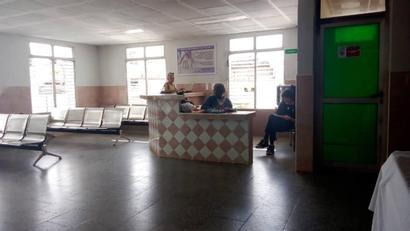
The reception is almost always empty, without even a custodian nearby / 14ymedio

On the next level are the polyclinics, which are not in better condition. In the José Luis Chaviano, “just looking at the facade you can already guess what awaits you inside,” says Vilma, a neighbor of Pueblo Nuevo, where the health center is located. “I have no choice but to come and inject myself twice a day. Sometimes I wait for the nurse, who went to her house or to solve some personal problem. The reception is almost always empty, without even a custodian nearby. And, in addition, I have to bring a syringe, needle, ampule and cotton,” says the retiree.

The woman, who also suffers from asthma, explains that until a while ago you could at least go to the polyclinic for an aerosol spray. However, there are no longer enough oxygen tanks for all the patients who arrive requesting that treatment, although a truck unloading them is observed with some frequency. “I am not aware that they are doing illicit business with such a delicate matter, but it is very suspicious that the supplies are unloaded and then disappear. If they got here, where are they going to end up then?” she asks.

Located a few meters from the Muelle Real embarcadero, the polyclinic has the category of University, although it rarely receives medical and nursing students, increasingly scarce on the Island. On the contrary, it is not uncommon to find “a single doctor on duty, whose specialty is writing certificates for work absences and prescriptions for missing medicines,” says Vilma. “The sick now go directly to the hospital, because they know that there they will not find what they are looking for,” she adds.

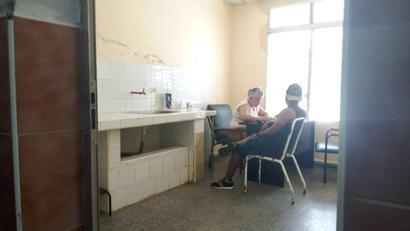
External consultations have practically disappeared because of the huge deficit of doctors / 14ymedio

Interviewed by 14ymedio, a receptionist at José Luis Chaviano says that outpatient consultations have practically disappeared “because there is a huge deficit of doctors in all specialties, and the few that remain were sent to the Provincial Hospital.” She doesn’t know for sure the state of other polyclinics, but since hers is “so central,” it’s logical that the rest are “the same or worse. Specifically in this area of health there is a very great lack, both in equipment and in personnel. The walls even have mold and the floors are dirty, because it is difficult for someone to accept work as a cleaning assistant for such a low salary. As a result, there is nothing and no one.”

Even the anti-vector fight, compares the employee, which attracted many students and fumigators to the surroundings of the polyclinic, to eradicate mainly the aedes aegypti mosquito, “ceased to be done a long time ago.”

Gabriel, a Cienfuegos man who has been “following the dentists” of the Provincial Hospital for months to have a procedure done, does not have a good opinion of this center, the most important in the city. “My daughter-in-law works in a private clinic and told me that she is going to help me get a prosthesis, but I first need the Provincial to analyze my case and indicate the treatment so that she can help me,” he summarizes.

“The problem is that they don’t have equipment or specialists for anything, and they are only doing extractions,” continues Gabriel. According to him, his daughter-in-law spent part of her internship as a student in the hospital itself, and even then “there was not enough water for her to wash her hands. She was gradually disappointed by all that,” he says, “and in the end she left before they pointed her out as hostile for her continuous complaints.”

Translated by Regina Anavy

____________

COLLABORATE WITH OUR WORKThe 14ymedio team is committed to practicing serious journalism that reflects Cuba’s reality in all its depth. Thank you for joining us on this long journey. We invite you to continue supporting us by becoming a member of 14ymedio now. Together we can continue transforming journalism in Cuba.
Dollars in Hand, an Elite of 40 Producers Monopolizes Agricultural Inputs in Sancti Spíritus, Cuba

Another 25,000 guajiros make up the rest of the peasant “body,” subject to the vagaries of the informal market.

Without dollars there is no “fuel, fertilizers, chemical products, machinery, implements,” say the farmers. / Escambray

14ymedio bigger14ymedio, Havana, 16 November 2024 — With a cartoon of a dollar bill decorated with elements of the Cuban peso, the Escambray newspaper denounced, this Saturday, that the campesinos of Sancti Spíritus are forced to buy supplies in foreign currency. Supporting production in “fulas” (dollars) leads to the inevitable increase in the price of products, a situation that the guajiros raised – not without “tensions” – during an extraordinary plenary session of the Provincial Committee of the Communist Party.

“Without dollars there is no “fuel, fertilizers, chemical products, machinery, implements,” the farmers listed. A figure that illustrates how indispensable the purchase of resources in foreign currency has become is what the Logistics UEB of the Ministry of Agriculture provides in just one month in the province: more than 270,000 dollars in inputs.”

The bank only accepts cards – Classic, Mastercard, Visa and the foreign currency card issued by the state-owned Banco de Crédito y Comercio (Bandec), with initial number 9240 – and clients from different places in the province, but also from Villa Clara, Holguín and Ciego de Ávila, come to it. They have a 12 million peso plan. “We almost always reach it,” they say proudly.

A large number of producers have to bring their seeds from abroad, through relatives.

Most of the purchases are made by some 40 “leading producers,” “whose main commitment is to the State,” who are able to constantly acquire what they need, because – Escambray believes – they have dollars on hand for one reason or another. The province, however, has a population of 25,000 guajiros who are subject to the fluctuations of the exchange rate and must buy the currency “on the street,” at an exchange rate of more than 330 continue reading

pesos (328 this Saturday, according to El Toque monitoring ).

This large number of producers have to acquire their seeds from abroad, through “a relative over there” – in the United States – or through unstable channels. “It is very difficult,” several told the newspaper, adding that the Party is well aware of the situation.

The State has promised a “scheme” so that the farmers have foreign currency and save when importing supplies. But, again, the plans will benefit above all the 40 “leaders,” because these are sectors that Havana wants to promote, especially the tobacco sector. However, even the situation of these large producers is not satisfactory. According to the salesmen of UEB Logística, previously 20 to 40 guajiros visited the store daily, now only eight or ten do so.

“Some take a tonne; others, a sack. Sometimes they join together and put the money on a single card and one person comes and buys for everyone. The most popular items are fertilizers, such as urea and NPK, herbicides; also tires and machetes, sold for more than two dollars. For some, certain products are very good, but the price is high,” the sellers explain.

One of the most sought-after products is the roll of netting, which sells for 4.22 dollars per meter. Farmers have to join together to buy it, because it is sold only in whole rolls of 100 meters.

One of the most sought-after products is the roll of netting, which sells for $4.22 per meter.

Escambray admits that the State openly benefits the “leaders” with solvency. “When the product arrives in small quantities, we inform the Delegation so that it can allocate the promised production. The formula is tough, but for many farmers it is better to have these inputs, despite their price, because it is worse not to have them or to buy them on the street where they are more expensive,” say the Logistics directors.

Juan José Nazco González, the provincial delegate for Agriculture, tried to “placate” consumers from Sancti Spiritus and the farmers who cannot buy at the level of the “leaders,” during an interview with Escambray. He said that tobacco growers “have guaranteed” supplies because it is an industry that, for the Government, is a priority. He admitted, however, that “no one produces to lose,” but that many aspects of production have gotten out of hand for the Ministry of Agriculture, which has not “finished ordering” the process.

The Escambray journalist who wrote the article lamented the ineffectiveness of all the regulations. “The paper can withstand anything they put in it and it has been a practice for years to divert written commitments from their course,” she concluded. Pedro López Cabello, deputy general delegate of Agriculture, offered even less hope: The authorities do not have “many ways” to guarantee supplies “through the ’little channel’.” “The only thing the State can guarantee is the land,” he said.
____________

COLLABORATE WITH OUR WORKThe 14ymedio team is committed to practicing serious journalism that reflects Cuba’s reality in all its depth. Thank you for joining us on this long journey. We invite you to continue supporting us by becoming a member of 14ymedio now. Together we can continue transforming journalism in Cuba.
A Mother of Three Children Is Killed With a Machete by Her Partner in Granma, Cuba

The femicide of Vania Mojeda, age 43, is the 44th this year

Mojena was the mother of two minor children and an adult daughter / Facebook / Vania Mojena

14ymedio bigger14ymedio, Havana, 15 November 2024 — Vania Mojena, 43 years old and a resident of the town of Mabay, near the city of Bayamo, in Granma, was murdered last Wednesday, November 13, by her partner. The femicide, the second of November and number 44 of this year, according to the record kept by 14ymedio, was confirmed on social networks by her family.

A post on the Facebook group Revolico in Mabay, made by an anonymous user, reported on Wednesday the sexist murder of Mojena. According to close sources, after returning from a trip to Russia, the alleged aggressor visited Mojena’s home on Wednesday night where he gave her several machete blows “in front of her children.” According to reports, the victim was the mother of two minors and an adult daughter, who confirmed, in a comment at the foot of the publication, the events.

Other sources, such as La Tijera, state that the aggressor “was aggressive and violent with women all his life.”

Just one day later, independent platforms confirmed the femicide of Elaine González Estrada

Just one day later, on November 14, the independent platforms Yo Sí Te Creo en Cuba (YSTC) and Alas Tensas confirmed the femicide of Elaine González Estrada, mother of a girl.

As they explained, González disappeared on November 3 after making a trip to a recreational center on the outskirts of the city of Santa Clara, in the province of Villa Clara. Two days later, she was found dead in the house of continue reading

her ex-partner. According to this Thursday’s report by Alas Tensas and YSTC, the aggressor fled but was captured by the police.

Before, in October, the month in which the highest number of femicides (seven) is recorded so far this year, Dianelis Veloz Hernández, in Havana; Yoannia Hernández, in Holguín; Liz Yohana Jiménez Morales, in Sancti Espíritus; Yadira Moreira, in Mayabeque; and Tamara Carrera, Yucleidis Morales and Dagnis Alida Hernández Milanés, in Santiago de Cuba were murdered. All were assaulted by their partners or ex-partners, and three of them in public spaces.

October is the month in which the highest number of femicides is recorded so far this year

At the end of October, the UN Committee on the Elimination of Discrimination against Women (CEDAW) issued, after receiving reports from the Cuban Government and independent platforms, its considerations on the situation in which women live on the Island.

CEDAW drew attention to Havana for femicide murders and urged the country to include femicides in its Criminal Code to “create awareness and public recognition, strengthen measures to prevent, prosecute and punish the perpetrators of cases of gender violence against women, and establish reception centers throughout the State, even in collaboration with civil society organizations.”

It also mentioned the existence of political prisoners, sentenced for “expressing dissident opinions,” and who face “violations of procedural guarantees and fair trial, severe penalties, physical abuse, psychological violence, including the arbitrary use of punishment cells in poor conditions and for excessive periods.”

Translated by Regina Anavy

____________

COLLABORATE WITH OUR WORKThe 14ymedio team is committed to practicing serious journalism that reflects Cuba’s reality in all its depth. Thank you for joining us on this long journey. We invite you to continue supporting us by becoming a member of 14ymedio now. Together we can continue transforming journalism in Cuba.

With More Than 30 Years in Prison, Miguel Díaz Bauzá Is the Longest-Serving Political Prisoner in Cuba

Amnesty International adds four imprisoned Cubans to its list of prisoners of conscience

Miguel Díaz Bauzá was awarded the prize in memory of Pedro Luis Boitel / OCB Roberto Koltun

14ymedio bigger14ymedio/EFE, Madrid, 23 October 2024 — Miguel Díaz Bauzá, imprisoned since October 1994, when he landed in Cuba with seven other men to fight Castroism with weapons, will spend eight more years in prison, according to what his family told several independent media. Karen María León Alfonso, the opposition leader’s daughter, expected that the 30-year sentence imposed on him would be completed on October 15, although she admitted that her father was aware that it would be extended until 2032

“They didn’t increase his sentence. In 2002, they gave him a joint sentence of 30 years, for a problem he had in the Camagüey prison,” said León Alfonso, who also revealed that the authorities offered the prisoner a parole, which he rejected. “He doesn’t want any benefit from the Government. He told the agent: ‘I’ll take whatever years, but I don’t want anything from you’.”

Díaz Bauzá, now 81 years old, was sentenced to 25 years in prison in 1994 for “infiltration,” “illegal entry into the country,” “terrorism” and “other acts against state security,” with the intention of organizing an armed uprising against the Castro regime.

“He doesn’t want any benefit from the government. He told the agent: ’I’ll pull as many years as it takes, but I don’t want anything from you’.”

In 2002, Díaz Bauzá joined a protest by prisoners at Kilo 8 prison in Camagüey to demand better conditions, for which he was sentenced to continue reading

another 25 years in prison. The court decided that he should serve both sentences together, for a total of 30 years.

“When they didn’t release him, I started to investigate and they explained it to me,” said the prisoner’s daughter, who points out that Díaz Bauzá did “have an idea that the 30-year sentence was from 2002” even though they had another “hope.”

The prisoner, winner of the 2020 Pedro Luis Boitel Freedom Award along with Real Suárez, will therefore remain in the Campamento la 2 center, in Remedios, Villa Clara, his home province. His daughter says that Díaz Bauzá is a very strong man, but at his advanced age he has to deal with the conditions of living in captivity.

He has health problems such as psoriasis, diabetes, hypertension and prostate problems, his daughter explained to CubaNet.

Díaz Bauzá and Humberto Eladio Real Suárez were members of the National Democratic Unity Party and entered the island with Armando Sosa Fortuny, who died in 2019 in the Camagüey prison as the prisoner who spent the most years in Cuban penitentiary centers, a total of 44 if the different sentences imposed on him in his life are added together. The rest of the commando was completed by Jesús Rojas Pineda, José Ramón Falcón Gómez, Pedro Visao Peña and Lázaro González Caraballo.

He has health problems such as psoriasis, diabetes, hypertension and prostate problems, his daughter explained to ’CubaNet’

Real Suárez was released from prison in March 2023 , after serving 29 years of his 30-year sentence, although he was once sentenced to death. With that release, Díaz Bauzá becomes the longest-serving prisoner in Cuban prisons – surpassing the late Mario Chanes de Armas, who spent 30 years – as denounced by journalist and former political prisoner Pedro Corzo. “The conduct of the Cuban dictatorship against Miguel Díaz Bauzá is the reiteration of evil, injustice and the use of absolute power against those who want freedom and civil rights on the Island,” he told Martí Noticias.

The news came out on the same day that the NGO Amnesty International (AI) added four Cuban prisoners of conscience to its list: opposition member Felix Navarro, journalist and the lady in white Sayli Navarro, ’11J’ protester Roberto Pérez Fonseca and activist Luis Robles.

In a statement, AI demanded his “immediate and unconditional release” as well as that of all people “unjustly imprisoned solely for exercising their human rights” in Cuba and denounced the “context of systematic human rights violations” and the “repression” and “criminalization of any form of dissent” on the island.

AI Americas Director Ana Piquer said that these designations are a “recognition” of the “courage and resistance of the people in Cuba who overcome permanent and widespread repression and fight” for human rights.

Felix Navarro, 71, is serving his third sentence “for political reasons” despite being ill, AI said. His daughter, Sayli Navarro, 38, co-founder of the Ladies in White movement, was arrested with her father after 11J.

Roberto Pérez Fonseca, 41, was convicted in 2021 for participating in the same protests, accused of contempt, assault, public disorder and incitement to commit a crime. The UN Working Group on Arbitrary Detention described his detention as “arbitrary” and considered that “his rights to a fair and impartial trial” were violated.

Finally, Luis Robles, known as “the young man with the placard,” has been sentenced since 2022 for enemy propaganda and disobedience for having peacefully demonstrated two years earlier with a sign calling for “freedom” for rapper Denis Solís, who was arrested days earlier.

“It is imperative that the international community show its solidarity and demand the immediate release of those imprisoned for exercising their rights,” said Piquer, who demanded that the Cuban government respect human rights, including freedom of expression, association and peaceful assembly; repeal repressive laws and cease repression of dissenters.

“It is imperative that the international community shows its solidarity and demands the immediate release of those imprisoned for exercising their rights”

With this announcement, the NGO significantly expands its list of prisoners of conscience in Cuba, which until now included opposition leader José Daniel Ferrer García; artists Luis Manuel Otero Alcántara and Maykel Castillo Osorbo; Yoruba priests Loreto Hernández García and Donaida Pérez Paseiro, and Cuban professor and activist Pedro Albert Sánchez.

AI stated that its aim is not to declare everyone a prisoner of conscience, but to draw attention to this problem by highlighting well-known and representative cases.

____________

COLLABORATE WITH OUR WORKThe 14ymedio team is committed to practicing serious journalism that reflects Cuba’s reality in all its depth. Thank you for joining us on this long journey. We invite you to continue supporting us by becoming a member of 14ymedio now. Together we can continue transforming journalism in Cuba.

Economic Commission for Latin America and the Caribbean (ECLAC) Estimates Cuba’s Per Capita GDP Fell in 2023

In Latin America, the Island is the State that spends the least on non-contributory pensions for those over 65 years of age.

Inequalities “disproportionately” affect some sectors, such as women, children and the indigenous or Afro-descendant and rural population. / 14ymedio.

14ymedio bigger14ymedio, Madrid, 14 November 2024 — Cuba lost 0.8% of its gross domestic product (GDP) per capita in 2023, according to data from the report “Social Panorama of Latin America and the Caribbean 2024: challenges of non-contributory social protection to advance towards inclusive social development”. Presented this Tuesday by the ECLAC’s [Economic Commission for Latin America and the Caribbean] Executive Secretary, José Manuel Salazar-Xirinachs, the report shows that the Island is still bringing up the rear in the region, in a group of four countries in which the figure was negative, although in a better situation than Peru (1.4%), Argentina (2.1%) and Haiti (3.1%).

The region’s per capita GDP did not show a large variation, barely a 1.4% increase, especially encouraged by the better data from Panama (5.9%), Costa Rica (4.5%) and Paraguay (3.5%). This figure, according to ECLAC, “reflects the economy’s capacity to generate income to meet the needs of the population. The availability of employment and labor force participation are direct determinants of household income. Inflation, especially food inflation, has an impact on the purchasing power of families, particularly those in a situation of economic vulnerability”.

Their amounts did not cover the per capita household income deficit.

The report, however, focuses on how the countries evaluated protect their most vulnerable populations, although it does address poverty and inequalities – with an absence of data for Cuba, which does not provide them – as well as care for ageing populations and how states are addressing continue reading

this challenge. On this occasion, ECLAC has focused on non-contributory benefit systems, which should ensure that the most vulnerable population is cared for.

The agency has studied the non-contributory pensions of 14 countries, among which Cuba is not included, and concluded that “despite their positive impacts, their amounts did not cover the deficit of household per capita income in relation to the poverty line”. The island, however, as documented in the report, has a system created in the 1970s (1979, in fact), like those of the Bahamas, Chile, Costa Rica, and is thus among the first, the pioneers being Uruguay, in 1919, and Argentina, in 1948. ECLAC admits that the legal existence of the system “does not guarantee the effectiveness or efficiency of these non-contributory social protection programs, but it does seem to provide them with greater legal stability compared to those based on administrative or ministerial decrees”.

Despite the lack of data from Cuba, which prevents us from knowing more about the endowment, coverage and other details, as well as comparing them with other countries, ECLAC does have a record of the contribution made by the State to non-contributory pensions for the over-65s as a percentage of total public spending. The result is that the regime is the one that allocates the least – together with Antigua and Barbuda – of the 24 countries with data, an amount below 0.005, compared to the regional average of 0.42, in which Trinidad (2.8%), Guyana (1.6%) and Bolivia (1.5%), stand out above the rest.

Panorama Social de América Latina 2024 / ECLAC

According to ECLAC, in order to make progress in eradicating poverty “it is necessary to establish an investment standard for non-contributory social protection of between 1.5% and 2.5% of GDP or between 5% and 10% of total public spending”. However, after studying the contributions of 20 countries, including Cuba, it is clear that they do not reach 0.8% of GDP or 3% of public spending in 2022.

Another noteworthy data that appears in the report for Cuba is that of inflation, precisely because of its absence. ECLAC considers that this figure is relevant “especially that of food” because “it impacts on the purchasing power of families, particularly those in a situation of economic vulnerability”.

Although official data indicates that in Cuba it stood at 31%, it is believed to be much higher in the informal sector. ECLAC does not include the figure in this report precisely because it considers that the island belongs to the block of “countries with chronic inflation”, together with Argentina, Haiti, Suriname and Venezuela, which could distort the statistical averages.

In general terms, the report contains good news for the region, which is the fall in poverty to 27.3% of the population in 2023, the lowest rate recorded since 1990 (172 million people), as well as in extreme poverty, which decreased by 0.5% (66 million people). The improvement is due especially to Brazil, and to a lesser extent Paraguay, the Dominican Republic, El Salvador and Colombia.

However, inequalities are growing in a continent greatly affected by unequal wealth distribution and where poverty “disproportionately” affects women of working age (22.2%), minors (40.6%), indigenous people (42.3%) and Afro-descendants (20.4%), and those living in rural areas (39.1%).

Translated by GH

____________

COLLABORATE WITH OUR WORKThe 14ymedio team is committed to practicing serious journalism that reflects Cuba’s reality in all its depth. Thank you for joining us on this long journey. We invite you to continue supporting us by becoming a member of 14ymedio now. Together we can continue transforming journalism in Cuba.

The Minister of Health Inaugurates a Hospital in Angola Where 20 Cuban Doctors Work

The inauguration of the Comandante Raúl Díaz Argüelles general hospital in the Angolan province of Cuanza Sur / Prensa Latina

14ymedio bigger14ymedio, Havana, October 21, 2024 — The Minister of Public Health of Cuba, José Ángel Portal Miranda, inaugurated the Comandante Raúl Díaz Argüelles general hospital on Monday, in the Angolan province of Cuanza Sur, where 20 Cuban doctors work. The official highlighted the collaboration between the two nations and confirmed that 1,243 specialists from the Island are currently deployed in Angola.

Chaired by the Angolan president, João Lourenço, the event pointed out that more than 16,500 Cuban doctors have been in Angola since 1975, when the cooperation began. It has been extended to “the contribution in training human resources,” with 1,646 graduates and 52 students who continue medical studies in both countries.

The Minister of Health, Sílvia Lutucuta, explained that the hospital has a capacity for 200 beds and the services of pediatrics, hemodialysis, gynecology and obstetrics, otolaryngology, ophthalmology, surgery, continue reading

orthopedics, cardiology, intensive care, mammography and imaging.

The hospital is named in memory of the first head of the Cuban military mission in Angola, Raúl Díaz Argüelles, who died on December 11, 1975, when his armored transport hit an anti-tank mine, said Prensa Latina.

The hospital has a capacity for 200 beds and pediatric, hemodialysis, gynecology and obstetrics services / Prensa Latina

In fact, the combatant’s daughter was present at the ceremony. Díaz Argüelles was entrusted with establishing and leading the Cuban mission in Angola in response to the request of President Agostinho Neto. “Cuba is proud to have contributed to Angola’s struggle against colonialism and the defense of its territorial integrity and sovereignty,” the Cuban minister said.

The authorities of the Island have stressed that relations between the two countries have remained uninterrupted since then. “This has been one of the African countries where Cuban collaboration has been the strongest,” reported the official media Cubadebate. “After the withdrawal of Cuban troops from Angola, and after guaranteeing the independence of Namibia, Cuba maintained its relations with the ruling party, the Popular Movement for the Liberation of Angola (MPLA).” The media did not mention the cost of the war in human lives.

Cuban intervention lasted 15 years, until 1991, and it is estimated that 350,000 men in total left the Island to perform military service in Angola. The Cuban Government recognizes only 2,000 deaths in the African conflict, a figure questioned by many historians.

In Angola, the literacy program “Yo sí puedo” was also implemented, in the province of North Kuanza, with the presence of 42 Cuban advisors

Angola, in addition, as published last June by the newspaper El Tiempo, represents the “second market” for the export of human resources with strategic importance for Havana, after Venezuela. In this country, the Government of the Island has managed to “project its political, ideological and military influence in a transcendental post-colonial struggle, while obtaining important economic benefits from a State with oil reserves and significant natural wealth,” said the executive director of the NGO Cuba Archive, María Werlau.

An investigation by El Toque in collaboration with Connectas revealed that the Corporación Antillana Exportadora S. A. (Antex) – a subsidiary of the Business Administration Group (Gaesa) of the Cuban Armed Forces – is in charge of hiring the professionals, and that in the last 12 years they have provided 1.808 billion dollars to Cuba.

With the inauguration of the hospital in the Angolan province of Cuanza Sur, the relationship with Cuba is pointed out / Prensa Latina

The study revealed Antex’s relationship with at least eight Cuban state-owned companies – without giving names – registered in Angola, and another in the Principality of Liechtenstein. They provide services to Angola in more than 30 sectors. “The operation has produced $6,755 million in the last 25 years.”

The same publication indicates the violation of several labor and human rights for Cuban professionals. A Cuban doctor prominent in Angola denounced Antex’s mistreatment in October 2023. The specialists, he said, had been earning the equivalent of 100 dollars in local currency for five months, because they were told that “there was no money.”

The cooperation between the two countries, in any case, has not been without controversy. In January 2021, Angola annulled a $77 million contract with Antex for breach of its obligations; specifically, with Imbondex Construcciones y Materiales de Construcción S.A. Other Cuban companies were Meditex, for medical services, and Imbondex Turística, owner of the travel agency Atlántico Azul, which had committed to building roads and bridges in the province of Bengo, which surrounds the capital of the country, Luanda. The work did not even begin, and the Angolan president, João Lourenço, terminated the contracts by decree.

Translated by Regina Anavy

____________

COLLABORATE WITH OUR WORKThe 14ymedio team is committed to practicing serious journalism that reflects Cuba’s reality in all its depth. Thank you for joining us on this long journey. We invite you to continue supporting us by becoming a member of 14ymedio now. Together we can continue transforming journalism in Cuba.

Senior Cuban Army Commanders Negotiate a Military Cooperation Agreement in Algeria

The signing of an agreement to expand medical cooperation is also planned.

The signing of an agreement to expand medical cooperation is also planned. / Ministry of Foreign Affairs

14ymedio biggerEFE (via 14ymedio), Algeria, 28 October 2024 — The Chief of Staff of the Algerian Army, Said Chanegriha, met this Monday with the Deputy Minister of the Armed Forces of Cuba, Joaquín Quintas Solá, who was visiting the country along with an important military delegation, to address cooperation between the two countries, reported the Ministry of Defense.

“Within the Algerian People’s Army (ANP) we are working to make the strategic visions of the leaders of our two countries a reality with the aim of promoting the partnership between our respective armies through the creation of a new dynamic in the field of military cooperation,” Chanegriha explained during the welcome ceremony.

This meeting was attended by prominent commanders, heads of departments and directors of the General Staff of the Army and the Ministry as well as the Cuban ambassador to Algeria, Héctor Igarza.

Both partners share “immutable” values and principles that seek to create a global movement that defends the interests of developing countries

It was also stressed that both partners share “immutable” values and principles that seek to create a global movement that defends the interests of developing countries and against polarization on the international scene, as well as laying the foundations for cooperation based on mutual assistance, solidarity and support for oppressed peoples and for just causes, led by the Sahrawi* and Palestinian issue. continue reading

For his part, Solá welcomed the “firm” will of his counterpart to consolidate bilateral relations and “raise high the aspirations of the leaders of the two friendly countries to lay the foundations for a fruitful and beneficial cooperation for both parties.”

The Cuban official was also received by the Minister of Health, Abdelhak Saihi, president of the Algerian-Cuban Joint Commission, which provides for the signing of an agreement focused on gynecology-obstetrics, ophthalmology and diagnostic imaging in addition to integrating preventive medicine.

*Translator’s note: The Sahrawi Republic is a partially recognized state in the western Sahara. Between 1884 and 1975, it was a Spanish colony.

Translated by Regina Anavy

____________

COLLABORATE WITH OUR WORKThe 14ymedio team is committed to practicing serious journalism that reflects Cuba’s reality in all its depth. Thank you for joining us on this long journey. We invite you to continue supporting us by becoming a member of 14ymedio now. Together we can continue transforming journalism in Cuba.

Arturo González, a Bishop Whom Díaz-Canel ‘Admires’, Is the New President of the Episcopal Conference

The Santa Clara prelate, a skilled diplomat, is a regular interlocutor of Pope Francis and high Vatican officials

In 2019, during the celebration of the 330th anniversary of the foundation of Santa Clara, the president went to greet González / Granma

14ymedio bigger14ymedio, Havana, November 8, 2024 — The Cuban Catholic hierarchy was reorganized this Thursday with the election of a new president for the Episcopal Conference. This is Arturo González, bishop of Santa Clara, who is accompanied by the standing committee until 2027: Juan Gabriel Díaz, bishop of Matanzas, as vice president, and the assistant from Havana, Eloy Ricardo Domínguez. In an aging institution, they are the three youngest prelates in the country.

“They are the three youngest in age, but not in experience, because Monsignor Arturo has more than 25 years of experience as a bishop,” a priest of the Diocese of Santa Clara explains to 14ymedio. González, he says, “has more years of experience than many of those who already consider themselves ’old’ at the Conference. In addition, the three have a desire to do the work and are physically capable.”

González, who will head the Cuban bishops from Santa Clara, will also be in charge of the important Economic Commission. Characterized by his diplomatic skill and his prestige before Cuban exiles, he has in his favor an old familiarity with Miguel Díaz-Canel since he presided over the Communist Party in Villa Clara.

“Díaz-Canel will love the news,” says the priest interviewed by this newspaper. “He admires Monsignor Arturo. He said it publicly when he was secretary of the Party, and when the mass was celebrated for the 330th anniversary of Santa Clara, Díaz-Canel went to the blessing of the city and ended up embracing the bishop.” continue reading

Faced with someone who has a good understanding of the president, a resumption of negotiations in favor of political prisoners is to be expected

Faced with someone who has a good understanding of the president, a resumption of negotiations in favor of political prisoners is to be expected, which González has carried out at the local level in his diocese. He is hoping for the support of Eloy Domínguez, who was appointed head of the Prison Ministry.

The Santa Clara bishop – until now vice president of the Conference – is also a regular interlocutor of Pope Francis and senior Vatican officials, and he was present at the last visit of the Cuban bishops to the Holy See.

The new structure replaces the one chaired since 2017 by Emilio Aranguren, which was characterized by non-confrontation with the Regime and cordiality with the Office of Religious Affairs of the Communist Party. Aranguren and Cardinal Juan García, two veteran bishops, will continue to be part of the permanent committee of the Conference.

For his part, Juan Gabriel Díaz, a man of solid intellectual training but – like Domínguez and González himself – seen as a moderate, will be in charge of the National Commission for the Prevention of Abuse of Minors and Vulnerable Adults. Raising the issue, which has been a priority during the pontificate of Francis, is practically a taboo in Cuba, and the Catholic Church has not disclosed any cases of abuse recorded on the Island. The Commission will have a legal adviser, a psychologist, a psychiatrist with forensic experience and several members.

The bishops of the affected dioceses shared their concern about the “bleak panorama” that is crossing through the country

The Commission has been working for several years, but the new directive will operate according to a recently approved manual of procedures, since the Vatican has given new and more solid guidelines on the subject.

The Episcopal Conference also reported that during its plenary meeting, held from November 4 to 7, the new apostolic consul in Cuba, Antoine Camilleri, was welcomed. The meeting took place “under the influence” of Hurricane Oscar for Guantánamo and Rafael for the Cuban west, according to the report. The bishops of the affected dioceses shared their concern about the “bleak panorama” that is crossing through the country. “While the Assembly was developing, we received news of the impacts, collapses and destruction that Hurricane Rafael has been leaving in the areas where it passed,” they said.

In addition, they sent their best wishes to Spain after the passage of the storm that affected Valencia and commented on the “social deterioration in the nearby Haitian people.”

They also met a delegation of the Catholic Church in Poland, chaired by Jan Piotrowsk, Bishop of Kielce. In a territory like Cuba, with a reduced national clergy, the presence of missionaries from European countries – and even more so from former Soviet nations – can translate into economic aid and missionaries, which Poland has been supplying to the Island for years.

Translated by Regina Anavy

____________

COLLABORATE WITH OUR WORKThe 14ymedio team is committed to practicing serious journalism that reflects Cuba’s reality in all its depth. Thank you for joining us on this long journey. We invite you to continue supporting us by becoming a member of 14ymedio now. Together we can continue transforming journalism in Cuba.

In Holguín, Cuba, the Windows of Hard Currency Stores Are Kept Covered for Fear of Being Stoned

“We Holguin residents are such that if they prick us we don’t even bleed”

Hard currency stores have been a frequent target of stone throwing in Cuba. / 14ymedio

14ymedio bigger14ymedio, Miguel García, Holguín, 25 October 2024 — Although the people of Holguín only have memories of October’s Hurricane Oscar, the El Nickel store, located at the intersection of Frexes and Máximo Gómez streets, still has its windows covered with panels. The reason for protecting the windows is not due to the winds or rains that the meteor brought to the province, but rather the authorities’ fear that popular indignation over the long blackouts will lead to a barrage of stones against the trade in freely convertible currency (MLC).

This Thursday, the downtown store offered a few goods, diminished by the lack of supplies and the compulsive purchases of customers who managed to prepare with canned goods, cookies and batteries for Oscar’s passage. “It seems that the windows will stay like this for a few more days, because we know that people here are very upset,” said Yunior, a driver of an electric tricycle that provides merchandise transport services on the outskirts of El Nickel. The social anger is summed up for the driver in a more than graphic phrase: “We Holguiners are such that if they prick us we don’t even bleed.”

Hard currency stores have been a frequent target of stone throwing in Cuba. The high prices and social inequalities that these businesses have contributed to aggravating are the fundamental fuel for these actions. The Holguin store sells household appliances, parts and accessories for motorcycles and cars, as well as sports equipment and food. “There are bicycles in there that cost 699 MLC, they have been there since the beginning and they have not been able to sell a single one,” Yunior criticizes. “In the four years since they turned El Nickel into a hard currency store, they have not reduced the price of those bicycles by a single dollar, despite the problems with transportation in this city.” continue reading

Other currency exchanges also keep their windows protected, which worsens the lighting inside.

Other foreign exchange markets also keep their windows covered, which worsens the lighting inside. “The height of absurdity, you go in and you can hardly see the products on sale because the few light bulbs that are on — when there is electricity, barely give a little light” — lamented a customer in another store in the MLC in downtown Holguin. Residents of the city have already experienced other moments of covered windows, such as in the days following the popular protests of July 11, 2021. “You can measure the degree of people’s discontent and the government’s fear by going around these stores to see if the windows are covered,” she adds.

This week, judging by the wooden planks covering the façade of El Nickel, it can be concluded that the discontent of the people of Holguín is high and so is the fear of the authorities.

____________

COLLABORATE WITH OUR WORKThe 14ymedio team is committed to practicing serious journalism that reflects Cuba’s reality in all its depth. Thank you for joining us on this long journey. We invite you to continue supporting us by becoming a member of 14ymedio now. Together we can continue transforming journalism in Cuba.

Cuba: Not Even Money and Advice From Vietnam Can Recover Fishing in the Los Palacios Reservoir

Vietnam will guarantee food and fish care in Pinar del Río until 2026, but no longer

The fishermen of La Juventud are aware of the leaders’ plans but warn that real life is going elsewhere / Guerrillero

14ymedio bigger14ymedio, Havana, 14 November 2024 — In 2011, Vietnam invested money and advice in the La Juventud reservoir, located in the Pinar del Río municipality of Los Palacios, hoping that almost 15 years later the results would be satisfactory. Fishing in the reservoir has not only been below what was planned in the last decade, but this year – between breakdowns, little investment and the desertions of fishermen – has been catastrophic.

Now the staff working at La Juventud awaits the arrival of four Vietnamese technicians who will contribute to the “intensive tilapia rearing.” With the newcomers’ strategy, the fishermen hope to live up to their plans: 10 tons to finish 2024, 40 in 2025 and 50 in 2026.

The scientists from Vietnam aspire to genetically improve tilapia through sex reversal. If they manage to make most of the fry male by injecting hormones into the eggs, they will have more weight when they mature. The Vietnamese left Los Palacios during the pandemic, but, the reservoir’s director, Antonio González, says with relief, they are already starting to return.

In La Juventud there are 16,000 tilapia raised in cages; each one weighs two pounds

In La Juventud there are 16,000 tilapia raised in cages; each one weighs two pounds. Vietnam will guarantee fish food until 2026, but not beyond. The “challenge” of the Cuban State is to “market part of its production in continue reading

foreign currency for the acquisition of feed.” Fishing, at the moment, is managed by the State-owned Pescarío, which catches, transports and refrigerates the fish. Everything, however, is limited to two municipalities – Los Palacios and Pinar del Río – and there are no guarantees that the product is exportable.

The fishermen of La Juventud are aware of the leaders’ plans but warn that real life is going elsewhere. Fishing “is not going at a good pace,” says Luis Quesada, with 20 years of experience fishing in the area. There are natural reasons and others that have to do with the lack of resources.

“The fish stick to the bottom,” Quesada explains, because of the bad weather on the surface. Winds, rain and the high level of the reservoir have forced the tench and tilapia to flee from the rough waves and go down to the bottom, a common behavior in the last months of the year due to the occurrence of cold fronts, but fueled by Hurricane Rafael.

On the other hand, the “Chernera”- as they call the boat used by the fishermen – was stopped for three months due to a break in the engine. Since January, when there was a good catch, “there have been very bad months,” the fisherman says.

The head of the fishing brigade, Julián Mesa, explains that they do not have appropriate nets either. Some fishing gear has been used for up to two decades, and the new materials that the State has provided them “do not have the ideal dimensions”: they are too small for such deep waters.

Mesa requested resources for a quarter-mile long net, but they “allowed” him to acquire one of only half that length

Mesa requested resources for a quarter-mile long net, but they “allowed” him to acquire one of only half that length. “With the high level of the reservoir we have to fish at the bottom behind the streams, which is where we get the small fish; if the nets were bigger, we would have a better catch,” he says.

However, his greatest concern, he explains, is the “discontent of his men.” “Two have already left the brigade this year because they are subject to payment systems for results, and when they do not meet the catch plan they receive only the minimum wage of 2,400 pesos, insufficient to cover the needs of their families,” he adds.

The members of the brigade are subjected to harsh working conditions. Standing from six in the morning, they finish at five in the afternoon, “but with the current gear and conditions of the reservoir the reward for the effort is minimal.”

González, for his part, is clear that “it will be very difficult to comply with the year’s plan” under these conditions. Fishing is only the first step of an industry that, in the province, does not work well. Little is processed and almost everything is restricted to the fish markets and the town’s canteens, where the people, he says, are always “waiting.”

Translated by Regina Anavy

____________

COLLABORATE WITH OUR WORKThe 14ymedio team is committed to practicing serious journalism that reflects Cuba’s reality in all its depth. Thank you for joining us on this long journey. We invite you to continue supporting us by becoming a member of 14ymedio now. Together we can continue transforming journalism in Cuba.

‘There Is Business’ in Cuba, Says the President of Spanish Entrepreneurs on the Island

Joaquín Samperio clarifies that “there are possibilities and offers, with risks involved”

The president of the Association of Spanish Entrepreneurs in Cuba (AEEC), Joaquín Samperio Sañudo

14ymedio biggerEFE (via 14ymedio), Havana, 3 November 2024 — To do business in Cuba it is necessary to “know the dynamics of the country,” where there are “risks” and “possibilities,” Joaquín Samperio Sañudo. says in an interview with EFE, speaking as president of the Association of Spanish Entrepreneurs in Cuba (AEEC).

The organization, the only one of national character legalized on the Island and with more than 250 associates from multiple sectors, celebrates its 30th anniversary from this Sunday, a “very important landmark” despite the “complex” situation that the country is experiencing, says Samperio in reference to the serious economic and energy crisis that the island suffers.

The celebration coincides with the International Fair of Havana (Fihav), the largest business event in the country, where Spain is once again the country with the greatest representation, with 63 companies, five pavilions (including that of the Basque Country) and three chambers of commerce (Guipúzcoa, Cantabria and Lugo).

“We try to give them a clear X-ray of the country’s situation,” says Samperio

“There is business. If all of us are here, it is because there are possibilities, there are offers, … with the risks that they entail,” explains Samperio. continue reading

Here the AEEC plays an important role informing potential Spanish investors. “We try to give them a clear X-ray of the situation in the country,” says Samperio, who clarifies that his “mission is not to encourage or discourage.”

“The main thing I tell them when they come to see me is that they have to understand the characteristics of the country. It is a country with a state economic model, and that radically changes the vision of the business we do in Spain, France, Peru, Panama and Brazil. This is a totally different model,” he says.

Samperio recalls the importance that Spain has at the economic level in Cuba. If the energy factor is eliminated, the European country is the first trading partner of the Island and carries special weight in a critical factor, the food sector.

About the economic situation, the president of the AEEC says that Cuba is in a particularly difficult situation because of the complex world situation added to the US sanctions.

It greatly affects all decisions and the economic policy that is developed in the country,” says Samperio and adds: “It’s a big problem, a great handicap.”

In this area, the effect of Cuba’s inclusion in Washington’s list of countries that sponsor terrorism stands out, which in his opinion was a “slap” to tourism, one of the country’s main sources of foreign exchange.

The pandemic, the tightening of US sanctions with Trump (2017-2021) and failed economic policies have aggravated the structural problems of the Cuban economy and led the country to one of its worst crises in decades, with shortages of basics, galloping inflation, massive migration and frequent blackouts.

The 2021 decision to allow Cuban private initiative again, says Samperio, has generated a new “quite important” sector

The 2021 decision to allow Cuban private initiative again, says Samperio, has generated a new “quite important” sector with which foreign entrepreneurs can interact, although in his opinion also some uncertainty.

“We are in a moment of putting order in the private sector in Cuba. It has only been two years and, like everything new, over time you have to put order into it and put it in its place,” explains the Spanish businessman: “the country is in a moment of change, little by little.”

Samperio, who expects a “good presence of the authorities” in the activities commemorating the 30th anniversary of the AEEC, assures that they maintain a “very good dialogue” with the Cuban Government, which gives “moral support” to Spanish entrepreneurs.

Translated by Regina Anavy

____________

COLLABORATE WITH OUR WORKThe 14ymedio team is committed to practicing serious journalism that reflects Cuba’s reality in all its depth. Thank you for joining us on this long journey. We invite you to continue supporting us by becoming a member of 14ymedio now. Together we can continue transforming journalism in Cuba.

The Head of the Havana Prosecutor’s Office Promises ‘Severity’ for Crimes During the Hurricane

Prisoners Defenders denounces the arrests of peaceful protesters during the October blackout

Lisnay Mederos, head of the Provincial Prosecutor’s Office of Havana / Facebook / Provincial Prosecutor’s Office of Havana

14ymedio bigger14ymedio, Havana, 14 November 2024 — From the appearance before the cameras of Canal Habana that Lisnay Mederos, head of the Provincial Prosecutor’s Office, made this Friday, two points were clear: “respect for authority is important” and Cubans have “rights, but there are limits.” Her intervention occurred as a result of “recent criminal acts” that occurred in the capital after the passage of Hurricane Rafael, but she did not offer numbers or names.

The Prosecutor’s Office has charged defendants with the crimes of “public disorder, attack, contempt and injuries,” inadmissible, Mederos stressed, in a population that is considered “disciplined.”

“You may have some dissatisfaction, some concern, something that you consider affects you,” Mederos said, “but you cannot transgress the law, because no one is above the law.” Regarding the crime of attack, although she did not give details, she said that she considered it an aggravating circumstance that occurred after the passage of the hurricane.

She announced condemnations of the utmost severity against those who attacked “goods that are of special importance for the country’s economy”

Mederos gave some clues about the crimes that the Prosecutor’s Office attributes to the defendants. She announced condemnations of the utmost severity against those who attacked “goods that are of special importance for the country’s economy,” specifically the National Electro-Energy System. She also alluded to thefts of “cables, brackets, transformers, continue reading

components and internal accessories [of electrical installations], public telephone equipment and property crimes, including home robberies.”

She said that during the evacuation of homes, robberies were committed, and the authorities had to “protect” the empty houses. The Havana Channel reported that the defendants have been tried in “different proceedings.”

Mederos, a prosecutor totally trusted by the regime – she is married to former spy Fernando González – ended up insisting that she has the “constitutional duty” to face “with all rigor and severity” those who attack the Revolution.

The recent natural events that have shaken the country – two hurricanes and two earthquakes – added to the energy crisis, the shortages and the deterioration of every sphere of life — are testing the patience of Cubans, who have protested against the Government, although not massively. Neither the police nor the leaders have lost the opportunity to assert their authority, by force and by arrests.

[[Prisoners Defenders states that the last few weeks have been hellish for Cubans]]

This is demonstrated by the most recent report of the organization Prisoners Defenders (PD), which places the number of political prisoners in Cuba at 1,117 and records the new imprisonments after the peaceful protests in October. PD says that the last few weeks have been hellish for Cubans. On October 17, a nationwide “total blackout” was announced that lasted four days, with serious consequences for food, water supply, transportation and daily routine. Despite this situation, the Ministry of the Interior and the Army warned that “revolutionary surveillance” was maintained and that demonstrations of discontent would not be tolerated.

Several groups went into the streets, despite the threats, in Santiago de Cuba, Granma, Villa Clara and Camagüey. In Santiago, on October 18, Luis Adrián Pupo protested and was arrested by the police for “disrespect” and “disobedience.” Pupo, says PD, did not resist when the agents captured him or when they moved him. However, he was beaten. The man was the one who questioned Miguel Díaz-Canel during a public meeting last March during the president’s tour of Santiago de Cuba. Since then, as he reported several times, he has been harassed and monitored by the police.

For his part, in Villa Clara, Professor Osvaldo Agüero – who protested on October 19 in front of the Municipal Assembly of Manicaragua – was arrested without a warrant, after being recognized by State Security in one of the videos of the protest. Nabriel Torres, who also demonstrated in Manicaragua, is in the Santa Clara State Security Crimes Unit.

In that same province, in the municipality of Encrucijada, at least eight people were arrested between November 8 and 9, during a protest in the streets that reached the headquarters of the Assembly of People’s Power. One of those detainees is José Gabriel Barrenechea Chávez, whose family has not heard from him according to the legal organization Cubalex. The independent journalist, a collaborator of 14ymedio, has been subject to harassment and persecution by the regime since 2019, which has “regulated” him, preventing him from leaving the country.

Nelson Caballero, father of two children in Camagüey, was arrested on October 19, after being attacked by police officers in Jimaguayú. “After the attack, the detainee received health care and obtained a medical certificate accrediting the injuries suffered, evidencing the physical abuse of the authorities. However, after this document was made public, in retaliation he has been kept incommunicado, without allowing visits from his wife or other family members,” says PD.

In Granma, Pastor Domínguez took to the streets on September 28 with a poster against Díaz-Canel. He was arrested the next day. In the same municipality, activist Yumaris Castillo, a member of the Union Party for a Free Cuba, was also arrested. “The State does not provide basic services but is very active in repression,” summarizes PD.

Translated by Regina Anavy

____________

COLLABORATE WITH OUR WORKThe 14ymedio team is committed to practicing serious journalism that reflects Cuba’s reality in all its depth. Thank you for joining us on this long journey. We invite you to continue supporting us by becoming a member of 14ymedio now. Together we can continue transforming journalism in Cuba.

State Security Continues To Pressure Berta Soler To Leave Cuba

The Lady in White was released without charges on Wednesday, after 72 hours in detention

Berta Soler speaks during an interview with EFE, on June 11, 2024, in Havana / EFE/Ernesto Mastrascus

14ymedio bigger14ymedio/EFE, Havana, 14 November 2024 — The leader of the Cuban opposition women’s movement Ladies in White, Berta Soler, was released on Wednesday after being detained for more than 72 hours last Sunday outside the organization’s headquarters in the Havana neighborhood of Lawton, according to her husband, former political prisoner and activist Ángel Moya.

According to Moya’s testimony, State Security agents dressed in plain clothes took Soler in a car to the Aguilera police unit, where the activist refused the medical check-up they tried to perform on her. Later, the leader of the Ladies in White was taken to the Cotorro unit and confined in a cell without a mattress and in precarious conditions, including the lack of water.

Moya reported that a State Security agent, identified as Felo, asked Soler “when he was going to leave Cuba to see his grandchildren and children.”

The activist was taken back to Aguilera on Wednesday at 5:30 p.m. and released at 6:15 “without charges.”

The activist was taken back to Aguilera on Wednesday at 5:30 p.m. and released at 6:15 a.m. “without charges.”

Members of the Ladies in White in Havana, Matanzas, Villa Clara and other towns on the island have been temporarily detained, and in some cases fined, on 102 Sundays since 2022, when the group decided to resume its usual Sunday marches after the worst of the Covid-19 pandemic. continue reading

The Ladies in White movement was created by a group of female relatives of the 75 dissidents and independent journalists who in March 2003 received long prison sentences during the period of repression known as the Black Spring.

From then on, the wives, mothers and other relatives of those prisoners identified themselves by always wearing white and after attending mass in a Catholic church they began to hold Sunday marches to demand their release.

The European Union and NGOs such as Human Rights Watch and Amnesty International criticized the wave of arrests, calling them political, while the regime accused them of being counter-revolutionaries who were trying to undermine national sovereignty on the orders of the United States.

In 2005, the Ladies in White received the Sakharov Prize for Freedom of Thought from the European Parliament.

____________

COLLABORATE WITH OUR WORKThe 14ymedio team is committed to practicing serious journalism that reflects Cuba’s reality in all its depth. Thank you for joining us on this long journey. We invite you to continue supporting us by becoming a member of 14ymedio now. Together we can continue transforming journalism in Cuba.