
 14ymedio, Julio César Contreras, Cienfuegos, 16 November 2024 — The deterioration of Public Health facilities, in the eyes of the residents of Cienfuegos, looks critical. From the small offices of family doctors that are scattered throughout the city, to the hospitals, the shortage of professionals and supplies is an obvious reality that worsens with the months.
Many of the offices that were built between the 80s and 90s of the last century were equipped with several rooms (waiting, consultation and checkups, in addition to a bathroom) and two homes for a doctor and a nurse to be permanently installed with their families. Over time, the houses passed to their descendants, regardless of whether they gave consultations. Today, many of these properties are closed; not only have the families emigrated but the shortage of professionals makes it impossible to keep all the centers active.
The “desolate” situation described by the residents of Cienfuegos is not as dramatic as in the small towns and isolated communities. At least in the provincial capitals some doctors make rounds and visit the office once a week. However, the premises hardly serve as “a reason to miss work, get a prescription or, if the doctor brings his own equipment, have your blood pressure taken.”
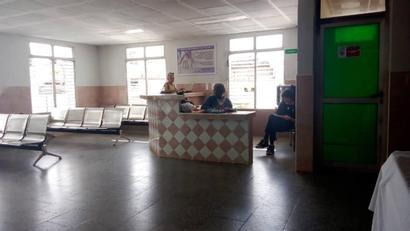
On the next level are the polyclinics, which are not in better condition. In the José Luis Chaviano, “just looking at the facade you can already guess what awaits you inside,” says Vilma, a neighbor of Pueblo Nuevo, where the health center is located. “I have no choice but to come and inject myself twice a day. Sometimes I wait for the nurse, who went to her house or to solve some personal problem. The reception is almost always empty, without even a custodian nearby. And, in addition, I have to bring a syringe, needle, ampule and cotton,” says the retiree.
The woman, who also suffers from asthma, explains that until a while ago you could at least go to the polyclinic for an aerosol spray. However, there are no longer enough oxygen tanks for all the patients who arrive requesting that treatment, although a truck unloading them is observed with some frequency. “I am not aware that they are doing illicit business with such a delicate matter, but it is very suspicious that the supplies are unloaded and then disappear. If they got here, where are they going to end up then?” she asks.
Located a few meters from the Muelle Real embarcadero, the polyclinic has the category of University, although it rarely receives medical and nursing students, increasingly scarce on the Island. On the contrary, it is not uncommon to find “a single doctor on duty, whose specialty is writing certificates for work absences and prescriptions for missing medicines,” says Vilma. “The sick now go directly to the hospital, because they know that there they will not find what they are looking for,” she adds.
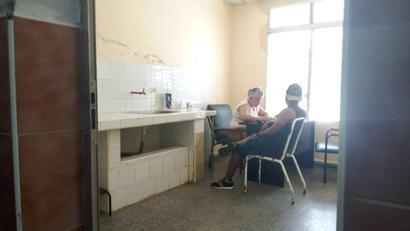
Interviewed by 14ymedio, a receptionist at José Luis Chaviano says that outpatient consultations have practically disappeared “because there is a huge deficit of doctors in all specialties, and the few that remain were sent to the Provincial Hospital.” She doesn’t know for sure the state of other polyclinics, but since hers is “so central,” it’s logical that the rest are “the same or worse. Specifically in this area of health there is a very great lack, both in equipment and in personnel. The walls even have mold and the floors are dirty, because it is difficult for someone to accept work as a cleaning assistant for such a low salary. As a result, there is nothing and no one.”
Even the anti-vector fight, compares the employee, which attracted many students and fumigators to the surroundings of the polyclinic, to eradicate mainly the aedes aegypti mosquito, “ceased to be done a long time ago.”
Gabriel, a Cienfuegos man who has been “following the dentists” of the Provincial Hospital for months to have a procedure done, does not have a good opinion of this center, the most important in the city. “My daughter-in-law works in a private clinic and told me that she is going to help me get a prosthesis, but I first need the Provincial to analyze my case and indicate the treatment so that she can help me,” he summarizes.
“The problem is that they don’t have equipment or specialists for anything, and they are only doing extractions,” continues Gabriel. According to him, his daughter-in-law spent part of her internship as a student in the hospital itself, and even then “there was not enough water for her to wash her hands. She was gradually disappointed by all that,” he says, “and in the end she left before they pointed her out as hostile for her continuous complaints.”
Translated by Regina Anavy
____________
COLLABORATE WITH OUR WORK: The 14ymedio team is committed to practicing serious journalism that reflects Cuba’s reality in all its depth. Thank you for joining us on this long journey. We invite you to continue supporting us by becoming a member of 14ymedio now. Together we can continue transforming journalism in Cuba.