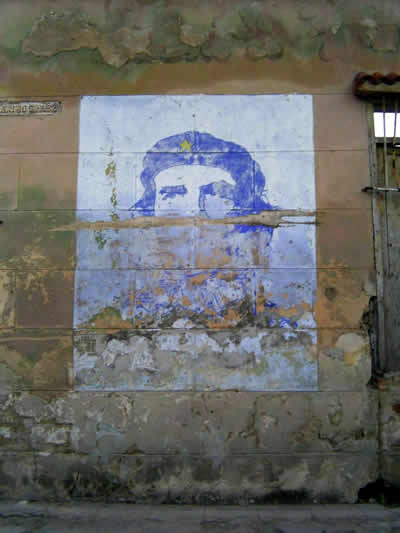
Occasional photos… / Silvia Corbelle
English Translations of Cubans Writing From the Island

The digital newspaper Diario de Cuba today published today an article by Regina Coyula entitled “When you are king, when you are executioner,” in which the author lays bare the hypocrisy of some critics of the “pavonato” who carry the entire responsibility for this Stalinist eruption by Luis Pavón Tamayo, who died recently, as if this disciplined censor, who for five years headed the Castro tyranny’s National Council of Culture, had acted on his own and at his own risk. As he executed abominable orders, Pavón deserves condemnation, but it is obvious that his bosses deserve a more severe rejection. There are no Pavons without Castros, nor Berias without Stalins.
Finally I find a place to leave you note. Thank you very much for the reference. Tomorrow I will put up a nice post about Alcides; I would like it if you leave a comment, and Alcides will delight you, the post is a surprise party. From the title I give you an account of a certain influence of a favorite poet. A big hug.
7 June 2013
The prison population has been overcome by stomach upset from a chicken not kept cold, completely decomposed, that was served to the prisoners. That night, everyone except me — I have been in this place three months without accepting “food” — ran from their beds to the bathroom. Lately it has also happened with the hash and other dishes.
A prisoner who tried to demand his rights, was savagely beaten and then sent to the punishment cell, which is their way of imposing order.
The lack of doctors in the prison, the tiny food ration and its poor quality, the constant beatings of the prisoners by the guards, the forced labor without pay, mental patients receiving psychotropic drugs three times a day, unfair penalties, the mistreatment of family, bedbugs, scabies, lice, lack of water in the prison and, thus, poor sanitation and cleanliness of the prisoners, the poor condition of the barracks, make this prison 1580, into an Olympian concentration camp.
The prisoners, who know through me and the politician Piloto Barceló, that Cuba received numerous recommendations in Geneva where the alleged “human rights” prevailing in the island, were exposed, are pinning their hopes on the Commission to return again in September, that the Rapporteurs who visit prisons will listen to them and their families recount the outrages of their legal process and then the penalties for offenses that are not considered such in any part of the world, and especially, as we have made known, the obligation to sign the UN Covenants, after evading them for over five years and that, at the last meeting, they were denied the time they asked for, alleging they weren’t prepared.
That would be the beginning, if they signed, our dream as Cubans not to be censored or persecuted for what we say, much less imprisoned.
To paraphrase Willy Chirino, “the dream is already coming.”

Ángel Santiesteban-Prats, Prison 1580
1 August 2013
The Cuban writer José M. Fernández Pequeño, through his important work, has set the stage for reversing the meaning of his name (“pequeño” means “small”), and again has grown like the giant of letters that he surely is and will remain.
I still haven’t read his book, “The Secret Weapon.” But I can assure you that the secret weapon of my friend Pequeño is his goodness, the quality of his heart, that emanates indelible feelings to those around him, and his sacrifice for others is bulletproof.
Pequeño, after receiving me in his home, where he hosted me along with his wife and children, took it upon himself, through another Cuban, to get me a job in the local subsidiary, of a major foreign publisher, with the intention of not returning to Cuba.
Here I am, in this horrible prison, happy that Pequeño will continue to be a leading exponent of Cuban literature, unfortunately in exile, in the second home country that the Dominican Republic represents for many Cubans, suffocated by poverty and the ideological pressure of the totalitarian regime.
They went there to escape the torment of socialism, to write their works without hunger and, especially, without their children being hungry, and it could bring them a horizon,that they enjoy today, thanks to the wise decision to emigrate and then managing to get them out.
Congratulations friend Pequeño, soon we will celebrate in a free Cuba that will open its arms to receive you once again, as the great writer you are, and that you would like to enjoy.
Inspired by your prize, I send you the most affectionate hug.
Ángel Santiesteban-Prats, 1580 Prison
30 July 2013
 A lighthouse at the entrance of a bay: a sexual metaphor, or a social one, if we see the bay as part of that Cuba that isn’t fertilized, even if the lives of millions of Cubans have been spent in an attempt to make it fertile.
This lighthouse does shine; not like the resumes of the army general and his officers, in which are divined the economic and social long night they promised to patient Cubans. It’s not a bad lighthouse nor is it like the mists that raise the unanimous applause of the still mute Parliament, or the journalists’ repetition of those numbers only useful to spotting the rear ends of the millions on the island who don’t even have money to buy toilet paper.
The same day that the current president of the Republic talks about the deteriorated civic values, the monstrous malformations in the conduct of Cubans, of cancers of the spirits that grow as much as the economic problems, his police shamelessly mistreating and arresting peaceful people who confront them only with civic values. What did he talk about then?
Because of this I don’t believe the current president. So I am publishing this photo of a lighthouse where I arrived after a dawn of mosquitoes, at the entrance to Manatee Bay, in the north of Las Tunas province. A lighthouse is my own metaphor that there are indeed sure ways to improve this island without the trauma of an infinite reform that hasn’t made us the slightest bit happy here.
Of course it’s not easy to get there: by the dark mountain path there are guards and trails to get lost in, but it’s better to walk with a bad helmsman and an old map. Those who still insist on guiding us with the same mistaken lighthouses as always, the fairy fires that lead us again and again into the reefs or the swamp.
Now, what we need are not more energetic or exhaustive speeches: we need to rectify this bad light and build our own lighthouses, new goals and distinct paths other than those designed in the offices upstairs, to see if, sometime, something really changes down here.
New and true lighthouses, for this island that at the same time is a drifting boat and the promised land. It’s what we are trying to do.
10 July 2013
After weeks without internet, I have nothing good to say. I’ve been “faking” housewifery. Among my skills, I take care of the plumbing: the shower, the sink and the sink had their Spring and have revolted en masse. I wrote about the faucet (faucet, key, tap, you already know) of my sink two years ago in a post titled My Programmed Obsolescence; and I’m once again struggling with obsolescence.
A cheap new faucet costs 150 Cuban pesos (CUP*), but I found “look-but-don’t-touch” one for 3 CUC* (72 CUP), installed it myself and when it breaks, which undoubtedly will be soon, I’ll see. We have to turn the shower on and off with pliers, and unfortunately the sink drips, but the prices are not for me, neither in CUCs not CUPs. What it takes to maintain a house built almost sixty years defies the imagination of people who don’t live Cuban-style.
Going out to look for the faucet, I took to the streets, and in the street, people are pissed off. Maybe it’s the heat, but verbal violence has become the natural way of communication for many people. To speak ill of the “thing” is normal. Even foreigners who know Cuba fairly well having visited it several times, comment to me about it, because it is so noticeable.
It is true that it’s summer vacation time, but in the Los Sitios neighborhood the number of young people sitting in the doorways or on the edge of the sidewalk killing time, or messing around with I don’t know what, caught my eye. I can not explain the siege at the door of the hardware store where several young men offer you the same thing the shop sells and more.
The beautiful people are traveling by car or in the videoclips, because man, are people ever ugly! Ugly and badly dressed. I’m not talking about the people in rags. The cheap clothes that the savvy traders go to Ecuador to buy (one of the few countries where we don’t need a visa), have contributed to the aesthetic calamity. I don’t buy my clothes in boutiques. I get them at flea markets and, when I am in Spain in Chinatown and at Caritas charity shops, and I’m not embarrassed to admit it. I would be embarrassed to put on the cheap Ecuadorean rags so worthy of reggaeton.
So many days without updating my blog and I appear with this as the second post. It’s the heat that’s affecting me; at least I don’t resort to verbal violence. I prefer to wear my Chinese-Ecuadorian clothes.
*Translator’s note: There are two currencies in Cuba: Cuban pesos, also know as “national money or CUP, worth roughly 24 to the dollar; and Cuban convertible pesos (which are only “convertible” in Cuba), exchanged at 24 to the CUP and nominally worth 1 dollar, although exchange fees add to the cost. Most wages are paid in CUP, but many things are only available for sale in CUC. The monthly wage averages less than $20.
2 August 2013
 I am in search of the forbidden book, like the Golem, or like the treasure of Eternal Youth. Why does a presidential, dictatorial or authoritarian edict decide to ban, hunt down and remove a book from a country. Faced with these questions I went looking with my Facebook friends and put an invitation on the forum what was sure would always be rich in nuances.
Then the ex-prisoner politician Juan Carlos Herrera Acosta showed up, along with the activist and now professor Osmel Rodriguez to accentuate the absurdity of such literary persecution. “Of the most censored books is at ’The Big Scam’ from Eudocio Ravines, also books by Adam Michnik, Milan Kundera, Aleksandr Solzhenitsyn with the ’Gulag Archipelago’, dozens and dozens,” said Herrera Acosta.
For his part, Rodriguez believes, that “Not only are studies of Cuba banned, but even so many novelists, some for not applauding the Cuban system and others for having escaped the island, I can make a little list …”
I have no idea about how, how much and what was prohibited in the early ’60s, but I do know that in the ’80s, when they returned, students and collaborators coming and going from what they called the Socialist countries, they brought quite a bit of literature not very welcomed by the Communist Party bosses. As the nineties started they knew what books were “inconvenient” and they were the motive for raids on the homes of peaceful opponents.
A brief investigation lets us know that the so-called “bible of opponents,” The Power of the Powerless, by Vaclav Havel, “How the Night Came,” the autobiography of Major Huber Matos, magazines such as “The Universal Dissident,” “ Encounter of Cuban Culture,” “Hispanic Cuban Magazine,” and the books of Carlos Alberto Montaner, Rafael Rojos, all swelled the “NO” book list.
My specific question for my followers on Facebook was this: “They say the book most wanted in Cuba by the political police is “The Wasp Network .” What books are banned in Cuba? What have they been since 1959? How have Cubans mocked censorship to get the banned books? Hubert Matos with his “How the Night Came”? “1984″ by George Orwell? Or those of Cabrera Infante Gillermo”?
This gave me the ability to create virtually online, to get writing and sharing with my readers and friends while they entered the messages in a network that is called frivolous and dull.
Ramon H. Colas, known in Cuban for having created, along with Berta Mexidor, the Independent Libraries, said that “more than the ban on the books has always been the policy of censorship against authors, which means that all of their work, in fact, is banned in the country. Bertrand Russell, Alexander Solzhenitsyn, Paul Johnson, Jean-Paul Sartre, Mario Vargas Llosa, Jorge Luis Borges, Milan Kundera, Eudocio Ravines and Juan Carlos Onetti, are, among many, some of the writers banned by official censorship in Cuba,” which makes the list more controversial.
It’s just an outline of the ban, which applies to the authors, the persecuted, the modus operandi of the persecutors and creepers and a small ranking of proscribed titles, where we certainly find The Wasp Network (about 12 agents, not 5, who acted in service to Havana on American soil) or History Will Absolve Me, that cache of Fidel Castro promises never entirely fulfilled. As Cabrera Infante said, it is not a brief, and not a brave list.

31 July 2013

Fidel Castro and Cecilia Sanchez
It is said that in his childhood he liked listening to news on the radio about the Spanish Civil War alongside the family cook. At the height of WWII he sent a letter to Franklin Delano Roosevelt letting him know that in an area near his house there were enormous deposits of nickel.
In exchange for this information he asked Roosevelt for a ten-dollar reward. There was no reply. His adolescence and youth were free of poverty. He liked to leave his father’s farm to scale the mountains. His mother would call him to lunch with two shots of a rifle.
He got his diploma from a strict Jesuit school in Havana. Even then he was obsessed with being a political leader. He would practice fiery speeches in front of his bedroom mirror. He dreamed of being president.
By the time he entered the University of Havana’s law school, he had not yet developed a fixed ideology. He read voraciously — everything from Adolf Hitler’s Mein Kampf to the writings of José Ingenieros and Machiavelli.
He joined the university gangs of the times, the kind whose members had short fuses and were prone to settling their affairs with guns. He tried to enter the republican political stage through the back door. One morning in the 1940s he went into the offices of Dr. Eduardo Chibás — that rare specimen, an honest politician — to join the Orthodox Party.
When his secretary, Conchita Fernández, told him Castro wanted to see him, Chibás reacted like a frightened child who had seen a ghost. “Conchita, please, don’t let that gangster in here,” he said according to Fernández, who died in 1998.
He was not put off by this insult. To reach the political summit, he had to look for other shortcuts. He found allies, godfathers and people with deep pockets such as his father-in-law, Rafael Díaz-Balart, who had been the political manager of a certain army sergeant and stenographer named Fulgencio Batista.
And although Díaz-Balart did not like the way his son-in-law bragged, he was the father of his grandson. Some people who knew Fidel in the 1950s describe him as being visionary, adventurous, crazy. His political ambitions could withstand hurricanes. He knew how to seduce.
Journalism was his next step. He wrote articles denouncing the corruption of the Carlos Prío Socarrás government and took part in student marches. He was participating in one of these when on March 10, 1952 Batista led a coup d’état. This action served as the perfect pretext for Fidel to turn to armed struggle.
There are crucial moments in history. One way or another Hitler was going to achieve absolute power in Germany in the 1930s. The Reichstag fire only sped up his plan. Castro would have been Castro even if there had not been a coup d’état.
Power was in his genes and the only way to achieve it was through the use of force. After the coup Castro organized a paramilitary group, later known as the July 26 Revolutionary Movement. He had the qualities of a leader. He recruited the humble: laborers, bookkeepers and the unemployed.
He did not recruit intellectuals or politicians. Castro wanted obedient soldiers. The group was not a school for democratic debate or a fledgling political party with a plan for gaining power through the popular vote. It was a private army. His shield.
With this group he launched an assault sixty years ago on the Moncada Barracks in Santiago de Cuba, 500 miles east of Havana. He took advantage of the fact that the city was celebrating its Carnival. On July 26, 1953 they attacked. The operation was a military disaster. In the span of a few hours fifty-five attackers died in combat or were later executed by government forces.
Not even the Socialist People’s Party — the Communist party of its time — applauded this hare-brained action. In a press release it condemned the attack, characterizing it as a “small bourgeois putsch.”
Looking back, if there is one thing that is most telling in Fidel Castro’s personal story, it is that he was an expert at turning defeats into victories. Disasters do not frighten him.
After the failed attack and his capture by army forces, Fidel drafted a document entitled “History Will Absolve Me” based on remarks he made as part of his self-defense at the trial. He was sentenced to fifteen years in jail.
The intercession of his father-in-law, Díaz-Balart, led to the Batista regime proclaiming a general amnesty, and Castro, his brother Raúl and the rest of the rebels were freed after only two years.
It is while in prison at the Presidio Modelo that the outline of his political profile emerges and he develops the chameleon-like abilities that will distinguish him in the future. In a letter to Melba Hernández, one of his most loyal collaborators, on the future of other political players he writes, “Let them talk. Later, when we are in power, we will squash them like roaches.” As so it was.
Before his triumphant entrance into Havana on January 8, 1959 surrounded by cheering crowds, Fidel Castro had led a three-year-long guerrilla war in the mountains of the Sierra Maestra. His victory was due to his own skill and the military ineffectiveness of Batista’s army.
Once in power he systematically went about doing away with any vestige of democracy and freedom of expression. He has been on the crest of the information wave many times. His decision in 1962 to install nuclear warheads on the island pushed the world to the brink of catastrophe. In a daring letter he told Nikita Khrushchev he should be the one to first pull the nuclear trigger.
Under Castro’s leadership a formidable apparatus of subversion was launched in America and Africa. Cuba was the school for guerrillas, Basque ETA members and revolutionaries transformed into terrorists. He turned the country into a fortress, with a million men under arms. More than 3000 tanks. And a fleet of 200 fighter planes.
For the first time in history, the Cuban regular army moved beyond its borders. In the conflicts in Angola and Ethiopia — and earlier in Algeria and Syria — he ignored the directions coming from the Kremlin, asking him not to intervene.
In the ’80s he established a command post at his residence in Nuevo Vedado. From there he drove much of the civil conflict in Angola and the Battle of Cuito Cuanavale against the army of South Africa. Lounging on a black leather swivel chair, pointer in hand, he led major battles from Havana. He was aware of everything: the exact amount of rations to be distributed among the troops or the infidelities of the wives of senior officers.
Economically he’s amassed failures. So many that they could fill several anthologies. He did everything on his own. At the cost of a depressed economy.
Fidel Castro has survived 54 years. Only an illness could part him. He has escaped numerous attacks and the stagnating economic crisis that has lasted 22 years has failed to pulverize his revolution.
The effectiveness of his Special Services is one of the keys to the permanence in office of the brothers from Biran and the Communist Party. Despite the exhaustion of power, Raul designs the succession. The Castro Clan pulling the strings of everything that moves in Cuba.
He will make changes that must be made to make his work endures. No matter the name and surname of the future president. Nor the ideology. Fidel Castro was always a political chameleon. His only vocation is power. And he is one for the history books.
27 July 2013

The mess about the North Korean boat loaded in Cuba with obsolete arms for repair, hidden under some tons of sacks of sugar, suitable for the captain’s suicide attempts and the crew’s hunger strike, all lunatics of Kim Il Sung and his descendants, continues to monopolize international media attention. Nevertheless, for Cubans, after the concise initial report, absolute silence and secrecy are maintained trying to give the impression that nothing is happening, basing that on the fact that if it does not come out on the TV News or appear in the newspaper Granma it is because it does not exist.
It calls attention that this happens immediately after the end of the 9th Congress of the Union of Cuban Journalists (UPEC) where, among the few things of interest that were considered, some journalists requested (they did not demand) to be permitted to have access to the reports. It seems that, although the word was yes, in practice it is no, beginning with the concealment, the same days as the closing ceremony (July 14), of the composition of the baseball team, which would participate in a tournement with one agreed to by North American universities in cities of that country, from which sports reporters discovered, when this was already known in the United States (July 15), in the afternoon, in the schedule of the insufferable Roundtable TV show, and continuing, almost immediately, with the mess about the boat.
The official press and the secrecy that accompanies it seem to have no remedy: it is something inherent in the model, that cannot subsist in a climate of freedom of information, not even under the control of the party through the UPEC, its bureaucratic shell.
The boat is another thing: no one understands this political bungling, it it wasn’t orchestrated for the purpose of torpedoing possible contacts, directed at the gradual normalization of relations between the governments of Cuba and the United States. As was expected, on the event of the 60th anniversary of the 26th of July assault on the Moncada Barracks, after the sausage of slimy speeches for the occasion by the invitees, absolutely nothing was said about the thorny matter. It seems that this stings and extends until August. Give it time!
*Translator’s note: “Little Paper Boat” is a Cuban children’s song. The words, in English, are: Little paper boat, my faithful friend / carry me away over the wide sea. / I want to meet children from here and there / and take them all my flower of friendship. / Down with war, up with peace / We children want to laugh and sing.
Translated by mlk
26 July 2013

This Saturday, July 20, Independent and Democratic Cuba (CID) has opened a new office in the Municipality of Marianao to honor the memory of the leader of the Christian Liberation Movement, Oswaldo Paya Sardinas, murdered by the dictatorship along with his compatriot Harold Cepero, 22 July 2012 near the city of Bayamo.
On July 22, 2012, at about two in the afternoon, the car driven by the Spanish politician Angel Carromero was hit by a red Lada, one of the cars that had been following and harassing it. In mysterious circumstances, Oswaldo Paya and Harold Cepero who were in the back seat, were pulled alive from the accident and then the dictatorship announced the death of both.
On Sunday July 21, 2013, eight activists from the October 10th township CID delegation met in pantheon of the Daughters and Fathers of Charity of St. Vincent de Paul in Colon Cemetery shelter where his family laid Oswaldo Paya’s body before leaving for the United States. The members of the CID delegation laid flowers, carried a Cuban flag, sang the national anthem and prayed for the repose of the martyr and their comrade in the struggle.
CID supports the repeated request of the Payá family and the Christian Liberation Movement to hold an international inquiry into the events that led to the murder of Oswaldo Paya and Harold Cepero.
24 July 2013
 It was a peaceful, bright morning, the sea, as usual, shone splendidly with its habitual shades of blues and greens, the treetops swayed to and fro in the soft breeze.
The happy natives were all engaged in their daily work. Suddenly, all the birds, in unison, took flight to the high sky, squawking. Cats fled terrified in search of safe refuge while the howls of mongrel dogs and pure breeds were rising.
All the inhabitants of the beautiful city, astonished, raised their gazes to the sky. That enormous artifact landed to the wonder of all. It threw out fire and light from all of its circular openings that surrounded its enormous circumference “green like our palms,” which made it blend with the landscape.
Soon its rounded doors began to open and some green bearded beings began to come out, sporting necklaces of strange seeds. Smiling, they raised their long extremities in greeting while they descended from the enormous apparatus which we much later supposed was a “time machine.”
At first everything seemed to go well. Everyone was excited by the marvelous apparition. They seemed inoffensive beings and even friendly, but this did not last long: one of them, the greatest in stature, immediately turned the counterweight to manipulate one of the levers, and everything began to change.
At first these changes were almost imperceptible. Besides, local men, women and children, as well as the visitors, were communicating well with the giant and all seemed normal. Nevertheless, many of the natives, suspicious, preferred to stay some distance away observing what was happening.
That big green man did not stop turning the lever, and as he gave more turns, some objects began to disappear: fabrics, trucks, cars and even grand houses and buildings. Afterwards, many animals, preferably of the greatest size, later money and finally people. Everything was growing dark. Now the hatches of the enormous artifact did not radiate light, also the fire was going out. Night was taking over the countryside.
But that big man did not let go of the control. Each time that some little green man or any other color approached to be heard, he raised his other hand and with a simple gesture made him disappear. Little by little fear was taking over everyone and paralyzing them. Many, who managed to react risking their lives, left for other worlds, availing themselves of any small boat or device that was still functioning.
The green fields began to cover themselves in thorny roots, which obliterated with their advance any other crop. Even the air was petering out, and there had to be a rapid census in order to be able to equitably distribute what remained. Cards were also printed where it was noted each month what each person consumed. The green ones, who at the beginning had been apportioned the best houses, moved to live on the outskirts, where there were still trees, and they kept themselves out of view of the recently captive populace.
Thus, slowly, the locals, due to all these shortages, were mutating: new beings were born without thought, with a line for a mouth, a small stomach, long arms to stretch to reach the few fruits that remained in the tall and thorny tops of the new vegetation, big feet to be able to stay standing in the same place for hours and strong legs to cover great distances walking.
Sunk in the isolated dark, they were erasing from their minds the images of the happy time in which their ancestors lived, before the arrival of the enormous green machinery. As everything was being exhausted and destroyed, the consequences of this began to affect, although in a small measure, many of the green men not so close to the giant. Thus, there was no other solution but to open a little some other hatch, to allow in some fresh air from the outside. Due to this, finally they had to authorize the entry of foreign carriers of a little breeze. In spite of the prohibitions and the harsh punishment inflicted, many of the mutants approached the recent arrivals, trying to create close connections to be able to leave with them.
Of course those that took most advantage of this new situation were the youngest. As a consequence, more old ones wandered alone through the occupied territory. Now a newborn was rarely seen. The women, by force of precarious food and intensified work, agreed not to get pregnant.
So, little by little, that beautiful asteroid where they lived was becoming greyer and dustier. The plagues from the sewer waters flooded all the city with their fetid aroma. The farm animals did not manage to satisfy the food needs, because these in their turn did not have anything to eat and were dying. Now there was only left some green grass which all the inhabitants, terrified, covered with old canvasses so that it would not be detected, for fear that they would also be rationalized. More mutants were escaping to other latitudes. No one noticed the dangers of the crossing. They preferred to die in the effort than to continue living without hope.
One day as in the trencadis all the fragmented pieces of that ancient civilization dispersed through the universe will come together to again form a strong and beautiful social mosaic.
Translated by mlk
9 July 2013

From Translating Cuba:
Regina’s phone number: 535-323-6668
Recharge options (both are having a two-for-one promotion):

Yesterday, faced once more with the frustration of not being able to connect to the internet, my friend and I decided to go shopping in the stores of the area. She needed a faucet for her kitchen and I didn’t take any money as I went along just to look.
We got to the complex of stores at 5th and 42nd, the name it is known by. We immediately went to the hardware store and saw the few things on display in the show cases. Among them was one that caught the attention of my friend: a quick-opening faucet acceptable enough and reduced from 11 to 4 CUC. It fit within her meager budget, so she set out immediately to call the seller over to show it to her. Commenting on the price, he responded that the faucet had a defect, it leaked. So my friend rejected it and commented that she was looking for one because the one she had also leaked and she wanted to solve the problem.
After searching through the rest of the departments, all of them with so little merchandise it gave the impression there had been a huge robbery, which we commented on with one of the employees, who turned her face away to answer. It seemed more like a set to film the Cuban TV comedy San Nicolás del Peladero. We continued on, poking through the haberdashery department, where I usually buy some of the materials for my work.
I suddenly discovered in one of the display cases a brand new pedal for an electric sewing machine, and as I’d just bought mine a few year ago, it made me happy to know they still had these parts. Also it was reduced in price. The card marked 11.45 CUC had been crossed out and said 7.95 CUC. Great, I thought, too bad I didn’t bring any money, but next week when I come back here I’ll buy it.
I got home suffocated by the immense heat of the street and the delay of the buses, and ran straight to the bathroom to wash my face and hands and change my clothes for something fresher. When I commented to my husband about the electric pedal and the price cut, he told me, “Get ready, I think we should go now, because if there are only a few or only the one in the window, now is the time to buy it.”
We arrived at the store and when I asked the employee to show me the pedal that was on sale because I wanted to buy it, she calmly said, “Yes, it’s on sale because it’s broken and doesn’t work.”
“How is it possible,” I asked her, “that you put on sale in the display case an article that doesn’t work, and at such a high price in hard currency? Useless merchandise shouldn’t be put out under any circumstances, it’s misleading to the public and immoral to do so. This is absolutely Kafkaesque,” I added.
She remained silent, as she knows me as a customer, and we left there like souls possessed by the devil.
Sadly, this isn’t an isolated event, it happens with incredible frequency, being an almost common practice to sell articles that are extremely damaged or that don’t work for what they were designed, with price reductions which, even more than an attack on their customers’ wallets, show an absolute lack of respect for them.
30 July 2013
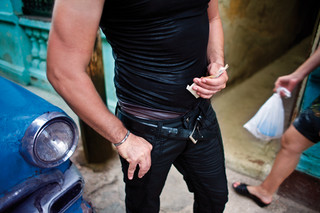 HAVANA, Cuba, www.cubanet.org Recently Cuban “parliamentarians” discussed the issue of prostitution among young people. According to the press official, they drafted strategies to face this evil, as well as pandering, widespread today all across the Island.
It is known that, since 1959, the regime openly proclaimed that women would not have to sell their bodies, since the revolution would provide work and wages. But it all ended up in the book of failure. Currently prostitution is a survival option in Cuba.
The maneuvers to eradicate it have only been from the repressive order, without hitting the target. Deportations to the interior of the island, temporary detention centers, police operations, jail for social dangerousness, and countless fluctuating measures have been implemented, but all are useless.
So I doubt that the alleged Cuban parliament has the solution in hand to solve this problem that corrodes Cuban society on a daily basis.
“No matter what profession we have, it doesn’t do us any good. Only through going to bed with tourists do we have the opportunity to visit the most famous restaurants, cabarets, clubs and hotels in the island, to buy good clothes and shoes, and to solve the pressing problems of our family, until one day we can get out of this country.” Thus spoke Yeilis, a young woman from Guantanamo, age 19, who has lived in the life for two years, in Havana.
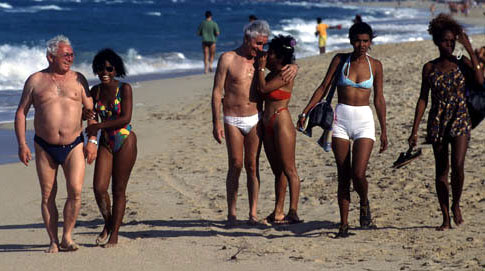 Another prostitute, who declined to be identified, said, “La Cecilia, Dos Gardenias, the Salón Rojo at the Capri, La Mesón, Don Cangrejo, El Diablo Tun Tun and las Casas de la Música, among others, are our favorite resorts to link up with tourists. Here the payments of “yumas” (foreigners) to the prostitutes range from 80 to 120 CUC* per night, excluding payments for security and surveillance, police and custodians, and bribes for the staff at the rented home.”
It is noteworthy that at this point Gen. Raul Castro laments the gloomy Cuban outlook with regard to the crisis of values, especially among youth. And while it’s better late than never, the General wasted the opportunity to recognize the direct responsibility of the regime, whose only concern over the years has been to maintain its sole command, regardless of the deterioration of “moral and civic values, decency, shame and decorum” that the nation exhibits.
Maybe his daughter, the “parliamentarian” Mariela Castro Espín, unlike the supreme leader of the revolution, could propose something more profitable to combat this scourge.
*Translator’s note: Roughly equivalent to the same amount in dollars.
24 July 2013
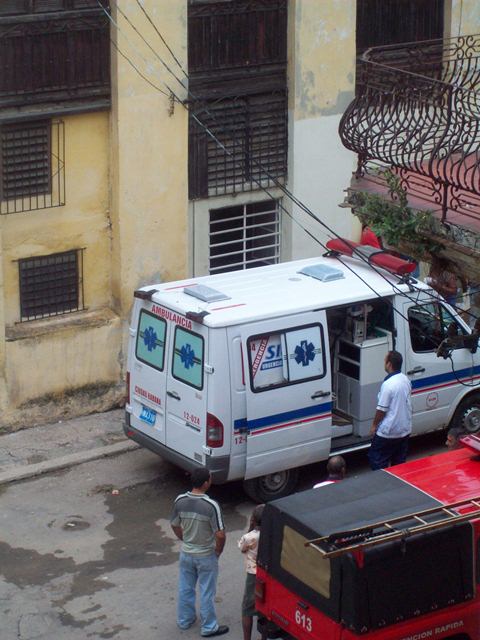 HAVANA, Cuba, July 2013, www.cubanet.org.- When a Cuban family is afflicted by disease there are many who depend on the favor of some neighbor with a car to take them to the hospital. Moreover, the paramedics and nurses of the Comprehensive Emergency Medical System (SIUM) depend on the “thanks” for their patients to “resolve” a chance to eat a better lunch or a to get a few pesos above their salary.
Juan López (he has asked me use a pseudonym), in order to take his father to the hospital, called SIUM and waited three and a half hours for the ambulance to come. The Center Coordinator told him onthe phone: “Your case is the first on the list be we can’t resolve it.”
“After that long wait I was at my limit. I went to look for a neighbor with car, some way to get him there,” said Lopez. “Time passed and the disease was evolving.”
Once a medical emergency is reported the time stipulated to a rescue is 10 minutes. A young SIUM worker asked not to be named to provide testimony. We will call him Nurse X.
He has a license in nursing and counts on their being a key system, in communication with the Provincial Coordinating Center at 44th and 17th, in Playa. Key 1 means there’s an emergency call. Key 2 indicates they’re on their way and should be there in 10 minutes. From 2 to 3 is working with the patient. And 4 is on the way to the hospital. Key 5 means that the case has been admitted and they’re ready to take on another.
“In reality, we spend up to 12 hours to pick up a patient, but there are seven bases all over Havana and on occasions there are seven or eight cars (ambulances), no more. Other times there are 11 or 12 for the whole province. For example, the based in Plaza also covers the demand for Cerro, Centro Habana and Habana Vieja. There are days, like today, when we are working with just one ambulance.”
The delay experienced by the population is the result of a long list that prioritizes the most severe cases. But from the position of Nurse X the work is continuous.
“Often, we leave at eight in the morning and it’s three in the afternoon and we haven’t eaten lunch. People offer us a soda, some snack, even money. Others have nothing to offer. Some are upset by the delay and protests. Sometimes we’re notified of a case of hip fracture, but after 10 minutes we get a case of loss of consciousnesses and the fracture has to wait. If then a heart attack comes up, the fracture falls further behind.”
Few Cubans have car; you can’t even say that one member of each family has one. The salary of a worker is so tiny that it’s not even enough to take a taxi to the hospital even when it’s a medical emergency.
There are three categories of ambulances, intensive, intermediate and basic. But Nurse X tells us that “it is possible that an basic care ambulance arrives for a critically ill patient and all you can do is verify it and call back to the Coordinating Center. Then they send a second ambulance has that has electrical equipment and a defibrillator, but that isn’t equipped with artificial ventilator and the patient needs to be intubated.”
The look of incredulity on my face leads to, “It happens.”
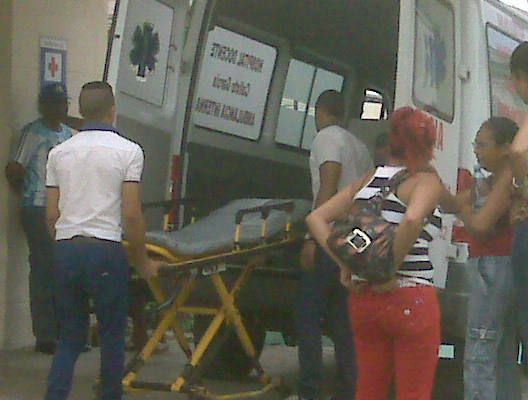 Nurse X works in an intensive care ambulance, supposedly designed to assist the most severe cases of the city. But because of the deficit of cars, he has even had to take care of transferring patients between hospitals. “I have come to work with 14 or 15 cases in a day, not only life support, but whatever shows up.”
Many buildings of Havana, especially in the downtown area, are several stories, with very narrow stairs. After an exhausting effort, no time to rest, nor is there a coffee before the next call. The SIUM staff work 24 hours. They complain about working conditions and the lunch menu: “Many times you can find yourself with a tray of flour with boiled or scrambled egg, soup with rice. ’International Nurse’s Day’ seems like a lot of hogwash.”
Someone with a degree in nursing, with SIUM, working 24 hours on and 48 off, earns between 740 and 750 Cuban pesos a month, the equivalent of about $30. “There are like 12 or 13 shifts a month. You have to put your feeton the ground, you have to eat and I have a daughter. That’s not nearly enough.”
Like many of his colleagues, Nurse X aspires to leave on a medical mission (outside the country) to improve his economic situation, but to do that he should first leave the ambulances and work as a nurse in some hospital.
“The SIUM is my life, but there comes a Training Course and they won’t release you for lack of personnel. So you stay and unfortunately if Public Health personnel don’t go on a foreign mission they’re nobody.”
The system also serves a political purpose
At the SIUM National Base, based in Arbol Seco Street, Central Havana, things are different. From the outside you see a parking lot with several modern ambulances. The first impulse of the reporter is to ask the medical staff chatting at the door how many cars the National Service has and what kind of cases they serve. A doctor’s response is blunt: “You have to go with a paper to the institution to which you belong, at the direction of the center, to get answers to those questions.”
 We do know that people complain of the delay and the quality of service. ’’The population is poorly educated. This is not a taxi service,” he replies.
I insist, invoking the public interest in the matter. The doctor’s answer is a lie flung in my face with cynicism: “There is no conflict between the interests of citizens and the interests of the State.”
The national SIUM is responsible for performing institutional transfers between provinces, but mainly for covering international events or other events, as on May Day at the Anti-Imperialist Bandstand. They are sent to the airport, to the Palace of Conventions. To the Parliament and any activity that has to do directly with the government. It was employees of the Cuban Red Cross who, during the previous visit to Cuba of Pope Benedict XVI, took the stretchers on hand for the public that might “suddenly fall ill,” and as observed worldwide, used a stretcher to assault a peaceful opponent.
Provincial SIUM workers see the nationals as “people working with very few tools and delivering very good service.” But also “ideologically filtered.” A paramedic from the provincial service who has also requested anonymity explained that “even the driver of the national delegation has passed courses in political training. They are internal officials working for State Security.”
The national SIUM ambulances themselves are equipped with everything you need to face any emergency. He himself asked to be part of that service because ” these people eat well” and don’t have the problems of the provincial SIUM. “When people see these ambulances they believe they’re looking at SIUM, but they’re not. In those cars all equipment works.”
Lilianne Ruiz
From Cubanet
26 July 2013