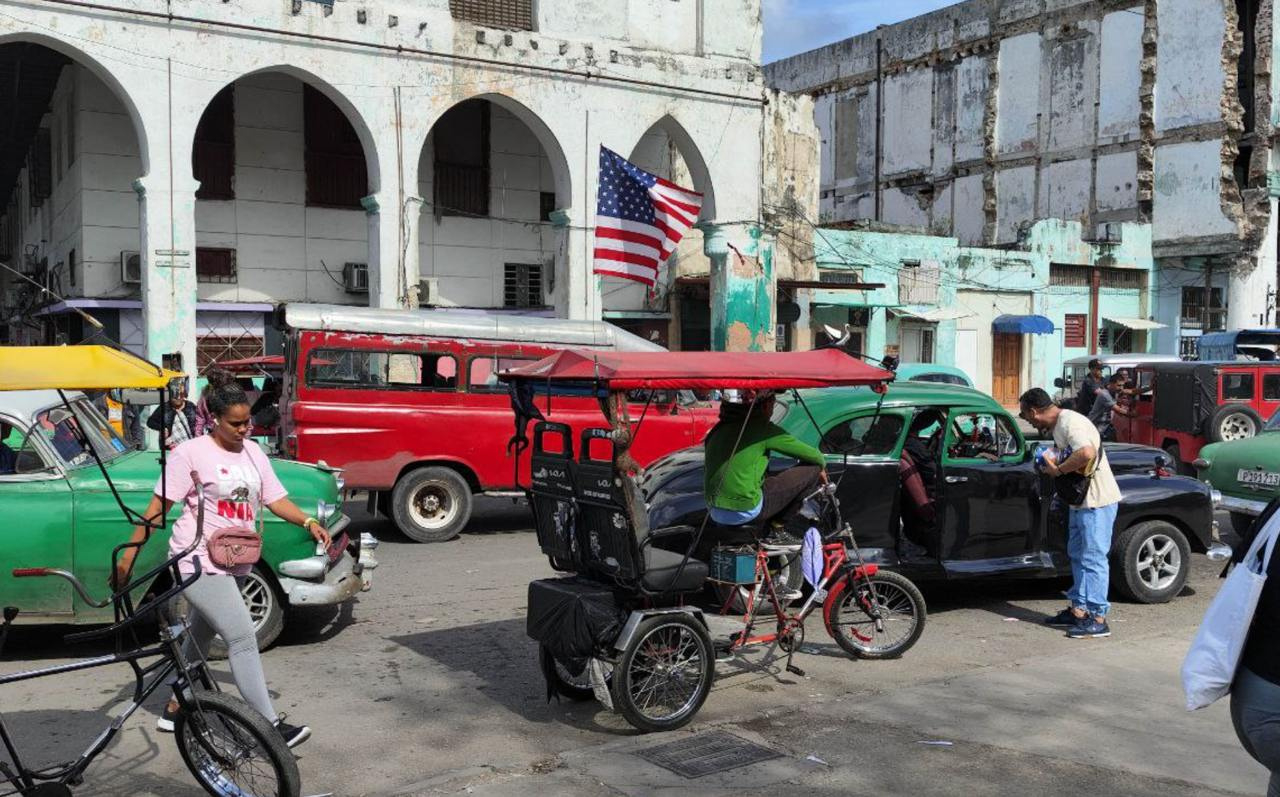
The Foundation believes that this “progress” is the result of the lawsuit it filed in court five days ago.
Damon Wilson, president and CEO of the National Endowment for Democracy. / X/@DamonMacWilson
To our Translating Cuba readers: This article is now 20 days old, in an ever changing reality. We post it here for its ‘historic’ value, and possible relation to future events.
14ymedio, Madrid, 10 March 2025 — The US State Department, led by Marco Rubio, has decided to unfreeze the funds allocated to the National Endowment for Democracy (NED) that were frozen by the Trump administration in early February. In a statement released Monday , the institution expressed its gratitude for the decision. “This is a significant step toward ensuring that the NED can continue its mission of promoting freedom around the world.”
Former Congressman Peter Roskam, chairman of the NED Board, added: “These are important steps toward fully restoring our ability to support frontline defenders of democracy in repressive regimes, including Cuba, Venezuela, Iran, China, Russia, and elsewhere.”
“We remain committed to achieving a final resolution that will allow NED to support the United States by promoting democracy and freedom around the world,” said NED President and CEO Damon Wilson. “A freer and more prosperous world strengthens U.S. security, drives economic growth, and reinforces American global leadership.”
The “partial restoration” of funding, the NED continues in its statement, allows them to “begin to stabilize operations and resume grantmaking.”
The Foundation believes this “progress” is the result of the lawsuit it filed five days ago in U.S. District Court against executive branch agencies and officials for illegally withholding funds allocated to it by Congress. Monday’s statement recalls the denial of $167 million that had already been allocated and an additional $72 million that Congress directly mandated.
The “partial restoration” of funding, the NED continues in its statement, allows them to “begin to stabilize operations and resume grantmaking.” It also hopes to ensure “access to the full amount of funds allocated by Congress” and that “their funding will not be interrupted again in the future.”
continue reading
The freezing of NED funds, as well as other federal allocations, particularly those of the United States Agency for International Development (USAID), has caused shock among thousands of non-governmental organizations around the world that depend heavily on them, including most of Cuba’s independent media and human rights activists on the island.
Several digital media outlets, such as CubaNet, El Toque, and Diario de Cuba, have launched a fundraising campaign among their readers. One of their hopes, however, lies with Marco Rubio himself, who also assumed the role of interim director of USAID on February 3. Although this marks the end of the agency as an independent entity, the former Cuban-American senator from Florida is aware of the pressing needs of the various actors fighting for democracy and freedom of expression on and off the island.
Other data, however, are discouraging. Of the 95 programs the International Republican Institute had to support democracy in countries like Cuba, Venezuela, and Nicaragua, only three remain in place after the decision to halt USAID subsidies, and none of them are Cuban.
____________
COLLABORATE WITH OUR WORK: The 14ymedio team is committed to practicing serious journalism that reflects Cuba’s reality in all its depth. Thank you for joining us on this long journey. We invite you to continue supporting us by becoming a member of 14ymedio now. Together we can continue transforming journalism in Cuba.
Sodepaz has also begun exporting high-quality organic coffee produced in Guantanamo.
In addition to coffee, the organization has expanded its interests on the island in recent years. / Cubadebate
14ymedio, Havana, 29 March 2025 — A Spanish NGO is threatening to overthrow Italy’s control of Cuban coffee. Sodepaz, with three decades of presence on the island, is expanding rapidly—financed by Spanish government funds—and has begun exporting high-quality organic coffee produced in Guantánamo. As if that weren’t enough, as part of an optimization project, it has opened up the possibility of installing solar farms in the eastern part of the country and, if necessary, “small hydroelectric or wind systems.”
“On March 24, 2025, we will begin distributing BIO coffee from Cuba. A Caracolillo robusta coffee from the eastern Cuban province, medium natural roast, produced in the mountains of Guantánamo and Santiago de Cuba by the cooperatives of the Agroforestry Group of Cuba and processed by the joint venture BioCubaCafé,” explains Sodepaz on its website.
In addition to coffee, the organization has expanded its interests on the island in recent years, and has in its stores a variety of Cuban products such as cane sugar “from the Carlos Baliño mill in Santa Clara” (4.10 euros per kilogram), Santiago de Cuba Carta Blanca rum (12 euros), Cubay añejo rum (16 euros) and now the BIO Frente Oriental coffee (5.60 euros for 250 grams).
The new project, Innova Café Guantánamo, it is being carried out in collaboration with the province’s Center for Technological Applications for Sustainable Development (Catedes) and will last 24 months, extendable for another 12, to seek “sustainable solutions to the current situation of coffee production in Cuba’s easternmost province,” the official press explained. Neither the organizations nor the media revealed the funds allocated to deploying solar panels. continue reading
The initiative seeks to “transform the coffee value chain” through the use of renewable energy sources.
The initiative seeks to “transform the coffee value chain” through the use of renewable energy sources, as well as improve the sector’s efficiency. To this end, Catedes plans to “diagnose” coffee production and determine where solar energy is best used.
The municipalities that will benefit, at least in the initial phase, will be San Antonio del Sur, Maisí, Yateras, Guantánamo, and El Salvador. However, expansion is planned to include a total of eight coffee-growing territories in the province, alleviating “the current electricity problems,” according to the press, as paraphrased by Cadetes.
Sodepaz, more concerned about production, explained that the budget had been approved in 2024 and was intended to “strengthen production and support other projects such as ProdeCafé or MásCafé.” The latter was funded by the Italian Agency for Cooperation and Development, which has offices in Santiago de Cuba, Holguín, Guantánamo, and Granma.
Activities will also be held to promote Guantanamo coffee, which will be marketed through “fair trade networks.” According to the NGO, Spain is a major consumer of Cuban coffee, and with its help, it will be able to improve its quality.
“Innova Café is seeking immediate benefits that will include greater stability in bean processing with the development of solar dryers and heaters, reducing environmental pollution from waste, and reusing it in a way that contributes to the circular economy,” the state press added. All the equipment, it is understood, will be provided by the organization.
Frente Oriental is not the first Cuban coffee exported by Sodepaz, which also has a presence in Nicaragua, Palestine, and Haiti.
Frente Oriental is not the first Cuban coffee exported by Sodepaz, which also has a presence in Nicaragua, Palestine, and Haiti. In 2021, the organization began selling Extra Turquino Especial, made with a dark-roasted Arabica bean, also harvested in Guantánamo. The product’s launch coincided with that year’s UN vote against the US embargo, one of Sodepaz’s sworn enemies.
“Aware that there is a lack of united initiatives to break the blockade* and at the same time have an impact on the Cuban economy, these are the reasons why this project of importing, processing, and marketing Guantánamo coffee in a fair and supportive manner was born,” explains the project’s website.
Along with the rest of the agricultural industries on the Island, Cuban coffee is experiencing one of its worst periods. According to the National Statistics and Information Office production has fallen by 51% in the last five years—which has forced the Cuban government to define its priorities. The decision comes as no surprise: so while the ration stores have stopped receiving the packages, the exports — especially those guaranteed by international organizations — have not slowed down.
*Translator’s note: There is, in fact, no US ‘blockade’ on Cuba, but this continues to be the term the Cuban government prefers to apply to the ongoing US embargo. During the Cuban Missile Crisis the US ordered a Naval blockade (which it called a ‘quarantine’) on Cuba in 1962, between 22 October and 20 November of that year. The blockade was lifted when Russia agreed to remove its nuclear missiles from the Island. The embargo had been imposed earlier in February of the same year, and although modified from time to time, it is still in force.
____________
COLLABORATE WITH OUR WORK: The 14ymedio team is committed to practicing serious journalism that reflects Cuba’s reality in all its depth. Thank you for joining us on this long journey. We invite you to continue supporting us by becoming a member of 14ymedio now. Together we can continue transforming journalism in Cuba.
It is natural that the millions of Cubans who have acquired American citizenship see the future of Cuba linked to the country where they have been able to prosper.
The average Cuban usually sees in Miami an image that contrasts with the precariousness and misery they suffer on the island. / 14ymedio
14ymedio, Yunior García Aguilera, Madrid, 28 March 2025 — The Castro-communist regime, whose narrative has been fundamentally based on its dispute with the United States, has always used the specter of annexationism as an argument in its favor. According to its theorists, the northern power desperately desires to seize Cuba, even today. To support their thesis, they use old theories such as the “low-hanging fruit ” of John Quincy Adams (1823), the Monroe Doctrine (America for Americans), and the doctrine of Manifest Destiny. On the other hand, the regime’s opponents have been repeatedly labeled “lackeys of the Empire” or, simply, as annexationists. In this way, Castroism hides behind a supposed defense of national sovereignty to legitimize itself.
One might suspect that Cuba’s State Security itself has been responsible for spreading annexationist sentiments among a segment of the exile community and the opposition to bolster its narrative. And while I have no doubt this is perfectly suited to their narrative, I also don’t ignore other reasons why this current of thought has all the fuel it needs to spread spontaneously.
Let’s be frank, annexationist thinking has existed among Cubans for more than two centuries. Its origins date back to the late 18th century, within the Creole slave-owning bourgeoisie. On the one hand, they were disappointed with the decline of Spain, feared abolitionist pressures from England, and were terrified by the slave revolutions taking place in the region. This sector saw in its allegiance to the southern United States an opportunity to maintain the stability of the slave economy. Even our flag has an annexationist origin, designed by the Venezuelan Narciso López, a staunch defender of that movement.
Within the United States itself, rejection of the idea of Cuba becoming part of the Union was growing.
However, within the United States itself, rejection of the idea of Cuba becoming part of the Union was growing. Perhaps the most striking reflection of this contempt for this option was the article “Do We Want Cuba? ” published in The Manufacturer in 1889. The article praised the land but despised its inhabitants.
White Cubans were categorized as an inferior race, effeminate, lazy, morally deficient, and naturally incapable. The main argument used to justify our inability to be free was precisely the continued failure of our rebellions.
Black Cubans were treated even worse, with the argument that they were “clearly on the level of barbarism.” According to the article, the only possibility of annexation was to completely replace the population. But even so, they feared that the Anglo-Saxon race would degrade under the effects of the tropical sun.
Obviously, the pamphlet was rejected by Cuban patriots, especially José Martí. The annexationist tendency gradually declined, while support for the independence ideal grew. Later, during the Republic, the rejection of the Platt Amendment would be one of the driving forces behind an increasingly nationalist outlook among Cubans.
Then came the Revolution, capitalizing on and radicalizing a supposed nationalism, although in practice it turned the island into a satellite of another foreign power: the USSR. The oversaturation of anti-American discourse, out of exhaustion, provoked the opposite effect in a large part of the Cuban population, resurrecting annexationist thinking.
While in the rest of Latin America the word “gringo” is often used to refer to Americans, in Cuba the word “yuma” is used, which has a connotation that is far from pejorative. The average Cuban tends to see in the US, and especially in Miami, an image that contrasts completely with the precariousness and misery they suffer on the island. On the other hand, it is only natural that the millions of Cubans who have acquired American citizenship over the decades see Cuba’s future inextricably linked to the country where they have been able to prosper.
In short, annexationist thinking not only has historical roots but is also a direct result of the political, economic, and social failure of the Castro regime, as well as the continued mass exodus of Cubans to the United States.
For my part, leaving aside any ideological bias, I don’t believe the American powers are seriously considering the possibility of annexing Cuba. The current US president, when he talks about expanding his territory, looks more to the north: to Canada and Greenland. This administration, when it looks south, doesn’t see any ripe fruit or anything like it. It goes and dreams… of very high walls.
I don’t think the American powers would seriously consider the possibility of annexing Cuba.
There are reasons to believe that the majority of the Cuban opposition desires a free and independent country. Beyond our differences, I believe the prevailing vision is a future Cuba that maintains a normal relationship with its northern neighbor, without renouncing our sovereignty. However, we cannot turn a blind eye to the differing opinions growing in certain exile communities.
Finally, and to dispel any doubts about the regime’s hypocrisy when it uses the word “sovereignty,” it is enough to recall Díaz-Canel’s words after his last visit to Moscow. The hand-picked dictator said he was deeply moved when Lukashenko reminded him that Cuba “was also a former Soviet republic.” He told this to Ramonet, his eyes watering with nostalgia. And he repeated it to Bruno Rodríguez Parrilla, moved and with goosebumps, from the presidential plane. When talking about annexationism, this anecdote cannot be forgotten either.
____________
COLLABORATE WITH OUR WORK: The 14ymedio team is committed to practicing serious journalism that reflects Cuba’s reality in all its depth. Thank you for joining us on this long journey. We invite you to continue supporting us by becoming a member of 14ymedio now. Together we can continue transforming journalism in Cuba.
The cultivation is maintained because it is a tradition, because as a business “it does not work,” say the guajiros
Tobacco plantation in Pinar del Río / Cubadebate
14ymedio, Havana, 28 March 2025 — The tobacco industry in Cuba has not been balanced for a long time. While Habanos S.A. declared a record income at the beginning of the year, the Cuban growers barely have enough inputs to maintain their crops. Some of them declared this week to the official press that the cultivation is maintained because it is a tradition, because as a business, “it doesn’t give results.”
Guerrillero begins its report with the good news: tobacco farmers who have improved their yields. Some are former soldiers who return to the lands of their childhood to sow the leaf and honor tradition – the watchword – that families have been following for decades: harvesting tobacco in Vuelta Arriba.
For the farmers, however, life is not rosy despite the fact that they work in one of the few privileged sectors of the economy. The first “stumbling block,” the newspaper explains, comes as a result of the country’s precarious energy situation. In the Gabriel Lache cooperative, everyone waters the furrows with electrical equipment, which has forced them to modify their schedules depending on the blackouts. “Sometimes they have to do it late at night or early in the morning,” the media explains. continue reading
“The cost of the resources that the company sells us is very high in relation to the price of tobacco paid in pesos”
Leonardo Díaz, 37, a tobacco farmer who has been working in Las Vegas since he was 15, tells the state press that he began the planting campaign without knowing if he would be able to water the crops. To the problem of the electrical service is added the breakage of the turbine in the middle of the dry season, and the lack of water, which “impacts the crops a lot.”
“This campaign has been difficult for me, also for that reason. Now they have provided me with an engine, and thanks to that I can get water from here or there. For the rest, in a general sense, we have received the necessary resources, but the greatest dissatisfaction of producers today is in tobacco prices,” explains the farmer.
According to him, the prices of the inputs he needs for the harvests, many of them acquired through the State, have risen, but the tobacco price “remained the same.” “In good Cuban, I can tell you that I am working for the divisa [foreign currency],” he admits to the media, and says that the entire fund in pesos goes into expenses associated with planting. “The worker charges you 1,000 pesos, plus lunch, and whatever resources cost for the cultivation. When you pay all that, the money is gone.”
Díaz insists that the situation is not new and “has been raised in several scenarios, because it is a general concern” of the farmers who plant tobacco.
He is supported by Julio Isidro Gorgoy Miranda, another grower who dedicates 2.5 hectares to sowing the raw material for cigars. “The cost of the resources that the company sells us is very high in relation to the price of tobacco in pesos,” he says.
“It’s what we like to do, but that’s a topic that creates discontent and demotivates the farmers”
According to him, in sowing about 1,000 tobacco plants, the farmer spends about 7,400 pesos. At most he would earn about 8,040, a tiny difference that barely brings him gains in a currency, moreover, that is devalued. “You would get 1,000 pesos for each quintal (about 100 lbs.) It doesn’t work,” he says.
“We will continue to do it because it is a tradition. In addition, it is what we like to do, but that is an issue that creates discontent and demotivates the farmers,” he says.
At the end of February, during the luxurious Habano Festival that Habanos S.A. celebrates annually in Havana, the company celebrated having achieved a record revenue of 827 million dollars – 106 million more than a year earlier – which represents an increase of 14.7%. Of this, only a tiny part will be reinvested in payments to and inputs for farmers.
This year’s event is also one of the most luxurious that the company has prepared – which Cuba manages with Spain – and included an exhibition fair at the Palacio de las Convenciones, presentations of new exclusive cigar bands, the traditional humidor auction, which this year raised 16.41 million dollars, and a dinner full of millionaires and waste staged in the Capitol building in Havana.
Translated by Regina Anavy
____________
COLLABORATE WITH OUR WORK: The 14ymedio team is committed to practicing serious journalism that reflects Cuba’s reality in all its depth. Thank you for joining us on this long journey. We invite you to continue supporting us by becoming a member of 14ymedio now. Together we can continue transforming journalism in Cuba.
The main artery of Old Havana has lost much of the network of residents who once gave it grace and life.
Tourists on Obispo Street in Havana. / 14ymedio
14ymedio, Natalia López Moya, Havana, 27 March 2025– It is one of the busiest streets in all of Cuba, but on the cobblestones of Obispo, those who pass by are mostly tourists, employees of nearby hotels and people from another municipality who come to walk or shop, but there are fewer and fewer neighbors. The main artery of Old Havana has lost much of the network of residents who once gave it grace and life.
“My mother spent the last few years of her life sitting on the balcony,” says Natacha, a 48-year-old woman from Havana who lives in a dilapidated tenement, one of the few buildings in which most of its inhabitants were born or have been there for many years. “She entertained herself by greeting the neighbors who passed by on the street, the merchants and everyone she knew. If she is resurrected, she will no longer have hardly anyone to greet.”
Natacha complains that the familiarity she felt as a child when she lived on Obispo Street has been lost. “The block is now full of businesses, hotels and rental houses for tourists. You go for a walk and don’t meet anyone you know, just people who are passing through.” The excessive tourist character of the area and the exodus of many of its former residents have left the feeling “that this is a movie, all made of cardboard,” she says. continue reading
“There’s the Florida hotel, next to the Cadeca, then a State store and a cafeteria. As for living, no one actually lives here”
Further up, the block where the foreign currency exchange is located is an example of what Natacha means. There are almost no houses on either side of the street. “There’s the Florida hotel, next to the Cadeca, then a State store and a cafeteria. As for living, no one actually lives here.” In front of the ATMs, in a long line made up of tourists and employees of nearby companies, a dozen people are waiting. “You ask them where the ration store is or if water came in today and they don’t know, because no one is from here.”
The massive arrival of tourists, which may seem like a blessing for any Cuban neighborhood, has completely changed the physiognomy of the historic center of Havana and especially of Obispo Street. On the corner with Habana Street, Hector and his family survive on the second floor of a four-story building. “Here there are only our neighbors and an old woman who lives on the first floor who remain,” he explains. “The rest are rental apartments for foreigners.”
The well-painted staircase, the facade without cracks and a “Room for Rent” sign on the main entrance distinguish the building where Héctor lives. But despite the renovations in the common areas, he and his family would prefer to have someone they know whose door they can knock on in case there’s a problem. “Sometimes we can’t sleep because the renters blast their music and stay up dancing until dawn.
Above Héctor’s apartment there is a rental apartment where “it’s rare that a week goes by that something doesn’t happen: they leave a tap open when there is no water and when it arrives the house floods and there are leaks. Tourists don’t understand that there is no water now but maybe in an hour it will arrive.” Another added nuisance is the prices. “The sellers believe that because we live on Obispo Street we are rich, that everyone here is rolling in dollars.”
Some of the inhabitants of Obispo have ended up trying to sell their belongings because they have emigrated / 14ymedio
The rise in prices in tourist areas is a phenomenon that affects several regions in Cuba. Varadero, the main resort of the Island, was the first place where the massive arrival of travelers from the 90s made prices go up in the markets and for the street vendors. The town of Viñales, in Pinar del Río, and the traditional city of Trinidad have followed in their footsteps.
“What in Cerro used to cost 200 pesos now costs 300 or 350 pesos,” complains an old man. On Saturday he haggled with a cart seller, set up on a corner, over a pound of small tomatoes that looked spoiled. “Buying in this area is like being robbed in the middle of the night at knife-point. Because there are tourists and renters here, the sellers think we are all loaded.”
Finally, the man declines to buy the tomatoes at that price and decides to turn his steps in the direction of O’Reilly Street to see if he has better luck. On the way he has to step over a beggar who, lying on the sidewalk, holds out a tin cup where some passers-by have dropped a few bills. Further along, an old woman with an outstretched hand also asks for “something to eat.”
The proportion of homeless people asking for money on Obispo Street is probably the highest in the entire country. They station themselves on the sidewalks with the illusion of receiving generous alms, preferably in a currency other than the devalued Cuban peso. Some sleep in the stairwells, in doorways or in a corner under the facades.
“When I was a child, the La Moderna Poesía bookstore was a wonderful place. I loved to go there, but it has been closed for years, and the surroundings are now the public bathroom for many of the homeless people who stay overnight on this street,” says Natacha. “Many places that used to give life to the neighborhood, where there were children, have been lost. Now everything is designed for tourism, and whatever does not bring in foreign currency is closed and left to deteriorate.
“There are many empty houses and businesses that started out well but now are being redone”
Natacha believes that the restoration process, promoted by the late City of Havana Historian Eusebio Leal, had “its good things but also very bad results.” Among the negative points she mentions are that “when they allowed the sale of houses this was one of the most expensive areas of Havana, and there were people who bought to remodel and make a private restaurant or a rental house. The families who used to live in those homes left because many were poor, and this was becoming a neighborhood for the rich.”
However, some of those new owners have ended up “closing the houses and putting them up for sale” because they have emigrated. “There are many empty houses and businesses that started out very well but now are gone,” the woman explains. “So you can find a lot of buildings where there are only one or two residents.” On classified sites, the homes on Obispo Street are advertised as “ideal for renting” or “with an active Airbnb rental business.”
Very few ads talk about the advantages of a house for a large family, the proximity of schools or agricultural markets in the area. Obispo seems like a place just to sleep a few nights and continue heading to another tourist destination. The so-called gentrification, which is hardly talked about in the official media, has especially favored the pedestrian zone that goes from the Floridita bar to the Plaza de Armas.
“That old lady over there was born here; she was my mom’s friend,” says Natacha. “She is one of the few left in the neighborhood who has lived all her life in this area.” To cross to the door where a lady in a wheelchair is sunbathing, Natacha must dodge a group of tourists who compulsively take photos of a building from the early twentieth century, bypass the feet of the man lying on the sidewalk with his cup for alms and go past the stand of a seller who offers oranges, twice as expensive as in any other neighborhood of Havana.
Translated by Regina Anavy
_________________________
COLLABORATE WITH OUR WORK: The 14ymedio team is committed to practicing serious journalism that reflects Cuba’s reality in all its depth. Thank you for joining us on this long journey. We invite you to continue supporting us by becoming a member of 14ymedio now. Together we can continue transforming journalism in Cuba.
The graffiti, attributed to a group of tourists, have shocked some and generated excitement in others.
The graffiti has sparked a debate over the most spectacular sea view in the city. / 14ymedio
14ymedio, Julio César Contreras, Cienfuegos, 27 March 2025 – A malecón isn’t just a sea wall. It needs people coming and going, and some pleasurable activity or other going on. In Cienfuegos, the longest wall in the city has been losing, bit by bit, that which drew both tourists and residents to spend some time there in front of the waves. Through a lack of street lighting, holes in the pavements and the strict prohibition of fishing in the area, little remains today of its former atmosphere of hustle and bustle.
The recent appearance of three pieces of graffiti on the wall has once again brought this recreational zone – which begins at the Paseo del Prado and finishes at Punta Gorda – into the centre of local debate. The graffiti, assumed to have been made by a group of tourists, has scandalised some people, whilst causing some excitement in others – but whichever the case it has sparked a debate about the most spectacular sea view in the city.
With the title ’Graffiti as Art, or Vandalism Disguised as Art’, one statement linked to official sources criticised the “poor quality” of the work of tourists who then “move on, leaving us with their ugly handiwork”. The webpage ’Fernanda’s Things’ branded as “visual aggression” and “vandalism” the graffiti designs which have appeared at various points in Cienfuegos, most notably on the malecón and in the historical city centre.
The graffiti assault has unleashed a wave of opinions, both for and against, but it has also opened up a familiar old wound for Cienfuegos residents. “What they ought to be doing is looking after the deteriorating sections of continue reading
the wall and the potholes everywhere”, complained Darío on Monday – a 48-year-old street seller of sweets and candies who walks the length of the seafront several times daily.
The three graffitis on the malecón seem to be the least of the Ciénfuegos residents’ problems. / 14ymedio
“Also, they need to get some better quality light bulbs in the street lighting because there are some with very low brightness and at nighttime it leaves the place in darkness”, says the seller, and he tells 14ymedio about the times in his youth when he often used to wake up on the sea wall. “It’s dangerous if you do that now because it’s so dark after sunset and people just don’t want to come here”.
For Darío, one of the greatest losses on the malecón has been the fishermen who have been prohibited from carrying out their activities on this part of the coast. “Ever since they implemented the new Fishing Law they prohibited them from coming here with their rods, hooks and bait”, he explains. He says that without those figures, who used to be dotted all the way along the sea wall, the promenade has lost some of its essential character.
The prohibition of fishing on the malecón is just part of a general deterioration of the Cienfuegos bay area – one of the most important industrial areas on the island, where the port activities converge with those of the refinery and other industrial plants to give out toxic waste. “The industrial and the sewage discharges all get poured into these waters, so they’re pretty dirty”, he adds.
The three graffitis on the malecón seem to be the least of the Ciénfuegos residents’ problems. They are centred within just two blocks – between the Provincial Hygiene Centre building and the Radio Sea City building. “There are no refuse bins around there and all the plants that were established there are dried out because the Community Services Company can’t be bothered to look after them”, says another local who’s a regular visitor to the malecón.
The malecón “has become a dangerous place to be at night because drug and alcohol users arrive here and the police don’t do anything”. / 14ymedio
“It’s become a dangerous place to be at night because drug and alcohol users arrive here and the police don’t do anything”, he says. This local resident blames the situation on the lack of alternative recreational activities for the youth of Cienfuegos. The nearby Plaza Cultural (Culture Square) hosts barely a couple of events in its monthly calendar and the prices in the cafeterias and bars remain beyond the reach of most; and the lengthy power cuts conspire against any attempts at an artistic programme for them.
“My parents told me that guys with guitars used to turn up here and there was a great atmosphere”, says Mailén – a 21-year-old who often comes to the malecón to watch a group of skateboarders. “It’s all that there is left for entertainment because this city is practically dead for young people”. The young woman interprets the graffiti as an act of rebellion against the situation in the area.
With its furrowed brow, one of the painted faces on the wall is described by Mailén: “This one seems to be hungry, or he’s angry because there’s no electricity”, she speculates. “That one with the cap and the red face reminds me of a policeman who’s watching someone who’s not committing any offence but everyone turns a blind eye to what’s really happening here”, she continues to interpret the shapes and the colours.
In the malecón of Mailén’s dreams there are “graffitis, sellers with lots to offer, fishermen and lots of young people enjoying themselves”. This last detail is fairly improbable as Cienfuegos has one of Cuba’s most aged populations. The percentage of people over 60 is 24.9% – above the national average of 24.4%.
Translated by Ricardo Recluso
____________
COLLABORATE WITH OUR WORK: The 14ymedio team is committed to practicing serious journalism that reflects Cuba’s reality in all its depth. Thank you for joining us on this long journey. We invite you to continue supporting us by becoming a member of 14ymedio now. Together we can continue transforming journalism in Cuba.
He was involved in many Church initiatives, such as the Center for Civic and Religious Formation and the magazine ’Vitral’
The bishop was ordained a priest in Venezuela in 1972. / religióndigital.org
14ymedio, Havana, 27 March 2025 — The Bishop Emeritus of Matanzas, Monsignor Manuel Hilario de Céspedes y García-Menocal, died Wednesday night at the age of 81. Manolo, as he was known within the Catholic Church, bore the surnames of two of the island’s presidents of Mambi lineage: Carlos Manuel de Céspedes, the first president of the Republic in Arms, and Mario García Menocal, president from 1913 to 1921.
After Fidel Castro came to power, few prominent Cuban families decided to stay and take on the island’s future. Although part of his family emigrated to Italy, both the bishop and his older brother, Carlos Manuel, who was vicar of the Archdiocese of Havana, dedicated their entire lives to Cuba.
Céspedes was born in the capital in 1944, studied at a Marist school in La Víbora, and in the 1960s moved to Puerto Rico, where he graduated in Electrical Engineering. In 1966, he traveled to Venezuela and began seminary studies in Caracas, where he was ordained a priest in 1972. Twelve years later, he returned to the island and served as parish priest of Minas de Matahambre and the Hermitage of Our Lady of Charity in Pinar del Río.
As a priest, he attended the Cuban National Ecclesiastical Meeting as a delegate, the first such gathering of its magnitude permitted by the Communist Party in 1986, where the situation of the Catholic community on the island was assessed. The event marked a turning point in the history of Cuban Catholicism, which, due to the lack of religious leaders, seemed on the verge of disappearing. It also strengthened the role of the laity. continue reading
He was a delegate to the Cuban National Ecclesiastical Meeting, the first such gathering of its magnitude permitted by the Communist Party in 1986.
He was also an advisor from 1987 to 2005 to the Catholic Commission for Culture, created to promote Christian values through art and education. Within the framework of this initiative, the Félix Varela Institute was founded in 2013, as well as the John Paul II Bioethics Center, founded in 1997 after the Pope’s visit.
Céspedes was involved in many other Church initiatives, such as the Center for Civic and Religious Formation and the Vitral magazine. He was a founding member of both and, in the case of the publication, also served on its editorial board until 2005.
Another founder and frequent collaborator of Vitral is academic Dagoberto Valdés, who mourned the bishop’s death on social media. “I am honored to have worked together from 1984 to 2005. As a priest and advisor to secular apostolic works, he was exemplary in promoting the laity, in the respectful and active exercise of his role as advisory companion, encouraging us and allowing us to assume the responsibilities inherent to our lay vocation and mission,” he wrote.
That year, Pope Benedict XVI appointed him Bishop of Matanzas, where he remained until 2022, when he retired.
That year, Pope Benedict XVI appointed him Bishop of Matanzas, where he remained until his retirement in 2022. The Camagüey priest Juan Gabriel Díaz Ruiz then assumed the episcopate. Previously he had been Bishop of Ciego de Ávila since 2017.
Neutralized as a critical presence, the Catholic Church and its Bishops’ Conference have remained silent for months regarding the situation on the island. Bland messages, scoldings of priests and nuns who oppose the regime, and zero complaints about vandalism of churches and church buildings have characterized the institution.
The new term in the Episcopal Conference, headed by Arturo González of Villa Clara — who Miguel Díaz-Canel has claimed to respect — began this year with the release of more than 500 prisoners thanks to a negotiation with the Vatican in which the Cuban bishops, as well as their cardinal, did not admit to having participated.
____________
COLLABORATE WITH OUR WORK: The 14ymedio team is committed to practicing serious journalism that reflects Cuba’s reality in all its depth. Thank you for joining us on this long journey. We invite you to continue supporting us by becoming a member of 14ymedio now. Together we can continue transforming journalism in Cuba.
Activist Rosa María Payá, promoter of Cuba Decide /X/@RosaMariaPaya
14ymedio, Madrid, 27 March 2025 — The US government of Donald Trump nominated Rosa María Payá to the Inter-American Commission on Human Rights (ICDH) on Thursday. The activist “deeply” thanked the Secretary of State, Marco Rubio, for the nomination, which, as she said in a statement broadcast on her social networks, “reflects the firm commitment of the United States to the independence of the Commission, its regional leadership and its real impact on people’s lives, a mission that I am determined to accomplish.”
In the text, the opponent remembers her father, Oswaldo Payá, founder of the Christian Liberation Movement, who “gave his life for freedom and democracy, with the conviction that rights go beyond the borders of politics, race or culture.” Likewise, she affirms that her commitment to human rights “is personal, one I’ve had for many years and that covers the entire region,” beyond “the critical cases of Cuba, Nicaragua and Venezuela.”
“I have worked with governments and institutions of different ideologies and beliefs, always from a solid conviction in the promotion and protection of rights and freedoms,” says Payá, who also mentions the experience of contributing to the work of the IACD, the General Assembly of the OAS and the Permanent Council. That experience showed her “the immense value of the Commission to give visibility, support and protection to those who need it most, such as political prisoners and rights defenders.” continue reading
“I am ready to serve and contribute to ensuring that the fundamental rights and freedoms of each person in the Americas be respected and protected”
Payá is committed, if elected, to “strengthen the connection of the Commission with young voices, women leaders, marginalized communities and victims of persecution” and affirms that she wants to ensure that “all member states of the OEA, regardless of their political color or size, can relate to the Commission in a respectful, effective and transparent manner.”
“I am ready to serve and contribute to ensuring that the fundamental rights and freedoms of each person in the Americas are respected and protected,” concludes her message.
The ICHR is composed of seven members who, according to the American Convention on Human Rights, “must be people of high moral authority and recognized competence in human rights,” and are elected every four years (after that, they can be re-elected once). At this time, those closest to ending their term, in December of this year, are Roberta Clarke, Carlos Bernal Pulido and José Luis Caballero Ochoa, who also serves as president. The next vote will take place on June 27 in Antigua and Barbuda.
The OAS General Assembly is responsible for the election of a list of candidates proposed by the Governments of the Member States. Each of these may propose up to three candidates, either from that country itself or from any other member of the Organization of American States. If they propose a third, at least one of the candidates must be a national of a State other than the ones proposed.
The Council for the Transition of Democracy in Cuba (CTDC) has immediately expressed its “satisfaction” with Payá’s nomination
Born in Havana in 1989 and graduated in Physics, the activist has lived for several years in the United States, from where she directs the Cuba Decide initiative, which advocates for a democratic transition on the Island. Payá has received numerous recognitions for her political work, including the keys to the city of Miami and the Ileana Ros-Lehtinen International Prize, awarded by the Hispanic Leadership Institute of the United States Congress.
The Council for the Transition of Democracy in Cuba (CTDC) has immediately expressed its “satisfaction” with Payá’s candidacy. In a statement issued on Thursday, it supports her candidacy and highlights her work in several aspects. Among them, the defense of democracy and human rights as a “prominent international activist” and the leadership and experience demonstrated as executive director of the Foundation for Pan American Democracy
In addition, it points out the boost she gave to the pro-democracy movement as the leader of Cuba Decide, which it considers the “main citizen movement in favor of political change” on the Island, in addition to her commitment and personal legacy as ” the successor to her father’s work.”
Translated by Regina Anavy
____________
COLLABORATE WITH OUR WORK: The 14ymedio team is committed to practicing serious journalism that reflects Cuba’s reality in all its depth. Thank you for joining us on this long journey. We invite you to continue supporting us by becoming a member of 14ymedio now. Together we can continue transforming journalism in Cuba.
It is unknown when the events occurred, nor is it known whether there has been environmental damage in the Bay.
Photograph of the trial of two Ñico López refinery workers. / Havana Channel
14ymedio, Madrid, 27 March 2025 — Two workers at the Ñico López refinery have been prosecuted for spilling 280,000 liters of regular gasoline (B-90) while unloading the fuel from the ship into the storage tanks. According to Habana Noticiario, the workers were subjected to a criminal trial in the Diez de Octubre Municipal People’s Court for the crime of “failure to fulfill the duty to protect the assets of state-owned economic entities.”
Article 302 of the Penal Code provides for a penalty of between six months and two years and/or a fine of 200 to 500 ’shares’ for this type of crime. It is unknown whether the gasoline was also dumped into Havana Bay, causing environmental damage.
The defendants, the brief publication stated, “did not follow established procedures” to carry out their work, causing losses estimated at more than five million pesos. The figure has been questioned by various users who reacted with astonishment to the information. “280,000 liters of B-90 gasoline were lost, and [there is] an economic loss of 5 million. That results in a liter costing 17 pesos and they sell me a liter of regular gasoline for 132,” calculated one Facebook user. “Cimex sells a liter of B-90 for 134 CUP,” estimated another, “so they would have collected more than 37.5 million pesos. Where did they get the 5 million loss?”
The penal code, in its article 302, provides for this type of crimes a penalty of between six months and two years, and/or a fine of 200 to 500 shares.
The names of the two workers, the date of the incident, and the sentence, which is presumed to have not yet been issued, have not been released. “More details in upcoming broadcasts of Habana Noticiario,” the publication announced. The news has sparked discussion on social media, where people are questioning, among other things, why two employees are taking sole responsibility for the incident. continue reading
“These unfortunate people paid for the audacity of others, including the administrator who is accusing them. They didn’t have the necessary training, because it wasn’t given to them, and on top of that, they worked without a supervisor,” laments one commentator, wondering where the defendants’ superiors were. “Was there so much fuel dumping that the company was forced to abandon its workers to their fate? Many more questions could be asked, but the judge isn’t interested, and the lawyer they had wasn’t able to ask them because it had already been determined who would bear the brunt.”
Although the authorities have aired the news in a further gesture of firmness against crime, most of the responses demonstrate the public’s discontent at seeing the weight of the law fall first, most forcefully, and with greater publicity on those with the least level of responsibility. “Comrade Gil stole more than that and they haven’t done anything to him. How ironic, right?” one user exclaimed, referring to the former Minister of Economy and Planning, who has been imprisoned—allegedly—for a corruption offense for over a year, with no information yet on what he did.
“And when will a court hold a trial for former Economy Minister Alejandro Gil and Deputy Prime Minister Jorge Luis Perdomo?”
His case was similar to that of another leader, whom citizens also remember. “And when will a court hold a trial for former Economy Minister Alejandro Gil and Deputy Prime Minister Jorge Luis Perdomo? When will they inform the people of the estimated economic losses due to their failure to fulfill their duties? How shameless!” adds another.
Perdomo was removed from office for “errors in the performance of his duties” in October 2024, and there is no news of what happened to him, just as in the case of his cabinet colleague.
Some online commenters, a minority, have expressed support for a strict enforcement of the penal code and believe that such a crime could even be linked to the “counterrevolution.”
____________
COLLABORATE WITH OUR WORK: The 14ymedio team is committed to practicing serious journalism that reflects Cuba’s reality in all its depth. Thank you for joining us on this long journey. We invite you to continue supporting us by becoming a member of 14ymedio now. Together we can continue transforming journalism in Cuba.
After a period of uncertainty, the station will broadcast several of its usual programs this Wednesday.
Martí Noticias goes on air this Wednesday / Capture
14ymedio, Madrid, 26 March 2025 — About 50 federal employees of Radio TV Martí and the news website returned to their jobs this Wednesday, and part of their programs returned to the air. In the morning, two internal sources consulted by 14ymedio said that the measure does not extend to the 20 “contractors” (collaborators) of the company. In addition, those who have been called to return do not know if they will be able to carry out their usual tasks, although they trust that they will be able to do so.
The employees received a Human Resources notification on Wednesday to rejoin, ten days after they received a letter informing them of the start of an “administrative leave” for everyone, without salary suspension. A day later, on Sunday, March 16, the collaborators also received an email informing them that they should “immediately” cease their work and that they would not be allowed access to the agency’s facilities or operational systems. In addition, it was indicated that the dismissal would be official from March 31 at 11:59 pm.
The situation has kept all the channels of the media, belonging to the United States Agency for Global Media (USAGM), without activity of any kind, including the Voice of America (VOA) and other media, also suspended from activities by Washington. In the case of Martí employees, we will have to wait to know in more detail the conditions of their return and whether they will be able to carry out their work with the human and material resources the Government provides.
In the case of Martí employees, we will have to wait to know in more detail the conditions of their return and if they will be able to carry out their work with the human and material resources the Government provides
“We return this Wednesday, but we don’t know yet if we will be able to broadcast our usual programs today,” one of the journalists who was preparing to return to work explained to 14ymedio. The Office of Transmissions to Cuba (OCB), which controls the Martí group, had an annual budget of 25 million dollars before the Trump Administration intervened. continue reading
The suspension of employment and broadcasts of Radio Televisión Martí is part of the policy of current US president Donald Trump, who, by executive order, ordered the suspension of operations of this and other federally funded media, claiming, among other reasons, that they involved a high expense for the taxpayer without providing any benefit. The channel – which began as a radio broadcast- began its transmissions on May 20, 1985 under the umbrella of the OCB, created in 1981 by then-President Ronald Reagan at the instigation of anti-Castro leader Jorge Mas Canosa.
On March 14, Kari Lake, chief advisor of USAGM, sent a statement that invited little or no optimism. In it, Radio Televisión Martí was accused of being “a huge ruin” and “burden for the taxpayer,” in addition to putting national security at risk. Although she did not provide data on most of the serious accusations she launched, the official accused the media of hosting spies and terrorists, of spreading “false news” and of coordinating with “external activist groups and organizations defending the radical left” to prevent Trump’s intervention in the agency and an “accountability.” To this she added public data of the expenses of Radio Televisión Martí, which she considered “excessive.”
Since then, Cubans from inside and outside the Island have supported the continuity of Radio Televisión Martí, considered by many the soundtrack of freedom in Cuba. Until, in the mid-90s, when Cubanet arrived and in the 21st century the independent media flourished, the station was the only voice that countered the propaganda of the Cuban regime and sent information that otherwise could not have been known on the Island, or known only from the perspective of the Communist Party, from the rafter crisis to the trial and execution of General Arnaldo Ochoa.
However, there has been no lack of those who have considered that, although the US Government could not give the regime the victory of eliminating Radio Televisión Martí, a review of the channel was necessary, including some Florida members of Congress, such as María Elvira Salazar. This will probably mean that, if it goes ahead, it must be maintained with a strong reduction in funds and personnel, and with content aligned with the geopolitical interests of the current US Administration.
The reincorporation of the salaried workers of Radio Televisión Martí comes a day after a federal judge issued, on Tuesday, a temporary order to prevent the cancellation of the funds received by Radio Free Europe / Radio Liberty (RFE / RL).
A federal judge issued, on Tuesday, a temporary order to prevent the cancellation of the funds received by Radio Free Europe/Radio Liberty
Judge Royce C. Lamberth, of the District of Columbia court, admitted an application filed by the broadcaster against USAGM, to which the magistrate indicated that “he cannot, with a single sentence of reasoning that offers practically no explanation, force RFE/RL to close, even if the president has ordered it.”
The lawsuit was filed on March 18 and argued that denying the funds allocated by Congress violates federal laws and the Constitution, which exclusively gives Congress control over federal spending.
The station also reported that it will receive $7.46 million after the release of part of a subsidy that had been withheld. Although it was not specified, it follows that it is part of the blocked Congressional aid that the National Foundation for Democracy (NED) demanded. Those funds affected 80 programs in the world – 18 in Latin America – that claimed that the money had already been committed.
To these disputes must be added the cancellation of aid to hundreds of programs to support democracy belonging to the International Agency for Development of the United States (USAID). A large part of the Cuban independent media suffers the impact of that suspension, although some funds have been unblocked.
Translated by Regina Anavy
____________
COLLABORATE WITH OUR WORK: The 14ymedio team is committed to practicing serious journalism that reflects Cuba’s reality in all its depth. Thank you for joining us on this long journey. We invite you to continue supporting us by becoming a member of 14ymedio now. Together we can continue transforming journalism in Cuba.
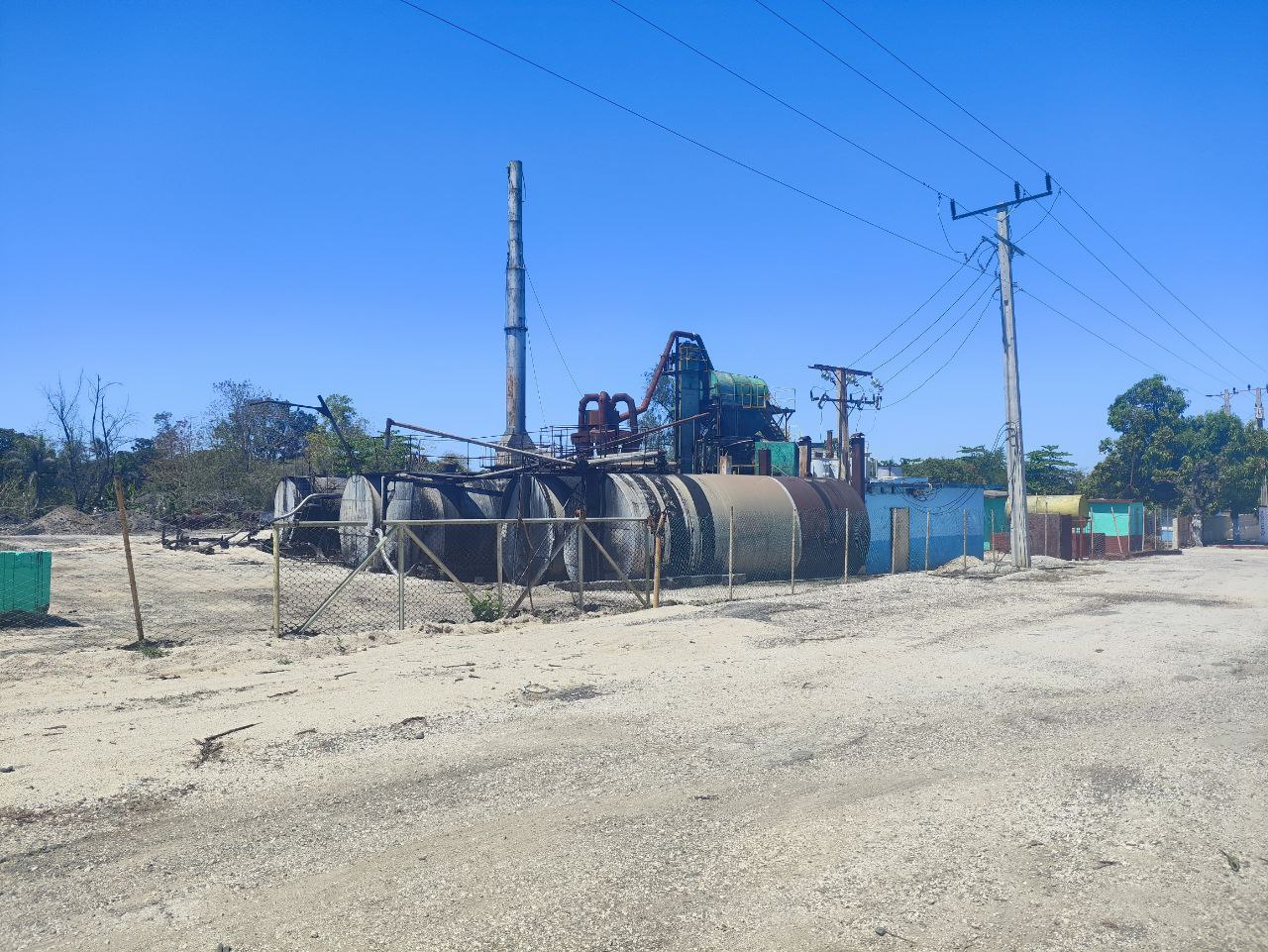
The low quality of the product has been the cause of friction between the plant and other related industries / 14ymedio
14ymedio, Mercedes García, Havana, March 22, 2025 — The asphalt plant of Sancti Spíritus has been closed for at least 15 days, as confirmed by a worker of the entity to this newspaper. From the outside, you can see that the enclosure is completely empty and that its machinery – pipes, cranes, towers and tank systems – is inactive.
Another source in the construction sector explained to 14ymedio that the problem has to do with the “lack of additives and raw material to prepare the substance that then becomes an asphalt mixture.”
The low quality of the product has been the cause of friction between the plant and other related industries, such as the Sergio Soto refinery, located in the neighboring municipality of Cabaiguán, which sometimes exported the asphalt produced in Sancti Spíritus and – according to the source of this newspaper – “has had to return the merchandise because, instead of asphalt, what they have sent has been full of bitumen,” of lower quality, whose application requires high temperatures.
A note published in Escambray this month gives an account of how unstable the situation of asphalt factories in the province is, for which the Government has set a plan of 25,862 tons of hot asphalt mixture throughout the year, plus 5,000 of cold asphalt. The managers claim that they “aren’t giving up” on that goal, but they see it as more and more distant.
The main municipality is not the only asphalt plant in Sancti Spíritus. There are also those of Trinidad and El Yigre, in Yaguajay. However, the factory that is closed today assumes the greatest production load. “When it produces at full capacity, the construction process is streamlined since its location in the center of the territory allows less fuel consumption,” adds Escambray.
The Sancti Spíritus factory assumes the highest production load / 14ymedio
The factory managers added two factors that prevent production: the lack of fuel and the blackouts. Three days after the newspaper published this complaint, the country plunged into its fourth total blackout in less than six months.
On the table of the provincial authorities is an asphalt plan that will require 19,000 tons of hot concrete. The extensive network of roads that need repair includes the two interprovincial connectors par excellence – the National Highway and the Central Highway – but also that of the South and North circuits, the La Sierpe road, and other roads affected by potholes and lack of maintenance.
The Yaguajay plant, for its part, was stopped for some time “for repair.” In mid-March, Granma announced that production was resuming “progressively” and promised a future “with quality.”
However, a specialist interviewed by the Communist Party newspaper reported that keeping the technology of these plants active “would be quite the feat.” With old equipment subjected to overexploitation, “structures such as those of Sancti Spíritus are among the oldest in the archipelago,” he said. Without “a certain level of investments,” the specialist added, they are doomed to failure.
Last December 24, the asphalt plant of Sancti Spíritus was also in the news, but for very different reasons. Alexey Díaz Salas, 48 years old and one of its workers, was the victim of a fire that left 60% of his body covered in burns. He was taken in serious condition to the hospital in the neighboring province, Cienfuegos, to be treated.
He suffered head trauma and injuries after the explosion of a highly volatile fuel tank, which he inspected without adequate protective equipment. Díaz Salas died shortly after.
The fire unleashed after the explosion, which was heard everywhere in the city, was described by eyewitnesses as “of great magnitude,” according to Escambray. The plant’s tanks stored a fast-curing liquid, a mixture of asphalt cement and a very volatile petroleum distillate, which must be preserved at high temperature to be applied on the road before pouring the asphalt.
The asphalt factory of Sancti Spíritus, founded in 1948 – the oldest in Cuba – is equipped with an old machine, model DK-117, of Ukrainian manufacture, which arrived on the Island during the years of the Soviet subsidy. Over the years, the deterioration and scarcity of parts have taken their toll on the installation.
Translated by Regina Anavy
____________
COLLABORATE WITH OUR WORK: The 14ymedio team is committed to practicing serious journalism that reflects Cuba’s reality in all its depth. Thank you for joining us on this long journey. We invite you to continue supporting us by becoming a member of 14ymedio now. Together we can continue transforming journalism in Cuba.
Anger and tenderness are the themes of this book; the rest is literature
Abreu next to the bronze sculpture of Peter Pan, one of his favorite characters, in London. / Facebook/Juan Abreu
14ymedio, Xavier Carbonell, Salamanca, 22 March 2025 — José Lezama Lima’s epitaph was supposed to be a phrase by Flaubert— “All lost, nothing lost” — which he ended up replacing with his own verses. When a Cuban reads Juan Abreu’s Debajo de la mesa [Under the Table] (Ladera Norte), the optimism of the Buddha of Trocadero vanishes: everything is completely lost, even nothingness, even the tomb where the epitaph was to be placed.
No one has written with as much freedom as Abreu. What else can they take away from him? His words come from a face scrunched up in rage, a rage he himself offers to readers as a guarantee of the truth. He speaks because he’s pissed off, and he’s pissed off because he’s free, and freedom sometimes comes from the gut and the pain. If you don’t like it, close the book.
Prose so insolent could only be born of tenderness. Anger and tenderness move Abreu and are the theme of this book. The rest is literature. From a young age, Abreu was obsessed with the idea of the work—narrated, painted, sung, lived—and the total sacrifice it demands of a creator. If there were a religion for him, this would be it. If there were a god, it would be Reinaldo Arenas, who makes his entrance as the omnipotent and ubiquitous divinity of books.
Arenas, the extreme tension, a temple for thousands of couples—regardless of sex, color, or Kama Sutra position—a mythological creature in the forests of Lenin Park, wrote a book of which Under the Table is a counterpart. If Before Night Falls is about the childhood and youth of a Cuban from the countryside, what Abreu tells is what life was like at the foot of a hectic city like Havana.
According to Abreu, both worlds—the countryside and the capital—were and will be in perpetual conflict. Fidel Castro, a puritan allergic to Havana’s chaos, took over the city to destroy it from within. To destroy the simple joy of families, the Christmas dinners, the cars along the bay, the dwarf skyscrapers, the lust of white women, black women, mulatto women, Chinese women, Chinese mulatto women, women “tall and superb, with hairy pussies, smoky skin, and massive but elegant bodies… where have those goddesses gone?”
All lost. From under the table, they emerge to play what all Cuban children—even after the Great Loss—have played: pellets, lizard-catching, kite-flying, hole-peeking, and what, as a teenager, constituted for Abreu an amulet against all kinds of devils (and she-devils): “the hobby of jerking continue reading
off,” which only the unbridled sexuality of the 60s and 70s could complement, never replace.
If the first part of the book is about childhood, parents and first loves, in the second it is no longer possible not to talk about Castro’s world.
If the first part of the book is about his childhood, parents, and first loves, in the second, it’s impossible not to talk about Castro’s world. Dystopia, suffocation, repression—unfortunately, none of this belongs to Cuba’s past. Although the cyberpunk Comandante didn’t manage—as far as we know—to freeze himself in a cryogenic sarcophagus, today’s Cuba is the result of what he created.
Against that mass of hatred, complexes, and propaganda sludge we call Castroism, we can and must fight, but not at one’s own expense. What is the purpose of a homeland, Abreu repeatedly asks. What purpose does it serve and what benefits does it bring? The Mariel Boatlift was Cubans’ great gamble on real life. Leaving rather than dying. If you have to choose between homeland or death, neither is better.
In Cuba, there was—and nothing has changed—too much death. The image of Arenas, when he was living as a beggar in Lenin Park and State Security was hunting him, is the best example: “He emerges from the darkness, preceded by two enormous rats frightened by his movements. When I see him, I want to cry. He’s already prepared to sleep. He’s fully clothed and his head is wrapped in various rags.”
“Thank goodness this newspaper is finally useful for something other than its official use as toilet paper.”
From his sleeves crumpled pieces of Granma spill. He uses them to protect himself from the cold. “Thank goodness this newspaper is finally useful for something other than its official use as toilet paper,” says Arenas. He is the persecuted writer par excellence, Abreu observes. He is the homosexual writer par excellence. And the one with the greatest moral stature in all of Cuban literature, in which there are so few excellent writers.
The complicity of Serrat with the Cuban regime—he allowed dissidents to be beaten during a concert; the events at the Peruvian Embassy in 1980; the campaigns against those who wanted to leave via Mariel; the snitching; the frustration of having Fidel within range of an AKM and not being able to fire; the progressive bleeding of Cuba; the exile of Arenas, of Abreu, of the entire family; the exile of an idea of a country.
Since they’re taking everything from us, let them take our homeland too. Our memory—what happens under the table, with a book in hand, while adults chat—can’t be taken away.
____________
COLLABORATE WITH OUR WORK: The 14ymedio team is committed to practicing serious journalism that reflects Cuba’s reality in all its depth. Thank you for joining us on this long journey. We invite you to continue supporting us by becoming a member of 14ymedio now. Together we can continue transforming journalism in Cuba.
The US Secretary of State described Cuban medical missions as an “atrocious practice.”
Jamaican Prime Minister Andrew Holness with U.S. Secretary of State Marco Rubio / EFE
EFE (via 14ymedio), San Juan, 26 March 2025 — U.S. Secretary of State Marco Rubio, on Wednesday, called Cuban medical missions an “atrocious practice,” but said he will engage in dialogue with the Caribbean countries that benefit from them because “there are places with better labor standards.”
“In many other parts of the world, doctors aren’t paid. The Cuban government is paid. Their passports are taken away. They basically operate as forced labor in many places,” he denounced at a press conference in Jamaica with Jamaican Prime Minister Andrew Holness.
“Now, each country operates its program differently. And obviously, because of our relationship with Jamaica, we’re going to be engaging with them on this, digging deeper into the issue, and understanding it better. Perhaps none of this applies to the way it’s handled here,” he added.
“In many other parts of the world, doctors [on medical missions] aren’t paid. The Cuban government is.”
This month several leaders of the Caribbean Community (CARICOM), of which Jamaica is a member, criticized the restrictions announced by Washington on Cuban medical missions and rejected the notion that benefiting from them could be considered a form of human trafficking.
On this issue, the Jamaican Prime Minister stated that his government is “very careful not to exploit Cuban doctors” working in his country. “We ensure they are treated in accordance with our labor laws and benefit like any other worker. We ensure continue reading
our program complies with all international laws and standards,” he said. Holness also acknowledged that Cuban doctors “have been of great help” since Jamaica has “a shortage of health personnel.”
In addition to Holness, Rubio is also addressing this issue in Jamaica during his meetings with the prime ministers of Trinidad and Tobago, Stuart Young, and Barbados, Mia Mottley. The US Secretary of State will also meet with the president of Haiti’s Transitional Council, Fritz Jean, as the security crisis in that country is one of the topics on the agenda.
“We ensure that our program complies with all international laws and standards.”
Regarding Haiti, Holness expressed his hope for “continued collaboration with the United States” to address the crisis, alongside Haitian leaders and other stakeholders.
“The extraordinary humanitarian, civil, and national security challenges in Haiti pose a grave threat to Haitians, regional stability, and indeed to its close neighbors, including Jamaica,” he stated.
Therefore, Holness emphasized that he agreed with Rubio that “everything possible must be done to stabilize the security situation in Haiti,” advocating for providing more resources and personnel to the Haitian National Police in its fight against gangs.
A multinational mission is currently deployed in Haiti to support the Haitian police, led by Kenya and financially supported by the U.S.
Regarding Washington’s recent foreign aid measures, Rubio asserted that “it’s not about eliminating foreign aid, but rather restructuring how we deliver aid. We’re going to provide foreign assistance. The difference is that we want to provide foreign assistance in a way that’s strategically aligned with our foreign policy priorities and the priorities of our host countries and the states with which we collaborate,” he explained.
“The extraordinary humanitarian, civil, and national security challenges in Haiti pose a grave threat to Haitians, regional stability, and indeed to its close neighbors, including Jamaica,” he added.
Rubio and Holness also reaffirmed their commitment to strengthening cooperation in the fight against transnational crime, ensuring the security of citizens and borders.
Holness also said they explored avenues to “further expand bilateral trade relations” and “attract greater U.S. investment to Jamaica’s emerging sectors.”
In this regard, Rubio said that the restructuring of trade alliances being carried out by his administration could be “a mutually beneficial opportunity. It makes perfect sense to see more productive capacity, more manufacturing, more industry relocated to our hemisphere.”
Following his stop in Jamaica, Rubio heads to Guyana and Suriname tomorrow, Thursday, where he will meet with Presidents Irfaan Ali and Chandrikapersad Santokhi, respectively.
_________________
The 14ymedio team is committed to practicing serious journalism that reflects Cuba’s reality in all its depth. Thank you for joining us on this long journey. We invite you to continue supporting us by becoming a member of 14ymedio now. Together we can continue transforming journalism in Cuba.
Following a renovation that was completed this month, private SMEs have opened where the previously unsupplied state cafeterias were located.
On Friday, during a game between Havana and Granma, the stands were almost empty / 14ymedio
14ymedio, José Lassa, Havana, March 23, 2025 — No roar was coming from the stands, the blackboard had no light, and barely one part of the Latin American stadium, in Havana, had an audience on Friday afternoon. However, the followers of the Industriales team enjoyed the 6-3 victory against Granma and briefly recalled the glory days of the Coloso del Cerro when the passion for baseball attracted crowds on the Island.
At the beginning of this month, maintenance and repair work was completed in the interior areas of the most important stadium in the Cuban capital. With the newly painted walls and the field in better shape, the house of the Leones resumed its programming and will host the III Elite League of baseball. On Saturday, Granma would take revenge and defeat the Blues after taking advantage of three home runs, closing the score 4 to 2.
“Gurriel should be ashamed!” roared a fan, haranguing the players who were somewhat lacking in spark / 14ymedio
But on Friday, that obstacle had not yet gotten in the way of the Havama team, especially impacted by the exodus of its players and the discouragement that has taken hold in the national sport. That afternoon they reigned over their concrete jungle, supported by a few followers who were more attracted by curiosity over the stadium repairs than by what was happening in the field.
That day, the opening pitchers were Andy Vargas for Industriales and César Gracía for the Granma team, two of the best pitchers in the Elite League. But the most mentioned player was not one of those on the field. The most heard name in conversations and debates was Yulieski Gourriel. The 40-year-old from Sancti Spíritus recently reached an agreement with the San Diego Padres to join their spring training camp.
“Gurriel should be ashamed!” roared a fan who harangued the players who were somewhat lacking in spark when it came to running the bases or trying to catch the ball. “You can’t ask them for more,” said a woman in defense of continue reading
the athletes, who receive a monthly salary of 8,500 pesos for participating in the tournament, less than 25 dollars at the current informal exchange rate.
Despite the soulless show, a local conga continued to play for much of the game, and the stands above home plate were full. The spectators with the most resources kept going in and out of their seats to look for something to eat or drink, incursions that ended, most of the time, with thousands of pesos spent. The regulars at the sports complex, however, poor people from the Cerro neighborhood that surrounds the colossus, were notable for their austerity. Dressed in worn clothing, they kept their eyes fixed on the field and consumed nothing during all nine innings.
The regulars at the sports complex, poor people from the Cerro neighborhood, were notable for their austerity / 14ymedio
Where the undersupplied state cafeterias once were, some premises managed by private MSMEs have opened. There are candy stores, which offer not only slices of cake, tortes and bow-shaped pastries but also whole cakes at 1,300 pesos that don’t fit well in the context of stands without spoons, plates or birthdays. For those who prefer something salty, the options are cheese pizzas at 300 pesos or ham pizzas for 360. To balance so many carbohydrates, you can always buy an imported soda for 250 or an energizing drink for 300 pesos.
The ban on the sale of alcohol is maintained, and inspections at the entrance seek to prevent the entrance of knives and the typical bottles of rum that people try to hide in the waist band of their pants. That close link between hits and beers, home runs and long sips of a cold Hatuey or a refreshing Polar are a thing of the past. The Cuban brewing industry, which invested in recreation and sports centers, financed stadiums and sponsored baseball players, was banished from the stadium decades ago.
There are sweet shops that offer small cakes, tortes, bow-shaped pastries and large cakes at 1,300 pesos / 14ymedio
Advertising also stands out for its absence. There are no posters with ads, nor banners recommending refreshments or the benefits of sports sneakers. The Cerro is a stadium where austerity has been imposed, which also affects the whole spectacle. “Revolutionary baseball” is like this: dull, without ads or distractions but also poor in resources and joy.
“It seems that they didn’t have enough paint,” summarized a follower of the Havana team while pointing to the nearby building, across the street, which for years has worn the intense blue color and the initials of the Industriales team. With the faded facade and the moldy eaves where weeds now grow, the building stands as a symbol of the current state of Cuban baseball. Inside, some apartments, empty due to the emigration of their owners, are looking for buyers to inhabit them, at bargain prices.
It’s also a metaphor for the absences, in the field and the baseball stands, of all those who have left
With the faded facade and the moldy eaves where weeds now grow, the building stands as a symbol of the current state of Cuban baseball / 14ymedio
The best junior handball players continue their training at the Cerro Pelado High Performance Training Center in Havana.
Everything indicates that Inder’s priority is the Junior Pan American games / Federación Mexicana de Balonmano
14ymedio, Andy Lans, Matanzas, 23 March 2025 — After Cuba’s sudden classification for the U21 Handball World Cup, to be held in Poland between June 18 and 29 of this year, sources in the sector tell 14ymedio that national participation in the event could be in danger due to lack of a budget. This has been made known to the group of young men who are preparing in Havana, without further details.
In 2024, the Cubans obtained third place in the IHF Trophy (International Handball Federation) in the category for North America and the Caribbean, which guaranteed them a ticket to the Junior Pan American Games Asunción 2025. But by not accessing the final of the tournament, they were momentarily without the possibility of attending the U21 World Cup. On March 16, the champion of North America and the Caribbean, the United States, repeated the title in the Intercontinental Phase of the IHF Junior Trophy, and therefore, the classification quota to attend Poland 2025 was extended to another country, mainly because of the geographical area in question. In this case, to the bronze, Cuba.
Although the best junior handball players in the category continue their preparation at full speed at the Cerro Pelado High Performance Training Center in Havana, “they should” consider the possibility of not attending the World Cup event. Everything indicates that, for the National Institute of Sports, Physical Education and Recreation (Inder), the priority is the Junior Pan American games. continue reading
Each Federation must pay 500 Swiss francs for registration in the tournament, in addition to a deposit of 5,000 francs
It would not be the first time that the sports monopoly in Cuba shows off its inability to solve the presence of its delegations in certain competitions. For example, in view of the Intercontinental Qualifier for the 2022 World League, the Women’s Waterpolo Team was notified that “there was no budget for the plane ticket.” However, after a Facebook post by Lisbeth Santana and the echo of several independent media, the money for the trip to Peru appeared as if by magic.
The code of competitions of the International Handball Federation (IHF), in its section of Junior and Youth World Cups, is transparent with respect to the economic demands of these competitions. According to Article 6, each participating federation must pay 500 Swiss francs ($566) for its registration in the tournament three months before the start of the championship, in addition to a deposit of 5,000 francs that the IHF can use to pay fees, fines or financial obligations of the corresponding federation. For their part, the organizers of the event will also charge a sum of accommodation determined by the number of members of the delegation, the days of stay and the exchange rate of the venue. And as if that were not enough, travel and visa expenses will be borne by the national federation in question.
The Cuban Handball Federation plans to “go whole hog” with the incorporation of players hired abroad
14ymedio was also able to learn that the Cuban Handball Federation plans to “go whole hog” with the incorporation of players hired abroad, if Inder gives the go-ahead from a logistical point of view. Taking into account that those eligible by age for the U21 World Cup must be between 16 and 21 years old, the most reliable options for Cuba are:
Freddy Lafontán Álvarez: 19-year-old winger of Vitória SC of the Portuguese First Division. He represented the Four Letters in the Senior World Cup held in Croatia, Denmark and Norway in 2025.
Reylán González and Jorge Abraham Luis: Both work in Artística de Avanca, also from the top Portuguese circuit. Reylán is a 20-year-old winger with a lot of activity in the first team. Jorge Abraham is signed with Porto, but he is on loan. He plays center and is 19 years old.
Translated by Regina Anavy
____________
COLLABORATE WITH OUR WORK: The 14ymedio team is committed to practicing serious journalism that reflects Cuba’s reality in all its depth. Thank you for joining us on this long journey. We invite you to continue supporting us by becoming a member of 14ymedio now. Together we can continue transforming journalism in Cuba.

 14ymedio, Madrid, 10 March 2025 — The US State Department, led by Marco Rubio, has decided to unfreeze the funds allocated to the National Endowment for Democracy (NED) that were frozen by the Trump administration in early February. In a statement released Monday , the institution expressed its gratitude for the decision. “This is a significant step toward ensuring that the NED can continue its mission of promoting freedom around the world.”