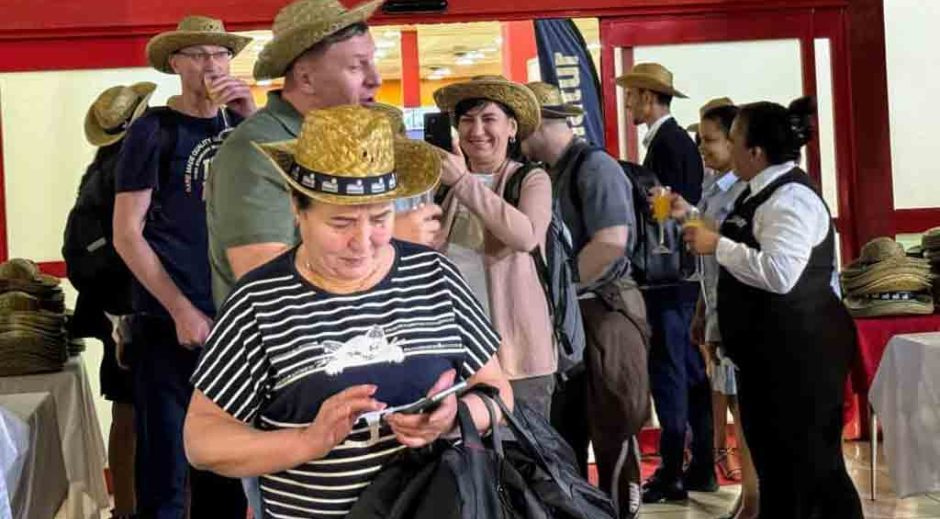
Cuba’s UMAP Camps or the Slavery of Youth

The UMAP lasted several years; it is estimated that at least 25,000 young people passed through its camps.


To say that the UMAP was implemented to seek the social re-education of repressed individuals is false. / Archive of “El Nuevo Herald”

14ymedio bigger14ymedio, Pedro Corzo, Miami, 31 March 2025 — Cuban filmmaker Lilo Vilaplana and the tireless fighter against Castro’s totalitarianism, Reinold Rodríguez, have committed to bringing to the big screen one of the most painful tragedies suffered by Cuban youth: the camps known as Military Production Assistance Units (UMAP).

They did an excellent job with the film Plantadas*, without overlooking Plantados*, so we are confident that this will be a testimony of immense value like the previous ones.

The sadism of the Castro regime’s highest hierarchy—Fidel Castro, Raúl Castro, and Ernesto Che Guevara, with the complicity of the entire upper echelons of government—arranged a repressive scheme that sought to severely harm young people who expressed their opposition to the Revolution in various ways. First, they were militarized; second, they were forced to perform work contrary to their abilities; and third, they foisted upon the conscripts a web of lies and manipulations aimed at socially crippling them.

The first and permanent targets were the Church, the political opposition, the free press, and independent economic activities, part of a long and continue reading

painful relationship.

The UMAP was a sophisticated instrument of political repression that, based on existing prejudices, sought to discredit the victims.

In 1960 and 1961, Guevara and Raúl Castro launched an official persecution against prostitutes, pimps, and homosexuals, but also against any individual who did not hide their rejection of the new order.

Those arrested in the raids were concentrated on the Guanahacabibes Peninsula. The official version stated that these individuals had to be rehabilitated, and according to reports at the time, more than 4,000 people of both sexes were imprisoned in that region. As a document from the Inter-American Commission on Human Rights denounced in May 1963, “all of this without a written sentence, carried out by a police captain, without procedure or legal basis, much less a constitutional one.”

While this was happening, the prisons were filling up with political prisoners. The firing squads grew deafening, and the harassment of those who decided to leave the country gave rise to the ever-present protest rallies.

In November 1963, the Castros implemented Mandatory Military Service (SMO), a novel method of imprisoning young people. The SMO was another instrument of oppression and forced ideology that should be thoroughly studied.

The creative capacity to repress and control was inexhaustible, and they invented the UMAP, a sinister plan aimed at subjugating the citizenry.

Thousands of young people were literally kidnapped. They were taken from their homes, schools, and religious seminaries. They were deceived and rounded up by the police, with no grounds to justify their arrests, much less the forced deportation they were subjected to. They were never formally charged, much less tried by a court, however spurious.

Thousands of young people were literally kidnapped. Taken from their homes, schools, and religious seminaries.

Most of them were of military age, but they weren’t called up to the SMO because the dictatorship considered them even more “disposable.” The regime didn’t want them armed. They weren’t trustworthy. They were disaffected young people who committed the original sin of not believing in Castroism.

They were forcibly transported to barbed-wire concentration camps. Guarded by soldiers. Forced to survive in extreme poverty. Held in inhumane conditions, forced into involuntary agricultural labor. Their visits were monitored. They were frequently punished. Beaten by uniformed henchmen who relished the pain they inflicted. Some committed suicide, others were murdered by the jailers, and some were shot, like the young Alberto de la Rosa.

The UMAP lasted several years. It is estimated that at least 25,000 young people passed through its ranks. Raúl Castro, its architect, said: “The first group of comrades who joined the UMAP included some young people who hadn’t had the best conduct in life, young people who, due to poor upbringing and environmental influences, had taken the wrong path in society. They were incorporated in order to help them find a correct path that would allow them to fully integrate into society.”

The UMAP was a sophisticated instrument of political repression that, based on existing prejudices, sought to discredit the victims. To say that the UMAP was implemented to seek the social re-education of those repressed is false; its sole objective was to destroy them for being opposed to the regime. It’s as absurd and irrational as defending the Castro brothers’ dictatorship or believing that when the UMAP disappeared, the repression ended—a mistake, because other brigades like the Centenario Youth were soon created.

*Translator’s note: Plantado literally means “planted” (with plantada the feminine form), and refers to “the most uncooperative of Cuba’s political prisoners.”

____________

COLLABORATE WITH OUR WORK: The 14ymedio team is committed to practicing serious journalism that reflects Cuba’s reality in all its depth. Thank you for joining us on this long journey. We invite you to continue supporting us by becoming a member of 14ymedio now. Together we can continue transforming journalism in Cuba.

Without Technicians To Reactivate the Shortwave Transmitters, Radio Martí Does Not Reach Cuba

On the 1180 kHz AM frequency, only Radio Reloj and Radio Rebelde can be heard, “and between them, a huge noise”

On the 1180 kHz AM frequency, “you can only hear Radio Reloj and Radio Rebelde, and between them there is a huge noise” / 14ymedio

14ymedio bigger14ymedio, Havana, 1 April 2025 — Not in Havana nor in other places in central Cuba, such as Villa Clara, nor by climbing onto rooftops, nor even by adapting antennas to old equipment. The task of tuning into Radio Martí on the island, via AM radio, has been fruitless these days, almost a week after the station resumed part of its programming.

On the 1180 kHz frequency, the AM band on which the station reported broadcasting, “you can only hear Radio Reloj and Radio Rebelde, and there’s a tremendous noise between them,” testifies a resident of the Havana municipality of Plaza de la Revolución. “The band is empty; there’s a dark void there,” says a technician who tried to pick up the signal from Central Havana with a Cuban antenna, “installing a spiral of copper wire with six turns, which is what’s used for AM.” This signal is frequently jammed by the regime and barely reaches the island’s northern coast.

Last Wednesday, the 26th, around 50 federal employees of Radio and TV Martí and its website returned to their jobs, and that same day, some of its programs, such as Las Noticias Como Son (The News As It Is)mreturned to the air. However, the measure did not extend to the 20 or so “contractors,” that is external collaborators of the state-owned company. continue reading

Those who are federal employees at the headquarters, on the other hand, “have not been authorized to return to their posts.”

This is one of the reasons why the station doesn’t yet broadcast on shortwave, which avoids interference and reaches Cuba more effectively. The technicians in Greenville, North Carolina, where these transmitters are located, are not federal employees. And those who are federal employees at that headquarters, moreover, “have not been authorized to return to their posts,” a worker who requested anonymity told 14ymedio. “The contractors’ contracts were canceled.”

Last week, optimism prevailed. Opposition leader José Daniel Ferrer, leader of the Patriotic Union of Cuba (UNPACU) and one of those who had raised his voice for the reestablishment of Martí Noticias’ operations, stated that he had received “positive news that it could resume operations later.” Today, the outlook is bleaker. The media employee laments: “Management is making efforts, but the bureaucracy doesn’t understand.”

As part of the drastic cuts recklessly implemented by his new administration, Donald Trump ordered the suspension of federally funded media operations through an executive order, citing, among other reasons, that they represented a high cost to taxpayers without any return.

On Saturday, March 15, Radio and TV Martí employees received a letter informing them of the start of an “administrative leave” for all employees, without suspension of pay. A day later, the employees also received an email informing them that they must cease their work “immediately” and that they would not be allowed access to the agency’s facilities or operational systems. The message indicated that the dismissal would be official as of March 31 at 11:59 p.m.

“I haven’t listened it on the radio in a long time,” “I tune in through the internet,” “I don’t even have a radio.”

The situation has kept all of the outlet’s channels, which belong to the United States Agency for Global Media (USAGM), grounded. This includes Voice of America (VOA) and other outlets, such as Radio Free Europe/Radio Liberty (RFE/RL), also suspended by Washington.

Last Friday, Manhattan federal judge J. Paul Oetken declared that he would temporarily block the dismantling of the USAGM. After an initial hearing in the case brought by VOA lawyers, the judge ruled that the decision to shut down several public media outlets was “arbitrary and capricious,” given that the budget for this year had already been approved by the United States Congress.

Judge Royce C. Lamberth of the District of Columbia Court also granted a motion filed by the station against Usagm, stating that it “cannot, with a single sentence of reasoning that offers virtually no explanation, force RFE/RL to shut down, even if the president has ordered it to do so.”

The lawsuit, filed on March 18, argued that denying Congressional appropriations violates federal law and the Constitution, which grants Congress sole control over federal spending.

The return of the shortwave signal doesn’t, in any case, guarantee the return of Radio Martí’s audience inside Cuba. “I haven’t listened to it on the radio for a long time,” “I tune in online,” “I don’t even have a radio,” are some of the impressions of residents on the island.

“I think the audience had dropped significantly by the time the signal was cut off,” estimates a Havana resident from El Vedado, who nevertheless laments the loss of a voice that was so important in helping Cubans understand the reality outside of what the regime was telling them, especially in the first decade after its founding by then-President Ronald Reagan in 1985. “Unfortunately, Facebook and WhatsApp finished off Radio Martí.”

____________

COLLABORATE WITH OUR WORK: The 14ymedio team is committed to practicing serious journalism that reflects Cuba’s reality in all its depth. Thank you for joining us on this long journey. We invite you to continue supporting us by becoming a member of 14ymedio now. Together we can continue transforming journalism in Cuba.

Cuba and Iran Advocate Closer Economic Ties in Response to US Sanctions

Cuban Foreign Minister Bruno Rodríguez and Iranian Deputy Foreign Minister Saeed Jatibzadeh met in Havana.

Iranian Deputy Foreign Minister Saeed Jatibzadeh met with Cuban Foreign Minister Bruno Rodríguez on Tuesday / Islamic Republic of Iran

14ymedio biggerEFE (via 14ymedio), Havana, 1 April 2025 — Cuba and Iran rallied this Tuesday against US sanctions on both countries and reiterated their willingness to continue promoting bilateral relations and cooperation in economic and commercial areas. The governments of these two allied countries presented their positions during a meeting in Havana between the Cuban Foreign Minister, Bruno Rodríguez, and the Iranian Deputy Foreign Minister, Saeed Jatibzadeh, according to a statement from the Cuban Ministry of Foreign Affairs.

“During the meeting, which took place in a cordial atmosphere, the brotherhood and solidarity between both peoples and the positive progress of bilateral ties were highlighted,” the article said.

In the meeting held at the headquarters of the Foreign Ministry in Havana, both diplomats also addressed “the unilateral coercive measures and other aggressions that the government of the United States and its allies apply against various countries.” continue reading

“The brotherhood and solidarity between both peoples and the positive march of bilateral ties were highlighted”

They also spoke about “the situation in the Middle East, the escalation of attacks by Israel and the dangers to regional and international peace, stability and security.”

Iran is one of Cuba’s closest allies in the world. Both countries established relations in 1975, which were interrupted in 1976 and re-established in 1979, after the triumph of the Islamic Revolution.

Two years ago, during the visit to Cuba of then Iranian President Ebrahím Raisí (who died in 2024), the two countries signed a total of six agreements for comprehensive cooperation between governments, political consultations between Foreign Ministries and cooperation in telecommunications, information technology and computer services.

In addition, they signed two memoranda of understanding in customs matters and another between both Ministries of Justice.

Translated by Regina Anavy

____________

COLLABORATE WITH OUR WORK: The 14ymedio team is committed to practicing serious journalism that reflects Cuba’s reality in all its depth. Thank you for joining us on this long journey. We invite you to continue supporting us by becoming a member of 14ymedio now. Together we can continue transforming journalism in Cuba.

State-Owned Rice for the Poor in La Princesa, Private Rice for the Rich in La Calzada

In Cienfuegos, you either have to wait in long lines to get a pound for 150 pesos or you need a deep pocket to buy it for 290.

The mirrored columns of La Princesa just look tired  / 14ymedio

14ymedio bigger14ymedio, Julio César Contreras, Cienfuegos, 1 April 2025 — Anyone from Cienfuegos who wants to eat rice—and what Cuban can do without it—has a decision to make. Either they go to the state-run La Princesa market, knowing that the sweat, the lines, and the discomfort will make them feel the antithesis of royalty, or they go to La Calzada, a private establishment, designed, yes, for the buyer who has the pockets of a duke or a marquis.

One pound is 150 pesos—a capped price and only five pounds per person allowed—at La Princesa; at La Calzada, it’s 290 pesos. This huge and significant difference sums up the customer’s dilemma. Furthermore, as everyone knows, the price in local currency must be added to another price: the one paid in stress and disappointment.

The mirrored columns of La Princesa reflect the shoppers’ tired faces. Surrounding them is a crowd of very similar faces, shoulders pushing each other, and hands making gestures of weariness. The line is so dense that, if it weren’t for practice, no one would know where it begins and where it ends.

The line is so dense that, if it weren’t for practice, no one would know where it begins and where it ends. / 14ymedio

Who’s last?” Antonio asks* again and again until someone responds. He ran away from work as soon as he heard they were going to sell rice and beans. continue reading

In recent weeks, shortages have worsened in Cienfuegos. Hunger and people’s ability to obtain food are inversely proportional, he explains.

Antonio is one of those who knows how the contrast between La Calzada and La Princesa works. “That place was empty today,” he comments. It makes sense. Everyone mobilized when they learned that the grain had arrived at the state market. “Let’s see how it goes for us,” he says gloomily.

Man does not live by rice alone. At La Princesa, there is spaghetti for 320 pesos; a chocolate bar for 190; instant soup for 200; and a bottle of soda for 620. For the more refined palates, at least by the standards of affluent Cuba, there is butter for 480 pesos, condensed milk for 520 pesos, and chorizo ​​for 800 pesos.

The walls of La Princesa have been closing in on the shoppers. The heat and the ever-increasing arrival of people have turned the market into a hotbed of chaos, and the sale hasn’t even begun. Antonio despairs, but he quickly recovers. “Things are bad,” is his mantra. Instead of distressing him, this thought gives him a certain equanimity, essential for taking on the line.

At La Princesa, spaghetti costs 320 pesos; a chocolate bar costs 190; instant soup costs 200; and a bottle of soda costs 620. / 14ymedio

“They always delay everything until a problem arises,” he says. He’s not wrong. The most fed up, the youngest, those who have to return—like him—to work, begin to mutter protests. There have been several arguments. In such a heated space, everything explodes faster.

The beans, a secondary but also coveted target, are 350 pesos. Those already craving their bowl of stew have lined-up twice, an old trick to take home twice as many beans. That’s what Vicente did, repeating his strategy to everyone and telling dozens of stories to kill time.

The tension reaches its boiling point at midday. The sun beats down on the rooftops of Cienfuegos and the mass of hot air enters La Princesa. Vigilant shoppers are keeping an eye on the usual line-cutters. They won’t make any concessions: everyone wants to take home some rice.

“Listen here. There’s plenty of rice and beans, but we will only sell five pounds per person, so everyone can buy,” the clerk announces. The crowd cheers up, but there’s disappointment in the air.

“I was right about it,” Vicente protests. “These people don’t make a loss even selling disposable cups. You’ll see that in a while they’ll say they’re all gone or find an excuse to stop selling. Their business is on the outside, selling in bulk to whoever pays them well. And the people, may they be struck by lightning.” The people pretend not to hear him.

Hours pass, and those who finally get their sack of rice suspiciously explore its contents. “Sometimes it’s even sold with weevils,” explains an old woman. Discovering the blackish vermin playing among the grains arouses a rage that’s impossible to quell by complaining to the seller.

Those who haven’t been able to buy anything head to La Calzada, ready for “la puñalada”… “the stabbing”… a word that couldn’t be more expressive to describe the drain on Cubans’ wallets. If there’s no money, there’s a third option: hunger.

*Translator’s note: Cubans join lines by asking “who’s last” and then, as soon as the next person joins behind them, they can move around freely without anyone ’losing their place’.

____________

COLLABORATE WITH OUR WORK: The 14ymedio team is committed to practicing serious journalism that reflects Cuba’s reality in all its depth. Thank you for joining us on this long journey. We invite you to continue supporting us by becoming a member of 14ymedio now. Together we can continue transforming journalism in Cuba.

Cuba’s Officialdom Admits That “Price Caps May Be a Cure Worse Than the Disease”

Participants on Squaring the Box insist that price controls were a measure agreed upon with the private sector.

Empty market in Havana, after price caps went into effect for some products. / 14ymedio

14ymedio bigger14ymedio, Madrid, 1 April 2025 — The price caps on six basic products last July was a measure agreed upon with private sector companies, participants in the Cuban television program Cuadrando la Caja [Squaring the Box] argued on Sunday. “When a price is going to be capped, it always has repercussions,” said Glenys González Almager, Havana’s Finance Director. “That decision must also be consulted [with producers] and, when implemented, it must be widely publicized,” she summarized, referring to that process.

The first news of the price cap on cooking oil, chicken, pasta, detergent, sausages, and powdered milk began to circulate when some private business owners were summoned to meetings to discuss the measure. However, few were invited to these meetings, and many disagreed with a policy that threatened, from the outset, purchases they had already committed to. The official maintained that, thanks to the tariff exemption, a consensus was reached.

The data itself as presented in the program, however, indicates that such consensus was conspicuous by its absence. Between 138,000 and 140,000 inspections were carried out in the first quarter of the year, and violations were detected in 60% of them, stated Silvio Gutiérrez Pérez, a director of the Ministry of Finance. Although these figures were referring not only to the price caps on six products for private retailers, but also to the so-called “concerted prices” imposed by municipalities, where, judging by what was said, producer discontent is even greater. continue reading

“We haven’t been able to achieve this in all municipalities,” admitted González.

“We haven’t been able to achieve this in all municipalities,” admitted González, who believes these meetings are very enriching and highlight the difficulties farmers face, including the real costs of imports and the informal foreign exchange market they must navigate to obtain the necessary inputs for agricultural production.

Sunday’s program was titled ” Price Caps: Solution or Illusion?”, and experts admitted on countless occasions that the measure is not only controversial but also a double-edged sword. “Although they are implemented with good intentions, seeking greater purchasing power and greater access to products for low-income people, it is probably the regulatory policy in which the state finds most contraindications or that can cause the most problems in practice,” said Carlos Enrique González García, a researcher at the Center for Cuban Economic Studies.

“The first thing that happens is that there’s a discouragement of production and supply: if you cap the price of a product, I’m not going to produce it, I’m not going to sell it, I’m going to move on to another product,” he reasoned, and said, forcefully: “It could be serious from a nutritional perspective, and a well-intentioned policy could have a negative effect.”

In the expert’s opinion, the price cap should be temporary, highly technical, and analyzed after the fact. According to this monitoring, he said, the measure has worked for chicken and oil, but not for other products, although he did not mention whether a modification of the decision is being considered.

“It could be serious from a nutritional perspective, and a well-intentioned policy could have had a negative effect.”

González García’s defense of price caps as a very concrete measure also clashed with reality when he reviewed the many times this policy has been used in recent years. The specialist mentioned the controls in 2016, 2019, “and now again,” he acknowledged. He also admitted that it has also been tried with private transportation, where it has been a resounding failure. “Let’s just say the results weren’t the best,” he softened.

The guests agreed that pricing policy has changed a lot in recent years, although that small “great revolution” consisted of shifting control from the state to the municipality. “Only a few [centralized] ones remain, the decisive ones, such as milk, livestock, fuel… which are important prices,” said Gutiérrez Pérez, who spoke of macroeconomic indicators, of the long years that Cuba has been mired in high inflation and a high state deficit. “Let’s say we have the perfect storm: an economy with fewer products and more money,” he said, since the Central Bank never stopped printing banknotes.

Carlos González argued that medium-term change can only be achieved through investment, which Cuba does not dedicate to food. Last year alone, the Cuban government invested 14 times more in tourism than in agriculture, 37.4% compared to 2.7% of total investment. “In terms of production, it doesn’t make much sense to make new investments if you have previous investments and idle productive capacity. Focus resources on achieving the production of those idle capacities, not new investments (…) Then there are possibilities that have a greater impact in the medium and long term,” he explained.

However, in the short term, he sees no other option than price caps. “Today, I don’t see any immediate measure other than controlling and regulating prices,” he said. This sounded especially negative because, minutes earlier, he had stated: “When we talk about price controls, the cure may be worse than the disease.”

____________

COLLABORATE WITH OUR WORK: The 14ymedio team is committed to practicing serious journalism that reflects Cuba’s reality in all its depth. Thank you for joining us on this long journey. We invite you to continue supporting us by becoming a member of 14ymedio now. Together we can continue transforming journalism in Cuba.

From a Miami Detention Center, a Cuban Asks To Be Deported Due to Inhumane Treatment

Octavio Pérez Rodríguez has been detained at the Krome Detention Center since February 25.

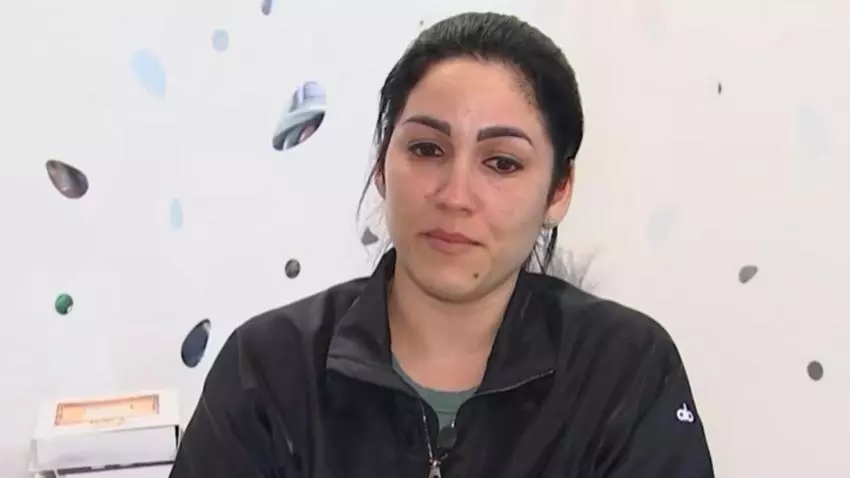
Midalys López Corrales with her daughter and her husband, Octavio Pérez Rodríguez, now detained by ICE. / Video capture/Telemundo

14ymedio bigger14ymedio, Havana, 31 March 2025 — Cuban migrant Octavio Pérez Rodríguez has spent more than a month without food or medical attention at the Krome Detention Center in Miami. According to his wife, Midalys López Corrales, “he’s desperate” and has asked for his deportation. “Titi, I’m dying, I’m in pain… You can’t imagine what I’m going through,” he told her in a phone call.

Deportation is very possible in Pérez Rodríguez’s case. The woman says he was deported in 2019 and broke the law by re-entering the country with her in 2022 through the Mexican border. “I know he made that mistake, but there has to be a solution. Deportation can’t be the only way out,” she said.

López Corrales told Telemundo that after a year in the U.S., Pérez Rodríguez applied for residency through the Cuban Adjustment Act and filed Form I-485.

During his stay in the country, the 36-year-old Cuban followed the requirements and was able to obtain a work permit to work as a truck driver. When he received an appointment to appear before authorities on February 25, he thought it was for residency because they asked him to bring a translator. However, he was detained.

Midalys López Corrales claims her husband is not receiving medical care at the center under ICE control. / Video capture/Telemundo

“He went hoping to receive his papers. He’s a hard-working man; he renewed his work permit, and he didn’t expect this,” López Corrales told Telemundo.

His immigration status has been left in limbo. His wife said she has spent continue reading

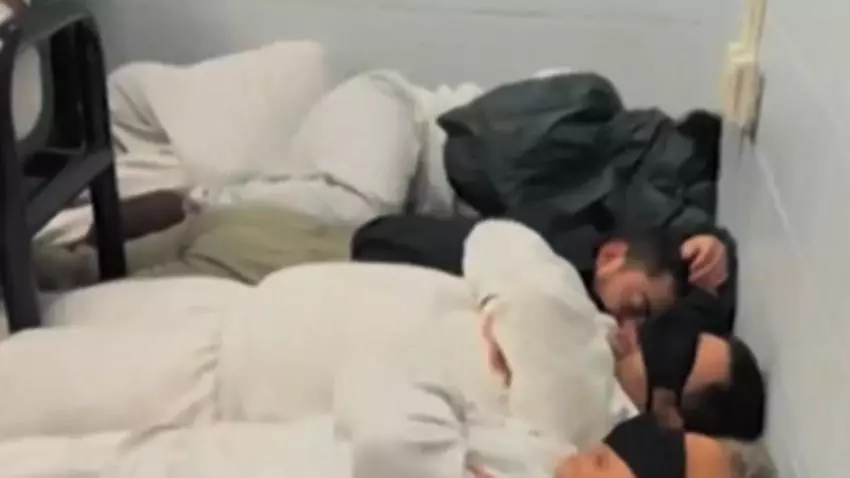
“eleven days sleeping on the floor” out of more than a month of detention. The woman reiterated in her account to Telemundo that her husband is not given medication to treat his ailments. “The conditions are terrible.”

Paul Chávez, director of the litigation program at Americans for Immigrant Justice, confirmed to Diario de Sonora the overcrowding in centers controlled by Immigration and Customs Enforcement (ICE). “Many people are signing deportation orders simply to escape the horrible conditions.”

One migrant told USA Today that while she was detained, she saw people handcuffed and she spent hours without food or water. “We smelled worse than animals.” Another described the center as “a living hell.” The women said they live in unsanitary and overcrowded conditions, lacking access to bathrooms and showers. Raids against women have intensified due to overcrowding in the men’s centers.

Octavio Pérez Rodríguez slept on the floor for several days due to overcrowding at the ICE center. / Video capture/Telemundo

ICE affirms that the incidents do not meet its policies or standards of care. However, it acknowledged that “some facilities are experiencing temporary overcrowding due to the recent surge in detainees.” It also stated that it is “implementing measures to manage capacity” and “maintain” its “commitment to humane treatment.”

However, complaints of inhumane conditions persist. Hundreds of people protested this Saturday outside the Krome facility, following multiple reports of appalling conditions and alleged abuse of women in custody at the all-male prison.

Protesters gathered outside the Detention Center to demand accountability from ICE regarding the situation of immigrants detained there, which has seen two deaths in its custody so far in 2025, EFE reported.

The Krome center came under the scrutiny of activists this year after the reported deaths of 29-year-old Honduran Genry Donaldo Ruiz-Guillén on January 23 and 44-year-old Ukrainian Maksym Chernyak on February 20. Both migrants were transferred to hospitals after being detained there. Protesters demanded an investigation and the closure of the detention center.

____________

COLLABORATE WITH OUR WORK: The 14ymedio team is committed to practicing serious journalism that reflects Cuba’s reality in all its depth. Thank you for joining us on this long journey. We invite you to continue supporting us by becoming a member of 14ymedio now. Together we can continue transforming journalism in Cuba.

The Multiplication of Solar Parks in Cuba Fails To Reduce the Energy Deficit

Nine units of the country’s seven thermoelectric plants are shut down due to breakdowns.

René Díaz, worker at the Ciego Norte solar park in Ciego de Ávila / Invasor

14ymedio bigger14ymedio, Havana, 31 March 2025 — With the Government’s accelerated commitment to photovoltaic energy, a new hero has been born in Cuba: the solar panel installer. The official press sings his praises, like this bit from Invasor: “It’s almost 12:00 noon on a Wednesday in March, but René doesn’t care about the date or time. Since the beginning of January his routine is the same. He wakes up at 5:00 in the morning, has breakfast, takes a bus from the Moronse town of Nereida to Grego, in Ciego de Ávila, and works from sunrise to sunset.”

This worker, an employee of the Ciego Norte park, one of the six connected last Friday to the national electricity system (SEN), reflects on the Herculean task that lies ahead: to alleviate the unending energy crisis. “Behind his glasses, his eyes reflect a concern inappropriate for his daily work, although in his hands lays, perhaps, part of the solution itself. René is distressed to know that last night his relatives had a bad night because of the blackouts in Santiago de Cuba, more than 400 kilometers from where he is trying to restore light to the country,” the pompous report continues.

This Monday the generation deficit again approaches 1,500 megawatts. The epic stories, for the moment, solve little. The forecast of the Unión Eléctrica continue reading

de Cuba (UNE) for peak hours is, specifically, a deficit of 1,360 MW (there is 1,990 MW for a demand of 3,350 MW) and a real shortage of 1,430 MW.

The daily report of the UNE includes, as always, the list of damaged thermoelectric power plants (CTEs) and those shut down for maintenance, a total of nine: two from CTE Mariel, one from Nuevitas, another from Felton, one more from Santa Cruz del Norte, two from Cienfuegos and two from Renté, in Santiago de Cuba.

Due to “thermal limitations” there are 341 MW absent, and due to fuel shortages, 485 MW, corresponding to 75 distributed generation plants, which run on [imported] fuel oil and diesel, while most CTEs use national [crude] oil.

Other thermoelectric workers are no less heroic. Thus, in Sierra Maestra they praise the employees of the Renté, “who perform feats every day to keep an obsolete machinery in operation, on which the life of the country depends.”

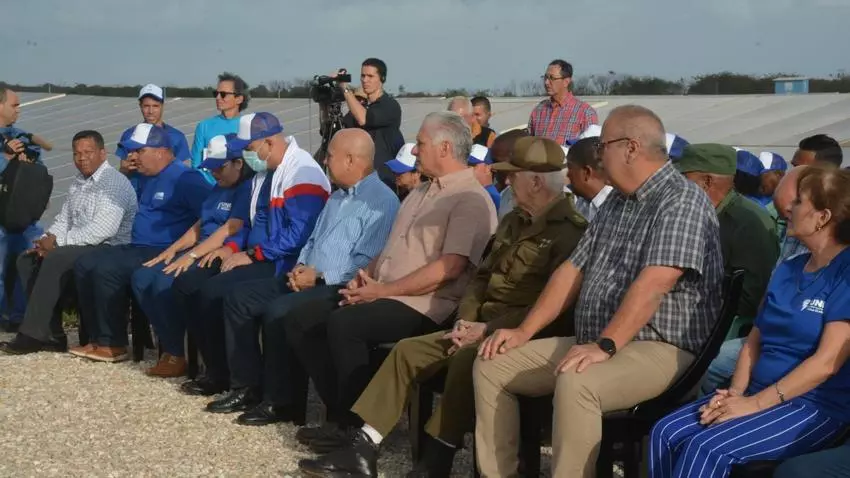
Miguel Díaz Canel, Ramiro Valdés, Vicente de la O Levy and other authorities at Friday’s inauguration of the Remedios park, in Villa Clara / Vanguardia

The report doesn’t hide, in fact, the antiquity of the ailing plant in Santiago de Cuba, built 59 years ago and whose useful life was estimated at almost 30 years less. Energy in general and the construction of new solar parks – with Chinese technology and funding – mainly occupy the pages of state newspapers.

In addition to Ciego Norte, four other facilities have recently been “synchronized” to the SEN, as advanced by the Minister of Energy and Mines, Vicente de la O Levy, in the long serialized interview published last week: Mango Dulce, in Artemisa; La Corúa, in Holguín; Jovellanos II, in Matanzas, and Remedios, in Villa Clara.

The latter was inaugurated by a prominent native of the province, the hand-picked president Miguel Díaz-Canel, who was accompanied by De la O Levy himself and other high authorities, such as Ramiro Valdés. Remedios is the first park of this type to be installed in Villa Clara, and the governor, Milaxy Sánchez Armas, said that it will save about 9,000 tons of oil per year.

Ramiro Valdés was also present at the debut of the Mango Dulce, in Artemisa, and the Jovellanos II, in Matanzas

Ramiro Valdés was also present at the debut of the Mango Dulce Photovoltaic Park, in Artemisa, and the Jovellanos II, in Matanzas.

These facilities, all with the same generation capacity, 21.8 megawatts (MW), are added to the School of Nursing, in El Cotorro (Havana), Alcalde Mayor, in Abreus (Cienfuegos) and La Sabana, in Granma.

The government’s plan for 2025 is to enlist 55 photovoltaic parks, out of a total of 92 that they expect to end up providing more than 2,000 MW of generation in 2028. The goal for 2030 is to reach 24% of renewable energy, including wind power.

Although the authorities assure that photovoltaic energy is an “undying hope,” they have also admitted that solar parks will not solve the energy crisis.

If the country has 1,500 MW of deficit, as the Minister of Energy calculated a few days ago, with the 1,000 MW of photovoltaics planned for this year, a third of what is needed will still remain unresolved.

Translated by Regina Anavy

____________

COLLABORATE WITH OUR WORK: The 14ymedio team is committed to practicing serious journalism that reflects Cuba’s reality in all its depth. Thank you for joining us on this long journey. We invite you to continue supporting us by becoming a member of 14ymedio now. Together we can continue transforming journalism in Cuba.
Starting Tuesday April 1st, Cuban Residents Will Only Be Able to Return With A Valid Passport

The exception approved in 2020, due to the closures and limitations of consulates during the pandemic, is coming to an end.

Previously, Cubans temporarily abroad were not required to renew their passports. / (Patrick Farrell/Miami Herald Archive)

14ymedio bigger14ymedio, Madrid, 31 March 2025 — Cubans resident on the island must have a valid passport starting this Tuesday when they return to the country. The exception created due to the pandemic that allowed entry into the country with expired documents ends this Monday, as announced by the Foreign Ministry in December.

The Ministry of Foreign Affairs noted that on that date that consular offices abroad “are fully prepared and capable of providing this service, with the necessary speed, so that Cubans can enter the country with their valid passports starting April 1, 2025.”

For this reason, according to Ana Teresita González, Director General of Consular Affairs and Assistance to Cubans Living Abroad, March 31 was the last day designated for entry with an expired passport.

In November 2020, the Government approved this exception to address a problem generated by the pandemic that had led to the closure, reduction, or operation in very limited circumstances in all sectors, including embassies and other state agencies around the world. “This measure was implemented temporarily, with the aim of protecting our citizens amid the continue reading

pandemic,” the Foreign Ministry stated.

Although the worst of Covid-19, which forced these kinds of decisions, was beginning to be under control—including the first vaccinations, which began a month later in several countries—long months of restrictions remained in Cuba, as 2021 was, in fact, the worst year of the coronavirus on the island.

The Foreign Ministry indicated, however, that Cubans who did not reside on the island should continue paying for their extensions and would only be allowed to enter Cuba with a valid and up-to-date passport.

“It has been decided that Cuban citizens residing in Cuba who are abroad at the time of this announcement may, exceptionally, return to Cuba with their expired passports without extending them,” the Ministry reported at the time. The rule included extending the period of stay abroad for Cuban citizens beyond the 24 months officially provided by law, without this implying the loss of their residency in Cuba.

The Foreign Ministry indicated, however, that Cubans who did not reside on the island should continue paying for their extensions and would only be allowed to enter Cuba with a valid and up-to-date passport.

The Cuban passport is one of the most expensive in the world, costing 180 dollars or euros when issued abroad and 2,500 pesos in Cuban offices. Its current validity is 10 years, versus the six years in July 1, 2023. In 2020, the need to extend the document’s validity every two years was eliminated, and the cost of issuing it—which previously varied depending on the country where it was requested—was fixed.

The government is currently pending the entry into force of the Migration, Foreigners, and Citizenship laws, approved in July 2024 , which were intended to “design procedures” for Cubans leaving the island and control the “increase in the number and diversity of immigration irregularities involving foreigners.”

The law also provides that Cubans residing abroad may maintain their properties on the island, even if they have spent more than two years abroad. Those who spend more than 24 consecutive months without returning to Cuba will no longer be called “emigrants,” and those who spend “most of their time in the national territory” will be called “effective residents.”

____________

COLLABORATE WITH OUR WORK: The 14ymedio team is committed to practicing serious journalism that reflects Cuba’s reality in all its depth. Thank you for joining us on this long journey. We invite you to continue supporting us by becoming a member of 14ymedio now. Together we can continue transforming journalism in Cuba.
‘Químico Sold Here’: The Cry of Lujanó Residents Against Drug Traffickers in Cuba

 A sign painted next to a house led the cannabinoid sellers to flee.

The enormous sign remained painted on the street all day Sunday without the police responding. / 14ymedio

14ymedio bigger14ymedio, Juan Diego Rodríguez, Havana, 31 March 2025 — “Químico for sale here,” the synthetic cannabinoid, commonly called ’the chemical’ that is wreaking havoc in Cuba. The phrase appeared painted in enormous white letters on the asphalt of Pérez Street in Luyanó (Havana) this Sunday, leaving all the neighbors who passed by to do some shopping, walk their dogs, or simply take a walk speechless. “It’s a huge sign, it takes up about three houses,” they commented in surprise to one another several hours before it was erased.

The residents, between amused and stunned, discussed the incident. For most, it was clear that it couldn’t be an advertisement to attract customers, but rather a complaint to notify the police. “That’s a defiant attitude,” argued Juan, who warned of the “elements” who live in that area. “People avoid going through there,” confirmed María, another neighbor. “They play loud music, have their parties, and usually end up with fights breaking out.”

“I know those people by sight,” Juan tells 14ymedio; he believes the graffiti is practically an advertisement. “There’s a tremendous amount of people there, but a lot of people sell químico here. Some do it more discreetly than others, but people come here, to that piece of land over there…” His neighbor strongly disagrees. “No. I don’t believe it. I think anyone would have come in there to report it, because people have children. It’s not in their interest to draw attention to themselves and have the police come, because besides, anyone here who isn’t selling químico is illegally selling something else…”

Hours passed without the police coming, ready, as usual, to erase such an enormous challenge, although it did not help that it was Sunday.

Hours passed without the police coming, ready, as usual, to erase such an enormous challenge, although the fact that it was Sunday didn’t help matters. Just a week earlier, the government’s crusade against narcotics continue reading

had concluded, under the name “Third Exercise to Prevent and Combat Illicit Drugs,” with one objective: “To reach the neighborhood with preventive and countermeasure actions, through systematic work with community factors, to raise risk perception and rejection of drugs, and to achieve greater family participation in the education and protection of their children.”

The circulation of ’’the chemical’ is not only not decreasing, it appears to be increasing, in the eyes of a population shocked by a phenomenon that has been highly unusual in Cuba until now. Exemplary trials with long prison sentences, talks and workshops in schools and social groups have all been insufficient to control the real social and health problem that these drugs, with their low prices and unpredictable effects, are becoming.

Hours later, the letters were still there, but the mystery had been solved. “I know what happened now,” María says. “They say someone painted it there because they weren’t interested in having that business there. Everyone has their own system here. But do you know what happened? They all disappeared from there right away,” she reveals, laughing. “They put it there to make them go away,” she affirmed. “Citizen justice.”

____________

COLLABORATE WITH OUR WORK: The 14ymedio team is committed to practicing serious journalism that reflects Cuba’s reality in all its depth. Thank you for joining us on this long journey. We invite you to continue supporting us by becoming a member of 14ymedio now. Together we can continue transforming journalism in Cuba.

Despised in His Country, Andy Díaz Triumphs for Italy While Cuban Sport Sinks

Three Cubans on the triple jump podium at Paris 2024, and “the credit goes to other countries who trusted them more than their own. A joy, but what a shame for the country.”

His most recent medal was the gold as world champion on an indoor track in Nanjing (China) / Instagram

14ymedio bigger14ymedio, Havana, 28 March 2025 — “You have no talent to be an athlete,” managers and coaches told triple jumper Andy Díaz in 2014 in Cuba. Then 19 years old, Díaz, from Havana, had come in fourth place in the U20 World Championship. “Many insisted that I was not good and would never get anywhere,” the naturalized Italian athlete told the sports newspaper Relevo. He won the bronze medal at the Paris 2024 Olympic Games and, this year, the gold in the indoor world championship in Nanjing (China) and the European event in Apeldoorn (Netherlands).

Despite the constant ostracism suffered on the Island, the athlete says he never stopped believing in his abilities. Thus, he recalled that in 2015 he joined the national team and repeated being in fourth place in the World Cup of the U20 specialty. In those days the world champion and Olympic medalist Yoelbi Quesada was training him.

“I wanted to win an Olympic medal for Cuba, my country,” but the disdain of the federations led him to look for other horizons. “I knew that there [in Italy] it would be difficult, that I had to start from scratch, far, very far away,” he said about his decision.

His success in Paris 2024 not only earned Díaz the bronze but also gave evidence of the sports debacle on the Island. In the event, the three medals were taken by exiled Cuban triple jumpers: the gold went to Jordan Díaz representing Spain and the silver to Pedro Pablo Pichardo with Portugal.

“I hope the managers realize what they lost,” he said. “It’s a shame, but I don’t regret anything. Even if things hadn’t turned out well at a sports level, there were three Cubans there, and the credit goes to other countries that trusted us more than our own. It’s a joy, but what a shame for Cuba. In my case, I am happy to give that medal to Italy,” he stressed. continue reading

Díaz attended the Tokyo 2020 Olympic Games in discomfort. The regime knew that he was injured and still took him, counting on the fact that in some sports it is possible to participate with injuries. “You grit your teeth, and nothing happens.” However, his case was complex, and he was determined not to participate. “I didn’t want to and I couldn’t,” he said. The reality is that he had already planned to escape during his stay in Europe.

In Cuba they told him that he would never make it big, which forced him to flee to Spain- / Jit

Back in Cuba, Andy Díaz took advantage of a stopover in Spain and ran away. He says that he decided to settle in Rome, because Italy is the most Latin country in Europe. “I had nothing and I lived on nothing,” he recalled. For a long time, he says, he questioned whether he had made the right decision. “It’s not easy to leave a country. I didn’t know if everything I was doing was right. My mother, my family and I, all crying. Then I thought there was no turning back. I couldn’t go back to Cuba for eight years,” and he still has five left.

Díaz asked for asylum. The documents arrived in mid-2022, but it took eight months to give him nationality. He mentioned that to be one of the first in line, he slept “on the street several times in front of the immigration office in Rome. Then they moved the office and I also went to the other side. I had to sleep nearby so as not to lose priority in the document appointments.”

While going through the procedure, Díaz contacted the Italian Fabrizio Donato, bronze medalist at the London Olympic Games (2012) and world gold indoor in Turin (2009), as well as European outdoor champion in Helsinki (2012). The athlete was fundamental in helping the Cuban achieve Italian nationality in February 2023.

Translated by Regina Anavy

____________

COLLABORATE WITH OUR WORK: The 14ymedio team is committed to practicing serious journalism that reflects Cuba’s reality in all its depth. Thank you for joining us on this long journey. We invite you to continue supporting us by becoming a member of 14ymedio now. Together we can continue transforming journalism in Cuba.
Trump Revokes the Permits of Oil Companies That Export Venezuelan Crude Oil

Among those affected are the Spanish company Repsol, the American company Global Oil Terminals, the Italian company Eni, the French company Maurel & Prom and the Indian company Reliance Industries.

Pumpjack operating at an oil well in Maracaibo (Venezuela) /EFE/Henry Chirinos/Archive

14ymedio bigger14ymedio/EFE, Madrid/New York, 30 March 2025 — The President of the United States, Donald Trump, has notified partners of the state oil company PDVsa that their permits to export crude oil and derivatives from Venezuela were canceled, several US media reported this Saturday. Among the affected companies are the Spanish Repsol, the American Global Oil Terminals, the Italian Eni, the French Maurel & Prom and the Indian Reliance Industries.

Most of them had received a license from the Biden Administration (2021-2025) as an exception to the sanctions against Nicolás Maduro’s regime and had already suspended imports of Venezuelan oil after Trump ordered a 25% tariff this week on buyers of Venezuelan crude oil and gas.

Repsol and Reliance had requested authorization to operate in Venezuela and avoid incurring sanctions

However, in the cases of Repsol and Reliance, with a large presence in the United States, authorization had been requested to operate in Venezuela and avoid incurring sanctions. Now, the companies have until the end of May to liquidate operations in Venezuela.

They will thus join the American Chevron, which has until May 27 to close out transactions involving its operations in Venezuela. continue reading

The decision intensifies the Trump Administration’s campaign to isolate Venezuela, in the midst of a battle in which migration also plays a fundamental role: Maduro promptly opposed accepting Venezuelans deported from the United States.

In February, Venezuela exported 910,000 barrels per day (bpd) of crude oil and fuel, up from 867,000 in January. The main fuel destinations were China (503,000 bpd) and the United States (239,000 bpd, 19% less than the previous month).

Translated by Regina Anavy

____________

COLLABORATE WITH OUR WORK: The 14ymedio team is committed to practicing serious journalism that reflects Cuba’s reality in all its depth. Thank you for joining us on this long journey. We invite you to continue supporting us by becoming a member of 14ymedio now. Together we can continue transforming journalism in Cuba.

Military Counterintelligence Harasses Those Who Report Corruption at Gas Stations in Cuba

“CIM agents broke down my door to try to silence me,” reveals the organizer of the queues for several Cupets.

The messages directly accuse the Cimex corporation, which belongs to the Gaesa military conglomerate and is responsible for the Cupet. / 14ymedio

14ymedio bigger14ymedio, Havana, 30 March 2025 — A striking complaint is being posted on the Telegram groups coordinating fuel dispatch at Havana gas stations where the Ticket app is not yet available. “Someone very close to me has told me that I am ’sick of communism,’ and if it’s about demanding that the rights of the people be respected, demanding what is due to us, and demanding that what is established be fulfilled, then yes, I am sick,” Pedro Garcés, organizer of the El Vedado gas stations and the social group Gente de Barrio, began his message.

“No one knows better than my team and I the worries and anger we’re experiencing regarding the fuel issue (since last night, with a new incident at the Cupet del Riviera) simply because there are those who believe they ’own’ the town and think they can do whatever they want with total impunity,” the man continued, alluding to an issue he explained in another message.

The worker, who when the Ticket app came into effect for the service stations at 17 and L and Tángana – which he coordinated – began to do the same with the Riviera, denounced this Sunday: “Unfortunately, once again, there is no transparency or understanding between those responsible for the fuel at the Cupet Riviera and us.”

“There are those who believe they own the people and think they can do whatever they want with total impunity.” And he continued: “Last night they closed without warning at 9:00 p.m., then informed us that we would attend to the pending orders (which had already been scheduled) this morning. To our surprise, when we asked for the amount of fuel we should have left from our inspections (for 50 cars), they told us it was only for 30, and to avoid any disagreements, we only scheduled 30. The worst part was continue reading

that when we got there, they told us to cancel the order because ’there’s no fuel.’”

While apologizing to customers, he said, “I still don’t understand and I’m waiting for someone to take action on this matter.” This same Saturday, Roberto Gelaber reported to the Riviera group: “It’s been a blast, stay tuned for the calls.”

Their messages, while not detailing the specific circumstances of what happened at the Riviera, directly accuse the Cimex corporation, which belongs to the Gaesa military conglomerate and is responsible for the Cupet scandal. “Sadly, this is what has been proliferating for a long time in my country, and those same rapists who profit from what is not theirs (because as far as I know, Cimex is not yet privately held) feel above the law and positions, and they allow it. How long must we tolerate such disrespect and lack of communication?”

Furthermore, he revealed that he has been harassed by agents of the Military Counterintelligence (CIM). “They have disturbed my rest and that of my family, breaking down my door to try to silence me,” he asserts, and exclaims: “I am waiting for them with the responses to so many complaints filed, and they have been able to prove that the population is not lying.”

“The evil is deep inside, the evil comes from those who don’t want our country to improve, and it’s not just the enemy 90 miles away.”

Numerous group users were quick to support the hardworking coordinators. Brynden, for example, agrees, pointing out the impunity of Cimex and “its corrupt gang” and calls for: “Away with corruption and impunity from socialist companies.”

“The evil is deep inside, the evil comes from those who don’t want our country to improve, and it’s not just the enemy 90 miles away,” Ernesto Burgos says in a long message of support. “It’s those we have here who receive briefcases full of money for authorizing and allowing corruption.” For this user, “those from the CIM who knocked on his door to demand silence are ordered by other corrupt officials who receive the profits from what is done at the Cupet Riviera and many other places, where they profit from what belongs to the people.”

Yamira González agrees: “It’s time to put a stop to the Cupet Riviera, about which there have been so many complaints and no one cares anymore.” In her message, in addition to congratulating Pedro Garcés and his team, she alludes to the so-called “government representative” at the gas station, “a jerk” who “thinks he’s the owner, with bad manners, rudeness, and disrespect, without mentioning the huge business he has and is still unpunished.”

The woman also expresses her surprise at the fact that Tángana and 17th and L, in El Vedado, which “were the most organized Cupet,” were precisely “the first to switch to Ticket.”

One of Havana residents’ main objections to Ticket, which began rolling out on March 13, is precisely that it wouldn’t work as well as the aforementioned Telegram groups. In them, the affected drivers argued at the time, “at least we have real people standing up and organizing the lines.”

Those in charge of these groups, such as Esther Lilian Pérez Trujillo at the gas stations in Guanabacoa, or Pedro Garcés in El Vedado, have proven to carry out their tasks efficiently—and in some cases with a firm hand. Their hand isn’t trembling when it comes to reporting them to more powerful authorities.

____________

COLLABORATE WITH OUR WORK: The 14ymedio team is committed to practicing serious journalism that reflects Cuba’s reality in all its depth. Thank you for joining us on this long journey. We invite you to continue supporting us by becoming a member of 14ymedio now. Together we can continue transforming journalism in Cuba.

Congresswoman María Elvira Salazar Scores a Victory With the Release of a Cuban with an I-220A

Former political prisoner Lázaro Yuri Valle Roca and his wife say they are “at risk for having entered the country under humanitarian parole.”

Laura de la Caridad González Sánchez was placed in the custody of ICE on March 10 / Facebook

14ymedio bigger14ymedio, Havana, 29 March 2025 — Laura de la Caridad González Sánchez, one of the Cubans with an I-220A Form who were arrested in Miami by the Office of Immigration and Customs Control (ICE), was released on Thursday. Cuban-American congresswoman María Elvira Salazar attributed the young woman’s liberation to her efforts with the immigration authorities and the United States Department of Homeland Security (DHS).

According to Salazar on social networks, since she learned of González’s case she has maintained “close communication with her family” and talked to ICE to release her. “I personally spoke with ICE and DHS to request her release, stressing that she had no criminal record, had a pending asylum case and posed no risk to society,” she said.

She also added that in her conversations with the office she requested the cessation of the arrests of Cubans with I-220A who have no record and are waiting for the resolution of their asylum cases. “I highlighted the terrible conditions in Cuba, where a brutal dictatorship tortures dissidents and tramples on human rights,” said the congresswoman. She said she had no news of new cases like González’s since her last conversation with ICE.

In an interview with Univision, González, 26, claimed to have felt “very afraid of deportation” during her stay in a California detention center. The nursing student entered the United States illegally in 2022 and was granted continue reading

Form I-220A, an alternative from the Government for asylum seekers that avoids keeping them under arrest until trial.

In an interview with Univision, González, 26, claimed to have felt “very afraid of deportation”

However, González was arrested on March 10 after attending a routine appointment at the ICE office in Miramar. Then, she told the media, the authorities warned her that she would be transferred to another center under the custody of the institution.

“It never crossed my mind that I could be involved in such a situation,” said the young woman, who says that the officials never explained to her the reason for the arrest.

González was not the only one in custody. According to Univision, another group of women were also sent with her to the Broward detention center. Shortly after, she was sent to another facility in California until her release last Thursday, although she must wear an electronic ankle bracelet.

The media has reported in recent weeks at least five other cases of Cubans detained during their appointments with ICE who have not been released. The most recent was that of Beatriz Monteagudo, another young woman with no criminal record. Before her, Denice Reyes and her husband were detained – he was released with an ankle bracelet and she was sent to the center at Broward – in addition to Yadira Cantallops Hernández, mother of a small child born in the United States, who has a trial date scheduled for April.

Cubans with Form I-220A are not the only ones who fear being deported by the US authorities. This Saturday, the opponent Eralidis Frometa Polanco denounced on social networks the appearance of an announcement on the pages of the US Government dedicated to the beneficiaries of parole that warns about the suspension of the program.

“As a result of the Executive Order, the Department of Homeland Security has exercised its power to end parole programs for foreigners who are nationals of Cuba, Haiti, Nicaragua, Venezuela, and their immediate relatives,” reads the striking red sign.

Frometa and her husband, an independent journalist and former political prisoner Lázaro Yuri Valle Roca, arrived in the United States in 2024

Frometa and her husband, an independent journalist and former political prisoner Lázaro Yuri Valle Roca, arrived in the United States in 2024 through humanitarian parole after being expelled by the Havana regime. Valle, in fact, was serving a prison sentence in the Combinado del Este in Havana and was released and transferred directly to the airport by prison agents.

“Both my husband, an independent journalist and former political prisoner of conscience, and I are at risk for having entered with the humanitarian parole,” she said.

In mid-March, Washington announced that it will revoke the Humanitarian Parole Program as of April 24, when the resolution signed by the Department of Homeland Security comes into force. The rule indicates that people who have benefited from the permit do not have a legal basis to stay in the US and that after the end of the parole they must leave the country.

The Humanitarian Parole Program, approved by Joe Biden, favored the legal arrival in the United States of 110,240 Cubans, Haitians (213,150), Nicaraguans (96,270) and Venezuelans (120,760). The latest data published by the federal agency recorded 110,970 travel authorizations for Cubans.

Last Thursday, the organizations Red UndocuBlack (UBN), the Coalition for the Human Rights of Immigrants (Chirla) and Casa filed a lawsuit against the revocation of parole for the four countries involved. The agencies, represented by the Justice Action Center, explained that the expulsion of thousands of beneficiaries violates the “due process of migration.”

Translated by Regina Anavy

____________

COLLABORATE WITH OUR WORK: The 14ymedio team is committed to practicing serious journalism that reflects Cuba’s reality in all its depth. Thank you for joining us on this long journey. We invite you to continue supporting us by becoming a member of 14ymedio now. Together we can continue transforming journalism in Cuba.

Rosneft and the Shanghai Fair, the Cuban Government’s Bets To Stop the Debacle of Tourism

Authorities invite the Chinese to “discover the smile, gratitude, and spirituality of a noble, heroic, resilient, and optimistic people.”

Employees of the Russian state-owned Rosneft, upon arrival at Matanzas airport, this Friday / Prensa Latina

14ymedio bigger14ymedio, Madrid, 30 March 2025 — Not in vain has the official Cuban press widely covered the arrival, this Friday in Varadero, of the first flight of the season loaded with 285 Rosneft employees from Russia. Bringing workers of the state-owned companies to Cuba is vital, at a time when the arrival of Russian tourists – in 2024, down by 50 percent from the previous year – is catastrophic.

Russian employees, reports Cubadebate, based on statements from Havanatur, “will start a two-week program designed to improve the quality of life and promoting corporate tourism.” In coming months, they expect two other similar flights, “each with more than 370 passengers,” and by the end of the year, another four, “with an increase in the number of travelers compared to previous years.”

Faced with the sector’s debacle, the Government is trying strategies of all kinds, including going to China. This Sunday, several authorities are in Shanghai, where the Tourism Plus Fair began. There, they expressed their willingness to work together to increase the flow of Chinese tourists, who, today, are not on the list of main international travelers to the Island.

For his part, the Cuban ambassador to China, Alberto Blanco, invited future visitors to China to “discover the smile, gratitude and spirituality of a noble, heroic, resistant and optimistic people.” He highlighted three elements as “unique” that favor tourism cooperation between both countries: “the complementarity between two socialist nations without conflicts of interest, the stability and security that characterize Cuba, and the special affection and historical admiration of the Antillean people for the Asian country.” continue reading

China will, in fact, be the guest of honor at the Cuba International Tourism Fair, which will celebrate its 43rd edition between April 30 and May 3. “This collaboration would allow us to adapt our facilities and services to the preferences of Chinese tourists,” Blanco explained at the press conference held in Shanghai, alluding to “efforts to adjust the gastronomic and cultural offer to the demands of this market.”

The head of the Cuban diplomatic delegation also announced the possibility of Chinese companies managing hotels on the island, “following successful models from other Asian nations.” The Indian chain MGM Muthu manages a dozen hotels in Cuba and the Indonesian Archipelago International operates five facilities under the Aston and Grand Aston brands.

As the official press recalls, in 2025 Cuba and China commemorate 65 years of diplomatic relations. The collaboration between the two countries in tourism matters has so far materialized in several measures, such as the establishment, in May last year, of a direct flight with Air China and the visa exemption for Chinese citizens with ordinary passports.

Faced with the search for international travelers in distant fishing grounds, other usual markets show their decline

Faced with the search for international travelers in distant fishing grounds, other usual markets show their decline. This is evidenced, for example, by Cuba’s non-participation this year in the Tourism Fair in Barcelona (B-Travel), where the Embassy used to have a representation space.

Several Cuban activists went to the fair to denounce the reality of the Island, according to CiberCuba. One of them, Avana de la Torre, declared that if the official participation of the Island in B-Travel was suspended it is “because Cuba is a big lie, and we free Cubans show what Cuba is like from the inside.”

The monthly report on the arrival of travelers from the National Office of Statistics and Information, published on March 21, confirmed the debacle announced by the preliminary figures of the Ministry of Tourism published by the economist Pedro Monreal days earlier. Weighed down by the huge decline of Russians and Canadians, Cuba received 30% fewer tourists in January and February than in the same period of the previous year.

As of February, the arrival of 178,263 foreign visitors was recorded, 17,741 fewer than in January – when 196,004 arrived – and 153,649 fewer than in the first two months of 2024. The data make the Cuban government’s goal, already lowered compared to other years, of 2.6 million tourists in 2025 increasingly impossible.

Translated by Regina Anavy

____________

COLLABORATE WITH OUR WORK: The 14ymedio team is committed to practicing serious journalism that reflects Cuba’s reality in all its depth. Thank you for joining us on this long journey. We invite you to continue supporting us by becoming a member of 14ymedio now. Together we can continue transforming journalism in Cuba.

Swiss Bank PostFinance Closes Accounts of Holders in Cuba

In a letter published by the SRF radio station, the entity gives an account holder two weeks to withdraw their funds.

Branch of the Swiss bank PostFinance in Zurich in Cuba X/@UrsBolt

14ymedio bigger14ymedio, Havana, 28 March 2025 — The Swiss bank PostFinance gave Sandra, who lives in Cuba, two weeks to find a new bank. The financial institution sent her a letter on 17 March telling her that they are “forced to terminate the business relationship and close the account and associated services”. According to Swiss radio station SRF, the decision follows pressure from US sanctions on the island.

In its report, the media outlet says that “the short deadlines raise questions” and supposes “the US authorities put direct pressure on the federally controlled bank”. The bank did not provide any information on this to the broadcaster. “The reaction suggests the conclusion that fear of Donald Trump has reached the head office in Bern,” said SRF.

PostFinance, for its part, denied it, telling Reuters that the SRF report was based on speculation. Any possible termination of business ties was carefully reviewed in advance, PostFinance said.

“Due to bank-client confidentiality, we cannot comment on the specific reasons that ultimately led to the termination of individual business relationships,” the bank responded.

Regarding Sandra’s case, PostFinance stated that the client’s profile “did not match the commercial policy orientation” of the institution, but did not explain further.

Sandra tried to make a withdrawal after receiving the letter, but was unable to do so. As a Swiss citizen living abroad, she pays continue reading

higher bank charges. She now lives in uncertainty because “it is not clear how they will receive their AHV payments (old-age and survivors’ pensions paid in Switzerland) in the future”.

The radio station confirmed that Sandra’s case is not unique. PostFinance is systematically closing its services to clients with a connection to Cuba.

SRF recalled that a few years ago major Swiss banks suspended payment transactions with Cuba due to US pressure. However, PostFinance remained the only large institution that continued to make payments, until 2019 when the institution stopped processing them. “This led to criticism. Filippo Lombardi, a former centrist member of the Council of States of the canton of Ticino, argued that PostFinance had been mandated by the federal government to guarantee basic payment services, including for retirees abroad.”

On 20 January, Donald Trump assumed the presidency of the United States and among his first actions was to reverse the last-minute decision of Joe Biden’s administration to remove Cuba from the list of state sponsors of terrorism.

PostFinance said that international sanctions are subject to constant change and that sanctions against Cuba are nothing new, but have also evolved over time. PostFinance has therefore constantly adapted its internal policy on this, he added.

Translated by GH

____________

COLLABORATE WITH OUR WORK: The 14ymedio team is committed to practicing serious journalism that reflects Cuba’s reality in all its depth. Thank you for joining us on this long journey. We invite you to continue supporting us by becoming a member of 14ymedio now. Together we can continue transforming journalism in Cuba.