The Mexican Navy Rescues Two Cubans Who Were Floating on a Board

Concerns grow among Cubans in the US over a possible increase in the deportation of migrants with the I-220B form

The Cuban rafters were 80 nautical miles north of Isla Mujeres (Mexico) / Secretariat of the Navy

14ymedio bigger14ymedio, Havana, July 15, 2024 — Two Cuban rafters, whose boat was shipwrecked 80 nautical miles north of Isla Mujeres, were rescued this Saturday by the Mexican Navy. According to the local media Cambio 22, they were found by Uxmal PC-335 coastal patrol personnel on “a table on top of several drums,” which kept them afloat for hours.

The Cubans, whose identity was reserved, were detected by the Regional Captaincy of Puerto de Juárez, which notified the Ninth Naval Region for the implementation of the rescue operation. After providing them with medical assistance, they were handed over to the National Institute of Migration.

One of the Cuban rafters receiving medical care / Secretariat of the Navy

The authorities are investigating the rafters’ version of the breakdown of the raft on which they made the crossing. This Sunday they will carry out an inspection in the area where the migrants were located.
Last May, four Cubans — Yurieski Romero Hernández, Mario Sergio Márquez Ventura, Rogelio Loaces Fuentes and Diosan Lazo Loaces — who spent 34 days adrift on the high seas, received a residence card for humanitarian reasons.

Five other Cuban rafters were rescued by the Navy on May 6. The migrants had been located before disembarking in Punta Pájaros, a private island located in the Sian Ka’an Biosphere Reserve. continue reading

Image of Cubans before being handed over to Migration / Ministry of the Navy

Meanwhile, in the United States there is fear among Cubans with the probation form I-220B (people with this document can be deported at any time) in the face of a pattern of detentions and possible deportations to the Island.

Yoselianys Rodríguez was arrested after attending her appointment with the Immigration and Customs Service (ICE) in Miramar (Florida), reported her husband Ashley Cepero, a doctor who left a mission in Venezuela and now has U.S. nationality. Cepero told Telemundo 51 this Saturday that when Rodríguez entered the United States, she was arrested at the Broward Transitional Center (BTC). “She went to court, but unfortunately they didn’t defend her and didn’t prepare her properly,” he said.

Immigration lawyer Antonio Ramos said that the arrest of Cubans with I-220B and without a criminal record is strange. “There are people with crimes who are not deported to Cuba. And people who are honest and who have not committed any crime are deported just because Cuba is accepting them,” he said.

Llamiris Gámez was arrested by ICE agents on June 17 while on her way to work.

Translated by Regina Anavy

____________

COLLABORATE WITH OUR WORKThe 14ymedio team is committed to practicing serious journalism that reflects Cuba’s reality in all its depth. Thank you for joining us on this long journey. We invite you to continue supporting us by becoming a member of 14ymedio now. Together we can continue transforming journalism in Cuba.

By 2100 Cuba Will Have Lost Half of Its Current Population, According to UN Forecasts

The maximum, with 11.3 million inhabitants, occurred in 2012, while at the end of the century there will be 5.5 million.

Life expectancy will increase significantly, up to 88 years, compared to the current 78. / EFE

14ymedio bigger14ymedio, Madrid, July 15, 2024 — Cuba is one of the countries that shows the most negative population statistics in the UN demographic perspectives report. The document, prepared with a database that goes from 1950 to 2100, indicates that the Island reached its peak population in 2012, when it had 11,303,175 inhabitants. When the 21st century ends, the projection indicates that there will be only 5,577,280, 50% less.

The fall in population will not be an exclusive phenomenon of Cuba, although its situation is extraordinary. The report reflects that in 2080, the planet will reach its maximum level with 10.3 billion people, and then over the next twenty years there will be a decline of 6%, since in 2100 there will be 9.6 billion inhabitants, according to the document, entitled “World Population Outlook 2024” and prepared by the United Nations Department of Economic and Social Affairs.

In general, the fall is attributed to a lower fertility rate in the large world economies. This is the case of several nations that are currently in the group of the ultra-low fertility rate; fewer than 1.4 births per woman. Cuba barely escapes that group, since currently this figure stands at 1.44. However, everything indicates that the blow to the Cuban population is not because of this. continue reading

In general, the fall is attributed to a lower fertility rate in the large world economies

Spain is in that segment, with a fertility rate of 1.2 children per woman. Although the UN estimates that it will rise slightly to 1.38, its population, which is currently 47.9 million, will fall to 32.1 million people in 2100, a sharp decrease of 33%, much lower than that of the Island, so the causes point more to migration.

According to UN forecasts, of the 5.5 million Cubans that there will be in 2100, 2.8 will be men and 2.7 women, with an average age of 54.9 years, which indicates a notable aging of the population. There would be 410 Cubans over 60 years old for every 100 Cubans over 14 years, compared to the current 157. Meanwhile, the population growth rate, which today is -3.5, in 2100 will be -10.8.

In addition, the mortality rate will be 17 per 1,000 inhabitants, with 95,000 annual deaths, compared to 38,000 births. The age of life expectancy increases significantly, up to 88 years compared to the current 78, but at the same time it reflects a decrease in the percentage of women of childbearing age, which falls another 10 points from the current 41% to 31%.

Li Junhua, Undersecretary General of Economic and Social Affairs, believes that the population data provided by the report are positive in general and that a decrease in the population not only reflects a higher level of development, but will have an impact on “a lower ecological pressure of human impact due to a lower aggregate consumption.”

A decrease in the population not only reflects a higher level of development, but will have an impact on “a lower ecological pressure of human impact due to a lower aggregate consumption”

The report indicates that the population “peak” has been reached in 63 countries – Cuba among them, although most are from the so-called ’”developed world.” China, Germany, Russia and Japan stand out; in that group, a net population reduction of 14% is expected.

There is another segment of countries, with Brazil and Iran in the lead, where the peak will occur between now and 2054; finally, in the remaining 126 countries, that peak will not arrive until the second half of the century.

In this last group of countries, which will continue to grow in population for decades, are India, Pakistan, Indonesia, Nigeria and the United States, predictably due to immigration in the latter case.

In 50 countries of the world, it will be emigration that will attenuate the effects of a declining and increasingly older population. The arrival of emigrants will increase the birth rate and slightly rejuvenate the average age of the population

At the end of the 2070s, there will be more people in the world over 65 years of age than under 18, and a greater number of elderly people (over 80) than infants under one year of age.

In 50 countries of the world, emigration will mitigate the effects of a declining and increasingly older population

All these forecasts can, however, change significantly. The COVID-19 pandemic was a factor that significantly modified the demographic data, for example, with an increase in the mortality rate.

In addition, in Cuba, mass migration may, in fact, have already changed the figures. The UN puts the Island’s population at 11 million at the moment, although it is almost certain that the number of residents has decreased. The data is kept hidden by the delay of the census that the Government should have prepared in 2022 and postponed due to the economic crisis.

The new tentative date for its realization is in 2025. However, an independent study by Cuban economist and demographer Juan Carlos Albizu-Campos that came to light a few weeks ago affirms that the population of Cuba fell by 18% between 2022 and 2023 and is currently 8.62 million.

Translated by Regina Anavy

____________

COLLABORATE WITH OUR WORKThe 14ymedio team is committed to practicing serious journalism that reflects Cuba’s reality in all its depth. Thank you for joining us on this long journey. We invite you to continue supporting us by becoming a member of 14ymedio now. Together we can continue transforming journalism in Cuba.

More Than 20 Exiled Cuban Athletes Will Represent Other Countries at the Olympic Games in Paris

In addition, 62 Cubans who remain with the State will participate in the Olympics.

Among the emigrants, two will be part of the Olympic Refugee Team

14ymedio bigger14ymedio, Havana, 13 July 2024 — Twenty-one Cuban athletes who have emigrated will participate – with flags from other countries or on the refugee team – in the Paris 2024 Olympic Games, which will begin on July 26. Among the flags that the athletes from the Island will show are those of Spain, the United States, Chile, Portugal, Canada, Azerbaijan, Bulgaria, Belgium, Poland, Puerto Rico, Brazil, Turkey and Italy. Of the emigrants, three hope for gold in athletics.

Triple jumper Pedro Pichardo – who left his delegation in the German city of Stuttgart – will play for Portugal, for which he won gold in Tokyo 2020 with a record jump of 17.98 meters. Triple jumper Jordan Díaz Fortún, who “deserted” in 2021 in Spain, will play with the red flag and carry with him the prestige of having achieved the third best mark in history, with a triple jump of 17.98 meters. Finally, Andy Díaz, who achieved a jump of 17.61 meters in the Copernicus Cup and has not played for Cuba since 2021, will represent Italy.

There will be three emigrant boxers. Javier Ibáñez, who left Cuba in 2018, will enter the 57-kilogram category for Bulgaria. Last May he was crowned European champion by the International Boxing Association, and won the silver medal at the 2024 European Championship and the gold medal at the 2023 European Games. continue reading

Enmanuel Reyes (“The Prophet”) traveled to Spain in 2016 and plays for that country for the second time in the Olympics. After a defeat against his compatriot Julio César La Cruz in Tokyo, he told the Olympics portal that “my goal is to win the gold medal in Paris 2024.” Loren Berto Alfonso, who has won medals for Azerbaijan since 2019, won the bronze medal in Tokyo 2020. The boxer arrives at the Parisian event with bronze in the European Championship in Belgrade (2024) and silver in the World Championship in Uzbekistan (2023).

Yulenmis Aguilar will compete in javelin throwing. She won a gold medal at the beginning of July in Spain and was champion in 2015 and 2017. She received her Spanish naturalization papers in 2020.

Volleyball player Wilfredo León will defend Poland

Volleyball player Wilfredo León will defend Poland. The athlete from Santiago, who escaped in 2013, plays offense on that country’s team. For his part, the outside hitter Yoandy Leal, who became a naturalized Brazilian, between 2010 – the last year he defended Cuba – and 2020, won 25 titles with the volleyball club Sada Cruzeiro. In addition, he won three club world championships (2013, 2015 and 2016), three South American championships and five editions of the Super League.

Melissa Vargas leads Turkey’s women’s volleyball team, considered by the Olympics portal as the best in the world. Vargas was chosen in 2023 as the most valuable player on her team, Fenerbahçe Opet, and in 2024 she dominated the women’s ranking worldwide.

Ismael Romero won his ticket to the Olympics with the Puerto Rico basketball team. The Cuban was key for that team to return to the event after 20 years of absence.

In freestyle wrestling, Frank Chamizo will defend Italy. The athlete left the Island in 2011 and won bronze in Rio de Janeiro 2016. In the European Championship he won bronze in Bucharest (2024) and silver in Zagreb (2023). For his part, the Greco-Roman fighter Yasmani Acosta arrived in Santiago de Chile in 2015 and participated in Tokyo 2020. He won bronze in the Pan American Championship (2022) and the Pan American Games (2023).

Wrestler Néstor Almanza Jr. left the Island to settle in Chile in 2020 and that same year won the national championship. The athlete became a Chilean citizen in December 2022. Two years later he won a place in the Olympic Games and became the youngest athlete from Chile to achieve it.

Judoka María Celia Laborde, who fled in 2014, will play for the United States in the competition

Judoka María Celia Laborde, who escaped in 2014, will defend the United States in the competition. In 2022 she won the American national title, the African Open of Tunisia and the Pan American Open of Santo Domingo. For her part, Ana Laura Portuondo-Isasi will arrive in Paris with the Canadian team. Before doing so, she took the silver in the Pan American Judo Championship (2024).

Fencer Neisser Loyola achieved his qualification in the Olympic Games, with the flag of Belgium, after winning the World Cup in Tbilisi, Georgia, last March. The athlete, who left the Island at the age of 16, also won the silver medal in the Doha Grand Prix (2023).

Sailor Pedro Luis Fernández Jr. is another of the hopes for Puerto Rico – where he arrived in 2008 – in the Parisian capital. As for the hurdler Yasmani Copello, he will compete for Turkey. In Rio 2016, he won the bronze. He has been champion and runner-up in the editions of Amsterdam 2016 and Berlin 2018.

The refugee team will be formed by the canoeist Fernando Dayán Jorge Enríquez, gold medal in canoeing at the Tokyo 2020 Olympic Games, and Ramiro Mora, weightlifting champion resident in the United Kingdom, where he worked in a circus before achieving the British record in the 89 and 96 kilograms categories.

In addition, 62 Cubans who remain with Cuba will participate in the Olympics, a figure that says a lot about the state of Cuban sport, since it is the smallest delegation that the Island has sent to this event since Tokyo 1964. Still attached to the Cuban Athletics Federation – which will send 19 athletes to the games – Juan Miguel Echevarría will not go to the event because he does not meet the qualifying requirements. Nor did Shainer Rengifo, who was injured last June and fled during an event in Spain this Thursday.

Translated by Regina Anavy

____________

COLLABORATE WITH OUR WORKThe 14ymedio team is committed to practicing serious journalism that reflects Cuba’s reality in all its depth. Thank you for joining us on this long journey. We invite you to continue supporting us by becoming a member of 14ymedio now. Together we can continue transforming journalism in Cuba.

Villa Clara’s Accountability Report Presents a Bleak Assessment of the Cuban Province

The failure of food policies, with a year without water in several localities and the collapse of the sugar crop are the most critical points

“The situation for water supply and wastewater treatment in Villa Clara is not favorable,” admitted the leaders / IPS Cuba

14ymedio bigger14ymedio, Havana, 13 June 2024 — On July 18, the government of Villa Clara will present to the National Assembly its 2023 management report, and so far this year, it will not delight the state leadership. The failure of food policies, with a year without water in several locations and the collapse of the sugar crop are the most critical points in the province. The officials, however, have said from the beginning that it is not their fault, but the “complex stage from the economic and social point of view” has affected them.

Among the sectors analyzed, food is the one that has hit bottom the hardest, and the problem starts in the fields. In 2023, only 46% of the land dedicated to food was planted, and the demand for fertilizers to meet the plan was covered by only 32%. In the plots for animal consumption, the planting covered only 62% of the hectares destined for these crops.

As a result, livestock and the breeding of free-range animals also suffered last year. The province’s milk plan achieved 21 million liters in 2023 and 1.3 million in the first quarter of 2024. In those same periods, the delivery of beef was, respectively, 66% and 109%; the higher numbers reflects figures that coincide with the livestock census and the ban on selling animals.

“The non-compliances are due to the (poor) quality of the feed, the aging of the laying hens and the delay in moving the flock”

Egg production did not reach what was planned either, and last year only 78.9% of the amount planned was collected. The data, however, are not surprising considering that the malnutrition of chickens was news at the end of that year in the official press. In the first months of 2024, however, the figure is even more alarming, since the debt was 4,581,400 units. “The non-compliances are due to the (poor) quality of the feed, the aging of the laying hens and the delay in moving the flock,” the document admits. The provincial fishing industry also closed last year with a debt of 40%, and this year the debt is already at 42.2%. continue reading

The report closes the food section with a disturbing fact: “In the sugar harvest, out of a plan of 58,811 tons, 21,760 were achieved, or 37% ; in the planting work of 5,286 hectares, only 975 have been sown,” so the next campaign is not guaranteed either.

Another key sector, water, exhibits indicators “distant from what is desired and from the real needs of our population,” the authorities explain. Even with investments at 100%, about 30% of the population does not have domestic service and 38% do not have sewers. “The situation of water supply and waste treatment is not favorable,” it adds, especially in Santa Clara – where the cycles exceed 90 days – and in the town of Mataguá, in Manicaragua, where it’s now 355 days. The worst situation, however, is that of Güinía de Miranda, where the breakage of the hydraulic pump completely stopped the service.

Another key sector, water, exhibits indicators “distant from what is desired and from the real needs of our population”

The supply of tanker trucks is not a viable alternative either, they recognize, because in some cases the frequency of supply exceeds 180 days. As for housing, in 2023, 269 “basic housing cells” of the 653 projected were built by the State. Of these, 48 are finished but are not habitable due to the lack of electrical service.

Until this April, public transport in the province decreased its number of trips by 27% and the number of passengers it moves by 34.3%. Of the 221 routes, only those between 48 and 71 continue to operate, depending on the parts and the fuel. Of the roads and railways, “only 27.8% are in good condition.”

Another critical point is crime, especially in the fields. In 2023, 50.5% of the 22,055 criminal acts recorded – an increase of 2,142 compared to 2022 – were against livestock. This was followed by “other thefts and violent robberies.” These three “modalities” account for 80.7% of the crime in the province. There were also 100 ration store robberies in 2023, a decrease from the 176 in 2022.

Unlike other sectors, whose problems were left pending solutions or with mere suggestions, the government of Villa Clara has a clear strategy to combat, not crime, but its perception by the residents of the province. “There has been a significant impact on the people of the dissemination of the results of the confrontations, with emphasis on social networks of institutional and personal profiles of cadres, of the local organs of the People’s Power and on the so-called ’People’s Force’,” the report states.

The list of management failures continues, but it is clear that the authorities know very well what prevents the territory from advancing

The list of management failures continues, but it is clear that the authorities know very well what prevents the territory from advancing. In the case of the state sector, where 17 companies closed 2023 with losses, the deficit of inputs and raw materials, the shortage of fuel, the inflated workforce and the “centralized prices” are the biggest burden for the local economy, which is a reflection of other territories and of the entire country.

Only exports, a sector that the regime prioritizes for its opportunity to raise foreign currency, remain afloat. Although the report does not break down the services and products, the 2023 plan was fulfilled by 106.7% with 1,575 million pesos raised, and by 126% in the first quarter of this year, with 487 million.

Translated by Regina Anavy

____________

COLLABORATE WITH OUR WORKThe 14ymedio team is committed to practicing serious journalism that reflects Cuba’s reality in all its depth. Thank you for joining us on this long journey. We invite you to continue supporting us by becoming a member of 14ymedio now. Together we can continue transforming journalism in Cuba.

Juan Gualberto Gómez’s Legacy Is ‘Democratic and Subversive’ for Cuba, Says His Great-Granddaughter

Facade of the Juan Gualberto Gómez House Museum, at number 359 of Empedrado Street, in Havana / 14ymedio

14ymedio bigger14ymedio, Xavier Carbonell, Salamanca, 12 July 2024 — A large part of Juan Gualberto Gómez’s library was kept in the house that the patriot and his wife had built in Santos Suárez. When the family decided to leave Cuba, after Fidel Castro’s coming to power, they didn’t have time to take everything out. Angelina Edreira, his daughter, who was relocated, still lived there. The Government sealed the house and handed it over, shortly thereafter, to a large family, who threw what was left of the archive into the street. A friend informed Clara Caballero Caraballo, Juan Gualberto’s great-granddaughter, that the family’s books – including his own – were scattered on the sidewalk. She went to look for them. She managed to get a photo of her great-grandfather and a book dedicated to Emilio Roig, whose title, in the light of present circumstances, was still ironic: For a Free Cuba.

This Friday marks the 170th anniversary of the birth of Juan Gualberto, and his great-granddaughter has organized a tribute in Madrid, where she has been living in exile for decades. Architect and researcher about the Cuban “sacarocracia”*, Caballero talks with 14ymedio about the oblivion and recovery of the memory of the hero, whose thought has been relegated to the dustbin by the Revolution because it continues to be – she maintains – “democratic and dangerous.”

Mortuary mask by Juan Gualberto Gómez, in a reproduction of the original of 1933 / 14ymedio

Born in 1854, Juan Gualberto Gómez appears in Cuban history books as “Martí’s friend,” always in the background, and his work is very rarely studied. Caballero says that her great-grandfather “died poor and did not have a square meter of land to be buried in so a tomb was built for him.” During the ceremonies for Martí’s centenary in 1953, her grandmother Angelina approached the governor of Havana and told him: “The Republic is celebrating, and the remains of Juan Gualberto Gómez are welcomed by a religious archconfraternity.”

The following year – when Caballero had just been born – the patriot could count on a worthy tomb, paid with a government credit. “It was a racist society and his name did not appear in any history book,” Caballero says, to illustrate how relegated his memory was. Caballero’s aunt, Nancy Loyola Edreira, had to fight a lot for Havana Historian Eusebio Leal to include the house on 359 Empedrado Street – where Juan Gualberto lived and worked – in Havana’s restoration plan. Today it is a museum.

“In the family it was conveyed that Juan Gualberto was very loving and sincere. My father’s generation and my aunts opted for pedagogy – in particular history and geography – and French culture. My grandmother studied at the French Alliance in Havana and traveled a lot to Europe before the Revolution. And, of course, she knew how to dance chotis**,” jokes Caballero. continue reading

Objects belonging to Manuela Benítez, wife of Juan Gualberto Gómez / 14ymedio

Angelina left Cuba in 1968. Other members of the family went into exile in New York or Chicago, whose university has a study center named after Angelina Pedroso, granddaughter of Juan Gualberto and a benefactor of Hispanic students. Everyone also venerated José Martí. During the Republic, the family bought a house in Zaragoza – where the Cuban national hero studied – to which they went on vacation. “At the end of the meals when there were visitors, there was always talk of history in the house, around a table with documents, books and papers,” Caballero recalls.

Juan Gualberto also lived for some time as an exile in Europe. Caballero comments that the official files of the time allude to her great-grandfather’s tendency to “filibuster” and admit that he was under close surveillance by Spanish intelligence. “I have more information about his life in Madrid, Ceuta and Paris, which his initial biographers did not have, and street or school names that should be corrected, but without a revisionist spirit. I have found addresses where he lived, and there is a building in very good condition that remains standing,” she explains.

For Caballero, the legacy of Juan Gualberto Gómez is summed up in finding the balance among the old values of freedom, equality and fraternity. Achieving it in the future Cuba will not be easy, because “generations of Cubans have been humiliated in a thousand and one ways, in which fear has been transmitted above all.”

“Juan Gualberto was a convinced democrat. Since his Parisian youth he had fought with his pen during colonial domination, and in the time of the Republic he would not enter the ranks of any reactionary party, so he resigned, abandoned, founded and merged parties. And for each party he founded a newspaper expressing its ideology. He never looked back, but forward. That is his legacy, it is an example for politicians and journalists of all time,” she says.

His writings and his biography insist on the need for tolerance. In Spain, Caballero explains, he interacted with people diametrically opposed to separatism but who greatly respected him. “He promoted, like Martí, love among Cubans from the Island, peninsular Spaniards and emigrants. He managed to legalize peaceful separatist propaganda after his writing “Why we are Separatists,” for which he was sentenced to two years, eleven months and eleven days in prison,” she adds.

Commemorative plaque of Juan Gualberto Gómez on the facade of Empedrado 359 / 14ymedio

“In Cuba, unfortunately, there have now been decades of betrayal and harassment of those who think differently. Even within the family, as reflected in Eliseo Alberto’s book, ’Report against Myself.’ That doesn’t agree with Juan Gualberto’s thought.” This Friday, Caballero will try – in her words – to “show an image of him to an audience in Madrid.” Doing it in the Athenaeum, a “very symbolic” place for what it represented for Juan Gualberto, is a profession of faith in free thought.

“To compose the table I have summoned people who are familiar with the socio-political transformations that Juan Gualberto suffered in colonial and Republican Cuba. They have valuable and different visions,” she says, alluding to her guests: the editor and poet Pío E. Serrano, and historians Luis Miguel García Mora and Christina Civantos.

“There will also be talk of the problems between the autonomists and the liberals of colonial Cuba. In addition to the research on his life in Ceuta, which I love because it argues Juan Gualberto’s position regarding the reality of white and black Cubans, it defends the construction of a national identity and also covers the Abakuá or ñañiguismo religion, which is not usually dealt with when talking about political patriotic issues. I will also display old photos and books that I forgot to put in the program.”

Her objective is to “open other perspectives on Juan Gualberto,” for which she is in a privileged position, since “there are no other descendants interested in the subject.” However, she acknowledges that she sees in other members of his family – such as his daughter, Ángel, and his aunt Angelina – not only the traits of her great-grandfather but also his “political, moral and ethical honesty.”

Another significant point is to pay tribute to Juan Gualberto Gómez in Madrid, a city where hundreds of Cuban exiles now reside. Organizing the tribute has also been for Caballero an exercise of reflection on family and personal history. She arrived in Spain in the 70s with her parents; she made a career as an architect, and now she wants to “honor her ancestors.” The Island, so close in sentimentality, is still far away geographically. “I have learned to live without the sea,” she says.

* The business of sugar production, controlled by a few families during the time of Spanish rule.
** Traditional dance of Madrid.

Translated by Regina Anavy

____________

COLLABORATE WITH OUR WORKThe 14ymedio team is committed to practicing serious journalism that reflects Cuba’s reality in all its depth. Thank you for joining us on this long journey. We invite you to continue supporting us by becoming a member of 14ymedio now. Together we can continue transforming journalism in Cuba.

Panama Temporarily Suspends Tourism and Transit Visas for Cubans

The procedure to apply for online visas “is disabled” in the face of “a detected situation of vulnerability”

The transit visa authorizes Cubans to stay in the air terminal for 24 hours / 14ymedio

14ymedio bigger14ymedio, Havana, 13 July 2024 — The National Migration Service of Panama decided to suspend the processing of stamped visas (tourism and transit) for Cubans for the remainder of July in the face of “a situation of vulnerability detected in the system” that they are “trying to resolve,” the institution said in a statement on Thursday. Migration said that in the transition process of a change in Government, the failure was detected. “The procedure for the online application, for appointments to obtain the stamped visa for foreigners of Cuban nationality, was found to be disabled.”

Likewise, the statement specifies that “once the procedure process is enabled,” it will continue to proceed on a regular basis; in this case the application must be presented” at the main headquarters of the National Migration Service.”

Roger Mojica Rivera, general director of Migration of Panama, declared that the institution “is committed to providing the transparency that these processes deserve, and the laws and immigration compliance will be defended. Our commitment is to respect human rights and comply with the laws of the country,” he added.

The institution “is committed to providing the transparency that these processes deserve, and the laws and immigration compliance will be defended”

In 2021, the Panamanian Government reactivated the granting of shopping tourism visas to citizens of Cuba and the Dominican Republic. The tourist card, known as a “shopping card” among Cubans, simplified the procedures for entering the country for nationals of the Island. continue reading

Created in October 2018, the document allowed the arrival and stay in Panama for up to 30 days of citizens, self-employed or artisans. In mid-2019, the Migration Service temporarily suspended the issuance of the visa alleging irregularities detected by the Government in the allocation and use of this procedure.

In addition to this tourism document, many Cubans, since March 2022, are obliged to apply for a transit visa in case of taking flights with a stopover at Tocumen International Airport. On that date, Panama declared that the requirement responded to the increase in national travelers from Cuba who fail to be admitted to the country of their final destination.

The transit visa authorizes Cubans to stay in the air terminal for 24 hours. The current resolution expires on July 31, and for the moment there is no information about an extension of the transit visa for Cubans .

Recently, Panama closed three unauthorized border crossings, which this year have used by more than 195,000 migrants – including 500 Cubans – to make the crossing to the United States.

With the support of 300 units of the National Border Service (Senafront), points were blocked on the coast of the Pacific Ocean and the Caribbean Sea. In addition, barbed wire was placed on the shortcuts that lead to the Hito de Chucurti area, bordering Colombia.

Translated by Regina Anavy

____________

COLLABORATE WITH OUR WORKThe 14ymedio team is committed to practicing serious journalism that reflects Cuba’s reality in all its depth. Thank you for joining us on this long journey. We invite you to continue supporting us by becoming a member of 14ymedio now. Together we can continue transforming journalism in Cuba.

Almost 400 Private Businesses Are Fined for Violating Price Caps While Products Disappear

Readers of the official press are divided between those in favour of a heavy hand and those against the government’s measures

This Thursday, the line at Carlos III for picadillo and detergent was huge, but customers wondered if there was anything else. / 14ymedio

14ymedio bigger14ymedio, Madrid, 12 July 2024 — In less than 72 hours, the Cuban authorities already had almost 400 violators of the price cap for six basic products that came into force on Monday. Last week, the Deputy Minister of Finance and Prices, Lourdes Rodríguez, warned on Canal Caribe that 7,000 inspectors were prepared to verify that the provisions were complied with, and this time their effectiveness has been proven, since on Wednesday night 1,079 “control actions” had been carried out that imposed fines on 393 private individuals, some in response to complaints from the population.

The information was offered by the Minister of Finance and Prices, Vladimir Regueiro Ale, in a television program in which he reviewed the Resolution that marks the highest selling prices for chicken (680 pesos per kilo), oils, not including olive (990 pesos per liter); powdered milk (1,675 pesos per kilo); pasta (835 pesos per kilo); sausages (1,045 pesos per kilo); and detergent powder (630 pesos per kilo). He said that these six products are exempt from import tariffs and that, in addition to the cap on consumer prices, there cannot be a profit margin of more than 30% in sales from the private sector to the State.

Regueiro insisted that the objective is to contain inflation, since the cost of these essential products had progressively increased, and admitted that for a large part of the population they are still very high prices, in particular for retirees or people with low incomes. continue reading

He admitted that for a large part of the population they are still very high prices, particularly for retirees or people with low incomes

However, he said that this measure came from meetings with more than 50,000 “economic actors,” the self-employed, members of cooperatives and owners of private businesses. The State is not subject to this policy, at least for the moment, since stores in Freely Convertible Currency (MLC) sell at prices much higher, as a large part of the population denounced, which, however, admits that it matters little, since there are no products in those establishments.

“I wish we could buy in MLC [hard currency] stores,” commented a user this Wednesday in a Cubadebate forum that asked for experiences from consumers, “but there the prices are equally high and abusive, the shelves are empty and then again, what percentage of the population owns that currency?” “In the province, in MLC there is nothing or almost nothing, and even less in municipalities; most of the merchandise is in Havana, that’s why the people of the province had to end up in the MSMEs, which also annoy people a lot. Now there’s nothing on offer by the State or the MSMEs,” complained another.

Regueiro Ale added that, since local governments have the power to set other price caps, if they are lower than the State ones, they do not have to raise them.

The official also insisted on two important ideas: the first, that the State makes a “sacrifice” by renouncing the income it would obtain at Customs in order to “favor the reduction of costs”; the second, that the measure is not isolated and that there will be others “that will have an implementation soon and will allow the creation of a scenario where we have more production and provision of goods and services.”

He did not specify anything else, but the warning may be linked to the six decrees that the authorities say they have ready to approve in the coming days that “correct the distortions that are present in the action of non-state forms of management.” There is no concrete information yet, but progress has been made concerning reforms to the decrees that regulate self-employment, mipymes and non-agricultural cooperatives, as well as the Social Security rules for their workers and the tax system.

In addition, the municipalities will progressively assume the ability to authorize MSMEs, a process that has begun in Ciego de Ávila – the province with the most entrepreneurs outside of Havana – with the training of officials, who “dominate the business ecosystem and know the potential of the respective actors who are there or can be there, based on their needs and priorities.”

“It’s not about prohibiting or taking a step back; this is regular, it’s accompanying, driving, controlling”

The new rules, said Prime Minister Manuel Marrero, will try to fill legal gaps or aspects that they had not initially foreseen, in order to continue “perfecting” the system and making it clear that “the main player in the economy is the socialist state enterprise, and the different forms of non-state management are a complement to it.” “It’s not about prohibiting or taking a step back; this is regular, it’s accompanying, driving, controlling,” he added.

Uncertainty reigns, between some things and others, in the private sector, where many have chosen to “hide” the products with capped prices, as 14ymedio has been able to see in tours made in Havana, although in other provinces the absence is not so noticeable, according to the collaborators of this newspaper. The real impact cannot be evaluated until more time passes, but economist Pavel Vidal, in his report for the OMFI (Cuban Observatory of Money and Finance), fears the worst.

“The measures are concentrated almost exclusively on the containment of expenses, on the management of the crisis in the very short term and on the use of instruments of direct economic control of proven failure (such as price caps). A part of the proposals generate predictable negative effects and greater uncertainty for the private sector, especially those that sell imported products,” he says.

The expert, who reports that imports from the United States increased by 65% in the first five months of the year and by 59% in May, compared to 2023, advances that “if a contractive impact is confirmed on the dynamics of external purchases of the private sector, there would be a moderating effect on the exchange rate,” although he rules out that it is significant, due to the absence of “background” measures. This Thursday, the dollar was exchanged in the informal market for 335 pesos.

“It is a war against the State that spawned them and protects them. Control and monitoring of the application of exemplary measures is being imposed”

Consumers, meanwhile, are divided between those who experience a slight relief from the new prices and those who already feel the lack of products on the street. “Great move. We all knew what they were going to do. Several of the products disappeared in the MSMEs. Now they will sell them secretly and at higher prices. It ’s a war against the State that engendered them and protects them. Control and monitoring of the application of exemplary measures is being imposed,” says a reader of Cubadebate.

A hard hand that asks for more. “They show that the State has the legal force, and, to all those who don’t offer anything, let them boycott the measures, encircle them and that’s it. Stop passing the buck and defend the working people.”

But others differ. “Competent policies are essential to improve the functioning of the markets, which in turn benefits consumers,” considers one person. Another says, “These policies seek to increase competition in the markets so that consumers have more options and lower prices. In addition, they promote transparency and asymmetric information so that consumers can make well-informed decisions.”

Translated by Regina Anavy

____________

COLLABORATE WITH OUR WORKThe 14ymedio team is committed to practicing serious journalism that reflects Cuba’s reality in all its depth. Thank you for joining us on this long journey. We invite you to continue supporting us by becoming a member of 14ymedio now. Together we can continue transforming journalism in Cuba.

Miraculous Fishing in the Zaza Reservoir Thanks to the Drought or How To Turn a Setback Into Victory

The fishermen caught 500 more tons of fish than in 2023, when the situation in Zaza was stable / Cubadebate]]

14ymedio bigger14ymedio, Mercedes García, Sancti Spíritus, 12 July 2024 –After weeks of “miraculous fishing” in the exhausted Zaza reservoir, the Sancti Spíritus Fishing Company obtained 1,980 tons of fish, which represents an overcompliance of 113% in its semi-annual plan and 28% of what was collected throughout Cuba.

With a very bad memory, the official press celebrates the result – “in greeting to July 26,” (the province is the site of the upcoming anniversary celebrations) – and omits the alarming situation of the reservoir, weighed down by the drought. Only now, months after Escambray announced the frenetic “aquatic harvest” that was carried out in Zaza so as not to “miss” the very low level of the largest reservoir on the Island – at 13% of its capacity in May – the authorities admit that they were pursuing a fishing record within the framework of the official celebrations for the largest anniversary of the regime.

The protagonists of these six months have been the brigades – fleets – Sierra, Pantera, Pitirre, Liudmila and Tuinucú, whose employees did not have to be told to continue taking fish even if the plan was already fulfilled. It was a “state commission,” Escambray explained this week, stirred by the promise that they were also “fishing for more salary.” A ton was paid at 4,000 pesos. continue reading

The local newspaper then recognized its concern for Zaza, where fish “can be caught by hand”

The local newspaper then recognized its concern for Zaza, where fish “can be caught by hand,” an opportunity that the hungry fishermen in the area did not miss, with constant embellishments like the report this Thursday by Cubadebate. The overflowing boats; the crowded nets; entire fleets in the navigable part of the reservoir; the workers of the state Acuiza exhibiting large tilapia; and the scenes of “abundance” after a “tense battle” against the dam fill the idyllic report, which does not say a word about the drought.

They took out 500 tons more than in 2023 – according to Cubadebate – when the situation of Zaza was stable and the species that populate it could be fished without danger of extinguishing the prey ecosystem, composed of carp, brill, tilapia and catfish.

The authorities admit that there was an “intense drought” and that the spring rains have been “elusive,” which keeps water levels in Zaza “low.” That reference, however, is interpreted as good news because it “catalyzes the catch.” “Contributing food” is the currency, for which they were given a small “improvement in working conditions”: the company gave them 20 more boats; two have motors.

“Contributing food” is the currency, for which they were given a small “improvement in working conditions”

They fished so hard that Cubadebate has the luxury of joking about the “strengths and skills” that the muscular fishermen developed in pulling out their nets, full of “good specimens.” Crammed with the “precious cargo,” the flotillas returned to the shore with great difficulty. The boss of the Tuinucú brigade – who is the best – revealed his secret: to exceed the daily plan – from 5 to 6 tons – even if it is in small quantities. This is how the “prominent campaign” was achieved, which hasn’t stopped.

Last May, Cubadebate gave details about the panorama of Zaza, which, with its capacity to house 1.02 billion cubic meters of water, is the largest reservoir in the country. There were only 132,600 cubic meters at that time. The fishermen then anticipated that a large number of fish would die, so they had received the approval of Acopio – whose trucks opened their doors on the shore so that there were no tricks when delivering to the State what the State asks for – for an “accelerated fishing.”

The opinion of one of the fishermen, Armando García, was that Zaza was “agonizing,” and that you could only work in “small streams and puddles.” The media also recognized that the fish were not sufficiently developed to face, without risk to their population, such a campaign.

Nor was the Zaza very clean: the dirt and excess vegetation impeded the navigation of the fishermen and allowed the fish to hide. Created in 1975, 264,000 people live in the vicinity of the dam – many of them also carry out an illegal and small-scale fishery in its waters.

For five years the dam has not opened its spillway because it hasn’t been filled, and cows now graze in many of the nooks and crannies left by the drought. This was confirmed by 14ymedio, who visited the dam in June and saw that many farmers have plucked up their courage: if you can’t fish, at least the thin cattle can take advantage of the green weeds that grow where there once was water.

Translated by Regina Anavy

____________

COLLABORATE WITH OUR WORKThe 14ymedio team is committed to practicing serious journalism that reflects Cuba’s reality in all its depth. Thank you for joining us on this long journey. We invite you to continue supporting us by becoming a member of 14ymedio now. Together we can continue transforming journalism in Cuba.

Exiles and Legislators in the United States Call for the Release of Cuba’s Political Prisoners Three Years After 11J

The Assembly of the Cuban Resistance echoed the letter entitled “Nosotros Somos Plantados,” written by three prisoners

The image of political prisoner Juan Enrique Pérez holding a poster that says “We were so hungry that we ate our fear” was one of the most iconic of the 11J protests.

14ymedio biggerEFE (via 14ymedio), Washington, 12 July 2024 — Members of Congress and Cuban exile organizations in the United States asked this Thursday, on the third anniversary of the historic anti-government demonstrations of 11J in Cuba, for the release of all political prisoners on the Island. Republican members of Congress Carlos Giménez and María Elvira Salazar, and their Democratic colleagues Debbie Wasserman Schultz and Bob Menéndez, demanded the release of the more than 1,000 political prisoners arrested “for demanding freedom from the murderous regime.”

“The 11J movement is a series of peaceful protests throughout the Island of Cuba, which capture the attention of the world, against the brutal and murderous regime of Castro and the Communist Party of Cuba. The regime has responded with extreme brutality,” said Giménez, born in Cuba.

“The 11J movement is a series of peaceful protests throughout the Island of Cuba, which capture the world’s attention, against the brutal and murderous Castro regime”

In turn, the Democratic Party of Florida stated that three years ago the Cuban people took to the streets in “the largest demonstration in decades” to demand freedom.

“Since 11 July 2021, the Cuban regime has kept hundreds of peaceful protesters in prison and has continued its efforts to silence Cubans, intimidate protesters and arrest political prisoners,” said Florida Democratic Party president Nikki Fried. continue reading

Fried called for the release of prominent leaders of the Cuban opposition, such as José Daniel Ferrer, Luis Manuel Otero Alcántara, Félix Navarro Rodríguez, coordinator of the Pedro Luis Boitel Party for Democracy, and his daughter Saylí Navarro, in addition to Maikel Castillo Osorbo, one of the composers and performers of the song Patria y Vida, which has become the anthem of the historic marches.

Senator Marco Rubio from Florida said that since the protests of three years ago, things “have gotten worse” in Cuba, not only because of the number of prisoners and the long sentences, but also because of the “broken” national economy that has led to 5% of the population leaving the Island.

“Marxism doesn’t work, the dictatorship doesn’t work, and they are destroying a beautiful country that deserves freedom,” added the senator, born in Miami to Cuban parents.

The Assembly of the Cuban Resistance echoed the letter “Nosotros Somos Plantados,” which three Cuban political prisoners signed and released from prison clandestinely

The exile group M.A.R. for Cuba called on democratic governments and the international community to place themselves on the “side of Cubans who fight for homeland, life and freedom.”

For its part, the Assembly of the Cuban Resistance echoed the letter “Nosotros Somos Plantados*,” which three Cuban political prisoners signed and got out of the prison clandestinely, and in which they ask the people to “continue to oppose the dictatorship inside and outside prison.”

The signatories of the letter, Arianna López Roque and the married couple, Donaida Pérez Paseiro and Loreto Hernández García, reported that they reaffirmed themselves in their status as “plantados” after refusing to participate “in the program of ‘education’ and ‘indoctrination’ imposed on prisoners who oppose the dictatorship.”

*Translator’s note: Literally “We are planted”; Plantados are political prisoners who resist their imprisonment in many ways.

Translated by Regina Anavy

____________

COLLABORATE WITH OUR WORKThe 14ymedio team is committed to practicing serious journalism that reflects Cuba’s reality in all its depth. Thank you for joining us on this long journey. We invite you to continue supporting us by becoming a member of 14ymedio now. Together we can continue transforming journalism in Cuba.

BioCubaFarma Extends Its Activities in China and Russia

The State group recently opened a company in the Chinese province of Hebei

Visit of a delegation from Shijiazhuang to the BioCubaFarma facilities in August 2023 / X / BioCubaFarma

14ymedio bigger14ymedio, Havana, 12 July 2024 –After 10 months of “connection,” the state group BioCubaFarma established a company with 100% Cuban capital in the city of Shijiazhuang, in the Chinese province of Hebei. This Monday, the company, with a fund of $500,000, completed its registration and is ready to start its operations, ranging from the import and export of pharmaceutical products to consulting services.

For the Chinese press, which released the news this Thursday of the definitive settlement of the Cuban corporation in the High Technology Zone of Shijiazhuang, the company represents one more foreign investment among many. For the Cuban side, on the other hand, it is an important step in the expansion of its medical-pharmaceutical activities and an opportunity to form other agreements with China that are beneficial for the Island.

According to the online media “Sina,” it is expected that in the near future BioCubaFarma will establish another center, this time dedicated to biomedicine, which will “further deepen the cooperation” between the two countries. continue reading

According to the online media “Sina,” it is expected that in the near future BioCubaFarma will establish another center

The Shijiazhuang High Technology Zone also has a special interest in the establishment of the Cuban business group in the region, and during the months of accommodation, there were several exchanges between those responsible for the area and the Cubans. The representative of BioCubaFarma in Beijing, Su Li, in addition to several Cuban technicians and specialists and members of the Embassy of the Island in that country, were invited on a tour of the area.

The Chinese representative also visited Cuba last August on a tour that included the Cuban Center for Genetic Engineering and Biotechnology, the AICA laboratories – which manufactured the Abdala vaccine against COVID-19 – and a working meeting with Mayda Mauri Pérez, who assumed the presidency of BioCubaFarma last February.

The expansion into China of the conglomerate, which produces 50% of the Island’s pharmaceutical products, and the countless agreements it has signed in recent months with Russian companies seem to be part of a plan of expansion and search for State autonomy in the sector, about which the Government gave clues this Tuesday in the Cuadrando la Caja [Squaring the Box] TV program.

In the program, Antonio Vallín, director of AICA, addressed the “tortuous process” of asking for permits from the State every time a step is taken or a foreign investment is approved. Many times, he admitted, investors despair and give up on putting their money into a State-owned company because the approval of the leadership has not yet arrived. “The investor doesn’t wait,” the manager warned.

The lead in a long section of the program, Vallín had time to present his own economic ideas

The lead in a long section of the program, Vallín had time to present his own economic ideas. “Cuba, with its economy and size and with its few energy and mineral resources, cannot build a self-based economy,” he said. “It has to build an economy where Cuba is a subsystem of a much greater integration with the outside world,” and that is precisely where the two most powerful allies of Havana fit together: Beijing and Moscow.

This Thursday, the Russian innovation center Skolkovo approved the collaboration with BioCubaFarma for five pharmacological projects. According to Prensa Latina, the agency estimates that “the five proposals involve the first innovative molecules of their kind in the world,” and one of them – designed to combat Parkinson’s – has been receiving Russian funding since 2018.

In June, the Russian Direct Investment Fund (RDIF) announced that it would deliver, in an initial phase, 11.3 million dollars for BioCubaFarma to develop medicines against geriatric and oncological diseases. The investment is part of the cooperation agreements signed between the RDIF and a consortium made up of the Cuban firm and Russian pharmaceutical companies during the International Economic Forum that was held that month in the Russian city of St. Petersburg.

The general director of the Fund, Kiril Dmitriev, explained at the time that the volume of the investments can be increased to 113 million dollars. He also specified that the RDFI is focused on attracting the best pharmaceutical manufacturers in the world to the Russian market in order to locate the research and production of medicines, replace imports and create its own production base.

Translated by Regina Anavy

____________

COLLABORATE WITH OUR WORKThe 14ymedio team is committed to practicing serious journalism that reflects Cuba’s reality in all its depth. Thank you for joining us on this long journey. We invite you to continue supporting us by becoming a member of 14ymedio now. Together we can continue transforming journalism in Cuba.

Two Books Point Out That the ’11J’ Protests Put an End to the Idyllic Vision of the Cuban Revolution Abroad

For the Regime, “nothing happened” that day, not even in Beijing’s Tiananmen Square in 1989, said Francis Matéo, sarcastically

People protesting on July 11, 2021 in Havana / 14ymedio

14ymedio bigger14ymedio, Xavier Carbonell, Salamanca, 10 July 2024 — Three years after the massive protests of 11 July 2021 (’11J’), many Cuban readers wait to read two books: a historical study that defines the caliber and meaning of the demonstrations and an anthology of the chronicles, reports and photographs that – regardless of ideological position – were published during those days. Now, on the eve of its third anniversary, bookstores have received valuable personal testimonies and many studies about the event that changed the citizen landscape of the Island.

One is the Spanish edition of Cuba… Homeland and Life! (Ecúmene Ediciones), by the French reporter Francis Matéo, whom 14ymedio interviewed about his “chronicle of a revolt.” A year after that conversation, Mateó explains to this newspaper the need to “not forget what happened” on 11J.

“It has been weeks, months and years (we should add: days and hours) of suffering and agony for the victims of the repression that followed these demonstrations. Thousands of families were mistreated, violated and destroyed by the harassment inflicted on their loved ones. Innocent victims were imprisoned or condemned to exile, if not to the despair that continues to worsen on the Island,” he says.

“Innocent victims were imprisoned or condemned to exile, if not to the despair that continues to worsen on the Island”

The situation, he says, “has only become worse.” Many of those who were arrested in those days “continue to languish in prison” and “almost 600,000 Cubans have emigrated since the summer of 2021.” continue reading

In his book, the journalist undertakes a study of the root causes of the crisis that led to the eruption, including the erosion of the methods of control of the Cuban regime, the indebtedness of the leadership and the collapse of the economy.

According to the press release that accompanies the launch, the book recounts a series of events for which citizens “paid dearly. For the first time in more than sixty years, the Castro dictatorship is openly condemned in the streets of the entire Island, and the fear imposed by the repression of any form of protest yields to the courage of the peaceful but determined demonstrators,” he summarizes.

Matéo traveled to Cuba after the coronavirus pandemic and collected the testimonies of dozens of demonstrators, including several from the Havana neighborhood of La Güinera, one of the main focuses of the protest and where Diubis Laurencio Tejeda was shot dead at the hands of the police. He also came into contact with journalist Iliana Hernández, who at that time lived in the capital under strict police surveillance.

Matéo’s book represents a critical trend within European journalism that, according to the author himself, seeks to counteract the idyllic vision that many have of the Island. Annihilating the “romanticism about the Revolution” is the declared objective of Cuba… Homeland and Life!, which takes its title from the song that became the soundtrack of the protests.

Matéo traveled to Cuba after the coronavirus pandemic and collected the testimonies of dozens of demonstrators, including several from the Havana neighborhood of La Güinera

In 2022, a few months before his death, the Uruguayan journalist Carlos Liscano wrote about the idealization of the Island, which crumbled for many foreigners on 11J, and the silence over Cuba’s reality. In his book, Cuba: Better Not to Talk About It (Fin de Siglo), he settled accounts with a Revolution to which he himself dedicated much enthusiasm; he was a Tupamaro guerrilla in his country and a political prisoner, in addition to covering the invasion of Playa Girón [Bay of Pigs]. He defined the complicity of Latin American intellectuals about the Island in one sentence: “We didn’t know because we didn’t want to know.”

The demonstrations of 11J broke the silence for many “ideological tourists,” a term with which Liscano defines those who travel to a Havana that is decorative and prepared by the regime, diametrically opposed to the real life of the Cubans who protested. Cutting the internet, arresting journalists, beating citizens and imprisoning thousands of people are among the methods that made the difference – according to the Uruguayan – between silence and denunciation.

An attempt at an academic approach to 11J was made by Alexander Hall, compiler of Cuba 11J: Counter-hegemonic perspectives of the protests (Marx21.net). The volume brings together a group of voices, mostly left-wing or with some degree of commitment to officialdom, who in recent years have radicalized their positions on the Regime. This is the case of the historian Alina Bárbara López or the economist Miguel Alejandro Hayes. The volume also includes essays by intellectuals of such disparate approaches as Julio César Guanche, Mauricio de Miranda, Zuleica Romay, José Antonio Fernández Estrada, Dmitri Prieto and Leonardo Romero Negrín.

The book, which aimed to point out the birth – or at least the awakening – of a “critical left” on the Island, lamented the country’s poverty but subscribed to some of the causes that the regime attributes to it, such as the US blockade.* It was right, however, to define the economic triggers of the protest – the package of measures imposed in January 2021, accelerated inflation and the financial defenselessness of citizens in the face of the pandemic – and to diagnose the moral bankruptcy of the Regime.

The value of the book lies in the fact that it collects documents issued by the Regime during those days, which attest to the calls for repression by Miguel Díaz-Canel

The Cuban government itself promoted the drafting of an official history of the protests – Cuba 11J. Protests, responses, challenges (Elag) – in which it totally blamed Washington for the outcry and washed its hands of the debacle by pointing to the person responsible: Donald Trump. The value of the book lies in the fact that it collects the documents issued by the Regime during those days, which attest to the calls for repression by Miguel Díaz-Canel.

In addition, there are the speeches given by the president, “with Raúl Castro by his side,” in the so-called acts of revolutionary reaffirmation after the protest; the messages of several writers and artists in defense of the regime; an interview with Silvio Rodríguez in which he criticizes the demonstrators; and the opinions of citizens close to the leadership.

For July 11, the Government had a slogan from the beginning: “Nothing happened.” Nothing happened in Beijing’s Tiananmen Square in 1989, says Francis Matéo, sarcastically. “It is true that nothing seems to have changed in Havana, apart from this palpable and increasing sense of despair,” he admits. The reality, however, is different: there is growing “anger and resentment” towards the Government of Díaz-Canel, Patria y Vida has become an alternative national anthem and the country is ready – with the spirit that began on 11J – to achieve its liberation.

*Translator’s note: There is, in fact, no US ‘blockade’ on Cuba, but this continues to be the term the Cuban government prefers to apply to the ongoing US embargo. During the Cuban Missile Crisis the US ordered a Naval blockade (which it called a ‘quarantine’) on Cuba in 1962, between 22 October and 20 November of that year. The blockade was lifted when Russia agreed to remove its nuclear missiles from the Island. The embargo had been imposed earlier in February of the same year, and although modified from time to time, it is still in force.

Translated by Regina Anavy

____________

COLLABORATE WITH OUR WORKThe 14ymedio team is committed to practicing serious journalism that reflects Cuba’s reality in all its depth. Thank you for joining us on this long journey. We invite you to continue supporting us by becoming a member of 14ymedio now. Together we can continue transforming journalism in Cuba.

Cuban State Security Warnings for the Anniversary of the 11J Protests Reflect “The Power of the Date”

Independent journalist Yunia Figueredo has been on guard at the door of her house since Tuesday. / Yunia Figueredo

14ymedio bigger14ymedio, Havana, July 11, 2024 — The third anniversary of the massive protests of 11 July 2021 (11J) takes place for the Police and State Security like the previous ones: with the harassment and surveillance of activists, dissidents and independent journalists. Since the day before, the editorial staff of 14ymedio has been incommunicado, as have many other Cubans who have expressed in one way or another their disagreement with the regime.

Among the cases, that of Dagoberto Valdés stands out, who was summoned on Tuesday for an interrogation this Wednesday at 9 in the morning. The director of the Center for Coexistence Studies was summoned to State Security headquarters in Pinar del Río, where he waited five hours for the officer, Major Lázaro, who gave him a warning citation.

The objective was to inform Valdés that he could be charged with six crimes defined in the Criminal Code, including “incitement to violence, association to commit crimes, destabilization of international peace and violation of constitutional precepts,” he explained on his departure. The officer indicated to him that there was “nothing to celebrate” on 11J because “the 2021 demonstrations were violent acts,” and the activist rejected both the possibility of committing any of the aforementioned crimes and any other, in addition to signing the citation. continue reading

The officer told him that there was “nothing to celebrate” on 11J because “the 2021 demonstrations were violent acts”

Then Major Ernesto, who “takes care of [the group] Coexistence,” joined the interrogation and insisted, in the same vein, about the inconvenience of Valdés attending any activity scheduled for this Thursday or Friday, recalling the anti-government protests that also continued on July 12, 2021.

Both agents told the activist that he should not be “influenced by people and associations from inside and outside Cuba that intend to involve him in the organization of events against the Government,” and they complained about his attendance at the reception on July 4 organized at the US Embassy in Havana, because, they said, “it was a meeting place for people financed by the enemy to destabilize” the country.

Raymar Aguado Hernández, writer and activist, was another of those who raised his voice this Wednesday over a summons from State Security, which urged him to appear at the Cayo Hueso Council, located at 55 Infanta Street for an “interview.” Thirty minutes later he was in the Key West Council Sector of the National Revolutionary Police (PNR).

As he said on his departure, First Lieutenant Rogelio and Officer Mía asked him what he planned to do this Thursday, to which he answered with another question: “What can’t I do tomorrow?”

The agent replied: “Do you remember what happened a few years ago? That’s what you can’t do tomorrow.” The rest of the interview took place with questions about his absence from Pride, how his friends’ families were in Gaza or if he had met with the La Joven Cuba team, but nothing was as relevant as what surrounded the anniversary.

“Do you remember what happened a few years ago? That’s what you can’t do tomorrow”

Aguado Hernández points out that these facts indicate the “powerfulness” of the date, turned into an “emblem that makes the authoritarianism of the Cuban State nervous,” and although he says he does not know his plans are for today, he warns: “In the face of an explosion from below: proletarian, popular, anti-authoritarian… I don’t know, I won’t be able to resist.”

Among the activists who have had the internet cut off are Manuel Cuesta Morúa, of the Plataforma Nuevo País, activist Marthadela Tamayo; María Elena Mir, of the Independent National Workers’ Confederation of Cuba and rapper Osvaldo Navarro (Navy Pro).

Independent journalist Yunia Figueredo has reported on social networks that she has been on guard at the door of her house since Tuesday. “Why, instead of repressing and guarding and putting us under house arrest, don’t they release all political prisoners on 11J? They are such rats that the only thing they show is fear,” she wrote this morning, tired of the threats. The agents approached, she says, to tell her that if she leaves her house before the 14th she will incur a crime of contempt.

In addition, journalist José Luis Tan Estrada was already called on July 6 for an interrogation in which he was warned that he must refrain from making any publication on his social networks, as well as attend public places, under threat of being imprisoned for disobedience and contempt.

Also on June 28, Roberto Álvarez, one of the founders of the Democracy Movement, was prevented from entering Cuba. The activist was going to travel to Villa Clara from Miami to visit his father, who was very ill.

Meanwhile, Marta Perdomo, mother of the prisoners of 11J, Nadir and Jorge Martín Perdomo, denounced on Facebook that she has not heard from the latter for two weeks. “This is one more crime, like so many others. What they are doing is torturing Jorgito and the whole family for the simple fact of raising our voices for all the injustices that have been done to them and continue being done to them,” she proclaimed.

Translated by Regina Anavy

____________

COLLABORATE WITH OUR WORKThe 14ymedio team is committed to practicing serious journalism that reflects Cuba’s reality in all its depth. Thank you for joining us on this long journey. We invite you to continue supporting us by becoming a member of 14ymedio now. Together we can continue transforming journalism in Cuba.

Remodeled for July 26 Celebrations, the Zaza Hotel Has No Shortage of Workers or Fuel

More than 250 workers have been hired, including brigades from two MSMEs from Morón and Trinidad

Repairs include the facade, rooms, bars, disco and swimming pools / Escambray

14ymedio bigger14ymedio, Havana, 10 July 2024 — After Manuel Marrero’s visit at the end of June, the Zaza de Sancti Spíritus hotel underwent a marathon to restore it before the July 26 celebrations, whose main act will be held in this province. With a “progressive deterioration” and “very bad condition” from years of disuse, the authorities intend to revitalize the facility in less than a month, not without the criticism of the people of Sancti Spíritus. The restoration of its 124 rooms – 32 will be prioritized for the holiday and then the others will be repaired – the change of the waterproofing, the repair of the facade, the remodeling of the swimming pools, the construction of the villa – which was demolished – and other minor tasks such as the installation of the perimeter fence: this is what the builders must accomplish in the few remaining days.

However, the authorities have not skimped on resources and a “large investment” – of which the official press does not reveal the origin – has made it possible to bring more than 250 workers from five provinces: Matanzas, Villa Clara, Ciego de Ávila, Sancti Spíritus and Havana. Brigades of builders from two MSMEs have also been hired: D’Obras (from Morón) and Génesis (from Trinidad).

“So far we have not had serious problems with the resources or with the fuel to ensure the work, and when an obstacle has arisen, it has been cleared,” the logistics managers of the works told Escambray, which is surprised, like the workers, that the works are beginning at a good pace, contrary to the usual experience. continue reading

The workers insist that they have lacked nothing while rebuilding the hotel.  / Escambray

The workers insist that they have not lacked anything while rebuilding the property / Escambray

“Generally, we have not had problems with building materials nor with food, despite the difficult situation that, as we all know, the country is going through. I think that anyone who complains does it because he wants to,” concludes one of the employees. “The intervention being made to the Zaza hotel is very useful and necessary because it will bring back to life this facility that for so many years was distinguished in this province. Upon arrival we found it in a degree of total deterioration, but I assure you that when it is concluded it will look like new,” says another of the workers. The citizens of Sancti Spíritus, however, are not so sure that the remodeling is as beneficial as the authorities promise.

In the comments section of an article in Escambray a few days ago, many readers highlighted the irony of “letting a hotel be lost and then spending millions to restore it,” money, by the way, that could benefit other facilities in the province that were not included in the “touch-ups” for July 26. In addition, Internet users point out, the speed of the work leaves doubts about its quality. They fear that they form part of the makeup that is traditionally put on the host cities of the event.

The official press glosses it over: “In the Zaza you have to do everything well, out of elementary respect for the work, for those who this summer will partially enjoy it again and, above all, for the territory to guarantee materials that are as as scarce as they are expensive, which several works and projects would appreciate no less in sectors such as health, education and others of high social impact as well.” Even so, doubts persist.

The property experienced several repair attempts and served as an isolation center during the pandemic

“What will they do to market it? The hotel was destroyed as a result of its decommercialization when the hunting and fishing tourism on which it depended ended, and it is not attractive for national tourism due to the competition from Rancho Hatuey and Los Laureles, with similar offers and a closer location. What are they going to do to make it attractive and at the same time profitable?” asked another user, to which commentators responded with sarcasm: “Soon it will be filled with foreign tourism because surely the price will not be within the reach of the ordinary Cuban.”

For their part, Escambray and Granma insist that the hotel, in its years of splendor, was the insignia of the province and one of the most demanded by the inhabitants. However, they do not clarify whether the “national” character of the facility will be maintained, to which – suspiciously – too many resources have been dedicated in record time.

The property has undergone several attempts at repair. In 2023, the local government promised an investment of 80 million pesos for the Zaza, which had been used as an isolation center during the pandemic. However, by March, the deadline, the work was still unfinished and only a quarter of the money had been spent. The mass of socialist architecture was not lucky either that February, when a Russian company came to manage the Jatibonico plant. The workers, they said at the time, would stay at the hotel, which was closed to the public. The “capital repair” that was promised did not take place.

A week ago, 14ymedio portrayed in an article the adornment of the capital city for the event on July 26. The facades of pharmacies and ration shops, painted in bright colors, contrasted with the ruined interiors and the empty shelves of the stores. Many of the remodeled shops remained closed, and the 10 kilometers of road whose repair was completed was all in the section that the officials will travel when they arrive in the province.

Translated by Regina Anavy

____________

COLLABORATE WITH OUR WORKThe 14ymedio team is committed to practicing serious journalism that reflects Cuba’s reality in all its depth. Thank you for joining us on this long journey. We invite you to continue supporting us by becoming a member of 14ymedio now. Together we can continue transforming journalism in Cuba.

Capped Prices in the Private Shops in Holguín, Anarchy in Havana

Many stores do not have any of the six items for sale with established prices.

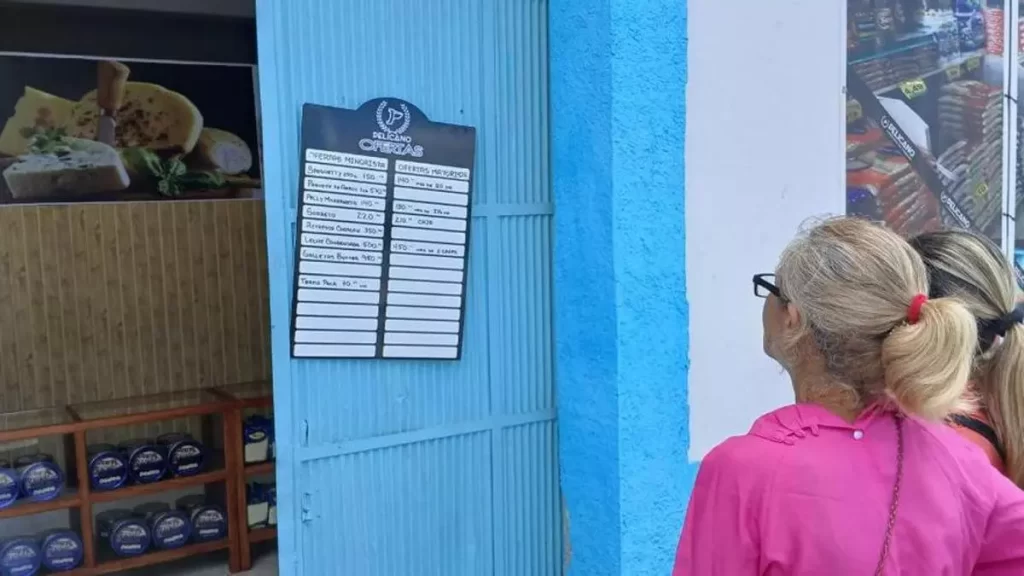
Pelican, a private business in Holguín, this Tuesday / 14ymedio

14ymedio bigger14ymedio, Miguel García/Juan Diego Rodríguez, Holguín/Havana, 9 July 2024 — Curiosity and need come together in the private shops of Holguin, which this Tuesday have had a greater influx of customers than on other days. At the entrance to the premises, a board showed the new prices, which have been capped for basic products since July 8.

In one of the many points of sale visited by 14ymedio, the employees had just learned about the new regulation and changed, in view of the buyers, the numbers written next to each item . Although the oil and pasta were below the new amounts, the powdered milk went above the 1,675 pesos per kilo established by the Official Gazette.

In the kiosk managed by the MSME Bodegón Holguín, the line filling the sidewalk in front of the premises did not respond, however, to any of the six products that have been exempted from taxes on imports and which have capped prices. The crowd, in fact, was waiting to acquire the newly discounted instant soft drink packages, which are mainly intended for the school snack.

The capped price “is not going down because if that’s what’s legally allowed why sell it cheaper?”

This Monday, vegetable oil at 990 pesos per liter was now in line with the new regulation. But the price, instead of satisfying consumers, raised criticism among those who believe that once set at that limit, “it will not go down because if that is what is legally allowed, why sell it cheaper?” asked an elderly woman who arrived at the Bodegón. continue reading

With a pension of 1,420 pesos per month, she can’t benefit from the new prices. “There is a lot of disorganization with this measure. At the Chinese Fair there were several kiosks that have not even heard about it and still have cooking oil at more than 1,000 pesos per liter,” the woman complained. “I found chopped chicken at 370 and 380 pesos per pound in several places; it seems that they have not realized that it’s at 340.

In Havana, the panorama has not been very different. Some central businesses have opted for caution, while several places in El Vedado and the neighborhood of Cayo Hueso did not even have for sale what popular humor has already baptized as “the magnificent six.” Others displayed the new prices on their boards.

The EJT market shelves of 17 and K, in El Vedado, returned to their usual appearance / 14ymedio

On Reina Street, in the municipality of Centro Habana, on Monday the line was extended in front of a private business that announced a pound of chicken at 310 pesos. What was saved in money was lost in time, because the line could take up to two hours between getting a number and accessing the counter. The main cause of the delay, according to an employee, was that “we have to wait for them to bring more supplies.” They were exhausted due to the multiplied demand.

In Havana, the shelves of the Youth Labor Army [EJT] market at 17 and K, which last week appeared surprisingly empty in the face of the confusion due to the entry into force of the capped prices, returned to their usual appearance. However, they didn’t sell chicken. “The chicken is still kidnapped,” an old woman said with a sneer.

The prices in the informal market, through home delivery applications on social media groups that market everything from spaghetti to beef, were the same as a few days ago, unrelated to the new official guidelines.

“The big chicken thighs: I’m not lying. If you want quality, this is your option at 380 pesos per pound and we charge home delivery separately,” said an ad in a WhatsApp thread dedicated to food and cleaning products. In the photo that accompanied the ad you could see a package with the colors of the American flag and three letters: USA.

Translated by Regina Anavy

____________

COLLABORATE WITH OUR WORKThe 14ymedio team is committed to practicing serious journalism that reflects Cuba’s reality in all its depth. Thank you for joining us on this long journey. We invite you to continue supporting us by becoming a member of 14ymedio now. Together we can continue transforming journalism in Cuba.

Close to 40,000 Cubans Applied for Spanish Nationality at the Havana Consulate

As of April, the majority – some 40% – of the 301,121 applications were from Argentina. The Council of Ministers extended the deadline for the procedure by one year.

Cubans line up in front of the Spanish Consulate in Havana. (14ymedio)

14ymedio biggerEP/14ymedio, Madrid, 9 July 2024 — Consulates in Argentina and Cuba account for 50% of the 300,000 applications for Spanish nationality submitted between October 2022 and March 2024 under the Democratic Memory Law, which allows descendants of exiled Spaniards to enjoy this benefit, according to data revealed by the Ministry of Foreign Affairs, European Union and Cooperation. As explained by the Ministry of Foreign Affairs in a statement, since the law entered into force on October 22, 2022 and until March 31, 2024, the Consular Civil Registry Offices had received 301,121 applications for the option of Spanish nationality by origin. In the first year of the measure, according to the data collected at the time by Europa Press, more than 102,000 Spanish nationalities had been granted.

More than 95% of these applications were received at the consulates in Ibero-American countries, as well as at the Consulate General of Spain in Miami. In the specific case of Argentina, the five consulates general in the country accumulated 40% of the applications, and if those received by the Consulate General in Havana are added, the figure rises to 53%. This puts the petitions on the Island at 13% of the total; that is, 39,145 up to that date.

The Council of Ministers authorized this Tuesday, as already announced in February by the Minister of Territorial Policy and Democratic Memory, Ángel Víctor Torres, the extension by one year of the period to exercise the right to qualify for Spanish nationality contained in the eighth additional provision of the Law of Democratic Memory, which gave two years. continue reading

In all consular offices “there are a number of applicants who can’t be summoned and attended to before the end of the planned two-year period”

The Department of Foreign Affairs, headed by José Manuel Albares, has explained that in all consular offices “there are a number of applicants who can’t be summoned and attended to before the end of the two-year period provided for” by law.

For that reason, the Government has decided to extend the deadline by one year “in such a way that all appointment requests already submitted and pending requests can be met, as well as all applications that are submitted and cannot be met in the first two years of application initially provided for in the law,” said Albares.

Specifically, the aforementioned additional provision of the Law of Democratic Memory guarantees that Spanish nationality can be applied for by those born outside Spain to a father or mother, grandfather or grandmother, who would have originally been Spanish, and who, as a result of having suffered exile for political, ideological or reasons of belief or sexual orientation and identity, would have lost or renounced Spanish nationality.

It also includes sons and daughters born abroad of Spanish women who lost their nationality by marrying foreigners before the entry into force of the 1978 Constitution as well as the sons and daughters of legal age of those Spaniards who were recognized for their nationality of origin by virtue of the Historical Memory Law of 2007.

Translated by Regina Anavy

____________

COLLABORATE WITH OUR WORKThe 14ymedio team is committed to practicing serious journalism that reflects Cuba’s reality in all its depth. Thank you for joining us on this long journey. We invite you to continue supporting us by becoming a member of 14ymedio now. Together we can continue transforming journalism in Cuba.