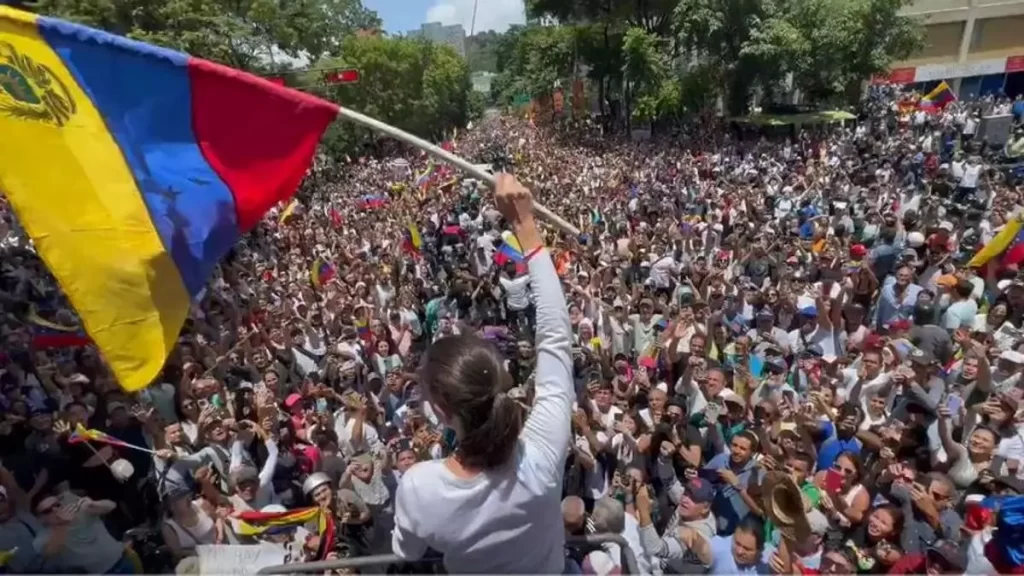

María Corina Machado Comes out of Hiding To Participate in a Demonstration in Caracas

María Corina Machado passed through the streets on a truck and said a few words to the crowd / María Corina Machado/ Instagram

14ymedio bigger14ymedio/EFE, Havana/Caracas, August 3, 2024 — Venezuelan opposition leader María Corina Machado left her hiding place this Saturday, where she had been for security reasons after President Nicolás Maduro threatened the leaders of the opposition with prison.

Machado reappeared standing on a truck that traveled the streets of a neighborhood in the capital, until she reached the demonstration called by the opposition to repudiate the electoral fraud and violence on the part of Maduro, who insists on declaring himself the winner in the July 28 elections.

In her first statements, Machado reiterated the triumph of the opposition and maintained that it had never “been as strong as today,” nor “has the regime ever been so weak,” while facing a crowd gathered on Avenida Principal de Las Mercedes. “We knew that, just as it took us a long time to achieve the electoral victory, we are now entering a new stage that we live day by day,” she added.

She said she was very grateful to all the presidents of Latin America “who have recognized the civic and massive character of the vote on July 28.” In that sense, she stressed that now “these countries and these governments have a great responsibility to maintain the civic and peaceful character of the mobilization.” And she asked them to “make the regime understand that the time for the democratic transition has come, that we are willing to negotiate and give guarantees so that it will be in an orderly, sustainable and peaceful way.” continue reading

Machado arrived at the demonstration that took place in the east of Caracas, along with the anti-chavistas Delsa Solórzano, Juan Pablo Guanipa, María Beatriz Martínez, Biagio Pilieri and Williams Dávila. They are all members of parties that make up the largest anti-chavista coalition, the Democratic Unitary Platform (PUD). However, so far the presence of the coalition candidate, Edmundo González Urrutia, who obtained 70% of the votes according to the ballots compiled by the opposition, has not been confirmed.

“We knew that, just as it took us a long time to achieve the electoral victory, we are now entering a new stage that we live day by day,” said Machado

Thousands of participants shouting “Freedom!”greeted the opposition leaders, led by Machado, after they said that they fear for their lives. In parallel, a caravan of motorized vehicles in support of Maduro rolled from Petare to the center of Caracas.

The protests began in Caracas normally and without notable incidents, despite the large influx of people, both on foot and by motorcycle. The protests have been replicated in the main cities of the country, where, as in the Venezuelan capital, thousands of demonstrators met peacefully and sang the country’s national anthem. Demonstrations are also reported in support of the opposition in other cities around the world such as Bogotá, Madrid and Washington.

In the last few hours, the victory of the opposition candidate has been recognized by seven countries on the continent. In addition, a group of American congressmen presented a resolution on Friday in which they recognize González Urrutia as the legitimate president-elect of Venezuela. The United States also expressed its “solidarity with the Venezuelan people” and condemned the fraud of Nicolás Maduro, who is accused of wanting to “steal the elections” in an attempt to perpetuate himself in power for a third consecutive period.

Demonstrations in support of the opposition are also reported in other cities around the world such as Bogotá, Madrid and Washington

The resolution, signed by Democrats and Republicans, denounces the violent repression that protesters have suffered “for democracy” in recent days. According to the count of the independent Venezuelan press, there have now been 20 killed by firearms at the hands of the regime, which has deployed the National Guard, the Police and the so-called “chavista collectives” in the streets, a kind of rapid-response brigade made up of armed civilians.

The document also advocates new sanctions from the United States Government, headed by President Joe Biden, and greater pressure from the international sphere for Maduro to “accept the will of the Venezuelan people and allow a peaceful transition of power.”

They warned that the United States must strengthen the measures against Maduro, since he is “closely allied” with all of Washington’s “adversaries” 

The initiative was promoted by Florida congressional members Mario Díaz-Balart, of the Republican Party, and Debbie Wasserman Schultz, a Democrat. Both jointly chair the Congressional Committee in favor of Democracy in Venezuela.

“Despite the dominance of Maduro’s totalitarian regime, the Venezuelan people refuse to allow democracy to die. Now more than ever, the United States must strengthen the measures against the dangerous Maduro regime, which is closely allied with all the adversaries of the United States who work against our national security interests,” Díaz-Balart said.

Wasserman Schultz said that on Sunday Venezuelans “valiantly” went to the polls to look for “a true and legitimate representation” after “a decade lost under Maduro,” who has governed the country since 2011, after the death of Hugo Chávez.

The congresswoman regretted that, however, the “brutal narco-regimen” refuses to face reality, despite the clear evidence that demonstrates Maduro’s defeat. The opposition has uploaded the electoral results to the internet, so that anyone can consult them. “Now we have to put pressure on Maduro and his thugs to respect the will of the Venezuelan people or face the consequences,” she added.

The opposition, which has in María Corina Machado a moral leader, continues to receive international support, after several countries, including Argentina, Uruguay, Ecuador, Peru, Panama and Costa Rica also recognized Gonzalez Urrutia as the winner of the elections.

For his part, the Secretary of State of the United States, Antony Blinken, held a call with González Urrutia and Machado this Friday, on the eve of the national protest. Blinken congratulated the standard-bearer of the Democratic United Platform (PUD) for having “received the majority of the votes” and expressed his concern about the “security and well-being” of both him and Machado.

Blinken expressed his concern about the “security and well-being” of both González Urrutia and Machado on the eve of the national protest

Blinken’s call comes on the same day that Machado’s party, Vente Venezuela, denounced a “robbery” of its headquarters during the early hours of the morning, with six armed men, who “subdued” the guards and took equipment and documents. This happened precisely one day after the opposition leader published an article in the American newspaper The Wall Street Journal, where she said she feared for her life. “They might capture me while I’m writing these words,” she wrote.

Through his social networks, González Urrutia called to respond with “hope, harmony and peace” to the “attacks of the regime” of Nicolás Maduro, who accused them of planning an “attack” this Saturday to “destabilize” the country during the national protest they have called in rejection of the result of the elections announced by the National Electoral Council (CNE) this Friday.

“We are in very difficult times, and we can, and must, have the serenity to respond to those attacks with the firmness and hope of a better future,” he said this Friday in a video posted on his Instagram account.

It was through the state channel VTV that Maduro pointed out: “I really thought about it, because we could be revealing a source of information that we have been working on from groups of criminals of the comanditos [little commanders, a pejorative], as they call the political organization groups of the opposition. Some of these groups of comanditos, armed with grenades and other weapons, intend to carry out an attack tomorrow in the area of Bello Monte (in Caracas).”

This came after the CNE, owned by the regime, said again on Friday that the ruling party obtained 51.9% of the vote without presenting evidence. So now, when the election results tallied by the Maduro Government have still not been delivered, fraud in the presidential election is more than a suspicion.

Gutiérrez Urrutia, through a statement, reiterated that the electoral body has the duty to “guarantee the transparency and reliability” of its processes, so he hopes they will “comply with the constitutional and legal obligation to publish the results of the scrutiny, the totals and the audits.”

Translated by Regina Anavy
___________________

COLLABORATE WITH OUR WORKThe 14ymedio team is committed to practicing serious journalism that reflects Cuba’s reality in all its depth. Thank you for joining us on this long journey. We invite you to continue supporting us by becoming a member of 14ymedio now. Together we can continue transforming journalism in Cuba.

Venezuela Demands That Chile and Seven Other Countries Withdraw Their Diplomatic Staff for Election ‘Interference’

Argentine President Milei: “Not even Maduro believes the electoral scam that he celebrates.”

The president of Venezuela, Nicolás Maduro, speaks after being proclaimed president-elect by the National Electoral Council this Monday, in Caracas / EFE

14ymedio biggerEFE (via 14ymedio), Ronald Peña R., Caracas, 30 June 2024 — The Government of Venezuela demanded on Monday from Argentina, Chile, Costa Rica, Peru, Panama, the Dominican Republic and Uruguay “the immediate withdrawal of their representatives on Venezuelan territory,” in rejection of their “interference in and statements” about Sunday’s presidential elections.

Likewise, the Executive of Nicolás Maduro, according to an official statement, decided to “withdraw all diplomatic personnel from the missions” in these seven Latin American countries.

“Venezuela reserves the right to all legal and political actions to enforce respect and to preserve and defend our inalienable right to self-determination,” said the Chavista Government, which “will confront any action that attacks our country’s climate of peace and coexistence.” continue reading

“Venezuela reserves the right to all legal and political actions to respect, preserve and defend our inalienable right to self-determination”

In its pronouncement, the Venezuelan Executive expressed “its strongest rejection of the interference and statements of a group of right-wing governments, subordinate to Washington and openly committed to the most sordid ideological postulates of international fascism, (…) that pretend to ignore the electoral results.”

The National Electoral Council (CNE) officially proclaimed Maduro president on Monday, after he announced on Sunday night that the Chavistas, in power since 2013, won the elections with 51.2% of the votes, the exact same result that he gave when only 80% of the ballots had been counted with more than two million left to count.

Meanwhile, the standard-bearer of the majority opposition, Edmundo González Urrutia, obtained 44.2% of the votes, according to the first and only public report of the CNE, which did not specify which candidates received the 2,394,268 votes that were not reported.

On Monday, the governments of Uruguay, Argentina, Costa Rica, Ecuador, Guatemala, Panama, Paraguay, Peru and the Dominican Republic expressed their deep concern about the development of the presidential elections.

They also demanded a complete review of the results and called for an urgent meeting of the Organization of American States (OAS).

Argentine President Javier Milei wrote on X: “The Dictator Maduro’s insults are flattery for me. They repeat the same grievances of many well-thinking ‘journalists’ of Argentina, whose infantile position allows Maduro’s atrocities to be legitimized. Maduro doesn’t even believe the electoral scam he celebrates. Neither does the Argentine Republic. We do not recognize the fraud; we call on the international community to unite to restore the rule of law in Venezuela, and we remind the Venezuelan people that the doors of our Homeland are open to everyone who chooses to live in freedom.

LONG LIVE FREEDOM!”

President Milei described the results of the presidential elections in Venezuela as an “electoral scam” and ignored the CNE’s announcement.

“Maduro doesn’t even believe the electoral scam he celebrates. Neither does the Argentine Republic,” the Argentinian leader wrote on X.

“We do not recognize the fraud; we call on the international community to unite to restore the rule of law in Venezuela, and we remind the Venezuelan people that the doors of our Homeland are open to everyone who chooses to live in freedom,” added the ultraliberal politician.

He also referred to Maduro’s statements during his speech after the first official results of the elections were known, in which he referred to Milei as a “fascist Nazi,” “sellout” and “coward,” and warned him to “keep his mouth shut.”

Translated by Regina Anavy

____________

COLLABORATE WITH OUR WORKThe 14ymedio team is committed to practicing serious journalism that reflects Cuba’s reality in all its depth. Thank you for joining us on this long journey. We invite you to continue supporting us by becoming a member of 14ymedio now. Together we can continue transforming journalism in Cuba.

Venezuelan Prosecutor’s Office Threatens María Corina Machado by Accusing Her of a Plan To Invalidate the Election Results

Venezuela’s Attorney General, Tarek William Saab, warned that he will be monitoring any act that intends to initiate an escalation of violence

Tarek William Saab said that he appointed two prosecutors for this case / EFE

14ymedio biggerEFE (via 14ymedio), Caracas, July 29, 2024 — The Prosecutor’s Office of Venezuela announced on Monday the opening of an investigation into an alleged plan of people linked to the majority opposition to invalidate the results of the presidential elections, held on Sunday, in which Nicolás Maduro was proclaimed president-elect by the National Electoral Council. In a statement to journalists, Attorney General Tarek William Saab said that yesterday the electoral system suffered a “cyber attack from North Macedonia,” whose intention was to “manipulate the data that was being received” on the votes in more than 15,000 authorized polling places.

“They wanted to invalidate the votes of the automated system,” stressed the prosecutor, who blamed the attack on the opposition leader María Corina Machado, as well as former deputy Lester Toledo and former mayor Leopoldo López, both exiled opponents and members of the Voluntad Popular party.

“They wanted to invalidate the votes of the automated system themselves,” stressed the prosecutor

It is “an attack that slowed down the sending of the votes for scrutiny,” continued Saab, who appointed two prosecutors to investigate the case. He also stressed that the Prosecutor’s Office “will be monitoring any act that intends to initiate an escalation of violence to muddy the democratic celebration” and warned that these actions would constitute crimes that carry penalties of up to 20 years in prison. continue reading

He asked Venezuelans “not to allow themselves to be used in destabilizing agendas that respond to petty interests unrelated to the national interest, which seek the chaos, unrest and suffering of the majority.”

Maduro was formally proclaimed the winner on Monday by the National Electoral Council despite the allegations of the largest anti-chavista coalition, the Democratic United Platform (PUD), which believes that its leader, Edmundo González Urrutia, won the elections with a wide margin.

González Urrutia stated that “all the rules have been violated,” due, among other things, to the refusal of the electoral body to deliver to the PUD the voting results in more than 50% of the centers.

Translated by Regina Anavy

____________

COLLABORATE WITH OUR WORKThe 14ymedio team is committed to practicing serious journalism that reflects Cuba’s reality in all its depth. Thank you for joining us on this long journey. We invite you to continue supporting us by becoming a member of 14ymedio now. Together we can continue transforming journalism in Cuba.
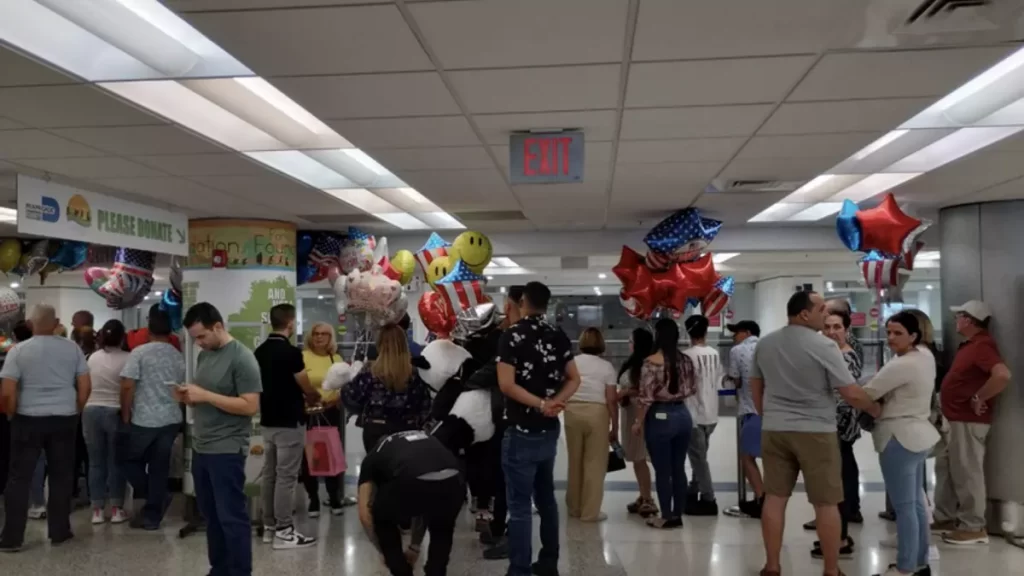
For Fraud, the United States Suspends the Travel Permits of Beneficiaries of Humanitarian Parole

Despite the arrests and deportations, the flow of Cuban rafters does not stop

People greet their relatives at Miami International Airport / 14ymedio

14ymedio bigger14ymedio, Havana August 2, 2024 — The United States temporarily suspended travel permits for those who have received humanitarian parole for alleged “significant levels of fraud.” The US Department of Homeland Security (DHS), according to Martí Noticias, stopped the trips “as a precaution” until the results of a report are clarified and warned of irregularities in the process. Washington must review the irregular requests of the sponsors – which seem to be the crux of the matter – to make sure that the forms for the beneficiaries of parole are in order. The sponsors’ documents contained social security numbers, addresses and telephone numbers that had been used on hundreds of similar applications.

The DHS “has mechanisms to detect and prevent fraud in our immigration processes. We take any abuse very seriously,” an unidentified spokesman for the Department told Martí Noticias. “When a fraud is identified, the ICE (Immigration and Customs Enforcement Service) investigates and takes the cases to the immigration courts, in addition to referring them to the Department of Justice.

“We will restart the processing as soon as possible, with the appropriate safeguards,” the official said. continue reading

“We will restart the processing as soon as possible, with the appropriate safeguards,” the official said.

Since January of last year, the humanitarian parole program has helped 30,000 people a month from Cuba, Haiti, Nicaragua and – since earlier months – Venezuela. As of last May, 105,000 Cubans had received parole, and 98,200 of them had arrived in the United States.

For its part, the American network Fox News said that the U.S. Customs and Border Protection Office (CBP) had stopped issuing travel authorizations to the citizens of Venezuela – currently in political crisis after Nicolás Maduro’s non-recognition of the election results – as of July 6. On July 18, according to a Congressional source cited by Fox News, Haitians, Nicaraguans and Cubans were also left without authorization.

The four countries continue to remain in limbo. In the case of the Island, the situation is critical, and Cubans have not stopped emigrating by air and sea, sometimes with disastrous results. That is what happened this Friday, when the U.S. Border Patrol took into custody 10 rafters who made their journey north on a boat, with registration number HA50363F.

Among the rafters were eight adults and two minors, said Samuel Briggs, head of the Command in the Miami Sector.

Between last Tuesday and this Friday, 43 migrants from the Island disembarked. Of these, 33 were prosecuted for deportation. According to the U.S. authorities, these Cubans were informed that illegal entry into the United States by sea could lead to criminal charges.

Between last Tuesday and this Friday, 43 migrants from the Island disembarked. Of them, 33 were prosecuted for deportation

The rafters “are not eligible to apply for asylum.” In addition, they are prohibited from entering U.S. territory for at least five years. However, the Biden Administration has clarified that deportations “will not apply to legal permanent residents, unaccompanied minors, victims of a serious form of human trafficking and other non-citizens who have a valid visa or other legal permission to enter the United States.”

Briggs highlighted the results of Operation Vigilant Sentry to mitigate illegal migration. In fiscal year 2023, 11,955 rafters were intercepted, he said, without specifying their nationality. “Once on board a coastguard vessel, people are processed to determine their identity; in addition, they receive food, water, shelter and basic medical care before being repatriated to their country of origin,” Lieutenant Cheri-Ann Thompson explained.

The Coast Guard warned about the dangers of illegal sea crossings, risks that increase when there is the formation of a tropical depression, such as the one detected this Thursday. “Regardless of development, heavy rains could cause flash floods in parts of Florida, Cuba and the Bahamas over the weekend,” the agency said on its social networks.

The governments of Havana and Washington maintain a bilateral agreement that stipulates the deportation of all irregular migrants who arrive by sea to U.S. territory. Migrants from the Island continue to flee. According to a recent CBP report, last June 17,563 Cubans arrived in the United States, the lowest monthly number of the current fiscal year 2024 that began last October.

Translated by Regina Anavy

____________

COLLABORATE WITH OUR WORKThe 14ymedio team is committed to practicing serious journalism that reflects Cuba’s reality in all its depth. Thank you for joining us on this long journey. We invite you to continue supporting us by becoming a member of 14ymedio now. Together we can continue transforming journalism in Cuba.

Cuban Freemasons Had To Hand Over Their Cell Phones Before Entering the Meeting With the Communist Party

Gustavo Pardo regrets the “inability of the brotherhood to solve its internal problems”

The Freemasons scheduled an extraordinary session for next September 21 at the Great National Masonic Temple / Supreme Council of Degree 33

14ymedio bigger14ymedio, Juan Izquierdo, Havana, 2 August 2024 — The Communist Party refrained from making decisions this Thursday during the meeting that the head of Religious Affairs of the Cuban Communist Party (CCP), Caridad Diego, held with a group of Freemasons from the capital. Grand Master Mario Urquía Carreño, protagonist of the schism that divides the brotherhood, did not participate in the meeting. Caridad Diego limited herself to declaring that she “did not know anything about what was happening” before a public that had been stripped of their cell phones. She said that the fate of Freemasonry is the responsibility of the Registry of Associations, which depends on the Ministry of Justice.

In contact with several of the participants in the meeting, historian and Freemason Gustavo Pardo informed 14ymedio that the Party and the Ministry of Justice will make decisions about the Freemasons, but from now on “they will follow the guidelines provided by Caridad Diego.” For their part, the Freemasons have scheduled an extraordinary session for next September 21 in the Great Masonic National Temple, located on Reina Street in Havana, with a thorough agenda signed by the secretary of the Grand Lodge, Juliannis Reinaldo Galano.

Among the 54 points to be addressed will be a series of “motions outside the day’s agenda” that could, in Pardo’s opinion, address the heart of the crisis: the authority of Urquía Carreño, accused of the theft of $19,000 from his office and whose successive expulsions and rehabilitations have led to an unprecedented Masonic crisis. continue reading

“On the point related to motions outside the day’s agenda, several measures can be presented that can put Urquía Carreño in an awkward position,” Pardo said in an article published this Friday. He also noted that whatever decision is made by the Registry of Associations, it is up to the Supreme Council of Degree 33 and the Grand Lodge of Cuba – the main Masonic authorities of the Island – to be “governed by their respective laws” instead of blindly complying with the “frank and blatant intervention of the CCP Central Committee.”

With the prohibition on cell phones in the meeting, the Government assured that the disseminated version of what happened is “at the discretion of the state agencies”

For Pardo, who says that the meeting with Diego was carried out “as planned,” the Cuban Freemasons “evidenced their inability to solve their internal problems by applying their own laws” by asking Diego to “solve the problem.” In addition, he points out, with the ban on cell phones in the meeting, the Government assured that the disseminated version of what happened is “at the discretion of the State.”

José Ramón Viñas – leader of the Supreme Council of Degree 33 and accuser of Urquía Carreño – was also not present at this Thursday’s meeting. In addition to this absence, apparently voluntary, the writer Ángel Santiesteban and the independent journalist Camila Acosta, arrested by the Police, did not attend, as they denounced on their social networks.

The extraordinary session scheduled for the end of September serves as a repetition of the one held last March, which the Ministry of Justice declared illegal after the Freemasons tried to remove Urquía Carreño from his position of Grand Master. The state agency then asked that the process be held again, something that Diego highlighted this Thursday when she “made it very clear that the Supreme Council violated the law by not summoning Urquía Carreño to defend himself,” and the Grand Lodge did the same thing with Viñas, said Pardo.

According to the historian, “both judicial processes must be initiated again, with the exception that if the High Chamber” – in charge of the judicial process – “approves the decree that suspends the Treaty (of Friendship and Mutual Recognition between the Grand Lodge and the Supreme Council), Viñas will be facing a very serious event.”

If both Masonic bodies lose their bond, the Supreme Council, led by Viñas, would automatically become an irregular lodge

As Pardo explained to 14ymedio on a previous occasion, if both Masonic bodies lose their bond, the Supreme Council, led by Viñas, would automatically become an irregular lodge. “They don’t even own the place where their offices are located,” he clarified at the time.

“Urquía Carreño is the Grand Master with all the powers granted to him by the Masonic Constitution,” says Pardo. Until his departure from the post is achieved through legal channels, he has the right to stay there. The intervention of the Government, which so far has been on behalf of the Grand Master, does not augur anything good for the Freemasons.

Last week, at least 200 Freemasons from several provinces asked the Grand Master to leave his office and face those who asked for his resignation peacefully. Urquía Carreño’s response was to decree the suspension of three lodges in Havana and another in Artemisa. If the scales tilt in favor of the Grand Master, Pardo fears that the brotherhood on the Island will lose many members. Something similar to what happened in 2010, when it was learned that Grand Master Manuel Collera Vento was actually an infiltrator of State Security.

Translated by Regina Anavy

____________

COLLABORATE WITH OUR WORKThe 14ymedio team is committed to practicing serious journalism that reflects Cuba’s reality in all its depth. Thank you for joining us on this long journey. We invite you to continue supporting us by becoming a member of 14ymedio now. Together we can continue transforming journalism in Cuba.

Cuban Communist Party Summons Masons to a Meeting Seeking to Increase Its Control

The regime takes advantage of the mistake made by the fraternity in its attempt to dismiss the Grand Master

A Masonic march chaired by José Ramón Viñas and other senior officials of the fraternity / Supreme Council of Degree 33 for the Republic of Cuba

14ymedio bigger14ymedio, Juan Izquierdo, Havana, August 1, 2024 — The eyes of the Cuban Freemasons are on the meeting that the members of the fraternity in Havana, including several senior officials, will hold this Thursday with Caridad Diego, the Communist Party’s head of the Office of Religious Affairs. The agenda: mediating the institutional crisis that began in January with the theft of $19,000 from the office of Grand Master Mario Alberto Urquía Carreño, which now threatens to stoke the schism between the two highest Masonic authorities in the country, the Grand Lodge and the Supreme Council of Degree 33.

The mediation of Diego, the eternal apparatchik of the regime in this position, assumes that the Masonic problem is already in the hands of the Communist Party and not of the Ministry of Justice, whose Registry of Associations has failed to resolve the crisis through successive interventions. For the historian and exiled Mason Gustavo E. Pardo Valdés, the Party has a clear objective: to create the image that “the Office of Religious Affairs is conciliatory and is the savior of Masonic unity.”

According to Pardo, several of the Freemasons on the Island believe that the Party will take “advantage and benefit” from the exchange. In any case, he explains, the meeting – which will take place at the headquarters of the provincial government of Havana – will be “very interesting.” “The Freemasons of the capital have been ’invited’ to this meeting. There you will be able to know or intuit who is behind this chaos,” says Pardo. continue reading

Entrenched in his office and with the support of several senior officials who recognize his authority – including his secretary, Juliannis Reinaldo Galano – Urquía Carreño has continued to legislate and issue decrees against the lodges that oppose him. Last week, at least 200 Freemasons from several provinces asked the Grand Master to leave his office and face those who asked for his resignation peacefully. His answer came a few days later.

The schism between the Masonic bodies presided over by Viñas Alonso and Urquía Carreño (left and right, respectively) is getting worse / Grand Lodge of Cuba

Four decrees, signed by Urquía Carreño and ratified by Galano, sanctioned two lodges that refused to accept his authority with a measure of suspension. The lodges are Evolution, in Artemisa, and Carlos Manuel de Céspedes, General Guillermo Moncada and Luz, from Havana.

According to Pardo, Cuban Freemasonry has been shipwrecked for several months due to serious ethical and legal errors of its members, not only of the Grand Master. The four lodges that agreed to the non-recognition of Urquía Carreño acted, in the light of Masonic Legislation, illegally, whatever their intentions.

Pardo defended this opinion in an article published last Sunday, in which he reminded the Cuban Freemasons that they were bound by obedience to the person occupying the Grand Lodge. There were other legal remedies that should have been used to oust Urquía Carreño, and violating the Masonic Code, he emphasizes, only complicates the matter.

“Urquía Carreño is the Grand Master with all the powers set by the Masonic Constitution,” Pardo summarizes. Until his departure from the post is achieved through the legal channels, he has the right to stay there.

Pardo alludes to Title VIII of the Masonic Constitution, which provides that to dismiss a Grand Master it is necessary for no less than 50 lodges to formulate an accusation, which is sent to the president of the Supreme Court of Masonic Justice.

After the Supreme Court analyzes the case, an investigating judge will be appointed, who will take the relevant statements and submit the result to the president of the Court. The decision will have to be approved by at least two-thirds of the members of the Grand Lodge, who will make up the Grand Jury. This process was not respected.

It is not known for sure how many Freemasons support the current Grand Master. In Havana, Pardo explains, there are 111 lodges in which approximately a third of Cuban Freemasons operate. “If you look carefully at the recording of the protest in the Grand Lodge building, you can see that there are 140 to 200 Freemasons, many of them members of the Supreme Council.”

Cuban Freemasonry has a total of 324 active lodges and around 20,000 members

Cuban Freemasonry has a total of 324 active lodges and about 20,000 members. The Supreme Council, for its part, has between 3,500 and 4,000 members throughout the country, according to Pardo. Since 2010, when it was known that Grand Master Manuel Collera Vento was actually an agent of State Security, Freemasonry has lost about 9,000 members. “Now something similar will happen, because it will increase the control of the Party,” he says.

To be part of the Supreme Council a mason must go through the first three degrees – apprentice, companion and teacher – which is what is known as “symbolic” Freemasonry. Those three steps are the foundation of Freemasonry and are under the authority of the Grand Lodge. A Freemason cannot belong to the Supreme Council without being affiliated with the Grand Lodge; hence a schism between both Masonic bodies can be complicated, explains Pardo.

“In fact, if the Grand Master decrees it, the members of the symbolic Freemasonry cannot visit the Supreme Council, and they would not even have temples in which to carry out their work,” he explains.

Among the Cuban Freemasons there are those who have recommended that the Supreme Council definitively separate from the Grand Lodge and constitute a separate Masonic body – what is called the Great East. For Pardo, this path would be a mistake. If the Supreme Council carried out this maneuver, it would become an irregular Great East, which would start on the left foot and not have the slightest recognition by international Freemasonry.

The members of the Supreme Council of Degree 33, chaired by Viñas Alonso / Supreme Council of Degree 33 for the Republic of Cuba

“They don’t even own the place where their offices are located,” says Pardo. “Even the building of the Supreme Council in Jovellar 164, between Espada and San Francisco, belongs to the Washington Lodge, subordinate to the Grand Lodge.” In fact, Pardo observes, when Urquía Carreño suspended the Treaty of Friendship and Mutual Recognition between the two Masonic bodies, he turned the Supreme Council, in practice, into an irregular institution in the eyes of international Freemasonry.

There is one way to oust Urquía Carreño: Masonic Law. That has not been the way that the Supreme Council has chosen. In Pardo’s opinion, the high court has made one mistake after another, starting with the management of the money of the Llansó Masonic Elderly Asylum, whose theft triggered the crisis.

Pardo is blunt: “There was a violation of the Asylum regulations by José Ramón Viñas, who presides over the Asylum and the Supreme Council.” Viñas, who has been in the sight of the State Security for his criticism of the Government, was the one who accused Urquía Carreño of stealing the $19,000. Since then, both senior officials have been in a struggle.

“There was a violation of the Asylum regulations by José Ramón Viñas, who presides over the Asylum and the Supreme Council”

“The Treasury of the Elderly Asylum had the obligation to deposit its funds – both in national currency and in foreign currency – in the corresponding branch of the state bank . Who participated in that violation? Viñas and his governing board, who agreed to deposit the currency in the safe that exists in the Grand Master’s office,” analyzes Pardo.

“Why wasn’t the money kept in the safe of the Grand Treasury? Wasn’t that money the property of the Grand Lodge? Freemasons know that the assets of the institution are managed in the way that best suits the officials in charge of them. But this opened the possibility that Urquía Carreño, who is not a saint, would be used as a scapegoat to unleash the current crisis,” he reflects.

If anything has become clear in the seven months of tension, it is that the problem is no longer just Masonic. The Government has tried to intervene – first from the legal angle, now from the Party – and has arrested or intimidated several Masons opposed to Urquía Carreño, such as the writer Ángel Santiesteban.

Pardo has no doubt that the Office of Religious Affairs and State Security has a large part of the responsibility in the crisis. “Since 1959,” he explains, “infiltration into Freemasonry has been a goal of the State. We now see that this practice is paying off.”

Translated by Regina Anavy

____________

COLLABORATE WITH OUR WORKThe 14ymedio team is committed to practicing serious journalism that reflects Cuba’s reality in all its depth. Thank you for joining us on this long journey. We invite you to continue supporting us by becoming a member of 14ymedio now. Together we can continue transforming journalism in Cuba.

‘Our Patience and That of the International Community Is Running Out,’ the United States Warns Maduro

The Cuban Foreign Ministry demands, in a strident tone, that the “majority support of the people” for Maduro be recognized

Three young people walk with their hands up to avoid being arrested by the members of the Bolivarian National Police in a protest in Caracas / EFE/ Ronald Peña R.

14ymedio bigger14ymedio, Rosa Pascual, Madrid, 1 August 2024 –On the third day, the United States changed its tone on Venezuela. The caution which the Secretary of State, Antony Blinken, expressed after the Venezuelan National Electoral Council (CNE) proclaimed the victory of Nicolás Maduro in the elections of Sunday, July 28, ended this Wednesday, when the White House woke up warning about being fed up waiting for the tally sheets of the vote after going to bed with the request to recognize the opposition’s victory.

“Our patience and that of the international community is running out. We are tired of waiting for the Venezuelan electoral authorities to be honest and publish the complete and detailed data of this election so that everyone can see the results,” said White House National Security Council spokesman John Kirby at a morning press conference.

It was the preamble to the expression of some harsher words by Brian Nichols, in charge of the Department of State for Latin America, before the Permanent Council of the Organization of American States (OAS).

“With the irrefutable evidence based on the voting records, which everyone can see, it is clear [that the opposition] defeated Nicolás Maduro by millions of votes,” said the diplomat. The senior official referred to the electoral tally sheets published by the opposition in which it is observed that, with 81% of the documents provided, between Edmundo González Urrutia and Nicolás Maduro there are almost four million votes in favor of the first. continue reading

“With the irrefutable evidence based on the tally sheets, which everyone can see, it is clear [that the opposition] defeated Nicolás Maduro by millions of votes

“This is not a projection, even if Maduro wins 100% of the votes in the less than 20% of the votes that remain to be published, he could not surpass González,” stressed Nichols, who urged both the Chavista candidate and the other countries “of the world” to recognize the opponent’s victory. “Those who do not do it are allowing Maduro and his representatives to carry out an attempt at massive fraud and disregard for the order of the law,” he added.

However, the OAS, despite everything, did not reach an optimistic conclusion. The member countries did not have the necessary consensus to approve a resolution that asked the Venezuelan authorities to publish “immediately” the tally sheets of the elections. Although there was no vote against, the absence of Mexico and several Caribbean countries, added to the abstention of 11 countries, including Brazil, Colombia and Bolivia, led to the fact that the votes necessary to approve the document in an extraordinary session of the Permanent Council were not obtained.

The representatives of the member countries negotiated the document for more than five hours, but it was impossible to agree on a wording that everyone could accept. The resolution requested only that a “comprehensive verification” of the results be carried out “in the presence of independent observer organizations to guarantee the transparency, credibility and legitimacy of the results,” which had already been requested by “the relevant Venezuelan political actors.”

According to diplomatic sources, several countries that abstained asked to delete this last part, and others – such as Panama and Peru – opposed the deletion. Faced with that situation, unanimity was impossible.

Colombia’s abstention generated a wave of internal criticism from former Colombian presidents and politicians, who accused the Government of Gustavo Petro of being “an accomplice” of the “fraud,” which forced explanations from its foreign minister. Luis Ernesto Vargas pointed out that Venezuela has no representation in the OAS, so it would only be a “salute to the flag.” Bogotá, in addition, considers that the statements of the Secretary General, Luis Almagro, prevents the OAS from being an “impartial” organization.

This position is the same as that offered by Mexican President Andrés Manuel López Obrador for not attending the meeting. Both countries are, along with Brazil, in dialogue with Chavismo “to create the necessary conditions and seek an agreement for coexistence and political peace,” according to the Foreign Minister. Other diplomatic sources say that the United States is working with these countries to find a negotiated way out for the regime. “This is the most important and difficult political operation of this century in America,” a participant in the talks told El País.

Colombia, Brazil and Mexico, along with the United States, are looking for a negotiated exit for the regime. “This is the most important and difficult political operation of this century in America,” say sources close to El País

This Wednesday, Argentina, Canada, Chile, Costa Rica, Ecuador, El Salvador, the United States, Guatemala, Guyana, Haiti, Jamaica, Panama, Paraguay, Peru, the Dominican Republic, Suriname and Uruguay voted in favor of the resolution. Antigua and Barbuda, the Bahamas, Barbados, Belize, Bolivia, Brazil, Colombia, Granada, Honduras, Saint Kitts and Nevis, and Saint Lucia abstained. Dominica, Mexico, Saint Vincent and the Grenadines, and Trinidad and Tobago did not participate in the session.

Cuba, which also does not belong to the OAS, made a public statement through its Ministry of Foreign Affairs in which it accuses the OAS of a lack of “moral or legal authority to resolve matters that only concern Venezuelans.” The text denounces the “long history of the OAS in the service of American imperialism,” its interference in the internal affairs of sovereign states and its support for “coups d’état, military dictatorships, repression and torture.”

The Cuban Foreign Ministry emphasizes that the “dignified attitude of a group of countries prevented the interference document from being approved,” but when mentioning that “the Venezuelan people decided to maintain their majority support for the option founded by Commander Hugo Chávez Frías” it ignores that it is left alone in closing ranks with a Chavismo that it desperately needs, if only for the oil.

The isolation is so great that Argentina also adhered to the almost universal position among the international left. The Union for the Argentine Homeland issued a statement in which it considered “the publication of the election tally sheets essential” and pointed to Maduro as responsible “for ensuring that the scrutiny is transparent with the corresponding counting of votes and display of the tally sheets before national and international observers.”

Also in Spain there was a movement of position by the left closest to Maduro, especially from the political parties Podemos and Izquierda Unida (IU), which went from demanding immediate recognition of the official results on Monday to adhering to the Colombian position and demanding “transparency in the results.”

“Let everything be done with transparency,” said the general secretary of Podemos who demanded the publication of “all the tally sheets,” but at the same time denounced the “Venezuelan right” for making an “openly pro-coup” speech. The federal coordinator of IU, Antonio Maíllo, valued the position of the president of Colombia as a “sensible” proposal. “It’s a good way without a doubt. From the standpoint of friendship of the peoples and looking at the common good.”

“It’s a good way without a doubt. From the standpoint of friendship of the peoples and looking at the common good,” said the coordinator of Izquierda Unida

The members of the G7 (four European countries, the United States, Canada and Japan) also urged Maduro yesterday to “publish the detailed electoral results with total transparency,” and expressed gratitude to González Urrutia, for “his solidarity with the people of Venezuela and his call for the publication of the detailed electoral results.”

“From all corners of the world, they support the legitimate demand of Venezuelans to respect their decision to change in peace,” added the Democratic United Platform (PUD), as well as calling for the protection of María Corina Machado, whom Maduro wants imprisoned.

“If you ask me my opinion as a citizen, I tell you that those people should be arrested, behind bars, and there has to be justice in Venezuela,” said the head of state at a press conference.

“They should, instead of hiding, appear before the Prosecutor’s Office and show their faces, instead of fleeing like cowards and continuing to incite their criminal groups to insurrection,” Maduro added, despite the fact that neither of the two opponents is in hiding anywhere, since this Tuesday they led massive demonstrations in Caracas.

The president also asked, before a gathering of supporters, that citizens denounce those who participate in the protests for “altering public order.” “We are going to open a special window of the VenApp page, which we use for the 1×10 of the Good Government, at page 58. It will be opened for the entire Venezuelan population so that they can confidentially put in the data of all the criminals who have threatened the people, who have attacked the people, to go for them, so that there is prompt justice.” Although a multitude of opponents claim to have managed to get Google and Apple to suspend the service, there is still no evidence that the option was enabled yesterday, despite the unverified videos circulating.

The president also asked, before a gathering of his supporters, for citizens to denounce those who participate in the protests for “altering public order”

The Government describes the demonstrators as “terrorists” and has already arrested more than 1,200 people, according to official figures. The Bolivarian National Guard (GNB) affirmed, without providing evidence, that those people were “trained for some time” in Peru and Chile, and also in “Texas” and “Colombia,”with the aim of going to Venezuela to “attack and burn, which is terrorism.”

In an effort to delegitimize those who denounce the fraud, Chavismo has been forced to open the political arc of the “fascist right,” in which it now includes the Argentine president, Javier Milei – who is accused of saying “stupidities” – and his Chilean counterpart, Gabriel Boric, who is considered left-leaning.

“We don’t care what you say,” said Diosdado Cabello, number two of Chavismo, in his TV program Con el mazo dando. On the program he spoke out mainly against Boric, whom he called “idiot,” “dummy,” “crooked” and”sellout,” as well as “very sad puppy of imperialism.”

Translated by Regina Anavy

____________

COLLABORATE WITH OUR WORKThe 14ymedio team is committed to practicing serious journalism that reflects Cuba’s reality in all its depth. Thank you for joining us on this long journey. We invite you to continue supporting us by becoming a member of 14ymedio now. Together we can continue transforming journalism in Cuba.
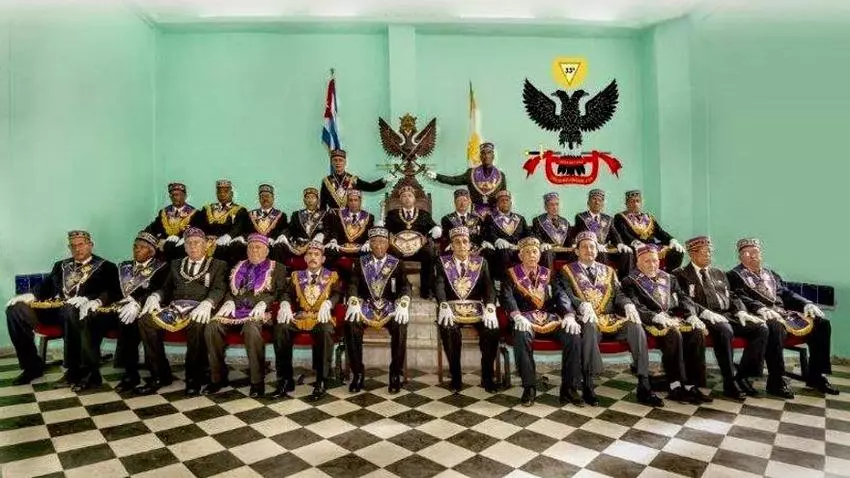
Cuba Confirms the Presence of the Oropouche Virus in Its 15 Provinces

The Deputy Minister of Health pointed out that, for the first time, the simultaneous circulation of two arboviruses has been detected in the country during the summer season.

Among the main transmitters of the Oropouche virus is the ’Culex’ mosquito / 14ymedio

14ymedio biggerEFE/14ymedio, Havana, 1 August 2024 — The cases of the Oropouche virus, which is transmitted through the bite of a mosquito, have spread to the 15 provinces of Cuba, the Ministry of Public Health reported on Wednesday on state television. The Deputy Minister of Public Health, Carilda Peña, pointed out that, for the first time, the circulation of two arboviruses (transmitted by mosquitoes) has been detected in the country during the summer season: dengue and Oropouche.

She also indicated that both have a very similar evolution in patients who go to health services and, in the case of Oropouche, she pointed out that very little is known about the aftereffects.

The first cases of the Oropouche virus were confirmed at the end of last May in two municipalities of Santiago de Cuba, and at that time more than 35,000 infections had been recognized.

One month later, the authorities activated the health system due to the increase in cases of dengue, whose transmitter agent is the Aedes aegypti mosquito, and Oropouche, which arrives via the Culex mosquito of the Bunyaviridae family, but also via the Culicoides, popularly known in Cuba as the jején (gnat). continue reading

Durán stated that until that moment all the identified cases had evolved in a “favorable” way with an improvement in symptoms between the third and fourth day of the disease

Oropouche had then been detected in 23 municipalities, but at the beginning of July, the director of Epidemiology of the Ministry, Francisco Durán, said that it was already circulating in 39 municipalities of 12 provinces and that the only territories without confirmed cases were Havana, Pinar del Río and Las Tunas, in addition to the special municipality of Isla de la Juventud.

Durán stated that until that moment all the identified cases had evolved in a “favorable” way with an improvement in symptoms between the third and fourth day of the disease.

So far this year, Oropouche fever has now been detected in Bolivia, Colombia, Peru and Brazil. To date, according to the Pan American Health Organization, no serious and critical cases or deaths have been reported, however the Ministry of Health of Brazil reported two deaths related to this virus on July 25.

Translated by Regina Anavy

____________

COLLABORATE WITH OUR WORKThe 14ymedio team is committed to practicing serious journalism that reflects Cuba’s reality in all its depth. Thank you for joining us on this long journey. We invite you to continue supporting us by becoming a member of 14ymedio now. Together we can continue transforming journalism in Cuba.

Cuba Receives 32 Rafters Returned by the United States for a Total of 899 From Several Countries in 2024

The United States estimates that if the pace is maintained, by the end of the fiscal year some 245,000 Cubans will have entered.

The governments of Havana and Washington have a bilateral agreement so that all migrants who arrive by sea on U.S. territory are deported to the Island / EFE

14ymedio biggerEFE (via 14ymedio), Havana, August 1, 2024 — Cuba received this Wednesday 32 irregular migrants returned by the United States Coast Guard Service (USCG), which now totals 899 deported to the Island from different countries in 56 returns so far in 2024, official media reported. This new group is made up of 26 men and six women who had participated in an illegal exit from the country and were later intercepted by the US Coast Guard.

After their arrival at the port of Orozco, in the western province of Artemisa, an investigation was initiated against one of the rafters “for allegedly having committed a crime,” according to a statement from the Ministry of the Interior.

The governments of Havana and Washington have a bilateral agreement for all migrants arriving by sea on US territory to be returned to Cuba. continue reading

The governments of Havana and Washington have a bilateral agreement for all migrants arriving by sea on US territory to be returned to Cuba

Deportation flights were also resumed in April 2023, mainly for people considered “inadmissible” after being held at the U.S. border with Mexico.

According to a recent report by the U.S. Customs and Border Protection Office (CBP), in June there were 17,563 Cubans who arrived in the United States, the smallest number during a calendar month of the current fiscal year 2024 that began last October.

According to the data, there are now 180,925 Cubans who have entered the United States in the last nine months, and if this pace is maintained, at the end of the fiscal year (September 2024), there will be 245,000 Cubans who have entered.

Since the beginning of the year, Cubans have also been returned on commercial flights from the Cayman Islands, the Bahamas and the Dominican Republic.

In the last three years, Cuba has recorded an unprecedented migratory exodus both for the volume of migrants and the prolonged time period due to the serious economic crisis on the Island, with frequent and prolonged power outages, shortages of food, medicines and fuel, galloping inflation and a partial dollarization of the economy.

Translated by Regina Anavy

____________

COLLABORATE WITH OUR WORKThe 14ymedio team is committed to practicing serious journalism that reflects Cuba’s reality in all its depth. Thank you for joining us on this long journey. We invite you to continue supporting us by becoming a member of 14ymedio now. Together we can continue transforming journalism in Cuba.

Concerned About the Risk of a New Exodus of Venezuelans, Colombia Asks for ‘Transparency’

The crisis for several countries of the continent has been exacerbated. Mexican President López Obrador sees no “evidence of fraud” and criticizes the “interventionism of the OAS.”

Gustavo Petro accused the United States of maintaining an “inhuman blockade” against Venezuela /EFE

14ymedio bigger14ymedio, Havana, July 31, 2024 — The president of Colombia, Gustavo Petro, who had taken care to make statements about last weekend’s Venezuelan elections, finally expressed his official position on Wednesday. Although he calls for “transparent scrutiny,” the president is ambivalent on other key issues, but he did make it clear that “anything that happens in Venezuela will affect Colombia.”

So far, Petro’s government, through its Foreign Minister Luis Gilberto Murillo, has refused to recognize any victory, either of the opponent Edmundo González Urrutia or of the current president, his political ally, Nicolás Maduro. Likewise, Murillo requested a review of the ballots and an audit of the results declared by the National Electoral Committee of Venezuela (CNE). However, the voice of the Colombian president, who during his term has guided a rapprochement with Caracas, was missed.

“The serious doubts that are established around the Venezuelan electoral process can lead the people to a deep violent polarization with serious consequences of division,” were the first words that Petro wrote on his X account, while calling on the neighboring Government to respect, with transparency, the result of the elections “whatever it is.” continue reading

“We respectfully propose to reach an agreement between the Government and the opposition that allows maximum respect for the party that has lost the elections. Such an agreement can be delivered as a Unilateral Declaration of State to the United Nations Security Council,” he added.

“We respectfully propose to reach an agreement between the Government and the opposition that allows maximum respect”

“I invite the Venezuelan Government to allow the elections to end in peace by allowing a transparent counting of ballots and a scrutiny of all the political forces of the country, with professional international oversight,” said the president, who did not miss an opportunity, however, to point out the “blockade” of the United States as “an anti-human measure that only brings more hunger and more violence than already exists and promotes the mass exodus of peoples.”

The concern about the mass migration of Venezuelans is a subtle constant in the president’s statement. Colombia has been affected in recent years by the stampede of those fleeing Chavismo.

“Free people know how to make their decisions,” is the point of Petro’s statement, and what shows the measure of their loyalty, even if they fall back on neutrality, is the hope that Chavismo will accept its “great responsibility” to remember the spirit of Chávez and allow the Venezuelan people to return to tranquility so that the elections end calmly and a transparent result is accepted.”

The statement – extremely careful – of the Colombian president, however, contrasts with that of other countries allied with Caracas, such as Cuba and Nicaragua, which did not hesitate to congratulate Nicolás Maduro for a re-election that many States of the continent and international organizations consider “fraudulent,” or that have remained on the sidelines, such as Mexico, which does not “see signs of fraud” but is waiting for definitive results.

Colombia awaits a response from Venezuela, which has asked for the withdrawal of diplomatic personnel from several countries that have doubted Maduro’s true victory, including Argentina and the Dominican Republic.

Much more critical positions have been taken by other governments in the region, such as Peru, which reiterated on Wednesday that the multiple irregularities committed in the Venezuelan elections constitute “an authentic electoral fraud.” Peru has now received a diplomatic note from Venezuela that finalizes the official decision to break diplomatic relations.

One day earlier, Dina Boluarte, President of Peru, recognized González Urrutia as the president-elect of Venezuela

One day earlier, Dina Boluarte, President of Peru, recognized González Urrutia as the president-elect of Venezuela, which the Peruvian Foreign Ministry defended again today, explaining that its commitment to protect democracy is “inescapable.”

In a statement released by the Ministry of Foreign Affairs on X, the President indicated that Peru is coordinating with like-minded countries for the protection of its interests and Peruvians in Venezuela, in accordance with the provisions of the Vienna Convention on Diplomatic Relations. Likewise, she said that she will continue to make efforts to serve the Venezuelan community that resides in Peru, estimated at 1.5 million people.

For his part, the acting president of Mexico, Andrés Manuel López Obrador, is still waiting for the results, although on Wednesday he stated that “there is no evidence” that electoral fraud has been committed in Venezuela. He also questioned the Organization of American States (OAS) for its “interventionism.”

“We’re going to wait. I think that evidence has to be presented, the ballots, and I think they must have a record, even if it’s been carried out electronically. I believe that in the procedure there are ballots, there are data to know what happened,” the president said during his morning conference.

He also said that the Mexican Foreign Minister, Alicia Bárcena, will not participate in the meeting convened by the OAS because she does not agree with the organization’s attitude toward the Venezuelan elections. “Why are we going to a meeting like this? That is not serious, it is not responsible,” he emphasized. López Obrador also demanded the end of “interventionism,” the cause – according to him – of the “stagnation” of Venezuela and its problems.

Even the Carter Center, which participated as an observer in the Venezuelan elections after being selected by the ruling party itself, said on Tuesday that the process “did not fit” the international parameters and standards of electoral integrity. The organization, whose delegation left the country before issuing its statement and will present its detailed report in the coming days, was categorical in the advance of its conclusion: the election “cannot be considered democratic.”

“The Carter Center cannot verify or corroborate the authenticity of the results of the presidential election declared by the CNE of Venezuela,” it added. The organization stressed that the entity has not announced the results disaggregated by table, which “constitutes a serious violation of electoral principles. The process has not reached the international standards of integrity in any of its relevant stages and has violated numerous precepts of the national legislation itself.”

Venezuela also has strained relations with Argentina, whose embassy in Caracas is harboring six opponents as refugees since March 26. As those received at the headquarters denounced on Wednesday, Maduro’s “regime security officials” continue being on the outskirts with troops and “seek to take this diplomatic headquarters.”

“We alert the diplomatic corps accredited in the country about this serious violation of international law,” Pedro Urruchurtu, international coordinator of the opposition party Vente Venezuela (VV), said on X.

This is the second time that Venezuelan officials have surrounded the diplomatic headquarters

This is the second time that Venezuelan officials have surrounded the diplomatic headquarters, since, according to Urruchurtu, this Monday a group of police officers also intended to “take” the residence but then left, faced with the arrival of hundreds of supporters of the opposition leader María Corina Machado, in support of the asylum seekers.

Urruchurtu denounced that, since this morning, the presence of “patrols and regime officials in the surroundings” of the headquarters is being repeated, while the residence has had a “power cut” since Tuesday, something that the Government of Argentina described as “harassment.”

Meanwhile, the mood in the streets remains heated. As reported on Wednesday by Attorney General Tarek William Saab, at least 1,062 people have been arrested in the protests carried out by Venezuelans for several days after the CNE granted the victory to Maduro.

Translated by Regina Anavy

____________

COLLABORATE WITH OUR WORKThe 14ymedio team is committed to practicing serious journalism that reflects Cuba’s reality in all its depth. Thank you for joining us on this long journey. We invite you to continue supporting us by becoming a member of 14ymedio now. Together we can continue transforming journalism in Cuba.

Fined 20,000 Pesos for Filming and Disseminating on Social Networks the Theft of Potatoes in a Field

Norberto Muñoz was fired from his job as an agricultural worker in Artemisa and had to hand over his cell phone to the Police.

The crops that characterize that area of Artemis are potatoes, bananas and legumes / Invasor

14ymedio bigger14ymedio, Havana, July 31, 2024 — Filming a video and uploading it to social networks has cost Norberto Muñoz Palomino a fine of 20,000 pesos, his job and the loss of his cell phone, which has been held for weeks by the Alquízar Police, in the province of Artemisa. The images transmitted by this resident of the community of Pulido, last February, showed a group of people looting a potato field.

In the video, published on Facebook, one can see the long furrows of potatoes belonging to a state company and dozens of area residents filling sacks with potatoes and taking them away. “Man, look at that, people ran into the field, and there is no one to stop them,” says the man posting the video.

Muñoz Palomino also adds that “they are so hungry, not even the special brigade is stopping them,” alluding to the troops of the National Special Brigade of the Ministry of the Interior, also known as “black berets.” The short film was quickly disseminated on social networks, independent news media and channels in South Florida. In a few hours, thousands of Internet users had seen the images.

“Shortly after that I was summoned by the police,” Muñoz Palomino tells 14ymedio. After an interrogation in the Alquízar Police Unit, he was fined 20,000 pesos under Decree Law 370 that allows the authorities to sanction social media users for the opinions they express or the content they disseminate. The agents also kept his cell phone and so far have not returned it. continue reading

“It’s been a hard blow because now I have been left incommunicado and without a job,” says Muñoz Palomino, who adds that after the incident he lost his contract in the state company and nobody in the area wants to hire him as an agricultural worker, a job he performed when he filmed the scenes of the potato theft. In the town of Pulido, on the outskirts of the city of Alquízar, the chances of earning a living, beyond the countryside, are scarce.

With a long and narrow street, Pulido has traditionally been a village of farmers, and after the nationalization of most of the land around it, its inhabitants work mainly in the Basic Cooperative Production Units of the area. The crops that characterize that part of Artemisa are potatoes, bananas, legumes and also garlic and onions.

The inhabitants of the town have been forced to seek their livelihoods in other municipalities

The nearby Pre-University Institute in the Socialist Republic of Romania Field, which in the 80s and 90s was also a source of employment for the residents of Pulido, ceased to function almost 20 years ago as a teaching center. The inhabitants of the town have since been forced to seek their livelihoods in other nearby municipalities such as Güira de Melena or in the municipal capital, Alquízar.

“Not being able to have a job here is a condemnation,” Muñoz Palomino tells this newspaper. In addition, he has already had to pay the 20,000 pesos of the fine to avoid the amount “accumulating and being greater.” That amount of money approaches half a year of the salary he earned as an agricultural worker. He sums up his annoyance: “Just for showing the truth; I didn’t deceive anyone.”

Now, his hope is that they will return his cell phone as soon as possible, but the police have told him that the device is being analyzed to “review its content and the contacts” that Muñoz Palomino has stored on his cell phone. Meanwhile, to communicate, he appeals to family and friends, but he is still unemployed.

Translated by Regina Anavy

____________

COLLABORATE WITH OUR WORKThe 14ymedio team is committed to practicing serious journalism that reflects Cuba’s reality in all its depth. Thank you for joining us on this long journey. We invite you to continue supporting us by becoming a member of 14ymedio now. Together we can continue transforming journalism in Cuba.

The Tobacco Growers of Sancti Spíritus Violate the Golden Rule of the Cigar

Three companies want to accelerate the curing of the leaf with solar heaters to increase production

The province wants to speed up the curing of the leaf to increase cigar production / Escambray

14ymedio bigger14ymedio, Juan Izquierdo, Havana, 31 July 2024 — Sancti Spíritus has initiated a series of tobacco “experiments” that violate the golden rule of the cigar: never produce it in mass. The idea – supported by an “unpublished investment” of the monopoly Habanos S.A. – is to enhance the controlled curing of the leaf, a euphemism that hides accelerated production by artificial means.

The curing process, which normally requires between 45 and 55 days, will now take only one month. Three producers from the municipality of Cabaiguán – the tobacco-growing territory par excellence in the center of the country – are the “pioneers” of the new process, which aims, even if the official press does not mention it, to remedy the terrible results obtained by the province last year, the worst in its productive history. Only one-sixth of the tobacco that was harvested was good enough for export.

Now, and against the basic rules of a crop where there are no short cuts to achieve excellence, the province wants a quick curing of the leaf for more cigars and better quality. The “new project” has solar heaters to accelerate the drying, which Escambray celebrates because Habanos S.A. also paid for them as a strategy to “reduce the consumption of electricity and fossil fuel.” continue reading

The province’s Communist Party newspaper admits that the investment still has no “use value”

The first signs of failure are already there: the province’s Communist Party newspaper admits that – although they have been experimenting with this method for two years – the investment still does not have “use value” and that not a single cigar has been exported with the new method, although the producers say that there is “a high degree of progress” in the project’s infrastructure.

To recover the status of “leading territory” of the cigar, along with Pinar del Río, is the aspiration of the three state producers who have benefited from the investment. Yoandi Rodríguez, Aniskyn de la Cruz and Nelson González intend, in their words, to “bring technology closer to the field.”

“The cigar is less damaged” than when it dries naturally – a process with several centuries of implementation – argue the producers, who promise to increase the amount of exportable leaf. However, the result has to go through the review of the experts and Cuba’s very demanding international customers, who quickly detect any drop in the quality of a product that is very expensive.

The producers centralized the whole process in their cooperatives, from planting to curing

The producers centralized the whole process in their cooperatives, from the planting to the curing, drying and picking of the leaf that is then sent to province’s factories. Sancti Spíritus has tried to improve the fast-track production numbers at any cost, given that the regime chose the province as the venue of the July 26 events and the harvesters were required to be “up to the task” of the “honor.”

This was the case of the Roberto Rodríguez Cigar Factory for Export, which produced 4,000 cigars a day – 96,000 units a month – during the first quarter of 2024. The Roberto Rodríguez takes care of the premium cigars that Sancti Spíritus delivers to Habanos S.A., which end up in the luxury humidors of Spain, China, the United Arab Emirates and the United Kingdom.

Its principal brands are Cohiba, Montecristo, Romeo and Juliet, Partagás, Rey del Mundo, Bolívar, San Luis and Trinidad, the cigar “invented by Fidel Castro” that the regime has vigorously promoted this year.

Roberto Rodríguez’s tobacco growers are paid 27,000 pesos per month – in April there were 40,000 – thanks to the fact that international sales skyrocketed by “180%,” its director alleged. The money has contained the “fluctuation of the workforce,” as the official called the stampede of state workers that characterized 2023. Now the factory staff is “almost covered.”

Translated by Regina Anavy

____________

COLLABORATE WITH OUR WORKThe 14ymedio team is committed to practicing serious journalism that reflects Cuba’s reality in all its depth. Thank you for joining us on this long journey. We invite you to continue supporting us by becoming a member of 14ymedio now. Together we can continue transforming journalism in Cuba.
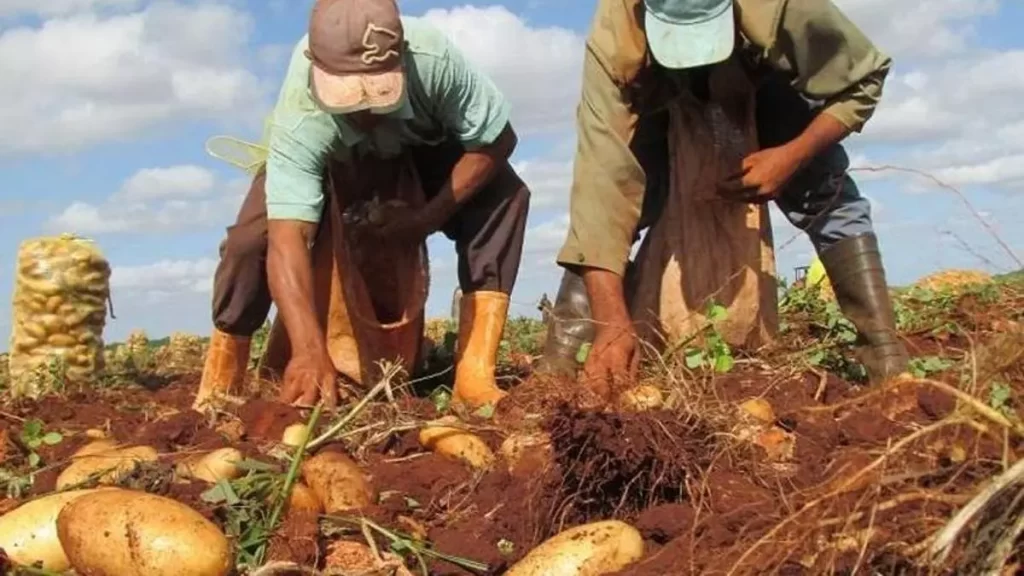
Protests in Venezuela Against Electoral Fraud Increase While Havana Supports Maduro

  • The number of deaths in the protests against the electoral result has now risen to 11, according to an NGO
  • Most countries on the continent and the EU insist that without the verified ballots, the victory that Maduro proclaims will not be recognized
Several statues of Chávez were demolished this Monday in Venezuela. / EFE

14ymedio biggerEFE (via 14ymedio), Madrid/Caracas, July 30, 2024 — The disputed official results of the presidential elections in Venezuela, which grant victory to President Nicolás Maduro, resulted in protests in Caracas and several regions of the country this Monday. Several have been repressed by the military, while the majority opposition ratified “the victory” of its candidate, Edmundo González Urrutia, with 70% of the votes.

Within the framework of the demonstrations, a total of 11 people have died, according to the non-governmental organization Foro Penal, which leads the defense of political prisoners in the country.

Of the total, five were “murdered” in Caracas, two in the state of Zulia (northwest), two in Yaracuy (west), one in Aragua (north) and one in Táchira (west). Two of them were minors, aged 15 and 16 years old, said Foro Penal, Justicia, Encuentro y Perdón (JEP), Provea y Laboratorio de Paz at a press conference.

The total for the protests is six deaths and 749 detainees who face various charges, including that of “terrorism”

Meanwhile, at least 749 people have been arrested in Venezuela. The Attorney General, Tarek William Saab, offered an assessment of the performance of the security forces within the framework of these demonstrations, which also resulted in 48 injured police and military personnel.

Saab did not talk about the injuries suffered by the demonstrators who were repelled with tear gas and battering rams, according to the EFE agency in the Venezuelan capital. In his opinion, the arrested demonstrators are “criminals” who did not participate in peaceful protests but generated violence. They are accused of the crimes of public instigation, obstruction of public roads, incitement to hatred, resistance to authority and, “in the most serious cases, terrorism.” continue reading

The Minister of Defense of Venezuela, Vladimir Padrino López, denounced a coup d’état “forged again” by “fascist extremist right-wing factors,” alluding to the protests. He says that the alleged coup d’état is supported “by imperial factors, American imperialism and its allies.”

In the country, sleepless due to the late announcement of the first bulletin, the demonstrations began after noon, especially after the National Electoral Council (CNE) proclaimed Maduro president, in power since 2013. He received, according to CNE, 51.2% of the votes, compared to 44.2% for González Urrutia.

EFE noted the passage of hundreds of motorcyclists through one of the main avenues of Caracas, the vast majority coming from Petare, the largest favela [slum] in the nation, some of whom dragged posters of Maduro’s campaign with the face of the Chavista leader. At the same time that there were multiple protests in other areas of the capital, as well as in 20 states, according to NGOs.

The anti-chavista leader María Corina Machado, González Urrutia’s main supporter, said that the protests were “spontaneous and legitimate expressions” of a people whose “future was being stolen by an illegitimate regime.”

In Caracas, citizens chanted slogans such as “You see, you feel, Edmundo is president,””Maduro we don’t love you” and “I don’t want bonuses, I don’t want CLAP (subsidized food distribution program), what I want is for Nicolás to leave,” among others.

Several people told EFE that the authorities have “stolen the elections,” which is why they decided to leave their homes to express their discontent.

“We are claiming our rights; the elections were won by Edmundo González together with María Corina Machado, and it turns out that the elections have been stolen once again in the country. We are now tired of that. We have children, we have grandchildren, boys who are studying, who will never get ahead with this Government,” said an elderly man.

EFE confirmed that troops of the Bolivarian National Guard (GNB) and the Bolivarian National Police used tear gas and fired buckshot

EFE found that members of the Bolivarian National Guard (GNB) and the Bolivarian National Police used tear gas and fired buckshot at the demonstrators who were peacefully protesting in an area of Caracas until the arrival of the troops, who arrested twenty of them.

During the day, in addition, at least four statues of the late President Hugo Chávez (1999-2013) were demolished.

Maduro, for his part, denounced “criminal” and “terrorist” acts, for which he blamed the majority opposition, grouped under the Democratic United Platform (PUD). He said that dozens of people involved in these actions have been arrested, which included – he pointed out – attacks on members of the Bolivarian National Armed Forces (FANB). According to the Government, at least 23 soldiers were injured.

González Urrutia promised Venezuelans that “the will expressed through their vote” will be “respected,” because “that is the only path to peace.”

“We have in our hands the ballots that demonstrate our categorical and mathematically irreversible triumph,” said the former ambassador, who thanked the international community for its solidarity and support.

Machado said that the majority opposition managed to obtain 73% of the votes cast in the presidential elections, which give, he said, the victory to González Urrutia, with an “overwhelming ” difference, contrary to what was announced by the CNE.

The former deputy indicated that, according to the percentage of ballots available to them, Maduro obtained 2,759,256 votes, while González Urrutia 6,275,182, and “they lost.”

Diplomatic sources cited by the newspaper O Globo claim that Maduro has promised the former Brazilian foreign minister, Celso Amorim, international adviser to the Brazilian president, Luz Inácio Lula da Silva, that he “will deliver the (electoral) ballots in the coming days.”

Maduro has promised the former Brazilian Chancellor, Celso Amorim, international advisor to the Brazilian president, Luz Inácio Lula da Silva, that he will “deliver the (electoral) ballots in the coming days”

Amorim, who has been in Caracas since Friday as an observer from Brazil, said before a meeting he had yesterday with Maduro, that he is “uncomfortable” with the possible lack of “transparency” of the process.

“I don’t necessarily doubt what is being said, but the (Venezuelan) Government said that it would supply all the ballots” from which Maduro’s victory has resulted, and “that has not yet happened,” said Amorim, who will be in the Venezuelan capital at least until this Tuesday and who also planned to meet with María Corina Machado.

Lula’s government emphasized that only when all the results are known will he pronounce on the victory attributed by the electoral authorities to Maduro.

For his part, Joe Biden will speak this Tuesday with Lula about the situation; the United States has expressed its doubts about the result. “By declaring a winner without the support of detailed ballots by district, the representatives of (Nicolás) Maduro have lost any credibility they might have about the alleged election results,” a senior U.S. official said in a call with journalists.

It’s the same position taken by the European Union, reiterated on Monday night by its chancellor, Josep Borrell, who pointed out once again that the results “have not been verified and cannot be considered representative of the will of the Venezuelan people until they are published and confirmed.”

The head of European diplomacy urged the CNE of Venezuela to “act with maximum transparency in the process of tabulating the results, including immediate access to the voting ballots of all the polling stations and the publication of the disaggregated electoral results.” According to Borrell, there are “reliable reports from national and international observers indicating that the elections were tarnished by numerous failures and irregularities.”

Meanwhile, the Governments of Uruguay, Argentina, Costa Rica, Ecuador, Guatemala, Panama, Paraguay, Peru and the Dominican Republic expressed their deep concern about the development of the presidential elections and demanded the complete review of the results. All of them, along with three more, convened an extraordinary meeting of the Organization of American States (OAS) to be held this Wednesday.

All of them, along with three more, convened an extraordinary meeting of the Organization of American States (OAS) to be held this Wednesday

The Maduro Government has demanded that Argentina, Chile, Costa Rica, Peru, Panama, the Dominican Republic and Uruguay “immediately withdraw their representatives from Venezuelan territory.” Peru responded by expelling the Venezuelan diplomats in Lima, giving them 72 hours to leave the country.

Caracas also announced the temporary suspension, from Wednesday, of commercial flights to Panama and the Dominican Republic.

Argentina, through its chancellor, Diana Mondino, thanked the Venezuelans who gathered in the vicinity of the country’s diplomatic headquarters in Caracas after being alerted to an alleged attempt to take over the diplomatic headquarters by a group of police.

The episode was denounced by one of the six opponents who have taken refuge in the official residence since March 26.

“Urgent. At this time, officers of the DAET (Directorate of Strategic and Tactical Actions of the Bolivarian National Police) intend to take the residence of the Embassy of Argentina in Caracas, where there are six asylum seekers from the campaigns of María Corina Machado and Edmundo González,” Pedro Urruchurtu Noselli, International coordinator of the opposition party Vente Venezuela (VV), denounced on X.

Leader María Corina Machado also warned about the incident during a press conference and said that she had been informed about the presence of “armed and apparently masked officers of the Bolivarian National Police,” before asking the press and the neighbors of the area to approach the place to ensure the safety of those who are sheltered there.

Cuba has also sent its “solidarity and support” in the face of what it described as “an imperialist siege, external interference” and “onslaught of the Right”

Meanwhile, Maduro received congratulations from countries such as Russia, China, Iran, Serbia, Nicaragua and Cuba, which has also sent its “solidarity and support” in the face of what it described as “an imperialist siege, external interference” and “onslaught of the right,” despite the fact that numerous left-wing governments on the continent and in other parts of the world have questioned the victory of Chavismo.

For the Cuban Foreign Minister, Bruno Rodríguez, the criticism of Sunday’s process is part of a “media and political manipulation” aimed at “destabilizing and generating violence to attempt a coup against the Bolivarian and Chavista Government and the Civic-Military Union.”

He asked that “the popular will expressed in the results of the elections in Venezuela officially announced by the electoral authority be respected, in the face of the campaign of external interference that tries to ignore them.”

In addition, the Casa de las Americas has issued a statement from Havana in which, after congratulating Maduro on his alleged victory, it regrets that “Monroe’s spirit is still alive and active” and that the “new emboldened and euphoric fascism (…) reappears, with some sudden allies, to sow doubts about the cleanliness of the Venezuelan electoral authorities and request the intervention of the sinister OAS, always ready to legitimize the aggressions of the empire.”

On the other hand, the Christian Democratic Party of Cuba expresses its solidarity and “provides its full and unrestricted support to Edmundo González Urrutia” in a letter published on Tuesday in which it also expresses its support for international organizations to take charge of “the necessary and sufficient electoral claim, and to demand transparency to reliably recognize the decision of the Venezuelan people, in favor of their longed-for democracy.”

Translated by Regina Anavy

____________

COLLABORATE WITH OUR WORKThe 14ymedio team is committed to practicing serious journalism that reflects Cuba’s reality in all its depth. Thank you for joining us on this long journey. We invite you to continue supporting us by becoming a member of 14ymedio now. Together we can continue transforming journalism in Cuba.

The Price of Vehicles Imported Into Cuba by Individuals Is Lowered but the Tariffs Will Be in Foreign Currency

According to the Minister of Transport, the proceeds will go to a fund to recover public transport and infrastructure

Vehicles like these, shown by Maravana, leave for Cuba from Miami, upon payment of the tariffs required by the company and Customs. (Maravana Cargo)

14ymedio bigger
14ymedio, Madrid, 30 July 2024 — Cubans will be able to import vehicles from abroad at the same price as companies, although they will have to pay the tariffs in foreign currency. The measure is expected to take effect in November, as announced on Monday by the Minister of Transport, Eduardo Rodríguez Dávila, who advanced on Canal Caribe and the social networks of his department the general lines of the “update” of the rules, which are being carried out. Until now, individuals paid more than businesses, but when the reform enters into force the sales prices will be adjusted, said the official, “so they will not vary if the buyer is a legal or natural person”; therefore, “the prices will be lower than the current ones.”

This is intended, he said, to facilitate “people’s access, with the capacity to do so, to different alternatives to meet their mobility needs from their own resources.”

This is intended, he said, to facilitate “people’s access, with the ability to do so, to different alternatives to meet their mobility needs from their own resources”

With the money raised, Rodríguez Dávila said, a fund will be created, managed by the Ministry of Transport, which will be nourished by the tariffs and will be “destined for the recovery and development of public transport and its infrastructure.” continue reading

Among the novelties is the authorization to import mopeds and motorcycles that have a combustion engine or are hybrid as long as they are of low cylinder capacity, which opens the possibility of acquiring these vehicles, which until now had to be electric (the so-called motorinas). With this energy source, the options are extended to electric tricycles with more than two seats or with charging capacity, which can also be imported.

A special tax on the sale of vehicles is established that will depend on their type, ranging from 35% of total value for high-end ones to an exemption when it comes to electric vehicles assembled in Cuba. In addition, there will be a progressive tax, also, of course, in foreign currency, depending on the number of vehicles that people own above three for motorcycles, cars and trucks. There is a limit to the number bought in a period; people and companies are authorized to buy a maximum of six vehicles in five years.

Another novelty is the possibility of transmitting ownership of these goods, with the exception of state legal entities, which need authorization from the Council of Ministers to grant them to an individual, and foreign diplomats, who are governed by a special system.

In addition, “a onetime import of vehicles to people who are on official missions abroad is authorized, according to the conditions that will be established by their agencies.”

“A one-time import of vehicles is authorized to people who are on official missions abroad, according to the conditions that will be established by their agencies”

Finally, there is a measure aimed at the sale in national currency, detached from import, which is the possibility of acquiring the vehicles that are available in the Cuban market, including those that conclude their operation in the tourism sector, provided that they are in good technical condition. To date, the option has been limited by the low number of vehicles.

Thus, the authorities seem to have found the solution to the problems of the Cuban roads that, in the words of Manuel Marrero, are capable of “melting” quality cars. The minister believes that the new measures will contribute to “modernizing vehicles in the country, achieving greater road safety, stimulating national production and assembly, and the greater use of vehicles with clean energy.”

The statement has already been contested on social networks. “The same thing was said with the stores in MLC [freely convertible currency], that the money raised was going to be used to supply the stores in national currency. And nothing happened, it was just one more lie,” a user reacted to the Canal Caribe video.

Pending the articulation of these measures, what the authorities did let drop in detail is the painful road situation in which the collected currencies are allegedly intended to be invested.

In his speech in the National Assembly, the report of the Ministry of Transport delivered lethal data: of the 1,109,298 square meters of road surface affected by potholes, only 247,359 were repaired. Of the 127 kilometers of provincial and municipal roads planned for repair in the first half of the year, only 69 had been completed. Of the 25 hot and cold asphalt concrete plants operating in Cuba, 12 are “paralyzed by breakage.” This summary explains the high accident rate on Cuban roads, not to mention the shortcomings of public transport.

Last week, in an interview with 14ymedio granted by Alejandro Martínez, president of the car import company in Miami, Maravana Cargo, the businessman was optimistic about a possible legislative modification of the Cuban Government that, he considered, would be favorable to his interests. “It’s not about my optimism, it’s about being practical. Where there must be optimism is there, where the problems and the need exist. The impression I have is that it’s going to be the other way around. There will be a flexibilization of many things in that sense,” he said.

Translated by Regina Anavy

____________

COLLABORATE WITH OUR WORKThe 14ymedio team is committed to practicing serious journalism that reflects Cuba’s reality in all its depth. Thank you for joining us on this long journey. We invite you to continue supporting us by becoming a member of 14ymedio now. Together we can continue transforming journalism in Cuba.

Cubadebate Targets the Disinformation Campaign About the Elections in Venezuela

Maduro’s campaign presents polls to counter the pro-opposition surveys

Urrutia and Machado sign committing to the “democratization” of the country in case of winning the elections / EFE/Henry Chirinos

14ymedio bigger14ymedio, Madrid, 25 July 2024 — The Cuban state press has rushed to shore up the disinformation campaign launched in Venezuela by the Chavista hosts to try to make people believe that Nicolás Maduro will win next Sunday’s elections. Faced with independent polls, which show the opposition candidate, Edmundo González Urrutia, a clear winner, the Venezuelan Government has been airing its own polls for days that grant victory by a wide margin to the current president.

According to the government Center for Measurement and Interpretation of Statistical Data, reproduced by Cubadebate on July 20, Maduro has a “very high probability of winning with 53% of the votes.” The electoral results “are not polarized,” and participation “does not exceed 65%.”

The numbers are opposite to those shown by the most recent calculation of the Center for Political and Government Studies of the Catholic University Andrés Bello and the pollster Delphos, who estimated that González Urrutia would obtain approximately 4.9 million votes and Nicolás Maduro 2.9 million votes. In “any of the scenarios,” of high or moderate participation, these independent institutions said, there is “a difference ranging from 20% to 34% in favor of the opposition.” continue reading

Even more forceful was a survey published in May by Datincorp, considered the most reliable survey company in the country, which gave González Urrutia 62% support, compared to only 20% for Maduro. This pollster also highlighted an overwhelming participation of 75%.

The Chavista campaign does not only present its own polls but also tries to discredit the independent polls

The Chavista campaign does not present its own polls but also tries to discredit the independent polls. Thus, they talk about “fake surveys,” as in an article in the Mexican newspaper La Jornada, also reproduced by Cubadebate this Tuesday.

“It’s a mathematical market for experts using diverse methods, almost always attached to unsustainable syllogisms for illusionist operations. The problem is not the surveys (if they are scientific), but the ambushes of fallacies that they serve, knowingly or not. Since they no longer have ideas, they believe that they still have the numbers, and they manipulate them,” says the cryptic article, without providing supporting data.

In Venezuela, the mood on the street is torn between the hope of an opposition victory and the pessimism over Chavismo fraud, or that the Government will not recognize the results if they are flagrantly unfavorable, or that even, as Maduro recently threatened, there will “a bloodbath” if he loses. If there are protests, another unknown is what part the Armed Forces will play. For 25 years it has closed ranks with the Government, but like the majority of the population, it may feel optimistic.

Edmundo González Urrutia, 74, is a retired diplomat with a long career. He has repeated many times that he would never have expected to be a presidential candidate, but today the appreciation that the majority of Venezuelans profess for him is undeniable. Appointed by the Democratic United Platform (PUD) instead of María Corina Machado, the initial candidate and disabled by Maduro, “Egu,”as his supporters call him, has impacted the campaign with his relaxed manner and his brief but forceful speeches.

His image is not on any propaganda poster, unlike Maduro’s

González Urrutia has promised to improve deficient basic services, such as electricity, water, education and health, but he has essentially focused on the reconstruction of the institution of President and on reconciliation between Venezuelans. Likewise, he has emphasized dialogue, stating that he is willing to talk to anyone, even if they are representatives of Chavismo.

His image, curiously, is not on any propaganda poster, unlike Maduro’s, which floods every corner.

The efforts of the current president in the “marathon” of closing the campaign are considerable. Videos broadcast on social networks show some soulless rallies, with people passing by indifferently next to the screens where you can see and hear the president screaming. Jorge Rodríguez, head of the so-called “Comando de Campaña Venezuela Nuestra” and brother of Vice President Delcy Rodríguez, announced “mass acts” these days before the elections. Among them, a “motorized caravan” with more than 60,000 will perform “activities of agitation and will march throughout Caracas.”

In recent weeks, the resemblance of Maduro’s campaign to that of Daniel Ortega in 1990 in Nicaragua is surprising

In recent weeks, the resemblance of Maduro’s campaign to that of Daniel Ortega in 1990 in Nicaragua is surprising. He was called ‘el gallo enavajado‘ — the fighting rooster. Maduro uses a similar image, ‘el gallo pinto’.  And in the images that allude to a “loving” candidate shown hugging children, with optimistic mottos (“The worst has already happened, we are recovering. With Maduro everything will be better” vs. “We will win and go ahead! Daniel, president. Everything will be better!!!”).

In both cases, the opponent – disqualified in the case of Venezuela – was a woman. In those Nicaraguan elections, Violeta Chamorro beat Ortega with almost 55% of the votes. Venezuelans hope that both campaigns will also be similar in that regard.

Translated by Regina Anavy

____________

COLLABORATE WITH OUR WORKThe 14ymedio team is committed to practicing serious journalism that reflects Cuba’s reality in all its depth. Thank you for joining us on this long journey. We invite you to continue supporting us by becoming a member of 14ymedio now. Together we can continue transforming journalism in Cuba.