According to the Attorney General, 72% of the victims were between 25 and 59 years old
The authorities say that most cases of violence against women occur in the family environment / Alas Tensas
14ymedio/EFE, Havana, July 29, 2024 — The Council of Ministers of Cuba approved this Sunday a national system of “registration, attention, following and monitoring” of gender violence and resulting femicides on the Island, the official media reported on Monday. The measure was presented by the Attorney General, Yamila Peña Ojeda, and will be made up of a group of 25 experts from the Ministry of the Interior and the Popular Supreme Court.
In an article published by Granma that reviews the meeting, the official media does not clarify whether the information collected on that platform will be made public. In any case, the newspaper says that it will be an “administrative register (…) for the management of criminal proceedings” that aims to “have statistical information for prevention in the fight against acts of gender violence,” especially in the family environment.
Peña proceeded to reveal statistics for gender violence on the Island, where in 2023, 75% of these cases occurred in family homes – “a trend that continues this year,” Granma clarifies. Seventy-two percent (72%) of the victims were between 25 and 59 years old; 45% were unpaid workers; and “the survivors who suffered mistreatment during a relationship were also identified, as were those who made previous complaints about threats or injuries that were sometimes withdrawn as part of the cycle of violence.” continue reading
In the case of the aggressors, 84% were partners or former partners of the victims, and 46% had attended school only up to the ninth grade
In the case of the aggressors, 84% were partners or former partners of the victims; 46% had attended school only up to the ninth grade; 40% worked, and 31% had a criminal record of violence. The Attorney General also pointed out that there were other common characteristics among the profiles of the aggressors, such as dissatisfaction with the rupture of the romantic relationship with the victims, the tendency to use the children “to inflict more suffering” and the use of knives and firearms.
Despite the policy of silence of the media and the authorities in the face of cases of gender violence, Peña defended the importance of managing figures and producing statistics to create prevention plans. Whether the figures will be made public was not clarified .
In Cuba, femicide is not classified as a crime, and information about gender murders in the official press is always scarce. Faced with this reality, it is the observatories and independent media who in recent years have carried out the count of cases, often hindered by the lack of access to criminal records and the fear of many families to report femicides or violence.
Cuba closed the first half of the year with 28 femicides verified by feminist groups, 43% less than in the same period of the previous year, a fall that activists attribute mainly to their growing difficulties in ratifying the information. In 2023, 87 people were killed, compared to 34 in 2022 and 36 in 2021.
In June of last year, the ruling Federation of Cuban Women (FMC) presented the Cuban Observatory on Gender Equality, which would include statistics of “women who have been victims of intentional homicide as a result of gender violence in the last 12 months.” The organization, however, limited itself to figures in 2022 and only includes femicides with firm sentences. So far the official platform has not disseminated the data that it planned to update at the end of June of this year.
Translated by Regina Anavy
____________
COLLABORATE WITH OUR WORK: The 14ymedio team is committed to practicing serious journalism that reflects Cuba’s reality in all its depth. Thank you for joining us on this long journey. We invite you to continue supporting us by becoming a member of 14ymedio now. Together we can continue transforming journalism in Cuba.
Due to the shortage of pesticides, this little parasite could spread to corn, sweet potatoes, rice, potatoes and sugar cane
In Guantánamo, about 55 hectares of legumes were damaged due to the plague / Escambray
14ymedio, Havana, July 29, 2024 — As if its disappearance from the Cuban markets wasn’t enough due to inflation and the price cap, the black bean has been facing another enemy since June. The black bedbug, a plague that the official press describes as “exotic” and that appears in Cuba for the first time, is threatening the vegetable crops on the Island.
The first affected municipalities were Imías, Maisí and Baracoa, in the province of Guantánamo, where the plague has devastated 55 hectares of pigeon peas [edamame], Peruvian white beans and green beans.
Bedbugs don’t even appear on the official list of quarantined pests on the Island, Judith Medina, head of the Plant Health department, told the local newspaper, but already “constitute a challenge for the Agriculture delegation.” According to the authorities, the black bedbug feeds on young or adult leaves and stems, causing “withering, discoloration and delayed growth.” continue reading
“Due to the wide range of hosts and the economic value of the plantations, surveillance in the planting of the bean has been intensified, as well as the training of the productive bases, peasants, technicians and the implementation of plant health measures to stop their spread,” clarifies Venceremos, which includes among the measures to combat the plague the use of insecticides such as Bimida, Bunker and Cipermetrina.
The shortage of pesticides and fertilizers on the Island has been recognized even by the government authorities, who question the ability of the Ministry of Agriculture to confront the plague. Coming from Asia, the black bedbug not only attacks the black bean, but is able to spread to other important crops on the Island, such as corn, sweet potato, rice, potato and sugar cane.
The bean has been suffering for weeks from the ups and downs of the price caps on several essential products
Meanwhile, the bean has been suffering for weeks from the ups and downs of the price caps on several essential products – including black beans – which has led to its sudden disappearance from the markets.
In a recent visit to the stalls of several merchants in Havana, 14ymedio learned about the cause of the absence: “The problem is that they want it to be sold below the price at which it was bought. We buy it at 340 pesos a pound and they (the Government) want us to sell it at 300,” a seller at Neptune and Gervasio explained to this newspaper.
On July 12, the governor of Havana, Yanet Hernández Pérez, signed a resolution fixing the maximum prices for agricultural products. The standard affects 21 products, which from now on will be marketed per pound in the following way: sweet potato, yucca and avocado, 45 pesos; malanga Colocasia, 75 pesos; Xanthosoma malanga, 100 pesos; plantain, papaya and pineapple, 50 pesos; burro banana, fruit banana, cucumber, guava and mango, 40 pesos; pumpkin, papaya and tender corn, 30 pesos; okra, 65 pesos; bean, 60 pesos; black bean, 300 pesos; red bean, 350 pesos, and rice, 180.
Translated by Regina Anavy
____________
COLLABORATE WITH OUR WORK: The 14ymedio team is committed to practicing serious journalism that reflects Cuba’s reality in all its depth. Thank you for joining us on this long journey. We invite you to continue supporting us by becoming a member of 14ymedio now. Together we can continue transforming journalism in Cuba.
The US, Argentina, Chile, Peru, Guatemala and Costa Rica do not recognize the alleged reelection of the Chavista candidate
While Mexico and Brazil are careful to congratulate Chavismo until the vote count is finished
Rally convened in support of Edmundo González and María Corina Machado this Sunday in the Plaza de Colón, in Madrid / EFE
Agencies (via 14ymedio), Madrid, July 29, 2024 –The president of Cuba, Miguel Díaz-Canel, sent his most “affectionate congratulations” to Nicolás Maduro on Monday, for what he described as a “triumph of dignity” after the National Electoral Council (CNE) announced the electoral results that granted him victory by 51.20% of the votes, compared to 44.2% for Edmundo González Urrutia.
On social network X, Díaz-Canel said that “the dignity and courage of the Venezuelan people triumphed over pressures and manipulations.” He added that he conveyed his “affectionate congratulations for this historic victory” to Maduro, whom he described as his “brother,” and he reiterated the Island’s commitment to “be with the Bolivarian and Chavista Revolution.”
Nor did Raúl Castro miss the opportunity. According to a note from the Ministry of Foreign Affairs, he spoke by phone with Maduro to convey his “solidarity and affection.”
“We congratulate the Venezuelan people and President Nicolas Maduro for the electoral victory of this historic July 28. Great way to remember Commander Hugo Chávez” – Luis Arce, president of Bolivia
The president of Mexico, Andrés Manuel López Obrador, during his usual morning address on Monday, called the official data confirming Maduro’s win as “information” but avoided formally congratulating him while waiting for the votes to be counted and to “see what the legal process shows.” continue reading
For their part, other governments friendly to Caracas, starting with the Bolivian Luis Arce and the Nicaraguans Daniel Ortega and Rosario Murillo, husband and president and wife and vice president respectively, followed the line of Havana and had no qualms about congratulating Chavismo on its victory.
The spokesman for the Foreign Ministry of Iran, Naser Kananí, also sent a message congratulating the Venezuelan regime on its election. “We congratulate the people and the government of Venezuela for the successful celebration of the presidential elections in the country, as well as the president-elect of the Venezuelan people,” he said on X.
“The Islamic Republic of Iran renews its support and solidarity with the Bolivarian Republic of Venezuela to advance its national development programs and strengthen bilateral cooperation” – Naser Kananí, Iranian Foreign Minister
The spokesman for the Chinese Foreign Ministry, Lin Jian, added at a press conference that China and Venezuela are “good friends and partners who support each other.”
Russian President Vladimir Putin also congratulated Maduro in a statement. “I would like to reiterate the willingness to continue our joint constructive work on the current bilateral and international agenda. Remember that you are always welcome on Russian lands,” said the Kremlin.
Former Ecuadorian President Rafael Correa, who currently resides in Belgium, also sent an emotional message to Maduro. “Glory to the brave people! Now it’s official,” he said when reviewing the results of the first report. “Congratulations to President Maduro and the Venezuelan people.”
The European Union (EU) also marked the line that, apparently, its member states will follow, with Spain and Italy being the first to position themselves. “It is vital to ensure the total transparency of the electoral process, including the detailed counting of votes and access to the voting records of the polling stations,” wrote the European Union High Representative for Foreign Affairs, Josep Borrell.
Many countries were concerned about the results, including the United States and Chile. From Tokyo, the U.S. Secretary of State, Antony Blinken, expressed his “serious concern” about the validity of the announced results and questioned the legitimacy of the process as well as the representation of the “will” of the voters.
Blinken said: “We have serious concerns that the results announced do not reflect the votes or the will of the Venezuelan people”
Likewise, Chilean President Gabriel Boric spoke out against the results, classifying them as “difficult to believe.” Boric said in the early hours of Monday that his country will not recognize “any result that is not verifiable.”
Others have joined the list of governments that have condemned the electoral results in Venezuela and have expressed their doubts about the process, including Peru, Colombia, Costa Rica, Guatemala and Panama. The latter even announced that it will “suspend” diplomatic relations with the Venezuela.
The president of Argentina, Javier Milei, rejected the Venezuelan electoral results in the early hours of Monday. Milei said that his country “will not recognize another fraud” in Venezuela and argued that the citizens of that country “chose to end the communist dictatorship of Nicolás Maduro.”
Through his account on the social network X, Milei published: “Argentina will not recognize another fraud and hopes that the Armed Forces (of Venezuela) this time will defend democracy and the popular will,” emphasizing that this was his position even before the official CNE results were known. This earned an immediate response from Maduro who at a celebratory event, early Sunday morning, attacked Milei, calling him a “fascist Nazi.”
In Brazil, the Government of President Luiz Inácio Lula da Silva celebrated the “peaceful character” of the elections but said it will wait for the totality of the results before pronouncing itself. According to a note from the Ministry of Foreign Affairs, the country is waiting for the publication of all the results “detailed by polling station.”
Translated by Regina Anavy
____________
COLLABORATE WITH OUR WORK: The 14ymedio team is committed to practicing serious journalism that reflects Cuba’s reality in all its depth. Thank you for joining us on this long journey. We invite you to continue supporting us by becoming a member of 14ymedio now. Together we can continue transforming journalism in Cuba.
Knowing how the hierarchs of the regime live, what they eat, who they sleep with, the watches they wear, what jokes they tell, produces a poisonous effect: that is the true merit of Norberto Fuentes
A group of ’sweet Cuban warrior’ with Tony de la Guardia on the far left and Arnaldo Ochoa in the center/ CC
Xavier Carbonell, Salamanca, July 28, 2024 — Arnaldo Ochoa was shot 35 years ago. Will anyone have remembered him on July 13, or Tony de la Guardia, or the others who shared lead, sweat and fear with him? I would also not have noticed the date if I hadn’t finally found, after two and a half years of searching, a copy of Dulces guerreros cubanos [Sweet Cuban Warriors]. I could never get the book in Cuba, with the photo of the executioner on the cover shooting his AK-47, a man making his way through history by fire and death. The exterminating angel.
Roberto Bolaño didn’t like that book. Bolaño, who probably only read the first pages – the condemnation of the reviewer out of necessity – dedicates to him the hardest words that have been said about Norberto Fuentes: “It is as if Raúl Castro today went into exile in Miami and wrote a book lamenting the injustices committed by his brother in forty years of dictatorship.” To Fuentes, the survivor par excellence of Cuban literature, there is no way to approach him without having an opinion. Few have read his work, but all of us – including me – read it with rage against Fuentes; we read to refute or get pissed off with Fuentes.
“It’s as if Raúl Castro went into exile in Miami today and wrote a book lamenting the injustices committed by his brother”
Bolaño fell into that trap. He criticized the ‘syncopated style’ of the book, its chronic imitation of Hemingway, the revolutionary double standard – two Rolexes, two houses, two women, two pistols, two passports – and the fate of someone whom the writer does not consider, a soul in pain. Going, not without disgust, through the 459 pages of that book does not transform the reader. There is no apology or excuse anywhere – that also displeased the Chilean – and the author doesn’t like it any better. Nor the man. continue reading
However, Fuentes delivers an outsider’s guide to the Cuban Revolution that is at the level of – and perhaps surpasses, because it is written by an old agent – other horror chronicles, such as the Mapa dibujado por un espía (Map Drawn by a Spy) by Cabrera Infante or the now worn out Antes que anochezca (Before Night Falls) by Reinaldo Arenas. As a writer, one regrets that Fuentes — obsessed with the center of power, with killing his Personal Jesus, ‘Fifo’ [a nickname for Fidel] — and enthroning the heroes, does not explore the margin any more. From that hive of minor agents, informers without salary, lovers with ration books, crazy scientists and useful idiots one wants to know more, because they still exist.
Ochoa’s phrase about the type of business that others do – ‘little boys’ things,’ little money – directs the focus to the right place, but Fuentes resists. He wants epic. He wants, with good reason, literature. ’There was death and regret for this book,” he cries.
It is a book about the toxin, the non-enjoyment, the dialogues that would annoy anyone. A new language for a new generation
Witnessing the intimacy of those bastards, knowing how they live, what they eat, who they sleep with, what kind of watches they wear and what they do to relax described to paroxysm produces a poisoning so effective that it is the true merit of Fuentes. A book about the toxin, the non-enjoyment, the dialogues that would annoy anyone. A new language for a new generation: “Viking. Buffaloes. Prophets. Ranger. Crossbow. Everest. Moccasin. Stuka.” Two images summarize that environment: Raúl Castro’s aluminum flask, which he continues to use to get drunk, and the breakfast scene of Fidel and Dalia Soto del Valle, the teaspoon of honey, the buffalo milk, the dictator’s slippers.
Ochoa, the mulatto philosopher, the Greek – although Raúl insists on calling him the Negro – plays with the essential powers, “the Party and the Mafia”; that is, the proverbial monkey* without his harmless chain. Ochoa is the man who laughs, the joker, who clashes with the Jesuit severity of the Castros. “The officer of the Armed Forces to whom I have drawn attention most times, whether sitting in front of him at a desk, at a family meal, in a corridor, is named Arnaldo Ochoa Sánchez,” Raúl lectures in the famous recording. “And the first thing I started to criticize is that he is always talking, he is always joking, you never know when he is serious.”
The “tormented brain,” the “absent dream,” the installation in reality – “I went to brush my teeth in the bathroom behind my office”; the pathos – “I saw tears running down my cheeks”; the epic sprinkled with kitsch, rosy death: those are the qualities of the true revolutionary. “As you can assume, I was first outraged with myself. I immediately recovered and understood in the act that I was crying for Ochoa’s children,” he exclaims.
Bolaño failed to understand Dulces guerreros cubanos (Sweet Cuban Warriors) as the great epitaph of Tony de la Guardia, the Cuban Achilles
But Ochoa is the least in that book. Bolaño failed to understand ’Sweet Cuban Warriors’ as the great epitaph of Tony de la Guardia, the Cuban Achilles and, like Achilles, reserved for death. It is possible that Fuentes’ portrait is exaggerated, as all memories are exaggerated, but there is no doubt that it is moving. The lack of understanding of the panorama, the lack of warning in the face of disaster – they were the great strategists of the Army! – the assurance that death awaited them and was going to take them away, that those people were lost. The family portrait is so touching that one almost forgets that they were elite murderers.
A few years ago, when Patricio de la Guardia – Tony’s twin – left the dungeon where he had been locked up since 1989, Fuentes celebrated him. Patricio was already an old man, as weak as Raúl Castro or Ramiro Valdés, although he was born in 1939 and had the mantra of his clan tattooed on his forearm: Never say die (“Nunca digas morir”). With those three words, worn out on his transparent skin; with Raúl’s aluminum flask; with hundreds of dirty uniforms, broken pistols, frayed epaulettes, whose memory is not sweet; with all that dust and that shit, one hopes that the Cuban Revolution will finally end.
*Translator’s note: From a common expression in Cuba – referencing ordinary people’s relationship to power – “You can play with the chain but not the monkey.”
Translated by Regina Anavy
____________
COLLABORATE WITH OUR WORK: The 14ymedio team is committed to practicing serious journalism that reflects Cuba’s reality in all its depth. Thank you for joining us on this long journey. We invite you to continue supporting us by becoming a member of 14ymedio now. Together we can continue transforming journalism in Cuba.
A program by the anonymous spokesman Cuban Warrior and the arrest of the writer Ángel Santiesteban form part of the measures against those who oppose the current Grand Master
Urquía Carreño, on the right, during an event in 2023 with several of the senior Masonic officials who protested on July 23 / Grand Lodge of Cuba
14ymedio, Juan Izquierdo, Havana, 26 July 2024 — The Cuban regime has demonstrated in the last 48 hours that the protest of Freemasons on July 23 in the building of the Grand Lodge, in Havana, did not go unnoticed. An official note from the Ministry of Justice, a program on the Freemasons by the anonymous spokesman Guerrero Cubano and the detention, this Thursday, of the writer and Freemason Ángel Santiesteban indicate that the Government is not willing to lose control of the situation.
The crisis revolves around the figure of the several times-expelled and rehabilitated Grand Master, Mario Alberto Urquía Carreño, whose leadership has been in question since the theft of $19,000 from his office last January. A large group of Freemasons, among whom are almost all the senior officials of the fraternity, have been demanding his dismissal since then, because they consider him to be a tool of State Security to weaken and infiltrate the organization.
After the protest on July 23, during which Urquía Carreño refused to leave his office, the Government hinted he would cede in a statement broadcast live by the independent press. The Ministry of Justice, in an ambiguous document signed that same day, said that after detecting “irregularities” in the sanctions issued against Urquía Carreño – his deposition as leader and his expulsion from Freemasonry – and the election of a new Master, Juan Alberto Kessel Linares, they should continue “to carry out those processes again in accordance with the statutes and the will of the members.”
At first glance, the text seemed a simple capitulation of the Ministry, which in the face of disgust with Urquía Carreño and the exodus of Kessel – who gave the seat again to his predecessor – recognized the right of the Freemasons to self-determination. However, subsequent events made it evident that the matter was not over. continue reading
In a subtle way, the Ministry emphasized the differences between the two Masonic bodies into which Cuban Freemasonry is divided
In a subtle way, the Ministry emphasized the differences between the two Masonic bodies into which Cuban Freemasonry is divided: the Grand Lodge – at the moment presided over by Urquía Carreño – and the Supreme Council of Degree 33, headed by Ramón Viñas Alonso, critic of the regime and accuser of Urquía Carreño. The Ministry had already clarified that it considered both bodies to be different institutions for legal purposes, and it has said that the Supreme Council operated illegally against the Grand Lodge, in the person of Urquía Carreño.
The strategy of dividing both bodies was, precisely, the one followed by the Guerrero Cubano [Cuban Warrior] YouTube channel, which is usually cited and reproduced by the official media. For 45 minutes, Cuban Warrior was dedicated to attacking Viñas Alonso and the Supreme Council, suggesting that they behaved “irregularly” and that they were the real culprits of the crisis, for revealing “Masonic matters to laymen” – that is, to those not initiated in the order.
The same accusation fell on independent journalist Camila Acosta, to whom Cuban Warrior mistakenly attributes a romantic relationship with Viñas. In the argument of the official government YouTuber, Acosta has disclosed – by order of the CIA, he affirms – Masonic secrets and has exposed the fraternity. In his opinion, the Ministry of Justice has done nothing more than to ensure compliance with the statutes.
Cuban Warrior directed its invective against a third person: the journalist and 33rd degree Freemason – the highest degree of Freemasonry – Ángel Santiesteban. Critical of the Government and close to Viñas, Santiesteban has been in the sights of State Security since before the crisis began. This Thursday, according to a message published by Acosta, his partner, he was arrested by the political police and released hours later.
Acosta said the arrest was “a direct affront to Freemasonry” and accused the Police of giving the July 23 protest “a political connotation”
Acosta said the arrest was “a direct affront to Freemasonry” and accused the Police of giving the July 23 protest “a political connotation” to justify the arrest of the Freemasons opposed to Urquía Carreño. “This is not only a blow to Freemasonry but also to the homeland. It is the implementation of a dictatorship within an institution that has been able to survive in a dictatorship and continue to promote freedom, equality and fraternity,” she said.
Santiesteban, she added, was about to go to Viñas Alonso’s house at 2:00 pm this Thursday when he was arrested. Both Freemasons intended to discuss the current situation of the fraternity and analyze the crisis due to Urquía Carreño’s insistence on remaining in office.
For his part, the Grand Master himself – who, entrenched in his office, did not want to talk to those who complained about his presence on July 23 – issued a new circular, reproduced by CubaNet. In the document, signed on the 24th, Urquía Carreño gave his version of the “Masons and laymen” protest, convened by “instant messaging groups.”
The title of the Secretary of the Grand Lodge, Juliannis Reinaldo Galano, along with that of Urquía Carreño, and the fact that no one has prevented him from entering the lodge, means that at least one group of Freemasons allied with Urquía Carreño continues to support his leadership.
According to the text, the cause of the protest was Decree 1761 – signed by the Secretary – which suspended the Treaty of Friendship and Mutual Recognition between the Supreme Council for Degree 33 and the Grand Lodge, which dates from 1876 and is one of the oldest and most significant documents of Cuban Freemasonry.
Urquía Carreño complained that the protest, which had been called for the outskirts of the Grand Lodge building on Carlos III Street, “ended” on the 11th floor, knocking on the doors of his office. “The claims made within the alleged Masonic laws were not made at all in accordance with our precepts and oaths,” he alleged.
Urquía Carreño complained that the protest, which had been called for the outskirts of the Grand Lodge building on Carlos III Street, “ended” on the 11th floor
He also added fuel to the dispute between the two highest authorities of Cuban Freemasonry; he pointed to Santiesteban as a “representation ” of the Supreme Council, “who has had a leading role in the campaign of discredit and misrepresentation of the facts.”
He also alluded to Acosta – present at the protest – who, according to Urquía Carreño, was an instrument of Santiesteban to involve the independent press and expose “Masonic internal affairs,” an argument that Cuban Warrior had already put forward. Acosta “has attacked this Grand Lodge of Cuba and this Grand Master with information that a layman should not control,” he said.
Neither the Ministry of Justice, nor Urquía Carreño or Cuban Warrior has mentioned the theft of the money from the Llansó Masonic Asylum – and other sums whose loss was reported in the following months – that triggered the crisis in January. It remains to be seen if, in the coming weeks, the Grand Lodge will take literally the statement of the ministry that suggests turning the page and choosing a new Grand Master, or if the crisis will give the Government an excuse to suspend – and therefore, ban – the Grand Lodge and the Supreme Council from its Registry of Associations.
Translated by Regina Anavy
____________
COLLABORATE WITH OUR WORK: The 14ymedio team is committed to practicing serious journalism that reflects Cuba’s reality in all its depth. Thank you for joining us on this long journey. We invite you to continue supporting us by becoming a member of 14ymedio now. Together we can continue transforming journalism in Cuba.
The specialists arrived in the country in 2022, after being originally hired for one year, although their stay was extended for two
An image of the Cuban doctors who arrived in 2022 in the state of Campeche (Mexico) / Heraldo Carmelita
14ymedio, Ángel Salinas, Mexico City, July 28, 2024 –In October, seven Cuban doctors will stop work in hospitals located in the Mexican state of Campeche. According to Eva Baeza Fuentes, president of the board of trustees of the María del Socorro Quiroga Aguilar general hospital, the doctors were informed of their return to the Island, and there is “uncertainty” among them because they do not know if they will return to Mexico.
Baeza Fuentes confirmed to the newspaper Por Esto! that two gynecology specialists, an internist, a surgeon and an intensive care specialist will leave the hospital where she works. An anonymous source specified that “the Cubans arrived in October 2022 with a one-year contract, which included a six-month period of leave; however, their stay was extended for another year, which ends in October 2024.” This does not rule out that it is only a change of headquarters.
Among the Cuban specialists who arrived at the María del Socorro Quiroga Aguilar general hospital in 2022 are Misleidy Bárbara Labrada Cedeño, Yisell Muñiz Cárdenas, Liliana Castro Goulet, Elizabet Valdés Hernández and Manuel de Jesús Molina Sánchez. continue reading
The governor of the state of Campeche, Layda Sansores, when receiving Cuban specialists in 2022 / Layda Sansores
These health workers are part of the group of the first 600 hired by the Government of Andrés Manuel López Obrador. For each of these professionals, the Island received, according to the agreement, $2,042 per specialist and $1,722 per general practitioner. The money was managed by the Comercializadora de Servicios Médicos Cubanos, S.A. In the agreement with Mexico it was specified that this first stage was for one year, “with the possibility of extending the agreement.”
Of that money, Cuban doctors receive only “a stipend for their needs,” meaning that their “salary stays in Cuba,” denounced a specialist in February 2023. Of the amount paid by the López Obrador Administration that should be allocated for the doctors’ salaries , the Government of the Island receives the most. Organizations such as Prisoners Defenders have questioned the Government of Mexico for hiring Cuban professionals in “conditions of slavery.”
Baeza Fuentes said that in addition to the specialists at the Socorro Quiroga Aguilar hospital, a Cuban neurosurgeon who is working at the Escárcega Hospital and a surgeon established in Ciudad del Carmén will also leave.
According to Governor Layda Sansores, 51 Cuban specialists arrived in the state of Campeche. A group of 109 were sent to Nayarit and another 52 to Guerrero. The rest are in Baja California Sur (51), Chiapas (12), Colima (86), Michoacán (71), Hidalgo (39), Oaxaca (68), Quintana Roo (31), Sonora (60), Tamaulipas (15), Tlaxcala (105), Veracruz (25), Yucatán (3) and Zacatecas (28).
On July 16, the Government of Mexico announced the hiring of another 2,700 doctors from the Island. They will join the 950 who are now in the country
On July 16, the Government of Mexico announced the hiring of another 2,700 doctors from the Island. They will join the 950 that are now in Mexican territory, distributed in 23 states.
The Cuban doctors are part of Imss-Bienestar, the free health organization created in 2022 by the Government of the self-styled Fourth Transformation, headed by López Obrador, replacing the Seguro Popular, in power until that time.
A source confirmed to 14ymedio last Friday that a new group of health workers arrived in Mexico and were transferred to the state of Veracruz. These doctors are part of the 1,200 that were contracted last May.
Translated by Regina Anavy
____________
COLLABORATE WITH OUR WORK: The 14ymedio team is committed to practicing serious journalism that reflects Cuba’s reality in all its depth. Thank you for joining us on this long journey. We invite you to continue supporting us by becoming a member of 14ymedio now. Together we can continue transforming journalism in Cuba.
The problem is due, among other reasons, to the fact that only 13 of the 25 asphalt plants are functioning
According to Rodríguez Dávila, even the prioritized repair plans fell through / Eduardo Rodríguez Dávila
14ymedio, Havana, July 27, 2024 –In Cuba there are “quality problems in road repairs, and a lack of discipline and organization in interventions.” The euphemisms to disguise the unfortunate state of Cuban roads – and the neglect of the technicians -, analyzed this Thursday by the Minister of Transport, Eduardo Rodríguez Dávila, was accompanied by alarming numbers: Of the 1,109,298 square meters of road affected by potholes, only 247,359 have been repaired. The data is just the tip of the iceberg in a triumphalist report – although detailed – of the situation, which promises a second part. Along with the usual complaints about the U.S. embargo and the fuel shortage, Rodríguez Dávila also implies that the State lacks money to carry out the planned repairs.
Of the 127 kilometers of provincial and municipal roads that they had planned to repair in the first half of the year, they have only completed 69. The numbers are “far below real needs,” Rodríguez Dávila explained, resorting to a new euphemism.
The minister admitted that there is not enough budget on the Island for the purchase of specialized equipment
The minister admitted that there is not enough budget on the Island for the purchase of specialized equipment, or for the indispensable spare parts. In addition, he complained about the “instability” both in the allocation and the availability of physical fuel, to start the machinery and solve logistical needs. continue reading
The origin of the problem is that of the 25 hot and cold asphalt concrete plants that operate in Cuba, there are 12 “paralyzed by breaks.” The result is damaged roads, which only received 10% of the hot concrete they need and 14% of the cold.
According to Rodríguez Dávila, even the prioritized repair plans fell through: only 8.3% of the roads that lead to the Island’s airports – and which are essential routes for the transport of tourists – were repaired with the asphalt mixture. The same failures are verified on the National Highway (whose repair is at 15%), the Central Highway (11%), the one that leads to the Special Economic Development Zone of Mariel (10.3%) and the one that leads to the Cayería Norte (18%).
The repair of bridges, many of them about to collapse, remained at 21%. Other roads, especially at the provincial and municipal levels, suffer “significant delays.”
The repair of bridges, many of them about to collapse, stayed at 21%
Rodríguez Dávila could only be proud of the “maintenance and repair of the tunnels of the capital,” in particular the tunnel of the Bay of Habana, and promised that soon those of Línea and 5th Avenue will be repaired.
The urgency is now to seek “better financial support” from the Government and to obtain “fuel and materials,” he said. He explained that many repairs now depend on provincial governments, which lack “completion of the number of positions”: a third euphemism that points out the lack of local leaders, a phenomenon that with the immigration stampede and the emergence of MSMEs, has become recurrent.
Active on social networks and on Cuban Television, Rodríguez Dávila’s face has become one of the most recognized in the Council of Ministers. His Facebook profile covers the ministry’s operations on a daily basis, in particular the development of one of its initiatives: a kind of “revolution of electric tricycles,” with which, he explains, he plans to alleviate the situation of urban public transport. The Achilles heel of the plan are the blackouts, which give no respite to state or private carriers.
Santiago de Cuba, a province that had not joined the tricycle fever, received its first ten this Saturday, which were paraded on July 26 before the first secretary of the Party, Beatriz Johnson Urrutia.
Translated by Regina Anavy
____________
COLLABORATE WITH OUR WORK: The 14ymedio team is committed to practicing serious journalism that reflects Cuba’s reality in all its depth. Thank you for joining us on this long journey. We invite you to continue supporting us by becoming a member of 14ymedio now. Together we can continue transforming journalism in Cuba.
In Florida, Melody González Pedraza will have to prove, after a first failed attempt, that she is eligible for political asylum
Several human rights organizations have demanded the release of the young people sentenced by judge Melody González Pedraza / Facebook
14ymedio, Havana, July 27, 2024 — The Provincial Court of Villa Clara will review on August 9 the sentence issued in Cuba by former judge Melody González Pedraza — who is now imprisoned in a detention center for migrants in Broward, Florida — against four young people accused of throwing Molotov cocktails at a vehicle and other police property in 2022. González Pedraza, who has a history of collaboration with the regime from her position in the Municipal Court of Encrucijada, will face a legal process in the United States, where she arrived and applied for political asylum last May, after she was denied humanitarian parole. The former judge will have to prove, after a first failed attempt, that she is eligible for international protection.
González Pedraza alleged in an interview that she had acted according to instructions “from above”
In turn, González Pedraza alleged in an interview with Diario de Cuba that she had acted according to instructions “from above,” although the evidence against the young people was not conclusive. Now, their families are appealing Sentence 4/2024, signed by the former judge, a process that will take place in the Chamber of Crimes against State Security in the Provincial Court, according to Martí Noticias. continue reading
The appeal document, published by this newspaper, indicates that the hearing will be held at 9:00 am “with the reproduction of all the evidence that was carried out in the trial of first instance,” which will be submitted for review.
Captain Miguel Martínez, First Lieutenant Ricardo Domínguez, Lieutenant Colonel Jorge Luis Alfonso and a person identified as Ramón Benítez will testify as new witnesses – all members of the Police and State Security.
At the beginning of July, the Cuban Observatory for Human Rights (OCDH), based in Madrid, Spain, asked for the acquittal of the young people after González Pedraza’s statements and her application for asylum in the United States. The conviction handed down by the former judge, said OCDH, is based only on the retraction of the confession by one of the accused and on testimonies provided by officials of the Ministry of the Interior.
“They gave me precise indications; I decided that the defense lawyers had presented important evidence”
“They gave me precise indications; I decided that the defense lawyers had presented important evidence, especially witnesses. But the order I received was that the evidence of the Prosecutor’s Office was sufficient and had more value. We had to keep them in pre-trial detention and punish them,” the former official said in her interview with Diario de Cuba.
OCDH presented “new reasons for acquittal and revocation of the sentences,” since “it is evident that it was not lawful and just to pronounce a criminal sentence.” The organization prepared a report, with six recommendations, addressed to the appointed lawyers of the sentencing of the Municipal Court of Encrucijada and the members of the Governing Council of the Provincial Court of Villa Clara, among other agencies.
“There was a violation of guarantees and fundamental rights to the detriment of those convicted, as well as the absence of a crime and the serious judicial misconduct of convicting them without a sufficient minimum of evidence. We believe that there are sufficient elements for imminent freedom measures to be adopted in favor of the appellants, as a definitive measure in justice,” explained the OCDH.
Translated by Regina Anavy
____________
COLLABORATE WITH OUR WORK: The 14ymedio team is committed to practicing serious journalism that reflects Cuba’s reality in all its depth. Thank you for joining us on this long journey. We invite you to continue supporting us by becoming a member of 14ymedio now. Together we can continue transforming journalism in Cuba.
“They put a policeman every ten meters around the block where the Party’s hotel is located”
Overflowing garbage on the corner of Consulate and Trocadero, next to what was once José Lezama Lima’s home, in Central Havana / 14ymedio
14ymedio, Mercedes García/Juan Diego Rodríguez, Sancti Spíritus, 26 July 2024 — This Friday there is no rebellion but much reluctance and indifference to the most important anniversary of the regime. Cubans will not feel like celebrating, but the Police and Security remain as active as ever and have demonstrated it, not only in Sancti Spíritus – the site of the regime’s celebration – but also in other cities of the Island. July 26 has become National Surveillance Day.
Pablo lives a few blocks from the place where Miguel Díaz-Canel and the other hierarchs of the regime are staying, who held a kind of vigil this Thursday for the anniversary. Pablo witnessed a “strong operation” that began in the afternoon. “They put a policeman every ten meters around the block where the Party’s hotel is located,” he tells 14ymedio.
The secured area occupied 500 meters, estimates Pablo, who also saw agents in the vicinity. “We feel very well cared for in the neighborhood,” he says, sarcastically, referring to how the neighbors had to ask for permission to enter and leave the perimeter. “They asked us where we were going and other details,” he explains. continue reading
“They,” says Pablo, alluding to the main leaders of the country, “arrived around 5:00 pm.” The meals were not made there. They had lunch at the Cayería Norte, according to one of his neighbors, a hotel worker who saw how the traffic in the area was interrupted for the entourage to pass.
Raúl Castro and Ramiro Valdés Mesa participated in the event, and the official press reported that 5,000 people had been summoned
“The Party’s hotel is not a big deal,” Pablo clarifies, “but they always stay there by protocol. The building was fixed and painted recently. New lamps and fence, repairs in the pool, and more comfort inside.”
At the event, for which the official press reported that 5,000 people and 140 foreign “friends of Cuba” were summoned, there were Raúl Castro and Ramiro Valdés Mesa, two of the few survivors of the group that, led by Fidel Castro, failed to take the second most important military barracks in the country. Castro transformed that defeat into a propaganda machine that, 71 years later, is still active although agonizing.
Like last year, the leaders again waited for dawn in between long speeches and the play of lights projected onto the plaza. It was Cuban Vice President Salvador Valdés Mesa who was in charge of the celebration, which focused on Raúl Castro and the U.S. embargo. Less proactive than his government colleagues, Valdés Mesa said that Cubans will have to work “without waiting for miracles.”
This Friday, in the Cuban streets, no one expected a party or, even less, a miracle. On Obispo boulevard in Havana, only three people celebrated July 26. With the appearance of state workers or agents dressed in plainclothes, they walked the street again and again wearing red sweaters. On the back, a sentence on the fabric: “Nothing is impossible for those who fight. Fidel.”
In Havana there was little festive spirit, but there was a lot of garbage that no one will take care of “in greeting” to the anniversary. One of the most formidable trash dumps in Havana is on Trocadero Street, next to the battered house – today a museum – of the Cuban writer José Lezama Lima. Enthusiastic about the Castro Revolution in his first months, Lezama wrote a small text about July 26 in which he affirms that the date “brings happiness” to Cubans. This Friday, however, it has only brought garbage. And continuity.
Translated by Regina Anavy
____________
COLLABORATE WITH OUR WORK: The 14ymedio team is committed to practicing serious journalism that reflects Cuba’s reality in all its depth. Thank you for joining us on this long journey. We invite you to continue supporting us by becoming a member of 14ymedio now. Together we can continue transforming journalism in Cuba.
It is the second time in eight months that the association has spoken out in support of the teacher
Alina Bárbara López Hernández during an interview in April 2023. (EFE)
EFE/14ymedio, Havana, July 5, 2024 — On Thursday, more than 50 academics from the Association of Latin American Studies (LASA) urged the executive committee of that group to publicly condemn the “political repression” in Cuba after the allegations of police violence against the critical intellectuals Alina Bárbara López and Jenny Pantoja. It would be the second time that the Association, historically considered favorable to the Cuban regime, has raised its voice for the professor.
Among the signatories are Mexican professors and researchers Alejandro Monsiváis and Carlos Torrealba, the Cuban American economist Carmelo Mesa-Lago, the Brazilian sociologist María Hermínia Tavares, the Cuban economists Omar Everleny, Pavel Vidal and Pedro Monreal, as well as the historian Rafael Rojas, brother of the former Cuban Deputy Minister of Culture Fernando Rojas.
The text, advanced by the independent website CubaXCuba (CXC), calls for LASA’s condemnation of “the political repression in Cuba, intensified during the last year and increased,” against López, historian, editor and member of the group, and against the anthropologist Pantoja.
Among the signatories are Carmelo Mesa-Lago, Omar Everleny, Pavel Vidal and Pedro Monreal, as well as the historian Rafael Rojas
Regarding López’s case, subscribers point out that since October 2022, “she has suffered persecution and various violations of her rights to free movement, thought and expression, among others. continue reading
In addition, they say that the renowned academic “has been a victim of practices that qualify as torture, and cruel, inhumane and harmful treatment to human dignity. Just for writing, expressing her critical ideas about Cuban reality and civic formation, and demonstrating peacefully.”
In a recounting of the situations that the 58-year-old historian has confronted with the local authorities, the last two refer to physical aggressions that have caused her bodily injuries.”
“The harassment has intensified,” they argue, pointing out that both events occurred when she was trying to travel to Havana – on April 18 and June 18 – after which she was taken by the political police to a police station in the city of Matanzas, where she lives.
Specifically, the academics urge the LASA council to reiterate “its position in defense of the freedom of expression,” “condemn the political persecution” against López and Pantoja, and any other person, and express their solidarity with both intellectuals for their “unjust prosecution.”
In December 2023, LASA, after weeks of doubt, took the step that its members expected to “condemn political repression in Cuba” in general terms, although the pronouncement then also came “in particular” for López Hernández, who had been found guilty of a crime of disobedience in November.
This fact was unprecedented since the organization was historically linked to the regime. In 2015, 14ymedio published a column by Manuel Cuesta Morúa, who was satisfied with the “turn towards ideological plurality” that the association had made. In his opinion, the process began in 2011, when it started to “open up to criticism of the leftists in power from the intellectual left.”
In December 2023, LASA, after weeks of doubt, took the step that its members were waiting for to “condemn political repression in Cuba” in general terms
However, in May 2021, a large group of at least 300 people signed an open letter criticizing LASA’s lukewarm statement in the face of the repression against the imprisoned artist, activist Luis Manuel Otero Alcántara and several other Cubans. In addition, some of its members refused to continue being part of LASA.
That week, in a public statement, more than 200 writers and artists denounced the “police violence” against López and Pantoja during the arrests.
According to the account of both intellectuals, the police arrested them when they were going from Matanzas to Havana to protest. They were beaten, thrown to the floor, and forcibly put into a patrol car and taken to a police station, where they were held for hours.
López, who is co-director of CubaxCuba, has been arrested on several occasions in recent months for making symbolic protests. As a result of these actions, she was sentenced at the end of last year to pay a fine for the crime of disobedience.
The intellectual has declared herself in “contempt” of the sentence and refused to pay the fine, aware that this can lead her to jail, as she has written in different articles on social networks.
The NGO Prisoners Defenders, based in Madrid, said that the trial, “without guarantees,” had “political motivations” and sought only to “repress the exercise of the fundamental rights” of López, whom it described as a “victim of conscience.”
Translated by Regina Anavy
____________
COLLABORATE WITH OUR WORK: The 14ymedio team is committed to practicing serious journalism that reflects Cuba’s reality in all its depth. Thank you for joining us on this long journey. We invite you to continue supporting us by becoming a member of 14ymedio now. Together we can continue transforming journalism in Cuba.
Cuba Siglo XXI publishes a report signed by economist Emilio Morales
While Cuba received only 2.4 million tourists in 2023, a neighboring country, the Dominican Republic, exceeded 10 million / 14ymedio
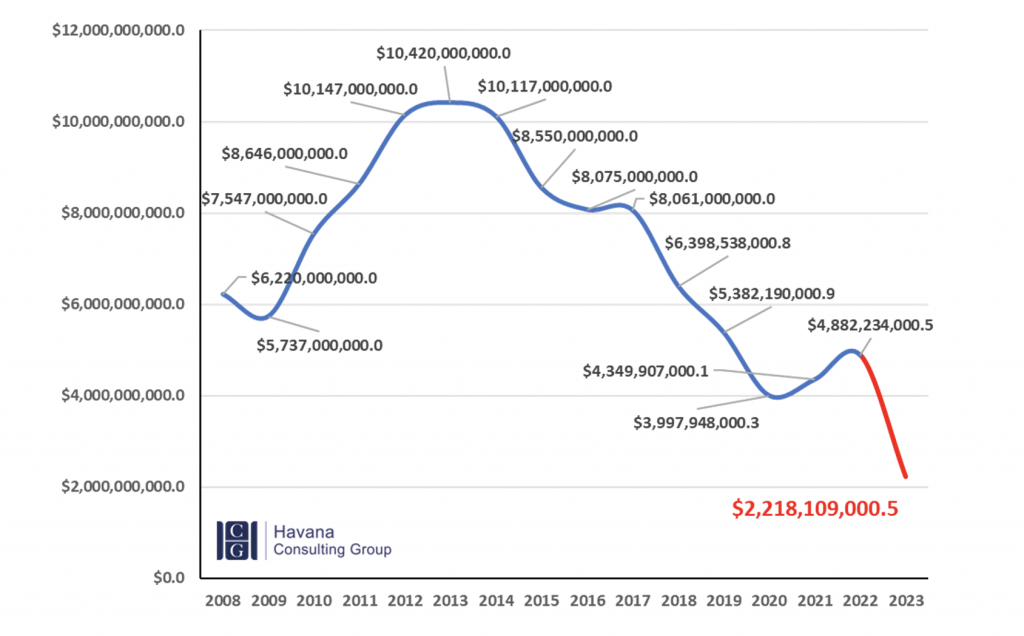
14ymedio, Madrid, July 25, 2024 — In three key points – the collapse of medical service exports, the fall in remittances and the debacle of tourism – economist Emilio Morales deciphers the collapse of the “Cuban system.” In the most recent report of the organization Cuba Siglo 21, based in Madrid, the researcher says that there has been a drop of more than 50% in the Government’s main sources of foreign currency, which will “reach the 71st anniversary of the assault on the Moncada barracks with a country in “countdown.” Published this Thursday, the report documents how one of the most powerful foreign exchange inflows that Cuba had – the export of medical services – fell by 78% since 2013, when it generated 10.42 billion dollars for the Regime.
According to the report to Parliament by the Minister of Finance and Prices, Vladimir Regueiro Ale, in 2023, Cuba lost 63.939 billion pesos, which, with the official exchange rate of 24 to 1, is equivalent to a loss of 2.664 billion dollars for the Island. The largest part of these revenues corresponds to medical services, managed by Gaesa, the economic arm of the Army, through the company Comercializadora de Servicios Médicos and the Banco Financiero Internacional y de Antex S.A, another company designed to handle contracts for the Cuban doctors in the exterior, says Morales.
Historical data on the income stream from the export of medical services, 2008-2023 / Havana Consulting Group
“Gaesa has pocketed no less than 69.8 billion dollars of the 108.5 billion it has collected from doctors’ salaries” between 2008 and 2023, summarizes the economist, who supports his conclusion with a graph. That money “never returned to the reconstruction of hospitals, acquisition of equipment and medical supplies, or to improve the conditions of patient care.” continue reading
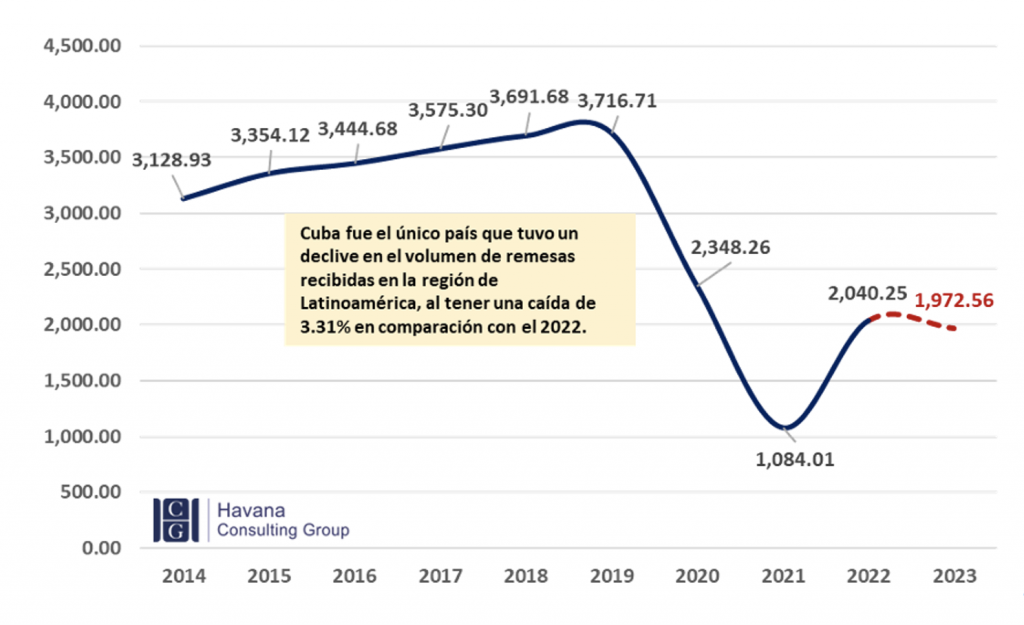
The Government, in fact, invested only 1.7 billion dollars in Public Health in 2023, a figure that contrasts with the 24.2 billion invested in the construction of hotels. On the other hand, remittances also decreased in 2023. The entry into the country of 1.972 billion dollars represented a fall of 2.31% compared to 2022, and 46% compared to 2019. The cause – which Morales has referred to on more than one occasion – is not a mystery to anyone: the massive stampede after 11 July 2021 and the economic crisis of recent years. In addition, those who emigrate, instead of sending money to those who stay, prefer to take them out of the country as soon as possible.
Morales summarizes the data recently offered by Cuban economist Juan Carlos Albizu-Campos, who estimates that between 2022 and 2023, 1.79 million people left Cuba. With that exodus, remittances also fell. “In 2023, it is estimated that the exiled and excluded Cuban diaspora spent between 1.8 and 2.2 billion dollars to take out of the country the 200,287 Cubans who emigrated to the United States, and tens of thousands of others who are still on the way,” he analyzes.
Remittances to Cuba, 2014-2023. Data in millions of dollars / Havana Consulting Group
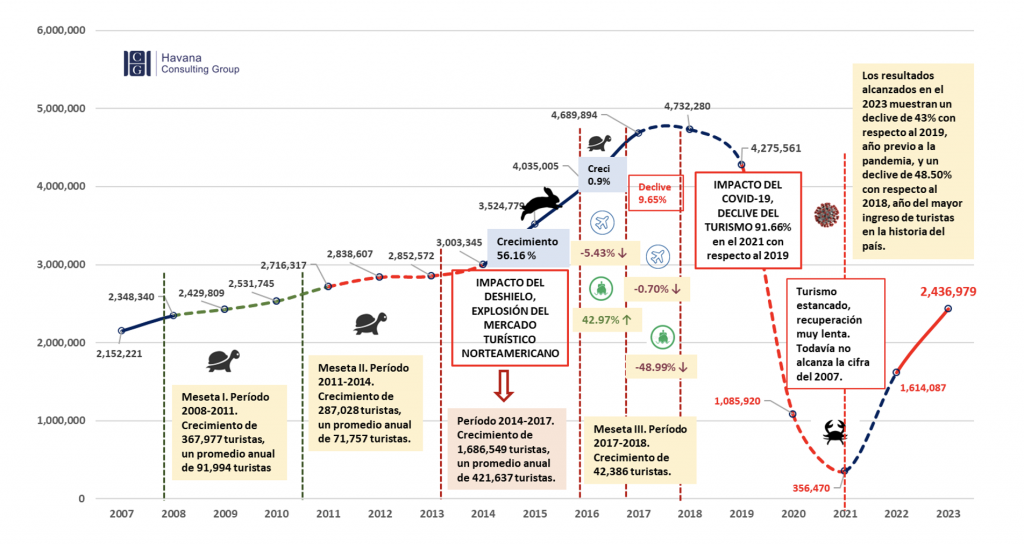
As for tourism, Morales analyzes its failure after the pandemic, in an international context characterized by the recovery of visitor levels. While Cuba received only 2.4 million tourists in 2023, a neighboring country, the Dominican Republic, exceeded 10 million. The regime has opted for Russian tourism, which, however, “has not compensated for the loss of European tourism, affected by Cuba’s support for Russia in the war against Ukraine,” explains the economist. To illustrate the debacle, Morales points out that the five main European countries – Italy, France, Germany, Spain and England – sent 67.45% fewer travelers to the Island. Cubans living abroad, indispensable for tourism, also decreased their number in 2023 by 42% compared to 2019: only 358,480 were c0unted.
The problem also has a political dimension, which is that both the Communist Party and the government structures in the country have been left without relief by the mass exodus, even of their own cadres. The Supreme Court, as recognized by the government, has only 69% of the judges it needs to operate in the country.
Arrival of tourists in Cuba, 2007-2023 / Havana Consulting Group
Morales blames Gaesa for the mismanagement of the country’s resources and says it has led a war against the MSMEs to limit their field of action and decrease their control. It is, clearly, a “dysfunctional” system, he says, which is pointed out even by Cuba’s allies, who no longer dare to launch a “large-scale economic rescue,” given the resistance to the change in leadership at the head of Cuban power. In a comatose state and grasping at partial and last-minute solutions, the Cuban Government – says the economist – has its days numbered.
Translated by Regina Anavy
____________
COLLABORATE WITH OUR WORK: The 14ymedio team is committed to practicing serious journalism that reflects Cuba’s reality in all its depth. Thank you for joining us on this long journey. We invite you to continue supporting us by becoming a member of 14ymedio now. Together we can continue transforming journalism in Cuba.
Like any scarce and desired product, in Cuba the lime has gone to the foreign currency stores or to nourish exports / Facebook
14ymedio, Mercedes García/Natalia López Moya, Sancti Spíritus/Havana, July 7, 2024 — No, lime is not the basis of everything but it is an essential ingredient in many recipes of Cuban cuisine and cocktails. The Creole mojo that is put on the cassava, the marinade that is plastered on the pork before cooking and the mojito that is inseparable from bars and celebrations need that acidic flavor that stings your eyes and awakens the soul.
However, Persian lime, or lemon as it is also called, has become in the last decade an elusive guest at the tables and bars on this Island. Counting on it to prepare a dish could end in defiance and frustration. To alleviate its absence, all kinds of subterfuges have emerged, from replacing it with vinegar in some preparations to making use of that artificial imposture that comes in a bottle and is called “lemon juice.”
In the last 12 months, in the Plaza Boulevard market in the city of Sancti Spíritus, the most appreciated citrus has made it clear that no one can take it for granted. From November 2023 until last April, it was absent from shelves, and in the last year, according to the weekly compilation done by this newspaper, its price went from 100 pesos per pound to the current 250 pesos. continue reading
When it was most needed, the lime was not there. It was not on Plaza Boulevard when customers arrived searching like crazy for something to marinate the pork for the Christmas holidays, or to throw over a salad on the night of December 31. Nor did it appear for the lemonade on Three Kings Day.
On February 14, couples had to settle for other less traditional cocktails or drink a mojito with “plastic lemon,” as they call those extracts supposedly made from citrus but that look more like a product synthesized in the laboratory than something taken from a fruit that was once hanging from a bush.
The luckiest made do on those dates with some hard lime rind, dark green and with very little juice that would serve more to break a window than to season a dish. That rickety and dry version has generated several culinary methods to try to get some liquid out of them. From immersing them in hot water before cutting and squeezing them, to placing them on the floor and, squeezed tightly under the foot, rolling them on the surface so that their interior softens and produces something.
However, almost always those methods are so disappointing that you end up throwing the lime in the trash between swear words and curses, most of them dedicated to those who manage the Cuban fields, to the terrible policies implemented in agriculture and to an official “wise man” who, without blushing, considered the lime as “the basis of everything.”
From those heights of the Government, they blame the frequent disappearances of the lime and also the plummeting supply of oranges, grapes and mandarins on the negative impacts of pests, hurricanes and the U.S. ‘blockade’*. Of those citrus productions, which exceeded one million tons three decades ago, currently only the memory remains. If in 1990 the land destined for its cultivation reached 145,000 hectares, by 2020 it was barely 11,907.
Like any scarce and desired product, in Cuba the lime has gone to the foreign exchange trade or to nourish exports rather than humiliate itself by ending up on local tables. In the digital portals that sell to emigrants to supply their families on the Island, the product can be found more frequently and stably, but yes, at a price of around five dollars a pound.
Also, the very vain limes travel rather than remaining in the homeland. In September 2020, the official press announced that a farmer from Mayabeque had become the first private producer in Cuba who managed to export limes to Spain through the company Frutas Selectas.
Meanwhile, some online shops, which sell in foreign currency, began to offer limes from Panama, Mexico and the United States in the catalog of goods that Cuban exiles use to buy for their parents, grandparents or children who have stayed on the Island. As if national consumers could no longer aspire to the citrus that sprouts from their land and should be content with foreigners buying it for them.
As good news, in the forums where opinions are exchanged about these virtual stores, a criterion is repeated again and again: “Those Mexican limes are good, they have juice and you don’t have to hit them or put them in hot water.” The cassava mojo is guaranteed in this way for certain Cuban tables, but the limes can no longer be called “creole.”
*Translator’s note: There is, in fact, no US ‘blockade’ on Cuba, but this continues to be the term the Cuban government prefers to apply to the ongoing US embargo. During the Cuban Missile Crisis the US ordered a Naval blockade (which it called a ‘quarantine’) on Cuba in 1962, between 22 October and 20 November of that year. The blockade was lifted when Russia agreed to remove its nuclear missiles from the Island. The embargo had been imposed earlier in February of the same year, and although modified from time to time, it is still in force.
Translated by Regina Anavy
____________
COLLABORATE WITH OUR WORK: The 14ymedio team is committed to practicing serious journalism that reflects Cuba’s reality in all its depth. Thank you for joining us on this long journey. We invite you to continue supporting us by becoming a member of 14ymedio now. Together we can continue transforming journalism in Cuba.
The regime’s proposal to buy from farmers did not prosper due to the shortage of products
In 2017 Iberostar received a permit to create a joint import business with the Cuban Caribbean Hotel Logistics / Trip Advisor
14ymedio, Havana, July 24, 2024 — The Cuban Government’s inability to meet the demand for the most basic products also affects its trading partners. The large hotel companies installed on the Island have had to import, for years, part of the products they provide in their facilities. Since the escalation of the crisis after the pandemic, however, companies went from importing in order to “maintain luxury” to importing out of necessity.
The last to join the list was Meliá, which at the beginning of this year announced that it would create, with the permission of the State, its own import company. It was not until this Wednesday, however, that it revealed Mesol’s specific purpose: to supply its hotels with linen, sports and artistic equipment, kitchen utensils and even food, beverages and cleaning items.
The transport, distribution and storage of the products are also borne by the company, which for now has its main supplier in Spain but is looking for other suppliers in Latin America and the Caribbean, where invoices will be less expensive. continue reading
The “appropriate purchase and delivery flows,” the statement adds, will help maintain the quality of the service
The “appropriate purchase and delivery flows,” the statement adds, will help maintain the quality of the service, diminished by the lack of variety in the food, the low quality of the meals and the defective cleanliness, common complaints among those staying on the Island.
Other companies have taken similar measures. At the beginning of last year, when the Indian MGM Muthu Hotels reached 7,000 rooms on the Island, its adviser explained a plan to keep all the facilities supplied. “We are going to have two importers in Cuba to bring in products, not only beverages, but everything. It can be furniture and fittings, everything. We are already creating two companies for this,” he said in January, and in May, an importer from Portugal was already a reality.
“We have a trading company to import all kinds of supplies from Portugal. We are growing little by little, sin prisa pero sin pausa* — without haste but without pause,” he added.
In 2022, the Government granted Canadian Blue Diamond a license – accompanied by the exclusive management of 11 complexes in Cayo Largo del Sur – to bring in the necessary supplies to maintain them. Nutella, butter and ketchup, not very available in Cuba, were some of the products promised by the vice president of Sunwing Travel Group, owner of the hotel. “The right to import and to be able to control quality is a great thing,” he said.
“Importing cannot be the solution; the country must be able to provide domestic products to hotels”
That same year Granma published an article criticizing the hotels that imported much of the products they needed in their daily management, including food, when, it said, they could get them in Cuba. “Importation cannot be the solution, the country must be able to provide hotels with domestic products and thus ensure attention to the growing arrival of visitors, which favors economic chains,” it complained.
The text tried to explain the successful association between hotel companies and the producers of the locales where they are installed but forgot to point out that the contracts are always made through the Ministry of Agriculture, which lowers payments to the farmers and discourages them, at the same time that it fails to comply with its commitments and is unreliable in its business dealings with the hotels. companies.
In 2017, Iberostar received a permit to create a joint import business with the Cuban Logística Hotelera del Caribe (LHC). The Spanish chain did not clarify what it intended to import but explained that the company, located in the Special Development Zone of Mariel, would be dedicated to the wholesale trade of products for the hospitality industry and that Iberostar would not be the only beneficiary.
With tourism stalled in numbers similar to those of last year, in addition to the discredit that the Island has suffered internationally for its political and economic situation, companies like Meliá have decided to take the reins and try to improve the statistics of their hotels on their own. In 2023, Cuba was the only one of its destinations where revenues fell and hotel occupancy was lower than expected.
*Translator’s note: Sin prisa pero sin pausa — without haste but without pause — became a signature phrase of Raul Castro in reference to ‘fixing’ the problems of Cuba, after he assumed the presidency on the death of his brother, Fidel.
Translated by Regina Anavy
____________
COLLABORATE WITH OUR WORK: The 14ymedio team is committed to practicing serious journalism that reflects Cuba’s reality in all its depth. Thank you for joining us on this long journey. We invite you to continue supporting us by becoming a member of 14ymedio now. Together we can continue transforming journalism in Cuba.
The anointing of the sick is the only sacrament that is increasing, another reflection of the demographic situation on the island
The priests do not offer official figures for baptized people on the Island. / Reynaldo La O /Havana Times
14ymedio, Havana, July 24, 2024 — The Catholic priest Ariel Suárez, secretary of the Cuban Episcopal Conference – and, in practice, its spokesman – said during an interview in Spain that in a parish like his, the sanctuary of the Virgin of Charity in Havana, 300 children can be baptized every month. The figure is not impossible, although optimistic, in a country weighed down by migratory stampede and low birth rate, according to the religious authorities of several Cuban dioceses interviewed by 14ymedio. In the parishes of the most important cities of Matanzas – Varadero, Cárdenas and Matanzas – they are far from that number, according to a source from their bishopric: about 15 children a month in Cárdenas and about 20 per priest, if he has to attend several parishes.
In Camajuaní, where several years ago dozens of children were baptized every Saturday, the current number is between 4 or 6 children each month. A member of the diocesan administration of Santa Clara explains to this newspaper that it is normal for families “to baptize the children and then leave the country one week later.”
In Camajuaní, where several years ago dozens of children were baptized every Saturday, the current number is between 4 or 6 children every month
Apparently, he says, they believe that the ritual provides some kind of protection or luck during the trip, or they have the superstition that it will facilitate the exit procedures. As for the data offered by Suárez, he says, “it could be real for that parish, because it is a sanctuary in the middle of Central Havana, although it seems too high.” continue reading
“In each diocese there are sacramental statistics. They are done every year. It must be borne in mind that each parish in Cuba is very different. In the city of Santa Clara, for example, the number of baptisms in a sanctuary like Buenviaje or in the cathedral is not the same as in the churches of La Pastora and Carmen,” he explains.
The decline in rituals is not only for baptisms: “There are few births, fewer baptisms, a lot of emigration, fewer confirmations – another sacrament -and there are also fewer religious marriages,” he summarizes. There is only an abundance of what is known as the “anointing of the sick” – formerly called extreme unction – because the “old people are left behind.”
In the archdiocese of Santiago de Cuba – where mountain communities abound – a source in the archdiocese tells 14ymedio that priests do not usually compile monthly statistics, only an annual figure that he did not reveal. He admitted, of course, that it tends to decrease. “People are attending Church because they are desperate,” he explains. “Many of the baptisms are just a number.”
During his interview, Suárez sounded amazed that “after so many years, of a social system that promulgated atheism with such force” and given the current circumstances, baptisms continue to be held in Cuba. “The parents of those children are young,” he added, and “they do not have a Christian foundation,” but – despite the indoctrination of the regime – they do not look at the Catholic Church with “hostility or indifference.”
The priest said he was aware of the migratory crisis, in which “Cubans of all ages leave, not only young people. Of course, the departure of young people is felt more in a nation, because they are supposed to be the ones who have projects and dreams for the future of a country and of the Church itself,” he said.
“People are attending Church because they are desperate,” he explains. “Many of the baptisms are just a number”
In addition, he made it clear that the Church in Cuba considers itself “vulnerable,” and he listed what, in his opinion, it has to lose: the “small but significant” education centers, nursing homes and care spaces for the sick, the elderly and the alcoholics.
In a context of extreme coldness in Church-State relations, Suárez has become a spokesman for an increasingly lethargic Episcopal Conference. Cuban bishops have not published a joint document that contains criticism of the Government or descriptions of the country’s situation for months. Last April, Suárez – interviewed by the American network NBC – again reminded the authorities that the Church was ready to have a conversation about the freedom of political prisoners.
In the protests of last March 17 – and in the previous ones – Suárez said that the pain “turned into a scream,” which was “listened to” and “accepted” by “all the authorities of the country.” At least everyone has agreed to consider that the cry reflected anguish, reflected despair, and that it was obviously asking for a different situation from what was being experienced,” he said, referring to the demonstrations in the city of Santiago de Cuba.
A source from the archdiocese of Havana told this newspaper that what Suárez expressed “is a subtle message” that the bishops send to the regime to say that the Church can mediate “despite the sorrows.” However, he acknowledged that “at the diocesan level, the tension with the Party’s Religious Affairs Offices is worse than ever.”
Translated by Regina Anavy
____________
COLLABORATE WITH OUR WORK: The 14ymedio team is committed to practicing serious journalism that reflects Cuba’s reality in all its depth. Thank you for joining us on this long journey. We invite you to continue supporting us by becoming a member of 14ymedio now. Together we can continue transforming journalism in Cuba.
Plaza de la Revolución Mayor General Serafín Sánchez Valdivia de Sancti Spíritus, this Wednesday / Escambray
14ymedio, Mercedes García, Sancti Spíritus, July 24, 2024 — “Not a hand raised,” is how the attendees at a meeting of an entity linked to the Ministry of Agriculture in the city of Sancti Spíritus reacted on Monday when its directors inquired about the willingness to participate in the official event on July 26. The justifications for evading the commitment ranged from the obligation to care for children and the elderly to anxiety over the Oropouche virus.
“We were summoned to the auditorium to organize everything this Friday,” an employee who prefers to remain anonymous tells 14ymedio. “They told us that our company had been assigned ten chairs for the event, and they read us some organizational details, such as that you have to be in the Plaza [Mayor General Serafín Sánchez Valdivia] at one in the morning, and you can’t carry anything in your hands – no bags, no backpacks or water bottles.”
After reading the requirements, the managers of the company inquired about the willingness of the workers to attend, but the first response was “silence, not a sound; people were just looking at the floor.” The Ministry worker explains that the leaders of the Communist Party and the Union then began to summon the employees one by one, but they all had a justification for not participating.
“There are people who have small children and can’t leave them alone, and I also have co-workers who care for elderly parents and, although they have family who can help, can’t come that early in the morning,” he tells this newspaper. “Others said they had just gotten over Covid or Oropouche and can’t be outside at dawn.” continue reading
“Others said they had just gotten over Covid or Oropouche and can’t be outside at dawn”
The practice of going to the celebration very early, when the sun is just coming up, is the official act of remembrance for the assault on the Moncada barracks, on 26 July 1953. This was encouraged by Raúl Castro after assuming power in August 2006, when the convalescence of his brother, Fidel Castro, was announced. The rigors of the summer heat and the advanced age of many of the officials participating in the commemoration influenced that decision.
Over the years, the time to arrive has also been advanced due to the security protocols that surround an event attended by the highest leaders of the Communist Party, the Council of Ministers and the Parliament. After the massive popular protests of 11 July 2021, those controls became stricter, and the presence of metal detectors at access points has also been added.
The concept of the event has also changed significantly over time. The massive standing rallies have given way to a smaller number of seated audiences. State entities, educational centers and the military sector receive quotas to join the commemoration, with the prior commitment of each participant, and transport is included if they live far away and are on the list when they arrive.
“There will be a reserve group on the library staircase in case some of those who said they were coming don’t show up,” says a cooperative member from the Taguasco area who is among those summoned in that municipality. “There is a lot of discomfort around here, and people have not shown too much enthusiasm about signing up to go,” he admits.
“There is talk of about farm-by-farm inspections to find out what has happened with the crops.”
The annoyance of the Taguasco farmers, as in the rest of the province, comes from the behavior of the state-owned Acopio, which in recent weeks has lowered the purchase price for several agricultural products. Among the most affected are corn, pumpkin and sweet potato, whose deliveries to the State have also fallen significantly. “There is talk of farm-by-farm inspections to find out what has happened to the crops,” he says.
However, farmers are among those who will attend the commemoration, and “beginning at midnight they must meet at a certain point to get a ride.” A transport organized by the cooperative will allow them to go to Sancti Spíritus and “visit the family after it’s all over.” With the critical situation that transport is experiencing due to the lack of fuel, any ride “is welcome,” but he does not have many expectations.
The farmer doesn’t expect the speakers to say anything important about the economy. For decades, the July 26 celebration was the stage chosen by Fidel Castro to communicate the measures with the greatest impact on Cuban society, such as the dollarization of the economy in 1993. In the midst of the current crisis and the mass exodus, however, no surprises are expected next Friday in Sancti Spíritus.
Translated by Regina Anavy
____________
COLLABORATE WITH OUR WORK: The 14ymedio team is committed to practicing serious journalism that reflects Cuba’s reality in all its depth. Thank you for joining us on this long journey. We invite you to continue supporting us by becoming a member of 14ymedio now. Together we can continue transforming journalism in Cuba.

 14ymedio/EFE, Havana, July 29, 2024 — The Council of Ministers of Cuba approved this Sunday a national system of “registration, attention, following and monitoring” of gender violence and resulting femicides on the Island, the official media reported on Monday. The measure was presented by the Attorney General, Yamila Peña Ojeda, and will be made up of a group of 25 experts from the Ministry of the Interior and the Popular Supreme Court.