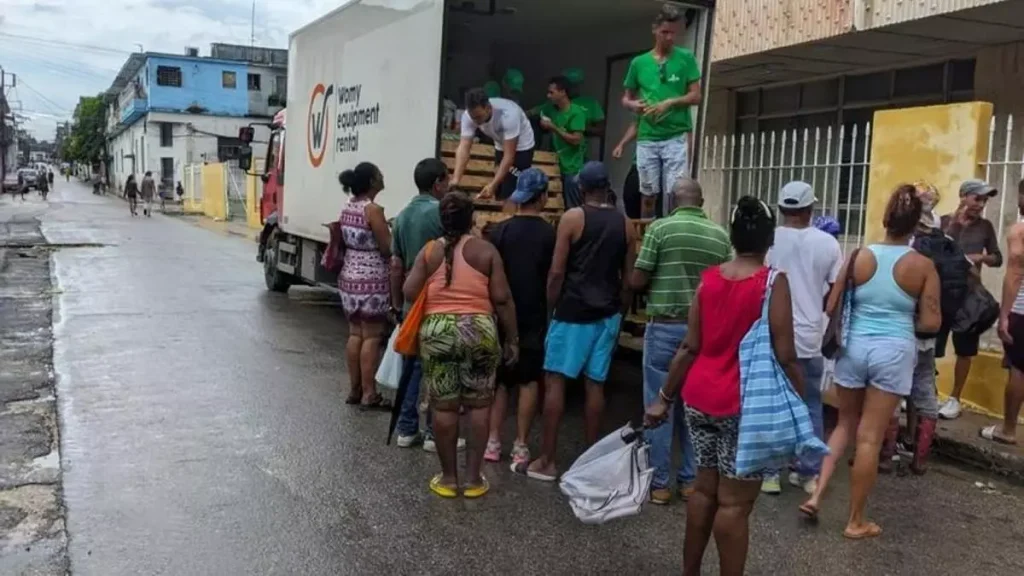
Hurricane Oscar’s Devastation in Guantánamo Raises Fears in Cuba of More Victims

So far, the number remains at six deaths in San Antonio del Sur and one in Imías, but both places are incommunicado


View of the bridge from San Antonio del Sur to Imías, completely divided into two sections / Facebook

14ymedio bigger14ymedio, Madrid, 23 October 2024 — Hurricane Oscar left Cuba 24 hours ago, but anguish continues in San Antonio del Sur, Imías and, to a lesser extent, Baracoa, where almost all communication is cut off. The damage to the roads prevents access to the three populations of Guantana, and there is no telephone signal, so the concern of relatives and friends does not cease. The authorities have counted seven deaths so far, but the conviction is growing that there may be more visible in the photos and people who have not yet been located.

“Of the people who have gone to Imías, does anyone know anything about the community of Guajacal, which was not evacuated? I do not see Government photos uploaded from there,” said a user on Facebook. “From Yacabo,” “from San Ignacio…” doubts about the smaller communities of Imías accumulate, and the phone connection is scarce. “Part of Cajobabo has a signal and also internet. Let them send you news from there,” someone replied.

“Part of Cajobabo has a signal and also internet. Let them send you news from there”

Officially, the victims of San Antonio del Sur are Liz Anyi Elías Labañino, 5 years old; Iriannis Labañino Domínguez, 31; Francisco Columbié Matos, 92; Esmérido Noa Fiffe, 86; Antolino Áreas Domínguez, 83; and Alexander Savón Matos, 42. In addition, there is one deceased in Imías whose identity is still unknown.

Baracoa’s local television, Primada Visión, also reported the transfer by helicopter of a child in serious condition. There are many photographs of hospitals such as the Agostinho Neto and the pediatric Pedro Agustín Pérez with the injured who have been able to be rescued, but there are great difficulties in reaching the area. continue reading

According to the Minister of Transport, Eduardo Rodríguez Dávila, yesterday afternoon a huge sinkhole was detected on the road in front of the hospital in Acopio, which caused a road closure before Imías, leaving this population without access – in Baracoa and Maisí, for example. In addition, in Macambo and La Farola there were “big landslides” and damage to the San Antonio-Puriales road, whose bridge had one of its supports undermined.

“I got to San Antonio and couldn’t continue traveling. There are serious problems with the roads. We still don’t know all the damage,” reported Jesús Pérez Alonso, director of the Provincial Road Center.

Aerial view of homes in the flooded areas of Imías / Facebook

Early this Wednesday morning, Radio Guantánamo indicated that the work on the road to San Antonio and Imías continued, while in Baracoa and Maisí the situation was somewhat better. One person who was able to reach Imías, on Tuesday afternoon, was Yoel Pérez García, first secretary of the People’s Communist Party (PCC) in Guantánamo, who arrived on foot because of the impossibility of doing it any other way. His individual feat was taken advantage of by the ruling party, which extended the achievement to the past and present PCC. “Fidel Castro showed us the legacy that President Miguel Díaz-Canel Bermúdez continues,” praised Solvisión.

In a night appearance, Díaz-Canel admitted the seriousness of what is happening in Guantánamo: “The situation is very complex,” he said. So far, at least 1,183 total collapses and 1,048 partial roof collapses have been confirmed, in addition to 51 total house collapses.

The Army also began to arrive this Tuesday in helicopters, and 493 rescues have been carried out in flooded areas, according to the deputy director of the Operations Department of the National Civil Defense General Staff, Eduardo Cross. He added that 4,865 people are in evacuation centers and 443 in the homes of family and friends.

The population, however, considers that everything has been insufficient because the residents of the area were surprised by a change in the trajectory of the hurricane due to the lack of electricity and communications since Friday. “Those people were without electricity, like the whole country,” says a man in Havana. “On Sunday I was left without a way to charge my phone, but the last I saw from the NOAA (US National Hurricane Center), the hurricane was category 1 and entered closer to Holguín. On Monday when I had battery power again the hurricane had changed its route.”

Bridge that connects Maisí with Imías, also destroyed after the passage of Oscar / Facebook

The multitude of photographs showing destroyed and flooded roads reveal the impossibility of accessing the most affected localities at the moment, but there is a lot of indignation on social networks due to the lack of air equipment, which could have reduced the damage and, predictably, the deaths that are still unknown. “I wonder, is there only one helicopter in Cuba and can it take only one ride a day? Those of us who are mainly outside Imías and have families there are desperate,” a user from Guantánamo asked.

Others used nostalgia, not to charge against the regime, but against the current government: “Does anyone remember when Fidel almost lost his life in an amphibian in the middle of a hurricane? Of course, surely many. That’s why he was and will always be our only and undefeated leader. If Fidel existed, he would have already arrived with rescue forces in Imias. No one doubts it.”

Meanwhile, the electricity in these areas is still inadequate. Guantánamo is connected by microsystems, and the circuits are rotated as much as possible. A break in the optical fiber also prevents telephone and Internet communication, and telephone and electrical poles have fallen, which complicates other vital services.

Translated by Regina Anavy

____________

COLLABORATE WITH OUR WORKThe 14ymedio team is committed to practicing serious journalism that reflects Cuba’s reality in all its depth. Thank you for joining us on this long journey. We invite you to continue supporting us by becoming a member of 14ymedio now. Together we can continue transforming journalism in Cuba.

Lack of Communication With Family Abroad Is Another Traumatic Consequence of the Island-Wide Blackout in Cuba

Many emigrants have had to wait several days to reconnect with relatives on the Island

Etecsa doesn’t need hurricanes or energy debacles to disconnect Cubans from one shore to the other / Primade Vision

14ymedio bigger14ymedio, Juan Izquierdo, Havana, 23 October 2024 — The patience of Cubans runs out on par with the battery of their cell phones. For their relatives abroad, despair comes when an image, a voice and even messages vanish. That a person is no longer online means that he is submerged in the blackout, and that the silence will last until – indispensable to maintaining sanity at night – he can find a way to charge his phone. Jorge, a resident for four years in Mexico City, knows this well. His phone did not ring until, three days after the announcement of the “total disconnection,” his mother wrote him the first “Hello.” In Santiago de Cuba, she had not been able to find anywhere to connect her phone. In the rain, she managed to walk the four kilometers (2.5 miles) that separated her from her sister, for three-hour’s of light: an “alumbrón*.” There she bathed, prepared some food and dialed her son’s number.

“We could only talk for a few minutes,” Jorge reports. “The video froze, and we saw each other for a second.” If calling Cuba in normal times is cumbersome, – Etecsa does not need hurricanes or energy debacles to disconnect Cubans from one shore to the other – the blackout has made every attempt at communication a series of garbled and cut-off words.

In the short time that the dialogue lasted, Jorge heard from his mother about the first hours of the blackout. The soup she had that day was made on her wood stove. The first signs of decomposition had already begun to appear in some pork she had in the refrigerator, so she threw it in a pan and fried it. “That could last two days,” she told him. Then, we’ll see.” continue reading

In Madrid, it took Ana two days to learn that her grandmother – a robust and active woman, 74 years old – had suffered a stroke in Santa Clara

In Madrid, it took Ana two days to learn that her grandmother – a robust and active 74-year-old woman – had suffered a stroke in Santa Clara. “My dad found her passed out on the kitchen table,” she says. He had been surprised that his mother-in-law did not answer the phone and went to her house. With no signal on the phone and in the midst of a transport crisis that the blackout took to a critical point, Ana’s father managed to call an ambulance. Of course, it took a long time to arrive.

“I knew the whole story when my family found a way to call. I hadn’t had any news from them since the disconnection began, and I could barely understand the news when they gave it to me,” says Ana. For the girl, getting sick now in Cuba is like suffering a litany of calamities. Without supplies or electricity, with the doctors overwhelmed by personal and hospital situations, the message after the diagnosis was clear: “They did not give her more than 72 hours.”

For his part, Alfredo – who moved to Seville after the island-wide protests of 11 July 2021 (’11J’) – knew that his cousin, in Cienfuegos, had passed two patrol cars when he went out at night to walk with his girlfriend. According to the young man, the city was “militarized” with the blackout. The phone signal was minimal, and his cousin’s voice reached him intermittently.

“The last time I experienced something like this was during 11J,” Alfredo recalls. The tension in the streets was similar, and the crash of the internet – intentional at that time – made it difficult, as now, for the news of the situation to cross the borders of the country and reach relatives abroad. “My cousin told me that some were now demonstrating and banging on pots and pans, but such a “cacerolazo” can be like an episode of socialist Masterchef, with a wood stove in the middle of the street,” he says sarcastically.

Official journalists accustomed to leaving the country have tried to hide the situation and defend the regime

Official journalists accustomed to leaving the country, such as Yanetsy León from Camagüey, have tried to hide the situation and defend the regime against those who claim that blackouts are “romanticized” in Cuba. “We have spent months resisting blackouts, days without electricity and the weight of uncertainty,” claimed León, who has spent most of the year traveling in Europe.

He also invited Cubans to “take care of their emotional well-being” and ignore those who “from outside or other parts of the country” are emphasizing the seriousness of the national blackout. He admitted that there was a “disconnection” between the Cubans who left and those who still reside on the Island. But he wasn’t looking for culprits. “We are all struggling with our own forms of resistance,” he said, without a single request for accountability from the Government of Miguel Díaz-Canel.

*Translator’s note: “Alumbrón” is a word coined by Cubans that means “the time when the lights (electricity) come on” — that is the opposite of “blackout.” English has no equivalent.

Translated by Regina Anavy

____________

COLLABORATE WITH OUR WORKThe 14ymedio team is committed to practicing serious journalism that reflects Cuba’s reality in all its depth. Thank you for joining us on this long journey. We invite you to continue supporting us by becoming a member of 14ymedio now. Together we can continue transforming journalism in Cuba.

Six Young Baseball Players Flee Cuba in Just Three Days

Eric Valenzuela, Adrián Gómez, Cristian Rego, Eugenio Rodríguez, Osniel Castillo and Dayron Núñez are now in the Dominican Republic

Baseball players Eric Valenzuela and Adrián Gómez / Facebook

14ymedio bigger14ymedio/Swing Completo, Havana, October 22, 2024 — Baseball players Eric Valenzuela, Adrián Gómez, Cristian Rego, Eugenio Rodríguez, Osniel Castillo and Dayron Núñez are the most recent athletes who have fled Cuba. The escapes occurred between Sunday and Tuesday, according to reports by sports journalist Francys Romero. All of them are now in the Dominican Republic and will be presented to professional scouts from the MLB organizations.

Of the six, four are pitchers and average 90 mph throws. Despite their youth, every one has a previous tour of the local championships of various categories. Of them, Eric Valenzuela, the oldest of this group, had greater prominence in the National Series, in the ninth of Isla de la Juventud.

The 20-year-old player, who is 6’5″, played three classics in the country. In 33 matches he had 259 starts. He recorded three wins, nine defeats and an offensive average against him of .250.

Despite their youth, they all have had previous participation in the local championships of various categories

For his part, Adrián Gómez, 18, was one of the most outstanding prospects during trials carried out this year by the Cuban Baseball Federation for the most talented players. continue reading

Dayron Núñez is another pitcher with a lot of power in his throws. At only 19 years old, the player from Guantánamo also has experience in the National Series, where he won four games and lost six with the provincial team.

The youngest of the pitchers, Cristian Rego, barely 16 years old and 6’3″, has been one of the most coveted players by various seekers of new talent during the international tournaments in which he participated. In the U18 Pre-World Cup, last August in Panama, the player from Havana did not allow clean runs in 13.1 innings of work. In addition, although he records a speed that ranges between 87 and 90 mph, due to his physical qualities, he can potentially throw at more than 95 mph, according to Swing Completo.

To the list is added Eugenio Rodríguez, who has experience in the National Series with the Alazanes de Granma. In 2023 he had few opportunities on the offensive, since he only accumulated 29 official turns at bat, in which he hit six home runs, for an average of .207. However, at under 20 years old, he is seen as a medium-term prospect.

Finally, Osniel Castillo is a skilled runner and an excellent hitter, which placed him as first up at bat when he represented Cuba in international tournaments. During the U18 in August, he was the powerful hitter of the Cuban ninth.

Last week, another player who broke his link with the Island was the veteran Raúl González, who asked for asylum in the United States

Just last week, another player who broke his link with the Island was the veteran Raúl González, who asked for asylum in the United States after being excluded from the national team, next to compete in the Premier 12 tournament. The 37-year-old player is in the process of investigation by US immigration authorities, after entering through the northern border with Canada, where he played in the main league of that country with the Kitchener Panthers, under the auspices of the Cuban Baseball Federation.

Most of the athletes fleeing Cuba are baseball players. According to a count of the official weekly Trabajadores, in January 2022, at least 862 athletes had left the Island in a decade, of which 635 were baseball players. Today it is estimated that almost 1,100 athletes have fled the country in that period. To that figure we must add the dozens that have fled this year. In addition, since 2012, the exodus includes 2,344 coaches, 85 of whom worked at the highest level, according to the National Institute of Sport, Physical Education and Recreation.

Translated by Regina Anavy

____________

COLLABORATE WITH OUR WORKThe 14ymedio team is committed to practicing serious journalism that reflects Cuba’s reality in all its depth. Thank you for joining us on this long journey. We invite you to continue supporting us by becoming a member of 14ymedio now. Together we can continue transforming journalism in Cuba.

Salt Fields Destroyed, Crops Damaged and up to 6,000 Affected by Hurricane Oscar in Eastern Cuba

It is still impossible to give a total account of the damage because of isolated communities

It is estimated that there are some 4,000 families affected in the eastern provinces / Prensa Latina

14ymedio bigger14ymedio/EFE, Havana, October 22, 2024 — The northeastern end of Cuba is experiencing a dramatic situation one day after the passage of Hurricane Oscar, which left at least seven dead and much material damage. Baracoa, for example, remains incommunicado. According to the report on national television this Tuesday, the linemen mobilized from other provinces could not arrive: the La Farola viaduct is closed to the passage of vehicles due to landslides caused by the rains.

In the same report, they pointed out that the salt field of San Antonio del Sur, the most affected community, was totally damaged. In addition, 200 hectares of tomato plantations were lost. Throughout the territory, damage was reported in “almost 50% of the banana plantations,” and in the coffee plantations.

Early Tuesday, the official press reported that there are 6,000 people affected – about 4,000 “family nuclei” – mainly by the floods, which have caused river overflows and sea penetrations in low coastal areas.

In the last 48 hours, the province has recorded accumulated rain of more than two feet in some points, according to data from the Institute of Meteorology. continue reading

Oscar entered Cuba as a category 1 hurricane (out of 5) on the Saffir-Simpson scale on Sunday afternoon and spent just over 24 hours on the Island, accompanied by strong winds, intense rains and high tides. It made land near Baracoa at 6:10 pm on Sunday and left Cuban territory in the vicinity of Gibara around 7:20 pm on Monday.

Civil Defense decided on Tuesday to declare the return to “normality” in the eastern provinces of Santiago de Cuba, Granma, Holguín and Las Tunas, but in Guantánamo classes will continue to be suspended at least until Thursday.

Oscar is the fifteenth hurricane of the current season in the Atlantic

Oscar is the fifteenth hurricane of the current season in the Atlantic and the first to touch land in Cuba. The meteorological services of the United States and Cuba warned months ago that this hurricane season in the Atlantic, which runs from June 1 to November 30, was going to be especially active.

The last time a big hurricane hit Cuba was in 2022, when Ian caused a collapse of the power grid similar to the one that Cuba has experienced in recent days.

Translated by Regina Anavy

____________

COLLABORATE WITH OUR WORKThe 14ymedio team is committed to practicing serious journalism that reflects Cuba’s reality in all its depth. Thank you for joining us on this long journey. We invite you to continue supporting us by becoming a member of 14ymedio now. Together we can continue transforming journalism in Cuba.
Large Hotels Waste Electricity While Private Hostels Remain Without Customers

Foreign tourists are cancelling their reservations due to the energy crisis, and private hostel owners are feeling the impact

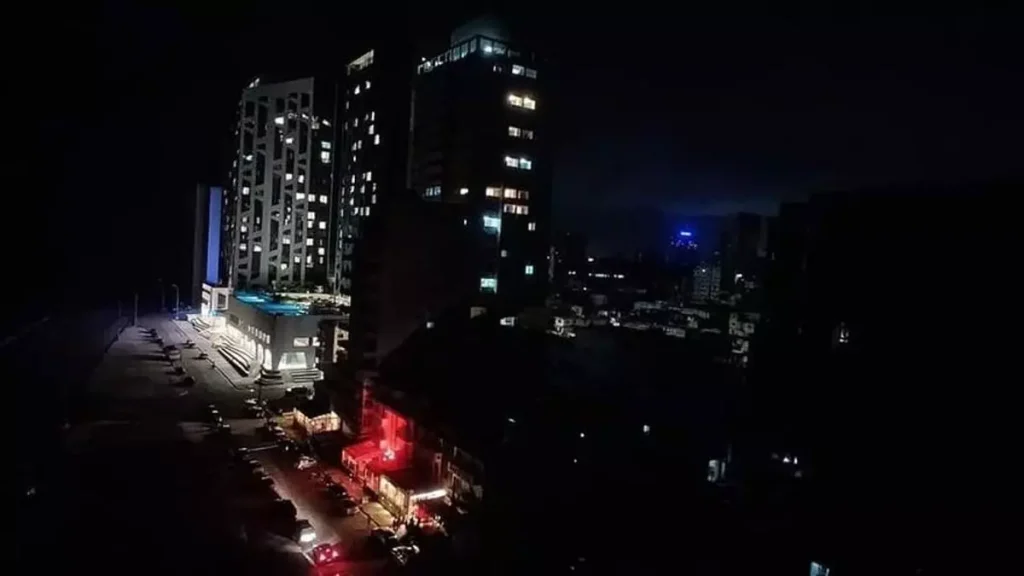
The Grand Aston Hotel, at 1st and D on the Havana Malecón, has the lights on in the middle of the generalized blackout/ Facebook / Maravillosa Malecón

14ymedio bigger14ymedio, Natalia López Moya, Havana, 22 October 2024 — Lucía’s hostel in Viñales, Pinar del Río, had not received a single customer for weeks. Her desperation was appeased when two Spaniards rented a room in her house to spend a vacation as a couple on the Island. However, the chosen moment could not have been worse. “They arrived on Saturday in the middle of a general blackout, and after a single night they wanted to leave,” she tells 14ymedio.

The heat, mosquitoes, darkness and deserted streets, without a car to rent to visit some caves and mogotes, horrified the foreigners, who had arrived with the idea of relaxing in Viñales, a region known for its valleys and opportunities for nature tourism. “They were going to stay until Thursday, but after the first night without electricity they decided to leave,” says Lucía.

Their departure was not without obstacles either. The Spanish couple not only had to buy a return ticket a few days in advance – with the predictable high prices – they also had to find a way to get to Havana, in the middle of the fuel, energy and transport crisis.

“My clients had to hire a car to get to Havana and stay in a hotel with a generator because they couldn’t stand this anymore. They couldn’t even walk at night because it’s pitch-black when the sun goes down,” Lucía explains with obvious annoyance. continue reading

“Here the private restaurants had to finish the little food they had left and are all closed now”

According to Lucia, her business is not the only one that has suffered during the last five days of uninterrupted blackout. “Here the private restaurants had to finish off the little food they had left and are all closed. Not even the guides want to work because they have to take care of their own families who have been without power since Friday,” she says.

This is not the only place on the Island where tourism is shipwrecked – even more so, if possible, given the latest official figures. For the fifth consecutive month, the number of foreign travelers continues to fall, and in August, 144,981 travelers were recorded, 32,325 fewer than for August 2023. The same thing happens in the “privileged” capital. Elena, who has a rental house on the beach of Boca Ciega, in East Havana, received the cancellation for two clients she had scheduled in late October and early November.

The October clients were a couple of Mexicans who called her this Sunday to tell her that they were no longer coming because they had read in the press about the problems that existed in Cuba with electricity and were afraid of being stuck on the Island with an airport closure.

The man is a surgeon and has to return to work on time, they said, so “he can’t afford to be stranded” on the Island.

The other cancellation was an Italian family that “has been coming religiously every year for almost twenty years, with the exception of the time of the pandemic.” They have a friend who was in Cuba a few days ago and warned them not to come because “there is a lot of garbage.” This friend visited the east of the country, where the blackouts had a great impact. “To top it all off, he got infected with Oropouche,” says Elena.

In the tourism video the facilities have all the lights on and show the restaurants, gym and spa providing service

Unlike private rental houses, hotels on the Island have been – for the most part – operating without problems thanks to their generators. The few who have suffered cuts have come to light on social networks. This is the case of several facilities in Varadero, which on Friday, when the Island fell into a general blackout, were also left without service. Several customers, including Cubans who were vacationing at the time in the hotels, reported the situation. “For those who deny the blackouts, I’m in a hotel in Varadero without light. Things are really unpleasant,” commented a user on Facebook.

The problem in tourist establishments seemed to be solved quickly, unlike the blackout in the rest of Cuba, which has already lasted five days. The entry into operation from minute one of the Energás plants, which feed Varadero and part of the capital, in addition to the hotels’ own generators, contributed to maintaining stable service in the spa.

So far, it has not been reported that the hotels have suffered cuts, and the websites and social networks of the establishments, especially those managed by foreign companies such as Meliá, Iberostar, Muthu and others, sell an environment of tranquility on the Island. Their promotions, which ensure destinations and services of the highest quality, do not at any time warn travelers of the bad time they could face if they arrive in Cuba in the middle of a general blackout. And they insist that flights continue to arrive normally, since air traffic has not been affected by blackouts and all airports have power plants.

During these days, many Cubans have shared on social networks with indignation images of hotels in several provinces, although mainly in the capital, with all their lights on while behind you can see entire cities in the dark.

In fact, hotels, the only ones that remained in service when the entire Island went out – even before hospitals and other essential services were prioritized – have begun to become the refuge of a few who can pay for a night in their rooms.

A Cuban influencer known as ‘Flor de Cuba’ published a video on Instagram this Monday accompanied by a text in which she explained that she had decided to seek “shelter” from the blackouts at the Grand Aston La Habana hotel, a luxury establishment located on the Malecón, overlooking Havana Bay.

In the video, the influencer showed her reception in the hotel, managed by the Indonesian chain Archipelago International, which offered cocktails and accommodation for her and her children. In the video the facilities have all the lights on, with restaurants, gym and spa providing service.

Translated by Regina Anavy

____________

COLLABORATE WITH OUR WORKThe 14ymedio team is committed to practicing serious journalism that reflects Cuba’s reality in all its depth. Thank you for joining us on this long journey. We invite you to continue supporting us by becoming a member of 14ymedio now. Together we can continue transforming journalism in Cuba.

Cuban President Díaz-Canel Cancels His Attendance at the BRICS Summit Due to the Collapse of the Cuban Electrical System

 Instead, Cuba’s Minister of Foreign Affairs, Bruno Rodríguez, will attend

The Cuban president with his Russian counterpart, Vladimir Putin, in a 2022 photograph / Granma

14ymedio bigger14ymedio, Havana, 21 October 2024 — Miguel Díaz-Canel will not attend the XVI BRICS summit, which will be held in Kazan, Russia, between Tuesday and Thursday, due to the collapse of the electrical system on the Island. It was not the Cuban president or any authority on the Island who reported it, but the advisor for international affairs of the Russian presidency, Yuri Ushakov.

The official told the press on Monday that Díaz-Canel canceled his trip due to “unforeseen circumstances.” That is, “the problems of the energy supply in Cuba,” which “are forcing the Cuban president to stay in Havana these days.”

The Minister of Foreign Affairs, Bruno Rodríguez, will take his place. Unlike what happened last August, Cuba hopes to concretize its incorporation as a partner country. continue reading

Another leader who canceled his visit to the summit is Luis Inácio ’Lula’ da Silva, for “medical guidance” after suffering a “domestic accident”

Another leader who canceled his visit to the summit is Luis Inácio ’Lula’ da Silva, for “medical guidance” after suffering a “domestic accident” in which he hit his head, government and hospital sources reported.

The Brazilian Presidency said in a statement this Sunday that it decided to cancel the trip due to a “temporary impediment to long-term flights,” but that Lula will participate by videoconference in the meeting.

The president, who is 78 years old, injured the back of his head on Saturday and was admitted to the Sírio-Libanês Hospital in Brasilia, according to a brief medical report.

Ushakov said that the first meeting, in which the Russian president will meet with the director of the New BRICS Development Bank, former Brazilian President Dilma Rousseff, will take place this Tuesday.

Another country that seeks to join the bloc is Venezuela, although, according to a report published by the Brazilian newspaper O’Globo this Monday, Lula da Silva wants to avoid it

“Rousseff will be followed by the Prime Minister of India, Narendra Modi. We had planned a meeting with the president of Brazil, Lula da Silva, but it is clear that he will not come, so we will meet with the president of South Africa, Cyril Ramaphosa,” he said.

It is expected that during the sessions of the XVI Brics Summit one of the central themes will be the admission of Cuba to the group. Russia, Brazil, India, China and South Africa are the group’s founding members, and Egypt, the Arab Emirates, Ethiopia and Iran have recently been added.

Another country that seeks to join the bloc is Venezuela, although, according to a note published by the Brazilian newspaper O’Globo this Monday, Lula da Silva wants to avoid this. He considers that the Chavista regime, led by Nicolás Maduro, violated international agreements by disputing clean and auditable elections.

Translated by Regina Anavy

____________

COLLABORATE WITH OUR WORKThe 14ymedio team is committed to practicing serious journalism that reflects Cuba’s reality in all its depth. Thank you for joining us on this long journey. We invite you to continue supporting us by becoming a member of 14ymedio now. Together we can continue transforming journalism in Cuba.

Hurricane Oscar’s Passage Through Eastern Cuba Leaves at Least Six Dead

The effects of the hurricane will delay the recovery of electricity in Guantánamo province

A street in the city of Baracoa, in Guantánamo province, after Oscar’s passage / Radio Guantánamo

14ymedio biggerEFE/14ymedio, Havana, 21 October 2024 — Hurricane Oscar, weakened and downgraded to a tropical storm as it passed through the eastern region of Cuba, left at least six dead in the municipality of San Antonio del Sur, Guantánamo, the authorities reported on Monday. The storm continues slowly along its path, with heavy rain and winds that have caused material damage and the evacuation of thousands of people.

“At the moment there are forces from the Ministry of the Interior, the Armed Forces and the Red Cross participating in salvage and rescue actions” in San Antonio del Sur, said Colonel Argenis Perales Pérez, head of the Operations Department of the National Staff of Civil Defense, speaking on the Mesa Redonda program. He pointed out that the number of deaths is considered “preliminary data.”

The first hurricane of the current season in the Atlantic that has directly affected Cuban territory, Oscar entered on Sunday afternoon through a point near the city of Baracoa, in the province of Guantánamo, where the greatest effects are recorded, according to official media.

“Greenhouses, homes, work centers, electrical lines and crops have suffered damage caused by the heavy rains and winds of Oscar,” reported Radio Guantánamo, illustrating its publication on networks with images of the city of Baracoa after the passage of the storm.

According to preliminary reports, both in Baracoa and the municipalities of Imías and Maisí, there are effects of varying magnitude in more than 1,000 homes, and large floods have forced the evacuation of several thousand people. continue reading

Oscar continues to weaken over the eastern region, and its maximum sustained winds are up to 37 miles per hour

Regarding the effects of the hurricane, state television has reported accumulations of rain up to 12 inches, overflowing rivers and flooding, washed-out roads and the loss of roofs due to the force of the winds.

The most recent hurricane warning from the Institute of Meteorology (Insmet) has indicated that Oscar continues to weaken over the eastern region, and its maximum sustained winds are up to 37 miles per hour, with higher gusts.

The heaviest rainfall has spread to the province of Holguín and remains over Guantánamo and its adjacent seas, while the storm moves slowly to the west-northwest at only four miles per hour, adds Insmet.

It also warns, for the next few hours, of heavy and locally intense rains, showers and thunderstorms in much of the eastern region, and high tides on the north coast of the provinces of Guantánamo, Holguín and Las Tunas.

According to forecasts, Oscar will remain in eastern Cuba for more than 24 hours and is expected to break from a point north of Holguín province on Monday night.

The effects of the system will delay the recovery of electricity in that territory of the Island, according to information from the authorities, on the fourth day that the country suffers from the collapse of the national energy system.

Oscar is the fifteenth hurricane of the current season, although the US National Hurricane Center has described it as “small.”

The meteorological services of the United States and Cuba warned months ago that this hurricane season in the Atlantic, which runs from June 1 to November 30, was going to be especially active.

The last time a major hurricane hit Cuba was in September 2017, when Irma advanced parallel to the north coast of the Island and caused ten deaths and material losses officially valued at 13,185 million dollars.

Translated by Regina Anavy

____________

COLLABORATE WITH OUR WORKThe 14ymedio team is committed to practicing serious journalism that reflects Cuba’s reality in all its depth. Thank you for joining us on this long journey. We invite you to continue supporting us by becoming a member of 14ymedio now. Together we can continue transforming journalism in Cuba.

The US Does Not Rule Out Providing Assistance to Cuba and Attributes the Blackouts to the ‘Mismanagement’ of the Regime

White House spokeswoman Karine Jean-Pierre explained that the Administration is “closely monitoring” the energy situation on the Island

The blackout on the Island lasted four consecutive days beginning this Monday / 14ymedio

14ymedio bigger14ymedio/EFE, Havana/Washington, 21 October 2024 — The White House said on Monday that it is closely following the blackouts that Cuba has suffered in recent days and does not rule out providing aid to the Island, although it specified that the Cuban Executive has not requested assistance.

In a press conference requested by the EFE news agency, the White House spokeswoman, Karine Jean-Pierre, explained that the Administration is “closely monitoring” the energy situation on the Island.

“We are concerned about the possible humanitarian impact on the Cuban people. As we have seen in recent years, the economic conditions of Cuba, derived from a prolonged mismanagement of policies and resources, have undoubtedly increased the difficulties of the Cuban population,” she said.

“We are concerned about the possible humanitarian impact on the Cuban people,” said a White House spokeswoman

Jean-Pierre also emphasized that the United States “is not responsible” for blackouts or the general energy situation in Cuba, contradicting the Cuban continue reading

authorities, who have blamed the commercial “blockade” that Washington has maintained on the Island for more than six decades.

The spokeswoman explained that the Cuban government “has not requested any help so far,” although she did not rule out providing it in the future if they do. In the event of such a request, she explained, the US Administration would “evaluate the next most appropriate steps.”

At the beginning of the general blackout, on October 18, the US Embassy issued a warning: “All US citizens in Cuba or who plan to travel to Cuba must be aware of and plan according to this situation.”

Translated by Regina Anavy

____________

COLLABORATE WITH OUR WORKThe 14ymedio team is committed to practicing serious journalism that reflects Cuba’s reality in all its depth. Thank you for joining us on this long journey. We invite you to continue supporting us by becoming a member of 14ymedio now. Together we can continue transforming journalism in Cuba.

Without Announcing New Oil Shipments, Venezuela Asks the World To Support Cuba in the Face of the Blackouts

Nicolás Maduro says that the crisis on the Island is due to the US embargo

Caracas has significantly decreased oil shipments to Havana in the last year / EFE

14ymedio bigger14ymedio/EFE, Havana/Caracas, 19 October 2024 — The Government of Venezuela called on the international community on Friday to mobilize in support of Cuba, in view of the national blackout that the Island is experiencing, a situation for which Caracas holds the United States and its policy of economic sanctions responsible. Venezuela “expresses its absolute solidarity and unconditional support to the sister republic of Cuba, while facing the cyclical energy contingency, the product of the cruel intensification of the economic war and financial and energy persecution by the US Government,” Nicolás Maduro’s Executive said in a statement.

In his opinion, the “illegal blockade against the Cuban people” seeks “the application of a collective punishment, which represents a crime against humanity.” “Venezuela supports all the efforts heroically made by the people of Cuba as well as its president, Miguel Díaz-Canel, to mitigate the impacts of the criminal unilateral coercive measures,” the letter reiterates.

In this sense, Caracas ratified that Cuba “has the full support” of the Venezuelan Government to face this situation and overcome it, while calling on other countries to support the island nation at this time. “Venezuela urges the international community, especially the Latin American and Caribbean, to mobilize in support of Cuba and absolutely condemn the infamous unilateral list of countries that supposedly support terrorism, facts that are undoubtedly the main cause of the effects Cuba suffers today,” the statement concludes.

Havana’s historical ally did not make a single mention of the regular oil shipments it sends to the Island as part of the agreements signed between Hugo Chávez and Fidel Castro. In September, the latest available data, Caracas sent about 22,000 barrels of oil per day (bpd) to Cuba, a considerable drop compared to 33,700 bpd in June and even 28,000 bpd in April. continue reading

The historical ally of Havana did not make a single mention of the regular oil shipments it sends to the Island

At that time, Maduro accused “an account called Anonymous” of “the extreme right, anti-Venezuelan,” which “works directly with the CIA,” of having sabotaged the national electricity system. The president did not offer details of the “attack,” but a few days later, a major power cut occurred in the country again. That, along with breakdowns suffered by the equipment, explains Reuters, forced them to postpone improvements for several more days, which ended up having an impact on fuel shipments.

The fall in the supply of Venezuelan crude oil coincides with the worsening of the energy crisis in Cuba, an argument supported by the expert of the University of Texas, Jorge Piñón, as he explained this Friday to Martí Noticias. “I know, from my sources, that Venezuela told Cuba that it would prioritize oil shipments to (the Spanish) Repsol and (the American) Chevron, which pay in cash, and that is what they need. […] They told Cuba to stand in line,” he explains. As for the aid from Russia and Mexico to Havana, the first has not quite materialized, and the second has decreased, says Piñón.

This Friday, after hours of “zero national energy coverage,” the Cuban Government announced that the National Energy System had a second “total disconnection,” making it clear that Cubans will spend more hours without electricity.

Translated by Regina Anavy

____________

COLLABORATE WITH OUR WORKThe 14ymedio team is committed to practicing serious journalism that reflects Cuba’s reality in all its depth. Thank you for joining us on this long journey. We invite you to continue supporting us by becoming a member of 14ymedio now. Together we can continue transforming journalism in Cuba.

The Blackouts and Lack of Fuel Have Ended What Was Left of Transport in Cuba

The minister explained the causes of the debacle in the sector: “lack of tires, batteries, parts and spare parts, lubricants, oil and special liquids”

s of August, not even half of the planned number of passengers had been transported in Santiago de Cuba

14ymedio bigger14ymedio, Havana, 20 October 2024 — It was just a matter of time before Eduardo Rodríguez Dávila, the “Minister of Facebook,” reported on how the total blackout in which the Island is immersed has fatally injured Cuban transport. The “contingency of the electricity system” – the usual euphemism with which the official press insists on describing the massive energy debacle – has been disastrous for the whole country, but especially, the official reported, for the eastern provinces.

The train and bus routes that connect Santiago de Cuba, Holguín, Bayamo, Manzanillo and Guantánamo with Havana – a transport network that has been showing signs of exhaustion for at least eight months – have been severely affected by the lack of fuel. Therefore, in the face of the most recent blackout, they face “complex conditions due to various operational aspects, related to fuel supply,” according to Rodríguez himself, but this is only the icing on the cake.

The situation within the provinces is even worse. In Santiago de Cuba, the provincial transport company, since the first half of the year, has fulfilled only 45.7% of its plan for the period, which translates into less than half of the passengers it had planned to transport.

Rodríguez ventured to explain the causes of the debacle in the sector: “the lack of tires, batteries, parts and spare parts, lubricants, oil and special liquids for the sustainability of the fleets. On the other hand, only 56.1% of the fuel planned for the first eight months of the year has been available. The above aggravates the working conditions, organization and quality of services.” continue reading

“The figures from Granma province are even more serious than those of Santiago de Cuba,” the minister also said on his social networks

“The figures from Granma province are even more serious than those of Santiago de Cuba,” the minister also said on his social networks. The numbers support that sad panorama in the province, where the company failed to comply with the provincial plan by 76.4% and operates only 7.7% of the bus fleet, which received only 21.9% of the fuel that corresponded to it in that period.

The “alternative” vehicles, such as electric tricycles – allegedly prepared to overcome the fuel shortage – have not been an efficient solution in Granma province either. Despite the fact that the authorities, including Rodríguez Dávila himself, have promoted them as the solution to all the mobility problems of the Island, the service is not well organized. It is insufficient, of low quality and unable to help the Island recover from the general blackout.

The situation resembles those of other eastern provinces such as Holguín, where at the end of August, only 37.7% of the trips originally scheduled had been made.

The data show a compliance of 17.3% in the case of urban buses, 56.9% for interurban buses, 30.9% for public transport and 45.1% for rural buses. “The province has assets of just over 50% its buses, which have less than a third of the fuel planned for the eight months of the year,” the minister said.

In Guantánamo, the data are almost identical to those of the other provinces. Less than half of the passengers were carried, only 44% of the vehicles are still in operation, and the fuel allocation was barely one-fifth of what was needed.

Rodríguez Dávila introduces in his reports phrases such as, “Behind the complex situation of transport in each territory there are very sharp financial and resource limitations”; “It is not something that can be solved in only one visit”; and, “It is possible to reverse all this” – hoping to appease public opinion. However, it is becoming increasingly difficult to explain to Cubans why, in the midst of a general blackout, only planes continue to operate, flying in and out of in the country.

Translated by Regina Anavy

____________

COLLABORATE WITH OUR WORKThe 14ymedio team is committed to practicing serious journalism that reflects Cuba’s reality in all its depth. Thank you for joining us on this long journey. We invite you to continue supporting us by becoming a member of 14ymedio now. Together we can continue transforming journalism in Cuba.

“At Least Until Wednesday, There Will Be No Electricty in Sancti Spíritus”

  • In Holguín, hospitals are in the dark, and anguish is growing before the arrival of Hurricane Oscar
  • There are mile-long lines to buy propane to cook food before it rots in the refrigerators
The situation has escaped the hands of the authorities / 14ymedio

14ymedio bigger14ymedio, Mercedes García/Miguel García, Sancti Spíritus/Holguín, 20 October 2024 — When Olimpia saw last Friday that her entire neighborhood in Sancti Spíritus was in a blackout, she thought that the episode was just one more of the many they have been having for weeks, when the daily deficit of the Electric Union did not fall below 1,000 megawatts. It was not until a neighbor uttered the words “total disconnection” that her concern skyrocketed. In the last two days, her block only recovered service once, this Sunday morning, only to lose it again soon after.

“The whole night all of Sancti Spíritus was in the dark,” explains the woman, who has seen the city transform into a ghost town in a few hours. “People only go out to buy food, but there is not even that. Many have lost all the food they had because without a refrigerator it begins to rot. The bread that is mainly supplied by private bakeries also suddenly disappeared,” she says.

Olimpia explains that the bread from the bodega (ration store) continues to arrive, but – she highlights – those places have not been spared from the consequences of the general blackout. “Since there is no current, they are selling all the rationed chicken that came in for the ration quota until it runs out in all the bodegas. It’s one small piece of chicken thigh, but people buy it even if they have to cook it right away so it doesn’t spoil.”

Olimpia, like other Cubans, saw her parents and grandparents “resolve” with what they could to overcome any situation. The inventiveness she received by inheritance, however, did not prepare her for a situation like the present one, she says. “People are going crazy watching what they eat, how they cook. Gas lines have become impossible. They suspended the tickets in the on-line application because, since there is no connection, there is no way to know if it was your turn. Only the physical line works. I signed up and have a number close to 700,” she says. continue reading

The bodegas have started selling the rationed chicken to prevent it from spoiling / 14ymedio

The alternatives in these days of uncertainty, she says, are few: “In several places they sold some broth for eight pesos.” In practice, Cubans have had to manage as they can. “This morning I was able to charge my generator and am using it only for the fridge, so that my meat doesn’t spoil. Otherwise, I stay in the dark,” she states.

Olimpia has been able to communicate very little with her family, which she finds – as she explains – as uninformed as she is. “The radio works occasionally. This morning I was able to listen to it for three or four hours, but the news gave little information, and the only useful thing they said is that in this area, at least until Wednesday, there will be no electricty.” The internet connection, she continues, has also been “terrible” these days. “The cell phone continues to show 3G or 4G, but in reality you can’t send messages or make calls. The information that people have is what they hear from the neighbor, who in turn heard it from someone else.”

The movement of the authorities also does not give any indication that there will be changes soon. “There is an orientation for workplaces that they cannot turn on the generators, and those who turn them on out of necessity cannot turn on air conditioners or computers. Only the essentials. The transport is not working either. There is only one bus going around in the mornings, but there are almost no people on the streets.”

One thing, however, has caught Olympia’s attention these last few days: “The military is running around like crazy ants.” “There are policemen and agents everywhere, especially those in green uniforms that say Operational Guard. I don’t know what they are doing, but they are mobilized,” explains the woman, who saw an army vehicle pick up two neighbors from her block. “The wife of one of them told me that she has not yet heard from him,” she adds.

In Holguín, Manuel has seen the same symptoms of the crisis. Refrigerators full of spoiled meals, the stench of garbage accumulated for days, the scarcity of water that begins to hit families and, to top it off, the arrival of Hurricane Oscar this Sunday that keeps the people distressed by the scarce resources they have and the little information they receive.

Many people have spent up to 12 hours in line to buy something / 14ymedio

“I had to go out to a field on the outskirts of the city to be able to contact my family. I got as close as I could to an antenna, and although the connection was bad, I was able to call. However, all the numbers I dialed were off or out of the coverage area,” Manuel explains .

The situation in the provincial capital, he summarizes, is “as everywhere”: dark. “I talked to my 70-year-old grandmother, who lives in the San Rafael neighborhood, and she told me that she had to cook with wood,” says Manuel, who explains that in recent hours the residents in the city have bought out the propane tanks to stock up before the effects of Oscar are felt in the province. “The lines are miles-long, with hundreds of customers waiting to buy. There are people who got in line at two or three in the morning, and after 12 hours they are still there,” he says.

A visit with his sick mother in the Lucía Iñiguez Surgical Clinical Hospital allowed him to see a side of the crisis that he would never have imagined. “Everywhere they say that electricity has been prioritized to hospitals, but when I entered all the doctors were giving consultations in the dark,” he recalls.

The tension, he explains, could be felt in the corridors, where even the doctors and nurses openly expressed their discontent. “I passed by a consultation and listened to a doctor, very frustrated because there is no staff even to perform operations. At the moment they are only attending to emergencies, but the situation worsens as the cases accumulate,” says Manuel, who heard the health worker complain about the lack of resources. “He said that he recently had to give a patient a list of everything he had to get to have an operation, from syringes and catheters to antibiotics and topical anesthesia,” he adds.

I also heard two nurses complain that Public Health does not give them time off because many people have left. There is a lack of staff in the internal pharmacy, in the operating rooms, in the specialist consultations,” he lists, saying that, at first glance, you can see that “the hospital is almost empty.”

The situation has escaped the hands of the authorities, who do not even efficiently reach the population to explain the collapse of the SEN or the arrival of Hurricane Oscar. And the confluence of the two worries Cubans. “Since they reported this disaster at the national level, people are very upset,” reflects Olimpia, who soon abandons the theme and returns to reality: “What are we going to do? Where are we going to go?”

Translated by Regina Anavy

____________

COLLABORATE WITH OUR WORKThe 14ymedio team is committed to practicing serious journalism that reflects Cuba’s reality in all its depth. Thank you for joining us on this long journey. We invite you to continue supporting us by becoming a member of 14ymedio now. Together we can continue transforming journalism in Cuba.

“Anyone Who Depends on the ‘Basic Family Basket’ in Cienfuegos Cannot Bathe”

Deodorant, toothpaste and other basic necessities are available only in private stores and shops that take foreign currency

Sellers increase their prices and “take advantage of the problem” with toiletries / 14ymedio

14ymedio bigger14ymedio, Julio César Contreras, Cienfuegos, 19 October 2024 — Anyone who wishes to purchase personal hygiene products in Cienfuegos at a reasonable price will have to travel the whole city without the guarantee of obtaining what they are looking for. Deodorant, toothpaste and other basic necessities have disappeared from state establishments. When they are found, they are displayed on private business tables and shelves at prices unattainable for the majority of the population. Wearing perfume, therefore, has become a luxury that few allow themselves.

“Buying a deodorant in a store in MLC (freely convertible currency) is simply impossible,” complains Irene, a Cienfueguera in her 40s. “The few times they put it out, it’s quickly monopolized by merchants who then resell it at a minimum price of 800 pesos.” This Monday morning, she says, she walked all over the Paseo del Prado and saw them priced at up to 2,500 pesos. “In my house there are four people, and between my husband and me we earn only 7,000 pesos per month. I get like the Cockroach Martina,* with the difference that with that money we can’t buy anything,” she adds.

According to this mother – she has two sons – the shortage of this type of article is more pressing in rural areas. There, she says, private merchants raise prices more and “take advantage of the problem. While in the city of Cienfuegos a common soap costs 160 pesos, in Palmira it can be worth 200 or 250, depending on the seller. The saddest thing is that this is our only option. Whoever depends on the ’basic family basket’ [from the rationing system] in Cienfuegos cannot bathe.”

Michel, owner of a restaurant, says that he allocates no less than 5,000 pesos a month just for toiletries

For his part, Michel, owner of a restaurant, says that he allocates no less than 5,000 pesos a month just for toiletries. “I’ve always liked to put on cologne after bathing. Touring the points of sale on the boulevard, the cheapest price is around 1,500 pesos, and in the Eureka store, for example, continue reading

the most affordable is 7 MLC,” he says. “I wonder how people who don’t receive financial aid from abroad and those who receive the miserable salary that the Cuban government pays to its workers can buy these things.”

This self-employed person says, however, that some time ago it was relatively easy to buy soap and detergent at private businesses, to name just two products. However, with the most recent government measures, these items have also been lost from these establishments. “Along the Calzada de Dolores you could find what was necessary, and there was even variety. Today it is a tremendous headache to get the essentials to keep the house clean and, in my case, also the business,” emphasizes Michel.

In the private shops on San Carlos Street, toothpaste costs between 1,300 and 2,000 pesos / 14ymedio

In the private shops that are located along San Carlos Street, toothpaste can be found for a price between 1,300 and 2,000 pesos, depending on the brand and the quality of the product. “I don’t buy a tube of toothpaste every month, but the mere purchase is almost a family sacrifice,” says Annia, who just bought the item in a private store. “There is no alternative but to save as much as possible, because it is not an optional product: it directly affects health.”

This Cienfuguera confesses that she must juggle to keep her clothes well washed, and having shampoo and hair conditioner is practically a whim: “We have been plunged into horrifying misery. People, in addition to being hungry, are neglected and dirty, experiencing extreme needs that threaten the quality of life and existence itself. Misery has even crept into our skin, and it will be very difficult to eliminate it.”

*Translator’s note: A story told to children about a cockroach that finds a penny and doesn’t know where to spend it.

Translated by Regina Anavy

____________

COLLABORATE WITH OUR WORKThe 14ymedio team is committed to practicing serious journalism that reflects Cuba’s reality in all its depth. Thank you for joining us on this long journey. We invite you to continue supporting us by becoming a member of 14ymedio now. Together we can continue transforming journalism in Cuba.

In the Face of the Total Blackout, Wood Fires Are Lit Throughout Cuba To Save the Food

Despair is growing after almost 30 hours without electricity, which could last much longer

A truck parked this Saturday morning in front of the Miguel Enríquez hospital, in Havana, sells candles and cookies at exorbitant prices / 14ymedio

14ymedio bigger14ymedio, Juan Izquierdo, Havana, 19 October 2024 — The prelude to the total blackout was, for Magaly, very similar to a horror movie. The TV screen lost intensity, the fans began to move the blades in slow motion, and the refrigerator’s surge protector – whose red light turns on the alarm of any Cuban home – went off. The woman, retired in Santa Clara and a veteran of the Special Period, launched her “protocol” to save food.

Months of intense blackouts have prepared her for any scenario. Without wasting time, she took half a dozen bottles – real “blocks” of ice – from the freezer and placed them in the main compartment. “This keeps the cold in a little, but even if the door isn’t opened, the food will eventually spoil,” she explains.

The first to succumb are the vegetables and fruits. The meat lasts a little longer, but after several days it follows the same path. Cooked beans and stews do not survive very well. “I lost a papaya, in addition to a couple of jars of beans and cucumbers pickled in vinegar. Now I have to start sorting and throwing things away,” she says.

Classifying means arranging food in chronological order, according to its expiration date

Classifying means arranging the food in chronological order, according to its expiration date. Throwing it away means losing resources and money in a country where food, in itself expensive, borders on the prohibitive in times of disaster. And, for Magaly, the “total disconnection” announced this Friday by the Ministry of Energy and Mines is a national catastrophe, like a hurricane.

In fact, the atmosphere on the streets of the city is similar to when a hurricane is expected: a swarm of people in front of each food stall, huge lines in front of stores, prices that go up as the hours go by. “The bag of cookies that cost you 250 pesos yesterday costs 270 today,” says a woman. “Not everyone can afford it. In the private stores that sell food, this Friday, because of the blackout, neither ham nor croquettes could be delivered. There is a lack of supply for everything and a lot of demand.” continue reading

The WhatsApp groups for the bodegas (ration stores) have become fashionable, where the administrator alerts people when “two little pounds of rice” or “anything” has arrived.” At midnight a message appeared in the chat: “Please, the milk for children has just arrived. Be considerate.” Magalys translates: the bodega wants them to go as quickly as possible because the milk was about to spoil. At two in the morning, other bodegas in Santa Clara sent similar messages to their customers.

The early morning was hard. Children were crying in every neighborhood; telephones – the only source of escape for many – couldn’t be charged; and flashlights ran out of battery. “It’s hopeless,” says Magaly. “At least the night was cool.”

“People who have a freezer with food are trying not to open it to see if it can keep cold”

With almost 30 hours of blackout in the municipality of Colón, Jorge, a teacher at a local high school, sees that the food in his refrigerator is on its last legs. “We had to cook everything,” he says. “We lit a charcoal burner in the doorway – it’s raining on the patio – and we threw on a piece of liver. It was the only thing left and it wasn’t going to last much longer.” In the absence of gas and electricity, the old wood stoves have shown that, unfortunately, they are not objects of the past.

Jorge has not had electricity since Friday morning; Susana, a resident of Remedios, Villa Clara, has been in a blackout since Thursday night. “People who have a freezer with food are trying not to open it to see if it can keep cold,” he says, “but those of us who only have a refrigerator already had to eat what we had left.”

This Friday, Susana and her family dismantled a package of chicken whose “shelf life” they planned to extend for a longer time. They took the pieces and cooked them on charcoal. “We invited the neighbors next door, who also had to finish off some tamales. They do spoil very quickly.”

In Camajuaní, a few kilometers from Remedios, Carmen, a housewife, could not save the milk or the little rice she had reserved. “Everything I had frozen was lost a while ago. Anything with bones – like chicken – I made yesterday; I’ll cook the rest today. At this rate, everything will have to be cooked.”

Wood fires are flaring up throughout Cuba, not only to save food but to have some light and a place to crowd around and talk. Without phones or radios to inform themselves, people are feeling uncomfortable and given to venting. An increasingly accentuated anger has filled the place. This Friday, Magalys was afraid that “something big” could happen.

The Government has announced some measures so that people “have food and some vital products”

The Government has announced some measures so that people “have food and some vital products.” In Cienfuegos, says the State newspaper Granma, a “comprehensive agricultural fair” is being prepared for all municipalities.

Meanwhile, in Havana, a truck parked this Saturday morning in front of the Miguel Enríquez hospital. The line did not take long to form, but the “reinforcements” to weather the storm are minimal: cookies at 1,300 pesos and a package of candles – made in Cuba – at 750. A woman’s reaction to the anti-blackout kit says it all: “Is this what they send us? What am I going to pay for it with?”

Checking the local news pages, such as the CMHW in Villa Clara or the bulletins of the Electric Union itself, provides a good inventory of curses to hurl at the regime. The complaints range from personal insults to Cuban President Miguel Díaz-Canel and requests for his resignation to jokes: “We should send a letter to the Space Station,” says a reader, “explaining to them that they are not going to see Cuba at night in the next few days.”

Translated by Regina Anavy

____________

COLLABORATE WITH OUR WORKThe 14ymedio team is committed to practicing serious journalism that reflects Cuba’s reality in all its depth. Thank you for joining us on this long journey. We invite you to continue supporting us by becoming a member of 14ymedio now. Together we can continue transforming journalism in Cuba.

Cuba: The Governor of Las Tunas Who Described His Province As ‘Ungovernable’ is Dismissed From His Position

’Cubadebate’ mentions without further details the “mistakes made” by Jaime Ernesto Chiang

In the center, Chiang Vega, and on the right, Cruz Reyes, in a photo with Manuel Pérez Gallego, member of the Central Committee / Trabajadores

14ymedio bigger14ymedio, Havana, October 19, 2024 — Jaime Ernesto Chiang Vega, the man who told Parliament in 2023 that Las Tunas – the province under his command – was “ungovernable,” was dismissed this Saturday by Cuban President Miguel Díaz-Canel, in the middle of the energy debacle. With him went his deputy governor, Ernesto Cruz, who sent the president a “resignation request” after “incurring violations in the exercise of his responsibilities.”

While the whole country suffers a second day without electricity, Cubadebate reserved a place on its front page to report that Díaz-Canel, “making use of the powers conferred on him,” dismissed both politicians and informed the Provincial Council.

The statement alludes to the “mistakes made” by Chiang that caused his removal, but Cubadebate does not say a word about the failures attributed to him. In the case of his deputy governor, the “process of revocation of office” came “from above.” Chiang is replaced by Eduardo Walter Cuelí, current coordinator of Programs and Objectives of the provincial government, the next on the promotion ladder in Las Tunas.

The lack of transparency and the strange circumstances in which both dismissals occurred have been noticed by users on Cubadebate’s Facebook page – not just on its website. “Why did they replace him? Where’s the Communication Law that says you have to tell the truth about everything and not censor?” complained user Rogelio Loyola. continue reading

“We are still waiting to hear about the mistakes of the Minister of Economy”

Another, knowing that the Government rarely gives information about the “mistakes” of its officials, said: “We are still waiting to hear about the mistakes of the Minister of Economy,” referring to Alejandro Gil, whose whereabouts are still unknown.

Last April, the governor of Cienfuegos, Alexandre Corona, also “resigned” from his position after “recognizing mistakes” committed during his four years of administration. These exits are added to the unusual number of changes of political figures in Cuba, both at the regional level within the Communist Party and in several ministries of the country.

A year ago, all the governors were voted in for five-year terms, but for various reasons these provinces have had to seek replacements in advance. In these cases, the delegates vote on the governors proposed made by the country’s president, and so far there have only been majority ratifications. Thus, the so-called “movements of the cadres” accumulate on the Island, ranging from the dismissal of the first provincial secretaries of the Party to ministers.

In December 2023, Chiang appeared before the National Assembly to account for the situation in Las Tunas, one of the provinces that had done the worst that year. His speech, which he delivered with a serious face and a thick report in his hand, ended up summarizing the “situation of ungovernability and disobedience in the population,” which he attributed to the “enemies of the Revolution.”

Chiang intended to exonerate his administration from the alarming figures that he himself provided: 34 entities that did not comply with their plans due to “lack of demand, rigor and responsibility on the part of some cadres”; 1,481 million pesos missing from his total net sales plan; “deficient collection management”; “chains of nonpayments”; “insufficient economic and financial administration”; and, in short, an expenditure of 185 million pesos more than the state budget allowed, 3.511 billion.

“Between El Chino and El Gallego they went from bad to worse for the working people”

Their solution to obtain money was to use force. Their “confronting crime” campaign, which resulted in some 8,488 “control actions” to collect overdue fines and detect irregularities, gave the State 15,531 million pesos. Judging by this Saturday’s announcement, it was not enough.

Among the people of Las Tunas, neither Chiang nor his deputy governor – nicknamed El Gallego (the Spaniard) and El Millonario (the Millionaire) – had a good reputation. A resident of the provincial capital tells this newspaper that both politicians ignored government management and concentrated on protecting several owners of private businesses that had “monopolized the sale of food.” “Chiang is just a scapegoat,” he adds, “but it’s true that between El Chino and El Gallego they went from bad to worse for the working people.”

Translated by Regina Anavy

____________

COLLABORATE WITH OUR WORKThe 14ymedio team is committed to practicing serious journalism that reflects Cuba’s reality in all its depth. Thank you for joining us on this long journey. We invite you to continue supporting us by becoming a member of 14ymedio now. Together we can continue transforming journalism in Cuba.

María Corina Machado Denies Maduro’s Statement and Declares ‘I’m Here With the Venezuelans’

The opponent thus denied the statement of the Government of Nicolás Maduro, who had said shortly before that the former deputy “fled the country to Spain”

Venezuela’s opposition leader, María Corina Machado / Facebook

14ymedio biggerEFE (14ymedio), Caracas, 17 October 2024 — María Corina Machado denied the statements of the President of Venezuela, Nicolás Maduro, who said on Wednesday that the opposition leader had fled the country to Spain. “Venezuelans know that I’m here in Venezuela. The people know it and Nicolás Maduro also knows it. Maduro’s government is desperate to know where I am, and I’m not going to give them that pleasure,” the opponent said in an interview with the EVTV channel.

The Venezuelan government had said that Machado “fled the country to Spain,” where the standard-bearer of the opposition coalition, Edmundo González Urrutia, considered the winner of the last presidential elections on July 28 by the Spanish Congress of Deputies, is exiled.

In a televised event, Maduro – proclaimed re-elected by the Venezuelan National Electoral Council – said that “la sayona” – as he usually refers in a derogatory way to Machado – “also left” the country and “fled” to “a very good bar in Spain.”

“I’m here with the Venezuelans, here, obviously protecting myself and taking care of myself because I’m not going to give them the pleasure of knowing where I am,” Machado told EVTV without specifying if she was guarded in a diplomatic headquarters within the country. continue reading

Although Nicolás Maduro did not mention the name of the opponent in his statements, the Minister of Communication, Freddy Ñáñez, said on Telegram that, according to the president, “María Corina Machado fled the country to Spain.”

Specifically, Maduro said: “I have a secret for you, but I don’t know, do you know how to keep a secret? (…) Who likes gossip? (…) It turns out that the old man [in reference to González Urrutia] left a month ago, (…) and the “La Sayona” also left, fled, fled, (…) finally left, to a very good bar there in Spain, (…) she went there. Please don’t tell this to anyone.”

“I’m here with the Venezuelans, here, obviously protecting myself and taking care of myself because I’m not going to give them the pleasure of knowing where I am”

La Sayona is a woman who, according to Venezuelan legend, appears in the form of a ghost and punishes unfaithful men.

Last Monday, Maduro, without giving names or direct references, said that “she” had left the country, despite the fact that she has been banned from leaving the national territory since June 2014.

“Don’t tell anyone, she left the country, my sources tell me that she fled (…) they are cowards, they are good at sending messages of hatred and intolerance, but she left, she took her Gucci suitcases and left,” he said again, without pronouncing her name.

González Urrutia, leader of the main opposition coalition, the Democratic United Platform, arrived in Madrid on September 8, after requesting asylum due to the political and judicial “persecution” that he suffered in his country after the elections.

After the opponent’s departure, Machado, who claims to be in “hiding” for fear of her “life” and “freedom,” reiterated that she will continue to fight from Venezuela, while González Urrutia will do so “from outside.”

Also, on September 30, the former deputy, in her speech of thanks by videoconference after having won the Václav Havel Human Rights Award, reiterated that she will “continue to fight alongside the Venezuelan people.”

The vice president of Venezuela, Delcy Rodríguez, called Machado a “fraud” and a “whore” for requesting sanctions from Venezuela’s enemies and at the same time speaking in favor of wage increases for workers, who have been, according to Rodríguez, “severely affected” by foreign sanctions.

Machado expressed her “deep admiration and affection” for the educators, who, despite “hunger wages,” have “remained at the forefront of this struggle, with an infinite dedication

“Who has asked for the blockade against Venezuela? Leopoldo López, Julio Borges, Juan Guaidó and María Corina Machado, who causes tremendous damage to Venezuela and asks for still more sanctions … She then, every day, makes videos (saying): ’Dear workers, I am with you, and now we are going to fight for Venezuela and improve your working conditions,’” Rodríguez said.

She insisted that Machado, “whoring for the United States Government, calls for sanctions and a blockade against Venezuela.” The also Minister of Oil called the former deputy and other opponents “tremendous fakes.”

Rodríguez also said that the workers have been in the “vanguard” of the “active resistance against the criminal blockade imposed by Washington with the support of Western countries” and “the call made by the extremists and fascists in Venezuela,” referring to anti-Chavista leaders.

The vice president charged against Machado a few days after the opponent expressed her “deep admiration and affection” for the educators, who, despite “hunger wages,” have “remained at the forefront of this struggle, with an infinite dedication,” according to the former deputy.

Translated by Regina Anavy

____________

COLLABORATE WITH OUR WORKThe 14ymedio team is committed to practicing serious journalism that reflects Cuba’s reality in all its depth. Thank you for joining us on this long journey. We invite you to continue supporting us by becoming a member of 14ymedio now. Together we can continue transforming journalism in Cuba.