Independent observatories confirmed the murder of Orlis Daniela, a nine-year-old girl, at the hands of a neighbor in Grito de Yara.
In addition to the prison sentence, the court applied accessory sanctions / Periódico 26
14ymedio, Havana, 28 June 2025 — The Provincial Court of Las Tunas on Friday sentenced a man accused of killing his former partner to 28 years in prison, the official press reported. “The accused, in the early hours of June 5, 2024, assaulted with a knife and took the life of the woman (…), with whom he had two children,” reported Periódico 26, which did not reveal the name of the victim or the aggressor.
However, the description of the crime coincides with the femicide of 25-year-old Katia Ortiz Figueredo on the same date last year. At that time, an aunt of the young woman told the Cuban journalist Alberto Arego that the murder occurred in the door of the pharmacy located on 11th street in the Aguilera neighborhood, close to 11:00 at night and in front of several people waiting to buy medicines.
“They were divorced a few months ago, but he had held her under threats for five days in her home and sexually abused her, making her pregnant, according to the forensic expert who examined the body. She left behind two children, a boy of eight and a three-year-old girl,” said a family member.
The newspaper also identified the killer with the initials, Y.V., who was arrested that same night. Asked by Arego whether the family was aware of the situation, the woman said that her niece was very afraid and did not want to “expose” her relatives to possible reprisals, so no complaint was made. Periódico 26 also pointed out that the aggressor “has previously been punished for other acts”, although it did not clarify whether they are related to machista violence or whether they were of a different nature. continue reading
The trial was held as part of the “third national exercise to prevent and combat crime, corruption, drugs, illegalities and social indiscipline”
In addition to the prison sentence, the court applied the additional penalties of deprivation of public rights, the prohibition of passport application and departure from the country during the serving of his sentence, and the duty to provide maintenance for the minor children until they reach the age of majority or until they complete their studies.
The trial was held as part of the “third national exercise to prevent and combat crime, corruption, drugs, illegalities and social indiscipline,” carried out this week by the Government. The official press report does not mention femicide or machista violence, but instead categorizes it as murder, as stated in the Penal Code.
This Friday, the observatories Alas Tensas and Yo Sí Te Creo in Cuba (YSTC) confirmed the death on June 20 of Orlis Daniela, a nine-year-old girl, at the hands of a neighbor in Grito de Yara, Granma province. “Orlis Daniela and her younger siblings were the ones who found the body of their mother, Yusmila Mayo Ruiz, a victim of femicide in 2024 in Las Tunas,” said the platforms, accusing authorities of failing to protect indirect victims of cases of machista violence.
However, the relationship between the girl and the aggressor is unknown, so the observatories classified the crime as a “social femicide.” 14ymedio, for its part, records these cases as homicides.
“The terrible story of this little girl is not a tragedy or fate; it is the consequence of a broken society and neglect of the State, which refuses to protect the lives of women and girls,” said the platforms, which asked for protection for the four younger siblings of Orlis Daniela.
“A total of 76 women aged 15 and over were victims of gender-related murder at the hands of their partners, former partners or other persons”
According to a recent report by Cuba’s state-run Observatory on Gender Equality, “a total of 76 women aged 15 and over were victims of gender-related murder at the hands of their partners, ex-partners or other persons,” as revealed in court proceedings held in 2024. The Observatory, established in 2023 to collect official data on women’s participation in various fields, including statistics of “women who have been victims of intentional homicide” by machista violence, cited that “in 73.7 per cent of the cases, the incident took place at home, and a total of 70 children were left without maternal care.”
Regarding the relationship between the victims and the aggressor, it pointed out that the number deaths of women by their partner or former partner totaled 50 in 2023 and 55 in 2024.
In Cuba, femicide is not criminalized, and there is little information about the machista murders in the official press. The Attorney General’s Office, the Ministry of the Interior, the Supreme Court and other institutions recently announced that they would jointly develop a computerized administrative register to collect data on femicides, but clarified that it would not be made public.
The register of machistamurders by 14ymedio so far this year is 15 femicides.
Translated by Regina Anavy
____________
COLLABORATE WITH OUR WORK: The 14ymedio team is committed to practicing serious journalism that reflects Cuba’s reality in all its depth. Thank you for joining us on this long journey. We invite you to continue supporting us by becoming a member of 14ymedio now. Together we can continue transforming journalism in Cuba.
A court gives Immigration ten days to grant permanent residency to Ghislayne Jiménez Moret, Luis García Ramirez, and Otmara Arencibia Bustamante.
Otmara Arencibia Bustamante, Ghislayne Jiménez Moret and Luis García Ramirez in Tapachula, Chiapas / UltimatumMx
14ymedio, Ángel Salinas, Mexico City, June 25, 2025 — The Cubans Ghislayne Jiménez Moret, Luis García Ramirez and Otmara Arencibia Bustamante began a hunger strike this Monday in front of the headquarters of the National Institute for Migration (INM) in Tapachula, Chiapas. The migrants blame the Mexican Commission for Aid to Refugees (COMAR) for delaying their asylum procedures.
“We will be here for as long as it takes,” says Luis García Ramirez, who left the island last October. The lack of documents has limited the possibilities for this young person to find a well-paid job. “It’s very difficult because they don’t accept you for any job,” he says.
García Ramírez tells this newspaper that because of their appointments with Migration, they have lost job opportunities. “They keep you there for five hours; they don’t attend to you, and then they return you home without your process advancing.”
Otmara Arencibia Bustamante, diagnosed with breast cancer, tells this newspaper that she started the process five months ago. Despite “getting the eight signatures required” by COMAR to conduct a final interview, “they don’t tell you” when it will be held. The woman showed the Amparo [protective order] 957/25 to which she resorted to expedite the procedure, but she still hasn’t received refugee status.
A source revealed that COMAR in Tapachula “has no operational staff, translators or interviewers”
The delay has affected her income; the little that she receives from family members helps her to survive in Tapachula. “I would like to have papers so that I can work,” she says. “If I don’t have papers from Mexico, they won’t continue reading
let me work.” Arencibia Bustamante says that, despite having a unique key of registration of temporary population (CURP)*, there have been sites indicating that “it is not sufficient” to get a job.
Currently, COMAR’s headquarters in Tapachula is only providing a CURP and scheduling appointments to have a final interview with the migrant to decide whether he or she can be a beneficiary of refuge. The migration process normally involves several formalities and takes a few months. During this period, a work permit is obtained while it is decided if the applicant can become a refugee, but at present this process is not being respected by the institution in the face of an influx of migrants.
Attorney José Luis Pérez points out to 14ymedio that this group of Cubans has faced apathy from the authorities. The lawyer confirmed that the Fourth District Court “gave the INM ten days to respond to its procedure of permanent resistance.”.
A source from Migration, who requested anonymity, revealed that COMAR is facing restructuring. “There is no operational staff, translators or interviewers in Chiapas,” he said. “At the moment there are hundreds of migrants in limbo. Procedures are taking up to a year.”
El Colectivo de Monitoreo-Frontera Sur denounced the accelerated institutional deterioration that directly affects thousands of migrants and asylum seekers on the border between Mexico and Guatemala.
The organization pointed out to Diario del Sur that due to the deterioration, “COMAR’s operational capacity has been reduced, in addition to the existence of a backlog in the humanitarian flights of the INM and forced evictions without minimum guarantees, which reflects a migration policy based on omission, criminalization and abandonment.
* CURP stands for Clave Única de Registro de Poblacíon para Extranjeros, or Unique Key of Registration of Foreign Population.
Translated by Regina Anavy
____________
COLLABORATE WITH OUR WORK: The 14ymedio team is committed to practicing serious journalism that reflects Cuba’s reality in all its depth. Thank you for joining us on this long journey. We invite you to continue supporting us by becoming a member of 14ymedio now. Together we can continue transforming journalism in Cuba.
Students from the two neighboring schools “get high in broad daylight”
Instead of prioritizing prevention, authorities mount exemplary trials with sentences of up to 20 years in prison.
Alberto Sosa González Secondary School, in Holguín / Facebook
14ymedio, Miguel García, Holguín, 26 June 2025 — Holguín’s Marijuana Alley earned its name years ago for the ease of finding someone to sell some “marijuana cigarettes.” But with the appearance of the ’químico’ – chemical – and its cheap and potent papers, cannabis is in retreat. The new king of drugs now passes from hand to hand, from high school students to younger boys, from the unemployed to housewives, while it continues to gain ground in the city.
A few meters from the alley there are two schools, says Susana, who used to attend both centers as a social worker. The secondary school is called Alberto Sosa González and has about 1,000 students. In an annex, “almost wall to wall,” she explains, there is also a pre-university. “With 150 or 200 pesos in hand, any of those boys can get a dose of chemical,” she says.
She has seen them herself, she confesses. “In the morning, before they go to school, you find them there, smoking cigarettes and something else. Then in the afternoon, when they leave class, they go back to the alley,” she says. A few years ago students were hiding while sharing marijuana cigarettes, but now they are completely uninhibited. “Even outside of school, while waiting for their girlfriends, many get high as if it were nothing, in broad daylight.” continue reading
Susana is no longer a social worker, but that hasn’t stopped her from noticing that drug use in Holguín is “rampant”
Susana is no longer a social worker, but that has not prevented her from noticing that the consumption of drugs in Holguín, especially in schools, is “rampant.” “Although they have not been made public, there have been several cases of boys being found with little bits of chemical in their rucksacks or uniforms. They have also been caught eating it,” she warns.
Parks, corners, specific streets or entire neighborhoods. The cannabinoid is present throughout the city, not only in schools. “A few months ago I myself witnessed a purchase,” says the Holguinera, who places the events in the so-called Chivos park, another enclave where drug “transactions” have become frequent.
“A man arrived on a bicycle and stopped in front of three young boys without getting off. The boys paid him, and he took out a sealed pack of cigarettes, gave each one a little piece of paper and left,” says Susana, who up until that point was not sure what she had witnessed.
“I immediately noticed when the boys started taking the tobacco out of the end of the cigarette to make room for the chemical. They lit up right there and started smoking.”
Susana has also heard of other methods of consumption. “To amplify the high of the chemical, they buy rum and instant soft drinks. After consuming the drug, they prepare a concentrate of the alcohol and powder that makes them feel good,” she explains.
In addition to Marijuana Alley, Susana relates the areas of greater presence of the chemical with the most marginal neighborhoods. “There is a place known as the Loma del Tanque where there is also a lot of drugs, especially among young people aged 15 to 25. There are very poor people who live there; they have come from other municipalities and the countryside trying to get close to the city,” she points out.
The 26 de Julio neighborhood, she adds, is another “red zone.” If she had to point out the “capital” of the consumption of chemical and marijuana, says Susana, it would be Chivos park.
Susana has learned of many trials and operations to combat the presence of narcotics in the city
Susana has learned of many trials and operations to combat the presence of narcotics in the city. “A few days ago they raided two places on 13th Street and seized químico,” she says. But the areas that are commonly known to be epicenters of narcotics sales continue to spread, and among consumers, although mostly still young people, there are also adults and the elderly, both men and women.
Far from focusing on prevention and rehabilitation, the Cuban Government has chosen to wage war against those involved in crimes of drug use and possession. It is a rare day when the official press or news does not speak of an exemplary trial against sellers and consumers. This same Wednesday, the official newspaper Granma reported the sanction of up to 20 years in prison for a resident in Ciego de Ávila for growing marijuana. Another person was sentenced to three years for knowing and not reporting the crime.
On the same day, the Prosecutor’s Office of Santiago de Cuba disclosed the case — without specifying the sentence — of a 64-year-old Venezuelan citizen, tried for “crime related to illicit drugs and substances with similar effects.”
Both trials were broadcast one day before the celebration on Thursday of the International Day Against Drug Abuse and Illicit Trafficking, a day that the Government has used to underline its “zero tolerance” towards narcotics.
Translated by Regina Anavy
____________
COLLABORATE WITH OUR WORK: The 14ymedio team is committed to practicing serious journalism that reflects Cuba’s reality in all its depth. Thank you for joining us on this long journey. We invite you to continue supporting us by becoming a member of 14ymedio now. Together we can continue transforming journalism in Cuba.
Nearly 14,000 private motorcycles fill the gap left by the authorities.
Of the 190 routes officially established in Santiago de Cuba, 131 are operational / Sierra Maestra
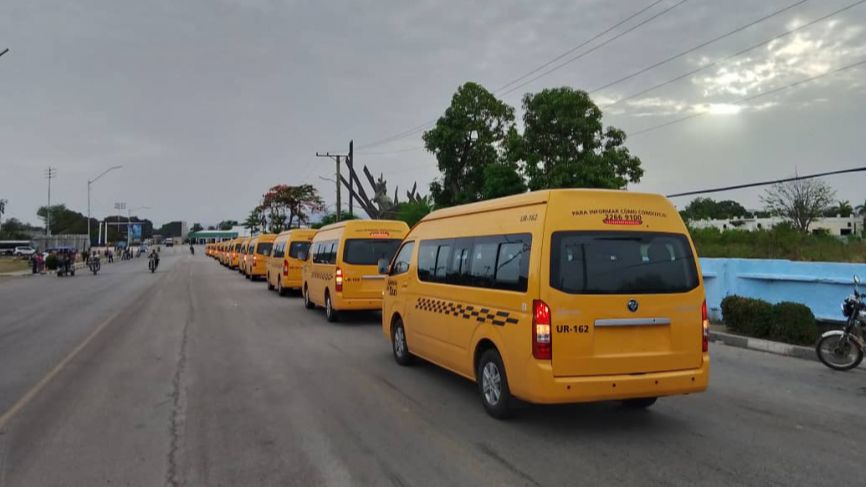
14ymedio, Havana, June 26, 2025 — The new Foton minibuses are slowly arriving in the provincial capitals where they have been allocated after the government reversed its decision to concentrate in Havana the 100 vehicles purchased from China. This Wednesday, the newspaper Sierra Maestra reported the arrival of 20 sent to Santiago de Cuba to reinforce “the four routes of greater mobility,” in an attempt to mitigate the effects of the prolonged shortage of fuel and spare parts.
The new minibuses, according to Jaime Codorniú Furet, delegate of the Ministry of Transport in the province, are part of the actions for the city’s 510th anniversary and an effort to sustain a service that has been seriously limited for years. The official also noted that 20 electric bicycles have been operating in the southern part of the city since 2023, with an average of 10 trips per day, although they do not escape the interruptions caused by frequent and long blackouts.
The coverage is clearly insufficient
Santiago de Cuba, with more than 500,000 inhabitants, has 190 officially established routes, of which 131 are currently in operation, according to data from the transport agency itself. These journeys are served by a combination of state transport, company vehicles, private cars and leased vehicles, some of which are also used as ambulances and hearses.
However, this coverage is clearly insufficient. Given the shortage of buses and the irregularity of rail service, where many so-called “ferrobuses” remain out of service, users have found in motorcycles a fast and relatively affordable alternative that is adaptable to current conditions. continue reading
Santiagueros have found in motorcycles a fast and relatively affordable alternative that is adaptable to current conditions
The boom of electric bicycles and motorcycles in Santiago has been documented both by state media and independent publications. Their popularity soared in the last five years, especially after the pandemic, when restrictions on mobility and the collapse of public transport pushed many citizens to purchase personal vehicles.
Although private motorcycles are not regulated as public transport, in practice they have become a semi-informal taxi service. Many circulate in strategic boarding points such as Trocha, Garzón and Martí avenues, as well as in peripheral areas with little bus coverage.
The attempt to ban passenger transport on motorcycles in 2021 accomplished nothing. At that time, Santiago de Cuba had about 14,000 motorcycles circulating in the city. Faced with complaints from motorcyclists, the government was forced to back down.
The cost of those trips went from 150 to 300 pesos
Four years later, motorcycles and prices have multiplied. On social networks, Santiagueros often comment on the cost of these trips: from 150 to 300 pesos, depending on the distance, time and fuel availability. For many state workers or students, this rate is unaffordable on a regular basis, exacerbating inequality in access to transport.
The proliferation of motorcycles is not without risk. Authorities have reported an increase in traffic accidents related to these vehicles, as well as fires, robberies and violent incidents. Despite these problems, their presence is widespread and in neighborhoods without bus routes they are the only means of connection to the city center.
In parallel, the Government has tried to alleviate the situation by providing 18 boarding points in the provincial capital and one in each municipality, according to official figures. Animal carts and bicitaxis are also retained as short-distance options, although their availability is limited and coverage uneven.
In neighborhoods without bus routes, motorcycles are the only means of connecting to the city center
Chronic fuel shortages have had a direct impact on transport. In March 2024, the Minister of Transport, Eduardo Rodríguez Dávila, acknowledged before the National Assembly that the Cuban motor vehicle fleet was “on the verge of collapse”.
Against this backdrop, urban mobility in Santiago de Cuba seems increasingly to be supported by individual ingenuity rather than effective state planning. Motorcycles, a symbol of everyday life, still have a role that, although unofficial, is essential for the functioning of the city.
Translated by Regina Anavy
____________
COLLABORATE WITH OUR WORK: The 14ymedio team is committed to practicing serious journalism that reflects Cuba’s reality in all its depth. Thank you for joining us on this long journey. We invite you to continue supporting us by becoming a member of 14ymedio now. Together we can continue transforming journalism in Cuba.
I had lost the interest and passion that had taken me out of my province and placed me among the top ranks of Medicine.
“What could a young college student with such a passion for Galena do but pack it in a suitcase and run?” / Instagram / Liz Ashelle
14ymedio, Liz Ashelle Díaz Gómez, June 2, 2025 — I live in the state of Hidalgo, Mexico, in a town that is two hours from Mexico City. It’s small and colorful, and I loathe it with all my soul. I work in a marketing agency for the telephone company AT&T, and part of my job is doing field work: going to remote places in the city and begging the most ignorant and poor people in the neighborhood to change to our company, because our salary depends on that commission. So I have known little by little every corner of this territory.
We go up to the mountain ranges, under the burning sun, and I pretend to relieve the pain in my heels by thinking about what scene of the cinema reproduces the images that I have in front of me. It is a landscape of hills with discontinuous stairs to access the community: girls coming out of school in their horrible uniforms, socks up to half calf, rushed, carrying piñatas shaped as an axolotl* under their arms; the murals, all with skulls and crosses, and shoes hanging from the power cables.
There are grocery stores on every block, with their millions of snacks and sweets that I do not know, although my fellow hikers stop every now and then to buy some that they know I have not tasted. They await my reaction with wide-open eyes as I grab the first and issue a judgment, which is usually the same every time: “It’s good but it stings my mouth.”
“Oh, that’s nice, this is like a Mexican movie,” and we all laughed out loud. My supervisor replied: “Because you’re in Mexico!”
They hang colored flyers from post to post for the Day of the Dead and do not remove them throughout the year, similar to those that hover in my childhood from a CDR party, and the wind beats them and turns them into the only thing that moves and sounds in those streets paved with dust and abandoned on top of a hill. Everything is cinematic. I know that there is, although I can not remember it, some film of Alfonso Cuarón that I saw as a teenager, with a scene identical to the panorama of which I am part, and a protagonist who surely is called Marifer but does not dress like me, speak like me or have my skin color and hair.
On the first day we walked up, and I stood at the edge of a ravine and saw the colorful houses stacked, distributed throughout the surface of the hills, separated by narrow streets where the cars tumbled past, so tightly that they seemed like toys. I shouted: “Oh, how nice, it’s like a Mexican movie,” and we all laughed. My supervisor replied: “Because you’re in Mexico!”
I’m in Mexico. Magical Mexico. Why am I no longer living in Cuba?
I was living in Havana with my girlfriend, in a rented cottage in a bad part of Cerro, very pretty and cool, where they almost didn’t turn off the power. On some weekends we visited Matanzas and came back crying a lot. Amanda’s continue reading
family lived in Jovellanos, an hour and a half from where my mom lived, in a two-story home. There they shut down the power religiously at five in the morning and turned it on at two in the afternoon. As soon as the air conditioner was turned off and the house was in a resounding silence, I irredeemably woke up and began my most exhausting hours of the day.
The heat began to flood the bedroom little by little, appropriating the space. I uncovered Amanda, who was still sleeping undisturbed, and she began to turn around in bed looking for the cooler side of the sheet. The minutes before dawn lasted three hundred seconds. We were gradually moving from an overwhelming stillness to the first signs of morning life: you could hear the grandfather just waking up doing his toilet routine in the bathroom, including all the throat clearing and the most scandalous evacuation. Then, the grandmother chasing after the baker or yoghurt maker, shouting at them from the back of the house as she walked to the door, and the dog barking, sticking her tail between her still agile legs.
“Would those things happen anywhere else in the world?” / Instagram / Liz Ashelle
From the bedroom, we could hear all the conversations inside and outside the house, no matter the tone of voice. I heard my mother-in-law whispering at the window: “Don’t shout, you’ll wake up the girls.” When the sun finally began to rise, Amanda became meat for the mosquitoes; they appeared to bite her legs and torso without any compassion. I tried to kill as many as I could and turned my hand into a fan to scare them away. I was not stung; mosquitoes never liked my blood, but she woke up full of red welts and almost always about to cry, soaked in sweat.
By that time I had spent four or five hours awake in that thick darkness, thinking. I watched her sleep as only a woman in love, twenty years old, can watch the dreams of someone who was about to become the most immediate victim of emigration. I pushed her hair out of her face and kissed her sweaty and sour forehead. She groped for my hand with hers, passing over the quilt, the clothes I took off, my thigh, the cell phone, a portable charger and, finally, my hand.
Amanda and I were arguing louder each time, more violently, more like men. I let months fly by watching as the relationship of my teenage dreams crumbled and dragged us in its wake, becoming two monster daughters of other monsters that occasionally made love. Twenty-three years of the most beautiful woman I had ever seen sleep, with her mouth open, mosquitoes making a halo over her head and my hand clinging to hers. Completely naked in front of me, on equal terms, we the most optimistic thoughts about a future together, which only required that we fix a little here and there to make it sparkle, and I had to punish myself for forgetting that the night before she had spit in my face and we had screamed until we were completely exhausted.
They were daily hours of a struggle between the deepest love and a dangerous madness. When there was a spot of light on the ceiling, we were two women recognizing each other’s more miserable and rotten side, and when not, the only miserable and rotten thing we could see was the Revolution. Amanda woke up in a puddle of rancid fluids and tears. By then I had bathed, cried, and had breakfast with her mom and grandmother. She would sit on my legs on the Swiss couch in the kitchen and share with me her most horrible impression of the blackout: we were visiting, but her family and my mom lived like that.
“My mother had decided that she was running out of time, that, with almost fifty years under her belt, the bars of the island prison were closing and she wasn’t going to stay inside”
My mother had decided that she was running out of time, that, with almost fifty years under her belt, the bars of the island prison were closing and she wasn’t going to stay inside, even if to leave she had to sell the only asset we had in the world: the house of my childhood, with everything inside. House for sale with everything inside, in Pueblo Nuevo. It comes with the washing machine and the scratches made by the dog on the door. I will leave you the microwave and the landline telephone, the picture of the girl’s quinceañera, the fish tank, the extra bed. Also if you want to occupy it, there is a cat, how are you going to keep him from breaking into his house? I will leave the blacksmithing things with the tools, and the pillows… everything, but I ’m taking the quilts because they say that it’s cold in El Salvador.
The sticky mark on the wall is from a poster of Malú, I think with acetone it will come off. That air conditioner does not work, but I’ll leave it and you can sell it for parts. Look, this is how the door opens, by pulling the cord on the stairs so you don’t have to go up. The armchairs are not upholstered in the back. The water tanks are on the roof, one is yours and the other is for my sister who lives downstairs, and it’s all painted because my husband bought the girl some spray paint years ago, and I had to let her graffiti the ceiling in exchange for not vandalizing the street. Yes, it was necessary to control her so she wouldn’t get into that gay propaganda, but she came out lesbian anyway. Do you see how there are two keyholes on the door? They open with the same key. If you want to buy it we can sign the papers this week, the refrigerator is still under warranty. I want to sell now because in a few months there will be elections in the United States, and you never know.
“I was forced to make a very cruel decision: take part of the money and stay in Cuba, or leave with her”
Once put on sale in all the Facebook groups, with explicit photos that violated the privacy of what was once my home, I was forced to make a very cruel decision: take part of the money and stay in Cuba, or leave with her.
The return to Havana was an even more excruciating hell. Sometimes my in-laws would take us in their car, but we had to make most of the trips on foot through the street, stumbling, loaded with packages of frozen food and clothes, until we reached the Martí neighborhood. The university, which in other years had been the place of greatest achievement for my generation, had become a deeply hostile place, and I, adapting to circumstances, had completely lost the interest and passion that some time ago took me out of my province at all costs and positioned me among the best ranks of Medicine.
Who was going to tell the 18-year-old teenager who sat in a psychological consultation about to decide that she would leave her home, that it would be to the capital, that she would study medicine, and that she would have to marry her stepfather to get the papers from Havana and be able to study there, that half of her dreams were going to be consumed like raisins when she put them in the hands of the system. When the alarm sounded in the morning, I broke into uncontrollable crying that has accompanied me since childhood, as the crudest symptom of depression. The days that I could open my eyes without crying and transport myself to school were even more miserable, and I ended up finding an excuse to go back home, prepare food and throw myself into bed to watch a pretentious A24 movie.
“Exaltation and doubt had been brutally murdered by the disinterest in teaching and the lack of resources”
The peak of academic demotivation was reached in my first direct experience with the clinic in Fajardo. What could a young college girl with such gallant passion do but pack her bag and run? The Red Theater, which once bestowed on me the Relevant Award on the Day of Science, was one more arm of the dictatorship, where the dean exercised his power of political-ideological coercion.
My group of friends, who used to be an optimistic study team and successfully navigate the group dynamics, had become a flock of zombies walking around the hospital, dodging reasonable protests from patients and waiting for the visitation pass to end. Exaltation and doubt had been brutally murdered by the disinterest in teaching and the lack of resources.
My last day at the Teatro del Fajardo, which I recently heard collapsed, was the day they announced that they were going to assess the school for accreditation. The news came with a blackmail that put in play my grade of a filler subject, if I did not answer the questions cautiously to favor the prestige of the University of Havana. That day, for the first time since I arrived in the capital, I did not raise my hand to speak. I shut my mouth and chewed up the virgin and scandalous girl who first entered the theater and was amazed when they turned on the lights, who cracked open a window and directed her group towards the row on the right because more air came in, who stood in front and explained a research paper and published it, who ate an omelet with bread on the staircase of the theater at midnight on guard duty. I swallowed them and never went back in. The system was given a passionate, enthusiastic, revolutionary, idealistic and committed-to-science teenager, and in three years it returned a woman imprisoned in anger and skepticism.
The decision was not difficult; it was taken before it was considered possible, before 1959. The day I was born, in the maternal hospital of Matanzas, bald, pink and without consciousness, this fate had already relentlessly swept over me. The only thing left for my very small and not so free will, was when.
“I walked slowly all over G, in the same uniform coat they gave me in my first year, now a faded yellow and tight”
It was over a month, which felt like a year, before I could accept that I was saying goodbye. I went out to buy vegetables in the country and observed the fruits and the delicacies in detail, the avocados that did not fit into my hands, the yucca that did not know what it was called in Colombia or in Uruguay, the man on the little square who signaled me that he had shrimp for sale under the table. Would these things happen anywhere else in the world?
We turned on the projector and I placed with excessive care the books that supported it (Internal Medicine I and II), and I memorized the counters and the prices of the kiosk where we shopped daily. The rattling of the key that closed the front door, and the roar that the balcony door made when it was thrown open; we always agreed to put a quilt there to cushion the blow but then forgot. Halfway through the film I paused the projector and asked Amanda to bring something to eat. She protested, surrendered, came out, projected the film on her naked body. I tried to memorize it, ran behind her to hug her and started crying. There was no need to speak, it was over. I had pronounced a death sentence and after that there was only room for silence and crying.
The streets of Havana appeared bigger, more beautiful, more populated; they embraced me with their capital’s arms. I walked slowly all over G, in the same uniform coat they gave me in my first year, now a faded yellow and tight around my chest and arms. I made a mental journey with my eyes closed to the theaters of El Vedado; I imagined the sound of my boots stepping on the wooden floor of the Trianon, like the first time I went to see The Shoemaker’s Prodigious Wife [a play by Federico García Lorca].
I crossed and walked making a mental sketch, with the privileged memory of grief, of the previous occasions I had walked those streets, and with whom, and what clothes I wore, and how I felt. Every two or three blocks I would stumble upon someone to greet and tell him that everything was fine, I’m here, struggling, say hello to your mom. The smell of the salt water from the Malecón began to accost my nose, and the memory of the first night I sat alone on the wall, just arrived from Matanzas, believing that I was going to die of homesickness and that I was in a movie by Fernando Pérez.
The city held my hands very tightly, as if I wanted to escape and it had to tame a naughty child. I walked clenching my fists, why was I so upset, so tired, so violent? I did an urgent introspection exercise, and the anger was born so far back that I had my own stuffed animal in the crib from which I fell at three months. My face was burning, red with fury and flooded in tears: I’m leaving, I’m leaving Cuba, tomorrow I’ll confirm it to my mother, I’m leaving here. I had begun the journey.
* An endangered Mexican salamander
Translated by Regina Anavy
____________
COLLABORATE WITH OUR WORK: The 14ymedio team is committed to practicing serious journalism that reflects Cuba’s reality in all its depth. Thank you for joining us on this long journey. We invite you to continue supporting us by becoming a member of 14ymedio now. Together we can continue transforming journalism in Cuba.
Cuba’s Minister of Tourism announced in an interview with the Spanish newspaper ‘El País’ that there will be direct flights between Barranquilla and Santiago de Cuba.
Foreign tourists giving money to a woman on Havana’s Paseo del Prado. / 14ymedio
14ymedio, June 25, 2025 — Cuba’s Minister of Tourism, Juan Carlos García Granda, has a proposal to encourage tourism in Cuba: the creation of a visa-free common area in Latin America. The idea does not seem, for now, to be more than in his head, but he outlined it in an interview with the Spanish newspaper El País during a meeting with tourism entrepreneurs in Colombia, held at the Hotel Dann Carlton, north of Bogotá.
“Perhaps we need to start talking about visas that can be used for several countries, as is the case with the Schengen Area in Europe. We must see how the world has done it and apply it in the region to attract common benefits from such distant tourist flows,” says García Granda, who considers it essential to reduce bureaucracy. The official introduces the proposal when asked about the Chinese market, which Cuba has been dreaming about for at least two years.
The minister explains to the journalist that the decline in traditional markets, particularly in Europe, has led his department to try to look for new fishing grounds, including Turkey, China and Russia. “We already have better [tourism] flows that we want to grow. And we want to do so by providing a unique offering as a region that benefits us and by sharing it, he states.
“We already have better [tourism] flows that we want to grow. And we want to do so by providing a unique offering as a region that benefits us and by sharing it”
García Granda omits a part of the reality revealed by his own data. The number of Russian tourists arriving on the island has plummeted so far this year. Until 2024 the evolution was positive, reaching third place by continue reading
origin and with around 185,000 travelers last year, but in 2025, a decline of around 50% began. It is true that the number of Turks (12.6%) and, above all, the Chinese (48.6%) visitors increased, but the figures are still anecdotal: 14,898 and 26,760 respectively.
The minister says that another strategy is to increase connectivity. “Faced with such a difficult scenario, we are trying to strengthen markets that we have always had, like Colombia, Mexico and Brazil,” he says. The last two had a good evolution last year, maintaining the figures of Mexico, which is not small in view of the debacle of the sector, and Brazil rose by 11 percent. However, Colombia did have a substantial drop: 32,604 travelers arrived from that country, 20% fewer than in 2024.
Perhaps the effort to recover the lost quota was part of García Granda’s meeting with some 30 tour operators and sales managers of Colombian airlines. El País reports that beginning July 3, the airlines will have a new route between Barranquilla and Santiago de Cuba, coinciding with the celebration of the Caribbean Festival. “This demonstrates how there are still people with enthusiasm and knowledge of Cuba and the Colombian market. I think they have made a bet that has every chance of winning,” says the minister. Although there are no more details about these routes, the Colombian press has indicated that they are charter flights and also suggests that they will continue after the event.
“All the people know that the economic benefits of the sector bring prosperity and cushion the effects of these very difficult times.”
In the interview, García Granda tries to convince the journalist, as he does in Cuba, that the investment effort made by the State is aimed at improving the conditions of citizens. “All the people know that the economic benefits of the sector bring prosperity and cushion the effects of these very difficult times,” he said, when asked by the journalist about a possible rejection of the population towards the strength of the hotel sector in the middle of the long blackouts. “That [narrative] has tried to provoke the counter-revolution and slanderous campaigns,” he spit out.
Next, García Granda, after claiming that the establishments have their own generators, tries to soften his remarks. “I would not say that there is an isolated system of energy generation, but we work so that the weight of our consumption [that of the hotel sector] does not necessarily fall on the shoulders of the population.”
In the interview, there was also time to talk about the United States. The journalist asks García Granda if Havana plans to improve relations with Washington in order to recover the sector. The minister remarks that the ball is in the court of the White House, which prevents its citizens from traveling to the island. “It is very bad that governments prohibit their citizens from deciding freely, and the world should help citizens to do so and not sell the US as a symbol of freedom,” he argues.
The official also wants the journalist to ask former president Barack Obama – who was in Cuba in April 2016 – “what is the only place where the Beast (Obama’s armored car) has walked and even the people threw a tomato at him.”
COLLABORATE WITH OUR WORK: The 14ymedio team is committed to practicing serious journalism that reflects Cuba’s reality in all its depth. Thank you for joining us on this long journey. We invite you to continue supporting us by becoming a member of 14ymedio now. Together we can continue transforming journalism in Cuba.
Some neighborhoods barely suffer any outages, while others live among candles and silent refrigerators.
Members of the Teatro de las Estaciones, in Matanzas, with a poster announcing the suspension of the play. Sign: “Function suspended. Theater for children is not a priority of those who plan electricity service.”/ 14ymedio
14ymedio, Pablo Padilla Cruz, Matanzas, 20 June 2025 — “The essential is invisible to the eyes,” says the famous quote from The Little Prince. But when Antoine de Saint-Exupéry wrote it, he was not referring to the blackouts. In Matanzas, the children find it difficult to see the adaptation prepared by the group Teatro de las Estaciones. The city has become a dark pit, in whose abyss the light is distributed with diffuse and often arbitrary criteria. In that abyss, only some – the chosen few, the closest to power – receive the grace of constant electricity. As is often the case on this island, for some to win, others must lose.
“We know what is going on in the country. We know and understand that hospital circuits must have priority. What we don’t understand is how a circuit where there are only houses of Party officials and militants has ten hours more electricity than any other,” says a theater worker who prefers anonymity. While he brings a cup of coffee to his lips, he smiles with irony and adds: “The provincial headquarters of the PCC [Cuban Communist Party] is just there,” and he points to some lights a few meters away.
The comment is not isolated. Parents, artists, technicians and theater managers share the same frustration. It is not just the impossibility of rehearsing or presenting performances, but an implicit message: culture, childhood and art are not priorities. continue reading
It is not just the impossibility of rehearsing or presenting performances, but an implicit message: culture, childhood and art are not priorities
The children who came to the theater with the hope of seeing a puppet show, accompanied by parents who strive during the week to offer them moments of healthy recreation, found the doors closed, lights out, curtains down. “Then we and the kids put our heads in our hands. Places where children can grow up with sensitivity are not valued,” continues the same worker.
The Teatro de las Estaciones is not just any institution. Founded by maestros Rubén Darío Salazar and Zenén Calero, it has been for decades a quarry of creativity and sensitivity for generations of Cubans. Its members have taken the puppetry technique to unexpected levels, combining tradition and avant-garde, raising the genre to a level of respect and recognition. “I don’t say it only because I work here,” insists a woman from Mantanzas. “I say it because we have built it with a lot of effort, with every rehearsal, with every performance under the sun and under the blackouts.”
The work, entitled A Trail in the Stars (Invisible poems to say at twilight), started from the verses of Asteroid B612 by writer José Manuel Espino – a book that pays homage to Saint-Exupéry’s immortal classic. The company has had to suspend performances, adjust rehearsals and reinvent the calendar because of power cuts. But more than a technical contingency, what is perceived is a deep fracture: the lack of equity in the distribution of energy.
The authorities have implemented a rotation system that, according to the official discourse, seeks “equity” in the distribution of electricity. In practice, however, the perception is different. Some neighborhoods barely suffer cuts, while others live among candles, exhausted batteries and silent refrigerators.
Art, like the flower of the Little Prince, needs care. It does not survive without light, without attention, without a space to flourish
Art, like the flower of the Little Prince, needs care. It does not survive without light, without attention, without a space to flourish. And although the rulers proclaim from the grandstands the importance of culture and healthy recreation, administrative decisions contradict that discourse. “They talk about culture as a shield, like a sword, but here we feel forgotten,” says another member of the artistic collective.
And this is not just a cultural anecdote. It is a reflection of how the blackouts – that word so present in Cuban daily life – affect not only domestic life, but also the social fabric, the mood, the soul of the nation. Because when the theaters go out, it’s not just the light bulbs.
Artists don’t ask for privileges. They ask for minimum conditions to do their work, one that often fills educational, emotional and spiritual gaps. In a country where childhood is surrounded by scarcity and uncertainty, theater is something more than a respite.
“We are not a priority. That is clear. But at least don’t keep telling us that we are,” one of the actors concludes with resignation. While in some neighborhoods the air conditioning does not stop buzzing, in others, as in this theater, the heart of Matanzas, the only thing you hear is the silence of a performance that was not. A flower that could not be watered, a child who did not know the fox, an asteroid without light.
Translated by Regina Anavy
____________
COLLABORATE WITH OUR WORK: The 14ymedio team is committed to practicing serious journalism that reflects Cuba’s reality in all its depth. Thank you for joining us on this long journey. We invite you to continue supporting us by becoming a member of 14ymedio now. Together we can continue transforming journalism in Cuba.
The mysterious company, falsely Mexican, opened a La Favorita butcher shop in the central market
New butcher shop sells in dollars at La Favorita by Richmeat on Cuatro Caminos / 14ymedio
14ymedio, Juan Diego Rodríguez / Olea Gallardo, Havana, June 20, 2025 — A new business has just joined the fever of dollarization in Havana. And not just anywhere, but in the largest and oldest market of the capital, Cuatro Caminos, in Centro Habana. This is a butcher shop of the firm Richmeat, which three months ago signed an agreement with Cimex to manage a whole complex of shops under the name of La Favorita, as some of its products are called.
Just a few days after opening, the place looks pristine, clean and perfectly air conditioned. A blue and yellow balloon decoration shows that the opening is recent. All of the employees address anyone who enters with the same question: “Can I help you with something?”
The variety of the offers – pork, boneless or seasoned chicken, house brand picadillo (El Cocinerito), sausages, burgers… – contrast with the freely convertible currency (MLC) part of the Plaza, only a few years ago well stocked and now languishing.
While the store was previously accessed through a door in front of the MLC products, it is now accessed through the main facade on Cuatro Caminos. / 14ymedio
As if to separate the new venue from the old, which is gradually being abandoned, they changed the entrance. Previously accessed through a door in front of the products in MLC, clients now enter through the main facade of Cuatro Caminos. “The hard currency gets the red carpet,” an old man mocked in front of the new butcher shop.
“Here there is almost nothing, but look there, girl, in dollars,” indicated a custodian of the place to a client. Nothing was said about the poor quality of continue reading
Richmeat’s products, which does not prevent the company from becoming increasingly prosperous.
La Favorita will soon open a branch in a privileged enclave, the Náutico de La Habana, a shopping center close to the exclusive club of the same name, in the municipality of Playa. That was going to be the first of the shops according to the agreement between Richmeat and Tiendas Caribe, announced by the authorities, but the one of Cuatro Caminos has advanced without explanations.
An employee confirmed to this newspaper that the plan to open that butcher shop in the western part of the city is still ongoing, predictably also in dollars.
The poor quality of the products of the Richmeat factory does not prevent the company from becoming more and more prosperous
The official press indicated last March that in a “first stage” of the agreement with Cimex they would have not only the Playa store, but three more. As “the project progresses,” said Cubadebate, “its expansion to other territories of the country will be planned.” They did not say at that time, however, that the sale of products would be in dollars.
This agreement was the second of its kind by the state corporation belonging to the Group of Business Administration (Gaesa), after the one signed with Vima for the store at Infanta and Santa Marta, in Centro Habana, inaugurated last January.
This is not the only similarity between the two brands. Like the one founded by the Spaniard Víctor Moro Suárez, Richmeat products are little appreciated by Cubans, although they often represent the only protein option in the basket amid perpetual scarcity. “No one wants to eat the picadillo” is the comment of many consumers when they receive those tubes of 400 and 800 grams, which are marketed under the brand of El Cocinerito and La Favorita, respectively.
Another coincidence with Vima is that both companies are registered abroad, in Mexico in the case of Richmeat, but neither is known in their respective countries. In Cuba they have preeminence and receive all kinds of hospitality.
There is no indication that Richmeat is a truly Mexican company and not a Cuban firm “disguised” as foreign
Beyond its legal registration, effectively in Mexico, and the nationality of both its president, Luis Alberto González Hernández, and its vice president, Alejandra Chapela Díaz – both present at the signing of the recent agreement with Tiendas Caribe – there is no indication that Richmeat is a truly Mexican company and not a Cuban firm “disguised” as foreign.
As 14ymedio found, the most important Mexican meat industry agencies do not have this company registered: neither the National Agri-Food Certification and Verification Agency, nor the National Association of Establishments Type Federal Inspection (ANETIF) or the Mexican Meat Council.
Even more significant is that the National Service of Health, Safety and Agri-food Quality (Senasica), the Mexican authority responsible for issuing animal health certificates for exporting meat and products derived from it, has no news of Richmeat. “This must be because it operates directly in Cuba, and its products do not come from Mexico,” an official of that agency who asked for anonymity told this newspaper.
According to a knowledgeable source, Richmeat sources its meat on the island, not in Mexico. / 14ymedio
According to a knowledgeable source, Richmeat purchases the meat in Cuba, not in Mexico. This would explain the poor quality of the products. Meat in Mexico has an established reputation, and it’s no wonder the country is one of the world’s leading exporters of beef. According to this source, Richmeat buys the meat on the island, and one of the sites where they buy is the Rigoberto Corcho Credit and Service Cooperative (CCS), in Artemisa.
That it is truly Cuban and not Mexican would explain the “constant presence” of Richmeat “for more than eight years,” which the official press often emphasizes, “even in the most critical periods during the covid-19 pandemic”.
What is clear are the privileges received by the firm. It is often praised by the authorities and now has a location in Havana’s main market. This suggests that it is most likely a company controlled by the Cuban leadership, and the view is that it is expanding.
Translated by Regina Anavy
____________
COLLABORATE WITH OUR WORK: The 14ymedio team is committed to practicing serious journalism that reflects Cuba’s reality in all its depth. Thank you for joining us on this long journey. We invite you to continue supporting us by becoming a member of 14ymedio now. Together we can continue transforming journalism in Cuba.
Former Cuban Foreign Minister Felipe Pérez Roque, “dismissed” in 2009, recently seen on the streets of Havana / Facebook / Siro Cuarte
14ymedio, Yunior García Aguilera, Madrid, June 23,2025 — The Cuban regime, after more than six decades in power, has developed an enormous fondness for the use of euphemisms. Even to dismiss their bureaucrats, ambiguous terms and encrypted phrases are common, as if each token move, rather than a routine partisan maneuver, was a riddle for “the enemy”. And when power is held by force, that enemy can be everywhere, in the streets or within their own ranks.
Also, the graduates of the Ñico López -University of the Communist Party (PCC)- sometimes find it difficult to hit the target when some official note announces the “release” of a Party cadre. Some speculate that there are subtle differences in the language used, which do not mean the same as “duties,” “positions,” “responsibilities,” and “functions.” Each could hide a different cause and effect, as if it were a secret code.
It is here that the parallel euphemisms used in the bread lines and bus stops come into play. If it is a cadre that is promoted to a higher position, on the street it’s called “falling up.” If we never see his face again or hear his name, they have put him on the “pajama plan.” If his dismissal conceals the possibility of an error or a slight suspicion of disloyalty, he was “dethroned.” continue reading
Now the destroying bolt of lightning has hit Roberto Morales Ojeda, although he did not inherit the official title of “second secretary”
During the years 2011 to 2021, the person in charge of “enthroning” was José Ramón Machado Ventura, number two of the PCC’s Central Committee, after Raúl Castro. Now the destroying bolt of lightning is in the hands of Roberto Morales Ojeda, although he did not inherit the official title of “second secretary,” which Machado intends to keep symbolically and for life. The royal hierarchies of power in Cuba are today an undecipherable puzzle.
From his position as head of Organization and Cadre Policy, Morales is responsible for boxing ears, offering promotions and cutting off heads, but some decisions are made over his head.
The year 2024 was his year of glory. He moved his chips in at least seven provinces, replaced three ministers and swept away two deputy prime ministers. Bald and discreet like his predecessor, Morales passes the sword quietly and opportunely. If there is any scandal in sight, the cadre in question must be kept in place at all costs. No “giving weapons to the enemy” or pleasing the dissatisfied plebs. Then, when the waters calm down and no one expects it, the time will come to settle accounts. The best example is, perhaps, Alpidio Alonso -Minister of Culture-,who has survived in office against the current and without any favorable result. They must wait for an independent newspaper to mention him, then “release” him from his responsibilities.
It is necessary to be absolutely inexpressive, repress any aspiration to occupy first place and avoid standing out at all costs
The one in charge of putting someone on the throne must meet some basic requirements. It is necessary to be absolutely inexpressive, repress any aspiration to occupy first place and avoid standing out at all costs. Charisma is a remnant of the era of Fidel Castro, skillfully exterminated by his younger brother. Raúl took it upon himself to annihilate that generation of screamers that emerged during the Battle of Ideas and the Open Forums. Now is the time for Machado’s pupils: disciplined 50-year-olds, preferably mediocre and without any oratory skills.
Some of the cadres removed in 2024 were relocated to other provinces or to the higher structure of the Central Committee. But not all. Luis Antonio Torres Iribar -former first secretary of the PCC in Havana- was “released” in April with the semantic novelty of a “renewal,” something that was not used in other provincial releases. Although he maintains activity on Facebook and X, his agenda is in deadlock: he only shares institutional publications, and no new posts appear on his profiles.
The phrase “release for renewal” was also used in the cases of two other dismissed ministers: Elba Rosa Pérez Montoya -Science, Technology and Environment- and Manuel Santiago Sobrino Martínez -Food Industry. The first one has no profile on X. The second one does, but he hasn’t published anything since 2022. No official media has mentioned them again. Journalists in the State apparatus soon learn not to dig into the names of any released cadres.
“Committed errors in the performance of his duties”
The one seen a few weeks ago was Jorge Luis Perdomo Di-Lella, former deputy prime minister. He appeared for two seconds in the Noticiero del Mediodía, in a report on a tribute to Fidel Castro, where his widow and some of his children were also present. The official note of Perdomo’s dismissal used the expression “removal from office,” and added something worse: “he committed errors in the performance of his duties.”
Translated by Regina Anavy
____________
COLLABORATE WITH OUR WORK: The 14ymedio team is committed to practicing serious journalism that reflects Cuba’s reality in all its depth. Thank you for joining us on this long journey. We invite you to continue supporting us by becoming a member of 14ymedio now. Together we can continue transforming journalism in Cuba.
Sunday saw the second-worst record in history, just 21 megawatts shy of the record set on April 23.
Thermal generation has more than 300 megawatts affected, and the distributed generation almost triples this deficit / 14ymedio
14ymedio, Madrid, 23 June 2025 — The night has not given respite to Cubans anywhere on the Island. All the gossip centered on the second historic event for electricity deficit, reached on Saturday and recognized this Sunday by the electric company of Villa Clara, although it affected the entire country. At peak time, the deficit was 1,880 megawatts (MW), only behind April 23, when it reached 1,901 MW.
The data was accompanied by a series of brutal statistics. Five of the 12 worst records in 2025 were in April, and the current month accumulates three “serious events” on June 17, 20 and 21, which mark, says the electric company from Villa Clara, an “upward trend.” In addition, all these data are even worse than those of 2024, including the critical month of November, when one of the three total disconnections from the national electricity system occurred.
The information was shared on the Facebook page of José Miguel Solís, a journalist specializing in energy who is often on social networks, popularizing what until then had a smaller audience, just the followers of the company of Villa Clara. The flood of comments was instantaneous, with endless reproaches from those who questioned the graph that reflected with two very distant upward lines the concepts of consumption and deficit. The tone of the response was: How can you talk about consumption when you have up to 22 hours a day without light?
“The high peaks occur after a blackout, since people have everything connected waiting for the current to arrive so consumption rises at that precise moment,” argued a Cuban living in Miami. “Get your neurons to work. This high continue reading
consumption is from the favored circuits of the Party and the dance venues of Varadero and Havana, which are consuming the little current that is generated,” another refuted.
“The blackouts were horrible in the provinces, of course. Here they removed it three times, and we are on the same circuit as the hospital. They took it off, put it on, took it off, put it on…” says a Havana resident in Cayo Hueso. In the newsroom of 14ymedio, located in Nuevo Vedado, the power was cut off at dawn this Monday.
Monday is another day without news. The Electric Union (UNE) confirmed that on Sunday there was a deficit of 1,650 MW at 9:50 pm, the hour of greatest demand, although the contribution of the 16 solar parks was more than 1,800 MW. One customer was wondering how investments in solar are helping, and another answered, saying that everyone in the country had the same issue, and that those who have solar panels use them during the day and get enough power, but at night they have nothing.
Today, the maximum demand is estimated at 3,550 MW, while generation will remain at just 1,850 MW, which means a peak deficit of 1,770 MW. In addition to the failures of units 6 and 8 at Mariel and 2 at Felton (Holguín), maintenance work was carried out on units 2 at Santa Cruz del Norte (Mayabeque), 4 at Cienfuegos and 5 at Renté (Santiago de Cuba), for a total thermal deficit of 390 MW.
But in addition there are 96 distributed generation plants out of service due to lack of fuel, a total of 738 MW of deficit to which are added 97 MW that are not available due to lack of engine oil
But in addition there are also 96 distributed generation plants out of service due to lack of fuel, a total of 738 MW of deficit to which are added 97 MW, not available due to lack of engine oil.
The situation is alarming and customers are wringing their hands thinking about the possible repercussions of the closure of the Strait of Hormuz, through which large quantities of crude oil pass for everyone, as a result of the open conflict between the US and Iran. The decision is pending approval by the Supreme Council, but the concern is extreme. “If the oil that was coming into Cuba was from Iran, we will have some dark vacations,” says a customer.
“So many meetings of collaboration with countries like Russia and China, so many agreements to be signed, so many trips abroad for officials to ask for help, and we don’t see the results. They distributed only a little propane in each province, and in many places only very few people received it. “When will the others? “someone asks. For the moment, complaints are once again limited to social media, but the straw that breaks the camel’s back may be coming.
Translated by Regina Anavy
____________
COLLABORATE WITH OUR WORK: The 14ymedio team is committed to practicing serious journalism that reflects Cuba’s reality in all its depth. Thank you for joining us on this long journey. We invite you to continue supporting us by becoming a member of 14ymedio now. Together we can continue transforming journalism in Cuba.
There is concern about the use of the Canary Islands government subsidy, which claims to have received supporting documents.
“Fernando Rojas has exterminated the Canarian community in Cuba; he has disarticulated the little autonomy we had left” / 14ymedio
14ymedio, Natalia López Moya, Havana, June 21, 2025 — The descendants of Canary Islanders (Canarians) in Cuba have been crossing the desert for more than three years. The accusations of corruption within the Leonor Pérez Cabrera Canary Island Association and the closure of its main headquarters in Havana adds to the despair of many elderly people, who now have more difficulty in receiving the direct aid offered by the government of that Spanish autonomous community.
“The closure of the Casa Canaria has dispersed a lot of people, and the elderly are the most vulnerable,” says José, a descendant of migrants from Tenerife. He believes that with the 2023 closure of the Association’s house at 258 Monserrate street in Old Havana, part of the glue that held the Canarians together in Cuba has been lost.
In 2022, the Cuban government intervened in the Association after numerous complaints of malpractice, and they created a management commission chaired by the then deputy minister of culture, Fernando Rojas, whose grandmother is from Arucas (Las Palmas). The group, which presented itself as a transitional entity, has ended up monopolizing internal decisions, appointed like-minded people to head several local associations and manages, without transparency, the renovation of the emblematic building on Monserrate Street.
“No progress has been made in the electrical system nor have hydraulic improvements been made”/ Courtesy
José Luis Perestelo Rodríguez, deputy councilor of Foreign Affairs for the Canary Islands, tells 14ymedio that the government of the Canary Islands “provided a grant of 90,000 euros for the restoration of the building that housed the Casa Canaria, a grant that, as of today, is currently executed and justified.” However, traces of that money are barely perceived in the interior of the building, according to statements collected by this newspaper.
“No progress has been made in the electrical system, nor have hydraulic reforms been made. So far, the only thing that has been achieved is to demolish some structures, built arbitrarily, and throw away garbage and rubble,” says a source close to the restoration process. “Restoration students linked to the Office of the City Historian helped to clear the rubble but were not paid even one peso,” he adds. continue reading
Walls corroded by moisture, damaged framework and wooden doors, roof leaks and deteriorating pipes, especially in bathroom areas, are still present. “From the outside you do not notice any change but inside is where you can see how little has been done. Three years and 90,000 euros later the place is a ruin, and the schedule of repair and reopening is a mystery. They tell us nothing,” he complains.
Even a musician has joined the complaint and, with the refrain of “return the Canary House,” has recorded and broadcast a theme about the current situation of the property. ” They tricked us with false meetings, empty promises, false choice,” he exclaims in his song. “They occupy our place as if it were their own,” says the young man who identifies himself as a “guanche* and mambí rapper.”
Even a musician has joined the complaint with the refrain of “return the Casa Canaria”
Perestelo Rodríguez, in reply to this newspaper, says that “the government of the Canary Islands at this moment is not interested in the recovery of the building. The priority is to meet the needs of the Canarians and their descendants in Cuba, for which we provide individualized assistance to people directly.” He claims to be “in dialogue with the current management of the Casa Canaria to proceed with the renovation by the governing bodies, in a process that must be open to all members”.
The delay in the renovation of the premises causes problems that go beyond not being able to count on the large rooms where meetings, dances and concerts were organized, and in which a restaurant also functioned.
“Not having a place to meet up has greatly weakened the bonds among the Canarians,” reflects José in reference to the 50,000 migrants or descendants of Canarians who in 2023 were estimated to live in Cuba, a figure that may be lower today due to the mass exodus experienced by the Island. For his part, “Fernando Rojas continues to pressure the government of the Canary Islands to convince them that he is the only one who can handle Canarian matters in Cuba”.
“Rojas is an official and responds to the Cuban government, not to us”
“We cannot meet, because without the Havana headquarters we have to depend on the management commission to provide a place, but they have done very little in all these years,” adds José. “Rojas has exterminated the Canarian community in Cuba, has disarticulated the little autonomy we had left and has turned it into his private estate because he is an official and responds to the Cuban government, not to us”.
In a WhatsApp group, to which this newspaper had access, Dayamí Blanco Jorrín, the right hand of Rojas, announced the celebration on May 30 of the Day of the Canary Islands. In her message she said that “the event will take place during a very difficult time for Cuba, marked by economic difficulties and a constant and escalating aggression that does not know justice”.
As a finale, Blanco wrote that the Canary Islands government had not delivered the funds in 2025 intended for the Leonor Pérez Cabrera Association Canaria, but on the official site of the entity appears an allocated grant of 20,000 euros for that period. José explains that it has not been possible to obtain this money, and the Association remains without a leader after postponing the electoral process in order to elect a government that Rojas has tried unsuccessfully to form with people sympathetic to his policy.
To elect a president, member meetings must first be held, followed by convening an extraordinary general meeting and forming the electoral board. Only that entity can update the membership register. However, the sequence has not been followed, and the association remains without a leader since May 2022, when Lázaro Rivero was removed from the presidency by the management committee due to financial irregularities.
Those who have taken the brunt of the paralysis of the Association, the closure of the Casa and the loss of social activities have been the elderly. Not only do they not now have some of the cultural and recreational events that added some diversion to their lives, but they also don’t receive advice from the institution and other younger Canarians who helped them on important issues, like knowing about announcements and filling out forms for receiving financial aid distributed by the Canary Islands government.
“Most of those who need the aid couldn’t even fill out the application”
The Vice Councilor of Foreign Affairs of the Government of the Canary Islands awarded this year “a grant to 149 Canarians resident in Cuba, for a total of 29,800 euros, 200 euros per person, in order to alleviate the precarious health and socio-economic situation in which they are living,” explains the entity. But the number of beneficiaries seems like a drop in an ocean. “Most of those who need the aid couldn’t even fill out the application,” says José. “When the Casa was functioning, the younger people helped the elderly, but now the only ones who can get help are those who have a son or grandson to help them with the paperwork,” says the descendant of Canarians.
“There is very little information on aid, and, with the problems of connecting to the internet, an elderly person who lives here has a lot of difficulty in completing the paperwork for receiving aid,” says a daughter of 72-year-old Canarians living in the town of Cabaiguán, Sancti Spíritus. “Here, in addition, there are many who managed to get Spanish citizenship and left. There are only a few of us who stayed.”
The woman, who prefers to remain anonymous, obtained a Spanish passport through the Democratic Memory Act but has not left the Island because she takes care of an older sister, who is bed-ridden and in need of constant care. “Most old people cannot fill out the forms and send them in on time, and they don’t want to be kept hanging wondering if they’ll get the money or not.”
“The only thing that has been achieved so far is to demolish some structures, built in an arbitrary way, and to throw away garbage and rubble” / Courtesy]
The problem, however, does not end when the person is approved for financial aid. “The bank gives us the money in national currency, at an exchange rate of 1 euro for 120 pesos, but on the street the euro is worth three times more”, she says, referring to this Tuesday’s informal exchange rate, which is 1 euro for 410 pesos.”You’re supposed to be able to withdraw that money in foreign currency, but in my branch they always tell me that they don’t have it”.
The Canarian descendant lists the process of being attentive to new calls, filling out the forms, printing them for signature, re-digitizing the documents and finally sending them by e-mail. ” Before, the grassroots organizations provided the forms already printed and helped the elderly to fill them in, but now everything is in chaos: the management commission is not fulfilling any role; it does not inform us, does not manage and does not keep the community organized and united”.
“Only four of the basic organizations are functioning, and badly; the rest are deactivated,” says the woman. “Many of those who ran them have gone to the Canary Islands and from there do nothing for us here”, she says. ” The Association has become the private business of some, no longer fulfilling the function of representing all of us”.
* Genre of music in the Canary Islands.
Translated by Regina Anavy
____________
COLLABORATE WITH OUR WORK: The 14ymedio team is committed to practicing serious journalism that reflects Cuba’s reality in all its depth. Thank you for joining us on this long journey. We invite you to continue supporting us by becoming a member of 14ymedio now. Together we can continue transforming journalism in Cuba.
“It’s still cheaper to buy a 6GB package on the street for 1,000 or 1,500 pesos, not this 2GB scam for 1,200 pesos.”
The State monopoly recognizes that 38% of users in Cuba consume more than 8 GB / 14ymedio
14ymedio, Havana, 19 June 2025 — The new data plans for web browsing of the Cuban Telecommunications Company (Etecsa), announced on Thursday — after three weeks of student protests over the price increases — the so-called ‘tarifazo‘ — imposed on May 30 — have not taken long to awaken indignation.
As explained by the state monopoly, one of them is called the Additional Plan, through which you can buy 2 gigabytes (GB) for 1,200 pesos — added to the basic 6 GB for 360 pesos and 30 days — “once a month and with a validity of 35 days.” The second, the Sector Plan, is exclusively for students and offers an additional 6 GB for 360 pesos. Both will be available starting this Friday.
In the report published by official media, Etecsa recognizes that 38% of users in Cuba consume more than 8 GB. They therefore apologize: “Our company is aware that there are sectors with greater consumption needs and that this Additional Plan will be insufficient for them; but in the current conditions, it is the solution that can be provided to increase the level of connectivity of our customers.”
The new rates provide for “extra” plans in dollars at a cost unpayable by the average Cuban
Likewise, they allude, without specifying it, to the discomfort caused by the prices established at the end of May: “Etecsa reiterates its commitment to the search for solutions to overcome current challenges, working hand in hand with the people, supporting education and the construction of the Cuban digital society.” The new rates provide for “extra” plans in dollars at a cost unpayable by the average Cuban: 3 GB for 3,360 pesos, 7 GB for 6,720 pesos and 15 GB for 11,760 pesos.
The more than 100 comments on Cubadebate spoke for themselves. Arturo Hernández Valle stated: “My retirement is not enough to eat, let alone buy, with my pension of 1,528 pesos, a similar plan of 1,200. Nor the other ’basic’ plan. Please! If Etecsa is losing, we retirees are lost.” continue reading
Ibrahim pointed out: “I think neither of the two offers solves anything. For the first, they multiply by 10 the plan of 120 pesos for 2 GB. I think it’s still a mockery of the people if we take into account the purchasing level of our wages according to the spiral of rising prices of food and basic necessities, which the State has not been able to control. The second one benefits only a sector of the population and does not include the rest of the professionals in this country who need the internet to work and can’t get recharges from abroad.”
“Do they really call that an improvement”? wrote Alejandro
“It’s a joke, right? 2 GB for 1,000 CUP? Do they really call that an improvement?” wrote Alejandro, who pointed out that the students of the Central University of Las Villas have not been contacted “at all,” and the professors “less.” The rest of the population has been hit by a bolt of lightning.” Lemon added, “They do not realize that 2 GB is nothing.”
User Sachiel observed: “It turns out that Etecsa, after approving the measures and implementing them without 30 days’ notice, now reaches an agreement with the students, who depend on their parents’ salary to approve measures, rates and packages.”
Many of the messages were answered by employees of Etecsa – who called themselves Layla or Lara – somewhat automatically: “We continue to advance in the configuration of the lists and update the ownership of the mobile service in the universities. As this process is completed, each student will be notified by an SMS,” they replied to Alejandro.
For his part, ‘Machete Afilao’ said: “It is still cheaper to buy it on the street, where they sell you a pack of 6 GB for 1,000 or 1,500 pesos and every time you want, not this scam of 2 GB for 1,200 pesos. I think sometimes that these people underestimate the intelligence of the Cuban people.”
‘Machete Afilao’ said: “It’s still cheaper to buy it on the street “
This is a practice that the Government has already warned will have legal consequences. This Wednesday, the spokesman of the regime, Humberto López, gathered guests from the Ministry of the Interior, the Public Prosecutor’s Office and the telecommunications monopoly Etecsa on the Hacemos Cuba site, to threaten anyone who participates in “frauds.” They can be accused of the crime of “sabotage,” one of the most serious in the Penal Code.
The most common way to operate in these cases is that a family member abroad buys a recharge through some site where he finds lower prices than those offered by Etecsa. These offers are simultaneous to those announced by the state monopoly with special promotions for recharges from abroad -with benefits such as free night browsing or unlimited WhatsApp, among others – which invites the buyer to believe that the family member in Cuba will receive these advantages. However, they say, the owner of the site keeps the hard currency and deposits the money or balance to an intermediary account on the Island to make the refills in national currency.
According to the explanation of Colonel Marcos Giovanni Rodríguez González, second head of the specialized body dealing with crimes against the economy, networks usually involve “people who have a license as a telecommunications agent of Etecsa,” which allows them to make numerous recharges in national currency without the constraints of customers. At the price of the US currency in the informal market – 370 pesos, they admitted in the program – the recipient of the foreign currency needs only one dollar to make, for example, three refills of 110 pesos.
“They were taking fewer dollars, but only and exclusively because they wanted him to keep taking 25”
In Cuba, the population has a very different view of what the authorities consider “fraud,” and they think that the scam is actually committed by the telecommunications company. “They charge the dollar at 25 pesos, but the dollar is over 370,” explained a user on X. “To avoid being scammed by Etecsa many people began to create a business that, from abroad, could put 20 dollars in their foreign account, and I, from here, use Transfermobile to give you 6.000 Cuban pesos’ worth of recharge on your cell phone.”
His interlocutor asked: “Then it was better to recharge from Cuba with Cuban pesos than from outside. That is, they were really taking fewer dollars?” And he said, “They were taking fewer dollars, but only and exclusively because they wanted him to keep charging 25 dollars and ripping off buyers from abroad. No one is more at fault than Etecsa. That scam benefited from crumbs taking the dollar at 25 when it trades at 15 times that price.”.
Translated by Regina Anavy
____________
COLLABORATE WITH OUR WORK: The 14ymedio team is committed to practicing serious journalism that reflects Cuba’s reality in all its depth. Thank you for joining us on this long journey. We invite you to continue supporting us by becoming a member of 14ymedio now. Together we can continue transforming journalism in Cuba.
Initially created to promote Latino businesses, the app already has more than 100,000 downloads.
“It is helping many of us to be alert and take precautions,” says another of the migrants with Form I220A / 14ymedio
14ymedio, Miami, 19 June 2025 — The maps in the Hack Latino app were originally created to discover places, businesses and restaurants, and to share them with the Latino community in the United States. Happy destinations, very different from what its users are seeing these days as an addition: indications about where raids of the Immigration and Customs Control Service (ICE) are being carried out in real time.
The app already has more than 100,000 downloads in the Play Store and in WhatsApp groups among Cubans with Form I220A: it is “the theme of the moment,” says Pedro, from Havana. He arrived in Florida more than three years ago by the “route of the volcanoes,” via Nicaragua. Now awaiting a hearing in the Immigration Court since he arrived in 2022, he is part of a group at risk of detention and deportation, among which the use of Hack Latino is multiplying.
“It was a lot of work and took us so much work to get to a country where we thought we would be safe”
“It is helping many of us to be alert and take precautions,” another I220A migrant who prefers anonymity tells this newspaper. “It took us a lot of work to get to a country where we thought we would be safe,” he says, complaining about the tightening of immigration policies by the Trump Administration, which includes increased surveillance, the ability granted to ICE agents to detain foreigners in any city of the country and the order for mass deportations. continue reading
The man, who gradually managed to bring his wife and children from Cuba, continues: “We are living in a horror movie. I understand that they want to clean up the country, but I think they should do it with criminals, not family people who are working just to bring a put a plate of food on the table.”
Among the “I220As”as they call themselves, there is the same mood, not only of concern but also of disappointment. When Trump took office, the general opinion of those who had this type of permission was favorable to the new president, full of hope that he would regularize their situation. They have been in migratory limbo since Trump canceled the policies of his predecessor, Joe Biden, and now their tone has changed completely.
“This crazy old man is leading the country to chaos and ruin. This is not defending the republic! This is racism followed by oligarchy with a view to forced dictatorship,” says one of the comments that can be read in a group of migrants. “What matters is to satisfy the whim of that madman in the White House,” replied another.
“This crazy old man is leading the country to chaos and ruin”
These are some of Hack Latino’s new clients. Created as “a community of Latinos in the US to connect businesses and highlight the importance of Latin America,” the new use given to its interactive maps actually connects with the story of its founder, Adrián Lozano Jr., a Mexican emigrant to the United States.
In an interview with Factor de Éxito [Success Factor], the entrepreneur, born in the Mexican city of Torreón, Coahuila, recounts how he became aware of the needs of migrants “by performing traditional jobs for the Latino community, from construction to catering.” His app, he explained, “seeks not only to provide critical information, but also to empower the Latino community to actively participate in the economy and be successful in its journey through the United States.”
Lozano also shared “a key experience that marked his commitment to the Latino community”: the deportation of a relative when he was nine years old, which left him with “a deep scar, but also strengthened his determination.”
Translated by Regina Anavy
____________
COLLABORATE WITH OUR WORK: The 14ymedio team is committed to practicing serious journalism that reflects Cuba’s reality in all its depth. Thank you for joining us on this long journey. We invite you to continue supporting us by becoming a member of 14ymedio now. Together we can continue transforming journalism in Cuba.
“If they deport him, what future will he have in Cuba?” said Heriberto Rivero Carrera’s partner.
Judoca Heriberto Rivero entered the US through the border with Mexico in 2022 / Facebook
14ymedio, Havana, 20 June 2025 — Uncertainty reigns in the family of Cuban judoka Heriberto Rivero Carrera, who deserted in 2022 in Mexico. The 29-year-old was arrested last Friday after attending the preliminary asylum court in Miami, and his family fears he will be deported. “The judge didn’t even want to listen to him,” the athlete’s mother told Univision. “They didn’t give him a chance to explain himself, and immigration immediately detained him and took him away”.
Rivero entered US territory three years ago through the border with Mexico. The authorities issued him a Form I-220A, an “order of provisional release” on parole. However, the document is not recognized by Migration as a legal entry, and in the case of the judoka, he could not apply for the benefit of the Cuban Adjustment Law after one year and one day in the country.
The mother of the national judo medalist fears for his safety, as “everyone knows what it means to desert a national team.” The regime considers it a “serious indiscipline,” and athletes are added to the list of “traitors” and “worms” who are prevented from entering Cuba for eight years.
Rivero’s wife, who is four months pregnant, warned about the possibility of the regime accepting his deportation, but “if he is deported, what future will he have in Cuba ?” The woman warned that as part of the harassment, “they are not going to give him work anywhere, nothing,” and he runs the risk of being ’disappeared’.” continue reading
“The judge didn’t even want to listen to him,” the athlete’s mother told Univision. “They didn’t give him a chance to explain himself, and immigration immediately detained him and took him away”
In the US, Rivero has a clean record. Although he has tried to continue in the sport, his most recent competition was in 2023, when he won gold at the US Open in Fort Lauderdale as part of the Mambí judo club.
Last May, lawyer Ismael Labrador acknowledged that “at the present time, Migration is looking for any loophole in the law to be able to detain him.” In an interview with journalist Mario J. Pentón, the lawyer acknowledged that there are ways to get ahead of the “new wave of persecution.”.
“We know that this is definitely a terrible violation of due process and the rights to have a hearing and represent yourself in court.”
However, arrests continue to be reported. Last Tuesday Didie Espinoza, a Cuban with Form I-220A, was arrested by agents of the Immigration and Customs Control Service (ICE) on his exit from the courtroom in Miami.
“They don’t care that you have asylum; it doesn’t mean anything to them. It’s random,” Daysi Salvador, the Cuban couple, told Univision. “I have videos in which they (ICE) have a sheet with certain names and are waiting for you,” the woman said. “When I arrived there was no one, but then they send them up. There were six in the elevator; I’m in the waiting room, and they are there hoping to cross you off the list.”
Translated by Regina Anavy
____________
COLLABORATE WITH OUR WORK: The 14ymedio team is committed to practicing serious journalism that reflects Cuba’s reality in all its depth. Thank you for joining us on this long journey. We invite you to continue supporting us by becoming a member of 14ymedio now. Together we can continue transforming journalism in Cuba.
The ousted Freemasonry leader has the support of the Cuban authorities
Filema has refused to hold a meeting at the Grand Lodge on June 14 / 14ymedio
14ymedio, Havana, June 12, 2025 — A new document signed by Mayker Filema Duarte, dismissed as Grand Master (GM) of the Grand Lodge of Cuba (GLC) on May 25, was made public this Wednesday, June 11. During an extraordinary assembly that brought together more than a hundred Masonic representatives from all over the country, Juan Alberto Kessel Linares was elected in his place. Filema had already issued a statement calling those who stopped him “traitors” and announcing a purge within the Order.
In his new statement, he confirmed his intention to remain at the head of the GLC and disqualified his provisional successor, Kessel, whom he branded as a “self-styled leader by and for a group of brothers,” and someone who, according to him, “does not have institutional recognition.” He also denied the legitimacy of the session where his dismissal was voted, which he referred to as a “so-called Upper Chamber session.”
Those who removed him are organizing a meeting for June 14
The main reason for the statement is to oppose a meeting of those who removed him, scheduled for June 14. He accuses them of “promoting and instigating the plan” as well as violating “the sworn principles of discretion and reserve.” “Once again they intend to use our headquarters,” he added, “to offer a message to the world of instability and ungovernability.” He called the scheduled meeting a show and accused the organizers of being responsible for “total destabilization.”
Cuban Masonry is now going through its worst crisis since the 1921 schism. Filema himself has described the situation as an “insurmountable break,” reflecting the depth of the conflict, which combines corruption scandals, internal divisions between the GLC and the Supreme Council of Degree 33, and a growing and undeniable interference of the Cuban State, particularly the Ministry of Justice and State Security. Tensions have been catalyzed by episodes such as the theft of $19,000 in 2024, the imposition of government-like figures and the exclusion of members critical of officialdom. continue reading
In its statement, Filema also attacked the independent media, especially Cubanet, which it accused of “extreme bias.” Without naming her directly, he also criticized the journalist Camila Acosta, stating that “one of the media collaborators,” based in Miami, “maintains close relations with brothers opposed to our principles of Fraternity.”
“Only in dictatorships is it a crime to take sides or defend unofficial positions,” said Camila Acosta
Acosta replied from her personal Facebook account: “The ’bias’ has a viable argument, which is not a crime, but part of the freedom of expression that we defend. Only in dictatorships is it a crime to take sides or defend unofficial positions.”
The “opposing brother” referred to by Filema is none other than Ángel Santiesteban Prats, writer, screenwriter of the film ‘Plantados‘ and partner of Acosta, who was expelled in April from the symbolic degrees of the Order, but not from the philosophical degrees (4 to 33). Santiesteban has repeatedly accused Filema of serving the interests of the Ministry of Justice and has denounced the support he receives from state official Miriam Marta García Mariño, Director of Associations.
To this is added the repetition of the narrative on “economic and logistical support from foreign sources”
Filema’s accusations against the Masonic dissidence and the free press reproduce with disturbing similarity the official speech of the Cuban regime. His constant appeals to “the laws of the country,” “the competent authorities” and the denunciation of “acts of public disorder” do not distance him from the “political nuances” that he himself condemns. According to his critics, these expressions reinforce the perception that he acts as an operator within a state strategy of institutional control. To this is added the repetition of the narrative about “economic and logistical support from foreign sources,” an argument used by the Cuban ideological apparatus to delegitimize any dissident voice.
Government interference has been even more evident in the case of the Supreme Council of Degree 33. The Ministry of Justice not only refused to recognize the re-election of Commander José Ramón Viñas – an uncomfortable figure for officialdom – but also tried to impose Lázaro Cuesta Valdés, a Freemason and Babalawo (Santeria priest), linked to religious structures controlled by the State. Cuesta has been noted for his role in the “moderation” of the Letters of the Year issued by the Miguel Febles Commission, in order to avoid clashes with the government’s narrative.
In 1921, despite the intensity of the conflict, a definitive break was avoided
The intervention of the Ministry of Justice in the interpretation of the internal rules of the Order has been strongly rejected by large sections of Freemasonry, who consider this a violation of their autonomy and a threat to their founding principles.
Cuban Masonic history offers an illustrative antecedent: the schism of 1921. At that time, the GLC experienced a break when it decided to incorporate 16 lodges from the east of the country. However, despite the intensity of the conflict, a definitive break was avoided. Thanks to the publication of manifestos, fraternal debates and the strengthening of institutional mechanisms, the crisis was resolved without external intervention. That episode is remembered as a lesson in maturity, in which Cuban Masonry showed that it is able to overcome its divisions by appealing to its own values, without submitting to political impositions.
Translated by Regina Anavy
____________
COLLABORATE WITH OUR WORK: The 14ymedio team is committed to practicing serious journalism that reflects Cuba’s reality in all its depth. Thank you for joining us on this long journey. We invite you to continue supporting us by becoming a member of 14ymedio now. Together we can continue transforming journalism in Cuba.

 14ymedio, Havana, 28 June 2025 — The Provincial Court of Las Tunas on Friday sentenced a man accused of killing his former partner to 28 years in prison, the official press reported. “The accused, in the early hours of June 5, 2024, assaulted with a knife and took the life of the woman (…), with whom he had two children,” reported Periódico 26, which did not reveal the name of the victim or the aggressor.