Wife of Political Prisoner José Daniel Ferrer Arrested After Demanding Proof of Life

The leader of UNPACU began a hunger strike this Saturday to denounce the poor conditions at the Mar Verde prison.


“Two Castro hitmen arrested Nelva Ortega and took her to an unknown location” / Facebook

14ymedio bigger14ymedio, Havana, July 1, 2025 — Around eleven o’clock on Tuesday morning, Nelva Ortega, wife of political prisoner José Daniel Ferrer, was arrested in Santiago de Cuba. The activist was also arrested while demanding a proof of life for Ferrer, who began a hunger strike on Saturday to denounce the bad conditions facing prisoners in Mar Verde prison, where he is detained.

The prison authorities denied the woman a visit to Ferrer, and “two Castro thugs arrested Nelva and took her to an unknown location,” according to a Facebook post by Ana Belkis Ferrer García, sister of the leader of the Patriotic Union of Cuba (UNPACU). To date, the whereabouts of Ortega are unknown, although she is presumed to be in the custody of State Security.

The two minors who accompanied the doctor, her young son Daniel José and Ferrer’s daughter Fátima Beatriz, had to return to UNPACU headquarters in Altamira.

Ferrer also seeks to denounce the decision of the Cuban regime to send him back to Mar Verde

The political prisoner’s hunger strike is not only a form of protest against “the abuses, hunger, rotten food and contaminated water that makes so many prisoners sick,” as his sister detailed in an earlier note. Ferrer also seeks to denounce the decision of the Cuban regime to send him continue reading

back to Mar Verde on April 29, three months after his release from prison.

The Supreme Court revoked the opponent’s parole, granted last January after a negotiation between Havana, Washington and the Vatican. According to Maricela Sosa, vice president of that court, Ferrer was found guilty of not going to court twice after his release.

“Not only did he not show up, but he also announced on his social networks, in flagrant defiance and contempt of the law, that he would not appear before any judicial authority,” Sosa told British news agency Reuters.

After his return to prison, several organizations issued an “urgent alert” for Ferrer. The Complaints Center of the Foundation for Pan American Democracy recalled that the opponent is “a beneficiary of precautionary protective measures granted by the Inter-American Commission on Human Rights (CIDH)”.

After his return to prison, several organizations issued an “urgent alert” for Ferrer

“We condemn this new aggression by the Cuban regime against those who are fighting peacefully for freedom and democracy, and we demand the immediate release of all detainees, as well as respect for their physical integrity and fundamental rights,” said the Center in a statement.

For its part, the Council for the Democratic Transition in Cuba issued a document where they not only demand the release of Ferrer but also give details about his legal status and assurance that he had already fully served his sentence of August 2024.

For the Cuban Observatory for Human Rights it is also “a new assault of the Cuban regime against opponents and human rights activists and reveals the increase in the repressive climate on the island”.

The organization fed hundreds of needy people in the city of the Cuban East

UNPACU and its leader lived through months of extreme tension with the political police for their humanitarian activities in Santiago de Cuba. During his release, Ferrer told in videos and statements the process by which the organization fed hundreds of needy people in the city of the Cuban East, and the obstacles that the regime has placed on his work.

Throughout this time, Ferrer assured that he would not accept conditions for his release, and that he would continue to denounce both the critical situation of the country and the responsibility of the government in the multisectoral debacle of the island.

Translated by Regina Anavy

____________

COLLABORATE WITH OUR WORK: The 14ymedio team is committed to practicing serious journalism that reflects Cuba’s reality in all its depth. Thank you for joining us on this long journey. We invite you to continue supporting us by becoming a member of 14ymedio now. Together we can continue transforming journalism in Cuba.

Cuba’s Tourism Minister Speaks Nonsense on His Desperate Tour in Latin America

After suggesting a regional ‘Schengen’, García Granda proposes taking advantage of the World Cup

Juan Carlos García ha visitado México tras su paso por Colombia y Brasil en un intento de impulsar el turismo en la región. / El Sol de México

14ymedio bigger14ymedio, Madrid, 2 July 2025 — Juan Carlos García Granda, Minister of Tourism, does not lack ideas; the problem is to concretize them. His Latin American tour has already left a proposal in Colombia, where he launched the suggestion of creating a regional common visa area similar to the European Schengen and now he has raised another idea: to create a joint promotion with Mexico with soccer (football) as its engine.

This idea slipped into an interview with El Sol de México in which, after García Granda talked about working with Claudia Sheinbaum’s government to reactivate sunken Cuban tourism, the journalist asked him if there is any tangible agreement. “We aren’t talking about agreements yet. We are talking about the willingness to agree to do many things, such as mutual tourism promotion for the football world cup that will take place next year. We want to bring many Mexicans to Cuba,” the minister replied.

This is how the article ends, without it being clear what Cuba has to do with a sports event that takes place in 2026 with a triple venue: the United States, Mexico and Canada. It is also not understood how the proposal to attract Mexican travelers to Cuba appears in this context, when thousands of sports fans from all over the world will want to go to one of the three North American countries that hosts the most continue reading

important international football competition in the world.

“We are defending and trying to justify multi-destination tourism. We are beginning to discuss it as a way of doing a lot of good for the region of the Americas”

García Granda, who had told El País of his idea for a Latin American Schengen, was more general this time. “We are defending and trying to justify multi-destination tourism. We are beginning to discuss it as a way of doing a lot of good for the region of the Americas,” says the minister, eager to highlight a twinning with the region that has taken him these weeks to Colombia, Brazil and Mexico. Although his meetings have been with entrepreneurs in the field, it is symptomatic that all three are countries with governments in ideological harmony with Havana.

“I talk about Cuba, but really when you visit the countries of Latin America you can see that we have many similarities. We are unique people, hospitable, with a lot of culture, but at the same time we have great possibilities because we are authentic. We all have those common qualities but we do it each in its own way, and instead of dividing us, this can unite and add to us,” he insisted.

When García Granda referred to Europe as a model, he did not take into account that beyond a common culture there is political unity among the majority of countries in the Common European Area (EU) and agreements for other members to be part of it, a feature that is not present in Latin America.

The Cuban minister admitted, to questions from the journalist, that the island is far from recovering the tourism figures it once reached, with 4.8 million international travelers in 2018 as a record. “Tourism at the moment is going through a rather difficult situation, which is multifactorial, but what we have done is analyze the causes and drawn up strategies and actions to solve the problems, and being here is proof of it,” he said, faced with the prospect of not reaching the official target of 2.6 million foreign visitors in 2025.

Cuba’s traditional markets, with Europe in the lead, have suffered a huge setback, which has led the island authorities to try fishing in other waters. The initial bet, which began in the best years of the sector, was Russia. But the Russians abandoned the destination for other areas of the Caribbean with similar beaches and greater abundance, and did so before the worst of the pandemic. Only the war in Ukraine, which marginalized Russian citizens by sanctions against their government, allowed Cuba to regain ground, but the prosperity soon faltered. After a promising 2024 in which it reached 185,000 travelers from Russia, so far this year the numbers have been reduced by half.

Cuba was already trying to gain the Chinese market, very desired for its immensity, as well as for the important spending by its people when they travel outside their borders. Now Cuba’s greatest hope is Latin America, especially Argentina, Mexico, Colombia, Peru and Brazil, although only the first three bring relevant numbers of tourists to the Cuban market.

Cuba was already trying to gain the Chinese market, very desired for its immensity, as well as for the important spending by its people when they travel outside their borders

García Granda points out in the interview that Mexico has “a lot to contribute” and says that it is counting on its ally, President Sheinbaum. “Together, with the Mexican government, we could have a lot of support in promotion, advertising. We could also do things together to sell attributes of both countries as part of a service, a vacation, because we are bringing people from China and Russia, and these people need unique experiences after traveling so far. They want to experience something unique,” he persisted.

However, the most striking thing in this conversation has been his analysis of how Cuba faces the US sanctions, which have again taken center stage by insisting on the new memorandum of Donald Trump in the audit of travel from that country to the island, as he ordered in 2017. “Cuba does have a large part of its impact due to the intentional measures generated by the blockade, but we make an assessment of these impacts and do not cry in a corner but try to turn them into challenges,” he said. On the same day, the official press is filled with complaints about the “inhuman measures” of the United States.

Translated by Regina Anavy

____________

COLLABORATE WITH OUR WORK: The 14ymedio team is committed to practicing serious journalism that reflects Cuba’s reality in all its depth. Thank you for joining us on this long journey. We invite you to continue supporting us by becoming a member of 14ymedio now. Together we can continue transforming journalism in Cuba.

Migrants Turn Around: Thousands Return Disillusioned With the “American Dream”

Donald Trump’s arrival to power has pushed for this return, which is not always easy.

Many migrants use land and sea routes to avoid the Darién Jungle and face limitations due to lack of documentation / EFE

14ymedio bigger14ymedio, Madrid, 1 July 2025 — A wave of migrants wanders along the road. After years of a steady flow north, more and more people in the region are returning to their countries of origin or stopping along their route, forced by lack of resources, obstacles at the borders or disenchantment with the “American dream,” a phenomenon that is beginning to be noticed in Panama, Colombia, Venezuela and Ecuador, among other countries.

They tried to reach the United States, but the arrival of Donald Trump to power has pushed thousands of migrants back to South America. The return is not easy. Many migrants use land and sea routes to avoid the Darien Jungle and face limitations due to lack of documentation to access humanitarian flights or voluntary return programs, while remaining in vulnerable conditions.

In Panama, migrants collide with the Darién barrier and the high cost of continuing on a boat through the Caribbean. “Here we are held back by the sea and money,” they confess to EFE. In Miramar, a small coastal town in the Panamanian Caribbean, dozens of migrants, mostly Venezuelans, hope to embark for Colombia after running out of means to continue their journey.

In Miramar, a small coastal town in the Panamanian Caribbean, dozens of migrants, mostly Venezuelans, hope to embark for Colombia after running out of means to continue their journey

Marielbis Campos, mother of four children who traveled through the Darién carrying one of them on her back, waited in Mexico for more than a year for an asylum appointment. But with Trump’s return to the White House, the notification never came. It was then that she decided to return to Brazil, but the return has become another ordeal. Marielbis is accompanied by her four children, ages seven, four, three and one.

Marielbis’ journey is that of thousands of migrants. The tightening of immigration policies in the United States has changed the direction of the continue reading

flow. According to data from the Panamanian authorities, more than 12,700 migrants, 94% of them Venezuelans, have transited from north to south since November 2024, a reversal of the flow that previously filled the route to Darién, which over half a million people crossed in 2023 to go north. The number has been declining after a peak in April with 3,000 migrants, which fell to 1,779 in June.

Return journeys are marked by precariousness and fear. In Panama, some migrants such as Jesús Alfredo Aristigueta, a 32-year-old Venezuelan, report being kidnapped in Mexico and extorted on his return route. And he regrets that the help from the Venezuelan authorities that once made it easier to go north has disappeared for those who now need “a push to return.”

The phenomenon of “reverse transit” is also intensifying in Colombia. Between January and May, more than 10,200 migrants, mostly Venezuelans, have returned through the Darién, where they crossed rivers and areas of difficult access without any presence of officials or agents, exposed to trafficking networks and sexual violence. The Office of the Ombudsman has warned about the lack of protection channels for these migrants, many of them unaccompanied minors.

Migrants complain that the help from the Venezuelan authorities that once made it easier to go north has disappeared for those who now need “a push to return”

“Reverse migration is a challenge that requires binational cooperation and urgent protection,” says Mireille Girard, representative in Colombia of the United Nations High Commissioner for Refugees (UNHCR). Many of these people return without resources or support networks and in the aftermath of violence and exploitation during the journey, she says.

The authorities of Venezuela claim to have reactivated a program called “Gran Misión Vuelta a la Patria,” which has facilitated the return of more than 5,600 Venezuelans deported from the United States between January and May this year, some on flights with stopovers in Mexico and Honduras.

This return occurs within the framework of a deportation agreement signed between Caracas and Washington despite the absence of diplomatic relations since 2019. Returnees receive medical assistance and reintegration support, with programs from the International Organization for Migration (IOM) providing training to help them achieve economic self-sufficiency.

Ecuador has not recorded a massive return after the change in United States policies, but the country has undergone a change of destination for migrants. More and more Ecuadorians are heading to Argentina, where over 7,700 people have traveled since the beginning of 2025 without being recorded as having returned. Displacement is driven by the lack of opportunities and growing insecurity in the country.

It is estimated that about 100,000 Ecuadorians have emigrated annually since 2021 on a regular basis and not returned. Meanwhile, the Government is trying to promote circular migration programs, which have so far been limited in scope.

It is estimated that about 100,000 Ecuadorians have emigrated annually since 2021 on a regular basis and not returned

Peru also faces a complex situation. In addition to being a major recipient of Venezuelan migrants, with 1.6 million on its territory, the country is dealing with the suspension of international cooperation funds, which means limited attention to vulnerable migrant populations. At the same time, Peruvians in an irregular situation in the United States have been deported, with more than 12,000 returning since 2022.

In the Dominican Republic, the phenomenon of return has its own peculiarity. The policy of mass deportations of undocumented Haitians has led to an increase in voluntary returns. Between January and May of this year, more than 153,000 Haitians have been deported following measures that include requiring documentation even in hospitals, which is affecting pregnant women and people seeking basic health care.

This panorama of reverse migration in Latin America reflects the impact of migratory restrictions imposed by the United States, lack of resources, violence along the routes and disenchantment with the “American dream”. For the thousands of people starting their return journey, this change in the migratory flow is taking place without protective measures or initiatives of bi-national cooperation, and amid new dangers.

Translated by Regina Anavy

____________

COLLABORATE WITH OUR WORK: The 14ymedio team is committed to practicing serious journalism that reflects Cuba’s reality in all its depth. Thank you for joining us on this long journey. We invite you to continue supporting us by becoming a member of 14ymedio now. Together we can continue transforming journalism in Cuba.

The Regime Prevents Cuban Guests From Attending the 4th of July Party at the US Embassy

Several activists and opponents, in Havana and in the province, were arrested or surrounded in their homes.

Berta Soler, leader of the Ladies in White, was arrested when she tried to leave the organization’s headquarters / Facebook / Ángel Moya Acosta

14ymedio bigger14ymedio, Havana, 2 July 2025 — As happens every year, the celebration of US Independence Day becomes an uncomfortable date for the Cuban regime. This Wednesday, several independent journalists, activists and opponents denounced the police surrounding their homes to prevent them from attending the official reception organized by the chargé d’affaires of Washington in Havana, Mike Hammer.

Journalist Reinaldo Escobar reported that agents of State Security prevented him from leaving his home in the neighborhood of Nuevo Vedado, both to attend a family lunch and for the July 4 celebration, scheduled for 7:00 pm at Hammer’s residence in the municipality of Playa.

“I tried to go, I was going to a lunch, but an agent of State Security intercepted me and told me that I couldn’t leave,” he confirmed. Since the early morning, on the ground floor of the building where 14ymedio is located, a permanent operative was deployed, according to several neighbors.

For Escobar, the crackdown on party guests is “disrespectful to the American nation.” The reporter wonders “how ‘friends of Cuba in Washington’ would react if the FBI prevented them from attending the festivities for July 26 at the Cuban embassy.”

“A State Security officer intercepted me and told me that I could not leave”

In a similar situation is Manuel Cuesta Morúa, vice-president of the Council for the Democratic Transition in Cuba, who claimed to be under close surveillance at his home in Alamar, in the municipality of Habana del Este. Also, activist Marthadela Tamayo and rapper Osvaldo Navarro reported on social networks that the headquarters of the cultural project Di.Verso remains surrounded by agents dressed in civilian clothes. continue reading

The same measure has been applied against former political prisoner Óscar Elías Biscet and his wife, activist Elsa Morejón, in the Havana neighborhood of Lawton, as well as against the opponent Librado Linares, in the municipality of Camajuaní in Villa Clara, to whom “an officer on a motorcycle verbally announced” the movement restriction.

For her part, Lady in White Maria Cristina Labrada reported on her Facebook page: “My house is besieged by servants of the Communist Party and the Department of State Security.” Labrada described the presence of two women dressed as civilians stationed at the corner of their house on Cortina street, Milagros corner, in the neighborhood of Santos Suárez. A neighbor alerted her to the operative from early hours. “Always, even with fear, they sympathize with me,” she added, referring to her neighbors.

“An officer on a motorcycle verbally announced” the movement restriction

Labrada also published a list of other opponents under house arrest, including the leader of the Ladies in White, Berta Soler – who was arrested – and activists Bárbaro de la Nuez and Juan Alberto de la Nuez Ramirez. This newspaper was also able to confirm that journalist Boris González Arenas had surveillance around his house.

Another case is that of former political prisoner Ángel Moya Acosta, intercepted by political police agents around 9:30 am on Wednesday morning as he was walking along Calle E and Avenida Porvenir, in the Havana neighborhood of Lawton.

“One of the operatives, who identified himself as an officer of State Security, told me that I could not go to Martha Beatriz Roque’s house and urged me to return to the headquarters of the Ladies in White,” said Moya in a message sent from his mobile phone shortly before being held incommunicado. He said that his neighbors had alerted him to the presence of a patrol car and plain-clothes officers outside the headquarters of the opposition movement.

Arrests and similar operations have also been reported outside Havana

Roque, also a former political prisoner of the Black Spring, had declined Hammer’s invitation for health reasons. “I can’t walk,” she told this newspaper. The concentration of police around her house suggests that the intention was not only to prevent her attendance but also to avoid any meeting or connection between dissidents on the eve of the celebration.

Outside Havana, similar arrests and operations have also been reported in recent days, which could be related to both the 4the of July event and another key date: the anniversary of the 11 July 2021 protests.

On 23 June, during an interrogation in Pinar del Río of the two main members of the Centro de Estudios Convivencia, Dagoberto Valdés and Yoandy Izquierdo, an officer warned them that this year they would not allow “people from the provinces” to attend the Independence Day event.

The regime has been waging an intense campaign against diplomat Mike Hammer since his appointment

In Camagüey, journalist Henry Constantín – director of the independent newspaper La Hora de Cuba – has been detained since Sunday, when he accompanied his colleague Iris Mariño to a police summons. In Santiago de Cuba, Nelva Ortega, wife of political prisoner José Daniel Ferrer, was arrested on Tuesday while demanding proof of life for the opposition leader, currently on a hunger strike.

The regime has been waging an intense campaign against diplomat Mike Hammer since his appointment as head of mission at the US Embassy in Cuba. The media offensive has increased as Hammer has developed a style of direct diplomacy, going through neighborhoods, greeting passers-by and visiting the homes of activists and opponents, in contrast to his predecessors.

Traditionally, the American independence celebration is attended not only by independent activists and journalists but also by artists, Catholic priests and a wide diplomatic representation from other countries.

“This is not a meeting for guidance from the CIA or the State Department, as the regime tries to make it”

“In previous years there was no surveillance to prevent the participation of civil society at these celebrations,” recalled journalist Camila Acosta, also under house arrest on Wednesday. “But now, with a new administration in Washington that has increased the pressure against the regime, and an ambassador who has visited almost all of Cuba in a few months and has a more confrontational stance, they want to prevent us from going.”

Acosta stressed the informal nature of the event: “This is not a meeting to receive guidance from the CIA or the State Department, as the Cuban regime tries to make it. What is happening is a party. But their objective is to isolate us, to prevent us from having contact with US diplomats and with each other.”

Translated by Regina Anavy

____________

COLLABORATE WITH OUR WORK: The 14ymedio team is committed to practicing serious journalism that reflects Cuba’s reality in all its depth. Thank you for joining us on this long journey. We invite you to continue supporting us by becoming a member of 14ymedio now. Together we can continue transforming journalism in Cuba.

ICE Confirms the Deportation of One Cuban and Two Others Arrested for Serious Crimes

The country Rafael Ojeda Acosta was taken to is not disclosed; the arrests of Osmani Mompié and Vladimir Blanco Menéndez on serious charges are also reported.

The Cuban Rafael Ojeda Acosta was arrested and tried in New Orleans / X/@ERONewOrleans

14ymedio bigger14ymedio, Havana, 2 July 2025 — The Cuban Rafael Ojeda Acosta was arrested and tried in New Orleans for the crimes of “illegal carrying of a weapon, rape, sodomy, assault, escape from custody, theft and invasion of private property.” The Immigration and Customs Control Service (ICE) reported on Monday that he was deported without indicating to which country. The entity also reported the arrests of Osmani Mompié and Vladimir Blanco Menéndez.

The most recent flight of deportees from the US to Cuba was on June 18. The Interior Ministry confirmed the arrival of a flight to Havana with 89 migrants from the island- 76 men, 12 women and one minor. It was reported that one of the returnees was transferred to the investigative body, because at the time he illegally left the country he was on probation.”

In the last week of June, the Supreme Court gave free rein to US President Donald Trump’s administration to resume expelling immigrants to third countries such as South Sudan and El Salvador.

However, a month earlier, the Department of National Security deported Cubans Enrique Arias Hierro and José Manuel Rodríguez Quinones after Cuba refused to receive migrants with criminal records. The action sparked controversy, and Boston-based federal judge Brian Murphy said that the Trump administration violated a court order by deporting eight migrants to South Sudan without giving them an opportunity to object to the transfer. continue reading

One of the most recent cases is that of a Cuban identified by the initials C.R.L. According to official information, the transfer “was delayed because Cuba did not want to receive him and refused to facilitate his deportation.” The migrant, who spent three years in prison for serious crimes, resorted to habeas corpus and requested to be released until the US found a country willing to receive him. Mexico was the nation, but the detainee refused to accept it, so he remains in custody.

As for Osmani Mompié, ICE stated that he was sentenced for conspiracy to transport immigrants illegally, which put the lives of the people involved at risk. “He came here to traffic people. Now he’s the one who is being escorted back,” the agency emphasized in its publication.

The agency reported that Vladimir Blanco Menéndez was arrested and charged with child sexual abuse in Palm Beach County, Florida. It also published a number for people to report in the case of more victims.

The local newspaper The Palm Beach Post reported Blanco’s capture in 2019. The publication reports that a woman installed a tape recorder in her home on suspicion of a relationship with her daughter. The audios were used by the young woman to denounce her aggressor, whom she accused of forcing her to have sex. He was prosecuted by the authorities and fined $75,000 at that time.

Translated by Regina Anavy

____________

COLLABORATE WITH OUR WORK: The 14ymedio team is committed to practicing serious journalism that reflects Cuba’s reality in all its depth. Thank you for joining us on this long journey. We invite you to continue supporting us by becoming a member of 14ymedio now. Together we can continue transforming journalism in Cuba.

The UN Manages Aid of up to $40,000 for MSMEs in Eastern Cuba

Applications will be received between July 1 and 31, and the selection process will take approximately three months.

The project is designed to provide resources and equipment for “new economic actors” in the east of the country / Sierra Maestra

14ymedio bigger14ymedio, Madrid, June 30, 2025 — From this Tuesday and throughout the month of July, both private and state-owned MSMEs*, non-agricultural cooperatives (CNA) and local development projects (PDL)  from the east will be eligible for up to $40,000 in funding. The project, financed by the European Union as part of the United Nations Development Programme (UNDP) with assistance from the French Government, is intended for acquiring resources and equipment.

The objective, described by UNDP in the call made public last Wednesday, is “that the new economic actors [NAE] strengthen their capacities, improve the quality of their products and services, and broaden their presence in the market, in order to promote the creation of employment and the activation of the local economic fabric, with a focus on women and young people.”

Thus, they intend to “contribute to the well-being of the Cuban population by encouraging a dynamic and revitalized economy and economic actors in their innovation, entrepreneurship, management and, where appropriate, access to international markets,” they say in a burst of optimism that contrasts with the deep crisis that the country is experiencing.

The agency also announces that it will soon launch another five calls, two regional and three national

The review of applications will be carried out by “multidisciplinary teams,” says the statement, “made up of an odd number of experts from the three regions of the country, who will never evaluate projects in their own region in order to facilitate transparency and impartiality.” continue reading

To apply, you must fill out a form and send it to convocatoriasnae2025@gmail.com, with the subject “Application,” from 1 to 31 July. The selection process will take, according to UNDP, no more than three months.

The agency also announces that it will soon launch another five calls, two regional and three national, focusing on “strategic sectors” such as sustainable agro-food systems, renewable energy, information technologies and “creative industries.”

On UNDP social networks, several users complain that self-employed workers (TCP) are excluded from these possible grants. Thus, Henry Chávez Góngora asks how a TCP could access funding, to which the organization responds that although the call “is aimed at other actors, it aims to promote experiences that encourage productive chains where other actors can participate.”

Chávez Góngora, who claims to have an agro-industrial project with “eight production lines potentially only 12 kilometers from the main port of Cuba” – Mariel – continues: “How good, but at the beginning and in the end it is the farmer who is directly in the field, with projects of mini-industries in my case, to process myself the productions obtained on the land. My suggestion is to look at the front line of the production chain and if we have chains in our businesses.”

To the question of whether the call covers farmers with land under usufruct, UNDP answers that “other forms of management” can participate by “associating themselves with these experiences as chains,” it says, referring to MSMEs, CNA and PDL. And the user argues: “The farmers are associated with all these forms, but we perform the same work as them and with a greater commitment to the people. We sell at much lower prices and make greater more sacrifices in order to produce. If your call is only for that ’robust sector’, it stinks in my opinion.”

A total of $35.3 million was allocated to Cuba last year by this UN program, according to its own report, “to support sustainable development” in more than 40 projects on the island.

Translated by Regina Anavy

*MSME – Micro, Small, Medium Enterprises

____________

COLLABORATE WITH OUR WORK: The 14ymedio team is committed to practicing serious journalism that reflects Cuba’s reality in all its depth. Thank you for joining us on this long journey. We invite you to continue supporting us by becoming a member of 14ymedio now. Together we can continue transforming journalism in Cuba.

With Half-Empty Hotels and Deserted Restaurants, Varadero, Cuba is Bleeding

Many workers return to their hometowns, Cárdenas and Matanzas, to seek alternatives outside the tourism sector.

After the shock of the Covid pandemic, Varadero is experiencing its worst crisis in decades / EFE]

14ymedio bigger14ymedio, Pablo Padilla Cruz, Veradero, June 30. 2025 — In the 1990s, during the so-called Special Period, the Cuban regime bet on international tourism as a lifeline for its faltering socialist economy. The Hicacos peninsula, better known as Varadero, became in a few years the emblem of the new economic model: all-inclusive hotels, rum, tobacco and a low-cost tourist package that attracted mainly Spanish hotel chains.

But the boom is only a memory. After the shock of the covid-19 pandemic, Varadero is experiencing its worst crisis in decades. The decline in tourism has left half-empty hotels, deserted streets and thousands of workers on the verge of subsistence.

“There have always been ups and downs, but nothing like the last five years” / 14ymedio

“After Covid we had to reinvent ourselves,” says Maria Carla, a 30-year employee of the restaurant Floridita in Varadero. “There have always been ups and downs, but nothing like the last five years. All inclusive hotels have affected us a lot: tourists no longer leave the hotel, they leave a tip inside to ensure good service and they go away without stepping inside a shop or restaurant outside the complex.”

Maria Carla remembers with nostalgia the days when the city was a hotbed. Today, except for some places frequented by locals, such as the brewery on 43rd street or the bowling alley on 45th, “Varadero looks like a desert.” Many workers are returning to their home towns of Cárdenas and Matanzas to look for alternatives outside the tourism sector.

During the last decade, the official press claimed to have exceeded four million tourists per year, of which more than one million would have arrived in Varadero, but that figure has been questioned even from within.

“Every December they said that they had reached one million visitors, but there was still a long way to go to reach that figure” / 14ymedio

“At Radio 26, where I worked, everyone knew that the numbers were inflated,” says a former technician from the provincial radio station. “Every December they said that they had reached one million visitors, but there was still a long way to go to reach that figure”.

Competition has also played its part. Punta Cana, Cancun, Puerto Rico, Isla Margarita and the Bahamas offer modern infrastructure and better service. The comparison is humiliating.

“The hotels here look like campsites,” says Anthony, a buffet worker at the Los Delfines hotel. “Shrimp and lobster are almost invisible. And if they come in, we workers fight for them. Our salary is not enough, and when tourists see the environment, the toilets without seats and the leaks when it rains, they don’t leave a tip. If you don’t believe me, pass by Cuatro Palmas on a rainy day.” continue reading

“The hotels here look like campsites”

Anthony bitterly recalls a week he spent in a modest hotel in Punta Cana: “In Varadero, it would be in the top ten.” It is not surprising that the state-owned chains – Cubanacán, Gaviota and Islazul – are increasingly turning to national tourism.

“It’s the third year that we come here with the family,” says Elena, a habanera living in Marianao. “My husband and I work hard and give ourselves this luxury. But you can see the drop in service and offers. Still, we had a good time, although every year we think it will be the last. Just three days in a three-star hotel cost us more than 100,000 pesos, and with that we can eat at home for several months.”

For many Cubans from Mantanzas and Cárdenas who work there, Varadero is not just a beach, it’s their livelihood. Every tip, every bag of groceries and hotel leftovers ends up in their homes. “If Varadero is fine, Matanzas is fine,” is repeated as a mantra among those who live on what “falls off the truck.”

Translated by Regina Anavy

____________

COLLABORATE WITH OUR WORK: The 14ymedio team is committed to practicing serious journalism that reflects Cuba’s reality in all its depth. Thank you for joining us on this long journey. We invite you to continue supporting us by becoming a member of 14ymedio now. Together we can continue transforming journalism in Cuba.

The Cuban Government Remains Silent on the Historic Collapse of Venezuelan Oil Shipments

Reuters reveals that Caracas sent only 8,000 barrels of crude oil per day in June, instead of 55,000

Pdvsa is exporting more oil, but 90% ends up in China, while it decreases in Cuba / EFE

14ymedio bigger14ymedio, Madrid, 2 July 2025 — Havana, which has historically benefited from fewer scheduled power cuts, has already had its dose of blackouts for a few days. According to the authorities, the change “is due to the situation of extreme contingency of the electroenergetic system in the country, caused by the lack of fuel.” In recent days, the Electric Union (UNE) has placed at almost 900 megawatts the deficit of generating plants that depend on imported oil, and the population can’t take it anymore. The explanation is in the surprising data that Venezuela sent only 8,000 barrels of crude oil per day (bpd) in June, a historic low.

The figure is far from the average of 55,000 bpd committed in 2000 in the agreements signed by Hugo Chávez and Fidel Castro, and it is also worse than the previous low record, which was 10,000 bpd last January. According to the statistics, the average received by Cuba from Venezuela in the five months for which there are data -in May the amount was not known- is 32,000 bpd, a figure exactly the same as the average in 2024, which was already 42% lower than that for the same period in 2023.

In June, Venezuelan oil had the worst deficit data in the recent history of Cuba, reaching 1,936 MW on Saturday the 28th

In June, Venezuelan oil had the worst deficit data in the recent history of Cuba, reaching 1,936 MW on Saturday 28. The Cuban government, which handles its crude oil imports as a state secret, has not published any data and has not given an explanation about the dramatic reduction in deliveries.

There is no apparent reason why Venezuela has delivered such a derisory amount of oil to Cuba in the midst of the alarming situation that its partner — and brother, as described by Maduro and Díaz-Canel — is experiencing. According to Reuters data, the Venezuelan state-owned Pdvsa exported 8% more than last month, a total of 844,000 bpd, and it went mainly to China, to compensate for the loss of US and European markets affected by Washington’s decision to suspend the license to Chevron and other partners authorized to market Venezuelan crude.

The Venezuelan oil company exported that amount, in addition to 233,000 metric tons of by-products and petrochemicals, with 27 tankers leaving the country in June. For China, the fuel is sold to “little known intermediaries that make deals with independent refineries in China,” according to Reuters. In total, Beijing received 90% of Venezuelan oil exports, compared to 75% the previous month, which indicates that the bet on the Asian market is clear.

In total, Beijing received 90% of Venezuelan oil exports, compared to 75% the previous month, which indicates that the bet on the Asian market is clear

Other products exported by Venezuela, in this case to Europe and India, were methanol and petroleum coke, a solid byproduct. The British agency also highlights the boost in sales of Boscán crude oil, with three shipments to Asia. The ultra-heavy product is used for asphalt processing and has proved to be key, according to Reuters, in preventing Pdvsa from cutting its production in this oil field, which is one of the country’s largest, with reserves estimated at 25 billion barrels, previously acquired by Chevron.

According to Reuters, Pdvsa did not import diluents this June, but it took the prevention of filling its refinery tanks before the licenses were canceled.

While Venezuela exploits its products in Asia, the island lives on the edge. The Cuban flag tanker Sandino, which according to the Mexican press will carry 296,000 barrels of crude oil to the Cienfuegos refinery, is still docked in the port of Coatzacoalcos (Mexico) this Wednesday, and the blackouts do not cease.

Translated by Regina Anavy

____________

COLLABORATE WITH OUR WORK: The 14ymedio team is committed to practicing serious journalism that reflects Cuba’s reality in all its depth. Thank you for joining us on this long journey. We invite you to continue supporting us by becoming a member of 14ymedio now. Together we can continue transforming journalism in Cuba.

The Mexican Press Reveals That Pemex Has Sent More Oil to Cuba, in Addition to Ammonia

Since January, the Sheinbaum government has delivered more than one million barrels to the island.

The Cuban-flagged oil tanker ’Sandino’ awaits a shipment of approximately 296,000 barrels of crude oil in Mexico / Shipspotting.com

14ymedio bigger14ymedio, Madrid, June 30, 2025 — The oil tanker Sandino, which sails under a Cuban flag, is anchored in front of the Port of Coatzacoalcos (Mexico) where it awaits its turn to load approximately 296,000 barrels of crude destined for the refinery in Cienfuegos, Cuba, according to the local press and the Marine Traffic website. The records of the Administration of the National Port System (Asipona) reveal that this year four shipments were made to the island, three of oil and one of ammonia, two of them in January and two this June, according to Veracruz state media.

According to this information, the first shipment of the year appears in the documents of Asipona Coatzacoalcos, which reflect that the Cuban tanker Vilma was at that port between December 31, 2024 and January 3, 2025, to load 53,040 tons of Isthmus-34-Light, also bound for Cienfuegos.

A few weeks later, between January 21 and 24, the same Cuban oil tanker returned to take a similar quantity of the same product back to the island. The two shipments are equivalent to 774,000 barrels.

A few weeks later, between January 21 and 24, the same Cuban oil tanker returned to take a similar quantity of the same product back to the island. The two shipments are equivalent to 774,000 barrels

After several months without further data, the same entity’s schedule shows that between June 6 and 10, 5,000 tons of ammonia were sent to Cuba from the docks of Pemex in Pajaritos, the petrochemical compound at the port of Coatzacoalcos. The product was loaded onto the Liberian flag ship Eugenia Gas, with final destination in Havana, and it arrived in Mexico through the shipping company Tomás Ruiz. continue reading

According to the local press, ammonia is produced at the Cosoleacaque Petrochemical Complex and is used for the manufacture of fertilizers.

Currently, the Eugenia Gas appears in Moa, allegedly arriving from Coatzacoalcos on June 26.

Applying the reference calculation of 7.3 barrels per ton of crude oil, although the quantity depends on the density of the product, the total sent from Mexico to Cuba so far this year would amount to approximately 1,070,384 barrels; how Cuba acquires it is not known. At the current approximate price of a barrel, the cost would be around 60 million dollars, a sum that is very difficult for the island to pay, as it is immersed in an enormous economic crisis.

In 2024, Pemex sent to Cuba some 20,100 barrels of oil per day (bpd), 20% more than in 2023; derivatives decreased by 18%. However, the past aggregate value doubled to what it was before, reaching $600 million.

The transactions were made through Gasolinas Bienestar S. A., a subsidiary of the state-owned oil company that provides data to the United States Securities Commission, where Pemex is listed.

The exchanges began during the term of office of Andrés Manuel López Obrador, predecessor of the current president, Claudia Sheinbaum, who are both close to the regime in Havana. In September 2023, Chancellor Alicia Bárcena said in an interview that the country should study how to send oil to Cuba without incurring US sanctions. “Why not? We have to see how it can be done, with what kind of transaction. We have a financial situation, of course. It is not easy to donate,” said Bárcena.

The managers of the oil company have persistently denied that any of their products are being donated and most recently stated that “the sales of Gasolinas Bienestar are made under contracts denominated in pesos at current market rates. We have procedures in place to ensure that such sales are conducted in compliance with the applicable law,” they insisted.

On that occasion, Sheinbaum herself confirmed the dispatch of technical cooperation and a tanker with 400,000 barrels, but so far no data are known for 2025

Claudia Sheinbaum stated, after the collapse of the Cuban national electricity system in October 2024, that her country would continue to support Cuba in this regard even if there were criticisms, and that it would do so “for humanitarian reasons.” On that occasion, she herself confirmed the dispatch of technical cooperation and a tanker with 400,000 barrels, but so far no data are known for 2025.

Mexico, along with Venezuela and Russia, is one of the main suppliers of oil, a product that Cuba desperately needs in the midst of an unprecedented energy crisis that worsens. This weekend, the island broke a new record of electricity deficit, with the lack of 1,936 megawatts on Saturday, when the demand was 3,600, indicating that only 1,664 MW were being generated, some 46% of the national needs.

The thermoelectric power plants are in poor shape, and the contribution made by solar parks during the day helps a little, but the authorities point out that the great problem today is the lack of 860 MW due to the paralysis, caused by the fuel shortage, of a significant number of generating plants.

Translated by Regina Anavy

____________

COLLABORATE WITH OUR WORK: The 14ymedio team is committed to practicing serious journalism that reflects Cuba’s reality in all its depth. Thank you for joining us on this long journey. We invite you to continue supporting us by becoming a member of 14ymedio now. Together we can continue transforming journalism in Cuba.

Nearly 14,000 Cubans Remain in Tapachula, Mexico, and Many of Them Are Trying To Rebuild Their Lives

According to official figures, 3,915 migrants have permanent residence, 1,533 have temporary permits and 2,228 have humanitarian reasons, while 6,000 are undocumented

Almost 6,000 Cubans are still waiting to regularize their immigration stay in Tapachula, Chiapas / EFE

14ymedio bigger14ymedio, Angel Salinas, Mexico City, June 30, 2025 — Tapachula has become a second home for 13,779 Cubans. However, 5,959 of these people still have not regularized their immigration status, a migration employee confirmed to 14ymedio. “There are no officials in the Comar [Mexican Commission for Aid to Refugees], so they have delayed the delivery of documents, and this will go on for another two months,” says Yaniel Ponce de León, who still doesn’t have his humanitarian visa.

The Cuban said he was surprised by the list of Cuban migrants recorded by the Unit of Immigration Policy, Registration and Identity for the Government Secretary. “Although I see many more.” According to him, families “are there for one or two months and then want to leave the city to settle in Veracruz and Cancun, because they think they can get better pay there.”

Ponce de León also plans to move to the city of Veracruz but does not rule out establishing himself in Mexico City. Although he has had to sleep on cartons and eat one meal a day, he says that “you’d have to be crazy to return to the Island.” continue reading

Although he has had to sleep on cartons and eat one meal a day, he says that “you’d have to be crazy to return to the Island”

Attorney José Luis Pérez denounced the apathy of the immigration authorities toward speeding up the process for these Cubans. “Migration violates the rules and has kept thousands of people in uncertainty stranded in Mexico. With the arrival of Donald Trump to the presidency of the United States, the American dream was cut short, and all that migrants are asking for is an opportunity.”

The lawyer has advised several Cubans who “have abandoned their country and left behind children, grandparents and parents because they live a constant nightmare. Everyone tells you that the black market is the only way to get medicines and food. Wages are not enough, and if you protest they harass and threaten you. There is no fuel, and blackouts happen every day.”

Pérez says that migrants come to the Comar, explain their case and everything goes well, but the process, which should take a maximum of three months, takes up to six months and even a year. “There is an urgent need for the authorities to address this situation because the migration will not stop. Many Cubans, Venezuelans, Colombians and Haitians still mistakenly think that Trump is going to open the border.”

According to figures confirmed to this newspaper, in the state of Chiapas, bordering Guatemala, 1,533 Cubans have a Temporary Resident Card, which guarantees them legal stay in the country for a limited period and its subsequent renewal. Another 3,915 Cubans already have permanent residence.

The Unit of Immigration Policy, Registration and Identity has also issued 2,228 Cards for Humanitarian Reasons to Cubans in vulnerable or at-risk situations, giving them temporary access to services and legal protection.

Translated by Regina Anavy

____________

COLLABORATE WITH OUR WORK: The 14ymedio team is committed to practicing serious journalism that reflects Cuba’s reality in all its depth. Thank you for joining us on this long journey. We invite you to continue supporting us by becoming a member of 14ymedio now. Together we can continue transforming journalism in Cuba.

The Miami Political Asylum Hearing for Cuban Oscar Casanella Continues Without a Verdict

The defense will submit its briefs for the conclusion of the summary on July 11.

The hearing lasted almost seven hours, from 8:30 in the morning / Courtesy

14ymedio bigger14ymedio, Miami, June 24, 2025 — Cuban scientist Oscar Casanella, a member of the San Isidro Movement (MSI), had his political asylum hearing in Miami on Tuesday, three years after arriving as an exile in the United States. After the hearing, which lasted almost seven hours from 8:30 in the morning, the activist’s lawyers, Kenia García and Deliane Quiles, of the law firm García & Qayum Law Group, told the press gathered in front of the immigration court that there was still no verdict.

On July 11, the defense will hand in its closing briefs and then, within about two weeks, the judge in charge of the case will communicate her decision in writing, which will be published in the immigration system.

The magistrate “wants to evaluate all the evidence that was submitted in this case”

“The judge has definitely been very generous with her time and the prosecutor with his time, and they have heard all the arguments and all the testimony that Oscar wanted to give,” said García, who also explained that the magistrate “wants to evaluate all the evidence that was submitted in this case.”

Her view was somewhat more optimistic than that expressed by Casanella’s family, who, according to CubaNet, which was covering the case live, had complained that the questions were “a bit tough” for him to “answer yes or no,” without giving him a chance to explain himself at length. “What I told Oscar, who is a little dejected, is that it is not easy to say “yes,” especially in this administration, and it has to be well justified. This in my opinion is not bad news,” explained Kenia García in a first statement published on networks. She thought the process “was smooth” and the hearing “relaxed.” continue reading

If he is denied asylum, Casanella would have 30 days to appeal to the Virginia Court of Appeals.

In his statements to the media after the hearing, the activist said that he felt “well accompanied and advised by his lawyers” -who are providing him with services free of charge, as the opponent himself has said- but that “I would have liked everything to go faster and was hoping for an answer today.” The case, he added, “is open,” and no “particular details” can be provided.

If he is denied asylum, Casanella would have 30 days to appeal

Similarly, he referred to the assassination of the Nicaraguan opponent Roberto Samcam by hitmen in Costa Rica  as an example to the question of a journalist about the closing argument before the judge, in which he said that he felt safe in the US but not in another country, because the Cuban regime had “tentacles” everywhere, and his life “was in danger.”

Casanella, who entered the US on foot in 2022, received an I-220A form, which, as with other Cubans in the same situation, does not guarantee either asylum in a court or the granting of residence under the Cuban Adjustment Law. According to the same activist in an interview with CubaNet on Monday, immigration authorities did not allow him to conduct a credible-fear interview when crossing the border into El Paso, Texas.

His concern at this Tuesday’s hearing was that the court would dismiss his case and order his expulsion. “To deport myself to Cuba would mean that I would end up in prison, where anything could happen to me. It would also mean that my wife and eldest son would also be deported and left totally vulnerable to the harassment of the Cuban political police.”

Cuban State Security, claims Casanella, has been harassing him since 2013, for his proximity to dissident artists such as the group Porno para Ricardo and Tania Bruguera. In 2016, he was expelled from the National Institute of Oncology and Radiobiology (INOR), where he worked, allegedly for “ethical misconduct”, denied by the activist.

State Security, claims Casanella, has been harassing him since 2013

But the attacks escalated, he said, starting with his participation in the San Isidro Movement in November 2020, when 15 MSI members locked themselves inside their headquarters on Calle Damas 955 and went on a hunger strike to protest the arbitrary detention of rapper Denis Solís.

They were forcibly evicted by officers dressed as health personnel more than a week later, on 26 November — Oscar Casanella had already left two days before — which provoked the solidarity of more than 300 artists who gathered the next day in front of the Ministry of Culture to ask for a dialogue with the authorities. This was the origin of the 27N group.

In 2022, says Casanella, he was forced to leave Cuba. Before that, he told CubaNet, for the whole of 2021 — the year of the historic demonstrations of 11 July — he was almost “under house arrest”: surrounded by State Security. The state telecommunications monopoly Etecsa also denied them telephone and mobile data service, “so I was kind of dead in life.”

By then, the opponent also reported, the regime had a file on him “for sedition,” with which he was threatened if he did not leave: “We are going to let you out of the house for a month so that you can do your paperwork and leave the country. If you’re still in Cuba a month from now, you go to prison.”

Translated by Regina Anavy

____________

COLLABORATE WITH OUR WORK: The 14ymedio team is committed to practicing serious journalism that reflects Cuba’s reality in all its depth. Thank you for joining us on this long journey. We invite you to continue supporting us by becoming a member of 14ymedio now. Together we can continue transforming journalism in Cuba.

In the Port of Havana, a U.S. Luxury Ship Provokes Stares and Questions

“Who came on that yacht? There’s a ticket there,” curious people comment.

This type of boat usually is seen in the Marina Hemingway, a much more discreet place than the bay of Havana / 14ymedio

14ymedio bigger14ymedio, Natalia López Moya, Havana, 25 June 2025 — Unreachable and glistening under the sun of Havana, the luxury yacht First Lady, with the flag of the Cayman Islands, arrived this Wednesday in the bay of the Cuban capital. While people inland face an energy deficit of more than 1,700 MW, the dark grey hull of the boat is just a preview of the comforts enjoyed by its passengers. Nearby, punished by the heat and wearing uniforms soaked in sweat, several policemen guard the ship from early morning.

This type of boat usually is seen in the Marina Hemingway, a much more discreet place than the bay of Havana. “Who’s going on that yacht?” asks a woman sheltering herself in the shade, sitting on a wooden ramp across the street from the Customs Building. “Someone here has a ticket”, says a young man who also scrutinizes the boat, trying to decipher the name of the client who has paid more than $200,000 a week for ploughing through the sea while sitting on a comfortable sofa, filled with cushions, in the main lounge, or for showering while the bow of the First Lady cuts through the waters in its path.

The price of the ’First Lady’ is around $200,000 a week for cruising the sea / 14ymedio

With air conditioning, coffee machine, jacuzzi and a powerful wifi signal for internet connection, the boat was built in 2023, at the Italian shipyard of Riva, and has a capacity of 11 people and 7 crew. Satellite tracking sites located it just a few days ago in Key West, Florida; until June 16 it had been in Miami, the capital of the Cuban exile in the United States.

The trip is surprising because it is no longer the time of the diplomatic thaw between Washington and Havana, when that voyage was more common. Now, with declining tourism on the Island and the tone of confrontational discourse rising between both countries, the First Lady has a ghostly presence, an apparition from another time or dimension. continue reading

From the wall of the Malecon you can read, on one side of the yacht, a small inscription that confirms the pleasures enjoyed by its guests. “Dolce vita”, boasts the poster. Fanning herself with a piece of cardboard, an old woman and her grandson, from the opposite sidewalk, follow every detail of the sumptuous “flying saucer” that has not fallen from the sky but has arrived by sea and from the North.

Translated by Regina Anavy

____________

COLLABORATE WITH OUR WORK: The 14ymedio team is committed to practicing serious journalism that reflects Cuba’s reality in all its depth. Thank you for joining us on this long journey. We invite you to continue supporting us by becoming a member of 14ymedio now. Together we can continue transforming journalism in Cuba.

By Denying Visas to Women’s Volleyball Team, the US Creates a Precedent for Vetting Cuba in More Trials

Uncertainty grows regarding the participation of athletes from the island in the 2028 Los Angeles Olympics.

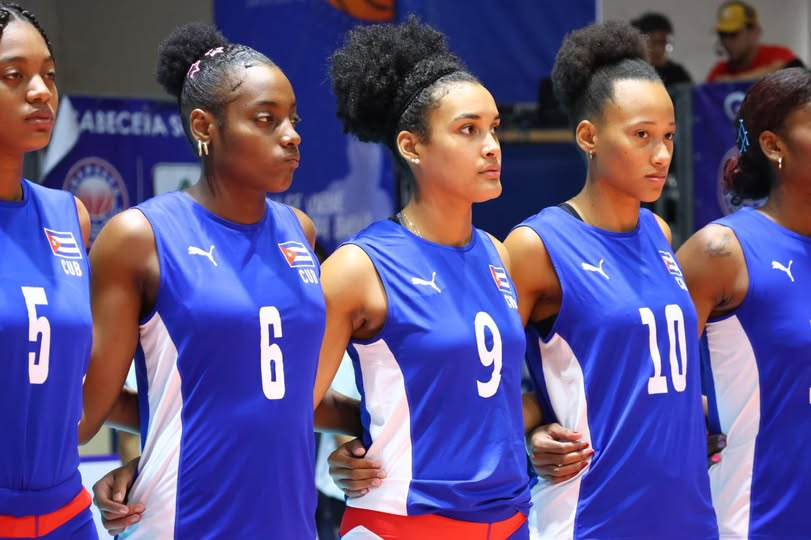
The US Embassy in Havana denied visas to 12 volleyball players, two coaches, one referee and a team manager / Norceca

14ymedio bigger14ymedio, Havana, June 27, 2025 — The Cuban Volleyball Federation (FCV) called “unjust and discriminatory” the refusal of the US to grant visas to the team of Cuban volleyball players who aspired to participate in the Final Four of Norceca, to be held in Puerto Rico from July 16-21. It also expressed “uncertainty” about what “may happen in the future in the conduct of the country that will host the Olympic Games Los Angeles 2028, for which Cuba plans to qualify.

The FCV also says that the measure “hinders” the presence of the new Morenas del Caribe -as they call the national volleyball team- in “a qualifying event for the Central American and Caribbean Games of Santo Domingo 2026 and for Norceca and world ranking eligibility.”

According to the sports agency, the US Embassy in Havana denied visas to 16 members of the delegation: 12 athletes, two coaches, a referee and a team manager.

Journalist Yasel Porto Gomez published on the Facebook page of DPorto Sports LLC: “The refusal of visas to the women’s volleyball team only makes it clear that the presence of Cuba in the World Classic 2026 is far from becoming a reality.”

The reporter warned that “if the MLB (Professional Baseball League) does not negotiate things in time with the government of Donald Trump, it will again experience the same suspense of 2006 when we didn’t know until the continue reading

last minute whether or not we would play.”.The difference, he estimated, is that there is a “greater chance now that for the first time in these events a team will lose all their games due to no-shows.”

Without visas, the new Morenas del Caribe are out of the Norceca Final Four in Puerto Rico / Jit

The Por la Goma sports portal also reported that “tension continues to grow” between the US and Cuba. “This political corrosion continues to generate bitter situations completely unrelated to the field of sports,” it stressed. What is desirable “would be for both nations to reach an understanding and to absolutely exclude politics from sports.”

Por la Goma added that “until that happens, uncertainty will continue to affect the participation of athletes and coaches residing in Cuba, even at very important events.”

For its part, the official organization insisted that the refusal of visas reflects a position “alien to the precepts of the sport, which adds to what has already happened this year against delegations from other disciplines.”

Last May, the US denied visas to Cuban Olympic Committee president Roberto León Richards, International Olympic Committee vice president and member María Caridad Colón, and secretary Ruperto Herrera.

Leon and Herrera were unable to attend the meeting of the Executive Committee of Panam Sports in Miami, held between May 13 and 15, and a parallel meeting in Puerto Rico. Colón was absent from the “Women in Sports” Commission event.

In April, the Cuban Athletics Federation (FCA) reported that the US denied visas to 14 of 16 Cuban athletes. The governing body considered that this “unacceptable action” prevented the country from having a full delegation at the 2025 World Indoor Athletics Masters Championships, which took place in Gainesville (Florida) between the 23rd and 30th of March.

Translated by Regina Anavy

____________

COLLABORATE WITH OUR WORK: The 14ymedio team is committed to practicing serious journalism that reflects Cuba’s reality in all its depth. Thank you for joining us on this long journey. We invite you to continue supporting us by becoming a member of 14ymedio now. Together we can continue transforming journalism in Cuba.

Without Electricity and Air Conditioning, Cubans Sleep on Rooftops in Search of Cool Air

With a record electricity deficit, some hospitals, such as the Lidia and Clodomina polyclinic in Regla, look like ghost buildings.

Fuel scarcity remains the main problem of the SEN / 14ymedio

14ymedio bigger14ymedio, Juan D. Rodríguez/ Darío Hernández, Havana, 29 June 2025 — When Vladimir read that the Electric Company (UNE) was expected to have a deficit of 1,977 megawatts (MW) by Saturday night, he knew that it was not by chance that it would affect a neighborhood like his without hospitals or hotels. He went up to the roof of his house in Nuevo Vedado and reinstalled the hammock that, during the last week, had been his bed in the dark nights under the sky of Havana.

His prognosis hit the nail on the head while that of the UNE, although a little below, also came close. At the time of maximum affect, the national electric system (SEN) reported a shortage of 1,936 MW, the second record deficit in the last week, as last Tuesday’s of 1,901 MW.

For this Sunday, the authorities expect to lower the allocation with the entry of several units to the SEN [National Electrical System], and they predict a shortage of 1,753 MW in peak hours. It is expected that by then they will have already synchronized unit 6 of the thermoelectric power continue reading

plant of Mariel, with 80 MW; unit 6 of Nuevitas (Camagüey) with 100 MW, and two plants of Energas: Boca de Jaruco with 30 MW and Varadero with 30 MW.

Unit 2 of Santa Cruz (Mayabeque), 4 of Cienfuegos, 5 of Nuevitas and 5 of Renté in Santiago de Cuba are also under maintenance.

The authorities also want to incorporate 40 generating plants “which are out of fuel, because of the shortage.” These are, however, a small part of the total of 111 plants of this type that are out of service, leaving behind about 860 MW.

In the streets, the discomfort of the Cubans is seen in the faces of passers-by and despairing mothers who fan their children. “My neighbors are timid, they think that the UNE workers are having a hard time with this area,” says Vladimir, who from the sidewalk, where he sits to catch some fresh air, hears the comments of frustration.

“I went to buy cigarettes and the woman who sells them said she couldn’t grab a wink of sleep last night. She told me: ’This is criminal, boy.’ I felt sorry for her, but I’m the same way, walking like a zombie,” he confesses .

“I hear my neighbors complaining that they have sleepless nights, that they don’t have anything for breakfast and that the internet comes and goes,” he explains. Vladimir says that in the last few days the blackouts have given him no respite. “They put on the power on at night and remove it from 1:00 to 4:00 in the morning. Then, at 6:20, another blackout,” he says, frustrated.

The Habanero says that he barely has time to charge his devices and, although he has a small solar panel on his roof, the energy he manages to store is not enough to survive the hot nights.

“It would be much better to live near a hospital, because they always have power,” he says, but life is not easy for those who have the geographical position in their favor. “My aunt lives near a polyclinic, so she almost always has electricity, but yesterday she had to come here to rest for a while, because the neighbors are driving her crazy asking her to let them charge their cellphones,” he explains.

Nor does living near a medical center guarantee that there will be power. In a visit to Guanabacoa and Regla, this newspaper found that while an office of the State telecommunications company Etecsa and a gas station had electricity, the nearby neighborhoods were dark until 8:30 am. Even the Lidia and Clodomina polyclinics, with no one nearby, looked like a ghost building.

Meanwhile, the authorities are struggling to signal that the SEN is improving. In Rio Cauto, Granma province, they inaugurated a solar park last Tuesday, publicized this Sunday with a lot of fanfare. With a maximum contribution of 21.8 MW, it will be connected to the SEN on July 4, but its entry 10 days before is already cause for celebration by the official press.

Another photovoltaic park was launched yesterday in the municipality of Martí, in Matanzas, with the presence of Ramiro Valdés, a historic figure appointed to lead the program to stabilize the SEN. However, the 18 solar plants inaugurated since January with the help of China barely represent a power of 360 MW and only produce electricity in the optimal hours of sun.

Vladimir has no hope of those promises being fulfilled, and tonight, when the lights go out again, he will have no choice but to hang up his hammock on the roof.

Translated by Regina Anavy

____________

COLLABORATE WITH OUR WORK: The 14ymedio team is committed to practicing serious journalism that reflects Cuba’s reality in all its depth. Thank you for joining us on this long journey. We invite you to continue supporting us by becoming a member of 14ymedio now. Together we can continue transforming journalism in Cuba.
One Hundred Cubanisms Will Be Added to the Spanish Language Dictionary in 2026

A team of experts carried out a meticulous research process with various sources to select the Cubanisms representative of the Spanish of the Island.

The project is considered “an example of collaboration between traditional lexicography and modern digital tools” /14ymedio

14ymedio biggerEFE (via 14ymedio), Havana, 29 June 2025 — The Cuban Language Academy has completed a project to incorporate 100 Cubanisms into the next edition of the Spanish Language Dictionary (DLE) that will be presented in 2026, state media reported on Sunday.

A team of experts carried out a meticulous research process with various sources to select the Cubanisms representative of Cuban Spanish, according to local media.

Alexander Puente, professor of the Faculty of Arts and Letters (FAyL) of the University of Havana and part of the team, explained that the selection process began with a listing of the Dictionary of Americanisms focused on words used exclusively in Cuba.

In a first phase, each voice was verified and documented; undocumented voices were discarded, leading to the search for additional terms, he said. continue reading

Priority was given to editorial sources, such as the press and literature, avoiding blogs and oral records, as well as quotations with errors or controversial content

In addition, he explained that various categories of use were considered, including colloquial records, without restrictions on connotations, and even words with pejorative meanings were accepted, always with the appropriate lexicographic mark to contextualize their use.

Another participant in the project, professor Lydia Castro, said that for each word selected at least three examples of use in written texts from different eras were required.

Priority was also given to editorial sources, such as the press and literature, avoiding blogs and oral records, as well as quotations with errors or controversial content, she added.

The incorporation of these 100 Cubanisms into the DLE represents for its promoters a “significant step” in the recognition of the richness and diversity of Spanish spoken in Cuba, as well as contributing to a more complete and inclusive vision of the Spanish language.

The project is considered “an example of collaboration between traditional lexicography and modern digital tools,” reinforcing the commitment of the Cuban Language Academy to the preservation and dissemination of Cuba’s linguistic heritage, according to local media.

Translated by Regina Anavy

____________

COLLABORATE WITH OUR WORK: The 14ymedio team is committed to practicing serious journalism that reflects Cuba’s reality in all its depth. Thank you for joining us on this long journey. We invite you to continue supporting us by becoming a member of 14ymedio now. Together we can continue transforming journalism in Cuba.