Nearly 14,000 private motorcycles fill the gap left by the authorities.
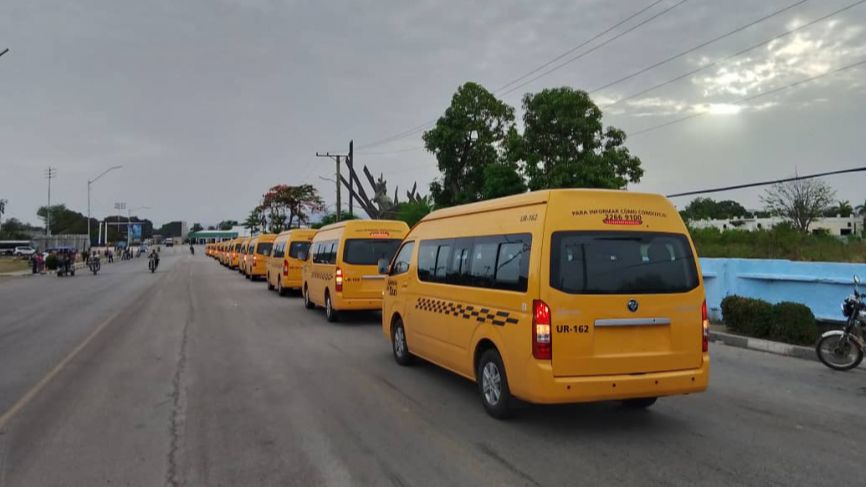
 14ymedio, Havana, June 26, 2025 — The new Foton minibuses are slowly arriving in the provincial capitals where they have been allocated after the government reversed its decision to concentrate in Havana the 100 vehicles purchased from China. This Wednesday, the newspaper Sierra Maestra reported the arrival of 20 sent to Santiago de Cuba to reinforce “the four routes of greater mobility,” in an attempt to mitigate the effects of the prolonged shortage of fuel and spare parts.
The new minibuses, according to Jaime Codorniú Furet, delegate of the Ministry of Transport in the province, are part of the actions for the city’s 510th anniversary and an effort to sustain a service that has been seriously limited for years. The official also noted that 20 electric bicycles have been operating in the southern part of the city since 2023, with an average of 10 trips per day, although they do not escape the interruptions caused by frequent and long blackouts.
The coverage is clearly insufficient
Santiago de Cuba, with more than 500,000 inhabitants, has 190 officially established routes, of which 131 are currently in operation, according to data from the transport agency itself. These journeys are served by a combination of state transport, company vehicles, private cars and leased vehicles, some of which are also used as ambulances and hearses.
However, this coverage is clearly insufficient. Given the shortage of buses and the irregularity of rail service, where many so-called “ferrobuses” remain out of service, users have found in motorcycles a fast and relatively affordable alternative that is adaptable to current conditions.
Santiagueros have found in motorcycles a fast and relatively affordable alternative that is adaptable to current conditions
The boom of electric bicycles and motorcycles in Santiago has been documented both by state media and independent publications. Their popularity soared in the last five years, especially after the pandemic, when restrictions on mobility and the collapse of public transport pushed many citizens to purchase personal vehicles.
Although private motorcycles are not regulated as public transport, in practice they have become a semi-informal taxi service. Many circulate in strategic boarding points such as Trocha, Garzón and Martí avenues, as well as in peripheral areas with little bus coverage.
The attempt to ban passenger transport on motorcycles in 2021 accomplished nothing. At that time, Santiago de Cuba had about 14,000 motorcycles circulating in the city. Faced with complaints from motorcyclists, the government was forced to back down.
The cost of those trips went from 150 to 300 pesos
Four years later, motorcycles and prices have multiplied. On social networks, Santiagueros often comment on the cost of these trips: from 150 to 300 pesos, depending on the distance, time and fuel availability. For many state workers or students, this rate is unaffordable on a regular basis, exacerbating inequality in access to transport.
The proliferation of motorcycles is not without risk. Authorities have reported an increase in traffic accidents related to these vehicles, as well as fires, robberies and violent incidents. Despite these problems, their presence is widespread and in neighborhoods without bus routes they are the only means of connection to the city center.
In parallel, the Government has tried to alleviate the situation by providing 18 boarding points in the provincial capital and one in each municipality, according to official figures. Animal carts and bicitaxis are also retained as short-distance options, although their availability is limited and coverage uneven.
In neighborhoods without bus routes, motorcycles are the only means of connecting to the city center
Chronic fuel shortages have had a direct impact on transport. In March 2024, the Minister of Transport, Eduardo Rodríguez Dávila, acknowledged before the National Assembly that the Cuban motor vehicle fleet was “on the verge of collapse”.
Against this backdrop, urban mobility in Santiago de Cuba seems increasingly to be supported by individual ingenuity rather than effective state planning. Motorcycles, a symbol of everyday life, still have a role that, although unofficial, is essential for the functioning of the city.
Translated by Regina Anavy
____________
COLLABORATE WITH OUR WORK: The 14ymedio team is committed to practicing serious journalism that reflects Cuba’s reality in all its depth. Thank you for joining us on this long journey. We invite you to continue supporting us by becoming a member of 14ymedio now. Together we can continue transforming journalism in Cuba.