With Better Quality, the Private Sector Has Ended the State Monopoly Over School Uniforms

Unlike rationed sales, it is possible to purchase as many pieces as you can pay for.


[[Located in the central Paseo del Prado, this Monday the business and its workshop welcomed customers looking for the desired uniforms / 14ymedio
14ymedio bigger14ymedio, Juan Diego Rodríguez, Havana, July 8, 2025 — Tired of long lines, missing sizes and poor fabric quality, Cuban families are increasingly choosing to buy school uniforms in the private sector or abroad. The opening of Figuera, a private store that sells these outfits in Havana, accelerates the loss of state terrain in a commercial niche that until recently was an official monopoly.

Located in the central Paseo del Prado, in the Salón Smara de la Unión Árabe de Cuba, this Monday the business and its workshop welcomed customers looking for the desired uniforms. The firm also offers business clothing, and although its employees recognize that they do not have all sizes available, they can be ordered in advance and produced by the seamstresses.

Unlike the rationed sale, in Figuera it is possible to buy as many pieces as you can pay for

A line of about a dozen people were waiting outside the workshop to order or pick up clothing for the next school year. They did not have in their hands any document bearing the stamp and letterhead of any department of the Ministry of Education, which they were authorized to purchase. Unlike the rationed sale, in Figuera it is possible to buy as many pieces as you can pay for. They accept any payment, from Cuban pesos, through dollars to transfers by Zelle, the American instant payment system that is very popular among merchants on the Island.

There is no pushing in the line, no one shouting because someone has slipped in or because the end of some very sought-after size is announced. Everything goes smoothly because the clientele is already filtered by economic status. Unlike the subsidized sales, prices in Figuera have nothing to do with real wages. This is one of the last commercial sectors to have private offers, because the government has wanted for decades to prevent social differences from being expressed in the educational field.

In a country where the school uniform, according to level, is identical in each province, municipality and classroom, the loss of a monopoly on its sale is not a minor issue. Fidel Castro himself designed the clothing of some school grades and for decades penalized the use of blouses or shirts that, although similar to those prescribed, showed some mark or sign that they were made privately or had been imported from abroad. continue reading

Fidel Castro himself designed the clothing of some school grades

But the economic crisis and the inability of the State to meet the demand have been transforming the panorama and marking the contrasts between those who may have a new uniform every September and those who are obliged to reuse the previous one or alter the only size they have to fit their body.

“When I was in school, the only way to buy a uniform was in the State stores,” recalls a father who arrived this Monday with his children, two twins who will enter high school next year. ” I remember that in my teens I had a rash and had to go the whole year with pants that were short, because you had to wait for them to give you a paper so you could buy the next ones, and they only delivered it after the final exams.”

The sale of school uniforms in Cuba usually begins between May and June, but in recent years the date has been delayed due to lack of raw materials. Now the sale starts at the end of July and is marked by long lines and problems with sizes. Factory workers must extend their working hours for those dates and thus try to make the nearly 1.5 million uniforms planned for more than 1,000 schools.

A line of about a dozen people were waiting outside the workshop to order or pick up clothing for the next school year / 14ymedio

The textile workshop in Figuera has seven workers; six are women sewing, and a man at a table does the designs. Among the employees there is a doctor who attends to the public and an engineer on the preparation side. The fabrics are cut and sewn and will end up being a uniform for primary, secondary or upper secondary education. Everything works with order and an unusual efficiency when compared to the State workshops.

“I ordered my grandson his first uniform for preschool which starts in September, and today I am here to pick it up,” says a proud grandmother accompanied by a restless child who does not stop jumping and running through the narrow corridor while waiting for their turn to enter. “At the time I placed the order I had to pay the full amount, and it took about two weeks to make three shirts and two shorts.”

In total, the woman has paid 7,500 pesos for the set, three times her monthly pension. “I’m the one who looks after him because my daughter and her husband are outside Cuba. They sent me the money to buy the uniforms since it’s impossible with my pension,” she says. “I’m also glad that I could save myself from standing in line at the [State] store, because last year I was standing so long that I got dizzy.”

“I hope it’s strong and durable, does not lose color with a few washes and can be left for the younger children who come behind”

“I hope it’s strong and durable, does not lose color with a few washes and can be left for the younger children who come behind,” the grandmother resumes. “These look pretty good but the last word will be the use.” A few minutes later the woman leaves with a bag that includes the clothes that the little one will wear, almost every day, in less than two months.

Two women who are in line, with their respective children, praise the possibility of having this private shop. “Until now, when I needed to buy a uniform without spending days in a line, I appealed to a neighbor who brings them from Miami; she buys them in Ño Que Barato,” explains one of them. Cuba’s large emigrant community in Florida has also shaped commercial offerings in the US.

Some of the shops in Miami make their money in August with every need that arises on the Island, from coffee “with Cuban roast,” through plastic covers to protect ration books, to uniforms of all levels of education. Every year the Ño Que Barato chain sells thousands of clothes that will end up in Cuban classrooms. The red-wine colored pants intended for males attending primary school are $14.99, while a blouse for pre-university students is $10.99.

“The only thing missing is the police uniform,” jokes a friend, who finally gets her turn to enter Figuera. The cool atmosphere, due to the air conditioning, the clean table where a seamstress cuts the fabric and the smiling face of the employee complete the experience. Uniforms sold by the private sector are much more expensive, but it is clear that they do not come with sweat, tears and shouting.

Translated by Regina Anavy

____________

COLLABORATE WITH OUR WORK: The 14ymedio team is committed to practicing serious journalism that reflects Cuba’s reality in all its depth. Thank you for joining us on this long journey. We invite you to continue supporting us by becoming a member of 14ymedio now. Together we can continue transforming journalism in Cuba.

Mexico Paid More Than $1 Million for 25 Medical Students To Specialize

The group is part of the 428 scholarship recipients who have been on the Island since 2021.

A group of Mexicans who completed their specialty in ophthalmologic surgery in Cuba

14ymedio bigger14ymedio, Ángel Salinas, Mexico City, July 7, 2025 — A group of 25 Mexicans completed their specialty in surgery last June at the Cuban Institute of Ophthalmology (ICO) Ramón Pando Ferrer, in Havana. The students are part of the 428 who arrived in Cuba through the scholarships that have been reactivated since 2021 by the National Council of Humanities, Sciences and Technologies of Mexico (CONAHCYT). According to one source, “Mexico spent 937,500 euros ($1,098,958) on their education.”

The Mexican students are enrolled in the 2022-2025 generation, and their return to Mexico is planned, but “there is still no date for their possible incorporation into the IMSS Bienestar health system,” confirmed the health official, who requested anonymity.

The same source acknowledged that “every investment in education is beneficial, but sending students to Cuba is more expensive than sending them to the United States, Spain or Germany.” According to the database of post-graduate scholarship recipients, a student with a scholarship in the United States costs Mexico $20,970 per year, $7,000 less than in Cuba.

“I can confirm some expenses for this group, including the payment to the Cuban Medical Services Commercialization Agency of $14,648 per year for each student. In addition to $1,277 for the CONAHCYT scholarship, there is an additional one-time payment of $1,758 to prevent desertions,” said the official.

The students are part of the 428 who arrived in Cuba through scholarships that have been reactivated since 2021 by the National Council of Humanities, Sciences and Technologies of Mexico

It is cheaper for Mexico to send students abroad to the Netherlands, where the annual investment is $20,389; to Spain, $18,666; to Canada, $18,415; to Germany, $17,379; to in France, $689 dollars. continue reading

Between 2021 and 2023, the same source recalled, CONAHCYT awarded scholarships to Mexican students to study their specialty at the University of Medical Sciences in Havana, the Ministry of Public Health and the Center for Medical Surgical Research.

Despite the failure and controversy that was generated in its first edition in 2021, Mexico has maintained the CONAHCYT scholarship program to study one of the 13 medical specialties in Cuba.

According to the tab shown in euros in the call itself, the prices are: pathology, 7,800 euros; general surgery, 12,500; hygiene and epidemiology, 7,800; medical genetics, 12,500; geriatrics, 7,800; rehabilitation medicine, 9,900; intensive care medicine, 12,500; internal medicine, 9,900; pulmonology, 7,800; ophthalmology, 12,500; clinical pathology, 9,900; psychiatry, 9,900; and traumatology and orthopaedics, 12,500 euros.

The information was reported shortly after seven Cuban doctors were celebrated in Campeche for a year of providing services at the Imss hospital in Escárcega: Ángel Rondon, Jackeline Naranjo, Gricelia Elias, Isabel Toranzo, Jaqueline Baquero, Juan Alberto Tamayo and Joel Solórzano.

Translated by Regina Anavy

____________

COLLABORATE WITH OUR WORK: The 14ymedio team is committed to practicing serious journalism that reflects Cuba’s reality in all its depth. Thank you for joining us on this long journey. We invite you to continue supporting us by becoming a member of 14ymedio now. Together we can continue transforming journalism in Cuba.

Andy García Lorenzo, one of the 11J prisoners in Santa Clara, is now free

The young man was sentenced to four years in prison for shouting slogans against the regime and served his full sentence.

“Andy is free, he owes nothing to the regime, and he’s going to take his time to be with the family” / Courtesy

14ymedio bigger14ymedio, Havana, July 7, 2025 — Andy García Lorenzo was one of the most visible faces on July 11, 2021. His mother, Tayri Lorenzo Prado, confirmed to 14ymedio that the young man “has been released after serving four years in prison, without any reduction in his sentence.”

García, then 23, was arrested after peacefully demonstrating in the Leoncio Vidal park in downtown Santa Clara. He was tried together with 15 other demonstrators and sentenced to four years’ imprisonment for the offenses of public disorder and contempt.

“It was a trial without evidence, a farce,” his sister reported live on social media at the time. “Everything was based on the words of the police against his. It was a circus.”

“How am I going to regret the proudest act in my life, of all Cubans?” / CourtesyThe ruling of the Municipal Court of Santa Clara stated that the youth had met with other citizens in areas adjacent to the park to “shout slogans” such as “Díaz-Canel singado [sic] and Policía Pinga,” as well as “dance in the form of a mockery of uniformed personnel and townspeople who felt aggrieved by his rude behavior.” The prosecutor in the case, Daily Carrazana Rodríguez, even requested a seven-year prison sentence. continue reading

Despite institutional pressure, García enjoyed broad public support from the start. “They gave him a very long sentence, when in Santa Clara, as elsewhere, not even a shop window was broken and nothing happened at all,” his brother-in-law Jonatan López wrote on the social network X after hearing the sentence.

In May 2022, authorities announced that García would be transferred to an open regimen camp in El Yabú, a change that never materialized. Shortly thereafter, while going with his father Nedel García Pacheco to the prison of Guamajal to collect some belongings, both were intercepted on their way home. State Security agents transferred them to the 5th Santa Clara Unit for a “conversation,” and the minimum severity measure was revoked.

“It was a trial without evidence, a farce” / Courtesy

Throughout his sentence, García was steadfast in his convictions. In an interview with Cubanet, he said: “How am I going to regret the proudest act of my life, of all Cubans? It was the happiest day in history, the day when the people rose up against the oppressor.”

Now 27, Andy has returned home. One of his first gestures upon leaving was to visit the tomb of his paternal grandmother, who died during his imprisonment. He has also been able to rejoin his maternal grandparents, whose health has deteriorated in recent years.

“Andy is free, he owes nothing to the regime, and he’s going to take his time to be with the family,” said his mother. The family does not rule out continuing pressure from State Security, which in these cases usually tries to prevent former political prisoners and their relatives from talking to the independent press.

Translated by Regina Anavy

____________

COLLABORATE WITH OUR WORK: The 14ymedio team is committed to practicing serious journalism that reflects Cuba’s reality in all its depth. Thank you for joining us on this long journey. We invite you to continue supporting us by becoming a member of 14ymedio now. Together we can continue transforming journalism in Cuba.

‘Patria y Vida’ Hits US Theaters on the Fourth Anniversary of 11J

The documentary, directed by Beatriz Luengo, premieres this Friday coinciding with the fourth anniversary of the historic protests.

Directed by Beatriz Luengo, the film relates “the historical and social impact of the song” / EFE

14ymedio bigger14ymedio, Hugo Barcia, Miami, 8 July 2025 — Spanish composer and actress Beatriz Luengo and Cuban singer Yotuel Romero insist that the call of the song Patria y Vida, which prompted the 2021 protests in Cuba, is still alive, and they hope that the premiere this week of the homonymous documentary in the United States will open a new door to the demand for freedom.

“It is still alive, the call of Patria y Vida has a before and an after,” said Romero in an interview with EFE, in which he highlighted the historic role of the song, which he performed together with other Cuban artists. He stated that the arrival of the documentary in American cinemas will allow people to remember the milestone of a motif that took thousands of Cubans to the streets to protest against the dictatorship.

The film, directed by Luengo, will be released this Friday, July 11, in 10 movie theaters in the state of Florida, most of them near Miami, where the largest Cuban community outside of Cuba resides.

“This is a story of today, and a movie that contains a call to action. People come out of the cinema feeling that they can do something,” said Luengo

During its 90 minutes, the documentary reviews how the theme Patria y Vida was conceived, in addition to the influence it had on the anti-government protests that broke out on 11 July 2021 in Cuba, which resulted in the arrest of 1,400 people. continue reading

“This is a story of today, and a movie that contains a call to action. People come out of the cinema feeling that they can do something,” said Luengo

Although the song has already become a mass phenomenon, winning two Latin Grammy Awards – as song of the year and best urban song – both the Spanish artist and the Cuban singer agreed that it is now the turn of the documentary, which arrives in the US after its premiere in Europe.

“What we hope will happen is that thousands of people will send messages to Cuba saying ’You are bright, brave people. We’re with you’ (…), and that they identify with the pain of the people they see in the documentary,” said Romero.

“If previously the largest group that came out on the streets were Cubans, what we want to achieve is that this coming July 11 the groups that come out are not only Cubans but also citizens of every country demanding freedom for the people,” he added.

And although both argue that the musical theme “was historic” and managed to open the eyes of the world and demonstrate the strength of the Cuban people, they admit that there is still a long way to go.

“We are talking about a defenseless people, a people who have been oppressed for 56 years. Without water, without electricity, without food, it is very difficult to face a machine like the dictatorship that has all the weapons,” said the Cuban artist.

Among them are different forms of repression that the artists themselves personally suffered. It was the case of Romero, who left Cuba several years ago, and Maykel Osorbo, another of the interpreters of Patria y Vida, who was sentenced in 2022 to nine years in prison for “disobedience, resistance and contempt.”

“We are always asked at the end of the film if Maykel is still in prison,” recalled Luengo.

The documentary itself is banned in Cuba, which the Spanish artist interprets as a win: “That means we have done our job well”

The documentary itself is banned in Cuba, which the Spanish artist interprets as a win: “That means we have done our job well.”

In contrast, with the premiere in Miami they want the thousands of Cubans living in this city to go to the theaters “to feel it and mourn,” and take other people with them to show them what is happening in Cuba.

“It is a common malaise, not only of the young people, not only of the people who have left, but also of the people who are still there, practically unable to sleep [because of the power outages],” summed up Romero, before issuing a final warning to the Cuban government.

“Now the dictatorship has nothing to hold on to. Every time there are stricter laws, they inflict more and more fear, and that only makes you understand one thing: they are very afraid of the Cuban people because they know what they are capable of doing,” he said.

Translated by Regina Anavy

____________

COLLABORATE WITH OUR WORK: The 14ymedio team is committed to practicing serious journalism that reflects Cuba’s reality in all its depth. Thank you for joining us on this long journey. We invite you to continue supporting us by becoming a member of 14ymedio now. Together we can continue transforming journalism in Cuba.

The Coffee of the Poor in Matanzas, Cuba: Scarce, Cold and Bitter

Many retirees would need to invest half of their pension in a simple 284-gram package of the imported product.

The collapse of Cuban coffee is a palpable reality, evident in the disappearance of the product in the bodegas /14ymedio

14ymedio bigger14ymedio, Julio César Contreras, Matanzas, July 8, 2025 — Only the color remains in the cup of coffee that Rafael, every morning, brings to his lips, leaning on the counter of the Reparto Armando Mestre snack bar in the city of Matanzas. Unable to face the day without first taking a sip that wakes him up, this 67-year-old Cuban has come to accept that his pocket can only afford a scarce, bitter, adulterated and almost cold concoction.

“About seven o’clock in the morning I leave my house here, after loading water,” he tells this newspaper. Rafael has a routine that reminds you of those wheels hamsters spin around all day. ” From early morning I start to watch for the water truck to see if I can fill at least one bucket that will serve me for the kitchen or washing a cup.” If I’m lucky, I’ll also be able to store water in a bottle and save a little for a bath later.”

In the cheapest cafes a small cup costs 10, 20 or 40 pesos, but in the most expensive they charge up to 200 / 14ymedio

Then it’s time to go to the El Matador snack bar, managed privately, where, for 20 pesos, Rafael can have a cup of coffee that he does not enjoy, because it’s not very good. “It has a strange taste because it is very mixed, but at least it is something hot that wakes me up a bit,” he tells 14ymedio. In his home, hard hit by blackouts that often exceed 20 hours a day and without propane, it is very difficult for him to use his coffee maker.

“When I’m lucky and the light comes on, I can set up the electric coffee machine, but then there’s a blackout and I can’t keep that coffee warm, it gets cold like a dead man’s leg.” The quality of the roast is another headache for those who seek to delight in a good variety of Arabica with a pronounced aroma, mild taste and low acidity, like the one that used to come from the national crops.

“Most of the coffee that is being sold right now in Matanzas comes from Miami,” says an employee of a private cafeteria who dispatches, every morning, up to 50 small cups. Thousands of packages of coffee enter the island every day in the luggage of travelers, an import that has completely continue reading

displaced the national coffee, which is scarce due to the drop in production.

The collapse of Cuban coffee is a palpable reality. Consumers notice it in the disappearance of the product in the bodegas, in the increase of the price of the bean on the informal market and even in the quality of what they manage to buy. According to the National Bureau of Statistics and Information, production in the sector has fallen by 51% over the last five years.

“From Miami comes La Llave and Bustelo coffee, which they like very much because they have the traditional Cuban roast, and when people drink it they remember what the coffee here used to be like,” says the seller. “But also in recent years, other cheaper brands come in, and although they are of lower quality, for any Cuban they are glorious compared to the bodega coffee”.

El Morro, El Dorado, La Carreta and Cubanazo are some of the names that have also slipped from Florida into Cuban coffee shops. In the large community of Cuban exiles, the products from shops and supermarkets fill the niches that the deep economic crisis has opened up for them in Cuba. From school uniforms for all levels of education to generators for the blackouts: goods designed and intended for the consumer within Cuba have grown in recent years.

“My cousin who lives in Hialeah says that she only buys those packages of coffee to send here because they aren’t what she likes to drink every day,” the cafeteria employee admits.” But here they do very well because people don’t have the rationed coffee, which hasn’t appeared in Matanzas since February.” Mixed or low quality, the imported coffee always exceeds by far the bitter and often unnamed coffee that is distributed through the ration book.

“Before I bought the coffee that they sold in the bodega, mixed it with peas and added a little of the good coffee,” explains Rafael, but even that possibility is a thing of the past because now the rationed coffee “neither arrives nor serves. The few peas I can buy are for eating,” he adds, in allusion to the grain that for decades served both the state and consumers to stretch the monthly coffee ration.

With a pension of 2,500 pesos per month, Rafael would need almost half his retirement – about 1,200 – to purchase a 284-gram package of La Llave. Paying this amount would be a mistake, so he carries in his head a mental map of where he can still drink coffee in a cafe that has prices of 10, 20 or even 40 pesos a cup.

“If I don’t have a sip in the morning, I get a headache, but if I drink it in a state cafeteria I’ll probably end up with a belly ache”

“I have had coffee in the kiosks at bus terminals, and it was like being struck by lightning,” he explains. “If I don’t have a sip in the morning, I get a headache, but if I drink it in a state cafeteria I’ll probably end up with a belly ache,” he says, summing up his dilemma. The state premises that still distribute the popular drink have been reduced, and the volume of his laundry has also been limited. “If you get to the water truck ten minutes after they start dispensing it, it’s already gone,” Rafael complains.

There is, however, the option of going to a better place with higher prices. “I can no longer afford the coffee at the Sala White, much less the Hotel Velazco, and I do not count on those in the Paseo de Narváez. I don’t have the 200 pesos to spend,” laments Nilda, another matancera who needs her daily dose of caffeine. “It looks like they made this one early, because it’s lukewarm. That’s what there is for the poor,” she asserts.

The employee keeps the sugar bowl under the counter and administers only one spoon per cup. She is not allowed to add more because the most emblematic product that comes out of the Cuban fields also suffers a drop in production. “A pound is 270 pesos,” explains the worker. At one side of the stove, where the coffee sits on a burner, is a package with the label “Florida Crystals,” containing sugar from those cane plantations that, in Florida and at the hands of Cuban-American entrepreneurs, also supply the island.

Translated by Regina Anavy

____________

COLLABORATE WITH OUR WORK: The 14ymedio team is committed to practicing serious journalism that reflects Cuba’s reality in all its depth. Thank you for joining us on this long journey. We invite you to continue supporting us by becoming a member of 14ymedio now. Together we can continue transforming journalism in Cuba.

The Cuban Government’s Magic Statistics Erase Etecsa’s ‘Tarifazo’ in June’s Inflation Numbers

Although the cost of communications multiplied by 13, ONEI places the increase at 0.38% year-on-year and 0.02% in June.

The tomato is the product that rose the most in June, after eggs  / 14ymedio

14ymedio bigger14ymedio, Madrid, July 8, 2025 — The Etecsa tarifazo, or price increase, which came into force on May 30, was expected to raise inflation, which has remained high in recent months but is much more controlled than in previous years. The prices of the state communications company was multiplied by 13 in some options, but the consumer price index (CPI), published this Monday by the National Office of Information and Statistics (ONEI,) places the rise of this sector at just 0.02% in June.

“The price increase of Etecsa will be reflected in the June CPI and will represent a shock to the costs of operating businesses, especially in more digitized activities,” said Cuban economist Pavel Vidal, although he also hoped that, in the long run, the effect would be positive. There is no apparent explanation for this situation, which clashes with what happened in January 2024 when alcohol and tobacco prices rose, causing a tsunami in the CPI, or when in March the costs of a liter of gasoline rose, increasing by 15% the April indicator for the transport sector.

In the absence of an explanation to understand the situation, the sector that consolidates huge increases in 2025 is tobacco and alcohol

In the absence of an explanation to understand the situation, the sector that consolidates huge increases in 2025 is tobacco and alcohol. Despite the fall in prices this June (1.42%), so far this year it has accumulated an increase of 72.67% and 110.74% compared to the previous year. Nevertheless, the fact that they are not basic necessities means that there is less impact on the lives of citizens, who, however, pay more than twice as much for them as in June 2024.

The general CPI of the month rose only 0.75%, rising to 8.26% year-on-year and 14.75% year-on-year. Predictably, in the parliamentary appointment of next week, the regime will puff out its chest from an indicator that evolves favorably since, as the Spanish news agency EFE has published, it is the lowest in years: “Inflation has tripled prices on the Island since 2020, according to official statistics. The CPI closed in 2021 above 77%, while in 2022 it stood at 39.07%; in 2023, at 31.34%, and in continue reading

2024, at 24.88%”.

But EFE is fixed on a fundamental detail: these data only reflect official prices and do not take into account “the country’s black market, which is more varied and dynamic” than the state. In addition, the experts have stressed that, while at the macroeconomic level CPI control is positive in normal situations -“it reduces uncertainty for firms and investors, facilitates financial operations and helps to define contracts and make long-term decisions for greater predictability”- Vidal said recently, in Cuba it has been achieved because the impoverishment of the population has reduced their purchasing power and, thus, price pressure.

Food, one of the most influential sectors in the CPI, rose 1.28% last month – only education, with a 1.44% rise, exceeded it – resulting in a not negligible 6.77% so far this year. Despite the containment of inflation, it is very remarkable that Cubans are paying 12.79% more for food. In fact, almost all the products whose price varied substantially involved food, especially the increasingly desired chicken eggs, the scarcity of which has caused them to rise by 12.9 per cent.

It is followed by other agricultural products such as tomatos (10.13%), potatos (5.9%), peppers (3.95%), onions (3.6%) and rice. The latter, one of the most basic items in the Cuban diet, cost 3.9% more in June than in May. On the opposite side are fruits such as mango (-4.9%), lemon (-2.4%), oil (-2.16%) and raw sugar (-1.9%).

The restaurant and hotel sector, another segment to be evaluated jointly with food, also saw a significant increase last month

The restaurant and hotel sector, another segment to be evaluated jointly with food, also saw a significant increase last month. The increase is only 0.99% in June, but the annual figure rises to 11.42%, and the year-on-year figure to 21.77%, a magnitude so important as to be the second largest growth in a year. Lunch and dinner (1.53%), breakfast (1.76%) and snack (0.12%) all rose last month; also noteworthy is the impact this sector has on the increase in the price of rum, 1.63%, and soft drinks, with 0.95%.

The document closes with a sector dedicated to cleaning and hygiene products, which have had important increases. The most prominent is toothpaste, which costs 6.6% more than the previous month. Deodorant (1.85%), manicure (1.58%), shampoo (1.15%) and conditioner (0.63%) are also in this sector.

In all categories, except alcohol and tobacco, there were slight but moderate increases. Although the annual figures are better than in previous years, some sectors still reflect very significant data for the already penalized pockets of citizens: miscellaneous goods and services (14.44%), housing services (13.69%) and food and non-alcoholic beverages (12.79%). With single-digit rates, clothing and footwear (8.92%), recreation and culture (7.17%), transport (4.97%), health (0.90%) and the mystery of communications (0.38%), have been in the line for at least five years and now, despite the tarifazo.

Translated by Regina Anavy

____________

COLLABORATE WITH OUR WORK: The 14ymedio team is committed to practicing serious journalism that reflects Cuba’s reality in all its depth. Thank you for joining us on this long journey. We invite you to continue supporting us by becoming a member of 14ymedio now. Together we can continue transforming journalism in Cuba.

Cuban Television Dedicates a Program to the Corruption From Below, Ignoring the Major Cases at the Top

Everything about the embezzlement in the distribution of basic food products, nothing about the dismissal of Minister Gil or the finances of Gaesa.

The program invites citizens to report what is happening in their immediate environment / Government of Havana

14ymedio bigger14ymedio, Havana, 4 July 2025 — With a great propaganda display, Cuban television announced a “historic” program of Hacemos Cuba dedicated to denouncing cases of administrative corruption on the Island. Finally, some thought, Humberto López would lift the veil over a matter that is roiling the country. But disappointment was not long in coming. Not a single word was said about Alejandro Gil, former deputy prime minister and head of the economy, accused in March 2024 of “corruption, simulation and insensitivity.” No high-level issues were touched upon.

The guests of Humberto López’s program – officials from the Office of the Comptroller General of the Republic, colonels from the Ministry of the Interior and representatives from the Attorney General’s Office – presented an image of severe institutionalism and operational efficiency. Between impeccable uniforms and carefully measured phrases, they insisted that “there is no impunity” and that the structures of the state are designed to detect and punish any irregularities. However, their presence on the set reinforced the feeling that corruption is only pursued when it occurs at the margins of power. More than guardians of legality, the guests seemed interpreters of a libretto that carefully avoids pointing up.

Cases covered during the transmission included embezzlement in the distribution of basic basket products, misappropriation of funds in state enterprises and criminal actions continue reading

by mid- and low-level officials.

The most prominent example was that of the Base 654 Business Unit in Bayamo, where a pattern of systematic subtraction of rice, peas and sugar was detected

The most prominent example was that of the Base 654 Business Unit in Bayamo, where a pattern of systematic subtraction of rice, peas and sugar was detected. According to the authorities, those involved even filled bags with sand to hide the lack of food for more than 256,000 consumers in Granma province. Eight people are currently in pre-trial detention, including the director of the entity, a commercial specialist and other warehouse workers.

In another case, in the Suchel company, personal care products were stolen and placed on the informal market. Similar events were also mentioned in solid waste collection entities in the municipalities of Plaza de la Revolución and Centro Habana, and in a subsidiary company of Copextel in Camagüey. The authorities stated that in all these cases investigations were initiated by popular complaints or internal audits, with the participation of the Comptroller General, the Public Prosecutor’s Office and the Ministry of the Interior.

The structure of the program was more geared towards reaffirming the official narrative, which presents the state as a victim of dishonest employees, rather than providing a true exercise in accountability.

Professor Alina Bárbara López Hernández expressed her disappointment at what was presented as an “unprecedented crusade”. Although the driver Humberto López showed “almost childish enthusiasm at inaugurating this new stage of the program,” the expectation of addressing major corruption cases -such as that of former minister Gil, the shady operations of Cimex or the opaque finances of Gaesa- was quickly frustrated. Instead of digging into the heights of power, the program was limited to “exposing deviations and improper management in base entities and municipal enterprises, presented as if they were the core of the problem.”

Professor Alina Bárbara López Hernández expressed her disappointment at what was presented as an “unprecedented crusade”

López points out that the program’s approach reinforces a narrative of horizontal surveillance: citizens are invited to report what is happening in their immediate environment, without questioning the higher gears of the system. Despite some revealing assertions, such as the admission of structural failures in internal control mechanisms and the need for a “separation of functions”, she stresses that these failures are a reflection of the vertical political order where there is no “separation of powers”.

Corruption in the base is a symptom, not the source. As long as one does not look upwards with the same impetus, the attempt to show transparency will be, as in this first program, insufficient and disappointing.

Translated by Regina Anavy

____________

COLLABORATE WITH OUR WORK: The 14ymedio team is committed to practicing serious journalism that reflects Cuba’s reality in all its depth. Thank you for joining us on this long journey. We invite you to continue supporting us by becoming a member of 14ymedio now. Together we can continue transforming journalism in Cuba.

Two Cubans Lose Their Appeal in the US To Avoid Being Sent to South Sudan

In total, eight migrants have been detained at a US military base in Djibouti since late May awaiting judicial decision.

The Supreme Court has twice ruled that the Trump administration can deport migrants to third countries / EFE

14ymedio biggerEFE (via 14ymedio), Washington, 5 July 2025 — The eight migrants, including two Cubans and a Mexican, who remain held by the US in Djibouti, have lost their last appeal against the US government’s controversial attempt to deport them to South Sudan. Late on Friday, federal judge Brian Murphy of Massachusetts denied the appeal, which opens the door for all of them to be sent to the African country, where the human rights situation is worrying, according to various organizations, and which the US itself recommends not to visit due to the escalation of the local armed conflict.

All eight have been detained at a US military base in Djibouti since the end of May, when Murphy determined that the Trump administration violated an order preventing him from deporting these immigrants to a country where they can be tortured without giving them the opportunity for a proper legal defense.

Since his return to the White House in January, Trump has been pushing for express expulsions

The US Supreme Court has twice ruled that the Trump administration can deport migrants to third countries, most recently last Thursday. The ruling then overturned a motion issued by Judge Murphy, and that same night the appeal was filed, which the magistrate himself has ultimately denied. continue reading

Since his return to the White House in January, Donald Trump has been pushing for express expulsions as part of his campaign for large-scale deportations, one of his campaign promises. This has led to various entities accusing their government of violating basic rights such as due process.

Of the eight deportees, only one is from South Sudan and the rest are from Cuba, Mexico, Laos, Burma and Vietnam.

Translated by Regina Anavy
____________

COLLABORATE WITH OUR WORK: The 14ymedio team is committed to practicing serious journalism that reflects Cuba’s reality in all its depth. Thank you for joining us on this long journey. We invite you to continue supporting us by becoming a member of 14ymedio now. Together we can continue transforming journalism in Cuba.

Cuba Reads From Right to Left: Cubans Rush To Consume Manga

Álex Jiménez, a 21-year-old, has been running a thriving business that he has decided to call Mangatiny

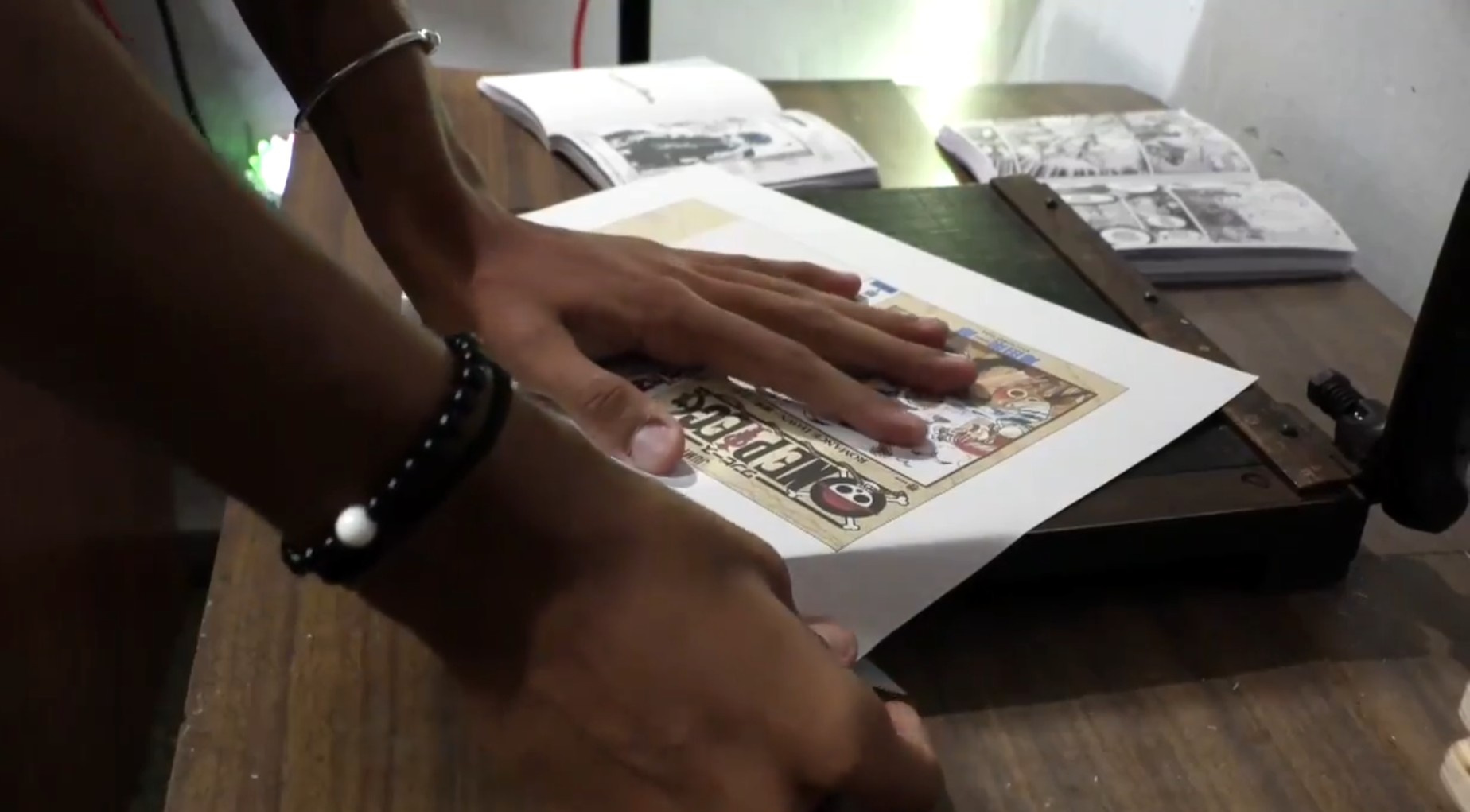
Jimenez hand-covers the books to deliver them to a wave of followers of this type of literature in Havana. / EFE / Screen Capture

14ymedio biggerEFE (via 14ymedio), Juan Carlos Espinosa, Havana, 6 June 2025 — The room of Álex Jiménez, a 21-year-old Cuban, is an operations center with a katana on the wall, a desk with Dragon Ball Z dolls and a Death Note mouse pad.

His computer contains about 20 gigs of manga — illustrated Japanese stories, similar to comic books, read from right to left — and a couple of design programs, a passion he developed from an early age.

But his uniqueness is what he has done with that digital mini-library. For three years now, the young Cuban has been running a thriving business that he decided to call Mangatiny.

Jiménez hand-stitches the books to deliver them to a wave of many followers of this type of literature in Havana. 

The interest in manga (written medium) – as well as anime (animated medium) – has risen like foam in Cuba in recent years. And the young man knew that there was a unique opportunity in a country where buying the original volumes is practically impossible, either because there are none or because, when there are, they are at exorbitant prices. continue reading

“The culture in Cuba has expanded completely, and thank God my business has continued to grow”

As he tells EFE in an interview in his room, in the Havana neighborhood of Alamar, the idea originated when he was in military service and saw a colleague in his dead time reading a miniature copy of Harry Potter that he printed at home.

He didn’t think twice and did something similar, though much more professional, with his favorite manga: Chainsaw Man. Everything was positive from that moment on.

“In previous years, if you watched a manga, you were someone special. Something like: ’ay, you’re a child’, you know? The culture in Cuba has expanded totally and thank God my business has continued to grow,” says Jiménez, while showing how he makes a customer’s order.

José Ángel González, a 21-year-old friend of Jiménez is a good example of how Cubans have embraced Japanese popular culture in recent years. His first approach to that world was, like many other compatriots who grew up before the arrival of Wi-Fi in 2014, with a burned CD that his mother bought him at a street stall. Inside the disc was the anime “One Piece.”

The jump from anime to manga was natural. There came a point where he just couldn’t wait to copy new arcs (seasons) from his favorite, Bleach, onto a memory stick.

González explains to EFE that, unlike its counterpart, comic strips, manga, and in general the very particular way of telling stories in Japan, has a much deeper exploration of characters than in the West. And that has connected very well with the average Cuban.

“Today, I would dare to say that four out of five people consume anime”

“They are stories that reach the heart and, at the same time, the mind. In the West, for example, the comic strip ultimately is more about the epic, the hero: the invincible protagonist overcoming certain problems. But they do not go to the center, the core of what the character feels, of what is going on”, he says.

The popularization of manga in Cuba is more evident if we analyze the varied profile of Jiménez’s clients. His orders range from the lifelong otaku (young person), who isn’t over 18, to a husband’s birthday gift to his wife. 

The fans can be a worker, student, reggaeton, rocker or athlete. Jiménez knows it well and reaffirms: “Today, I would dare to say that four out of five people consume anime”. He sees it with his own eyes when the orders arrive. 

According to him, printing a manga can take only a few minutes, although wrapping it in cloth can increase the time to an hour.

On a normal day, he may spend 6 to 7 hours working, alternating with his computer studies, not counting the long blackouts in his municipality. In fact, the lights went out during the interview. 

Jiménez sees himself in the years to come doing the same thing he does now, but with a much larger operation. He knows that the consumption of manga will continue to rise, and his offer will continue to satisfy that hunger for new issues every week. 

Translated by Regina Anavy

____________

COLLABORATE WITH OUR WORK: The 14ymedio team is committed to practicing serious journalism that reflects Cuba’s reality in all its depth. Thank you for joining us on this long journey. We invite you to continue supporting us by becoming a member of 14ymedio now. Together we can continue transforming journalism in Cuba.

Sandro, Grandson of Fidel Castro: Condemn Me, Instagram Will Absolve Me

The hardliners (Taliban) of the Cuban regime cannot stand that the young man displays the contradictions of the system

The ’influencer’ grandson mocks the Electric Union with a Yankee flag at his back. / Screen capture / Instagram

14ymedio bigger14ymedio, Yunior García Aguilera, Madrid, July 5, 2025 — The orthodoxy of Castroism has unleashed a strong offensive against the most viral grandson of Fidel Castro, founder of the oldest dictatorship in Latin America. Sandro Castro has gained more than 100,000 followers on Instagram for brazenly demonstrating the strong contrasts in today’s Cuba. While most suffer blackouts, shortages and hardships, a privileged few like him will never know the words sacrifice or effort. His main sin has been to break a golden rule in his family: enjoy and shut up.

Yuliet Teresa Villares, communication coordinator at the Martin Luther King Jr., Memorial Center, suggests in a publication that Sandro is an “unpunished shithead”. The propagandist Pedro Jorge Velázquez -nicknamed El Necio – calls him an “ideological enemy” on X. Ernesto Limia, vice-president of the Union of Writers and Artists of Cuba, publishes a pamphlet on Facebook, fills it with appointments to cover his back, and finally releases it: “Sandro is an idiot.” Immediately the former spy Gerardo Hernández Nordelo, high priest of the monitoring committees, blesses his post with an “amen.”

Pedro Jorge Velázquez – nicknamed El Necio – calls him an “ideological enemy” on X

Sandro is the son of Alexis Castro Soto del Valle, the eldest of five sons of Fidel and Dalia. The boy’s mother, Rebecca Arteaga, has been a faithful observer of the family golden rule and keeps a low profile.

The boy assaulted his own Moncada four years ago, when he posted pictures with his girlfriend pressing the throttle of a Mercedes Benz, “one of the toys I had at home.” After a boxing of ears, he offered apologies publicly, although behind his words he seemed to say: Condemn me, it doesn’t matter, Instagram will absolve me. continue reading

Curiously, the same people who now want to burn him at the stake of the Fidelist inquisition go in procession to the center that treasures the relics of the Commander, to venerate the armored Mercedes Benz model 500 SEL that “the first of his name” used for two decades to drive through his estates.

Sandro is the broken mirror of a political project that swore to create the “New Man” and has ended up generating an influencer who mocks the Electric Union with the Yankee flag at his back. He owns a bar, never strays from a cold Cristal beer and is a fan of vampires. Perhaps it was Sandro who enlightened the official Alexis Triana to get in Spain a copy in good condition of the film Vampires in Havana. Before the media grandson made reference to a film that the Cuban Institute of Art and Film Industry had not been able to preserve, the skilled squire Triana stepped forward.

“Ah, but look at Fidel Antonio Castro Smirnov, so discreet, so intelligent, so committed”

To prove that he does not have a genetic defect, the ultra-fidelistas compare Sandro to one of his cousins. They say: “Ah, but look at Fidel Antonio Castro Smirnov, so discreet, so intelligent, so committed”. Smirnov is the son of a Russian woman with Fidel Ángel Castro Díaz-Balart — Fidelito, the second of his name — who threw himself from a fifth floor window in 2018. Smirnov, unlike Sandro, was trained outside Cuba. His passion is not for Cristal; it is for cigars. He is not attracted to vampires but to parachuting. His partner is not an instagrammer, she is a presenter of the television program Cuadrando la caja: Marxlenin Pérez. What conservatives like about him is his silence.

The anger of the “loyalists” has exploded because Sandro disassembles all their rhetoric and represents what they will never be. El Necio and Limia may become mere propagandists, perhaps with minor privileges, perhaps with the possibility of reaching some position within the nomenclature. But they will never be untouchable. They belong to a lower caste, like Carlos Lage, Felipe Pérez Roque and Alejandro Gil. They will taste the honey of power as long as they are useful, and if the power in the shadows decides to discard them, it will do so without a blink of an eye.

Limia did not say “I can’t speak out of turn” when Raul’s grandson-bodyguard ran over a 19-year-old girl with impunity

Attacking Sandro seems easy. Comparing him with Smirnov too. The one the Taliban will never mention is Raúl Castro’s favorite grandson: El Cangrejo (The Crab). Raúl Guillermo Rodríguez Castro – son of Débora Castro Espín and the late López-Calleja – makes Sandro look like a commoner. 

Limia did not say “I can’t speak out of turn” when Raúl’s grandson-bodyguard ran over a 19-year-old girl and her young son with impunity on April 23, 2022. He will never dare to question his videos shot on luxury yachts singing “I’m a Playboy model.” El Necio – whose nickname fits perfectly with his scarce talent – will never dedicate a measly criticism against the most powerful dauphin of Cuban royalty. Opportunists always know where it says “danger.”

Translated by Regina Anavy

____________

COLLABORATE WITH OUR WORK: The 14ymedio team is committed to practicing serious journalism that reflects Cuba’s reality in all its depth. Thank you for joining us on this long journey. We invite you to continue supporting us by becoming a member of 14ymedio now. Together we can continue transforming journalism in Cuba.
Lester Lescay, a Cuban Exiled in Spain, Is Preparing To “Give Everything I Have” to the World Cup Long Jump

Lescay, from Santiago, aspires to surpass his personal record of 8.35 meters and reach the level of other Cubans who have represented Spain

This year, the athlete obtained Spanish nationality after marrying his girlfriend. /EFE

14ymedio bigger14ymedio, Havana, 5 July 2025 — Cuban long jumper Lester Lescay had to wait three years for the European country to grant him citizenship after leaving a Cuban delegation in Belgrade and marrying his girlfriend in Spain. “I was not given citizenship because of my sport, as has happened in other cases. The path has been different, but in the end I have managed to integrate well,” he tells OnCuba in an interview in which his determination to migrate appears as the final turning point of his career.

“I left Cuba because I didn’t want to spend my youth there,” the athlete begins saying and the phrase gives title to the interview. His youth career is not negligible: At the age of 15 he took second place in the U-18 long jump world championship, a year later he already jumped more than eight meters and at 17 was crowned champion of the Buenos Aires 2018 Youth Olympic Games. “It was very fast, I almost didn’t have time to assimilate it, I just jumped trying to make a competition better than the previous one,” he remembers.

Despite being among the best of the Cuban squad, other names stood out for accumulating better results, something that the 23-year-old santiaguero attributes to the speed with which some boys manage to improve their technique while others go at a slower pace. “We do not all go at the same pace, some explode before others. Sometimes you lose patience very quickly with the young people, but you can’t despair,” he explains. Still, he qualified for the 2020 Tokyo Olympics.

Lescay explained that it was right after the games in Japan that he had determined that his future wasn’t in Cuba

In an interview given to Runners World two years later and after his escape, Lescay explained that it was right after the games in Japan that he had determined that his future wasn’t in Cuba. “I decided that as soon as there was a trip, I would leave the Island,” he said. The poor state of Cuban sport and the story of his aunt, Mabel Gay Tamayo – world runner-up in triple jump at Berlin 2009 and bronze at the Indoor World Cup in Istanbul 2012 – helped him decide. “She was a good athlete, and I saw that almost immediately after she finished she was nothing,” he added about Tamayo, continue reading

who reached 14.67 meters.

Integrating into the Spanish sport has not been easy for Lescay. Initially, OnCuba claims, “he wasn’t seen as a potential addition to their national team,” and the fact that they did not grant him citizenship because he is an athlete proves it. It wasn’t until last January that, with his red passport in hand, Lescay was endorsed by the World Athletics to enter the professional sport in Spain.

However, the athlete does not complain. “I stayed with a super nice Spanish family who welcomed me as one of their own,” he says in reference to his wife’s family. He also received support from the Playas de Castellón club, of which he has been a part since he arrived in Spain. “Their help has been crucial, because when you migrate you don’t know how you’re going to live. It’s a lot of uncertainty, and they were always there for me,” he says.

Gradually, Lescay has started to add titles representing the colors yellow and red. This year he won bronze at the European indoor track held in the Netherlands. “That was my official debut with Spain, unforgettable, both for the medal and for having competed injured, almost without being able to run. I had to worm my way in to jump. The hardest thing was not being able to enjoy the event, but it is a happy memory for the result,” he estimates.

The Puma brand, which sponsors events and sports professionals, was also interested in Lescay, who recently signed a contract with them.

His first disappointment came with the European Championship by Nations, held in the Spanish capital, where he was left out of the first division

His first disappointment came with the European Championship by Nations, held in the Spanish capital, where he was left out of the first division. “It’s a pity that here in Madrid I didn’t make the leap that the fans were waiting for. It was not a good day, but not for lack of legs: I simply didn’t jump well,” he regrets, but without losing momentum: “The important thing was to bring points to the team. I’m not sad, but I know I could have done more.”

His plans are also ambitious for the upcoming competitions. “If I take care of myself, I have few limits,” he told the media, and he described his plan for the next event on his agenda. “There is the World Cup next September in Japan, where I will give everything I have. There will be no team involved: Only I will compete, and if I fail, the harm will be exclusively to me,” he explains.

However, the priority of the Cuban, who has managed to sneak into the Spanish sports scene, is to exceed his personal record of 8.35 meters, a jump he achieved in 2024 in Guadalajara with Luis Felipe Méliz, another Cuban exponent of the sport who is currently his coach. When he left Belgrade in 2022, his maximum was 8.28 meters outdoors.

Translated by Regina Anavy

____________

COLLABORATE WITH OUR WORK: The 14ymedio team is committed to practicing serious journalism that reflects Cuba’s reality in all its depth. Thank you for joining us on this long journey. We invite you to continue supporting us by becoming a member of 14ymedio now. Together we can continue transforming journalism in Cuba.

When the Train Arrived at Expocuba, the Passengers Discovered a Field of Ruins

The summer offer of leisure time for Havanans is a trip to nowhere

The train has three railway wagons that can accommodate about 200 passengers / 14ymedio

14ymedio bigger14ymedio, Darío Hernández, Havana, July 5, 2025 — “Hurry up, the trains waits for no one,” screams a woman on the Central Station passenger platform. This Friday, barely 20 people boarded the train bound for Expocuba, reactivated on July 2 after being paralyzed for a decade. With great fanfare, the authorities celebrated the availability of the route this summer for leisure offers to Havanans.

In the intense midday heat, the yellow and green locomotive starts; children jump from one seat to another as the blue railway wagons rattle.

“This route has been closed for more than ten years. They put it back now because of the huge deficit of buses. It is guaranteed for all the holidays and will continue for the whole year,” one of the engineers, cigarette in hand, tells 14ymedio. With three used railway wagons and a price of 20 pesos, the train was enabled to transport 204 people and makes stops in Luyanó, Dolores, La Víbora, Naranjito, Miraflores, Los Pinos, Alcázar, Arroyo Naranjo, Galapagos, Calabazar and La Piscina.

he stations through which the train now passes were closed for a long time due to deterioration and accumulation of garbage /14ymedio

The stations, he continues to explain, were closed for a long time and began to deteriorate and accumulate garbage. The section that the train covers today had to be cleaned before starting the route, and on the side of the tracks you can still see traces of waste, but “they will continue cleaning it up until Bejucal,” he adds. “They even took down several power and telephone wires that were on the tracks. On one of the trips, the neighbors had to raise a cable with a stick so that the train could pass.”

Bushes, abandoned warehouses, houses and hovels in the middle of nowhere, and a river from which some boys wave to the train is all the journey has to offer. At each stop the train loses passengers, and by the time it reaches Expocuba at 3:30 pm, there are only a grandmother with two grandchildren left. They came to spend some time at the fairgrounds and are going to be disappointed.

The park is closed because the bus carrying the workers broke down, and most of them could not get there. Inflatable toys, confesses an employee, is continue reading

the only children’s attraction available.

“Today we have hardly had any visitors,” she explains to the newspaper. “I was sitting with only two people until now,” she says. Asked about how Expocuba works when employees can arrive, the woman admits that “normally we have almost all the pavilions closed.”

With a glance at the park’s condition the reason is obvious. The deterioration of the buildings, the wear and tear of the attractions – faded by the sun and with missing pieces – and the almost zero gastronomic offers are eloquent. “There is no longer even the agricultural pavilion where they kept the exhibition animals that everyone was told to go see. They were removed because people started stealing them,” she explains.

“Yes, we do have the inflatable toys park, and all the bars function: La Solera, El Mirador, El Ranchón. The Casa del Queso has a variety of cheeses that aren’t very abundant because we have, as does the country, a shortage of many things,” she says.

Keeping the park running is no easy task. “We workers have no transport. We have a bus that leaves us off on the Calabazar bridge, and none of us lives in Arroyo Naranjo or nearby. When we get off on the bridge we have to figure out how to get home,” she complains. “What happens? The bus also broke down. So, today the famous train has arrived, and the workers are going to go on it to see how it is working”.

The condition of the buildings, the attractions with missing pieces and the almost zero gastronomic offers are eloquent / 14ymedio

On the return, the journey does not differ much from the one-way trip. The sun continues punishing the tin roof of the wagons, which are half bent, and the boys who were in the river have already left.

Expocuba is no longer an option for many in Havana, who are looking for other ways to enjoy, even briefly, the summer days. The state doesn’t offer much either: this Saturday the train to Playas del Este that takes more than an hour and a half on each trip was enabled. Transtur offers trips from Havana to the same destination, with departures every hour from 9:00 am, for 10 dollars or 1,200 pesos.

For those who can pay these prices, a day awaits in which they will have to guarantee, with their own means, everything from the food they consume to the drinking water.

Translated by Regina Anavy

____________

COLLABORATE WITH OUR WORK: The 14ymedio team is committed to practicing serious journalism that reflects Cuba’s reality in all its depth. Thank you for joining us on this long journey. We invite you to continue supporting us by becoming a member of 14ymedio now. Together we can continue transforming journalism in Cuba.

Athletes and Coaches Complain That Sports Schools in Cuba Are Falling Apart Due to Neglect

Images and a video show the deterioration of the Eide Ormani Arenado, the Manuel Fajardo Faculty of Physical Culture and the 19 de Noviembre Multipurpose Hall.

The Eide Ormani Arenado hosted on June 15 the selection of the artistic gymnastics team in Pinar del Río / Facebook/Pinar Indir

14ymedio bigger14ymedio, Havana, 4 July 2025 — The foundation of Cuban sports is falling apart. Athletes, coaches, circus artists and users denounced on social networks the abandonment of the Ormani Arenado School of Sports Initiation (Eide), the November 19 Multipurpose Room (both in Pinar del Río) and the Manuel Fajardo Faculty of Physical Culture (Santa Clara).

They have had to remove pieces of rotten wood from the floor of the Eide Ormani Arenado, which looks like a minefield. One of the revolutionary emblems inaugurated in 1963 inside the Athenaeum is in ruins. “Seeing it like this causes immense pain,” lamented US-based Cuban boxer Yuniesky González, who shared the image of the facility. “Wow! I had to see it to believe it. How we ran around on that floor! How many of us went through there?”

Adriana Lazaga, a teacher of the National Institute of Sports, Physical Education and Recreation (Inder), recognized that the Eide has been forgotten for years. “Nobody cares about sports anymore, let alone the well-being of our athletes. When I entered in 1997, at the height of the Special Period, it was 100 times better than now, 28 years later.”

The boxer’s post generated comments from athletes who visited his site. “In 1990 that part of the gym was flawless, but now it is unattended,” recalled Noel Tapia Morales, who practiced wrestling.

Circus artist Yandisley Leal commented that the deterioration of the facilities in the Eide Ormani Arenado “is not even half the conditions we had before, and they were bad.” The member of the German company continue reading

Circus Probst, Osmaikel Otaño, mentioned that in a decade the gym has “fallen into pieces.”

The investment seems insufficient. In June 2024, the vice president of Inder, Omar Venegas Echemendía, spoke about new developments for the sports infrastructure in Pinar del Río. As part of the advancement of 65×60=Fidel Program, the official highlighted two new dormitories for the more than 400 athletes participating in the National School and Youth Games, concluded this Friday.

Image of the Eide Ormani Arenado in Pinar del Río / Facebook/Yuniesky González

Venegas praised “the tangible repair work on the floor for artistic gymnastics, the wrestling mattress and the baseball field, which have received a transformation,” according to the official media Guerrillero.

However, the alleged improvements to the floor are not noticeable. During the selection of the artistic gymnastics team held on June 15 at Ormani Arenado headquarters, the lack of wood and paint in some places and the worn implements that athletes deal with every day are evident.

Handball coach Iván Roger Pérez Díaz said that the abandonment in the Eide is minimal compared to the deterioration of the infrastructure in the November 19 Multipurpose. “Don’t be surprised,” he warned.

Last year the sports authorities expanded the floor repair to the hallway, in addition to the judo tatami mats and surrounding areas. Work also continued on restoring the asphalt covering on the roof, which was torn away by Hurricane Ian.

In August 2023, the sports management told the official newspaper Granma that the waterproofing of the Multipurpose Hall 19 of November was “highly expensive,” despite the fact that at that time there was a donation of $15,000 from the Cuban Volleyball Federation and another 3,000,000 pesos allocated by the Provincial Defense Council after the passage of Hurricane Ian.

The waterproofing work continued but was a failure. Last March, Cubadebate reported that a few months after the work was completed, “the leaks persist.”

The main investor of the Provincial Direction of Sports, Luis Ricardo Ferreiro, said that the work “is poorly done in every way,” and, in addition, “the asphalt they used was expired.”

The specialist explained that the asphalt used for waterproofing has a type of small pebble that melts together with the rest of the material when steam is applied. “We have picked it up with shovels and sacks; it has obstructed the gutters up there. This means that it did not meet the required quality.”

Pinar del Río is the birthplace of champions. Mijain López, Marlenis Costa, Omar Linares, Pedro Luis Lazo, Yarisley and Idalys all come from there, promoted by Tele Pinar in 2022. At that time it warned that “for decades, in the midst of the difficult economic context of the country, the policy of the government and of Sports in Pinar del Río has been aimed at rescuing sports facilities to maintain results.”

The Faculty of the Manuel Fajardo Physical Culture (Santa Clara) is also abandoned. Ariel Martínez shared on Facebook a photo of the facade and the reactions from Internet users. Professor Maritza Aguila was sorry to see the center where she worked for 30 years in ruins.

Josefa Pons recalled that she started in 1976, “when it was inaugurated. It was a beautiful school, really a wonder. What a stage! There was everything.” She said that back then the place “had comforts, a culture and education. I was fourteen years old and enjoyed it very much. What I liked was modern gymnastics.”

From that time of glory only memories remain. The reality was shown in a video by Gabriel Nodarse. In the small area where football and basketball were played, only piles of rusty wood and iron remain, just like the judo area.

Translated by Regina Anavy

____________

COLLABORATE WITH OUR WORK: The 14ymedio team is committed to practicing serious journalism that reflects Cuba’s reality in all its depth. Thank you for joining us on this long journey. We invite you to continue supporting us by becoming a member of 14ymedio now. Together we can continue transforming journalism in Cuba.

The Central Committee, the Hard Core of the Communist Party, Is Strengthened by Two Generals

The 10th Plenary Session is committed to closing ranks and militarizing the political apparatus.

Major General Raúl Villar Kessel, head of the Central Army, is one of the new members of the Central Committee / Cubadebate

14ymedio bigger14ymedio, Havana, 4 July 2025 — The X Plenary of the Central Committee of the Communist Party of Cuba (PCC) began this Friday in the Palace of the Revolution with the usual speeches laden with a rhetoric of resistance. The meeting, which will conclude this Saturday, called for in-depth analysis and national mobilization, although the immediate result was a greater militarization of the political apparatus.

In a context where shortages, deterioration of essential services, mass migration and social disenchantment are reaching critical levels, the leadership decided to strengthen the core of the Central Committee with figures coming directly from the Armed Forces and the Ministry of the Interior. Major General Raúl Villar Kessel, head of the Central Army, and Brigadier General Oscar A. Callejas Varcalce, head of the Political Directorate of the Ministry of the Interior, were added as new members of the highest organ of the PCC. The “unanimity” that approved their admission is not surprising, as it follows the logic of total consensus that characterizes these events.

Brigadier General Oscar A. Callejas Varcalce, head of the Political Directorate of the Ministry of the Interior, was also added

The third person to fill the vacancies generated by the internal cadre movement was Magda Resik Aguirre, First Vice-President of UNEAC. A frequent face on official television, the presenter and screenwriter has called the population’s weariness that manifests itself in social networks as a work of “the enemies of the Revolution,” who “make every effort to offer a theoretical platform for the disenchantment and delegitimization of socialism.” continue reading

Chaired by Miguel Díaz-Canel, first secretary of the Party and president of the Republic, the plenary began with appeals to unity and denunciations of the US embargo, in an attempt to justify the economic and social paralysis that is choking millions of Cubans.

The “vitally important” event began without the presence of Raúl Castro Ruz

Despite the fact that the event was classified as “of vital importance,” it began without the presence of Raúl Castro Ruz. His absence from such meetings has become increasingly frequent. Nor did he attend the previous plenary session held in December, although he was present on June 6 for the promotion of the main figures of the Ministry of the Interior.

Beyond the political theater, the incorporation of two high-ranking military officers into the party leadership structure shows a clear trend: the regime is facing the crisis by closing ranks rather than giving signs of political reform. Far from renewing ideas, they insist on shielding positions. Faced with economic collapse and the erosion of ideological control, the leadership is betting on military discipline as a guarantee of internal stability.

The leadership is betting on military discipline

Despite the symbolic references to Fidel Castro and the patriotic dates of the revolutionary calendar, this Plenary resembles more a declaration of political survival than a strategy for the future. Raúl Castro’s absence does not mark the end of an era, but the advance of a direction increasingly disconnected from the real country, locked in its epic narrative while the people face endless lines, blackouts, uncontrolled inflation and deep despair.

The Communist Party of Cuba, far from being a “compass and force,” as proclaimed by Organization Secretary Roberto Morales Ojeda, remains a wall. And this X Plenary is confirming it.

Translated by Regina Anavy

____________

COLLABORATE WITH OUR WORK: The 14ymedio team is committed to practicing serious journalism that reflects Cuba’s reality in all its depth. Thank you for joining us on this long journey. We invite you to continue supporting us by becoming a member of 14ymedio now. Together we can continue transforming journalism in Cuba.

Pinar del Río Loses 400 Hectares of Tobacco Because of Blackouts

The managers of Consolación del Sur complain that part of the plantations have been ruined due to the lack of irrigation.

All varieties of the leaf grown in the municipality have been affected. / Tele Pinar

14ymedio bigger14ymedio, Havana, 27 June 2025 — The constant power outages are not only trying the patience of Cubans, but also affecting important sectors of the country’s economy. Tobacco, one of the privileged sectors because it is almost entirely exported, is one of the hardest hit. According to official press reports, in the municipality of Consolación del Sur in Pinar del Río alone, 385 hectares were lost due to the blackouts this season.

In a note published in the local newspaper, Guerrillero , the loss is reported, which damaged “all varieties of tobacco” grown in the area, including the sol en palo variety and Virginia.

The municipality’s initial production was also not expected to be high from the outset. At the start of the campaign, only 1,500 hectares of tobacco could be planted, which have been depleted due to the lack of electricity to operate the irrigation systems. “We estimate an impact of half the contract, which translates to 0.6 tons per hectare; as a result, we have a production of 1,301 tons, compared to an initial plan of 1,778 tons,” Mario Luis Zamora, director of the Comprehensive and Tobacco Company in the municipality, told Guerrillero.

According to the leader, by this date his company should have collected about 2.5 million cujes

According to the leader, by this date his company should have harvested nearly 2.5 million cujes, but the harsh conditions for maintaining the crops have left the amount at just 1.9 million, equivalent to 79% of what was forecast for this year’s campaign. continue reading

Zamora is hopeful that the situation will be different next season—an unlikely outcome given the state of the country’s electrical system—and that they will be able to reach 2,100 hectares planted. To ensure the current production of 327 tons and the next, he adds, 1,036 drying houses for the leaves have been built, and “we are receiving the zinc needed to roof another 85.” In total, he estimates that around 1,800 houses will be roofed next year.

As for the current crop, we’re working with what we have. “We already have all the selected crops working and processing the stored tobacco, and we hope to have more than 80% of the producers with their lands cleaned and their accounts settled by the 26th.”

With cigar production clearly in trouble, Habanos SA—half Spanish, half Cuban—has begun to pay more attention to machine-rolled cigars at the Internacional Cubana de Tabacos (ICT) factory in the capital. These aren’t Cuban cigars, nor do they have the prestige of being rolled by the sweat of the destemmers, but the profits the brand makes from the smaller, easier-to-roll, and more affordable sizes position them among its most profitable products. In 2024 alone, machine-rolled cigars brought in $38 million of the $827 million the company recorded.

With 400 workers, the International is the only industrial cigar factory in Cuba, and can deliver about 800,000 units daily.

With 400 employees, Internacional is Cuba’s only industrial cigar factory and can deliver around 800,000 cigars per day. Production delays, even minimal, translate into losses because everything produced, its managers assured AFP weeks ago, “goes on sale immediately.”

In 2001, the company became a joint venture with Tabacalera, a Spanish company that, according to AFP, belongs to “a consortium of Asian investors whose names have never been officially revealed.” It has 64 machines that can produce up to 42 cigars per minute, from the Cohiba, Partagás, Montecristo, and Romeo y Julieta brands. To maintain the pace, workers told the agency, the staff is divided into three work shifts per day, from Monday to Sunday.

However, Habanos SA can’t rely solely on machine-made cigars. Its clientele with luxurious tastes and deep pockets prefers thick, exotic vitolas that sometimes cost thousands of dollars. However, with the company’s $827 million in revenue in 2024—breaking its own record—it will surely be able to survive for a while.

* Cujes are sticks of attached tobacco leaves used in drying.

Translated by Regina Anavy

____________

COLLABORATE WITH OUR WORK: The 14ymedio team is committed to practicing serious journalism that reflects Cuba’s reality in all its depth. Thank you for joining us on this long journey. We invite you to continue supporting us by becoming a member of 14ymedio now. Together we can continue transforming journalism in Cuba.