
But What Good Practices Are They Going to Substitute in Cuban Agriculture?

As Cuba’s economic situation worsens, citizens are faced the with empty markets. (14ymedio)

14ymedio bigger 14ymedio, Elías Amor Bravo, Economist, 29 May 2022 — Is the agricultural situation in Cuba really going to be substituting “good practices” to increase the production of food, vegetables, grains and fruits? Well, it seems that this is what they did in the National Plenary of Cooperatives and Advanced Producers of the Productive Poles of various crops. Tremendous name.

According to the State newspaper Granma, which carried out the news coverage of such an important meeting, “the integral management of agroindustrial chains to generate high value-added products and services was analyzed, and the good practices of producers were socialized, with the purpose of increasing the production of food, vegetables, grains and fruits.” Deputy Minister Tapia, Minister of Agriculture Ydael Pérez, along with other ANAP (National Association of Small Farmers) authorities participated in the event.

Faced with the terrible results of the agricultural sector in 2021, which apparently are just as bad in 2022, as Minister Gil acknowledged at the last meeting of the Council of Ministers, citing the numerous “non-compliances” in product deliveries, communist leaders organize these “flower games” in which the cooperatives that make up a so-called “Political Productive Vanguard Movement” participate for the 100,000 kilograms of various crops and advanced producers.

Apparently 19 municipal plenaries were preceded by as many others in the agro-industrial “productive poles” with an agricultural vocation, the last collectivist invention of the regime, and four provincial ones. And of course, in the face of so many agricultural gatherings of the “productive avant-garde” one asks: Who is left in the furrow working daily to produce more? continue reading

The communists, in the face of the evident failure of their “63 measures” and any initiative that has its origin in the social communist model that governs Cuban agriculture in the last six decades, can think of nothing more than to “distract” producers, instead of letting them work freely, decide how much to produce, in what dimensions of plot and at what prices.

The regime’s interference in agriculture is the origin of all the evils of a sector that aspires to have the freedom to decide. Agrarian reform was a disaster; INRA’s (National Institute for Agricultural Reform) replacing the old ministry was another. A lot of time has passed since then, but the evils of Cuban agriculture remain the same: statism, bureaucracy, interference, control and repression.

It is not with “substitution of good practices” that more and better can be produced. The communist invention of the so-called “productive poles” dedicated to the production of various crops, will not work either, since it implies exercising a coercive force on producers, based on bureaucratic and political decisions, which have little or nothing to do with the socio-productive reality of Cuban agriculture.

A good example of this deficient creation of the so-called “poles” was offered by Granma stating that this formula, despite the full support of the regime, including these “substitutions of good practices,” has only produced 706,200 tons, barely 26% of the total production achieved in the year. A minutiae. And in the first quarter of this year, when non-compliance by Minister Gil was reported, the productive poles have not improved their contribution, with only 232,485 tons, which represents 25.3% of total production, one point less.

Then the National Director of Marketing of the Ministry of Agriculture spoke about marketing policy to point out what everyone knows, “that it is once again a difficult task, especially because of the scenario that Cuba is currently experiencing.” The solution is at their fingertips, and if they don’t implement it, it’s because they don’t want to: suppress ACOPIO (Cuba’s State Procurement and Distribution Agency) forever and leave absolute freedom to the marketing of producers with competitive private distributors. That’s a good practice.

In reality, and although this plenary served to vindicate, for the umpteenth time, the 63 measures of agricultural production, the truth is that no more production has been achieved, and there are the official results of ONEI (National Office of Statistics and Information) and the statements of Minister Gil, and they have not served to improve marketing either. Cuban communists still do not understand that what is not produced cannot be distributed, and that before the pitcher, you have to have the cow to produce milk. The achievements in terms of new products, new points of sale and new economic actors that offer products in other varieties have been carried away by the wind, in a 2021 lost forever, and a 2022 that is not going any better.

And in the face of the failure of the “63 measures”, the leaders insist that it’s necessary to continue “advancing in the dissemination of this policy, in which its importance and advantages, especially for the producers, are understood.” The author of this blog has consulted several Cuban agricultural producers who insist that the problem isn’t in knowing the measures, but in their futility, which simply don’t address what is really needed, so they turn their backs on them.

The meeting also discussed agricultural prices, an issue of the utmost importance, which according to the CPI prepared by ONEI on a monthly basis, are the fastest growing of the different components of the index, with their negative influence on the population. The evidence indicates that the current inflationary process that the Cuban economy is experiencing, which will get worse in the coming months, is originating from and also influencing the prices of raw materials and food.

And that either the authorities face this problem with effective and practical solutions, or the probability of a food crisis in Cuba seems very high. Wasting time relying on a possible solution to the problem on the part of state-owned companies doesn’t make sense, in view of past experience. The productive poles don’t either. The regime has no solutions within the communist social model to deal with the agricultural crisis, a situation that, similarly, led the Vietnamese to apply the Doi Moi (1986 Vietnam economic reforms). Why not in Cuba?

With this type of substitution of “good practices” and support for statism, the communist regime is on its way to a situation of serious structural crisis in the agricultural sector that no one wants, but which is on the doorstep. For a long time, the Cuban guajiro has known what the good practices are in his sector, and although he cannot claim them freely for fear of repression, it’s very clear: freedom, private property rights and a free market. The rest is wasting time.

Translated by Regina Anavy

____________

COLLABORATE WITH OUR WORK: The 14ymedio team is committed to practicing serious journalism that reflects Cuba’s reality in all its depth. Thank you for joining us on this long journey. We invite you to continue supporting us by becoming a member of 14ymedio now. Together we can continue transforming journalism in Cuba.
No. The Cuban Agricultural Sector is Not Doing Well

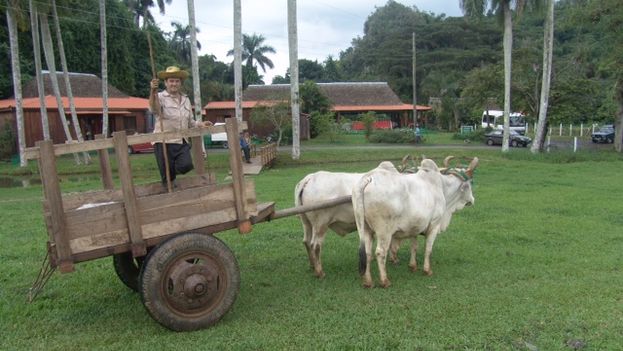
Farmers believe that the new measures only support “on paper” what they had already been doing. (Archive)

14ymedio bigger14ymedio, Elías Amor Bravo, Economist, 25 May 2022 — The worst thing that can be done to a person is to deceive him or take him for a fool, or both at the same time. This is what can be concluded from the Round Table program in which the Castroite Minister of Agriculture, Ydael Pérez, participated, and which Cubadebate has outlined with an article entitled “A year after their approval, how are the 63 measures to boost agriculture going?”

Well, they’re going badly. Very badly. They don’t produce the expected effects, no matter how much makeup you put on them, and now, in addition, as a council of economists in Davos warns in a quarterly report, a global food crisis is coming that won’t pass by Cuba, far from it. As happens in these cases, the blame for everything lies with the American embargo, and the rest is a mere formality.

It was another Roundtable program wasted for Cubans, in which Randy Alonso limited himself to agreeing with everything the communist minister said. Yes, the regime is concerned with looking for solutions and energizing agricultural production; yes, the processes in agriculture take time and some are long; yes, there are 63 measures and 658 actions with measurable goals and indicators, which are accountable to their promoters, and endless explanatory arguments that don’t convince anyone because once again they entertain themselves with indicators of process and not with the results, when what really matters to people is being able to eat every day. Very communist.

I ask, what Cuban is interested in the ministry’s decisions being divided into seven groups related to the management and finances of the agricultural system, the productive program, the cooperative system, the cadres of the sector, science, innovation and communication or the agricultural communities? What Cuban is interested in knowing that 16 agricultural policies, seven decree laws, 11 decrees and 19 resolutions have already been approved, to favor and unblock issues related to production? What Cuban is interested in knowing that the National Assembly recently approved the Law on Food Sovereignty and Food and Nutrition Security? As if hunger and food shortages were resolved by publishing laws and more laws. continue reading

The minister missed a golden opportunity to assume responsibility and speak clearly about why there is a lack of food in Cuba. Surely he knows why and also that getting lost in talking about a process indicator does nothing more than bore an audience that doesn’t give a damn that there is a reorganization of the ministry or that the role of the municipalities is strengthened, passing employees from one place to the other, as well as Raúl Castro’s old idea of producing in pots, parks and gardens.

At one point in his speech, the minister alluded to the restructuring of companies, which have reduced their workforce by 39%, especially the OSDEs*, which, out of an average of 180 contracted workers, now have fewer than 70. To avoid panic, he said that it’s not a matter of leaving people unemployed, but of “relocating them” and cited the example of “comrades who were heads of UEB** who today are heads of an irrigation-machine labor collective.” In other words, UEBs don’t help much, if budget tables can be dispensed with.

The minister said that “we need to look for more people dedicated to production.” it seems that he doesn’t have enough, that almost 20% of the employed population in Cuba is in the agricultural sector, and he wants more people producing with the result of lower productivity. On the other hand, he talked about “inflated structures” so we don’t really know what to expect.

He also talked about increasing foreign investment, recognizing that not enough progress has been made in agriculture. In fact, it has been on the margins of the projects, due to the legal structure of property rights that has to change.

He referred to the agricultural development bank, which in his opinion “has been very well received by producers,” but in reality has a marginal existence, since only 1.8 billion pesos were granted last year “mainly to producers linked to pig production, cattle ranching, and the cultivation of rice, bananas, cassava and guava” without significant increases in production, as revealed by ONEI*** data.

Other beneficiary products such as tomatoes, soybeans, pigs and livestock, in addition to rice, beans, corn, potatoes, bananas, cassava and sweet potatoes, also did not experience any improvements, with the exception of tomatoes. The 18,282 credits approved do not reach 10% of tenants and independent producers, and the 5 billion pesos are a drop in the bucket for the real needs of the sector. The farmers have turned their backs on the “dynamizing measures” of agricultural production. They have done the right thing.

Then, after talking about the need for more labor in agriculture, the minister said that “there is a lot of land to be exploited,” and in this case, once again, the direct responsibility is his. In reality, if “idle or poorly exploited land remains in Cuba, a problem to be solved in order to raise production,” the regime has to recognize that collective ownership of land is a strategic error and that it should be transformed into private property, as the Chinese and the Vietnamese did.

If the minister wants “our people to feel that making the land produce is part of their life project,” what has to be done is to give the land to those who work it, but with all the consequences, so that its use can be increased, reduced, sold, rented, or freely decided without ideological or partisan slogans, only with the criteria of efficiency and profitability.

The minister doesn’t seem to bet on this. For him, it’s more important to take care of labor groups as part of the land delivery process. He cited the more than 1,500 labor groups, with almost 15,000 workers, who could benefit from the approved measures, but acknowledged “that they’re not received everywhere in the same way (…) We find problems with the bosses, because they don’t change their methods. That doesn’t create a sense of belonging in the workers, and we need efficient management there as well.”

With regard to the delivery of land, the minister was critical and pointed out the delays in meeting the deadlines and resistance of the administrations to deliver idle land. The picture is bleak: premature requests that have to be resolved through political management, many more in process and the people going hungry.

The minister spoke of “working more intentionally with producers, approaching them and offering land to them.” But he stressed in this regard that “we don’t want to concentrate the ownership of the land in usufruct [a form of leasing], but in the management of that land.” And it was justified by the delivery of land for livestock, because of more than 7,000 hectares of land delivered, due to the lack of imported feed, no increases in production have been achieved.

In livestock production, milk and meat, the minister spoke of the recovery of more than 1,000 typical dairy farms, as well as the efficiency of the more than 150,000 producers, the 27,000 ranchers with 10 or more cows that “are key in our plans and we are visiting them” to give them land. Apparently it doesn’t work; they want to give them up to 555 acres of land but the average is around 165. No one wants to contribute their work and effort to something that will never be theirs. Let’s see when they learn. The minister acknowledged that there is a decrease in the livestock mass and said that “we have just over 3.5 million head of cattle, but only 40% of our cows give birth. Although we are complying with the milk plan, this is an area where more can also be done.”

In organic farming, the minister pointed out that the cultivated areas have grown but are insufficient. For example, bananas need 70,000 more acres, while malanga needs another 27,000 and cassava needs more than 125,000. The disturbing question is who decides which areas are organically cultivated, how and why?

He also pointed out that in the cultivation of food and vegetables, “more could be done” and cited as an example the autonomy of municipalities to agree on prices as a stimulus to production, while helping not to raise costs excessively, in his plans is to recover urban agriculture.

At another point he said that in Cuba there are 4,494 cooperatives and more than 400,000 producers and noted that “in the Political Bureau, 17 solutions for cooperatives were approved, and work is currently being done on a new legal norm that gives them more independence.” The organizational form is in crisis.

Regarding the training of cadres, with which he was dissatisfied, he pointed out that work is being done on skills and on the projection of the cadre and insisted that “we have to continue to improve work with young people.”

He reserved another part to talk about the role of scientists and science, which in his opinion has allowed progress in innovation-based management having achieved “247 innovations, 33 topics and 117 indications from the president.” In this regard, he said that “dissatisfaction persists. We must look for mechanisms that allow what has been achieved in one producer to spread more quickly to others.”

In summary, the minister defended the implementation of the 63 agricultural measures by justifying their positive impact, but didn’t offer a single indicator of improvement results. The recent publication of ONEI still gave figures very close to the negative balance of the agricultural sector in 2021. Therefore, following the lines of Minister Gil, the head of agriculture joined the official speech that “progress is being made, although we can’t feel pleased. We are totally dissatisfied.”

The question is, what gradual progress should be achieved to be satisfied with something that obviously doesn’t work? Because at this rate, either a new model for the Cuban agricultural sector is identified, or the food crisis anticipated by analysts and experts is closer than ever.

And it may be true that the solution is not to import consumables, as the minister said, but to find a way to produce them here, but perhaps others should look for and implement solutions. Cubans can’t be fooled any longer. Don’t take them for fools. Their daily meal is not secure. Things are getting worse and worse.

Translator’s notes:
*Organizaciones Superiores de Dirección Empresarial [Higher Organizations of Business Management]
**Unidad Empresarial de Base [Basic Business Unit]
***Oficina National de Estadisticas e Información [National Office of Statistics and Information]

Translated by Regina Anavy

____________

COLLABORATE WITH OUR WORK: The 14ymedio team is committed to practicing serious journalism that reflects Cuba’s reality in all its depth. Thank you for joining us on this long journey. We invite you to continue supporting us by becoming a member of 14ymedio now. Together we can continue transforming journalism in Cuba.
Cuba: ‘No One Should be Forced to Choose Between Leaving Their Country or Facing Abusive Charges’

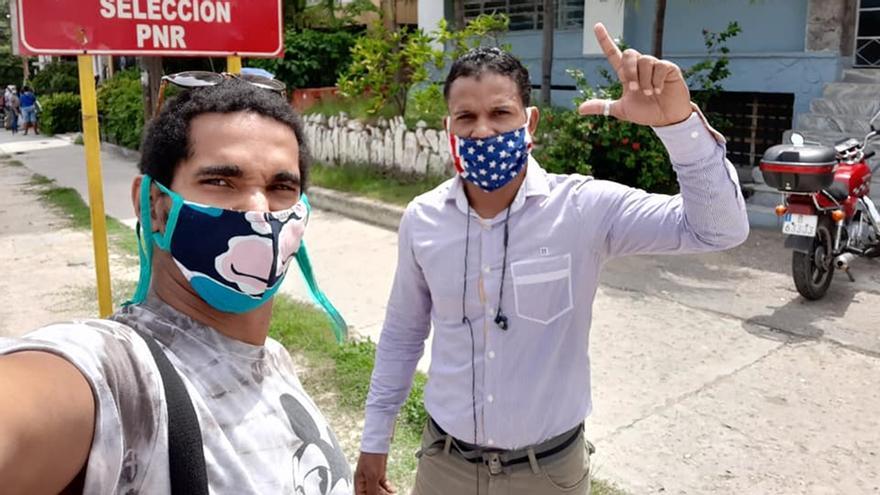
The artist Luis Manuel Otero Alcántara (left) with rapper Maykel Castillo months before his imprisonment. (Facebook)

14ymedio bigger14ymedio, Havana, 27 May 2022 — Just four days before the start of the trial against Luis Manuel Otero Alcántara and Maykel Castillo Osorbo, the international human rights organizations Amnesty International and Human Rights Watch have issued a joint statement in which, in addition to demanding once again the release of both artists, they condemn the practice of exile used by the Cuban regime to get rid of opponents, a tactic that the two activists have rejected but that many others were forced to accept.

“No one should be forced to choose between leaving their own country or facing abusive criminal charges for which they should never have been prosecuted or imprisoned,” the two organizations reproach. In the text, they explain that they were aware of the offer made by the Cuban authorities to Otero Alcántara and Osorbo to be released and that the former publicly rejected it, while in the other case it was retracted. “This is a practice that the Cuban Government has carried out historically and with other critics in recent months and that violates the human right of everyone to enter their country of origin,” they say.

Tamara Taraciuk Broner, Acting Director for the Americas at Human Rights Watch, said that both artists “are being prosecuted for exercising their human right to criticize their own government” and has demanded that the countries of the continent take a stand in a this situation. “Latin American governments should not remain silent when there are artists threatened with prison sentences, a sign of extreme intolerance typical of the brutal dictatorships that ruled the region in the past.”

For its part, Amnesty International’s representative for the region, Erika Guevara-Rosas, demanded that if the trials continue, as they take for granted they will, the governments of Latin America and Europe be able to closely follow the trials “against these Cuban prisoners of conscience, who should never have spent a day in prison… In a country where more than 700 people, including some under the age of 18, are imprisoned simply for expressing themselves, it is of the utmost importance that these trials are subject to international scrutiny,” she added.

The organizations note that these cases are just the tip of the iceberg and that these trials are only “part of a much broader pattern of systematic abuses against Cuban artists and other critics of the Government and protesters in the country. In recent years, the Cuban authorities have imprisoned, criminally prosecuted and forced into exile dozens of Cuban artists, including those of the San Isidro Movement and the 27N [27 November], who bring together artists, intellectuals and critical journalists.” continue reading

The trial against Luis Manuel Otero Alcántara and Maykel Castillo begins this coming Monday, May 30th, in Marianao, Havana. The Cuban Prosecutor’s Office requests seven years in prison for the first for aggravated contempt, public disorder and incitement to commit a crime, and ten years for Osorbo, for attack, public disorder and evasion of prisoners or detainees. Alcántara also carries the accusation of outrage against patriotic symbols, for creating a work of art, “Drapeau,” with the Cuban flag.

Otero Alcántara, declared a prisoner of conscience by Amnesty International, has been in the Guanajay maximum security prison since July, from where he sent a message on May 17. “We have endured all this and more in search of a dream and responsibility for the Cuba of today and tomorrow. And they are dreams that as of today nothing has erased,” he said, adding that for those dreams he is willing “to sacrifice the flesh of the artist, my flesh of the artist, my freedom-loving spirit.”

For his part, Castillo, who was arrested on May 18 of last year, has been in the maximum security prison of Kilo Cinco y Medio since May 31. His family, the organizations report, learned of his whereabouts days after the United Nations Committee on Enforced Disappearances urged the Government to disclose it.

In January 2022, the United Nations Working Group on Arbitrary Detention concluded that Castillo Pérez had been arbitrarily detained and said that the Cuban Government should release him immediately by determining that he had been arrested for exercising his fundamental rights and had suffered violations of due process, including abusive limitations on his right to defend himself.

Amnesty International and Human Rights Watch close the statement demanding that the authorities allow the presence of journalists, human rights observers and personnel of foreign embassies in Cuba in the 11J trials, which, in any case, should be annulled.

Translated by Regina Anavy

____________

COLLABORATE WITH OUR WORK: The 14ymedio team is committed to practicing serious journalism that reflects Cuba’s reality in all its depth. Thank you for joining us on this long journey. We invite you to continue supporting us by becoming a member of 14ymedio now. Together we can continue transforming journalism in Cuba.
Mexican Court Agrees to Consider Injunction Against Hiring of Cuban Doctors

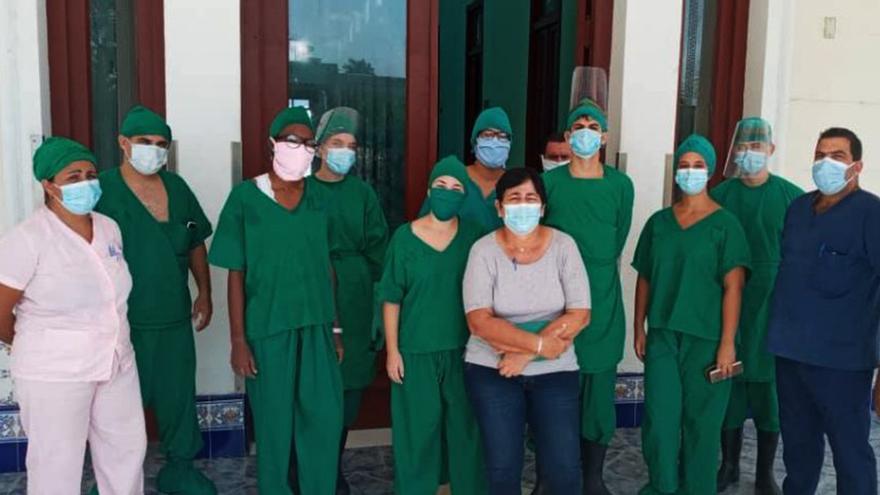
Mexico will send the new brigade of Cuban health workers to the “Guerrero Mountain area.” (Cubadebate)

14ymedio bigger14ymedio, Madrid, 27 May 2022 — A Mexican judge has agreed to consider a preliminary injunction against plans announced by Mexican President Andrés Manuel López Obrador to hire 500 Cuban doctors, according to the Associated Press.

According to the Mexican press, the second district judge in matters of Civil, Administrative and Labor Protection of Puebla, José Luis Evaristo Villegas, has agreed to the injunction, refusing the provisional dismissal because “the agreement signed by the federal government contravenes provisions of public order.”

“Future acts of uncertain performance, both in their execution and in their effects, are not likely to serve as a matter for the precautionary measure; this is only appropriate if there is certainty about their performance because they are imminent acts,” the judge concluded.

The judge has given the Government a deadline to present its arguments and will decide on June 1 whether or not to grant the injunction.

The injunction indicates that the Mexican Government has not demonstrated that the doctors have the adequate capacity or training to practice medicine in Mexico and argues that the remuneration of health workers might go to the Cuban Government rather than the professionals.

The complainants argue that the agreement was negotiated “without having confirmed the quality of the doctors, and without having validated their education, as required by applicable regulations, and without proving they have knowledge of the illnesses and endemic diseases of the Mexican population.”

“Their hiring is illegal, favoring the conditions of modern slavery and even human trafficking,” adds the injunction. continue reading

During his trip to Havana on May 8, López Obrador announced the hiring of 500 Cuban doctors, in addition to buying the island’s vaccines. The Mexican president said that his country has a “specialist deficit,” and there are health workers who don’t want to go to remote areas. The Cubans will be sent to the Montaña de Guerrero area, one of the most violent places in the country, due to the presence of several drug cartels.

After the opposition criticized the hiring, stating that there are capable doctors in the country and underlining the well-known semi-slavery conditions in which Cubans work, the Mexican president lashed out at them and maintained that he would not back down.

“Why shouldn’t we have the doctors? If we’re doing this with Cuba, it’s because we need them,” said López Obrador, who took the opportunity to charge his “adversaries” of the “neoliberal period” with having damaged the public health system.

On Tuesday, and to appease the controversy, the Government announced a broader plan, which it christened “recruitment of medical specialists” and through which it seeks to hire 13,765 national specialists in order to reduce the deficit.

We don’t have the doctors we need, according to the World Health Organization (WHO),” the President said. We need internists, emergency specialists, gynecologists, obstetricians, pediatricians and anesthesiologists.

The president assured that the Government will “hire Mexican doctors as far as possible,” because “unfortunately” the country doesn’t have all the required specialists.

Translated by Regina Anavy

____________

COLLABORATE WITH OUR WORK: The 14ymedio team is committed to practicing serious journalism that reflects Cuba’s reality in all its depth. Thank you for joining us on this long journey. We invite you to continue supporting us by becoming a member of 14ymedio now. Together we can continue transforming journalism in Cuba.
Cuban journalist Camila Acosta is fined 1,000 pesos for reporting about 11J

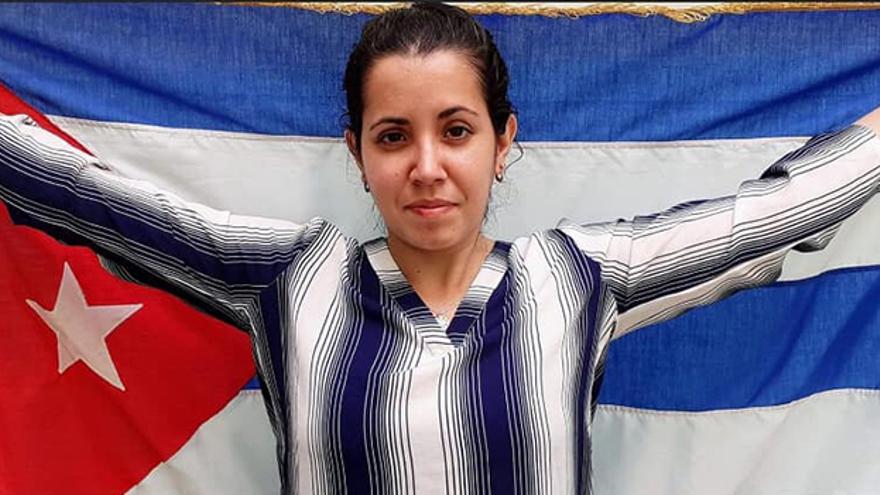
Camila Acosta, independent Cuban journalist. (Facebook)

14ymedio bigger14ymedio, Havana, May 27, 2022 — Camila Acosta has avoided  trial for an alleged crime of public disorder after paying a fine of 1,000 pesos imposed by State Security. The independent journalist, who was arrested for reporting on the protests of July 11 (11J) and had been under house arrest for 10 months, reported on the resolution of the case in an article published by Cubanet, the media with which she collaborates.

Acosta relates that the Aguilera police, in the municipality of Diez de Octubre, summoned her on Wednesday and imposed a fine on her in the presence of her lawyer under a rule — relating to the criterion of opportunity — that allows proceedings to be resolved without going to court.

The fine must be paid in three days, and although she believes this is arbitrary, she is accepting it to avoid going to trial, “which, knowing the constant violations that are committed and the state of total defenselessness before the laws, is the lesser of evils.”

In addition to the fine, State Security confiscated personal property that she allegedly had on the day of her arrest on July 12: two laptops, a hard drive, two phones, five flash drives, work agendas, books, a blouse she wore on July 11, $50 and 20,000 CUP pesos. “Some of these assets were not even my property,” the journalist adds. They returned only a phone charger, a wireless computer mouse, and a recording device, which she thinks they broke, because it doesn’t work.

Acosta denies that a she committed a crime and, even less, that the confiscated objects are related to the public disorders that she was charged with. continue reading

During the four days she spent in detention, the journalist says that she was interrogated by State Security twice a day for two hours each time, and she confirmed to them that she participated in the July 11 protests as a reporter. “I don’t regret having done it, and I would do it again. Reporting is not a crime, nor is a peaceful demonstration.”

Camila Acosta says she is aware that she didn’t commit a crime, but going to trial would mean a sentence of three months to one year in prison. The criminal investigation against the journalist was opened ten months ago, and in the last five she was under daily surveillance in her home, where she was constantly harassed “with the psychological burden that this represents, both personally and for family and friends.”

The journalist predicts that her fight is not over yet. “The new Criminal Code is more criminal than the previous one and provides the regime with repressive tools that directly attack independent journalists, the opposition and civil society in general. The torment is far from over.”

Camila Acosta is a contributor to CubaNet and the Spanish newspaper ABC, and before moving to the independent Cuban press she was on local television, Canal Habana.

The transition to the private sector has cost her family break-ups, repression and the harassment of State Security, as is the case with many other reporters and activists.

The resolution agreed in this case coincides with the release of several young people who participated in the 11J protests, such as the young Andy García Lorenzo, who went from prison to an “open regime” camp; after an appeal, five others obtained the same benefit: Jorge Gabriel Arruebarruena, José Miguel Gómez Mondeja, Lázaro Alejandro Rodríguez Ruiz, Ariel Núñez Martínez, Mercy Daniela Pitchs Martínez and Amanda Dalai Matatamoros Cabrera.

Jonathan Torres Farrat was also released, as a change of pre-trial measure, after the payment of bail, while awaiting his trial.

Others released on Wednesday were Eloy Bárbaro Cardoso, an 18-year-old university student captured in La Güinera; Juan Yanier Antomarchi Nuñez, also 18 years old and sentenced in the first instance to 8 years of deprivation of liberty, and Dariel Cruz García, 20 years old, who also received an 8-year sentence.

In total, this week, 15 accused of participating in the July 11 protests have been released. Thirteen of the protesters had their sentences reduced by up to 10 years, and two were switched to correctional work, one of them without internment.

Translated by Regina Anavy

____________

COLLABORATE WITH OUR WORK: The 14ymedio team is committed to practicing serious journalism that reflects Cuba’s reality in all its depth. Thank you for joining us on this long journey. We invite you to continue supporting us by becoming a member of 14ymedio now. Together we can continue transforming journalism in Cuba.
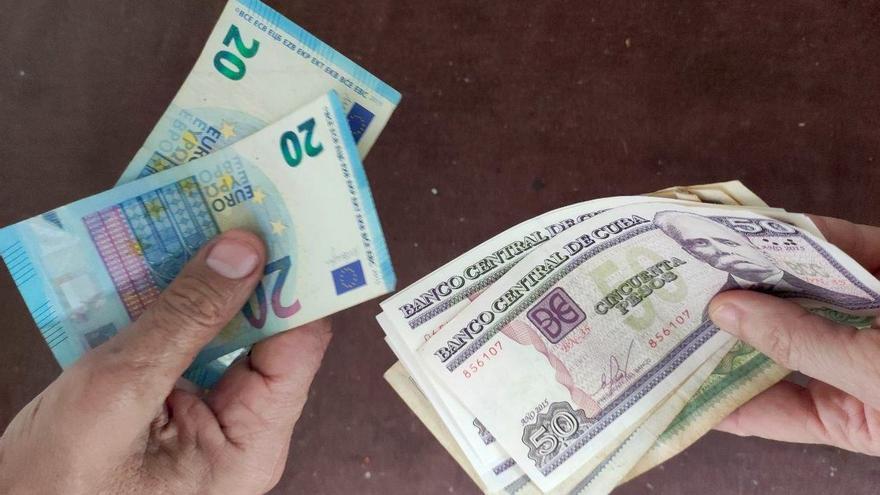
The Price of Hard Currency Drops on the Black Market in Cuba

Until last week, the price of hard currency on the black market was on the rise. (14ymedio)

14ymedio bigger14ymedio, Havana, 25 May 2022 — The price of hard currency in Cuba is plummeting on the informal market. Not only has the freely convertible currency (MLC) fallen, but also the dollar and even the euro.

“Last week the MLC rate was 125 pesos, but I could only sell at 10 to 110 pesos to a family member,” says Niurka, a Havanan from El Vedado, who receives remittances and suffers first-hand from the fall of the freely convertible currency, which de facto replaced the Cuban convertible peso (CUC) after its disappearance, dictated by the so-called Ordering Task*. “I can’t explain it to you. I can spend 1,100 [Cuban] pesos in one moment in the agro market now,” she complains.

Like so many other Cubans, Niurka usually changes much of what she receives into Cuban pesos. “In the MLC stores you don’t buy everything you need. Yes, chicken, tomato puree, some olive oil, a condiment or a jam, but I buy the rest on the street, in CUP: meats, vegetables, rice, beans… Not to mention the daily expenses, electricity, gas, the telephone,” she explains.

According to the figures published daily by the independent media outlet El Toque, the black-market exchange rates are 110 Cuban pesos (CUP) per MLC, 100 per dollar and 115 per euro. The drop is substantial compared to what was quoted last week: about 125 pesos per MLC, 115 pesos per dollar and almost 130 pesos per euro.

Until then, the price for hard currency was on the rise, due to growing demand, on one hand because of the need to buy products in MLC stores that are not found in the peso stores, and, on the other, because of the need for dollars for those who want to emigrate. continue reading

The turning point came on May 14, when the Cuban Minister of Economy, Alejandro Gil Fernández, declared that a “special” exchange rate would be established for some producers, state and private, of high-demand goods. He didn’t give details except to say that it would be between the official rate of 24 pesos and that of the informal market, which in those days was reaching 125 pesos.

The measure immediately aroused criticism from experts, such as economist Pedro Monreal, who called it “one more nail in the coffin of the ’ordering task’ and a possible source of illegality.” In any case, the collapse of the MLC this week seems to be a direct consequence of those statements.

Another factor that influenced the fall in currencies is the new measures announced by the Biden Administration last week on May 16, which include the elimination of the $1,000 per quarter/per person limit on remittances.

This restriction had been in force since 2019, when it was promulgated by then-US President Donald Trump along with other provisions that largely paralyzed the official business of foreign exchange, such as the prohibition on doing business with the Cuban military. This was the case of Fincimex, blacklisted by the US Treasury in June 2020, which managed remittances up to that time.

Remittance services, such as Cubamax or VaCuba, two of the most used, haven’t yet received official communication to eliminate the limit of $1,000 every three months, but Biden’s mere announcement seems to have had an effect on the informal foreign exchange market.

“Something is happening in Cuba with the MLCs,” says Jonathan, who emigrated to the United States last year. “The muchacho I use to send remittances to my family, for the first time in almost a year doesn’t have MLC there to pass on to them.” And not only freely convertible currency, which only works if deposited on a Cuban magnetic card, but also dollars, euros or even national currency.

Jonathan says that just a week ago, he was able to send money without a problem in this unofficial way, but it turns out “that yesterday I wrote him and he says that he has no MLC or anything. That things are bad right now. I asked him when he was going to have it and so far he hasn’t answered me.”

*Translator’s note: Tarea ordenamiento = the [so-called] ‘Ordering Task’ is a collection of measures that include eliminating the Cuban Convertible Peso (CUC), leaving the Cuban peso as the only national currency, raising prices, raising salaries (but not as much as prices), opening stores that take payment only in hard currency which must be in the form of specially issued pre-paid debit cards, and many other measures related to the Cuban economy. 

Translated by Regina Anavy

____________

COLLABORATE WITH OUR WORK: The 14ymedio team is committed to practicing serious journalism that reflects Cuba’s reality in all its depth. Thank you for joining us on this long journey. We invite you to continue supporting us by becoming a member of 14ymedio now. Together we can continue transforming journalism in Cuba.
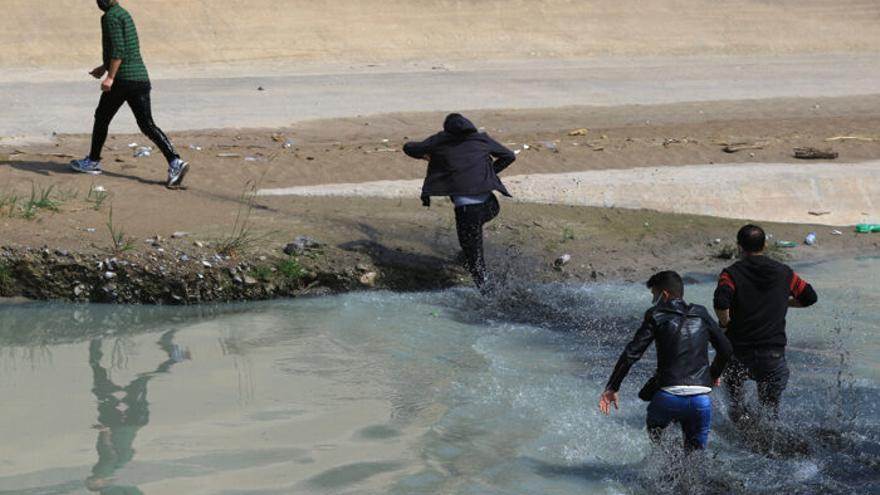
Cuba’s Machiavellian Use of Migration

Four Cuban migrants cross the Rio Grande in Ciudad Juárez, Chihuahua (Mexico). (EFE/Luis Torres)

14ymedio bigger14ymedio, Yunior García Aguilera, Madrid, 25 May 2022 — On June 22, 1990, before the United Nations, Nelson Mandela firmly demanded that the sanctions against Pretoria be maintained. The African leader wondered what mistake had been made to allow a country with apartheid to be seated after the Universal Declaration of Human Rights or the Nuremberg Trials. He strongly urged that the measures not be relaxed until the crime is stopped.

In Cuba we have suffered for decades an ideological apartheid that segregates citizens into two camps: “revolutionaries” and “worms.” Those who have been pigeonholed in the second group have suffered imprisonment, physical and psychological torture, persecution, acts of repudiation, exclusion, censorship, harassment, separation from their jobs or expulsion from their places of study, forced expatriation and even death.

##The historical amnesia that they try to impose on us from the propaganda machine cannot erase horrendous memories such as the shootings, the UMAP (Military Production Aid Units), the ’parameterization’, the sinking of the tugboat March 13 or the combat order of July 11 of last year, where the “revolutionaries” obtained a license to stone, beat or shoot at the demonstrators.

There are testimonies that claim that several public health centers were instructed to deny medical assistance to those they considered “worms.” The irrefutable mark of that apartheid that we suffer is summarized in the phrase that affirms that the streets, the common space, belong only to the ethnic group that carries the revolutionary gene in its cells.

The accession of Miguel Díaz-Canel to the one-party throne has been a huge setback for the aspirations of citizens in areas such as freedom of expression, pluralism, social participation, rights, economic prosperity or democratic changes. Today, a generation without charisma, mediocre to the core, lacking legitimacy or historical weight, clings to the reins of power. The current leadership knows that it no longer has the support of the majority, and the panic of suffering the same fate as Nicolae Ceausescu is reflected on their faces. continue reading

That’s why they quickly resort to the club and the gag. That’s why they keep the largest number of political prisoners behind bars in all of Latin America and see young people as a major danger. That’s why they unanimously approve a reactionary, cowardly and medieval Criminal Code. That’s why they include penalties of up to ten years in prison for the crime of treason that not even contemporary monarchies have taken so far.

It’s a fact that the majority in Cuba is already fed up with the dictatorship and want change. Opinion is divided into how and where. Many were optimistic when Obama decided to try a new strategy, defrosting tensions and trying to empower the private sector on the island. Trump returned to ice and aggressive speech. Now Biden zigzags between isolation and the relaxation of sanctions.

But beyond the leaders’ back and forth is a population of 11 million trapped in hopelessness, misery, impotence and fear. That same citizenry that erupted on June 11 today finds no choice but to sell everything, grab a backpack and cross borders. Although the ruling press says with cynicism that Cubans go to Nicaragua to contemplate the lava of the Masaya volcano, we all know that the stampede advances much further north.

The regime, an expert in turning its defeats into victories, has always used migratory waves for a triple purpose. First, the exodus serves as an exhaust valve to release internal pressure. Second, migration crises are used as weapons to put anyone sitting in the White House on the ropes. These frequent exoduses have almost always been the responsibility of Democratic administrations. Lyndon B. Johnson naively believed that the quarter of a million Cubans who left through Camarioca and the Puente Aéreo could return to Cuba in a short time.

Jimmy Carter lost the 1980 elections, among other things, due to the bad press that exaggeratedly reported the exodus of the Mariel Boatlift. Clinton had to set up the Guantanamo Naval Base as a temporary refuge to avoid a collapse in south Florida, during the Rafter Crisis. But the third and most Machiavellian use of migration by the regime is to convert exile into economic investment. Every Cuban who flees becomes a potential sender of hard-currency remittances.

The vaunted national sovereignty is nothing more than a mirage, a kidnapping, a fallacy.

Translated by Regina Anavy

COLLABORATE WITH OUR WORK: The 14ymedio team is committed to practicing serious journalism that reflects Cuba’s reality in all its depth. Thank you for joining us on this long journey. We invite you to continue supporting us by becoming a member of 14ymedio now. Together we can continue transforming journalism in Cuba.
American Businessman Authorized by the U.S to Invest in Cuba Is Keeping His Deal Secret

Kavulich still needs the approval of the Cuban side and is sure that he will get it. (Cubadebate)

14ymedio biggerEFE (via 14ymedio), New York, 19 May 2022 — The United States authorized for the first time in six decades an investment in a private business in Cuba, undertaken by John Kavulich, who told EFE today that he has been in contact with “officials of the Joe Biden Administration,” congressmen and senators who have allegedly been helping to bring this operation to fruition for almost a year.

Kavulich, President of the United States-Cuba Economic and Trade Council, does not give many details about the investment “up to 25,000 dollars,” nor does he give the name of the Cuban business, since he prefers to wait for Cuba to give the go-ahead. He only announced that this business is not related to the Government of Miguel Díaz-Canel, has more than 5 years in the service sector and has continued growth.

The businessman doesn’t want to give names of who his partners have been in the Biden administration: “[They were] officials of the Biden-Harris administration, including the State Department, the Department of the Treasury, the Department of Commerce, the Department of Defense, the Department of Justice in all areas, as well as the two houses of Congress,” says Kavulich.

Until now, the U.S. embargo on Cuba, in force since 1960, prevented this type of investment and, according to Kavulich, it’s the first time that this type of license has been approved since the boycott came into force.

No official of the Biden Administration has so far spoken on this issue or on the eventual lifting of the embargo on investments in Cuba.

The investor submitted the license request to the Office of Foreign Assets Control (OFAC) on June 10, 2021, and this agency gave him the green light on May 10, 2022. continue reading

Kavulich points out that his efforts with the White House and Congress date back long before the Biden Administration, during which time he has been figuring out if his investment efforts can be successful.

After formally submitting his petition last June, the businessman was optimistic, but as the months went by he lost hope.

“They gave me contradictory statements and communications in the past two months that shattered all my optimism,” he recalled, stressing that the final news of the approval of the investment took him completely by surprise.

In order for Kavulich to be able to invest in this company – -which he discovered thanks to a Facebook group — he still needs the approval of Cuba, but the businessman says he is “90% sure” that he will get it.

“My 90% certainty is not because the Cuban government is enthusiastic, but because of how necessary it is,” he stressed, explaining that this need has become more evident with the great blow that the island’s economy received with the pandemic.

Likewise, Kavulich notes that his objective in this investment is not intended to look for “a fast dollar,” but to pave the way for future investors.

“My role as president of the council and the work that the council has done since 1994 is that if there is a problem, we try to solve it and then let everyone know what we did. And that is precisely what we are doing here,” he says.

For Kavulich, the fact that an investment is allowed by a U.S. businessman on the island can represent a great “potential” for Cuba’s private sector.

Yesterday, Biden took another step in opening up to Cuba by announcing a relaxation of the limitations on remittances and flights, among other things, reversing part of the last round of sanctions applied by former U.S. President Donald Trump.

“It’s hard not to see a connection. We applied for the license on June 10, 2021. They issued the license on May 10, 2022, and six days later, they announced all these other changes. If one plus one equals two, in this case there is no doubt that it’s not a coincidence,” he concluded.

Translated by Regina Anavy

____________

COLLABORATE WITH OUR WORK: The 14ymedio team is committed to practicing serious journalism that reflects Cuba’s reality in all its depth. Thank you for joining us on this long journey. We invite you to continue supporting us by becoming a member of 14ymedio now. Together we can continue transforming journalism in Cuba.
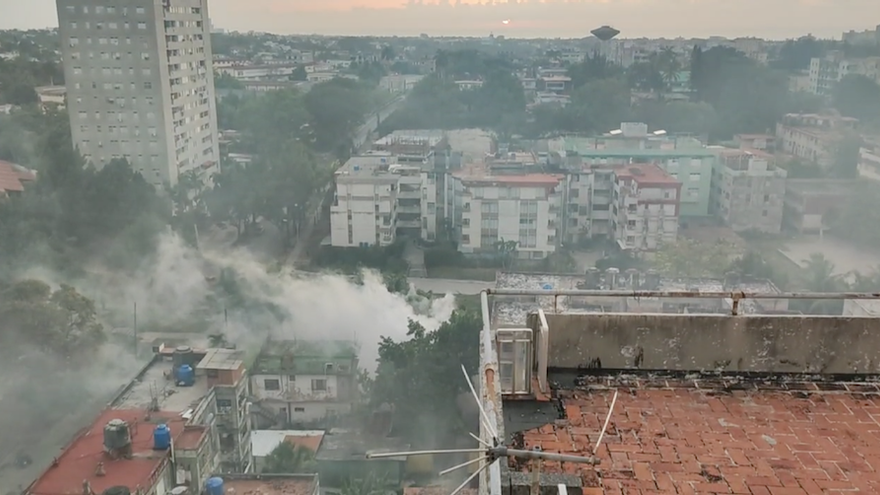
Massive fumigation in Some Havana Neighborhoods to Fight Dengue Fever

Fumigation this Monday in the Havana neighborhood of Nuevo Vedado. (14ymedio)

14ymedio bigger14ymedio, Havana, 10 May 2022 — Years ago, before the economic crisis gripped the island, fumigation in Havana to combat the Aedes aegypti mosquito was done house by house, with prior notice, on a certain day in the summer. Those days will not return.

Now, the fight against the insect responsible for the transmission of diseases such as dengue fever, Zika, and chikungunya is done in neighborhoods spontaneously, with vehicles that fill the air with poison and gasoline (the indicated product contains 25% of cypermethrin diluted in petroleum as a solvent). This is how it was this Monday in the Havana neighborhood of Nuevo Vedado.

“I haven’t seen fumigation like this in many years,” says a resident in the face of the pestilent smoke. “Dengue must be thriving.”

The Cuban Minister of Public Health, José Ángel Portal Miranda, recently acknowledged that there is an outbreak of the disease throughout the country, although he assured that the Government is “in a position to reverse the situation.”

In any case, the Island’s own health authorities recommend that after fumigating, the product be left for almost an hour. “If we don’t leave the house closed for 45 minutes after the treatment is applied, the mosquito leaves, the microdrop doesn’t fall on top of it — the mechanism that causes its death — and we have lost time and fuel and, what is worse, the mosquitoes and the focus of their transmission remain,” Carilda Peña García, the National Director of Surveillance and Vector Control of the Ministry of Health, explained last year during the campaign to fight Aedes aegypti. How is this condition met outdoors?

Fumigation has also been the target of popular criticism for the frequency with which campaign operators steal part of the product or fuel and replace them with mixtures that do not fulfill the function of exterminating insects, in addition to causing greater allergic reactions in people.

Translated by Regina Anavy

____________

COLLABORATE WITH OUR WORK: The 14ymedio team is committed to practicing serious journalism that reflects Cuba’s reality in all its depth. Thank you for joining us on this long journey. We invite you to continue supporting us by becoming a member of 14ymedio now. Together we can continue transforming journalism in Cuba.
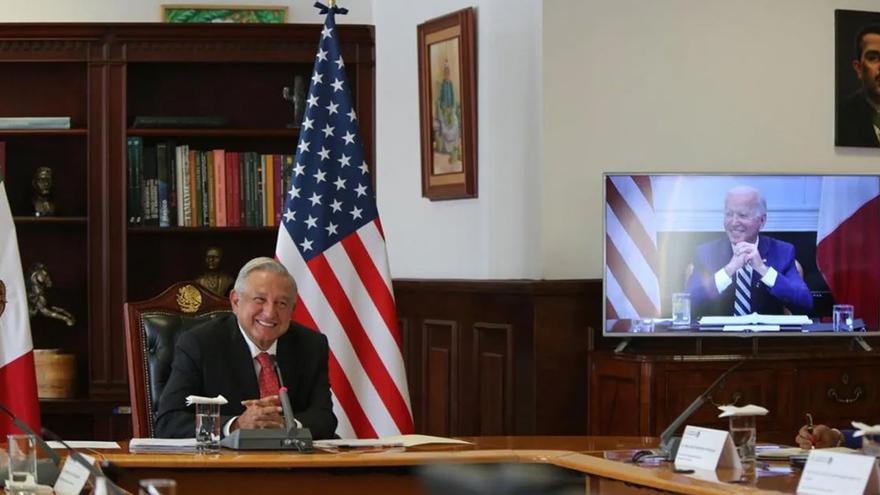
Lopez Obrador Speaks With Biden About Immigration Before Traveling to Cuba

The Mexican President, Andrés Manuel López Obrador and his U.S. counterpart, Joe Biden, had a virtual meeting that lasted 52 minutes. (Presidencia de México)

14ymedio bigger14ymedio/EFE, Mexico, April 29, 2022 — Reducing migration at the border was the main topic of Monday’s conversation held by U.S. President Joe Biden and his Mexican counterpart, Andrés Manuel López Obrador. “The tone of the call was very constructive,” said White House spokeswoman Jen Psaki.

Psaki did not clarify if Biden made any concrete request to López Obrador to strengthen Mexico’s southern border and prevent the passage of more undocumented immigrants from going to the United States, but she wanted to distance the position of the U.S. president from that of his predecessor, Donald Trump (2017-2021).

“This was not a call in which President Biden was threatening the Mexican president in any way,” the spokeswoman said about the virtual meeting that lasted 52 minutes.

The figures show the severity of the migration crisis for both Mexico and the United States. The U.S. Customs and Border Protection Agency (CBP) recorded 7,800 arrests of irregular migrants per day along the border with Mexico in the last three weeks, almost five times the 2014-2019 average, before the COVID-19 pandemic.

From October 2021 to the end of February 2022, the CBP reported the arrival of 46,000 Cubans by land in the United States. The five-month figure exceeds that of the 12 months of 2021, which had already been a record (39,303), and some calculations estimate that after a year about 150,000 nationals from the island will have arrived on U.S. territory, more than the 125,000 of the Mariel ’Boatlift’ exodus. continue reading

This was not a call in which President Biden was threatening the Mexican president in any way.

The conversation between Biden and López Obrador “was scheduled in part due to the Summit of the Americas (to be held in June in Los Angeles), but also because the lifting of Title 42 is approaching,” Psaki stressed.

Title 42 is a protective measure that the Center for Disease Control and Prevention (CDC) imposed during the pandemic in 2020, during the term of then-president Donald Trump, and which has continued under Biden.

This measure means that the United States automatically deports the majority of undocumented immigrants who arrive at its southern border, without giving them the opportunity to apply for asylum.

The CDC recently announced its plan to rescind that measure on May 23, but that decision now depends on the decision of a Louisiana judge, who suspended for 14 days the Administration’s preparations to end that regulation.

A source consulted by the AFP agency who asked for anonymity announced that the Summit of the Americas, convened for June 8 and 9 in Los Angeles, will address the issue of migration from Central America.

López Obrador will travel next week to Guatemala, El Salvador, Honduras, Belize and Cuba. Meanwhile, Mexican Foreign Minister Marcelo Ebrard will travel to the United States next Monday to advance issues of cooperation for development and the next Summit of the Americas, as reported in the publication.

Translated by Regina Anavy

____________

COLLABORATE WITH OUR WORK: The 14ymedio team is committed to practicing serious journalism that reflects Cuba’s reality in all its depth. Thank you for joining us on this long journey. We invite you to continue supporting us by becoming a member of 14ymedio now. Together we can continue transforming journalism in Cuba.
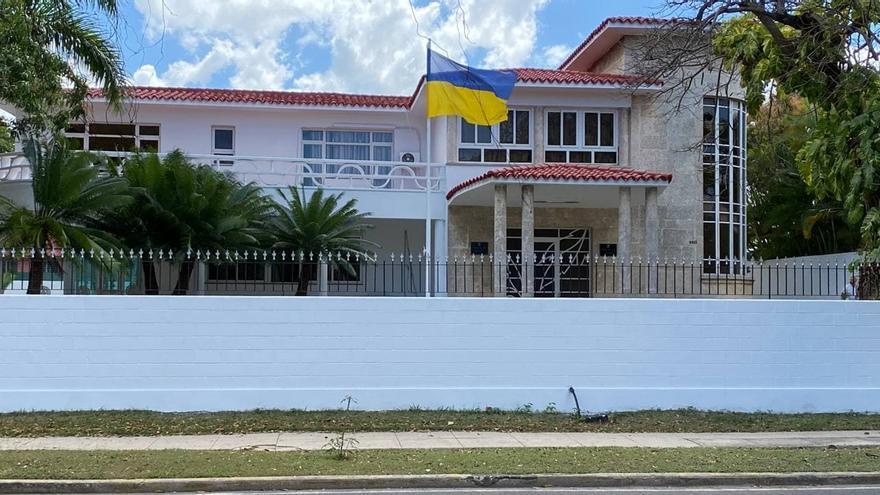
Ukraine’s State News Agency is Blocked in Cuba

The Embassy of Ukraine is located on Fifth Avenue in the municipality of Playa, Havana. (14ymedio)

14ymedio bigger14ymedioHavana, 27 April 2022 — The state press agency of Ukraine, Ukrinform, is blocked in Cuba according to the report of the Cuban political scientist, Alexei Padilla, on Facebook, and published in Diario de Cuba. The site isn’t accessible from the Island without VPN (a Virtual Private Network)*, although the Cuban Government has not made any public decision in this regard, as is usually the case when the decision is taken to prohibit other news media, whether they be international, like CNN, or national, like 14ymedio itself.

“UPEC (The Cuban Union of Journalists) itself, which rent its garments in anguish over the censure of Russian media in Europe and the U.S., perhaps hasn’t heard, I think, of the censure in Cuba of Ukraine’s principal news agency, because Ukraine and its news media don’t have solidarity with UPEC,” said Padilla on Facebook.

Since the beginning of Russia’s invasion of Ukraine on February 24, the official media of the Island have criticized any method of sanction taken by the members of NATO and other western countries against businesses, institutions, and persons linked to Putin’s government. One of these measures has been the European blockade of Russia Today and Sputnik, which have been accused of disinformation and generating destabilizing currents of opinion.

In addition, collaterally, the financial sanctions also prevent the financing of delegations from those media in Europe, and issues can include anything from the rental of housing to workers’ salaries. continue reading

At the beginning of March, UPEC denounced the suspension of those media as a “cultural crime” and considered this a violation of the rights “of millions of people who lack all the elements necessary to evaluate the conflict.” Up to now they haven’t said a word about the application of similar measures in Cuba for Ukrinform, just as they have never said anything about the rights of Cubans to know points of view that are different from the official ones.

In all this time, Cuban State media continues to publish articles rejecting the western censorship of the Russian media and even went so far as to call the West “Nazis” in a text published September 5, entitled “The Russians are the new Jews and the West the Third Reich.”

In it, in addition, half-truths were spread like the one that said the University of Valencia in Spain had “invited” the Russian alumni to leave. In reality, the institution had offered economic and administrative support to whoever wanted to return to Russia, a complex task because of the sanctions.

It also said that the University of Córdoba fired the Russian professors, something legally impossible. That institution indicated that there was a revision of the programs of collaboration maintained with the technical scientific institutions of the Russian State.

The official Cuban press has been the mouthpiece for the Kremlin in the 63 days of the conflict, questioning the reports coming from Ukraine without any proof and defending those coming from Russia, among them denying the massacre in Bucha, verified even through aerial photographs and comprehensive, irrefutable reports from The New York Times.

Ukrinform was founded in 1918 and belongs to the European Alliance of News Agencies. The European governments announced the end of emissions from Russian media in February, while Russia made public the blocking of channels like the BBC, Voice of America, Radio Free Europe/Radio Liberty and Meduza, in addition to Twitter and Facebook. But the Cuban Government maintains silence about its censorship.

*Translator’s note: VPN stands for “Virtual Private Network,” an application that encrypts data, identity, and browser history for a monthly fee.

Translated by Regina Anavy

____________

COLLABORATE WITH OUR WORK: The 14ymedio team is committed to practicing serious journalism that reflects Cuba’s reality in all its depth. Thank you for joining us on this long journey. We invite you to continue supporting us by becoming a member of 14ymedio now. Together we can continue transforming journalism in Cuba.
Cuba: From the ‘Blockade’ to the Emigration Crisis

Cubans during the 1980 Mariel boatlift. (FLORIDA HISTORICAL SOCIETY)

14ymedio bigger14ymedio, Elias Amor Bravo, Economist, 22 April 2022 — There are two phenomena that have affected the life of the Communist Regime in Cuba for six decades. The two are closely related and have also been used for the Cuban government’s own benefit every time it wanted to.

To interpret both processes over such a long period of time can cause forgetfulness, intentional or not, which makes it difficult for the general public to understand what’s being discussed. Is it enough to read an article in the State’s flagship newspaper Granma entitled “Who benefits from creating a ’migratory crisis’ between the U.S. and Cuba”? The article goes to the heart of the matter by recounting facts that seem taken out of a fairytale.

It was enough to read that, already in the Fifties, Cuba wasn’t receiving immigrants and that what was really happening was a massive exodus of Cubans to the United States, where, the article says, 100,000 Cubans were living in 1958. This has nothing to do with the more than 2 million in 2022. But it’s all the same; when It’s a matter of distorting reality and creating a nonexistent alternative, the Communists have no rival.

And there’s no other way to look more ridiculous than to be determined to do the same thing over and over again. The only thing you can do is to go to the ONEI, the National Office of Statistics and Information, and consult the annual statistics for 2020, the latest published in the historical series of population by sex, annual rate of growth, and ratio of male to female.

If you take the figures from 1950, which show 5,876,052 inhabitants, and compare it to 1960, with 7,077,190 inhabitants, there is an increase in population of 1,201,138, or 14%, the highest in the historic data. Later, in the decade of the Sixties, the relative growth was lower, some 13%.

To think that this increase in population in Cuba in the Fifties was due only to birth and death is naive. A half-million Europeans came to Cuba in those years to realize their dreams, because in their countries of origin it was impossible. But be careful with the data, because they’re a boomerang that can come back to hit you. continue reading

Starting from this observation, reality confirms that the Cuban population is affected by the massive exodus of Cubans to the Exterior, a flow that hasn’t slowed since 1959 and that the Communist regime has managed at its will, encouraging every 15 years, more or less, massive population departures: 1965, Camarioca; 1980, Mariel, 1994 Guantánamo (Balseros).

The data exist for anyone interested, and there’s no need to invent them. This continual exodus of six decades has made Cuba the world leader as the country that has a larger percentage of its citizens living in the Exterior, nothing more and nothing less than 20%. Not even the levels of migration in the Third World reach these numbers.

Cubans have turned their backs on the Regime that requires them to live a certain way, a way they don’t want, and with the impossibility of democratic changes, they leave the country, because in Cuba it’s impossible, with the Communist Party in power, to open a space for a democratic process and freedoms, or for economic reforms that improve prosperity and a better quality of life.

So now we have the second result. The U.S, throughout this traumatic history, has received more Cubans and “prevented” them from living in their country because of the “embargo/blockade” (as Fidel Castro branded it), which certainly doesn’t exist. The U.S. has to face, every day, a political regime that presents the ’blockade’ to the international community as the cause of all Cuba’s ills.

But the argument creates many scandalous votes in the United Nations, with claims that Cuba is owed billions of dollars because of the embargo, and other absurd nonsense. The embargo has become wishful thinking that has no common sense. Trade between the United States and Cuba reaches 200 million dollars annually, and Cuba receives from the United States around six billion dollars in remittances each year that now other countries will want.

And in spite of the evidence, the leaders in Havana play the embargo card every time things get complicated in Cuba, as is happening presently, above all since they launched the ’Ordering Task’ in 2021* with disastrous consequences for the country.

So now we face a new cycle in which the Communist leaders can expect another massive exit from the country to reduce the internal social tensions provoked by poor management of the economy. They can blame the U.S. for everything under the heading of “blockade/embargo” and encourage it through some worthless negotiations, which end up with the U.S. welcoming those who want to abandon the Island in search of a better future.

In this way the ’blockade’ and the immigration crisis are two sides of the same coin which the Regime plays with. And it gets advantageous results in the international sphere at the same time it rids itself of many problems that it doesn’t recognize or, worse, that It doesn’t want to fix. And thus for more than 60 years, they fall into the same trap.

*Translator’s note: Tarea ordenamiento, the [so-called] ‘Ordering Task’, is a collection of measures that include eliminating the Cuban Convertible Peso (CUC), leaving the Cuban peso as the only national currency, raising prices, raising salaries (but not as much as prices), opening stores that take payment only in hard currency which must be in the form of specially issued pre-paid debit cards, and other measures. 

Translated by Regina Anavy

____________

COLLABORATE WITH OUR WORK: The 14ymedio team is committed to practicing serious journalism that reflects Cuba’s reality in all its depth. Thank you for joining us on this long journey. We invite you to continue supporting us by becoming a member of 14ymedio now. Together we can continue transforming journalism in Cuba.
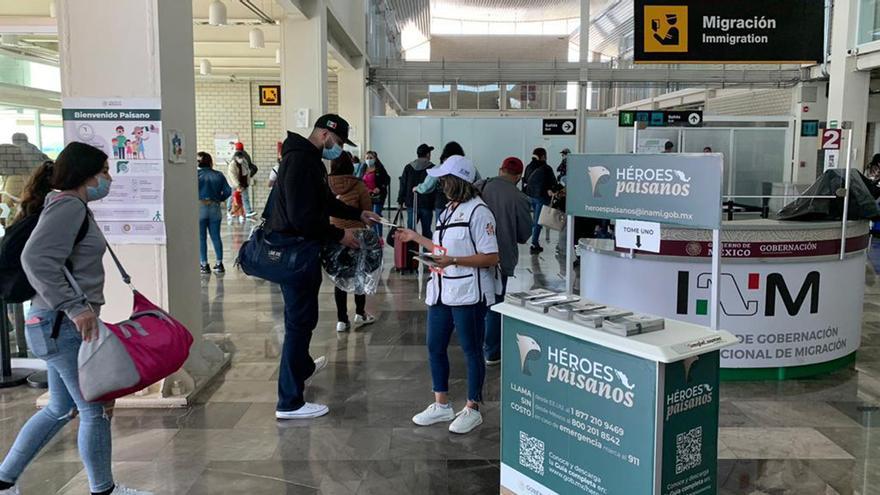
Cubans Must Pay $100 to Avoid Detention in the Mexicali Airport Terminal

Immigration agents at the International Airport of Mexicali are seen extorting Cubans. (INM)

14ymedio bigger14ymedio, Ángel Salinas, Mexico, 22 April 2022 — Whether or not you live there or have a tourist visa, in the International Airport of Mexicali “Cubans pay or are detained,” Deborah Rodríguez told 14ymedio. This woman, originally from Old Havana and now living in Mexico City, made three trips this year to the capital of Baja California, on the border with the U.S. “On two of them I had to give the agent 500 pesos [around $25] to let me continue.”

She worked as an assistant in an audiovisual production company, and they singled her out from the others in transit. “It was in February. They didn’t separate me from the group but put me against a wall like a criminal. The agents denigrate you without anyone doing anything.”

The terminal area has the capacity to perform 18 operations per hour and counts on charter routes for U.S. citizens from Los Angeles and San Francisco and Canadians from Vancouver. The airport is located 20 kilometers [13 miles] from Mexicali and has been converted into a route for Cubans on their transit to the U.S.

Norma Bustamamte Martínez, the Municipal President of Mexicali, confirms that “the arrival of 70 Cubans” was registered on April 12. The officer says that the denunciations of migrants about extortion are “rumors.” Alberto Gómez, from the National Institute of Migration (INM), denied these allegations. continue reading

But Rodríguez tells a different story. She reports that when you get off the plane, there are two checkpoints before you get to the exit. “The first is the INM where they review your documents. This is where you slip some money among your papers or you can’t leave. The second is the National Guard Army, where they review your papers and give you a pass to the commercial area and the exit to the station.

In spite of denials by the authorities, inside the airport are the immigration agents who control the extortions. The Cuban boxer, Michel Sarita, arrived in the terminal at the end of March with official documentation to remain in Mexico, according to Luis Felipe, who knows him. Before they took away his cellphone, the athlete said, “They put us on a bus, here in Immigration, and I don’t know where they’re taking us.”

A Venezuelan woman and her brother each paid 500 pesos to the agents. They told Luis Felipe that they had been arbitrarily detained and weren’t told where they were being taken. “Not everyone is able to pay.”

Javier is another native of the Island who was a victim of blackmail on the part of the Immigration authorities. You have to pay a fee, “everyone knows that.” Even though you have residence in Mexico or a tourist visa, it’s an “obligation” when you land in this airport to “put $100 in your passport when the agents approach you.”

This Cuban from the province of Granma was a permanent resident in Ecuador, and after one month he decided to emigrate to the U.S. to try his luck. He arrived in Mexico with a tourist visa which gave him the right to travel anywhere in the country. In Mexicali he had to pay $100 without any argument in order to avoid arrest.

Another two Cubans with permanent residence in Mexico also confirmed to 14ymedio that they suffered extortion. “We know why you come here”, the officials warned them. “Be honest.” They continued like this until the Cubans gave in and paid the money. In exchange the officials returned their papers and let them leave the terminal.

Another source confirmed to this newspaper that one person with a false visa paid 300 dollars to Immigration in this airport to avoid arrest.

The Department of Customs and Border Protection registered the arrival of 80,000 Cubans to the U.S. between October 1, 2021 and March of 2022. And in Mexico, Immigration reported the detention of 15,907 Cubans on April 16.

Translated by Regina Anavy

____________

COLLABORATE WITH OUR WORK: The 14ymedio team is committed to practicing serious journalism that reflects Cuba’s reality in all its depth. Thank you for joining us on this long journey. We invite you to continue supporting us by becoming a member of 14ymedio now. Together we can continue transforming journalism in Cuba.
Mexico Investigates a Network That Charges up to $10,000 to Take Cubans to the U.S.

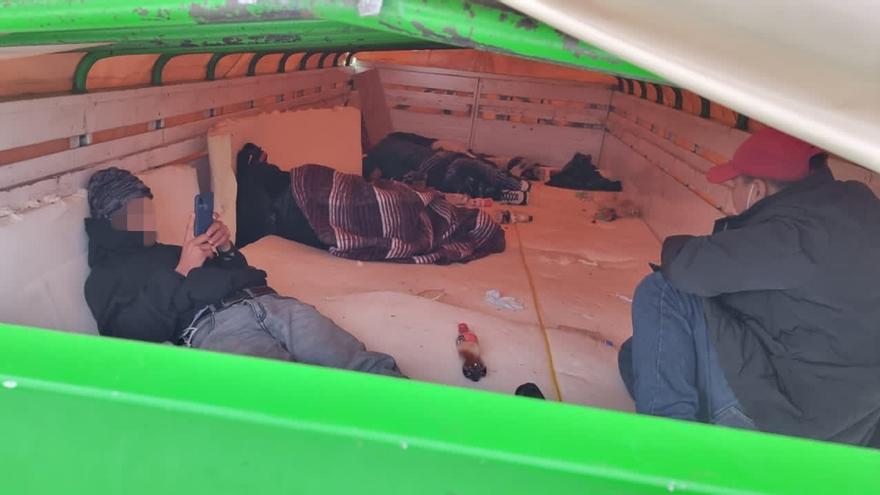
Photo of Cuban migrants who were transported in the back of a truck on Mexican roads in the state of San Luis Potosí in Mexico.

14ymedio bigger14ymedio, Ángel Salinas, Mexico, 11 February 2022 – – The Minister of Public Security (SSP) of the Mexican state of San Luis Potosí is investigating a trafficking network that charges $8,000 to $10,000 to take migrants to the U.S. border. Between last Wednesday and Thursday, 135 foreigners, 22 of them Cuban, were detained as part of the first investigations.

“It’s a criminal group that is making transfers due to gaps in security to avoid the National Guard checkpoints,” state security spokesman Miguel Gallegos Cepeda tells 14ymedio. Coyotes arrive in the villages and pass migrants off as tourists to avoid suspicion.

Traveling from San Luis Potosí last Wednesday, in the community of Villa Hidalgo, the police located five vehicles that were hiding behind an embankment, so they requested the support of the Army and the National Guard in the face of a possible “narcotics” event. According to SSP information, the drivers accelerated to try to flee but were intercepted by the military.

Six coyotes were traveling in the five vehicles, all from the state of Puebla, and they were transporting 30 migrants: 15 Cubans, including a family with children, 10 Nicaraguans, and 5 Guatemalans. The drivers were arrested and transferred to the facilities of the Attorney General’s Office, where an investigation was opened for the trafficking of migrants. continue reading

“Caravans with dozens of Central Americans are passing through the state. Now there are many Haitians who are trying to find work, but these transfers in vans and trucks are from a network that is beginning to exploit the so-called Gulf route,” Antonio, an agent of the Prosecutor’s Office, told this newspaper.

From San Luis Potosí, explains the official, there are two options to reach the border with the U.S. The first is to go to Monterrey and from there to Nuevo Laredo, on the Tamaulipas border with U.S. territory, and the second is to leave for Saltillo, in the border state of Coahuila, and from there to Piedras Negras to try to reach Eagle Pass, in Texas.

The first inquiries located a group operating in the vicinity of the Palenque archaeological zone, in Chiapas. “Part of this network takes migrants to Coatzacoalcos, in Veracruz, then through the municipality of Tierra Blanca until they reach Orizaba, and from there they leave for Querétaro and continue until they reach San Luis Potosí,” Antonio emphasizes.

“The $10,000 dollar charge is not [only] for the transfer through Mexico but from the countries of origin. We hope to finish putting together the puzzle and dismantle this group,” explains the agent.

Last Thursday, state police detected a truck that was speeding in the Potosi municipality of Charcas. After a chase the driver was arrested in the stretch that connects the community of Matehuala with El Huizache. The back of the truck had two levels and was lined with spongy material, and 105 migrants were found there: 28 from Guatemala, 21 from Honduras, 13 from El Salvador, 36 from Nicaragua, and 7 from Cuba.

“This confirmed the modus operandi of the trafficking network. Migrants mentioned that they paid $10,000 to reach the U.S. The coyotes sold them the idea of up to three transfer opportunities in case they were arrested and returned to Guatemala.”

So far they have detained 7 people in the human trafficking network, and investigations are continuing concerning the owners of the secured vehicles.

Meanwhile, in the Yucatán, the Mexican Navy rescued 8 Cuban rafters who were found 12 nautical miles from Puerto Progresso. After being attended to by medical personnel, they were transferred to the remote terminal of Progresso and taken to the National Migration Institute.

Translated by Regina Anavy

____________

COLLABORATE WITH OUR WORK: The 14ymedio team is committed to practicing serious journalism that reflects Cuba’s reality in all its depth. Thank you for joining us on this long journey. We invite you to continue supporting us by becoming a member of 14ymedio now. Together we can continue transforming journalism in Cuba.
Caribbean Mexican Authorities Are Alerted About More Cubans Arriving by Boat

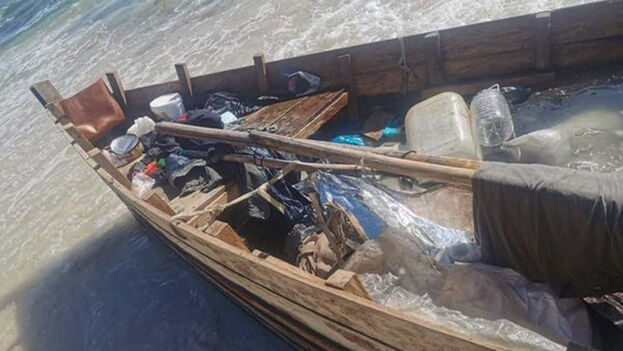
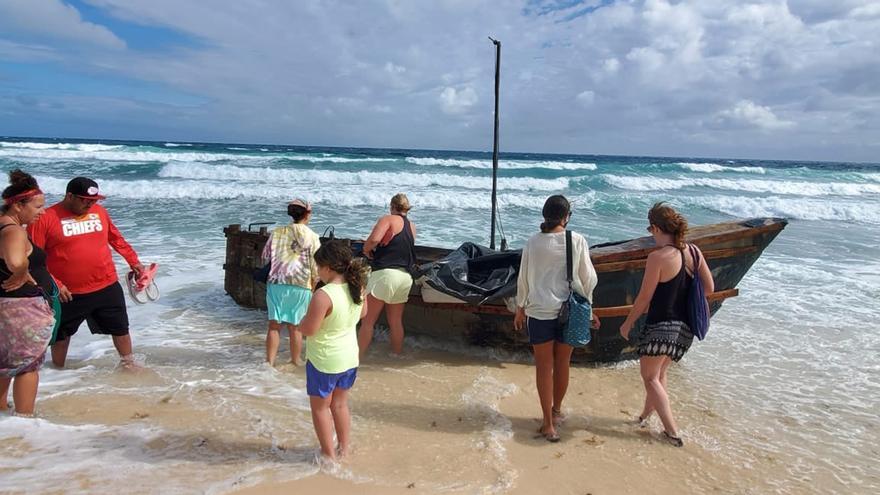
Photo of the boat abandoned on the beach known as The Secret, on the Mayan Riviera. (Facebook/Quintana Roo Panorama)

14ymedio bigger14ymedio, Ángel Salinas, Mexico, 16 February 2022  — Authorities from the states of Yucatán and Quintana Roo were advised by the National Migration Institute (NMI) of the arrival of Cuban balseros [rafters] to the Mexican Caribbean. Last Wednesday, a boat was abandoned on the beach known as “The Secret” on the Mayan Riviera.

The Secret beach is 30 miles south of Cancún, so the “crew had to have help leaving the place in vehicles,” Raúl Tassinari, the police chief, told 14ymedio. “They had adapted a car engine, and we even found containers of gasoline and clothing.”

The discovery of the arrival took place the same day that representatives of the National Migration Institute (NMI) had a meeting with personnel from the Cuban Consulate in Cancún, in which they talked about cooperation and coordination in respect to migratory matters. Tassarini reported that in February alone they had reports of three events related to Cuban rafters.

“The Navy was informed of the vessel so that it could be secured, and the port captain and Immigration were also notified,” emphasizes  the officer, who doesn’t rule out the deployment in the coming days of elements of the National Guard and the Army to stop the entry of migrants through Quintana Roo.

According to figures from the NMI, the state of Quintana Roo has become a route for the illegal entry of Cubans in recent years. Between October and December 2021, 29 rafters who arrived at Isla Mujeres were detained. Of 60 Cubans detained in that same year, 45 were deported and 15 received legal advice to obtain refuge. continue reading

The boat used by Cuban rafters is found abandoned on the eastern coast of the island area of Isla Mujeres and serves as a tourist attraction.

On February 12, another boat was abandoned on the eastern coast of the island area of Isla Mujeres, at the height of the Colegio de Bachilleres. The state police confirmed to this newspaper that the migrants “got into a truck, so the surveillance cameras are already being checked.” The island’s natives left medicines, 200-liter drums, canned food in bags, as well as men’s and women’s clothing on the raft.

Ten days earlier, personnel assigned to the Fifth Naval Region rescued seven Cuban rafters, who were shipwrecked 43 nautical miles northeast of Isla Contoy. The migrants were transferred to the Puerto Juárez naval station. A Migration source indicates that this group would be deported.

Last January, members of the Navy in the city of Cancún detained seven Cubans on the boulevard near the Plaza Kukulcán shopping center, after the undocumented immigrants were captured by the video surveillance cameras of the C5 Security Complex. The alert of the arrival of rafters was also extended to the state of Yucatan, confirmed the Mayan Riviera official.

Collaborate with our work:   The 14ymedio team is committed to doing serious journalism that reflects the profound reality of Cuba. Thank you for joining us on this long road. We invite you to continue supporting us, but this time by becoming a member of our newspaper. Together we can continue transforming journalism in Cuba.

Translated by Regina Anavy

____________

COLLABORATE WITH OUR WORK: The 14ymedio team is committed to practicing serious journalism that reflects Cuba’s reality in all its depth. Thank you for joining us on this long journey. We invite you to continue supporting us by becoming a member of 14ymedio now. Together we can continue transforming journalism in Cuba.