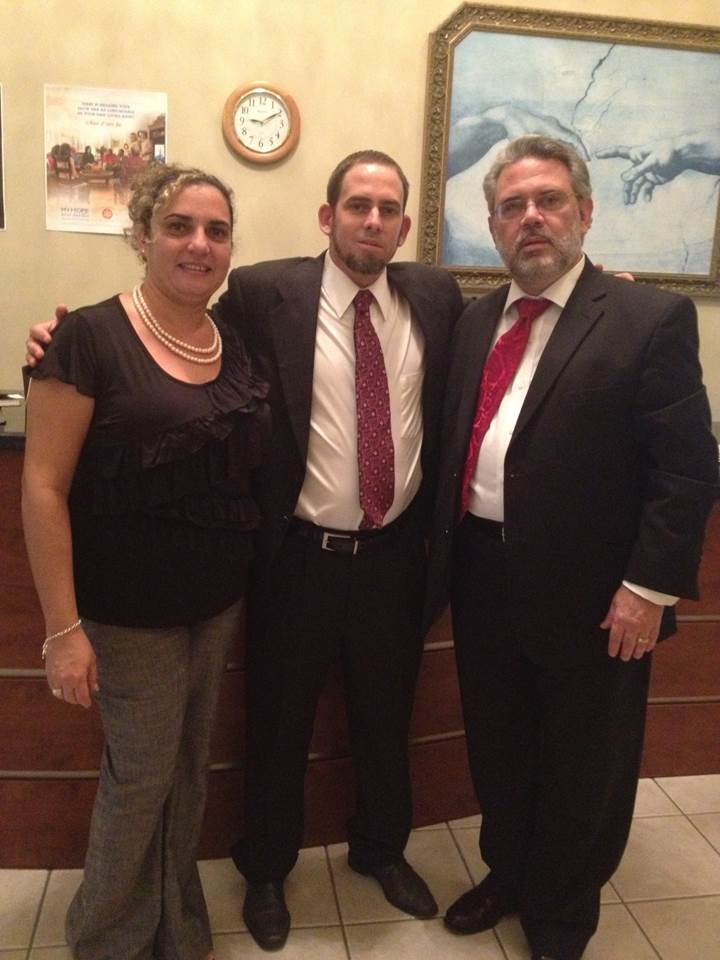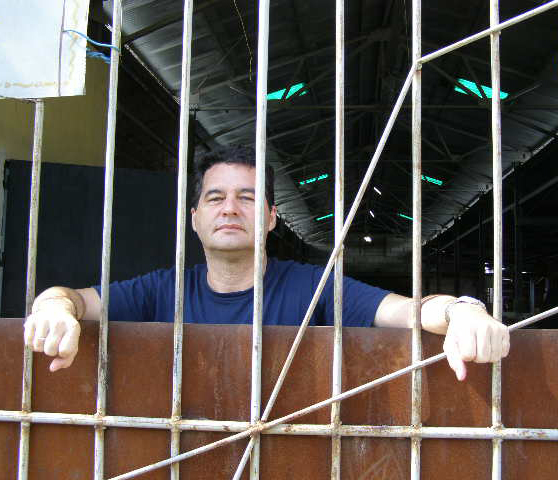
Through Havana with Laura / Tania Diaz Castro

Laura is a Cuban woman who has lived in Spain for more than twenty years. She speaks like a Spaniard. She looks like a Spaniard. Her husband, children and grandchildren are Spaniards. But in spite of the passage of time and the distance separating us, she still considers me her best friend. Or so she tells me.

She is a little older than me, though we are both elderly. Nevertheless, we began planning a trip to Havana.

“Like old times,” she told me.

“Like old times,” I said.

Because those times remain in our memory and form part of our experience. The adventure of visiting Havana — that beloved city of ours that continues to struggle for survival in spite of the neglect and apathy brought on by half a century of socialism — is something I just have to tell you about.

We got into an almendrón, a taxi fashioned out of one of those old 1950s American cars, in Séptima de Santa Fe, a coastal town outside of Havana. We asked the driver to drop us off at Galiano and Zanja streets, located in the very heart of the Cuban capital.

What we saw would impress anyone. At the intersection of these two streets is El Curita Park, named in honor of Sergio González, who today is considered a pillar of the “July 26th Movement.” In March 1958 he was shot to death by Batista’s police for having committed numerous terrorist acts.

Though it was during working hours, we counted several hundred young people of both sexes in the park and its surroundings. They were standing or sitting on its low walls, or leaning on cars, engaging in an odd way of wasting time, or worse. They were fishing for pesos. The commotion spoke all too clearly about the lack of employment opportunites from which our society suffers.

“What do they sell?” I asked an old vagabond who extended his hand to us, asking us for monetary help.

“Anything, ladies,” he said to us:  sex, drugs, jewelry.  Whatever you need.  But be careful.  If you deal with one of them, you will be lost in a heartbeat before the eyes of whoever, through the mysterious stairs of this neighborhood.

We entered an old family restaurant that in previous years I had visited on Aguila and Dragones, inside a small dwelling, without natural light or air, but where they served, for only 30 Cuban pesos, a little more than a dollar, a magnificent creole meal composed of black beans, well roasted pork meat, white rice and a typical dessert.

My friend Laura seemed horrified by the place and we left.

“Let’s enjoy a good Spanish meal,” she said.

And a bike-cab took us through the famous Prado, while its driver told us that in the back of all those wide gates, which seemed in good shape, there were as many uninhabitable tenements as in any slum neighborhood of the city and that the water was in such short supply that many bathed in the dirty waters of the Malecon, in spite of the danger that this represented.

On the Malecon, between Genio and Crespo, the driver stopped and we entered the restaurant of the Castropol Asturian Society, founded in Cuba in 1929.

My old friend was right. A good meal is better enjoyed in a comfortable and agreeable place. There we enjoyed some delicious chickpea fritters which I recommend to my Cubanet readers.

Tania Diaz Castro

Cubanet, November 8, 2013

Translated by mlk

Kokuba / Regina Coyula

Image from ElPais.com

Kakebo notebooks. Image from El Pais.com

The kakebo comes from Japan and is a hybrid between a calendar and an accounts book.  It is said that Tomoko Hina, the first Japanese woman journalist, was the one who at the beginning of the 20th century developed the first kakebo in order to arrange and record household expenditures.  Housewives adopted it in order to organize the family economy and optimally administer resources.  Now its application has extended and there are kakebos of all kinds and all varieties and models, for big families to singles.  And for the first time here the year 2014 will feature Kakebo, book of accounts for household savings, published by Blackie Books (17.9 Euros).

With this news*, I eat breakfast with which, for years, my family’s economy has passed through a Kakebo.  A school notebook with the grid paper that they hand out freely, have been our expense control.  The page, divided in the middle to reflect the Cuban pesos on one side and the convertibles on the other.  Before, we had tried to manage our accounts by dividing our money into four parts corresponding to the money for the month destined for food each week, only to invariably violate the envelopes before the immediacy of an unexpected expense.

We resigned ourselves then to record expenses until the day on which we open the drawer and now there is no money; for a brief stage, with variable success, pockets, wallets and old ashtrays are checked, today often earmarked. Now it is known that it is time to eat the pseudo-bread of the notebook, I cannot buy coffee and the oil must be stretched.  Extravagances like beer, beef (including hash), or butter, a short while ago became harmful options, and not precisely to one’s health.  Must-have luxuries?  Coffee and hair dye.  That of bars, tobacco and meals out is a misplaced concern.

I’m dying to know what kind of welcome the sale of these Japanese philosophy notebooks will have in Spain.  I don’t know about the rest, but I can’t get it out of my head that whoever has to keep accounts, does not spend eighteen Euros on some other consumer object. For my part, I am about to abandon the daily notes, because I have arrived at the conclusion that everything has come to everyone in Cuba: on the topic of expenses and income, this film is backwards.

*Translator’s note: The link is to an article in El Pais about Kakebo notebooks

Translated by mlk

6 November 2013

The Welcome of Our Brothers in the USA / Mario Lleonart

US churches and ministeries plus the media and secular institutions are giving us a warm welcome.

Tomorrow at 9 am we will participate in the special service dedicated to the Protestant Reform Day that will be celebrated at 9 am in the Lutheran Church “Prince of Peace” (6375 West Flager Street, Miami, FL 33144).  We were invited by its pastor Lenier Gallardo; we listened to him from Cuba for many years preaching a liberating gospel through the program “Yesterday, Today and Always” or through his famous sermons of seven words each Holy Friday, through WQBA.  In this special service the sermon will be provided by the Baptist pastor, also a prolific writer, journalist and historian, Marcos Antonio Ramos, and with whom we already had the honor of sharing at Miami Dade College.

Then at 11 am we wiil have the responsibility of preaching in the New Jerusalem Baptist Church at 760 SE 8 St in Hialeah, invited by its pastor Luis Estevez.  We already did it at Adonai and Mi Ebenezer, invited by its pastor Moises Robaina; at Estrella de Belen, invited by its pastor Javier Sotolongo; at Bethel, invited by its pastor Gerardo Garcia and at Nazaret, invited by its pastor Noel Perez.

We have also been invited to the Baptist program of Multicultural Radio (UNAVISION RADIO), to several programs of the services of “Onward” by 1450 AM; and to the program of Life (1080 AM) and Radio Luz by 1360 AM, this last can be heard perfectly in Cuba, and we had the unforgettable opportunity of being heard by our brothers there.

To top it off, pastor Javier Sotolongo gave us the opportunity to exercise a professorship in the Miami Bible College that he directs.  The live transmission of his church services permitted us to reach with our preaching many around the world, including those who had the privileged and very exclusive possibility of accessing from Cuba.

We are receiving invitations to go share with churches and ministries in other cities and states like Tampa, Atlanta, Dallas, North Carolina, New York, New Jersey and Indiana.  We were already in Washington DC where one of our most important stops occurred: the visit to the headquarters of the World Baptist Alliance where we were received by the unforgettable brother Raimundo Barreto who directs the Commission of Justice and Liberty there; in Oklahoma where we met courageous brothers, typical inhabitants of the not coincidentally named Bible Belt of the United States. We thank God for offering us the excellent opportunity of also proclaiming his Word on this shore where we also have found so much of Cuba present.

Translated by mlk.

26 October 2013

“I Am a Prisoner Because of a Tantrum by Raul Castro” / Juan Carlos Linares, Angel Santiesteban

Havana, Cuba, October, www.cubanet.org — Without any doubt, the prosecutor at the oral hearing clung to the least of the supposed crimes, “Housebreaking and Injuries,” being proved by the very “witness” who lied.  The farce of a trial was a settling of scores for Santiesteban because of his opposition to totalitarianism, and so he was made to know by the political police officer, named Camilo, a month before he learned the sentence of the Tribunal of Room 1ra. of the State Security, in his special headquarters in Carmen and Juan Delgado: Five years in jail.

How do you describe your transition from famous person of Culture to dissident?

I have always expressed the desire to count on a little corner of the least important newspaper, on the last page, to communicate my views there, wrong or not, as any mortal.  On a trip to the Dominican Republic, the last I could take abroad, the writer and brother Camilo Venegas showed me something that he called a blog, unknown to me, and that affected me. I returned to Cuba with a fire inside, a flame that grew to upset my view of what surrounded me and worried my contemporaries. Trying to be a voice. From that moment, they began to create my dissident and then criminal file.

They applied the most extreme accusations to me, like running over a child in the street with my car and fleeing, attempted murder, armed robbery, wife beater, even rape, and other stupidities that would make you laughter if they had to do with a fictional comedy and not the real life of a man, and by which I am now a captive.

Who did they use against you?

An ex-wife from whom I was separated for more than two and a half years.  She was angry about multiple situations about which I do not scoff.  I have never said this because it embarrasses me.  And I did not expose it at the trial because it intruded on minors.  Today they are adolescents.  My ex knew about my daughter, 32 days younger than our son. Add to that that I never agreed to marry her.  Later I began a relationship with a talented, beautiful, popular actress, which increased her rancor.

My ex spoke horrors to our son of my new partner, even without there having been a simple dialogue between them, and she still hates her. It happened also that at that time my ex was having a relationship with Mayor Pablo, chief of the chiefs of Playa Municipality Sectors, and that’s where they brought him in. I do not know who manipulated whom, or if both parties did it, but they had grudges against me, that is to say, my ex and State Security.

I do know that they employed the instructor, Captain Amauri, who falsified and hid proof in the preparation of my file. I accused him before his superiors in a letter, calling him an illiterate liar. He was expelled from the PNR (police) for bribery, and although he worked my file, they decided not to present it at my trial.  Maybe one day he will tell the truth about what happened.  I trust that time will bring the truth to light, even if making excuses that he was following orders.

How deeply do you feel the damage that they have done to you?

My journey towards opponent has taken me away from literary media, and of course, driven away colleagues that I used to consider “friends,” leaving only a few: enough. I like to think that each one of those few true friends for me are worth more than the whole group of cowards that fled. All that cultural marginality that they have fabricated around me gives me immense pride.

I have passed through punishment cells, and if thinking differently brings this punishment, I believe that I am in the proper place for me.  At least now I feel far from all pretense.  Really my crime was writing an open letter to Raul Castro, challenging him to free Antonio Rodiles, and some days before, the demonstration that we carried out in front of the police station on Acosta Avenue. Those events were the triggers for my incarceration. I am a prisoner because of Raul Castro’s tantrum, of that I have no doubt. I call it a tantrum to make a decision that does more damage than good, to persist in satisfying his ire. You have to be sick with power to carry out the violations that historically the Castro brothers have to hit out against those who have opposed them.

What do you remember about the trial?

A handwriting expert, Lieutenant Colonel, made me copy nothing less than fragments of an economics article in the Granma newspaper.  According to them, by the heights of my letters and the slant, I am guilty.  It sounds like a joke, but it is real.  My lawyer argued that the handwriting proof is not defining.  It is not accepted internationally.  It is a pseudoscience.  The expert insisted that it is a science, which dates to the 17th century, and that it was defining. My lawyer, young, cited several handwriting specialists, whom she did not know, according to what was argued in the trial.  They are on the internet and their literature is found in Havana, which she also did not know. It was evident that she had gone there without preparation, only to follow an order of the State Security. They refused my five witnesses, and did not admit the arguments of manipulation. They imposed a five year sanction on me which was not for the crime that they imputed to me.

How much benefit will you extract from prison as a writer?

It has been a great experience. I try to get the best and greatest benefit. Surrounded by killers, drug traffickers, thieves. I have the best relationships with them. I take advantage by writing and finishing some literary projects.  I finished the novel The Summer that God Slept. I sent it to the Frank Kafka Novels from the Drawer Contest in the Czech Republic, and I received the news that I had won the award. Tremendous happiness!

The book relates the agony of a group of boat people who escape on a raft, the vicissitudes of the sea, picked up by a boat that takes them to Guantanamo Naval Base, life in the camp, the indisciplines, the corrections, the internal problems that emerge, until they decide to return to Cuban territory crossing the mined country that is in the zone.  It has a lot of testimony.

To be in a less rigorous prison setting and to give you a pass, that you received recently, will that be a form of ceding by the government?

To the contrary. I believe that they distanced me from the jail conflicts that I constantly denounced in the prior jails through which I passed. I got involved in inmates’ situations and defended them. For my punishment, I’ve been assigned to the “minimum” incarceration regimen, that is to say, less danger, from what I can tell, by regulation, to be in camp and not in maximum security prison.  Sending me to prison 1580 was a violation of their own laws.

In the camp one leaves with a pass every sixty days.  In seven months here, I should have left many more times, but State Security did not want it.  Here, where I am, the inmates go out every 27 days, but as I do not work or collaborate on re-education, they do not permit me to leave monthly.

On the other hand, I have always had positions in Freemasonry, the latest was at a national level, and I had to dedicate a lot of time; also, the free thinking project of Estado de Sats… I gave that space all the time necessary because it seems to me a laudable and tangible purpose for the political change that Cuba needs.  So once a prisoner, I told myself: Get to work!

Juan Carlos Linares

Translated by mlk

Cubanet, 25 October 2013
Western Pumpkins / Rosa Maria Rodriguez

I am not going to tackle an everyday plot related to the cinemagraphic or literary genre that became one of the cardinal points of the United States, but that historic company that offers financial and commercial services, Western Union.

Until sometime more than three months ago, if some friend or relative abroad advised by phone that he was planning to send “a little help” by that means to a Cuban inside, those here had the possibility of calling one of the offices of Western and giving his name or that of the sender in order to see if the deposit was already posted and to go and cash it. Since the beginning of July you have to have the transfer number to receive the money, and if not they “give you pumpkins” — that is, they dismiss you — by telephone or personally, although you have the documents and identification that prove that you are the beneficiary.

I’m bothered by the suspicion that that measure is the result of joint management of those that work at the Western Union offices in the Cuban capital — almost always a female — because all those I know are embedded in dollarized businesses and “it is established” that the employees of those offices work simultaneously in the store.  As is natural, it is more stimulating for them and economically convenient for those of Western Union to work with those who are going to spend at the store, than with those who come to their offices to get cash and who know through their relatives how much it cost them to send the shipment.

Some days ago I went to the Casino Deportive internet navigation room or “cyber-without-cafe” in order to send an email and there I found myself with an old woman who asked me for help.  Information technology has still not reached her understanding and her arthritic fingers and she did not know how to create an email account so that her daughter who lives abroad and financially subsidizes her can send her the transfer number.  I wrote her user name and password on a piece of paper for her and she left very grateful, but it left me with doubt whether the next time she will find someone else prepared to leave aside their communication management in order to help her computationally.

What will the old people, whose relatives are accustomed to sending them a regular remittance from abroad, do now?  (In socialist and contemporary Cuba saying “remittance from abroad” is almost a redundancy).  Without doubt, the benefactor will have to call, with the consequent telephone charge in order to give the number of the financial transaction so that the favored one might receive it.  And what about the old people that suffer advanced cataracts, glaucoma, Parkinson’s disease or some other degenerative illness that impedes them from doing it?  And the visually impaired?  With so few computers with internet access in Cuba, that measure against a part of the population is such a great abuse that it verges on contempt.

It seems that when the money already makes up part of the government’s coffers, no one worries about the fate that befalls its intended recipients, if it is in the only hands that really interest the Cuban state: its own.

Translated by mlk

30 October 2013

Remnants to the Wind / Rosa Maria Rodriguez

I found the body of a dead dog like a decal on the floor of the intersection of the streets Amado and Goss, in Vibora, and twenty meters closer to Mayia Rodriguez, a bird also laminated in the asphalt.  That image filled my retina in the block of the Monaco market.

So daily deteriorates the hygiene in any Havana neighborhood for ordinary Cubans. There where the animal died — it does not matter if run over by a car or illness — his entrails were left in the sun for the decay to infect the environs and pollute the olfactory space of the passersby.

What’s worse is the level of contamination to which those who habitually pass through there — among them many children — are exposed and the possible breeding ground for transmission of sicknesses and the risk of contagion for other vagabond dogs and hungry scavenging animals that poke at or feed on the hound’s remains.

Cuba has become — also — a dump or open cemetery for unburied animals and it seems to matter to no one.  These kinds of situations should not happen, but now that they do, to whom to write or direct oneself?  It is possible that we get a faceless, nameless replica of an entity and although you have it, it does not fill the void of decades of helplessness, indolence and filth.

The most regrettable thing is that the answers almost always remain on paper, in the article and personal interest of a journalist, in a public complaint and nothing more.  When will we overcome the stage of explanations and confront problems with facts and concrete solutions?

The remedy would not be — as the authorities are accustomed to doing — to create more entities to attend to social matters and needs accumulated for decades, but they should de-bureaucratize the agencies or firms and give them the resources and powers to quickly and satisfactorily solve these kinds of issues that confront the people and that the State does not solve.

I would like to see the surroundings of the residences, markets and commercial centers that the head honchos, their relatives, their friends and high military chiefs frequent.  I wonder if there are stray dogs in those areas.  Possibly not, to avoid fecal waste, disagreeable odors and the running over of one of those animals.  But if something were to go astray, have an accident or perish in one of those places, surely it would be duly and diligently “transferred” in order to receive “rapid” burial or cremation.

Logic works expeditiously for sectors from “above” like a horizontal and vertical elevator which, although it seems to be, is not stuck but really designed not to go further down from a certain level.

Translated by mlk

29 October 2013

To Have or Not To Have a Car / Fernando Damaso

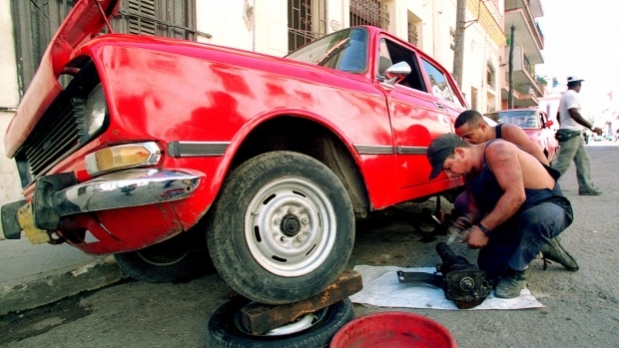
Above: Two men repair a car from the former USSR.

In any country, the acquisition of a car, whether new or used, usually represents a reason for the new owner’s satisfaction.  In Cuba, if acquiring a vehicle demands overcoming numerous obstacles, keeping it functioning requires overcoming many more.

In the first place, new cars can only be gotten if the State grants the right, generally to functionaries of political and governmental agencies, armed forces officers, some professionals (above all from the health sector after completing missions abroad), artists (mainly musicians), some intellectuals and high performance athletes with relevant results in international events.  In all cases, demonstrated loyalty to governmental ideology and politics is an indispensable requisite.

In the second place, the decree that authorizes the purchase and sale of vehicles between citizens — something that was already done in an illegal manner — refers only to those in use for several years.  We are talking about those that have traveled our deteriorated roads and avenues for a long time: vehicles from the ’40s and ’50s, the first known as “almendrones” (from the word for “almond”) mostly of American make, some German and Italian, and the ones built in the formerly socialist camp, largely the extinct Soviet Union and Poland.  In recent years, although in reduced quantities, vehicles from Japan, South Korea, Germany, Brazil and lastly China have been added.

The owner of a vehicle must confront various problems, one of the most important being the acquisition of fuel: he must pay 1.20 CUC in convertible pesos for each liter for regular gasoline and 1.40 CUC for higher octane.  This represents, in the first case, two days’ salary in national currency (29 Cuban pesos, or CUP), and in the second, more than two days’ (33 CUP), based on an average monthly salary of 440 CUP.

The next problem refers to the oils and lubricants, missing in the garages that offer scrubbing and lubricating service in national currency, requiring the car owner to get them in CUC, at elevated prices, in the convertible pesos garages, or in CUC or CUP at a lower price on the black market.

Nevertheless, these problems are trifles compared to those involved in confronting repairs and the acquisition of replacement parts, tires and batteries.  The majority of state mechanic shops disappeared, and individuals not yet authorized, the repairs must be resolved with private mechanics, who are able to work on state premises devoid of equipment (by arrangement with the appropriate administrator), at his home, at that of the car owner, using his own tools and, sometimes, even those of the client.

The prices, as is to be expected, are arranged directly between the mechanic and the car owner, usually being elevated, as much in CUC as in CUP.  The main replacement parts, almost always missing from the state stores, must be gotten on the black market.  Customarily, near the state stores, the presence of the citizens equipped with cell phones that, before any solicitation, immediately locate the searched-for piece or accessory.

In the state stores, depending on the type of vehicle, a tire may cost between 89 and 155 CUC (five or eight months’ average salary) and a battery between 90 and 175 CUC (the average salary of almost five to nine months).  On the black market tires can be acquired for 60-80 CUC and batteries for 90-110.

It seems, although it may not be the intention, that the State, with its elevated sale prices for citizens, stimulates the the existence of the illegality, especially when all or most of these items come from the “misappropriation of resources” and theft from the state stores and warehouses.

And best not to address the issue of sheet metal and paint, because these services, more than the cost of the materials (sheet metal, acetylene, welder, paints, thinners, etc) reach astronomical figures, on the order of hundreds of CUC.

The decision about having or not having a car in Cuba demands a lot of reflection: although it resolves a problem of scarce public transportation and represents freedom of movement, it constitutes too heavy a burden for any pocket and the psyche of the happy (?) owner.

From Diario de Cuba.

23 October 2013

Translated by mlk

Three Cuban Women Under the Boots of Crime / Luis Felipe Rojas

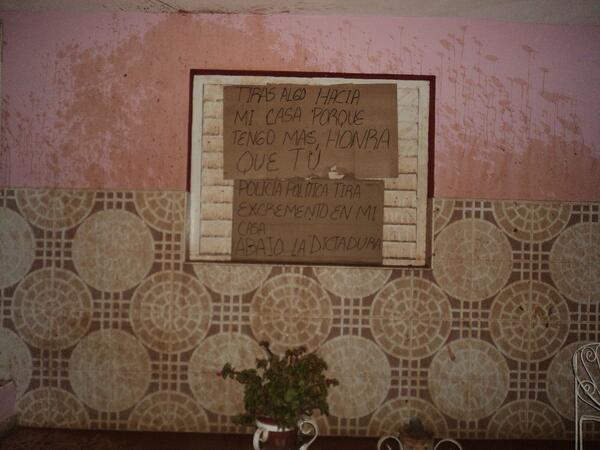
Signs: Throw something at my house because I have more honor than you. Political officer throws excrement at my house under the dictatorship
This appeared on the house of Caridad Burunate after being pelted with eggs by a mob.

“On October 4, they had me in a choke hold, it was the Special Brigade.  There were men, I was talking to one of the big men, they took me to the door of the house, inside the house.  They came with their uniforms.  Some men dressed in overalls painted the house in asphalt, five times they have done it, without taking into account that there are minors here,” that is the testimony of Damaris Moya Portieles, President of the Central Opposition Coalition, resident of Santa Clara.

Violence against women, dressed in white or not; with or without gladioli in hand has become recurrent all over the island.  It has to do not only with the hate sessions like the Acts of Repudiation, the physical mistreatment and the torture are “a piece of cake” in the containment measures against the opposition.  Damaris herself relates:  ”Some months ago I was admitted into the Arnaldo Milian Castro hospital, the result of a beating that the State Security officers dealt me,” she says, and offers the name of the oppressors:  ”Yuniel Monteagudo Reina, Erik Francis Aquino Yera and Ayor vigil Alvares, plus Pablo Echemendia Pineda,” she concludes.

Fourteen Sundays Under Rocks and Words

She is a hardworking woman and always likes to prepare the best dishes for her family; one day she decided to do it for the poor.  Caridad Burunate hosts each week in her home some twenty elderly and destitute people to give them a little ration of food.  She does it under the project “Capitan Tondique,” and the name of the anti-Castro guerrilla fighter has cost Burunate, in Colon, Matanzas, the well-known acts of repudiation, beatings, arrests and the painting of her house black.

“The mobs prepare, they are criminals, and they cuff us, fight us.  Even prisoners have been brought from the Aguica prison, because they tell them that they are going to give them passes, they even kick us.  When we arrive at my house from the walks (every Sunday with the Women in White), they wait for us with bags of rocks, eggs, they even painted my house because they wrote, “Long live Fidel, Long live the Revolution” and I wrote to them on top of that:  ”Down with the Revolution” and “Down with Fidel.”

The president of the People’s Power, Dignora Zenea Sotolongo, brought a jeep full of eggs, which are non-existent, people do not have them to eat, and they threw them at my house; and of course, she has almost all her family in Miami.  This house they bathed in eggs and asphalt.  They give eggs to children for them to throw.  I made myself an opponent because we have no rights, and because I have always enjoyed expressing what I feel, I did not do it just for myself, but also to help others,” she concludes.

A Violent Beginning

Tania Oliva Chacon resides in Palma Soriano, Santiago de Cuba.  She received the first beating “in March of this year,” when she joined the Ladies in White.  ”On October 10 I found myself at a friend’s house and we were about to watch the class they broadcast on TV every day, but the house was surrounded since early morning, and when we were about to sing the national anthem, they threw themselves on us like beasts, like animals.

They knocked me down with a kick to the leg, and injured me.  They immobilized me for 21 days, but I had no way to heal.  The one who kicked me is Captain Arsenio, the chief of the sector Police.  One of my companions was badly hurt, they got him in the ribs and he is still in a very bad way.  On many occasions they come dressed as special troops in order to impress us.  I was in my last year of studies for a Bachelor’s in History, but as I began to demonstrate and to tell about the thefts that were happening, then I “fell ill” and could not finish.  My son has graduated and has not been able to get a job,” she said.

Translated by mlk.

21 October 2013

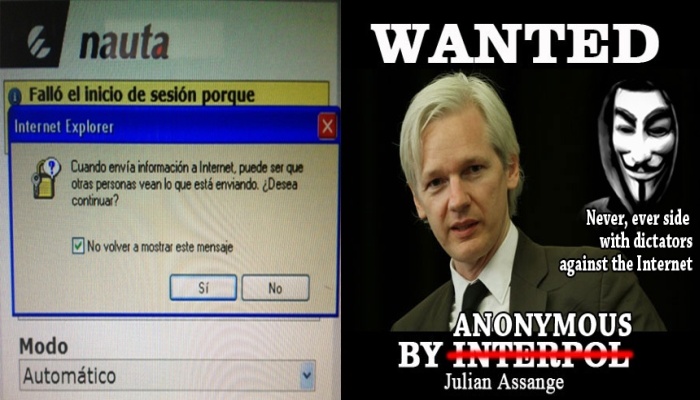
A Cyber Cafe in Cuba? No chance.

Illustration: photomontage The Singularity of the Island.

Under the heading “Protect Internet Cafes in Cuba. Julian Assange Bungles It,” the website  http://www.lasingularidad.com offers good advice for Cuban citizens and digital non-conformists wanting to get around censorship restrictions.

Every time that I receive questions from activists in Cuba about the internet browser rooms, I never tire of repeating the phrase “Begone, Satan”, “Good riddance”, “Take them winter wind”, or any other interjection I can think of at that moment to make it clear that they should run as though from the devil himself. Like moths to a flame, they are designed to attract the unwary, who are bedazzled by its radiance.

The Cuban regime took its time designing these “booby traps” and — in what it considers a masterful sleight-of-hand — is attempting to make itself look good in the eyes of the modern world, which increasingly considers internet access to be a basic human right.

In fact, it has already reaped some rewards this week by successfully recruiting a “figure” of no less international stature than Julian Assange to proselytize politically on behalf of the Cuban regime. This is a completely surreal and incomprehensible development since, supposedly, the hacker’s code of ethics mandates fighting for free access to information.

His support for one of the world’s most repressive communist dictatorships — one known for restricting access to the free flow of ideas on the internet — is a senseless action that will very probably cause Assange to lose face in the eyes of the hackers who support him. Will Assange turn out to be one of those typical useful, misinformed fools or an opportunist looking for free vacations in the Caribbean? Whatever the answer, the betrayal of the ideals of hackers like Anonymous will not go unnoticed.

Why is Nauta a trap?

1 – Price censorship.

The cost of one hour of access to the internet in these rooms is 4.50 CUC, some $5 US if we convert it. Considering that the average salary in CUCs is approximately $20 per month, we can calculate that one hour of internet use costs Cubans close to 25% of their monthly salary. In a country where the salary is barely enough for one or two weeks’ worth of food, very few can afford to visit these rooms. By way of comparison, if in the United States or Europe one hour of internet cost more than $1,300, social network sites like Facebook would be very bleak places…

2 – Total lack of security, privacy and basic functionality.

To be able to buy a Nauta card, users have to display their identity cards. Their names, addresses and surnames, together with the identification code of the cards sold, are registered in a database. In this same database all their activity is stored: the sites they visit, passwords they enter, screen captures and general captures of all that they type (keyloggers).

The computers available are in fact thin clients* running a modified and highly restricted version of Windows Xp, an operating system so antiquated that it will soon be discontinued by Microsoft, which will no longer issue updates for it.

Short Restrictions:

It is not permitted to right click with the mouse. This reduces functionality for those who are used to cutting and pasting text using menus and eliminates all the information that right clicking in Windows provides. Hint: You can use the keyboard shortcuts ctrl+C to copy, ctrl+X to cut and ctrl+V to paste.

It is not permitted to run any programme from USB memory sticks.

It is not permitted to run any programme from command lines (CMD.exe).

Task Manager is disabled, the Ctrl + Alt + Del and don’t even dream of administrator access in order to install some program that you may need.

Overcoming Nauta

The number one rule is : If you can avoid it, DO NOT USE IT. In Cuba, there are many other alternatives: Access from work centers, much less restrictive network dial-up access, illegal accounts shared by foreigners, friends who can send your emails as a favor, and of course access to offline internet content like the Web Packets Weekly Mulitmedia Packets that reign across the island.

If you have no other option you can protect yourself using these simple tips:

1.  Use disposable email accounts, ask your contacts to do the same if possible. The value of your messages lies not only in their contents but also in those to whom they are directed and from whom and from where you receive them (Metadata).  Never use your name or personal information to create an email account or to search websites on the Internet.  If you use false data and a fake name it will be much more difficult for government analysts or their spy programs to determine if your mail or user profile is worth the effort of analyzing.  These spy programs are used by almost all governments, including the United States and, of course, Cuba.

2.  Mask “complicated” words in your messages by using spaces, repeated letters and punctuation signs at random.  This will prevent automated software or analysts that search for key words from being able to flag your messages or profile as being of interest for analysis.  For example, instead of writing “the dissidents screamed liberty at the demonstration” write “the di. Si-dde :ntes shouted lib. ee.r t y in the demi. str *ati-on”  A text search for the words “dissident” and “demonstration” will not detect your messages.  Government agencies in other countries like the C-I. A and the N-S. A will not appreciate this advice, either.:)

3.  Mask your messages by excess information.  For example, began your email with several paragraphs of weighty poems and by prior agreement let your recipient know in which paragraph will be the true message.  The poor analyst that has to read your email will simply go to the next when he sees your long poem. The idea is to make his work difficult all the time.  Remember to mask words as explained above.

4.  Be aware that everything that you type and capture on-screen is being recorded on your user profile.  If you are forced to use a personal password, mask it with random fillers that you will then remove with the mouse and the Delete key. For example, if your password is “freecuba123,” write “iwantfreecub123456.”  Then select “iwant” and “456″ with your mouse and hit delete.  This is not 100% safe with advanced keyloggers but it will make it hard for the analyst who is watching your information to discover which is the true password.  There exists no completely secure protection in the world of information nor in the real one.  It is like protecting your home:  the more difficult you make it for the thief, the less likely your house will be the one in the neighborhood that gets hit.

5.  Use PHP proxies for accessing web pages whose navigation is censored and that you do not want to be kept in your navigation history.  Write on Google:  ”php proxy list” to access web pages that keep lists of proxies that constantly change in order to prevent them from being blocked.  These proxies will permit you to navigate as if your were in another country and will hide the website addresses that you visit.  Nevertheless, remember that your screen is being recorded and if you do something that calls attention they might check your user profile.

6.  Https is your friend.  Always prefer web pages in which the URL or address begins with https.  This means that all traffic between your navigator and the web page server is automatically encrypted in a secure way, hence the letter “s.” However, remember that what you type is being recorded so you cannot stop using the tricks listed above or better still, if you can avoid it, do not enter your search information on any page from Nauta.

If you have other ideas and suggestions for the protection of privacy and security of users in browser rooms in Cuba, write them in the comments below.

Archived in Cuba

*Translator’s note: Computers or computer programmes which depend heavily on other computers (their servers) to fulfill their computational roles.

Translated by Shane J. Cassidy, mlk

30 September 2013

No Remedies, Political Changes / Martha Beatriz Roque Cabello

HAVANA, Cuba, October, www.cubanet.org — Raul Castro has repeated constantly that errors are the greatest enemy of the Revolution, those that have been committed and new ones that may be committed.  Nevertheless, he does not speak of the political changes necessary for correcting those errors, since the so-called reforms are not enough, particularly because of how slowly they advance.

Such “reforms” have been good only for the discourse abroad, but within the country they have negative results, from the social and economic point of view. Income inequalities are more noticeable, and today begging is significantly increased.  The small role they have given to the private sector does nothing to confront the grave crisis.

Economic reforms require political changes.  And although modifying the Constitution of the Republic has been spoken of superficially, the fact that the communist party is the superior directing force of society and the State perpetuates the lack of liberties, installing the government as all-powerful so that it does not worry about the people’s problems.

Although the regime maintains a policy of centralization of the means of production, it could think about speeding up some services.  Nevertheless, we are already seeing symptoms of the Nicaraguan style of “piñata.”  And as is natural, the beneficiaries are the high officials of the army and of the ministry of the interior.  The possibility of creating non-agricultural cooperatives is accompanied by this characteristic syndrome of regimes in decline.

Those who think that the current situation will end with solutions like the Mariel Special Development Zone are wrong. Modifying or updating the economic model is talked about, but you cannot modify something that does not exist.  If they tried to copy what is permitted in China and Vietnam, they fell short, and the legislation is very far below what should have been allowed.

The Legal Decree that establishes the Special Development Zone shows that the regime knows that a profound change towards a market economy is necessary. Among the objectives it pursues are attracting foreign investment and creating a logistical system that permits high levels of efficiency in the import, export and distribution processes.  Both areas behave inefficiently within the Cuban economy.

They may keep taking mediocre measures (including those who propose that they legalize lottery gambling, as in the early years when the National Institute of Saving and Housing existed and one could buy lottery bonds), but that will only contribute to delaying the true change by some years.  Sooner rather than later, the situation of increasing poverty, the enrichment of a few, and the “piñata” that now is distributed among those at the top, will defeat the worn out “construction of socialism.”

A good recommendation would be to stop the suffering of the people and affect true political, economic and social reform.  As a first step, they should free the political prisoners and stop the harassment and beatings of dissidents, while leaving aside the false discourse that calls for strengthening national unity around the Party and the Revolution, because without doubt the regime knows that, although they continue prohibiting it, in Cuba there now exists broad ideological diversity.

Martha Beatriz Roque Cabello

From Cubanet, 10 October 2013

Translated by mlk

As Much in Cuba as in Spain

The letter by friends from Spain is a cruel reminder that when it comes to confronting the government, repression can happen anywhere.  One of their sons was detained at a demonstration of the CNT and accused of assaulting a police officer.  Although in this time of smart phones there exists documented proof that it was the police who assaulted the young man while he hoisted a banner, he has to confront a trial where he could be sentenced to up to seven years in jail.  The illegality is so flagrant that Amnesty International has taken an interest in the case.  I am no philosopher or political scientist, my knowledge of economics is precarious, in times past I thought that culture could save us, but also that is an illusion.  It is justice, with eyes blindfolded and a true balance, that they should erect over governments and ideologies to protect any citizen.

Translated by mlk

11 October 2013

Why Don’t Cubans Want to Have Kids? / Ivan Garcia

1-MATERNIDAD-620x330In its official discourse, the government suggests with pride that Cubans have gone from being housewives to being academics with ambitious projects.

The regime alleges that most women postpone motherhood until they have passed 30 years of age, the same as in the First World, for the sake of their professional careers.  Opponents and dissident journalists point in another direction.

They assert that it is a problem more of an economic nature than professional pretensions.  After Fidel Castro took power in January 1959, the doors of the working world opened to many women who lived maintained by their husbands, raising children, completing domestic chores and listening to radio soap operas.

But in spite of women having a more relevant role in all spheres of public life — except in politics, where they are a distinct minority — since 30 years ago, they have on average less than one child by the conclusion of their reproductive years.

I consulted 18 childless women aged between 19 and 43.  Also six mothers with young children about the difficulties and shortages in raising a baby.

The figures are disturbing.  The Cuban people are aging.  And decreasing.  More people die than are born.  Other bad news is that less than one girl is born for each woman capable of bearing children.

Let’s review some numbers.  The average age in Cuba is 38 years.  In 2025 it will rise to 44.  By then more than 26% will be more than 60 years old.

In 2030, 3.3 million people will exceed that age.  Currently the group of Cubans older than 60 is 17.8%.  Greater than the segment of children under 14 years which is 17.3%.

The gap, according to analysts, has to grow.  Emigration is one of the factors that hampers maternity in Cuba.  More than 30 thousand people leave each year for the United States or somewhere else on the planet in order to improve their precarious living conditions.  The majority of those emigrants are young women and men with good academic training.  It is a tragedy.

Yudelis, a 21-year-old university student, is clear.  ”One of the causes of women not wanting to have children is the economic situation, which is burning.  I myself live in a house with three different generations.  My parents, my grandparents and I.  My boyfriend has the same situation in his home.  If we were to marry and try to have children, where would we live?”

Yudelis finds only one answer:  ”To emigrate, nothing else occurs to me if I want to start a family.  If I wait for things to improve economically in Cuba, I would never have children.  It’s been bad since I was born.  I do not believe things will improve in some five years.”

Eighty-five percent of the 18 women surveyed who do not have children think that the economic factor is key to not starting a family.  Eleven of them live in homes with numerous family members and without the best conditions (62% of dwellings on the island are in fair or poor condition).

 Elsa Lidia, 41-years-old, still has no child.  She watches the calendar with worry.  ”I don’t have much time.  But I live on a tenement, in a little room with a barbecue.  Five of us live in 30 square meters.  My parents’ room is separated by a plasterboard partition.  My sister and I sleep on the bed.  My brother sleeps on a cot in the living room.  I have a had a formal relationship for years.  My partner wants to have children.  But how?  With my salary of 450 pesos (20 dollars) as a mid-level technician I will never be able to aspire to buy myself an apartment with a price of 10 to 20 thousand dollars.”

The future for Elsa Lidia is a bad word.  ”I have no family abroad.  My life project is day-to-day.  When I think what is going to become of me in five years I panic.”

Some of the women surveyed who still are not mothers live in good houses, are high-caliber professionals, and receive dollars from relatives living abroad.

“But I do not want to raise my child surrounded by uncertainty.  With the anguish of whether I will be able to feed him well, buy him clothes, shoes, toys…  With my salary I cannot guarantee a good level of life.  It is very difficult to have a family in Cuba in the current economic conditions,” says Sulia, an architect.

I was investigating with mothers who have children 5 years and under.  After the flower bouquet and the unmatched emotion of childbirth, four of six consulted suffer deprivations in raising them.

And it is not a medical problem.  During pregnancy the State guarantees a daily dose of iron and vitamin complex called Pre-natal.  In the neighborhood offices or clinics they keep track.  They advise them about adequate weight and they receive free advice about how and for how much time to breastfeed the future baby.

Even through the lean ration book they offer them an extra quota of three pounds a month of beef and fish.  And some extra kilos of root vegetables.  Maybe those attentions, rare in a poor Third World country, have provoked the Save the Children organization, with headquarters in London, for the second consecutive year to consider Cuba as “the best country in America to be a mother.”

Probably the British NGO ignores the problems that begin after birth.

I spoke with Yadira, a young computer science graduate.  ”I have had three abortions.  I took contraceptive pills.  But even so I got pregnant and it was dangerous for me to undergo another D and C.  I cannot stand another.  We fixed the room as we could.  The family gave me a crib.  Through the ration booklet, the State offers you 10 meters of antiseptic cloth and gauze to make diapers, baby cologne, a pair of shoes, a cream for the baby, three soaps and a baby bottle, among other things.  It costs 85 pesos.  But it is not enough.  If the child gets sick, as mine is, problems increase.”

The pediatrician recommended that Yadira buy in one of the foreign currency stores the formula NAM by Nestle; each can costs more than 4 CUC.  ”The baby was consuming two or three cans a month.  We had to sell personal articles to be able to buy them for him.”

According to the consulted mothers, some with more solvency than others, the advisable thing is to save no less than 600 dollars and to be able to guarantee a proper layette.  The prices of strollers, playpens and walkers are sky-high.

One rocking cradle between 110 and 130 CUC.  A playpen between 80 and 140 CUC. The stroller between 60 and 180.  A crib mattress exceeds 50 CUC (the average salary in Cuba is 20 dollars a month, and one CUC, with exchange fees and taxes, is a little less than one dollar).

“Add to all that, as he grows, food, clothes, shoes toys, walks and birthdays.  Even having the money, there are articles that are scarce and cost a lot I work to get them. One does not regret having a child, but in Cuba it is very hard,” says Yadira while her two-year old son sleeps rocking in an iron chair.

 Iván García

Photo:  Hospital Materno Ramon Gonzalez Coro de Havana.  Taken from The Hard Test of Maternity.

Translated by mlk

5 October 2013

In Treble Clef* / Rosa Maria Rodriguez

The killer sun that perches over Cuba every year hit me harder this August because I had to go several times to the branch of ETESCA in Casino Deportivo to use the online navigation room there.  It is two kilometers from my house and there is no way to get there except on foot, with the heat from the asphalt under my soles and the midday sun burning my skin.

Private taxis charge two CUCs or the equivalent in Cuban pesos to transport someone from Monaco there.  At that location there are only three sad little machines for a population of several thousand inhabitants. One of the two gatekeepers — the plump “nice lady,” who at times dozes off in her chair from boredom — takes reservations and watches over the three spots while the neighbors from the buildings across the street rest in their homes, perhaps in order to combat the drowsiness that every so often makes her nod off.  So in addition to waiting and fighting with the line of people, you must also “take a number” from the drowsy caregiver.

The saddest thing is when it urges you to connect yet you discover that you have no credit left on a card that costs $4.50 CUCs per hour and that is only valid for a month.  If your purchase happens to coincide with a special discount on telephone service that the company — the only one in Cuba — offers, it becomes a really irritating problem.  The special offer leads to demographic congestion at the entrance, sidewalk and flowerbeds of the store location because the employees inside make you wait in the sun, yes, the tropical sun.

It is outrageous that the store’s online customers must suffer these and other obscene indignities, which force them to have to type an incredible number of words per minute. If you go on sale days, you are reduced to waiting in a single line for everything, even though refilling the card is a simpler and quicker transaction than the tell-me-your-life-story process required for a telephone service contract.

This summer pentagram coincided with the school vacations.  Wherever one went everything was full, and that cyber place could not be an exception.  One resting his rear in front of his computer somewhat tired and frustrated by the wait and also from having to endure the heat and the network administrator disabling the right click, making it impossible to “copy and paste.”  That is to say, that although one brings a post previously written, you have to transcribe it onto their machines and consume more connection time.  The speed is that of the oxcart, maybe because of the incapacity of the computer or the spy programs that they install on the server to monitor what the users do and write.

This September I returned and everything continues more or less the same.  As far as what individuals may have at home, no one loses hope in spite of the blockade on computers and information — among many others — by the Cuban authorities. Never mind, it seems we still have to “tiptoe” to navigate barefoot on the hot asphalt of a dictatorship with an exhausted political discourse, but that still keeps an iron grip on many aspects of national life.

*Translator’s note: A play on words; in Spanish “the key of sun” is “treble clef.”

 Translated by mlk

24 September 2013

Bathing Alternate Days / Rosa Maria Rodriguez

Image taken from Todo Fugas

Every other night between 8:00 and 10:00 the zone where I live “has its turn” at the water, and when it runs for a while, my block shows itself off like a shiny glass mirror.  It is because the conducting pipe from the aqueduct “comes out” in that section — and in many others in different blocks, neighborhoods and municipalities — and in the absence of street cleaner cars, which have not been seen in years in Havana neighborhoods, we are left the impotent alternative of watching as the water leaks out cleaning and polishing my asphalt artery under the opaque light of an ephemeral Chinese fixture.

In Vibora it is now tradition that each time it rains the roadways flood and the neighbors and pedestrians feel like wrecks adrift on the water and waste, because they do not sweep the streets and the trash from the containers that they begrudgingly pick up are dragged to the nearest drainage and clog them.  After the downpour passes, it is common to see much filth trapped by the tires of parked cars on the side of the street and much filth and various objects — buoyant or not — change places because of the waters.

It is ironic to sit in front of the television and see spots directed at citizens that speak of hygienic-sanitary measures and encourage the saving of the vital liquid in our homes, which seems fine to me.  ”Drop by drop water is depleted,” says one of these.  We all know the importance of this liquid for satisfying fundamental human needs, and industrial activities and very necessary energy resources depend on it.

Nevertheless, the vital liquid that we consume domestically is contaminated with waste water due to the quantity of broken pipes and drains that exist and that are the result of years of negligence.  In the same way, while in many places in Havana the leaks are public, in others they have not had running water for years, months or days because of the poor organization and distribution of the supply and because the aqueduct networks are too old.  Almost all date to before 1959, so that in more than 54 years there has not existed the political will to solve this paramount subject for the people.

When a pipe breaks in the street and the neighbors call the state entity “Havana Water,” their plumbers show up as if they were tire patchers, armed with pieces of tubeless tires for wrapping the pipe and solving the problem as if it were a flat tire.

Maybe some think that I should be happy because my block is bathed on alternate days but there are so many places in our country and in the Cuban capital that lack that valuable liquid, that I cannot help but think of the cleanliness that many public offices in Cuba also need, whose bureaucrats do not stay in them because of their efficient management or for the service they offer the people who supposedly elected them, but because of their unconditional adherence to a contaminated regime of administrative inefficiencies and sewer politics for decades.

Translated by mlk

28 September 2013

Cuba: The Bitterness of its Sugar / Ivan Garcia

cuba1-600x330

Carrying sacks of sugar – Taken from the Repeating Islands Blog

In 23 years, Cuba has gone from being one of the world’s sugar refining nations to importing the sweet grass for the consumption of the tourist sector.  If in 1990, in the dawning of that silent war that was the “Special Period,” 8.2 million tons of sugar were produced, in 2013 a little less than one million was produced.

This year the sugar harvest was 11% less than predicted in the state plan. Only with that fabulous capacity that the official media have to cushion failures, did they adorn the disaster with tinges of optimism.

A peripatetic television reader said that, in spite of a deficit in the production of 133 thousand tons, “the sugar harvest of 2012-2013 was the best in the last nine years.”  According to the official version, the poor results indicated “difficulties in efficiency due to technological obsolescence in the agricultural industry and machinery, poor organization and indiscipline.”

The sugar harvest fiasco is a hard economic blow.  A ton of sugar on the world market is valued at 400 dollars.  Therefore, the rickety state finances lost an income of 53.2 million dollars.

President Raul Castro has tried to revitalize the formerly premier national industry by making butcher cuts. In 2012 he closed the enormous bureaucratic apparatus of the Ministry of Sugar and, with a third of the employees, created a state enterprise called Azcuba.

The entity announced that it aspired to an increase of 20% in the sugar production with respect to the prior harvest of 1.4 tons.  The possibility was studied of managing a center in the province of Cienfuegos with the Brazilian firm Odebrecht.

The preparation of the harvest was thoroughly planned: petroleum to be consumed by means of transport, inputs for cane cutters, pieces of spare machine parts for the mills and output that should be obtained per 33-acre tract sowed with cane.

The forecast was a resounding failure.  I asked a sugar industry expert why, for a long time, the sugar production has not exceeded the barrier of 2 million tons. Currently he is retired, but for several years he worked in the Ministry of Sugar, in days gone by a powerful institution, with a millionaire budget and a structure surpassed only by the Armed Forces and the Ministry of the Interior.

In that time, the official traveled half the world, buying equipment and machinery. “If you want to know what has stopped working in the current sugar campaigns, you have to do a little history.  After 1911 in the Cuban republic, sugar production fluctuated between 5 and 7 million tons.  They were harvests that rarely took three months.  The productivity per hectare was among the best on the planet.  At the level of Hawaii or any sugar power of that time.  The Cuban industry was a jewel, with a world class efficiency.  With the arrival of Fidel Castro into power in 1959, there began the slow decline of our premier industry.”

The specialist continues his story. “Blunders and volunteerism succeeded each other in abundance. The lack of spare parts for the machinery of the mills and the insufficient training of technical personnel in the mills, who occupied important posts thanks to their political loyalty, were undermining the sugar industry.  Castro involved himself in the sector on an authoritarian basis.  His plans and fantasies caused a lot of damage. By pure whim, he substituted the cane variety that was planted in the fields, very resistant to plagues and with high sucrose volume. The ’Ten Million Ton Sugar Harvest’ in 1969-1970, was the coup de grace.  Those consequences are still taking their toll on the production of sugar.”

According to the expert, Castro was like a devastating hurricane, a noxious plague. “He not only planned the cold campaign in a wrong way, the subproducts that the cane generates were also wasted.  Sugar powers like Brazil take advantage of it all. The cane is not only sugar or alcohol.  It serves to produce furniture, medicine and animal protein, among other features.”

In the Cold War years, when Cuba allied with the communist countries of Eastern Europe, the island sold its sugar production at a preferential price.  Inputs, fertilizers and machines were not lacking.  In the Holguin province, some 800 kilometers east of Havana, with Russian technology, a factory was built that produced cane cuttings.

By the end of the 20th century, all the sugar machinery was being dismantled.  In 2002, the government put into place a plan of plant conversion.  Of the 156 existing plants, 71 produced sugar; 14, sugar and molasses for livestock feed; and of the 71 others, 5 would be converted into museums, 5 would be kept in reserve, and the other 61 would be dismantled.  But in 2005 government sources reported that between 40 and 50 of the still active plants would be closed.

In October 2002, Fidel Castro designed a reordering of the sugar industry and named it Alvaro Reinoso’s Task (he was a considered a founding father of the scientific agriculture in the island in the 19th century).  In a public speech he said that in the coming weeks schools would be opened for no fewer than 90 thousand industry workers.  In an undercover manner, thousands of sugarcane workers were forced out of work.

Today, dozens of sugar mills and its warehouses are considered scrap.  Along with the “company towns” around them, where people subsist eating little and badly and consuming alcohol in alarming quantities.

Via the rationing book people get five pounds of sugar per person. In the black market the prices of this commodity is almost prohibitive in a country where the  average monthly salary is $20 dollars.  The cost of a pound of white or refined sugar is $8 Cuban pesos (40¢ US), and $6 Cuban pesos (30¢ US) for raw or dark sugar.  Due to its awful quality, there have been more than a few occasions where the tourism industry has had to import refined sugar from the Dominican Republic and Brazil.

When the history is retold about the leading and monumental failures of Fidel Castro’s revolution, the sugar industry will be in first place.  From a great exporter in the past to an importer in the present. That’s a bitter reality.

By Ivan Garcia

Translated by mlk

22 September 2013