Children Screaming / Armando Anel, Luis Felipe Rojas

About 30 members of the Cuban opposition,belonging to the illegal Partido Popular Republicano, throwing flowers into the sea in memory of the victims of the tugboat “13 de Marzo”. Archive photo (martinoticias.com)

By Armando Añel

What happened can be briefly summarised: on July 13th 1994 – 17 years ago today – at the crack of dawn, 72 people tried to escape from the island in a tug. When they were some 12 km from the coast of Havana, three other tugs charged the vessel, spraying high pressure water jets over its occupants. In succession they targetted the 13 de Marzo – which was now flooded – until it gave up the ghost, broke up and sank, with a total of 41 fatal victims, 23 of them children, including a 6 month old baby.

Up to now, the Castro government has not shown the slightest willingness to clarify what, from the start, it termed “an accident”. In the Granma daily newspaper, ten days after it sank, an article appeared – signed by Guillermo Cabrera Alvarez – where it said that, among other things, “a group of company workers took direct action to defend its interests. They informed the Coastguard of the crime and took it upon themselves to prevent them getting away.” Earlier, the same newspaper had argued that “in order to obstruct the theft (referring to taking the 13 de Marzo towboat), three MITRANS boats tried to intercept it, and while they were manoeuvring in order to achieve that, the unfortunate accident occurred, in which the vessel sank.” continue reading

Since then, the tone of the sporadic explanations given by the government has remained the same:  we were dealing with an irresponsible act of  piracy promoted by the “counter revolution” , in the face of which people took the law into their own hands.  Obviously, goes the official line, the “people” taking the law into their own hands is nothing punishable.  As long as things turn out in their favour, any crime is justifiable.

It’s clear that the official version gives rise to various questions. If we were looking at a spontaneous, uncoordinated action, why were various tugs waiting at the entrance to the bay for the 13 de Marzo tugboat, at the crack of dawn? And why tugs exactly, a type of boat which lends itself perfectly to intercepting fugitives ? Why did these lookouts let the vessel continue on its flight? Why did the interception take place some seven miles off the coast, exactly where it could not be spotted  from the land by unwelcome witnesses, but while still in Cuban waters?  And how was it possible that, having been informed about the escape from the start, the coastguard  speedboats  delayed for an hour and twenty minutes before turning up at the scene, after the massacre had taken place?

But all these questions become irrelevant when you frame the fundamental question: why don’t they try the case to clarify once and for all if what happened was an accident or a crime? Because, if it was the first, the urgent, reasonable and normal course is to put the people involved in front of a judge, a defence lawyer and a prosecutor, in order to see justice done. That’s what happens when any traffic accident occurs, especially if there are fatalities:  they don’t take the driver’s innocence as a given; they investigate first. And, in Cuba, since 1959, the accused have to prove their innocence.

Meanwhile, the massacre of passengers of the 13 de Marzo tugboat – more than that of Canimar, Cojimar, Guantánamo base, etc. – has become lodged in the  collective memory  of those who are exiled and even of many of  those who are stuck on the island. The image is horrific: a young woman protects her baby from the Castro regime’s high-pressure jets of water, while she shrieks, almost in a whisper “they are going to kill the children …they are going to kill the children … “. She surrendered, but to no purpose. She surrendered , and her executioners mocked her. She surrendered, but in an island’s memory, it is exodus and memory, escape and perennial return, the Tug does not surrender.

The screaming of the children continues to shake our ears.

Translated by GH

25 June 2014

Travel Insurance is not a Trustworthy Contract / Edilio Hernandez Herrera, Cuban Law Association

Lic. Edilio Hernández Herrera

A few years ago, some friends encouraged me to taik about travel insurance for tourists coming to Cuba. What they cover, how the guarantee limits work, legal quality and certainty, which provisions are legally and objectively reclaimable.

This subject arose in relation to a retired gentleman, who was ill and as his family in New Jersey were unable to look after him properly for reasons of employment, they arranged things with family members in our country; retired people and student grand-daughter included, in order to make his treatment more effective and human, so that he could recover. They paid his very expensive insurance and additional costs for his stay in Cuba for a period of six months.

He began to run short of medicines, reagents, and vehicles to transport him about, etc. I don’t want to go into detail, to safeguard the family’s privacy. But the bottom line is: the sentimental grandfather left before three months was up. continue reading

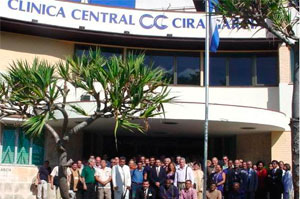
After such a long time, I was asked to take on this work, because recently I went with a friend to the Cira García hospital for foreigners, whose services, drugs and other tests are paid for in Cuban Convertible Pesos (CUC). In the said location we inquired about the phantasmal travel insurance cover  in order to receive some service and, to our surprise, in spite of the fact that before coming to Cuba the insurance contracts between the overseas agency and Asistur Cubana were signed, it was not possible to look into anything here, not directly with the company, but you had to call the country of origin to deal with the inquiries. I was astonished, after querying with them about the cost and loss of time calling abroad when the Cuban company is in Cuba, and I received the reply which you can imagine.

With some experience in commercial contracts, I started to inquire if Asistur had in fact any agreement with the Cira García hospital to hande any medical insurance contract. You can again imagine the result.

Among the more significant factors in the poor legal security of contracts in Cuba is the monopolistic working of almost all the provisions which give rise to or trigger payments; contracts are generally unalterable and may not be queried, any ruling to do with valuation in provisions, which are slanted in favour of the party offering the contract, are dismissive and coercive; since there is no competition, you can take it or leave it. Moreover, although the parameters may appear fair in terms of guarantee, quality, processes to sort out problems reasonably and legally, they are never, in their absence in practice, inclined in favour of the client.

The backward and out-of-date character of the legal system in our country is much more serious than many people may think.

Translated by GH

9 June 2014

Wait, There’s Nothing Else To Do / Juan Juan Almeida

Some days ago they announced the closure to all traffic of the route over the “iron bridge”, the swing bridge in the city of Havana, which links the Municipal Square with the beach. Because yesterday they started, or at least that´s what they said, some capital maintenance works; the first ones in 55 years. The intention is to put back in order both the physical operation of the bridge, and also its appearance.

What I recall is that, some time ago, quite some time ago, because of the extensive damage to the bridge´s elements, it was necessary to limit it to only pedestrians, bicycles and motorcycles, because of its bad state.

Now, all we can do is wait, and see if they will really will do what they promise, or if it´s just another superficial paint-job.

Translated by GH

17 June 2014

They Taught Us to Lie, Steal and Pretend / Gladys Linares

HAVANA, Cuba – Very often we hear the officials of the Ministry of Education stress our country´s successes in this field from 1959 onwards, and we ask ourselves how can they possibly talk about this without the slightest shame, ignoring the profound loss of values confronting Cuban society, when even Raúl Castro, on July 7, 2013 at the 1st ordinary session of the 8th Term of the National Assembly of Popular Power recognised that for the more than twenty years of the Special Period “there has been an acceleration of the decline of moral and civic values such as honesty, decency, shame, respect. honour, and an absence of sensitivity toward other peoples´problems.”

With these words he recognised that the destruction of Cuban society did not start in the Special Period. What happened is that, from the start of the totalitarian Castro dictatorship, Cubans have had to lie, be dishonest, distort childrens´ education and many other things in order to survive.

Now they say that the school and the family are fundamental in the development of the citizen, but for many years they have not cared about the training and care of the educators. In Cuba, before 1959, they had achieved great advances in public education, and although even more effort was needed to deal with the serious deficiencies in rural education, our schools were forming professionals capable of improving the culture and education of our people.

While it is true that the literacy campaign was an important event in the fight against illiteracy, not everything was wheat, because at the same time a difficult period was starting for Cuban teachers.

With the intention of imposing an educational system which would answer to the interests of the new government, they introduced the law nationalising teaching and set up a unitary educational system under the pretext that the schools we inherited were schools which tended to serve the “spurious” interests of imperialism. Those teachers who were against this were removed from education. The Kindergarten “Normal” Schools, as well as the “Normal” schools for teachers, disappeared, and distinct programmes started up for turning young people into a new type of teacher, like the voluntary teachers (who took intensive courses in the Sierra Maestra). the Makarenko teachers and, more recently, the emerging teachers.

In 1975, in view of the scarcity of teachers, they started the Teacher Training Schools, where 6th grade pupils entered, and which functioned until 1990. These schools started up again in the 2010-2011 academic year, now with 9th grade pupils. There are 22 in the country and this year will be the first graduation.

This is the way they improvised teaching: with kids, adolescents and young people without either the teaching experience, nor the necessary knowledge to carry out the complete activity of teaching and educating.

At the same time, the arbitrary programmes applied in the system, like the boarding schools in the country, where the students had to devote a part of their day to farm labour, separated the children and young people from their families at decisive stages in their upbringing, which accentuated the loss of values.

Also, during all those years, there was the continuous exodus of teachers, driven by the low salaries (no more than 400 Cuban pesos a month, less than twenty dollars U.S.), as well as the poor teaching methods, which impacted on their professional evaluation, and the very bad working conditions.

Nowadays the Cuban school is characterised by the absenteeism of pupils and teachers, by the inappropriate form of dress and way of addressing each other, and also some teachers frequently use obscene words to control the students. And we can´t avoid mentioning the deterioration of the state of the facilities.

As a result of all this, the recent scandal about fraud in the maths exams to enter higher education was no surprise, which came to light when the echoes of the previous case were still reverberating, in relation to the maths test for the eleventh grade the previous year. And the worst of it was everyone knows these weren´t the only incidents, just the ones which were made public. And, sadly, I would dare to say that they won´t be the last. I hope I´m mistaken.

Cubanet, 6 June 2014, Gladys Linares

Translated by GH

Travelling by Tram / Fernando Damaso

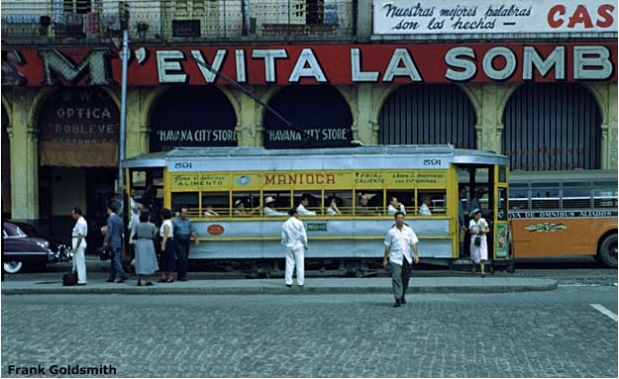
Fernando Dámaso | La Habana | 1 Jun 2014 –- My generation used trams when we were kids and early adolescents. After that they disappeared, to be replaced by English Leyland buses, supplied by Autobuses Modernos, known as “nurses” because they were white with a blue stripe running along the bodywork, which looked like the white uniform with a blue cape, which nurses wore.

A Havana tramway token: “Good for one journey” (FD)

Taking a ride on a tram was a whole experience in itself, with its hard basket seats, its wooden windows which you could slide up and down, and the motorman and conductor – that’s what they called the fare collector – with their ’20’s style uniforms, trying to connect the end of the  trolley pole with the electric wires, pulling on two ropes, when the pole had become detached after going too fast around a bend. continue reading

The trams had platforms at the front and the back, at a lower level than the floor of the car itself, which you used to get on and off at the stops. The former had a grill, looking like a moustache which stuck out to push away possible objects on the road, the motorman had the use of a gadget located to his left which allowed him to regulate the speed in a range of between one and nine. If he needed to, he could put it in reverse, making the wheels turn in the opposite direction. The brake was a crank located at the front, which you operated by turning it. The right pedal was used, when going up or down hills, or when it rained, to drop sand on the rails from boxes over the wheels, improving the grip and avoiding skids.

There was also an iron lever used to move the points to change the direction of the rails.

A traffic jam of trams, when one of them had a problem, lasted some time, until the broken-down one was towed out of the way onto a siding. Opposite the stairway to the University, in San Lázaro Street, in the days of the student protests, the students put pieces of soap on the rails, and the trams, abandoned by their passengers, with the motorman trying to control them with their shiny bronze crank handles, shot off downhill, crossing Infanta at top speed, and often getting as far as Belascoaín, so long as they hadn’t derailed on the way. It was also very impressive going down the Loma de Jesús del Monte, where they got up to a high speed, until they arrived at Toyo.

The trams were made of wood and iron and were painted white with yellow stripes. On their front platforms, over the windows and on the right, there was a large letter which indicated the stop – V, Vedado: P, Príncipe; C, Cerro; S, Santos Suárez; and M and L, Jesús del Monte – followed by a number for the route or line, and, on the centre another number which was the vehicle series number.

Under the windows and above the grill, a flag with colours indicating the itinerary: Lawton-Parque Central, Víbora-Vedado, Cerro-Muelle de Luz, etc.

You paid with a special token showing an H in the centre, which had engraved on one side “Havana Electric Railway Co.” (the name of the company), and on the other side “Good for one journey”.

Crossing in a tram over the Puente de Pote, now called the Puente de Hierro, you could see the transparent and clear water of the Almendares River, which was not contaminated in those days. The El Vedado trams looked more elegant. The passengers got on them and got off again in a ceremonious manner at the different stops. It was a comfortable, slow, democratic and safe mode of transport, belonging to a world now gone. It had more to do with a straw hat than a cloth hat.

The Jesús del Monte stop, popularly known as the “The Viper”, was a hub, with cars entering and leaving, with all type of businesses around it. When the bigger buses came along, the traffic got worse: trams and buses crossing and overtaking with just a few centimetres separation, only avoiding scrapes by the expertise of the bus drivers, since the trams moved on fixed rails and couldn’t manoeuvre to one side.

When it was decided to take them out of service, most of them, after having the motors, bearings and trolley poles removed, were used as filling for new streets and avenues, principally in El Vedado and Miramar. Now they are lying under them. They removed the overhead cables and the tracks, some of which were simply covered over with asphalt. Sometimes they stuck out of the many potholes that existed. One of the last trams, converted into a cafe called “Desiree”, remained for several years on a site near the Fuente Luminosa.

The tramway was noisy, and open to the elements, the best way to enjoy it. When it rained, everyone ran about, trying to close the windows which, given their primitive system, they tried several times, and the conductor had to come and help the passengers. If the tramway was near the pavement, there was no big problem in getting on and off, but if it was far away, nearer the middle of the street, it was impossible not to get wet, apart from having to be careful not to be run over by any motor vehicle. There were lots of accidents like that. The tramways were part of an era, and disappeared when it did, leaving those of us who enjoyed it with happy memories

Translated by GH
8 June 2014

Internet in Cuba: A Success in Spite of Everything / Ivan Garcia

CUBA-INTERNET ACCESSEight in the morning. On the ground floor of the Focsa building  – Cuba’s Empire State – on M between 17 and 19 Vedado, in a shop between the Guiñol theatre and a beaten-up bar at the entrance to the Scherezada club, a queue of about 15 people are waiting to enter the internet room.

It is one of 12  in Havana. They are few, and badly distributed for a city with more than two and a half million inhabitants. In El Vedado and Miramar there are four, two in each neighbourhood. Nevertheless, 10 de Octubre, the municipality with the most inhabitants in the island, doesn’t have any at all.

Poorer municipalities like San Miguel, Cotorro and Arroyo Naranjo (the metropolitan district with the greatest incidence of acts of violence in the country), don’t have anywhere to connect  to the internet either.

On June 4, 2013, they opened 118 internet rooms for the whole island. According to an ETECSA (Telecommunications Company of Cuba) official, around 900,000 users have accessed the service. Not very impressive figures. continue reading

On average, each internet room has received 7,600 customers a month in the first 12 months. Some 250 internet users a day. 25 an hour: the internet premises are open 10 and a half hours every day of the week, from 8:30 am to 7 pm.

But remember that Cuba is the country with the lowest connectivity in Latin America. Some people continue to regard the internet as something exotic with hints of espionage or science fiction.

The murmurings of the NSA analyst Edward Snowden, accusing the Unted States Special Services of eavesdropping on half the world, added to the paranoia of the Castro regime, which compares the world wide web with a Trojan Horse designed by the CIA, along with the USAID’s trickery, trying to demolish the olive green autocracy with a blow from twitter, inhibits many ordinary Cubans from exploring the virtual world.

The oldest people get panicky when they sit at a machine – the way they do. Lourdes, 65-years-old, housewife, only knows the internet by references. “Seeing it in American films on the television on Saturdays. I have never sat down in front of a computer. That is something for the youngsters”

There are plenty of people who see a James Bond in every internet surfer. Norberto, president of a CDR (Committee for the Defence of the Revolution) considers that “the internet is a Yankee military invention which is used to subvert and drive the youngsters crazy with frivolities. An instrument of virtual colonisation. Our organs of State Security have to meticulously regulate those of surf the web.”

And they do it. The Cuban Special Services have taken note of the way the social networks operate during the Middle East uprisings.

According to an ETECSA source, who prefers not to be named, there exists a formidable virtual policy police which controls all the access services to the internet in Cuba with a magnifying glass.

“From the spy programs and the army of information analysts to hack into dissidents’ accounts, up to following social networks like Facebook, Twitter or Instagram. All surfers are under suspicion. Before ETECSA opens a new internet  service, the State Security surveillance tools are already working,” indicates the informant.

A technician tells me that, right now, the Ministry of the Interior (MININT) has a fleet of vehicles equipped to detect illegal internet signals and cable satellite channels.

“Month in and month out there are MININT and ETECSA personnel working together to remove cabled games networks or illegal wifi which are connected up by kids where they live. They also pursue pirate internet connections, illegal international phone call connections, and cable television. A couple of years ago, in one of these investigations, even Amaury Pérez, a musician loyal to the government, had an illegal cable dish connected” recalls the technician.

In spite of everything, the internet is an unstoppable phenomenon for many Cubans, who don’t care about the absurd prices. Although you pay 4.50 CUC (112 pesos, a third of the average salary in the island) an hour, in internet rooms like the one in Focsa, there is always a queue.

Just to open an account in the Nauta mail on their mobile phone, in order to read their emails, a little over 100,000 Cubans stood in queues from the early hours of dawn.

“There were so many people waiting, that we had to assign 30 daily shifts,” indicates a lady working in the Focsa internet room.

The international press tends to incorrectly refer to the Cuban internet rooms as “cyber cafes”. Nothing further from the truth. In none of the 118 premises do they sell coffee, refreshments or sandwiches.

They are commercial offices, where people also pay their phone bills, they sell flash cards and charge up mobile phones. They are big and have air conditioning like the one at Focsa or the Business Centre of Miramar, with 9 computers. The one which has more pc’s, with 12 of them, is situated in Obispo Street, in the heart of Old Havana.

The connection speed can’t be compared with what you find in other countries: between 512 Kb and 2 Mb. It’s a huge difference in comparison with the narrow band connection of 56 Kb offered by ETECSA to the state-approved users.

Even in 5 star hotels, like the Saratoga or Parque Central, the connection is no more than 100 Kb. The price they charge in the tourist locations is very high. One hour costs between 6 and 10 CUC. There is no business strategy. In spite of charging more, the connection is slower.

Because of that it is normal to see lots of foreign tourists or Latin Americans and Africans studying in Cuba, standing in queues outside one of the 118 ETECSA internet rooms.

The internet rooms are called Nauta. The staff are friendly although some have limited ability to advise people who are using the internet for the first time.

I only go onto the internet twice a week. And, apart from striking up conversations with anonymous surfers, who are not known to be dissidents or independent journalists, I have noted that their ages range between 18 and 55, approximately.

There are more whites and mestizos than black people surfing. When you talk to them, 90% say that they are going to look at their Facebook account, look for friends or boyfriends/girlfriends, or to read news about sport, and deal with processes for migration or working abroad.

For those who like to read the international media, the favourites are the BBC, El Pais and the Financial Times. Of the Cuban pages, the most visited are Diario de Cuba and Havana Times, and, of the Miami newspapers, El Nuevo Herald and Diario de las Américas. Martí Noticias, Cubanet and Cubaencuentrohave always been blocked  by the govenrment.

Of the blogs or webs originating in Cuba, like Primavera Digital, out of every 100 people consulted, only 9% said they copy the contents onto a pendrive to read later at home.

Cuba is a country of extremes. The internet arouses affection and fear. A country which limits it, disconnects itself from scientific advances. Puts shackles on progress and throws away the keys in the bottom of the ocean.

he government’s fear of a possible seditious uprising, has reined back the world information superhighway, at the expense of torpedoing the economy and branches of cultural and technological knowledge. That’s what happening in Cuba.

Iván García

Translated by GH

29 May 2014

Cuba: Its Silent Conquest of Venezuela / Ivan Garcia

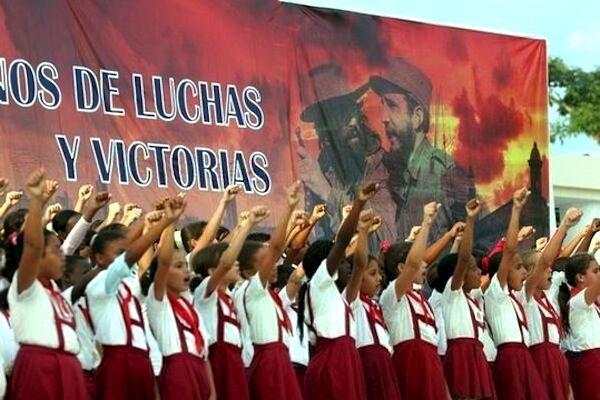
Fidel Castro and Hugo Chavez in one of their many meetings in Havana. From La Vanguardia
February 2006. Fidel Castro and Hugo Chavez in one of their many meetings in Havana. From La Vanguardia

Not in his wildest dreams did Fidel Castro think he would gain political control of and derive economic benefit from a nation nine times bigger than Cuba, with two and a half times the population and with the biggest oil reserves on the planet.

Cuba’s ideological colonisation of Venezuela could go down in history as a work of art in terms of political domination. The bearded chap never ceases to surprise us.

He wasn’t a minor autocrat. For better or worse, he was always a political animal. Charlatan, student gangster and manipulator, and always audacious.

He showed his clear inability to create riches and establish a solid and coherent economy. Before he came to power, at the point of a rifle in January 1959, Cuba was the second largest economy in Latin America. continue reading

Fifty-five years later, with its finances in the red, meagre GDP, and scant productivity, the island now vies with Haiti for the lowest place in the continent.

In terms of political strategies, Castro is an old fox. He always liked planning revolutions and wars. In the ’80’s, from a big house in the Havana suburb of Nuevo Vedado, he remotely controlled the civil war in Angola.

He is an incorrigible maniac. He likes to know everything that’s going on. From the soldiers’ meals, and livestock cross-breeding, to forecasts of the path of a hurricane.

Castro was unpredictable. He was not a comfortable Soviet satellite. He plotted conspiracies, guerilla warfare, and indoctrinated some star performers of Latin American youth. Some of them now holding power, constitute a formidable political capital for the regime.

An excellent talent-spotter, when, on February 4th 1992, Lieutenant Colonel Hugo Chávez led a rabble in a coup d’etat in Venezuela, before anyone else did, Fidel Castro, from Havana, saw the potential of the parachutist from Barinas.

He invited him to Cuba as soon as he stepped out of jail. He was his full-time political manager. Just as in any alliance or human relationship, one person always tries to dominate the other.

Castro was subtle. For health reasons, he was already back. His strategy with Chavez was low profile. He didn’t overshadow him. On the contrary. The project was to create a continental leader.

Chávez had charisma and Venezuela had an interesting income stream from oil. Cuba was in the doldrums after the fall of the Berlin Wall, a crisis with a stalled economy and the disappearance of the USSR.

The guerrilla wars in America were not yet a way forward. The “disgusting bourgeois democracy”, of which the “Comandante” was so critical, was the means by which the political groups related to the Cuban regime would gain power.

Those groups came in by the back door in broken countries, where corruption and poor government prevailed. Fidel Castro’s great achievement was to colonise Venezuela without firing  a single shot.

In the annals of history there have existed different forms of domination. Imperial powers were not always very large countries. Denmark, Belgium and Holland had overseas possessions.

But, in the background, there was an economic strength or a fearful military machine. Great Britain, in its golden age, could count on an impressive naval strength.

These days, the United States is the possessor of a nuclear arsenal and military technology never seen before. Castro’s Cuba is an economy heading for the fourth world.

Its previous military power, which allowed it to get involved simultaneously in two military campaigns in Ethiopia and Angola, has now reduced, following the Soviet collapse, to an army equipped with obsolete weapons.

The geopolitical logic taught in schools, that the countries which are economically and militarily strong dominate the ones which are poor and weak, has been blown to bits by the case of Cuba and Venezuela.

Castro’s trick for occupying Venezuela has been ideological complicity. According to the Venezuelan journalist Cristina Marcano — joint author with Alberto Barreras of the biography Hugo Chávez sin uniforme: una historia personal (Hugo Chávez without a uniform: a personal history) – everything started in 1997.

General Antonio Rivera, who worked as Head of Telecommunications for the President and was National Director of Civil Protection, points out that in that year 29 Cuban undercover agents established themselves in the Margaritas Islands and helped Chávez with intelligence, personal security and information areas in the election campaign.

After that the interference increased. About 45 thousand Cubans now work in the Venezuelan public administration, the presidential office, ministries and state-owned companies.

Or as bureaucrats, doctors, nurses, dentists, scientists, teachers, information officers, analysts, agricultural technicians, in the electrical services, and cultural workers and developers. Also in security, intelligence and in the armed forces.

When the Cuban collaborators arrive at the Maiquetía airport in Caracas, all the immigration formalities are dealt with by the island´s military personnel.

Cuban Ministry of the Interior specialists run the Venezuelan identification system, the ID cards and passports, commercial registers and Notary Publics.

They know what properties they have and what transactions they carry out. They also jointly manage the ports, are involved in the airports and immigration entry control points, where they can go about their business as they please.

The Cuban company Albet SA, from the University of Information Science (UCI), which runs the Information Service of Identification, Immigration and Emigration (SAIME), is so powerful that they don’t allow Venezuelans into the top floor of the headquarters of SAIME in Caracas.

The Presidential information systems, ministries, social programmes, police services and those of the state oil company PDVSA are also Cuban, by way of the joint venture, Guardián del Alba,* according to the journalist Marcano

The political influence of Cuba, as much in relation to the government of the late Hugo Chávez as now with that of Nicolás Maduro, is decisive. The strategic strings are pulled from Havana.

The Castro brothers benefit to the tune of more than 100 thousand barrels a day of oil and financial assistance estimated at $10B annually.

The PSUV (United Socialist Party of Venezuela) is so dependent on them, that the Cuban big-wigs, including General Raúl Castro, fly around in luxury executive jets with Venezuelan plates.

No other empire in the world has ever been able to conquer another nation without the benefit of economic power, or having to send troops. Cuba is the first. In private, Fidel Castro must be very proud.

Iván García

*Translator’s note: Cuban- Venezuelan information software company in support of the oil industry established to maintain the country’s independence in this field.

Translated by GH

15 May 2014

Leaving / Orlando Luis Pardo Lazo

At 7 past 7 in the morning of 5 March 2013, yesterday, I left my wooden house where I had lived all my life, to go to José Martí airport. I spent the whole night copying things on a few flashdrives. And deleting evidence of my ever-more-obvious work as a dissident and counter-revolutionary.

Of course I copied texts, which don’t take up much space, of which I had thousands, mine and other peoples’. I copied photos, which do take up a lot of space and aren’t worth the trouble. I copied what I could in those pendrives which would constitute all my work from that Tuesday onwards. Those gigabytes will be my oblivion and my eternity. My portable homeland, my body, my lack of spirit. My illusion that the journey was not true.  I did not want the journey to become true with the passage of time. But it did. Better that way.

I left everything I loved on top of my bedsheets. My mother still hasn’t changed the bed clothes, she tells me every so often on the phone: a white and yellow bedcover, knitted in 1934 by my paternal grandmother, the Andalucian lady who was born at the end of the 19th century. continue reading

I donated the Vaio i7, one of the fastest ones, outside the Council of State. I left the Canon 7D camera, also given by generous anonymous hands that turned out to be from Washington DC, where I am now writing this page, in the Rosslyn subway station, which, for some reason, seems to me indistinguishable from the Focsa building.

I left the pictures of the girls I loved, some of them naked, all of them so helpless (none of them was a woman, much less, my wife). I left the insidiously annotated books, which are not to fall into the hands of the State Security. Especially Paradiso, where I save a small novel annotated on the margin of Cuban Letters and Cintio Vitier’s menopausal prologue.

At the airport, the same killers that put me in jail three times took my passport and held me alone in a room for over an hour. Based on the time, I thought the plane to Miami had taken off without me, and I left the terminal area. I told this hatefully to Radio Martí. On the sidewalk, my 77-year-old mom was crying. But Silvia came to me and told me, “Fuck it Landy, go in there only come out if they’re taking you to jail”.

And I went back in, jumping the security barriers as if nothing would happen. A scene from, I believe, Basquiat came to my mind. Until a black man wearing a uniform ran to me and took an object out of his front pocket. I thought it was a gun, and I swear to God I did not care. But it turned out to be just my passport. The man wearing olive green asked me for forgiveness and said there was “an error in the database”.

It turned out that they had delayed the flight for three hours (these Miami charter companies are 100% Castro’s police). Minutes later, at the Miami airport, they called me out of the line with loudspeakers, my name was a “priority case” (and no, don’t even tell me about the “Americans”; in fact I myself am one more American).

Hugo Chavez was just now dying in Venezuela. Nicolas Madura was crying on Miami’s flat screen TVs. My night would soon end with Pedro Sevcec, who immediately asked me the same question State Security asked me in Havana: What did you do to the Cuban flag?

The next day I was in Manhattan, which is the spitting image of Havana but just huge. And the next day I was in DC. The only thing I can’t stand is that every night I have the same recurrent dream about Cuba, which I am not going to tell you about.

 Orlando Luis Pardo Lazo

In USA

7 May 2014

From Penultimos Dias

Translated by GH

The Biggest / Fernando Damaso

I read in the official press: the biggest workers’ parade in the world. How wonderful! Congratulations! But I ask myself: how does this help Cubans on a day-to-day basis?  Does it resolve any of their many problems? Maybe it would be better, although without trying to be the biggest or highest, to improve the GDP (Gross Domestic Product), and production, productivity and quality of what little we make, increase our present salaries and miserable pensions, sort out the shortage of houses, and carry out maintenance on the ones that do exist, perfect our health care and education systems, repair our streets and avenues, ensure the regular supply of water and the proper working of the drainage network, and lots of things besides. continue reading

It appears that triumphalism is an evil we are stuck with, and it keeps popping up, in spite of all the discussion about poverty and how to deal with it.

The extinct Soviet Union kept organising the biggest workers’ parades, every May 1st in the historic Red Square in Moscow. Did it solve anything? Did it prevent socialism collapsing and disappearing? And what remains of that now? The  only thing it achieved was that their leaders, lined up on the stand above Lenin’s Mausoleum, believe that the workers, totally united, supported them unconditionally and were happy with everything they did. Are we going to make the same mistake here?

May 1st is just a day in which, in democratic societies, the workers insist on improvements and concessions from the current government, and, in non-democratic societies the government uses the workers for political propaganda.

Translated by GH

2 May 2014

Wages in Mariel: One Good Thing and a Lot of Bad Things / Dimas Castellanos

From cubacontemporanea.com

In accordance  with the new Foreign Investment Law*, workers will be engaged by an State-run employing organisation. When you factor in the fact that the only union permitted is the one representing the interests of the State, we are looking at a capitalist-style relationship in which the workers have no-one to defend them. Although we already knew about this, the information provided by the Director General of the regulating office of the Mariel Special Development Zone (ZEDM) is surprising just the same. Let’s see: continue reading

First of all, the ZEDM workers will receive 80% of the pay rate agreed between the employment agency and the investors. Next, payment will be in Cuban pesos (CUP), so that, in order to pay for nearly all their daily necessities they will have to convert them into convertible pesos (CUC). Thirdly, they won’t exchange what the workers are paid into CUC at the official conversion rate of 24 CUPs to 1 CUP, but at a special rate giving the workers only 10 CUPs for every 1 CUC.

The first of these is relatively good, because up to now Cuban workers contracted to entrepreneurs or countries never received 4/5 of the amount paid amount for their work. The second one is bad.

Let’s suppose that a foreign entrepreneur pays $1,000 a month for the services of an electrician; the employment agency converts the dollars into 1,000 CUC, of which the electrician gets 800. With this money, which he has earned, he could lead a decent life without having to “fight” or “invent” anything to survive.

The third part is the worst, because with the special rate of 1 CUC for 10 Cuban pesos, the 800 dollars is no longer 800 CUC, it gets converted into 333 CUC. And in the end the state grabs two-thirds of the $1,000 paid. In this way the worker is hurt by the foreigner but more than anything by the State.

On the other hand, the worker will retain the rights contained in Art 27 of the  Foreign Investment Law, which indicates that the investor has to comply with the employment and social security legislation applying in the Republic of Cuba.

But the fact is that the employment legislation, contained in the Employment Rules Law, passed 29 December 2013, in spite of the fact that it constitutes a step backwards from the Law of Labour Information Commissions of 1924 (enacted in order to channel the employer-employee conflicts related to loading sugar), nevertheless, having disappeared, it is impossible to know exactly what it says.

The disparity between the level of pay and the cost of living in Cuba is primarily due to the decades of totalitarian socialism, especially from 1989 on, when price inflation began to outstrip salary increases, leading up to the present crisis, one of whose manifestations–with the most negative impact–is inadequate pay.

That problem is so worrying for Cuban workers that it was referred to in an interview with Carmen Rosa–who is right now leading the preparation for the 20th Congress of the CTC (Workers Central Union of Cuba)–published in the newspaper Granma dated 27th April: in all the analyses carried out this year the recurrent theme of the assembly members’ proposals relates to salaries. That shows that the organisers’ objectives go in a different direction to the worries of the unemployed.

The 1940 Constitution affirms the following in Art. 61: The Law will set up a process for periodic review of salaries or minimum wages, by way of joint committees for each employment sector; in accordance with the living standards and particular circumstances appurtaining in each region and each industrial, agricultural or commercial activity.

Today, not only do the workers not participate in this process, but they also do not know how the calculation works out. By definition, the minimum wage is the basic amount you need to subsist. Using this definition, most of the salaries in Cuba, being insufficient to cover basic necessities, are in fact lower than what the minimum wage should be.

Because of that anomaly, people have to look for other employment outside of the wage relationship–almost always on the edge of what is legal–and Cubans are forced to keep shifting from one place to another, from one activity to another and one profession to another, without regard to vocation or training.

The official press has stressed that thousands of jobs are going to be created with much higher salaries than the current average of 20 CUC a month. Nevertheless, the way in which they are paid, which in any other part of the world would lead to union protests, in the case of Cuban workers, having no space or institutions to defend them, they can only express their discontent in private, at the same time as they go to the employment agencies to try to improve their position, because that mechanism, in spite of the abuse and mockery, permits them to receive a higher wage than the national average.

It has to be added that one of the main worries of foreign investors is whether they can count on efficient workers, and therefore it suits them to pay them a salary capable of motivating them and awakening their interest in the results of their activities.

Having said that, the current analysis shows us that the way in which workers will be paid now can act as an obstacle to the objective of attracting foreign investment. Therefore, they need to change the proportion from one good thing and many bad things to the opposite of one bad thing and many good things, because asking for everything to be good would be like asking for the moon.

*Translator’s notes: This refers to foreign investment into Cuba, not the reverse.

Translated by GH

Originally published in Diario de Cuba.

22 April 2014

One Night: A Critical View of Cuban Social Reality / Dimas Castellano


Una Noche
(One Night) is the film which best reflects why it is that young people leave Cuba. That’s how a female friend of mine, who is a lover of the seventh art, laconically replied to my question, after visiting the film exhibition in the 34th Festival of New Latin-American Cinema, which took place in Havana from 4th to 14th December 2012.

Because of the social theme it deals with, because of the magnificent photography of Trevor Forrest and Shlimo Godder, Roland Vajs’ and Alla Zaleski’s sound quality, and also director Lucy Mulloy’s script, the British-Cuban-North American co-production Una Noche constitutes an important cinematographic work, which, with its truthful narrative, gets close to documentary cinema; and, due to the authenticity of the people and social events it focuses on, it gets close to naturalism. Shot in Havana, with local actors, dealing with a national theme, the film can be considered to be part of the filmography of the island.

una-nocheShot between the years 2007 and 2011, the 89 minute film received international resonance with the news that the three principal protagonists, Javier Núñez, Anailín de la Rúa and Daniel Arrechada, deserted the artistic delegation going to the XI Tribeca Film Festival in New York, in the month of April 2012.

The first two did it as soon as they touched down on North American soil in Miami, the third, after receiving the prize in Tribeca. The event, something quite ordinary for Cubans, attracted international attention to the film and served to confirm the film’s story.

continue reading

Una Noche gained three of the prizes awarded in the Tribeca Film Festival. Javier Núñez Florián, jointly with Dariel Arrechada–neither with acting experience before Lucy Mulloy selected them in a casting session–were awarded the category of Best Actor; it also obtained the Best Direction and Best Photography awards, which made it the most recommended film in the New York festival.

Then, in the 43rd Film Festival of India, Mulloy’s debut film received the jury’s special prize, the Silver Peacock, worth $27,500. In the first Brasilia International Film Festival it picked up Best Script. It next entries–in the Deauville Film Festival, in France; in the Vancouver International Film Festival in Canada; in the Trinidad and Tobago Film Festival; and in the Rio Festival–are likely to attract further awards.

In Cuba, the film opened in the month of September in a sexual health fair, organised by the National Centre of Sex Education, in the cinema La Rampa, and more recently in the 34rd International Festival of New Latin American Cine in Havana, included in the “Made in Cuba” section, in which were included audiovisual productions made in the island without the right to compete for the Coral awards.

On each of these occasions it was shown just once, and because of that only a few Cubans have had the opportunity to acquaint themselves with the multiprize-winning film which deals with a very significant aspect of their lives.

The feature film focuses on the social phenomenon of illegal emigration, especially concerning young people going to the United States, which constitutes one of the worst tragedies in Cuba because of the large number of people who have died in the process, because of the split families, and because of the brain drain of Cuban professionals (a theme I will return to later).

The principal cause of the Cuban migration phenomenon lies in the absence of civil rights such as being able to freely enter and leave the country, which has developed into a flight to realise human aspirations, which, although they are basic ones, are impossible to satisfy within our frontiers.

We are talking about a general permanent flow which Una Noche presents on a personal level in terms of the story of three young people who escape in a fragile craft, made of car tyres.

In spite of the fact that the director spent several years in Havana, gathering information for the feature, it remains suprising that, without being Cuban, she manages to get so deeply inside the behaviour of a part of the society and show in sound and vision the conduct of a section of present-day Cuba, its shortages and frustrations.

Lila, one of the film’s protagonists, tells how people leave Cuba via different routes, but she never imagined that Elio, her twin brother, could abandon her. The story begins when Elio starts to work in the kitchen of the Hotel Nacional, and there makes the acquaintance of Raúl.

From that moment on, Lila’s worry that her brother might leave her begins to give her horrible nightmares which prevent her sleeping. Right away the film starts to look into the social settings and digs about for the possible reasons for flight.

In another scene Lila comments that in Havana you can get what you want. The shops are empty, but if you know the right person, everything is for sale; a statement about the reality of daily life in the capital, which is demonstrated by way of Raúl and Elio’s vicissitudes as they seek the things they need to cross the dangerous Straits of Florida: tyres, compass, wood, a motor, food and glucose.

In each process we see highlighted the mistreatment by state organisations, the environment and language of the slums, the under-the-counter business, the loveless sexual relations, the domestic violence, the moral deterioration in the bosom of the family, the destruction and lack of hygiene in Havana, the robberies, and police repression and abuse. An asphyxiating climate which is illustrated and accentuated by rap and reggaeton music.

In the same way, the camera, which can penetrate further than the human eye,  and the microphone, which can register sounds undetectable by the human ear, make incursions into the homes of the protagonists.

In the twins’ house, the macho attitudes, the disagreements between the parents and the material misery they live in; in Raúl’s apartment, the dirt, the physical and moral destruction, where his mother, who is getting on in years, and is suffering from AIDS, has to work as a prostitute, and the absence of a father, who left Cuba and does not keep in contact with them.

Along with the above, mixed in are scenes of groups of young people and adolescents behaving irresponsibly, bathing in the contaminated waters of the Havana Malecon, or risking their lives cycling about in the middle of the traffic; the old man singing dementedly in the street, whose daughter married an Italian and never came back to see him; the woman selling religious artifacts who completes the picture with false predictions in return for money.

The climax, which concludes and summarises what has happened in the events narrated, expresses the key to the story. In the boat, the dramatic conflicts, the superficiality, and the lack of foresight, show themselves.

Elio loves Raúl and Raúl loves his sister; discussions about prostitution and Elio’s and Raúl’s superficial approach to their future in Miami; Lila’s fall into the water; the shark attack, and the sinking of their boat which leads to Elio’s death, while the shipwrecked Lila and Raúl desperately cling on to a piece of polystyrene, until they are rescued by a sea scooter on a Florida beach. The film ends with Raúl’s detention in Havana, where we see dream and reality mixed up and confused.

The treatment of social phenomenon on the screen is nothing new. Information about the discovery of one of the pioneers of the seventh art, French theatre director and actor, producer of Viaje a la Luna (Journey to the Moon), George Méliès (1861-1938), shows us cinema as a way of interpreting and forming reality; and the North American film director David Wark Griffith (1875- 1948) director of Birth of a Nation and Intolerance, this last considered to be the artistic culmination of the silent screen, who looked at history as a source of cinematographic experiences.

In that sense, Una Noche, with its penetrating analysis of Cuban immigration, may be said to occupy a place in the history of social criticism in our country centred on that way of observing social reality at the margin of official apologetics.

That current, which was present in Cuba since the silent film era, started to show itself after the Revolution with the documentary PM–a short film about the ways in which a group of people in Havana had fun, which was produced in 1961 by Orlando Jiménez Leal and Sabá Cabrera Infante–which showed us a modern look at the Revolutionary reality, and became, because of that, the most problematic film in Cuba’s audiovisual history, at a time when the priority for the Cuban Institute of Cinema Arts and Industry was propaganda about class struggle and the fight against the threats of imperialism.

PM was censored and it was forbidden to show it, which produced controversy among the artists and intellectuals which led to the discourse of the Leader of the Revolution on 30 June 1961, known as Palabras a los intelectuales  (Words to the intellectuals), in which he introduced the restrictive idea: Within the Revolution, everything; against the Revolution, nothing. From that moment on, culture, which precedes and transcends politics, became a prisoner of the Revolution right up to today.

In 1971, in the fictional feature film Una pelea cubana contra los demonios (A Cuban struggle against demons), its director, Tomás Gutiérrez Alea, proposed: in any time or place it is unrealistic to develop human existence in any authentic manner, if you impose limits on the process, if you define limits of acceptability of group social behaviour, if, with the starting point of a moral interpretation of society (whether it’s called bourgeois or socialist, religion or liberal) you prevent people freely discussing their own visions of the world …

The intellectual, he said, is the specialist who is most able to express clearly the semantic incoherences which have arisen within the Revolution. In the ’90’s of the last century, among the 60 cinematic works of fiction produced, there emerged important works of social criticism.

In the 21st century, among the many film directors who have made incursions into social phenomena, I would like to focus on the prize-winning creator Fernando Pérez, who has clearly shown the potential of cinematographic criticism for encouraging reflection among Cubans.

In La Vida es Silbar (Life is to Whistle) (1998), Fernando dealt with the search for happiness by way of inner liberation, the truth and social communication, and in Suite Habana (Havana Suite) (2003), he decided to convert our contradictory reality–as seen in Una Noche–into an inexhaustible source of inspiration for love and inner liberty: love of a neighbour and of a city, which, in spite of its neglected and destroyed condition, he shows us to be beautiful and full of possibilities.

In that respect, Una Noche and Suite Habana are radically different. The first one concentrates on showing the harshness of the physical and moral destruction, the second turns away from that destruction in order to show the hidden beauty and the possibilities of getting beyond it. Between the two of them they offer a comprehensive close-up on the general reality of Havana and Cuba.

On the same lines, the film producer Alfredo Guevara, President of the New Latin American Cine Festival, in its 33rd event in 2011, said, “The Cuban Revolution, which, in 1959 could …” This Revolution now requires the privatisation of Cuban Society, freed from the state bureaucracy, which corrupts everything.

The 2011 festival showed us a group of films whose common theme was social criticism: Casa Vieja de Lester Hamlet (Lester Hamlet’s Old House), a film which talks about who we are and how to understand Cubans’ lives from the standpoint of emotional commitment. Esteban Insausti’s Larga Distancia (Long Distance), in which he shows the frustrations caused by emigration in our society.

Boleto al paraíso (Ticket to Paradise) by Eduardo Chijona, inspired by real events, deals with the degradation of youth, going as far as deliberately catching the AIDS virus in order to be able to have a better life in a sanatorium. Afinidades (Relationships) by Jorge Perugorría and Vladimir Cruz, in which corruption leads to emptiness, taking refuge in your instincts, using sex as a way of discharging electricity, manipulating people near to you as a means to reaffirming your damaged personality. Martí el ojo del canario, (Martí , the eye of the canary), by Fernando Pérez, a masterwork of cinema as historical investigation.

Just as Lucy Malloy outlines some of the causes of emigration, her film offers the opportunity to show, as a kind of accompaniment, some thoughts about the migration problem in Cuba, which could be useful for those people who, having seen the film, feel inclined to get to understand a bit more about contemporary Cuba.

The economic inefficiency, the loss of civil and political rights, the inadequacy of salaries in relation to the cost of living, among other things, have had very negative effects: corruption, a phenomenon which was present in the political administrative sphere in the republic before the revolution, spread into all levels of society; while immigration, which had characterised the country since earliest times, changed after 1959 into a diaspora, that’s to say, with people moving out all over the world, as shown in the statistical data.

On 9 January 1959, the government enacted Law No.2, to restrict the right of freedom to leave the country on the part of those who wanted to go. This provision was amended by Law No. 18, which stipulated that any Cuban in possession of a valid passport issued by the Ministry of State, who wanted to travel to another country, had to obtain an “authorisation to that effect , which would be provided by the Chief of National Police”.

In 1961, the Ministry of the Interior instituted the notorious “exit permit” and laid down the length of time Cubans could remain abroad. In 1976, Law No. 1312 was enacted, by way of which permission to leave was confirmed.

In spite of these measures, the number of Cubans in the United States, who, in 1959, amounted to some 124,000, increased substantially after that date. Firstly by way of people linked to the overthrown regime or who lost their property, along with the thousands of children who left by way of Operation Peter Pan (1960-62), and then the first massive outflow via the port of Camarioca and the air bridge from Varadero, with 260,000 Cubans leaving between 1965 and 1973.

In April 1980, after a bus violently crashed through the fence of the Peruvian embassy in Havana, and its passengers requested refuge, thousands of Cubans invaded the embassy with the same intention. The result was another 125,000 Cubans left the island.

Between May and August 1994, groups of Cubans invaded the Belgian and German embassies and also the Chilean consulate, at the same time as various boats were seized.

On August 5th of the same year, Fidel Castro accused the United States of encouraging illegal immigration, and said: either they should take measures or we will not prevent people who want to go and seek their family members.

As a result, during the summer of 1994 approximately 33,000 Cubans escaped from the island, of whom about 31,000 were provisionally detained at the Guantánamo Naval Base.

During those three huge wave–Camarioca, Mariel and Guantánamo–there also occurred innumerable tragedies. Cautious estimates suggest that at least 25% of the boat people didn’t survive their journey in their variety of very different floating objects.

Nevertheless, as the main cause of the emigration was the economic deterioration and the absence of liberty, none of these laws was able to hold up these individual departures, in groups or en masse.

The Cuban diaspora constitutes a continuing process over a period of time by all the different ways of which Cuban imagination and desperation could conceive, which is reflected in the 2010 United States Census, which showed a total of 1,800,000 Cubans, which, added in to all the others who spread out all over the world, takes us past 2 million; that’s to say, that 18% of all Cubans are abroad.

Family members separated for years, or all their lives; married couples who have grown old with the pain of not being able to return to their children; kids grown up in other countries who will never more be able to see their parents. Suffering which has caused anthropological damage in many Cuban homes, where the family ceases to be the school of love, education and security and becomes instead a place for ideological disagreements, grudges and mental upsets, exactly what Lucy Mulloy was stressing in Una Noche.

The diaspora, resulting from the absence of liberties and economic inefficiency, has had, in turn, other negative effects. The rate of demographic increase was altered during the years 2001-2010 by a negative migration balance of 342,199 people, to a rate of on average 34,000 per year; a process which is converting Cuba into the only country in America with a declining population.

In the same way, it has led to a brain drain of professionals, as Cuba, which had managed to achieve a very high proportion of higher education graduates, has changed into one of the countries which is losing its professionals and technicians due to emigration.

In the last 30 years tens of thousands of doctors, engineers, qualified in various specialties such as mid-range technical people, and skilled workers, have emigrated, which amounts to a present day and potential future threat to the country.

The fact is that the illegal departures before and after the Ley de Ajuste (U.S. Cuban Adjustment Act), and before and after the migration accords which have been agreed, clearly shows it is directly related to the Cuban internal crisis.

The production of Una Noche, a film which shows the role of cinema in the way we see, interpret, and form reality; comes at exactly the moment when the Cuban government decided to modify the current migration legislation, although the change does not give Cubans back all the rights which were violated by the legislation described.

The need to obtain permission to leave the country disappears, but certain categories of Cubans, either because of the positions of responsibility they occupy, or because of studies undertaken, continue to be subject to the same limitations as previously, which will be the cause of further young people abandoning their studies and fleeing in order not to be caught by the new law.

In this sense, Una Noche is the precursor to new migratory changes up to the point where Cubans will recover the right and freedom to leave their country just like any other citizens in the world.

***

Published in German in edition 60 of TRIGON magazine, entitled “Fliegen oder bleiben?; hintergründe zum film Una noche. (To fly or to stay? background to the film One Night)

Translated by GH

25 February 2014

Police Sharks / Tania Diaz Castro

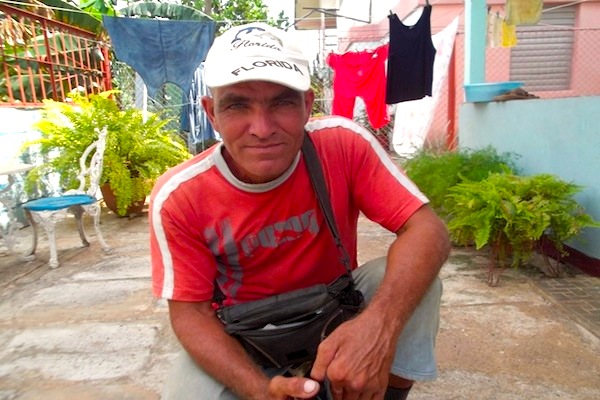
Osvaldo Brito, Valdy, with his Florida baseball cap – Photo Tania Diaz Castro

HAVANA, Cuba, April – Osvaldo Esteban Brito Amat is another of the many Cubans, mostly youngsters, who every day jump into the sea looking for a better future.

“And the sharks? Aren’t you afraid of them?” I asked him while he told me about what happened to him when he tried to get to the coast of the US for the second time.

“No way. If you don’t take any risks in life, you won’t achieve anything. The sharks here, on land, do you more harm. They go around dressed as policemen and they don’t let you live.”

Everyone calls him Valdy and he was born 41 years ago in Ben Tre, one of the various communities forming part of Bauta Council, in the province of Artemisa next to the city of Havana.

Because of his height, blue eyes and his build, Valdy could be taken for a North American in any place in the world, although the sun has darkened his skin and he speaks in a very Cuban manner.

He boasts of never having been a good example of a revolutionary, because from when he was a child he never felt anything in his heart when he was made to repeat every morning before starting his classes: “Pioneers of communism, we will be like Ché.” He says that nothing that you are forced to do can be sincere.

“I think that ever since I was born I have dreamed of living in the USA,” he tells me. “I didn’t try to go earlier because of my mother. I promised her not to do anything crazy like going in a very risky way. But my mother died a year ago. So now it won’t hurt her if the worst happens. And if I succeed in getting there I am sure she would be very happy.”

“In Ben Tre, that small village, where scarcely three hundred people lived, working on miserable little plots and in the poorest of living conditions, many people remember the former North American landowners there in the fifties of the last century, the good wages they paid to the workers, and how they lost their lands and they left the country when Fidel Castro disappropriated them without offering any compensation.

“It’s the second time I have jumped into the sea, hardly ten days ago, at El Salado beach, at Baracoa. I was a kilometer from the Florida coast. I could almost smell Miami. I felt so happy to be able to open my eyes and try to make out its lights from afar. But they caught us. There were several of us, all youngsters and we almost cried when we saw the US coastguards’ boats on top of us.

“They treated us well. With respect. Just as the Cuban authorities did. They only asked us why did we want to leave. I told them the truth: because I don’t like socialism. I am a bird with four wings who wants to fly to liberty. To earn money by working, not looking for handouts offered by the Cuban government.

“I work for myself. I sell meat and pigs’ trotters, sausages, and some fruit, from my horse and cart; what I get from the community in order to earn an honest living. But that’s a criime in Cuba. That’s why I am familiar with jail. I am very familiar with it without being a criminal.”

“Of course I will try again. As they say, third time lucky.”

He showed me the baseball hat with Florida on it which they gave him in the US boat. For him it’s a trophy for his heroic act of confronting the sharks in the middle of the night. I ask him if he doesn’t think that they deserve to be welcomed into that great country and he looks at me with his deep blue eyes, filled with tears.

Cubanet, 8 April 2014

Translated by GH

The Difficult Task of Eating Lunch and Dinner / Leon Padron Azcuy

HAVANA Cuba – Imagining a Cuban nutritionist in a health centre is like flying a kite without air. Given the general scarcities, these specialists in healthy eating, in their efforts to propose adequate diets to patients with obesity, high cholesterol or diabetes, have to act as circus magicians.

How can anybody guide you on what to eat to improve your health when you can’t obtain essential foods such as milk, beef, fish, seafood, when malangas (a kind of sweet potato) are available occasionally and potatoes are unobtainable?

Carmen, a nutrition specialist in various hospitals, finds her work makes her sad. “We all know what deficiencies we have to put up with. It pains me to see the looks on the faces of the old people who ask what they should eat, and complain about the impossible prices of fish, a pineaple, or oranges, from the healthy eating suggestions I give them so that they can recover their good heath”, she told me.

Most people – Carmen included – can’t afford fruit, on their miserable incomes. Imagine an old lady whose social security payment doesn’t even allow her to buy medicines, or a single mother without economic support from her child’s father.

Worthless junk food

A balanced diet is necessary to control certain conditions, but it’s also necessary to maintain your health. The worthless junk food eaten by Cubans is really an insult to the palate, is responsible for the small stature of today’s kids, the early loss of teeth, and the use of canes on the part of many under-70’s, due to deterioration in their bones.

It’s impossible to avoid catching diseases, when we are eating our monthly ration of “enriched mince*” (whose ingredients no-one knows), the little bit of chicken you get when there isn’t any fish; and other “leftovers”, dating back to the 90’s, of the notorious Special Period**, which never ends.

Who would tell the Cubans of the island that their food would be much worse than the diet the 18th and 19th century colonist farmers gave their slaves? In the plantation barracks they did not go without dried beef, bacalao (a type of fish), beef, milk and other valuable nutrients.

The 1842 rules regarding slaves specified that the masters must give their slaves two or three meals a day, with eight ounces (230 gm) of meat, dried beef or bacalao, and 4 ounces (115 gm) of rice or other kind of grain, accompanied by 6 or 8 plantains every day, or their equivalent in sweet potatoes, yams, yuccas or other types of tubers.***

Before 1959, the chef Nitza Villapol, became popular with her television recipes Cooking by the Minute. Later, in order to survive in the revolution, Villapol (by then a party militant) adapted her recipes to fit what you received in your meagre ration card. And ended up offering a recipe for “grapefruit steak”.

Even our very own Fidel Castro didn’t escape the temptation of offering cooking recipes. He recommended Cubans to drink some milk with a little bar of chocolate. It seemed like a joke: “what chocolate, and what milk?” asked the desperate mothers at home, who did not know what to dream up to feed their kids.

It’s absurd that the government can’t guarantee every citizen a glass of milk, and doesn’t allow Cubans to set up private businesses to supply milk and meat. It’s hypocrisy to blame the low livestock output on theft of cattle, when it is nothing else but another product of our misery.

What can we look forward to? Today’s slave-owners refuse to relax the state monopoly, the reason why Cubans can’t enjoy a balanced diet. What can Carmen, the nutritionist, say to the elderly person lacking in vitamins who asks her what should I have for lunch and dinner?

Leonpadron10@gmail.com

Translator’s notes:
*”Mince” refers to “minced meat” which, in Cuba is likely to be a “mystery substance” rather meat.
** Fidel Castro coined the term a “special period in times of peace” to refer to the time after the collapse of the Soviet Union when the sudden loss of the USSR’s financial subsidy plunged Cuba into a severe economic crisis
***Source:
El Ingenio, Manuel Moreno Fraginals

Cubanet, 4 April 2014

Translated by GH

Microbuses or Transport’s Shame / Ernesto Garcia Diaz

HAVANA, Cuba – In the Cuban capital, two cooperatives operate the old public routes of the so-called taxis-ruteros, microbuses which take passengers from the Parque de El Curita, to four destinations: El Náutico, Alamar, Santiago de las Vegas and La Palma.

Curious to know why the people in Havana speak so ill of these services, I asked the impatient passengers: how frequently do they run? how long do they take to get there? And to various drivers of the vehicles, about the contracts the cooperatives use to lease out the buses.

A driver on the Parque del Curita Micro X line – who didn’t give his name – answered me: ” I do about 16 journeys a day, the microbus has 25 seats, and the fares for them to go to the CNoA (Non-Agricultural Cooperatives), 50 seats for the total return journey, or say 250 pesos. The fare is 5 pesos (CUP), equivalent to 20 cents.”

The driver continued: I carry more than 800 passengers a day, I collect about 4,000 Cuban pesos (equivalent to $160).  In 24 working days I hand over to the association, not less than 96,000 pesos ($3840). First I pay over what is due to the cooperative, which leases me the vehicle, the difference, or what is left over, goes to the drivers, because we are the semi-owners of these microbuses. Did you know we have to repair, clean, and cover the cost of maintenance, for which we have to pay third parties and the CnoA itself?

Another driver went further than his colleague: “After paying the association, I am left with some 1,200 pesos ($48), because as I am going along people get on and off. Those receipts don’t go to the CNoA; we keep them for our costs, because we are driving piles of old junk.

I could recognise that the micro’s driver, as well as his own income, receives about 600 pesos a month from the cooperative ($24), as profit share for being associates.

Waiting 40 minutes in the sun and rain. Photo Ernesto García.

Liliana Ezquerra, vice president of the Provincial Administration Council of Havana, recently emphasized to the media: “When the two transport cooperatives started operating, using vehicles rented from the state, the number of passengers in the capital increased and at a lower fare than the private drivers charge.”

Havanans waiting and getting exasperated in El Curita park. Photo Ernesto Garcia.

One passenger in the Micro X Alamar told me “It’s 8:50 in the morning, I waited 40 minutes for the bus, they arrive here when they feel like, come to fill up with fuel and hang around to go back again or to start their working day. They take time having a snack – how should I know?! The bottom line is, it’s a disaster. They may be cheaper than the privates, but I can’t rely on them to get me to my work on time.”

Another passenger told me: “There is no fixed time for them to start work; but nevertheless the pirates are in the street at 6 in the morning, and at 12 at night they are still providing a service; I don’t even want to talk about the public buses, you can’t even count on finding one at 7:30 at night.”

The third passenger, irritated, assured me: “Look, a microbus just got here and it got lost more than 30 minutes ago. Just so you can see. Look, there it comes, who should I complain to if now they are the owners?

As for me, I took a photo of the delayed bus, because I also spent more than 30 minutes waiting for it.

Cubanet, March 11th 2014.  

Translated by GH

24 March 2014

Sociology of Transport / Regina Coyula

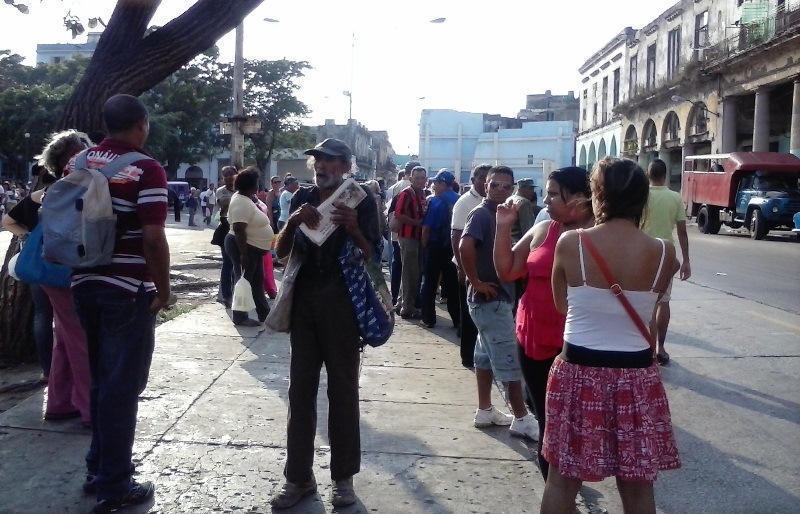
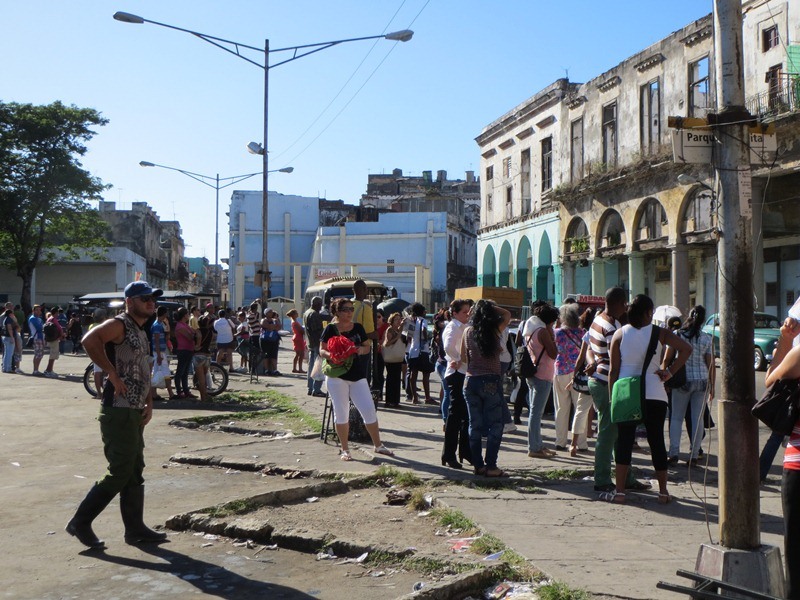
My acquaintances in public transport like Ms. C tells me that we are now facing another cyclical crisis in urban transport. In the rush hours you see bus stops which are full up and people hanging about in queues 50 metres long and who are trying to guess where the bus is going to pull up, which, you can be sure, will not be at the stop.

The “blues” and “yellows” we used to see have disappeared, those inspectors authorised to stop public transport and organise passengers wanting to get on. In contrast, lots of fairly empty buses associated with work places, pass the crammed-full bus stops, one after the other, giving rise to lots of colorful comments on the subject of the privileged few.

In the face of this phenomenon, I always ask myself whether it wouldn’t be better if this semi private transport were incorporated into the public transport, but as a dear acquaintance says to me: The “Razonamil* I’m taking must have too strong an effect.

The irritation of buses whizzing past just adds to other frustrations, every one of  which is a burden. Therefore, waiting for a bus and, if you can manage to get on, listening to how everyone in there gives vent – even if briefly – to his individual view of the process of modernisation of the economy, and how it provokes immediate reactions from other passengers, is a good thermometer, even though it may be that the general “reaction” is one of indifference.

Looking at the passengers’ faces doesn’t show you a happy society. Some of them pass the journey dozing, even though they are standing up; the younger ones often cut themselves off with their earphones or, on the other hand form noisy groups and are often abusive if people protest.

Most of the passengers are men and they are also the majority sitting down. Rucksacks, baskets, briefcases and parcels which seem to be heavy, take up a space which is already insufficient for the passengers. Gaunt faces, acrid smells, verbal violence in response to the slightest incident. And the heat is the last straw in this micro world.

*Translator’s note: “Razonamil” is a joke, a fake name of a drug that makes Regina “see reason”.

Translated by GH

28 March 2014