Alfredo has tried several times to get in touch with his brother. He doesn’t bother with sending an SMS because he has sent various messages on other occasions which haven’t arrived on time.
Following ETECSA informing most of its users of the new service, they can access their emails via NAUTA.cu from their mobile phones. The SMS service won’t work as it did before.
These problems with ETECSA’s service have affected all the Cuban government’s opponents, even leaving them without access to the internet. But what’s happening now is no more than possible overloading being experienced by ETECSA in carrying out what they have promised.
Does ETECSA have the ability to offer a quality service?
Another one of the services affected is MMS. In spite of the fact that it isn’t popular among Cubacel’s users because they don’t know about it. Those people who have been able to use it have found it difficult to send an MMS.
“Yesterday I sent a photo of her granddaughter to my mother and she wasn’t able to see it because the service isn’t working”, said Michel.
Is ETECSA going to get worse? Just as everything that the government touches does. Or is it just a question of getting used to a poor to middling service quality which varies from month to month?
Sixty percent of the buildings cry out for basic repairs
Autocrats always want to transcend their own times. The Roman emperors, Hitler, Mussolini and the communist dictators Stalin, Honecker or Ceaucescu, bequeathed their own styles of architecture.
In Rome they still retain coliseums and palaces. Mussolini left hundreds of works, constructed under the label of fascist rationalist architecture, rolled out in Italy at the end of the 1920s in the last century.
Hitler also put up buildings and spaces in the Nazi cult, with the patronage of Albert Speer, in an original architectural style inspired by neo-classicism and art deco.
Sixty-nine years after the psychopathic Führer shot himself in his Berlin underground bunker, just before the defeat of the Third Reich, the Germans are still driving along the magnificent autobahns built in the Hitler period.
A serial criminal like Stalin left us socialist realism – horrible, certainly – which encompassed all the arts. Nicholas Ceaucescu, another dictator doing it by the book, demolished a fifth of Bucharest and put up new buildings.
His greatest project was the Palace of the People, the second biggest building in the world, after the Pentagon in Washington.
Fidel Castro won’t leave any timeless architectural works. He put up thousands of schools and hospitals, but, apart from the Instituto Superior de Arte, in the Playa Council area of Havana, the rest of his designs disfigure the landscape.
And forget about quality of construction. Most of the buildings put up after the bearded people came to power look older than many built at the beginning of the 20th century.
In Havana, capital of the first communist country in America, the architectural legacy will be irrelevant. You’d have to search with a magnifying glass to spot any high calibre work.
Among them would be the Coppelia ice cream shop, designed by Mario Girona in the centre of Vedado, or Antonio Quintana’s Palacio de Convenciones in the suburb of Cubanacán. You could also make an exception of Camilo Cienfuegos city, in East Havana, and Lenin Park, a green lung provided on the outskirts of the city.
But architectural design from 1959 onwards is, to say the least, odd. If you could demolish the dormitory suburbs of Alamar, Mulgoba, San Agustín, Bahía, or the twenty or so horrible apartment blocks built with Yugoslavian technology in Nuevo Vedado, you would partly put right some clumsy construction mistakes.
Havana, a city which is pretty and conceited with its several kilometers of gateways and columns, and a splendid esplanade among its architectural offerings, maintains the greatest variety of styles.
It was designed for 600,000 inhabitants. Today 2.5 million people live there. The regime has neither modernised nor widened its streets or avenues or a site as important as the Albear aqueduct.
They have only patched and asphalted the principal arteries. They have not improved the roads of Las calzadas de Monte, Diez de Octubre, Luyanó, Cerro, Infanta, Avenida 51 or Puentes Grandes to deal with the increase in vehicular traffic.
Some 70% of the side streets are full of potholes and water leaks. 60% of the buildings are crying out for fundamental repairs.
Let me give you a fact. According to an official of Physical Planning in Havana, 83% of works carried out are done privately. The urgent need for homes to be built has resulted in constructions all over the length and breadth of Havana without benefit of professional advice.
Thousands of home-made cast-iron windows with hideous grills make the capital look even uglier. The impression you get is of a large prison. Without any order or harmony, desperate families refurbish buildings and houses of great architectural value, trying to improve their lives a little.
The once cosmopolitan Havana, at the forefront of new technologies like the telephone, radio, or long distance TV transmissions, has now turned its back on globalisation.
The internet is a science fiction dream for many of its citizens. And what was once a beautiful colonnaded city, which would inspire Alejo Carpentier, is, in the 21st century, a heap of ruined buildings and ancient automobiles.
The Castro brothers haven’t even been able to leave any legacy in the city where they have been governing for years.
Iván García
Photo: Taken from Juan Valdés César’s blog where you can see more images showing the current state of Havana.
According to the newspaper Granma, five directors of state-owned chains of shops have been suspended from their posts, and five others have been disciplined because of illegalities in the sale of cooking tools to customers and distorting the credit policy implemented by the Cuban government.
The disciplinary measures implemented by the Minister of Internal Commerce, Mary Blanca Ortega Barredo, were applied to executives of the CIMEX corporation, the TRD Caribe chain and the Union of Business and Cookery of Havana. Up to that point, everything’s fine. But I would like to know who punished the person behind the ridiculous national energising campaign, which obliged many Cubans to buy Chinese refrigerators which don’t refrigerate, electric saucepans which don’t cook, and hotplates which never worked. These people are now up to their eyes in debt. That is what, in Cuba, and in China, is called getting swindled.
This March 12th, commemorating Cuban Press Day, the ex-head of culture, Dr Armando Hart Dávalos (who a while ago went off his rocker) offered an award to the Cuban journalists. During the solemn proceedings, Señora Magda Resik, director of Havana Radio, came out with an over-the-top, “The most important obligation for Cuban journalists is the immense task of appraising the work of Jose Martí, and it is…”
I am sorry to interrupt the sentence, which is certainly very journalistic; but I think that the obligation of the press is nothing to do with Martí, but rather it is toward the Cuban people who, thanks to the disastrous work of the press, continue to be misinformed and have cataracts in their eyes.
A year after his death, it would be unjust to deny that the ex-president Hugo Chávez had the ability to be a leader, and a most convincing negotiating weapon: oil.
Supported by this, and with the Cuban government as co-conspirators, he was able to put together a kind of Latin American integration, which turned into a monolithic, geopolitical and economic bloc, whose principal role was, and continues to be, to assist him in the regional context.
The cost of all this expansion, was national division. Partition which he master-minded using his well-known ability to confront internal problems with arrogant creativity and the power to manage people.
After he died, Maduro’s big objective, as successor, was to reunify the nation; but it’s a difficult job, Venezuela has turned into an apparent democracy within one of the most unequal societies in America, with the added twist of having lost all sense of tolerance.
The time bomb exploded. The official forces repressed, and the young people were not afraid. Venezuela is splitting again, and expresses it in demonstrations, many against and a good many others in favour of Nicolás Maduro’s government.
The country’s situation is critical, and it is shameful to see how some social network pyromaniacs and followers and “likers”, making out to be heroic “patriots”, try to avoid dialogue and with total irresponsibility (from the comfort of their homes), with a coca-cola in hand, encourage confrontation, as if the followers of Twitter and Facebook were more important than the victims of the conflict.
I believe the prospects for the Venezuelans are predictable, and I can’t imagine that there will be–in the very short term–a national move back toward democracy. All the more so following the delayed and timid OEA (Organisation of American States) resolution adopted by a 29-3 vote, and not a consensus, because, as expected, the ALBA bloc countries and CARICOM had a majority and opposed the adoption of a stronger and more effective resolution.
Thanks to the sophistries of the then president Hugo Chávez, with the benefit of advice direct from Havana, the senior secretary general of the OEA, José Miguel Insulsa, without detracting from his demonstrated experience in affairs of state, lost part of his leadership within the organisation he presides over.
It has become evident that the OEA has structural problems, that it needs an overall review, has ceased to be an entity for valid dialogue for this hemisphere, and today is simply the governments of Caracas and Havana, which, without belonging to it (Cuba was suspended until 2009) and, like María Ramos’ kitty [a Cuban prostitute’s cat, which she blamed for the death of her pimp], have a majority of votes among the member states of this organisation.
Insulsa, as an additional post-diplomacy move, should ask, even if his request is rejected, to visit Venezuela to see personally on the spot what the situation is and in that way be able to avoid the different very biased versions of what happened put forward by one side or the other.
In this crucial moment, the important thing is not the cruelty of some, but the indifference of many. Politics is very serious, and we are all responsible, and cannot just leave it up to the politicians.
According to a spokesman for ETECSA, the only telecoms company in Cuba, they are going to start marketing internet in peoples’ homes, with ADSL included, from the first half of September.
We don’t yet know what the price of the installation will be. What has come to light in a document which we have seen are the different tariffs for national and international internet surfing.
The document, put out by Ibis Díaz Silva, commercial executive of ETECSA’s Oficina de Pequeños y Medianos Usuarios (Office of Small and Medium Users ), indicates that the 20 hour internet package will cost 10 convertible pesos a month, 50 hours 15 cuc (Cuban convertible currency), 100 hours 30 cuc, 180 hours 50 cuc, and 220 hours 60 cuc. There will be a 90 hour package, usable between 8 pm and 7 am which will be offered at 20 cuc. They will sell additional hours at 30 convertible pesos.
Additionally, starting from September, they will market the local intranet network at a lower price, where you can find official media. The connection speed will be between 2 and 4 megabytes.
Gradually, Raúl Castro’s government has taken some steps forward to provide internet access for Cubans. On 4th June 2013, ETECSA opened 116 navigation rooms in 15 provinces of the country.
Up to this month, according the ETECSA spokesman, about 600,000 customers have connected to the network. Last February 25th, the Gaceta Oficial de la República (Official Gazette of the Republic) announced new cellphone internet tariffs. And from 2013, ETECSA workmen have been busy putting in place wireless networks in different parts of Havana.
The prices of these new services have generated a lot of controversy. The point is that the Cuban man in the street, with an average salary of $20 a month, can’t afford the luxury of connecting to the internet while he has no chicken, fish or meat in his pantry.
One way or another, nearly everybody is complaining. Whether they are unknown citizens, like the private shoemaker Alfonso Ayala, who has never surfed the net, or official journalists like Elaine Díaz or Alejandro Rodríguez, who have criticised the excessive prices in their blogs.
“One hour at 4.50 cuc (Cuban convertible currency) is equivalent to 112 Cuban pesos. Repairing shoes, I make between 80 and 100 Cuban pesos a day. All my income is for buying food and supporting my wife and kids. As far as I can see the internet continues to be out of my reach,” says Ayala.
As far as the regime is concerned, the internet is an invention of the US special services with the aim of colonising information and culture. Only the inescapable necessity of not continually putting the brakes on Cuban professional development has forced the government to authorise access to the internet.
It all started in 1998, when the island was connected up, via satellite, more slowly and with a narrower band than a public university in New York. The official press blamed the technological backwardness on the trade embargo imposed by Washington, which forbids connection to the underwater cables owned by US companies, which surround the green Cayman Islands. And we know that Cuba and the USA are continuing with the Cold War. And truth is the first casualty of any war.
According to the ETECSA spokesman, in 2010, some gringo companies located in Florida were authorised by the Obama government to negotiate with Cuba to recommission an old unused underwater cable.
“The project was viable. It cost $18m with a bandwidth right for our requirements. But the government preferred to bet on the so-called digital self-government and designed a project jointly with Venezuela called ALBA1, stated the source.
At a cost of $70m, the submerged cable connected the twin cities of La Guiara and Siboney in the east, in Santiago de Cuba. There is a spur off it which goes off to Kingston, Jamaica.
There is a structure of corruption around the cable in the upper echelons of the Ministry of Communications and Information, which led to the desertion of a high-up manager of ETECSA in Panama in 2012.
There was no news about ALBA1 until 4 June 2013, following the government decision to open new navigation rooms. There is no doubt that the famous cable clearly improved the connection speed.
Before that, in a five-star hotel like the Saratoga, where Beyoncé stayed last year with her husband JayZ, the connection speed was slow and expensive. At best it didn’t get past 100Kb. And 2 hours of internet cost a bit over $15.
From September 2014 on, things are going to change, according to specialists I have spoken to. It could be that not many Cubans will be enthusiastic about the new provision, on account of its irrational pricing. But the ETECSA functionary referred to is optimistic and considers that the opening up of cyberspace will bring more positives than negatives.
Iván García
Photo: A Cuban surfs the net in one of the cyber cafes opened by ETECSA all over the island in June 2013. Taken by El Universal.
Leopold Lopez giving himself up for arrest in Caracas
The name of Albert Einstein was considered for a time to be synonymous with academic failure; Thomas Edison too, who studied for only two years in the formal education system; also Beny Moré, known to all Cubans as El Bárbaro del Ritmo (The Rhythm Barbarian) and who, with a lot of effort, learned to read the notes on the musical stave.
These, and other examples, tell me that I form part of that group of persons who, without scientific evidence, consider that you are born with your talent; and then later, as it should do, the education system refines your innate abilities.
In politics, in my opinion, the same thing happens, since I don’t accept the notion that a leader is developed from nothing. Leadership is the ability to communicate with a group of people, influence their feelings so that they let you lead, share the group’s ideas, stick with them, and carry out those actions or activities necessary to achieve one or more objectives.
For example, and with respect, in my country (I am referring to both the ranks of the government and the opposition) I can see heads; but not leaders. In Venezuela, it’s a different story; Leopoldo López, great great grandson of Concepción Amestoy Palacios (niece of Simón Bolívar), and of Cristóbal Mendoza (first president of Venezuela), was born with a political predisposition and with leadership in his genes.
I am not trying to put myself up as a historian, I am not, or to relate the details of why we are now fixing our attention on Caracas; but I do want to say that in a similar situation, any hysterical fool, irresponsible bigmouth, or prominent sick person could have dragged that country towards a civil war and an irreparable bloodbath. But only a political tactician is able to take a government which is powerful, arrogant and ruthless to the position of checkmate.
Calling a historic march and delivering it, Leopoldo López showed his individual vulnerability; making it evident that his defence does not depend on the much overvalued cyberspace, but on the real world, on a popular mass, above all students, who live outside of the computer screen and of the “liking” of the social networks. So much so that, after he was put in prison, we have seen a considerable increase in real people protesting on the streets of Caracas.
The president Nicolás Maduro, is on the point of getting burnt by the hot potato in his hands. He knows that if he sets López free, he runs the risk of demoralisation, and the feared result of loss of control; but if he leaves him in jail, and the protests continue, the danger could be even greater.
Calling for dialogue was an important and very helpful decision by the Bolivarian bus driver, who, for the moment, counts on the support of the armed forces and institutional power; but now the opposition possesses the switch which can ignite the extremely powerful and explosive popular bomb.
The official forces stomp on the thousands of young people in the streets, who are not afraid and appear to shower themselves with Red Bull. I think that we have come to the moment for sitting down and discussing everything. The freeing of Leopoldo López, the unification of a divided country, the urgent recovery of a people … and including a negotiated exit for Maduro.
This time Venezuela will win, thanks to the opportune action of a wise and intelligent leader.
Since the decontrol of the contracting of mobile phone services in 2008, the number of lines rented has reached almost two millions, which has given ETECSA [Empresa de Telecomunicaciones de Cuba S.A.Telecommunications Company of Cuba, which is a government owned telecoms company] an income of about $2bn. Now, with the announcement that they will include the astronomically expensive internet service with mobile phones, the Cuban state monopoly ETECSA will end up valued at about $3bn.
Good heavens, and not for one moment are they going to soften the blow by dropping their prices a little.
Beautiful Venezuela, so weighed down for such a long time with your own revolution. Is that what you wanted? No! That’s why we are going to save ourselves.
So much left wing higher education, so much nostalgia for Silvio Rodríguez and so many other dogs’ breakfasts of patriotic poetry, so much Castroism disguised as uncomfortable intellectualism, so many arms smuggled from Havana (the scroungers were previously the guerrillas), so much of our parents’ out of date Marxist social criticism. Is that what you wanted? No! That’s why we already saved ourselves.
Thanks, Venezuela.
Fidel Castro hates the Venezuelans as much as he hates Cubans a much as he hates human beings. Much more now, because he will die soon. And he hates the idea that millions and millions of people should live when he doesn’t.
The Venezuelans resisted Fidel too much, since January 1959 when the Commander in Chief proposed a diabolical pact to President Rómulo Betancourt: Venezuela will give Cuba all its oil and also its land as a trampoline for expanding the Revolution: in return, Fidel held out the promise of the destruction of the United States in a few years’ time and the damned imposition of the dream of Bolívar and Martí (he almost managed it in October 1962, at the cost of the Russian nuclear missiles, which showed that Bolívar and Martí, far from having dreams, had terrible nightmares). continue reading
Fidel tried military invasion of Venezuela several times. The continental consequences were negligible. No-one had any faith in his invasions. There were fabrications of Yankee imperialism and of national oligarchy. And the repressed people applauded that argument which seemed at the time to be conciliatory rather than totalitarian terrorism. Do you get it now, my dear Venezuela? Yes, I know, my strong and beloved little girl.
Also, it is possible that the Venezuelans felt a certain demoniacal left-wing pride at having been invaded time and again from the little island. You agree? Doesn’t matter.
Finally, when Fidel noticed that the world had changed, and that he had become older, he recruited thousands of Venezuelans, taught them his jargon of hate and thuggery, and he gave them the money to empower them (money which in fact came blood-soaked from Libya and Iran)
In this disgusting chess game, Rafael Caldera was the anonymous ally of Castroism, which cost many Venezuelan lives, including countless soldiers who were massacred in “accidents” authorised by Hugo Chavez and including later the assassination of Chavez himself when the very obedient one let the wild beasts know that he, Chavez, ought to be Fidel’s successor.
Beautiful Venezuela, so pregnant for so long, to give birth also to your own Revolution. Is that what you wanted? No! Now all of this is about to happen. Maybe it has already happened.
Today, those who don’t know about any of this, are angry on the streets in Venezuela. They are a legion of heroes. They are life. They are beauty. They are truth. They don’t yet have the strength to give up. They are not going to surrender. Let’s not abandon them, please. We are not going to abandon them.
Those free Venezuelans don’t want to live a life without liberty until the end of time. They are as tired as the Cubans, but they still have a last breath of hope. Best of all, this little ray of light may also wake up us apathetic Cubans.
Free little Venezuelans do not want to exist in a caricature of Castroism without Castros. In Venezuela today the future is showing itself, for fuck’s sake, and they are slaughtering that future in full view of the world. Don’t abandon them, please.
Please
What do we do?
I propose some International Peace Brigades, to put together a Freedom Fleet in a couple of days, and then sail from all the ports in America to Venezuela, loaded up with all our love, and more love (and food and clothes and medicines to cure the wounds of torture, and arms to close ranks by your side, and togetherness in our looks that we will never turn our backs), and once we are there, relaunch a country where words are not a perverse parody, where despotism is just a relic of the Corpse in Chief cooking in his dreadful nearly ninety years old delirium in a buried, inhuman Havana.
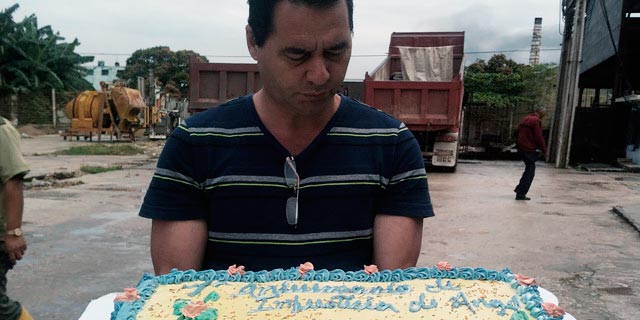
First anniversary in prison of the intellectual and writer Ángel Santiesteban-Prats
This 28th February marks the first anniversary of the unjust punishment imposed by the Havana provincial tribunal on the prize-winning writer Ángel Santiesteban-Prats. Judgement prepared by the Cuban government.
Santiesteban-Prats, has passed more than 5 months locked up in the Lawton centre, situated in the 10 de Octubre area, under constant restriction by the Heads of the Havana headquarters.
The celebrated literary figure, holder of various international and national prizes. In his critical blog of the¨Los hijos que nadie quiso¨(The Children Nobody Wanted) he has continued in his perennial role as stone-thrower into the middle of a pond. He redoubled his efforts. When the government attacked him, his ability to do this reduced.
In these 12 months he has suffered physical and psychological torture.
He found out that the appeal process which was presented to the Ministry of Justice (MINJUS) on July 4, 2013, had been filed away for more than six months on the basis of lack of a contractual agreement. Finally he presented another document, which is proceeding, has been accepted and is to be found in the Provincial Review Department, where they are keeping it while they wait for the sanctioning tribunal to forward them the lawsuit.
The injustice perpetrated against Santiesteban-Prats has served to strengthen him more. He has maintained his writing as a sacred space for this celebrated creator.
We hope that the Cuban government will accept responsibility for committing a grave error. Santiesteban, when he is free again, will continue to insist on the rights of all Cubans, because not even imprisonment has been able to stop him.
To all his readers, lovers of literature, do not give up the fight for his immediate release.
This day he was presented with a cake so he could celebrate his first anniversary in prison.
So that Amnesty International will declare the Cuban dissident Angel Santiesteban to be a prisoner of conscience you can sign the petition: please click on this link.
I am addressing each one of the twenty-eight nations which make up the European Community, to demand more depth, through an exhaustive investigation with free people, unencumbered and unafraid, to find a just consensus to the national issues of the Island, more so when we know that the historic practice, in more than a half century of socialism, has not been the welfare of the people, but the maintenance of the cruel machinery for the sake of their “Iron Totalitarian Power,” the imprisonment and daily repression of dissenters, and the mysterious deaths of opposition leaders.
I appeal to you, in the light of the recent decision of your Foreign Ministers, to open up a bargaining agreement with Havana, which we consider to be a grave mistake, in view of the fact that while the European Union was arriving at this agreement, the regime was imprisoning its opponents.
We hope that you do not see Cuba as a palliative to help you solve the crisis you are dealing with, at the cost of permitting the violation of our rights.
Exposing ourselves to risk, we have learned that the Castro brothers will never permit any imposition which gives any space for opposition, so that they have not even signed the United Nations Covenants, which in this 21st century should be the minimum indispensable requirement for the self-respect of any state, in the face of the international community; achieving this, and thus liberty and respect for the opposition, would be the contribution that the European Community could present to the Cuban people, and in turn this would be a credible step forward on the part of the Raúl Castro government, showing that it really is its intention to provide openings and improvements in terms of the Human Rights of the Cuban people.
In actual fact, they have filled up the jails with young people who, without any other option, have preferred to be criminals rather than submit to hunger and the absence of basic necessities. In those prisons, you will find many professionals, “embezzlers”, who have had the same misfortune as those who haven’t studied, since they haven’t had the opportunity to emigrate, as is the case with the overwhelming majority.
With respect, we urgently request that the European Community does not change its Common Position, without previously assuring itself in respect of the necessary change for the political democratisation of the Cuban archipelago.
Fishermen at Playa de El Chivo – Photo Ernesto Garcia
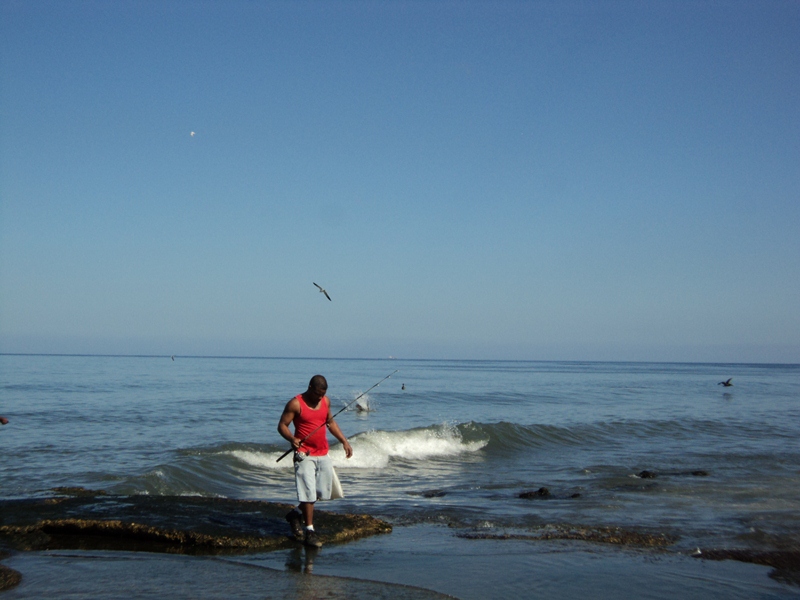
Havana, Cuba – At la Playa de El Chivo (El Chivo beach ), on the northeast coast of Havana, at the foot of the Castillo de los Tres Reyes del Morro (Three Kings Castle), people carry on fishing for sport and business, between the marine waters and sewage, without the health authorities, environmental authorities or the coastguards taking a responsible attitude. The zone receives thousands of cubic metres of polluted water and its sand dunes are deteriorating as a result of the man’s actions.
The grunt, snapper and barber fish, among others, turn the rocky beach into both a centre for boats which arrive every day to seek their economic support; and at best, some people who are enjoying their leisure and are fishing for sport.
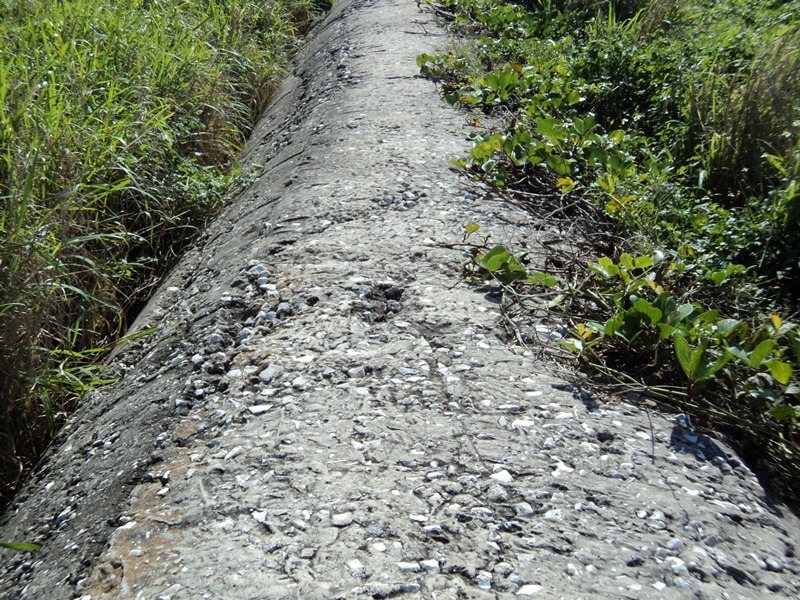
This is going on in the mouth of the submerged sewage outlet pipe which runs from the Havana sewage treatment plant, which filters the solid waste coming from the northern and southern collectors of the capital. A concrete pipe of about 375 metres in length crosses Havana Bay, as far as Casablanca, where they pump the dirty water up to La Cabaña, so that it then falls by gravity down to the El Chivo beach, about 150 metres along the coast.
The most astonishing thing is that many fishermen enter into the area of the lower reefs, without any protection, on the edge of where they are fishing in a contaminated area, breathing in the fetid smell from the drain, which keeps the coastal water cloudy with its permanent discharge from the Havana sewers, whose pipes and canals are not lacking in cracks and leaks. continue reading
When it comes to the end result of the activity, various fisherment indicate that they eat the fish themselves, and that they also sell some, but they don’t say where the fish come from.
These citizens, impelled by their desperate need to support themselves and their families, imperil the health of people who are unaware that they are buying a product of uncertain or unknown origin, as many are offered as skinned fillets, or say that they are deep sea fish, which prevents the consumer seeing the physiognomy of the species, so they can at least identify them, in order to avoid the “ciguatera” (tropical fishfood poisoning syndrome ) which is transmitted by the picúa or the aguají, among other species which it is forbidden to fish.
Murky waters at Playa de El Chivo – photo Ernesto Garcia
Additionally, on this beach’s rocky and sandy coast, the environment is being damaged by the dumping of plastic handles, fish-hooks, fishing lines, and other discarded items, which are thrown away by people living there or those passing through the area who don’t take any notice of the prohibitions.
Alberto, an ex-fisherman, known as “The Wizard”, admitted that he used to sell fish for a while, but that it was very hard work, always running the risk of a consumer falling ill, because the species caught in this area end up eating the discarded rubbish in the sewage, or a shoal of sardines who have also come over to eat toxic residues.
Concrete drain pipe in El Chivo beach – photo Ernesto García
El Chivo Beach, by the Castillo de los Tres Reyes del Morro, classified by UNESCO in 1982 as a World Heritage site, has been converted into a contaminated focal point of bacteria and micro-organisms which can affect the health of those who fish in its waters, pass through there, or consume its fish.
The authorities would be perfectly able to preserve the cleanliness and health of the ecosystem of this sandy coastline, which has been abused and is hardly a good example of sustainable development of a zone of natural, historical and cultural value which should be cared for.
In relation to the ongoing tense situation in Venezuela, the Cuban government and its Government Organisations unceasingly make declarations of support and solidarity with the government and the people of that country, bundling them up together, as if those who are protesting and joining in demonstrations are not a part of that people. It is worth remembering that in the last elections, 5,300,000 voters endorsed the official candidate and 5,000,000 the opposition candidate.
What’s more, our official communication media only show one side of the coin; the Chavista*. The opposition demonstrations, as numerous as the government ones, are hidden. This distorts the reality of a country in crisis, and creates confusion.
It’s an old method which the Cuban authorities don’t stop repeating: in the old Czechoslovakia, they supported the Soviet invaders and the Treaty of Warsaw, in Poland, the Communist coup d’etat, in the old USSR those who opposed Gorbachev, in Iraq against Saddam, in Libya against Gaddafi and now in Syria against Assad and the pro-Soviet government in the Ukraine.
The opposition, without any kind of distinction, are referred to as mercenaries, employees of the Western powers, antisocials, delinquents, etc. It’s a cracked record, which we always hear in Cuba. For many years the Cuban government has only known how to ally itself with similar governments and to support the worst causes: the reactionary and anti-democratic.
Now, with Venezuela, you have to be able to read between the lines and find the censored pictures, in order that what might happen does not catch us by surprise, as happened when the notorious Berlin Wall fell and pulled European socialism down with it.
An old song goes: God creates them and the devil brings them together. Sometimes it isn’t necessary for the devil to unite them: they do it all by themselves.
*Translator’s note: Chavista refers to supporters of the late Hugo Chavez and his party, which remains in power.
In his first decision of this year, published in the Gaceta Oficial Extraordinaria (Special Official Gazette) dated February 7th, the head of MININT (Ministerio del Interior de la República de Cuba – Cuban Ministry of the Interior) Army General Abelardo Colomé Ibarra, ordered the General Management of the General Revolutionary Police to exchange information, such as the co-ordination of criminal actions and investigations, with the General Management of the department of Bank Financial Operations Investigations, in order to combat money laundering, financing of terrorism and moving illicit capital out of the island.
The challenge is large and high-cost; but the solution is very easy. For starters, build a wall around the boundary of the present location of the Central Committee, leave the guards outside, and convert it into a high-security prison. And whatever else is needed.
In Cuba, it’s not a secret to anybody, problems enjoy a long life. As there is no organised civil society able to insist on its rights, you always have to wait for the decisions of the authorities, and, like the problems, they also take their time.
And the official press isn’t bothered about them either, unless it is no longer possible to hide them or the government decides to address them. Then you see articles and reports considering what they are doing to resolve them, without mentioning what it was that caused them, what they failed to do to prevent to prevent their development, who was responsible and, most importantly, how the people have been affected by them.
In spite of the update and the briefing about which the press may feel critical, it seems that they go forward fearfully, afraid to go beyond what is authorised. There have been too many years of censorship. Here are some examples taken at random.
Banes has its new water pipeline, reports the newspaper Granma. The town of Banes, in Holguín province, had its aqueduct, which delivered water to its inhabitants. With the passing of the years and lack of maintenance, the steel pipes and the original concrete deteriorated to the point that out of the 150 litres a second of water to be delivered, only 32 came through, with delivery cycles of 32 days.
Now, after dozens of years, the pipework has been repaired with polyethylene tubes, reducing the delivery cycles to 9 days. A complete success. With not a word about the suffering and annoyance caused to the people by this situation, or saying why the restoration was delayed so long, much less who was responsible for doing nothing for so many years.
In Havana – the TV tells us — some apartment blocks are under construction, to be offered to families in temporary housing, and to others who were living under the La Lisa bridge. The buildings are low cost quick-build, poor quality and unfinished, ending up as a call on the resources (?) and the labour of the new tenants.
Some of the beneficiaries passed some 15, 20, 30, or nearly 40 years living in hostels, or under the La Lisa bridge, in precarious conditions. The journalist did not say one word about the effect this long-drawn-out situation had on the lives of the members of these families, and devoted his time to relating the gratitude of the beneficiaries to the Revolution. End of story.
The Casablanca cinema reopened its doors –Juventud Rebelde tells us. The cinema, located in the city of Camagüey, remained shut for over a decade. Not a word about how the situation came about nor about who was responsible. Nor did it indicate how much the locals were disadvantaged culturally by this prolonged closure.
This all sounds like the report of the story of the patient who, having died of hunger due to lack of provisions, enjoyed the expert and magnificent medical attention in his final hours.
 Alfredo has tried several times to get in touch with his brother. He doesn’t bother with sending an SMS because he has sent various messages on other occasions which haven’t arrived on time.