- The fuel, intended for the private sector, will be stored in Cupet tanks under the supervision of the company Vanguard Energy.
- The Florida-based company spent months negotiating a long-term agreement with Washington and Havana for similar shipments “once a month or every 40 days.”
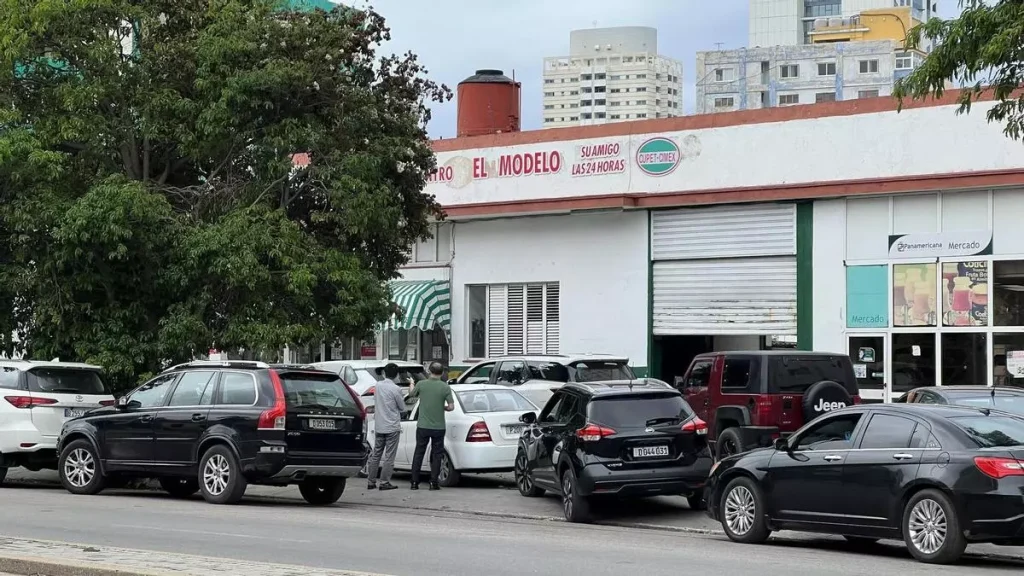
 14ymedio, Madrid, June 10, 2026 – The first significant agreement between Washington and Havana centers on Cuba’s most sought-after scarce commodity: fuel. The Vanguard Energy company, based in Coral Gables, has finalized a contract with a Cuban importing company to lease Cupet facilities and store fuel on a large scale, according to a report published Tuesday by the Miami Herald. In addition, according to Bloomberg, the company is preparing its first shipment of 250,000 barrels of diesel and gasoline, which the U.S. government estimates will cover about 11 days of Cuba’s normal demand.
The agreement is the result of months of discussions among Vanguard, Cuban authorities, and U.S. officials, the Miami Herald reported, citing a company statement. “It is the most significant commercial change in Cuba’s fuel sector in decades,” the statement said.
“We are looking to bring in a reasonably sized vessel, capable of carrying more than 250,000 barrels of diesel and regular 87-octane gasoline, to store them in a tank,” said Vanguard Energy president Matthew Klann, adding that shipments would arrive once a month or every 40 days. He noted that several initial customers have already been identified, including the U.S. Embassy in Havana. Matthew Aho, an adviser at the Miami-based law firm Akerman and a negotiator of the agreement, added that the arrangement will allow increasing amounts of fuel to reach the private sector and, in turn, lower prices.
“We are looking to bring in a reasonably sized vessel, capable of carrying more than 250,000 barrels of diesel and regular 87-octane gasoline, to store them in a tank” once a month or every 40 days
The idea is no longer a small-scale supply operation but rather the privatization of the sector. “As the process moves forward, appears to work, and can be audited, and as both the United States and Cuba see the benefits of privatization in their fuel market, you would expect further progress, more companies entering the market, gas stations selling to the private sector, and the energy and fuel markets beginning to flourish again,” Klann added.
“This would be the first process of its kind in Cuba, demonstrating to both sides that privatizing the fuel market is the right way to manage this business,” the president said.
Vanguard Energy, which specializes in regional fuel trading in the Caribbean and Latin America, moved quickly to take advantage of the U.S. government’s authorization to sell gasoline to Cuba’s private sector, which the Cuban government, for its part, authorized to purchase fuel beginning in February. Until now, however, sales could only be made in small quantities. ISO tanks, with a capacity of just over 20,000 liters, must be returned by Cuba after being emptied, making the process costly and inefficient.
The new agreement changes that. “This is not about delivering fuel to Cupet; it is about establishing a physical presence on the Island, where a U.S. person, subject to U.S. law, has the right to inspect the fuel, retains ownership of it, and distributes it only after payment has been made in the United States,” Akerman attorney Augusto Maxwell told the Miami Herald. The arrangement represents a concession by the Cuban government, allowing U.S. audits on Cuban soil and ensuring that payments do not pass through the Island’s banking system. The latter also protects the company from sanctions related to the U.S. embargo.
Akerman affirmed that the contract complies with U.S. legal requirements. “We will be able to provide the U.S. government with complete traceability of sales,” Maxwell said, including guarantees that fuel cannot be sold to the Cuban government, the Armed Forces, or individuals subject to U.S. sanctions. According to the lawyer, the contract includes safeguards such as retaining ownership of the fuel, controlling who may purchase it, and maintaining the ability to monitor and inspect stored fuel.
“Sales will be limited to customers who successfully complete Vanguard’s due diligence program, ensuring transparency, accountability, and compliance with applicable U.S. regulations,” the company said in a statement. “To comply with U.S. law, Vanguard will also implement safeguards to ensure that the fuel is not diverted to the Cuban government or to U.S.-sanctioned state-owned enterprises.”
Initial reactions on social media have been skeptical, if not outright disappointed. “That’s what they’re after, business and money. And to hell with the people”
The challenges, however, remain considerable. Although the company has portrayed the agreement as a “major victory for U.S. policy,” the news has generated unease in some sectors. Early reactions on social media ranged from skepticism to disappointment.
Among the main concerns raised, mostly by Cuban Americans, are the lack of confidence that the Cuban government will not benefit, doubts about the existence of a truly independent private sector, fears that the fuel could be resold to the State, and suspicions that Vanguard Energy may have undisclosed ties to the Cuban regime. “Yet another sign that nothing is going to change in Cuba. It’s a damn joke,” one commenter summarized.
The U.S. State Department and Cuba’s Ministry of Foreign Affairs declined to answer questions from the Miami Herald, which views the agreement as a first step toward broader participation by U.S. companies in Cuba’s energy sector and, eventually, the opening of other sectors to private enterprise.
“It opens the door to countless independent distributors and encourages companies much larger than Vanguard Energy to become interested and begin operating in Cuba. It also facilitates a potential transition. We will gain the expertise needed to supply oil to Cuba through the experience acquired with Vanguard,” University of Texas expert Jorge Piñón told the newspaper when asked about the matter.
Translated by Regina Anavy
______________________
COLLABORATE WITH OUR WORK: The 14ymedio team is committed to practicing serious journalism that reflects Cuba’s reality in all its depth. Thank you for joining us on this long journey. We invite you to continue supporting us by becoming a member of 14ymedio now. Together we can continue transforming journalism in Cuba.