None of the experts consulted consider a U.S. military intervention with troops on the ground to be plausible, but they believe major economic changes are approaching.
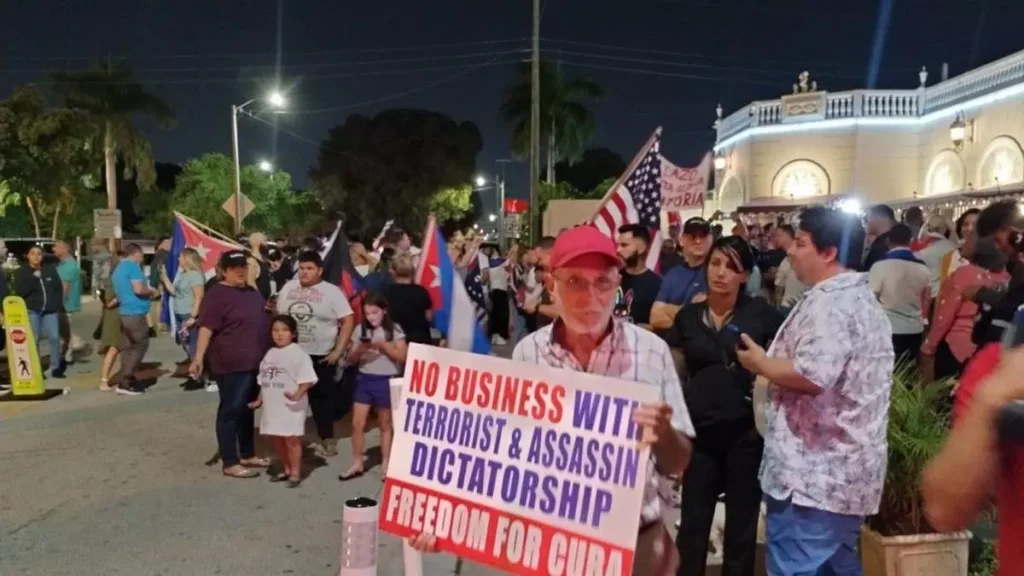
 EFE / 14ymedio, Washington, June 10, 2026 – An agreement between Cuba and the United States that opens the way to the political and economic changes demanded by Washington on the Island could include concessions from both sides, among them decisions that may prove unpopular within the Cuban exile community, several analysts warned on Tuesday.
Amid the escalation of pressure by the Trump administration on Havana, “there will likely be decisions made” by the Republican administration “that will not satisfy everyone within the Cuban-American community,” said political scientist José Cárdenas.
“Difficult decisions will have to be made and compromises accepted in order to achieve the ultimate goal: a stable and peaceful transition toward something much better,” said the former acting deputy administrator for Latin America and the Caribbean at the now-dismantled United States Agency for International Development.
“Difficult decisions will have to be made and compromises accepted in order to achieve the ultimate goal: a stable and peaceful transition toward something much better”
The veteran consultant added, during a discussion at the Inter-American Dialogue, that they are witnessing “a series of factors that continue to increase pressure on the Cuban regime, demonstrating that there is no way out.”
Foreign policy and immigration expert Emily Mendrala concurred that an agreement between Cuba and the United States “could involve concessions by both sides.”
“The United States has long demanded the release of political prisoners, a reduction of Russia’s and China’s presence on the Island, whether in intelligence operations or other areas, and the opening of the Cuban economy so that citizens can actively participate in it,” Mendrala explained.
The former senior migration adviser in the White House of Democrat Joe Biden added that Washington could ease sanctions on Cuba and allow the resumption of oil flows that were cut off by Trump last January, which, while not the primary cause of the Island’s severe humanitarian crisis, have worsened it.
In recent weeks, the two neighboring countries have established contacts at the diplomatic, intelligence, and military levels, though these have not produced visible results, at least publicly.
Following the recent criminal accusation against former president Raúl Castro, 95, sanctions against Cuban president Miguel Díaz-Canel, and threats of reprisals against foreign investors in Cuba, Havana has intensified its rhetoric against its longtime adversary.
The economist insisted that “centralized economic systems do not work. Even Cuba’s allies, such as China and Vietnam, abandoned those systems a long time ago.”
Despite this escalation, and although they acknowledge that conditions on the Island are reaching a breaking point, none of the experts considers a U.S. military intervention with troops on the ground to be likely.
“I believe we are approaching a turning point with regard to Cuba,” warned Ricardo Torres, an associate researcher at the Center for Latin American and Latino Studies.
The Cuban economist reiterated that “centralized economic systems do not work. Even Cuba’s allies, such as China and Vietnam, abandoned those systems a long time ago.”
“I believe the Cuban people deserve to hear that from their government: this system does not work. Likewise, on the political level, we need a system that allows for accountability, where the government must answer to its own people,” he concluded.
Translated by Regina Anavy
______________________
COLLABORATE WITH OUR WORK: The 14ymedio team is committed to practicing serious journalism that reflects Cuba’s reality in all its depth. Thank you for joining us on this long journey. We invite you to continue supporting us by becoming a member of 14ymedio now. Together we can continue transforming journalism in Cuba.