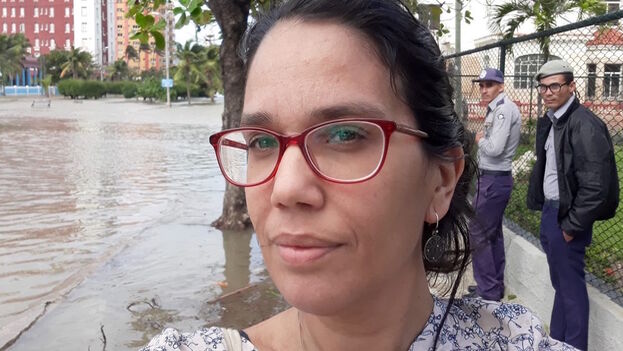
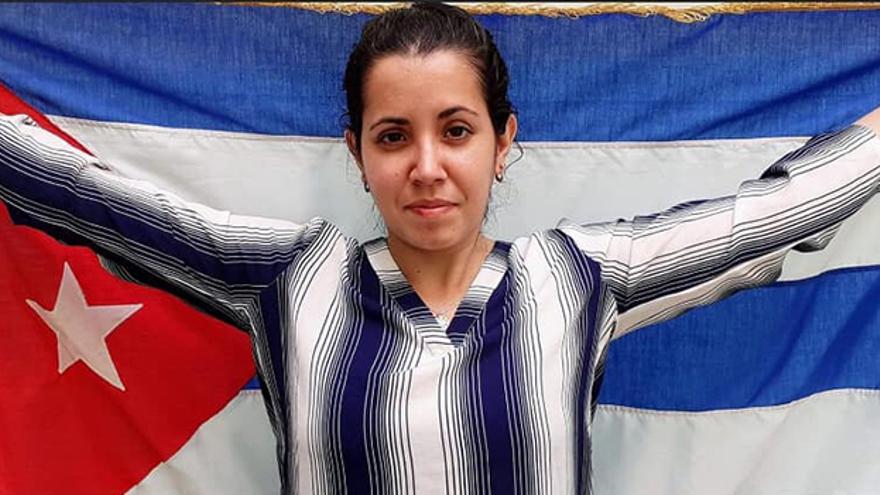
14ymedio, Havana, May 27, 2022 — Camila Acosta has avoided trial for an alleged crime of public disorder after paying a fine of 1,000 pesos imposed by State Security. The independent journalist, who was arrested for reporting on the protests of July 11 (11J) and had been under house arrest for 10 months, reported on the resolution of the case in an article published by Cubanet, the media with which she collaborates.
Acosta relates that the Aguilera police, in the municipality of Diez de Octubre, summoned her on Wednesday and imposed a fine on her in the presence of her lawyer under a rule — relating to the criterion of opportunity — that allows proceedings to be resolved without going to court.
The fine must be paid in three days, and although she believes this is arbitrary, she is accepting it to avoid going to trial, “which, knowing the constant violations that are committed and the state of total defenselessness before the laws, is the lesser of evils.”
In addition to the fine, State Security confiscated personal property that she allegedly had on the day of her arrest on July 12: two laptops, a hard drive, two phones, five flash drives, work agendas, books, a blouse she wore on July 11, $50 and 20,000 CUP pesos. “Some of these assets were not even my property,” the journalist adds. They returned only a phone charger, a wireless computer mouse, and a recording device, which she thinks they broke, because it doesn’t work.
Acosta denies that a she committed a crime and, even less, that the confiscated objects are related to the public disorders that she was charged with. continue reading
During the four days she spent in detention, the journalist says that she was interrogated by State Security twice a day for two hours each time, and she confirmed to them that she participated in the July 11 protests as a reporter. “I don’t regret having done it, and I would do it again. Reporting is not a crime, nor is a peaceful demonstration.”
Camila Acosta says she is aware that she didn’t commit a crime, but going to trial would mean a sentence of three months to one year in prison. The criminal investigation against the journalist was opened ten months ago, and in the last five she was under daily surveillance in her home, where she was constantly harassed “with the psychological burden that this represents, both personally and for family and friends.”
The journalist predicts that her fight is not over yet. “The new Criminal Code is more criminal than the previous one and provides the regime with repressive tools that directly attack independent journalists, the opposition and civil society in general. The torment is far from over.”
Camila Acosta is a contributor to CubaNet and the Spanish newspaper ABC, and before moving to the independent Cuban press she was on local television, Canal Habana.
The transition to the private sector has cost her family break-ups, repression and the harassment of State Security, as is the case with many other reporters and activists.
The resolution agreed in this case coincides with the release of several young people who participated in the 11J protests, such as the young Andy García Lorenzo, who went from prison to an “open regime” camp; after an appeal, five others obtained the same benefit: Jorge Gabriel Arruebarruena, José Miguel Gómez Mondeja, Lázaro Alejandro Rodríguez Ruiz, Ariel Núñez Martínez, Mercy Daniela Pitchs Martínez and Amanda Dalai Matatamoros Cabrera.
Jonathan Torres Farrat was also released, as a change of pre-trial measure, after the payment of bail, while awaiting his trial.
Others released on Wednesday were Eloy Bárbaro Cardoso, an 18-year-old university student captured in La Güinera; Juan Yanier Antomarchi Nuñez, also 18 years old and sentenced in the first instance to 8 years of deprivation of liberty, and Dariel Cruz García, 20 years old, who also received an 8-year sentence.
In total, this week, 15 accused of participating in the July 11 protests have been released. Thirteen of the protesters had their sentences reduced by up to 10 years, and two were switched to correctional work, one of them without internment.
Translated by Regina Anavy
____________
COLLABORATE WITH OUR WORK: The 14ymedio team is committed to practicing serious journalism that reflects Cuba’s reality in all its depth. Thank you for joining us on this long journey. We invite you to continue supporting us by becoming a member of 14ymedio now. Together we can continue transforming journalism in Cuba.
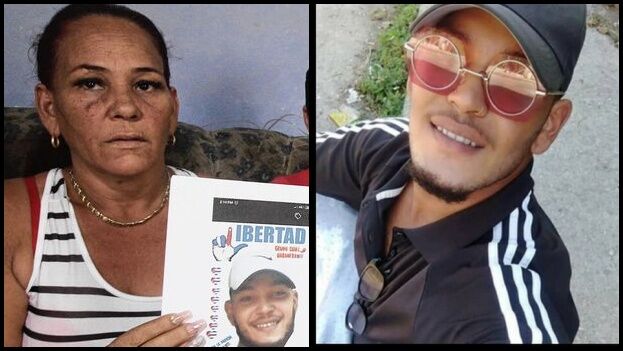
Migdalia Gutiérrez Padrón and her son Brusnelvis Cabrera Gutiérrez. (Collage)
14ymedio, Yoani Sánchez, Havana, 27 May 2022 — Migdalia Gutiérrez Padrón can’t stand it anymore. The nightmare that she has lived through for more than ten months has become very difficult to bear. On May 11, her hopes were pinned on the appeal trial of her son Brusnelvis Cabrera Gutiérrez, sentenced to 15 years for the La Güinera protests in Havana. But in that oral hearing they only reduced his sentence by five years. The young man has a decade left behind bars.
“The defense attorneys behaved very well,” the mother tells 14ymedio, “but the prosecutors blamed the boys and tried to make them look like criminals.” The appeals trial took place in the Diez de Octubre Popular Municipal Court, and for the relatives of the accused it was a bitter pill to swallow: “I had a lot of tightness in my chest because of so much injustice that was being committed there against them and especially against my son,” 21 years old.
Gutiérrez had the hope that the error of the first trial, which was held in March, would be corrected and that her son would be released. On that occasion, the image of a young man on a motorcycle who, with the movement of his arm, summoned the protesters, was enough for the Court to sentence him to 15 years in prison, an alleged evidence that the mother insistently refutes. “The boy in the photo has no tattoos on his arm and my son has it full of tattoos.”
However, the appeal process did not conclude as expected. “There was a big police operation around the Court,” she recalls. After the trial, more than two agonizing weeks passed and this Wednesday she had to tell her son by phone the result of the appeal. “He felt so bad when he heard the 10-year sentence that I asked him to get someone close to him to talk to, to help him process the information.” continue reading
Cabrera is being held in the Combinado del Este prison, the largest on the island, and was sentenced for the crime of sedition that has been widely used in the trials against the protesters on July 11 and 12, 2021. “I told him I was going to do the impossible to fight for their freedom but I couldn’t. But now I don’t have much hope left, I am really discouraged.”
After hearing the sentence of ten years in prison, the mother went to see the defense attorney to review the case. “As his mother I am not going to stop fighting. I am his mother and I am his voice. Right here in La Güinera several of those convicted of the protests, and who are under 21 years of age, have received, after the appeal, the possibility of going to open-regime camps, but they left my son with ten years in prison.”
Despite multiple witnesses who placed Cabrera in another location on that day of popular demonstrations, the Court dismissed this evidence and argued that “it was clear that those who testified” in favor of the accused “were not credible,” although the only action described by the youth during that day is to “drive a red moped” and with “gestures with his hands and movements with his body” summon people to join the march.
The conviction against Cabrera has shaken the entire family that lives on 2nd Street, in the Rosario neighborhood, a very poor area. For months they have had to focus on the judicial process and looking for food to take to the young man to prison. The mother’s strength is diminished: “I feel destroyed by that decision that the Court has made, because my son has to spend ten years in prison.”
In La Güinera, in the Havana municipality of Arroyo Naranjo, dozens of mothers are in the same situation as Migdalia.
____________
COLLABORATE WITH OUR WORK: The 14ymedio team is committed to practicing serious journalism that reflects Cuba’s reality in all its depth. Thank you for joining us on this long journey. We invite you to continue supporting us by becoming a member of 14ymedio now. Together we can continue transforming journalism in Cuba.
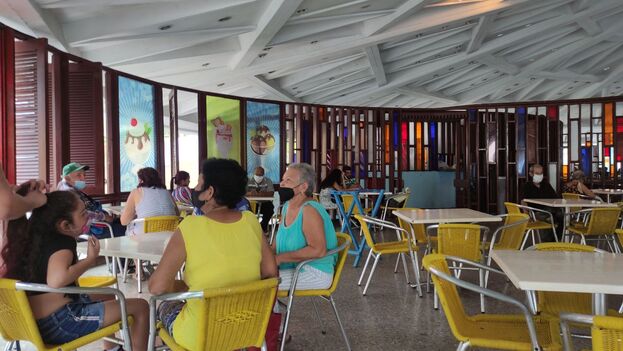
On the ground floor, half of the tables were also empty, something unusual in the history of Coppelia. (14ymedio)
14ymedio, Juan Diego Rodríguez, Havana, 27 May 2022 — Coppelia, Cuba’s “Cathedral of Ice Cream” in the heart of Havana’s Vedado district, has always been characterized, more than by the quality of its product — always far from that sixties dream of Fidel Castro of producing more and better flavors than the United States- – due to the very long lines that had to be endured before entering under the shade of its concrete ceilings.
In recent weeks, those lines, like the flavor of their ice cream scoops, which they have been making since March with soy milk instead of cow’s milk, have disappeared. “Go up to the tower, it’s empty!” employees shouted at customers who agreed this Friday to cool off in the May heat, asking them to go up to the top floor, traditionally the most frequented.
On the ground floor, half of the tables were also empty, something unusual since the place was founded, in 1966.
“It’s just that lately it has very few flavors,” argued a girl, who admits that she goes to Coppelia less than she used to. “When the price increase started, they increased the variety and improved a little bit. Now they all taste the same.” continue reading
One of the generalized complaints is the scarcity with which they distribute the ice cream scoops for the ‘salads’ – as the multi scoop treats are called. In the opinion of a young client they are only half of what they should be.
Another regret is that in the salads they offer for sale – two per person at 70 pesos – there is less and less variety of flavors (this Friday, only vanilla and guava). The chocolate, which is part of the obligatory combination, vanishes within a few hours of opening.
“Niño, if you combine the salads with the same flavors, how come you run out of chocolate first?” a lady complained to one of the employees, who tried an unlikely response: “In the areas where the employees went out to lunch, they still have a little left.”
The woman was not satisfied. “Here what happens is the usual, intrigue and business,” she murmured between her teeth. “They are doing something with that chocolate*. Because if they start out with the same amount of chocolate as guava and vanilla, it cannot be that it runs out hours earlier.”
Beyond musings, the reasons for Coppelia to be emptied of customers must also be sought in the increase in competition. In recent years, other ice cream parlors, private ones, have proliferated, offering a slightly more expensive product, but of much higher quality.
Another young man, who usually frequents these businesses, is blunt: “Here in Coppelia the ice cream is bad and they have raised the price, and that’s it. This ice cream should be served to the visitors of the Cumbre del Alba [the Alba Summit], so that they know what ‘integration’ is.”
*Translator’s note: She is implying that they are selling it ‘under the table’ and/or taking it home.
____________
COLLABORATE WITH OUR WORK: The 14ymedio team is committed to practicing serious journalism that reflects Cuba’s reality in all its depth. Thank you for joining us on this long journey. We invite you to continue supporting us by becoming a member of 14ymedio now. Together we can continue transforming journalism in Cuba.
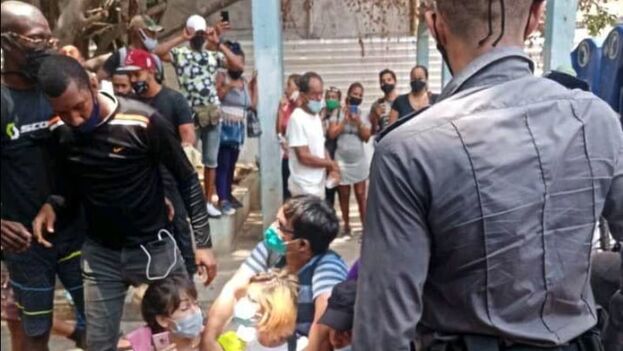
Demonstration in Havana in protest of the repression and in solidarity with Luis Manuel Otero Alcántara. (Screen capture)
Alexis Romay, New Jersey, 27 May 2022
The Cuban people have spoken:
they have voted with their feet,
they gather on any street
to talk about what’s been broken
for so long that not a token from the government can quench
the thirst, the hunger, the stench
stemming from that institution
that some call “the Revolution,”
which digs its grave and its trench.
____________
Author’s note: This text is my recreation and condensation, in English, of my décimas published this week in the Spanish edition of 14ymedio. Remember, this post —part of Ideological Deviation, my weekly column— is considered a crime by the Cuban government.
COLLABORATE WITH OUR WORK: The 14ymedio team is committed to practicing serious journalism that reflects Cuba’s reality in all its depth. Thank you for joining us on this long journey. We invite you to continue supporting us by becoming a member of 14ymedio now. Together we can continue transforming journalism in Cuba.
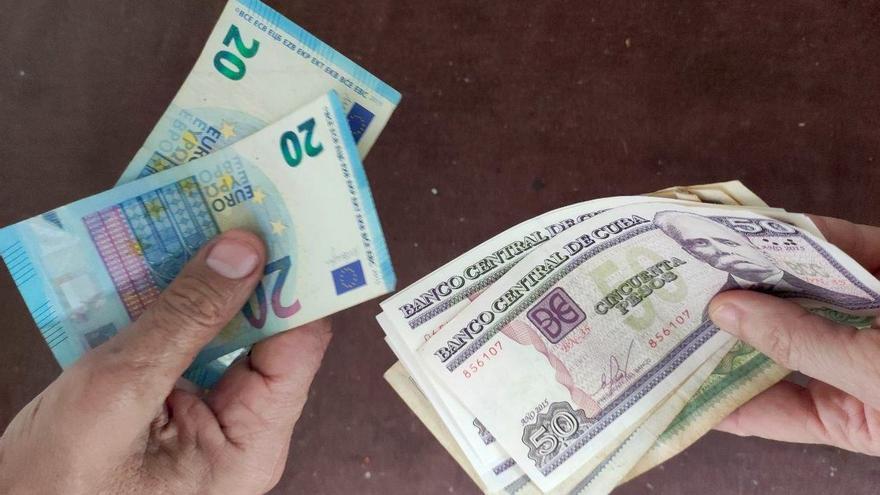
Until last week, the price of hard currency on the black market was on the rise. (14ymedio)
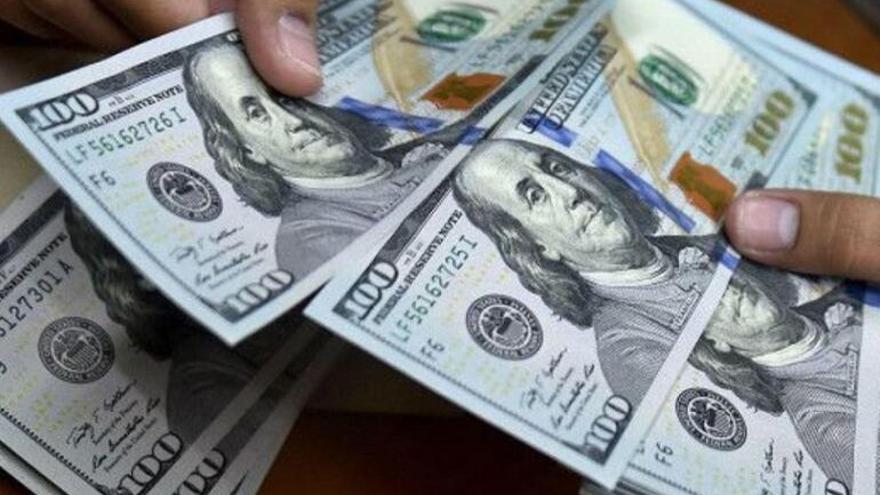
14ymedio, Havana, 25 May 2022 — The price of hard currency in Cuba is plummeting on the informal market. Not only has the freely convertible currency (MLC) fallen, but also the dollar and even the euro.
“Last week the MLC rate was 125 pesos, but I could only sell at 10 to 110 pesos to a family member,” says Niurka, a Havanan from El Vedado, who receives remittances and suffers first-hand from the fall of the freely convertible currency, which de facto replaced the Cuban convertible peso (CUC) after its disappearance, dictated by the so-called Ordering Task*. “I can’t explain it to you. I can spend 1,100 [Cuban] pesos in one moment in the agro market now,” she complains.
Like so many other Cubans, Niurka usually changes much of what she receives into Cuban pesos. “In the MLC stores you don’t buy everything you need. Yes, chicken, tomato puree, some olive oil, a condiment or a jam, but I buy the rest on the street, in CUP: meats, vegetables, rice, beans… Not to mention the daily expenses, electricity, gas, the telephone,” she explains.
According to the figures published daily by the independent media outlet El Toque, the black-market exchange rates are 110 Cuban pesos (CUP) per MLC, 100 per dollar and 115 per euro. The drop is substantial compared to what was quoted last week: about 125 pesos per MLC, 115 pesos per dollar and almost 130 pesos per euro.
Until then, the price for hard currency was on the rise, due to growing demand, on one hand because of the need to buy products in MLC stores that are not found in the peso stores, and, on the other, because of the need for dollars for those who want to emigrate. continue reading
The turning point came on May 14, when the Cuban Minister of Economy, Alejandro Gil Fernández, declared that a “special” exchange rate would be established for some producers, state and private, of high-demand goods. He didn’t give details except to say that it would be between the official rate of 24 pesos and that of the informal market, which in those days was reaching 125 pesos.
The measure immediately aroused criticism from experts, such as economist Pedro Monreal, who called it “one more nail in the coffin of the ’ordering task’ and a possible source of illegality.” In any case, the collapse of the MLC this week seems to be a direct consequence of those statements.
Another factor that influenced the fall in currencies is the new measures announced by the Biden Administration last week on May 16, which include the elimination of the $1,000 per quarter/per person limit on remittances.
This restriction had been in force since 2019, when it was promulgated by then-US President Donald Trump along with other provisions that largely paralyzed the official business of foreign exchange, such as the prohibition on doing business with the Cuban military. This was the case of Fincimex, blacklisted by the US Treasury in June 2020, which managed remittances up to that time.
Remittance services, such as Cubamax or VaCuba, two of the most used, haven’t yet received official communication to eliminate the limit of $1,000 every three months, but Biden’s mere announcement seems to have had an effect on the informal foreign exchange market.
“Something is happening in Cuba with the MLCs,” says Jonathan, who emigrated to the United States last year. “The muchacho I use to send remittances to my family, for the first time in almost a year doesn’t have MLC there to pass on to them.” And not only freely convertible currency, which only works if deposited on a Cuban magnetic card, but also dollars, euros or even national currency.
Jonathan says that just a week ago, he was able to send money without a problem in this unofficial way, but it turns out “that yesterday I wrote him and he says that he has no MLC or anything. That things are bad right now. I asked him when he was going to have it and so far he hasn’t answered me.”
*Translator’s note: Tarea ordenamiento = the [so-called] ‘Ordering Task’ is a collection of measures that include eliminating the Cuban Convertible Peso (CUC), leaving the Cuban peso as the only national currency, raising prices, raising salaries (but not as much as prices), opening stores that take payment only in hard currency which must be in the form of specially issued pre-paid debit cards, and many other measures related to the Cuban economy.
Translated by Regina Anavy
____________
COLLABORATE WITH OUR WORK: The 14ymedio team is committed to practicing serious journalism that reflects Cuba’s reality in all its depth. Thank you for joining us on this long journey. We invite you to continue supporting us by becoming a member of 14ymedio now. Together we can continue transforming journalism in Cuba.
Luz has continued to publish her articles that focus, especially, on life. (14ymedio)
14ymedio, Yoani Sánchez, Havana, 26 May 2022 — Luz Escobar must have been “The New Man.” She boarded a train every eleven days at the Tulipán street train station in Havana to get to a pre-university course in the countryside that she hated but needed to obtain the diploma that would propel her towards university. She went through it all: bullying, lice and no water supply. She was the daughter of the Cuban social experiment from which she would end up distancing herself: the ideological alchemy did not work with her.
Luz was not born as a journalist five years ago or even a decade ago. She was practically nursed in a Newsroom. A photographer mother and a reporter father, that girl with abundant black hair grew up surrounded by the typical questions we ask ourselves every day in this guild. The “six W’s,*” or the big questions of the job, she incorporated from a young age as something natural, everyday. She didn’t become a columnist, she grew up one.
Then came the hugs, the tears and the congratulations. There was no lack of those who said that “son of a cat hunts mice,” because of this daughter of a journalist father who has been in the profession for more than half a century and exercising it from within Cuba. But, although the congratulations that bind her to the family may be partly right, this is not the triumph of the family tree or of blood, this is the achievement of someone who tried to fit into the official molds of indoctrination and shook them of … one by one. This is the triumph of Luz Escobar. continue reading
Luz’s daughters are two wonderful teenagers. They have grown up hearing police operations that do not let their mother leave her house. They have been harassed in all spaces, even the lowest, which I reserve in this text out of modesty and due to the necessary restraint that must be shown on information involving minors. But they have risen above them with everything and much more. The meanest and the dirtiest has fallen on them.
However, Luz has continued to publish her articles, which focus, especially, on life. She is one of those few street journalists, from corner to corner and from daily stories who remains on this Island where the iron repression has forced so many colleagues into exile. She was there , almost like the first, when a wall collapsed on the corner of Monte Street in Havana; she is seen in several photos reporting from the historic May 11, 2019 march on the Paseo del Prado, and also at the events in front of the Ministry of Culture on November 27, 2020.
Each of these coverages had its punishments and retaliation. If Luz has not told all the details about the penalties she received, it is because she has always preferred to be the source of information, someone who reports from the place, before being an object of the reporting and relating only what happens to her. She has preferred to shed light on others rather than stare at her own navel. The difference is a thin red line, but she has known who and when she should cross it or how best to do it.
Eight years ago, when the newspaper 14ymedio was founded, Luz had two little girls who absorbed almost all her time. She was unable to be a full-time reporter in those early days but she joined the team very soon after. We, jokingly, compared the first months of this Newsroom with the stage in which the foundations of the Yugoslav model building where our headquarters are located in Havana were dug.
When the excavations began to raise the building, in that distant 1981, the waters did not take long to cover the hole where the columns were going to melt. The first builders, who – besides being unintentional builders -were those who would inhabit this ugly block and they had to submerge themselves in the mud and the miasma that drained towards the crack in the earth. Later “microbrigadistas” continued to arrive, but the initial sacrifice was unique and highly valued almost 40 years after the building was completed.
Luz was not totally dedicated to the hole, but she reached the top. She rose from the sewers of a system that only accepts their orders, to fly above all of them and all of us. She has done journalism where many believed that only obituaries could be written. She overcame the personal and collective traumas that successive economic crises and surveillance left us. She broke with the paranoia although the paranoiacs continue to watch her.
The train whistle sounds. She no longer goes to a rough concrete block where she is forced to work and pretend. It is the whistle of the profession, as pressing and unappealable as the cry of a hungry child in her cradle. Luz knows that there is no other: journalism or journalism; write or write; narrate or narrate The mice are the ones that hunt the cat in this case, the fierce feline of a regime that, although it appears to be invulnerable, is afraid of journalism.
COLLABORATE WITH OUR WORK: The 14ymedio team is committed to practicing serious journalism that reflects Cuba’s reality in all its depth. Thank you for joining us on this long journey. We invite you to continue supporting us by becoming a member of 14ymedio now. Together we can continue transforming journalism in Cuba.
14ymedio, Madrid, 26 May 2022 — The twentieth edition of El Mundo International Journalism Awards celebrate freedom of expression and the free flow of information by awarding prizes to two reporters who, from different parts of the globe, are an example of the fundamental values of the profession: courage and rigor.
In the Best Journalistic Work category, the winner was the Russian journalist Alexey Andreevich Kovalev, head of research for the Meduza news project, based in Riga (Latvia). And in the Freedom of the Press category, the winner is the Cuban journalist Luz Escobar, a reporter for the digital media outlet 14ymedio, who is currently under house arrest in her country.
After the careful deliberations, the jury made the decision to announce the awards this morning and plans to deliver them at the end of the summer. Jury members are Joaquín Manso, director of the newspaper El Mundo and president of the jury; Silvia Román, editor-in-chief of El Mundo International; the novelist Carmen Posadas; Araceli Mangas, senior academic and vice president of the Royal Academy of Moral and Political Sciences and Professor of Public International Law and International Relations at the Complutense University of Madrid, together with political scientist José Ignacio Torreblanca, director of the Office of the European Council on Foreign Relations, and César Antonio Molina, former Minister of Culture and writer.
The prize, endowed with 20,000 euros and a commemorative sculpture by the artist Martín Chirino, recognizes rigor, journalistic value, ethical commitment and the defense of freedom of expression. These awards are being held in memory of El Mundo journalists Julio A. Parrado, a victim of the Iraq war, Julio Fuentes, assassinated in Afghanistan, and José Luis López de Lacalle, columnist for El Mundo assassinated by ETA, the Basque separatist group.
Last year, after the absence of the awards in 2020 due to the pandemic, the winners were Anne Applebaum, who works at The Washington Post, and Roula Khalaf, a Lebanese journalist and director of the Financial Times. continue reading
Kovalev and Escobar thus join a long list of journalism professionals who, over the last two decades, have celebrated the importance of the profession with El Mundo. In 2019, former Washington Post editor Martin Baron and The Times editor John Witherow were recognized.
In recent editions these international awards have also been given to important names in the national and international journalistic profession such as Thomas L. Friedman, Lydia Cacho, Anabel Hernández, Mark Thompson, Klaus Brinkbäumer, Manu Brabo, Santi Palacios, Salud Hernández-Mora, Rosa Montero, Arturo Pérez-Reverte or Javier Espinosa. Raúl Rivero, who died in 2021, was also one of the winners in the 2003 edition. Rivero was imprisoned in Cuba and later became a regular collaborator and columnist for this newspaper.
The newly appointed director of El Mundo, Joaquín Manso, has highlighted the worth of both winners. In the midst of the war in Ukraine, de Kovalev stressed that he “brings information to Russian citizens” and also that he was responsible for demonstrating, among other things, “Trump’s links with the Russian oligarchy… There are few sources of information about Ukraine for the Russian citizen,” he emphasized.
The award to Luz Escobar highlighted her “her work of denunciation and her courage” defending free information. Escobar is currently under house arrest. In the words of Silvia Román, editor-in-chief of the international section of El Mundo, it is important “not to forget” this type of profile and that her work “is not in vain.”
COLLABORATE WITH OUR WORK: The 14ymedio team is committed to practicing serious journalism that reflects Cuba’s reality in all its depth. Thank you for joining us on this long journey. We invite you to continue supporting us by becoming a member of 14ymedio now. Together we can continue transforming journalism in Cuba.
An image of the same old man in a corner of Centro Habana, the left on May 11, the one on the right, this Thursday. The missing poster said ‘The Party is the soul of the Revolution’ (14ymedio)
14ymedio, Havana, 26 May 2022 — In a green plastic box, the kind used for bottles, and in another cardboard box, between colored paper and newspapers, the eighty-year-old man, with tobacco in his mouth and a resigned gesture, exhibited his items for sale: soap and cigarettes – purchased with the ration book – homemade tomato puree – of a dubious color – toothpaste, menstrual pads…
It was not a strange image in Cuba, where pension money is not enough for retirees and they have to make a living in order to survive . At worst, they dig through the garbage; at best, they resell what they buy in the regulated market, like this old man stationed with his chair on a corner of Centro Habana.
What was striking was the poster behind him, summoning the Eighth Congress of the Communist Party of Cuba, which was held between April 16 and 19, 2021, with the words: “The Party is the soul of the Revolution.” In the year that had passed since the sign had been put up, the official red color had turned pink.
This Thursday, the same old man returned to the same corner, with the same boxes and the same precarious resale products. But, this time, without the same poster. Someone decided it was time to remove it. The Party no longer watches over the old man’s miserable business. Gone from his sight is “the soul of the Revolution.”
____________
COLLABORATE WITH OUR WORK: The 14ymedio team is committed to practicing serious journalism that reflects Cuba’s reality in all its depth. Thank you for joining us on this long journey. We invite you to continue supporting us by becoming a member of 14ymedio now. Together we can continue transforming journalism in Cuba.
Valladares was jailed at the age of 21 for refusing to hang a plaque that read “I am with Fidel.” (EFE)
EFE (via 14ymedio), Miami, 26 May 2022 — Pedro Luis Boitel was forced to go thirsty during a hunger strike in prison, because “Castro gave the order that they cut off his water until he died,” according to what his cellmate, the human rights Armando Valladares, told Efe.
“You cannot write the history of political prison in Cuba without naming Pedro Luis,” says Valladares, a painter, poet and former US ambassador to the UN Human Rights Council, in an interview with Efe.
“Fidel Castro expressly hated Pedro Luis, a leader of the 26th of July Movement and exiled (by Fulgencio Batista) in Venezuela,” Valladares comments shortly before participating in a colloquium in Miami on Wednesday for the 50th anniversary of Boitel’s death.
“He was well known and the candidate with the most possibilities to win the elections (for president) of the FEU (University Student Federation)” before the Revolution, he adds about his companion in cell 64, of circular building number 4 in the Isle of Pines prison, now in disuse and from which they both fled.
In 1961 Boitel was arrested and charged with conspiracy against the state. He was sentenced in a trial to ten years in prison, a sentence that was later extended with other charges.
A kind of maximum security Alacatraz, found in a small island in the south of Cuba, the Isle of Pines was considered “impossible” to break out of, recalls Valladares, who turns 85 next Friday.
Valladares, imprisoned at the age of 21 for refusing to hang a plaque that read “I am with Fidel” and who spent 22 years in prison, during which he suffered torture and punishment of all kinds and went on eleven hunger strikes, met Boitel at the La Cabaña prison in Havana. continue reading
“When they finished my interrogations in the political police, they sent me to galley 12 in La Cabaña. At the door was Pedro Luis, thin and with very large glasses. Then we were together for years and years and years,” he recalls.
“When we escaped on October 21, 1961 – I remember it because I was released on the same day 20-odd years later – there was a guard who walked around at sunset with a dog and a rifle,” he relates about this installation, in which Fidel Castro was also imprisoned before being amnestied by the Government of Fulgencio Batista.
“We went inside the barracks dressed as soldiers, greeting the guards. They captured us on the third day because the people who were supposed to pick us up on the coast did not come, they thought it was impossible for us to escape,” adds Valladares.
“We were the only ones who managed to get out of the cordon of the prison, it will remain in history, I don’t know why there is a tendency to eliminate this heroic and almost novelistic act from the interviews,” he laments, and clarifies that the idea of the escape was Boitel’s.
Upon being captured, they were taken to the punishment cell where they remained “almost a year,” says Valladares. “We went on strike to get us out of there, which was the first,” recapitulates the author of the book Against All Hope, where he recounted his memories after 22 years in prison.
According to the activist’s account, Boitel was taken to the Military Hospital (in Havana), where he was one of the first to be given civilian clothes. “He was making strikes until the last one in (the prison of) the Castillo del Príncipe.
It was a hunger strike, not a thirst strike. Fidel Castro gave the order that the water be cut off until he died,” says Valladares.
Boitel died at the age of 41 on a hunger strike on May 25, 1972 in the Castillo del Príncipe prison in Havana.
The organizers of the tribute to Boitel, among which are the “Plantados hasta la Libertad de Cuba” [Resisters until Cuba is Free], the Institute of Cuban Historical Memory against Totalitarianism and the PEN Club of Cuban Writers in exile, yesterday brought a floral offering to the tomb of the Boitel’s mother, Clara Abraham de Boitel, at Miami’s Flagler Memorial Cemetery.
In the afternoon, the documentary Boitel: Murienda a plazos, directed by Daniel Urdanivia and produced by Pedro Corzo, was screened at the Tower Theater in Little Havana, where Valladares spoke to the audience.
Next to him was “another great friend of Pedro Luis”, Richard Heredia, also an anti-communist and who was with Boitel “underground.”
“It is a well-deserved tribute. Pedro Luis is a legend for all political prisoners like me. Fortunately, we have groups within Cuba that have even adopted his name,” he stressed.
____________
COLLABORATE WITH OUR WORK: The 14ymedio team is committed to practicing serious journalism that reflects Cuba’s reality in all its depth. Thank you for joining us on this long journey. We invite you to continue supporting us by becoming a member of 14ymedio now. Together we can continue transforming journalism in Cuba.
The author of this series of articles, with young Nicaraguans and Hondurans, minutes after crossing the Rio Grande to enter the US near McAllen, Texas. (14ymedio)
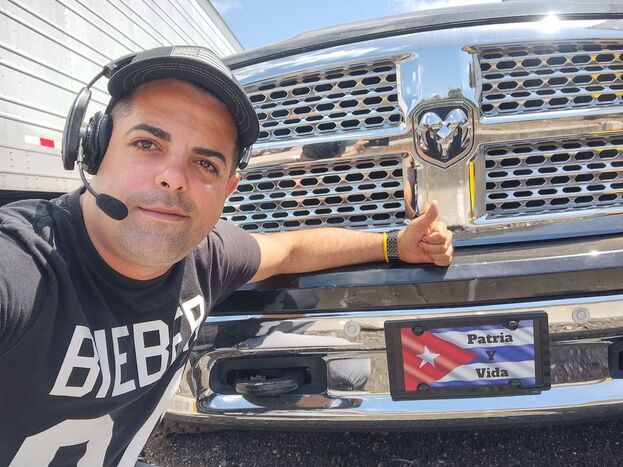
14ymedio, Alejandro Mena Ortiz, 2 May 2022 — The conditions of the prison were not bad, as I was saying, and in addition you could also play Parcheesi, dominoes, chess, soccer or basketball. We turned into a huge, multinational family.
One of the Cubans who impressed me the most was a guy from Villa Clara who sold everything to be able to leave. He worked with the province’s Fund for Cultural Assets, but he was self-employed. He did restoration works in theaters, in houses of culture, and they paid him lots of dollars. He told me that the level of corruption in the Cultural Center, at least in the municipality of Santa Clara, is incalculable. But then things got bad and Covid was the last straw.
This man was never interested in politics or the situation in the country, because he says that there were months in which he earned thousands of dollars. He built a mansion for himself, houses for the whole family, established pig farms… He had a lot of money and sold it all, although he didn’t tell me a figure.
I also talked to a guy, Richard, who was a cook in Havana. He was interested in pastry and shops and bakeries, and he always wanted to set up his own business, despite being quite young, 25 years old. An aunt of his who lives in Houston told him: “Mi’jito, (Sonny) you’re never going to become anyone there. Come, I’m going to pay for everything so you can set up your own sweets and bread business.” He left a lot of family in Cuba and that hurt him. He had been in prison for 17 days (he was released from prison on March 14th). I only spent 3 days.
There was a Venezuelan who told me: “Maduro is a son of a bitch just like Fidel Castro and his entire generation.” This was one of those who went out to protest in Venezuela in 2017 against the regime there, but they harassed him so much that he ended up leaving and going to Peru. He spent four years there, and it did not go badly, but with the pandemic he lost his job and came to the United States, jumping borders from Peru.
This young man told me that the hardest part of the trip was the Darién jungle, very dangerous. In all the groups that go into the jungle, there is always a person who dies, he says, and in his group, it was a 14-year-old boy. The boy, who could have been from from India, according to what he told me, slipped down a rock, hit his head and was left there. The parents paid some natives 5,000 dollars to carry him to Panama, because the coyote didn’t care. They left them in Panama, the little dead boy and his parents. After that, he didn’t hear from them anymore. He says that if you look to the sides of the Darién trails, you’ll see decomposing bodies, because they cannot be carried. continue reading
You have to carry chlorine tablets to drink the river water, but he didn’t have any tablets and he drank it like that, untreated. Of course, then he had diarrhea and fatigue
Another thing he told me is that the water doesn’t even last a day. You have to carry chlorine tablets to drink the river water, but he didn’t have the tablets and he drank it like that, untreated. Of course, then he had diarrhea and fatigue. The coyote tried to rush them and threatened to leave them behind. In another instance, they made progress, paying about 275 dollars each to cross a river. Paying was better, he said, because the danger of dying is much greater.
After all that, he went through Panama, Costa Rica, Nicaragua… and when he got to Mexico, he said that he crossed it in three days. I told him that he had been extremely lucky, but he disagreed. They had put him in a truck with a false bottom –they had a wooden floor on top, where they placed crates with tomatoes, vegetables, and things like that – and they laid below the false floor, unable to move. Sometimes they stayed like that for 21 hours while they traveled, with stops of up to five hours at the edge of the road, waiting for a checkpoint to leave. They urinated in a bottle that they threw out as best they could, but sometimes it spilled on them.
To make things worse, it either was so hot that they suffocated or so cold that they froze. On one occasion, he says that he thought he was about to die because he was very sleepy and felt nothing.
There were also three Guatemalans there, a strange thing, because they are deported quickly, but they had arrived in December. Their group was caught and they were pointed out as witnesses against the coyote. After 90 days in a prison, they were transferred there, and two had an open expulsion order and the other was given the classification of parole, because it seems that he was the only one who spoke out.
One night, they came to do a PCR test on me and six others, and they told us to be on the lookout, in case they came looking for us. And so it happened: at 4:00 in the morning, they woke us up, they gave us breakfast in a cell and they returned the money we had when we arrived, in my case, 120 dollars. They also took away our prison uniforms and we put on the clothes we arrived in. You could imagine the stink of those clothes.
They took us by bus to ICE (Immigration and Customs Enforcement), and once there, an officer had me sign the papers and told me to stay out of trouble. After that, another bus, and then they took us to a church that welcomed us in a courtyard, sitting on chairs, where they called us one by one.
On that portion of the trip, I met one Venezuelan and two Cuban women. The Venezuelan one left in December and was arrested in Guatemala. The coyotes paid to release her and she was arrested again in Mexico: 30 days in a Tapachula prison. When she was let out, she again looked for someone to help her get across. In total, her family spent thousands and thousands of dollars for her to reach the US. She told me that she was very depressed, that if she had known how things were, she would not have done this. She also told me that she would like to return to her country, but that as long as Maduro was still there, she would not return.
The man asked me what was happening in Cuba, he mentioned Fidel Castro, and I told him that it was his fault that we were not free
On our arrival at the church, where they gave us food and clothes, you can’t leave if you don’t have a plane ticket, so my family tried to buy me one from Laredo to Miami, but they were over $800. In normal times, I was told, that flight is about a hundred something dollars, so we found a solution through Houston. They took me to a bus station, where I bought a ticket to San Antonio for 59 dollars. Two older men who help immigrants were waiting for me there.
I was very moved by this, because they gave me food, toiletries, a mask, and even a small blanket to cover myself. I even told them to save it for someone who was more in need than I was, but in the end, I took it, because the trip was long and my flight didn’t leave until 7:30 in the morning.
The man asked me what was happening in Cuba, he mentioned Fidel Castro, and I told him that it was his fault that we were not free. He was very sympathetic. Also, I really liked San Antonio, with its huge buildings. It seemed incredible to me, to be seeing so much beauty before my eyes.
Arriving in Houston, a cousin of mine who lives there found out and said she wanted to come pick me up. She took me to her house, where I ate, showered, and they washed the clothes I had been wearing, and at 5 in the morning they took me to the airport.
I was a little embarrassed, because the treatment was not the same as for the rest of the passengers: they separated me from the line, they searched me more vehemently, they took photos of me… But I was also amazed at the sheer size of that place: a kilometer to my boarding gate, full of shops, people, life.
I entered the Miami airport through gate 21, and my cousin was waiting for me. I grew up with him but life separated us when he left Cuba and went to Spain, when we were 17 years old; then he ended up in the US. Well, here we are, together again.
At the moment of the embrace, of the uncontrollable tears, I began to remember how long I had spent to get to this country and I couldn’t believe that I had arrived safely, that I had arrived alive. After so much waiting I was with my buddy in this land of freedom.
Alejandro Mena Ortiz in the United States. (14ymedio)
I turned 34 years old on my last birthday, as you already know, in the dungeons of an ice-cooler while I was detained. My closest family – my children, my wife, my parents, my grandmother – are in Cuba.
I was a cook for many years in a private restaurant in Havana, but for a long time I have been working as a reporter for 14ymedio. I am so proud of this that I would need a whole chapter to talk about it.
My trip lasted 26 days from the time I left Havana until I arrived on US soil. It cost a total of 10,075 dollars, including plane tickets, payment to coyotes, cash to eat, etc. This money was put up by a relative, to whom in due course, and when I have it, I will begin to return everything “invested” in my trip.
My cousin is a truck driver here in the US, so in a few weeks by his side I have already crossed 20 states. I have seen many beautiful things. Also, other very ugly ones that I didn’t like, I suppose that happens in all countries.
Now I am discovering what it is like, seeing the lies that the official media in Cuba told us. This is a country with many objectionable things, yes, yes, yes, but it is a country where one can have freedom. I still haven’t adjusted to that. I still have the ghost of fear, of anxiety, when I see, for example, a police patrol or a police officer approaching, because it reminds me of the oppressors who do not allow us to live our lives.
With this chapter ends the series on ‘Cuba, the Island in March.’ A pdf version has been published in the original Spanish and an English pdf will also be prepared and linked to here, along with links to the other articles on this site.
____________
COLLABORATE WITH OUR WORK: The 14ymedio team is committed to practicing serious journalism that reflects Cuba’s reality in all its depth. Thank you for joining us on this long journey. We invite you to continue supporting us by becoming a member of 14ymedio now. Together we can continue transforming journalism in Cuba.
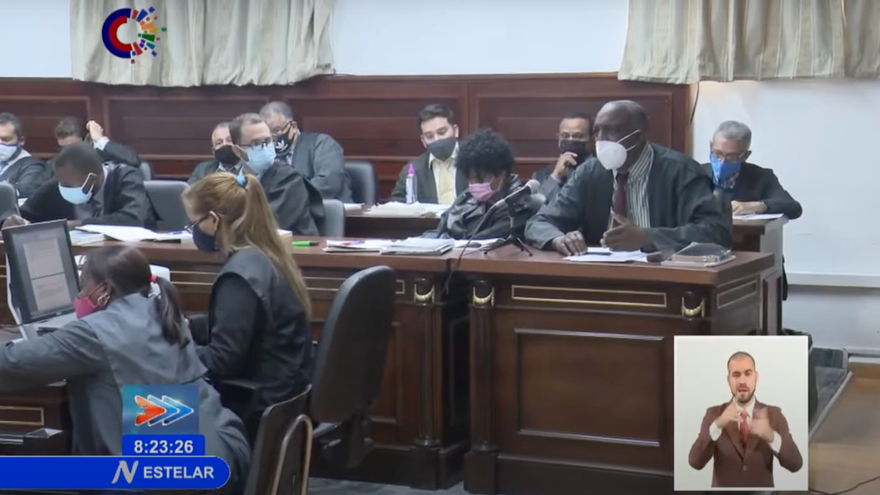
The press does not have access to the trials, only a few images are captured and broadcast on the Primetime Newscast. (Screen capture)
EFE/14ymedio, Havana, 25 May 2022 — A total of 519 of the 564 people who have been tried in Cuba for the anti-government demonstrations last July – 92% – have been sentenced and 40 are still awaiting their sentencing, the NGO Justicia 11J reported on Tuesday.
According to a statement from the organization, only five of the defendants have been acquitted after the start of the trials, at the end of 2021.
In the event that the 40 people who are still awaiting their resolution are found guilty, the percentage of those sentenced would rise to 99%, according to data from the association.
The NGO also reported that “of all the people tried or awaiting trial, we can say that around 70 to 80% have awaited trial under pretrial detention.” In addition, it criticized that 101 people are still waiting for their legal process to begin.
On the other hand, Justicia 11J increased its record of detainees after the demonstrations from 1,444 in April to 1,470 today, 12 minors of whom are under 18 years of age.
With the data of this same association, it can be asserted that the appeals of the convicted are not serving to modify the sentences either. As of 13 May, 40 people had received a response to the review of their sentence in the first instance, of which only one managed to go from one year in prison to acquittal. continue reading
Also in another case, after appealing a sentence of 3 years and 8 months, a prisoner obtained a reduction to 2 years and two months. Most of the remaining cases, at least 32, have kept the sentence intact and some isolated cases have modified the form of imprisonment or reduced the time of internment by one month.
Despite this, organizations defending the rights of prisoners insist that the families continue to resist and not give up a right that could be useful to them, even though the percentage of success is very low.
Relatives of those convicted and organizations have not ceased to criticize the trials, with a total lack of guarantees, fabrication of evidence and high sentences, accusations that the Supreme Court rejects.
However, two weeks ago, Raucel Ocaña Parada, former prosecutor of Palma Soriano, in Santiago de Cuba and now exiled in Europe, awaiting a resolution of his asylum request in Switzerland, said in an interview that the sentences are decided by the party and are imposed on the courts, which are not independent.
The Cuban Attorney General’s Office assured in January that 790 people had been prosecuted for the July 11 protests, of which 55 were between 16 – the minimum criminal age – and 17 years old.
Amnesty International requested to be able to attend the trials, to which the press also does not have access, but it has never been answered in the affirmative. For the upcoming trial of Luis Manuel Otero Alcántara, scheduled for next Monday and Tuesday, the opposition has asked the correspondents to do everything possible to cover it.
The NGO Prisoners Defenders points out that at least 842 people were in prison on the island at the end of 2021 for political reasons, mostly for the events of July 11, although the authorities insist that there are no political prisoners and assure that the legal charges have to do with “acts of vandalism.”
____________
COLLABORATE WITH OUR WORK: The 14ymedio team is committed to practicing serious journalism that reflects Cuba’s reality in all its depth. Thank you for joining us on this long journey. We invite you to continue supporting us by becoming a member of 14ymedio now. Together we can continue transforming journalism in Cuba.
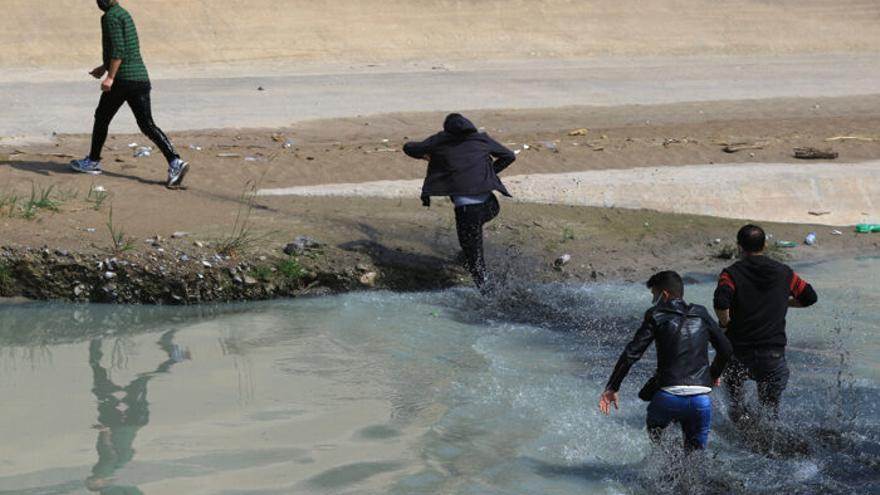
Four Cuban migrants cross the Rio Grande in Ciudad Juárez, Chihuahua (Mexico). (EFE/Luis Torres)
14ymedio, Yunior García Aguilera, Madrid, 25 May 2022 — On June 22, 1990, before the United Nations, Nelson Mandela firmly demanded that the sanctions against Pretoria be maintained. The African leader wondered what mistake had been made to allow a country with apartheid to be seated after the Universal Declaration of Human Rights or the Nuremberg Trials. He strongly urged that the measures not be relaxed until the crime is stopped.
In Cuba we have suffered for decades an ideological apartheid that segregates citizens into two camps: “revolutionaries” and “worms.” Those who have been pigeonholed in the second group have suffered imprisonment, physical and psychological torture, persecution, acts of repudiation, exclusion, censorship, harassment, separation from their jobs or expulsion from their places of study, forced expatriation and even death.
There are testimonies that claim that several public health centers were instructed to deny medical assistance to those they considered “worms.” The irrefutable mark of that apartheid that we suffer is summarized in the phrase that affirms that the streets, the common space, belong only to the ethnic group that carries the revolutionary gene in its cells.
The accession of Miguel Díaz-Canel to the one-party throne has been a huge setback for the aspirations of citizens in areas such as freedom of expression, pluralism, social participation, rights, economic prosperity or democratic changes. Today, a generation without charisma, mediocre to the core, lacking legitimacy or historical weight, clings to the reins of power. The current leadership knows that it no longer has the support of the majority, and the panic of suffering the same fate as Nicolae Ceausescu is reflected on their faces. continue reading
That’s why they quickly resort to the club and the gag. That’s why they keep the largest number of political prisoners behind bars in all of Latin America and see young people as a major danger. That’s why they unanimously approve a reactionary, cowardly and medieval Criminal Code. That’s why they include penalties of up to ten years in prison for the crime of treason that not even contemporary monarchies have taken so far.
It’s a fact that the majority in Cuba is already fed up with the dictatorship and want change. Opinion is divided into how and where. Many were optimistic when Obama decided to try a new strategy, defrosting tensions and trying to empower the private sector on the island. Trump returned to ice and aggressive speech. Now Biden zigzags between isolation and the relaxation of sanctions.
But beyond the leaders’ back and forth is a population of 11 million trapped in hopelessness, misery, impotence and fear. That same citizenry that erupted on June 11 today finds no choice but to sell everything, grab a backpack and cross borders. Although the ruling press says with cynicism that Cubans go to Nicaragua to contemplate the lava of the Masaya volcano, we all know that the stampede advances much further north.
The regime, an expert in turning its defeats into victories, has always used migratory waves for a triple purpose. First, the exodus serves as an exhaust valve to release internal pressure. Second, migration crises are used as weapons to put anyone sitting in the White House on the ropes. These frequent exoduses have almost always been the responsibility of Democratic administrations. Lyndon B. Johnson naively believed that the quarter of a million Cubans who left through Camarioca and the Puente Aéreo could return to Cuba in a short time.
Jimmy Carter lost the 1980 elections, among other things, due to the bad press that exaggeratedly reported the exodus of the Mariel Boatlift. Clinton had to set up the Guantanamo Naval Base as a temporary refuge to avoid a collapse in south Florida, during the Rafter Crisis. But the third and most Machiavellian use of migration by the regime is to convert exile into economic investment. Every Cuban who flees becomes a potential sender of hard-currency remittances.
The vaunted national sovereignty is nothing more than a mirage, a kidnapping, a fallacy.
Translated by Regina Anavy
COLLABORATE WITH OUR WORK: The 14ymedio team is committed to practicing serious journalism that reflects Cuba’s reality in all its depth. Thank you for joining us on this long journey. We invite you to continue supporting us by becoming a member of 14ymedio now. Together we can continue transforming journalism in Cuba.
Kavulich still needs the approval of the Cuban side and is sure that he will get it. (Cubadebate)
EFE (via 14ymedio), New York, 19 May 2022 — The United States authorized for the first time in six decades an investment in a private business in Cuba, undertaken by John Kavulich, who told EFE today that he has been in contact with “officials of the Joe Biden Administration,” congressmen and senators who have allegedly been helping to bring this operation to fruition for almost a year.
Kavulich, President of the United States-Cuba Economic and Trade Council, does not give many details about the investment “up to 25,000 dollars,” nor does he give the name of the Cuban business, since he prefers to wait for Cuba to give the go-ahead. He only announced that this business is not related to the Government of Miguel Díaz-Canel, has more than 5 years in the service sector and has continued growth.
The businessman doesn’t want to give names of who his partners have been in the Biden administration: “[They were] officials of the Biden-Harris administration, including the State Department, the Department of the Treasury, the Department of Commerce, the Department of Defense, the Department of Justice in all areas, as well as the two houses of Congress,” says Kavulich.
Until now, the U.S. embargo on Cuba, in force since 1960, prevented this type of investment and, according to Kavulich, it’s the first time that this type of license has been approved since the boycott came into force.
No official of the Biden Administration has so far spoken on this issue or on the eventual lifting of the embargo on investments in Cuba.
The investor submitted the license request to the Office of Foreign Assets Control (OFAC) on June 10, 2021, and this agency gave him the green light on May 10, 2022. continue reading
Kavulich points out that his efforts with the White House and Congress date back long before the Biden Administration, during which time he has been figuring out if his investment efforts can be successful.
After formally submitting his petition last June, the businessman was optimistic, but as the months went by he lost hope.
“They gave me contradictory statements and communications in the past two months that shattered all my optimism,” he recalled, stressing that the final news of the approval of the investment took him completely by surprise.
In order for Kavulich to be able to invest in this company – -which he discovered thanks to a Facebook group — he still needs the approval of Cuba, but the businessman says he is “90% sure” that he will get it.
“My 90% certainty is not because the Cuban government is enthusiastic, but because of how necessary it is,” he stressed, explaining that this need has become more evident with the great blow that the island’s economy received with the pandemic.
Likewise, Kavulich notes that his objective in this investment is not intended to look for “a fast dollar,” but to pave the way for future investors.
“My role as president of the council and the work that the council has done since 1994 is that if there is a problem, we try to solve it and then let everyone know what we did. And that is precisely what we are doing here,” he says.
For Kavulich, the fact that an investment is allowed by a U.S. businessman on the island can represent a great “potential” for Cuba’s private sector.
Yesterday, Biden took another step in opening up to Cuba by announcing a relaxation of the limitations on remittances and flights, among other things, reversing part of the last round of sanctions applied by former U.S. President Donald Trump.
“It’s hard not to see a connection. We applied for the license on June 10, 2021. They issued the license on May 10, 2022, and six days later, they announced all these other changes. If one plus one equals two, in this case there is no doubt that it’s not a coincidence,” he concluded.
Translated by Regina Anavy
____________
COLLABORATE WITH OUR WORK: The 14ymedio team is committed to practicing serious journalism that reflects Cuba’s reality in all its depth. Thank you for joining us on this long journey. We invite you to continue supporting us by becoming a member of 14ymedio now. Together we can continue transforming journalism in Cuba.
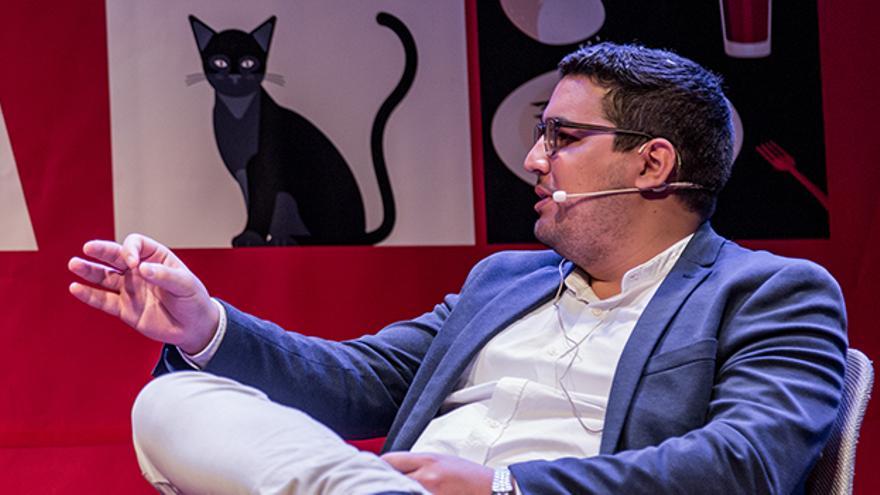
Xavier Carbonell in a debate last month in the Tenerife Noir Film Festival, the Atlantic Festival of the Noir Genre, organized each year in the Canary Islands. (Facebook Tenerife Noir)
14ymedio, Xavier Carbonell, Salamanca, May 22, 2022–Those who think that all ciberclarias* are slick and anonymous are mistaken. Some come with pedigree and martial ranks. There is a group of ever-loyal comrades, trained in military or Party schools, who do not understand the Five Grey Years, nor the special periods, nor have they foreseen crises other than capitalism.
Antonio Rodríguez Salvador belongs to this caste of commissars, censor by vocation and certainly by trade. Last week, I came upon an article by this subject where he demonstrated stupefaction at one of my statements, published in this and other dailies: that the Italo Calvino Prize for Novels — one of Cuba’s most prestigious — had been awarded to me last year and I rejected it in favor of another literary award offered in Salamanca, where I now live.
With more reluctance than skill, what Rodríguez Salvador suggests is that the author of this column must be unhinged, a pathological liar, and that the news outlets that interviewed me, among them El País and 14ymedio, displayed lack of professionalism by speaking with a deranged man.
My first reaction was compassionate laughter, because I understand that the business of defending Castroism is ever more difficult and everyone has to make a living. I understand that Humberto López’s yapping and that of the so-and-so from Con filo — I never remember his name — eclipse the humble trade of censoring in writing, in La Jiribilla or in Granma. continue reading
The nonsense of this CDR [Committee for the Defense of the Revolution] member — inconceivably, a reader of independent news outlets — not only implicated me, but also a colleague at this daily. Thus, to dispel any of my censor’s doubts, I will clarify a couple of points about that day when I received two awards for a single novel.
Toward the end of October 2021 a dark personality called me from Uneac (National Union of Writers and Artists in Cuba) — I don’t plan to identify him, but Rodríguez Salvador must know who I am speaking of: “Don’t act like you don’t know,” he said, “you won the Italo Calvino.” My interlocutor assumed that the Uneac officials in Santa Clara, where I lived and worked, had already spread the rumor. But they were miraculously discreet and I only found out during that phone call. “We do not have a way to get you here, so figure it out.”
Then he read to me the remarks of the judges, which included Roberto Méndez, Carlos Zamora, and Gaetano Longo, which included beautiful and very generous words about the novel. If they are gentlemen and honorable, they will say whether I lie.
On that day I received two missed calls from a Spanish number. I responded and it ended up being the office of the mayor of Salamanca, who on the following day gave me the news of the other prize. When I presented the situation to the person at Uneac, his words were these, “The Spaniards will take the money back when they find out and furthermore you will cause political issues for us with the Italian Embassy, which funds the one here.”
Due to copyright, I could not accept both awards. I opted for the Peninsula’s award, and not for metaphysical reasons: it offered more money and would allow me to leave an oppressive, castrating country where those who travel, live, and triumph — paid by the Government — are the commissars like Rodríguez Salvador, who takes photos of himself “strolling in Buenos Aires” during that country’s book fair.
“Well,” clarified the person from Uneac when I communicated my decision, “we’ve reached a new agreement and there is no problem with your resignation. Send it to me in writing.” His tone, always vulgar and now evasive, had changed since our last conversation. “You know,” he said before hanging up, “that if you say anything, we will categorically deny it.” The prize was awarded in November to writer and finalist, Dazra Novak, who undoubtedly deserved it.
They knew the results since the beginning of 2021. Uneac kept it a secret because the pandemic restrictions prevented Italians from traveling to the country with the 4,000 euros. The fact that one novel on surveillance, paranoia, and censorship had won the prize is a symptom of how weary they, the commissars themselves, are of the game, the act, and the secrecy.
Paradoxically, Uneac opted to hide everything, begin from scratch, and “categorically deny.” The Association’s panic of the “irregular” explains why Antonio Rodríguez Salvador does not have the slightest idea of what happened and accused me of post-modern piracy.
Among other finesse of intellect, the Sancti Spiritus-based writer rambles on about my opinions of the Pope, spiritual fulfillment, and life on the island. “It may be that for this author it is less profitable to publish his works in Cuba than portray himself as censored by the regime,” he concludes.
Rodríguez Salvador forgets — conveniently — what I said in that same magazine and now repeat. I am not interested in playing the role of a censored intellectual (although I was and many times); I am not a writer of political literature (though I am a citizen with the right to criticize the Government of his country) nor do I dramatize exile. I care about writing and living, freely and decently, and that is impossible in Cuba.
“On the conscience of glorified ciberclarias like Rodríguez Salvador are the young prisoners and exiles of the Island. Those who die crossing borders to escape their country. Their families. The censors, for cowardice, money or the inherent malice of mediocrity, are the dictatorship’s most sordid accomplices. If they weren’t so dangerous and infamous, they’d only evoke pity.”
*Translator’s notes: The so-called “cyberclarias” are accounts that hide behind false identities and photos to defend the actions of the Cuban government on Twitter and attack criticism made by dissidents or activists. (Source)
Translated by: Silvia Suárez
____________
COLLABORATE WITH OUR WORK: The 14ymedio team is committed to practicing serious journalism that reflects Cuba’s reality in all its depth. Thank you for joining us on this long journey. We invite you to continue supporting us by becoming a member of 14ymedio now. Together we can continue transforming journalism in Cuba.
As published on Tuesday by the Cuban Electrical Union (UNE) and featured in Cubadebate, there was a failure this Monday afternoon at the Carlos Manuel de Céspedes Thermoelectric Plant in Cienfuegos. Unit 3 of that plant stopped working just hours after two units of the Antonio Maceo plant, in Santiago de Cuba, and Diez de Octubre, in Nuevitas (Camagüey), which had been out of order for a few days, came into operation.
“The electricity generation deficit in Cuba continues to affect the service, despite the synchronization of two other units,” says the publication of the official newspaper. continue reading
Last Friday, the UNE explained in a note that, despite the fact that the Lidio Ramón Pérez thermoelectric plant, in Felton, in the Holguin municipality of Mayarí, was back in operation after a breakdown, it was not managing to supply the demand of the country because “six thermal units continue to fail and maintenance is planned at Feltón 2, Mariel 8 and Talla Piedra.”
The UNE has said that the situation is “complex” and President Miguel Díaz-Canel acknowledged that “the country’s energy situation continues to be very difficult” due to “breakages in some plants and the scheduled shutdowns of others for maintenance.”
However, the Cuban president insisted, the fault lies not with the lack of maintenance of the plants, but with the covid-19 pandemic and “the intensified [American] blockade.”
Each blackout has pushed the patience of Cubans to the limit, because they must suspend work due to the constant outages that arrive without notice, despite the broadcast of a schedule by local radio stations. The situation becomes more difficult on hot May nights that require the use of fans or air conditioning equipment to sleep.
____________
COLLABORATE WITH OUR WORK: The 14ymedio team is committed to practicing serious journalism that reflects Cuba’s reality in all its depth. Thank you for joining us on this long journey. We invite you to continue supporting us by becoming a member of 14ymedio now. Together we can continue transforming journalism in Cuba.
 14ymedio, Havana, May 27, 2022 — Camila Acosta has avoided trial for an alleged crime of public disorder after paying a fine of 1,000 pesos imposed by State Security. The independent journalist, who was arrested for reporting on the protests of July 11 (11J) and had been under house arrest for 10 months, reported on the resolution of the case in an article published by Cubanet, the media with which she collaborates.