
Where is the Cuban Embargo/Blockade?

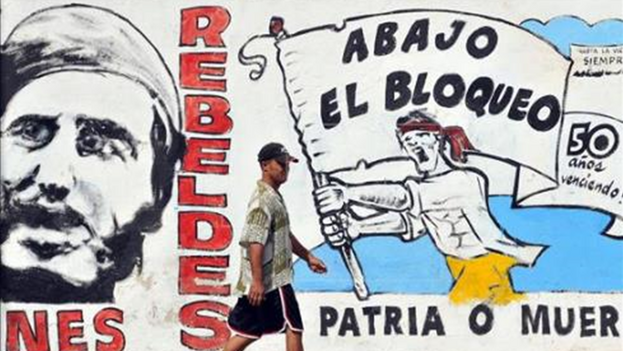
A billboard in Cuba demanding “Down with the blockade” and vowing “Fatherland or Death”

14ymedio bigger14ymedio, Elías Amor Bravo, Economist, 30 April 2022 — Where is the embargo? Day in and day out, the communist leaders parade the intensification of the U.S. embargo/blockade as the origin of all the ills of the Cuban economy. And it turns out that these leaders contradict the news published by the official press of the regime.

The State newspaper Granma boasts in the run-up to May 1st of the signing of no less than 18 agreements this past week by the Castro consortium BioCubaFarma with Cuban and foreign entities.

I insist: where is the embargo? If this fiction created by the Cuban communists to hide their responsibilities really existed, this type of agreement would be impracticable, impossible. But no. The 18 agreements between companies of the BioCubaFarma group and Cuban and foreign entities indicate that there is no restriction whatsoever for Cuba to trade, receive investments, capital or any type of aid from 192 countries in the world.

There is, however, a dispute with the United States that regulates the scope of relations between the two countries, which, moreover, has its well-defined origin in the practices of the communist regime towards its northern neighbor, which has refused from the beginning to negotiate.

Nevertheless, BioCubaFarma’s agreements are implemented, as are the agreements with Vietnam, with Spanish hoteliers, Canadian or Dutch miners, etc. The Cuban economy is one of the most open in the world, receives donations from numerous countries that support the “revolution” and establishes, when it deems it convenient, the most controversial alliances, as in this case, in the field of biotechnology.

The agreements, moreover, have not fallen from the sky. They have been well worked out, despite the “threat” of the embargo, and have been presented as one of the results of the BioHabana-2022 International Congress, which concluded last Friday. Someone from the organizing committee of the congress told Granma “we exceeded a thousand participants, including Cubans and foreigners from 51 countries, although 10% participated virtually; in addition, more than 600 papers were presented in conferences, short oral presentations and posters.” continue reading

Indeed, it is very difficult for a blockaded or embargoed country to hold this type of international congresses, even to promote conference tourism, which is catered for in the formidable luxury hotels of the capital, close to the collapsed buildings, the destroyed streets and the rubble plots of that marvel that was long ago the world’ s old Havana.

Other information published in Granma that questions the embargo is the agreement signed by Cuba and Argentina concerning the housing sector, after the celebration of the XIII International Construction Fair Fecons-2022, which concluded this Friday.

This was a convention aimed at improving the production of construction materials in Cuba, with the participation of state-owned and foreign companies, non-agricultural cooperatives and MSMEs. There they talked about goods needed for Cuba to boost its industrial and housing construction sector, such as plaster, mortars, additives, and the repair and maintenance of equipment, and new investments in technology to achieve efficiency with a rational use of the workforce, but with diligence.

But the event led to the signing of a memorandum of understanding between Argentina’s Ministry of Territorial Development and Habitat  and Cuba’s Ministry of Construction, with the reciprocal interest of promoting the economic progress and integration of Latin America and the Caribbean and collaboration in the housing sector.

Under this agreement, emphasis was given to the family of medium, fine and special pegaporcelain mortars; ceramic tiles decorated with digital printing; gray clinker for cement and the housing cell construction system. This is the embargo/blockade, one more example that the arguments used by the regime are not true.

For the record, this blog will never be against the Cuban economy maintaining its openness to the outside world and obtaining these types of agreements, and even better ones. Cuban biotechnology should advance as much as possible, since it is one of the technologies that encourage the development of the fourth industrial revolution. Betting on this sector could be an intelligent decision. And the same goes for the manufacture of construction materials, whose scarce production has forced the regime to increase its prices significantly.

What we will always denounce in this blog is that the ills of the Cuban economy are attributed to something that does not exist, the embargo/blockade, or that only exists in the imagination of a regime that lives on confrontation and provocation to its northern neighbor since Fidel Castro’s visit to the Teresa Hotel in Harlem in 1959.

A lot of rain has fallen since then, but if in anything in the expectations of the communist regime devised by Fidel Castro have been exceeded, it has been in the field of the embargo/blockade fiction, of which these Granma articles are a good example, of course, of the very opposite.

The embargo/blockade propaganda has worked for the Cuban communists for more than 60 years. It is true that when the multimillion dollar subsidies from the former USSR used to flow in, nobody remembered it, but the sign of the times shows that the relations between two neighbors, which were built by geopolitics since colonial times, were destroyed by the communist regime as soon as it came to power, and this for its own benefit, even if it was detrimental to the interests of the Cuban people.

It is difficult to find a similar process in any other country in the world.

Translated by: Hombre de Paz

____________

COLLABORATE WITH OUR WORK: The 14ymedio team is committed to practicing serious journalism that reflects Cuba’s reality in all its depth. Thank you for joining us on this long journey. We invite you to continue supporting us by becoming a member of 14ymedio now. Together we can continue transforming journalism in Cuba.

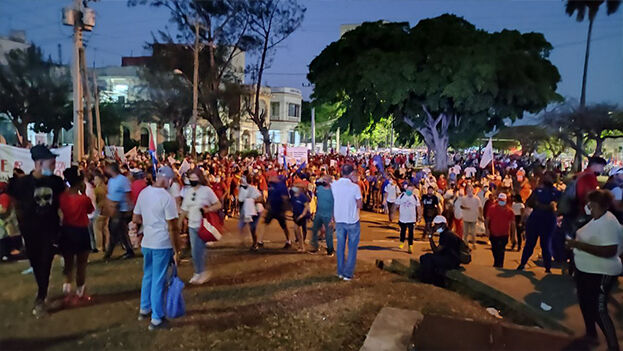
Cuba’s May 1st Parade: ‘The Buses We Haven’t Seen for Months are Here’

Buses on Carlos III avenue and Rancho Boyeros, which transferred the attendees of the May 1 concentration. (14ymedio).

14ymedio bigger14ymedio, Havana, 1 May 2022 — This Sunday, a line with dozens of buses lined part of Carlos III and Rancho Boyeros avenues in Havana while the May 1 parade took place in the Plaza de la Revolución. The Government has paid special attention to this event, after its having been suspended for two years due to the pandemic, and the first parade to take place after the popular protests last July.

Starting at dawn, the buses were transporting participants to the parade and rally for Workers’ Day, especially from the outskirts of the city and from the provinces of Mayabeque and Artemisa. Cuba officialdom has wanted to immerse itself in the crowds, in what the official call itself warned that it could be the last parade with the presence of some historical figures.

Sheathed in his military uniform, Raúl Castro, 90, accompanied Miguel Díaz-Canel and other members of the Cuban Executive on the platform of the Plaza. The event began with the words of a television announcer who addressed the message to “internal and external enemies” to whom he reiterated the slogan “Vamos con todo” [Let’s go with everything] that has become the new official motto in recent weeks.

A day earlier, Díaz-Canel called on Cubans, from his social networks, to participate in the marches throughout the island. “We are going to return to our squares and streets after two years without a march,” he wrote and also published a video message in which he added: “We are going to paint together the landscape of unity and continuity, the landscape of a revolution in power. Vamos con todo to this first of May.” continue reading

Hundreds of people gathered in a park in El Vedado to go to the parade in the Plaza de la Revolución. (14ymedio)

The events began this Sunday after seven in the morning with a message from Ulises Guilarte, general secretary of the Central de Trabajadores de Cuba, the only union in the country. After his words, the parade began with healthcare workers and the scientific sector at the forefront.

The parade was held in the midst of a deep economic crisis that has hit the food supply and the availability of public transport especially hard, a situation that made many desist from joining the official march. In the workplace and among teachers, the calls not to stay at home have become more intense in recent days and have included warnings of reprisals for those who do not attend.

“I walked 13 minutes, measured by the clock, and the line of buses did not end,” a young man from Havana who passed by the parade this Sunday told this newspaper, although in the end he did not decide to join. “They have taken all the buses that we haven’t seen here for months to the streets.”

Calls have been made from dissident circles not to participate in the parade and, if they do, use the rally to demand labor demands and freedom for political prisoners. Numerous activists and independent journalists received threats and police summonses to warn them that they could not go out on the streets during the day.

____________

COLLABORATE WITH OUR WORK: The 14ymedio team is committed to practicing serious journalism that reflects Cuba’s reality in all its depth. Thank you for joining us on this long journey. We invite you to continue supporting us by becoming a member of 14ymedio now. Together we can continue transforming journalism in Cuba.
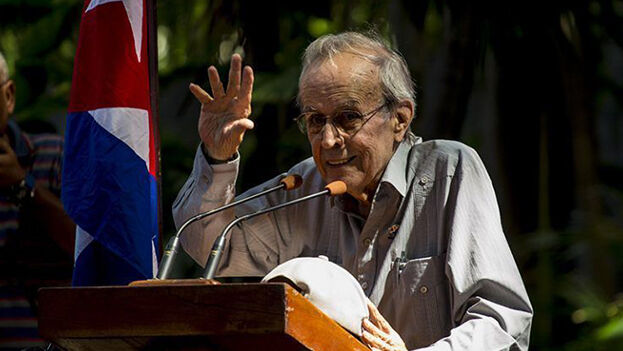
Ricardo Alarcon Dies, the Cuban Diplomat Who Was Sidelined in His Last Years

The most intense memory Cubans have of Alarcón is that of his debate with a student from the University of Informatics Sciences in 2008. (Cubadebate)

14ymedio bigger14ymedio, Havana, 1 May 2022 — This Saturday, Cuban diplomat Ricardo Alarcón de Quesada passed away in Havana at the age of 84. Submerged in official oblivion, after retiring from public life, his health had deteriorated in recent months, family sources confirmed to 14ymedio.

Born in Havana in 1937, Alarcón entered the University of Havana in 1954 where he was part of the leadership of the University Student Federation (FEU). Later he joined the 26th of July Movement and later the 13th of March Revolutionary Directorate.

In 1961, two years after Fidel Castro came to power, he became president of the FEU, a position he held until 1962. That same year he was appointed Head of the Americas Division at the Ministry of Foreign Affairs and served as Cuba’s Permanent Representative to the United Nations between 1966 and 1978.

Alarcón also held the position of Minister of Foreign Affairs from 1992 to 1993, he was Cuba’s ambassador to the United Nations and for 20 years, between 1993 and 2013, he presided over the National Assembly of People’s Power.

In September 1996, he starred in an unprecedented debate with the exiled Jorge Más Canosa of the Cuban American Foundation, which was broadcast on CBS to more than 20 countries, but was only seen in Cuba at that time by a handful of high-ranking figures of the regime with access to satellite dishes.

At the beginning of this century, Alarcón became the most visible face in the campaign for the release of the five Cuban spies imprisoned in the United States after the dismantling of the Wasp Network. In 2012, his advisor Miguel Álvarez was arrested along with his wife, Mercedes Arce, and sentenced to 30 and 15 years in prison respectively for the crime of espionage.

In 2013 Alarcón was relieved of his position as president of the National Assembly. Although the case of his adviser did not come out in the official press, but in the well-informed sectors of Miami it was commented that his departure was linked to the arrest of Álvarez who died of cancer in November 2020.

The most intense memory that Cubans have of Alarcón is that of his debate with the then student at the University of Informatics Sciences Eliécer Ávila in 2008. The young man asked Alarcón why the people of Cuba did not have the ability to travel to different places of the world due to the travel restrictions imposed on the Island.

The president of the National Assembly responded that if everyone wanted to travel there would be a huge congestion in the air, a response that fueled an avalanche of jokes and criticism.

Since his departure from the National Assembly, and especially in the last five years, Alarcón had been removed from the official spotlight and was barely mentioned publicly.

____________

COLLABORATE WITH OUR WORK: The 14ymedio team is committed to practicing serious journalism that reflects Cuba’s reality in all its depth. Thank you for joining us on this long journey. We invite you to continue supporting us by becoming a member of 14ymedio now. Together we can continue transforming journalism in Cuba.
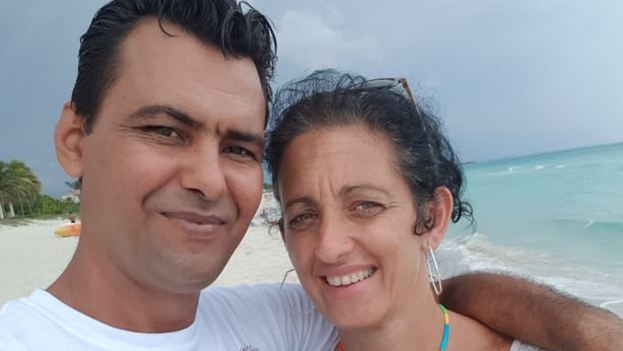
Cuba: ‘My Son Has Never Smiled Again’ Since His Father Was Arrested on July 11th (11J) in Cárdenas

Samuel Pupo Martínez with his wife Yuneisy Santana González. (Courtesy)

14ymedio bigger14ymedio, Yoani Sánchez, Havana, 1 May 2022– Judges did not forgive Samuel Pupo Martínez for starring in one of the most iconic images of the protests on July 11 (11J). Climbing on top of an overturned vehicle, this then 46-year-old man shouted “Down with communism! Patria y Vida!” a few meters from the municipal headquarters of the Communist Party in Cárdenas.

That was the last time that Pupo stepped on the streets of his city. Almost eleven months after the popular protests, he is kept locked up in the maximum security prison of Agüica, in the province of Matanzas. His wife, Yuneisy Santana González, has not stopped denouncing the sentence of seven years in prison for contempt and public disorder handed down by the court.

In the trial, which lasted three days, “his lawyer made a brilliant defense but the prosecutor asked the defendants for the maximum sentence for each crime they had allegedly committed,” Santana tells 14ymedio. “The witnesses they presented were all from the Ministry of the Interior and they showed a lot of inconsistency in their testimonies,” she recalls.

The sentence was pending for a month and both Pupo and his wife felt hopeful because the lawyer had requested a change of the pre-trial detention measure. “He appealed to scleroderma, a degenerative disease that Samuel suffers from and that is not compatible with staying in prison.”

The lawyer presented a summary of the clinical history of Pupo, who in this time has been admitted twice to the prison infirmary, but they denied him the change of measure. “We realized that it doesn’t matter how brilliant the lawyer’s defense is when the sentence is already written in advance.” continue reading

When frustration overwhelms her, Santana remembers those historic protests that shook the island. “It was never seen before. So many people in many provinces asking for freedom. The world saw the reality of what we Cubans live,” she stresses. Although she regrets that “in a few hours everything turned into arrests and mistreatment by the police.”

Pupo was arrested that same day. “They violently arrested him and took him to the Party headquarters between three uniformed men and a man dressed in civilian clothes. Once inside, a ‘red beret’ took his cell phone and threw it on the floor. They also kicked him while he was lying on the ground.”

Santana only saw her husband again 103 days after that arrest. After the reunion, she learned that on the evening of July 11, he was taken in a patrol car to the police station. “While handcuffed, they hit him in the face to forced him to shout ‘Patria o Muerte!’ but he kept repeating ‘Patria y Vida!’.”

Later that night, he was transferred to another Ministry of the Interior facility on the outskirts of the city. “There a ‘black beret’ squeezed his neck so much that he collapsed. At dawn they took him to the Labiotec women’s prison, where he spent 40 days sleeping on a zinc plate without a mattress, with very little food and little water.”

During the first days, his wife went from one place to another looking for her husband. “At the police station they told me that they didn’t know anything. I explained that he was diabetic and that he didn’t have his medication, but the police only questioned why, if he was so sick, he hadn’t stayed home during the demonstration.”

In those first days, “Samuel was psychologically tortured. They woke him up at any hour of the night to interrogate him. Nine days after being detained, Pupo was able to make the first phone call to his family.

“That’s when he told me he was in Labiotec. He had spent that time in the same clothes, without being able to clean himself and with the same facemask. The first visit his lawyer was able to make was on July 28.” Pupo was then transferred to Combinado del Este, the largest prison in Cuba, but on September 11 he was taken to Agüica.

“The food in prison is disgusting and very little. They begin to serve the prisoners from a bucket and sometimes there is not enough for everyone. One day there was only one boiled egg,” the woman denounces. “The calls are once a week and the phone he calls me from is so noisy that I can hardly understand what he is saying.”

“He has lost a lot of vision in these months due to glaucoma, which he also suffers from, he is very thin and sleeps little,” she lists. However, Santana prefers to remember him as an enterprising man, who works as a self-employed person, has a good command of English and teaches that language to a group of students. “In 15 years of marriage we had never separated.”

Together they have a 13-year-old son. “He had a dream to see him graduate from sixth grade and go with him to the first day of secondary school. But he couldn’t fulfill it because he was in prison,” says the woman. “I know my husband would not have missed that moment for the world. My boy has never smiled since his father was arrested.”

However, Pupo’s greatest dream “is that Cuba is free, we have democracy and the president can be elected, that there is not a totalitarian party in power.” He came to that conclusion in part because “in his spare time he was always looking for information on history. He was on top of everything and very up-to-date.”

“I became a mom and dad all at once. Since that day I sleep very badly because I wake up at dawn thinking about how it will be.” The prison guards “tell me all the time that they are going to put me in jail if I continue to demand freedom for him and for all the political prisoners in Cuba.”

When she receives these threats, Santana always has the same question that is immediately answered: “What did Samuel do? Raise his voice, demand his rights and ask for freedom for his country. I am very proud of him.”

____________

COLLABORATE WITH OUR WORK: The 14ymedio team is committed to practicing serious journalism that reflects Cuba’s reality in all its depth. Thank you for joining us on this long journey. We invite you to continue supporting us by becoming a member of 14ymedio now. Together we can continue transforming journalism in Cuba.

Cuban Migration Part 2: Caravan Through Honduras: There Were 30 Motorcycles with 30 Cubans Riding on Them

 Llegando a un retén que se llama Las Crucitas, nos pararon dos guardias, que se subieron y empezaron a pedir los documentos a todo el mundo. (14ymedio)
Arriving at a checkpoint called Las Crucitas, we were stopped by two guards, who got on and began to ask everyone for their documents. (14ymedio)

14ymedio bigger14ymedio, Alejandro Mena Ortiz, 24 April 2022 — Trojes is a very poor village in southern Honduras. I stayed in a typical country house, very humble. However, the food was not lacking. In that house lived three women and a man who knew life in Cuba well, because many Cubans had passed through there before me.

That made me happy, because Cubans are also waking up their Latin American brothers about the lie that Fidel Castro has invented all his life, continued by Raúl Castro and now by Díaz-Canel. We dismantle that lie wherever we go.

They gave me typical Honduran food, some corn tortillas, dried red beans, and beef, in sort of a sauce. They also gave me “fresh” – that’s what they call soft drinks – pineapple and orange.

After resting until two in the morning, we met at a point where we found many motorcycles, about thirty, to undertake the difficult journey from Trojes to Santa María, where one boards buses to Tegucigalpa. I was very happy to see so many Cubans, whom I had not seen since I left Managua. All the stress I had felt disappeared.

Cubans are waking up his Latin American brothers about the lie that Fidel Castro has invented all his life, which was continued by Raúl Castro and now by Díaz-Canel

There was a Honduran there who seemed to be one of the brightest of the group and he told me that he liked Cubans very much because they had the best doctors in the world. I replied that Cuban doctors were also the lowest paid and he wanted to hear more about it. I gave him many examples about the health system, which is presented as an achievement and is trash. He told me that the Cuban doctors who were there on mission were given money by the locals, because they knew that the government was not giving them everything they were owed. continue reading

That also had an impact on politics there. Many Hondurans I met complained about Juan Orlando Hernández, who was recently extradited to the United States, and he told me that they are happy with Xiomara Castro for now, but that “if she started playing funny games, they would remove her.” At the end, when I got on my motorcycle, the man said goodbye to me and said: “Cuban, long live free Cuba!” And he raised a fist at me and tears came to my eyes.

We started to climb mountains, muddy paths, at night, in absolute darkness. We were a 30-motorcycle caravan with 30 Cuban riders. On the way, we also passed five vans, which normally carry at least five people in front and another 15 in bed behind them.

There was an incident on the way, because one of the Cubans fell into a ravine, but he was lucky that both he and the driver got caught in some branches and, with help, managed to get out. The motorcycle was lost, but the Cuban was put on another one and we all arrived safe and sound.

Already in Santa María, the owner of a truck, who had come by a less cumbersome road, said that he was bringing 15 Cubans when three Hondurans assaulted them at gunpoint in the middle of the road and took everything they had. I met those 15 people later, when I arrived in Morales, in Guatemala.  I will tell you more about that a bit later.

There were two yellow buses with just 10 people on them, but many more were waiting to fill the buses. Of course, almost all of them were Cuban, although there were some Nicaraguans and a few Hondurans. We saw each other’s faces and made signs to each other. I said to many: “Free Cuba.” It was very emotional.

The trip to Danlí was pretty smooth, but I had a problem because of a wrong decision I made.

The one who was taking me on a motorcycle had entrusted me to a guide who was taking three Cubans. “Hey, please, take care of this little Cuban. Help him out,” he told the guide, who replied not to worry. I had to continue on that bus, very uncomfortable, by the way, to Tegucigalpa, but the guy told me: “Hey, we’re going to change buses, because we’re very uncomfortable here. It costs five dollars, it’s not much.”

So, we boarded the other vehicle – the number of migrants in that city getting on buses to the capital was amazing – after buying something, a pizza, bread and a hamburger each and a Coca-Cola (all very cheap, like a dollar and a half). Changing buses had not been necessary. At our arrival at a checkpoint called Las Crucitas, we were stopped by two guards, who got on the bus and began to ask everyone for their documents.

– Where are you all from?

– From Cuba.

– Passports?

The man left with the passports, crossed to the station, checked them, came back and told us: “Have a good trip”. Just like that, no more. To this day, I don’t know if they paid for that or if they let us go that easily.

We went through some incredible landscapes, many crops and cattle, and we arrived in Tegucigalpa, a rather gray city. It is very developed, but there they do attack you in a dirt quarter, as we say; they rob you and take everything from you. They tried to take my phone from me when I was taking pictures, but we were able to protect each other.

Something that struck me about Tegucigalpa, something that I had not seen in Nicaragua and even less in Cuba, was the number of begging children. We are not talking about children aged 10 or 12, but of 6 or 7-year-olds. “Please, sir, buy from me, buy from me so I can bring home some water, please buy from me”. Children at that age should not have to work.

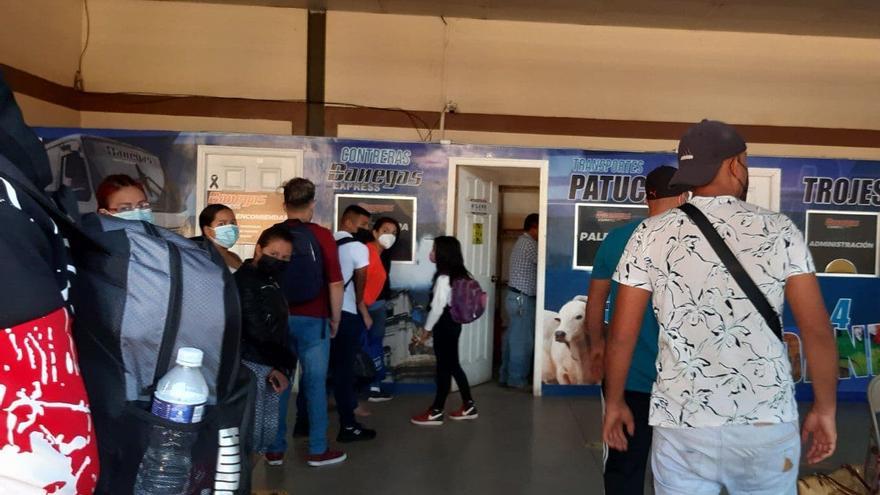
Terminal de ómnibus en Danlí, municipio del departamento de El Paraíso, en Honduras. (14ymedio)

There, too, I was shocked to see a 40 or 50-year-old man sniffing something in a large jar.  He sniffed it hard and sniffed it again and again, and I said wow! I had only seen this once, in a documentary, that people sniff to get high. But of course, in Cuba there is no glue for everyday use, much less for that.

I took a taxi to the Sultana terminal, where the buses to San Pedro Sula are taken, and I met three Cubans – there were Cubans everywhere – who told me their stories, almost all of them, in short, the same. Some said, and that bothered me the most: “No. Political problems don’t interest me.” I have heard that everywhere. People are not interested in politics, or political prisoners, or anything.

Those three Cubans I met there were from the eastern provinces. One was from Granma, Daniel, a pre-university teacher, who had an animal business that the pandemic did away with. He left for Jamaica, where everything was very expensive, according to what he said, and then Costa Rica or Panama. Later he went to Nicaragua and here we were. The other two were from Las Tunas, one an engineer, who told me that he had parachuted. The vast majority were 40 and under, many were young people, 25 or 26 years old.

I had to give my contact at the Sultana fifty dollars more, after hearing how he argued with my coyote because the money he had given him seemed too little. After he was satisfied with the money, they took me to a place close by, where there were many more Cubans, Haitians, Hondurans, people of all Central American nationalities. There was even a Russian woman -or from a neighboring country- who came with a Cuban. There were so many people that they didn’t have enough buses to take them to San Pedro Sula.

The trip was hard, about seven hours, with many curves, and in those ‘stools’… but San Pedro Sula is beautiful

Before sitting on one of the stools I chatted with Lauren, a Cuban from the eastern part of the Island, who had lived in Havana for many years. She was about 30 years old, very alert, very pretty. Her husband paid for her trip and she went alone, although she had a child of about six years old whom she had decided not to take with her. So, we decided to go down the road together.

Every seat was taken, and there were about five or six more people sitting on buckets or plastic stools in the aisle. A man, a little older, complained often that they lied to him, because they told him that they were going to take him from Nicaragua by car. He is one of those who were going to pick up visas in Cancun and that’s what they had been told. My friend Lauren had the same thing happen to her.

The trip was hard, about seven hours, with many curves, and on those little stools… but San Pedro Sula is beautiful. There, after a taxi ride, they placed us in a motel full of Cuban migrants. There, someone played Patria y Vida, and it was very exciting to hear it: everyone sang it.

In that room of the little hotel, we were five men and three women. Two of them were brothers and were traveling to reunite with their families in the United States. They had left their mother in Cuba and that hurt them a lot. I saw them crying. One, whose occupation in Cuba was slaughtering cattle, told me: “My chest hurts, because I think I’m not going to see my mother anymore.”

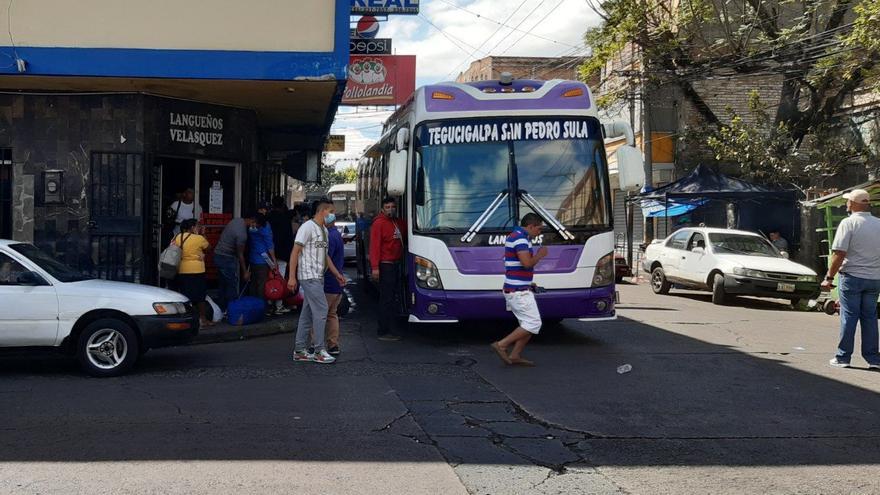
Cogí un taxi hasta la terminal de la Sultana, donde se cogen los ómnibus para San Pedro Sula y allí me encontré a tres cubanos. (14ymedio)
I took a taxi to the Sultana terminal, where buses go to San Pedro Sula, and there I found three Cubans. (14ymedio)

He spoke that the future was in Yuma and not in Cuba, that he was going to work and get ahead, but he also told me that politics did not interest him. There was also another girl from Cienfuegos who told me something similar, and that she had left two children there, one 10 and the other 12-years-old.

That night people continued to arrive from everywhere, but the important thing was to get some shut-eye, because they warned us that we had to leave early. I had to sleep on the floor, there were pitched battles to charge the cell phones. We bathed as best we could, the shower was only a small cold-water trickle, and we left around four in the morning.

They had told us that we probably wouldn’t all fit, so I said: “Let’s sit near the entrance, because that way we can get a seat on the bus”. And that’s when the mafiosos (because there is no other name for them) stood up, organized us, more or less, and opened a small door through which they began to take us out three by three. We were 177 people, 170 of whom were Cubans.

Tomorrow: 

Armed Coyotes, powerful Toyotas to cross Honduras

____________

COLLABORATE WITH OUR WORK: The 14ymedio team is committed to practicing serious journalism that reflects Cuba’s reality in all its depth. Thank you for joining us on this long journey. We invite you to continue supporting us by becoming a member of 14ymedio now. Together we can continue transforming journalism in Cuba.