In fewer than 280 characters, the Cuban president has put in writing his formula of governance. Translation of tweet: As a family, we watched the movie “Innocence” by Alejandro Gil, a very painful chapter in our history. Let us never forget that just as heroes abound, there is no lack of bastards in #Cuba, which can be worse than the enemy that attacks it. Viva forever #CubaLibre! [Yoani: The part of this tweet that refers to “the bastards in #Cuba” is intolerable, illegal and much closer to fascism than I have read in a long time. The text should be deleted immediately, he should apologize, and a commit to not using this language in the future. Will he do it?]14ymedio, Yoani Sanchez, Generation Y, Havana, 31 December 2018 — Miguel Díaz-Canel is receiving a hazing on Twitter. He arrived so late to this social network, in use for more than a decade by Cuban activists, that he is tripping over the primeval stones we ourselves discovered along the way. The first lesson is that everything one says on the network of the little blue bird does not remain only there, but multiplies and grows throughout the virtual community.
This Sunday, the Cuban president commented that he watched the movie Inocencia, based on the history of medical students shot by the colonial regime, and he added to his message the phrase, “just as heroes abound, there is no shortage of bastards* in Cuba.” In addition to the grammatical nonsense of the phrase, the “hand-picked” president put his verbs in the present tense, suggesting that there are still people, here and how, who should not have been born on the island. continue reading
Revolutionary bravado prevents him from erasing his tweet. Bad for him because the blunders are accumulating, and there are already several messages which transmit an idea of hatred, polarization and intolerance. Instead of endeavoring to make it known that he governs for all Cubans, the new tenant of the Plaza of the Revolution seems determined to please his predecessors. This tweet is not directed so much as an insult to us, the critics of the system, as to ingratiate himself with the historic generation of Castroism.
In fewer than 280 characters, the Cuban president has put in writing his formula of governance. He is not going to represent all of us, he tends neither to conciliation nor harmony, rather he intends to confront us, polarize us and add more labels to the wide repertoire of insults this system has generated. Now, we are no longer only “worms,” “mercenaries” and “enemies,” but the attack has reached into the past, to the time of our birth, to that instant in which we drew breath for the first time.
Poor Díaz-Canel, he does not know that the tweets remain and he just delivered a phrase that defines him in his just measure as extremist, fascist and dogmatic. If he had the least capacity for self-criticism, he would erase that message right now… but I suspect he will not do so.
Translator’s note: The original wording is “los mal nacidos por error,” which in a literal English translation would read: “the badly born by mistake.” In Spanish, however, it is very strong expletive, and so has raised a correspondingly strong response across social networks.
______________________________
The 14ymedio team is committed to serious journalism that reflects the reality of deep Cuba. Thank you for joining us on this long road. We invite you to continue supporting us, but this time by becoming a member of 14ymedio. Together we can continue to transform journalism in Cuba.
Maykel González Vivero was also arrested when he was working covering the damages caused by Hurricane Matthew in Baracoa. (El Estornudo)
14ymedio, Havana, December 29, 2018 — Maykel González Vivero has had a hectic year. In the last twelve months he took the first steps on the difficult path of directing an independent publication, fought a tough battle on social media for marriage equality, and his name was definitively inscribed on the Government’s list of “enemies.”
Although at first this young man, born in 1983, thought of becoming a philologist, he ended up graduating in 2012 with a degree in Sociocultural Studies and entering journalism. His first steps in the profession were as a reporter at the radio station of his native Sagua la Grande, Villa Clara, where he learned the rudiments of the press but also saw firsthand the face of censorship.
In 2016 this journey through the official editorial offices ended abruptly when authorities annuled his contract for collaborating with independent media. From then on his signature became common on various alternative digital sites, but González wanted to go further and form a new publication, where he could combine his two passions: the press and LGBTI activism. continue reading
Thus in December of 2017 Tremenda Nota was born, a publication that he directs and describes as “the magazine of minorities in Cuba,” which they produce in the difficult setting of a province, far from the capital. From there, and along with his team of reporters, he has covered controversial subjects like discrimination and racism, opted for graphics to accompany the most complex issues, and managed to become a reference in the extensive ecosystem of independent media.
Tremenda Nota also devoted wide coverage to the controversial Article 68 in the draft of the constitutional reform project, which would have opened the door to marriage equality and which, ultimately, was withdrawn. A monitoring done with journalistic quality and without fear. On balance, Maykel González Vivero has paid all the social and professional costs possible for writing. Arrested for his work during Hurricane Matthew, vilified by his former colleagues, and watched by State Security, now he does journalism without a gag, as he likes it.
The 14ymedio team is committed to serious journalism that reflects the reality of deep Cuba. Thank you for joining us on this long road. We invite you to continue supporting us, but this time by becoming a member of 14ymedio. Together we can continue to transform journalism in Cuba.
Yanelys Núñez, independent artist publicly confronts the Government over Decree 349. (14ymedio)
14ymedio, Havana, December 27, 2018 — A graduate in Art History in 2012, Yanelys Núñez Leyva (b. Havana, 1989) has this year been one of the most visible faces on the independent art scene of the Island.
Along with Luis Manuel Otero Alcántara and another group of artists she defied the country’s cultural authorities by inaugurating the #008Biennial of Havana. Núñez was one of the principle curators and organizers of the independent event that took place at the headquarters of the Museum of Dissidence, a project for which she was expelled from her position at the magazine Revolución y Cultura.
Through the Museum of Dissidence, Núñez sought to define via art the term ‘dissident’, also leaning on the meaning that the Royal Spanish Academy grants the word. In the same place, the curator mixed personalities from the history of Cuba, in the style of Hatuey, José Martí, and Oswaldo Payá. The project, which initially functioned in a digital format via a webpage, materialized between the walls of a house at 955 Calle Damas, Old Havana. continue reading
The place has also served as a headquarters for the festival Endless Poetry, the presentation of Enrique Del Risco’s book, El compañero que me atiende, and even a reading of censored authors, which was scheduled to happen in parallel with the Book Festival and was boycotted by State Security.
Since Decree 349, which regulates artistic dissemination, was published on July 10 in the Gaceta Oficial, Núñez has been an active part of the San Isidro group, which took a stand against the Government to ask for its repeal. The Decree lists up to 19 violations of the law, many of which directly affect the independent scene, like organizing cultural events without the Government’s authorization or disseminating contents that are “violent, pornographic, discriminatory, or offensive toward national symbols.”
The campaign against the law used texts and artistic actions to condemn its exclusionary character and reported that it had been written without previously consulting artists. Núñez headed a protest against the controversial text in front of the Capitol of Havana, covering her body with human excrement while she demanded respect for free art.
Although the decree was meant to go into effect on December 7, part of its contents has been suspended while a dialogue process has been opened up with pro-government institutions like the National Union of Writers and Artists (Uneac) and the Saíz Brothers Association (AHS) in which the writing of some complementary laws for its future implementation is being discussed.
The organization Amnesty International as well as the State Department of the United States have declared themselves against Decree 349, believing that it contravenes the right to liberty of expression and could be used to censor content.
The 14ymedio team is committed to serious journalism that reflects the reality of deep Cuba. Thank you for joining us on this long road. We invite you to continue supporting us, but this time by becoming a member of 14ymedio. Together we can continue to transform journalism in Cuba.
Cubalex, 15 August 2018 — The Council of Ministers, in Decree Law No. 349, on April 20, 2018 (effective on December 20, 2018) establishes sanctions for not complying with the cultural policies established by the Ministry of Culture, in relation to the suitability, professionalism and remuneration of artists, whether they are graduates of art education, general education or amateurs. The following 7 points summarize this policy:
1. Cuban artists, whether they are graduates of artistic education, general education or amateurs, in order to practice professionally, have to be qualified by the State.
2. Only artists who have been approved or enrolled in the Registry of Creators of Plastic and Applied Arts can exhibit, provide artistic services in public or have commercial space for their art. continue reading
3. Artists will be required to establish links with a State institution in order to receive remuneration for their work. Those who don’t comply with this policy can be subject to disciplinary measures by their work institution, including measures that affect their economic support.
4. Only institutions that are authorized by the Minister of Culture or the Cuban Institute of Radio and Television can establish work relations with artists and represent them to market their productions and artistic services in public.
5. Artists will not be able to benefit from productions or shows, or develop and expose their skills, talents and artistic attitudes in public without State authorization. Nor can they express their identity using national symbols. People who are not considered artistis are excluded from access to practices, benefits and cultural services.
6. State officials have it within their discretion to decide if a book doesn’t comply with ethical and cultural values; if audiovisuals, music or artistic presentations promote discrimination, violence or use sexist, vulgar and obscene language. Victims, affected groups, denunciations or guarantees of due process are not required for accusations.
7. State supervisors and inspectors will decide, at their discretion, if fines between 1,000 and 4,000 pesos or confiscation of goods are merited. Both measures can be applied to any person, organization, business, etc. “in places of State and non-State public installations,” which do not comply with the policy stablished by the Ministry of Culture. They also can suspend, immediately, any show or film and request cancellation of authorization for independent work activity.
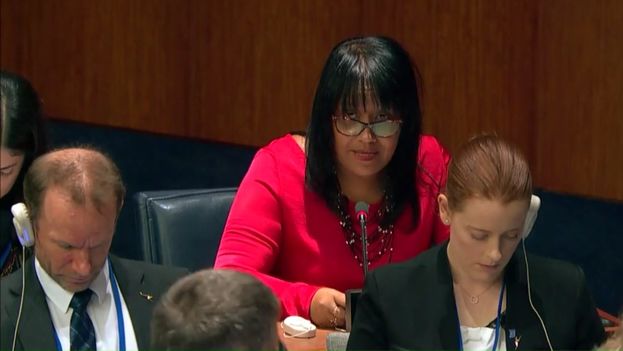
Anayansi Rodríguez requested in a letter sent to United Nations Secretary-General Antonio Guterres that an internal investigation be carried out “in order to determine those responsible for the violations” of the United States. (@CUBAONU)
14ymedio, Havana, 26 December 2018 — In January 2017, Anayansi Rodríguez Camejo delivered her credentials as permanent representative of Cuba to the United Nations. From that moment on, she became the first woman from the Island to assume that responsibility before the New York-based organization.
Previously, as a diplomat she had held the position of director of Multilateral Affairs in the Foreign Ministry and was Cuba’s permanent representative, until 2016, at the Office of the United Nations in Geneva.
Known for not deviating a single inch from the official discourse, Rodríguez compensates for the lack of charisma that is attributed to her with her great fidelity to the Plaza de la Revolución. Her work at the UN has been characterized by “revolutionary combativity” and continuous criticism of the United States. continue reading
In October, Rodríguez led an act of repudiation at the UN headquarters, in which several Cuban representatives loudly out-shouted a presentation being given on the United States’ campaign for political prisoners on the island. “In prison for what?” they yelled, while pounding on their desks.
“Never in my life had I seen diplomats behave like the Cuban delegation did today,” the American Kelley Currie, representative of that country on the UN Economic and Social Council, summed up after the meeting.
“One wonders, if the diplomats in this government behave like this, how will the police behave? It’s understandable why people are afraid to speak, why people are sent to jail for speaking,” Currie emphasized.
Rodriguez responded by accusing the United States of “smearing” the name of the United Nations in an act “against a member state, faking international support for its fallacious campaign.” To close her noisy performance, the ambassador of Cuba did not hesitate to accuse her opponents of having set up a “political comedy (with) crisis actors with an obscure track record in the service of a foreign power.”
The 14ymedio team is committed to serious journalism that reflects the reality of deep Cuba. Thank you for joining us on this long road. We invite you to continue supporting us, but this time by becoming a member of 14ymedio. Together we can continue to transform journalism in Cuba.
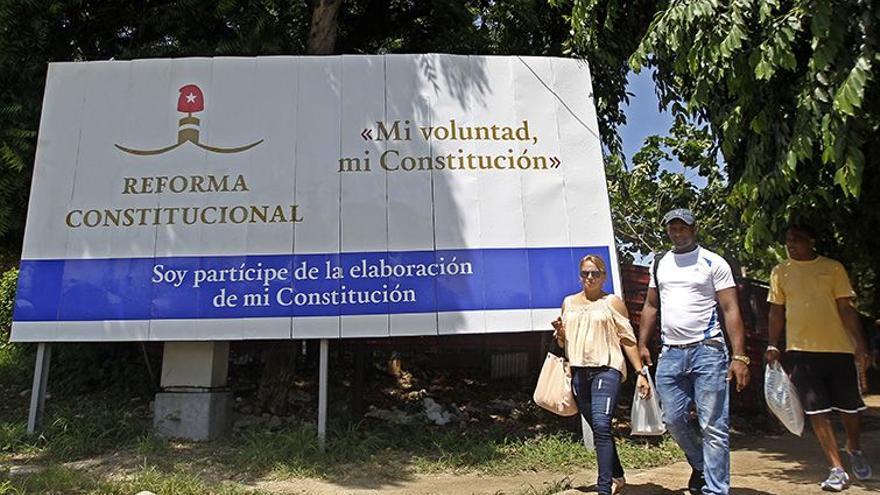
It seems unlikely that the Government will accept that a campaign for the NO vote will enjoy the deserved equality of conditions. Billboard text: “My will, my Constitution. I am participating in the drafting of my Constitution” (EFE)
14ymedio, Reinaldo Escobar, Desde Aqui, Havana, 25 December 2018 — With the blessing of the docile Cuban parliament, the question that will appear on the February 24th referendum ballot will be the following: Do you ratify the new Constitution of the Republic?
From the strictly legal point of view, the choice of the verb “ratify” is correct because in Article 162 of the current Electoral Law, it states that in referendums “citizens with electoral rights express whether or not they ratify the legal projects of Constitutional Reform…”
It is also based on ‘ratification’ appearing as a synonym of ‘approving’ in the thesaurus. However, beyond the definitions given by the Academy, words are marked by the use made of them. continue reading
We ratify a promise or commitment that we made earlier. A sentence that has been appealed is ratified, as is a treaty — commercial or otherwise — that already exists. So when the voters face this question in the privacy of the cubicle where they will vote, they will have a diminished assessment of the importance of their vote.
The Constitution of the Republic has already been approved by the National Assembly of People’s Power and now voters must “only” endorse that approval.
So far no authority, nor any legal article, has made clear what percentage of acceptance or ratification must be obtained for a proposal submitted to a referendum for the results to be binding. It could be that it is fifty percent plus one, or it could be claimed that two-thirds of the votes are required to determine acceptance of the matter on which voters have been consulted.
Nobody has explained what will happen if the majority of the electors decide to mark a civilized and peaceful X in the NO square. Will it be necessary to call a Constituent Assembly to write a new text? Will the already obsolete Constitution of 1976 maintain its validity?
Obviously the promoters of this new Constitution don’t even want to think about the remotest possibility of losing the referendum. The only sign that they do not feel safe is that the campaign for YES has already begun.
The next step, which is likely to take place after the final text has been published, will be the placement of billboards on public roads — some have already appeared — and the presence of messages in the media calling for an affirmative vote. It has been leaked that they will be mainly neutral texts, calling for a Yes for Cuba, a Yes for the future, or a Yes for children’s smiles. There will be nothing about a Yes for communism or something similar.
What seems unlikely is that the Government will accept that a campaign for the NO vote will enjoy the deserved equality of conditions.
It is said that opportunity only knocks once and if you don’t answer, it passes you by. The opportunity that we Cubans will have on February 24, to let those who hold power know that we are not willing to continue helping or supporting them is unique and unrepeatable.
This opportunity is not only going to knock just once, it’s going to pass at a run to make sure no one has time to get to the door.
__________________________
The 14ymedio team is committed to serious journalism that reflects the reality of deep Cuba. Thank you for joining us on this long road. We invite you to continue supporting us, but this time by becoming a member of 14ymedio. Together we can continue to transform journalism in Cuba.
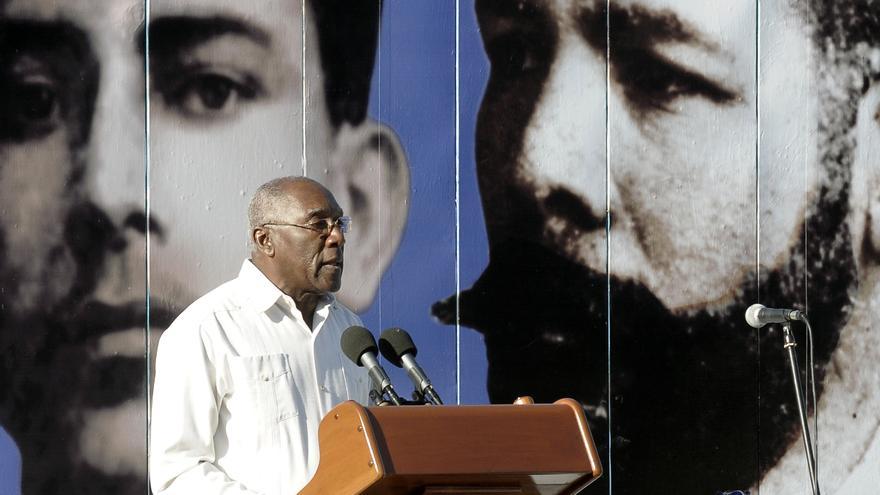
Salvador Antonio Valdés Mesa, first vice president of Cuba’s Council of State Council. (Trabajadores)
14ymedio, Havana, 24 December 2018 — The big surprise of 19 April 2018, when the Cuban Parliament elected a new Council of State, was not the investiture of Miguel Diaz-Canel as president of the Councils of State and of Ministers but the appointment of Salvador Antonio Valdés Mesa as his vice president.
His name did not appear among the speculations of the analysts who bet on different candidates for the second-in-command in the Government.
Valdés Mesa held the portfolio of Minister of Labor and Social Security in 1995 and, as of 2006, was general secretary of the Central de Trabajadores de Cuba (Cuban Workers Center, the country’s only legal labor union). continue reading
Since 1999, between a government position and a union one, he served as first secretary of the Communist Party in the province of Camagüey, where his management was very unpopular.
Now, at 68, the official is at an intermediate age between the octogenarians of the historical generation and the younger cadres born after the triumph of the rRevolution. Since he was appointed ice president, he has been frequently seen on television news programs visiting provinces, and checking the work of state companies and cooperatives. In most of these trips he has been accompanied by José Ramón Machado Ventura, second secretary of the country’s single party.
In his public speeches he insists on the need to work more, increase efficiency, raise savings and replace imports with domestically produced products. He is considered a hard-line conservative and therefore as the one in charge of monitoring the president to ensure that he stays within the political orthodoxy. Proof of this is that, unlike Miguel Díaz-Canel, he has not felt the need to clarify that he is not a reformer.
The 14ymedio team is committed to serious journalism that reflects the reality of deep Cuba. Thank you for joining us on this long road. We invite you to continue supporting us, but this time by becoming a member of 14ymedio. Together we can continue to transform journalism in Cuba.
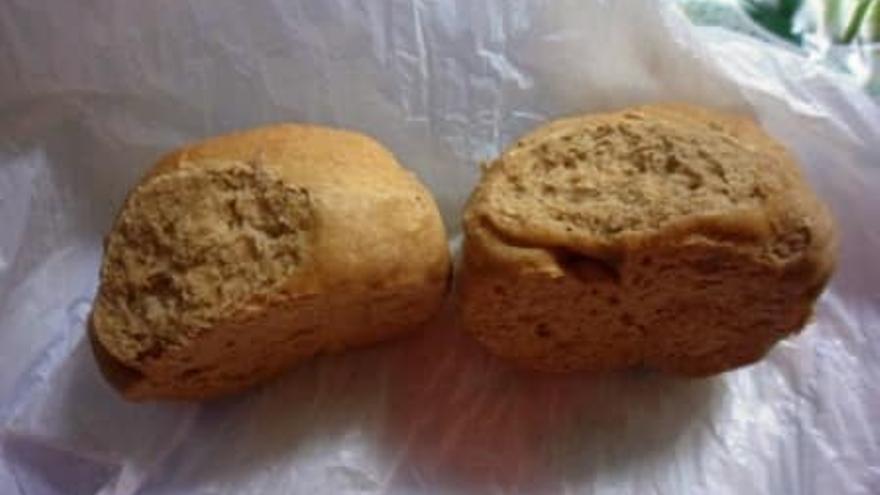
Hundreds of cuban Internet users have published photos showing the poor quality of rationed bread and the long lines to buy it. (Pedry Roxana Rojo)
14ymedio, Marcelo Hernandez, Havana, 27 December 2018 – Few products have been talked about as much on the social networks this last week of the year in Cuba than that of bread. The long lines outside the state bakeries and the poor quality of this rationed food have filled the walls of Facebook, Twitter timelines and Instagram accounts. The lack of flour that has led to the drop in supply is one of the most discussed issues of the moment.
Since December 6 when web browsing service on mobile phones became available, there has been an infinite number of photos and videos in which consumers complain about the typical bread. “This is not a stone it is bread,” says a resident of Placetas, Villa Clara, on her Facebook wall. “This is a line of several hours to buy something as simple as a bread,” writes another from the city of Santa Clara.
Greenish-tone breads, reduced in size and unappetizing in appearance, are photographed and shared in chat rooms and messaging services. Also innumerable signs outside the state establishments indicating that there is no bread or that sweets are not being sold “until further notice.” A true “bakery obsession” has taken over the social networks.
Who was to say that a theme of gossip and discussion such as the quality and shortage of this product would become an end-of-year spectacle?
Translated by Wilfredo Díaz Echevarria
_____________________________
The 14ymedio team is committed to serious journalism that reflects the reality of deep Cuba. Thank you for joining us on this long road. We invite you to continue supporting us, but this time by becoming a member of 14ymedio. Together we can continue to transform journalism in Cuba.
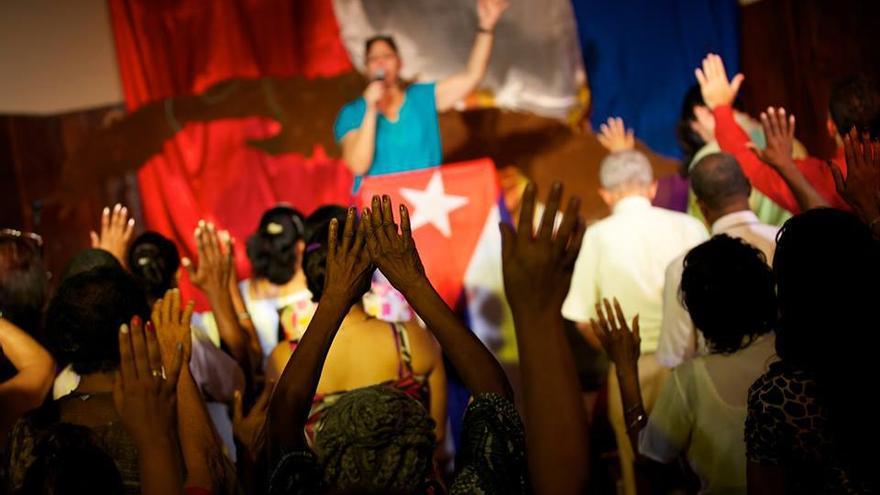
Cuban evangelical groups are fighting hard against including the concept of ‘equal marriage’ in Cuba’s revised Constitution. (EFE)
14ymedio, Havana, 25 December 2018 — In July of this year in more than 3,000 evangelical churches across Cuba prayers were raised to defend the traditional family and criticize the inclusion in the draft Constitution of Article 68, where marriage was defined as “the union between two people.”
The Assemblies of God Churches, the Eastern and Western Baptist Conventions, the Evangelical League and the Methodist Church led the intense campaign and published a statement against equal marriage. The document stated that the “gender ideology” had nothing to do with Cuban culture “or with the historical leaders of the Revolution.” continue reading
In Christian temples and churches throughout the country, Article 68 was openly criticized, a situation that made the ruling party fear a massive No vote against the Constitution when it is submitted to a referendum in 2019. Evangelicals have experienced rapid growth in recent years and it is estimated that the Methodists alone have more than 80,000 faithful throughout the country.
With the elimination of Article 68, after the process of popular consultation, these religious groups congratulated themselves publicly, but announced their intention to mobilize against the Government’s plan to include, within two years, that same concept in the Family Code.
“The news that the National Assembly of People’s Power ruled out the proposal of Article 68, because it was shown that a majority of the population of Cuba rejected it, gives a measure of how much the thought of the Evangelical Church of Cuba represents the Cuban People,” the Cuban Methodist Church posted on its Facebook page.
The Catholic Church also spoke about it. In October the Conference of Catholic Bishops of Cuba (COCC) published a pastoral message on the draft Constitution in which they claimed that the wording of Article 68 had an“evident influence from the so-called ‘gender ideology’,” which they adjudge “a strong subjectivism.”
The 14ymedio team is committed to serious journalism that reflects the reality of deep Cuba. Thank you for joining us on this long road. We invite you to continue supporting us, but this time by becoming a member of 14ymedio. Together we can continue to transform journalism in Cuba.
Groups of Cuba’s LGBTI community defended the inclusion of Article 68 in the draft Constitution. (14ymedio)
14ymedio, Havana, 25 December 2018 — Since the content of Article 68 was revealed in the preliminary draft of the constitutional reform project, the most active groups of the LGBTI community showed their support for the definition of marriage — the union between two people without specifying gender — contained in the text. The activists saw in this inclusion a step to achieve egalitarian unions, an long-standing demand of this group in Cuba.
In October of this year, the Proyecto Abriendo Brechas de Colores (Opening Color Gaps Project) called for a public demonstration in favor of equal marriage under the name “Take your kisses out of the closet.” The initiative was a response to the evangelical churches that rejected Article 68, but ultimately the organizers canceled the “kiss-in” under the argument that it could harm “the very project” they were trying to promote. continue reading
The confrontation between both tendencies was also expressed in posters and memes published on social networks. Since last June, posters have appeared in defense of the “original design of the family, as God created it” and against equal marriage on the facades of homes in several provinces of the country and in public spaces.
The LGBTI community and defenders of the island’s sexual rights responded with posters with more inclusive definitions of the concept of family and promotional videos with the message of “an original design of Cuban families” and “all rights for all families.”
The Metropolitan Community Church (ICM) in Cuba, known for its involvement in the recognition of sexual diversity, criticized the position of the evangelical denominations that rejected Article 68 and reminded that God is “polyamorous and radically inclusive.”
The news of the elimination of Article 68 in the revised Constitution fell like a bucket of cold water among the advocates of equal marriage who saw the decision as a step backwards.
The journalist Francisco Rodríguez Cruz, who runs the blog Paquito el de Cuba, reacted with annoyance. “Neither between man and woman nor between two people: the Constitution will not say what marriage is. Future Law will do it,” he detailed on Facebook. “To put it finely: put your marriage where it suits you!” added the activist.
Mariela Castro, director of the National Center for Sex Education (Cenesex) said that the new Article 82 “erases the binaryism of gender and heteronormativity with which marriage was defined in the 1976 Constitution,” so “there is no setback, the essence of Article 68 is maintained, the struggle continues, now let’s give a YES to the Constitution.”
The 14ymedio team is committed to serious journalism that reflects the reality of deep Cuba. Thank you for joining us on this long road. We invite you to continue supporting us, but this time by becoming a member of 14ymedio. Together we can continue to transform journalism in Cuba.
At the beginning of this month several artists who tried to carry out peaceful protests against Decree 349 in front of the headquarters of the Ministry of Culture were detained. (Nonardo Perea)
EFE via 14ymedio, Havana, December 23, 2018 — Cuban president Miguel Díaz-Canel insisted this Saturday that “artistic creation in Cuba is free and will continue to be so,” after Decree 349, intended to regulate the cultural industry on the Island, put a good part of that sector on a war footing.
“Some tried to twist the reach and objective of the regulation, and associate it with an instrument to exercise artistic censorship,” pointed out the leader during his closing speech at the final annual plenary session of the National Assembly, where the text of the new Constitution was approved.
This is the first time that Díaz-Canel has referred publicly to this controversial matter, which in recent weeks set the leaders of the country against artists and intellectuals who criticized the government for not having reached an agreement with them on Decree 349, whose contents they also considered a potential tool of censorship. continue reading
The leader recognized, this Saturday, that the decree “should have been better discussed and better explained because of its importance” and called “on artists with a proven and committed work” to discuss with the Government “the means of implementing this law.”
Although the decree was intended to go into effect two weeks ago, a part of its contents has remained suspended while a process of dialogue has opened with the pro-government National Union of Writers and Artists (Uneac) and the Saíz Brothers Association to prepare supplementary laws for its implementation.
Díaz-Canel insisted that the Government must protect the values of national culture faced with “pseudoartistic productions that present an image of a country that we have never been” and emphasized that the only objective of Decree 349 is “to protect the culture from false artists and from the pseudoculture that creates false values.”
Additionally, he indicated that among those waging a campaign against the new law are “entities alien to culture, those who never cared about it and remained silent in face of the proliferation of vulgarity, banality, violence, discrimination, and sexist and racist attitudes.”
At the beginning of this month, during the week prior to the law’s taking effect, various artists who tried to carry out peaceful protests in front of the headquarters of the Ministry of Culture were detained and later set free, among them the activist Tania Bruguera.
Both Amnesty International and the State Department of the United States have declared themselves against Decree 349, believing that it contravenes the right to freedom of expression and could be used to censor content.
Translated by: Sheilagh Carey
_________________________________
The 14ymedio team is committed to serious journalism that reflects the reality of deep Cuba. Thank you for joining us on this long road. We invite you to continue supporting us, but this time by becoming a member of 14ymedio. Together we can continue to transform journalism in Cuba.
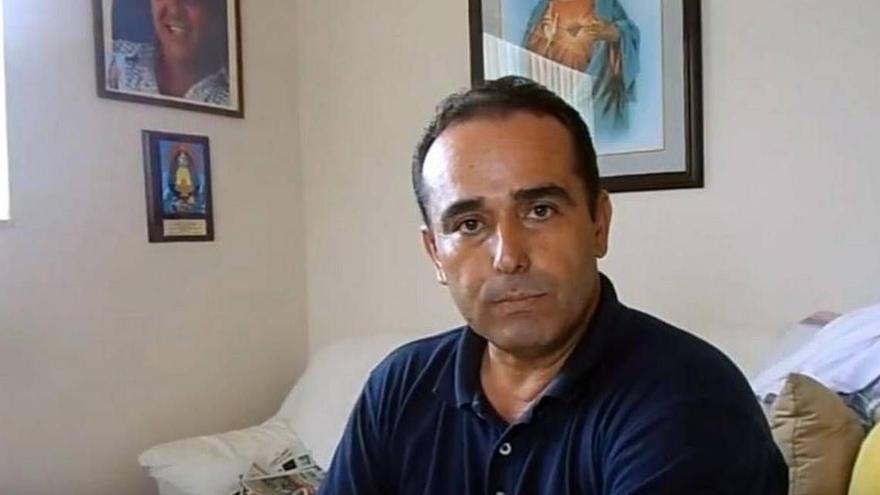
The opposition’s Eduardo Cardet is still in prison after the sentence of three years which was imposed on him. (Captura YouTube/MCL)
14ymedio, Havana, 24 December 2018 — In November Eduardo Cardet marked two years in prison. The leader of the Christian Liberation Movement (MCL) was arrested November 30, 2016 at the door of his home, in Holguín, and later was sentenced to three years of prison for the crime of attacking authority, in a trial that his family and other activists label “manipulated.”
Born in 1968 and with a degree in Medicine, the activist was chosen as the national coordinator of MCL after the death of Oswaldo Payá in 2012.
In October of this year the dissident was awarded the Patmos prize which has been granted by the institution of the same name for the past five years to committed Cuban Christians. A few weeks later he won the Pedro Luis Boitel 2018 Freedom Prize in a ceremony held in Miami. continue reading
In recent months Cardet has seen his conditions in prison worsen. In May his family members were informed by authorities that the opposition figure had been prohibited from receiving visitors for “spreading fake news” about his case.
At the end of July, MCL asked the Minister of Foreign Affairs of France, Jean-Yves Le Drian, to intercede on behalf of Cardet during his visit to Havana, but so far, the petitions of human rights organizations, national and international, and political parties have fallen into a black hole.
The NGO UN Watch presented a complaint to the United Nations Working Group on Arbitrary Detention to demand that the island’s authorities free Cardet. The organization’s lawyers registered the case against the Cuban State on July 23 in front of this body of the UN made up of five jurists and experts in human rights.
The 14ymedio team is committed to serious journalism that reflects the reality of deep Cuba. Thank you for joining us on this long road. We invite you to continue supporting us, but this time by becoming a member of 14ymedio. Together we can continue to transform journalism in Cuba.
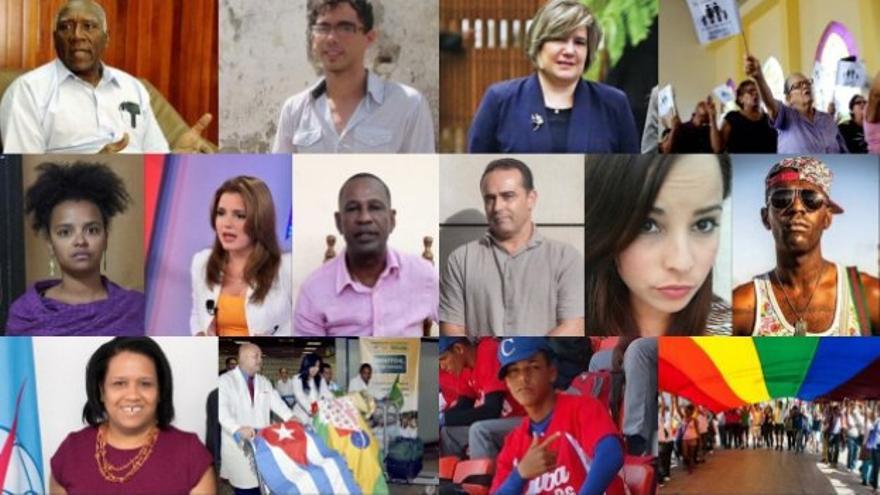
These are the 14 people 14ymedio’s is naming as newsmakers for 2018 (14ymedio)
14ymedio, Havana, 24 December 2018 — At the end of each year, 14ymedio presents a list of the names of people or groups who have left their mark on the twelve months that have just ended. They are the faces that embody the most important events that took place in Cuba from across the political spectrum, in the arts, sports, social activism and the news. Their names are associated with emblematic moments and are indispensable to understanding the year that is ending.
The protaganists for 2018 are:
– Eduardo Cardet, political prisoner and leader of the Christian Liberation Movement
– Salvador Valdés Mesa, first vice president of the Councils of State and of Ministers
The 14ymedio team is committed to serious journalism that reflects the reality of deep Cuba. Thank you for joining us on this long road. We invite you to continue supporting us, but this time by becoming a member of 14ymedio. Together we can continue to transform journalism in Cuba.
High up on the front part of the building facing the old Military hospital is a sign for 100% Noticias, but the bigger, the more visible sign, says “Jehovah.” (EFE)
14ymedio, Guillermo Cortés Dominguez, Managua, Nicaragua | December 25, 2018 — For the dictatorship, Miguel Mora became a “stone in the shoe.” For that they treated him mercilessly: high-profile smear campaign, stealing television cameras, beating reporters, intimidations, harassment, and threats against him, his wife, journalists, and other workers, as well as visitors to 100% Noticias, a violent raid of the media outlet, destruction of equipment, his kidnapping, that of his wife Verónica, his colleague Lucía Pineda, and four other employees, confiscation of the channel, the closing with zinc — like a tombstone — of its facade, the transport to El Chipotle and in less than ten hours to a court dressed in the blue of prisoners.
An aggravating circumstance for such malice is that for years the regime perceived him as “pro-government,” given that he was an activist for the FSLN party and he carried the agenda of the Government to 100% Noticias. They considered him one of their own, despite his lack of “discipline,” since he also reported events that from the perspective of Nicaragua’s First Lady Rosario Murillo, only done by “contaminated” media outlets. continue reading
For years, Mora distinguished himself by his pluralism, since on the channel there were non-“Orteguista” programs like “Jaime Arellano en la Nación” and “Café con Voz;” and on “IV Poder” critics of the regime were invited for debates. The complete dissidence, the spectacular “somersault” of 100% Noticias bumped into the beginning of the social explosion of April, the attack on a journalistic team, and the theft of a valuable TV camera, and later the press censorship for refusing an order of the regime not to report on the rebellion. Then its owner transformed the programming, and the outlet turned into the voice of the peaceful insurrection of the Nicaraguan people.
The channel dyed itself blue and white and its audiences, in an amazing manner, multiplied by the millions inside and outside of the country. Six months later the marches ceased due to the increase of the repression, but they continued daily on 100% Noticias, whose images of those oceans of flags of the homeland fed us and encouraged us.
For the Ortega-Murillo family this outlet became dangerous because it belligerently spread the popular fight and showed the abuses of the dictatorship. Going against national and international laws and the high cost it signified, now they silenced it, although not on social media.
In parallel to his political conversion that went along with concrete aspirations, like being President of the Republic, Mora experienced another one, spiritual, to the point of extremity, since he, his wife, and his Chief of Press daily showed themselves not only as devout Christians, but also as religious fundamentalists. He even made appearances on his outlet, as if he were an evangelical preacher. This is from his private reserve, but to bring it to 100% Noticias gave it a public connotation.
It was so cool that perhaps it was December that night, at a house where there was a party in one of the alleys of the Centroamérica neighborhood. A group of journalists was outside, on the sidewalk, passionately arguing — as often happens among colleagues — about the aspects of professional practice, when a “bold” youngster interfered in the chat and began “to spit in the circle.” We weren’t geniuses, but we were already established in journalism, and he intervened with audacity. It was Miguel Mora.
Later he made a brilliant career, graduated, began to work, was left so impressed with Ted Turner’s idea (CNN) to offer news 24 hours a day, that he proposed to do something similar, first creating a program and later realizing his idea, briefly interrupted by a fire in the location from which, paradoxically, through the economic help of persons from different political and economic sectors, he emerged strengthened.
Several times Miguel Mora invited me to his IV Poder Original, with Adolfo Pastrán, Xavier Reyes, and William Grigsby, the latter of whom insulted me verbally because he didn’t know how to debate. Strangely I remained calm and he got out of control. Miguel couldn’t do much to stop him, as it was his place to do as host. El Chele is a magnificent analyst, also an “Orteguista-Murillista” on short-circuit, who has broken with them several times, but who always returns to the fold. Mora also had differences with the power and the party and a lucrative state publisher even suspended him, but he knew how to sort it out.
With the imprisonment of Miguel Mora and the ultra fast political trial that they are already putting together; and the closure of the 100% Noticias channel, the citizenry suffers a strong loss, the absence of a daily companion that we are already missing a lot, and national journalism has received a stab wound from which much blood is flowing, which has left us stunned and several days later, we still haven’t gotten over the stupefaction and the pain of this hook to the kidney that sent us for a moment to the mat and from which we are sitting up with a grimace of pain and trembling in the legs.
High up on the front part of the building across from the old Military hospital is a sign for 100% Noticias, but the bigger, the more visible, the one that stands out, is one with enormous uppercase characters that says “JEHOVAH,” which gives the appearance that the place is an evangelical church and not a television channel.
Perhaps the religious ideas of Mora — that don’t combine at all with his political ambition nor with the professional practice of journalism — give him strength and hope to resist the rigors of prison, although what is most important is that a whole people accompanies him morally and that the international community of journalists, communicators, and defenders of human rights have made a cry to heaven about the barbarous repression against him and his TV channel. His freedom will depend on the reactivation of the peaceful resistance of the people.
Translated by: Sheilagh Carey
______________________
Editors’ note: This text has been published by the Nicaraguan digital outlet Confidencial, which has authorized us to reproduce it.
The 14ymedio team is committed to serious journalism that reflects the reality of deep Cuba. Thank you for joining us on this long road. We invite you to continue supporting us, but this time by becoming a member of 14ymedio. Together we can continue to transform journalism in Cuba.
Motonave ‘Huntsville’, built in Japan in 1971 which was part of Cuba’s Merchant Navy. (Webmar)
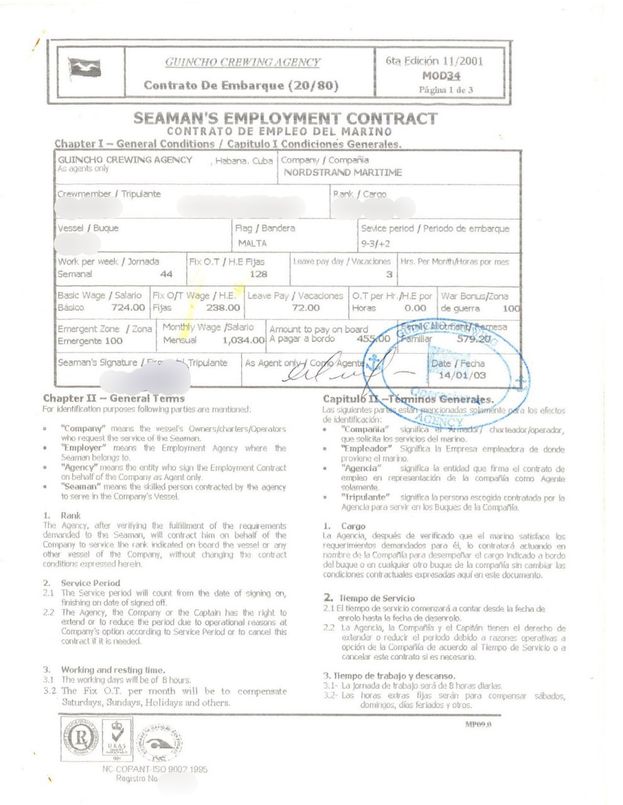
14ymedio, Miriam Celaya, West Palm Beach | 20 December 2018 –Health professionals were not the first to suffer a slavery system organized by the Cuban government itself. Long before, and without the media noise caused by the controversial departure of Mais Médicos from Brazil, sailors have been the invisible victims of the same abuses on the part of the State.
This peculiar “legal” network of human trafficking is attested to by Rolando Amaya (a fictitious name), an ex-seaman with a long history. A Mechanical Engineer who graduated from the Naval Academy, Rolando worked for several years as a machinist in the merchant fleet belonging to the Mambisa Navigation Company, the large shipping company created by Fidel Castro to transport goods to and from Cuba, mainly based on the active trade that existed at that time with the now defunct Soviet Council of Mutual Economic Assistance (CAME). continue reading
“In the contract, it is clear that my salary stated what I should earn, what I was paid on board and what was sent to Cuba as ‘family remittance’, which was the euphemistic term they used to call the money they kept and that ended up in the government’s coffers, or who knows where or who benefitted from it,” he tells 14ymedio, under the condition to keep his true identity secret.
“’Family Remittance’ was the euphemistic term they called the money they kept and that ended up in the government’s coffers, or who knows where it went or who benefitted from it”
Over the years, Rolando has kept some of the documents or contracts he signed with the state company Selecmar, in order to support his testimony and “so that the truth of the exploitation suffered by seamen is known.”
The “family remittances” and other discounts reflected in Rolando’s documentation constituted no less than 80% of the monthly salary paid by the foreign company for the sailor’s work. Therefore, both he and the rest of those contracted had access to the remaining 20%.
In the 70’s and 80’s, Cuban sailors were considered a privileged caste. On the one hand, they had the possibility of traveling around the world, while most of the locals lived the obligatory insular confinement. On the other hand, somehow, they managed to import (smuggle) clothes, shoes and other products of the capitalist world that the majority of the population could not even dream of.
In 1982, it was established that a minimum part of a sailor’s payment be made in foreign currency. Since then, recalls Rolando, the sailors began to see US $1 per day of navigation, a figure that has approximately doubled since 1985.
At the end of each trip, the hard currency was deducted from the salary in national currency and, if they did not spend that allowance, they could collect it in the form of “certificates” (chavitos) that allowed them to make purchases in several specialized stores to which foreign technicians also had access. These technicians were mostly Russians who resided in Cuba temporarily. These establishments were banned to the rest of the population and, in fact, they remained closed and with thick curtains behind the stained-glass windows, so that it was impossible to glimpse at those products to which common mortals had no access.
Former sailor Rolando Amaya’s contract document. (Courtesy)
This payment system was maintained until the loss of the Cuban merchant fleet, in the 90’s, when, with the disappearance of the USSR and the Eastern allies, the subsidies suddenly vanished and commerce became dramatically depressed. Cuba fell into the deep economic crisis from which it has not recovered to date, and the merchant fleet that had been Castro’s pride became a burden, as useless as it was difficult to sustain.
Finally, after several failed experiments to try to save the ships – including a process of merger and separation of the national shipping companies, the ephemeral association with recognized entrepreneurs of foreign shipping companies and the creation of short-lived joint venture companies – the ships were sold to the highest bidder or destined to be scrapped after remaining idle for a long stretch of
However, that did not mean the total extinction of the state bureaucratic apparatus. Mambisa survived as a niche that would direct the lobbying and business necessary to achieve foreign exchange earnings. There were no ships, but there was still a very valuable resource: the sailors. Paradoxically, the shipping company, already without vessels, found a way to become productive without the need to invest to renew or maintain a very expensive and inoperative fleet.
There they were, within reach, desperate to earn money, hundreds of sailors who were “available,” as the unemployed are euphemistically called in Cuba.
“It is then that Agemarca (Maritime Employer Agency of the Caribbean) and Selecmar are born, among other agencies in charge of subcontracting Cuban sailors to foreign shipping companies. Of these, the best known among us sailors, was Boluda, a Spanish company named after its owner, Vicente Boluda, with whom the Cuban government still conducts business,” says Rolando, who – like many others – emigrated years ago and has not returned to Cuba.
In order to mask the violation of the rights of these workers before the world organizations, the Cuban Government launched a fraudulent ploy
“There were also contracts with other companies in Africa, the Caribbean and Europe. I know of some of my colleagues who were hired by those companies, who were as poorly paid as I was. In their cases, the Government received most of the contract money, although I don’t know the exact details, since I haven’t had access to their documents,” he explains.
To mask the violation of the rights of these workers before the world bodies responsible for ensuring their compliance – especially the International Transport Workers’ Federation (ITF) as a qualified authority to represent seafarers before the International Organization of Labor (ILO) – the Cuban Government launched a fraudulent ploy.
The ruse consisted in having the seafarer sign a document, a copy of which he would not receive, in which he would state that he was earning a salary of between US $3,000 and $4,000 or more, depending on the position; that is, a figure much higher than what he really got. “This (false) document is the one that is shown to the international authorities that require it,” denounces the ex-mariner, who, although he emigrated over 10 years ago and has lost contact with his former work companions, has no doubt that “the exploitation continues.”
“It was customary to receive a some boss or company official who checked and corrected anything concerning the documents, inventories and everything related to the Quality System (by virtue of which each sailor must have updated the certifications that guarantee his ability to perform the work for which he was hired) who always somehow reminded us how bad the situation was in Cuba, the number of unemployed in the company, how poorly dressed they were, going through tough times, waiting to occupy our positions,” he continues.
“Many believed, and I dare say that even today they still believe that they are privileged even knowing that a significant part of their salary is being taken from them. It’s sad”.
This “worked as a kind of warning that you had to behave yourself or you would be out on the street.” Intimidation was always present, in a veiled or open manner. Many believed, and I dare say that even today they still believe that they are privileged, even knowing that a significant part of their salary is being taken from them. It’s sad,” says the former sailor, who is now almost 60 years old.
“One of the big problems that I had in the last years with the fleet was the age of the crew. It was an aging crew and, as far as I know, there was no way to replace them in the short term.”
Rolando believes that this, added to the fact that many of the sailors left Cuba in different ways and for different reasons, has led to the loss of trained personnel. “It has been a constant leak. Today I find some of them in the social networks, living in all parts of the world, much of that skilled labor that Cuba lost, and nobody stole it, Cuba lost it because of its exploitative politics.”
Translated by Norma Whiting
____________________________
The 14ymedio team is committed to serious journalism that reflects the reality of deep Cuba. Thank you for joining us on this long road. We invite you to continue supporting us, but this time by becoming a member of 14ymedio. Together we can continue to transform journalism in Cuba.
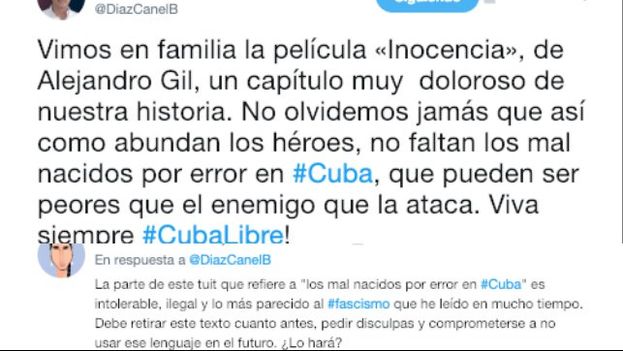
 In fewer than 280 characters, the Cuban president has put in writing his formula of governance. Translation of tweet: As a family, we watched the movie “Innocence” by Alejandro Gil, a very painful chapter in our history. Let us never forget that just as heroes abound, there is no lack of bastards in #Cuba, which can be worse than the enemy that attacks it. Viva forever #CubaLibre! [Yoani: The part of this tweet that refers to “the bastards in #Cuba” is intolerable, illegal and much closer to fascism than I have read in a long time. The text should be deleted immediately, he should apologize, and a commit to not using this language in the future. Will he do it?]