The 730,000 barrels received provide a breath of fresh air to the regime for a few weeks, but do not lift Cuba out of its energy crisis.
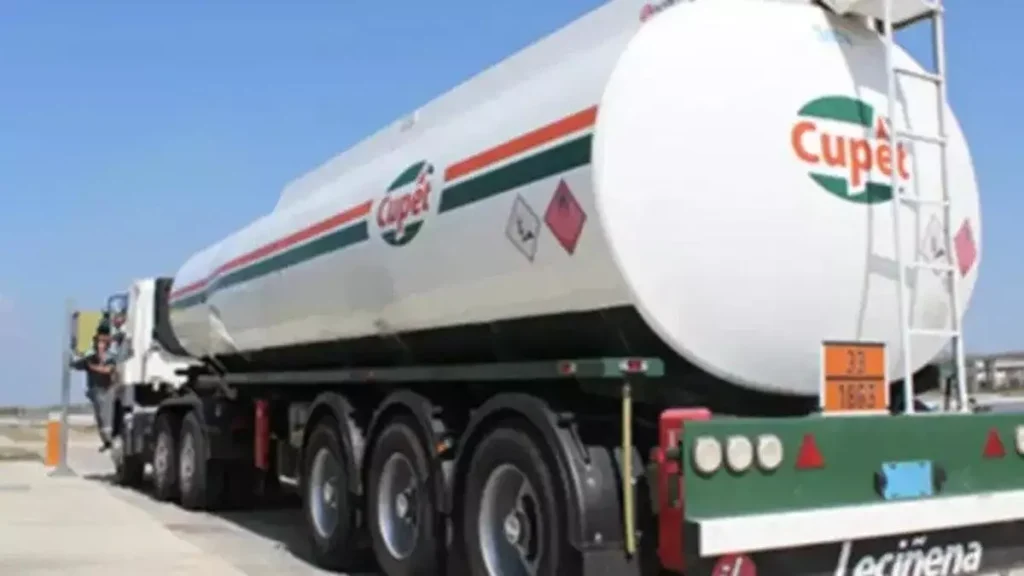
 14ymedio, Havana, April 19, 2026 — The Cuban government is trying to present the refining of 100,000 tons of crude oil donated by Russia in Cienfuegos as a turning point, but the announcement by the Cuba-Petroleum Union (Cupet) offers more of a temporary relief than a solution. The phrase, repeated by the official press—that the refined products will cover “around a third of national demand for a month”—sounds convincing, but it only holds water when different products, uses, and political priorities are conflated.
The first thing to dispel is the illusion of abundance. That shipment of some 730,000 barrels of crude oil won’t magically fill gas stations, revive public transportation, and restore normalcy to the country. According to Cuban energy expert Jorge Piñón, consulted by 14ymedio, that volume could yield “no more than 250,000 barrels of diesel,” a useful amount for setting priorities, but insufficient to resolve the crisis. He said this before it was known that the more efficient Havana refinery was shut down due to a breakdown and that the Russian crude would be processed at the Cienfuegos refinery.
Official propaganda makes no mention of the problems with the capital’s infrastructure and avoids making specific distinctions. It speaks of gasoline, diesel, fuel oil, and liquefied gas as if they would all simultaneously alleviate the needs of households, transportation, and the economy. In an emergency, available fuel typically goes first to distributed generation, the state apparatus, hospitals, vital services, and certain supply chains. The rest receive what’s left over. If the energy crisis of recent months has demonstrated anything, it is that the government doesn’t distribute fuel according to social demand, but rather according to political urgency.
The government does not distribute according to social demand, but according to political urgency.
This contrast becomes even more apparent on days when the regime’s propaganda machine consumes resources on political rallies, mobilizations, and events. Between April 16 and 18, Havana hosted the 5th International Colloquium “Patria,” another showcase of the official narrative amidst the shortages. That same April 16, the Castro regime returned to the corner of 23rd and 12th streets in Vedado to commemorate the 65th anniversary of the proclamation of the socialist character of the Revolution, and the official figure claimed more than 50,000 attendees, presented as proof of political strength.
Added to this is the preparation for May Day, which this year will not even be celebrated in Revolution Square, but rather at the Anti-Imperialist Tribune, in a context marked by logistical and energy restrictions that the official announcement itself acknowledges by asking for the event to be held “rationally assuming the limitations.” Even so, the regime insists on turning the date into a show of political strength, with the mobilization of workers, the union apparatus, and allied delegations.
The problem is the material cost of sustaining these mobilizations. While it’ i repeatedly stated that there is not enough fuel for the country’s daily needs, resources are readily available for mass rallies, transportation, party logistics, and a series of military exercises that Cuba has been conducting since the US operation on January 3rd in Caracas, which precipitated Nicolás Maduro’s downfall. The press itself reported that January ended with at least three consecutive Saturdays dedicated to defense activities, coinciding with the worsening energy crisis.
Therefore, the claim that the new availability of gasoline and diesel will help “boost the economy and freight and passenger transport” should be taken with a grain of salt. In Havana and other provinces, the dominant image has not been that of a revitalized network of service stations, but rather one of closed gas stations, frozen shifts, and symbolic sales.
In Havana and other provinces, the dominant image has not been that of a revived network of service stations.
Adding to this picture is a new development: private fuel imports. Since February, the United States has opened a regulatory loophole for transactions destined for the Cuban private sector or for humanitarian purposes, but Piñón himself—a researcher at the Energy Institute of the University of Texas at Austin—warned that the practical scope of this measure is very narrow.
Cupet controls maritime terminals, distribution centers, and tanker trucks. It is also leasing some of its service stations to micro, small, and medium-sized enterprises (MSMEs), although without disclosing the specific companies. One such example is the Acapulco service station on 26th Avenue in the Nuevo Vedado neighborhood. Employees do not reveal which private company has leased the station, but they say that “only the businesses of that MSME are being supplied there.”
Moscow announced another crude oil shipment, and Havana practically confirmed it during Deputy Prime Minister Óscar Pérez-Oliva Fraga’s official visit to Russia. However, this expectation clashes with the new extension of the license granted by the US through the Office of Foreign Assets Control (OFAC), which expressly excludes Cuba from the exception for transactions with Russian oil. Therefore, any new shipment would again depend on an exceptional political decision by Washington, like the one that allowed the arrival of the Anatoly Kolodkin at the end of March for reasons the White House presented as “humanitarian.”
The Russian shipment, therefore, is not irrelevant. It provides some relief. It reduces damage. It can shorten blackouts and sustain essential services for a few days or weeks. But to sell it as proof of recovery is another matter entirely. The government has not emerged from the crisis; it has merely managed, once again, to postpone the collapse.
______________________
COLLABORATE WITH OUR WORK: The 14ymedio team is committed to practicing serious journalism that reflects Cuba’s reality in all its depth. Thank you for joining us on this long journey. We invite you to continue supporting us by becoming a member of 14ymedio now. Together we can continue transforming journalism in Cuba.