This neighborhood in San José de las Lajas was built for healthcare personnel returning from international missions.
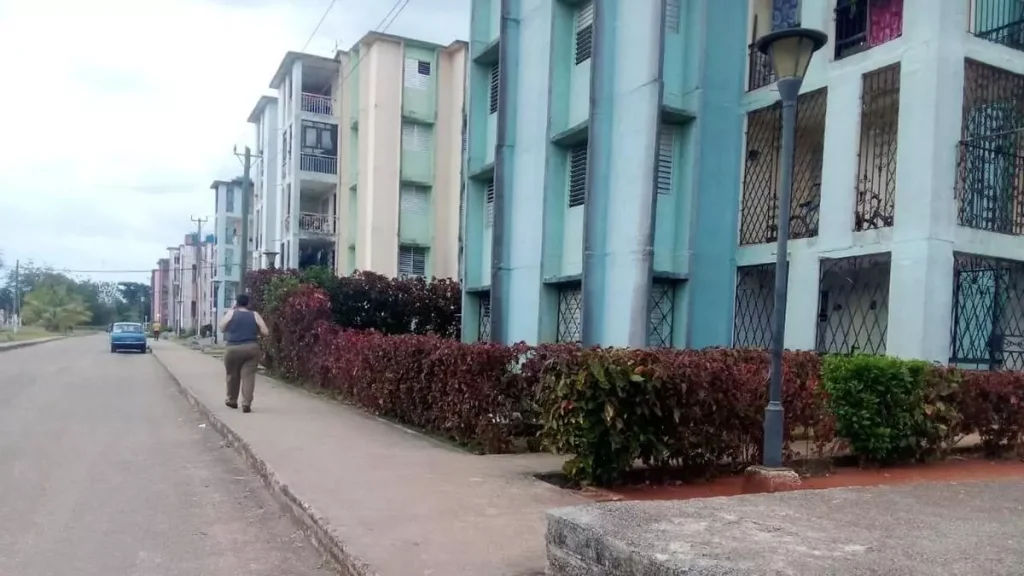
 14ymedio, Julio César Contreras, San José de las Lajas, April 19, 2026 / Nights fall early in the Reparto de los Médicos [Doctors’ Neighborhood] of San José de las Lajas, Mayabeque, not because the sun sets earlier, but because darkness arrives ahead of the daily routine. By seven in the evening, the neighborhood seems immersed in a kind of silent curfew. A few lights escape through the windows. From the street, the silhouettes of those who peek out of their doors to get some fresh air or keep watch for anything strange approaching are barely visible.
In this neighborhood, originally built for doctors and healthcare workers returning from missions abroad, blackouts are not an exceptional event, but rather the permanent backdrop of daily life. Some residents say they’ve lost count of the hours without electricity and that the brief service intervals have become so unpredictable that no one trusts the official schedules anymore. “Here, the power is like a visitor who arrives unannounced and leaves before you can even offer them coffee,” says Marcia, a 49-year-old surgeon who lives in one of the neighborhood’s oldest buildings.
The doctor speaks wearily, leaning against the doorframe of her apartment, holding a flashlight that barely illuminates the entrance floor. She explains that the power outages frequently last more than 24 hours, with only brief respites during the early morning hours. “They turn the power back on for a little while in the middle of the night. That’s when my husband and I get up to cook. Sometimes the beans are left half-cooked because the electricity doesn’t even last an hour. It’s a struggle every night. When I go to the hospital the next day, I feel like lying down in a ward. Honestly, I’m at my wit’s end,” she says.
“After 8:00 at night it’s impossible to go out, not only because of the darkness, but because people are being mugged and even buildings are even being broken into to steal.”
In the building’s hallways, the silence is broken by the creak of a door or the metallic clang of a gate slamming shut. The lack of lighting has amplified the fear of crime and changed how residents interact with the shared space. At night, almost no one ventures out. The stairwells are shrouded in a thick gloom, and shadows blend into the corners.
“After 8:00 p.m. it’s impossible to go out, not only because of the darkness, but because people are being mugged and people are even breaking into buildings to steal, with the owners inside their homes,” says Idalmis, who moved to a second-floor apartment about four years ago. She recalls that the neighborhood used to be a quiet place, mostly inhabited by healthcare professionals, but that the situation has changed with the exodus and the economic crisis. “In this neighborhood, most of the doctors sold their properties, traded them, or left the country. Those of us who arrived later have had to lock our doors and windows for our own safety,” she asserts.
The darkness not only affects tranquility but also domestic life. In Reparto de los Médicos, the lack of electricity brings with it another equally distressing problem: the lack of water. Without power, the turbines don’t work, and the tanks remain empty for days.
“The water shortage here is terrible. Without electricity, the turbine can’t be started. Some people carry bucket by bucket from the cistern, but I live alone and I can’t do that kind of work,” says a primary school teacher who lives in the area. The woman has had to improvise solutions to get through this routine. “I’m managing with a 55-gallon tank that I can fill once or twice a week. That has to be enough for housework and for bathing. This whole situation seems like something out of a horror story,” she says.
Household chores have become a race against time, where every minute of electricity must be used to the fullest.
As night falls, the neighborhood transforms into a mosaic of dim lights. From inside some apartments, the bluish glow of rechargeable lamps or the intermittent blinking of cell phones about to run out of battery project out. In other homes, total darkness reigns, and the silence is not a sign of tranquility, but of exhaustion.
In one of the buildings, Beatriz keeps vigil over her 92-year-old mother, who is bedridden and terminally ill. The woman spends her nights sitting by the bed, swatting away mosquitoes with a piece of cardboard as she waits for dawn. “My son and I take turns every night until sunrise so the mosquitoes don’t get to her. This situation with the electricity has truly exhausted us, and the worst part is that there’s no solution in sight amidst so many shortages,” she laments.
Fatigue accumulates in their bodies like a second skin. The daily grind has become a race against time, where every minute of electricity must be used to its fullest potential. Washing, cooking, pumping water, and charging batteries are tasks performed at any hour of the day or night, depending on when the power comes on.
“I might be washing clothes at three in the morning or five in the afternoon, when I finally get a chance with the electricity. I have to be like an octopus washing, cooking, cleaning, and then the power goes out again, without me having finished even half of the things that keep piling up as the days go by,” Beatriz explains, her eyes weary. Her patience is wearing thin as the electricity comes on less and less frequently.
______________________
COLLABORATE WITH OUR WORK: The 14ymedio team is committed to practicing serious journalism that reflects Cuba’s reality in all its depth. Thank you for joining us on this long journey. We invite you to continue supporting us by becoming a member of 14ymedio now. Together we can continue transforming journalism in Cuba.