
"December Is a Complicated Month and If You Go Out to Report You Will End Up In a Police Station"

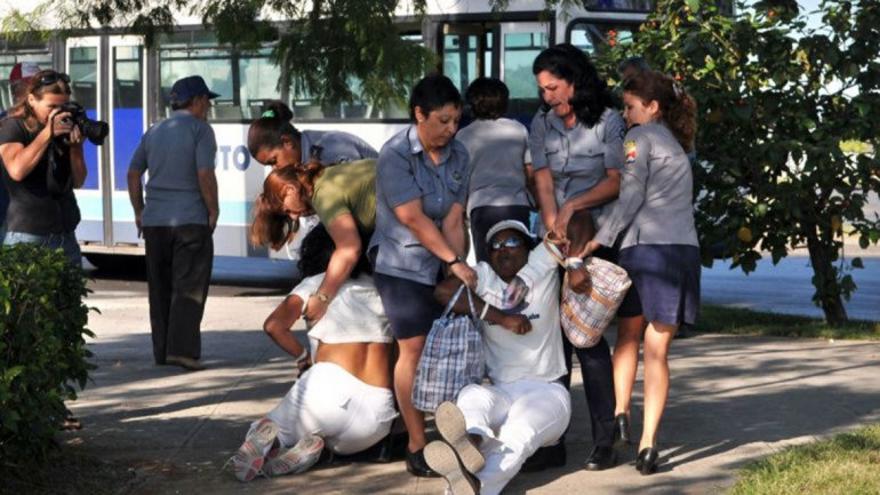
State Security encircles the Ladies in White from Thursday through Sunday each week, but this time they extended it more than usual. (Martinoticias.com/Archivo)

14ymedio bigger14ymedio, Havana, 4 December 2018 — December has started badly for a good part of the island’s civil society. Police operations, arbitrary arrests, a siege of activist homes and multiple threats against members of civil society have been constant in the first four days of this month that had already started with a warning. One of the reporters of this newspaper was warned that if he approached to cover “the provocations of the opposition” he would be arrested. “You know December is a complicated month and if you go out to report you’ll end up in a police station,” the agent said during the interrogation to which one of the members of the 14ymedio team was subjected.

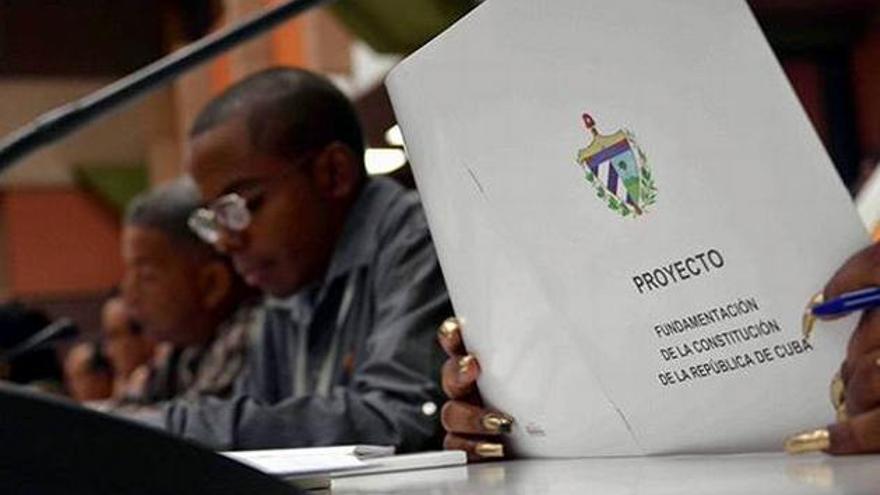
The warning was made on the first Monday of the month with the arrest of several artists who are carrying out a campaign against Decree 349 and who had convened, by using on-line networks, a “peaceful sit-in” in front of the Ministry of Culture to demand a dialogue with the institution and the repeal of the new legislation. Other actors of the independent civil society have organized events around the process of constitutional reform and are also preparing activities directed at showing the repression on the occasion of the celebration of Human Rights Day on December 10th. continue reading

Among those who have denounced the harassment, ratcheted up these days, is Ángel Moya, former political prisoner of the group of 75, from the so-called “Black Spring” in 2013, who told this newspaper that as of Monday afternoon the operation deployed by State Security since last Thursday still remained in place.

State Security organizes a police siege every week, from Thursday through Sunday, around the headquarters of the Damas de Blanco (Ladies in White) women’s movement to prevent the human rights activists from “arriving at Sunday Mass and participating in the campaign ’Todos Marchamos’ (We All March) for the freedom of political prisoners.” This week, the operation was  extended beyond the norm, according to Moya’s testimony, who added that there were police patrols and State Security officers on Porvenir Avenue.

Juan Antonio Madrazo Luna, a member of the Committee for Racial Integration (CIR), was also arrested on Monday while leaving his home by one of the officers who had surrounded his home since Sunday afternoon. Madrazo Luna was taken in a patrol to the Zapata and C police station and, shortly thereafter, driven to another station in the Playa municipality, where an officer who identified himself as Alejandro, second in command of the 21st, told him they were not going to allow the activities that his organization had planned throughout the week.

“In the morning I went down to open the door for a friend and to go out to buy bread, and the officer tells me that nobody can leave or come in. I told him that the only thing he could do was detain me, because I was not going to be imprisoned in my own house,” he recounted.

The activist pointed out that, in addition, he was warned that they would maintain “the same rigor against provocative activities that threaten public safety” financed with “money from the enemy.”

Moreover, the daughter of the historian and political scientist Enix Berrio Sardá, Ingrid, denounced this Monday to 14ymedio her father’s disappearance and asserted having no information of his whereabouts for several hours.

This Tuesday, the intellectual recounted that he was detained and held in solitary confinement in Picota and Villa Marista jails. “They detained me on the street at two in the afternoon, they kept me isolated and made me wait from midnight until five o’clock in the morning in a very cold room. Then the interrogation began, first linking me to the campaign against decree 349, under terrible conditions, it was torture; and then to the private transportation strike. At six in the morning the interrogation ended and at nine o’clock they released me. They are tense because of the level of conviction of the people involved in these matters,” he affirmed.

Berrio Sardá was one of the guests invited to the presentation of Por Cuba at Madrazo Luna’s house, where a presentation on the current process of the constitutional reform was to be held.

In Camagüey province, Henry Constantin also endured arrest for more than three hours on Monday. The journalist and editor of the magazine La Hora de Cuba (Cuba’s Hour) was arrested in the street and taken to a police station for no specific reason. “They gave me a warning notice, they said due to spreading false news, and they warned me that I would not be able to do anything else because they would not allow it,” Constantin told the newspaper as he left the police unit.

Translated by Wilfredo Díaz Echevarria

____________________________

The 14ymedio team is committed to serious journalism that reflects the reality of deep Cuba. Thank you for joining us on this long road. We invite you to continue supporting us, but this time by becoming a member of 14ymedio. Together we can continue to transform journalism in Cuba.

An Unwanted ’Fellow Traveler’ / Fernando Damaso

Signs in Havana advertising services provided by the self-employed.

Fernando Dámaso, 13 November 2018  — Although it has been shown that self-employment work, even with absurd limitations, excessive taxes and overt or overlapping state persecution, resolves problems that the State, with its obsolete companies and deficient socialist services, has been unable to solve in sixty years of exercising absolute power, it is still considered “an unwanted ‘fellow traveller’.”

It is obvious, moreover, that it has been precisely this private sector that has given work to the 600,000 people displaced by the state sector, and that today is the main generator of jobs. It also constitutes the sector most active in generating productive forces. In short, discourse goes on one side and reality on the other. continue reading

For months the delivery of new self-employment licenses has been “frozen”, under the pretext of studying improvements, to avoid illegalities by those who practice it. This preoccupation with illegalities should have been a focus of the State for many years based on the multiple illegal activities that are committed in their centers of production and services.

But, as is logical, you can not be a judge and jury at the same time. Now they come up with new Decree-Laws, Decrees and Resolutions published in the Official Gazette of July 10, 2018, which impose new restrictions, raise taxes and complicate with more bureaucratic measures the exercise of self-employed work.

The problem seems to be something else: the bureaucrats of the state apparatus (Ministry of Labor and Social Security, Ministry of Finance and Prices, Ministry of Internal Trade, Housing Institute, National Institute of Physical Planning, National Tax Administration Office and others) see self-employment as a dangerous competitor, which can’t be defeated or overcome in good faith, and they press on — so as not to lose their privileges — to bring it down with obstacles and abitrariness.

Some time ago the newspaper Juventud Rebelde published an article about the problems with the so-called preventive and orthopedic footwear, which is produced in the country only by two state companies — the so-called National Center of Technical Orthopedics Cuba-RDA (as obsolete as its own name) and Combell Company — both of which are rejected by their customers for their poor quality and worse design, which ensures that their warehouses are full of idle products, which have no customers in the market.

Faced with this situation, many citizens in need of this type of footwear choose to go to self-employed artisan shoemakers, who manufacture them with better quality and design, although at prices much higher than those of the state, but they have to produce them illegally because their licenses do not cover the manufacture of this type of footwear.

Simply one more of the many absurd rules in ridiculous licenses that limit the function of the trades. That is repeated with the carpenters, electricians, plumbers, masons and others, who can only legally perform a small portion of their trades, those that the incumbent bureaucrat came up with.

Bad examples abound:

The much publicized State Wholesale Market (Mercobal), until now the only one in the entire country, located on Avenida 26 and Calle 35, Nuevo Vedado, Plaza Municipality, functions only for non-agricultural cooperatives located in facilities leased to the State, under contract with the state suppliers that assign their orders.

In the also publicized Digital Commerce, which only functions at the Market of 5th and 42th, Playa municipality, you select the product and pay for it digitally and, to pick it up, using your own means, you must wait 72 hours. In other words, the payment is digital but the delivery is analog.

Who are the winners with so many absurdities?

Translated by Wilfredo Díaz Echevarria

San Cristobal’s Horsecart Drivers Strike in Protest Against New Restrictions

The work stoppage aggravates existing tensions between municipal managers and workers in this private sector. (14ymedio)

14ymedio bigger

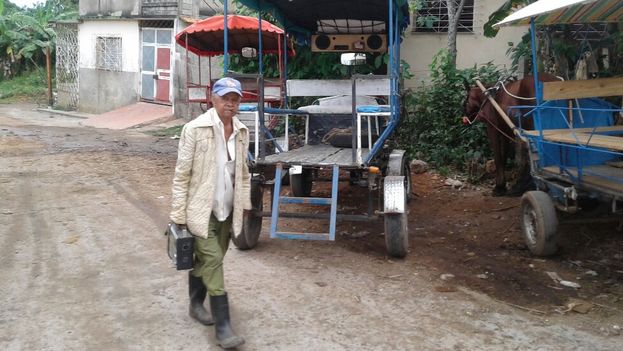
14ymedio, Bertha K. Guillén, San Cristóbal | December 01, 2018 – The drivers of horse drawn carts from San Cristóbal, Artemisa, have declared a strike as a signal of protest against new restrictions imposed by the Municipal Administration Council (CAM). The coachmen have decided to battles the authorities to repeal the measures that prevent them from entering the town and force them to only travel on outer roads.

On Friday, passengers arriving at the stand from where the horse-drawn carriages depart found the drivers seated, with arms crossed and insisting that they would not work until a “favorable agreement” was reached with the local government. The strike has paralyzed a municipality where most transportation is done via this rustic means of transit.

Last week the authorities decreed that the drivers could not circulate through the inner roads of San Cristóbal due to alleged complaints from neighbors about the bad smell of urine and the animals’ excrement of the animals. A version that drivers question, blaming the new restrictions on old tensions between municipal managers and workers in this private sector. continue reading

Less than three months ago the confrontation between both parties reached a point of no return, when in September the local government forced the drivers to move to secondary streets far from the center of the town. At that time, the drivers complained widely but ended up obeying the rules. On this occasion they have decided to go a step further.

“We can’t publicly say we are on strike, because in Cuba is not allowed, but we will stop working until we reach an agreement,” 14ymedio was told by Arsenio Ramirez, one of the drivers who this Friday reined in as a gesture of protest. “It was not enough for us to move five blocks away from the main roads, now they aren’t allowing us to enter the town at all,” he complains.

The drivers are sitting at their pick-up point and have organized to make the rounds with some of their vehicles but without picking up passengers on the road. The unusual scene of the horse-drawn carriages circulating empty has generated much curiosity among passers-by who have taken countless videos and photos of the work stoppage.

“The objective is for people to see the coaches circulating and find out what is happening,” explains Maikel, a young coachman who has joined the strike. “We have to collect evidence of the number of people who benefit from our service, with a bit of luck there will be more complaints from the population in favor of us and the authorities will have to reverse the measure.”

The local government has responded so far by placing a new bus that will cover the route from the main park of San Cristóbal to the hospital, twice a day. A way to easing the tension that has been created among the passengers who aren’t able to travel in the horsecarts that traditionally cover that stretch.

The self-employed are protesting because they are forced to travel around the town of San Cristóbal without being able to access its internal streets. (14ymedio)

“We transport around 7,000 people a day,” says Rolando Martinez, “most of them go to the hospital, whether workers or patients, who often come from other municipalities.” The driver believes that without the cars providing service the pressure on the authorities becomes unsustainable.

San Cristóbal has a population of more than 71,000 and is the second most populated territory in Artemisa province. In the town there is also a hospital that covers services of different specialties at the provincial level and the difficult situation of public transport forces the use of the horsecarts to get there.

“This morning the scene was bleak, doctors, nurses, children dressed in uniforms, everyone lined up on the road while the carts passed by empty, there was no transport so we had to walk to the hospital,” Carmen María, a nurse who had to walk the route on foot, complained Friday.

The changes in the horsecarts travel routes were announced last Thursday in a meeting in which representatives participated on behalf of the self-employed drivers, along with officials from the Municipal Administration Council.

“They treated us rudely, as soon as we expressed our discontent, the deputy director began to shout,” says one of the coachmen who participated in the meeting.

Pedicabs were also regulated with this measure, however they continue working in secret, although the local government has sent dozens of inspectors into the street who are imposing fines of up to 1,500 CUP on those who contravene the measure, which can even end up with the seizure of the vehicle in the event the driver is a repeat offender.

San Cristóbal has 81 animal-drawn vehicles in service for the transportation of passengers, 56 of them are duly regulated and at least six have contracts with institutions linked to education, commerce and culture sectors. The rest of the cars circulate illegally.

“As we are a large group, we organize ourselves and pay for a truck of water every two days to clean the area where we park the animals to avoid neighbors getting upset with the smell of horse urine, which is very unpleasant,” Arsenio Ramírez details to14ymedio.

Other drivers, such as Roilán, are optimistic about the results of the strike. “We have the certainty that the situation will be fixed, as soon as the week starts and people protest about having to walk.” The Self-employed driver says that if “each municipal administration sets its rules,” with this work stoppage the drivers are asserting theirs.

 ______________________________

The 14ymedio team is committed to serious journalism that reflects the reality of deep Cuba. Thank you for joining us on this long road. We invite you to continue supporting us, but this time by becoming a member of 14ymedio. Together we can continue to transform journalism in Cuba.
López Obrador or the Art of Launching Too Many Promises

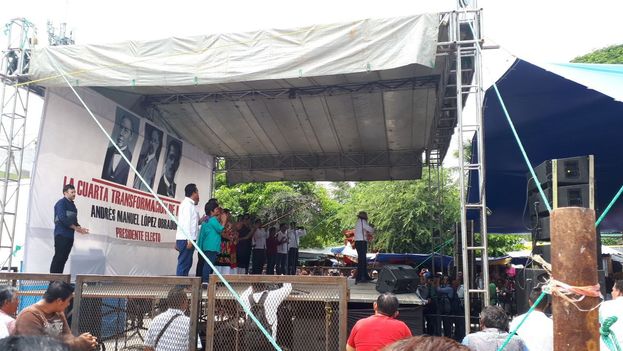
Andrés Manuel López Obrador during an event in Juchitán de Zaragoza, Mexico, last September. (Yoani Sánchez)

14ymedio bigger14ymedio, Yoani Sanchez, Havana, 4 December 2018 – Nobody had to tell me about it, I was there. The sun pricked my skin in Juchitán de Zaragoza, Mexico, a town still half destroyed by the earthquake that just a year earlier ravaged the region. Andrés Manuel López Obrador arrived to give a speech, but not everyone in the audience applauded or seemed to believe his promises. Some shouted clear and harsh slogans: “Out of the Isthmus!” (of Tehuantepec), they yelled.

That day, when by accident Amlo – as the president is known in Mexico – and I crossed paths, I thought I would find a passionate flood of his supporters but it was not like that. In fact, in Oaxaca there was talk of “the betrayal of Obrador,” the about-turn he had made between his campaign to reach the presidency and the gestures he made after being elected. One could already sense disenchantment and frustration over the contradictions that were beginning to show. continue reading

Schooled in the oratory of populists, that day I sensed in his discourse the haughty turns of language used to seek applause and call from the audience a response more devoted than reflective. I remember hearing him say that he would build “concrete roads” and that he would make the area an “industrial park.” He talked about employing everyone, raising wages and ending poverty in the area.

Noon arrived and the orator finished his speech. He quickly left through the back of the platform while the shouts against him rose from one side of the stage. I felt that I had been watching a theater performance, calculated but awkward, a professional staging that to my ears as a citizen born and raised in authoritarianism sounded familiar and dangerous.

On December first, the man I heard speaking in Juchitán de Zaragoza was sworn in as president of Mexico. On his shoulders he carries the hopes of millions who elected him, tired of traditional politicians, corruption and the scourge of insecurity. For them, Amlo is a wager to achieve healthy institutions, develop social programs that improve the lives of many Mexicans, and present an adequate response to violence.

Although his term is just beginning, it is easy to venture that he will not be able to fulfill so many promises, in part because some of them are completely chimerical. Others he will achieve at a cost harmful to the nation, appealing to the practices of patronage and accumulating too much decision power in his hands, under the justification that it makes everything more expeditious or better. The greater risk is that he ends up devouring the institutions with his person and that he swallows up the imperfect Mexican democracy under the pretext that the country needs a profound renovation.

Certain visions of a personality cult are beginning to emerge in Amlo’s Administration. Public mobilization rallies, during which the president uses words to hypnotically develop his theme, had already become part of his way of governing even before he donned the presidential sash. His followers do not admit criticism, he evades answers when questioned and his relationship with the press is beginning to get testy, especially when he treats reporters as children or kisses a journalist to avoid an uncomfortable issue. He presents himself as the redeemer of a nation, and expects in return the unlimited veneration of Mexicans who will give him their absolute confidence to resolve the national wrongs.

His obstinacy, which undoubtedly attests to the several attempts he made to reach Los Pinos, can be a virtue when the time comes to apply solutions, but also a double-edged sword that leads to the most ferocious voluntarism. It will be a challenge for his ministers and closest officials to maneuver with this human whirlpool, a man who believes he has the answers to all the problems and knows how to resolve each quagmire.

For now, the first “Amlo effect” that Mexicans will have to deal with is polarization. That confrontation that settles in society and threatens to sit at the table of every household. The half measures are over, now one can only applaud or reject his management, a dichotomy that undermines the healthy debate and moderation that public discourse in any democracy needs.

Confusing the nation with a Party, the homeland with an ideology and the people with a man, as has happened in the sad case of Cuba, has devastating consequences for citizen sovereignty, the independence of institutions and freedom of expression. That one individual stands as the savior of millions of people should scare us as much as coups d’état. They start by distributing perks and end up locking us in the authoritarian cage. Nobody had to tell me, I’ve lived it.

_____________________________

The 14ymedio team is committed to serious journalism that reflects the reality of deep Cuba. Thank you for joining us on this long road. We invite you to continue supporting us, but this time by becoming a member of 14ymedio. Together we can continue to transform journalism in Cuba.
Will Today Be The Day?

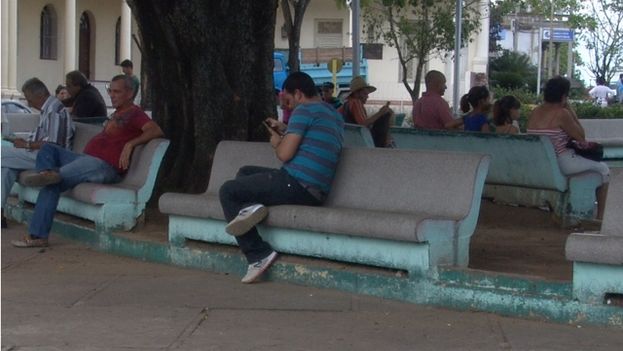
To connect by mobile phone you have to go to a wifi point. (14ymedio)

14ymedio bigger14ymedio, Yoani Sanchez, Generation Y, Havana, 4 December 2018 — Will today be the great day when the Telecommunications Company of Cuba (Etecsa) finally tells us – with precision, transparency and honesty – the date on which we Cubans will be able to enjoy internet service on our phones?

The state monopoly, one of the most inefficient companies on the planet, promised a few months ago that we would be able to surf from our cell phones before the end of this year. After three tests that were a resounding failure, Etecsa has not mentioned the matter again and now only 27 days remain until the end of the month. We do not accept excuses, we want to be respected as customers.

If Etecsa CAN’T (as it seems), the authorities should let other foreign companies with more experience and infrastructure come in to offer stable, modern and cheap connectivity. Professionals across the country are crying out for this, because every day they spend not as internet users their knowledge is outdated and their ability to innovate and create ceases to be competitive. continue reading

Entrepreneurs would also be able to scale to a new level if they could offer their products and services through the web (can you imagine Über arriving in Cuba?), and teenagers, students, housewives, and even retired people who stand in line for the newspaper, would have greater opportunities, new channels of information, more chances of interacting with their emigrated relatives and with the world.

In other words, the country would benefit. But the thing is, there are some who see nothing good coming from our being connected. They are those who have spent years been trying to “tame the wild colt of the internet,” the mediocre people who have gained prominence with their subsidized (and privileged) access to the web where they go to repeat their slogans. The lifelong censors who tremble just thinking about people having their hands on a device directly connected to the great world wide web, able to report an abuse in a matter of seconds, to record political violence, the chronic shortages, the popular discontent, to denounce a corrupt official… to question the system.

They are those who even fear people enjoying “the frivolity” of the web… because every song we listen to on iTunes, every dating site we visit, every product we “covet” on Amazon, will be time spent beyond the influence of official propaganda, far from the carefully packaged primetime newscast. It will be time in which we may seem apathetic, but at least we won’t be “fanatics.”

Anyway, Etecsa, how long until mobile internet arrives?

_____________________

The 14ymedio team is committed to serious journalism that reflects the reality of deep Cuba. Thank you for joining us on this long road. We invite you to continue supporting us, but this time by becoming a member of 14ymedio. Together we can continue to transform journalism in Cuba.
Lopez Obrador and Cuba Negotiate a Mexican “Mais Medicos” Program

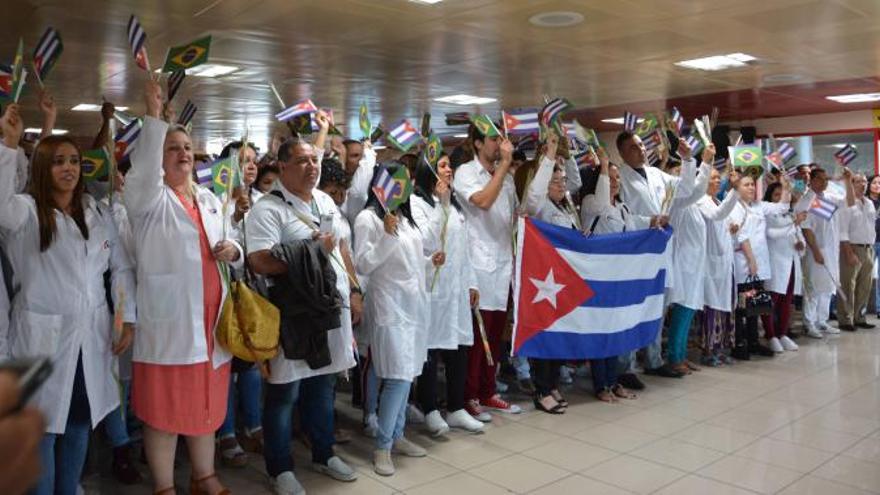
Doctors continue to arrive back in Cuba from Brazil after Cuba’s break with Brazil’s ’Mais Médicos’ (More Doctors) program. (Granma / Juvenal Balán)

14ymedio bigger14ymedio, Havana, 3 December 2018 — At least 3,000 professionals from Brazil’s Mais Médicos (More Doctors) might end up in Mexico if the negotiations between the government of new Mexican president Andrés Manuel López Obrador and the authorities in Havana are successful. According to the newspapers Estadão and Cubanet, the negotiations began last September, after López Obrador’s election victory, to create a program similar to Brazil’s in Mexico, The negotiations have been led by Lázaro Cárdenas Batel, the new coordinator of advisors to the Mexican president.

“There is no one better than Lázaro Cárdenas Batel manage [the project] among the three countries,” said a source quoted in an exclusive. The official belongs to a family closely linked to the Mexican left and has friendships with members of the Brazilian Workers’ Party. continue reading

After the suspension of several flights, Cuban doctors in Brazil were informed that “there are no available airlines” and their trips were paralyzed, although they were scheduled to start again on Monday.

López Obrador has stated on numerous occasions that changes in the health system are a priority for him. “We want the right to healthcare to be guaranteed and, in Mexico, when the six-year [presidential] term ends, we will have a health system like Canada’s, England’s, and that in the Nordic countries; we will have a free quality health service for all the people of Mexico,” said the president-elect.

However, the now newly-inaugurated president of Mexico has promised a national austerity program difficult to combine with the universalization of free healthcare. An agreement similar to the Mais Médicos program — potentially bringing in thousands of Cuban doctors — can be the key to lowering the high costs of his commitment.

 ____________________

The 14ymedio team is committed to serious journalism that reflects the reality of deep Cuba. Thank you for joining us on this long road. We invite you to continue supporting us, but this time by becoming a member of 14ymedio. Together we can continue to transform journalism in Cuba.
Several Cuban Activists Arrested Protesting Ministry of Culture Decree 349

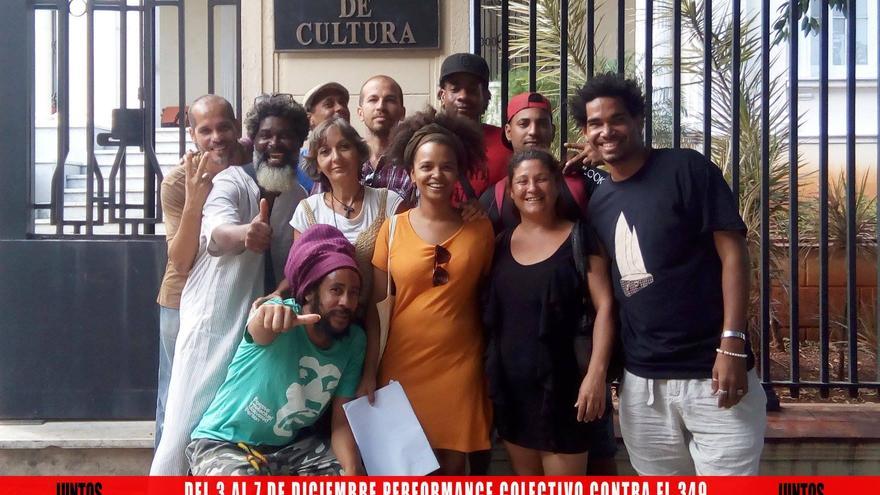
“Michel Matos, Tania Bruguera, Amaury Pacheco and Luis Manuel Otero had agreed to go on a hunger and thirst strike in the event that they were arrested,” according to Iris Ruiz. (Facebook)

14ymedio bigger14ymedio, Havana, 3 December 2018 — At least three activists were arrested on Monday outside Cuba’s Ministry of Culture when they tried to protest against the enactment of Decree 349, which places strict limits on artists and the diffusion of art. Tania Bruguera, Michel Matos and Amaury Pacheco have been arrested, so far, although the figure could increase in the next few hours, according to actress and activist Iris Ruiz who spoke with 14ymedio.

The well-known artist Tania Bruguera was arrested at her home in Old Havana, while Michel Matos and Amaury Pacheco were arrested outside the headquarters of the Ministry of Culture in Havana, when they tried to participate in a call for a sit-in against the new regulations that will go into effect on December 7. continue reading

Bruguera had time to make a call when she was arrested, while the artists Yasser Castellanos and Verónica Vega, also involved in the protest, were prevented from leaving their home by several uniformed officiers, Ruiz said.

The whereabouts of Yanelys Núñez and Luis Manuel Otero Alcántara are unknown; they had agreed to call Ruiz at a specified time, but their phones are not shut off.

“Michel Matos, Tania Bruguera, Amaury Pacheco and Luis Manuel Otero had agreed to go on a hunger and thirst strike in the event that they were arrested,” Iris Ruiz explained to this newspaper. She also detailed that “the agreement was made in [the neighborhood of] San Isidro,” in Havana, where the Museum of Politically Uncomfortable Art is located, and that “the idea is to maintain [the strike] until they can meet with a representative of the Government who confirms the repeal of Decree 349.”

As a condition for abandoing the fast, the protesters also demand that the authorities publish “a public commitment to retract the measure in the media and social networks.”

The campaign against Decree 349 was set out last September in the San Isidro Manifesto, with which the movement sought to augment its actions to denounce the regulation of artistic performances. The campaign involves musicians, artists and writers. Amnesty International said last August that Decree 349 “augurs a dystopian artistic world in Cuba.” Similarly, the United States Government reacted to this situation by stating that “Under decree 349, artists suffer the indignation of having to obtain authorization to express themselves,” according to a tweet from the State Department.

Those who criticize the promulgation of Decree 349 regret that in all cases the artists must have prior authorization from the cultural institution with which they will be compulsorily affiliated in order to carry out presentations, which directly affects those who work outside of these state entities. The content of the presentations and artistic works will also be regulated.

_____________________

The 14ymedio team is committed to serious journalism that reflects the reality of deep Cuba. Thank you for joining us on this long road. We invite you to continue supporting us, but this time by becoming a member of 14ymedio. Together we can continue to transform journalism in Cuba

Arrests of Cuban Activists "Notoriously Greater" in November

The CCDHRN highlights that among the activists arrested last month was Yasmani Ovalle León, a member of Unpacu. (Screen capture)

14ymedio bigger
14ymedio, Havana, 3 December 2018 — The Cuban Commission for Human Rights and National Reconciliation (CCDHRN) reported that there were “at least 247 arbitrary arrests of peaceful opponents for purely political reasons” in November, according to its latest report released Monday. The independent organization suggests that the figure may be higher due to “the opacity with which the repressive forces act.”

In the report, the CCDHRN points out that the number of arrests of activists is “notoriously greater” to those that took place during the month of October, in which 202 of these violations of citizens’ rights were documented. continue reading

Among the civil society organizations that suffered the most arbitrary arrests are the Ladies in White, the United Antitotalitarian Front (Fantu), the Patriotic Union of Cuba (Unpacu) and the OZT (Orlando Zapata Tamayo) Civic Action Front.

The Commission warns of two new political prisoners: Unpacu members Carlos Elvis Pérez Torres sentenced to three years for the charge of “Pre-criminal Social Dangerousness” and Yasmani Ovalle León, pending trial.

For its part, the Cuban Observatory of Human Rights, based in Madrid, denounced that the political police arrested numerous activists who are calling for citizens to vote “No” in the upcoming referendum on the revised constitution.

The entity, which counts 210 arbitrary arrests, warns about “the consequences of the new package of regulations that the Government of Miguel Díaz-Canel intends to put into effect in December.”

Among the new laws that are now in force, Decree 349 is included, which “imposes severe governmental controls on artistic creation and dissemination in private spaces,” as well as “other rules that limit even more the work of the self-employed in sectors as critical as transportation.”

According to the Observatory, “These measures reflect the reactionary spirit that dominates the government of Diaz-Canel, who does not know how or does not want to make life easier for citizens.”

The Observatory’s executive director, Alejandro González Raga, harshly criticized the attitude of the Spanish president Pedro Sánchez during his visit to the island, for having “an agenda completely alienated from human rights.”

 ___________________________

The 14ymedio team is committed to serious journalism that reflects the reality of deep Cuba. Thank you for joining us on this long road. We invite you to continue supporting us, but this time by becoming a member of 14ymedio. Together we can continue to transform journalism in Cuba.
The Exodus is the Consequence of Despair

The poor, the persecuted and those crushed by political repression know that there is a better world and that it is elsewhere, within reach of a raft, an difficult road or a border river. (EFE)

14ymedio bigger14ymedio, Carlos Alberto Montaner, Miami, 3 December 2018 — The image of the 21st century is that of fleeing multitudes. Who can forget the photo of Alan Kurdi, the three-year-old boy drowned in the Mediterranean when his Syrian-Kurdish family tried to flee from the hell organized by the Russians to support the despot Assad? He looked like he was sleeping (or rather snoozing, the baby was so small and cute).

Or the images of the caravans of Central Americans, especially Hondurans, who were trying to cross the border to the United States. Or the sub-Saharan Africans who travel crammed in small boats towards an uncertain European destination of drugs, prostitution or, in the best of cases, sale of counterfeit goods in makeshift stalls.

We have to do something. The phenomenon is universal. The poor, the persecuted and those crushed by political repression know that there is a better world and that it is elsewhere, within reach of a raft, a difficult road or a border river. Movies, television, social networks give constant news of those happy nations in which it is possible to dream of a different future. When we know that we are condemned to live poorly under the boots of our oppressors, the psychological need to escape arises. continue reading

This is what happened in 1980 when Fidel Castro announced that he was removing the police guard from the Embassy of Peru in Havana and anyone who wanted to could take asylum there. The Commander thought it a few dozen people would go there. Eleven thousand people entered in a few hours. Everyone crammed together. It was an unusual drama. It was a daring outpost to the millions of Cubans who had ascertained that their lives would inevitably be miserable and they could do nothing to improve them because the government interfered with prohibitions and absurd controls.

Leaving one’s country forever is like deciding to commit suicide. Suicides take their own lives when they see no way out of their misfortunes. It was this same urgency that fed the Central American caravans. They were failed societies with no hope of improvement. It is not poverty. There are poor people in Panama and Costa Rica and there are no natives of those countries in the midst of the flood of Central American immigrants. Panama and Costa Rica, in fits and starts, are liberal democracies in which it is possible to dream of a better future. There were poor people in pre-Chavez Venezuela and the country continued to receive immigrants with dreams. The exodus is the consequence of despair.

What can be done? The first thing is to relieve the victims. Cure them. Feed them. Give them back their lost dignity. I know because I was one of those victims. In September 1961, I arrived in Miami from Havana on a flight that brought asylum seekers from the Venezuelan embassy in Cuba. I was 18 years old. They did not tell me what I had to do, but they gave me the tools so that I could decide how to seek my own happiness and that of my family.

Unfortunately, this is something that can not be left to the democratic method. Societies tend to be severe with strangers. Maybe it’s part of our genetic load. The only mass gathering of Cubans in 1939 was called to block the way for the poor Jews fleeing the Nazi horror. The newspapers of the time say that 40,000 Havanans congregated to oppose this immigration. The image of the inhabitants of Tijuana throwing stones at the Central American caravans are an eloquent expression of these atavistic rejections.

The false idea that “they take away our jobs” or the mean calculation that “they come to use our limited public resources” usually prevail in the face of a weak instinct for solidarity. That’s why we can not leave it to the best judgment of the majority. The majority is very cruel when it comes to people who worship other gods, are a different color or speak another language. But we have to do something.

 ____________________

The 14ymedio team is committed to serious journalism that reflects the reality of deep Cuba. Thank you for joining us on this long road. We invite you to continue supporting us, but this time by becoming a member of 14ymedio. Together we can continue to transform journalism in Cuba.
Between Solidarity and Business / Fernando Dámaso

“April 19th Polyclinic” in Havana’s Nuevo Vedado neighborhood.

Fernando Dámaso, 28 November 2018 — These days, the official media are bored with the case of Cuban doctors who served in Brazil, and the second anniversary of the death of the “older Cuban” (senior athlete, senior doctor, senior educator, senior artist, senior rumba artist, etc, etc, etc.). In both cases the “teque*” is aberrant. However, I will refer only to the first case, because the second is inconsequential for most Cubans.

If we accept the case of the official propaganda, the only person responsible for what happened is the newly elected president of Brazil, Jair Bolsonaro, with his aggressive statements against the doctors and for meddling in matters that do not concern him, as the doctors fulfilled a humanitarian mission and an act of solidarity, providing medical care to dispossessed Brazilians. Nothing is said in the official discourse about the great economic business that they represented for the government of the Island. continue reading

Using some data available here and in Brazil, we can derive the following table: 8,500 doctors x 4,000 dollars per month is equivalent to 34 million dollars per month, which multiplied by 12 months of the year gives us the figure of 408 million dollars.

To this figure should be subtracted the 5%, which is paid to the Pan American Health Organization, that is 20,400,00 dollars, leaving 387,600,000 dollars.

To this new figure should also be subtracted the amount of $400 per month for each of the 8,500 doctors, which is what the Cuban government paid them (200 in Brazil for expenses and 200 deposited in an account in Cuba, available to them only after they complete the mission), or 3,400,000 dollars per month, which multiplied by the 12 months of the year equals 40,800,000 dollars.

Summing up: of the 408 million dollars that Brazil paid annually, 20,400,000 went to the Pan American Health Organization, 40,800,000 went to payments to the doctors and the Cuban government kept 346,800,000 dollars per year. A lucrative business!

In short, the two main approaches of the new Brazilian President Jair Bolsonaro were: to subject doctors to an examination, which is a common practice in most countries that hire foreign professionals, and to pay the salaries directly to the doctors. This second approach seems to have been the real trigger of the hasty decision of the Cuban authorities to order their withdrawal from the Mais Medicos (More Doctors) program.

The conditions could have been accepted, even if Cuban doctors received their salaries directly, due to the unjust current tax system in Cuba. The doctors would have had to pay the Cuban government 50% of the profits exceeding $2,000 per year.

It is true that the authorities would not have received the 34 million dollars a month, but they would have received 17 million and, annually, discounting  the 5% to the Pan American Health Organization (20,400,000 dollars), they would have received 50% of the amount paid to the doctors (193,800,000 dollars). Something is more than nothing!

I do not deny the right of the Cuban authorities to throw a tantrum over the millions of dollars they will stop receiving, but we must speak clearly without so much humanistic rhetoric, which recalls the arguments of the “soap opera novels” of the forties and fifties, with too much crying and melodrama.

Nor do I deny that Cuban doctors miss their patients, but it seems that they also miss the 400 dollars a month the Cuban government paid them for their work in Brazil, which was much more than the 40-60 dollars a month they receive working in Cuba, and which allowed them to satisfy some of their accumulated personal and family needs.

Let’s be clear about this!

*Translator’s note: El teque is Cuban slang for the unrefrained barrage of official rhetoric.

Díaz-Canel’s Wife Is a Ghost in Cuba / Iván García

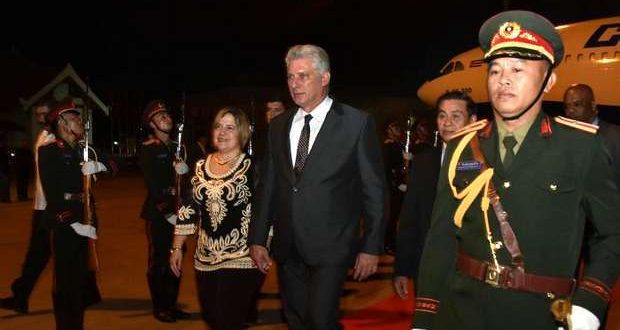
Miguel Díaz-Canel and his wife, Lis Cuesta, arriving in Laos on November 10, 2018. (Granma newspaper)

Iván García, 19 November 2018  — In its most extreme forms Marxism is an explosive cocktail of ideological fanaticism, macho stupidity and freehand populism. A lethal combination of the worst kind of religious dogmatism and Mafia-style clan loyalty.

Fidel Castro’s forty seven-year rule of Cuba was marked by Olympic-sized violations of the basic principles of a modern democracy. He treated his first wife, Mirtha Díaz-Balart, like one of those porcelain vases that you put on of a table. He learned this from his father, Angel Castro, a crude and ignorant peasant from Galicia who came to the island to wage war against pro-independence forces and who later settled in the east of the country where he established a successful agricultural operation. Angel saw women as housewives and semen depositories. continue reading

In many ways Fidel is not much different from his father. He ruled the country like the family farm back in Birán and believed he had the right to possess any attractive blonde who he crossed his path. More than anything, he thought of himself as a warrior. As the founder of the first socialist state in the Americas, ninety miles from “the empire,” everyone had to fall to their feet before him. For men this meant carrying out his orders. For women it meant spreading their legs when he was sexually aroused.

One would have to look to the macho origins of the 1959 revolution to understand the absence of Lis Cuesta, the wife of President Díaz-Canel, in the state-run media. Raúl Castro, brother of the deceased dictator and himself later president, had the advantage of being a family guy. His marriage was a public one. And he spent his Sundays having lunch with friends, serving them spit-roasted pork leg and orange juice laced with vodka.

Although women gained social, economic and institutional status, their rise represented more of a tactical political move than evidence of real independence. Most of the regime’s heayweights had lovers on the side. It was considered to be in good taste and a sign of manliness, especially if she was a singer rather than a journalist.

Díaz-Canel knows firsthand how the levers of power work. No one can accuse him of being the typical macho type. A farm boy, he was born fifty-seven years ago in the Falcón district of Placetas in Villa Clara province. He is of another generation. When he held the post of first party secretary in Holguín province, he had no qualms about divorcing his wife and marrying Lis Cuesta Peraza, then a well-known teacher and cultural promoter.

A former Holguín resident who now lives in Havana recalls that “Díaz-Canel didn’t do as good a job in Holguín as he did in Villa Clara, but he always walked hand-in-hand with Lis, who was not as heavy as she is now.” A former official who knew Cuesta in Holguín claims she is affable and talkative, and likes to dance and drink beer, like any Cuban. “I don’t know why the press ignores her,” he notes, “as though she were a kitchen rag. She is a competent woman. Her husband should demand that the media give her more coverage.”

Susana, a university student likes “the way Díaz-Canel’s wife looks. She is not embarrassed to have a tatoo on her back. She’s attractive and wears brand-name clothes. But she should lose some weight. She should take advantage of her position and install a gym in her house.”

“The way the national media marginalizes the wife of the nation’s president is inexplicable,” says Jorge, a political science graduate. “On television we see her at his side on various overseas trips but the news anchor never mentions her. Because of political prejudices Cuba has eliminated the role of first lady, but they ought to at least say she is his wife.”

A government journalist, who prefers to remain anonymous, says, “There are no specific guidelines for how to classify Lis Cuesta. Six months ago a television anchor referred to her as the first lady and was reprimanded. They have tripped over themselves trying to describe her. It’s enough to simply say she is Díaz-Canel’s wife. Cubans who don’t follow politics don’t even know her name. The assumption is that, in a country that prides inself on the family being the building block of society, subjects like this must be treated tactfully.”

Lucía, a textile designer, wishes the government and the press would report on Lis Cuesta and stop acting as though she were invisible. “The first lady should have an active role, like in other Latin American countries,” she says. “Lis has good taste in clothes, is well-groomed and doesn’t wear too much makeup. But if she had an image consultant, she would come off better. She lacks spontaneity and her smile is forced. And both she and her husband should lose weight.”

Norge, an attorney, says, “I do not understand why — at a time when women are increasingly in the international spotlight, we are in the midst of the #MeToo whirlwind and women are strongly represented in United States Congress — our press ignores the wife of the current president. It shows a lack of respect for Lis Cuesta and for Cuban women.”

In all of Miguel Díaz-Canel’s foreign tours — to France, Russia, North Korea, Vietnam, Loas and a layover stop in London — the television anchor never mentioned Lis Cuesta when she appears on screen. It is as though she were a ghost.

The Regenerative Power of NO!

“This project has not been prepared by a Constituent Assembly composed of delegates elected through an electoral process with all the guarantees.” Source: Granma, Cuba’s major newspaper, owned Communist Party.

14ymedio bigger14ymedio, Ariel Hidalgo, Miami, 1 December 2018 — A patriarchal group that has governed Cuba for 60 years is presenting a project for a revised constitution to become the law of the country. But this cosntitutional project has not been prepared by a Constituent Assembly, one composed of delegates chosen through an electoral process with all the guarantees of free and fair elections, as is supposed to be done in a truly democratic country. Rather it was prepared by a team of hand-picked editors.

The word ‘party’ comes from ‘part’, so it is clear that this project represents only a part of the population and not all the currents of thought among the citizenship, so it cannot really be considered the fruit of the popular will. This revised Constitution would reaffirm the violation of elementary rights of human beings, rights such as free association, free expression and the free activity of citizens to seek their own prosperity. The response of citizens before this consultation should be: No! continue reading

Our great problem as a nation is that we have spent our existence saying ‘Yes’ or, at least, shutting up when we should have said ‘No’. When a group of soldiers perpetrated a coup to overthrow a democratically elected president and abolish the Constitution, we did not throw ourselves into the streets to shout with one voice: “No!” And that was the beginning of our current misfortunes.

Then a group of supposed redeemers arrived and, in gratitude for our presumed liberation, we blindly obeyed everything they imposed on us. Why have free elections? Why reinstate the violated Constitution if those chosen by providence were there to guide us on a path of freedom and prosperity? If you idolize a caudillo and elevate him to an altar, that false god will rule your destiny with an iron fist.

This group that at other times has also persecuted and repressed citizens for their sexual orientation, for their religious practices and even for their artistic preferences, and who later had to tolerate even the veneration of a saint, the gay pride celebrations, and even erect a statue to John Lennon, has not ceased to be the same, but has had to yield to the swell of the people practicing civil disobedience in silence.

Now is the time to impose the right to think differently and to respect the different options and preferences of the population in spheres such as the economy, the social and the political, and for all us us to united in a single force to say ‘No’ to this constitution that they want to impose on us.

There are those who still believe that the correct attitude is to abstain, to refuse to go to the polls in response to the electoral consultations staged by the powers-that-be, that everything is a farce, that they will manipulate the counting of the votes and that the ‘consultation’ on the revised constitution will be legitimized by the attendance at the polls of those without power.

But this option to abstain has been chosen many times and has been repeated before the deaf ears of citizens for whom it is not easy to abstain in a country where one’s absence at the polling stations marks you as disaffected and where the pro-government organizations pressure you to participate, while it is less noticed to go and vote ‘No’ in the privacy of the polling place.

And today, in this world, abstention is nothing new in any country, but rather the most frequent response of a humanity tired of corruption and the lies of politicians. It is not seen as rejection but as laziness, a laziness that in a certain way also means acceptance, because those who call the elections win. That is why we must urge citizens to go to the polls and to vote ‘No’.

That Power will to manipulate the results is known, but with an overwhelming vote in favor of ‘No’ the truth would filter out through all corners and crevices, and run through different and unsuspected trajectories, like the flood of a river. And if the majority is reached, a vigorous minority will suffice to be impressive in a world where fear has always reigned, and where unanimity is demanded. And it will send a clear message to those who still collaborate with the regime, whether through fear, opportunism, or ignorance, among which there are officials, soldiers, and Party militants.

Let them know that the winds are already blowing in the opposite direction, announcing the proximity of a renewing storm. And if the fearful begin to lose their fear, and the opportunists to rethink their unconditional support, and the ignorant to question what until then they accepted blindly, that will be the beginning of the end of that world built on the basis of the lie.

Because no one governs without the consent of the governed, that is, of the people or a part of that people, and if this part finally decides to live in the truth, that world crumbles like night shadows before the luminous rays of dawn.

The campaign for ‘No’, could also bear an invaluable fruit: the confluence of the renewing forces that fight for change. The real fronts and coalitions are not made around a table, but in joint work and struggle. And there is no time more than now that requires the bringing together of all the opposition ranks in a single force capable of peacefully defeating ‘Yes’.

Because this campaign could not win any isolated group against a regime that has a monopoly over all the mass media. But in the face of a united front for ‘No’, it would be able to achieve victory. Our differences, our different projects and perspectives, a reflection of the polychromatic richness that we represent, far from distancing us, unites us like a rainbow in the defense of freedom of thought in the face of those who want to impose, by force, a sterile unanimity.

A consensual, measured call is needed, one that convincingly exposes the reasons for voting ‘No’, the fruit of the representative ranks of all currents of thought that, consequently, can be presented, alien to all partisanship and ideology, in the name of — and as the voice of — a whole civil society that until today has remained silent, gagged by censorship.

It could, with the cooperation of all, be published on all the networks, blogs and circulated hand-to-hand in neighborhoods, workplaces, universities, in theaters and seminars and other cultural activities, and thus expose Power’s manipulation of the results.

Such a joint document would not require its editors to gather at any meeting place, it would not take more travel than browsing through cyberspace, or more room to host delegates than a virtual site.

There is no need to fear campaigning for ‘No’, because it is a legitimate right to inform citizens about the other side of the coin of what the leadership wants to impose through coercion and fear. Because in a real popular consultation in which it is legal to vote for one of the two options, and Power has all the means to advocate for one of them, it must also be lawful to defend the opposite option.

Let us all be united in a single force capable of peacefully defeating the governmental proposal. Everyone vote ‘No’!

 ________________________

Editor’s note: Ariel Hidaldo is a writer and historian.

The 14ymedio team is committed to serious journalism that reflects the reality of deep Cuba. Thank you for joining us on this long road. We invite you to continue supporting us, but this time by becoming a member of 14ymedio. Together we can continue to transform journalism in Cuba.