
Cuban Artists Arrested Protesting in Front of the Capitol Against Decree 349

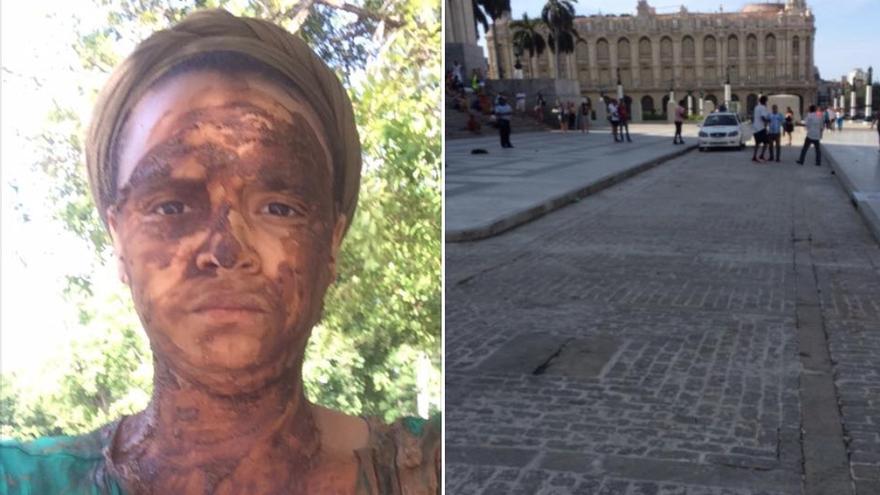
Left: Yanelys Núñez, after covering her body with excrement as a protest for the new controls on cultural diffusion. Right: The moment of the arrest of the other participants. (Facebook)

14ymedio bigger14ymedio, Havana, 22 July 2018 — Artists Luis Manuel Otero Alcántara, Amaury Pacheco OmniPoeta, Iris Ruiz, Soandry Del Rio and José Ernesto Alonso were arrested on Saturday afternoon in front of the Capitol in Havana after an attempt to protest against the recently approved Decree 349 that regulates artistic presentations in private spaces.

According to Yanelys Núñez, a curator, the artistic action consisted of Luis Manuel Otero “covering his body with human excrement” and displaying a sign with the words “free art.”

When Núñez arrived at the Capitol, she saw that a police patrol was holding the five artists in custody and decided to do the performance on her own. “I’m covered in shit now but I’m on my way to the police station at Cuba and Chacón to ask if they are there,” she told this newspaper by telephone.  continue reading


At six-thirty in the afternoon, Luis Manuel Otero Alcántara also denounced the arrest to 14ymedio by telephone from the Zanja Police Station and confirmed that Iris Ruiz, Amaury Pacheco and Soandry del Río were arrested along with him. 

Upon arriving at the station at Cuba and Chacón at around 8:30 in the evening, Yanelys Núñez was able to converse with José Ernesto Alonso, who had recently been released after having been detained there, and Iris Ruiz was also released shortly afterwards.

However, at the Zanja Street police station in Centro Habana, the officers informed the curator that Luis Manuel Otero, Amaury Pacheco and Soandry del Río were transferred to Vivac (detention center in Calabazar, south of Havana) “accused of public disorder,” and all three of them must await trial behind bars. Otero was also charged with “assault” against the police, for allegedly hitting one of them.

During the protest that took place in front of the Capitol, the curator shouted that they were against Decree 349. “We are artists, we want respect, we ask to meet with the Minister of Culture,” she said. He also claims that Otero Alcántara was beaten to put him in the patrol and that Pacheco was taken away because he refused to show the identity card to the police. 

Several artists have denounced that Decree 349, published on July 10 in the Official Gazette, limits the free creation of Cuban artists and their presentations in public spaces.

The new decree, included in a larger package of measures, is intended by the Ministry of Culture (Mincult) to control the presentations of artists and musicians and to leave the door open to institutional censorship. The text establishes fines, seizures and even the possible loss of the self-employment licenses of those who hire musicians to perform concerts in private bars and clubs as well as in state spaces if they do so without having authorization from Mincult or the recruitment agencies.

In the same way, the decree punishes painters or artists who commercialize their works without state authorization. It also allows punishing those who project films that contain scenes of violence, pornography, sexist or vulgar language, use national symbols in a way that goes against current legislation or have messages that discriminate against other people because of skin color, gender, sexual orientation, disability and any other trait that is “harmful to human dignity.”

According to the letter of the decree, state entities or private businesses that broadcast music or program artistic presentations in which violence is promoted “with sexist, vulgar, discriminatory and obscene language” will be sanctioned in the same way. The decree also applies to literature by prohibiting the sale of books of “natural and legal” persons that include “contents that are harmful to ethical and cultural values.”

____________________________________

The 14ymedio team is committed to serious journalism that reflects the reality of deep Cuba. Thank you for joining us on this long road. We invite you to continue supporting us, but this time by becoming a member of 14ymedio. Together we can continue to transform journalism in Cuba.
Paya Denouces the ‘Theater’ of Constitutional Reform on Sixth Anniversary of Her Father’s Death

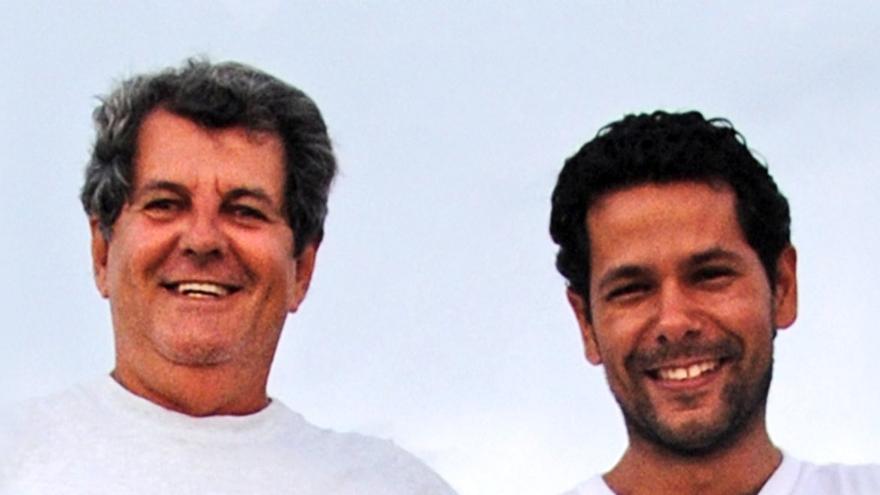
A Mass for Oswaldo Payá and Harold Cepero was celebrated this Sunday at the Copper Hermitage in Miami. (RosaMariaPaya)

14ymedio biggerEFE via 14ymedio, Miami, 23 July 2018 — Cuban Dissident Rosa María Payá stressed to EFE that the legacy of her father, Oswaldo Payá, is still alive six years since his death and the constitutional reform under way in Cuba is, in her opinion, both “theater” and a “trap.”

“My father’s words are especially relevant today, as they denounce the attempt of the Castro family and the group of the dictatorship’s generals to perpetuate their power through what my father calls ’fraud change,’ which is exactly what they are seeking with this theater of constitutional reform,” said Payá.

Payá, who leads the Cuba Decides movement, spoke some hours before the celebration of a thanksgiving mass in Miami, held in honor of the sixth anniversary of the “double state crime” whose victims were Cuban dissidents Oswaldo Payá (1952-2012) and Harold Cepero (1980-2012). continue reading

The Payá-Acevedo family and the Foundation for Pan American Democracy invited the community to attend this Mass that took place in the chapel of La Caridad in Miami, a place of devotion and gatherings for Cuban exiles.

Payá and Cepero died on July 22, 2012 in Bayamo (Cuba), when the car in which they were traveling left the highway. The car was being driven by a Spanish politician, Angel Carromero, who survived and was convicted in Cuba of reckless homicide.

Rosa María and her mother, Ofelia Acevedo, affirm that it was not an accident, but that Cuban State Security agents hit the car with another vehicle from behind, causing the car to crash.

The daughter of the opposition politician said that the goal of the mass was to “honor” the lives of her father and Cepero and to “thank them for their legacy.”

The family, she added, is encouraged by the recent publication of the first book by the creator of the Christian Liberation Movement, La noche no será eterna (The Night Will Not Be Eternal)(Editorial Hypermedia, 2018), and by the fact that the United States Senate has taken up an initiative “to change the name of the street in front of the Cuban embassy in Washington to Oswaldo Payá Way.”

This initiative dates back to 2015 and is supported by senators such as Ted Cruz, Marco Rubio and Bill Nelson, she said.

With regards to the constitutional reform announced by the Cuban government, she affirmed that “the dictatorship desperately needs to legitimize itself before the great discontent of the people” and the “imminent physical disappearance of the so-called ’historical leaders’.”

It has also influenced, she says, “the support won by the citizen demand for a plebiscite to change the system,” which the Cuban movement she leads proposes.

The government’s constitutional reform will be submitted to a referendum but, according to Payá, the whole process is a “fraud” and “lacks guarantees.”

She emphasizes, in this regard that, the “drafters of the preliminary draft,” members of the National Assembly, “have not been elected by Cuba’s citizens,” and that “(political) campaigning is not possible (because it is outlawed), nor are independent observers (allowed to be) present), nor is parallel counting (i.e. citizen oversight of the vote count),” nor is there  freedom to not vote without being coerced” in the  announced popular consultation.

But in addition, she added, “Whether YES wins or NO wins, the result is the same: the Communist Party in perpetuity,” because “the dictatorship” has already made clear the irrevocability of socialism and the continuation of the communist party as “governing force of society and the state.”

Oswaldo Payá, winner of the 2002 European Parliament’s Sakharov Prize for Freedom of Thought, will also be remembered this week at a ceremony in Miami with the the official presentation of his book La noche no será eterna, which has been available on Amazon since July 5.

The book is subtitled Peligros y esperanzas para Cuba (Dangers and Hope for Cuba), with a prologue written by Payá’s widow, Ofelia Acevedo, and its purpose is none other than, as the author explains, “to help discover that we can live the process of liberation and reconciliation and walk to the future in peace.”

 __________________________

The 14ymedio team is committed to serious journalism that reflects the reality of deep Cuba. Thank you for joining us on this long road. We invite you to continue supporting us, but this time by becoming a member of 14ymedio. Together we can continue to transform journalism in Cuba.

There Will Be No Transition in Cuba… Not Even of Communism

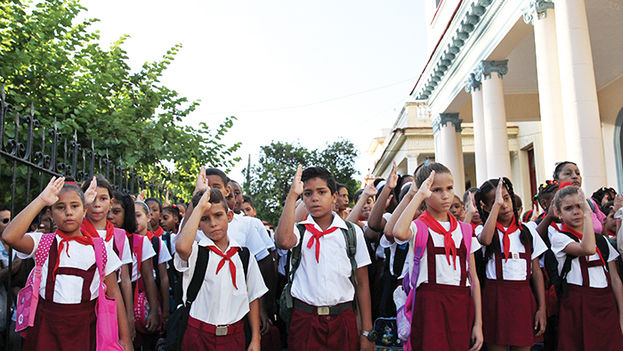
The primary school children who every day recite the slogan “Pioneers for communism, we will be like Che,” should start looking for a new motto. (EFE)

14ymedio bigger14ymedio, Reinaldo Escobar, Havana, 22 July 2018 — The classic definition that socialism is a transition stage towards communism has historically generated theoretical debates and has been the watershed between the political movements located on the left of the ideological spectrum. It has also prompted flashes of humor, such as the statement: “The worst thing about communism is the first 500 years of socialism.”

That long-yearned-for moment, when “material goods will rain down like water” and humanity could inscribe on its flags the golden rule “from each according to his abilities, to each according to his needs,” no longer appears as an explicit goal in the next Constitution of the Republic of Cuba. The word communism has been deleted from the project.

This omission, or more accurately, this erasure, comes as no surprise to those who had carefully read the Conceptualization of the Model approved at the Seventh Congress of the Cuban Communism Party (PCC). In that text, simmering now for nearly ten years, it is not mentioned that the final result of the model is the arrival of the communist society, nor even the purpose of “eliminating the exploitation of man by man.” continue reading

Only among those who have reached, or exceeded, the third age is there any memory of the times when Fidel Castro chose a different heresy by proclaiming that it was possible to build socialism and communism at the same time. It was the decade of the 60s and in the town of San Andrés, in the municipality of La Palma in Pinar del Río, the experiment was intended to do away with money and make everything free for the benefit of its 500 inhabitants.

It was also the time when Nikita Khrushchev promised in Moscow that “the present Soviet generation will live in communism,” and in Cuban universities and other centers of thought there were predictions of the fortunate moment when the red flag of the proletariat would fly over Washington DC.

In Saturday’s session of the Cuban parliament, where the elimination of that word was discussed, the president of the National Assembly assured that its absence “does not mean that we renounce our ideas, but in our vision we think of a socialist, sovereign country, independent, prosperous and sustainable.” Later he argued that the current situation of the island and the international context are very different from those in 1976 when the first Constitution of the revolutionary period was written.

If anyone had had the audacity to suggest the annulment of the term communism in any of the party congresses presided over by Fidel Castro, he would have been accused, at least, of being a revisionist and probably of being a traitor. Even today it must be assumed that many old militants find it difficult to accept this suppression and at this point are wondering how it is possible that the socialist road is “irrevocable” but the end point of the trip, the obligatory destination of that route, is not mentioned.

Primary school children, who every day recite the slogan “Pioneers for communism, we will be like Che” should start looking for a new theme in September, under penalty of being in opposition to the constitution.

The communist society is unfeasible for two fundamental reasons. First because the resources of the planet do not support it; and second, because personal ambition is an indissoluble part of human nature.

Raúl Castro should be congratulated for having the political courage or at least the pragmatism to avoid commitment to an unattainable goal. But to be consistent with such a decision, he would also have to eliminate, in the preamble, that we Cubans are “guided by the political-social ideas of Marx, Engels and Lenin” and, ultimately, change the name of the party that he leads. For that he would have recourse to appeal to the adjective “fidelista,” a doctrine based on voluntarism and the necessary absence of scientific rigor that allows the validation of any solution, any change.

Frequently slow in his decisions, Raúl Castro never decided to inscribe the Cuban system under the imprecise definitions of “socialism of the 21st century,” and left everything hanging from the plural possessive “ours.” He has dismantled most of the chimeras imposed by his brother while swearing allegiance to his legacy. Now, when his final retirement seems to be no further than five years off, he has made it clear that the final destination of this experiment will have to be defined by others.

For many communists this change can be as traumatic as it would be for a Catholic to hear the pope confess that there will be no life after death, that the messiah will never return, or that the heavenly paradise will be erased from the scriptures. That was the thought of two thousand years ago, now things have changed.

_________________________

The 14ymedio team is committed to serious journalism that reflects the reality of deep Cuba. Thank you for joining us on this long road. We invite you to continue supporting us, but this time by becoming a member of 14ymedio. Together we can continue to transform journalism in Cuba.
Cubalex Demands the Immediate Release of the Artists Luis Manuel Otero, Amaury Pacheco and Soandry Del Río / Cubalex


Arrest of Luis Manuel Otero

Cubalex, 22 July 2018 – Peaceful gatherings and demonstrations are essential for public participation

On the afternoon of July 21, 2018, Luis Manuel Otero Alcántara, Iris Ruiz, Amaury Pacheco, Soandry del Río, Yanelys Nuñez Leyva and José Ernesto Alonso met in front of Havana’s Capitol building, contrary to the regulations of Decree 349 / 2018 that violates and restricts the freedom of artistic creation.

Luis Manuel Otero “covered his body with human excrement” and in a poster he demanded “free art. No to Decree Law 349” adopted by the Council of Ministers. With the exception of Nuñez Leyva they were all arrested. In the case of Otero Alcántara the arrest was carried out with an excessive use of force and along with Iris Ruiz, Amaury Pacheco and Soandry del Río, they were transferred to the police station located on Zanja Street in the capital. continue reading

Along with José Ernesto Alonso, Iris Ruiz was released four hours later, accused of creating public disorder. Luis Manuel, Amaury and Soandry were transferred to the Vivac detention center, where they are accused of public disorder and aggression.

We remind the Cuban State that the freedom to comment on public issues without censorship or limitations, as well as to inform public opinion, is indispensable to guarantee the full exercise of participation in public affairs, which includes the freedom to hold peaceful demonstrations and gatherings, to criticize or oppose the government, and to publish political material.

The arrest of the artists is arbitrary, irrational, unnecessary and disproportionate, because it violates recognized international standards in relation to the guarantees of due process.

The procedure for legal detention in Cuba allows for arbitrary detentions, currently used by state agents as punishment for the legitimate exercise of freedom of opinion and expression, assembly and association, recognized in international human rights law.

States have the obligation not only to abstain from violating the rights of people who take part in a meeting, and to respect and guarantee the rights without any discrimination for prohibited reasons or of any other nature or any other condition of political opinion. The freedom to organize and participate in public meetings must be guaranteed to all natural persons, groups, non-registered associations, legal entities and companies.

In Cuba, access to public participation spaces is excessively and abusively restricted, as a result of which the full and free exercise of the freedom of peaceful assembly is practically impossible.

Cubalex demands that the Cuban State immediately release artists Luis Manuel Otero, Amaury Pacheco and Soandry del Río, and adopt urgent measures to protect human rights defenders against reprisals and eliminate undue restrictions on the use of public spaces.

"One ‘Yuma’ Less, Two Cubans More," the Arithmetic of Cuban Tourism

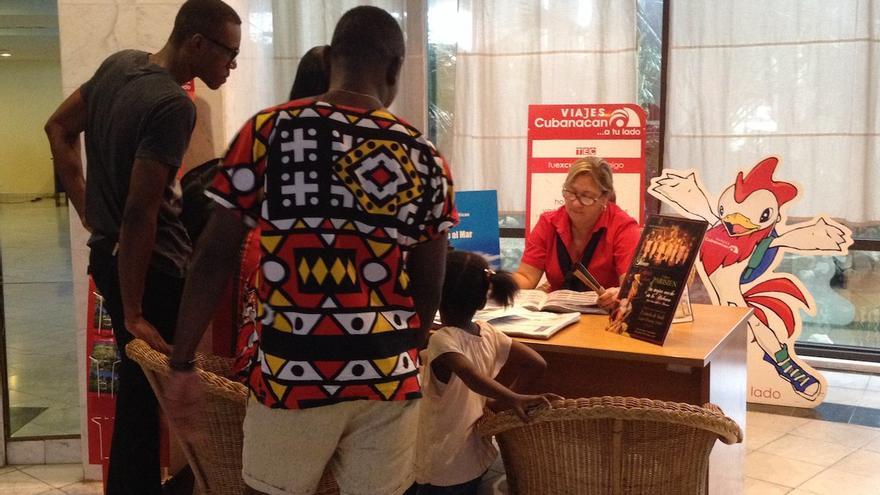
The majority of domestic customers are people with hard currency income. (14ymedio)

14ymedio bigger14ymedio, Marcelo Hernández, La Habana |19 July 2018 — Sand, sun and Cubans. The three elements prevail these days in many spas on the Island where national tourism takes advantage of school holidays and fills the gap left by the fall in foreign visitors. The employees of tourist facilities are least enamored with the domestic tourists, these expert seekers of the best deals and big eaters in the all-inclusive hotels, nationals are already the majority in many accommodations in the country.

The image differs greatly from what could be seen just a decade ago, when Cubans living on the island were prohibited from entering hotels that charged in hard currency. Ten years later, the local accent has become frequent in the formerly forbidden rooms and recreational areas, and a robust market of private excursions has grown that orgnizes everything from transportation to lodging and entertainment. continue reading

On a corner of in Havana’s Vedado neighborhood last Friday, at least twenty families waited for the bus that would take them to Cienfuegos. Loaded with bags and several baby strollers, the holidaymakers greeted the bus with applause of joy. They had made reservations for at least two nights with everything included at Hotel Jagua in that city in the center of the Island.

“On the same date last year there was no chance that we would manage to fit such a large group in a hotel in one of the most visited areas,” says Luciano, a private guide who has been organizing trips for eight years covering all the Island’s provinces. “Since foreign tourism bgan to increase it became more difficult to organize this type of travel for Cubans.”

“We are not fishing in troubled waters but in a calm river, if more people come from abroad we can not squeeze in our customers,” says Luciano. In his extensive catalog, some offers are marked with a red checkmark. “These are the most attractive but also the hardest to get, because foreigners like them a lot.”

“Cayo Santamaría, two nights with everything included for 160 CUC,” reads one of the promotions. Luciano organizes the transport with buses that work for state companies during the week, but that have permission from their administrations to make tourist trips from Friday to Sunday. “We leave the clients in the hotel lobby, they pick up the key to their rooms and start enjoying themselves.”

Luciano is one of the few who rejoices in the fall of foreign tourism and the increase in those who arrive on cruises, and sleep on the boat rather than occupying hotel beds. Between January and June, around 50% of American visitors who arrived on the island did just that. In Cuba, 17 cruise companies operate, including Norwegian Cruise Line Holdings, Carnival Corporation and Royal Caribbean Cruises, with a growth of 28.6% in the first quarter of this year.

Although the latest data on US tourism, released on Wednesday from sources cited by Reuters, are more optimistic than those of the same period last year, with an increase of 5% (68,000 Americans of non-Cuban origin), the outlook is still negative. Even more so if one takes into account the post-thaw euphoria.

Global tourism figures, about 2.5 million visitors to Cuba, fell by more than 5% between January and June 2018. The figures include cruises for the first six months, which brought 379,000 people to the island, 45% more than in 2017. Taking into account only American tourists, the fall for the period is 24%.

The impact on business in the most tourist areas has not been long in coming. Restaurants that barely manage to fill half their tables, rental houses that previously were occupied 80% of the time now looking at their almost empty rooms, and state rental car business that just a year ago couldn’t cope and now have parking lots full of cars.

“One yuma less, two Cubans more,” explains Luciano in a simple arithmetic. “When Americans arrive on cruise ships they do not rent accommodation and as a result of that pressure hotels that were no longer providing capacity for the national market are forced to do so and even lower prices. What before one foreigner would pay for one night, I can reserve for a national couple.”

“Another influence is that we are in the off season right now. For foreigners its too hot but for Cubans these are good dates to go to the beach.” Among the examples, he mentions the exclusive resorts of Varadero.

“These were places that were sold exclusively through foreign companies, but now appear more and more in our catalogs,” he explains. “The hotels that are run by Spanish companies or from other countries are those most requested by Cubans, because they know that the they willbe treated better and the facilities and supplies are better,” he says. “This is the time to catch a place like that.”

Tatiana, the daughter of Cuban and Russian, agrees with that opinion. “I have everything already reserved for this summer, but I am waiting for more offers to come available,” she explains to this newspaper by phone. With contacts in state tourist agencies such as Cubatur, the joung woman resells in-inclusive packages to Viñales, Trinidad and Varadero, to which she adds transportation and pick-up, “on the corner of their house.”

“I’ve worked with Cuban clients for three years and I prefer them despite everything,” she says. “It is true that when you arrive at a hotel with ten or fifteen Cuban families, you’re not treated as well as foreigners, but this is a clientele that does not depend on the arrival of a plane, on the arrival of a cruise, that is sold a reservation in another country, these customers are already here.”

“For another thing, I can communicate very easily with them and the clients I’ve been working with for some time know the rules.” Tatiana believes, however, that for a four or five star hotel with everything included is very likely that a Cuban guest will cost them more. “They eat a lot more and also want to try a lot of drinks they don’t get to have very often, like expensive wines, whiskey and even champagne,” she says.

The majority of Tatiana’s clients are the “new rich.” Cubans who receive remittances from abroad, are engaged in private businesses, have benefits through the sale of art or are part of musical groups. “Every once in a while an occasional client arrives who wants to book a trip paid for by a relative who is coming on vacation from Miami,” she explains. “They are all people with convertible pesos, from one side or the other.”

People with fewer resources frequently resort to Popular Campismo (People’s Camping), a plan created by Fidel Castro in 1981, to “open up valleys, beaches and mountains, a form of accommodation and enjoyment available to everyone.” The option, with very modest accommodations, does not enjoy a very good reputation among the social sectors that already aspire to more comforts.

“I sell tourist packages to Cubans but I treat them as people. Just because are nationals they don’t have to be given a worse product,, explains Tatiana. “In the end, they are the ones who support my business, and it’s better for me that foreign tourism keeps falling because the hotels are not going to close because of that, if they offer more affordable packages for those from here.”

 ________________________

The 14ymedio team is committed to serious journalism that reflects the reality of deep Cuba. Thank you for joining us on this long road. We invite you to continue supporting us, but this time by becoming a member of 14ymedio. Together we can continue to transform journalism in Cuba.

Reform the Essence of the Constitution, Not the Letter

Boris González, one of the promoters of the initiative. (14ymedio)

14ymedio bigger14ymedio, Reinaldo Escobar, Havana, 20 July 2018 — Despite the scarcity of information and the absence of public debate that have characterized the process of constitutional reform in Cuba, several civil society groups, the political opposition and the independent press have criticized some postulates announced by the official media.

In this context, the draft constitutional reform project undertaken by the Democratic Action Roundtable (MUAD) stands out. The text will be formally delivered to the authorities when it concludes a public consultation that began on July 11 and will end in mid-August.

Boris González, a member of MUAD’s executive secretariat, explained to 14ymedio that their committee that prepared a draft revised version of the 1976 Constitution, with its reforms of 1992 and 2002, did so not with the intention of modifying the letter, but rather the essence of the document. continue reading

“We concentrated on 82 articles. First we did an analysis of the content and then prepared a final form that not only included the proposals, but also the rationale.” Gonzalez emphasized how important it is for those who read the draft to know not only the suggestions for changes, “but also what is the reasoning that led MUAD to suggest them.”

Boris González said that one of the most significant contributions of the initiative is the strong will to extend the right of citizenship by birth to the descendants of Cubans who left the island in the middle of the last century. “We believe that the government’s willingness to change can be measured when it accepts that all Cubans who have left the country and their descendants are Cuban citizens with full rights,” he stresses.

Other vital aspects of MUAD’s projects are the recognition of private property, the right to create political parties, the establishment of a fair wage, the right to be compensated in case of dismissal, the right for citizens to enjoy a legal personality that allows them to invest in their own country, strengthening the concept of habeas corpus, and the creation of a Court of Constitutional and Social Guarantees.

The elimination of Article 5, which gives the Communist Party the role of the leading force in society, and of Article 62, which states that none of the recognized freedoms can be exercised against “the decision of the Cuban people to build socialism and communism,” are the most radical modifications proposed in the draft.

Although González believes that it would be ideal for there to be a process of deliberation across the nation with the largest number of people, he is aware of what they are facing. “That would be beautiful, but we have many limitations, not only of resources but of the obstacles imposed by the current Cuban institutions,” he says.

Those working on the draft proposal have created “constitutional initiative roundtables” to gather the opinions of those who wish to participate. “We also hope to collect ideas for the writing of the final document through email,” he adds.

The 605 deputies of the National Assembly began their “individual study” of the preliminary draft of the constitutional reform that will be approved this weekend, probably unanimously, during the year’s first ordinary plenary session of the National Assembly of People’s Power.

The division in the ranks of the opposition is reflected in its differing positions with regards to constitutional reform. In addition to the MUAD project, there are other sectors that believe the appropriate response to the modification proposed by the Government is to ignore it and not participate in its endorsement. Still others believe that the correct thing is to vote against it, to express their rejection, while a final sector has not yet made public its position.

“To believe that it is not worth making proposals is the position of repudiating everything, but there is a gradualness in how much of the existing order should be repudiated. Our position is: they will not listen to us, but if they read our document, they may find something that interests them and it will be better than what they are going to do with the new constitution,” says González, defending himself before those who believe that it is not worth proposing alternatives.

With regards to the referendum on the document that will be approved by the National Assembly he is forceful: “Up until now there have been no signs that the Constitution the Government will submit to a referendum will fulfill our ambitions, but I can not say in advance what the position of all the organizations that make up MUAD will be with regards to how to vote on the constitutional referendum.”

___________________

The 14ymedio team is committed to serious journalism that reflects the reality of deep Cuba. Thank you for joining us on this long road. We invite you to continue supporting us, but this time by becoming a member of 14ymedio. Together we can continue to transform journalism in Cuba.
The Country of ‘Wificulties’

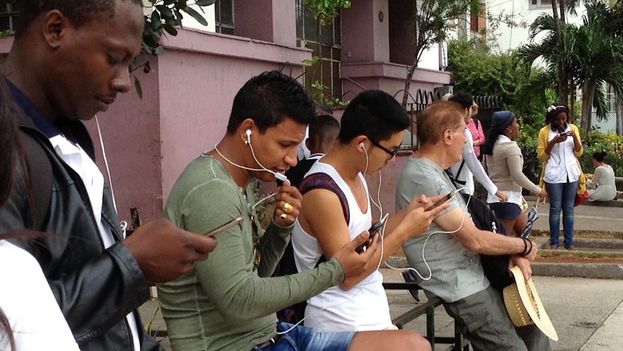
Cubans connect to the internet on state-owned Wi-Fi networks. (14ymedio)

14ymedio bigger14ymedio, Generation Y, Yoani Sanchez, Havana, 21 July 2018 — A small insect falls on they keyboard of my laptop, a few minutes later there’s another one while a third lands on my neck. A few yards away, a well-known filmmaker tries to block the sun shining on his screen and a lady screams some intimacies while videoconferencing with a family member who has emigrated. A stray cat approaches my bag and demands food, but I didn’t bring any, as I’ve come to a wifi access area only a few yards from my house.

I’ve been lucky enough to claim a bench, even if it doesn’t have any back, and after an hour of navigating my lower back is demanding some support. Then I move to an area near the staircase of a building, checking beforehand that there is no balcony over my head to be sure that some resident won’t throw water or food scraps onto my computer. I have found a good place on the stairs and my spine now has the relief of a wall to lean against. continue reading

After a few minutes I start to sense an unpleasant smell. Evidently someone used a nearby bush as a public toilet and my ideal “office” loses all its charm with that stench. I move somewhere else. Some children are playing baseball with an improvised bat and I put myself in a position where my screen is not in danger, but the sun is advancing towards the area and I calculate that I have half an hour before “the Indian” catches me.

The sky clouds over but now the battery is telling me it has less than 15% charge left. There are no outlets nearby and nobody who “resells” a little energy – a business that would be very lucrative to install in these wifi areas. So I adjust the screen brightness to save the battery, but with all the light around me I can barely see a thing. I manage to post a couple of messages in Twitter, check my inbox, and look over a contribution that has arrived for our daily newspaper, 14ymedio.

A drop of rain falls between the “D” and “F” keys. I have been lucky, it’s tiny and hasn’t managed to slip through the crack that would let it get inside to the circuits, the electrical contacts and, perhaps, the motherboard. My face reflects my fright as I wipe off the moisture and close the laptop. Looking around me, I see that while I’ve been focused on web pages and social networks, a stalker has sat down nearby and released his anxieties all over a bench.

I save everything and seek reliable shelter until the downpour passes. Under a small roof other websurfers talked about the news they’ve read, the messages they managed to receive before the rains came, and a half-finished visa application, but that was it until the sun came out again.

In spite of the wificulties, people squeeze the maximum out of the wireless signal they pick up with their phones, tablets and computers. The makeshift internet “café” hums with life all day, although for every connection hour users pay the excessive price of one convertible peso (CUC), more than half a day’s wages for the average state worker. Any thoughtful person would say that under these conditions you can’t get any work done, or do anything other than chat with friends or laugh at the memes. Every day, however, professionals of all kinds extract the most they can out of these places, sun, rain, insects and hungry cats notwithstanding.

___________________________

The 14ymedio team is committed to serious journalism that reflects the reality of deep Cuba. Thank you for joining us on this long road. We invite you to continue supporting us, but this time by becoming a member of 14ymedio. Together we can continue to transform journalism in Cuba.

The Failure Of The Dairy Sector In Cuba: From The Glass Of Milk To The ‘Master’ Cheesemaker / Elias Amor Bravo

Illustration of a cow. (14ymedio)

Elias Amor Bravo (economist), 17 July 2018 – The National Milk Group is one of those inefficient conglomerates that exist in the Cuban state economy to control corporate production, in this case in a fundamental sector such as dairy. To cite just one example, the National Office of Statistics (ONEI) reported the value of wholesale and retail trade in dairy products as 1.3 billion Cuban pesos (roughly $52 million USD) in 2016, representing 10% of total food expenditures. Almost nothing.

An article in the state newspaper Granma alludes to the increase in the investments of the State Group to increase the productive capacity of the dairy industry. The Castro brothers have starred in some unforgettable episodes. One of these was undoubtedly Raul Castro’s “glass of milk” speech.   But Fidel Castro himself, on occasion, acted as a cheese specialist before the master cheese makers of Cuba. Amazing. continue reading

One of the great failures of the Cuban economy established by the so-called Revolution has been cattle ranching and the dairy industry. The confiscations of the private cattle ranches and of the companies of the sector at the very beginning the revolutionary process left these industries, of vital importance for the country, without a strategic direction..

The regime has been trying for 60 years to increase the production of milk and derivatives, but has not been successful. Basically, because the institutional and property rights system is unable to offer products in the conditions of “variety, quality, safety and priority” that is required, and what is even more serious, of quantity. Cubans have been forced to coexist with the rationing of products in great demand. In other words, the collectivist effort has had disastrous consequences for a sector such as dairy. Let’s look at the data.

To mention some examples, the most outstanding and from the official information source, the ONEI, in 2006 the production of pasteurized milk, the highest volume type (in relation to condensed and evaporated) registered 127.8 thousand tons. In 2016, the last published data was 123.1 thousand tons. Only a year earlier it had been 104.8 thousand tons. In the years between 2012 and 2016, the average annual production of pasteurized milk was 110.78 thousand tons, 10% less than that obtained in 2006.

Another dairy product in high demand, yogurt, fell further, from 183.5 thousand tons in 2006 to 146.7 thousand in 2016, a 20% drop. It is even more serious to note that condensed milk, for example, was reduced from 0.9 thousand to 0.4 thousand in the same period, a 55% drop. But in this case, the aggravating factor is that imports of condensed milk, in the face of a limited domestic supply, has gone from 2.3 thousand tons to 2.6 thousand in the same period. The case of milk powder is also significant. Imports in 2016 amounted to 55 million tons, and according to ONEI’s statistics the product “disappeared” between 2012 and 2016, while in 2006 it had reached a total of 21.1 thousand tons. In this case, 141 million pesos are paid for imports, as a consequence of the absence of a domestic product.

These data confirm the backwardness of the industry, the inaction and the productive inability to meet basic needs. The sector calls for “the modernization of the plants with the entry of new equipment and the repair of existing ones,” although I do not believe that this is the solution, no matter how hard those responsible try to justify it.

Granma alludes to the conclusions of a “meeting held between directors, technologists, researchers and master cheesemakers from all over Cuba, recently organized by the Provincial Dairy Products Company of Camagüey.” What I find surprising is that the event still recalled “the extraordinary knowledge that Fidel Castro had” on how to recover the cheese culture in Cuba. True.

However, Castro retired in 2006 and since then, the results of cheese production are those that from before. An absolute collapse. What is more, now that neither Fidel nor his brother are there, the country is confronting the incentive of demand coming from tourism, estimated at 7 thousand tons of cheese. If Fidel really had any responsibility in the reorientation of the sector, and his words and messages meant at some point “the beginning of a new stage of transformations in the sector,” the results leave no doubt. The glass of milk will have to wait.

To recover the dairy sector in Cuba, it is necessary to make advances in the institutional transformation of the economy. This sector, which needs close ties from the milk producers to the final distribution, has numerous options for management, and none of them are state groups or companies belonging to the state.

The state is not good at milking cows, making milk powder or yogurt. This is an activity that has to be contracted out and for which private companies should be held responsible, with autonomy and a stable legal framework. The alternative is to throw money away. Even with investments in equipment (skimmers, clarifiers, presses, molds and pasteurizers, along with substantial improvements in the cooling systems), and the training of workers, the problem still would not be solved because the value chain of the sector remains broken.

The example is in milk production. In 2006, before the partial land reforms were launched, the private producers managed 344.4 thousand tons. These private producers in 2016 delivered 516.1 thousand tons, a growth of 50%. The state, which still retains a very prominent part of the final production, in the same period increased production figures by only 35%.

The answer is obvious. The private sector manages much better and produces more than the state. The solution does not admit questioning: begin by dissolving the State Groups, put the industrial sector in the hands of private entrepreneurs.

But above all, livestock management also needs to be in the hands of the private sector, as it was before 1959, and we will see how everything improves very fast. Then nobody will remember Fidel Castro’s lessons to the Cuban cheese makers, nor Raul’s “little glass of milk.” Put it to the test.

Cuban Woman Will Be Tried For Contempt For Calling State Official Corrupt / Cubalex

Indira Martínez Borges with her 2-year-old son. (Photo (c) Sol Grcia Basulto / Facebook)

Cubalex, 19 July 2018 — Indira Martínez Borges, 33 and the mother of a two-year-old, will be tried on July 20 in a summary proceeding, charged with the crime of “contempt” for calling an official ‘corrupt’. The official, Anais Rodríguez Cárdena,  is with the Provincial Directorate of Housing of the Camagüey municipality, which confiscated Martinez’s home and assigned her another in poor condition, for which she had to pay.

Cubalex is concerned over the incompatibility of these summary trials with the right to a defense. Martínez will be tried without the advice of a lawyer. Only if the court concurs to a trial with a Defender, will it allow the participation of one. Nor does Martinez have the resources to hire a lawyer from the National Organization of Collective Law Firms (ONBC).

Even if the accused can hire a defender, their right to defense would be violated. The legal services contracts of the ONBC are the only ones accepted by the court, a situation that affects the right to freely choose a lawyer.

ONBC lawyers are not independent. They receive influence, pressure and undue interference by the authorities that intervene in the criminal process, which prevents them from acting diligently and without fear, and so they act against the interests of their clients. continue reading

In these summary proceedings, the ONBC lawyers do not even attempt to request postponement of the oral hearing, knowing that they have not had time to prepare their defense or access to the investigation file.

On July 17, the Special Rapporteurship for Freedom of Expression of the Inter-American Commission on Human Rights (IACHR), in a press release, expressed its concern over defining criticism of public officials in Cuba as a punishable crime.

The Rapporteurship referred expressly to the cases of Ariel Ruiz, a doctor of Biological Sciences, that of Eduardo Cardet Concepción, coordinator of the Christian Liberation Movement (MCL), and also the case of Martha Sánchez González, member of the Ladies in White. All three were tried and imprisoned for this same crime, which undermines the freedom of thought and expression, and constitutes a mechanism to silence the pluralistic and democratic debate around the management of the government .

The Rapporteurship of the IACHR claims that the crime of contempt lends itself “to abuse, as a measure to silence unpopular ideas and opinions, which restricts a debate that is fundamental for the efficient functioning of democratic institutions.” It notes that in the majority of nations in the Americas the crime of contempt has been eliminated from the criminal legislation.

It calls on the Cuban State to adapt its legal framework to the Inter-American standards on freedom of expression, and reminds the Cuban government that “public officials are subject to greater scrutiny by society.”

The Office of the Special Rapporteur for Freedom of Expression is an office created by the Inter-American Commission on Human Rights (IACHR), in order to stimulate the hemispheric defense of the right to freedom of thought and expression, considering its fundamental role in consolidation and development of the democratic system.

Rights in Cuba: The Privilege of a Minority? / Cubanet, Miriam Celaya

Conga against homophobia in Cuba, 2018. Banner: I am part of the Revoluion. Me too. I am Fidel (cubadebate.cu)

Cubanet, Miriam Celaya, West Palm Beach, 18 July 2018 – With that sleight of hand that the Cuban authorities have always so skillfully displayed, currently they seem to have convinced a good part of national public opinion – and even more than a few foreign press agencies – of their supposed “will to change,” starting from the novelties that will be confirmed in the constitutional reform being planned behind closed doors by none other than Raul Castro himself.

The modifications that are part of those momentous developments that will soon adorn the Cuban Constitution include the recognition of private property, which already exists in practice; the limitation of the presidential term to a maximum of two periods of five years each, as had already been anticipated in the VIII Congress of the PCC; the concurrent establishment of the figures (hitherto unrecognized) of the President and Vice President of the Republic; as well as the prohibition of discrimination against people because of their gender identity, their ethnic origin or their disabilities.

The issue of “private property” has not generated much interest among the population, which is partly due to the fact that its recognition is restricted within the rigid governmental controls that demonize “the accumulation of wealth” (and therefore of property), and also because the majority of Cubans do not really have the patrimony or pecuniary capacity to acquire it. Thus, for this poor majority, this Law does not constitute a direct benefit or a significant change relative to their previous status. continue reading

The time limitation of the presidential mandate does not mean a real change as long as there is only one legally recognized political party in Cuba and no new electoral law is enacted that recognizes the right of all Cubans – rather than the insignificant 600 commissars – to decide at the polls who to elect to hold this position.

However, regarding the issue of gender identity, the response has been very different. Like a pack to which a bone has been thrown to tease its hunger while the masters reserve for themselves the juicy slices of meat, both those supposedly “benefitting” or “harmed” by this reform have been embroiled in a pithy speculation about the appropriateness or not of marriage between homosexuals, the rights to adopt, and other endless “pros” and “cons” that have not been explicitly reflected in the (unknown) official agenda, but that have exacerbated the prudishness of religious communities more retrograde and dogmatic than the old aspirations for equality of rights among the LGBTI communities.

That said, the matter would seem “normal” and even proper to a democratic society. Moreover, it suggests that Cubans on the Island are at the same level (or even at a higher level) of debate or recognition of social rights than the most democratic nations in the world.

And it is exactly here that the deception lies, because while religious leaders and LGTBI communities engage in a Byzantine battle that – we already know – will end up being resolved at the heights of power and at the convenience of the powerful, the essential issue that is being overlooked is the violation of the rights of all Cubans when it is reaffirmed that the constitution will maintain the “socialist character of the political and social system” and the role of the Cuban Communist Party as a “superior leadership force” that will continue to control, with its iron fist, the destinies of all, be they heterosexual, homosexual, white, black, mestizo, women, men, religious, atheists or agnostics.

The endeavor is so Manichean that it is hard to attribute naivety to those who succumb to the illusion of a “democratic” debate about their gender identity, their equal right to marriage and the creation of a family and even assisted reproduction, while no Cuban can even recognize such basic rights as the freedom of association, of expression, of information, of movement, of choosing what kind of education they want to give their children or who they want the president of their country to be.

It is not a matter of denying the just claims of particular rights of each group or community, particularly those that have been systematically relegated and discriminated against. But the truth is that under conditions of dictatorship no Cuban will have their rights guaranteed, especially because the recognition of those “rights” responds just to the political interests – and only to them – of the privileged class that holds absolute power over lives and haciendas.

If we believe that the “great battle” is the one that will be waged only by some social sectors more discriminated against than all Cubans, and if the “conquests” to which they aspire are confined to appearing finely dressed before notaries who will certify a sentimental union or the creation of a family whose members will remain in a thousand ways subjugated by an omnipotent dictatorial power legitimized in the constitution, then we can renounce all aspirations of freedom that belong to us as nationals.

In pursuit of the small crumbs of legality now offered by the autocrats, some useful fools – and with them also some carefully hidden servants of Castroism, because the “revolutionaries” are everywhere – continue to leave behind the larger interests that involve all of us. And this is, exactly, the government’s objective.

It is all a diversionary maneuver to fragment the aspirations of freedoms of common interest, create false sectarian expectations, and stimulate the attendance at the polls of an electorate that in the last “elections” has increasingly demonstrated clear signs of apathy and fatigue.

For the moment, the hoax is working for the government. If this is the case, we already know who will be the winners and who will be the losers in this endlessly announced saga.

(Miriam Celaya, resident in Cuba, is visiting the United States)

The Funeral of the Revolutionary Left

Miguel Díaz-Canel, Nicolás Maduro, Raúl Castro and Evo Morales, center stage, during the closing of the Sao Paulo Forum. (EFE / Ernesto Mastrascusa)

14ymedio bigger14ymedio, Yoani Sanchez, Havana, 19 June 2018 – The only thing missing was the funeral band accompanied by some black crepe and sobbing. The closing ceremony of the XXIV Sao Paulo Forum, on Tuesday in Havana, had all the traces of a funeral. You could almost hear the shovels of earth falling on the Latin American left which has not figured out how to disassociate itself from populism.

Far from the time when the region’s leftist leaders could fill a large stage, a few political survivors of that time, more closely related by their furious addiction to power than by the banner of social justice and the equitable distribution of wealth, met on the Island.

There was no lack, among the more than 600 guests, of disoriented people who still believe the propaganda that “the Island is a Utopia,” or who naively seek a space of fresh plurality in a meeting of this kind. False illusion. Created in the 90s at the initiative of Fidel Castro and Luiz Inacio ‘Lula’ da Silva, the Forum has never been a place for polyphony. continue reading

An indirect heir of those congresses organized by the Soviet Union, the scenography of the hammer and sickle is now hidden, the word communism eliminated from the talks, and Leninist allusions banished. The organizers may have dressed as progressives and sucked in the environmentalists and the indigenous and human rights movements, but the skeleton that supports them continues to mimic the constitution of the conferences staged by the USSR, because they try to pass off as spontaneous what is controlled down to the tiniest detail.

The latest edition has once again served as a gateway for those such as Nicolas Maduro who promote political intolerance, authoritarianism and ‘assistancialism’*. Others include Bolivian president Evo Morales, with his longing to serve in perpetuity, Raul Castro, the caudillo who inherited power through blood, and Cuba’s hand-picked president, Miguel Diaz-Canel.

For three days the participants furiously applauded the slogans, the rants, and even the false promises of “helping the disadvantaged” and “defending the truth,” which fell from the mouths of some of the most corrupt and predatory press on the continent. Every new phrase uttered was like an extreme unction intoned over their own doctrine.

Those who this week clothed themselves in the garments of social struggles and the demands of the most disadvantaged, have shown that once installed in their palaces their objective is to undermine republican institutions and dynamite the legal bases of democracy, actions that in the medium term end up inflicting extensive damage on the very social sectors they claim to represent.

The meeting also gave ample space to explaining the false and Manichean dilemma of choosing between a left that still speaks of revolutions and enemies, and neoliberalism, the right and the powerful. A false dichotomy that cloaks itself in calls to respect “the free determination of the people,” which in reality masks the demand for governmental impunity to sweep away citizens’ rights.

In the narrative thread that connected the sessions of the event, one strand insisted on the idea that the left is not finished in this part of the world and nor can one speak of a change in the ideological cycle. Such irony: those who contributed to the fall from grace of a political leaning presented themselves in Havana’s Palace of Conventions as doctors ready to auscultate their victim.

The populist champions who devoted a good part of the debates to naming the culprits, with index fingers pointing north, have handed their opponents the arguments to discredit an entire ideology on a silver platter. Experts, perhaps, in that fall from grace, they now appeal to each other to prop them up. “Either we unite, or we sink into the mud of the counterrevolution that they are trying to impose on us,” they concluded presciently.

That phrase also reveals the real reason for the event. A council to grease the wheels of the machinery that sparks actions, triggers protests, twists the frameworks of opinion and screams, from every lung, opposition to any speech that moves a single inch from the pre-established script. The Sao Paulo Forum functions like one of those meetings where the instructions for the ideological mafia are handed out and watches are synchronized to the time for the next ‘escrache’ or repudiation rally.

However, not everything from the recently concluded conclave should be discarded. Their sessions can act as a warning to the other left, democratic and less vociferous, that is rarely invited to this type of session, to publicly mark the distance and revitalize progressive ideas on the continent.

Latin America needs a left with renewed ideas, modern and responsible, not the conglomeration of unpresentable leaders who met in Havana. We need progressive parties that stop placing responsibilities elsewhere, fearing their own citizenship and fishing in the troubled waters of social conflicts. But for this to happen it is perhaps essential that the Sao Paulo Forum be dissolved.

That scenario is not so distant. To the extent that the governments that supported the Forum disappear from the executive map of the region, the meeting is stumbling back and forth among a few countries. The previous meeting was held in Nicaragua and this time it returned to the island, where it had already taken place in 1993 and 2001. It is easy to guess where the next encounters will be: Bolivia, Venezuela… or Mexico.

This time, and it came as no surprise, in their final declaration the forum members blamed United States “imperialism” for the revolts and social conflicts in the region, especially in Nicaragua, and called for the release of Luiz Inácio Lula da Silva. As expected, Venezuela’s “Bolivarian Revolution” received special support.

Something, however, cracked the mask and revealed the face hidden beneath the progressive disguise. On the same day the Forum ended in the Cuban capital, Daniel Ortega’s bombs fell on Masaya. Applause at the Havana Convention Center, and deadly explosions in the streets of Monimbó’s indigenous neighborhood. Laughter in one place, seven hours of terror in another. No attendee of the Sao Paulo Forum condemned the repression.

Translator’s note: Assistancialism is often defined as the creation of dependence through imposed aid. At least one scholar has defined it as “sit down and shut up money.”

______________________

The 14ymedio team is committed to serious journalism that reflects the reality of deep Cuba. Thank you for joining us on this long road. We invite you to continue supporting us, but this time by becoming a member of 14ymedio. Together we can continue to transform journalism in Cuba.
Cuba’s Docile Press Rebels Against Free Information

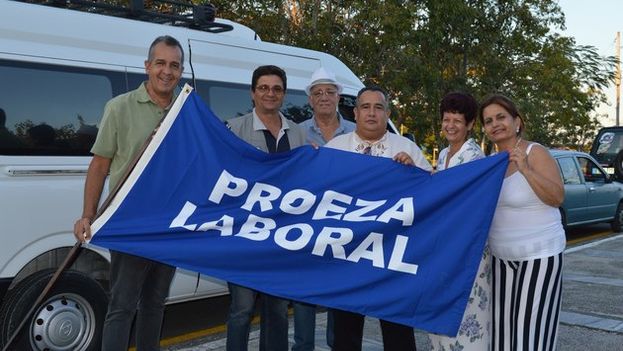
Alexander Jiménez (in the center) with members of his team after receiving the Flag of Labor Prowess. (Radio Villa Clara)

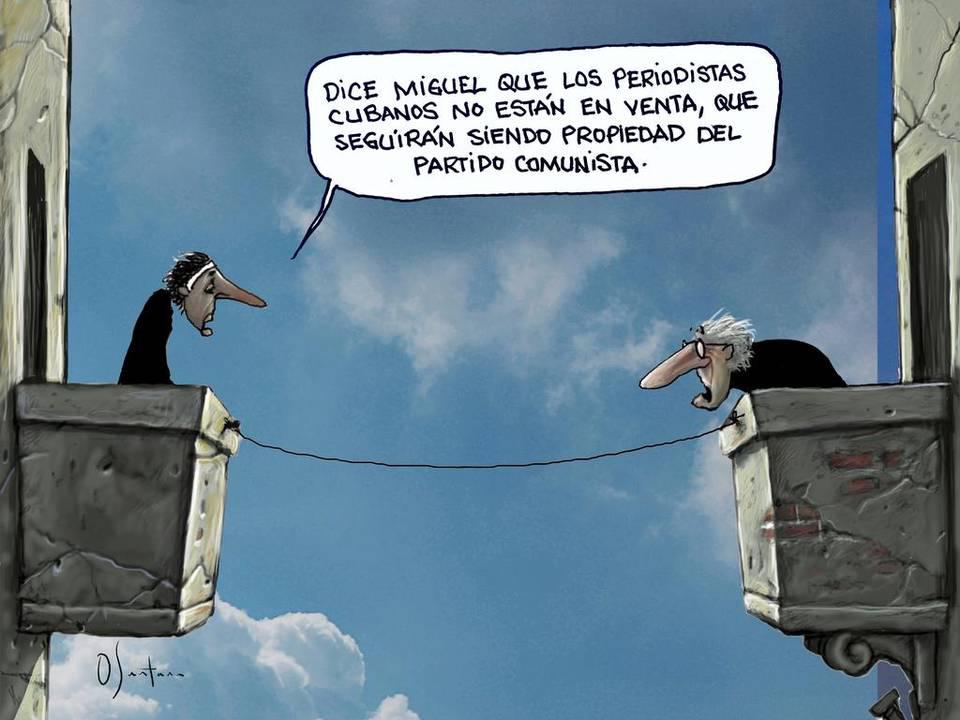
14ymedio bigger14ymedio, Miriam Celaya, West Palm Beach, 18 July 2018 — Nothing defines the essence of Cuban official journalism better than its own discourse. This was clearly demonstrated with the standing ovation that greeted the speech of Cuban president, Miguel Diaz-Canel, at the closing ceremony of the 10th Congress of the Cuban Journalists Union (UPEC) on July 14.

Diaz-Canel heaped praise on an article by a combative hack – one of those who, in the absence of arguments, defends the “system” with slogans from the barricades and insults to the adversary – as an example of the journalism that reflects the “Cuban truth” against those who have been called the “new revolutionaries,” whom he claims are bought with hard currency by foreign powers that seek to subvert Cuba’s political and social order.

Just in case the absolute subordination of the press monopoly to the service of power was not already amply exposed and enshrined at the 10th Congress, state television insisted on returning to the theme, this time presenting the “outstanding” intervention of an unknown ideological commissar, who participated as a delegate (nothing less) from the Ethics and Communication Commission. continue reading

Alexander Jiménez is the director of the radio network in Villa Clara province. However, incredible as it seems in these times of global connections and lavish new communications technologies, this supposed information professional cannot find any work in the national press or social networks.

His tenuous professional footprint seems to be limited to his performance as a functionary. On April 8, the collective of workers of the Villa Clara Radio System under his direction – made up of a provincial chain and several local radio stations – received the ‘Banner of Labor Prowess’ for “outstanding work informing people during the scourge of Hurricane Irma and later in the recovery phase.” In other words, he and his subordinates were distinguished with a banner just for doing their job. “Moral stimulus,” is what this type of award is called in Cuba.

But not all Jiménez’s subordinates are deserving of awards, as can be seen from his speech at the UPEC Congress, broadcast on television, which has provoked a lot of comments on social networks. In his speech, the journalist-functionary attacked certain colleagues, “mostly young people who sell their souls to the devil and, for payment in hard currency, contribute their writings to publications aligned with subversion against Cuba.” He adds that those journalists, “little girls and boys” who “until yesterday were docile (…) on occasion are transformed and become real monsters.”

“Those of us who direct press organs sometimes have our hands tied, or lack a legal basis to judge these wage-earners who are paid for subversion against Cuba and its social system, and who believe – because sometimes they do believe it – that they are going to overthrow the Revolution with a five-paragraph newsletter,” Jiménez complains. He goes on to demand that the draft of the new code of ethics for Cuban journalism must include a provision that doesn’t allow “collaboration with media that are hostile, clearly or covertly, to the political and economic order in force in our society.”

With this regulation, says Jiménez, press executives would not feel “bound hand and foot” when it comes to sanctioning “or considering two-faced” those “hostile” journalists who deviate from the government’s official line.

It is clear that for this paradigmatic servant of the ‘holy office’  – and therefore for his bosses in the Palace of the Revolution, the owners of the press monopoly – docility is a quality of (good) journalists.

That imaginary metamorphosis necessarily involves the endless refrain that these journalists are financed by “Cuba’s enemies,” and the hard currency payments they receive far exceed the salaries earned by official journalists. Sometimes the professional zeal of government amanuenses is too much like envy.

To the greatest alarm of the guardians of the old Castroite orthodoxy, those “monsters”– many of them graduates of the journalism schools in Cuban universities, and all born and educated under the sign of Castroism – are not only growing in number, but they dominate the exercise of their profession and (oh, sacrilege!) have the temerity to break the established rules and question reality, including political decisions at the highest level of the country.

Given the activities of the 10th UPEC Congress and the uproar among Castro’s troops, there are those who feel we are witnessing a great demonstration of the omnipotent power and its colossal press apparatus oiling its gears to launch a devastating blow to crush the independent press which is gaining in quality and distribution within the Island.

In reality it is the opposite: we are facing a clear demonstration of weakness; almost a declaration of defeat in another battle anticipated to be lost by the ‘inquisitors’. Because it is a fact that the grayness and stiffness of the official press, with its repertoire of slogans, anniversaries and intangible victories, cannot compete with the freshness and irreverence of the young journalism.

When the president of Cuba, his “docile” favorite yeoman, Manuel Lagarde, or an obscure commissar, such as Alexander Jimenez, launch their barrages of bravado and announce such a disproportionate campaign of harassment against the new Cuban journalism, in reality they are poorly concealing the terror inspired in them by free information, a fear that is also reflected in the terms they use to define their counterparts: mercenaries, traitors and, now, monsters.

Do not underestimate the repressive capacity of those in power, but do not let yourself be impressed by their war cries. It is the bravado of the bully who feels threatened by a strange force he does not understand but that he guesses is superior: that of freedom.

_____________________________

The 14ymedio team is committed to serious journalism that reflects the reality of deep Cuba. Thank you for joining us on this long road. We invite you to continue supporting us, but this time by becoming a member of 14ymedio. Together we can continue to transform journalism in Cuba.
GPS Use in Cuba Increases Despite its Prohibition

GPS has never been sold in Cuban stores, and its importation has been strictly regulated on the Island. (gpsetravelguides)

14ymedio bigger14ymedio, Marcelo Hernández, Havana, July 16, 2018 – The screen stands out in the middle of the dilapidated communal taxi. A small arrow marks the path the vehicle is following through the crowded streets of Camagüey and the driver reassures the passengers. “I don’t know where it is, but this device tells me,” he explains and caresses the TomTom GPS, which has never been sold in Cuban markets and whose importation is tightly regulated on the island

Along with USB drives, external hard drives, smart phones, and Wi-Fi antennas, satellite geolocation devices for land or sea navigation have become common in Cuba. Among motorists, cyclists, or rafters, the desire to know exactly where one is has made Satellite Positioning Systems (GPS) a highly appreciated tool.

But the Customs General of the Republic warns that the importation of these devices requires prior permission from the National Office of Hydrography and Geodetics. Obtaining authorization for a private person is almost impossible. “If you belong to a company or are a foreign resident you must bring a letter explaining why you need a GPS,” an agency employee explained via telephone. continue reading

“We don’t give that permission unless the person first proves that it will be used in a professional task endorsed by some institution or a duly accredited project,” the official said. The law provides for confiscation of the device and a fine for those possessing a GPS “that entered the country without permission or was purchased without appropriate papers,” she added.

The official wasn’t able to confirm to this journal whether the restrictions on  importation and use are due to security issues. “I can’t go into that in detail,” she said. A retired Interior Ministry official anonymously confirmed to 14ymedio that “those devices were banned at a time when it was feared that people would transmit detailed locations of military sites or houses of leaders of the Revolution.”

“I sell a Garmin GPS with all the maps of Cuba for 200 CUC,” says an ad on a popular classifieds website. A phone call is sufficient to flesh out the details. “This is the latest on the market and anyone who wants to provide taxi service professionally has to invest and buy a GPS,” says the seller. But he explains that “you won’t have any import papers, so if the police stop you, hide it.”

Among those seeking to exit the Island illegally, satellite positioning devices are almost as precious as the boat, motor, or rehydration salts that they tenaciously search for in order to leave the country. “A GPS makes the difference between being lost at sea or reaching a safe harbor,” says Víctor Alejandro Ruíz, a Cuban living in Tampa who managed to reach the U.S. on his sixth attempt to cross the Straits of Florida.

“I made it after selling all my belongings and buying a GPS. Before I always had problems,” he recalls now, three years after touching the U.S. coast when the wet foot/dry foot policy was still in effect. “I didn’t have to pay anything to the owners of the raft to let me join the expedition, because my payment was bringing the GPS.”

After arriving in the US, Ruiz became even more of a “GPS fanatic” for vehicles, he confesses, and managed to send one to the cousin he left behind in Cuba. “I sent it via a “mule” and although Customs found it, the lady gave them a few dollars more and they let it go,” he says. “Now my cousin is using his Garmin GPS and that has solved a ton of problems.”

Ruíz’s relative recently updated all the road maps in the device through another informal-market trader who “for 20 convertible pesos included everything, even the potholes in the street,” jokes the rafter. “Even though they are tightly controlled, just as with the parabolic antennas, you can’t buy them in stores or legally bring them into the country, but everyone has seen one.”

Foreign diplomats based on the Island and foreign media correspondents, who are authorized to import them, have found a lucrative business in reselling these devices to nationals. At least three drivers with TomTom or Garmin GPS confirmed to this journal that they had bought them from foreigners who finished their stay in Cuba.

Recently the news outlet Cubanet told the story of Shannon Rose Riley, an academic from the Humanities Department of San Jose State University in California, who visited Santiago de Cuba on the dates of the Fiesta de Fuego. The American brought a positioning device that works through the SPOT satellite system and that hikers and travelers usually buy when they go to remote places.

State Security subjected her to an intense interrogation and threatened to jail her if it was determined that she was using coordinates emitted by the device to send information to the government of her country.

In December 2009 Alan Gross was arrested in Cuba while working as a contractor for the United States Agency for International Development (USAID). The main accusation against him was that he had introduced satellite telecommunications devices that he delivered to the Jewish community of the Island. Gross was sentenced to 15 years and released in 2014, after the announcement of the diplomatic thaw between Washington and Havana.

The banning of these devices no longer makes much sense since many smartphones recently introduced to the market include positioning tools. Even without the ability to communicate with a satellite, some of these phones manage to tell the user where they are thanks to “telephone signal triangulation.”

“A mobile phone without GPS can provide location information,” confirms Yipsi Gómez, a computer graduate who works in a computer and cell-phone repair shop in the Cerro neighborhood in Havana. “The location can be obtained through the cell towers, by determining the intensity or time that radio signals are delayed between one and the other,” she says.

“When we have the data signal turned on, and even if we don’t have access to the internet, we can see in the maps on our mobile phones the point where we are, even if it’s not as accurate as when we receive the information from a satellite,” explains the young woman. “Most people who use a positioning system in Cuba do it that way, but it works poorly in areas with little mobile coverage.”

“Every day there are more devices that include a satellite locator, and they are continually getting smaller,” adds the computer expert, while showing her Garmin Forerunner sports watch with GPS.

Translated by Tomás A.

______________________

The 14ymedio team is committed to serious journalism that reflects the reality of deep Cuba. Thank you for joining us on this long road. We invite you to continue supporting us, but this time by becoming a member of 14ymedio. Together we can continue to transform journalism in Cuba.

Fernando Ravsberg: "In Cuba There Are Good Journalists and Bad Press"

14ymedio bigger14ymedio, Miami, 13 July 2018 — Fernando Ravsberg, a Uruguayan journalist living in Cuba, has closed his blog Cartas desde Cuba (Letters from Cuba), after an intense campaign of harassment on the part of the most radical sectors of official journalism. Ravsberg published his last post on Thursday, explaining that he made the decision because the authorities refused to continue to accredit him as a journalist on the island.

“This is the last post from Cartas desde Cuba, I write it with sadness. After a decade in cyberspace reporting on the reality of Cubans, the blog must disappear, I have no possibilities to continue, the gate has been closed,” the journalist wrote.

In a telephone conversation with 14ymedio, the former correspondent for the BBC and Público, said he had not wanted to specify in his last post whether he was leaving the country, however, sources close to the journalist told this newspaper that he will leave Cuba. Ravsberg is married to a Cuban so he could apply for permanent residency, but he can not work as a foreign correspondent. continue reading

Although the closure of Letters from Cuba is a victory for the most radical wing within official journalism, the communicator is optimistic about the future of the press on the Island.

“The number of readers we had and the debates that took place show that there is an interest in the nation for a different journalism to emerge,” he said by telephone from Havana.

Official journalists who now write in blogs what they are not allowed to write in the pages of the State media, as well as new magazines, pages and voices that relate a Cuba different from that in the media controlled by oficialdom, are examples of a new journalism that is opening a path, Ravsberg believes.

“There will always be forces that resist the new, the fact of economically drowning Letters from Cuba seeks to create a precedent, but I do not think they can stop all those who are doing different journalism at the moment,” he added.

In February of this year, Ravsberg launched a fundraising campaign to “save” Cartas desde Cuba. According to the journalist, he was able to collect just over 2,700 dollars, a small amount compared to the 30,000 dollars he has had to invest in the last five years to maintain the site.

“It’s not just maintaining Cartas desde Cuba, it’s a problem of maintaining me. I have a bad habit of having breakfast, lunch and dinner,” he jokes.

The grudge against Ravsberg has been steadily growing, according to the journalist’s own complaints. In January of last year the orthodox of officialdom accused the communicator of spreading false news about Cuba and even received threats of having “his teeth smashed in” because of the critical entries he posted on his blog.

At that time his accusers brought up a quote from Fidel Castro where he described Ravsberg as “the biggest liar” for daring to question one of his latest projects: the Energy Revolution that left the country in the dark.

Shortly before, the vice president of the Union of Journalists and Writers, Aixa Hevia, threw the first darts against the former correspondent for his defense of the ousted journalist José Ramírez Pantoja, of Radio Holguín. On that occasion he even let fall the idea of expelling Ravsberg from the country.

“I’m not complaining, we did good things, we called attention to the death of thirty patients of the psychiatric hospital, to the corruption in civil aviation during the time of General Acevedo and the strange negotiation that preceded the recent plane crash,” Ravsberg wrote in his last post.

He also highlights among his achievements what he calls “breaking ghettos,” making the different political tendencies of the country listen to “the arguments of the adversary.”

“In Cuba there is not bad press because there are bad journalists, the contradiction is that there are good journalists and bad press,” Ravsberg told 14ymedio.

Asked if these same forces that have driven the closure of Cartas desde Cuba can also drive the closure of the new information spaces that have emerged on the island, Ravsberg responds with a resounding no.

“There is an important difference between Cartas desde Cuba and the new spaces that are emerging, these new spaces are in the hands of Cubans, and of young Cubans. I am a foreigner, although the nation has welcomed me with open arms. I have to be silent because I am a foreigner, but that is not going to happen with the young people,” he adds.

The International Press Center did not renew Ravsberg’s credential, a measure denounced by the journalist a month ago. Apparently, the straw that broke the camel’s back was the publication in Cartas desde Cuba of a request for an independent investigation into the plane crash that killed 112 people in Havana.

The dissident Manuel Cuesta Morúa believes the assault on Ravsberg is proof that “the regime is afraid of the exercise of opinion, wherever it may come from, and that freedom of expression is incompatible with the system, regardless of the fact that the system is currently right in the middle of an apparent renovation. “

The dissident believes that the Ravsberg’s posts “have been criticized on both sides” of the different political positions, although he has always been linked to positions close to the Government.

Silvio Rodríguez, a singer-songwriter who for decades has sung praises to the government headed by the Castro brothers, came out in defense of Ravsberg on his blog Segunda Cita.

“It seems that at last the Cabrebrujas de Dores feel strong enough and unleashed, so much so that they seem capable of doing what Fidel and Raúl did not do … If this happens, if his press credential in Cuba is withdrawn and they push Ravsberg to emigrate with his Cuban family of 30 years, it can mean a parting of the waters in this Revolution that so many have loved, defended and built,” said the troubadour.

The worst fears of the author of El Necio (The Foolhave already been fulfilled: Ravsberg had his journalistic credential cancelled, he had to close lCartas desde Cuba and possibly board a plane in the coming weeks not to return, as thousands of Cubans have done in past decades. It remains to be seen on which side of the “parting of the waters” the troubadour will be located.

 ________________________

The 14ymedio team is committed to serious journalism that reflects the reality of deep Cuba. Thank you for joining us on this long road. We invite you to continue supporting us, but this time by becoming a member of 14ymedio. Together we can continue to transform journalism in Cuba.