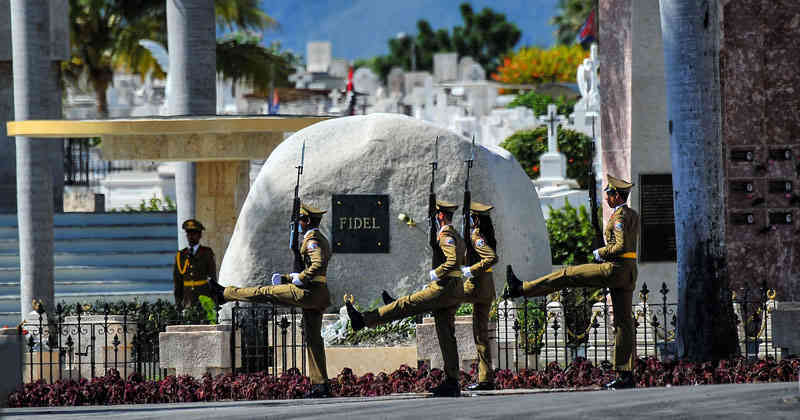
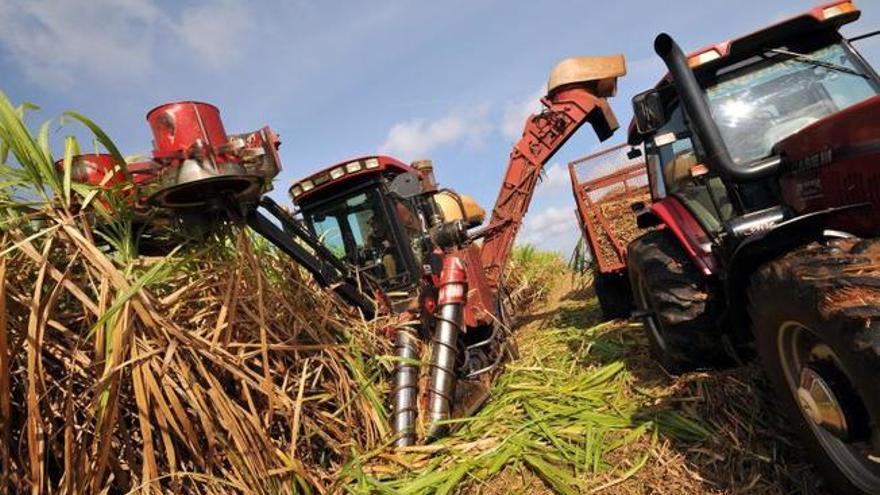
14ymedio, 28 November 2017 — The sugar harvest began last Sunday with the start-up of the sugar mill Boris Luis Santa Coloma in Cuba’s Mayabeque province. According to the state monopoly Azcuba, the drought that lasted 18 months and the subsequent scourge of Hurricane Irma have had negative effects and will limit production to around 1.5 million tons.
In the last harvest, the country produced just 1.8 million tons of sugar, far from the almost 8 million that it achieved in 1990, before production fell to one million tons due to Fidel Castro’s decision to close dozens of sugar mills when prices plummeted in the international market.
For this harvest, it is planned to operate 53 mills from November to May. Cuba was one of the main producers of sugar and the culture of the refineries and sugar cane is an indissoluble part of its idiosyncrasy, to the point that it used to be said “without sugar there is no country.” continue reading
With the end of the Soviet subsidies, estimated at more than 60 billion dollars in three decades, and the loss of the market of the socialist countries, the island opted for other sources of foreign currency, including tourism, nickel and biotechnology.
The reduction in sugar production not only affects the country’s income, but also contributes to reductions in the standard of living in many municipalities and towns of the island, whose residents made a living from the vats if the sugar mill.
These so-called “ghost towns,” where the sugar mills used to employ the majority of the population and defined the local economy, are now trying to recharge their economies with other agricultural or industrial products.
After the passage of Hurricane Irma in September, the national press reported that more than 40% of the cane plantations were lost. Almost a third of the sugar mills were also harmed by Irma, which left 13 of them in “very serious” conditions.
————————-
The 14ymedio team is committed to making a serious journalism that reflects the reality of deep Cuba. Thank you for joining us on this long road. We invite you to continue supporting us, but this time becoming a member of 14ymedio. Together we can continue to transform journalism in Cuba.
Ivan Garcia, 13 November 2017 — In the studio there are three light reflectors that give off an unbearable heat. In the background there is a wall of mirrors and two white umbrellas hanging from the ceiling.
Joan, a professional photographer, considers himself a freelancer. He also sells audiovisual packages to foreign press agencies based in Havana, planning a photographic exhibition with artistic nudes.
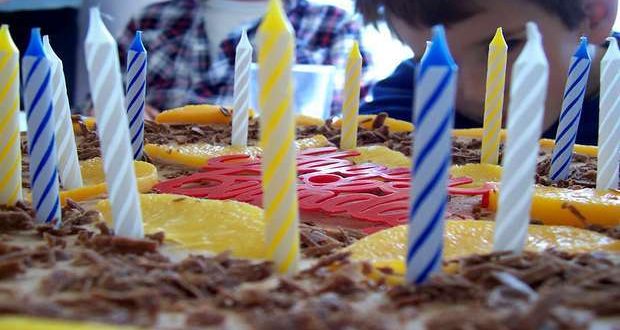
“But what earns the most money are the photo sessions for fifteenth birthday parties, both for females and males. Packages of photos, montages and videos range between 120 and 850 convertible pesos (CUC), and some are even more expensive. From the professional point of view it’s a cash cow, as long as you are up to date with the latest youth trends in Cuba and have a stock of sophisticated tools and applications. It’s true that art is scarce and kitsch is abundant, but you earn more money than with graphic journalism or artistic photography,” says Joan. continue reading
The fifteenth birthday parties on the island support a fat and efficient chain of businesses that enjoy generous profits. Hairdressers, barbershops, photographers, audiovisuals, cakes, buffet tables, sale or rental of costumes, choreographers, DJs, comedians and well-known television presenters usually participate in the celebrations for turning 15.
Moraima says that “on my daughter’s fifteenth I spent about 6 thousand chavitos (CUCs). A week in a hotel in Varadero for five people cost 1,500 CUC. On clothes for the girl we spent 450 CUC, 750 CUC on photos and videos, 200 CUC on hairdressing and almost 3 thousand CUC on the birthday, between the cake, refreshments, drinks, rent of the room in a hotel, presenter for the party , choreographer, DJ and a comic. The next day I did not even have a peso for a cup of coffee.”
But now Moraima’s son has gottenit into his head to also celebrate his 15th birthday.” He says that’s fashionable. His father and I put our hands on our heads, but the truth is that the boy gets good grades at school and deserves it,” the mother confesses.
José Manuel, father of two children who, in 2017, arrived at the ages of 15 (the boy) and 16 (the girl), found a solution that allowed him to lower costs. “We had a single celebration, like greased lightening. We rented two rooms in a four-star hotel in Cancun for eight nights for four people. Expenses were exceeded more than planned, around 10 thousand chavitos, but it was worth it. ”
The fifteenth birthday parties are a long-standing tradition in Cuba and other countries of the Caribbean and Latin America. The custom does not distinguish among races or social status. All Cuban families yearn to celebrate it in the best way possible; possible according to their economic possibilities. During Soviet Cuba, when one’s salary had a real purchasing power, it was less complicated to organize them, although the wealthiest could always go overboard and break the bank.
Zoila, 50, remembers: “My parents were workers in a textile factory. In 1982, when I turned 15, each one earned a salary of 200 pesos. However, with the five boxes of beer available on the ration book for fifteenth birthday parties and weddings, plus a little money saved, four cakes were bought, abundant food and drink was served, and several couples danced a rueda de casino. All that partying did not exceed a thousand pesos. Now, with the custom designed cake and the paraphernalia that usually accompanies a quinceañera, you’re out a thousand or two thousand chavitos. On my two daughters’ fifteenths, without great luxuries, I spent 4 thousand CUC.”
In Cuba, parties were never organized for boys when they turned 15 years old. But for four or five years it has become common. Although many fathers and mothers do not look on it kindly.
“The quinceañeras are a feminine tradition. My sons say that I am a Cro-Magnon, an antiquated one. But I’m against that ‘metrosexual’ fashion, men who shave their legs, chest and eyebrows, fix their nails and wear pink clothes. With this discourse that we all have the same rights, a part of the men have gone the gay route,” says Sergio, father of five children.
In a survey of 18 adolescents, females and males between 12 and 14 years old and from different social strata, 16 of them said that if their parents could afford it, they would celebrate their 15th birthday in some way, regardless of sex.
“It’s a cool thing and it’s fashionable. In 2018 I am going to be 15 and my parents are going to celebrate. I intend to make a digital magazine dressed in football outfits and audiovisual montages as if I were playing football with Messi and Neymar,” says Reinier, a ninth-grade student who is now 14.
Quite a few of the fifteenth birthday celebrations Cuba can be financed thanks to Cubans residing in the United States. “My uncle plans to come. He sent me name brand clothes and shoes, a phone and money. He told me by text that he is going to rent a week in an all-inclusive hotel in Cayo Santamaría,” says Lisván, a highschool freshman who will turn 15 in November.
So it is that many of the traditional holidays, now for the two sexes, in many cases are planned between relatives on the Island and in Florida. And the expenses are shared on both shores. Or they are paid in full by a magnanimous relative from Miami.
Ivan Garcia, 27 November 2017 — In a dirty and unventilated state bar on Tenth of October Avenue, which sells for six pesos (0.35 cents), with their tankard of beer served, two speakers reproduce a recital by La Lupe.
At a table in the background, Joel, with his glassy eyes, leans his back against a wall where you can read the meaning, according to Fidel Castro, of the word revolution, engraved with a fine-tipped brush and without much art.
When you ask his impressions on the first anniversary of Fidel’s death, Joel, who drinks more for vice than pleasure, shows the typical silly smile of people one step away from drunkenness. continue reading
“You’ve got me between a rock and a hard place. I did not remember the first anniversary of the death of that face like a coconut. The television and radio are twenty-four hours with that obsession, but my job is to work hard. I don’t have time to shoot the shit. Let those who believe in him remember him. Brother, life does not stop no matter how big the person who died is,” says the man, as he empties the rest of the cheap beer that remains in his jar.
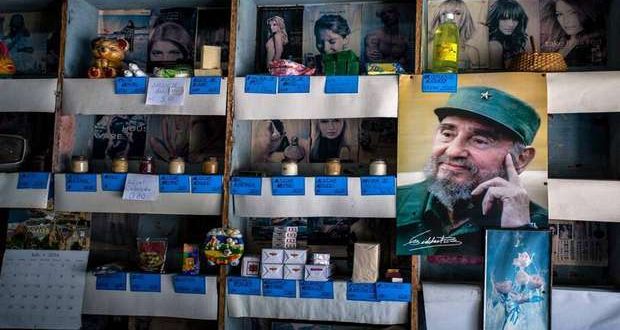
In Cuba, political advertising is everywhere. In the most unexpected places, phrases by Fidel Castro are read. It does not matter if it is an farmers market, a smelly low-key bar or on the Central Highway.
The promoters of the Castro faith work by piecework. They have filled with paintings, photos and praises to Castro every corner of the island. Not infrequently their crazy site has borders of black humor, cynicism or toxic delirium.
On one side of the old Prisión del Príncipe, where the Avenida de los Presidentes begins, in El Vedado, on murals and building facades there are Castro slogans. In the evenings, taking advantage of the lack of public lighting in that area, street exhibitionists masturbate to the step of any woman.
“It’s an epidemic. The shooters (masturbators) in Havana are making waves. Recently a guy was ’shooting’ from atop a tree, next to a sign with Fidel’s phrase ’Cubans must learn to shoot, and shoot well. What a coincidence,” says Camila, a dentist.
And it is Fidel Castro, like José Martí, that the propaganda of the communist party uses it for any facet of life. Be it a boxing match, a hurricane symposium or a poultry forum.
“The soundtrack about the man is tremendous. In between the innings of a ballgame, they slip a stretch of one of his speeches or images of him playing basketball or baseball. Advertising in the capitalist countries is abusive, but this day for the first anniversary of Fidel’s death in the media, all the time and at any time, it is simply harassing. Even those people who appreciated it come to reject it,” says Hernán, a retiree.
Carlos, a sociologist, believes that “political advertising must be handled with care, so that it does not have the opposite effect. It has happened with Martí: due to the excessive use of him, a considerable part of the new generations reject him. Fidel was a watershed, he has many local admirers, but also many detractors, although not openly expressed. They believe he is to blame for the current national disaster. With this laudatory campaign, where everything is praise and his flaws are not outlined, trying to sell his as a perfect guy, what they provoke is exhaustion.”
State media, lacking in creativity, have labeled the former commander in chief as a major athlete, rancher and farmer-in-chief and highlighted his wisdom with regards to the art of war.
If there is something overflowing in Cuban bookstores, it is texts about Fidel Castro. Nidia, an employee of a bookstore in Old Havana, says “Cubans barely buy Fidel’s books. The foreigners, a little. They don’t sell much.”
A year after the disappearance of the former top leader, people have continued on their own. The priority is the same: bring food to the table and earn enough money to repair their precarious houses.
The citizens consider that the state’s “information deployment” on the life and work of the autocrat does not bring them any benefit. “If every 25th of November they gave on the ration book a pound of beef per person or a basket of food, perhaps they would remember him more intensely. But life here stays the same. Without money, the markets are fleecing us and eating well is a luxury,” says Ángel, a worker, in line at the bakery.
The main concern of Havana residents like Joel, a practiced drinker, is that “on these days of commemoration they prohibit the sale of rum or beer. The best way to escape from problems, which in this country are a lot, is to go get drunk.”
Twelve months after the funeral of Fidel Castro, Cuba is still stuck in its stationary economic crisis and planning the future, more than boldness, it is a bad omen. Within three months, Raúl, the other Castro, has said that he is retiring from power. But apathy on the island is so profound that even this issue does not interest the population.
The goal of the ordinary Cuban is to make it to the next day. You live hour by hour. Short term. The commemorations and political campaigns are just a background music.
Fernando Damaso, 26 November 2017 — Maintaining the concept of “perpetual revolution” is convenient for government authorities because, in this way, those who do not agree with them are not against the government, but against the “revolution,” that entelechy turned into a myth, and confused by most of the citizens with the Nation and the Fatherland. It is a primitive formula that has given good results for sixty years.
Revolution is simply a violent change in the political, social or economic structures of a State. Nation is a human community generally established in the same territory, united by historical, linguistic, religious and cultural traditions and economic ties to a greater or lesser degree. The difference between the two is notable. continue reading
All revolutions have a beginning and an end, totally unrelated to the wishes of those who execute them: in the case of political, social or economic revolutions, they begin with the assault on the established power and end with the institutionalization of the new power. They are ephemeral phenomena, although their consequences and effects extend over time, beyond the periods of their own existence. The Cuban Revolution is no exception: it existed only during the transition stage.
To speak of the Cuban Revolution today, as if it were still a current event, and even worse of the “Revolutionary Government of Cuba,” as it is often written in official statements, in addition to referring to something that does not exist, is illegal, since, what the Constitution recognizes is the Government of the Republic of Cuba. It seems that this absurdity responds to the need that the “old revolutionaries” have to maintain their “histories” and to defend their old conceptions, without daring to insert themselves in the present.
They are addicted to the little word (economic, agricultural, industrial, educational, cultural and other revolutions), although over time, despite having tried to erase the so-called bourgeois period, changing the political, social and economic structures, and also the names of many towns, companies, businesses, and health, educational, cultural and other centers, as well as plazas, parks, avenues and streets, they have become well-off leaders and officials, with higher standards of living than those of the bourgeois they fought, with the difference that the old bourgeois lived off their own resources while the well-off leaders and officials live at the expense of the people’s resources.
They will continue to call themselves “revolutionaries” until the end of their days, but their revolution has long since ceased to exist.
The cap in homage to the deceased ex-president measures five feet long by 20 inches high. (Facebook)
14ymedio, Miriam Celaya, Havana, 22 November 2017 — A huge metal cap measuring five feet long and 20 inches high, weighing 66 pounds, is the latest fetish born of the yearning of a certain regional leftist sector to honor Fidel Castro, the favorite demiurge of vernacular socialism, on the first anniversary of his death.
The project of the headdress-talisman, an imitation of the cap worn by the famous deceased one as part of his perennial military uniform, was conceived by the Union of Cuban Residents in Argentina (Urca) and the Argentine Movement of Solidarity with Cuba (MasCuba), two groups that, from the distant comfort of that Southern Cone country, enthusiastically support the longest dictatorship in the hemisphere, and have managed the entire sculptural project, including its transfer to Havana by air from the international airport in Buenos Aires. continue reading
So far, the total cost of the new votive object, such as materials used, labor, transportation, air freight, etc., has not been made public
So far, the total cost of the new votive object, such as materials used, labor, transportation, air freight, etc., has not been made public, but if we assume as true the information from the official Cuban media and the regional liberal left on the difficult economic and social situation that workers in Argentina are going through, under the government of Mauricio Macri, it can be surmised that those responsible for the work made a huge personal and family sacrifice to make it possible.
This should not surprise us too much. It is well known that the radical left factions do not shy away from difficulties and become especially wasteful in resources and creativity when it comes to the cult of those who are deceased. Hence, certain strange post-mortem practices have been applied at different moments in history to honor their founders or certain beloved brothers, practices that may seem twisted to some priggish members of the bourgeoise.
One of the examples would be the mummification of the body of Vladimir Ilyich Lenin and its exhibition to the public in the Red Square of Moscow, which turned him at the same time into a material idol of the communists of the world and a tourist attraction for millions of visitors addicted to the morbid. It was perhaps the first case and, so far, the most famous of the necrophilia epidemic of the left.
Another example, although of a different style, is the consecration of the cult to Che Guevara – with all the commercial paraphernalia of his image multipled in T-shirts, match-boxes, ashtrays, posters or postcards – including the pilgrimages by many of the faithful of the ideology and other followers of myths to La Higuera, Bolivia, where the conspicuous guerrilla found the death he so desperately sought, or the tourist excursions to the tomb-monument that guards (his?) sacred bones in the Cuban city of Santa Clara.
We could also mention other interesting mortuary monuments of characters on the left, such as that of a total communist: the Spanish dancer Antonio Gades, personal friend of Raúl Castro. The talented artist spent such pleasant moments on the island that he asked to be buried in Cuba and, consequently, his mortal remains were moved from his native homeland and buried at the mausoleum of the Second Eastern Front, under a sepulcher with a pair of Flamenco dance boots fused in metal.
Not far from him, lie the remains of Vilma Espín – wife of the current general-president, Raúl Castro, and mother of his children – protected in a pyramid-shaped sculpture, symbol of immortality… Humble, these communist chaps.
The eyesore sculpture will participate in the 2018 May Day parade at the Plaza of the Revolution in Havana, and will afterwards be driven in a caravan to be revered throughout the Island.
But, returning to the matter of the monstrous metal cap, the intention of its creators is for the allegory to surpass the mere physical existence of the object, so that its presence promotes a complex ritual. Thus, the eyesore sculpture will participate in the 2018 May Day parade at the Plaza of the Revolution in Havana, and – as with happened with the coffin of the deceased-in-chief in the mournful novena that took place after his death – will be carried in a caravan to be revered throughout the Island, until it reaches the Santa Iphigenia Cemetery, in Santiago de Cuba, to the point where the ashes of the honored rest, but not in peace.
A liturgy to the benefactor of the poor that, paradoxically, would become a kind of tropical version of that ancient Swiss legend of the fourteenth century, immortalized almost five centuries later by the German poet and playwright Frederick Schiller in his work William Tell. In it, the inhabitants of the city were forced to offer humiliating reverence before the hat of their ruling despot, Hermann Gessler, placed on top of a stake in the main square. The rebellion of the archer William Tell, who refused to accept such a huge outrage, marked the beginning of the revolt that ended up liberating his people.
It is possible that, given the fascination with the cult of the Dead, Cuban authorities are ready to support the ridiculous spectacle of the adoration of the cap. What does seem difficult is that a William Tell would emerge unexpectedly from among Cubans, with enough courage to challenge such a colossal insult.
Translated by Norma Whiting
_______________________
The 14ymedio team is committed to serious journalism that reflects the reality of deep Cuba. Thank you for joining us on this long road. We invite you to continue supporting us, but this time by becoming a member of 14ymedio. Together we can continue to transform journalism in Cuba.
The opposition failed to get any of the independent candidates on the ballot, due to pressures in previous weeks. (14ymedio)
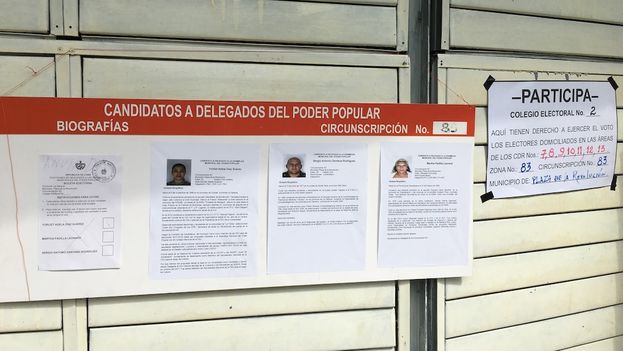
14ymedio, Havana, 27 November 2017 — The last municipal elections before the departure of Raúl Castro in February passed without surprises, exit polls or political differences between the candidates. During the day, several activists denounced irregularities in exercising their right to vote or access the counts and the rains forced some delays in poll closing times.
In these elections the delegates to the Municipal Assemblies of People’s Power were chosen for the 12,515 electoral districts of the Island. They will serve in the 169 municipal assemblies that will begin their new term in a few days. Votes were held at 24,366 polling stations across the country. continue reading
Manuel Cuesta Morúa, spokesperson for #Otro18 (Another 2018), confirmed that the opposition had not succeeded in getting any of the independent candidates on the ballots, due to pressures, threats and arrests that prevented them from even reaching their area assemblies where the candidates were selected.
For the rest of the citizens, the day passed without great expectations of change and in the midst of an intense campaign in the official media that described the Cuban process as a demonstration of “democracy” and “popular participation.”
“I’d just barely woken up when I had a pionerita (little Pioneer) shouting my name down there,” Claudia, who is 41 and lives in Havana’s Cerro neighborhood, told 14ymedio. The practice of going around looking for voters in their homes has been falling away in recent years in Havana, but this time the government didn’t want to leave time for the latecomers.
“We want all the voting done before three o’clock, but if we have to leave the polls open longer we will do it,” the head of a polling station in the Guanabo neighborhood in the east of Havana told this newspaper. “Everyone who knows a voter who hasn’t come to fill out their ballot has a civic duty to call them,” she added.
Alina Balseiro Gutiérrez, president of the National Electoral Commission (CEN), informed the press that 82.05% of the electorate voted. Balseiro said that CEN will release the preliminary results of this round of elections for delegates to the municipal assemblies of People’s Power on Monday afternoon.
Among the elected delegates will be potential deputies to make up at least half of the candidates for the National Assembly in the general elections that are scheduled for the coming months. The rest of the parliamentarians will be “handpicked” by the almighty candidacy commission.
It will be the job of the new parliament – the National Assembly of People’s Power – on 24 February 2018 to choose, based on the proposal from the Council of State, the successor to Raul Castro for the presidency of the country, and to give way to a new generation, possibly embodied in the figure of the Vice President Miguel Diaz-Canel Bermúdez, who is currently 57.
Raul Castro voted at seven o’clock in the morning at a polling station whose location was not specified. The elections coincided this year with the commemoration of the first anniversary of the death of Fidel Castro.
The official press took advantage of the coincidence of dates to present the elections as a way to honor “the memory of the Commander in Chief” and “continue his legacy.” In most of the polling stations, next to the coat of arms of the Republic and the national flag, an image with the face of the former president was on display.
An independent entity, under the name of Citizen Observers of Electoral Processes (COPE), mobilized about 40 people in 7 provinces of the country to roam between polling stations to “monitor the process of electoral administration, promoting democracy through citizen empowerment.”
From the province of Santiago de Cuba, activists of the Patriotic Union of Cuba (UNPACU) denounced irregularities in the voter registers and obstacles to participating as observers in the counting of votes. The opposition organization had joined the call of the Cuba Decides initiative for voters to write the word “plebiscite” on the ballot.
Manuel Cuesta Morúa affirmed, for his part, to EFE that another COPE, composed of 275 members in 13 of the 15 provinces, undertook “without great difficulties” the tasks of independent observation.
The Cuba Decides campaign, led by Rosa Maria Payá, presented on Sunday a formal request in several polling stations that blank ballots or ballots marked with messages in favor of a plebiscite be counted as valid votes.
UNPACU activist Carlos Amel Oliva reported that several members of the organization received evasive responses from those responsible for polling stations to their request to exercise their right to observe the vote count. Other opponents complained that their names were not even on the voter registers.
“As of midday we have a report of six activists arrested during election day, among them Víctor Campa Almenares, Carlos Oliva Riverí, Alexis Rodríguez Chacón, Vladimir Martín Castellanos, Juan Salgado Jurado and José Antonio Valdés Piña,” he details.
“All these opponents were arbitrarily arrested when they went to the polling station closest to their area of residence to participate as observers in the counting of votes,” he added.
__________________________________
The 14ymedio team is committed to serious journalism that reflects the reality of deep Cuba. Thank you for joining us on this long road. We invite you to continue supporting us, but this time by becoming a member of 14ymedio. Together we can continue to transform journalism in Cuba.
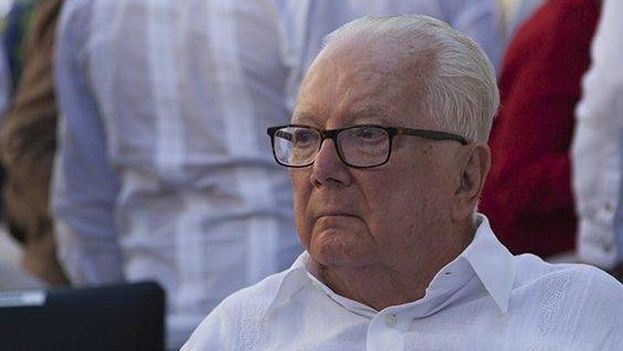
Armando Hart Dávalos died on Sunday afternoon in Havana at 87 years of age due to respiratory failure. (EFE)
14ymedio, Havana, 26 November 2017 — Cuban politician Armando Hart Dávalos died on Sunday afternoon in Havana at 87 years of age due to respiratory failure, according to the official press. The news was announced in the midst of the commemoration of the first anniversary of the death of Fidel Castro.
Born on 13 June 1930, Hart Dávalos graduated as a lawyer from the University of Havana, where he joined the Orthodox Youth and actively participated in the student agitation. In those years he was also part of the National Revolutionary Movement of democratic, patriotic and anti-imperialist projections. continue reading
He participated in the uprising of 30 November 1956 in Santiago de Cuba to support the landing of the yacht Granma, which brought 82 members of the 26th of July Movement from Mexico to Cuba, including Fidel and Raul Castro and Che Guevara. In 1957 he met Fidel Castro in the Sierra Maestra and guided him to the place where journalist Herbert Matthews from The New York Times was waiting to interview the guerrilla leader; Matthews’ article catapulted Castro’s profile to great prominence in international public opinion.
A short time later Hart Dávalos was arrested and sentenced to several years in prison, but while being taken to court he managed to escape and rejoined the clandestine struggle. After that incident he was appointed National Coordinator of the 26th of July Movement.
In January of 1958 Hart Dávalos was again arrested and sent to prison, where he remained until the triumph of the rebels. During the next decades of his life he would be one of the most loyal followers of Fidel Castro and a tireless apologist for the decisions made by the Maximum Leader.
The young man from Havana was part of the national leadership of the Integrated Revolutionary Organizations (ORI) and the United Party of the Socialist Revolution of Cuba (PURSC). In 1965 he was elected a member of the Central Committee and the Political Bureau of the Communist Party of Cuba.
Hart Dávalos was appointed Minister of Culture at the creation of the ministry in 1976 and remained in that post until 1997. His term followed the infamous Quinquenio Gris (The Five Grey Years) and was not exempt from purges, editorial censorship and punishments against critical voices.
Subsequently he went on to direct the Office of the Martiano Program, attached to the Council of State, the role of which is to study and promote the legacy of José Martí.
He married Haydée Santamaría Cuadrado, a fellow revolutionary and director of Casa de las Américas, who committed suicide in July 1980. The couple had two children, Celia Hart Santamaría and Abel Hart Santamaría, who both died in a car crash in Havana in 2008.
Among the books by Hart Dávalos are titles such as Aldabonazo (Wake-up Call, 1997) and Con la honda martiana (With José Martí’s Slingshot, 2009). He received the Order José Martí on his 80th birthday and the José Martí National Prize for Journalism in February of this year, in addition to many other official decorations.
His remains will lie in state at the Center for José Martí Studies, at Calzada and 4th, in Vedado, until 10 am on Monday and then, by family decision, will be cremated.
____________________________
The 14ymedio team is committed to serious journalism that reflects the reality of deep Cuba. Thank you for joining us on this long road. We invite you to continue supporting us, but this time by becoming a member of 14ymedio. Together we can continue to transform journalism in Cuba.
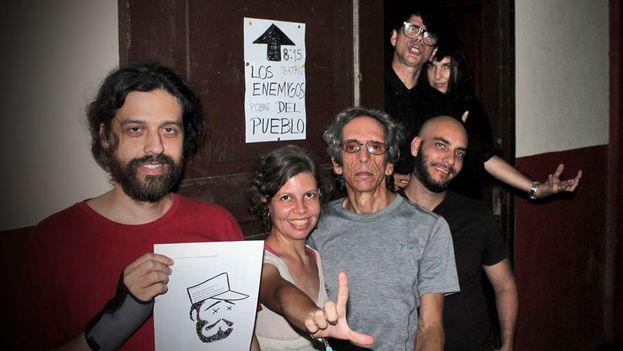
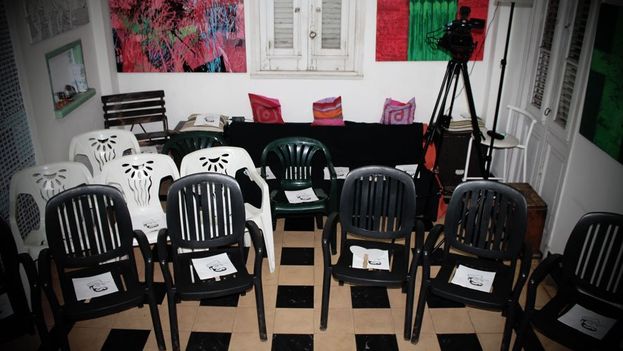
The creators of the play Enemies of the People denounce that State Security called the piece “subversive” without knowing anything about it. (@liavillares)
14ymedio, Havana, 24 November 2017 – Cuban State Security managed to limit attendance to just two people to last night’s premiere play The Enemies of the People. The police cordon set up around the El Círculo gallery in Havana’s Vedado neighborhood, where the play was going to be performed, worked as a method of pressure to intimidate would-be audience members.
Activist Lía Villares, owner of the house that that provides the premises for the theater, related via twitter what happened when members of the political police were stationed in the vicinity of the Villares’s house and pressured the numerous guests to not enter. “Everything that happened yesterday in the presence of witnesses and neighbors demonstrates the agonizing situation of cultural rights and freedom of expression in Cuba,” denounced Villares. continue reading
Despite the pressures, the activist said that actress “Lynn Cruz could not have given a better performance.”
The work, interpreted by Cruz and directed by filmmaker Miguel Coyula, offers “a timely vision of Cuban society subjected to a dictatorship,” explain its organizers.
Cruz reincarnates Charlotte Corday, a famous character of the French Revolution and who murdered Jean-Paul Marat. On this occasion, however, instead of Marat, Fidel Castro is the target of her action.
In her Twitter account Lia Villares said that the staging “almost starred the henchmen of Section 21,” the Department of State Security that deals with surveillance against opponents. “They did not allow anyone to enter” the El Círculo Gallery, lamented the activist.
The piece also has an incognito character, played by the musician Gorki Águila who delivers an emotional reading of the list of names of the 41 victims of the 13 Tugboat 13 de Marzo, sunk in July 1994 by four official boats that used water cannons to attack the boat on which the victims were trying to flee the country.
The seats were empty and photographed to denounce the absence of the audience who felt pressured and left without seeing the work. (14ymedio)
Those killed in the tugboat incident were between the ages of 6 months and 50 years. After a week in which the official media silenced what happened, Fidel Castro described the performance of the crews of the boats that attacked the tugboat as a “truly patriotic effort.”
The independent El Círculo gallery is a frequent target of police operations. Last April, a large deployment of troops prevented the public from attending the screening of the documentary Nadie (Nobody) directed by Coyula, which presents the life of the poet Rafael Alcides, censored in the official publications.
__________________________
The 14ymedio team is committed to serious journalism that reflects the reality of deep Cuba. Thank you for joining us on this long road. We invite you to continue supporting us, but this time by becoming a member of 14ymedio. Together we can continue to transform journalism in Cuba.
Laritza Diversent, 25 November 2017 — Paragraph 9 of Resolution 60/251 establishes that, in order to be able to occupy the position of Member of the Human Rights Council, countries will have to apply stricter rules for the advancement and protection of human rights. Cuba claimed in its candidacy that it signs up to 46 of the 61 instruments adopted by the international community in regard to human rights.
Certainly the Cuban state is signatory to 6 of the 9 most important universal treaties on human rights and to 2 of the optional-supplementary protocols in the Convention on Childrens’ Rights. Nevertheless, the country doesn’t have any way, or political will, to meet several of the requirements of the Human Rights Council, especially in relation to the general obligation to respect and protect, which are derived from the international instruments to which it has agreed. continue reading
In the 2009 EPU (Universal Periodic Assessment of every signatory’s progress on the advancement of human rights) it undertook to carry out a study into the need to complete legislative and administrative changes with a view to giving effect to human rights domestically and to progress its actions to adopt, reinforce and to align its national legislation with its international obligations pertaining to the treaties to which it is signatory.
In 2013, it reiterated its commitment to revise and maintain the congruence between its national legislation and international human rights instruments, and its international commitments, although, inconsistently, it only took note of the Convention’s suggested recommendation to incorporate the Convention against Torture into national legislation.
Broken promises and undertakings which should be taken into account by the community of nations when considering whether it should continue as a member of the Human Rights Council.
Up to now there is no legal regulation or procedure which permits the assessment of the compatibillity between domestic rights and international ones, and therefore there is no possibility that Cuba, as a member of the Council, will apply stricter norms on the advancement and protection of human rights.
[i] Sections 2 and 3 of paragraph 130, recommendation formulated by the United Arab Emirates, Trinidad and Tobago, Ghana, Uzbekistan, Mexico
[ii] Paras. 170.20 yand 170.22 formulated by Belarus and China
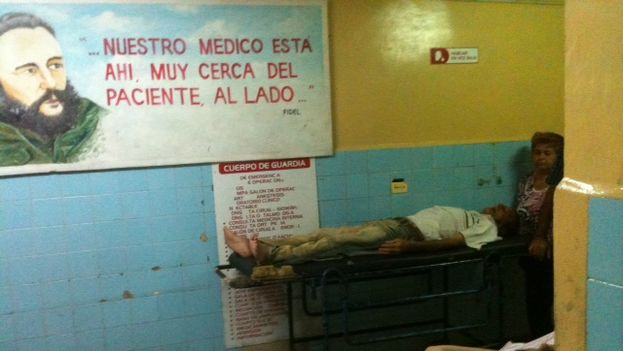
Emergency room in the Abel Santamaría Cuadrado Provincial Hospital of Pinar del Río. Sign: “Our doctor is there, very close to the patient, at his side. Fidel.” (Juan Carlos Fernández)
14ymedio, Mario Penton, Miami, 23 November 2017 — Under a parasol printed with a reproduction of the Tropical Gypsy, María Elena has left behind her profession as a doctor to dedicate herself to selling handicraft products that she makes for tourists in Matanzas.
She graduated in 1993 but has not practiced for more than 10 years. “They pay very little [in the health system]. They demand of you too many responsibilities, and now that there are so many doctors posted to international missions, you spend your life on duty and covering for those who are out of the country,” she explains. continue reading
The national health system is one of the sources of pride for the government. For years, Fidel Castro called it one of the most important achievements of socialism in Cuba. In 1984 he created the figure of the family doctor and thousands of doctor’s homes-cum-offices were built in the countryside and cities of the country to extend personalized preventive primary care. “It has really been a revolution,” Castro boasted in 1984. Today, 30 years later, these networks are in decline due to the desertion of thousands of doctors and the abandonment of the infrastructure.
“It was a colossal and good project, in principle, the problem was that there was no way to pay for it,” explains Julio César Alfonso, president of the Solidarity Without Borders network, a Miami-based NGO for those who have abandoned international missions and do not want to return To Cuba.
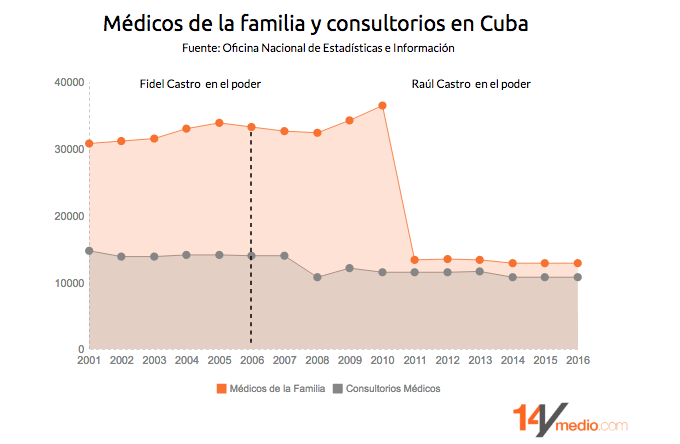
Family doctors and doctors’ offices in Cuba.
“Thousands of doctors who were initially part of that network escaped when they had the opportunity while on international missions (more than 8,000 to the United States) and many others simply took off their white coats to become drivers, artisans, artists and even street vendors,” adds Alfonso
Despite the guidelines of the Ministry of Health to reorient the health system “towards primary care and its fundamental pillar, the family doctor and nurse,” in the last six years alone their number was reduced by more than 23,000, according to official figures. María Elena, the doctor turned seller of handicrafts, believes that most of her colleagues “got tired of so many calls to sacrifice.”
“The doctor is the most exploited worker in Cuba today, [the government earns] millions of dollars, making them work abroad and paying them a stipend, and those who stay here earn less than a driver or a bricklayer. I know surgeons who still have to bicycle to the hospital to operate,” emphasizes María Elena.
According to the article The Current State Of Social Welfare In Cuba by the economist Carmelo Mesa-Lago published by the think tank Cuba Possible,”In 1989 Cuban social welfare surpassed many of the socialist countries and led the majority of Latin America,” but this changed with the demise of the USSR.
Mesa-Lago believes that such levels were possible because of “the social commitment of the government and the support of the Soviet Union,” which according to his calculations disbursed some 65 billion dollars to support its ally in the Caribbean.
The current economic situation does not presage greater economic incentives for the health sector. The Cuban GDP contracted by 0.9% in 2016, among other reasons because of the crisis in Venezuela and the 18% reduction in the purchase of professional services (especially those offered by doctors), the main source of foreign exchange income for Cuba.
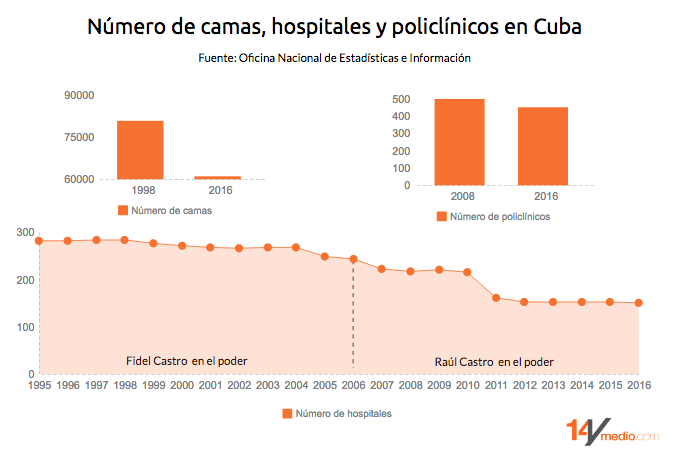
“Despite economic difficulties, Cuba maintains its universal and free healthcare system,” says Mesa-Lago. However, he confirms that the number of hospitals, hospital beds and medical personnel has fallen abruptly. In the case of doctors’ offices or family doctor homes-cum-offices, the number declined from 14,007 in 2007 to 10,782 in 2016.
The number of hospitals decreased by 46.6% and that of polyclinics by 9.2%. All rural hospitals and rural and urban posts were closed in 2011, with patients referred to regional hospitals, but the time and cost of transport increases and for emergency it is more risky,” adds Mesa-Lago.
Number of beds, hospitals and polyclinics in Cuba.
Regarding the quality of the services, the economist raises serious doubts about the deterioration of infrastructure and the reduction of diagnostics and costly tests. “There is a severe shortage of medicines (92.3% of basic products are unavailable), of supplies for surgery, and the patients must provide sheets, pillows and other necessities,” he adds.
According to the National Office of Statistics and Information, after the beginning of the Raulist reforms between 2008 and 2016, the number of health personnel has fallen by more than 22%. The number of technicians decreased by 54% and that of nurses by 16%. The number of doctors, however, increased 19%.
More than 40,000 doctors have been sent to work in foreign countries, so instead of having a doctor for every 127 inhabitants, as presumed by the Government, Mesa-Lago calculates that there is actually one for every 234 Cubans resident on the island, a level similar to that of 1993, the worst year of the economic crisis during the so-called Special Period, a time of severe economic crisis after the collapse of the Soviet Union and the loss of its support for Cuba. The situation is even worse in the specialties that have more personnel working abroad.
“The export of health professionals brings the country an income of about eight billion dollars per year, but it reduces access to medical services within Cuba,” summarizes Mesa-Lago. Hence the long lines involved in waiting for healthcare services on the island and the overall degradation of the healthcare system.
________________________________________
The 14ymedio team is committed to serious journalism that reflects the reality of deep Cuba. Thank you for joining us on this long road. We invite you to continue supporting us, but this time by becoming a member of 14ymedio. Together we can continue to transform journalism in Cuba.
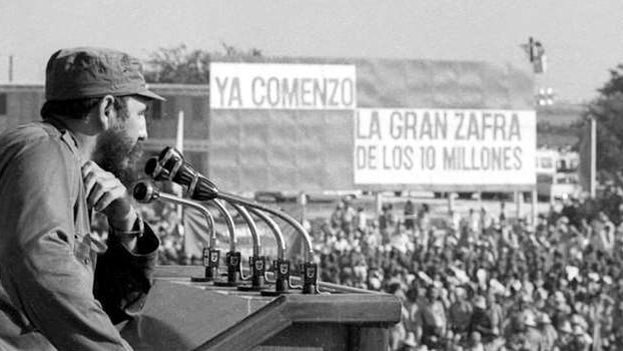
The author’s dream used to repeat itself on the nights that Castro delivered those interminable speeches in front of hundreds of thousands of people. Text of sign: Now begins the great 10 million ton harvest. (Archive)
14ymedio, Reinaldo Escobar, Havana, 24 November 2017 — Throughout my adolescence I had a recurring dream related to Mr. Fidel Castro. It used to repeat itself on the nights he delivered those endless speeches in front of hundreds of thousands of people.
My fingers would perceive with amazing clarity the texture of the upper edge of the podium, where I would balance myself on open arms while swinging back and forth. Sometimes I suddenly changed my position and with both hands would first caress and then change the arrangement of the five microphones facing me. Every time I touched them I generated a silence among the audience and not only those in the plaza but also the other thousands who were following my speech on television. continue reading
If, during those seconds I frowned, gave a slight smile or lingered with my gaze lost in the distance, I generated an additional expectation. That was the precise moment I let fly with what would ultimately be the center of my address, which the next day would be the headline in all the newspapers and, with complete certainly, would become another event to commemorate in the future.
Ordinary mortals don’t know what it feels like in the moment to have thousands of eyes focused on your face, attentive to every gesture, thousands of ears trying to anticipate your next word. The pleasure of being the master of this situation is incomparable. Then I speak with the appropriate inflection in my voice: firm, almost militaristic, if I am responding to a threat; sarcastic, if it is preferable that the message only be decoded by good listeners; sweet or sad, when I allude to past glories; cheerful and confident to promise a future conquest.
I have spoken and I take the opportunity to caress the curls of my hair (I am hairless) when an ovation escapes from all the throats and the applause continues in a crescendo without limits. From a corner of the square someone – an older man, a young woman, maybe a child – has uttered my name such that the crowd feels invited to repeat it, at first slowly and then at a syncopated rhythm. Then I woke up.
Almost twenty years had passed without having Fidel Castro as the protagonist of my dreams, until one night he returned. This time he was no longer inside my skin but was just six feet away from me. He was surrounded by his bodyguards and his eyes met mine. That’s when, with his usual arrogant tone, he asked me: “And what was it that you had to tell me?”
As I was working through an endless stream of questions and reproaches, the Comandante suffered a slow but remarkable metamorphosis. On more than one occasion he tried to interrupt me with his index finger escaping from a threatening fist, but he could not articulate a single word and only managed to look at his increasingly diminished escort as if to ask who had allowed me to get so close.
My voice changed with each reproach and it was not me who accused him, but his victims. I spoke in the first person as those shot, those sentenced to 20 or 30 years, those stripped of their property, those excluded because of their religious beliefs or their sexual preference, the dividing up of the revolutionary flock by minimal discrepancies, those who died or suffered for following their irresponsible decisions. Sometimes I spoke as an individual, sometimes I sounded like a gigantic chorus from the distance of all the exiles or from the bottom of the sea.
In the midst of the great accusations, sometimes the spark of an apparently minor detail appeared, as when he insulted the national symbol by signing a flag that a friend took to the North Pole; his own children that he sired but refused to recognize; the promises he never fulfilled; his allergy to self-criticism; his lack of piety; the propensity to satisfy his whims at any price was necessary.
At the end of this dream episode, often repeated, he always remained alone. His clothes did not have the bright olive-green that he wore for years but the confused gray-blue of a prison uniform or the worn-out pajamas of the forgotten in an asylum. He was alone and crying, not in repentance, but in anger.
I no longer dream of him. It is not healthy. The man who taught us to hate did not take away my compassion for the defeated.
___________________________
The 14ymedio team is committed to serious journalism that reflects the reality of deep Cuba. Thank you for joining us on this long road. We invite you to continue supporting us, but this time by becoming a member of 14ymedio. Together we can continue to transform journalism in Cuba.
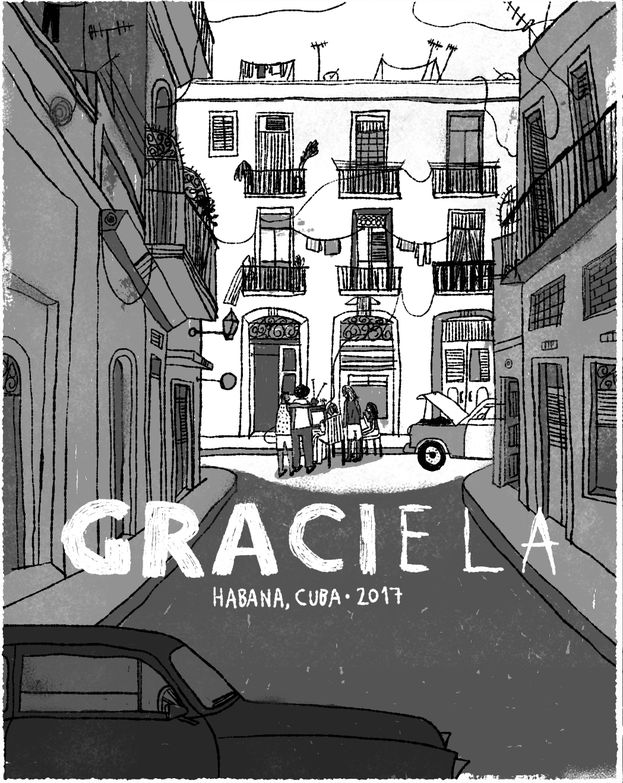
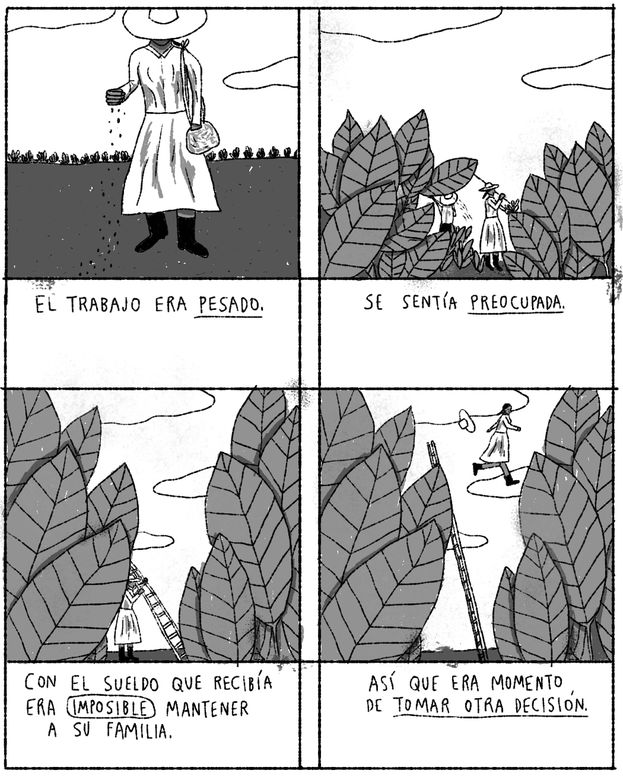
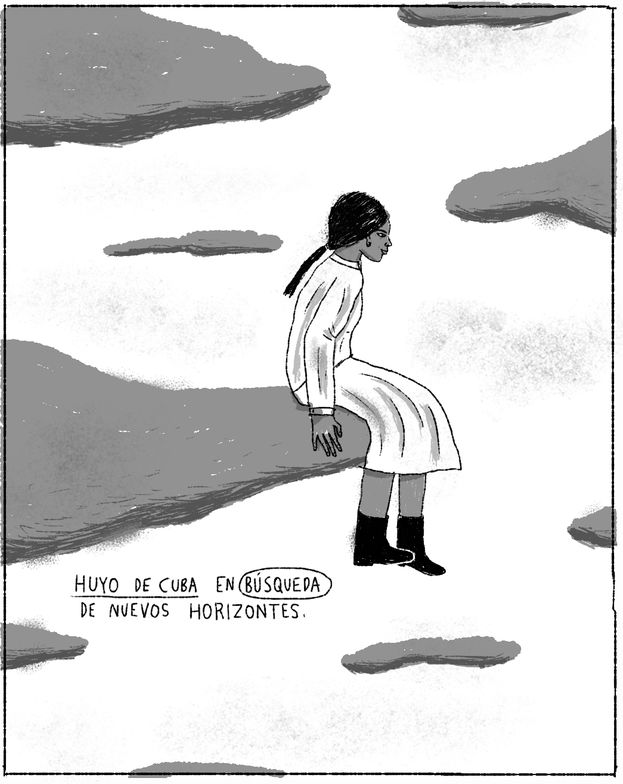
14ymedio, 25 November 2017 — The Mexican illustrator Joan X. Vázquez has created a series of comics produced by the human rights organization Amnesty International entitled Cubans’ Lives whose pages tell the lives of Cubans and the continuous restrictions to which they are subjected in their day-to-day lives.
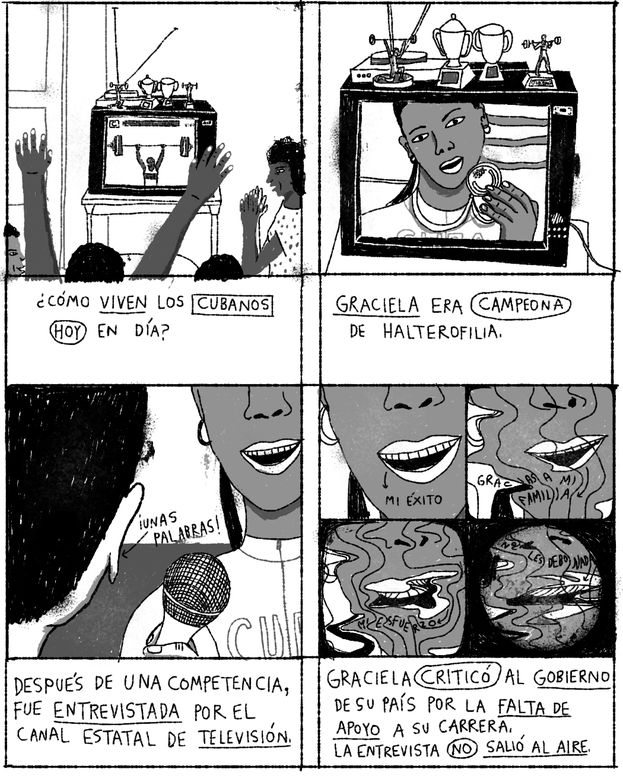
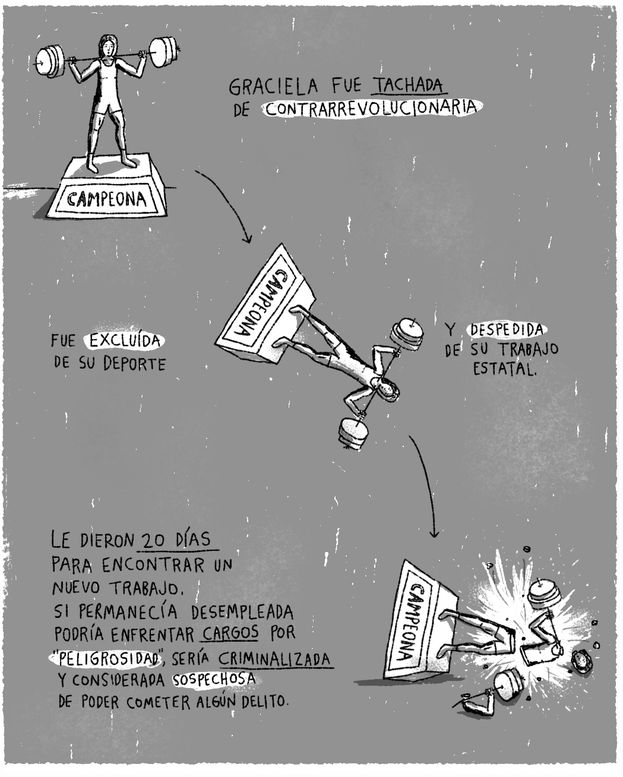
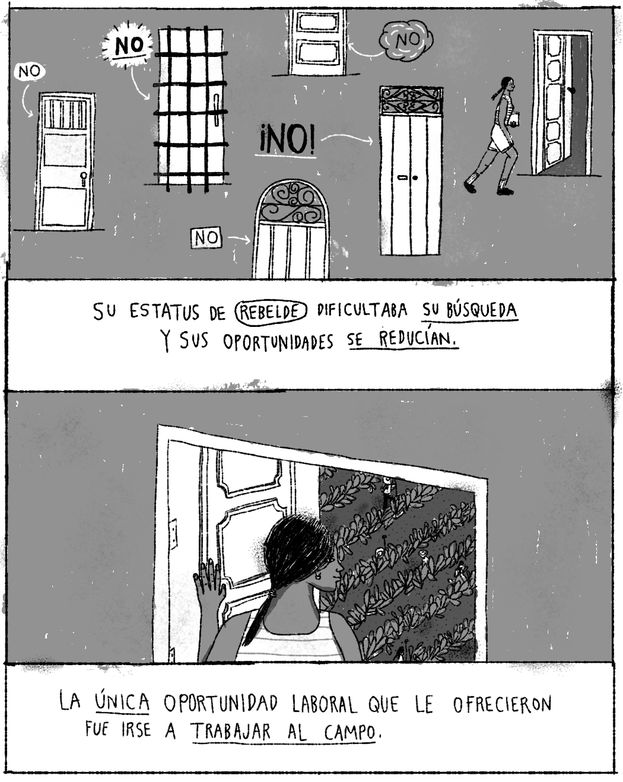
The first issue is dedicated to Graciela, a high-level sportswoman whose life took a radical turn when she made some statements in which she lamented the government’s negligible support for her specialty, weightlifting.
We reproduce here the first pages shared by the NGO.
How do Cubans live today? / Graciela was a weightlifting champion. / After a competition she was interviewed {“Some words!”} for the state TV channel. / Graciela criticized her country’s government for lack of support for her career. The interview was NOT broadcast. {My success… thanks to my family…}{Champion} Graciela was labeled a counterrevolutionary. She was excluded from her sport… and fired from her state job. They gave her 20 days to find another job. If she remain unemployed should be face charges for “dangerousness” and would be criminalized and considered suspect of being able to commit some crime.Her rebellious status made her search difficult and her opportunities diminished. / The only work opportunity they offered her was to go work in the countryside.The work was hard. / She was worried. / With the salary she received it was impossible to support her family. / So the time came to make another decision.Flee Cuba in search of new horizons.
At the same university where Ramonet (right) presented his book on Tuesday, a journalism student was expelled a few months ago for her involvement with an independent opposition group. (UCLV)
14ymedio, Generation Y, Yoani Sanchez, Havana, 23 November 2017 — When Ignacio Ramonet’s interview with Fidel Castro was published in 2006, many citizens did not miss the opportunity to mock the title. “Why should we read One Hundred Hours With Fidel if we have spent our whole lives with him?” people were saying on the streets, but the journalist did not even notice.
That volume, marked by journalistic meekness that led it to be cataloged as an autobiography of the Maximum Leader, earned more than just laughs. Accusations of having used the “cut and paste” method, to make answers out of the content of old speeches, also rained down. continue reading
Without having given a convincing explanation of such issues, Ramonet has returned to the charge with another book being promoted this week by several universities on the island. This volume has, also, has one of those titles that set off smiles of ridicule: The Empire of Surveillance.
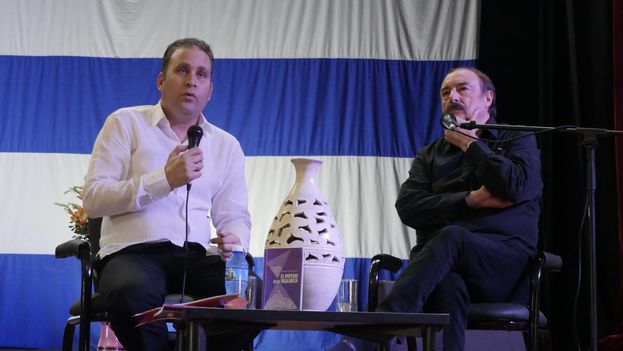
Last Tuesday, Ramonet, a professor of Theory of Communication, spoke at Marta Abreu de Las Villas Central University during the presentation of the book, which was brought out by José Martí Publishing. It was a bitter diatribe against the global surveillance network that the United States has woven to obtain information about citizens, groups and governments.
The book puts special emphasis on the complicity of companies that manage user data, adding them to that web of espionage, commercial interests, control and subordination, a tangle in which modern society is trapped and from which it must urgently escape, according to the analyst.
On this point, he doesn’t differ from what so many of the planet’s cyber activists are denouncing, but Ramonet suffers from an ethical hemiplegia when it comes to sharing responsibilities and commenting on other governments that invade the privacy of their citizens every day.
The fact that he traveled to such an Orwellian country as Cuba to point the finger at Washington shows his position when investigating topics such as Big Data, the legalization of surveillance on the web and the compilation of user data to predict behavior or sell products.
Cuba, where State Security (the Big Brother in this case) monitors every detail of the lives of individuals, is not the best place to talk about indiscreet eyes that read other people’s e-mails, policemen who observe every piece of information that crosses the network and data intercepted by powers that use them to subdue human beings.
This nation, where the Plaza of the Revolution maintains an iron grip on information and only allows public dissemination of discourses in agreement with itself, should be among the regimes Ramonet denounces in his book. But, curiously, for the journalist there is “bad” and “good” surveillance, with that carried out by the Cuban government among the latter.
At the same university where Ramonet presented his book on Tuesday, a journalism student was expelled a few months ago due to her connection with an independent opposition group. The Empire of Surveillance sees no shades of gray and trashed her with the complicity of some coerced students and student leaders.
A few days later, the cyberpolice that make up that army of control launched a campaign of defamation against the girl on social networks. To denigrate her they used information taken from her emails, her phone calls and even private conversations. Our Big Brother acted without regard.
A few years ago, national television showed the contents of several private emails that had been stolen from the personal account of an opposition member. All this without the order of a judge, without the lady being prosecuted for a crime and, of course, without having sent a request to Google to provide the content that supposedly should be published.
Ramonet cannot ignore that the Telecommunications Company of Cuba (Etecsa) maintains a strict filter on each text message sent by its clients. The state monopoly censors words like “dictatorship” and the names of opposition leaders. Although senders are charged for the messages, they never reach their intended recipients.
Nor has Ramonet, former director of Le Monde Diplomatique, gone to a Wi-Fi zone to access the web among those that the Cuban government opened after years of citizen pressure. If he had tried any of them, he would know that on this Island the Chinese firewall model has been copied to censor innumerable pages.
Does Ramonet know that a good part of Cuban Internet users use anonymous proxies, not only to access these filtered websites but also to protect their private information from the indiscreet eye of the State? Has he noticed that people lower their voices to talk about politics, put covers on forbidden books or shield their computer screens with their bodies when they visit a blocked newspaper like 14ymedio?
Has he ever wondered about the agreement between Havana and Moscow to open a center in Cuba under the name of InvGuard, which will implement an alleged protection system against network attacks? Just when the Kremlin is accused of having manipulated, through the internet, everything from Brexit to the Catalan crisis to elections in the United States.
The reader can find answers to none of these questions in Ignacio Ramonet’s most recent book, because, like his autobiography of Fidel Castro that he tried to pass off as an interview, this book raises questions among Cubans from the title alone: Why should we read The empire of Surveillance when our entire lives are under its control?
______________________________
The 14ymedio team is committed to serious journalism that reflects the reality of deep Cuba. Thank you for joining us on this long road. We invite you to continue supporting us, but this time by becoming a member of 14ymedio. Together we can continue to transform journalism in Cuba.
Primavera Digital, Eduardo Martínez Rodríguez, El Cerro, Havana, 22 November 2017 —If in Cuba we were to change everything that needs changing, we would have to rewrite our constitution. Why? Because of the many absurdities that do not permit the economy, nor society, to advance towards development, as do almost all the other nations on the planet—and all for protecting the spurious interests of a small clique that clings to power by virtue of no other legitimacy anymore than sheer force.
The government assures us that it desires a highly developed society, but this can only happen if there is a developed economy. How can this be achieved? By doing everything possible to incentivize development, and that is not how it’s done in Cuba. continue reading
In Cuba there is no store that sells tractors, trucks, farm equipment, or any other tools for the private farmers, who in fact comprise the immense majority (and the few outstandingly efficient members) of the agricultural sector. No big stores, nor small ones, either, offer agricultural supplies. The farmers are used to getting from the national or local government whatever they supposedly need for their work, such as the so-called technological packets, etc. But unfortunately our Ministry of Agriculture and subordinate agencies are staffed by “office farmers” who only know the type of agriculture that provides for our dinner table. And so it is in the rest of our ministries.
They supposedly want to incentivize private labor but unjust, un-payable and exorbitant taxes are imposed that we expect will function as they do in the US—but in a socialist system where the People (in reality the State) own the means of production, raw materials, all the unrealized gains, and all the income and aggregate value. In real terms these taxes function as an amortization of the chronic inefficiencies of the State.
They want the transportation system to get better but they don’t sell new or secondhand vehicles at a just and reasonable price. Nor is bank financing available. They don’t allow individuals to import from abroad, forcing us to continue to rebuild as best we can cars that are 60 or more years old.
They require that private transports be in excellent working condition when there is no State-run garage to take them to for maintenance and repair, no replacement parts provided or for sale, and the few other supplies that make it to the stores, such as batteries, tires and such, end up with astronomical price tags.
They pay lip service to bettering the standard of living while paying miserable salaries at the level of 30 years ago, and prices are, by decree, increased by 270% for sale in the hard-currency stores owned by the military.
They speak of civil society and impede oppositional movements. Our nation is ruled by very veteran military commanders, and even our low-level civilian functionaries now also sport the olive green, apparently as a fashion statement.
They wish for the nation to inhabit the Information Age when there is not a single store in the land that sells computers, while ETECSA, the state telecommunications and Internet monopoly–the only such entity allowed to operate–works very slowly in installing these new technologies despite being able to do it much more speedily.
They come out for improving education while the overwhelming majority of schools are in bad shape or lack adequate conditions for their proper functioning. Many resources are scarce and the professors make, as do all the workers in the country, on paltry salaries, unjust and abusive.
We try to be a medical power when there are not enough available doctors because of their exportation to the Third World, while our pharmacies are increasingly lacking medications to the point that we are approaching catastrophe for the elderly with their minuscule pensions. Meanwhile the black market for legal drugs at high prices continues to grow, for even aspirin is hard to find. To be admitted to the hospital today is a misfortune, not a solution, for the patient. New infections that cannot be controlled are breeding because of dire sanitary conditions.
They appear to try to instill in our young people our traditions and culture when our media, especially television, is increasingly and unpleasantly politicized and all our national symbols are manipulated to a disagreeable and degrading degree of chauvinism. Meanwhile our texts and the programming on offer are ever worsening in quality to the point that the citizenry seeks and finds alternatives such as pirated cable and the celebrated “weekly packet” that even the government tries to imitate with no luck, for it doesn’t change its methods.
The ancient bosses try to reach out to the youth with their speeches when they don’t see, don’t grasp—due to their advanced age—that young people must be approached via their evermore efficient and personal technological resources. Social media is being extensively used in politics (Donald Trump has more than 22 million followers on Twitter) while in Cuba there is still not even the possibility of accessing the Internet at home and apparently it will not be for along time by design of these same bosses.
They want the populace to make money but then we are publicly scandalized when some entrepreneur starts to do so.
They don’t allow the creation, for example, of associations or organizations of independent accountants for private or State-run enterprises. To speak of independent lawyers is subversive.
They authorize private manual labor when there are no supplies: there are carpenters without wood, welders without acetylene and oxygen tanks, etc. Even many years after the supposed opening the much desired wholesale market is still not in existence while the State enterprises do have one and even so they work very poorly.
Private businesses are not allowed to import what they need, and hard currency for foreign travel is not sold under any circumstances.
They change their tune constantly and this confuses the local ideologues and the populace. What’s all this noise about creating one, two, many Vietnams when Raúl Castro has declared a peace zone in Latin America? What about religion being “the opiate of the masses” versus Liberation Theology? Stalin was once a great man and now is a butcher. Fidel previously tried to get Nikita Khrushchev to fire the nuclear missiles but now he had nothing to do with it.
They want our children to be like Che when we should want them to be like Martí.
They want development but without anybody making money, betterment but we know not how, change but not too much of it.
14ymedio, Carlos Alberto Montaner, 19 February 2017 — It has been one year since Fidel’s death was announced. It seems like a century ago. For more than a decade, from July 26, 2006 to Nov. 25, 2016, he lived with one foot in the grave. That slow-motion agony was very useful to his brother Raúl. It served to fasten him to the presidential chair and allowed Cubans to adapt to his control while he gained power and surrounded himself with people he trusted.
Raúl is president because that’s what Fidel decided. He may have seemed a mediocre person to Fidel, without savvy and without charisma, but he was absolutely loyal, a virtue that paranoid people value far above all the others, so Fidel fabricated a biography for him to turn him into his shield bearer. He dragged him into the revolution. Made him commander. Made him defense minister. Made him vice president, and finally bequeathed to him the power, initiating the Castro dynasty. continue reading
Since then, Raúl has governed with his familial retinue. With his daughter Mariela, a restless and plain-speaking sexologist. With his son, Col. Alejandro Castro Espín, educated in the KGB’s intelligence schools. With his grandson and bodyguard Raúl Guillermo Rodríguez Castro, son of Deborah. With his son-in-law or former son-in-law (nobody knows if he’s still married to Deborah or if they divorced), Gen. Luis Alberto Rodríguez López-Calleja, head of GAESA, the main holding of the Cuban chiefs of staff.
Those are the people who govern with Raúl, but they have three very serious problems. The most important is that very few believers in the system remain in Cuba. Sixty years of disaster are too many to stay faithful to that folly. Raúl himself lost his confidence in the system in the 1980s, when he sent many army officers to European centers to learn management and marketing techniques.
Why should the Cuban brass learn those disciplines well? To implement the “Military Capitalism of State,” Cuba’s only and devastating intellectual contribution to post-communism. The State reserves to itself the 2,500 midsize and major enterprises of the productive apparatus (hotels, banks, rum distilleries, breweries, cement factories, steel plants, ports and airports, etc.) directed by high-ranking military or former military officers. When these people cannot directly exploit an industry for lack of capital or expertise, they bring in a foreign partner to whom they promise ample profits, all the while watching him as if he were the worst of enemies.
Simultaneously, ordinary Cubans are barred from creating major businesses. They must limit themselves to running small places of service (restaurants), baking pizzas, frying croquettes or frying themselves driving taxis. They are forbidden to accumulate wealth or invest in new businesses, because the objective is not for entrepreneurial individuals to display their talent and keep the profits but to come up with the manual labor that the State cannot provide. In contrast with China, making money is a crime in Cuba. In other words, the worst of both worlds: statism controlled by the army brass and microcapitalism bound hands and feet.
The second problem is that the Communist Party means nothing to almost anyone in Cuba. In theory, communist parties are segregated by a doctrine (Marxism) that, after losing all meaning, turns the CP into a purely ritual affair. That’s what happened in the Soviet Union. Because nobody believed in the system, the CP was terminated by decree and 20 million people went home without shedding a tear.
The third is that Raúl is a very old man (86) who has promised to retire from the presidency on Feb. 24 next year, although he will probably remain ensconced in the party. In any case, how long can he live? Fidel lasted 90 years, but all you need to do is read his final screeds to understand that he had lost many of his faculties. The oldest Castro sibling, Ramón, died at age 91 but had spent many years crippled by senile dementia.
The sum of those three factors foretell a violent ending for Castroism, maybe at the hands of some army officer, unless Raúl Castro’s heir (officially Miguel Díaz Canel, the first vice president, but it could be someone else) opts for a true political opening and dismantles the system in an organized manner, to prevent a collapse that will destroy that fragile power structure.
That’s what the electoral process is supposed to do, but the Raulists have already barred the way to a hundred or so oppositionists who are willing to participate in the next election, while rejecting the referendum proposed by Rosa María Payá, daughter of Oswaldo Payá, a leader assassinated for asking for the same thing his daughter, bravely, is pleading for today.
In other words, Raúl will bequeath to his successor a terrible jolt. The dynasty will die with him.
Translation taken from Interamerican Institute for Democracy

 Laritza Diversent, 25 November 2017 — Paragraph 9 of Resolution 60/251 establishes that, in order to be able to occupy the position of Member of the Human Rights Council, countries will have to apply stricter rules for the advancement and protection of human rights. Cuba claimed in its candidacy that it signs up to 46 of the 61 instruments adopted by the international community in regard to human rights.