The Crisis in Zimbabwe is Barely Mentioned in the Cuban Media / Iván García

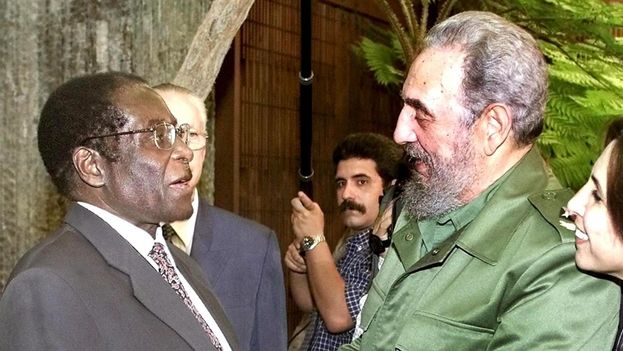
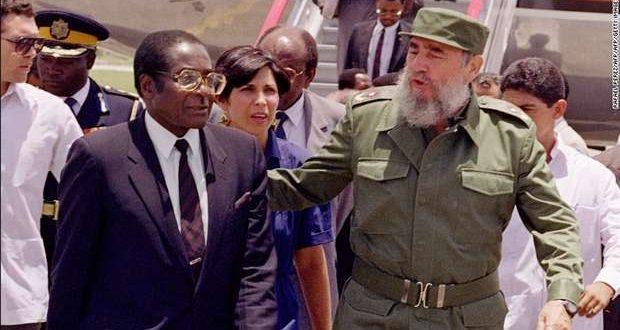
Fidel Castro receives Robert Mugabe in the Havana airport, June 8, 1992. Taken from CNN.

Iván García, 20 November 2017 — While Robert Gabriel Mugabe, the oldest dictator in the world at age 93, was giving a televised statement from Harare, surrounded by soldiers and elegantly-dressed officials, many miles away from Zimbabwe, Edna, a history professor at a pre-university, was washing clothes in Havana, in an anachronistic Aurika from the Soviet epoch.

When I ask Edna her opinion on the political crisis in Zimbabwe, she shakes her head and tries to find words that don’t sound trite. “If you ask my kids, I’m sure they don’t know who Robert Mugabe is and they wouldn’t be able to find Zimbabwe on the map. People here are disconnected, although I don’t include myself in this group, since I try to keep up with what’s happening in Cuba and the world,” says Edna, and she adds: continue reading

“I went on internationalist missions twice in Africa, once in Angola and another in South Africa. And I can tell you that those freedom fighters, like José Eduardo dos Santos in Angola, Teodoro Obiang in Equatorial Guinea, Mengistu Haile Mariam in Ethiopia and Robert Mugabe in Zimbabwe, ended up being dictators. The honorable exception was Nelson Mandela. Mugabe was in power for 37 years, olympically violating human rights and committing fraud in fake elections. Our press treats him like a king, because in addition to being an ally who always votes in favor of Cuba in international forums, our rulers are a reflection of him. Joaquín Sabina, my favorite singer, says in an interview that the Cuban revolution and the Venezuelan revolutions aren’t aging well. The same is true of the African independence movement, in which Fidel Castro played a big part; the same thing happened.”

To find someone on the streets of Havana who will seriously comment about a foreign event is hard. Most reject a question with a shake of their heads or muddle through with a mechanical response.

But an independent journalist like Juan González Febles always has a response: “It’s logical that the Regime doesn’t offer information. There’s a kind of club of dictators who indulge each other. With the Argentina dictatorship, Fidel Castro did business with the soldiers and offered them aid during the war in the Malvinas. Beginning with Honecker, passing through Ceausescu and ending with Mugabe, the Cuban Regime decorated the whole lot of them with the Order of José Martí. Right now a high-level delegation from North Korea is in Cuba. Almost no other country would permit an official from that rogue state to visit. The media silence comes from a debt of gratitude that the Cuban dictatorship has with the rest of the totalitarian governments in the world.

The State media have barely mentioned the grave political crisis in Zimbabwe that will mark the end of the Mugabe era.

In spite of the slow connection, browsing on the Internet I found that Prensa Latina published an article, reproduced Sunday, November 19 by Cubadebate, with the headline, “President Mugabe deposed as the political leader in Zimbabwe.” The same story was also released in the online editions of Bohemia and Tiempo 21 from Las Tunas. Previously, two “decaffeinated” commentaries were published: one on Thursday, November 16 in Granma (“Zimbabwe, the headline of the week”) and the other on Friday the 17th in Juventud Rebelde (“Discussion of the situation in Zimbabwe”).

However, Telesur, a channel funded with the petrodollars of Hugo Chávez, on Sunday the 19th transmitted the televised conference of Mugabe surrounded by soldiers and officials.

In Cuba, all news media, national or provincial, are directed by the ideological department of the Central Committee of the Communist Party. And they are always cautious and careful about condemning or criticizing communist governments, governments with leftist tendencies or any that are economic allies.

Nothing has been published on the Island about the corruption in China of the children of high officials and their spectacular lifestyles, and the press is silent about the relatives of Xi Jinping who are implicated in the Panama Papers.

The monarchist tyranny of North Korea is treated with the utmost respect. And you’ll never see the official analysts, experts on the U.S. or the European Union political systems, write an article condemning the testing of nuclear missiles by the Hermit Kingdom Kim family.

However, there’s a surplus of space and ink for counting killings in the U.S. or pointing out statistics on capitalist poverty. But about Zimbabwe, hardly anything is known. Cubans don’t know about the terrible economic situation, with 90 percent of its citizens unemployed, or that the average life span isn’t more than 40 years.

With Africa, the information blackout is redoubled. The role of the Castro autocracy in the struggles for emancipation on that continent is known. Fidel Castro maintained a special friendship with Robert Mugabe. In August 1986, Castro was in Zimbabwe to participate in the Eighth Summit of Nonaligned Countries, which was celebrated in Harare, the capital. For his part, Robert Mugabe made several visits to Cuba, on the following dates: September 1983; 1986 when he was decorated with the Order of José Martí; June of 1992; July of 2002; September of 2003, and September of 2005, according to photos found on Google. His last trip was in November 2016, in order to attend the funeral of his “brother, Fidel.”

Hence the scarce news on what is happening in Zimbabwe with the old friend of Castro the First. Nor do the Cuban media mention the enormous fortune accumulated by Isabel dos Santos in Angola, or the scandals of Teodorín Obiang, son of the intolerable dictator of Equatorial Guinea.

As for Latin America, we’ll never see a reproach against the regimes of Nicolás Maduro, Evo Morales or an analysis of the litigation against Lenin Moreno and Rafael Correa in Ecuador. The National press never qualified the FARC of Colombia as a terrorist organization. Nor did it publish one line on the detention for narcotrafficking of the nephews of Cilia Flores, Maduro’s wife.

The media in Cuba are an arm of the Regime. It uses them for the benefit of publicity. The ideology department of the Party isn’t stupid. They’re not going to shoot themselves in the foot with the monster that they themselves created.

For Cuban readers, Zimbabwe is a socialist democracy and Robert Mugabe is a hero of African independence. And his wife, Grace, repudiated in her country for her love of luxury and her delusions of grandeur, if we give credit to the commentary published in Juventud Rebelde, is an innocent woman who was a child when the war of liberation took place.

If someone wants to be informed objectively and know other points of view, then he must pay one convertible peso, two day’s minimum salary, to navigate on the Internet for one hour. That’s the only way.

Translated by Regina Anavy
A Debt to Bogota / Regina Coyula

Regina Coyula, 25 April 2017 — I had thought of writing about the first impressions that Bogota has left me, impressions deepened by the contrast of a people so warm that they do not seem to carry the burden of six decades of violence. I had thought of writing about a city dominated by churches and bricks, of green mango with lemon and pepper, of the beautiful cadence they give to the Spanish language, even from the loathsome loudspeakers of industrious street vendors. Of that and more I thought to write as yesterday I walked along Seventh Street, full of families on bicycles or Sunday strollers.

But that was yesterday and today, Monday, I can see the details of the standoff in Venezuela, with its macabre stasis. I see Lilián Tintori denouncing the the Public Defender’s office. I see Maria Corina, enormous, confronting an arrest warrant. I see Venezuela without the filter of its state-run network, TeleSur. continue reading

I also saw confirmation that Karla Maria Perez, a young, talented student at the Central University of Las Villas, had been expelled from the school of journalism by her classmates. The reason? She was a member of Somos+, a political movement considered “illegal,” like every group not allied with the government.

On one hand, the Venezuelan people want to rescue democracy. On the other, they deviously send ahead a group of young people, fearful themselves of losing their future if they aren’t convinced. These young people of the Student University Federation who have been deprived of innocence with a cruel lesson, incapable of articulating a question about the disappearance of the bust of Mella in that postcommunist space that now is the Manzana Kempinski (formerly the Manzana Gómez).

No, Bogotá. I can’t write the chronicle that you would have deserved.

Alquízar’s Truckers Challenge the Police, Showing Them the Wording of the Law

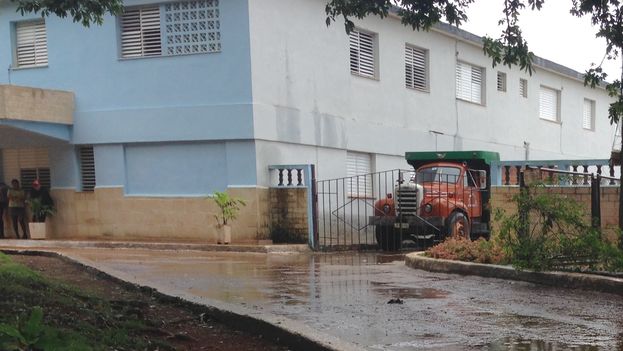
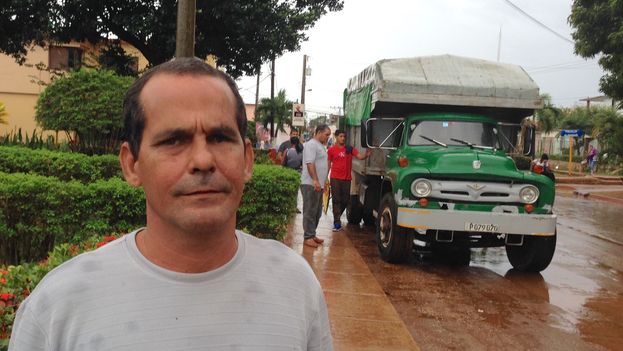
Eduardo Ramos Suárez, owner of a Mack truck manufactured in 1956, claims that the police chief of Artemisa told him that the law pertaining to truck drivers “doesn’t work.” (14ymedio)

14ymedio bigger14ymedio, Reinaldo Escobar, Havana, 20 November 2017 — Several impounded trucks and numerous drivers demanding respect for the law have been the results of the stiffening of police controls, in recent weeks, on the transport of agricultural products in the municipality of Alquízar, located in Artemisa province.

Around a dozen truck owners complained to 14ymedio this weekend that they had suffered harassment from the authorities, including confiscation of their merchandise and the impounding of their vehicles for several days, as punishment for transporting agricultural products to the markets that, unlike the state markets, operate on supply and demand. continue reading

For several weeks, and especially after the passage of Hurricane Irma and the subsequent problems of food shortages in several provinces, private carriers have seen an increase in police actions against them.

On the roads on the outskirts of the Artemisa towns and on the roads that lead to the city of Havana, the police presence has multiplied. “Every time they see a truck with a private license plate, they stop it to find out if it is carrying agricultural products,” says an Artemiseño driver who preferred anonymity for fear of reprisals.

When a vehicle transporting that type of merchandise is impounded, the products are diverted to the state distribution networks and the driver is fined. “They do not allow us to make a living and we have lost thousands of pesos between confiscations and the impounding of our trucks,” the source says.

In response to the police controls they label as “excessive,” private truckers in the area now travel with a copy of the Official Gazette in the glove compartment of their vehicles, so they can show it to the police in support of demands that they be allowed to transport food, vegetables, fruits and grains.

The document these drivers turn to is Decree Law No. 318, which came into force in 2013 and regulates the transport of agricultural products. This law establishes the right of owners of private trucks to enter into contracts to carry agricultural products.

In 2013 the official media said that the measure sought to “unleash the obstacles of the productive forces” and that it would allow producers and marketers to take advantage of the laws of supply and demand, once they had fulfilled their social commitments to the state.

The legislation, which was then presented by the authorities as “the definitive solution” for the problems of distribution, is not being respected in Alquizar, according to the testimony of several truckers consulted by this newspaper.

Eduardo Ramos Suárez, owner of a Mack truck manufactured in 1956, states that the police chief of Artemisa insists that “this law does not work” and the mere act of evoking it is considered by the official as demonstrating “a lack of respect.” The driver, however, claims that they have not been informed of a new regulation that repeals the provisions of Decree 318.

On the night of Tuesday, November 14, Ramos left in his truck from Alquízar heading to Pinar del Río with a shipment of yucca, taro, banana, fruit, cabbage and sweet potatoes. He was accompanied on the job by a small farmer with a self-employed worker’s license as a “selling wholesale buyer.”

A National Revolutionary Police (PNR) patrol intercepted the vehicle in the neighborhood of El Portugal, both were arrested and slept that night in the cells of Artemisa station. The merchandise was sent to the state-owned Acopio company for distribution in state markets.

Acopio has acted for decades as an intermediary between private farmers and the state. The entity buys a good part of the merchandise at prices that the producers denounce as being very low, and it is in charge of selling it in the markets managed by the state.

In addition, since the end of 2016 price caps have been applied to agricultural products, a practice that has spread throughout Artemisa and finally also been extended to Havana, Villa Clara, Cienfuegos and other provinces.

“I was treated like a criminal and to be able to leave they forced me to agree to sign in without fail every Tuesday, as if I were a dangerous criminal,” complained Ramos, who makes a monthly payment to the National Tax Office (ONAT) of 585 pesos as a tax on his activity as an independent worker.

The stop went badly for Ramos in another way as well. When the police stop a vehicle, they can hold it for two or three months during the investigation. In his case, the truck he drives is being “stored,” as of that moment, at the Alquízar Police Station.

When the police stop a vehicle, they can hold it for two or three months during the investigation. The truck that Eduardo Ramos drives is being “stored” at the Alquizar Police Station (14ymedio)

During the time the vehicles are being held, the drivers must continue to pay the fees on their carrier licenses to ONAT. “The PNR refuses to give us a paper that attests that the truck is in the station, which would mean we would not have to pay the license fee during that time,” explains Ramos.

Faced with this situation, the driver has more questions than answers. “Why, if I pay for a license to be within the law, do they prevent me from doing my job?” he protests. “It seems to me that the state is cheating me out of my money. What can I do in my country to work decently?”

Onelio González, another private transporter who has owned a 1948 Ford truck since 1978, has also denounced the situation to the inspectors of the Ministry of Transport, popularly known as “los verdes” (the greens). The officials say that the police should not keep the trucks and so avoid the owners suffering losses.

Despite the injustice they claim to be experiencing, most carriers prefer to remain anonymous to avoid further punishment. In contrast, Eduardo Ramos shows his face and does not hesitate to show this newspaper his truck, locked behind the bars of the station.

The courage of this driver may come from what he has experienced in recent years. In 2006 he left Cuba illegally from a point near the port of Mariel and after living a year and three months in the United States decided to return, also by sea.

On the other side of the Straits of Florida, he drove another Mack truck but this time in the ‘90s. “I used to go where I wanted, I paid my taxes and nobody ever messed with me,” he recalls now.

This “round-trip rafter,” who spent 35 days in the dungeons of Villa Marista – where political prisoners are kept – and almost a year in prison for returning to his own country, does not understand why it is so difficult to start a business and make his way honestly. “I’m Cuban and I want to stay here with my truck, why don’t they let me work?”

________________________

The 14ymedio team is committed to serious journalism that reflects the reality of deep Cuba. Thank you for joining us on this long road. We invite you to continue supporting us, but this time by becoming a member of 14ymedio. Together we can continue to transform journalism in Cuba.

Cubans in Trinidad And Tobago, Caught Between Illegality and Hope

Kenya Montes de Oca traveled from the Cuban community of Placetas, in Villa Clara, to Trinidad and Tobago where she has lived since September 2016. (Courtesy)

14ymedio bigger14ymedio, Yoani Sanchez, Havana, 19 November 2017 – She came to Trinidad and Tobago more than a year ago with “one pair of pants and two blouses.” Kenya Montes de Oca traveled from Placetas, in Villa Clara, with the idea of ​​becoming a mule and living off the import business, but life pushed her towards seeking political refugee status.

The villaclareña explains to 14ymedio that she still trembles when she sees a policeman in the streets of Port of Spain. During her first month in that small nation she lived illegally until she managed to get the so-called “supervisory order,” a step prior to the request for refugee status. continue reading

Trinidad and Tobago does not require a visa for Cubans, but at the airport immigration officials can deport anyone they suspect of wanting to stay illegally.  Montes de Oca passed that first test without great difficulties in September 2016.

The initial idea was to buy merchandise to resell in Cuba. However, a casual conversation at the Havana airport with a dissident and State Security’s subsequent visit to her family in Placetas led her to her current situation.

“I was forced to leave absolutely everything, my house, my family, my habits,” she emphasizes, although she feels that the questions she had been accumulating about the Cuban system would have led her, sooner or later, to get into trouble on the Island.

A union leader for a decade, Montes de Oca worked at the People’s Power polling stations and served as a lay judge. “I was responsible for the security of a poultry farm until I discovered a network of embezzlement.” Reporting these irregularities brought her countless pressures.

“It was never my goal to leave everything behind,” but “circumstances decided for me,” says this woman, speaking to the press for the first time.

There are no official figures on the number of migrants from the island who remain irregularly in the neighboring country, but Montes de Oca says that “they range from deserters from the FAR (Revolutionary Armed Forces) and MININT (Ministry of the Interior), to political cadres, medical personnel, marginalized Jehovah’s Witnesses and opponents: we are a mosaic.”

Some have been luckier than others. The worst case she ever encountered is that of a young woman from Ciego de Ávila who was working to send aid to her family in Cuba. “She suffered a horrible rape by the owner of the rental where she lived, but could not report the fact because she had no papers.”

The arrival of Cubans has been on the rise since the Government of Raúl Castro implemented its Travel and Immigration Reform in January 2013 that made it easier to travel abroad from Cuba. Last August the situation escalated to a point that the two governments began to negotiate a Memorandum of Understanding on Immigration Matters to regulate the flow of migrants.

Samuel, 32, has been living for 11 months in the Trinidadian community of San Fernando. Originally from the slum area of ​​Guanabacoa in Havana, the young man graduated a decade ago in mechanical engineering but now works as a bricklayer.

“I do not have papers but I have developed a clientele and I have friends who are helping me,” he tells this newspaper. With the nearly $600 he earns monthly, he has rented a room with a friend and sends money to his family in Cuba.

“I’m illegal, I do the worst jobs you can have here and yet I earn 50 times more than the salary I received in my country as a professional,” he argues. With the money that he sends every two weeks to his parents they have been able to “fix the roof of the house and repair the kitchen.”

His initial idea was to “earn a small capital stake” in Trinidad and Tobago to continue on to the United States, but last January he was surprised by the end of the wet foot/dry foot policy. “I thought I was going to die, but now I think this country can be a good place to stay,” he says.

Samuel is still far from being able to claim political refugee status. “I have not done the paperwork but I plan to start it in the coming months.” His greatest fear is ending up, like a friend of his from childhood, locked up for months in the Aripo detention center for foreigners.

Both Kenya Montes de Oca and Samuel have received help from the Living Water Community Center. “I did not go hungry thanks to that NGO and my first clothes I also received from them,” confirms the villaclareña.

Last June, the United Nations (UN) granted refugee status to a group of Cubans who protested for a week in front of the offices of that international organization in Trinidad and Tobago.

The majority of those who demonstrated had been waiting months for an answer to their request for political refugee status. The favorable ruling assured them of the protection of the United Nations High Commissioner for Refugees (UNHCR) and opened a door of hope for other Cubans in a similar situation.

On November 24, Montes de Oca has her appointment with the UNHCR from which she could leave as a political refugee. If she succeeds, a new stage will begin for her and she plans to remain in the Caribbean country for the time being.

She dreams of reuniting the family but her only son has been called to compulsory military service so the final reunion will be delayed. The young man wants to study to be a journalist, but she is sure that “because he has a refugee mother he will not be able to access that career” in Cuba.

From her new homeland, the villaclareña admires “the cultural mix” and the fact that people of “different religions or political positions live in harmony.” She does not hesitate to say that she will only return to Cuba “when people are not discriminated against or mistreated because of their way of thinking”.

________________________

The 14ymedio team is committed to serious journalism that reflects the reality of deep Cuba. Thank you for joining us on this long road. We invite you to continue supporting us, but this time by becoming a member of 14ymedio. Together we can continue to transform journalism in Cuba.

Cuba: Without Medicines and Without “Kindness”

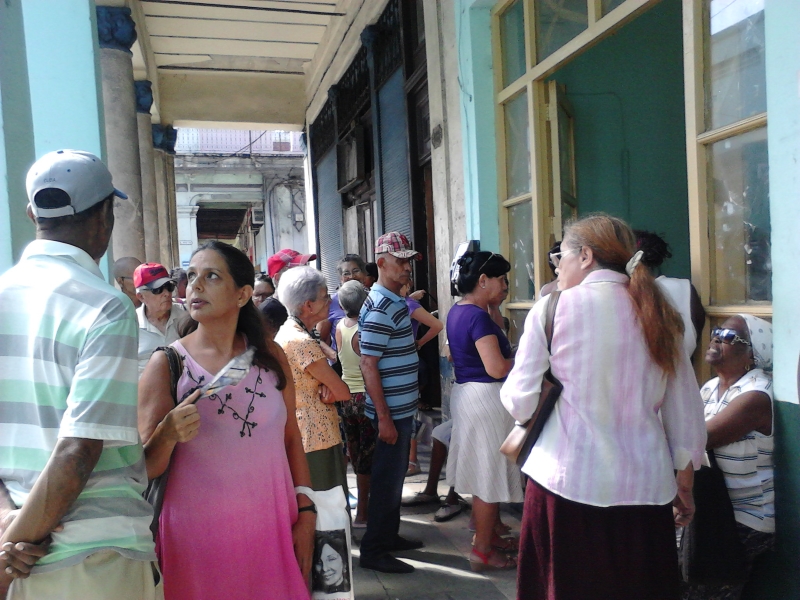
Lines outside a pharmacy in Havana, October 2017 (archive photo)

The severe shortness of medications in Cuba, far from getting fixed, threatens to become an “irreversible” malignancy.

cubanet square logoCubanet, Miriam Celaya, Havana, 15 November 2017 — The pharmacy, in the middle of Avenida de Carlos III in the Cuban capital, was crowded with people. The line extended outside the premises and formed a human conglomerate in the front, obstructing the entrance to the adjoining apartment building. “I have not been able to sleep for a week for lack of my medicine!” screams a frustrated patient when she finds out that, after waiting for her turn for more than an hour, they have run out of the medication alprazolam (Xanax), prescribed by her psychiatrist to treat her anxiety and her sleep disorder.

“I have been going from pharmacy to pharmacy in the 15 municipalities for days and nothing! Nobody cares, nobody knows when there will be medicine, nobody solves the problem! Here, for the person who does not have lots of money, or a relative abroad who sends him the medicine, all is left for him to do is to die. And then turn on the news and hear how good the Cuban health system is. It’s a mockery and a lack of respect!” continue reading

The impassive clerks behind the counter continue to dispatch the few products there are, and the woman emerges from the pharmacy like a furious whirlwind. As she moves away, she continues to unload her impotence loudly on the sidewalk, carrying on against “this damn shitty country” and waving the useless prescription in the air. The people in line are mumbling their own particular misfortunes. A hypertensive man complains that two months ago he could not buy enalapril or chlorthalidone, a cardiologist attests they are missing antiarrhythmics such as atenolol and nitrosorbide. Everyone comments on the shortage of duralgin, aspirin and meprobamate.

This is an everyday scene. The severe shortage of medicines which has continued to intensify in Cuba in recent months, far from being solved, has become a trend that threatens to become as much of an “irreversible” disease as the sociopolitical system that generates it. Even the official press has acknowledged the lack of medicines, which includes at least 160 drugs, but it has not pointed to a solution to the problem or a probable date for the normalization of supplies to pharmacies.

This shortage, however, is neither an isolated nor a recent phenomenon. Since the anguishing 1990’s, after the collapse of Soviet communism, there was not only a dramatic fall in the national production of drugs, but the importation of medicines that were not generated within the Island also decreased significantly. In fact, most of the medicines that were sold freely through the pharmacy network, without the need for an optional prescription, became “controlled,” which meant that they started to be sold only against a properly generated doctor’s prescription.

Since then and until today, the list of rationed drugs also includes some of the most basic analgesics, healing supplies, ointments, thermometers and other items, all of which have significantly declined as a part of the family medical kit of the common Cuban.

It was precisely in the midst of the crisis of the 1990’s when the “super ration card” was implemented; a personal file containing names, identity number, and private addresses designed to guarantee in the corresponding pharmacies the necessary medications for patients with chronic diseases – those with diabetes, hypertension, heart disease, neuroses, etc. – upon presentation of the medical certificate that accredited their disease.

It is fair to acknowledge that the measure achieved its purpose, at least while the pharmacies’ regular supply of medicine remained stable. However, the current drug crisis affects even this growing sector of chronic patients, for many of whom it is vital to have access to the drugs indicated for the treatment of their diseases.

The issue becomes all the more serious because the Cuban population presents an unstoppable tendency to aging, and a significant increase continues in high-risk diseases for life, such as hypertension, cardiovascular diseases, diabetes and hypercholesterolemia.

Meanwhile, and as invariably happens in every hardship situation, a robust and intricate network of illegal markets in medicines has developed over the years, in whose broad current flow both certain administrators and pharmacy clerks – given their direct access to product – as small occasional merchants, like those who thrive in neighborhoods by trafficking in anything reasonably marketable, even some unscrupulous doctors and “cadres,” bureaucrats of the national health system, who have access to blank prescription pads at their discretion. Because, as it is generally known, corruption and poverty are directly proportional: they grow at par.

Of course, the law of supply and demand works perfectly on the black market, so that, as the shortages have increased, the price of medicines has skyrocketed. Some products double, if not triple, their previous price in the illegal market itself. For example, a blister of 10 tablets of the highly demanded duralgin (dipyrone), an analgesic with a price tag of 40 cents in national currency in the pharmacy network and 5 (CUP) until recently on the black market, now is often quoted as 10 (CUP).

The same happens with psychotropic drugs, also in high demand in a country where stress and depression are part of everyday life. Chlorodiazepoxide, diazepam, and alprazolam, among others, have become so expensive as to be out of the reach of those of those who need them most: the poorest.

So far, the authorities have avoided going deeply into the subject, which they have barely mentioned tangentially. A few days ago, the announcement in the official media about dedicating a transmission of the TV program “Roundtable” to analyze this delicate issue created expectations in the population. However, for unexplained reasons, this program has been postponed.

For the time being, the crisis continues, and according to the testimonies of some doctors, who have opted to remain anonymous, in hospitals like the very renowned Hermanos Ameijeiras, located in the Centro Habana municipality, talks and lectures will soon be given to doctors about the benefits and advantages of homeopathic medicine, which indicates that the shortages of truly effective medicines are here to stay.

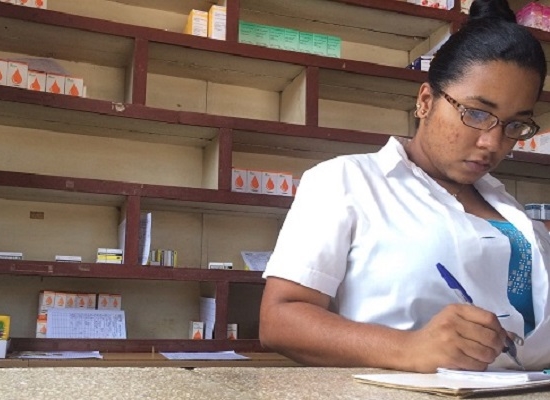
Several shelves remain empty in this pharmacy. The situation is repeated throughout the capital (archive photo)

But the crisis is as irritating as the “solution” that is provided in the Letters to the Editor column of the publication Juventud Rebelde. Under the title of “Medications, Anguish and Strategies,” the reporter Jesús Arencibia Lorenzo reproduces a letter in which a reader complains that he never gets to buy his hypertension medications – that is, drugs controlled by “the super ration card” and supposedly guaranteed by the network of pharmacies – because, while he’s working at his job, there are people who do not work and lineup and “hoard” the medications, so that “the same people” get the medicines every month.

The reader in question comments that “each minute, hour, day and month that goes by” without the medications he suffers “deterioration of the organism and propensity to suffer cerebrovascular or myocardial accident,” all of which is strictly true and reasonable, but not so his proposal for a solution. The aforementioned reader assumes that, given the insufficient distribution of the medicine, the right thing to do is “at least to divide it in half: one month for you, one for me.”

That is, his proposal does not consist in demanding that a way be found to solve the shortage of medicines, but to be able to access the drugs at least in alternate months: the month in which “it’s his turn to get the medicine” he would be safe from a heart attack, next month (when “it’s someone else’s turn”) he would be at risk of dying. That is, this subject does not even hope to have medicine every month, like “the hoarders,” but for him, the maximum expression of justice would be for them to get as screwed as him.

An assumption supported by the journalist Jesus Arencibia, when he harangues: “In the midst of deficiencies whose solution is often not immediately at hand, what should not be lost, at least in a social process like ours, is the meaning of justice and kindness, so that bonuses and penalties get distributed with the greatest fairness, in each case.”

And in closing, he adds: “Perhaps when we advance to the maximum transparency scenario,” in which the access to drugs at the pharmacies and the registries of patient records become accessible and public documents for the citizenship – as he calls it, the “popular control scenario” – “maybe we can prevent a few from benefiting while others continue to wait in the danger zone.”

All of which suggests that, at the end of the day, medications that keep us painfully alive in this absurd Island could continue to go missing, but what cannot be missing is “the kindness” that allows us to multiply the miseries. And there are still those who wonder how it is that the Castro regime has managed to survive for more than 60 years!

Cubans Are Traveling Abroad More and On The Island Less

The growth of domestic tourism was unstoppable until last year. (14ymedio)

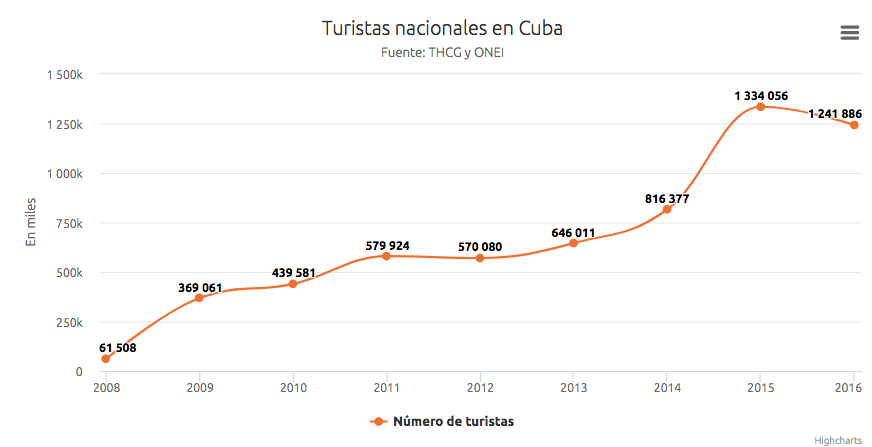
14ymedio bigger14ymedio, Mario Penton, Miami, 17 November 2017 – Cuba’s northern keys are a tropical paradise that were forbidden to Cubans for decades. In 2008, in the midst of a severe liquidity crisis, the reforms of Raul Castro’s regime allowed, for the first time since the opening to international tourism in the ’90s, Cubans to stay in domestic hotels on equal terms with foreigners. Since then, the growth of national tourism has been unstoppable. Until last year.

“National tourism decreased by more than 90,000 vacationers in 2016, according to data from the National Statistics Office this autumn,” explains Emilio Morales, group director of The Havana Consulting Group (THCG), based in Miami. continue reading

The factors Morales blames for the fall are basically the rise in hotel prices that occurred the previous year as a result of the increase in international tourism and the increase in the number of trips abroad by Cubans.

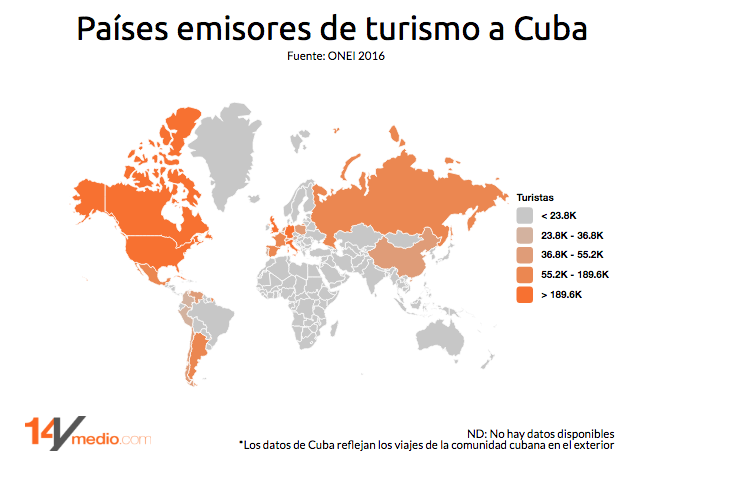
“Cuba recently experienced a boom in American tourism, a market with much more purchasing power than the rest of the markets that send tourists to Cuba. According to official figures, 281,706 Americans traveled to the island in 2016,” Morales explains.

Sources of tourists to Cuba: ranges by country.

The response of the Cuban tourist market, 40% of which is controlled by the Business Administration Group which is controlled by Cuba’s armed forces, was to raise the price of rooms.

“My husband and I went to Varadero, Viñales or Trinidad at least once a month but since last August we have not been able to because all the prices have skyrocketed,” says Maria Eugenia, 61, who lives in Havana. “What we used to pay for the whole trip now is not enough for one night, not to mention transportation,” she laments.

“The hotels where prices have increased the most are those in the keys, those in Varadero and anything else along the coastline of beaches,” says María Eugenia. “Also, it’s not worth going as a Cuban because there is a lot of mistreatment towards the national client.”

One of the main attractions of the all-inclusive vacation is the formerly all-you-can-eat buffets, but now there are restrictions imposed, according to the retiree. “There is not as much variety of products and nor are they so free, because now they control the amount of main dishes (meat or fish) that each guest can eat and they give you a ticket for a certain number of drinks.”

THCG carried out a study on the lodging network in the Cuban tourist sector in 230 hotels and verified the price escalation since the US thaw. “The study showed a rise in prices in all categories, with the highest growth in five-star hotels, which went from an average of $186 a night in 2014 to $362 in 2016,” the report detailed. As these establishments are filled, foreign tourists who occupied them begin to demand rooms in lower category hotels, which also increases the prices of those tourist facilities.

The most surprising figures are seen in the four-star hotels, which went from an average of $111 per night in 2014 to $247. “The Saratoga hotel, one of the favorites of celebrities and politicians, came to be priced in 2016 at between $700 and $1,000 dollars a night, compared to $375 as a minimum a year before,” adds Morales.

This escalation of prices also affected domestic tourism, a sector that had grown exponentially after the thaw initiated by former President Barack Obama, which unlocked the sending of remittances to the island and helped develop the country’s incipient private sector.

“In a study conducted by THCG in 2014, it was found that 37% of Cuban-Americans who traveled to Cuba stayed at least one weekend with their relatives living on the island at a hotel, mainly in the tourist centers of Varadero, the Keys to the north of Villa Clara and in Guardalavaca, Holguín. This trend has increased in recent years, and it is currently estimated that around 45% of Cuban-Americans traveling to the island stay in a hotel with their relatives in Cuba for two or three days,” explains Morales.

An employee of one of the most prestigious agencies based in the United States that arranges travel to Cuba told 14ymedio, on the condition of anonymity, that the situation of national and international tourism “is critical.”

Number of Cubans traveling as tourists within Cuba.

“I was in Cuba this November for the International Fair of Havana and the Cubans are asking for the return of tourism. But, the Meliá Cohiba was at less than 30% of its capacity, when last year it was full,” she says.

“With the increase in the prices of hotels in Cuba an excellent market opportunity is lost because once the tourists go to another place they do not return,” she says.

From 14 January 2013 to 24 October 2016, more than 779,000 Cubans residing on the Island traveled abroad, 79% of them for the first time. The official figures are misleading, however, because they count as still resident in the country any Cubans who have been abroad for less than two years. Even so, an increase in the number of Cubans traveling abroad is clear to see.

“So far this year, a 28% growth has been achieved relative to the same time period for the previous year,” Ernesto Soberón, director of Affairs of Cuban Residents Abroad, recently told Cuban television.

Morales believes that there are a variety of reasons for these trips abroad. “It is estimated that in the 2013-2016 period around 130,000 Cubans traveled for emigration reasons, while the remaining 541,000 did so for work, tourism and business reasons,” he explains. The researcher gives as an example the more than 100,000 Cubans who traveled to Mexico in 2016, “becoming the fastest-growing tourist segment in Latin America that visits Mexico by air, with a growth of 58% over the previous year.”

“The most popular destinations for Cubans are the United States, Mexico and the Dominican Republic,” explains Morales, who believes that the situation requires a serious analysis by those who develop strategies for the tourism sector on the island.

“It is evident that not having a balanced offer both with regards to price and recreational options means that the growing national tourism will satisfy its leisure needs in other markets. Without a doubt, Cuban tourists are discovering better options outside of Cuba’s borders,” he adds.

___________________

The 14ymedio team is committed to serious journalism that reflects the reality of deep Cuba. Thank you for joining us on this long road. We invite you to continue supporting us, but this time by becoming a member of 14ymedio. Together we can continue to transform journalism in Cuba.

Cuba Belongs to All Cubans / Iván García

Taken from Cartas desde Cuba

Ivan Garcia, 7 November 2017 — A fat man with a tenor voice and a bag hanging across his chest, as he passes through the inner streets of the Lawton neighborhood, announcing that he buys empty perfume jars and plastic soft drink bottles.

Two santiagueros fleeing poverty and lack of opportunities in their province, announce that they repair mattresses. And a lady shouts from her balcony to a neighbor that ground meat just arrived at the butcher’s shop.

Before noon, Lawton, in the south of Havana, is a combination of soot, broken streets, people selling anything, while reggaeton blasts in the background. Small gatherings assemble on the corners or anywhere. continue reading

In the doorway of a warehouse five people talk about the performance of Yuli Gurriel and Yasiel Puig in the World Series. Then, they discuss the new travel and immigration measures announced in Washington by Cuba’s grizzly Foreign Minister Bruno Rodríguez Parrilla that will begin to be implemented on 1 January 2018.

It is rare that in Cuba a family does not have relatives on the other side of the pond. Mildred, a mother of three children with brothers living in Miami, thinks about the new migratory reforms: “Personally, these changes do not benefit me, because my brothers were doctors and when they were on a mission in Venezuela, they abandoned their posts. They have to comply with a punishment of eight years during which they cannot enter Cuba. The government should understand that Cuba belongs to all Cubans and not only to those that suit them.”

Julio is the father of a young baseball talent who jumped the fence in pursuit of his dream of playing in the big leagues and who now earns a seven figure salary and helps his family out of perpetual poverty. Julio thinks along the same lines.

“With the players who leave the team during international events, it’s the same. They can not enter Cuba until the government pleases. Now they make concessions to counteract the harsh economic situation of the country. Trump is a half crazy guy and nothing can be expected from him. Venezuela can no longer send the same amount of oil and the state urgently needs the dollars from those it once called worms,” says Julio.

When you talk to ordinary citizens, the general opinion is that the government has to completely tear down the wall that has been dividing Cubans for so long.

“Cuba needs them more, than it does us. The current system is drifting. We must renew the public infrastructure and rebuild many things. We need capital, people prepared in the latest in science, technology, productive management, business and banking. The most talented in different spheres of knowledge, sports, art and culture flew from the green caiman. What’s left is small change, the bottom of the closet. We are an aging nation,” says Onelio, an economist.

But Castro’s autocracy continues with its Cold War command strategy and the mentality of the Cold War. It is their natural state. Selling themselves as a victim harassed by the United States government.

And contradictorily, the solution is to negotiate with the supposed enemy. The regime has been engaged in a battle, sometimes real, almost always exaggerated, with the different administrations in the White House, from 1959 to the present.

In his eagerness to make a mark for himself in the international scene, at the stroke of exporting guerrilla wars, armies of white coats and legions of soldiers to the African continent, Fidel Castro hijacked the aspirations of the Cuban people.

The diaspora and the people who survive in Cuba were, and are, hostages of typical policies of imperial nations and centers of world power, not of a small and backward country.

Twenty-six years have passed since the fall of communism in the USSR and even the Caribbean dictatorship does not decide to take the only foreseeable and reasonable step: to compromise with Cubans inside and outside the country.

It is the only way out in view of the national conflict. All that’s needed is a public apology and sitting down to negotiate. But the dialogue must be with everyone, not only with those who accept their ideology.

We must leave behind the old grudges. The future of Cuba involves engaging the entire diaspora (and not only those living in the United States) and Cubans on the island in the reconstruction of a modern, tolerant and functional society.

Of course, the regime will have to make concessions. Freedom of expression, democracy and free elections. The black list of compatriots, who by phallic or despotic decree, cannot travel to their homeland, should be annulled.

Carlos Alberto Montaner has every right in the world to present his books in Havana or to hold a conference in Guanabacoa. As long as they pay fair wages, not the poverty wages they give to Haitian sugarcane growers in La Romana, Dominican Republic, the Fanjul brothers could build sugar mills in the land where they were born.

Diario de Las Américas and El Nuevo Herald should have the option of placing correspondents in Havana: a good part of their readers are Cubans settled in Florida.

It is enough to milk the emigrants making them pay for their Cuban passports and to renew them at a golden price. No Cuban should have to ask permission to enter his home.

I did not understand the cheers and applause of a sector of exile when Foreign Minister Bruno Rodríguez launched the new travel and immigration proposal. The government is not doing anyone any favors. It is an internationally accepted right that citizens of a country can travel and return to the place where they were born, whenever they wish.

There is no better example of nationalism and sovereignty than to involve each and every  Cuban in the future of their country. We can still do this.

The Private Sector, the Most Powerful in Cuba / Iván García

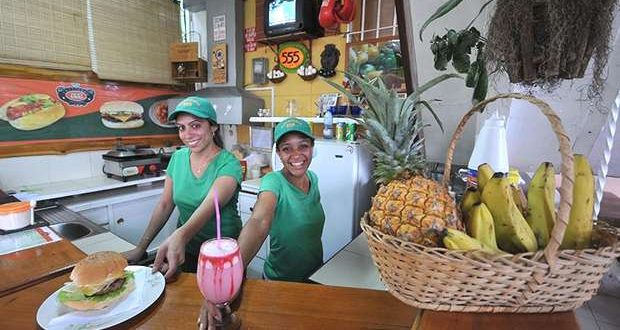
Private snack bar. Taken from On Cuba Magazine.

Ivan Garcia, 17 November 2017 — While several business owners from the island connected to the internet in the lobby of the EB Miami hotel a stone’s throw from the international airport, and others drank beer at nine dollars at the bar, a Cuban dissident lawyer who spent more than a decade in Puerto Rico and a former political prisoner of Fidel Castro’s regime were trying to understand the new social dynamic that exists in Cuba.

The diverse group of participants in the Cuba Internet Freedom event, organized by the Office of Cuba Broadcasting (OCB) that took place over three days at the Miami Ad School in the picturesque Wynwood neighborhood, included software and app developers, independent economic analysts, owners of small food service businesses and the gay director of a digital magazine for Cuban gamers. continue reading

Of course there were also political activists such as Eliecer Ávila, Rosa Maria Payá, Rolando Rodríguez Lobaina and Ailer González, along with audiovisual producers and independent journalists who are openly anti-Castro. But it was the group of Cuban entrepreneurs, young people very well prepared, unprejudiced and with an approach focused more on economics than politics, who generated mixed feelings not only among a segment of the historical exile that suffered severe repression first hand — shootings of relatives or friends and many years in prison — but also among some of today’s opponents from the island, convinced that the formula to overthrow the regime of the Castro brothers is street marches or writing the word “Plebiscite” on the ballots for the election of delegates to the People’s Power Assemblies.

Passionate debates, sometimes risqué, or with the usual accusations of calling any person who criticizes the opposition or thinks differently an agent of State Security, rather than promoting dialogue, raised the wall of intransigence. Yaima Pardo, a talented independent documentary maker left a bad taste in the mouths of the exile sector that labeled him as ‘apolitical’ although it did not accuse him to his face of being part of the olive-green autocracy.

“The mere fact of coming and participating in forums considered counterrevolutionary by the government is an important step. We do not have to think like the dissidence. I recognize the pain of a segment of exile, but those were other times. My goal is to live in a society where freedom of expression is not a crime. We all want the same thing, a better homeland, but they are always attacking those of us with different opinions,” said the documentary maker.

Yodalys Sánchez, co-owner with her uncle of the paladar (private restaurant) Doña Carmela, next to the San Carlos fortress of La Cabaña, prefers to talk about how complex it is to succeed in business matters in Cuba.

“I have thirty workers and our sales are going very well. We have grown based on creativity despite the harassment of state institutions. In Cuba everything is difficult: from getting the food and condiments, to preparing the daily menu, to having to pay unsustainable taxes. Of course I am interested in a better future for my country, but what I do not like is that there are Cubans both from Miami and from the island, who believe that to demonstrate something, we have to make public statements against the government. That’s not my job,” Yodalys said.

Probably the frustration of the historical exile, compatriots who arrived in Miami with a suitcase and an empty wallet who thought, after having their properties or businesses confiscated, that their time in exile would be brief, find their discernment clouded. Emotion can overcome good sense. But they did not emigrate because of economic problems. They were practically ordered to leave their homeland, in many cases after having been political prisoners and having their lives in danger.

But Cuba today differs a lot from that of the first years of the Castro revolution. Yes, it is true, it is still governed by a regime that curtails the essential rights of any modern democracy. But the fall of Soviet communism, combined with international pressure from Western countries, an increase in internal dissidence and the existence of an incipient free press, has forced them to yield in the economic arena.

It is still too little. There are too many controls and restrictions on small private businesses making a lot of money, something aberrant: like asking the fourth batter to just tap the ball.

Even in the political terrain there is a retreat. They beat the Ladies in White and barricade opponents of the UNPACU in the eastern region or illegally prohibit dissidents from running as candidates for district delegates, but the firing squads have been replaced by brief arrests and ordinary people are losing their fear and, even in the open street, freely criticize the state of affairs in Cuba.

In this complex panorama, more than two hundred Cuban journalists without gags write for media and websites based in Florida, Madrid or Havana. And on the island there are so many dissident groups and independent initiatives of all kinds that no one can keep track of them all. Twenty years ago, none of that was possible without going to prison.

In a dictatorship, its weakness or retreat is measured by those small victories achieved in the midst of intense repression. And yes, today Castroism is more fragile than two decades ago. It has less social control and thanks to the internet it can no longer control information at its own whim. Everywhere, Caribbean totalitarianism is taking on water.

In my opinion, it is not the dissidence that is going to lead the regime to come to an agreement with its people and open the gates. It will be private entrepreneurs and their demands which will lead to the desired change.

It is hard to believe that within the ranks of the opposition and exile, who always brandished the weapon of private enterprise, they now judge with reservations the most thriving sector. Along with the invasive marabú weed, it is one of the few things that thrives on the Island.

Threat of Giant African Snail Reappears in Cuba’s Official Press

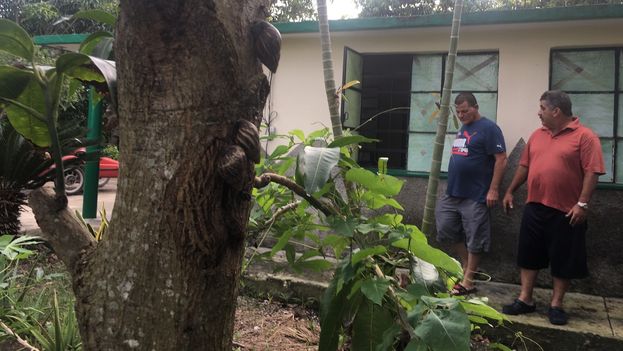
On the Santa Ana farm, in the municipality of Arroyo Naranjo, residents are desperate to find a solution to the plague of African snails. (14ymedio)

14ymedio bigger14ymedio, Reinaldo Escobar, Havana, 14 November 2017 — “Have you come about the Giant African snails?” the residents of the Santa Amalia neighborhood ask any stranger who walks through their streets and seems to be looking for something.

People have become increasingly alarmed after the publication, this Sunday, of a reader’s letter sent to the Juventud Rebelde (Rebel Youth) newspaper, warning about the proliferation of the mollusk on the Santa Ana farm in the Arroyo Naranjo municipality. It is the same area where, three years ago, this newspaper uncovered, for the first time, the presence of this dangerous animal in Cuba. Shortly afterwards the official media reported that a citizen of Nigeria had introduced several of these animals to the island, presumably for religious reasons. continue reading

Over the months, the plague has been spreading across the area south of the Cuban capital, and has now reached as far as San Antonio de los Baños, Artemisa, according to several contributors to this newspaper.

This Monday, José Antonio Cruz, the author of the Letter to the Editor published in Juventud Rebelde and owner of the Santa Ana farm, spoke with 14ymedio about the alarming situation on his land, located near Grant Street, due to the invasion of the huge snails.

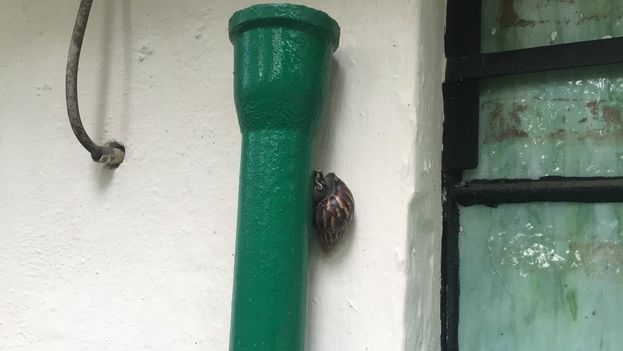
Dozens of these animals, with their narrow  conical reddish brown shells with vertical yellow stripes, can be seen on the trees in the courtyard, climbing up the pipes, and moving across the dry leaves of the patio.

The Achatina fulica, the scientific name of the species, is mainly herbivorous, but can also feed on the remains of dead animals, excrement and even some construction materials such as plaster. It can grow to be 8 inches long and it is one of the most harmful invasive exotic species in the world.

Cruz, an engineer with the Public Health services and a member of the Communist Party, tells this newspaper about his odyssey. His “despair, indignation and impotence as a citizen” led him to write the letter and send it “to every place where they may have in their hands the technical and material resources to stop this epidemic.”

Cruz has been living on the farm that belonged to his parents for more than 27 years. “In this place we grow flowers, fruits, root crops and vegetables, and we have to suffer seeing how the snails eat everything, avocados, guavas, mangoes and even the leaves of the malangas,” he tells this newspaper.

José Antonio Cruz’s house is in the same area where, three years ago, ’14ymedio’ uncovered the presence of the dangerous animal for the first time in Cuba. (14ymedio)

However, what worries him most is the imminent danger of an irreversible spread of the plague throughout the country.

“You have to find a solution to this problem, someone has to answer for this,” he protests. The snail, it is known, “has not yet caused any deaths, but it could happen at any time,” he warns.

This species harbors roundworms that transmit diseases such as meningoencephalitis. Children are especially in jeopardy because of their greater tendency to approach the striking animal and to ignore the risks of touching it.

In addition to transmitting parasites and bacteria, the enormous snail causes irreparable damage to the ecosystems it colonizes. It also has a great ability to adapt to varied climates and terrains. In Cuba it does not have natural predators that can curb its devouring cravings.

In the absence of official information speculation springs up, and fear spreads through ignorance. “They say it’s already in the metropolitan park of Havana, in Sancti Spíritus and in San Antonio de los Baños,” says the owner of the farm.

With the exception of Cruz’s letter, the official press has not published any update on the situation of the snail in recent months. As a rule, national newspapers only confirm the presence of a plague or an epidemic after independent media have disseminated the information.

While state guidelines and aid arrive, the inhabitants of Santa Ana farm have not remained idle. All around the house there is an true cemetery of African snails that members of the family have been killing with their own resources.

Rainold Facundo Plascencia, a resident of the area, complains that it is common for farmers to have a wounds on their hands, so they run the risk of getting poisoned if they run their fingers over a place where the snail has left its slime.

Cruz repeats that he has complained to the municipal section of the Party, Public Health, Plant Health, Epidemiology and the Ministry of Agriculture. “When I saw that there was so much apathy, I decided to write to the newspaper,” he explains.

The alternative solution that they have found to liquidate these hermaphroditic mollusks, capable of putting out up to 1,200 eggs in a year, is to sprinkle them with common salt, but it cannot be applied intensively because there is a risk of salinizing the soil.

In addition, salt is a rationed product and there are frequently shortages of it. “Finding a pound of salt is sometimes more difficult than spending a day smacking those snails,” adds a resident of Grant Street.

José Antonio Cruz believes that state institutions should be involved in the problem. “It is not possible for a person, or for a small group of farmers, to eradicate this plague, it would be necessary to fumigate the land or to apply a radical variant that is not in our hands.”

Several of those affected insist that they do not want to “turn this issue into a political problem,” because when these irregularities are pointed out there is always the risk of being misinterpreted.

Cruz shares this concern, but adds that you can’t be afraid to tell the truth. While speaking, he keeps his brow furrowed and his eyes fixed on a snail that is climbing up the trunk of a nearby tree. “A man who does not say what he thinks is not an honest man,” he says, paraphrasing José Martí.

_____________________________

The 14ymedio team is committed to serious journalism that reflects the reality of deep Cuba. Thank you for joining us on this long road. We invite you to continue supporting us, but this time by becoming a member of 14ymedio. Together we can continue to transform journalism in Cuba.

Another Ally Falls: The Siege Against Robert Mugabe

Every time Mugabe was condemned by international organizations for tainting elections and eliminating critical voices, Havana was always on his side. (EFE / File)

A year ago, Mugabe attended the funeral of Fidel Castro, his comrade in authoritarianism, perhaps like one who participates in his own funeral.

14ymedio bigger14ymedio, Yoani Sanchez, Havana, 16 November 2017 – No one who has been in power for four decades is innocent and Robert Mugabe will not be the exception. This week the 93-year-old African caudillo is being called to account for his outrages as the longest serving dictator in the world. The man who has held Zimbabwe in his fist since 1980, when he became head of the government, has been confined to his home by the army and his departure from his post as head of state, which he has occupied since 1987, seems imminent.

Sick, weakened and having become a nuisance even to his own party, the Zimbabwe African National Union-Patriotic Front (ZANU-PF), Mugabe has been at the head of the country for 37 years and his record of human rights violations is as extensive as his days spent sitting in the presidential chair. continue reading

Like most revolutionaries who come to power, Mugabe was responsible for destroying his own prestige. The first president of Zimbabwe, after the country shook off the colonial yoke, has, by his actions, negated that aura of freedom and emancipation that once clung to him.

Like a horse alone on the race track, he won one after another presidential elections, elections that he orchestrated to validate himself before international public opinion and that he won by using fraud and repression against dissent. He insisted he be venerated as a God and recently announced his obstinate candidacy for the 2018 elections.

In recent years, Mugabe has led the country into one of the greatest economic crises in its history, with an increasingly severe shortage of food, skyrocketing inflation and 80% unemployment, some of which he attributed to an international conspiracy, as is common practice in these kinds of regimes.

Mugabe has controlled every detail of the life of a nation, a nation that was once known as “Africa’s granary” ​​for its fertile lands and high agricultural production, now burdened by plunder and the social abyss. Where each citizen resides, what they eat, who they meet with, their sexual orientation, are not options to choose from in the Zimbabwe of the old patriarch.

His regime fits the word “totalitarianism” with the exactitude of a dictionary. A political system that he tried to cloak in the garb of social justice and opportunities for all, but that in practice only provided opportunities to the circle closest to the president, to his ideological allies.

His policy of privileging locals by offering them the action of foreign companies, did not result in a better life for the common man but ended up fattening the pockets of his fellow politicians, family members and loyal officials. The Mugabe clan put down deep and devastating roots in the national economy, just like colonialism once did.

An outstanding disciple of the school of dictators, as a ruler he has also been vengeful and intolerant of discordant voices. The political leader, born in the British colony of Southern Rhodesia, initially presented himself as a “savior” of peoples but became a source of hatred and polarization for the society he promised to represent.

Last year the thousands of people who protested peacefully for human rights violations and the deterioration of the economic situation faced his repression and were met with blows, arrests and threats. The one-time revolutionary covered his ears at the complaints of international organizations, after all Zimbabwe was his kingdom.

However, from that moment his days were numbered though he did not yet know it, or chose the arrogance of not wanting to see it. The straw that broke the camel’s back was last week’s dismissal of his vice president Emmerson Mnangagwa, and the evidence – ever stronger – that the satrap was planning to transfer power to his wife, Grace Mugabe, age 53.

As the president’s health has plummeted, power struggles have broken out and each party, those who support Grace and those who bet on Mnangagwa, seek only an end: to take control of Zimbabwe, an appetizing piece of the African cake.

Fear of the other makes these caudillos take refuge in their nuclear families, placing their confidence in their narrowest circle to pass the baton. Successors that guarantee continuity, protection and impunity forever.

Like the end of all authoritarian regimes, Mugabe’s is full of contradictions. While some media reports that the president was preparing his resignation and negotiating the departure of his wife, others say that the situation is controlled in order to save national sovereignty and the nation itself.

“We want to make it very clear that this is not a military takeover of the government, what Zimbabwe’s defense forces are doing is intended to pacify a degenerative political, social and economic situation in our country, which if not addressed could result in a violent conflict,” said a statement from the military.

A document made public this Thursday and signed by 115 civil society organizations in Zimbabwe asks Mugabe to resign and the military to restore the constitutional order to finally achieve the long-awaited democratic transition. It is part of the desperate cry of a nation exhausted by the excessive prominence of one man.

A year ago, Mugabe attended the funeral of Fidel Castro, his comrade in authoritarianism, perhaps like one who participates in his own funeral. A dinosaur saying goodbye to another fossil of the twentieth century.

Every time Mugabe was condemned by international organizations for tainting elections and eliminating critical voices, Havana was always on his side. For decades, the African satrap has maintained an exchange of favors with the Island that now begins to falter.

The Plaza of the Revolution is cautious today in statements about what is happening in Zimbabwe. The island’s news programs have not yet condemned the perpetrators of Robert Mugabe’s house arrest. They are on the lookout for a new caudillo to emerge, someone to whom they can extend a willing and complicit hand.

___________________________

The 14ymedio team is committed to serious journalism that reflects the reality of deep Cuba. Thank you for joining us on this long road. We invite you to continue supporting us, but this time by becoming a member of 14ymedio. Together we can continue to transform journalism in Cuba.

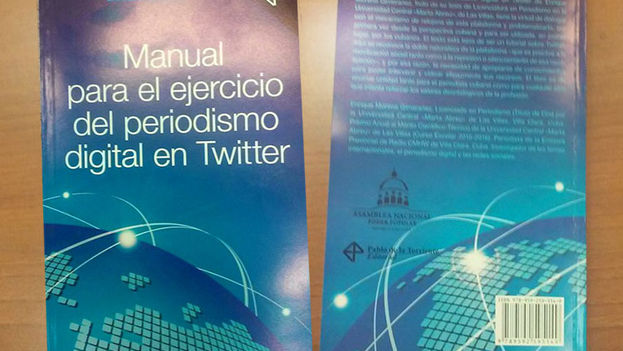
Twitter is No Longer the CIA’s, it is “Our Bay of Pigs of the 21st Century”

The book was presented on Tuesday at the Capitolio in Havana. (14ymedio)

14ymedio bigger14ymedio, Havana, 15 November 2017 — Twitter is “our Bay of Pigs of the 21st Century” according to the journalist Enrique Moreno Gimeranez, who presented his book Manual for the Exercise of Digital Journalism on Twitter on Tuesday at Havana’s Capitolio.

In the volume, the author criticizes “the malpractice of Cuban journalism on Twitter” which “has inefficiently used this resource on several occasions through slogans difficult to understand, retain and reproduce by foreign recipients.” continue reading

The text, the thesis of the author’s degree, was presented in the Sala Baraguá of the National Assembly of Popular Power by Franco-Spanish journalist Ignacio Ramonet, Tubal Páez, honorary president of the Union of Journalists of Cuba (UPEC) and Rosa Miriam Elizalde, director of the official website Cubadebate.

Moreno studied journalism Marta Abreu Central University in Villa Clara and after graduating he started at the CMHW station La Reina Radial in Villa Clara, where he is currently working.

In Moreno Gimeranez’s thesis, available on the internet and now published by the Pablo de la Torriente Brau press, the use of Twitter by Cuban journalists is addressed, but without mentioning the independent press which has a strong presence on that social network.

All users, labels and moments mentioned in Manual For The Exercise Of Digital Journalism On Twitter, which has a print run of 2,000 copies, are exclusively linked to official media.

The idea of ​​investigating the use of this social network on the Island came to Moreno Gimeranez when he was a third year journalism student and participated in the coverage of the Summit of the Community of Latin American and Caribbean States (CELAC) held in Havana in January of 2014.

The author collected interviews with nine experts from Spain, Argentina, the United States, Colombia, Peru and Cuba, among other countries.

During the presentation, journalist Rosa Miriam Elizalde pointed out that the book “is an example of the alliances that can be created to make communication practical.” While Ramonet urged “spreading to the new generations” the use of Twitter “not only technically, but in the more general area of ​​social, political and cultural life.”

The call contrasts with the first years when Twitter began to be used by activists within the Island. The first accounts appeared between the end of 2007 and mid-2008, when the authorities lashed out harshly against the social network and the official newspaper Granma called Twitter “a tool created by the CIA.”

Over the years, state institutions and entities opened their own accounts on the social network of the little blue bird, which are frequently used to call for an end to the US embargo, repeat political slogans and distribute news from the official press.

In 2016, Cuba registered more than 4.5 million internet users, according to official data published by the country’s National Office of Statistics and Information (ONEI).

However, in a report by Freedom House that analyzed the situation in 65 countries, the Island remained among the five worst nations in the world in terms of Internet freedom, with 79 negative points, only better than China (87), Ethiopia (86), Syria (86) and Iran (85).

In Latin America Cuba occupied the last position, w

The Fear of ’14ymedio’

The author of the review of ‘Departure’ regrets “that the exclusionary bias maintained in cultural affairs has impacted the career and life of the three officials.”

14ymedio bigger14ymedio, Regina Coyula, Havana, 15 November 2017 — A more inclusive air can be breathed in the corridors of Performing Arts of the Ministry of Culture. Or at least I thought that was the case when they told me that an article written by me about Departures, a work by the company El Ciervo Encantado (The Enchanted Deer), was in the catalog of the Theater Festival of Havana this year. But after the initial optimism, the logic of how events occur in authoritarian regimes caused me to doubt.

Was it an accident or a consequence of ignorance, mistake or intention on the part of three officials involved in the catalog? In any case, there was an institutional response: all of them have been removed from their positions. continue reading

My text, as has been described in the article about the punishment, is not conflictive. So that is not what the problem is. Nor should my signature be a problem because, to put it in the manner of my dear Manuel Díaz Martínez, I am an unimportant person. What is important is Departures, which twists the broken fibers of a country that for many years converted those physical partings into emotional ruptures that were intended to be final.

The work was exhibited before and during the Theater Festival, so nor is it because of the work itself. The lack, crime, transgression or whatever it is called by those imposing the punishment, has been to use a text from 14ymedio, a digital newspaper that for the authorities does not exist, inaccessible from the servers of the state telecommunications monopoly. The fact may seem ridiculous and even false to anyone who does not know the mechanisms of censorship in Cuba.

With regards to this, just a week ago I was at a presentation in Miami of the anthology The Compañero Who Watches Me, a compilation prepared by Enrique del Risco, literary and always political, of almost sixty writers about their experience with censorship, Big Brother, State Security. Sixty writers is not a small number for this little island, but at the same time their contributions fall short by the number of testimonies that do not appear because the protagonists opted for the healthy silence of voluntary oblivion, or because they were unaware of the existence of this project.

The current events surrounding Performing Arts do nothing more than provide an update to the stories in the book, not at all in the key of the past. I could not avoid the analogy.

Sincerely, I regret that the exclusionary bias maintained in cultural affairs has impacted the professional careers and lives of the three officials involved. It is an unequivocal signal for many of those who declare that politics does not interest them, whom I invite to look at the facts that have led to this “administrative” measure.

After the initial stupor, the three officials can look with new eyes at information and events all around them that previously they did not see (or did not want to see, it must be said). It is said that it is a capacity that many deploy only after being dethroned.

Without becoming Socratic, knowledge is a good path to individual freedom.

_______________________________

The 14ymedio team is committed to making a serious journalism that reflects the reality of deep Cuba. Thank you for joining us on this long road. We invite you to continue supporting us, but this time becoming a member of 14ymedio. Together we can continue to transform journalism in Cuba.

Three Cuban Cultural Promoters Fired For Publishing a Review From ’14ymedio’ in an Official Catalog

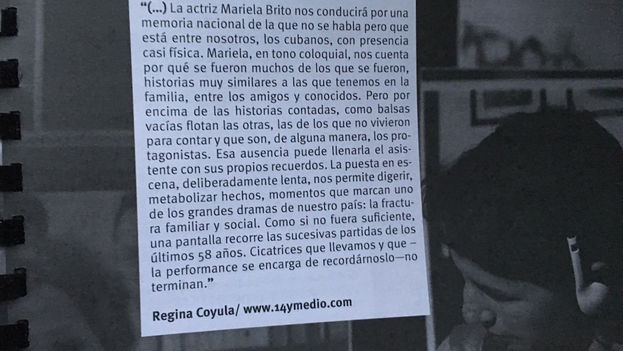
The excerpt from Regina Coyula’s theater review that appeared in an official catalog with a reference to 14ymedio. (Luz Escobar)

14ymedio bigger14ymedio, Havana, 14 November 2017 — A scandal is shaking up the National Council of Performing Arts (CNAE) a few days after the end of the 17th edition of the Havana Theater Festival. The publication in the festival catalog of an excerpt from a review of the event that appeared in 14ymedio has caused three employees of the state entity to be reprimanded and dismissed from their positions.

The head of the CNAE’s Directorate of Artistic Development, Noel Bonilla, his assistant Marielvis Calzada and CNAE vice president Marlén Gutiérrez are the three workers punished by the publication, who now find themselves in the midst of a process of administrative sanctions. continue reading

The inclusion of a paragraph from a theater review published in this newspaper last February and signed by Regina Coyula unleashed the wrath of the authorities of the Ministry of Culture (Mincult) because the text came from the independent press, a part of Cuban journalism censored and hidden by officialdom.

The excerpt chosen for the catalog addresses the performance of Mariela Brito in the piece Departures, by the company El Ciervo Encantado (The Enchanted Deer), which deals with Cuban emigration. “But beyond the stories told, others float like empty rafts, those who didn’t live to tell,” says the author of the article.

Although the excerpt from the review, included on page 69 of the catalog, does not contain direct political allusions or ideological messages, Mincult officials blamed the three employees for having allowed the name of this newspaper to appear in an official publication.

“The first thing that happened was that they brought us together and asked: ‘What is14ymedio doing in a Council publication? Why is it in the catalog, instead of promoting other authors who are within our institutional system and the recognized press in Cuba?’ ” explained Noel Bonilla on Monday by telephone to this newspaper.

Bonilla adds, “it is true that it was published in the wrong way, without consultation, not verified” and especially “in the haste with which the catalog was put together” and because of “the delays that occurred in the printing process.”

The Festival, which took place between October 20 and 29, had the support of the French Embassy in Cuba, the Goethe Institute, and the Ministry of Foreign Affairs of Norway among other foreign entities.

Bonilla said in his Facebook account days ago that “after almost fifteen years” he ended his responsibility as head of CNAE, after committing an alleged error. He informed readers that “he will remain attentive” to the world of theater because he considers himself “a cultural agent committed to the poetic obsessions” of artists.

In this message on social networks, the promoter told “those artists or aspirants” who were waiting for their evaluations, not to worry because “I’m sure someone will ensure continuity very soon.”

“Who sows walls collects nothing and that dreadful nothing will lead them to failure, to oblivion, to the abyss,” he says.

In a telephone conversation with 14ymedio the promoter was more cautious and avoided confirming that he had been removed from his position. Bonilla said that “until this minute” he has not been told “any official information about being fired from my job,” but confirmed that it was required because of several errors of content in the festival catalog.

With a degree as a Professor and Instructor of Dance, Bonilla has worked as a dancer, choreographer and professor at the Higher Institute of Art (ISA) of Havana. Before the incident, he was in charge of overseeing the artists in their qualifying evaluations and overseeing the progress of their projects.

“He is very capable and has managed for several years to survive in a position that carries a lot of responsibility but where one can very quickly make a misstep,” says a young actress who has worked with Bonilla and who prefers anonymity. “Right now everyone is talking about the injustice they have done to him,” she adds.

In February of this year, Bonilla was awarded the French Republic’s Chevalier Medal of Arts and Letters for his “exceptional trajectory” in the universe of Cuban and French dance.

Coyula, a regular collaborator to 14ymedio, cannot get over her astonishment at what happened. When she learned that her article appeared in the catalog she believed that “the cultural authorities had become more inclusive or that maybe it was due to someone’s ignorance of someone.”

“What I never thought was that by including that excerpt they might fire these people from their positions,” laments Coyula, who for eight years has run the blog La Mala Letra (Bad Handwriting) with topics ranging from social stories to computer news.

This independent newspaper has been blocked from servers in Cuba since its foundation. To access the site, Cuban internet users frequently use anonymous proxies or read the articles through an emailed news service or in the PDF with a selection of the best of the week, which is distributed hand-to-hand.

__________________________

The 14ymedio team is committed to serious journalism that reflects the reality of deep Cuba. Thank you for joining us on this long road. We invite you to continue supporting us, but this time by becoming a member of 14ymedio. Together we can continue to transform journalism in Cuba.

“My Attackers Act As If Nothing Happened”

José Enrique Morales Besada feels deceived and refuses to let the perpetrators go unpunished. (Courtesy)

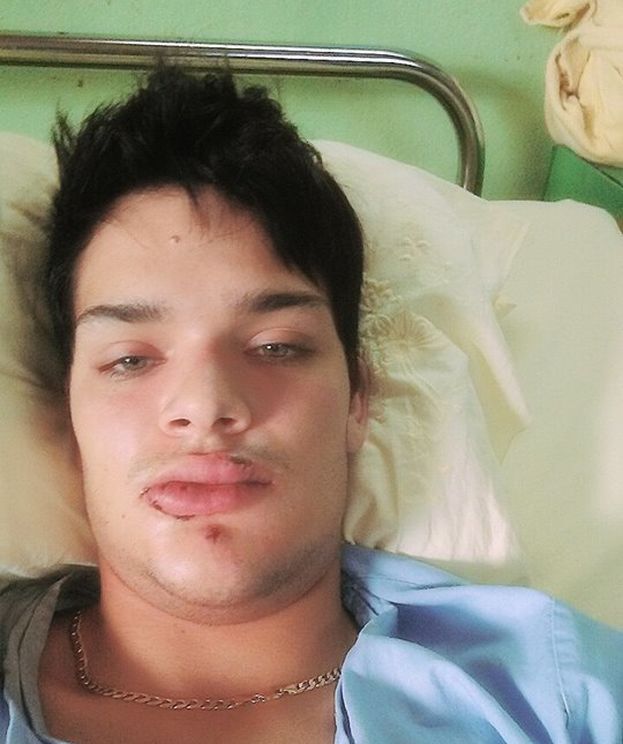
14ymedio bigger14ymedio, Luz Escobar, 13 November 2017 – It was a warm night in June and José Enrique Morales Besada was connected to the internet at a Wi-Fi hotspot in Morón, Ciego de Ávila. On returning home, his life took a dramatic turn when he was a victim of a homophobic attack that left him with serious physical consequences and a desire for justice that current Cuban legislation has failed to satisfy.

Last Friday, the Prosecutor’s Office decided to close the criminal process for his case and settle it with the imposition of a fine on his attackers. The interest in the attack on the part of the National Center for Sex Education (Cenesex), led by Raul Castro’s daughter Mariela Castro, has not been enough to bring his assailants to trial, although it did speed up the police investigation. continue reading

At just 21, this young man has spent the last months shuttling between medical consultations and police appointments after two men insulted him and hit him on the side of his face with a bottle. José Enrique only remembers lying on the floor, with a friend by his side who was screaming for help, he tells 14ymedio by phone.

Morales Besada dreamed of becoming a professional singer. He performed at parties and tourist facilities, offering pop themes, ballads, classics in English and popular dance music, but now he can barely finish a sentence without speech problems that stop him in the middle of his words.

“Every time I speak I have a very strange feeling, so I can’t sing because I can’t modulate my voice well,” he laments. The blow caused him to lose several teeth, destroyed part of his gums and caused a serious fracture of the jaw for which he had to undergo surgery.

Four years before the attack, the streets of Morón were filled with colorful displays when the province became the site for the Day Against Homophobia. The annual vindication has not succeeded in banishing the prejudices that remain deeply rooted in that region and in the rest of the country.

For Morales Besada, the Ciego de Ávila LGBTI community faces a “dark panorama” and its members suffer constant aggravations in the streets as well as “degrading treatment.”

“It is very difficult to sit in a park without someone passing by and throwing an insult or a can of beer,” he complains.

Homophobia in Cuba also enjoys police complicity. “When somebody goes to file a complaint about something like that they treat them like they’re crazy,” declares the young man, who, in spite of appearing with witnesses before the authorities, barely managed that his attackers spent 24 hours in custody. “They left after paying a bond of 1,000 Cuban pesos (roughly $40 US) each.”

The Cuban Penal Code does not include the concept of “hate crimes” regarding attacks against people based on ethnic origin, religion, race, gender, sexual orientation and identity. The latter, specifically, are not included in the current legislation and attacks against them are treated by the police and the courts like any other crime.

A few days after the attack, the singer wrote in his Facebook account an initial message saying what happened, demanding justice and asking Mariela Castro directly for help.

The report that was prepared in the hospital, and that recorded the facial and mouth injuries, was “conveniently” lost. (Courtesy)

In 2015, Mariela Castro had assured in a public event that the institution she directs was working in collaboration with the Ministry of the Interior to closely monitor these aggressions. “A thorough and specialized analysis is needed to determine the type of crime because all situations where LGBTI people are victims do not have hatred as a motive,” said the sexologist.

Cenesex began to investigate what happened in Morón and sent a letter to the municipality’s National Revolutionary Police (PNR). Morales Besada admits that when the officers heard the name of the daughter of the Cuban leader “they started running around and wanted to do in a day what they should have done from the beginning.”

The 10th was when Morales Besada knew that there would never be a trial for his attackers. The Prosecutor’s Office dismissed the opening of the trial and has settled the case with a fine against both perpetrators. After hearing the conclusion from the investigator, the young man came out crying. He did not even want to sign the official communication.

Morales Besada denounces multiple irregularities in the process. “Nobody from the investigation visited my maxillofacial doctor to ask what my current state of health is,” he complains. In addition, the report that was prepared in the hospital recording the facial and mouth injuries he suffered was “conveniently” lost and only appeared, after much searching, detailing cervical injuries.

“No trial was held and they deceived me because until that moment they had told me that they would be taken to court.”

Members of the Cuban LGBTI community have collected more and more records of assaults and hate crimes. Although official institutions do not publish statistics on murders or violent acts against lesbian, gay, bisexual, transgender and intersex people, the news now is made known thanks to social networks.

In May 2015, this newspaper published an article about the stoning death of a 24-year-old transsexual in the city of Pinar del Río. The official media never published the news.

Morales Besada, who feels deceived and refuses to let the perpetrators go unpunished “as if nothing happened,” published a Facebook message last Friday that has made his case known to thousands of internet users.

The young man claims that both attackers have a history of homophobic violence. “They beat another boy who works in the Cayo but he did not accuse them because he is afraid.”

“This attack has left me without a life,” says José Enrique. The physical damage can leave permanent affects, but what adds to the pain now is the impotence he feels in the absence of justice.

‘14ymedio’ Invites Readers to Join

14ymedio bigger14ymedio, Havana, 14 November 2017 — Two fundamental premises have guided the work of 14ymedio since its birth more than three years ago: making journalism of higher quality every day and maintaining editorial independence. To achieve this we have opted for a strict financial autonomy that allows us to pronounce freely on any subject.

So far, our financing comes from the contributions of a small group of friends in a personal capacity, from alliances with private foundations and academic institutions, and from sponsorships, events, content sales and advertising.

Today we take an important step by launching a collaborative membership model that will allow readers to contribute to the financing of 14ymedio. Thus, we can devote more resources to journalistic investigations and maintain universal and free access to the content of our media, in addition to solidifying our editorial freedom.

Our readers can become members of 14ymedio by visiting our membership portal, where you can support us with a small financial contribution. In return, you will receive invitations to events and the opportunity to collaborate with ideas regarding the editorial content.

On this site there is all the information about the different levels of membership, about our work and the editorial team, as well as a detailed breakdown of our finances.

We are the first medium in Cuba to take a step of this nature and we intend to make this privileged relationship with readers the main source of income for 14ymedio, in a participatory and transparent manner.

This Tuesday begins a new stage for 14ymedio. We hope you will join us, just as you have done since the beginning.

Become a member of 14ymedio.