Party Congress: Neither More Of The Same Nor Surprising News / 14ymedio, Reinaldo Escobar

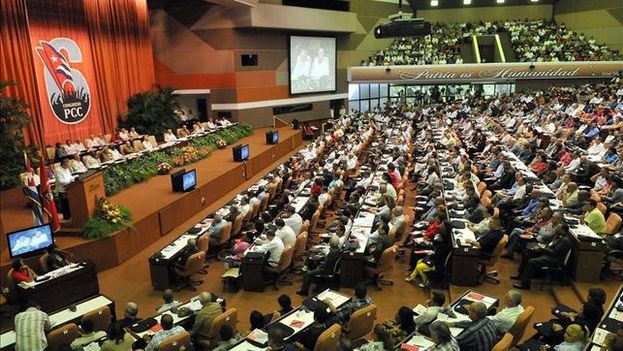
The Palace of Conventions during the Sixth Congress of the Communist Party of Cuba. (EFE)

14ymedio bigger14ymedio, Reinaldo Escobar, Havana, 12 April 2016 — Ruperto, the comedic character in Vivir del Cuento (Living the Story), woke up after a 28-year coma and still doesn’t understand Cuba’s dual currency system nor the end of the Socialist Camp. In this case, there are many “Rupertos” who will analyze the upcoming Seventh Congress of the Cuban Communist Party, who believe that everything will continue as before and the hardliners will have their way. For them, nothing has happened in the last decade since Fidel Castro left power and passed it on to his younger brother.

If, in fact, nothing happened, the great event of the Cuban communists would be a remake of previous congresses. Those who have not been in a coma since 2006 have seen that that axes around which Cuban politics revolve are not the same. The rampant reversal of paternalism, the preponderance of economics over ideology in decision-making, the failure of the monopoly on the media and culture, and a long list of reforms – classified by some as timid and by others as devious – paint an entirely different picture. To this should be added the change in the correlation of influences in the international arena and a growing and increasingly evident popular discontent. continue reading

Most of the delegates to this Congress have no memory of the first of January 1959 when “luminously dawned the morning,” as the poet Indio Nabori wrote. For the first time, when a new Central Committee, and especially a new Politburo are chosen, most of their members will have no responsibility for the executions of those first years and probably never even shouted the slogan “Paredón! Paredón!” – “To the [execution] wall!” None of them seized any properties. Those born after 1960 weren’t even old enough to vote when the first constitution was approved in 1976.

These delegates are no longer homophobic atheists who boasted of their machismo and the fact that they never passed the 9th grade because they were of humble origin. They have been politically shaped with an awareness that the system is not invulnerable and that the theory behind it is debatable. They have connected to the internet, studied marketing techniques and, although it seems a frivolity, passed a decade without listening to the speeches of Fidel Castro; and they did listen to Barack Obama’s remarks in Havana’s Gran Teatro.

And so this Party meeting cannot be more of the same.

However, this does not mean that General Antonio Maceo (b. 1845) is going to sit down to talk with General Martinez Campos (b. 1831), nor that the name “communist” will be removed from the Party. The hard core will impose its authority by dint of intimidation against the unruly and through the offering of perks and opportunities. It is also true that most of the delegates to this Congress should have participated at more than one repudiation rally, and it is probably that many have betrayed a co-worker or a neighbor, and that most of the time in the assemblies in which they have participated in they have dutifully raised their hands for what in the opinion of the nomenklatura is politically correct.

There will be no surprising news such as opening the door to a multi-party system, or launching a program of privatizations. No one will talk at this event about reconciliation among Cubans or dialog with opponents. There will be no decree of amnesty for political prisoners, nor recognition of the legitimacy of an alternative civil society, of freedom of expression or of an independent press.

However, those who rule Cuba know that they are forced to change something or at least to give the impression that they are willing to do so. They have their hole cards, but they should put them on the table. The secrecy with which they have managed the documents to be discussed can only indicate that they are preparing to change direction and we will have to wait for the closing remarks to see the course taken.

Because what has really characterized the Cuban Communist Party is not having its own theoretical base and, above all, not respecting the letter of its own agreements. Decisions made in a personal and specious manner by one or two people have always prevailed. And it is precisely this that would be the unpredictable essence of change. Will they recognize Marxism-Leninism as only a secondary source to be taken into account? In the hidden desires that fill the heads of these real men and women is the key to what to expect of the Seventh Congress.

Panama Is Preparing A New Shelter For More Than 1,000 Cubans / 14ymedio, Mario Penton

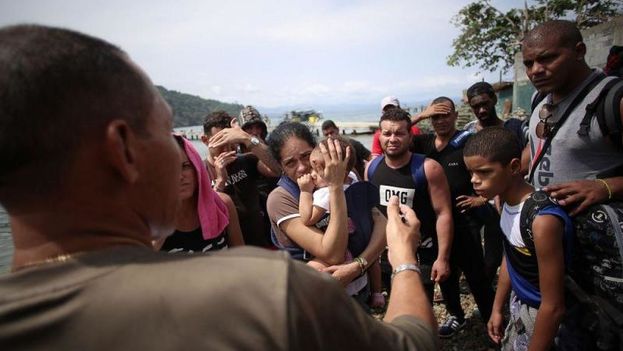
In Puerto Obaldia, Panama, there are already more than a thousand Cubans. (La Estrella de Panama)

14ymedio bigger14ymedio, Mario Penton, 9 April 2016 — An old and abandoned building in the district of Gualaca, in western Panama, is being refurbished to accommodate some of the more than 2,000 Cuban migrants who have been arriving in that country from Ecuador and Guyana in recent weeks.

The flow of migrants has continued despite warnings from the Panamanian authorities to discourage Cubans seeking to reach the United States through Central America. In the coming days at least 1,300 more Cubans are expected to arrive, joining those who are currently stranded on the western border of the country. continue reading

The local news channel Telemetro reports that the preparations for the shelter have not been well received by Gualaca’s authorities, who claim they were not consulted on the issue. However, after a meeting between residents of the community of Planes, local authorities and governor Hugo Mendez, it was agreed to allow the Caribbeans to be sheltered in exchange for social projects in the district.

The Panamanian press has also reported that among the conditions imposed by local authorities is the presence of the National Police along with troops from the National Civil Protection System to prevent the migrants from leaving the immediate area. A situation that has been denounced by human rights activists which categorize it as “forced confinement.”

Local people are also sensitive to issues of health and public safety, and the government will guarantee the presence of primary care personnel to provide for the healthcare needs of the migrants.

In the information published so far it is unclear whether the new shelter will be for Cubans who are arriving from Puerto Obaldia or those already in Paso Canoas. The latter have received the news with skepticism and concern.

For Silvio Enrique Campos it is “another media lie.” According to this migrant the conditions in the current camps are subhuman, the food is terrible and they have to pay for medical attention. “It is not like they say in the media,” he said.

Orislandy Diaz, meanwhile, told this newspaper that the Panamanian government has “a strategy” to keep them away “from the view of the pres.” The young man wonders why they want to keep them 50 miles from the Costa Rican border and believes that the purpose is to “hide” the thousands of migrants.

Isleyda Lelle, a Cuban who reached the Isthmus a week ago, considers the crowded conditions of the thousands of Cubans “grim,” and calls on the international community to help them continue their journey.

This week Costa Rica’s Foreign Minister said his country has no capacity to serve more islanders and will not allow access because the country’s capacity is exhausted after receiving more than 8,000 migrants last year. He added that “the problem can not come here,” referring to the nearly 2,000 Cubans settled on the Panamanian border.

This coming week there will be a meeting convened by Costa Rican President Guillermo Solis; invited to attend are United States immigration authorities, the Central American countries, along with Cuba, Colombia and Ecuador. Costa Rica is expected to again call for an end to the Cuban Adjustment Act and the tightening the conditions for granting visas to citizens of the island.

“What is appropriate,” said the Costa Rican Foreign Minister, “is the elimination of this legislation that responded to a historical context that is not current and that is affecting all of us who are in the middle.”

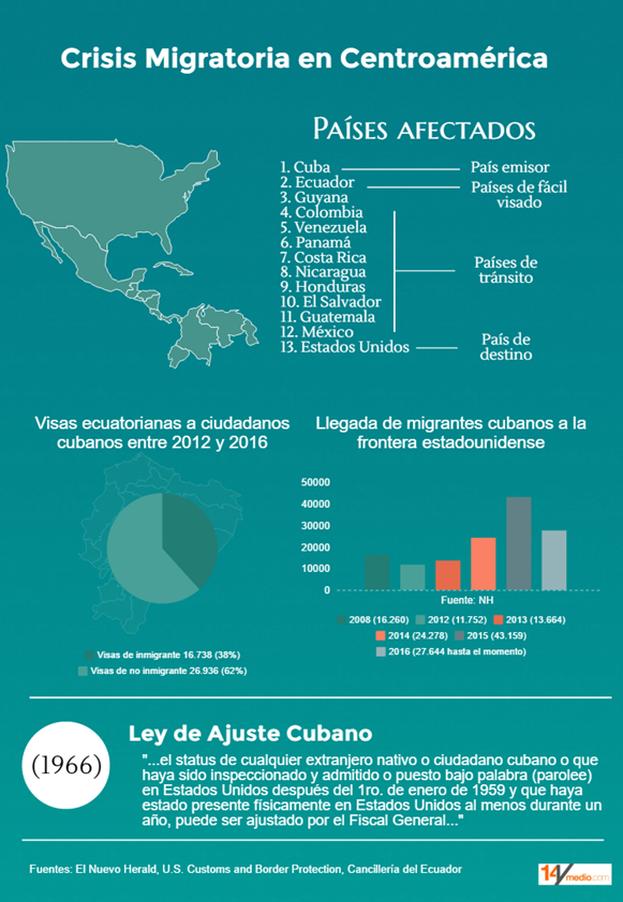
Facts and figures to understand the crisis of Cuban migrants in Central America. (14ymedio)

Rafael Alcides, Chapter 6: Capitalism in Cuba – Before and After / Miguel Coyula

This video is the 6th in a series of vignettes extracted from a four-hour interview of Rafael Alcides conducted by the filmmaker Miguel Coyula. Below are links to the previous Chapters.

‘Rafael Alcides’ Chapter 1: The Beautiful Things / Miguel Coyula

‘Rafael Alcides’ Chapter 2: Artists and Politicians / Miguel Coyula

‘Rafael Alcides’ Chapter 3: About Beauty / Miguel Coyula

Rafael Alcides, Chapter 4: Once Upon a Time in Biran / Miguel Coyula

Rafael Alcides, Chapter 5: The People / Miguel Coyula

Cuba’s Constitution of 1976: An Historic Setback / Dimas Castellano

Dimas Castellano, 1 March 2016 —  “Two Benchmarks of the Cuban Republic” — an article by Pedro Antonio Garcia which appeared in the journal Granma on February 24 — makes a comparison between the 1901 and 1976 constitutions that merits further discussion. Let us look further at three of the author’s main points.

1. It was not the Cuban Revolution that brought down representative democracy but rather the coup d’etat, led by Fulgencio Batista on March 10, 1952, which interrupted the constitutional rhythm of the country. Batista dismissed the president-elect, dissolved Congress and abolished both the constitution of 1940 and the electoral statutes of 1943. continue reading

The constitution of 1940 had retained the separation of powers and the rights recognized by the 1901 constitution while adding several others, such as the right to organize public protests and to form political associations which opposed the regime. It also guaranteed the autonomy of the University of Havana, declared any attempt to prohibit or limit citizen participation in the nation’s political life a criminal offense, and recognized the legitimacy of opposition intended to protect the rights of individuals. The coup d’etat that led to the suspension of this constitution in 1952 is an historical fact. But thanks to actions by civilian and military leaders — including Fidel Castro’s assault on the Moncada Barracks — Fulgencio Batista restored it in 1955.

Rather than being fully restored after the 1959 revolution, however, it was replaced with the Fundamental Law of the Cuban State, some of whose statutes conferred on the head of state, the prime minister and the Council of Ministers responsibilities previously held by Congress. This modification was similar to one carried out by Batista in 1952, when he implemented the Constitutional Statutes. The Fundamental Law remained in effect until 1976, when the first revolutionary constitution was adopted. This constitution was slightly modified in 1992 and became a means of preserving the status quo when in 2002 it declared that the political system, as it existed at that time, was irrevocable and would no longer reflect the kinds of changes that regularly occur in any society. Thus, the people — who supposedly are sovereign — cannot amend this Law of Laws, which declares eternal a system that those born after 1992 as well as those yet unborn did not choose.

As a member of the constitutional assembly of 1901, Juan Gualberto Gomez — a man Garcia acknowledges as a key figure of Cuba’s struggle for independence — opposed an attempt to constitutionally codify anything that might act as a brake on social change. Juan Gualberto Gomez stated, “I consider this to be an anti-liberal document. Having been given a specific mandate, we are taking advantage of our presence here by trying to toy with the future, by cutting off the people’s right to tomorrow and hindering their momentum.” He was referring to a counter-productive and harmful attempt to legislate in place of others, something we forget we when we deem the current political system to be irrevocable.

2. The articles of the constitution of 1901 established the principle of independence and sovereignty, and nullified other existing laws that undermined this principle. It excluded women from voting while extending universal suffrage to men. It granted the President of the Republic powers formerly held by the Spain’s colonial governor. Obviously, it protected private property.

The constitution of 1901 endorsed fundamental rights. Article 16 restored habeas corpus: “All those detained will be released or remanded to the competent judge or tribunal within twenty-four hours of their detention.” Article 25 granted freedom of expression “in speech and in writing, through the press or any other method.” Article 28 allowed freedom of association “for all lawful purposes.” And Article 29 enshrined freedom of movement. These universal, indivisible, sacred and inalienable rights and freedoms form the foundation for civic participation and popular sovereignty.

The constitution of 1901 was so ahead of its time that the rights it encompassed were not universally recognized until the adoption of the Universal Declaration of Human Rights in 1948, almost half a century later. Notably, the first proposal submitted to the United Nations’ Social and Economic Council for further consideration was presented by the Cuban delegation at this constitutional event.

The Protest of the Thirteen; the peasant struggles at San Felipe de las Uñas, Realengo 18 and Ventas de Casanova; student protests and university autonomy; the strikers movement from 1902 until the overthrow of Machado; the repeal of the Platt Amendment; the ultimate consensus of various factions at the 1939 Constituent Assembly. These historic struggles are examples of the blossoming of Cuban civil society, whose foundations were laid by the 1901 constitution.

The article’s author points out two limitations to the 1901 constitution: denying women the right to vote and extending the powers of the colonial governor to the President of the Republic.

Regarding the first issue, it is certainly true that the 1901 constitution did not grant universal suffrage. However, by taking advantage of the liberties recognized in this founding document, women founded multiple associations and media outlets, and organized meetings and gatherings to promote their rights. In 1917 women were granted custody of their children and control of their financial resources. In 1918 the Divorce Law was approved. The First National Women’s Congress was held in 1923, followed in 1925 by the Second National Congress, which led to a promise by President Gerardo Machado to grant women the right to vote.

After the overthrow of Machado in 1933, the National Feminist Alliance appealed to the interim president, Carlos M. de Cespedes (son), demanding the right to vote. As a result of those negotiations in January 1934, during the government of Ramon Grau San Martin, a Constitutional Convention was convened which recognized the right of women to vote and to be elected. During the presidency of Colonel Carlos Mendieta an interim constitution was approved, whose Article 38 formally extended the vote to women. And in February 1939, prior to the Constituent Assembly that drafted the Constitution of 1940, the Third National Women’s Congress called for “a constitutional guarantee of equal rights for women.” This demand was endorsed in the constitution adopted in 1940. As a result Cuban women legally exercised the right to vote in the elections of 1940, 1944, 1948, 1954 and 1958.

Regarding the latter — in other words the powers granted to the President of the Republic, which had formerly been those of the Captain General — one need only compare the powers of an executive branch, which are limited by legislative and judicial branches, with the powers established after 1959, which are those of a totalitarian, one-party state with monopoly control and ownership of the means of production. Need I say more?

As we can see, while the republic founded in 1902 was not exactly what Cubans had fought for, the undeniable fact is that Cuba was able to join the international community of nations with its own legal framework, close the door on annexation, disentangle itself from the Platt Amendment and convene a constitutional convention, which drafted the glorious constitution of 1940, the same constitution that provided the legal foundation of Dr. Fidel Castro’s defense at his trial for the assault on the Moncada Barracks.

3. By 1975, a time when country was undergoing profound transformations, the constitution of 1940 was no longer applicable to that moment in history. A new Law of Laws was needed for this new stage of the revolution. A group of jurists, appointed by the political and mass movement organizations, produced a draft constitution. In every school, workplace, military unit, city block, farm and rural village people discussed the document and made corrections and additions.

If Cuba was without a constitution from 1959 until 1976, it was not necessary to draft a new constitution. Since the 1959 statutes did not provide such a framework, what was needed was simply a constitution.

The 1976 constitution recognized rights and freedoms such as equality under the law, suffrage for both sexes, freedom of speech, of the press, of association and the right to protest. Where it differed from the constitutions of 1901 and 1940 was that these rights were subordinate to Article 5, which recognized the communist party as the dominant driving force of the state and society, whose goal was to build socialism and advance towards communism. This was summed up in an address by Fidel Castro to Cuban intellectuals: Within the revolution, everything; outside the revolution, nothing. Subsequently, articles six and seven stipulate which organizations are to be recognized, protected and fostered by the communist party, which led Cuba’s constitutional traditions to suffer an historic setback.

Originally published in Diario de Cuba
Cuba’s Official Press Treads Carefully With Panama Papers / 14ymedio, Yoani Sanchez

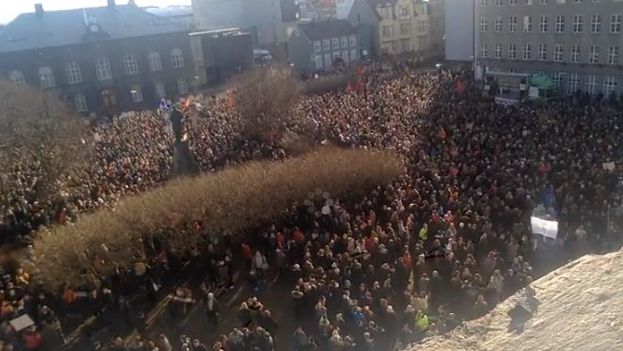
In Iceland, citizens took to the streets to demand the prime minister take responsibility after the leaked documents. (Twitter)

14ymedio bigger14ymedio, Yoani Sanchez, 5 April 2016 – The name of Cuba has not appeared among the so-called Panama Papers, but the official press is displaying caution over leaked documents that reveal fortunes hidden by politicians, athletes and entertainment figures. The national media has mentioned those touched by the scandal, such as Argentina’s president Mauricio Macro, while hiding evidence that points to Vladimir Putin and the Venezuelan government.

In Monday’s first newscast, the report on the exhaustive investigation into the documents from the Panamanian law firm Mossak Fonseca lasted less than a minute. The unveiling that exposed billionaires’ offshore accounts involving 140 politicians in 50 countries presents the ossified Party propaganda with the dilemma of joining the diffusers of these 15 million leaked documents, or keeping its distance before the involvement of numerous allies. continue reading

The Panama Papers involve not only doubtful transactions by political leaders such as the prime ministers of Georgia and Iceland, the King of Saudi Arabia and the president of Ukraine, but also reveal the shady dealings of close friends such as Russian president Vladimir Putin and Syrian president Bachar Al Assad, figures close to the Havana establishment and beneficiaries of favorable coverage in the local media.

The Plaza of the Revolution prefers to tread carefully before the avalanche of names of heads of states and governments — newly inaugurated or already retired –mentioned in the documents leaked by the International Consortium of Investigative Journalists (ICIJ). The monopoly maintained over the written and broadcast media allows Cuba’s Department of Revolutionary Orientation (DOR) to present the version of the scandal that is later repeated in chorus by its reports inside and outside the island.

However, the plot has just begun and there may be other names. The ICIJ has warned that the investigators will demonstrate which of those involved have no legitimate way to maintain offshore accounts and thus have committed a crime or violation of the law. For now, all those mentioned are in the eye of the hurricane of the public diatribe, but it is up to the organs of justice to determine their guilt.

The threads of the skein, now being untangled by 370 journalists and 107 media companies in 78 countries, start with the documentation from an anonymous source delivered to the German newspaper Süddeutsche Zeitung, and also involve the soccer player Lionel Messi, King Juan Carlos’s brother Pilar de Borbon, and the movie director Pedro Almodovar. It is expected that in the coming weeks the scandal set off by these leaks will cause resignations, judicial proceedings and who knows if there might be a suicide.

Cuba’s official daily Granma will juggle to hide the fact that Adrian Jose Valasquez Figueroa, former head of security at the Miraflores Palace in Caracas, opened a bank account in the Republic of Seychelles a few days after Nicolas Maduro’s victory in the presidential elections. The faithful former captain of the Bolivarian army now lives in the greatest luxury in the Dominican Republic with his wife Claudia Diaz Guillen, a former nurse to Hugo Chavez. A story that will not be mentioned by the official press.

However, the Panama papers are more than a scandal of public figures who hide their money and evade tax obligations. Above all it is a test of truth and transparency in a world where there are ever more walls, secret codes and masks. This massive leak of documents also restores hope to journalism, a profession in crisis that has managed to stand out through perseverance and teamwork.

Hiding the revelations, silencing the names of those involved, will only end up sinking the official Cuban press, incapable of reflecting its own reality and that of others.

Google Jumps Through Hoops In Cuba / 14ymedio, Luz Escobar

Uniformed officers from MININT leave the Google+Kcho.MOR site this Wednesday. (14ymedio / Luz Escobar)

14ymedio bigger14ymedio, Luz Escobar, 7 April 2016 — Google may be the Internet giant, but in Cuba it has had to jump through hoops. This Wednesday, the newly inaugurated Google+Kcho.MOR site opened its doors late because the employee who keeps the keys arrived late and because fumigation against the Aedes aegypti mosquito –carrier of dengue fever and the zika virus – had filled the place with thick gray smoke. Not even these setbacks caused the dozen users waiting outside to connect to the internet to leave.

The process to access the place is reminiscent of the lines to acquire products in short supply, like an interprovincial bus ticket or a dozen eggs. “You have to come early to mark your place in line, because you are going to spend the whole morning here,” said a young woman who said she had used the new infrastructure twice since it opened to the public this Monday. continue reading

And in spite of everything the brand new Google project has also bowed to the government and blocked websites. Sites such as Cubaencuentro, Revolico and 14ymedio remain blocked. The censorship is due to the provider of the connection, the telephone company ETECSA, a state monopoly that maintains control over what can and cannot be seen on its servers.

However the lines never end and every hour only 20 numbered tickets are issued. Prior to entry, users must leave all their belongings in lockers, with the exception of their ID cards without which entrance is denied. They cannot enter with cameras, phones, USB memory sticks or laptops. All published photos of the interior have been taken by the official press and a few foreign correspondents who have been allowed to publicize the new project.

Although initially there was talk about the possibility of being able to use storage devices, such as flash drives or external hard drives to take information home and to upload materials to the web, as of this Wednesday this is still not permitted. This limitation gives the surfing room the aspect of a museum: look, touch and go, but without taking anything, the employees warn. The novel experience is reduced to navigating the internet from one of the 20 Chromebooks in the place.

Fabian, a young man who has been three times between Tuesday and Wednesday, tells14ymedio that “at first they let you make calls and talk but then they prohibited it because people were shouting and it bothered everyone nearby.” The place is crowded and users have no privacy as they move around the World Wide Web. Several employees supervise every move and look over users’ shoulders at the pages open on their screens.

“The problem is that this is a library and you can’t speak in a loud voice,” one of the workers explained to this newspaper. As for the schedule, the young man said that so far it is open “from 7:00 AM to 12:00 PM, but the early hours are reserved for previously coordinated visits.”

A group of agents from the Immigration and Nationality section of the Interior Ministry (MININT) left the center on Wednesday just before the first 20 people in line were admitted. “Yesterday the ones dressed in green came, from MININT in fact… now, what I don’t understand is why these people have some priority,” said Dorian, a neighbor of the Google+Kcho.MOR center.

Yuli, a third year medical student returned to mark er place in line after having used the Chromebooks because she didn’t have enough time to find the information she needed. “Because you can’t copy anything, what I do is send it to my Gmail account and later download it take it to another site,” she detailed. Her boyfriend, a fine arts student at the Higher Institute of Art (ISA), said that the day before he had been able to visit several sites with “impressive virtual reality thanks to the cardboard glasses.” He was referring to “Cardboard,” a virtual reality platform for mobile phones, also donated by Google.

Particularly striking is the slow navigation speed in the new facility, as it had been announced that the place – integrated into the Organic Romerillo Museum (MOR) belonging to the artist Kcho – would have a connection speed 70 times faster than that offered in the WiFi zones in the rest of the country. Several users commented outside that they felt cheated because of the problems watching videos on Youtube or using other services that require a higher bandwidth.

Despite the obstacles, the wait, the numbered tickets and inability to take digital content home, users seem mesmerized by simply sitting in front of the screens and moving their hands at full speed over the keyboard so as not to lose a single second of their access to the web.

Looking on from the wall is a huge picture of Fidel Castro with a Cuban flag. An electronic marquee installed at the site shows one of the last phrases the former president wrote to Barack Obama: “We do not need the empire to give us any gifts.”

A View From Cuba of The US Presidential Campaign / 14ymedio, Pedro Campos

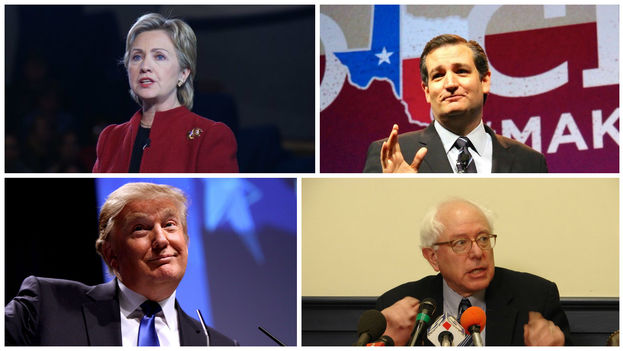
Hillary-Clinton-Donald-Bernie-Sanders_CYMIMA20160129_0004_13
Hillary Clinton, Ted Cruz, Donald Trump and Bernie Sanders.

14ymedio bigger14ymedio, Pedro Campos, Havana, 11 April 2016 — The current election campaign in the United States has been characterized by low blows and “disqualifications” in the Republican camp where, at this point, the person not wanted by the party establishment, Donald Trump, appears to be in the lead, with the entire structure of the party trying to cut the floor out from under him and supporting his opponent Ted Cruz, who carries Cuban blood.

The frontrunner is accused of being an extremist, fascist, crazy. While they crucify Cruz as impertinent, lacking charisma, and too conservative in religious matters, although both can claim another image in front of the national convention. It is well known: a fascist extremist and an impertinent extreme conservative do not have many chances in modern US presidential elections. continue reading

The Democrats, Hillary Clinton and Senator Bernie Sanders, project more presidential images and no one could accuse them of being extremists in any sense.

Trump assumes positions that concern a good share of the American public, and many around the world, because of their implications for the economy and security, but his insults to the establishment and his ordinary manners appeal to a part of the electorate tired of the dominance of a tax-imposing political class.

The lack of democracy within the Republic Party is seen is the maneuvers its establishment is using to try to unseat the billionaire during the party convention. This has led the candidate to consider the possibility of leaving the party, but so far there is nothing definite.

In the presidential elections in the United States the figure, respect and sympathy inspired by the candidate weigh heavily, as does his or her platform and the money to support a campaign.

Some analysts believe that the Republicans are already defeated because they failed to advance a candidate from the beginning with the weight and personality capable of uniting the party. But they have fought among themselves, and so have been weakened in the ultimate battle against the Democratic candidate and, at this point, “inventing” a winning candidate could result in a disaster for the party.

The campaign for the Democratic nomination has been cleaner and with greater unity and coherence. Clinton is ahead and, if nominated, could become the first woman president of the United States, a great attraction indeed. In addition, her skills were demonstrated from the State Department.

Sanders, without backing from millionaires or the establishment, has built his campaign from small donations from young people and workers who, weary of the great social differences and the abuses of power, want systematic changes; an outcome of the Occupy Wall Street movement. He is not a common socialist, and no one questions his commitment to democracy. His discourse has forced Clinton to declare that “companies must distribute part of their earnings to their workers.”

A common problem for the Democrats is mobilizing the vote of their historic base: Hispanics, blacks, workers and the middle class. A controversial or socialist candidate as their nominee could encourage these voters to go to the polls.

A Clinton-Sanders combination would unite a part of the establishment with some of its challengers, women, the liberal left and the traditional Democratic base; but it could be too far to the left of the traditional axis of the electorate, However, since Obama the Democrats seemed to have moved in that direction. However, both Clinton and Sanders come from the Northeast, so they may prefer a running mate from the South or West to gain greater support in those regions.

Traditionally, if the economy grows, if unemployment is at tolerable levels, if the rate of inflation is not elevated, if there are no international conflicts that jeopardize national security and if the outgoing government is viewed favorably, the candidate of the current president’s party has a greater chance of winning.

From here to November, everything will depend on the eventual changes that could occur in these parameters and on the level of unity and coherence that is finally achieved at each party’s convention, which, for now, favors the Democrats.

Without dramatic changes in these aspects, either of the Democratic candidates or a combination of them both would be more likely to win over any of the Republicans, who are still burdened by the novelty of an agitator with popularity among the Republican base but with positions that are too controversial to unite the party and defeat the Democrats. But a lot can happen between now and November.

Without Democratization There is No Guarantee of Cuba’s Independence / 14ymedio, Pedro Campos

The Mariel Special Development Zone. (ZEDM)

14ymedio bigger14ymedio, Havana, Pedro Campos, 6 April 2016 — Politicians, analysts and academics, both socialists and liberals, have addressed the importance of the political and economic democratization of Cuban society as a basis for the desired lift-off towards the development and modernization of the nation.

For a sector of the democratic left and more than a few nationalists, this democratization would also be a strategic guarantee for the independence of Cuba in every sense. continue reading

In the absence of subsidies, the current state-centric political and economic model can only guarantee its survival with a significant increase in foreign capital investment in the joint development of state mega-enterprises or direct investment in support of the plans for its “portfolio of businesses.”

In the belief that foreign capital will save the state companies, the official economic policy prioritizes its alliance with foreign capital, while opposing the full and free development of independent “non-state” forms, whether joint-venture or fully private, because it considers them “enemies of state capital.” Not to mention the dreaded “big bad wolf”: self-management under workers’ control.

In these circumstances, a democratization of the economy that put the bulk of it in the hands of the people – workers in self-managed state enterprises, and medium and small businesses, private or state-associated—is what could cushion the impact, absorbing into the Cuban economy as a whole the expected US investment once the blockade-embargo is fully lifted.

Cuba’s Foreign Minister Bruno Rodriguez told the state website CubaDebate that authorization for US telecommunications companies to operate on the island and financial support the non-state sector by the Obama administration only seeks to build opposition to the government of Raul Castro.

The internet and the development of the non-state sector are seen as “opposed to the government of Raul Castro.” To the bureaucracy it is the same whether the support for these activities comes from the US or from the Moon: the US has always interfered in the free development of”state socialism” in Cuba and wherever it has been tried.

It could not be otherwise for the “new class” generated by the statism that tries to preserve its control-power, which explains the limitations imposed on the internet, on self-employment and on the development of cooperatives, despite approval by the Sixth Congress the Communist Party of Cuba (PCC) itself, to not mention that the term self-management has disappeared from the vocabulary.

The independent development of small and medium-sized private and associated businesses (cooperatives, mutual or stock) in the short and medium term would displace inefficient and anti-worker state enterprises, as is already happening, if the regime does not move quickly to self-management or co-management. Were they to do so, workers would no longer be simply underpaid employees, but can become become effective owners of companies and participate directly in the property, or carry over to full or partial control of domestic or foreign capitalist enterprises.

In the first variant, the current state monopoly savage capitalism, which exploits the workers and impoverishes them, would thus be forced to transfer real economic power to the workers, which it has always refused to do because it would imply a decrease in and/or disappearance of the power of the bureaucracy and the current control exercised on all dividends generated by state enterprises. This is why they have preferred the second variant, an alliance with international capital so that power can continue to support itself, now sharing the exploitation of its employees with foreign capital.

But this involves delivering much of the country’s economy to foreign capital and eventually to the great American capital.

The principal enemy, the limitless capital of the United States, would become the government’s main ally in the joint exploitation of Cuban workers and in a fundamental way would lead to a new socio-economic dependence: a kind of virtual annexation to the United States, where there is no blockade and it costs little more to travel to Miami than it does to go from Havana to Varadero.

The communists who still believe that socialism relies on the salaried state company, where the workers continue to be widgets for which they don’t even have to pay full cost, are making the game into one of virtual annexation.

The fault is not the United States’, but the official policy against free labor. Without democratization and socialization of the economy and politics there will be no guarantees for the future independence of Cuba.

Orlando Marquez Resigns As Spokesman For The Archdiocese Of Havana / 14ymedio

Orlando Marquez has emphasized that his resignation is for "strictly personal reasons". (DC)
Orlando Marquez has emphasized that his resignation is for “strictly personal reasons”. (CC)

14ymedio bigger14ymedio, Havana – The director of Palabra Nueva (New Word) magazine, Orlando Marquez, has resigned his post as spokesperson for the Havana Archdiocese, according to a statement released this Thursday. The spokesperson for Cardinal Jaime Ortega says that he has made the decision “for strictly personal reasons.”

“I believe in the need for change and renewal,” he said. “I believe that the time has come for me to step away so that others can continue the work, according to their abilities, styles and life experiences, confident that it will always be in service to the Church and to readers, from Truth and Charity,” Marquez wrote in a note that circulated to various media and personal friends. continue reading

The resignation was communicated several days earlier to the Cardinal and to the Editorial Board of Palabra Nueva, a publication founded by Marquez. A layperson, Marquez says he has never considered the magazine as something personal, but as a service to the Church and to Cuba. He said that the success it has enjoyed has been due to all those who have collaborated on every issue that has been published.

Marquez emphasizes that “although it does not seem necessary, I prefer to insist that there is no other motivation in this decision. My relations with my Archbishop, Cardinal Jaime Ortega, are excellent.” And he added, “Working with him for 25 years has been a privilege and a constant learning opportunity and, I would add, an authentic human relationship.”

As of Thursday, Marquez resigns from any other “direct responsibility for the publication,” and he says that “it is up to Cardinal Ortega to appoint the new director of Palabra Nueva.”

Last February, Marquez gave a lecture at the Convent of San Juan de Letran in Havana where he was questioned from the audience about the relationship between the Church and the Office of Religious Affairs of the Central Committee of the Communist Party. The speaker acknowledged that “ultimately it is a relationship between the Church and an ideology, and an ideology that sees the Church always under suspicion.”

A Glossary Against the Deafness of Raul Castro / Luis Felipe Rojas

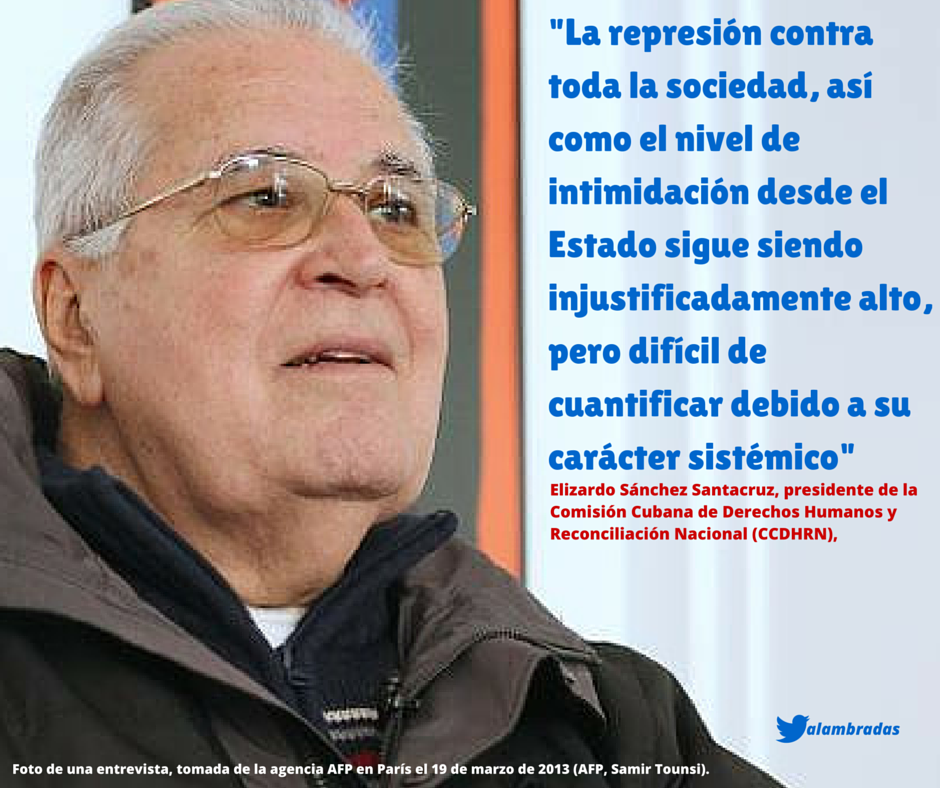
Elizardo Sánchez. Photo taken during an interview by AFP in Paris on 19 March 2013 (AFP, Samir Tounis). “The repression against all of society, as well as the level of intimidation from the state, continues to be unjustifiably high but difficult to quantify, given its systemic character.” –Elizardo Sánchez Santacruz, president, Cuban Commission on Human Rights and National Reconciliation (CCDHRN).

Luis Felipe Rojas, 28 March 2016 — With mouths agape and arms extended to the heavens, Cubans of goodwill are still awaiting the night on which Raúl Castro will liberate all political prisoners and fling into the garbage can that judicial aberration which is the current Penal Code.

Meanwhile, Elizardo Sánchez Santacruz, president of the Cuban Commission on Human Rights and National Reconciliation (CCDHRN) continues documenting–with an artisan’s meticulousness and well-sharpened pencil–every blow, act of repudiation, police harrassment, and finally compiles the details on every Cuban sent to prison under obscure circumstances that appear to be politically motivated. continue reading

CCDHRN published–mere hours after Castro’s misstep during the March 21 press conference with Barack Obama–a current list of Cuban political prisoners, including first and last names, detention dates, charges, sentences, and a few observations. CCDHRN provided the current list to 14ymedio two weeks prior to when the organization had planned to release its regular update; the General’s slip-up motivated them to issue an advance report.

There are 89 political prisoners. The flimsiest causes could end up being up charged with aggression after having bean beaten with military force, or receiving a years-long sentence for an indictment of public disorder following an act of repudiation–if one takes into account that the state’s case is based on the fact that activists are labeled as ones who provoke “the impassioned public” with their peaceful protests.

“The most frequent crimes for which government opponents are imprisoned are contempt, pre-criminal social dangerousness, resisting arrest, disobedience, or attack. If at the moment when a citizen is detained there is any violence, trying to block the blows with his hands can be interpreted as resistance. If in the scuffle the detainee elbows a police offider, this is considered an attempted attack,” Sánchez explained.

Throughout the 2000s I visited the CCDHRN headquarters in the Miramar neighborhood on several occasions, to have a drink of water, or to access books and magazines banned by the regime. I always witnessed the calls for help coming in from the most diverse points of the country: a lady who cried for her son whose ribs were broken because he pleaded for medical attention; the son of a prisoner of the Black Spring who denounced that his father was not allowed to receive a Bible; an elderly man who described how his brother was sentenced for damage to property, when in fact the government agents banged his head against the door of the patrol car. In all cases, Elizardo documents, takes notes, his “correspondents” gather details in the field, and a final report is issued.

“Give me the list!” shouted the old man of the olive-green oligarchy that day. There is such a list: it has been produced for more than 20 years, and has served such prestigious organizations as Amnesty International, Human Rights Watch, Reporters Without Borders, and governments that have negotiated the final exile of those condemned for differing from Cuban communism.

The list of political prisoners exists–as does the deafness of Raúl Castro.

Translated by: Alicia Barraqué Ellison

Turning the Page / Fernando Dámaso

Fernando Damaso, 4 April 2016 — Given President Barack Obama’s intelligent proposal to leave the past behind, turn the page, and together build a better present, some Cuban fossils have cried to the heavens, or to hell, go figure.

After the Revolutionary War, Cubans and Spaniards, who had fought a bloody war, with real fighting and not mere skirmishes, shook hands, agreed on mutual forgiveness and dedicated themselves to building a Republic “with all and for the good of all.” This was possible because José Martí’s ideas prevailed, a man who always proclaimed love over hatred and rancor. continue reading

Today, unfortunately, the situation is otherwise, because for too many years hatred and bitterness have prevailed over love. The problem is that Martí is unrepeatable. Changing this retrograde and suicidal mentality is very difficult, and will only disappear with the physical disappearance of its defenders.

However, if they acted intelligently and with some sense, they should be concerned because, more than anyone, Cubans also need to turn the page on all the arbitrary acts; division of families; absurd prohibitions; political, economic, social, cultural, religious and sexual repression; the thousands of deaths in the Florida Straits of people seeking freedom and the realization of their life projects; repudiation rallies; beatings; executions; violations of citizens rights; interventions in foreign countries and trying to change governments; and the many other barbarities committed. The blame for Cubans’ misfortunes and miseries  was not only on the other side, but also on this side. The real and supposed lights are not enough to hide their many shades.

These extemporaneous “tantrums” do not help anyone and, much less, those who participate in them. Now is the time to start thinking and acting with the responsibility of adults, setting aside voluntarism and so much accumulated hatred and bitterness, which should not be passed on to the new generations as a supposed “historic commitment.” Let us forget the false and broken prophets and once again put José Martí in the forefront, the real Martí and not the manipulated one.

Fidel Castro Reappears In Public During A Tribute To Vilma Espin / 14ymedio

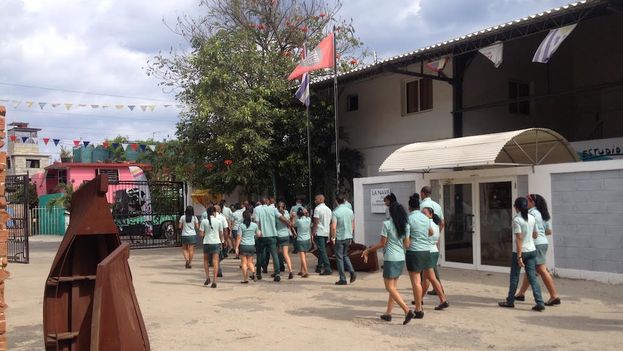
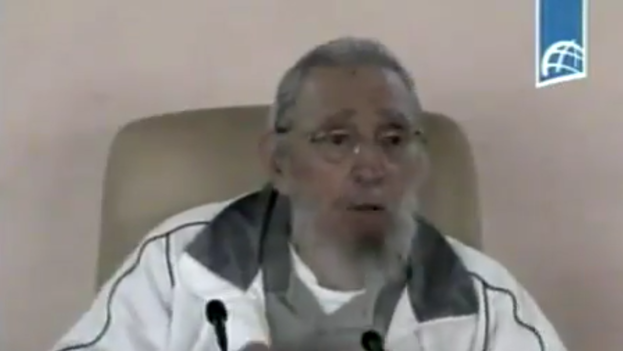
Fidel Castro talks with students and teachers during a tribute to Vilma Espin. (TV)

14ymedio bigger14ymedio, Havana, 7 April 2016 – Former Cuban president Fidel Castro reappeared in public during a tribute to Vilma Espin, the wife of his brother Raul. Primetime television news broadcast images of Castro while he talked to students and teachers of the educational complex in Havana that bears the name of his brother’s deceased wife.

Fidel Castro, who turns 90 in August, participated in the activities of remembrance for the founder of the Federation of Cuban Women (FMC) on the 86th anniversary of her birth. continue reading

Fidel Castro said that “Vilma would be very happy today, because she would see why she sacrificed her life, because he who dies fighting for the Revolution departs leaving their energy on the path and fighting for it.” He added that “for those of us here we consider it a privilege to be in this school today, because this kind of school is approaching a kind of a dream. I tried to remember if I knew of a place where there was a school like this. There is not.”

Vilma Espin Guillois School, in the Havana municipality of Playa, was opened on 9 April 2013, and currently has 43 employees including teachers, assistants and staff. The school has students from nursery school through sixth grade and for the upcoming year is expected to offer secondary education for 60 students.

Fidel Castro has not appeared in public since 9 January 2014, when he visited the studio of artist Alexis Leyva Kcho in the Havana neighborhood of Romerillo for the opening of an exhibition.

A few days after Barack Obama concluded his visit to Cuba, the former Cuban president lambasted him in a “Reflection” titled Brother Obama. The text, often disjointed and nonsensical, was intended as a response to the speech by Obama in Havana’s Gran Teatro, especially against his declaration that he wanted to leave behind “the last vestiges of the Cold War in the Americas.”

Police Prevent Attorney Wilfredo Vallin From Leaving Home / 14ymedio

The lawyer Wilfredo Vallin, President of the Law Association of Cuba. (14ymedio)

14ymedio bigger14ymedio, Havana, 8 April 2016 – On Friday, State Security prevented attorney Wilfredo Vallin from leaving home to participate in a discussion on the Electoral Law. The meeting, to be held at the home of Eliecer Avila, leader of the independent movement Somos+ (We Are More), was hindered by the police who only allowed two of the participants to reach Avila’s home, according to the testimony of Rachell Vazquez, an activist in the group.

From the early hours, the police forces knocked on Vallin’s door in the Diez de Octubre district to warn him that if he left his home he would be arrested. continue reading

The professor was to give the first training course for the promoters of the Otro18 (Another 2018) Democratic Platform, an initiative that is promoting a change in the Cuban electoral system.

Esperanza Rodriguez, the lawyer’s wife and also a member of the Cuban Law Association, told 14ymedio that the police did not allow them to meet their commitment. When they tried to cross the threshold of the building where they live, they found themselves “surrounded by an operation.”

To Vallín it is “obvious” that the authorities want to “prevent opponents participating in the Cuban electoral process.”

The Otro18 campaign, supported by 45 independent organizations within and outside of Cuba, promotes reforms of the laws governing elections, associations and political parties. Represented by government opponent Manuel Cuesta Morua, last week in Madrid the promoters of the initiative requested that the international community monitor the situation on the island because “the reform process undertaken in Cuba must address not only the economy, trade and investment sectors, but also the political sector.”

Coexistence Project Denounces Harassment of its Members / 14ymedio

A gathering organized by Coexistence. (Coexistence)

14ymedio bigger14ymedio, Havana, 7 April 2016 – At least two members of the Coexistence Project have received subpoenas in recent weeks from the Pinar del Rio Immigration Office (DIE), according to a statement made this Thursday. Yoandy Toledo was cited on two occasions to give details about his recent trip to Prague, and Javier Valdes, webmaster of the project’s digital publication, will have to report to the authorities on Friday afternoon.

It is an “explicit violation of the Cuban Immigration Law, which does not establish an interview before or after leaving the country,” complains Toledo, who says that the topics discussed in “the interrogations were never about migration.” continue reading

The young man told 14ymedio that during the second interview the official with a rank of major who identified himself as Pita, “chief of the DIE at the municipal level,” threatened that he would repeat the meeting during the month of April.

Wednesday afternoon, Valdes also received a citation for this Friday at 2:00 PM. Valdez is responsible for the technical issues of the digital site of the magazine of the Coexistence Studies Center. “Right now we are preparing a complaint to deliver to the Provincial Prosecutor where we express the violation of the law and the most basic rights of citizens,” the statement added.

In the afternoon of Wednesday, Valdes also received a citation for this Friday at 2:00 pm. Valdes is responsible for the technical issues of digital site lies the eponymous magazine Coexistence Studies Center. “Right now we are preparing a complaint to deliver at the Provincial Prosecutor’s where we express violation of the law and the most basic rights of citizens,” the statement said.

The publication was founded in February 2008 and bills itself as “a threshold for the citizenry and civil society in Cuba.”

One-Third of Cuba’s PCC Central Committee is Hand Picked With No Process / 14ymedio, Reinaldo Escobar

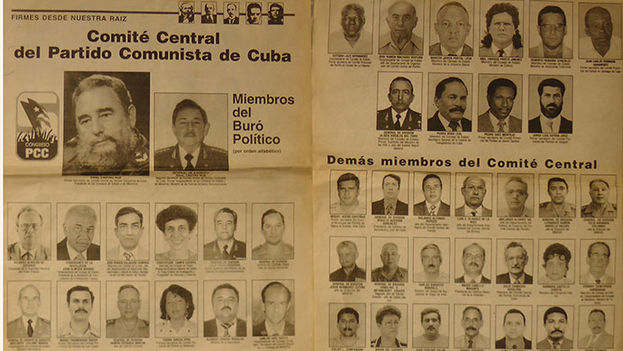
Pages from the newspaper Granma with some members of the Cuban Communist Party Central Committee elected at the 5th Congress

14ymedio, Reinaldo Escobar, Havana, 8 April 2016 — In a country where, under the fifth article of the Constitution, the Communist Party is “the highest leading force of society and the State” members of the Central Committee of that organization should be known by all citizens and, of course, access to the highest authority should not be covered by any veil of mystery.

However, only a few remember the last time there was a formal election of the membership to this group, on 10 October 1997, just before the closing of the 5th Party Congress. At that conclave 150 members were elected. In the slightly more than 18 years since then, there have been 29 deaths and 36 separations, some of these latter as a result of disciplinary sanctions and others because the militant ceased to hold, for different reasons, the administrative or political post that warranted their membership on the Central Committee. Currently, there are only 42 members of that group of 150 remaining. continue reading

But the numbers still do not add up. The data presented here have been amassed by Julio Aleaga Pesant, who has spent years organizing a magnificent collection of names under the ambitious title: Who’s Who in Cuban Society?   The analyst has had the patience to fight against the government’s secrecy and find all references in the national and provincial press which mention a person’s name with his or her position.

Clearly, Aleaga inherits the errors and imprecisions of those official reports. Not all sanctions appear in the press and many die without an obituary. This is why there are 43 doubtful cases without any notices, at least in the last five years. They involve “compañeros” who ascended to the highest partisan level because it was necessary to have the chief of some sugarcane cutting brigade there, or the head of a municipal bureau, or a member of an agricultural contingent. As the media never focuses on their names, it is probable that in some of the cases we don’t know how to respond with exactitude regarding whether or not they are members of the Party Central Committee, if they are still alive, and if they remain in the country.

In these almost 18 years, 51 other Communists have joined the PCC Central Committe, but in that time there has not been a formal process of elections as God commands, i.e. as established in the statutes. Thus names like Miguel Barnet, president of the National Union of Writers and Artists of Cuba; Gladys Bejerano, who heads the Comptroller of the Republic; Joaquin Bernal, newly-appointed Minister of Culture; Guillermo Garcia, a commander of the Revolution who was elected at the First Central Committee in 1965, but was not included in the elections of the 5th Congress.

None of them was proposed from the base; they did not come up from the ranks.

New wine has been filling old wineskins without these nominations involving the Party base, such that now a third of the members of the highest decision-making body has been handpicked from above.

The Seventh Party Congress has before it the task of renewing the Central Committee. Among the other things they will have to discuss the controversial issue of age, as it is not healthy for any organization to have in its membership individuals who do not have the physical ability to spend at least 10 hours a day resolving problems.