Somos+, Javier Cabrera, 1 April 2016 — Yesterday the news came out in various media: Ultra-secret information has been stolen from the Cuban Ministry of the Interior. The poor proclamation “Raúl’s Sovereign Technology” showed itself more focused on censorship of content and limiting communication than on constructing a true plan of security in the service of the nation.
It’s not the first theft of confidential information, although the previous ones were by citizens and not directly by people in the military, like the surveillance videos in Havana or the telephone directory of the state phone company ETECSA. The absurd pledge of reinventing technology has ended up being, as expected, manipulation. continue reading
State Security, formerly considered one of the most efficient bodies, has succumbed to ridicule. The absence of generational relief to conserve jobs and benefits, the government secrecy and the absurd plan of creating technologies that are dedicated only to counteracting the bad reputation of the “Revolution” in the digital world, such as in this blog, have produced fruits, although they aren’t the ones hoped for.
The Internet and technology are not re-inventable. It’s not necessary to adapt technology to Cuba, but for Cuba to enter with full force into technology. It’s not a matter of creating professionals to work in offline businesses, repair computers or traffic in movies, but of forming true leaders in digital businesses that generate quality employment at all levels.
While this change in mentality doesn’t happen, it’s more than probable that this isn’t the only case that scares the analog government of Havana. I’m very curious to know if Raúl will defend the rights of a “Cuban Snowden” when he’s presented to public opinion with the same arguments as the North American analyst.
Mr. President, permit me to welcome you, on behalf of all computer engineers, to the Twenty-First Century.
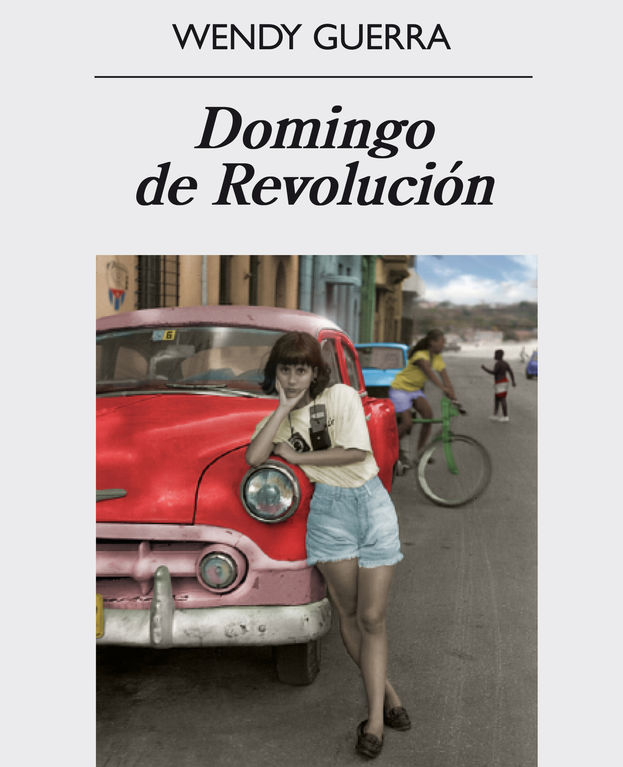
The cover of the book ‘Revolution Sunday ‘ by Wendy Guerra
14ymedio, Zunilda Mata, Havana, 1 April 2016 — With strong autobiographical overtones, Wendy Guerra’s latest book tells the story of Cleo, a young poet and storyteller residing in Havana living under the supervision of the publishing authorities and State Security. With a work published abroad, the protagonist ofRevolution Sunday (Anagram, 2016) is charged by the Ministry of Culture with being an author built by “the enemy” and is under permanent suspicion of being “an invention of the CIA.”
Guerra has commented that the character is inspired by a writer of her mother’s generation, the poet Albis Torres, who lived among microphones and ghosts. Many writers on the island “are going to laugh and cry” as they read this novel, the author of this novel told 14ymedio. Guerra is also the author of Everyone Leaves and I Never Was First Lady. Cleo is a compendium of memories of several generations of silenced artists continue reading
“in a closed society,” she says.
In the midst of writing the novel, Guerra found herself surprised by the announcement of the reestablishment of relations between Cuba and the United States. The author incorporated some of these events in the book, which she describes as “a historical novel” given the importance the political environment plays in the plot that runs through the story.
The book explores the conflicts generated by distrust and paranoia that run through a society where, for decades, everyone is afraid of everyone. While Cleo is considered among many intellectuals to be an infiltrator from the United States secret services, for others she is a skillful agent of Cuban intelligence, planted to give the idea that there is publishing tolerance in Cuba.
With a work prohibited and ignored in Cuba, Cleo finds success as a storyteller because her books are published and read outside the island. Her work is translated into several languages and she is seen as a chronicler of the failure of the revolutionary process. The volume explores the Cuban tragedy with sensitivity and humor, confirming Wendy Guerra as an indispensable writer in the panorama of contemporary Cuban literature.
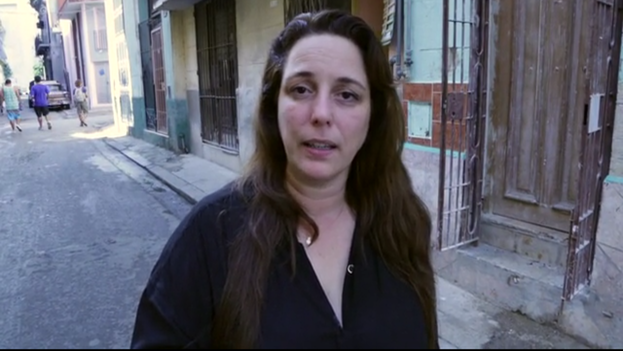
Tania Bruguera in the fundraising video for the Hanna Arendt International Institute of Artivism
Kickstarter campaign will fund “civic and artistic alternative to the emphasis in Cuba on money as the unique salvation to the problems of the country”
14ymedio, Mario Penton, Miami, 1 April 2016 — When in late 2014 the Cuban artist Tania Bruguera attempted to stage her performance of Tatlin’s Whisper in the Plaza of the Revolution, she felt firsthand the repression and censorship to which all voices who dissent from the government’s cultural guidelines are subjected.
Bruguera, who defines herself as an artivist, has created the Hannah Arendt International Institute of Artivism (INSTAR), with a site in Havana that, in the words of its founder, “will be a civic and artistic alternative to the emphasis in Cuba right now on economic projects, and with money as the unique salvation to the problems of the country.”
“We are at a moment when the Cuban government is not concerned about preserving the ethic principles and social justice that we seek to defend because there is no national project,” commented the artivist to 14ymedio.
In her opinion, the Cuban government is currently engaged in consolidating their personal economic power, with which they will also guarantee their permanence in political power. Cuba is caught between a civic and an ideological crisis because there is no long-term strategic vision for the country.
According to Bruguera her motivations for creating this campaign are based on the observation of Cuban reality. “We are accepting as normal corruption on the part of institutions and the citizenry. There is a calculated government effort to ensure that citizens do not feel empowered, because they are afraid,” she says.
The institute seeks to place Cuba’s future in the hands of Cubans, affirming that asking for their rights cannot wait until everything is decided and irreversible. “The time to intervene in Cuba’s future is now.”
The use of crowdfunding as a financing mechanism is an important element of the campaign with regards to money, which “is a very sensitive topic for Cuban projects.” This method, according to Bruguera, is democratic, because it forces the project to serve the citizenry and is a real commitment if one truly desires change. In addition, the artist added, INSTAR will be transparent with its accounting, showing where its financing comes from and where it goes, something it is hoped will spread to other civil society groups and to the government “as a part of their own working strategies.”
With seven days to go in the campaign, it has already exceeded its goal of $100,000 from almost 700 donations. The money will be used to purchase the equipment needed to carry out the project in Cuba, as well as to pay artists and fund the necessary logistics.
The citizen education workshops will be developed based on the demands of the participants, who the organization hopes will come from the entire political, social and cultural spectrum of the nation, under “the principles of transparency, respect and equality that govern INSTAR.”
The artivist summarizes the strategy of the institute in three actions: “Longing, Thinking and Acting. We want to convert ideas into civic action.” The desires and complaints of the participants will lead to the discussion of existing alternatives, presented by national and foreign guests, and the most realistic way of implementing them. Finally they will be put into action, “mobilizing and visualizing them with the creativity of the activists and artivists.”
Cuban State Security has begun pressuring those linked to the project. The permits to finished preparing the site that will house the institute took eight months to acquire, and the project manager charged with completing the construction asked them not to call him any more because State Security had “been to see” him. “We know we will be under a great deal of pressure because this project signifies a peaceful solution and achieving a civic education,” comments Bruguera.
Despite government barriers, Bruguera isn’t considering wavering in her intent. “Art committed to social activism is the path we have chosen for INSTAR as a relevant institution in the conquest of Cubans’ civil rights and for its direct impact on everyday life,” she concludes.