Cuba, A Broken Toy / 14ymedio, Reinaldo Escobar

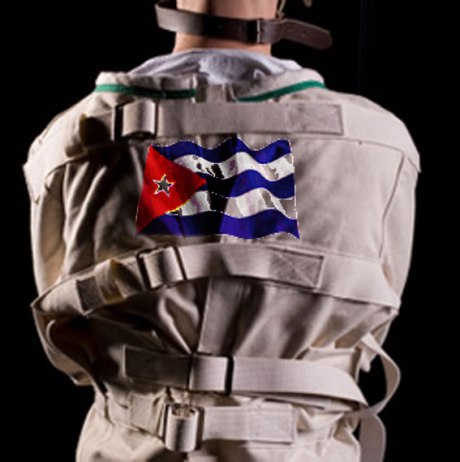
Like the spoiled child who wants his turn with a toy to last forever, Raul Castro intends to remain in office until 19 April 2021. (CC)

14ymedio bigger14ymedio, Reinaldo Escobar, 17 April 2016 — Among the many expectations raised by the Seventh Congress of the Cuban Communist Party (PCC) was the possibility that the expected generational change would be announced there. The prospect that young cadres would introduce bold changes and accelerate the timid reforms initiated with the departure of Fidel Castro from power, fed by the expectations among Cubanologists of different viewpoints.

Perhaps that is why, when the general-president proposed that the maximum age for joining the PCC Central Committee would be 60 and to hold senior posts one would have to be under 70, many had the momentary impression that the rule would begin to be applied at this Party Congress. Only a more sedate reading, stripped of all irrational optimism, was able to untangle the ambiguity of his words. continue reading

Raul Castro, First Secretary of the PCC, acknowledged that “the next five years, for obvious reasons, will be decisive.” Hence, the need “to introduce additional limits on the higher organs of the Party.” However, he declared that this would be a “process of transition that should be undertaken and concluded with the celebration the next Congress. Leaving for the future, “a five year transition so as not to rush things.” A phrase that reinforces Castro’s oft repeated premise of acting “without haste but without pause.”

The “additional limits” on age to be appointed to “the higher organs” had already been introduced, although not disclosed, at the first PCC Conference in January of 2012, when the concept of age was added to those to be taken into consideration at the time of filling leadership positions.

To Raul Castro it seems that having delayed four years and four months in defining the numbers that would mark the age limits would have been “not rushing things.” Although it is probable that his real concern has been that the Central Committee elected at the current 7th Congress would naturally dispense with the so-called “historic generation of the Revolution.”

The only obvious reason for not passing the baton in this Congress is reduced to an unhealthy addiction to power, especially to its obscene attributes of privileges and powers.

Like the spoiled child who wants his turn with a toy to last forever, the first secretary intends to remain in office until 19 April 2021, when he’ll be just 45 days short of officially becoming a nonagenarian.

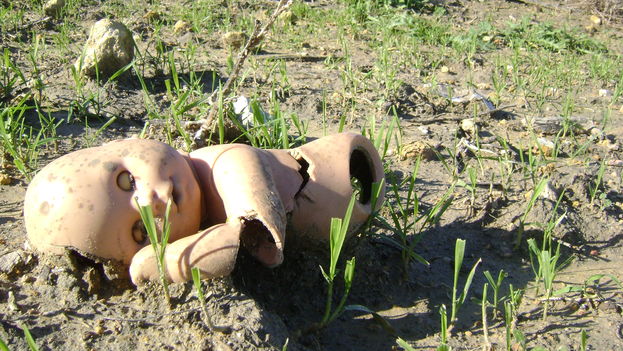
By that time, should he survive, what would be left of the instrument of his amusement could be an useless wreck, and we’re not talking about the Party but about the country: a toy broken beyond fixing through the attempts to make it work capriciously. The blame for its destruction will then fall on those who inherit it.

Mario Vargas Llosa: The Liberal Rebel / 14ymedio, Mauricio Rojas

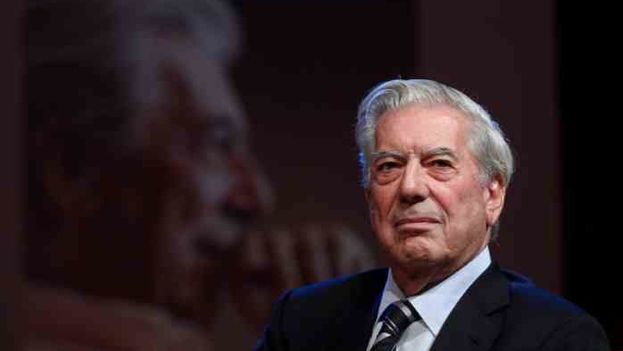
The writer Mario Vargas Llosa, winner of the Nobel Prize for Literature. (EFE)

14ymedio, Mauricio Rojas, 17 April 2016 — On 28 March Mario Vargas Llosa turned 80 and wanted to celebrate with a brief reflection on his political thinking and, in particular, his form of being a liberal. For this I want to start from two great French thinkers who played a key role in his intellectual development: Jean-Paul Sartre and Albert Camus.

Sarte, who was a great cultural hero for the young Vargas Llosa, did not stand the test of time. His dialectical artifices were not, in the end, capable of justifying the unjustifiable, that is, the supposed distinction between “progressive oppression,” undertaken in the name of a future paradise on earth, and oppression, plain and simple. However, Sarte did survive in the idea of a writer committed to his time, who takes sides, who is not silent, who doesn’t look away. Nothing is more foreign to Mario Vargas Llosa than indifference to his world. continue reading

This attitude has been a touchstone in a life in which politics has never been absent. This does not mean confusing politics with literature, essentially different activities, which Vargas Llosa himself never tires of explaining: the writer, the artist in general, starts from the sovereignty of his imagination to forge “real unrealities,” fictions so convincing that we experience them, for a moment, as reality. Those who engage in politics, on the other hand, should take care not to fall into political-fiction and do great damage, starting always from the sovereignty of what is really possible.

I now turn to Albert Camus. I associate him with that rebellious streak that, in my opinion, makes Vargas Llosa who he has always been. Rebellious in the sense of Camus, that is, one who does not accept indignity, injustice, oppression. Who says no and stands up to tyrants of every kind. The rebel is not a revolutionary who dreams of earthly paradises or new men. No, the rebel acts for the men we are, that imperfect and limited being, like all of human society that we can construct. But it no case does he resign himself to what we are versus what we can and must be: dignified, respected, free.

Vargas Llosa’s rebellious streak has resulted in what has been his most constant struggle, his true existential predicament from childhood: his strong, visceral opposition to authoritarianism, tyranny, dictatorship. He himself has expressed it better than anyone on several occasions. As an example I took some of his words from a conversation with Enrique Krauze:

“If there is anything I hate, that disgusts me deeply, that outrages me, it is a dictatorship. It is not only a political conviction, a moral principal: it is a gut feeling, a visceral attitude, perhaps because I have suffered many dictatorships in my own country, perhaps because from early childhood I experienced first hand this authority that imposes itself with brutality.”

I think I do not exaggerate when I say that very little in the life of Mario Vargas Llosa would be comprehensible if we don’t consider this aspect. To write, as he reminds us in his memoir A Fish in the Water, was also an act of rebellion before “this authority that imposes itself with brutality,” a vital act of resistance facing, in this case, the violence of his father in demanding that dignity and freedom that we are owed and that we owe every human being.

Hence, an absolute repulsion toward all tyrants. From General Odría, the Peruvian dictator whose regime marked Vargas Llosa’s youth, to the dictators and caudillos of the left and right who have marked our time, be they Brezhnev or Pinochet, Castro or Batista, Chavez, Khomeini or Qaddafi.

This consideration allows us to address the very nature of Vargas Llosa’s liberal thought, what he has called “integral liberalism.” This is something absolutely fundamental, as it distinguishes and denounces the suicidal temptation of a certain “liberalism,” not uncommon in Latin American, to reduce that expansive tree that is freedom to economic issues.

This does not mean that Vargas Llosa devalues the fundamental importance of an economy based on freedom, one that has allowed, as it has recently been extended across almost the entire planet, a higher standard of living for human beings in a way never before seen. This is clear, and provokes the ire of those who believe that, at least with regards to the economy, freedom is not our best option. But this does not mean transforming this freedom into the only thing worth defending, or into a kind of superior freedom before which other freedoms must prostrate themselves.

Taking this position has led Vargas Llosa to define liberalism in a way that reminds us of the most original, Hispanic, sense of what it means to be liberal, that which Octavio Paz recalled in 1981 on receiving the Cervantes Prize: “The word liberal appears early in our literature. Not as an idea or a philosophy, but as a temple and an encouragement; more than ideology, it was a virtue.”

This virtue, this form of being liberal with which we identify ourselves, as Vargas Llosa said in a text where he reclaims the intellectual heritage of Ortega y Gasset, is “based on tolerance and respect, in a love for culture, a desire for coexistence with others, with the other, with others, and a firm defense of freedom as a supreme value.”

A Chef on the 14th Floor / 14ymedio, Yoani Sanchez

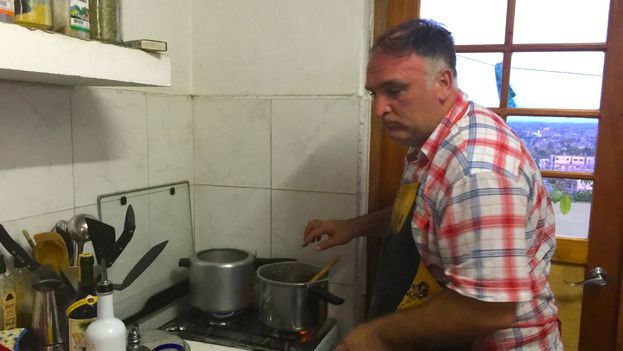
The chef José Andrés cooking in the kitchen of the 14ymedio newsroom. (14ymedio)

14ymedio, Generation Y, Yoani Sanchez, Havana, 18 April 2016 — José Andrés arrived in Havana at the best and worst moment of the year. One of the most famous chefs in the world knocked on the door of the 14ymedio newsroom the same day that Barack Obama was saying goodbye to the Cuban people. The shortages in the markets were an incentive rather than an obstacle for the Spaniard who moves easily between the glamorous kitchens of Washington DC and the wood fires of an impoverished Haiti.

In his fingers, each ingredient becomes pure magic. “What do you have?” He asked. And the answer reflected this period of empty shelves in stores. However, the art of cooking is to combine precisely what there is, the ability to convert the little one has at hand into have something marvelous for the palate. continue reading

In Cuba you need to be more alchemist than cook to turn out a tasty dish.

There he was, in our newsroom, this Paracelsus of the stove. “What do you have?” He asked again. Very little. Since early this year, with the price increases imposed by the government on many of the food markets and the absence of goods in the stores that sell in hard currency, it is difficult to buy everything from a cabbage to a pound of chicken. On the shelf, a package of Russian oats, scored in 2010, lights up the eyes of chef José Andrés. “We are going to do something with this,” he boasts.

Uniting the elements – including some he had bought under the counter in the streets of Havana – he turned a few somersaults and emerged from the kitchen with steaming and unique dishes. The great chef had climbed to the 14th floor to create an unforgettable dinner on a historic day.

A Dinner in Havana / 14ymedio, Jose Andres

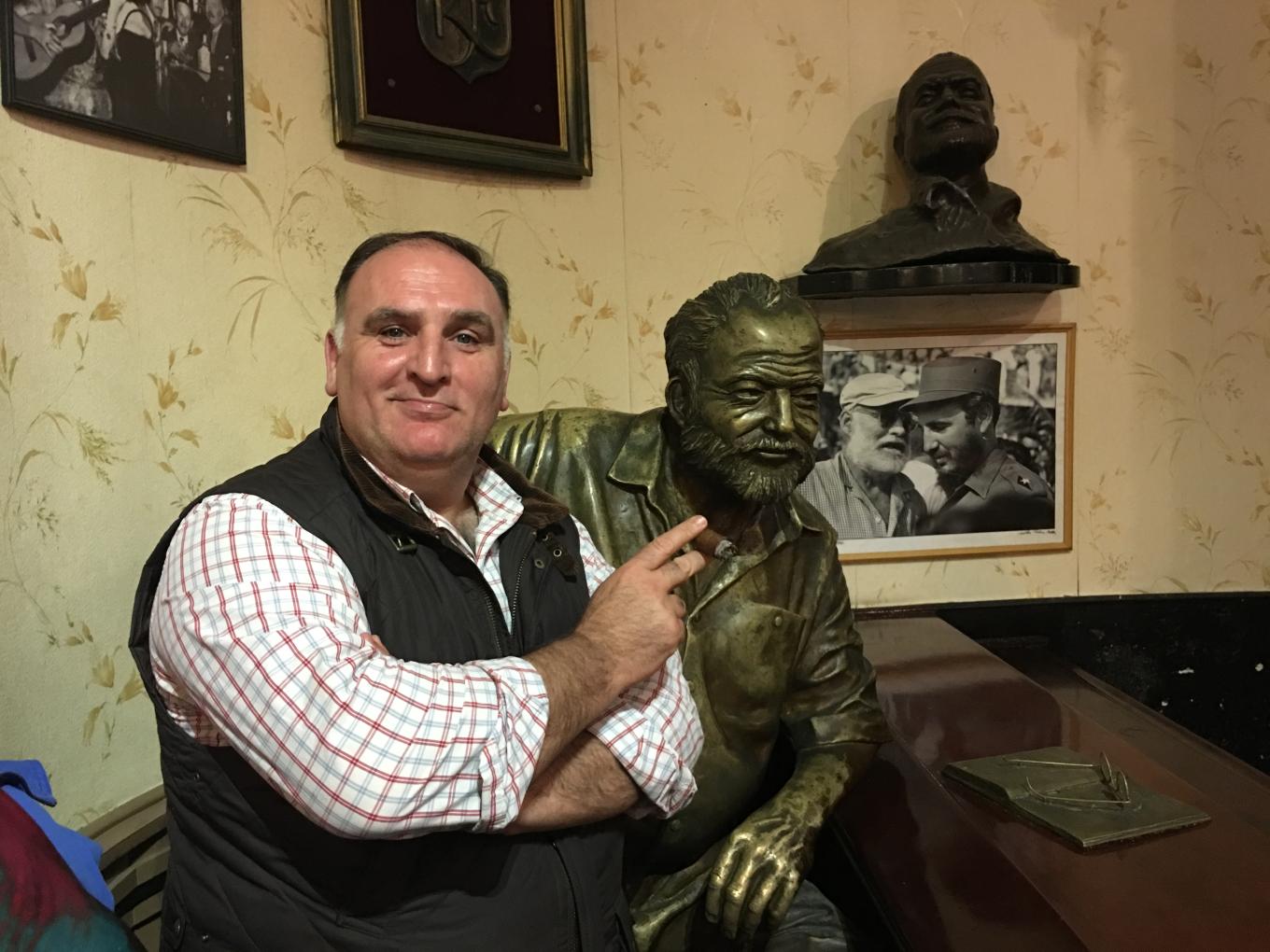
Chef José Andrés with "Hemingway" at El Floridita in Havana (Photo: José Andrés)
Chef José Andrés with “Hemingway” at El Floridita in Havana (Photo: José Andrés)

14ymedio, Jose Andres, Washington, 17 April 2016 — I was smiling. My sunglasses were lying beside the book on the bar. I turned around, as if I were coming back to reality, when I felt a hand on my back. I had just finished my sixth daiquiri in less than half an hour. The waiters serve them faster than you can drink them. Even so, I was not going to return to reality. I was just another tourist vying for a highly sought-after picture with Ernest Hemingway. I was a trophy hunter, trying to take a selfie, set on getting close to his statue in the corner of El Floridita bar.

El Floridita is a nearly 200-year-old institution of colonial Havana. I felt more excited there than usual. I could hear the music of my anxiety fill the air; the type of music Steinbeck talks about in The Pearl, that describes situations that words cannot. continue reading

El Floridita is now a tourist attraction. Still, I was delighted to enjoy the same setting that Hemingway did seventy or eighty years ago. The bar was full. Live salsa music filled the air. A few tourists, who did not have even one drop of rhythm flowing through their veins, were in denial about their dancing. Silly people. Decadence. What I really could not understand was how people could line up at the bar drinking daiquiris with a straw. A straw? Could you imagine Hemingway ever using a straw to drink a daiquiri? Never.

I raised my hand. Fidel, the bartender, was more than willing to please me with my seventh daiquiri. I took the straw out and asked him to add a little of the best rum they had. Fidel then poured a beautiful dark brown molasses-smelling liquid on my pale frozen citric daiquiri. I carefully lifted the glass to my lips and took a sip. That is how you are supposed to drink a daiquiri at El Floridita.

El Floridita’s chef finally arrived with a plastic bag. I had asked him to sell me some Brie, blue cheese, and a bottle of virgin olive oil. These ingredients are not easy to come by in Havana, so therefore, it was best if I asked a cook. But he has brought me something more than I expected. When I looked in the bag, I saw lobster tails. I then took another drag from my Cohiba Behique cigar. It was my fourth cigar that day, and it was only 6:00 PM.

I smoked three more cigars at the baseball game. Cuba and the United States were becoming friends through sport. It was a historic moment, a great moment. Perhaps this signals a change in the lives of many people. The joy was so intense that you could feel it.

I again glanced at the lobsters, and then took a sip of my daiquiri. Yoani Sánchez, my accomplice and host for that evening’s dinner, had asked me not to bring anything. She said: “It’s better that way.” What did she mean by that? During the last four days I had been trying to reach her. In the best of cases, Wi-Fi in Havana is spotty. When they do work, communication devices are very slow. That is why two days earlier I ventured late at night to her apartment in a fourteen-story concrete high-rise in the far off the tourist track Nuevo Vedado neighborhood. I decided to try my luck. It was 11:00 PM, and the street was dark. It was a fourteen-story building. I had no luck because no one opened the front door. After thirty minutes, no one came in or out. Since I was not able to call Yoani, I had no access to the elevator that would take me to her home and office. So I left.

Yet today was different. Now I had an invitation and a specific time I should be there. I grabbed the two plastic bags, the cheeses, the olive oil, and the lobster, and stored it all in my black backpack. I sipped my last daiquiri, and kissed my cigar goodbye.

I got in a taxi. I thought it best not to call any attention, so I wore the Cuban national baseball team t-shirt, with its beautiful shade of blue. I was also wearing a baseball cap. When we finally got to Yoani’s street, I told the driver to let me off where it starts off. “I’m going by foot,” I said. I wanted to walk. I wanted to get there on my own. But I did ask him to wait for me. Yet for how long? Maybe thirty minutes or a few hours, since I was not sure. I left a bag of t-shirts I bought for my daughters with him. That is how trust works: when you show it, it is reciprocated.

Protruding overgrown tree roots have cracked the sidewalks over the years. This is a good indicator of who is in charge of things. I twisted my ankle. I felt the pain for a second, but the excitement served as a good antidote. I suppose the daiquiris helped too.

At last, I arrived. I saw a man heading towards the door, and I followed him in and entered the elevator. I was going to the fourteenth floor, but there were only thirteen numbers. I did not want to ask why. I wanted to appear as if I were from there, especially after hearing so many stories about the police, informants, and dissidents thrown in jail.

My host Yoani is an independent journalist. She is renowned for her ability to use technology to let the world know what is happening in Cuba. Once I was on the thirteenth floor, I saw a narrow staircase leading to the fourteenth. Wonderful! The fourteenth floor did indeed exist. I reached a locked metal door, and rang the bell. A man came out and asked: “Are you José?” Was that the password? I said I was. Although we had never met, he opened the door, and gave me a bear hug, as if I were a long-lost friend.

I finally entered the apartment. Yoani was there, and all of her staff broke out in applause. I had met Yoani only a year earlier in Washington, D.C. Her stories about Cuba, her fight for freedom, and the difficulties that Cubans have to endure everyday in order to survive all resonated in my mind. I had promised to visit her someday, and I was finally there. Yet I was not in an apartment. It looked more like a newsroom.

I did not understand why all the applause. Perhaps it was due to the pictures I had sent Yoani from Obama’s entourage, since I had been invited on the trip as an official culinary ambassador. Or maybe it was the photos of business leaders with Obama, among others, that I had also sent her. These pictures were not sent directly to Yoani. Instead, they were forwarded to Miami, and somehow, they made it back to Cuba. I was counting on the idea that dining at Yoani’s during Obama’s visit would give me a different perspective on these events. Still, I felt like I was just visiting an old friend.

Yoani and her team kept moving in and out. The air smelled of baked chicken and oregano coming from three small chickens in the oven. The seemingly endless conversation went from one topic to another, from family matters to paladares, from Obama to beer, to ice… I prepared a soup of oats, Brie, chicken stock, and powdered chicken soup. Yoani explained that Cubans like big portions. They are hungry and stressed. So whenever they can, Cubans like to feast.

Yoani had just finished making a waffle in an electric waffle iron. Since it is such a small kitchen, creativity is a necessity. Still, a waffle at 8:00 PM? So I asked “Why not bread?” The staff replied: “There’s no time for bread. We’re too busy.” This was true, since Yoani had just interviewed Ben Rhodes, Obama’s national security advisor. It had been a very important day for her. She had gone from dissident to being in the presence of a man very close to the President. Yoani told me that she had even dared to ask Obama for an interview. “If you don’t dream, you don’t accomplish anything,” she said.

The 14ymedio staff was indeed hungry. They devoured the Brie and Blue Stilton cheeses I placed on the table.

There were only two waffles. I dressed them with margarine, the blue cheese that was left over, olive oil, salt, and pepper. I used the salt Yoani brought back from her last trip to Washington. She is proud of all the spices she has. Not all Cuban households are that lucky.

The pizza waffle was just too small, and we had no flour or eggs to make more batter. Still, the team seemed to like what we had. In Cuba we like big portions, José. But there was not much more I could do. There was only one Jesus Christ.

The chicken was ready. I cut it up in small portions, and sprinkled it with oregano and its cooking juices, and I brought it to the table. Everyone in the room was smoking, drinking rum and beer, and chatting.

Next, I served a dish made from the lobster I had brought with me. I used the part of the tails closest to the lobster head. I dressed it lightly with olive oil, chopped lettuce, and vinegar. I was lucky. The 14ymedio team thought they had nothing to cook, but I am a kitchen survivor. I learned how to work with a small kitchen on a ship of the Royal Spanish Navy, without gas, without ingredients… We cooks are like Jesus Christ. We can multiply anything.

It was time to put the frying pan with the leftover grease in the sink. However, the chicken juice and the burnt skin stuck to the bottom were ingredients that had to be saved. I relit the stove, added a glass of rum, and scraped the bottom of the pan. I added the tomato paste that was guarded as if it were a consecrated communion host. I added water and I let it boil. There was a little chicken broth left. I added the water left over from the lobster ceviche. A pinch of garlic. The pasta was ready. Half an hour earlier, I had been frying spaghetti in the pan. If one is not careful, it tends to burn. The stove seemed to give off a live flame, under control, and well mannered; a soft flame, like a whisper. As I toasted the pasta, Yoani told me about an article on Obama’s arrival in Cuba. Since it was a rainy day, he exited Air Force One holding his own umbrella, as he sheltered himself as well as Michelle from the rain. This is in marked contrast to Cuban government officials, who have others hold their umbrellas for them. This is another example of what freedom is like.

My dish was ready, or so I thought. I assumed it was the worse one I had ever made.

I put the toasted pasta and the small lobster medallions in the oven so the top part would be crunchy. If anyone saw me do this in Catalonia or Valencia, I would end up in jail. Nevertheless, on that long, messy table, full of dishes holding chicken, glasses of rum, and beer cans, we made room for the platter.

It was well received. We talked about how Cubans can end up in jail if they are caught with lobsters. Lobster trawlers are not allowed so that no one can escape the island. They would be too much of a temptation. The diners ate everything on their dishes. My cook’s ego was saved. This time, no one mocked me with that same old mantra, “Cubans like big portions, José.”

Yet the evening was not over. Yoani enjoys the drink I made for her last year in Washington. Called “cremat,” its ingredients are coffee grains, cinnamon, lemon peels, and rum that has been lit on fire. However, there were no lemons or limes, an oddity in a climate perfectly suited for citrus fruits. I suddenly felt guilty when I thought about how many limes were used for my daiquiris. So then I went on to narrate the story of the Catalonian sailors who returned home after the war between Spain and the United States in Cuba, and other places.

Spain may have lost the war, however, special drinks and traditions were created because of it. I started singing a Habanera, which in Catalan goes “El meu avi se’n va anar a Cuba…” (“My grandfather went off to Cuba…”). And by the light of the burning rum, we all sang together.

Editorial note: In 2011, the James Beard Foundation named José Andrés the nation’s most outstanding chef. Time Magazine has called him one of the one hundred most influential people in the world. Mr. Andrés is a globally recognized culinary expert.

Translated by José Badué.

The Expendable Revolution / Néstor Díaz de Villegas

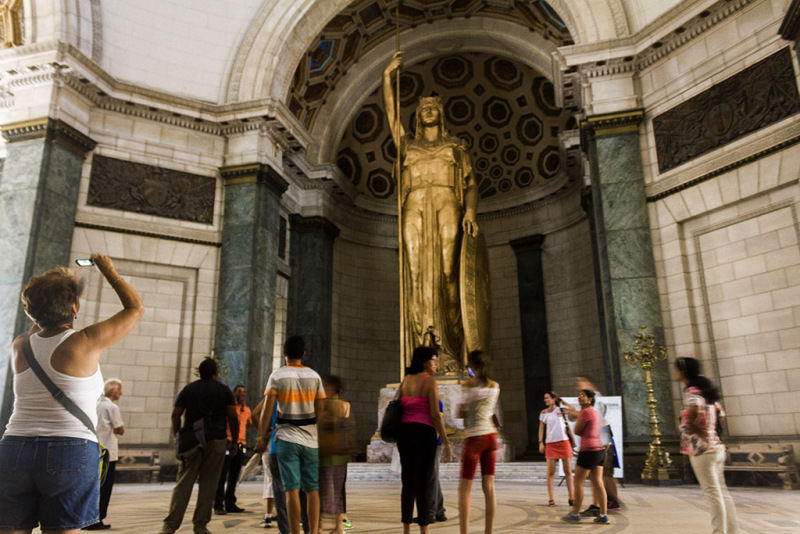
Inside Havana's newly restores Capitol building
Inside Havana’s newly restores Capitol building

Néstor Díaz de Villegas, 17 April 2016 – Once upon a time I made the mistake of thinking that the Revolution – I’m speaking about the Cuban Revolution – was indispensable, that its advent had forever altered the course of History. Today I am reflecting on what would be its fundamental contributions, the (let’s say) Grundlagen of the Cuban Revolution, and I find I can only think of three, precisely those that are rarely taken into account by historians.

The current state of affairs – with regards to what concerns the end of the Revolution – has provoked the most diverse opinions, but I think that the greatest lesson, the scandalous lesson of the terminal stage of the Castro regime, is not necessarily its mortality, but its dispensability.

Behold, Castro’s Revolution turned out to be expendable. Looking at the American Revolution, the French Revolution, or even the Fascist one, we see that the Cuban one is not an event in the same category. It is impossible to conceive of the world without the American Revolution, but the Cuban Revolution disappears from the map and nobody cries. continue reading

It leaves behind nothing essential, nothing permanent. It falls, in its Reaganesque way, into the Dustbin of History, and into the storeroom of ideological curiosities and nobody cares – or perhaps it will be dealt with as a Caribbean thing, or as an item in a catalog of personal adventures.

It has been tremendously easy to get rid of it. The CIA was right: it required the death of Fidel Castro, his physical elimination through a bullet or an exploding cigar, because the Revolution was nothing more than his whim, a Spanish capriccio, the fantasy of the mind of an cunning Spanish hidalgo (cunning in the sense of perfidious), or the nightmare of a Galician bumpkin suffering from Indies fevers.

So the CIA’s plans were fully justified, and now all the remains is to recognize the heroes and heroines who gave their lives in support of this ad hominem argument. Because the elimination of Castro would have brought on the advent of a substitute, a Sancho Panza, several decades earlier and with it what is today known as “Raulism,” which is to say, the transformation of Cuba into Cervantes’ Barataria.

The inconsequential end of the Castro regime brings no fallen walls nor decapitated statues – which would be so 20th Century! – on the contrary, it brings a private funeral to which only the family is invited: the Castros, the Espíns, the López-Callejas, the Soto del Valles, the Diaz Balarts, and the still warm dead.

An Argentine pope with connections to a dictatorship and a president with ancestors in Kenya, decided to put an end to Castroism during a secret meeting in the backroom of postmodernism. Raul Castro didn’t resist, he nodded and gave his consent. After all, he’s just an old Galician who thinks like an old gringo. He knows Castroism died in the geriatric ward without leaving reliable successors. Again it fell to Raúl, the prodigal brother, to find a practical solution to the problem. The laurels of History had wilted and now all that was left was to dust the ferns in the rehab center.

The visible effects of the Vatican conclave are, in order of importance: the “triumph” of Venezuelan opposition in the last parliamentary elections; the delayed but imminent departure of Nicolas Maduro; the Alberto Nisman affair in Argentina and the ouster of Cristina Fernandez de Kirchner and the rise of Mauricio Macri in that same country: events unthinkable without the consent of Havana.

What remains is pure theater: the imperial rhetoric of the Golden Age – which was, after all, our last century – repression as puppet theater, insolence as a tic, and the bands of unemployed leftists to whom the new democratic governments must offer free macramé lessons.

As for the three permanent creations of Castroism, I will try to explain them in as many quick paragraphs:

  1. If Latin America sought a magnetic center where it might implement its literary fantasies, it found it in Castro’s Cuba. Castroism was The Aleph, so its end is the equivalent of the demolition of the house of Carlos Argentino Daneri (in the story by Jorge Luis Borges). One had to go to Havana on a pilgrimage to see the world in a nutshell: Ernesto Guevara (Carlos Argentino) was the first to discover this trajectory, this magnetism. Because Castroism was, during the briefest of times, poetry with a Heideggerian ability to destine.
  2. Castroism is, in addition, the universal development of dictatorship. It fell to Fidel Castro to reinterpret the contents of the Batista regime (education, healthcare, repression, socialism, tourism and spectacle). The Castro ontogeny is just a myth: Castroism sprang complete out of the Republic’s head. The bifurcation of 1959 led to overdevelopment – or inflated development – of what would have happened anyway, although in a different form, under Batista. Instead of classical economic development, Castroism was an archaic antithetical development. The expanding Batista regime migrates to literature, and is resolved there, finding in literature its deferred culmination: in Cabrera Infante’s Three Trapped Tigers, in Lezama’s Paradise, and in Sarduy’s Metamorphosis.
  3. Exile is a Castro construction, a prison enclave where the class production system was maintained with the intention of resupply. The Exile is nothing more than another element of the Revolutionary economic diversification: a “New Economic Policyin partibus. There is no difference between exporting a revolution and exporting an exile. In fact, emigration has been Castroism’s secret weapon. The Castro migrations continued the Latinization of the Empire, a crowning achievement of Cuba’s foreign policy, much like what the vandalizing of national unity was to national policy.

Finally, and as an add-on, I must repeat that Reinaldo Arenas, the greatest Cuban thinker of the last half century, projected into Castroism the symptomatic aspects of his own disease. For Reinaldo, Castroism itself was a plague, the mal du siècle. That is, an intracellular, microscopic and underworldly affair and, at the same time, a cyberimmunological creation: the Fidel Castro virus. Because Castro is every medium, Castro is also the message (in the encrypted, encapsulated language of the retroviral code).

We all carry Castro within.


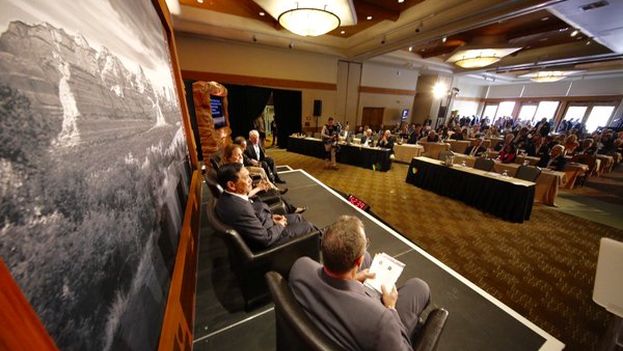
Thinking About America Amid the Red Rocks of Arizona / 14ymedio, Orlando Luis Pardo Lazo

Panel at the Sedon Forum in Arizona last week. (@McCainInstitute)

14ymedio bigger14ymedio, Orlando Luis Pardo Lazo, Arizona, 13 April 2016 — On the 8th and 9th of April, along with some fifty other speakers, I was invited to the Sedona Forum which is organized every year by the McCain Institute in cooperation with Arizona State University. So I flew from the democratic volcanoes of Iceland to fall, almost by parachute, among the rusty canyons of Arizona, whose red stones immediately reminded me of Stalinist aesthetics.

This elite event takes place behind closed doors at the Enchantment Resort, a kind of luxury campsite under Sedona’s cliffs and pristine dawns, where the sky is preserved by lighting technicians to make visible 101% of its stars, constellations, comets and Milky Ways.

I sneaked in there, with no qualifications but Cuba in tow, like a conspirator sect continue reading

, side by side with more than 200 personalities from the elite of American and global politics, including the National Intelligence Director, governors, ambassadors, ex-generals, university rectors, editors-in-chief, CEOs of NGOs, and a dozen senators and congressional representatives.

All were entertained on the family ranch of Republican Senator John McCain, a hero of the war against communism in Vietnam where, incidentally, he was tortured and left with lifetime scars by Cuban hitmen hired by the Ministry of Interior, who killed in cold blood several of his colleagues who were prisoners of war (all of which he told me with a hand on my shoulder and a resolute expression of resignation).

Until the sessions are made public on the website of this conclave, we were asked not to say anything of the men summoned there and their controversial statements. But I can reflect a little now on America as such. That word that, notwithstanding the academic left, remains synonymous with the only functioning and stable democracy in our hemisphere: “America” as an apocope of “United States.”

Without falling into apocalyptic aporiae, the American Union seems to stand, in the spring of 2016, just on the edge of one of those red abysses of the desert where the Sedona Forum took place. The United States desperately cries out for water, its eyes caked with the dry sand of freedom on probation. Between fundamentalism and schizophrenia, between fear and manipulation of the masses, between ethnic tolerance and immigration balkanization, between ghettos and wars, between nationalism and the NSA, between chauvinism and pornography, between correction and criminality, between idiocy and ideology, between capitalism and the lack of capitalists, between isolationism and abstention, between the State Department and its fourth floor despotic populism. Finally, between socialism and the wall.

The sessions included testimonies from Russian and Eastern European activists, for example, and they were chilling. For all of them, Putinism – that Mafioso model that Cuba is implementing today among the tycoons of Cuban exiles and the tyrant Raul Castro – mercilessly assassinated a colleague or loved one. Or both. Some of the panelists in my discussion, in fact, were survivors of violent attacks or the posthumous peace of free doses of radioactivity.

All these champions of human rights – including, by sheer luck, me – can or cannot return to our countries of origin some day, but all of us, within or outside of our Cubitas, face the most brutal impunity of regimes that kill professionally as a state policy. Be it in a “dictatorship” or a “democracy,” we all survive in an eternal state of quotation marks: precarious countries with a fancy for the gallows.

I understood then that the democracies of the world are a race in the phase of extinction and that we have been left very alone, like lost souls, despite the solidarity as symbolic as it is insolvent of the ever diminishing governments and institutions of the free world – where now no one declares themselves free – howling like fatally injured coyotes, or perhaps like characters from Roberto Bolaño: losers who are lost in the Sonora desert, just in sight of the Sedona Forum in new-century Arizona of the end of Europe and the United States.

I shared these 48 hours of voluntary seclusion like a half-silly monk amid futility and philanthropy. Still trying not to set off too many alarms in the debates all about this alarming situation. Still trying to seem like a person with perspectives, facing our fossil future or Fidelity ad infinitum. Still playing at being that Orlando Luis Pardo Lazo who, in the Isle of Infamies, at a party under surveillance even in our most intimate lives, was an incisive and intolerable writer for the system of the rude masses.

In my talk – and hoping not to violate the sub-rosa Sedona code in saying it – I first diplomatically applauded President Barack Obama’s approach to Cuba. It is not us, free Cubans, who rely on censorship and closure, but we are precisely the victims that have suffered it most. But. I immediately confirmed in public my faith in Castroism as a thing intrinsic to Cubans, as a congenital condemnation that defines us before and after Castro.

So. I told them in the English of my childhood – when the United States was, in Cuba, an illusion that everyone believed in, everyone hoped for, everyone supported – that the heart of Castroism is unwavering and that in consequence, it will end up (and this is already starting) criminalizing the Obama administration’s “opening” and its empowerment of our civil society, far beyond the vile greed of the Chamber of Commerce of an ever more un-united Union, and far beyond the terrible Cuban-American betrayal of a nation that was never born.

In other words. I told them, as a devotee of the barbaric nature of the Castros as an incarnation of Cuban complicity which, in whatever variant, America could emerge even more shutout with its “humanitarian” intervention of bombarding us with dollars and hams and computer clicks and cellphones. Although. I also asked them – among the cackle of American laughter and sophisticated sips of wine – for a civil re-colonization, a civilizing interference that finally makes us people and not subjects of a socialism with no way out, neither by ballots nor bullets. I asked them with full responsibility for a reverse invasion of human beings without anthropological damage, while our poor people escape in a suicide stampede. Curtain.

With or without embargo. With or without engagement. With or without internet. With or without repression. With or without political prisoners. With or without a market economy and the Sugar Kings who will come. With or without the rule of law. I told them that Cuba is and will be only a dynastic tyranny in self-transition, as long as a Castro or a Callejas or a Cardinal or a theatrical etcetera of these remains alive: a caste in the throes of perpetuating itself, not from Law to Law, but from Power to Power. And so. Cubans tremble, tremble like enslaved plebeians, tremble both from the opposition and from officialdom before the specific initiative of a plebiscite as a tool of liberation, as has been proposed by CubaDecide.org led by Rosa María Payá.

And I offered them this other little tidbit. Dear little friends, American daddies and grampas: the first Cuban opponent or dissident that is inserted into some little post within the institutional machinery of the regime, be it at the grassroots level in the People’s Power or in the National Assembly itself, before or after the post-totalitarian shebang of 2018, this will not be a Cuban opponent or dissident from any Cuba, but an agent planted not in secret but brazenly by the think tanks of the Ministry of the Interior and its intelligence thugs. Full stop.

Why. Without citizen mobilization and participation, the rights of Cubans – on the island as well as in exile – will remain hostages of our national sovereignty, in the hands of a clan that controls the agenda of the secret pacts where the latest guest of horror has been the White House. Please.

Forgive me, compatriots. I went to the Sedona Forum to talk about despair and left despairing. By the same grace, at a Miami foundation in the summer of 2013, a great magnate almost accused me of “doing the dirty work of the Havana Government.” And a radical counterrevolutionary said the same thing (listen to how good it sounds): “the Havana Government.”

My answer three years ago was the same with which I concluded my plea in Arizona on the afternoon of Friday, the 8th of April:

“Better despair than demagoguery.”

No ‘Privatization’ or Other Political Parties, says Raul Castro / 14ymedio

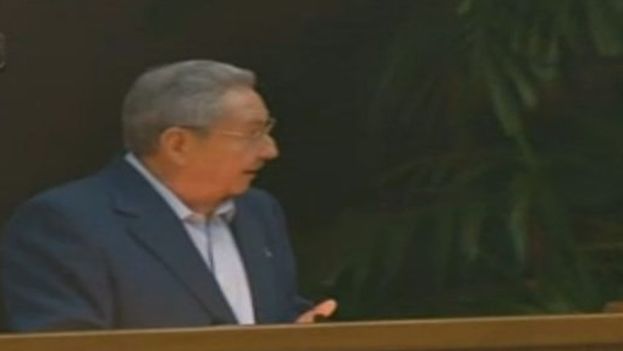
Raul Castro during the reading of the principal report to the Seventh Congress of the Communist Party. (Internet)

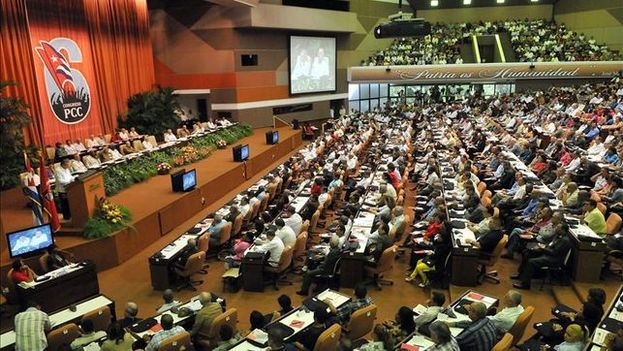
14ymedio bigger14ymedio, Havana, 16 April 2016 – In a room with huge images of Carlos Balino, Julio Antonio Mella and Fidel Castro, the Seventh Congress of the Cuban Communist Party opened in Saturday. Jose Ramon Ventura, Second Secretary of the PCC Central Committee, offered the opening words, in front of 995 delegates – of the 1,000 elected – present at the Palace of Conventions. Five delegates are not participating in the great event, among them the former Cuban president.

A few minutes into the event there was the first unanimous vote, in this case to approve the agenda. Raul Castro gave a speech of a little more than two hours, the main report dressed in civilian clothes, and recalled the days of the Bay of Pigs, emphasizing the role of State Security in this military victory. continue reading

The Cuban president warned that the island will never follow “formulas of privatization” or apply “shock therapy” during the so-called process of updating the economic model. “Cuba can allow itself to apply the so-called shock therapy, frequently applied to the detriment of the most humble classes of society,” he said.

Referring to Article 5 of the Cuban Constitution in which the Communist Party is enshrined as the highest leading force of society, Castro affirmed that “we have a single party and I say that with pride.” The first secretary of the PCC affirmed that “it is no coincidence that they attack us and demand, in order to weaken us, that we divide ourselves into several parties in the name of bourgeois democracy.”

However, for those who speculate that the party meeting will be the stage to announce the legalization of other political forces, Castro emphasized that “if they succeed in fragmenting us it will be the beginning of the end of the fatherland, the Revolution and socialism.”

The president proposed to establish “60 years as the maximum age to join the Party Central Committee,” and also noted that “up to 70 years” would be the time to hold senior Party positions.”

The report detailed that there are 670,344 PCC militants. The reduction in their number was attributed by Raul Castro to demographic reasons, to a policy restricting growth in the organization since 2004, and deficiencies in the work of recruiting and retaining members.

To justify the secrecy and lack of consultation that has surrounded the documents to be discussed during the Congress session, Castro said that unlike the previous Congress when the people were consulted on the Guidelines, this time a popular consultation was not undertaken, because it was a confirmation and continuation” of the line agreed to five years ago.

With regards to the “main course,” announced as a national development plan to the year 2030, which is “the fruit of four years’ work,” it “could not be finished,” declared the president and there would be continued “work on its drafting” which would end in 2017.

Similarly, there will be not discussion of the so-called “conceptualization of the model” but there will be a prior discussion with the participation of the Party militants, the Union of Young Communists (UJC) and the mass organizations, so that later the Central Committee can approve the final version.

The slowness in implementing the Guidelines approved by the previous Congress, of which only 21% have been completed, also found a justification in Castro’s words when he warned that it was known ahead of time that the process “would not be easy.” “The main obstacle has been the burden of an obsolete mentality which creates an inertia and lack of confidence in the future,” he said.

The “socialist state enterprise is in a disadvantageous position compared to the non-state sector,” Castro admitted. The distortion brought about the by dual currency system along with the low-key performance of the economy are the causes “that have not allowed the application of the agreement about improper gratuities and subsidies because a widespread wage increase has not been possible.”

Castro announced a program of “improving the education system” and said that the public health system will be reorganized to “increase its quality and make it efficient and sustainable.”

Calls for “more discipline and exigency” were also heard during the reading of the report because “ears and feet must be firmly planted on the ground,” explained the first secretary of the PCC.

The cold water also came for those who expected announcements about an early reunification of the dual currency system.  The update of the “monetary and exchange rate is a matter that we have not stopped on working on and whose solution will not be left for the twelfth of never,” explained Castro. He commented that this reordering will eliminate “the harmful effects of egalitarianism” so that “the standard of living corresponds to the wage income.” He also confirmed the decision to guarantee “bank deposits in international currencies, in Cuban convertible pesos and in Cuban pesos, as well as the cash held by the population.”

“We are not naïve nor do we ignore the aspirations of powerful external forces that are committed to what they call the empowerment of non-state forms of management with the intent of generating change agents to put an end to the Revolution by other means,” added Castro, who, however, declared that it is necessary to set aside “prejudices” with respect to foreign investment and to advance into new businesses.

With regards to Guideline 3, which states unequivocally that non-state forms of production will not permit the concentration of ownership, he now added that not will it concentrate wealth.

However, Castro explained that the concept of private property over the means of production for small businesses is widened, although he insisted that the fundamental means of production must be in the hands of the people.

In conclusion, the General expressed a wish that from this Congress “will emanate the principal directions of our work.”

Starting Saturday afternoon, the Congress delegates will work in four committees, which will also meet on Sunday in the Palace of Conventions in Havana. The Congress will look at 268 Guidelines of those approved at the prior congress: 31 original guidelines, 193 that have been modified and 44 that have been added.

On Monday, all participants will meet in a plenary session and vote on the nomination of the Party Central Committee. On that day the members of the Politburo and the First and Second Party Secretaries will also be announced.

Betting is Closed, Cuba’s 7th Party Congress Opens / 14ymedio, Reinaldo Escobar

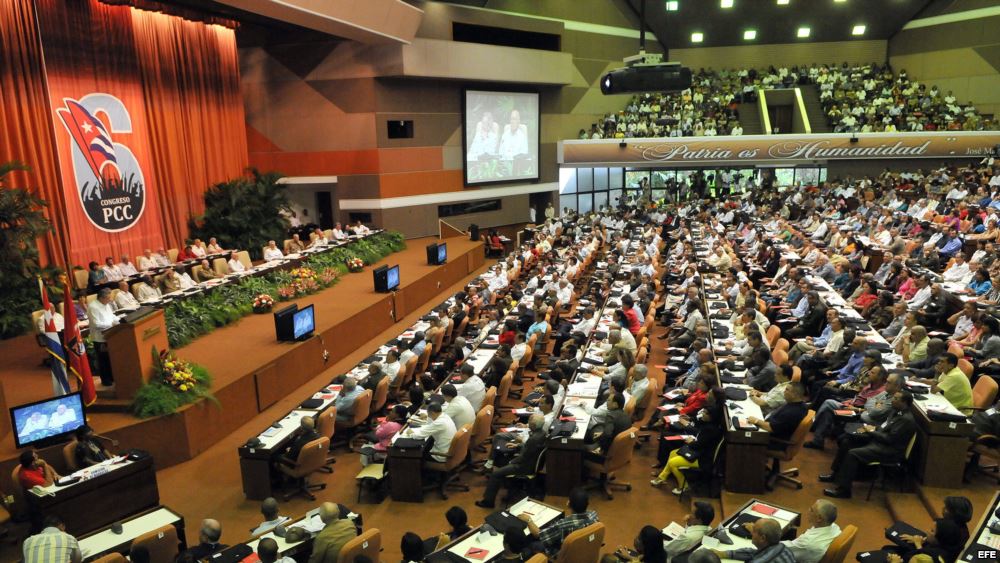
The Palace of Conventions during the Sixth Congress of the Communist Party of Cuba. (EFE)

14ymedio bigger14ymedio, Reinaldo Escobar, Havana, 16 April 2016 — Five years after the Sixth Congress of the Communist Party of Cuba, the only agreement from that congress that had a fixed date will meet this Saturday: the celebration of the Seventh Party Congress. The event will begin at 10:00 am at the Palace of Conventions in Havana with the presence of one thousand delegates and 280 guests. The secrecy and speculation regarding a possible change of course or a frustrating continuity continues.

At the opening session, which will be broadcast live on national television, the main report will be read. The main documents – which were not disclosed to the public and are not even known by the mass of Party militants, which exceeds 700,000 people – will be discussed, probably behind closed doors, in four commissions. continue reading

Among the issues the delegates will address are the conceptualization of the economic and social model, the economic plan, and the analysis of the implementation of the guidelines agreed to in the previous congress. Of great importance will be the election of a new Central Committee, where changes are expected among senior positions on the Politburo.

The expectations have been many and diverse. If you follow the opinions collected by the newspaper Granma, the meeting, considered “the congress of all Cubans,” should be characterized by continuity and “improving the economic and social model,” at least that is what different interviews with some of the delegates elected to the conclave have reflected.

Within this line they insist on the anti-imperialist character of the process and have repeatedly alluded to the will not to cede a single inch in matters considered unshakable principles.

Some commentators have slipped less orthodox views into the digital pages of the official Party organ. Among these are suggested changes that exceed the limits of continuity, including greater openness in the economy with the more flexible creation of non-agricultural cooperatives, and allowing the formation of small and medium enterprises in the non-state sector. Bolder actions demanded include the elimination of the dual currency and greater flexibility in all matters relating to the ownership of property.

With regard to politics, those who are hopeful that the Congress could introduce reforms in this area have referred to the need to introduce amendments to the Constitution and to offer a new electoral law. In a general sense there is a demand for the amplification of rights related to freedom of association and expression.

However, for the opposition sector to expect anything from this meeting of communists is a delusion. The most extreme are offended by any analysis that expresses the idea that the event could result in something positive.

Most observers agree that the importance of the partisan congress is that it will be the last in which members of the “historic generation,” most of them octogenarians, are present, so this must be the occasion on which it is defined who should take over.

Speculations incline to those who would take steps to openings, based on the improvement of relations between Cuba and the United States, the difficult situation of the internal economy, and the trend of decline among Cuba’s main allies on the continent. Those who are betting on the stagnation option rely on the traditional attachment to power of those who have spent more than half a century at the helm in Cuba, and their fear that the slightest concession could lead to an undesirable outcome.

As part of the symbolic aspect to be imprinted, the opening of the Congress coincides with the 55th anniversary of the declaration of the socialist character of the Revolution, while the closing session announced for 19 April marks five and a half decades since the military victory at the Bay of Pigs, baptized in official discourse as the first defeat of imperialism in Latin America.

When the most important event for Cuban communists opens this morning, the fate of the whole nation will be hanging on what is said in front of those microphones. The delegates to the Seventh Congress, and especially the senior Party officials, might let this opportunity pass amid the applause and vacuous statements, or they could make decisions that remove the shackles from the wheel of history.

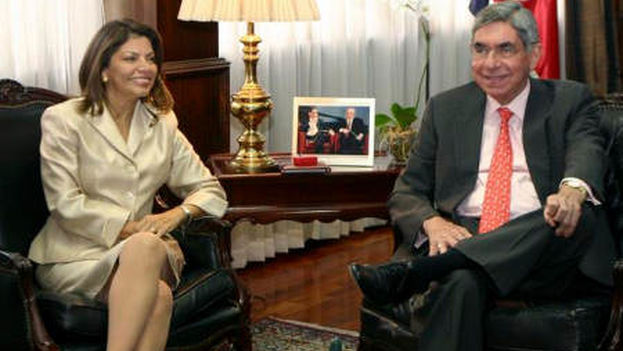
Cuba Must End “Apartheid Against Its Citizens” / Oscar Arias, Laura Chinchilla

Oscar Arias and Laura Chinchilla, signed the appeal along with dozens of Latin Americans. (TicoVisión)

The undersigned, Latin Americans and diverse in our allegiances, professions and interests, but united by a common aspiration for freedom, democracy, equality and well-being throughout the hemisphere, address our fellow citizens and governments, especially those in Cuba, to express the following:

We celebrate the growing process of normalization in Cuban-American relations and the willingness of other democratic states to increase their interaction with the authorities in Havana. We see an opportunity in this process to encourage a greater inclusion of Cuba in the world and to improve the living conditions of its citizens. continue reading

At the same time, we condemn the systematic and continuous violation of human rights on the island; the persistence of a political model centered on the control of a single party; the open repression against those who deviate from the official line, and the continuing discrimination against Cubans in favor of foreigners, in areas ranging from economic rights to free access to communications and information.

The time for an act of reciprocity with the democratic world has come, but above all, as an inescapable duty to its own people, it is time for the regime headed by President Raul Castro to begin a genuine process of political and social openness and to listen to the initiatives for change from its citizens, and to reactivate the timid economic changes announced with enthusiasm, but paralyzed amid rigidity, fear and bureaucracy.

The time has come for Cuba to open itself to its own people.

There is no justification to continue preventing Cubans from asserting the basic rights and freedoms that belong to them, and that are widely recognized by universal instruments of human rights. Many of which, paradoxically, have been signed by their own government.

The road to full democracy must be taken without delay. Each new setback prolongs the precariousness and limitations of the people, hinders the chances of success and raises the risks of internal conflicts. Thus, it is time to begin to open the path, recognizing, at least, the following guarantees for all Cubans:

Freedom of expression, understood as the right to seek, receive and impart information, opinions and other content by any means without limitations, censorship or subsequent repression.

Freedom of association, assembly and demonstration.

Freedom of movement inside and outside the country.

The right to petition the authorities and public powers.

The right to elect and be elected in a multi-party environment for all public offices.

The right not to be arbitrarily arrested and detained, to have fair trials before independent courts and have mechanisms for an effective defense.

The right not to be discriminated against in education, employment or social areas because of political or religious beliefs, or for any other reason.

The elimination of ideological control over education.

The freedom to undertake professional, labor and business initiatives without restrictions, and for Cubans to have at least the same opportunities offered to foreign investors or traders. The virtual economic apartheid, but also social and political apartheid, prevailing on the island against its citizens must end without delay.

None of these very basic rights, which are part of everyday life in the vast majority of our countries, can be exercised in Cuba. Worse still, those who dare to claim them are the targets of open repression and systematic marginalization.

In its 2016 World Report, the NGO Human Rights Watch highlights and documents several cases that “in recent years have significantly increased the short-term arbitrary detentions of human rights defenders, independent journalists and others.” Between January and October 2015, the Cuban Commission for Human Rights and Reconciliation, declared illegal by the government, received more than 6,200 complaints of arbitrary arrests, which were exacerbated prior to the visit of Pope Francis to the island in September of the same year.

The report also reveals the existence of a difficult to determine number of political prisoners, given the absence of reliable information; beatings and assaults against non-governmental protesters in the street; prison overcrowding; case-by-case restrictions on travel within and outside of Cuban territory; the inability to form independent unions; and the refusal to recognize the defense of human rights as a legitimate activity.

The sad conclusion is that, despite the world and particularly the United States, increasingly having become more open to Cuba, the regime has not opened to its own population, which, with some exceptions of privilege, remains mired in insecurity, controls, lack of opportunities and political and social asphyxiation. This closure must be dismantled; the political, economic and social embargo of the Cuban regime against Cubans must be eliminated.

Direct responsibility to end this situation belongs to the elite that has dominated Cuba since its one-party and monolithic state. However, it extends to the governments of Latin America, so far passive actors and even accomplices to chronic arbitrariness and paralysis of the regime.

“Our America” which the hero of Cuban independence José Martí proclaimed as an ideal of Latin American unity, cannot become reality as long as there persists in Cuba a government that is impervious to citizens rights, and that displays a double standard before the world.

In proclaiming these concerns, we express our desire for Cubans to be able to build, in peace and freedom, a new democratic, peaceful and inclusive order.

Oscar Arias (Costa Rica), former president and Nobel Peace Prize in 1987. Laura Chinchilla (Costa Rica), former president. Graciela Fernandez Meijide (Argentina), was Secretary of the National Commission on the Disappearance of Persons. Jaime Malamud Goti (Argentina ), jurist and one of the masterminds of the trial of the military junta in Argentina. Eduardo Ulibarri (Costa Rica), journalist and former Ambassador to the United Nations. Ricardo Gil Lavedra (Argentina), lawyer and politician, member in 1985 of the court that sentenced the military juntas of Argentina’s dictatorship. Beatriz Sarlo (Argentina), essayist and journalist. Carlos H. Acuna(Argentina), political scientist specializing in State and public policy and member of human rights organizations in Argentina from 1977. Roberto Gargarella (Argentina), lawyer and sociologist, CONICET researcher and teacher. José Manuel Quijano (Uruguay), Economist and former director of the Sectorial Commission and the General Secretariat of Mercosur. Sergio Fausto (Brazil), political scientist and Executive Superintedent of the Fernando Henrique Cardoso Institute. Roberto Ampuero (Chile), writer, columnist, former Minister of Culture and former Ambassador of Chile, lived in Cuba between 1974 and 1979. Rodolfo Rodil (Argentina), former vice president of the national Chamber of Deputies. Facundo Guardado (El Salvador), former member of the Farabundo Martí National Liberation Front and former presidential candidate. Daniel Sabsay (Argentina), professor of Constitutional law at the Faculty of law of the University of Buenos Aires. Liliana Riz (Argentina), sociologist and senior researcher of CONICET. Luis Alberto Romero (Argentina), historian, National Academy of History. María Matilde Ollier (Argentina), political scientist, teacher and researcher. Eduardo Viola (Brazil), professor of international relations at the University of Brasilia. Hector Schamis (Argentina), political scientist, teacher, researcher and columnist. Aníbal Pérez Liñán (Argentina), political scientist, teacher and researcher. Vicente Palermo (Argentina), sociologist, writer and researcher with CONICET. Marcos Novaro (Argentina), sociologist, professor and researcher with CONICET. Alejandro Katz (Argentina), essayist and editor. Roberto Garcia Moritán (Argentina), diplomat and former Vice-Chancellor. Fernando Petrella (Argentina), diplomat and former Vice-Chancellor. Jorge Edwards (Chile), writer and diplomat. Osvaldo Guariglia (Argentina), philosopher and researcher with CONICET. María Sáenz Quesada (Argentina), historian, writer and former Minister of Culture of the City of Buenos Aires. Lilia Puig (Argentina), Congresswoman in Parlasur and former national Congresswoman. Juan Octavio Gauna (Argentina), lawyer and politician, former Attorney General and National Deputy. Fernando Pedrosa (Argentina), historian, teacher and researcher. Raquel Gamus (Venezuela), anthropologist, political scientist and journalist. Patricio Navia (Chile), political scientist, teacher and researcher. Adolfo Garce (Uruguay), political scientist, teacher and researcher. Daniel Muchnik (Argentina), journalist, historian and writer. Carlos Gervasoni (Argentina), political scientist, teacher and researcher .Armando Chaguaceda (Cuba), political scientist, teacher and researcher. Daniel Perez (Argentina), designer and painter, published a testimony on the Cuban military intervention in Latin America during the 60s and 70s. Jessica Valentini (Argentina), lawyer and former Ombudswoman in the city of Cordoba. Sabrina Ajmechet (Argentina), sociologist, teacher and researcher. Jorge Elias (Argentina), journalist, writer and researcher. Alejandro Oropeza (Venezuela), political scientist, teacher and researcher. Francisco Quintana (Argentina), lawyer and legislator of the Autonomous City of Buenos Aires. Luis Gregorich (Argentina), journalist and writer. Manuel Mora y Araujo (Argentina), sociologist and communications consultant and public opinion relations. Marta Velarde (Argentina), lawyer and former Congresswoman. Carlos Facal (Argentina), lawyer and former president of the Citizens Power Foundation. Andrés Cañizález (Venezuela), journalist, teacher and researcher. Eduardo Amadeo (Argentina), National Deputy, diplomat, economist and former Minister of Social Development. Gabriel Palumbo (Argentina), sociologist, teacher and researcher. César Ricaurte (Ecuador), journalist and activist for freedom of speech and the press. Nicolas Joseph Isola (Argentina), Doctor of Social Sciences and columnist in various media. Romeo Pérez Anton (Uruguay), political scientist, teacher and researcher. Ignacio Labaqui (Argentina), political scientist, teacher and researcher. Aleardo Laría(Argentina), lawyer and journalist, political exile during Argentina ‘s military dictatorship. Antonio Camou (Argentina), Sociologist, teacher and researcher. Javier Valdez Cardenas (Mexico), journalist. Alejandro Páez Varela (Mexico), journalist. Rolando Rodriguez (Panama), journalist. Maria Sirvent (Mexico), human rights activist. Jose Ruben Zamora (Guatemala), journalist. Rafael Rojas (Cuba), historian, teacher and researcher. Leandro Dear (Argentina), political scientist, professor and head of the NGO electoral transparency. Fernando Ruiz (Argentina), political scientist, teacher and researcher. Martin Landi (Argentina), political scientist and activist freedom of expression. Hugo Machin (Uruguay), journalist and former political prisoner during the military dictatorship in Uruguay. Rogelio Alaniz (Argentina), journalist.
Fresh Fish / 14ymedio

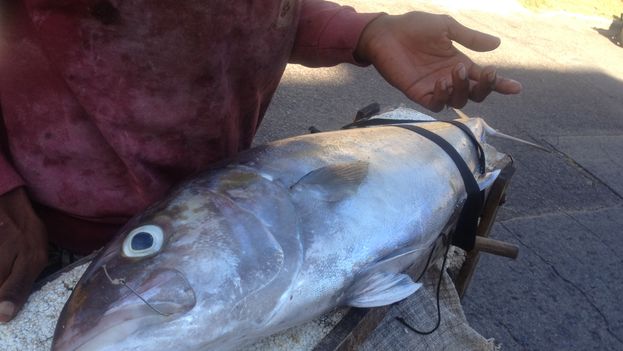
A young man with his recently caught fish near Havana's Malecon. (14ymedio)
A young man with his recently caught fish near Havana’s Malecon. (14ymedio)

14ymedio bigger14ymedio, Havana, 15 April 2016 – Near Linea Street in Havana’s Vedado neighborhood, a young man is selling this fish he just pulled from the sea. After hours on the water in a makeshift craft, the bold sailor has managed to hook a huge fish that he is offering for 20 convertible pesos, the equivalent of a months’ wages for a professional.

The sale of the beautiful specimen is accompanied by the epic of the fish. The young man brags of the difficulties he faced, the long time he had to wait to snag the fish, and even relates his surprise at the moment it emerged from the water. His face is filled with happiness on knowing that this afternoon, thanks to the fish, his family will be able to buy a little chicken, a bottle of oil and even some soft drinks for the kids.

Despite being surrounded by the sea, Cubans find it very difficult to get fresh fish. The managers of private restaurants must jump through hoops to ensure the supply of this product on their menus. They depend, in most cases, on the illegal market and fishermen like this young man, whose fish will probably end up this very night in the kitchen of one of these paladares (or palates, as private restaurants are called).

Chronicle of a Chronicle Not Foretold / 14ymedio, Manuel Pereira

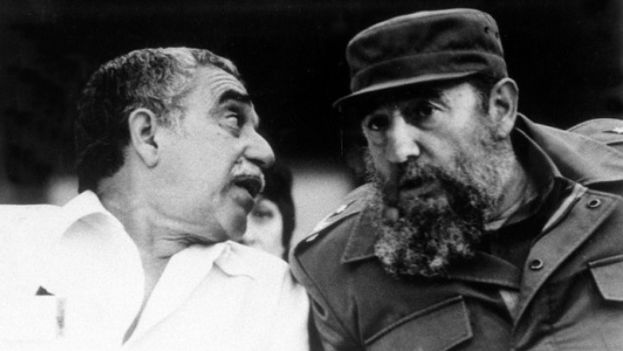
Gabriel García Márquez with Fidel Castro. (GGM files)

14ymedio bigger14ymedio, Manuel Pereira, Mexico, 15 April 2016 — In 1981 I was delivering some lectures about Cuban cinema at the National Autonomous University of Mexico (UNAM) when I received a call in my hotel in the Zona Rosa neighborhood from Gabriel Garcia Marquez. He asked me to come to his house on Fuego Street in the exclusive Pedregal neighborhood. We ate at a nearby restaurant called El Perro Verde, or something like that. He asked me to read his latest novel, he was in a hurry, it was short.

What was the mystery of such urgency? He knew that I was returning to Havana in a few days. “I can read it on the plane,” I told him. No, I had to do it in Mexico. He was in such a rush to give me the manuscript that he forgot his wallet on the table. He realized it when he got home and asked me to go look for it at El Perro Verde. The waiter was honest and had saved it, despite its being quite bulky, as I supposed the wallets of famous writers to be. “It’s all here,” sighed Gabo, after counting the bills. continue reading

He handed me the novel. I began to read it right away in his house, and then I locked myself in my hotel to keep reading. I read it in a couple of sittings, not knowing what the famous writer expected of me. The story of the two brothers who stabbed Santiago Nasar was well structured, flowed effectively, like everything from Gabo; with his impeccable craftsman’s prose, neither lacking or needing a single comma, the precise adjectives, the well-drawn characters. The following day we met again. Then he said to me, “You are the second reader of this work, after Mercedes of course.”

“It is an honor,” I replied.

But … what was the mystery of the hurry?

He confessed that he wanted Fidel to authorize him to publish this book.

Why?

Because he had made a public oath: he would not publish again while Pinochet remained in power. “And the problem is, he is not failing,” he grumbled. “And meanwhile, I wrote this book and I really want to publish it.” But before breaking his announced promise he should consult with Fidel.

Indeed, sinceThe Autumn of the Patriarch (1975) Gabo had not published any piece of fiction. Too long in silence for such an esteemed writer.

What did I have to do with all that?

“I want you to take this book to Fidel.”

“I do not personally know Fidel, I have no direct access.”

He hesitated a moment and added:

“But you know Carlos Rafael Rodriguez, right?”

“Yes, him I know.”

“Well, you give it to him to give it to Fidel.”

Then he wanted to know my opinion of the novel, which flattered the thirty-something I then was. With great tact I told him that his story reminded me of vaguely of Rashoman – the two stories from Akutagawa and Kurosawa’s film – because of its multiple witnesses and diverse versions of a crime, but he said no, his source of inspiration had been the assassination of Julius Caesar. I thought about the omens, the fatality of Greek tragedy, and concluded he was right, although the Japanese took nothing from Gabo, as was evident later with Memories of My Melancholy Whores, so akin to Kawabata’s House of the Sleeping Beauties, starting from the epigraph.

Twenty-four hours later I landed in Havana and handed the clandestine text (not foretold) to Carlos Rafael Rodriguez. Shortly afterwards Chronicle of a Death Foretold was published simultaneously in Colombia, Spain, Mexico and Argentina. Obviously, Gabo had obtained the imprimatur of Fidel Castro, as is proper of every high ecclesiastical or ideological authority. The Middle Ages in its purest state.

Only 5.5% of Communist Party Congress Delegates Under Age 35 / EFE, 14ymedio

The Palace of Conventions during the Sixth Congress of the Communist Party of Cuba. (EFE)

14ymedio biggerEFE/14ymedio, Havana, 14 April 2016 — The average age of the thousand delegates who will participate from 16 to 19 April in the Seventh Congress of the Communist Party of Cuba (PCC) is 48 years, and only 5.5% are under 35, according to data released Thursday by the newspaper Granma.

The oldest delegate, Jose Ramon Fernandez, is 92, and is currently president of Cuba’s Olympic Committee and one of the founders of the PCC. The youngest participant, Idaliena Diaz, age 27, is a deputy to the National Assembly and is president of a People’s Council in the eastern province of Guantanamo. continue reading

“It is natural that those attending events of this nature are, as a rule, compañeros who have accumulated considerable experience and have a long history in the Party ranks,” said Granma, the official organ of the PCC, which added that the Party Congress will be “a reflection of the [Party] militancy and of Cuban society as a whole.”

By gender, some 43% of the delegates are women, 2.5% more than at the previous congress held in 2011.

The representation of blacks and mixed race delegates will also increase, with 36% of the delegates, 4.5% more than five years ago.

Cuban communists will open their Seventh Congress on April 16 and end it on April 19, when the Central Committee elected the previous day will be announced, along with the members of the Politburo and the first and second Party secretaries.

At the previous PCC Congress, held five years ago, the president of Cuba, Raul Castro (now 84), was named first secretary of the organization, replacing his brother Fidel, who retired from power in 2006. At the same time Jose Ramon Machado Ventura (now 85) was designated second secretary.

On that occasion, the Cuban communists approved the plan of economic reforms under President Raul Castro.

A Friend and Cuban Military Official Just Sent Me an Email / Juan Juan Almeida

Juan Juan Almeida, 11 April 2016 — This will not just be the seventh congress of a communist party condemned to being swallowed up by history. It will be the last.

Cuba is a small island filled with dangerously blinding lights. All this brightness dazzles the opposition. So much so that it cannot even manage to capitalize on the discontent of eleven million Cubans.

This suggests to one segment of the exile community that the rhetorical debate has shifted from victimhood to complicity, that it overestimates a government that is losing power and is struggling to get itself out of a grave that we, the people, have not been able or known how to dig. continue reading

But there are fireflies who carry on in the darkness, like a friend of mine, who is an official in the Revolutionary Armed Forces (FAR). I would like to share an email he just sent but, given his ample political, military, intellectual and popular appeal, he prefers to remain anonymous. I have not changed so much as a comma:

“April 16, 2016 will mark the start of the Cuban Communist Party Congress in Havana. Numerically it is the seventh but alphanumerically it is the last. Seven is a magical number in Egypt while it has an anal connotation in charades and in the Cuban vernacular. This is where we are. At the end of communism’s digestive tract. What emerges from this congress will be nothing more than a nebulous and fetid outgrowth.

“Unlike previous events, this one two distinguishing characteristics: an excess of secrecy and extemporization. No one seem able to answer two questions directly. What will be discussed in these sessions and why now? We can only speculate. And since speculation is the spice of politics, here we go.

“Political journalists and some observers both inside and outside the opposition are asking themselves if some ‘logical changes’ in Cuba’s direction are being devised. Vocal opponents and silent opponents, staunch supporters and timid supporters, and those of all political stripes expect nothing of the sort. These supposed logical changes, the necessary reforms, require a mental flexibility that Raul Castro and his cronies do not have. To confuse the undeniable skill that Cuba’s leaders have shown in holding onto power as a sign of Realpolitik would be a mistake.

“This congress is part of Raul Castro’s master plan. It is the next step towards the ultimate goal. To retirement. The most important matter at this event will be trying to deal with the tricky matter that socialist governments throughout the world have had to confront: the problem of succession. It is one aspect of his conspiratorial nature. He is trying to pick the gerontocracy’s successors, people with no political base, some of whom are the result of blatant nepotism. Many of them are already in place. They are the dull, shadowy figures who repeat the same old ideas that no one of their generation in Cuba believes anymore. A straightforward public rollout of these people would have led to even more discontent and disappointment in society.

“The other reason for this mysterious project is the immediate future. The general idea is to  maintain the status quo. In other words, to try to consolidate state capitalism and to capitalize on a five-decades-long hold on power. This has very little attraction for the Cuban people and would further deepen the gap that separates them from the current regime. Cuban leaders are smart enough to know that this project cannot be discussed in public because it would contribute to an increase in social unease.

“All this fits perfectly with the issue of the timing of the congress. You cannot impose new leaders and unpopular policies without suffering the consequences. It takes patience and spit, and the first glob is the congress. Before [Raul’s] permanent retirement after the general elections there will be four sessions of the National Assembly in which to implement the succession.”

Ecuador And Mexico Take Steps To Stem The Flow Of Cubans / 14ymedio, Mario Penton

Cuban Migrants stranded in Panama. (Facebook)

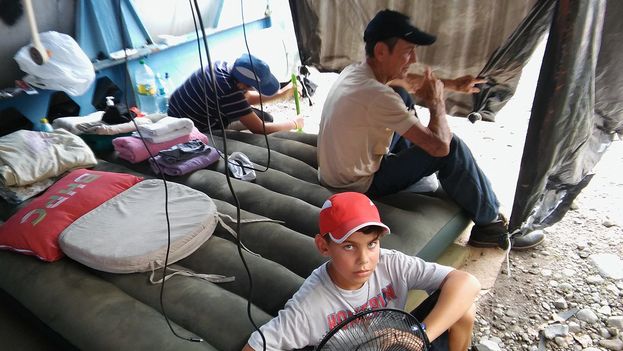
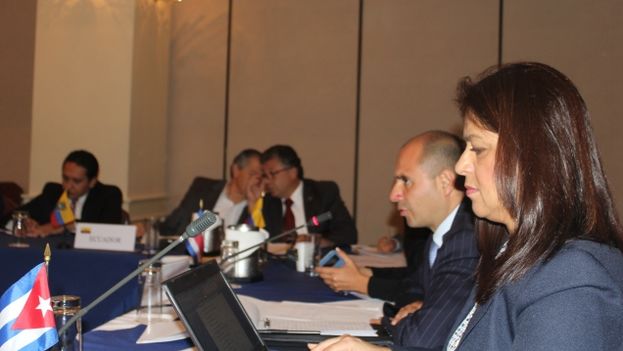
14ymedio bigger14ymedio, Mario Penton, Miami, 13 April 2016 — Mexico will not operate more “air bridges” for now, nor will Costa Rica allow more Cuban migrants in its territory, at a time when some 3,500 Cubans are flocking to the Panama isthmus trying to continue their journey to the United States. This is the scene at the climax of the summit where authorities of the countries involved in the flow of Cuban migrants – from the United States to Ecuador – are meeting.

Also present at the meeting, convened by Costa Rica to “follow up” on the crisis of last year, are the International Organization for Migration (IOM) and the United Nations Program for Development. The notable absences were Cuba and Nicaragua, allied governments who blame the immigration policy of the United States for the current situation. continue reading

Costa Rica called the meeting “constructive” and, according to a statement from its Foreign Ministry, “it has been a meeting to exchange some ideas about how to address the issue of immigration.” The Deputy Foreign Minister, Alejandro Solano, also commented on the proposal for “a normative study to try to harmonize laws” commissioned by the IOM, with a view of taking a regional approach to the practices in each country.

Moreover, it has emerged that Ecuador and Mexico are going to tighten measures to prevent the flow of Cubans. In the case of the Andean country, the cost of a visa will be increased from $100 to $400, one of the most expensive in the world, while the Aztec country has not yet clarified how it will stem the flow of Cubans to the United States. Still to be confirmed is whether Cuban migrants who reach Tapachula, Mexico will be granted safe conduct. Costa Rica has reaffirmed its position from recent weeks and according to the deputy minister will require a visa from all migrants seeking to cross its territory.

Meeting of the Central American foreign ministers Tuesday. (Costa Rica Foreign Ministry)

While the meeting was taking place in the Costa Rican capital, Nicaragua mobilized riot and military police near the border post at Teblillas, Costa Rica in response to an eventual furtive passage of migrants from Alajuela through this town. Also at the same time, Roberto Vega Lopez, a Cuban citizen, was captured in Colombia; he has trafficked people from the island in a complicated route that includes Guyana and the Brazilian and Colombian Amazon jungle. At the time of his arrest he was leading 15 Cubans through this dangerous route to Panama.

The conclusions of the meeting in San Jose fell like a bucket of cold water on the camps of Cuban migrants in Panama. According to Yunier Leiva, many of them had lit candles during the day in hopes of a “miracle,” that would resolve their difficult stay there. “In the end what they did is support the Cuban government and lock up even more Cubans in the floating prison that is Cuba,” he commented with a heavy heart.

For Silvio Enrique Campos, the alternative left to them by the foreign ministers was to “stick with the coyotes.” In a conversation with 14ymedio the migrant said that given “the lack of answers or solutions, Cubans in Paso Canoas are overcome by desperation.” Despite the difficulty of the moment, he calls on his compatriots not to endanger their lives because “the walls will fall again.”

In the absence of solutions to their problematic situation the migrants have decided to begin night vigils so that the international community can see the conditions they are living in. On Cuban who asked not to be identified for fear of reprisals, comments that every day several groups of Cubans are leaving Panama for the United States, crossing through the forests along the Costa Rican border.

He says, The only thing the authorities have done by not solving our passage in an orderly manner is to feed the bands of coyotes they are claiming to fight.” He also said that the human traffickers are now charging more for their services. “A trip that cost some $3,000 dollars has now been converted into a much more dangerous and expensive journey and last week someone wanted to charge me $7,000.”

From Ecuador, the Cuban National Alliance also released a note which encourages Cuban who have decided to emigrate not to get discouraged. “We knew from the beginning that it wasn’t going to be an easy task,” it says, and at the same time it calls on its members to “continue appealing to the reason and humanity of the governments.”

At this point it is not yet known what will happen to the thousands of Cuban migrants who are stranded in Central America. In a report presented by the Panamanian immigration authorities it stated that the number of Cubans has already reached 3,500 people, of which more than 150 are children.

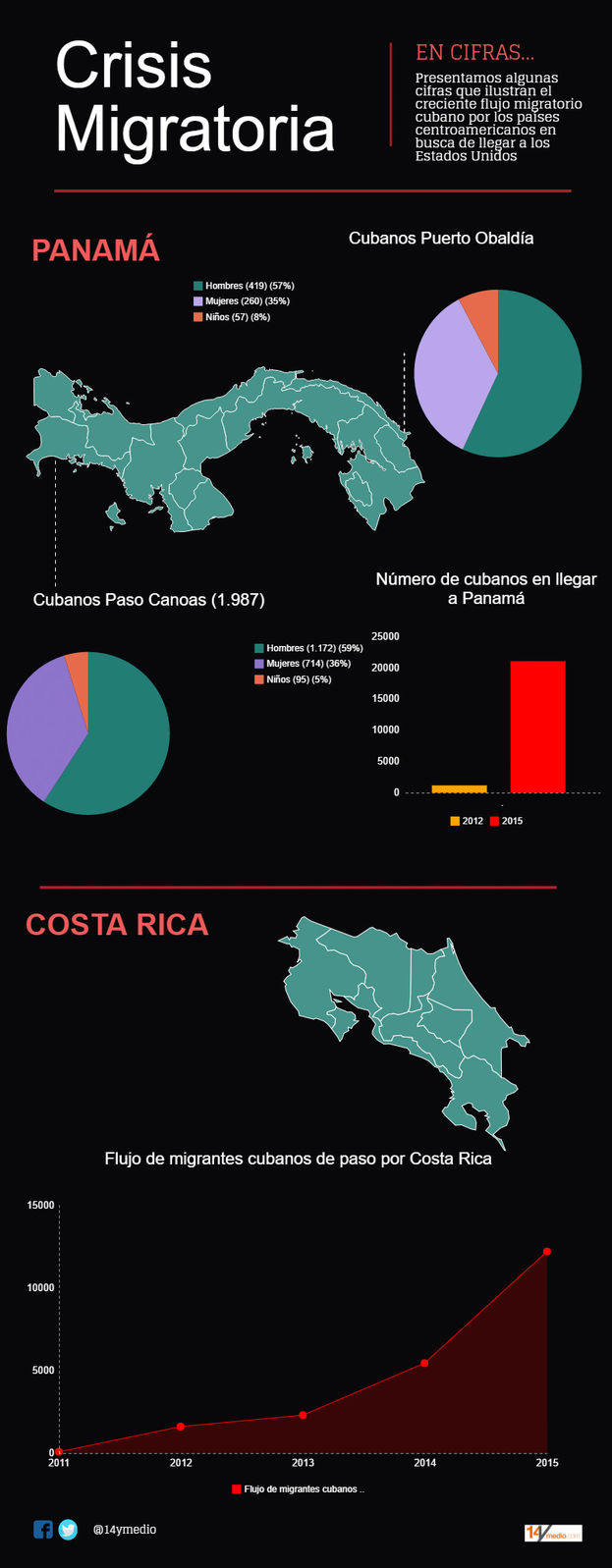
Cuban migration crisis in numbers.
Cuban migration crisis in numbers. (14ymedio)

The True Support of the Majority of the People for the “Revolution” / Somos+, Pedro Acosta

Somos+, Pedro Acosta, 1 March 2016 — In any forum our highest leaders intervene in, they express the idea that the majority of the people support the regime, however…

When the people, without excluding those who manifest being its followers, nor those militants of the PCC and the UJC, or leaders at all levels of the country, prove in a massive, uncontrollable, and endless manner, an entire category of “attributes,” such as those that:

Steal or receive, buy, sell, or give academic titles and medical continue reading

certificates. When the means of the state are deviated for personal benefit and enjoyment, corruption swarms. When the working day is wasted, and they absent themselves during working hours for different issues outside of these.

When hundreds of thousands abandon their homeland and many more hope to do so. When there is apathy, skepticism, accompanied by a high dose of indifference and  irresponsibility, it’s only for a simple, easy and obvious reason, and if you have not noticed it, or try to ignore it, I will remind you.

Know, gentlemen of the Political Bureau and the Council of State, the Cuban people neither respect  nor follow you, their daily actions prove it.

To be governed, Cuba needs young blood and fresh minds with new life and renewed energy. People who aren’t contaminated by previous vices, who know how to act with sagacity and intelligence, adapting to the reality of the moment. A youth that does not fear the whirlwind and indispensable changes needed to adapt to this 21st century, knowing in turn how to preserve our independence and sovereignty. People who know how to confront the leadership of the country thinking first of all, and understanding in reality, which are the real interests of the public, unlike those who think they know them only because they are consistent with their own opinions. Human beings that don’t protect their personal desires and privileges, under the misleading pretext that these are the interests of the homeland. Cubans that don’t defend with cloak and sword their incompetence, who are able to ask forgiveness from their people when it is necessary, taking responsibility for their errors. Cubans who bravely abandon power when it exemplifies their ineptness.

New vitality must undertake this gigantic task. And above all: people who don’t take advantage of power.

People who are not afraid to lose that which they don’t have!

(Taken from my book, unpublished, Promised Paradise, Acquired Purgatory)

Translated by: Emily Piltzer