
“The Problem Is Being Resolved” / 14ymedio, Reinaldo Escobar

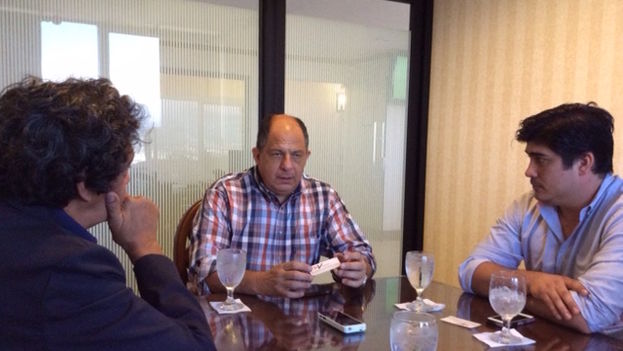
Costa Rican President Luis Guillermo Solis and Minister Carlos Alvarado Quesada during the interview with Reinaldo Escobar of 14ymedio (14ymedio)

14ymedio bigger14ymedio, Reinaldo Escobar (Special envoy), San Jose, Costa Rica, 30 November 2015 — Costa Rica has been overturned this November by the massive arrival of thousands of Cubans. From Ecuador, they tried to walk to the United States, but Nicaragua denied them passage and, desperate, they are stranded on Costa Rica’s northern border. On Sunday, the president of Costa Rica, Luis Guillermo Solis, talked about this immigration crisis in an exclusive interview with 14ymedio.

Reinaldo Escobar. How has Costa Rican civil society responded to this crisis?

President Luis Guillermo Solis. It has had a central role. People have shown up to help in a voluntary and spontaneous way, they have brought clothes and food. Churches have been side by side with us and the migrants, managing the shelters. If it hadn’t been for all this help, it would have been very hard to manage something like this, especially in the first days.

Escobar. Also in the poorest areas of the country? continue reading

Solis. The canton of La Cruz, where at the beginning virtually all of the Cubans were located, is one of the poorest cantons in Costa Rica, but the people there never said, “me first.”

The numbers were impressive. The first Sunday of the journey, when the migrants arrived in the central district of La Cruz there were more Cubans than Costa Ricans, because of the accumulation that was there, specifically. However, there was not a single incident, not a single dispute. Quite the opposite. People wanted to find solutions and they were very supportive.

Escobar. Does the solidarity extend beyond providing food and shelter?

Solis. We asked the Ministry of Culture and the Ministry of Sports to prepare some recreational activities, because over so many days, with so many people doing nothing and put in a shelter, they were going to go crazy. They got together 500 books, which were not many, and also began setting up football games, baseball games, concerts, putting on plays. The National Children’s Trust put on plays for children. With this we were able to realize something else about the migration, that it is made up of very educated people who wanted to read, who were also very interested in cultural interactions.

Escobar. Did Nicaragua’s closing of the border come as a surprise?

Solis.  Nicaragua’s closure was very unfortunate, because until that time they had been letting the migrants pass. They were passing with visa, a procedure with the ugly technical name of “deportation,” that meant they could cross the country to continue their journey through Nicaragua. It doesn’t seem that they want to open the border, unless talks this Monday between Cuba and the United States, precisely with regards to migration, work out something else.

Escobar. Is there any solution to this crisis in sight?

Solis. There are several solutions, because a ton of factors all have to line up. One that already happened was that Ecuador slowed down the entry of Cubans to its territory, because this was generating a huge flow inexorably headed north. It was very complicated. Second, we need the transit countries to give the migrants document and they are willing to do so. Only Colombia and Panama haven’t yet started this process. In the case of Colombia, because they say that it is physically impossible to control a border as long as theirs with Ecuador.

At the meeting in San Salvado, I believe the governments will recognize the need to give them visas. Because it is not the same journey with a visa as without a visa. We have strongly insisted on it for humanitarian reasons. Because if not, how can we protect them. They need a visa to allow them to move. With a visa they don’t have to be afraid, they can go to the market, connect to the internet, buy a phone card.

We want to be sure that the people making this journey don’t fall into the hands of organized crime, which is what most troubles us. We are also making a call to remain calm.

The other thing is, if the United States wants to resolve this problem, it needs to change the Cuban Adjustment Act. Because right now it is perverse that they can enter, but not by the easiest route, only by the most difficult one. So, Cubans are trapped between their aspirations and the dangers of getting there in this way. This generates some very complicated dynamics, geopolitically on the one hand, and for practical reasons on the other.

I’m not saying build a bridge between Havana and Miami, but certainly when relations between Cuba and the United States are completely normalized they should establish a normal and fluid interchange. So this is why I say there are multiple solutions. We all have to do our part.

Escobar. And the differences between Cuban migrants and those of other nationalities?

Solis. Right now in Central America there is a debate that refers to a core part of the problem. For countries that generate migrants, and I do not want to exclude Costa Rica in that, it is very difficult to deal with a migrant population which, when it arrives at its destination is received, documented, eventually legalized and given a residence card, while its own population, traveling by the same route, is rejected at the border.

On the other hand, all the Cuban migrants come with their passport, they are documented, but our border is also seeing migrants come from Africa, Asia, Pakistan, without papers. The challenge of dealing with this undocumented population is formidable, because legally they don’t even exist. It is a terrible drama.

Escobar. You had announced a trip to Cuba for the 15 December before all this happened. Will the issue of migration occupy a privileged position during the talks?

Solis. We will be obliged to talk about it. Fortunately, I understand that the problem is being resolved, that is, the process to transfer [past Nicaragua] the Cuban population that is now in Costa Rica, and those arriving is being worked on by the Foreign Ministry. I was with the president-elect of Guatemala four days ago and he will continue with the policy of the current government, which is to facilitate passage through their country. And the Government of Mexico also said it would let them pass, so we are resolving it.

Although the subject of Cubans in Costa Rica is part of the agenda, the reasons why I am going to Cuba are also of a different nature; they go much further, because it was planned earlier. We will consolidate a process of normalization that began in the nineties, we will establish in Cuba one of our working sites towards the Caribbean Basin. This government has been promoting dialogue and greater involvement of our investors with that area.

I had breakfast in New York with the heads of state of Caricom focused on this. We are developing our Caribbean province, Limón, so it is the door of Costa Rica to the Caribbean. Cuba is a new reality that can make us competitive in some areas for the Costa Rican economy, but is also an opportunity for exchange and cooperation.

Escobar. What is your opinion of the Cuban people?

Solis. I have a great affection for the Cuban people. Although what we have done for Cuban migration we would for any other migration. In fact, one of the paradoxes of this whole story is that with Nicaragua, Costa Rica has been an open and brotherly country, but now they do not seem to have the same attitude with respect Cuba, which, by the way, has helped them so much.

Escobar. What do you say to those who say that Costa Rica is using Cubans as “spearhead” against Nicaragua?

Solis. We have our “bones to pick” with Nicaragua, we have a complicated agenda. In our case, it is being dealt with legally, in the International Court of Justice and the result will come soon, in the next six to eight weeks. It is one of those contentious border issues, a complicated litigation. In the international bodies is where these suits belong; we have no need to use Cubans as spearhead. That makes no sense.

http://www.icj-cij.org/docket/index.php?p1=3&p2=3&case=152

Solis. I have seen everyone be supportive, without complaints. There are isolated cases of people who have gotten upset. In the cabinet itself, the shock of the first moment was of such magnitude that some came to ask, “How many more are coming, Mr. President?” But it was more the anguish of not knowing.

Escobar. How can future crises like this be avoided?

Solis. First we must understand this as a regional problem and therefore it requires significant international alignment. I have been a convinced integrationist for many years. I believe in Central American integration. In this particular case, integration is to no avail. We knew that, and that’s why we didn’t want to take it to the meeting of the Central American Integration System (SICA), because that was not the appropriate forum to discuss this issue. However, we promoted the participation of more countries.

The dimension of this problem obliges us to shine a light on it, it requires that migrants be documented.

Escobar. There has been talk of an airlift. What is the status of that solution?

Solis. We were just discussing that, but as there is no regional agreement, each country decided to announce its own measures on its own time.
57 Children And A Dozen Pregnant Women, The Most Vulnerable Group Of Cuban Migrants / 14ymedio, Reinaldo Escobar

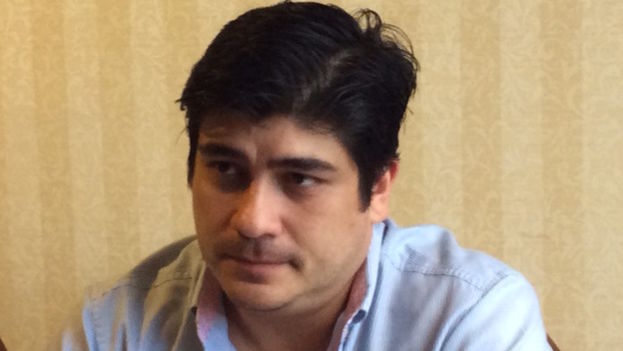
Carlos Alvarado Quesada, Minister of Human Development and Social Inclusion of Costa Rica (14ymedio)

14ymedio bigger14ymedio, Reinaldo Escobar (Special envoy), San Jose, Costa Rica, 30 November 2015 — Among the thousands of Cubans arriving in Costa Rica in recent weeks, one of the biggest concerns for humanitarian organizations and the people are the children. “There are 35 boys and 22 girls who need check-ups to confirm their state of health,” said Carlos Alvarado Quesada, Minister of Human Development and Social Inclusion in a conversation with 14ymedio on Sunday.

“I saw a woman with a baby girl of six months, in the La Garita shelter,” he recalls. “While she was nursing the baby she was telling another person how they were persecuted in Colombia. Her story made a strong impression.”

Alvarado Quesada, a communicator by profession and also president of the Joint Institute for Social Aid (IMAS), said minors are “clearly identified” and referred also to another vulnerable group, the dozen pregnant women in the shelters. continue reading

The latest official figures are that there are 18 locations providing accommodation and care for about 3,013 Cubans. “At least twelve of these places are in Liberia, ten in the canton of La Cruz, four in Upala, one in Guatuso and one in San Ramon,” lists the minister.

Alvarado Quesada agrees with the opinions gathered by this newspaper about the the communities are involved in supporting migrants. “The people of La Cruz and Upala, like other regions, are very committed,” he said, adding that residents have made donations and given all kinds of aid. “Also the churches have joined in solidarity, both Catholic and evangelical and are preparing and bringing food to Cubans,” he continues.

“I visited one of those kitchens where 3,000 meals are prepared daily and, in fact, the chef is Cuban. Every shelter has a Cuban cook, because among these people there is every kind of professional. There are economists, doctors, dancers, boxers …” says Alvarado Quesada.

The Ministry of Health and the Red Cross have conducted a census which includes data such as name, occupation and clothing sizes of the Cubans. “Some of this information will enable us to distribute aid, especially clothes,” explains the president of IMAS. In the case of children it is very important to know the exact measurements to make the distribution of clothes and footwear more effective.

Asked about the possibility of an airlift that would allow the migrants to continue their journey to the United States, Alvarado Quesada is more cautious. “There is willingness to help, but it can not be a flamboyant help, too dramatic,” he says. “This is a matter of freedom, not only of Cubans but the freedom of everyone.”

Hope And Fear At The Border / 14ymedio, Reinaldo Escobar

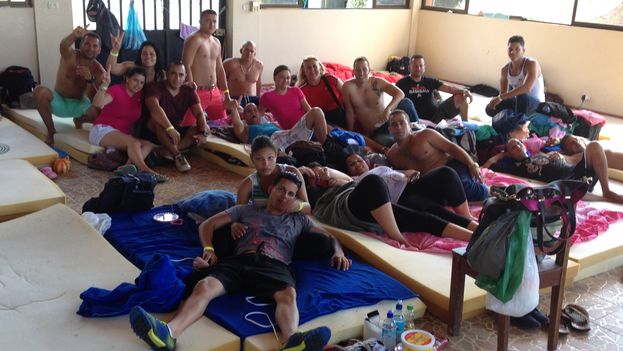
Cuban migrants at a shelter in La Cruz, a few yards from the border between Costa Rica and Nicaragua (Photo Reinaldo Escobar / 14ymedio)

14ymedio bigger14ymedio, Reinaldo Escobar (Special envoy), La Cruz, Costa Rica, 29 November 2015 — About 10 miles from the border with Nicaragua is the canton of La Cruz in the province of Guanacaste, in Costa Rica. Peñas Blancas is there, the most important outpost in the north and the place where serious incidents between Cuban migrants and Nicaraguan police have taken place.

At present, a thousand Cubans are distributed among several shelters, some in a church, others in a school and others who do not want to get too far away from the border post spend the night around the customs post. This weekend the whole area is buzzing with people coming and going, among them the migrants and volunteers from humanitarian organizations.

At the customs post there are blankets everywhere, vessels for storing water and clothes hanging on clotheslines, giving the place the look of a tenement in Old Havana. Jorge shares with 60 fellow travelers the floor of a place where they have settled with makeshift mattresses, and continues to wait for Nicaragua to allow them to continue on their way. continue reading

This loquacious Cuban with stubborn dreams completed an official mission as a healthcare worker in Ecuador. He didn’t want his picture taken or his name given to this newspaper, for fear of not being able to return to Cuba, but he relates the long journey that has brought him to Costa Rica.

“The goal of many of us was to complete our mission in Ecuador and in that time to make contacts to return to Quito or other cities with a contract to work privately,” Jorge explained. However, “at the request of the Cuban government, the Ecuadorian authorities ended the ability of Cubans to be placed on the professional register.” He emphasizes, “The Cuban government made this happen.”

Jorge notes with irritation, “I never thought of traveling to the United States.” Summing up his initial plans, he says, “I wanted to be a professional in Ecuador, where I could earn $2,000 a month. Why would I go to the United States to work in construction?”

“They forced me to do this because they shut down the path I was on,” the man says. Unable to register as a health professional left him the option of “cleaning floors in a hotel.” Of the $3,000 salary declared on the contract of his official mission, the Cuban government only paid Jorge $700. All these absurdities led him to undertake the journey to the United States, he says.

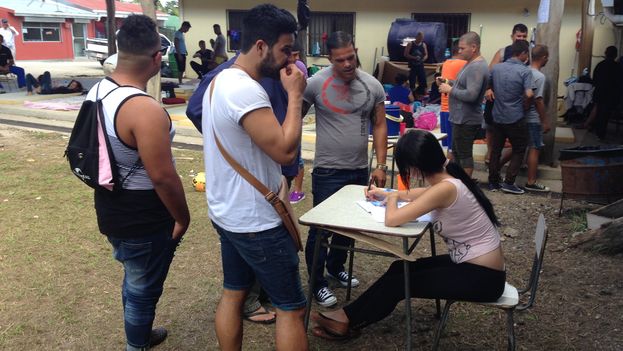
On a table outdoors, Beatriz is busy filling in the entrance forms for a group recently arrived at the La Cruz camp. She is a Cuban working with some church or NGO that is there helping Cubans, particularly because she pronounces all the letters of words.*

Beatriz from Camagüey works on a list of newcomers and orients them in the shelter (Photo Reinaldo Escobar / 14ymedio)

“This you see here is the dining room,” she says. “At any time of day or night people come here from the border and end up in a camp with better living conditions.” The young woman detailed that those in shelters in the town of La Cruz eat breakfast and lunch there. The costs are borne by the community, the church and other organizations, “that have made this possible and that support us in every way they can.”

Before leaving Cuba, Beatriz worked in the restaurant industry in Camagüey and has come to Costa Rica with her husband. They only arrived in Ecuador on 1 November with the intention to begin their journey north on the 10th, but moved it up to the 3rd. “When we got here they had already closed the border.”

She moves with purpose and has an authority that makes newcomers ask her for advice as if she were a specialist in immigration procedures. Only 23, she said she was optimistic that there would soon be a solution for the almost 4,000 “rafters on foot” stranded in Central America. The conviction that she will achieve her dream is based, above all, on her youth, “I have more future than past,” she repeats with certainty.

In the line to be added to “Beatriz’s list,” is Oneiqui Castro, who worked as a butcher in Ciego de Avila. At the registration table he shows his Cuban passport and a Florida state driver’s license in his name. “Two years ago I lived in the United States for 8 months. It went well for me, but I returned to Cuba for matters of the heart. Love played a dirty trick on me and now I’m back,” he says.

However, not everyone is there to reach the United States. The artist Tania Bruguera spent several days accompanying the Cubans at the border and has helped them create a Facebook page under the slogan “Let the Cubans pass.” Open just 72 hours, the site has already been visited 108,700 times.

Tania remains with the “rebel group,” those who do not want to stay in the shelters but prefer to remain as close as possible to the Nicaraguan border. They surround the artist, seeming to feel inspired by her, because of her peaceful yet disobedient vocation. Despite the fact that the official Cuban media never mentioned one word of Bruguera’s performance last December, the majority of those from the island know about it.

Others just don’t understand what is happening. This is the case with Foilan. “How is it possible, that on one day the Sandinistas ask for our help to overthrow Somoza and then receive doctors and teachers from our country, but that now they won’t open their borders,” asks this Havanan. “We have faith; we know we need luck, but the main thing is faith, without it luck is not possible,” he says while fingering the rosary he wears around his neck.

Tamara Roman responds to this paper with a certain air of desperation. She talks as if her life depended on her words. “The greatest fear that we have is that December 15 will arrive, when all the institutions start to get into Christmas, and we will have to stay here until January when the whole thing will start again.” Her fears reach beyond the border: “My greatest fear is that when we get to Mexico they will deport us to Cuba,” she says with anguish.

Katiuska Muñiz from Santa Cruz del Sur in Camagüey, Cuba worked in a Psychiatric Hospital (Photo Reinaldo Escobar / 14ymedio)

A fear also shared by Katiuska Muniz, from Santa Cruz del Sur in Camagüey. The woman worked at the Psychiatric Hospital in the provincial capital and left her two children, ages 17 and 9, with her mother. She served on an official mission in Venezuela where she was in charge of a pharmacy, but only lasted in the post a little more than two weeks. “I’m a professional and I want to go to America to work,” she explains. “And if it can’t be there, then to any country where my children can have a future.”

She is silent for a long time and looks like she is going to cry, but takes a breath and says, “I would like to thank all the people of Costa Rica, the president and the foreign minister and the entire humanitarian solidarity they are providing to us. We are not hungry or in need. They give us support and protection, the people on the street do not repudiate us but rather they support us; they talk with us, laugh with us, and they make us feel like family.” Her sentiment is shared by all.

As she speaks, another group of migrants has arrived, some laden with backpacks and with sweaty dirt-covered faces. Beatriz begins to take their names and the evening falls on La Cruz.

*Translator’s note: Spoken Cuban Spanish is notably characterized by the dropping of the sounds of many letters.

Padura and the Face of Cultural Context / Angel Santiesteban

Angel Santiesteban, 18 November 2015 — On October 31, in the Museo Napoleónico de La Habana, the book, “The Faces of Padura: Work and Life of a Writer, ” a compilation of texts about Leonardo Padura, was presented. Padura was recently awarded the Princesa de Asturias de las Letras Prize.

At the event, Padura shared the thank-you speech that was read in Oviedo before Spain’s royal family; words that should have been published by the Cuban press. But not only did they not publish them, but also in the official media it was completely ignored that for the first time a Cuban writer was given credit for such a prestigious award. continue reading

This attitude of the Castro press is one more mockery of the Cuban people’s intellect, caused by that “cult of secrecy” so many were talking about in the last Congress of the Union of Journalists of Cuba (UPEC), where it was treated as something from the past, blaming the journalists themselves for unnecessary self-censorship, now that politics is not interfering in the news and its opinions.

Which is to say that suddenly we had overcome the dictatorship and that we found ourselves in a State where there is free thought.

But returning to the question at hand: the book about Padura could have been one more release for the world of the many that the distinguished Cuban writer completed; only this one was special because it happened on his terrain, surrounded by family, friends and his natural readers, and it was delightful because it was presented by colleagues from his generation, among them the writer Francisco López Sacha.

But they couldn’t stop mentioning some irregularities around this event, like the rejection of eight cultural institutions which didn’t celebrate Padura, which is very alarming; of course, behind that was the sinister hairy hand of the Government, which has exhausted without success all its misleading strategies, praising him moderately in order to buy his silence and stop him from telling his truths and offering his critical evaluations about the reality of the Cuban people.

That Leonardo Padura — actually the most distinguished Cuban writer on the international scene — shares his books with readers at home is a deference that makes us grateful; however, that the Regime tries to make him pay the price for not being a writer who kneels before the manipulations of those who direct the cultural politics on the archipelago is an immense immorality, a brutal insensitivity, characteristics that are endemic to Caribbean totalitarianism.

That his books, awards and presentations aren’t promoted as they should be with a National Prize of Literature shows a lack of delicacy and transparency of the cultural politics and the Government, which discredits itself even more (if that’s possible, given the shameful and repeated practice of this and other dirty tricks), ignoring and trying to “invisiblize” a writer who, in spite of not coming out directly against the system, still doesn’t accept gifts or pampering, as do most of the intellectuals and artists on the island.

They at first tried to manipulate him with an open cynicism, through publications, national fairs, a homage in the Casa del las Américas, or with that final power of cultural officials, accepting that a jury award him the National Literature Prize, the greatest award for the work of a Cuban writer residing on the island. But, since Padura didn’t react before such “magnanimous” tokens — because here it’s only important that you have won, not that they decide whether or not you win — now the same cultural officials, who once called themselves his friends, are cold and distant in response.

I also know that the filming of the movies based on his detective novels that have his character Mario Conde as the protagonist, has received negative responses to official requests from foreign filmmakers to use some sets, the same that are used daily to film short police programs for national television.

The dictatorship thus holds a grudge against those who don’t bow their heads, against those who don’t permit the humiliation of being treated like objects, against those who refuse to be manipulated in order to abide by the designs of government power; all because they still try to ignore an irrefutable truth: art expands, endures and always wins against political power.

Ángel Santiesteban-Prats

Havana, November 16, under conditional “liberty” [on parole]

Note from Angel’s editor: The compilation, in the charge of Agustín García, includes his texts, those of Francisco López Sacha, María del Carmen Muzio, Dulce María Sotolongo, Lorenzo Lunar, Rafael Grillo, Michel Encinosa, Enrique Saínz, Rafael Acosta, Rebeca Murga, Elizabeth Mirabal and Gustavo Vega, the filmmaker Lucía López, Leonardo’s wife and one from Padura himself.

Translated by Regina Anavy

‘Rafael Alcides’ Chapter 1: The Beautiful Things / Miguel Coyula

A series of videos with Rafael Alcides, by the filmmaker Miguel Coyula (with Lynn Cruz and thanks to Marta Aquino)

Links to the other videos:

‘Rafael Alcides’ Chapter 2: Artists and Politicians / Miguel Coyula

‘Rafael Alcides’ Chapter 3: Beautiful Things / Miguel Coyula

Rafael Alcides, Chapter 4: Once Upon a Time in Biran / Miguel Coyula

Rafael Alcides, Chapter 5: The People / Miguel Coyula

Rafael Alcides, Chapter 6: Capitalism in Cuba – Before and After / Miguel Coyula

The Growth of GDP, and the Cuban Railway: Past and Present / Dimas Castellano

Dimas Castellano, 31 July 2105 — According to a report presented by the Minister of Economy and Planning, Marino Murillo Jorge, in the Fifth Ordinary Sessional Period of the National Assembly of Popular Power, during the first haf year of 2015, the GDP grew by 4.7%.

In reference to transport, among other things, he said: in the first half year of 2015 this sector grew 6.5%, but the goods sector fell short by 700,000 tons, so that there is production which could not be transported and raw materials which was not delivered on time to its destination; between 20 and 25% of the $2,100,000 which, up to the month of March, was paid for demurrage of containers and ships was caused by deficiencies in the railway system and road transport. In order that delegates might understand the importance and characteristics of transport, he explained that for journeys of over 280 km the best way to transport things is the railway, so that, it is important that its activity levels return to normal. continue reading

A quick look at the history of railways in Cuba permits a clearer evaluation of his proposals

Among the freedoms conceded by the cities to the Creole-Cuban landowners at the end of the 18th century was the right to import machinery, whose introduction onto the island was a decisive move for the sugar industry.

In 1794, during Francisco de Arango y Parreño and Ignacio Pedro Montalvo’s first technical study journey, what most attracted their attention was the steam engine. Arango y  Parreño saw in that the solution to the bottleneck in the Cuban sugar factories. In order to experiment he ordered a Watt, as these machines were called, named after their inventor. [1] Although the steam engine was not invented for specific purposes, the one acquired for Cuba was the first in the world which was applied to sugar production. [2] From 1820 on its use increased, continued in 1840 with the vacuum evaporator, as substitute for the open Jamaican trains, (a reference to the type of pails used in the processing machinery, and nothing to do with railway trains) and from 1850 on with the centrifuge to mechanise the purification operation. All of this made Cuba into the world’s largest sugar producer.

With the application of the steam engine to the wheels of the wagons, came the locomotive in 1804. In 1825, the first public railway in the world was opened in England and, in 1830 the first line for the haulage of passengers and goods. Arango y Parreño, being aware of the latest advances in the technology, understood the importance of its introduction on the island. On November 19, 1837, only twelve years after England, the fourth railway in the world was opened in Cuba. That day Havana was linked up with Bejucal. The following year the Havana – Güines line was completed, and twenty years after that all the sugar-producing areas in Cuba were joined by rail.

The railway dealt with the high cost of transportation, which was one of the brakes on the sugar industry. Up to 1830 the shipment of sugar from Güines to Havana represented 25% of the value of the product and, when the railway started up between those two points (1838), the transportation costs fell by 70%. But, apart from the economic considerations, the railway accelerated the unification of the island which had begun at the end of the 17th century, creating a similar physical and social picture throughout the island, leading to the emergence of Cuba as a social and economic entity.

Between 1899 and 1908, the Cuba Central Railway and the Cuba Eastern Railway were created. One of their objectives was to integrate the railways which had been constructed since colonial times. That process was speeded up by Military Orders 34 and 62 enacted by General Leonardo Wood, during the government of occupation, which developed the sugar industry as much as it did the railways. In 1909, when Major General José Miguel Gómez took on the presidency of Cuba the cities of Havana and Santiago de Cuba were already connected by the Central Railway.

Taking into account the fact that Cuba is a long thin island, it was understood since colonial times that the railway was the ideal mode of transport and consequently an efficient infrastructure was created which united the country from north to south and east to west.

Owing to the deterioration suffered after 1959, the Revolutionary government proposed the building of a central double-track line, 1,149 km long, for high-speed trains. On January 29, 1975, Fidel Castro opened the first 24.2 km section, but the plan collapsed, as such things nearly always did. Thirty-one years later, the same Fidel said: “We were intending to construct a new line employing all the technical resources required. Many curves were straightened out, but the work could not be finished, not just because we did not have the experience, but also for international problems which were arising. ..” In the same speech, delivered in 2006, he added: “Today we have just taken delivery of 12 locomotives, and not just any old locomotives; they are simply the best we have ever received in our country; the most modern, the most efficient, and the most economical.” [3]

From the year 2006 up to the present the official Cuban press provides information on what happened regarding the railway. The deterioration due to lack of attention in a 15 metre strip on both sides of the track, including some stretches which remained buried under rubble, required, in the year 2010, 30 million pesos to clean up and restore. [4]

With an integrated focus on the matter, Cuba arranged the purchase of 550 wagons, tankers and rolling stock, while at the same time investing in 112 Chinese-made locomotives. [5]

They did not put enough effort into solving the difficulties presented by the railway lines; in spite of spending nearly 600 million dollars in the last five years on the acquisition of equipment, machinery, tools, material and new productive lines capable of reversing the grave deterioration in the railways.

On January 20, 2011 capital repairs were started on the 40 km of the Central Line, planned for that year. According to the engineer Bárbaro Martínez, principal specialist in the National Company of Lines and Construction Works of the railway, “The damage ws such that we had to carry out a very major reconstruction task, equivalent, you could say, to building a new line.” [7]

The deficiencies in the tracks continue to be the principal cause of accidents. Interviewed by the newspaper Granma, the engine drivers of railcar 2125, Jorge Inerarity Estrik and Joan Camayo del Pino, recognised that, apart from the deterioration of the track, many accidents occur due to crew negligence, basically due to getting drunk, and other violations, and not complying with instructions. And frequently the cattle owners intentionally let their herds wander and wait with bags and knives until they are run over [because it is illegal to kill a cow in Cuba]. [8]

In 2011, manual maintenance of more than 7,000 km of track was realised, more than that delivered in 2010. Nevertheless, in spite of the achievements in the rail system, there are still factors obstructing all the effort put in to deal with all the accumulated deterioration over decades as well as the difficult economic situation in Cuba.

The Capital Industrial Works Company (Railway Sleepers)  of Villa Clara last year was unable to meet its production plan, in spite of having built a new line with Italian technology, and a surface treatment plant. There was no lack of concrete or ballast, but there were difficulties with plastic for the excavation mechanism, the cleaning, the die-making, the service provided by the national mechanical industry, and other problems.  and other problems. “For these reasons they failed to complete 45 thousand units, which prevented the renovation of 24 km of track.” (one km of track needs 1,800 railways sleepers. Right now, they are working with the left-overs from the last half-year of 2011, having not received any supplies.

From the foregoing analysis we can draw at least three conclusions:

1 – that the importance of the railway was understood by the ranchers over two hundred years ago, and from then up to 1959 the railway worked efficiently, so much so that you could set your clock by the punctual timekeeping of the trains;

2 – the goods left untransported in the half year examined is not news, it is the result of problems related to a common factor: the non-viability of the present Cuban model; and,

3 – the surprising fact is that in spite of the effect of the railway on the other sectors of the economy, the latter increased by 4.7%.

Footnotes

1: James Watt (1736-1819) Scottish engineers who invented the double-action steam engine
2: “The sugar factory, Cuban economic and social sugar complex” (Fraginals, Manuel Moreno)
3: Juventud Rebelde (Cuban daily paper). Alina Perera Robbio “We have procured the best locomotives in the world”, Sunday January 15th, 2006
4: Granma. Lourdes Pérez Navarro “Clean up the mess next to the railway track”.
5: Granma. Lourdes Pérez Navarro “The railway is waiting for its time”, Thursday, August 19, 2010
6: Granma, Lourdes Pérez Navarro “Investments which move trains” Friday May 28, 2010.
7: Lourdes Pérez Navarro. “Opening the way for the Central Line” Granma, Friday, 11 February, 2011.
8: Lourdes Pérez Navarro. “Accidents keep happening on the railway”. Granma, Thursday February 17, 2011.
9: Maylin Guerrero Ocaña. “Railway renovation moving on.”, Granma, Thursday, May 17, 2012
10: Lourdes Rey Veitía. “Without linking things up, the railway won’t advance” Monday, March 5, 2012.

Translated by GH

No Other Country Has Treated us Like Costa Rica / Ivan Garcia

Sanitarios-de-la-Cruz-Roja-costarricense-atienden-a-una-cubana-_ab-620x330Iván García, Costa Rica, 29 November 2015 — In the last two weeks, the authorities in Costa Rica have been forced to open new shelters to care for the more than 3,000 Cubans trying to reach the U.S. who are stranded on the border with Nicaragua.

Since November 15, thousands of Cubans have been sleeping in temporary shelters because of the decision by Daniel Ortega’s government to deny passage to Cubans, after an outbreak of violence between the Cuban “land rafters” and riot forces from Nicaragua.

In spite of this measure, the number of Cubans arriving in Costa Rica through Panama continues to increase. In general they arrive at night, in groups of 50 or 100 people, in a village named Paso Canoas, more than 600 kilometers south of San José. continue reading

There they stay in hostels that charge between 5 and 50 dollars a night. Those who don’t have money, after being fleeced by coyotes and traffickers in Colombia, sleep on a boarding platform used by interprovincial buses.

The number of Cubans who have entered Costa Rica by Paso Canoas now exceeds 3,000, and it’s said that more than 300 would be waiting in Panama to cross the border. The shelters in the towns of La Cruz, Peñas Blancas and San Ramon are spilling over with emigrants from the Island.

Days earlier, Costa Rican authorities, in cooperation with the Catholic Church in San Ramon, an hour’s drive from San Jose, decided to open another shelter with the capacity of 280 people.

Cubans arriving by bus from Paso Canoas must pay 15 dollars for the ticket. But at least three dozen migrants find themselves sleeping on cardboard on the floor of the bus station. The uncertainty is the biggest worry for the Cubans.

After 2:30 in the afternoon, an Immigration official returned passports to the Cubans who wanted to go to one of the shelters, where the authorities are guaranteeing them three hot meals a day. While some wait in hostels or outdoors for a decision that is out of their hands, others, who now are counting their money in pennies, decided to stay in a shelter set up in the parish of La Pastoral, in the county of San Ramón.

During the six-hour journey, through steep hills and a mountainous landscape crowned by dormant volcanoes, many of the Cubans were snoozing, listening to music on their cell phones or talking with family members in Cuba using the Internet from the telephone lines they access locally.

Halfway there, the bus was stopped at a checkpoint. A Costa Rican policeman reviewed the passports and, in a respectful tone, warned the group not to try to enter Nicaragua illegally.

The other bus stop was at a business on the side of the road. This allowed the immigrants to stretch their legs and look at the merchandise that few could buy because of the high cost.

Around 10:00 at night, local time, the group of Cubans arrived at the hostel. There, some 30 volunteers from the church, the Red Cross and the priest, Gravin Hidalgo, were waiting to take care of them and offer them a dinner (soup, white rice, scrambled eggs, salad, bananas, bread and orange juice). Then they were shown to rooms with four individual beds in each.

According to Father Hidalgo, they “want famlies and groups of friends to stay together.” But the unstoppable influx of Cubans escaping the Castros’ “tropical socialism” worries the Costa Rican pastor.

“We already have more than 280 people here. We’ve had to set up bunk beds in a room to be able to take care of them.” The exquisite treatment and the detail of locating an image of the Virgen de la Caridad, the patron saint of Cuba, brought congratulations on the part of the emigrants.

“Some, moved, have commented to me that they made the crossing with necklaces of the Virgen de la Caridad as amulets. One of the Cubans gave me a stone chosen by him in the Santuario del Cobre, in Santiago de Cuba. A very valuable gift for me. We hope to take care of them the whole time they stay in San Ramón. The civil society of the city, the Church and the authorities are happy to give this help,” the priest pointed out.

But good will can flood humanitarian assistance in a small country, which doesn’t count on an army and has limited financial resources at its disposal.

Meanwhile, in Paso Canoas, Cubans continue arriving.

Iván García, from Costa Rica

Translated by Regina Anavy

The Language of the Enemy / Cubanet, Camilo Ernesto Olivera

One of the urinals is "clouse" (photo: Camilo E. Olivera)
One of the urinals is “clouse” (photo: Camilo E. Olivera)

Decades of stigmatization of the English language weigh on Cubans’ collective unconscious

cubanet square logoCubanet.org, Camilo Ernesto Olivera Peidro, Havana, 27 November 2015 – It was Saturday night at a restaurant located on the downtown corner of O Street and Avenue 23. The bathroom was closed but, at least not completely. A sign, placed on the door to one of the available toilets, announced that it was out of order. As the Hotel Saint John is very close by and the restaurant is in a tourist area, whoever placed the sign tried to write it in Spanish and English.

But where it meant to announce closed was written “clouse.”

Imperialism talked and sang in English

After 1972, the Russian language requirement became widespread at various levels of education.

For years, repression of Anglo music, especially rock, marked more than a generation of Cubans. According to the regime, imperialism spoke and sang in English. As a result, classics of Anglo Saxon rock and pop from the sixties and seventies were known in Cuba through Spanish versions by groups from Madrid and Barcelona. Or there emerged on the island musical duos like Maggies Carles and Luis Nodal, “translating” into Spanish songs that were originally from Britain or the United States. continue reading

Ten years later, in some urban schools and high schools, English classes were offered using the Spectrum manual. This coincided with the period that followed the first Cuban law of foreign investment in 1982. The 1990’s marked a radical change after the end of the Soviet Union. In the midst of the crisis, language schools were filled with Anglo Saxon language learners.

The Americans come. The Cubans go.

This time the US invasion seems to be serious. They are not the “assassin marines” that, like the famous “Coco” of the horror stories for children, the regime showed in its political cadre training schools. The blondes do not disembark with M-16 rifles; they arrive with sunglasses, cameras, dollars and an almost insatiable curiosity.

In the capital’s private inns and restaurants knowledge of the language pays well in order to cater to those potential visitors. Few reckon that, when the current US president leaves the White House – Obama has been the main promoter of rapprochement between the two countries – things could take another turn between the two shores. A Republican leader, winner of the November 2016 elections in the US, would have the option of reversing the current process of detente.

Nevertheless, the perspective plans for “Yuma tourism” grow in the minds of the small business owners. The closest thing to the fable of the shepherdess and her jug of milk.

Meanwhile, other Cubans offer to sell their homes, cars, bodies, whatever will bring them money. The first step is to fly to Ecuador, then begin the odyssey en route to the United States which, recently, has taken on dramatic overtones on Costa Rica’s border with Nicaragua.

Talk to me in English

English language proficiency is essential for entering the US labor market on good footing. Weighing over thousands of potential Cuban emigrants from several generations is ignorance of that language that opens doors and opportunities. Others reject it being in Cuba.

Arriving in the north, they need to double their effort in order to adapt to another way of life which includes the need to communicate in the language of the host country.

Misnamed a thousand times in Cuba as “the language of the enemy,” it is the most important commercial language in the world. The greater part of music, movies and popular culture in general that is produced and consumed at a worldwide level is of Anglo Saxon origin. Cognizance and observance of federal laws of the United States and of each state also require knowledge of English.

The United States has not only been the refuge for those who flee the Cuban regime but also a challenge to creativity and self-improvement for those who arrive from the Island. And the English language forms a logical part of that necessary challenge.

camilo-ernesto-olivera.thumbnailClick name for author bio: Camilo Ernesto Olivera Peidro


Translated by Mary Lou Keel

Jokes from Argentina and Other Cold Cuts / Regina Coyula

Regina Coyula, 25 November 2015 — There is a joke that goes, in short, if Napoleon had owned a newspaper like Granma and lost the Battle of Waterloo, the newspaper would have acted like it never even happened. So true. Something similar occurred on Sunday evening with the presidential elections in Argentina and the victory by “the billionaire Macri,” as the Cuban media likes to describe him. Oddly, they never showed any curiosity about Mrs. Kirchner’s fortune.

It took the Venezuelan broadcast network Telesur half an hour to report the results. After the losing candidate acknowledged defeat and Marci addressed the Argentine people, the news anchor was “informed” that “preliminary polls indicate the possible winner to be…” when there were neither polls nor fortune tellers saying any such thing. continue reading

Cubans have nightly news shows, news magazines, news every ten minutes, a twenty-four hour radio news channel, print and digital newspapers, and national, provincial and even municipal television stations. Yet, except for North Korea, we paradoxically remain the worst informed people in the world.

There is a rumor going around that Etecsa’s Nauta* internet service was unavailable not because of technical problems but because of a decision to cut off communication between Cubans stranded in Costa Rica and their relatives on the island in order to suppress information about a mass protest intended to raise awareness in Cuba, and by extension throughout the world, of the humanitarian crisis.**

Whether true or not, the fact that people without Communist Party affiliation are casually discussing this serves to illustrate the lack of transparency in our news media. It should be added that the visit by the Cuban foreign minister to Ecuador and Central America was reported in a way that suggested a trip scheduled some time in advance, one in which emigration was to be only a tangential topic of discussion. The visit by the president of the International Red Cross was reported in a similar way.

This is nothing new. Quite the contrary. Once again the press has managed to turn conferences, workshops, meetings and seminars into crumpled paper. It shows a lack of self-respect, but even less respect for citizens, whom it is trying to keep uninformed. It is an accomplice to a political decision that interferes with a right as basic as the right to information.

Translator’s notes:

*Nauta is service by Cuba’s state telecommunications monopoly that offers wifi internet access in public spaces such as parks and hotels throughout the island. Accounts can be refilled from overseas at a cost of roughly US$2.00 for every two hours of access.

**Thousands of Cuban migrants trying to reach the United States by first passing through Ecuador have been stranded in Costa Rica after the government of Nicaragua denied them passage through that country.

Stories of Life on the Border / 14ymedio, Reinaldo Escobar

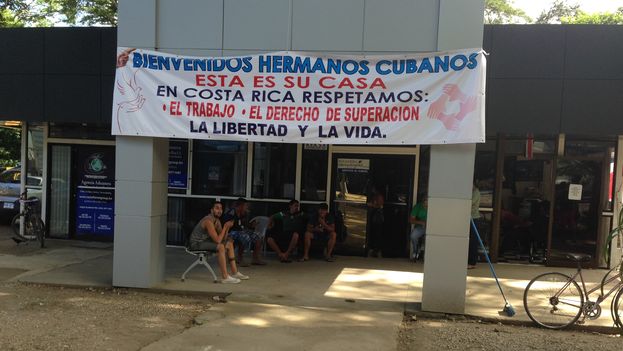
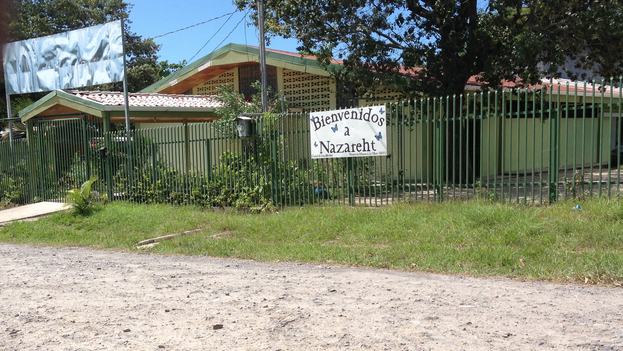
A few yards from the border with Nicaragua, Costa Ricans reaffirm their solidarity with Cubans: Welcome Cuban Brothers. This is your house. In Costa Rice we respect: Work, The Right to Succeed, Freedom and Life. (14ymedio Photo / Reinaldo Escobar)

14ymedio bigger14ymedio, Reinaldo Escobar (Special envoy), Liberia (Costa Rica), 28 November 2015 — A uniformed policeman guards the entrance to the shelter in the church of Nazareth, in the Costa Rican region of Liberia. It is there to protect 70 Cubans who are waiting for the Nicaraguan authorities to allow them to continue their journey to the United States. Journalists are not allowed access, not least because most migrants prefer not to give interviews.

However, the Cuban accent opens all doors. Once inside, a young man from Pinar del Rio explains that his family does not know he is in that situation and he does not want to worry his mother. “She believed I was going around the stores in Quito to buy clothes and then sell them back home in San Juan y Martinez.” Something similar occurs with Maria, an enthusiastic and charismatic woman from Camagüey, who spurred by the emergency has become the voice of the group. continue reading

Maria is a little frightened to comment: “I don’t want, tomorrow, for the Cuban government not to allow me to visit my family.”

Maria is the representative of Cubans who are there. Nobody gave her that position, no one voted for her, but her way of expressing herself and showing natural leadership have led her to speak for those who prefer to remain silent. However she confessed to this newspaper that she finds it a little frightening to make statements: “I don’t want, tomorrow, for the Cuban government not to allow me to visit my family.”

The hostel recalls the Cuban schools in the countryside through which passed the Maria’s and the young Pinareño’s generation. The difference here is that they are not forced to work in agriculture, nor to listen to the tiresome ideological propaganda of the morning assemblies. They are free, but have one obsession: continuing the path to the “land of freedom,” they say.

Sioveris Carpio left on 3 September for Ecuador. He never imagined that his journey would be complicated in this way. He arrived in Costa Rica on 12 November when the border with Nicaragua was already closed. Now, when asked if he wasn’t tempted to turn around, he uses a slogan heard thousands of times from Cuban officialdom: “Pa’ tras ni para coger impulso*.” And he adds with a smile, “My objective is to get there.”

He is an amateur musician, finished the 12th grade, and had worked as an animator and audio operator in Trinidad, but he lives in Condado, a corner of Escambray where the alzados – the anti-communists – were active in the sixties. “I live near where there is a monument to Manuel Ascunce, the literacy teacher killed by the alzados,” he says, and immediately clarifies, “the fact that I am going to the United States doesn’t mean that I’m against the Revolution.” In the conversation there is only this reporter and the impassioned young man, but at times he speaks as if a thousand ears are listening.”

“I was born and raised under a Revolutionary roof, what is happening is that I am looking for an economic improvement,” says Carpio Sioveris

“I was born and raised under a Revolutionary roof, what is happening is that I am looking for an economic improvement,” he says. He repeats the litany of many about his decision, that he “isnot political”, but admits that he has chosen the United States” because it is a country where you can find an opportunity to prosper.”

If “things get bad” and he can not continue toward reaching his dream, he will stay in Costa Rica. “Right here,” he says and states that “people are good and we have the same language, but life is expensive and it is not easy to find work.”

In Cuba he left his entire family and says that his parents “are suffering a lot because they know I’m here.” His dream, however includes the goal of one day returning to Cuba. “Not now, because unfortunately there are no opportunities, wages are minimal to the point that if you buy a pair of pants you can not eat that month.”

Carpio is a skeptic of the economic changes that have occurred on the island in recent years. “The results will be seen only long term. We will have to wait a long time and I am almost 40.” The clock of his life has marked a critical time and he prefers to spend the rest of it in foreign lands.

“Here on the roof of my house I have an antenna for television and they tell me that in their country satellite dishes are prohibited,” says a Costa Rican

But Carpio is only part of this drama. The people of Nazareht have seen dozens of these migrants arriving on their territory and have come out to help them. Mauricio Martinez has lived, from birth, across from the Bethel church in the Nazareht neighborhood, although he is not a member of the church. Now he dedicates many hours of his time talking to the Cubans.

Mauricio Martinez has lived, since he was born, across from Bethel church in the Nazareht neighborhood (Photo 14ymedio / Reinaldo Escobar)

“I’ve never seen anything like what’s happening here today. At first we had some concern, but the people are very quiet and very well educated. They are very friendly,” he confirms.

The help that the community has given to migrants has been spontaneous. People bring clothes or food, “according to what everyone can because we are humble people,” says Martinez. “But we’ve realized what is thay are going through and so we are collaborating,” he reflects.

The arrival of the Cubans is also leaving a deep impression in the way many Costa Ricans see the world. “Knowing them has allowed us to learn a very different reality to ours and also different from what we could imagine,” says a solicitous neighbor. “Here on the roof of my house I have an antenna for television and they tell me that in their country satellite dishes are prohibited, and thus I realize what they are looking for in freedom” he says.

A vehicle from the firm Movistar is parked front of the shelter. Mr. Benavides, a sales agent, is satisfied with his success in selling phones, SIM cards and recharges to the Cubans. “Since we learned that the shelters were filled with these migrants we assumed that they probably wanted to communicate with their families.”

“I came here with my wife but I left my four children, two grandchildren and my mother,” says Julio Cesar, who operated a tire retreading machine

The employee says that “there is a commercial interest, but the first thing that got us here was the desire to help.” He adds, “It’s amazing how they know the brand names, they are modern people and are eager to prosper.”

It is not easy to win the confidence of those who have had to sneal across several borders and fear that what little money they have left will be taken away or that they will be deceived by traffickers, but some speak to this newspaper with the familiarity of old friends.

Julio Cesar Vega Ramirez of San José de las Lajas, is not afraid of anything. He left Ecuador heading to Colombia without knowing the way, then by boat to Panama and then to Costa Rica, where he was given a pass for seven days that has been extended for fifteen more. “With this visa we can move around the country freely,” he says.

The man says that “everyone here has helped us, the church’s neighbors, the organizations. They bring sacks of cassava or bananas without charging a cent. The Cubans living in San Jose have also brought donations. ” Although he has also had the support of his family in Miami. “They have sent me the money bit by bit because it is not advisable to walk around with a lot of money,” he explains.

Julio César operated a tire retreading machine. “I came here with my wife but I left my four children, two grandchildren and my mother.” He said his family was aware of what was going to do. “Although I said nothing at work for fear that someone would spill the beans and spoil the plan.”

His wife, Maritza Guerra, has a degree in nursing and a master’s degree in comprehensive care for children. For years she has been a nurse in the pediatric ward of the Leopoldito Martinez Hospital in San José de las Lajas. It is also pediatric intensive care nurse. “Here we communicate with our families and friends thanks to wifi zone they immediately established for us completely free. I would like to ask those Cubans in exile and on the island to help us, please, do something for us,” she clamors insistently.

In the afternoon, when the sun goes down, the trees are filled with birds. The noise they make is very different from the sparrows in the parks of Cuba, because there is a lot of variety and they all sing differently. Birds coexist with each other and fly freely from one side of the border to the other.

*Translator’s note: Para atrás, ni para coger impulso. Roughly: No going back, not even to gain momentum (for another charge).

A Matter of Law / 14ymedio, Miriam Celaya

Nicaraguan police guarding the border with Costa Rica to prevent passage to Cubans bound for the United States (Photo Álvaro Sánchez / EFE)

14ymedio bigger14ymedio, Miriam Celaya, Havana, 24 November 2015 — The crisis that has led to a bottleneck of more than 2,000 Cubans on the border between Costa Rica and Nicaragua these last few days brings to the forefront the issue of the incessant flow of émigrés from Cuba to the US, creating a delicate collateral diplomatic situation between the two Central American nations.

Belatedly, as it is usual for the Cuban government to react to important situations that they would rather avoid, Cuba’s Ministry of Foreign Affairs has published a statement attributing all the causes for the exodus to the Cuban Adjustment Act and the “wet foot/dry foot” policy that the U.S. applies to those who flee the Island.

In short, according to the official Cuban version, responsibility for the growing tide of migration from Cuba to that country belongs entirely to the US administration, which is jeopardizing the process of reconciliation and dialogue between the two governments which began in December, 2014. 

With rampant disregard towards its people, the power is, once again, ignoring the human drama of emigration

Here is a situation where a foreign power applies a law that incites in Cubans the irrepressible urge to embark on an uncertain and dangerous adventure. continue reading

This portrayal, attributed to hundreds of thousands of Cubans who emigrate to the US, or aspire to do so, depicts them with the regrettable inability to reason for themselves, and, paradoxically, calls into question the much-vaunted national sovereignty, since it assumes that a law established by a foreign power is a necessary and sufficient condition to cause what is becoming a gradual and constant emptying of the Island.

Meanwhile, the official press ventriloquists have been ordered to support their boss, so very astute comments from its analysts have started to appear on television news programs and in newspapers. For Castro-style journalism, all resources are valid, starting from the most rude and cynic comment, offensive to the Cuban people, that mocks the national misfortune that this never-ending escape represents: from “Anyone who has $ 15,000 to pay a smuggler is not fleeing from poverty,” was the comment of Oliver Zamora, a yeomen of the guard, on last Friday’s primetime broadcast of the National Television News; to the reductionist, untimely and manipulative “opinion” article – “The Cuban Adjustment Act. From the escape to the stockade” – by Ricardo Ronquillo, in Sunday’s Juventud Rebelde.

Resolution of this problem is in the hands of the Cuban authorities, also from a legal perspective, that is, revamping the laws in our country

Both pawns stick to the Master’s script that points to the Cuban Adjustment Act – enacted and in effect since 1966 – as the cause and continuation of the problem, and the government’s defense is sustained on that aspect, which motivates the challenge of debating from a legal perspective.

Thus, accepting that such a law affects the Cuban exodus to some extent, and mercifully leaving aside the element that one of its greatest beneficiaries is precisely the Cuban government, whose coffers swell each year with the merciless tax it imposes on contributions sent from emigres to their relatives in Cuba, it is unquestionable that the resolution of this problem is in the hands of the Cuban authorities, as well as from a legal perspective, that is, revamping the laws in our country.

The absolute power of the Cuban regime places it in a privileged position when it comes to legislating, since the General-President is not required to consult anyone nor to have the approval of any parallel power to enact laws at will. If Castro II wants to defeat the formidable power he attributes to the Cuban Adjustment Act, and if he wants to avoid the shameful humiliation that a foreign law has greater convocation capability for the Cuban people than does the Revolutionary discourse of over half a century, he should make deep legal changes in favor of the governed, so that they benefit from our laws and not from the laws of others.

For instance, the Foreign Investment Law could be revised to acknowledge the rights of Cubans to invest in their own country, given that, as Oliver Zamora has stated, Cubans are not fleeing poverty, since they have funds to pay traffickers. It is logical to offer them the opportunity of a better way to invest their money in their own country. Incidentally, tax laws could be relaxed to establish soft taxing for Cuban investors, offer them low-interest, long-term credit, and enact favorable import tariffs for to improve the performance of their businesses.

I am convinced that the new scenario that would appear in Cuba from this revamping would greatly discourage the disorderly stampede of emigrants to the United States

The labor codes could also be reviewed to grant Cuban workers the right to strike, the right to unionize, and the right to enter into contracts; a new agrarian reform could be enacted that places ownership of the land in the hands of producers who work it; the period of time that Cubans can remain abroad without losing the right to return to their home country when they wish could be declared unlimited; provisions that establish the loss of citizenship could be repealed and the full right of all Cubans residing in Cuba or abroad to enter and leave the national territory and to participate in elections could be recognized.

Other legal issues that are entirely dependent on the will of the Cuban government and not on that of the U.S. are those concerning the consecration of those rights intrinsic to democratic societies, such as freedoms of expression, of opinion and of the press, and the multiparty system, just to mention the most elementary.

I am convinced that the new scenario that would appear in Cuba from this revamping would greatly discourage the disorderly stampede of emigrants to the United States. The suitability of Cuban laws would eventually defeat the evil power of the Cuban Adjustment Act and acknowledge the Cuban establishment. It would ultimately become clear that, in effect, the Cuban emigration problem is only a matter of law.

IMO, Person of the Year in Cuba / 14ymedio, Yoani Sanchez

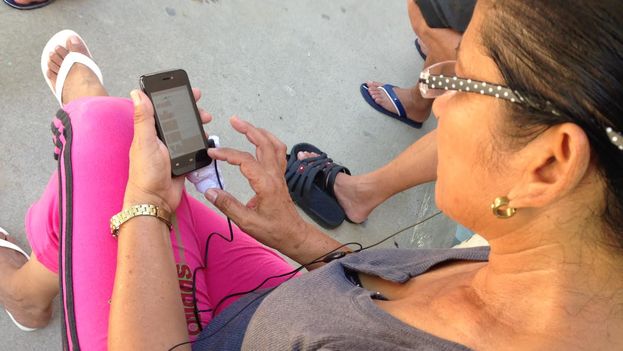
A Cuban migrant navigating the internet on her cellphone from a shelter in Nazareht, Costa Rica (photo 14ymedio)

14ymedio bigger14ymedio, Generation Y, Yoani Sanchez, 28 November 2015 – December will soon be here and numerous lists of this year’s protagonists will be published in Cuba. A difficult task in a country that over the last 12 months was visited by a pope, a secretary of state and even by Mick Jagger. However, the person who takes all the palms is not a politician, a religious leader or a rocker. It is a mobile application with a short name and a profound impact on our reality: IMO.

With over 150 million accounts worldwide, this video-call tool burst into our daily lives mid-year to shorten distances and reunite families. With its simple interface and capacity to adapt itself to the low speeds of our internet connection, IMO has achieved what insularity and politics has limited for so long: contact with the world. continue reading

Headquartered in Palo Alto, the startup responsible for this tool for text chats, voice and video, was founded by one of the first ten Google employees, who says that he likes working “on challenging projects.” A maxim that has been extensively tested in Cuba, where despite the technological obstacles the app has spread virally through smartphones and tablets.

Anyone who says that technology distances us and locks us in solitude, can wander through the wifi zone on Havana’s La Rampa and see the tears and smiles this utility gives rise to when Cubans connect between here and there. The emotions are very much as if they were face to face. There is no coldness on the screen, nothing dehumanizing on the keyboard, when they are the only chance of encountering the people we love.

The corner of Infanta and 23rd, any Saturday. A lady enjoys the son she hasn’t seen for two decades, checks out his latest hair dye, while the emigrant’s sister has brought the dog who also participates in the moment. At their side, a young man no more than 20 insistently repeats, while holding the phone in front of his face, “Don’t delay, get me out of here.” Through IMO we have tackled, in recent months, our hopes and our despair.

Even prostitution with foreigners has become more technological through the new utility. Now “the merchandise” is evaluated before the customer arrives in the country. The other day a young girl swept a tablet with a camera over her whole body while, on the other side, someone with a German accent asked if it was true that she was over 18.

However, IMO deserves the title of Person of the Year above all because of the key role it has played in the migratory crisis facing close to 4,000 Cubans on the border between Costa Rica and Nicaragua. While the official media remained silent about these rafters-on-foot, this tool has kept their families on the island informed about the fates of their loved ones trapped in Central America.

Alarm Bells on the Route of the Illegal Market / 14ymedio, Orlando Palma

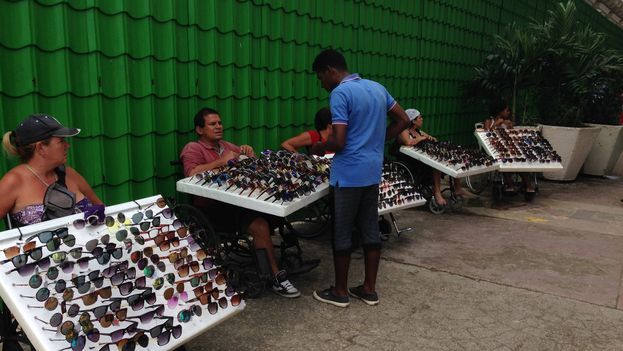
Informal vendors of glasses, a product that comes into Cuba mostly through mules. (14ymedio)

14ymedio bigger14ymedio, Orlando Palma, Havana, 27 November 2015 – Children’s clothes and sneakers were a part of the goods being called out by an illegal vendor this Thursday on Galiano Street in Havana. Although it is just four days until the migratory restrictions on Cubans announced by Ecuador take effect, alarm has already spread among merchants and “mules.”

The news of the new visa requirement for Cubans, starting on December 1, has fallen like a bucket of cold water, and not just among those who were planning to leave with Quito being the first step to their final destination: the United States. The bad news also affects a wide network in importing, distribution and sale of illegal goods that range from cleaning supplies to sophisticated appliances. continue reading

This Friday, when there are still no tangible effects of the change, the vendors already anticipate a drastic fall in their merchandise and customers fear the loss of variety in clothing and footwear now available on the illegal market. On the street, many speculate that the probability that prices will rise in the coming days and will trigger sales, especially so close to Christmas.

The mules who arrive in Havana on the Taca flight that landed shortly after five in the afternoon on Thursday felt fortunate. Coming from Quito, after a stop in San Salvador, the Cubans felt like shipwreck survivors and were received with relief by their families outside the airport.

The luggage belt was full of the so-called bolas – suitcases full of clothes, shoes and home appliances, wrapped in nylon in the airport of origin. The customs dispatch the bolas first and the passengers with suitcases have to wait behind the priority of the obvious freight traffic. Despite strict legislation approved in September 2014 on non-commercial imports, a whole network of corruption guarantees that the merchandise passes through the controls without major incidents.

A young man of 32, who asked to remain anonymous, was one of the fortunate ones who ended his trip to Ecuador without legal holdups. “We arrived just in time,” he told 14ymedio on his arrival at Terminal 3 at Havana’s José Martí International Airport, where he heard about the announcement of the new restrictions on Cuban nationals entering Ecuador. “There was a rumor there that they were going to close the door soon, but we never imagined it would be so soon,” he added.

The boy’s luggage contained everything from Christmas wreaths to a carpenter’s saw. “I should have risked bringing more stuff, because now I don’t know when I’ll be able to travel,” he lamented while his cousin helped him to push two carts full of bolas and boxes between which a flat screen TV also peeked out.

From now on Ecuador will apply the same restrictions as Panama, Mexico and the other nearby nations, which already require Cubans to have a visa to enter the country. Instead, holders of Spanish passports or Cubans with five-year visas to the United States will be able to travel freely, as before, to all those countries, including Ecuador. For informal traders, this path was a safe route despite the high ticket prices, which in the high season can exceed $1,000 US.

The buyers have also benefited from the use of this Ecuadorian trade route. The high prices of products in state sores push many families to buy their clothes and shoes in the illegal market, following an unwritten maxim often shared on this island: priority to individuals, rather than the State.

A pair of sneakers, which in the hard currency stores cost around 45 convertible pesos (roughly $45 US), can but got for half the price and of better quality. “You see these Adidas? You can’t find them here,” says Victor Manuel, a high school student who says he lives for clothes. “That’s what matters most to me,” he says.

The official press published a note this Friday on the new immigration rules for Cubans going to Ecuador. In the same issue, an article criticized the preference for foreign products among Cuban children and youth. The main reproach is directed directly to backpacks and accessories with the faces of Barbie dolls which are some of the products the mules import from Ecuador.

Despite the fears, some traders seem confident that the situation will be resolved. “We’ll find another way, we always have done,” assured the young man who arrived on the Taca flight. The bolas that he brought on his last trip from Ecuador barely fit in the family car that came to pick him up at the airport.

Cubans Propose Paying for Air Transport Out of Costa Rica / 14ymedio

A Cuban woman stranded in Costa Rica attempts to communicate by phone with relatives on the island. (Reinaldo Escobar)

14ymedio bigger14ymedio, Havana, 27 November 2015 — A group of Cuban migrants stranded in the Costa Rican city of La Cruz on the border with Nicaragua, have sent a letter to the country’s government in San Jose, and to other countries involved in finding a solution to the crisis, asking them to analyze the option of a “humanitarian corridor” by air, as revealed Friday in the Nicaraguan newspaper La Prensa.

Nearly 4,000 Cubans are in the north of Costa Rica where, as of November 14, Nicaragua has blocked their passage to continue on their way to the United States. The signatories of the document, some 200 people staying at the de La Cruz Night School assure that most of them have enough money to meet the cost of the flight. continue reading

“Today in La Cruz, Guanacaste province, there are a significant number of Cuban immigrants who are able to afford to travel without occasioning any government expenditures,” they say. They explain they sold their homes and belongings before the trip and they have the support of family and friends abroad.

This letter is in addition to other statements shared through the Facebook page, “Let the Cubans pass.” In a post published this Thursday from Peñas Blancas, the migrants addressed the Nicaraguan people. “The decision of President Daniel Ortego not only promotes human trafficking, but creates a problem where none existed, putting political interests above human rights,” they write.

Just a day earlier, the Cubans sent their “heartfelt thanks” to the institutions and people of Costa Rica. “At no time has it been our objective to disturb your tranquility and daily routine, but given the current circumstances we have been forced to stay longer than expected,” they explain.

Cubans in Nazareht, Costa Rica / 14ymedio, Reinaldo Escobar

Pastor Gerardo Obando. (Reinaldo Escobar)

14ymedio bigger14ymedio, Reinaldo Escobar (Special envoy), Liberia (Costa Rica), 27 November 2015 — The morning was warm and the Nazareht neighborhood had been listening for days to the distinctive Cuban accent. This point in the geography of Liberia, capital of Costa Rica’s Guanacaste province, is now one of the places where dozens of our Cuban compatriots are waiting to continue their journey to the United States.

At least 70 of them are housed in the premises of the Bethel Assembly of God Church. This newspaper spoke with Gerardo Obando, Costa Rican and pastor of the congregation, who detailed the current situation of the migrants in his care.

Escobar. Have you had any previous experience with migrants?

Pastor Obando. This is the first time that we have had this kind of emergency. When we were contacted by the authorities of the National Emergency Commission (CNE) we didn’t hesitate to say yes, to be able to help our Cuban brothers. My wife and I came from a tour of Nicaragua two Sundays ago and we couldn’t cross because the border was closed. We had to stay one more day on that side and it really bothered us, we were very sorry for the Cubans. continue reading

Especially thinking that there were children, older people, and because it was raining at the time. We were there, praying for them and it was a surprise when we arrived here the same Monday and the CNE coordinator contacted us to ask if we would lend our facilities.

Escobar. Is it a solitary task or are you being supported?

Pastor Obando. Several independent organizations and government institutions are involved, such as the Red Cross, the National Children’s Trust, the Lions Club and the national Ombudsman, among others. They have all been hand in hand here with us.

Escobar. Has there been any rejection by nearby residents to the arrival of so many Cubans?

Pastor Obando. People living here have reacted in a very humane way, there has been no opposition. They have been lending a hand, bringing any kind of assistance that may be needed here. Even some who do not come to the church have baked bread and brought it and milk for the Cubans.

Escobar. Are the migrants are being held here?

Pastor Obando. They are not prisoners here. They have complete freedom and can come and go. We only have a time when we close the gates, for reasons of security. On the other hand, they have visas and Immigration came yesterday and extended their visas for 15 days.

Escobar. Nicaragua officials have hinted that these people are criminals. Have there been violent incidents in the shelter?

Pastor Obando. We have not had any incidents. There is harmony and they are very nice people, well educated and very helpful. They have collaborated with us in fixing some things around the building, they are eager to work.

Nazareht shelter in Liberia, Costa Rica, home to some of the thousands of Cubans stranded in the country.(Reinaldo Escobar / 14ymedio)

Escobar. Do they participate in church services?

Pastor Obando. Yes, many are participating. We are also praying for them that they may continue their journey to the United States.

Escobar. What have you heard them say they wish for most?

Pastor Obando. The biggest dream of all of them is to reach freedom. Many of them have dreamt since childhood of a freedom they have not had.