My Cable and I. Fiber Optics in My Town? / Somos+


SOMOS+, Frank Rojas Torres, 24 November 2015 — It was October 15, 2015, and a success that should be transcendental for all my compatriots turns out to be nothing more than a false alarm, one more of so many expectations that remains only that. Another promise to be fulfilled in the long-term, only because “the steps taken should be well thought-out in order to not commit errors.”

It’s true that weeks before the news spread by word of mouth, growing or shrinking according to what one brought to it or took from it, showing this writer that we all believed it would be a reality weeks later.

The so-much announced, glorified, dreamed-of and awaited fiber optic cable called ALBA-1 finally made its brilliant entrance onto the terrain of my little country town, opening a passage between the solid rocks that make up its subsoil, pushing us a little more while we try to shorten the tremendous gap, which on this subject as on almost all, separates us from a large part of the outside world. continue reading

And yes, here I was so proud telling people about the immense amount of information that can run through its veins. I became majestic making a show of what it could do and having it rubbed it in my face that in the matters of information and informatization we are, as a good Cuban says, “more backward than the ampalla” (i.e. extremely backward) or light years from even the century in which we live.

I can’t deny that I was inundated with emotion, feeling the privilege of remembering that I’m human.

From Venezuela swam the cable, which would connect us with civilization, with our fellow men, leaving behind the primitive life of ignorant cave-dwellers. Now it seemed I finally would belong to the modern era. I already felt better located in time and space. It made me think about the idea of having nearby the key of traveling “to the infinite and beyond.”

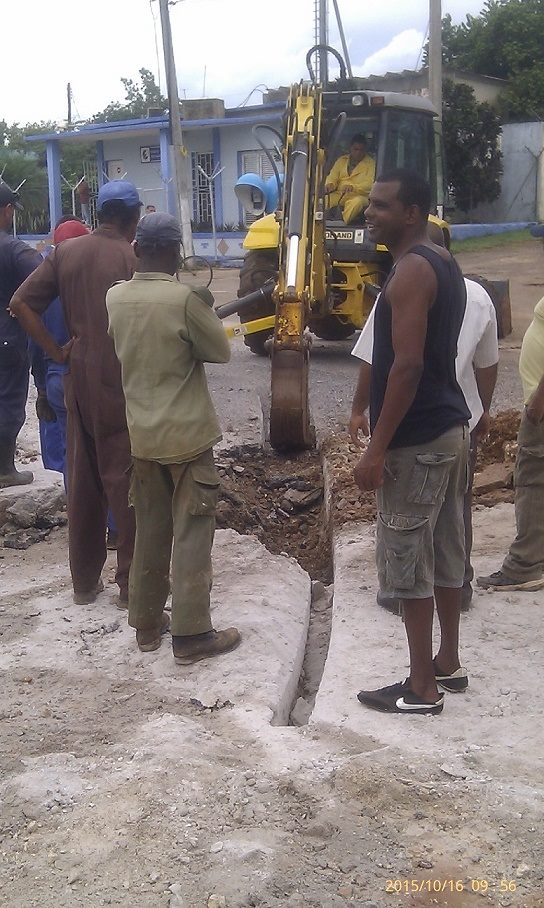
In front of me, the brigade of workers and machinery from the army — something already suspicious, hmmm — charged with creating the conditions pertinent to the good functioning of the new technology, were hard at work opening a trench where the aforementioned cable would extend to the terminals, while the curious — like me — little by little were gathering around the work area, asking questions and exchanging opinions about something that also was novel for them, seeing who could pick out the next stone that they would fling away.

Well, it’s not that I like gossip, but I couldn’t avoid being pushed by curiosity to see up close how they were connecting the cable to the terminals. Who would be the object of the test? Because everything that’s done here is submitted to a meticulous test before using it for more people, to avoid a “false” step. Because of this we function so “well.” Because of this our country is in the “vanguard” of “everything.” We can’t give ourselves the luxury of committing “errors.” We can’t give the “enemy” even the least opportunity to criticize us.

Well, who is our enemy now? Caramba, we have to fabricate another now that the Americans suddenly became our friends. Well, now someone will have to appear who wants to “blockade” us and put us on some black list.

Well, as I was saying, an irresistible force pushed me onto Street 3, to follow “Mr. Cable” as in his time Theseus did, following Ariadne’s thread that was leading him to the exit of the Minotaur’s labyrinth.

While I walk I wonder about who has been chosen for such an experiment. Finally I turn the corner and follow my cable, if indeed it’s mine. At this height and with all the joy that seizes me, I already feel it’s mine, a part of me and my family. Okay, it’s not a guy or a girl, nor will it be in the bakery or the grocery store. It’s logical that it should be in the library. Nor is Frank here.* I miss him, but I follow my cable. Where will it take me?

I almost run into a gentleman on a bicycle while I walk down the street, already connected with my friends, investigating things, looking for information, rediscovering my country and its rich history, especially the one not told, exploring a new world and perhaps finding a new girl to conquer in cyberspace.

I come to another corner and look up to calculate how many more were left before I saw where my cable would be placed, and I finally see its destination. No, it can’t be! This has to be a joke in very poor taste! I almost fall on my ass when, before my thunderstruck eyes, my cable, my friend the cable, like a fish in water, is being hooked up at the PNR (National Revolutionary Police) headquarters.

What was it doing there? It recently had come to my humble little town, and now they were surely warning the cable that it wouldn’t be like we thought, no sir, without first having to pass through this place before entering the life of all of us, because here all is done with “order.” This would be its Customshouse, where surely they would remove from it many things it was bringing to me and my people. I suppose they left the cable very clear about what it could or could not say, and what it could or could not let us see.

I felt newly brutalized and regressed again in time, moving away more and more from my friends and from the enormous universe that minutes before told me it was waiting for me. I was on the point of screaming from so much rage and frustration. I can’t deny that I almost cried.

Soon came to mind the image of a large filter through which would pass the information traffic that would travel in all possible ways through my cable. At once I realized it was an illusion to believe that everything would be so easy beneath this Regime of “total” totalitarianism. My naivety betrayed me at thinking during my detective run that this innovation would come to me just like that. Automatically I began to link together the latest stories about the building where the PNR is located, subjected for a couple of months to changes in its structure and some other remodeling.

Of course, conditions must be created in order to better adapt oneself to the new area of work. I had to change many things so that I felt comfortable with their listening in when I spoke with the “worms**,” my brothers in struggle.

Today is November 7, 2015, and for me it was going to be a big date in my little rural town. It ended up adding to that long list of things that today move me to continue looking for a different Cuba. I continue dreaming, awake, about something that arrived but continued on, like the waiter that passes in front of you with a succulent plate, leaving behind the smell of what you would like to eat but can’t because your money doesn’t stretch far enough to allow yourself that luxury.

Today November 7, 2015, and it’s almost a month since the arrival in the land of Limonar of the fiber optic cable. My buddy, my brother, I remain with the desire to touch you and a strange, bitter taste that reminds me where I am. I still see in the streets the open wounds made by those machines of doubtful origin, now infested with garbage and dirty water as unequivocal marks of a system that only leaves us that: open wounds full of filth.

Today I want to laugh at myself for being so stupid and for having converted this real-life story into one of those scenes from the fairy tale, “Little Red Riding Hood.” In the distribution of roles, the PNR is the wolf that waits for me in bed after swallowing my grandmother – my cable. I am the tender and innocent Little Red Riding Hood, who arrives at her grandmother’s house and sees her in bed with the face of a wolf:

“Yo! Little Red Riding Hood.” “But grandmother, what big ears you have!”

PNR, the wolf: “Ah, the better to hear you with my dear!”

Translator’s notes:
*Reference to a movie about a band leader. 
** “Gusanos” — worms — is one of Fidel Castro’s epithets for people who leave Cuba for the U.S.

Translated by Regina Anavy

Henry Constantin Arrested at the Airport on His Return From Lima / 14ymedio, Luz Escobar

Henry Constantin. (14ymedio)

14ymedio bigger14ymedio, Luz Escobar, Havana, 26 November 2015 — Journalist and activist Henry Constantin, director of the magazine La hora de Cuba (Cuba’s Hour), a member of the editorial board of the magazine Convivencia (Coexistence) and collaborator with 14ymedio, was arrested at three in the afternoon on Thursday at customs in the José Martí Airport, as he himself reported via text message. “They demand my laptop. And magazine. I respectfully refuse. They do not let me talk,” he said in his text.

Constantin arrived in Havana from Lima, Peru, where he participated in the Conference of Investigative Journalism (COLPIN), along with Amarilis Cortina Rey, Ernesto Perez Chang, Ignacio Gonzalez Vidal and Armando Soler.

Later, Inalkis Rodriguez said by telephone from Camagüey that Constantin was taken to the Boyeros police station, near the airport. However, Constantin confirmed to this newspaper that moments before getting into the car that was to take him to the police station, he was told he could go. According to his account, he was able to handle the pressure and remained in possession of his laptop. He then headed to Camagüey.

Meanwhile, Ignacio Gonzalez, director of En Caliente Prensa Libre (In Hot Free Press), said that he was also separated for a “routine examination” in the words of Cuban Customs officials.

They searched all his luggage, but after a while let him leave without further consequences.

Cubans Protest outside Ecuador’s Embassy in Havana / 14ymedio

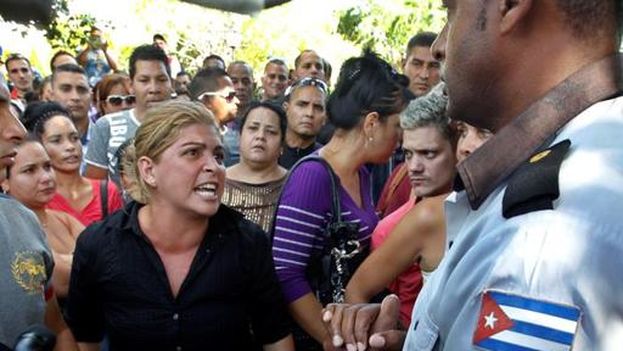
Woman argues with uniformed Cuban agent in front of the Ecuadorian embassy in Havana
Woman argues with uniformed Cuban agent in front of the Ecuadorian embassy in Havana (EFE)

14ymedio bigger[UPDATED] 14ymedio, Havana, 27 November 2015 — Hundreds of Cubans, on Friday, demonstrated their dissatisfaction with Quito’s decision to require visas from he island’s nationals as of Tuesday, December 1.

The embassy, ​​located in the Miramar neighborhood, is currently cordoned off by a strong police operation preventing anyone from approaching. The agents assert that “last night several people tried to sneak into the embassy,” although the majority of those congregating on the corners were talking about the unreliability of the official version.

Many people are also gathered in front of the offices of the airlines that fly to Ecuador, to demand or change tickets. At the office of Copa Airlines in Miramar, people continued to gather despite an employee advising them, an hour ago, that there are no more tickets for Ecuador until April Some have stayed, despite the warning, hoping to be refunded the price of their ticket.

Copa Airline offices at the Havana Trade Center in Miramar where customers gathered this Friday to request tickets prior to December 1 (14ymedio)

The Ecuadorian consul in Cuba, Soraya Encalada, took to the streets with other diplomats to explain that her government’s position is not to “obstruct” travel, but to “prevent human trafficking,” according to the press agency EFE. The diplomat said that the decision to require visas from Cubans was a “temporary situation,” which required everyone interested in traveling to Ecuador to enter their data into the embassy’s website in a “simplified” procedure to speed up the paperwork.

For years, Cubans who want to reach the United States have flown to Ecuador because it did not require a visa. The migrants would then continue their journey through seven countries (Colombia, Panama, Costa Rica, Nicaragua, Honduras, Guatemala and Mexico), facing many difficulties and dangers on the way.

Tania Bruguera is With Cubans in Costa Rica / 14ymedio

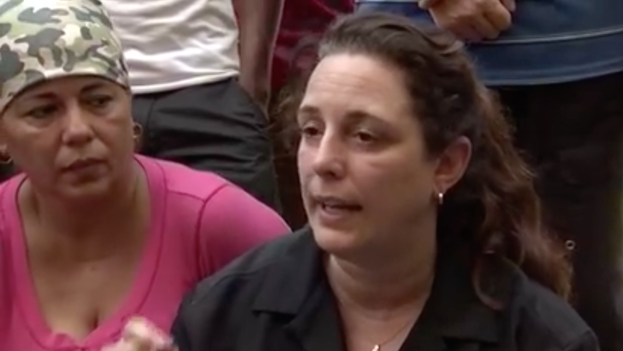
Tania Bruguera, in Costa Rica, with Cubans stranded at the border. (Youtube / screenshot)

14ymedio bigger14ymedio, Havana, 26 November 2015 — The artist Tania Bruguera heeded the call of some of the more than 3,000 Cuban migrants who have been stuck for more than ten days ago in the north of Costa Rica after the Government of Nicaragua prevented their continuing their journey to United States.

A group of migrants created a Facebook page called “Let the Cubans Pass” so that “the world will know their names, experiences and professions in order to contradict those who brand Cubans trying to reach the United States as criminals.”

“I want to show my solidarity by being there with them. I have no plan, I am not anybody who is going change any situation. But well, at least to be with them,” said Bruguera in an interview published by the Costa Rican online journal Socialism Today. continue reading

“A mechanism needs to be created for the people to hold the government accountable in a peaceful and legal way, without it being seen as a counterrevolutionary attitude” she stresses.

“I think the government is dedicated to lowering people’s hopes and what we are seeing today is that a year after [the restoration of relations with the US] people do not see a solution to their problems and prefer to sell their homes and leave their families and go to another country to seek their fortune rather than stay in Cuba to see what happens,” she says. “In Cuba there is no economic migration that is not political.”

Bruguera has also been affected by government limitations on movement when, between late December of 2014 and August of this year she was prevented from leaving Cuba. After being held on the island for eight months for organizing a performance in Revolution Square in Havana, the authorities finally returned her passport and she was able to take up a fellowship at Yale University.

The artist has worked previously on the subject of migrants, in particular when she founded the Immigrant Movement International, an art project conceived in 2006 and presented by Creative Time and the Queens Museum of Art. With this initiative she proposed to initiate a socio-political movement, so she spent a year working in the multicultural neighborhood of Corona, Queens in New York City.

The First Anniversary of a Truncated Hope / Rebeca Monzo

Rebeca Monzo, 26 November 2015 — Some days from now it will be the first anniversary of the reestablishment of diplomatic relations between the governments of Cuba and the United States, but the great expectations awoken by the desired event seem to have fallen into uncertainty and stagnation.

The vast majority of Cubans believed they saw on this event the potential for great improvements in every sense, but disappointment soon invaded all of us on seeing that the island’s government had not taken a single measure to indicate good faith and the desire to realize the changes so greatly longed for.

The fact that they authorized travel for all Cubans and have streamlined the paperwork is nothing new, nor is the authorization to buy and sell homes and cars. These are not government handouts, but simply a restoring of citizens’ rights usurped 56 years ago by the regime itself. continue reading

Government immobility has led to a new stampede of Cubans abroad, using every kind of means to escape from a regime in which nobody believes or has any confidence.

Moreover, while thousands of compatriots abandon the country that is totally bankrupt, selling all their property and belongings in order to finance the path to a new dream, the influx of tourists to the island grows as never before, surprising given that the country does not have adequate infrastructure to receive them.

Shortages in the markets and hard currency stores, the sporadic disappearance of basic goods like mineral water, soft drinks and beer, the bad state of the streets and highways, the unhealthy atmosphere in a city where garbage collection is inadequate, the outbreaks of dengue fever and cholera in the capital and other provinces, make me question what motivates this great arrival of foreigners, among whom we find stars of the screen, the stage and music.

Could it be they want to visit this great Caribbean Jurassic Park before the oldest and sickest of its dinosaurs, still breathing, cease to exist? Only time will have the last word.

President Solis Assures Cubans Of Costa Rica’s Support To Reach US / EFE – 14ymedio

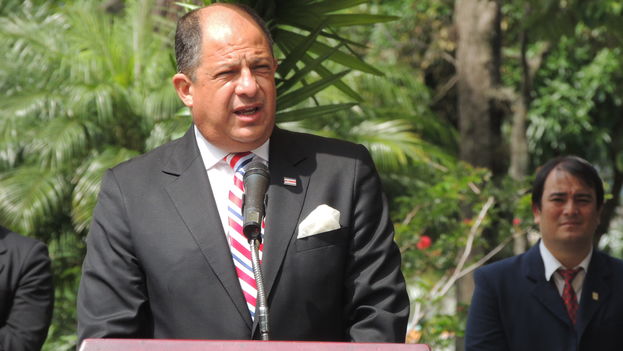
The president of Costa Rica, Luis Guillermo Solis

14ymedio biggerEFE (published in 14ymedio), San Jose, Costa Rica, 26 November 2015 — The president Luis Guillermo Solis of Costa Rica, on Wednesday, guaranteed the thousands of Cuban migrants who have been stranded in his country since 14 November that his government will make every effort to help them reach the United States, their final destination. “We will do whatever is necessary for you people to get to your destination and while you are here to live with dignity,” said the president at a press conference in San Jose.

Solis said that, following Nicaragua’s opposition to allowing the islanders to pass through that country, Costa Rica is making bilateral contacts with other countries involved in the migratory path of these people, to find a solution.

The solution is to “establish routes that allow them to continue their journey. The conditions, time and number are details that we are refining, but in this situation it is clear that we will not have the cooperation of Nicaragua and therefore we must take other measures under consideration.” continue reading

President Solis said that Costa Rica will not abandon the Cuban immigrants, but warned that their trip to the United States will be a process that will take time.

“In Costa Rica we will facilitate their travel and this entails a great effort not only to conclude the final negotiations with each country, many of whom will announce measures in the coming days, but also to guarantee, as long as they are in our territory, that they are living in adequate conditions,” he said.

Solis’s involvement in the case of Cuban migrants even led to an exchange views with the Cuban singer Silvio Rodriguez through the artist’s blog. The Costa Rican president left a comment on a post in which the singer demanded solutions for the migrants and criticized Solis for advocating a humanitarian corridor to the United States only for the Cubans and not for other Latin American, knowing that “there is a special law that favors the arrival of our people with dry feet.”

Solis Rodriguez said that it is most urgent is to find solutions for those at the border who are not at fault. The president also added that Nicaragua and Costa Rica would be wrong to “insinuate the situation of the migrants into geopolitics.”

Costa Rican Minister of Communications Mauricio Herrera Ulloa also responded to the musician, saying that his government’s request is “more than politics, it is humanitarian.”

The troubadour thanked the minister for his comments and acknowledged having written his post without all the information and out of concern for his compatriots. But then, Rodriguez added: “In addition to the best intentions of the Government in which you are a minister, there is constant propaganda against my country.”

Meeting in El Salvador on Tuesday, the foreign ministers of the countries of Central America, the Dominican Republic, Cuba, Mexico, Ecuador and Colombia sought a solution to the current crisis and also a long-term solution to Cuban emigration.

However, Nicaragua was adamant in not allowing the entry of Cubans to its territory, and accused Costa Rica of causing a humanitarian crisis by “ignoring the responsibility of the United States in the issue of illegal migration” and demanded that the immigrants be withdrawn from the border area.

As of 14 November, Costa Rica has granted temporary transit visas to 3,600 Cubans who arrived at its border with Panama, and has set up 12 shelters to provide humanitarian aid in communities near the border with Nicaragua.

President Solis also said that resolving the crisis will require “slowing down” the flow of Cubans into Costa Rica from Panama.

On Tuesday the Costa Rican Foreign Minister Manuel Gonzalez accused Nicaragua of being “intransigent” and acting in “bad faith” in this matter and said the region intends to find a solution.

The immigrants left Cuba legally by air and flew to Ecuador, which does not require them to have a visa, and from there they traveled “irregularly” through Colombia and Panama to Costa Rica.

The Costa Rican government has attributed this migratory wave to the dismantling of a human trafficking network and the rumor on the island that the United States is going to repeal its immigration laws that favor Cubans.

Ecuador Will Require Visas From Cubans as of December 1st / 14ymedio

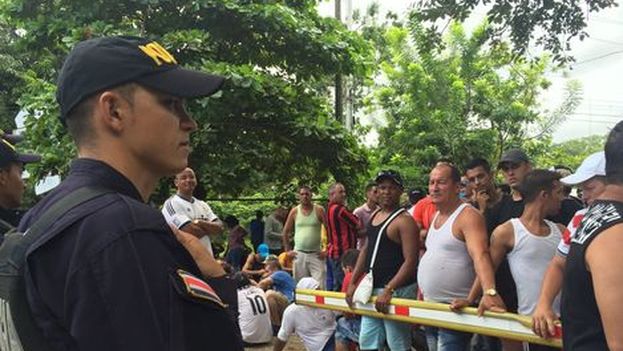
Cuban migrants at the border between Costa Rica and Nicaragua under the watchful eye of the Costa Rican police.(Natasha Cambronero / La Nación)

14ymedio bigger14ymedio, Havana, 26 November 2015 — Ecuador will require visas from Cuban citizens seeking to enter the country as of December 1, according to Deputy Foreign Minister Xavier Lasso speaking at a press conference.

This exception in the Ecuadorian immigration law is intended to discourage the Cuban migration, which has surged in recent months and has caused a crisis on the borders of Central America. “Our commitment is to human beings, to stop this migration trend is that puts men, women and children at risk,” said Lasso. “We are trying to control this type of migration, which is very risky.”

On the northern border of Costa Rica it is estimated that some 4,000 Cubans are stranded, waiting to cross the border. continue reading

The decision of Ecuador’s government comes less than a week after Cuba’s Foreign Minister Bruno Rodriguez visited Ecuador and Nicaragua to address precisely this issue.

As of November 14, Costa Rica has granted temporary transit visas to 3,600 Cubans who arrived at its border with Panama, and has set up 12 shelters to provide them with humanitarian aid.

Given the ease of emigrating to Ecuador, thousands of Cubans have traveled to that South American country in recent years. Most of them start from there on a long migratory journey of about 4,800 miles overland to reach the United States.

Ecuador’s deputy foreign minister said: “We are not closing the door to Cuba” but said his country “is committed,” along with the Latin American community, to avoiding this migratory flow.

A Night in Paso Canoas on the Border with Panama / Ivan Garcia

Cubans at the Panama/Costa Rica border

Ivan Garcia, Costa Rica, 25 November 2015 — When Alex Sigler, 22, landed in the Quito airport in an African heat with thunderclouds that presaged a tropical shower this past November 11, he began his own journey to achieve the American dream.

In five days of passing through the Colombian jungle, Alex encountered hitmen of few words and with twitchy trigger fingers.

“The police, who supposedly are there to preserve citizen order, are the first to rob us. Almost all Cubans have been fleeced at Colombian checkpoints. The coyotes are frightening. They traffic cocaine the same as people. They talk about their criminal exploits like a group of friends in the neighborhood commenting on football and a penalty,” explains Alex, lying on top of some tattered cardboard in an inter-provincial bus terminal in the Costa Rican town of Paso Canoas, a stone’s throw from the border with Panama. continue reading

On the platform about 30 Cubans are sleeping, having been robbed or conned by drug traffickers in Colombia. They have lost everything.

They find themselves without money, waiting for some relative or friend in Miami to urgently spin a few hundred dollars their way so they can pay for the rest of the crossing, if the authorities in Nicaragua will finally let them pass through their territory.

They burned all their bridges. On the Island, they sold everything. Or almost everything. The hazardous journey through eight countries to reach the U.S. is much harder than they thought.

But they’re not sorry. “I was already worn out. In Cuba we’re just a number. People count only for voting in the elections or supporting the Government. Maybe things will be bad for me in la Yuma (the US), but at least I’ll be a free man,” says Alex, who in Caibarién, some 350 kilometers east of Havana, left his wife and a four-month-old daughter.

The village of Paso Canoas is a township of one-story houses and ambulatory stalls where they sell every possible commodity. At night it’s deserted. The more than 300 Cubans who arrive in unstoppable dribbles from Panama have several options at hand for lodging. Those who arrive without a cent sleep in the old Canoas bus terminal.

Others pay five dollars a night, the lowest price for lodging, in a sweltering hostel without windows that is run by Pepe Restoi, a Catalán, who says with two raised hands that he is voting for Catalán independence.

“Man, it’s not that I’m uncaring; obviously I’m aware of the drama of the Cuban emigrants. But I’m a businessman. In Paso Canoas, between hotels and guest houses, there are about twenty. What you have to do is keep your property occupied,” says Restoi in the door of the El Azteca pension.

It would be very pretentious to call “hotels” a chain of houses adapted for guests or enlarged to be rented to the more than 3,125 Cubans who, since November 15, have walked through Paso Canoas.

Prices are expensive for a segment of terrestrial balseros (rafters) who, in tune with the closing of the Nicaraguan border, have to dig out bills and scratch their heads to stretch their money after having spent between three and four thousand dollars on their trip through Ecuador, Colombia and Panama.

“You have to be very farsighted with your money. You have to hide it in unsuspected places so that the Colombian hitmen don’t fleece you. You still have to cross four countries before reaching the U.S., and the dough is going to run out,” says Alfredo Ávila, 28, an electrical engineer who lives in the eastern province of Holguín.

Among the island emigrants there are different hierarchies. Those of extreme poverty are the ones who spend the night on the unpolished cement floor in the bus terminal and, for lack of a bathroom, urinate in a garbage dump site.

“This is hard. The majority eat only once a day. They only have their clothing left from their baggage. On the road, to lighten up, they left their belongings or sold them to be able to eat,” indicates Alex.

Gabriel, a young man who recently left military service in Cuba, says that while crossing Colombia a compatriot had to improvise a fishing rod to be able to eat.

The emigrants who have a more substantial economy spend the night in third- or fourth-class hotels, which in Costa Rica rent at first-class prices. The El Descanso hostel doesn’t calculate how many it’s received. A large grocery store is sometimes a restaurant, a bar and, occasionally, the Cubans who wait to cross the border drink beer without too much moderation.

One night, in a monumentally drunken episode in the swimming pool, some Costa Rican guests were wounded.

“They had to call the police. Many Cubans behaved inappropriately. Particularly those from Havana, who believe they deserve everything. They steal the towels, destroy the electrical outlets and are always complaining, even though the hotel management decided to reduce the tariff for them to nine dollars a night,” says Rey Guzmán, the manager of the El Descanso.

The lack of money has caused several girls to prostitute themselves or ask for money from the ticos (Costa Ricans). “In the Peñas Blancas encampment, two or three girls offered me sex in exchange for 20 dollars. Another asked me for two dollars to buy cigarettes,” says Jorge, a Costa Rican taxi driver.

Past midnight, Yadira, a willowy morena (brown-skinned woman) of 22 years, a native of Las Tunas, some 600 kilometers from the capital, was dancing a Dominican merengue surrounded by a chorus of drunken men who were whistling at her.

“She’s happy. If she’s looking for a man to save her (offer her money) she’ll do well. All the Cubans who are here have had trouble crossing, but for women it’s been worse. I have a friend who was raped seven times in Colombia,” says Magda, a blond who, in Cuba, owned a small manicure business.

Among the wandering emigrants from the Island there are those with sufficient money to stay in the best hotel in Paso Canoas, a two-floor building, painted an ivory color, that rents for 50 dollars a night.

Where are some Cubans getting so much money that they can pay between 10 and 12 thousand dollars in a country with an average salary of 23 dollars/month? I asked the engineer, Alfredo, at the entrance of the El Azteca pension.

“Many sold their car, their house or gold. Others earned money thanks to private business. Or they receive enough money from their relatives in the U.S. But most travel with their own money, which a family member abroad sends them, little by little, after a reunion, so they can come. It’s not recommended to travel with so much cash,” he answers.

Gabriel made an agreement with a sister who lives in Miami. “She offered me a loan and when I get to the U.S. I will pay her back,” he confesses, worried. He has spent the three thousand dollars and is still stranded in Paso Canoas.

Even far from Cuba, not a few emigrants are panicked at the thought of talking before the cameras or answering questions from journalists. “If I talk more, in case they send me back, I wouldn’t even be able to belong to the CDR (Committee for the Defense of the Revolution),” says a shirtless young man in the bus terminal.

On the contrary, a black man with a rugged complexion unloads his frustration, blaming the government of the Castros. “It’s their fault that people have to leave their country. Not even dead will I return.”

That’s the perception of the Cubans stranded in Puerto Canoas. There’s no way back.

Iván García, from Costa Rica

Translated by Regina Anavy

A New Campaign For Marriage Equality Announced / 14ymedio, Orlando Palma

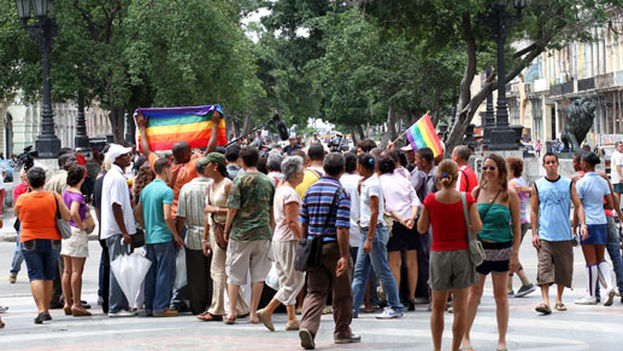
LGBTI Pride march in the Paseo del Prado in Havana in 2011 (Orlando Luis Pardo Lazo)

14ymedio bigger14ymedio, Orlando Palma, Havana, 25 November 2015 — After forty years together, Roberto’s partner died this year from a respiratory condition, but he will not collect a penny of the widow’s pension because in Cuba same-sex unions are not legally recognized or protected. Situations like this are in the sights of several independent organizations that demand rights for the LGBTI community, and that have just launched a campaign for marriage equality.

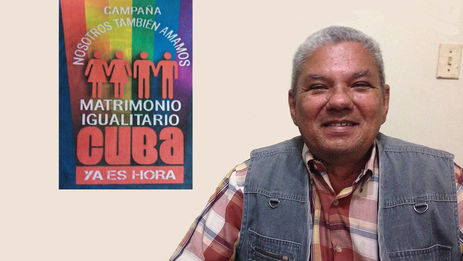
“We also love,” is the slogan under which different civil society groups will demand a legal framework that allows unions between people of the same sex, and equality of rights between homosexuals and heterosexuals. The initiative was presented to the press this Tuesday and will go public on the first of December. continue reading

Among the groups involved in the project is Corriente Martiana (Current [José] Martí), which is working on this project in coordination with the Cuban Foundation for LGBTI Rights, led by Nelson Gandulla in Cienfuegos province, and which shares the lead in the new campaign with the Integration Project of the Gay Community in Cuba led by Navit Fernandez in Havana.

Other entities not directly related to the LGTBI environment have begun to get involved in the project after being invited to show solidarity, such as the Candidates for Change project.

The organizers have developed several initiatives. including the presentation of a written request to the People’s Power delegates during weekly office hours they have with their constituents. Each of the activists should ask for a receipt that gives evidence of the request and that will accompany the collective petition that is finally delivered.

Moises Leonardo presents the campaign for marriage equality
Moises Leonardo presents the campaign for marriage equality in Cuba

The collective petition will be delivered to the National Center for Sex Education (CENESEX) and the Cuban Parliament, Moises Leonardo, spokesperson for the Corriente Martiana, explained to 14ymedio.

“First we will present it in municipal assemblies, then in the provinces and finally to the National Assembly of People’s Power. We will seek the support of artists and personalities of our culture, as well as a number of independent civil society organizations that want to join us. The campaign starts the first of December and will last six months, but even when that date has passed it will be ongoing.”

This campaign seeks to protect a couple’s rights, such as inheritance or insurance payments with respect to accidents at work, as well as obtaining legal protection for the distribution of property in the case of a separation.

“The intention is to climb one more step in the defense of human rights for a sector of the population. Practice tells us that the LGBTI community is very united in defense of their rights, and that encourages us a lot,” added Leonardo.

The Exodus Is Due To The Lack Of Freedom / 14ymedio, Pedro Campos

The Red Cross helps Cubans stuck at the Costa Rica/Nicaragua border since last weekend. (La Nación)

14ymedio bigger14ymedio, Pedro Campos, Havana, 25 November 2015 — The current immigration crisis created by the presence of thousands of Cubans in Central America in transit to the United States has put the issue of human rights in Cuba back in the international arena, in particular the civil, political, social and economic rights of Cubans.

The government of General Raul Castro and a part of the international press emphasize the idea that it is a legal issue, related to the Cuban Adjustment Act. The Cuban government also links it to the maintenance of the blockade-embargo, which analysts say is an attempt to pressure the US government to repeal both laws. continue reading

However, it is not possible to hide, behind the Cuban exodus, the fundamental problem in Cuba: the dissatisfaction of hundreds of thousands of Cubans with the economic and political situation in our country, which remains essentially unchanged thanks to decisions taken by the government — which has been in power for more than half a century – in the name of socialism, which has never existed.

No, we Cubans are not starving, because really there is no generalized crisis of that type in Cuba. Although for many nutrition is precarious, the fundamental appetite Cubans have is for rights and freedoms, for democracy, because the “dictatorship” – supposedly of the proletariat – established in Cuba and always led in the same direction by the Communist Party, continues to insist on its political and economic model of monopolistic State capitalism; by its nature anti-democratic, exclusive and retrograde.

Despite the public discourse of an “opening,” in reality economic activity outside the State is constantly limited by laws, regulations and provisions at all levels and by high direct and indirect taxes. Autonomous work, or self-employment, continues to be restricted to a group of activities and cannot be exercised by professionals in medicine or law, for example. To establish a cooperative requires permission from the Council of State.

But above all, State monopolies in domestic and foreign trade and the limited access to international communications networks, hinder non-State economic activity.

But what most oppresses Cubans, along with the daily problems of housing, transportation or poor-quality food, is the repressive philosophy of the State that impedes the freedom of expression, of association and elections, which obstructs any democratic alternation in power of forces and figures different from the governmental clan, forces and figures that could bring another focus to politics and get the country out of the stagnation in which it finds itself.

This is definitely a massive and flagrant violation of the civil, political, economic and social rights of the Cuban people, by a government that has spent more than half a century in power, with the methods and mechanisms to guarantee its indefinite existence. And this is the real cause of the exodus and of the current crisis.

It is true that the internal problems of Cubans must be resolved by Cubans ourselves, but when these problems affect other nations it is logical that they would take action in the matter and try to influence events through international means established by multilateral institutions recognized by the States.

The Central American community has met to discuss the crisis, but it should go beyond the legal and border problems involved and evaluate it in its entirety. The Inter-American system should also take action on the issue and the United Nations itself should involve itself, because as long as there is no resolution to the internal problems in Cuba, the system imposed by this “eternal Government” is going to continue to generate regional tensions related to immigration, be it in Central America, South America or the Straits of Florida.

Some believe that the current immigration crisis caused by the presence of thousands of Cubans in Central America is a land version of the Rafter Crisis of 1994. Any attempt to put a plug in the Cuban exodus across the continent could lead to a situation like that one, if democratic changes that loosen tensions do not come to pass in Cuba

‘La Joven Cuba’ Blog Questions Official Position on the Cuban Adjustment Act / 14ymedio

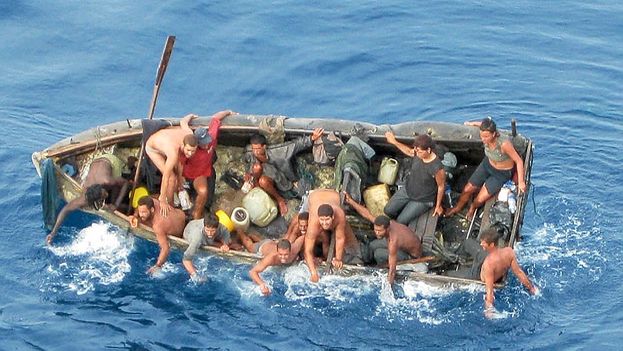
Cuban rafters
“Cubans who reach the United States without the Adjustment act will have to submit to the exploitation that other illegal immigrants are subjected to,” says the blog: La Joven Cuba

14ymedio, Havana, 25 November 2015 – In an unusual gesture of criticism toward an official position, the blog “La Joven Cuba” (Young Cuba) published a post on Tuesday that challenges the Cuban government’s approach to the Cuban Adjustment Act.

The site, run by graduates of the University of Matanzas, stresses “the need to of more than a few fellow countrymen to emigrate,” and defends the thesis that Cubans who want to reside in another country will do so regardless of whether conditions are better or worse. The article, signed by Roberto G. Peralo and titled “Eliminate the Cuban Adjustment Act and What,” uses an example close to him as an illustration. continue reading

“A woman friend who is a doctor was preparing to emigrate to Ecuador. She had a job lined up at a clinic. When she learned that the government of Ecuador wouldn’t recognize her license to practice her profession, she told me, ‘I’m going even if I have to clean the hospital floor for the rest of my life.’”

The author defends the Cuban government’s asking for the elimination of the law which also provides an advantage for Cubans over other immigrants and believes that the United States will end up repealing it. However, he believes that this will not improve things because Cubans will continue leaving and will do it in even worse circumstances.

“Cubans who reach the United States without the Adjustment Act will have to submit to the exploitation that other illegal immigrants are subjected to. They will not receive government benefits and will have to take the worst jobs at the most miserable wages. In the best of cases they will have to renounce returning to Cuba, even to visit, to be able to support the thesis that they are “politically persecuted,” so that they can receive government benefits.

The Joven Cuba website, which has also suffered censorship within the University of Matanzas, is a part of the sector relatively critical of the government, although from a “revolutionary” position that leads to censoring dissent and opposing a market economy.

In the official discourse the Cuban Adjustment Act is the target of the worse criticisms and is held responsible for the exodus of Cubans to the United States. On national television the presenters call it “The Assassin Law” and hold it entirely responsible for the current migratory crisis provoked by the arrival of more than 2,000 Cubans at the border between Costa Rica and Nicaragua.

This Wednesday, the newspaper Granma published a note on the meeting of the foreign ministers of the member countries of the Central American Integration System – Cuba, Ecuador, Colombia and Mexico – to seek a solution to the drama of the Cuban migrants. As the official organ of the Cuban Communist Party, Granma noted the unanimous rejection of “the Cuban Adjustment Act and other regulations related to the wet foot-dry foot policy and the Parole Program for Cuban Healthcare Professionals, which stimulates illegal immigration to the United States.”

Annoyances of the New Identity Card / 14ymedio, Sol Garcia Basulto

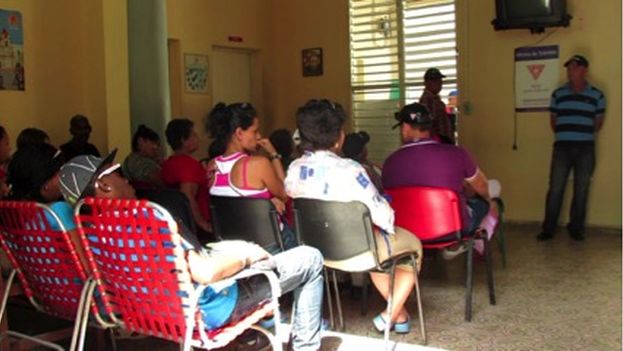
Identity card office in Camagüey. (14ymedio)

14ymedio bigger14ymedio, Sol Garcia Basulto Camagüey, 25 November 2015 – One year since the start of the issuing new identity cars in Cuba, many recognize the advantages of the modern ID card, but criticize the complex process to get one. In Camagüey province the manufacture and distribution of the new identify card started last May, but delays in delivering them and long lines continue to characterize their arrival in this region.

To learn about the details of the process, 14ymedio approached the ID card office this Tuesday, where people interested in applying for the new polycarbonate card had gathered since the early morning hours. The applicant must bring one or several stamp/seals with a total value of 25 Cuban pesos. Fingerprints are taken on the premises and the applicant is photographed. continue reading

Among those waiting to update their identity card was Gabriel Villafaña Bosa, whose previous document had deteriorated through use and the passing of years. This Camagüeyan believes that the new format is “stronger and more durable,” so that the number of times it needs to be replaced because of damage will be reduced. However, to get it he had to overcome a long wait.

Yosbani Martinez commented, “I still don’t have the new card because everyone in the world is here.” Living near the office, the young man says that he has passed by the place at four in the morning, “and the line goes to the corner.”

Trying to reduce the avalanche of requests, the authorities have warned that the document can only be replaced in case of loss, damage, change of address or reaching the age of majority. In statements in the official press, several officials have insisted that it is not obligatory to possess the new card, because the two prior formats continue to be valid.

The dissatisfaction with the long wait even made the pages of the local newspaper Adelante this last September whenthe journalist Yasselys Perez Chaos commented to a friend, “after waiting five days in nighttime lines I was allowed to enter the office, where a single unhappy looking official was able to issue only three to twelve cards a day.”

The delays mean serious problems for those who have lost their identification. “Imagine a police officer stops me and asks for the card. When I tell him I don’t have it they take me to the station for fun,” said Villa Faña Bosa. The lack of the document has even affected his collection of remittances. “What do I do if my dad sends me money? How can I collect it at Western Union without the card,” the young man asks, standing in the middle of a long line.

Others resist losing patience despite the obstacles. This is the case with Adalberto Perez Arteago, who says, “It’s the first card I have, because I spent 25 years in prison and didn’t participate in the prior change of format.” The man also feels that the design of the new document, “looks better.”

Among the changes in the document is that the identity number is embossed, there are security features, the content is printed in invisible ink, the bars are machine readable, and there is a ghost image on the back.

The most repeated complaints also address the continued interruptions in the service of delivering the new cards, for various reasons. This Tuesday the building was being fumigated, which paralyzed the process in the only office authorized to issue them in the Camagüey capital. A couple waiting for the process so they could get married decided to return another day, earlier. “It’s already five in the afternoon and look at the number of people who are here. We lost an entire day on this,” the woman pointed out.

As of last June, 380,645 new-format identify cards had been issued in the entire country; that covers 4% of the population over age 16. In Camagüey the numbers are more modest; with a population of 717,686 adults, only 5,746 had obtained the document by that date, some 0.8% of the local population.

Impromptu Meeting Between Raul Castro and International Red Cross / 14ymedio

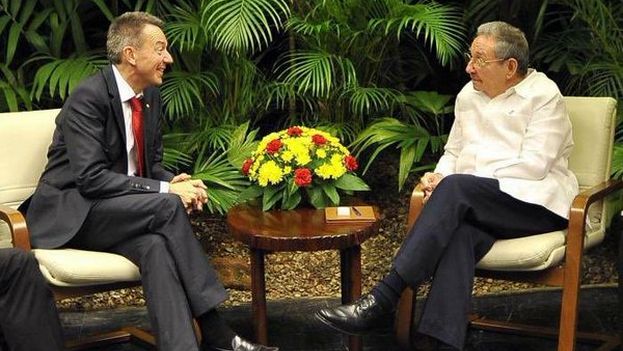
The president of the International Committee of Red Cross, Peter Maurer, and Cuban President Raul Castro. (JPSchaererICRC)

14ymedio bigger14ymedio, Havana, 25 November 2015 – An impromptu meeting this Wednesday between Cuban President Raul Castro and the president of the International Committee of the Red Cross (ICRC), Peter Maurer, suggests that the issue of the almost 3,000 Cuban migrants stuck in Costa Rica is one of the objectives of Maurer’s visit, the first at this level in more than 40 years.

Officially, Maurer has been in Cuba since Monday on a trip seeking to strengthen cooperation on humanitarian issues. In the statement pervious to his arrival, his program included only interviews with Health Minister Roberto Morales Ojeda, with the Chief of Staff of the Civil Defense, Major General Pardo Guerra, and with representatives of the Ministry of Foreign Affairs. continue reading

According to the official report, Castro and Maurer “spoke about the good level of relations between Cuba and the [Red Cross], as well as other topics related to the humanitarian field.” The meeting was also attended by the head of the ICRC regional delegation for Central America and Cuba, Juan Pedro Schaerer, and on the Cuban side by the Minister of the Revolutionary Armed Forces (FAR) General Leopoldo Cintra Frias, and the Acting Minister of Foreign Affairs Marcelino Medina.

Last Week the Red Cross of Costa Rica issued a call for solidarity to collection donations for Cubans stranded in that country after the Nicaraguan government blocked their passage on their route to the United States, where they can enter without a visa thanks to the Cuban Adjustment Act. In a communication, the Red Cross Chief in Costa Rica, Idalberto Gonzales, said that, “the Red Cross opens its doors to Costa Ricans so that they can lend their support to the Cubans in our country.”

The humanitarian organization especially requested toothbrushes, combs, toothpaste, disposable razors, bath soap, toilet paper, sanitary towels, bath towels, disinfectants, plastic utensils, shampoo and sunscreens. It also opened the opportunity to make monetary donations to Red Cross bank accounts in Costa Rica.

At this time, Costa Rica has set up seven shelters near the Nicaraguan border, where some 1,300 Cubans are being housed. Others are still being housed in churches, community centers and gymnasiums. More than 400 have refused to go to the shelters and remain the Peñas Blancas border post.

The Nicaraguan Red Cross is also waiting for the Cubans to be able to cross the border, to assist them with accommodation and food.

The International Committee of the Red Cross, founded in 1863, is defined as an impartial, neutral and independent organization. Its humanitarian mission is focused on protecting the lives and dignity of victims of armed conflicts and armed violence, as well as offering them assistance. The ICRC delegation for Mexico, Central America and Cuba, based in Mexico City, also works to ensure that people with major risk factors and vulnerability, especially migrants, are protected and assisted, and that their fundamental rights and dignity are respected.

Bucanero-Cristal Exploits Ties to Self-Employed and Palco and Habaguanex Executives / Juan Juan Almeida

Juan Juan Almeida, 24 November 2015 — Just as the proceedings surpassed the scandalous total of 42 people indicted, the General Vice-Prosecutor of the Republic of Cuba, Carlos Raúl Concepción Rangel, imposed a gag order on the case and hid it underneath the trite mantle of “secret character,” because — according to sources in the Prosecutor’s office — he’s expecting the number of those involved to increase.

The investigation filtered down, and some of the people implicated hardened themselves and beat it out of the country. Others are hiding out; there is a border alert for them, and an order of search and capture.

Before such an emergency, and even without finishing the trial, they’re taking the accused out of the investigation center at 100 and Aldabó — the women to the western prison, El Guatao (known as Manto Negro), the men to Valle Grande or the Combinado del Este. The VIP accomplices, owing to their natural status as first-class citizens, were sent home and asked to be “low profile” until their names could be pulled from the file or, at least, their complicity silenced in a case that could paint them as crooks. continue reading

Certainly the population’s complaints will increase due to the absence of the country’s beer in Cuban markets. There hasn’t been any of the national beer available in any restaurant or State establishment, nor in the TRD shops, the so-called Rápidos, or Ditú*.

The Minister of Foreign Trade faces lawsuits from international distributors for frequent non-compliance with contractual commitments.

The litigants claim that there was no delivery of Cristal and Bucanero; but the headquarters, Cervecería Bucanero S.A., says it fulfilled its production plans and satisfied requests without reporting anything stolen or lost.

Everyone’s asking the same question: “Where did that beer mysteriously go, once it left the factory, was paid for and didn’t show up in the State system?”

Indications point in only one direction: the private restaurants, private bars and other establishments of the self-employment initiative.

The investigation started at the end of last August, when a couple of inspectors, as lethal and accurate as good snipers, targeted a truck from Cervecería Bucanero S.A., which each week unloaded merchandise in a private restaurant located on the Pinar del Río-Havana highway.

Inconsistent but true because — although the Government says it’s boosting private initiative and the press repeats the lie and many who are misled believe it — there is a regulation that prohibits the self-employed from buying what they sell privately directly from the companies (whether national or foreign), that is, wholesale; they can only buy goods in ordinary consumer stores or shops.

Ministry of the Interior (MININT forces), as part of the process of compiling data and evidence to document the investigation’s case, and make citizens uncomfortable, are examining the house of one of the managers of the Bucanero warehouse, and — according to the investigative file: “In one room (Fambá’s**), inside a safe, the police confiscated 82,000 CUC and three lists: one with the names of sellers to whom they must pay a commission, another of Palco and Habaguanex officials, and the other with directions for distributing merchandise.”

They’re adding prisoners to the list; the investigation is expanding; and the anger of those organizing the case is growing, even when those implicated find themselves facing an “accomplished fact” with no defense. It’s difficult to imagine, because they managed to use methods of buying and selling that are not even conventional enough to qualify as criminal acts.

The private business owners delivered money to the officers of State companies, Palco and Habaguanex; and the officers issued, to Cervecería Bucanero S.A., a bill of payment (not falsified) with the amount of the merchandise, together with an official order.

Bucanero had to deliver, and it did deliver. So sellers and buyers were violating the regulations, yes, but not the law. And in place of being judged for an act of corruption, they should be awarded for their ingenious solution.

Translator’s notes:
*TRD is the Spanish initials for “Hard Currency Collection Store” — which the regime uses to ’collect’ people’s remittances from abroad by selling them overpriced products not available in Cuban pesos; El Rápido is a fast-food chain; Ditú is a chain of coffee shops.
**In the African-Caribbean religion, Abakua, the Fambá is a room where rituals are performed.

Translated by Regina Anavy
Is There a Cuban Style? / Rebeca Monzo

Rebeca Monzo, 13 November 2015 — As I see it, it would be incorrect to claim there is a Cuban style. During the last fifty years Cuban men and women on the island have been dressing any way they can with whatever was sent to them by overseas relatives, by repurposing old clothes or, in recent years, with contributions by those who had the opportunity to travel and brought back clothing of low-quality for resale. Until now, the only major points of reference on which Cubans could rely for their so-called fashion sense have been popular video clips and TV soap operas, most of them Brazilian. continue reading

It is very difficult to be a fashion leader if you do not have a strong economy and great designers, or a textile industry and light manufacturing to provide everything necessary for its creation. That is why fashion has always been dictated from the great capitals of the world, Paris being the prime example. It is the public itself that ultimately determines what fashion is by adapting it, using it and broadening its appeal. Everything else is determined by fashion trends, adaptations to climate, social status and the infrastructure of individual countries. It should be noted that there are iconic pieces, such as the Cuban guayabera, the Panama hat and the Mexican shawl, to name a few, but by themselves they do not constitute fashion.

A very interesting and commendable recent development in this country has been the first Artisan Fashion Week, which serves a prelude and kick-off to the famous annual FIART fair. It has become essential to set a benchmark on what constitutes proper dress. With the disappearance of fashion magazines as well as related institutions decades ago, there has been a lack of information, and the mass media has not provided good examples to follow.

The only hint that there might be such as thing as Cuban fashion came when La Maison created some fabulous and very tasteful pieces inspired by the guayabera and Creole buttons. Another key moment was the appearance of those famous Telarte fabrics, created by some of our country’s best designers. Their life was, however, as fleeting as that of a butterfly. At the time there were some hard currency stores that carried these creations but the population of Cuba was denied access to them, along with the use of that particular type of currency.

Historically speaking, we should note that the most important changes in women’s fashion internationally coincided with big, earth-shattering events. During World War I, women found themselves taking on jobs formerly held by men, who were at the front. One of the big changes in women’s lives was a new wardrobe more appropriate to their new social role. This meant abandoning uncomfortable undergarments such as corsets, which limited their movements, and adopting shorter skirts and looser hip-length blouses. Later came boyish haircuts and the use of cigarettes holders for smoking, which women felt they had gained the right to do in public. With these changes came economic independence and self-determination.

As a result, certain iconic items altered the landscape of fashion: extended waists, long strings of pearls, reed-like cigarette holders and short shirts that exposed legs covered by sheer flesh-colored silk stockings. These were the hallmarks of an elegant woman of the 1920s.

Two styles of dress conquered the fashion world, took root and remain popular today: the tailored suit and casual wear. The first — made from a myriad of materials, including thin, soft wools for daytime and beautiful lamé fabrics for night — was one of the major contributions by Coco Chanel. Casual wear resulted mainly from the great boom in sports and thrilling sporting events, which women attended both as spectators and to show off.

The difficult years of World War II saw widespread rationing. Fabric, an essential commodity, was one of the hardest hit. Skirts ended just below the knees to save on fabric.

The widespread use of the uniform for women in critical jobs, both in the army and in factories, affected the way they dress. Nevertheless, the great couturiers never stopped responding to new requirements by offering new solutions. In 1947 there was a radical and dramatic change in appearance of a woman’s waistline. It became more refined as skirts became a little longer, giving them a beautiful fullness, which had been missing for many years. One of the most prominent designers of this period was undoubtedly Christian Dior, until then virtually ignored.

Until the 1950s, Cuba served as a model of female beauty and elegance. So renowned were Cuban women for these qualities that, when they travelled overseas or moved to foreign countries, women such as the Countess of Merlin dazzled the royal courts of Europe with their refinement. This was due in large measure to the number of designers and fashion houses in the Cuban capital. One of the most internationally renowned and recognized of these designers was Cuba’s Ismael Bernabeau, to whom this article pays homage.