Today I Woke Up To Bullets / 14ymedio, Nelson Jesus Lanz Fuentes

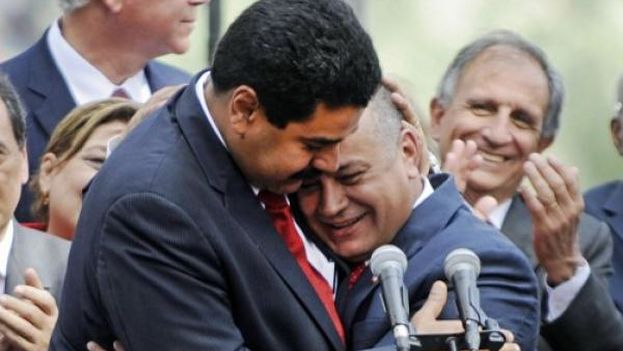
Nicolas Maduro and Diosdado Cabello

The author, a militant follower of Hugo Chavez, rebukes Venezuelan president Nicolas Maduro and Speaker of the National Assembly Diosdado Caballo, and the mafiosos who are destroying Venezuela.

14ymedio bigger14ymedio, Nelson Jesus Lanz Fuentes, 5 November 2015 – I have borrowed a title from a poem by Victor Valera Mora that appeared in one of his books, New Anthology, to define the moment in which I am living. Why do I say that I woke up to bullets? Because in these fateful days full of darkness and pain I want to become this, the bullet fired from the gun of history that we have to construct, those of us forced to see how in the last 55 years the always there official deceivers and liars have filled our beautiful Venezuela with hunger and misery.

I have to bear up and force myself to be patient, not to go out in the streets and turn myself into a real bullet to demonstrate the rage that I feel toward so many drones and crooks who have turned our country into a casino where everything has a price, is in play and for sale. A bullet loaded with contempt instead of lead, against Maduro and Diosdado and that whole string of mafiosos that accompany them in their work of destroying our country. A bullet with some huge desires to do away with, once and for all, the evil Venezuelans of the opposition gerontocracy solidly wedded to old precepts and immovable remnants, unable to evolve toward new scenarios. It is the so-called collaborationist opposition, the same one that spent time negotiating with the rojo-rojito (redder than red) traitors. continue reading

Today I woke up to bullets, perhaps tomorrow I will wake up with a smile on my face and hope on my lips, because today, today I woke up to bullets. Imaginary bullets that I want to shoot against those negotiators of the future of my children and grandchildren. Against those sectors where all the vices and old evils of capitalism, like strong-man rule, authoritarianism and despotism, are reflected.

Today I woke up to bullets because I cannot bear to see how the soldiers who should be defending out constitutional rights have allied, like in the old days, with the new and old bourgeoisie, that is, the most rancid of capitalism, to trample those rights. Corrupt soldiers, vicious gangsters sustaining this putrid government, living live like kings as they pimp out the country they say they are defending.

Today I woke up to bullets because I cannot bear to see how the noble and combative people of Venezuela, after two centuries of shedding their blood in the streets, fields and cities, fighting against all the evils caused by capitalism and its repressive agents, after a short awakening, were again sweet-talked with promises that none of those agents delivered on. They will vote again for the same people who killed their dreams and their desires to fight. The lie will prevail and the country will weep again and the blood will have been spilled in vain.

We, if we want, can truly give birth to a new country and a new man. The so-called Fourth and Fifth Republics were only, and are only, governments led by hookers and prostitutes in service to the most aberrant capitalism. We (the people), if we want to, can accomplish a Venezuela that is yours and mine. Throw out of the Miraflores Palace those who have always trampled the country that the Liberator left us. If we want, we can make the Venezuelan soil and those who mistreat it tremble. Only the people save the people and their colossal fury will make the corrupt of the Fourth and Fifth Republics tremble with fear.

Today I woke up to bullets, hopefully every day will dawn this way.
 

The Lilliput Rebellion / 14ymedio, Yoani Sanchez

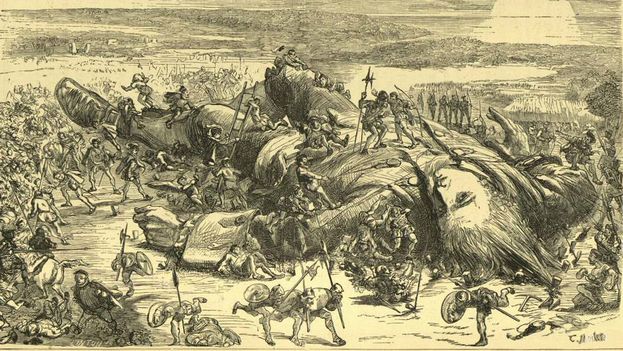
Gulliver being tied by the Lilliputians (CC)

14ymedio bigger14ymedio, Generation Y, Yoani Sanchez, 5 November 2015 – Calling for austerity while living in opulence has been common practice for Cuban leaders for more than half a century. Demands to “tighten one’s belt” are brandished about by officials with fat necks and ruddy faces, who for decades haven’t known what a refrigerator with more frost than food looks like. This contradiction undoubtedly annoys those who have to divide rationed bread with a family member, or cleverly cut up a bar of soap so it will last for several weeks.

The popular unease before the contrast between words and deeds could have led the journalist Alexander A. Ricardo to publish a metaphorical but accurate text in the opinion section of the Havana Tribune*. Under the title The Travels of Gulliver Junior, the opinion column refers to someone who “is seen in giant enjoyment of the shores of the Mediterranean, or as a dwarf adventurer without a problem in his life, in his visa.” continue reading

The allusion in the column was published some months ago when Antonio Castro, one of the sons of the former Cuban president, was discovered by a hidden camera while on vacation in Bodrum, Turkey. A place he arrived at from the Greek island of Mykonos on board a 150-foot yacht, and where he stayed with his companions in luxury suites.

It is hard not to relate the opulent life of Fidel Castro’s son and the calls for savings being launched today by his uncle from the dais, with the ironic phrase of the journalist: “Once he gets home he says nothing, He deceives his countrymen with stories about shipwrecks.” The similarities between the symbolic history and the real-life story have made the article go viral, and it is spreading via email within Cuba.

The coincidences grow when A. Ricardo writes, “he returned to weigh anchor, this time for the north, where the cold climate distanced him long ago,” which coincides with the onward journey of the ex-president’s son to New York, where he was also photographed, sheathed in sportswear and with a teddy bear in his hands.

“Thanks to his father Gulliver Junior travels quite often,” reads the text appearing in the newspaper of the Cuban capital. That is, because of the precarious economic situation imposed on millions of Cubans by his progenitor, now he can give himself luxuries that exceed what could be paid for with the retired father’s pension. But the Lilliputians are also getting tired. Could this journalist’s article be a sign of that indignation not at all diminutive?

*Translator’s note: A newspaper published by the Provincial Committee of the Cuban Communist Party

Writer Angel Santiesteban is Released / 14ymedio

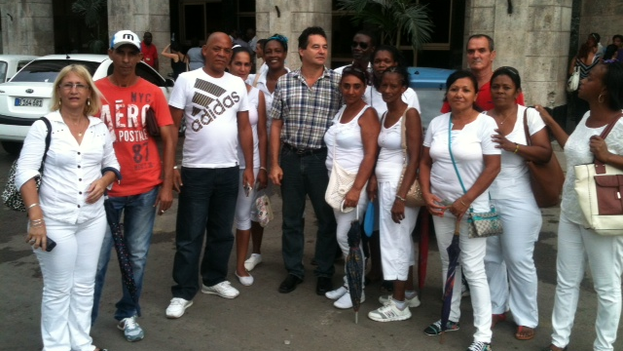
Angel Santiesteban (center, plaid shit) and several activists after his release. (14ymedio)

14ymedio, Havana, 5 November 2015 — The writer Angel Santiesteban was released Thursday after appearing before the Provincial Court of Havana. The journalist had been arrested yesterday afternoon, accused by his ex-wife of the supposed crime of “violation of domicile,” the same charge he was convicted of 2012.

“We were going to revoke your probation, but you are behaving well and so we are not going to revoke it,” the judges said, as confirmed by the writer to this newspaper. He said the trial never happened because the cause was withdrawn. Santiesteban said that they learned that “a paper signed by his ex-wife” withdrew the complaint for the supposed crime. After what happened this morning, the activist remains on parole, as he has been since last July.

A few yards from the Havana Capitol, a dozen Ladies in White, activists and members of the Patriotic Union of Cuba (UNPACU) gathered from the early hours and were able to witness the moment Santiesteban, handcuffed, escorted by two policemen arrived and was led into the Fifth Chamber where he would be tried. Among the opponents was Berta Soler, leader of the Ladies in White.

Ladies in White outside the provincial court. (Angel Moya)

In the morning, the artist Danilo Maldonado, known as “El Sexto” (The Sixth), took toiletries for the writer to the police station in Zapata and C where he was being held, but he had been transferred to the court, although several sources said he was able to make a phone call before leaving.

Writer Angel Santiesteban Arrested Again / 14ymedio

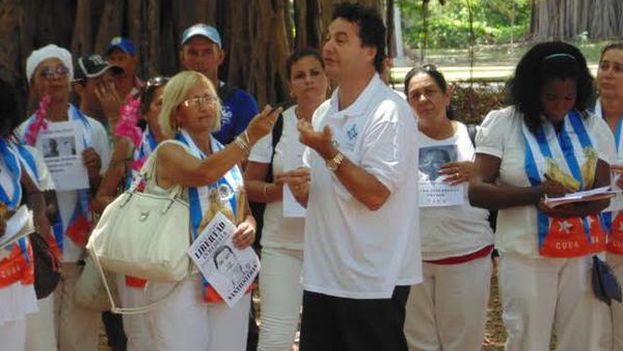
The writer Angel Santiesteban with the Ladies in White at Gandhi Park, just outside the church of Santa Rita. (Luis Lazaro Guanche)

14ymedio bigger14ymedio, Havana, 4 November 2015 — The writer Angel Santiesteban was arrested on Wednesday afternoon in Havana. A police car drove the activist from Antonio Gonzalez Rodiles’s house, where he was, to a police station, according to Santiesteban himself who spoke to this newspaper at the time of his arrest.

After the arrest, the blogger Lia Villares informed this newspaper that the police told the writer that it was “circulated for a month,” under the alleged “violation of domicile.” This Thursday he could be “tried in the Fifth Chamber of the court,” the same source stated.

Another source told 14ymedio the writer had missed the last time he was supposed to have signed in at the police station, a control measure that he must complete every week, under the terms of his probation. Should certain information arise, the authorities could use this to revoke his parole and return him to prison.

Last July Santiesteban was released after entering prison in December 2012, after a process that was considered by many to be arbitrary and precipitate. At that time he was convicted and sentenced to five years in prison also for alleged “violation of domicile and injuries.”

The writer has won significant literary awards, including the Casa de las Américas Prize in 2006. His book The Summer God Slept received the Franz Kafka Novel in Drawer Prize in 2013; the prize is given to censored writers whose work is, literally, “in a drawer” because they are unable to publish in their home countries.

Cuba, The Fourth Healthiest Country In The Americas / 14ymedio

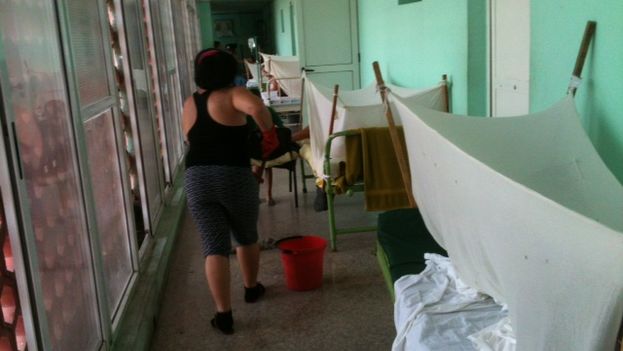
Hallway in the Pepe Portilla Pediatric Hospital in Pinar del Río. (Juan Carlos Fernandez)

14ymedio bigger14ymedio, Mexico, 3 November 2015 — Cuba is the third healthiest country in Latin America and the fourth in the entire continent, according to the list compiled by Bloomberg based on data from the United Nations, the World Bank and the World Health Organization.

The ranking, published on the website of the World Economic Forum , is made up of 145 countries. They are led by Singapore, Italy and Australia, and following those three, the top ten consist of adding the top ten, Switzerland, Japan, Israel, Spain, the Netherlands, Sweden and Germany.

Within the Americas, both Canada, ranked 14, as well as the three most healthy nations of Latin America — Costa Rica (24), Chile (27) and Cuba (28) — are ahead of the United States, in place 33. Behind are Mexico (37), Panama (38), Ecuador (47), Argentina (48), Colombia (58) and Venezuela (61). At the end of the list is Bolivia (93), with Guatemala (83) and El Salvador (78) in second and third to last place.

The health score is based, first, in the mortality rate of each country and, secondly, on the various factors that can limit health, such as the proportion of young people who smoke or immunization levels.

“It is a good time for Cuban independent journalism” / 14ymedio, Reinaldo Escobar

The journalist Roberto de Jesus Quiñones.

14ymedio bigger14ymedio, Havana, 3 November 2015 – He just won the top prize in the Havana Newsprint journalism contest, but Roberto de Jesus Quinones feels that reporting is only one part of his civic responsibility. A lawyer by profession, this man from Guantanamo had to enter the world of reporting, press releases and the difficult search for sources in a country where independent reporters are frowned upon and outlawed by the ruling party.

Reinaldo Escobar. How does it feel to get this award?

Roberto de Jesús Quiñones. I am very happy, especially because the award has come at a time when I felt really badly about everything that has happened to me since October 5. So am doubly pleased, because I also know that participating in the contest were very worthy colleagues whom I respect greatly, such as the columnist Miriam Celaya, the attorney Rene Gomez Manzano and the reporter Manuel de Jesús Guerra Pérez. All of them are journalists of the independent media with years of experience in the profession. continue reading

RE. How did you come to do independent journalism?

RdJQ. I am a graduate in law and when I left the prison (Editor’s note: he was convicted of falsifying documents in the process of buying and selling a home, although it is suspected that it was actually for his role as a lawyer in the defense of regime opponents) I asked repeatedly to be able to return to the practice of that profession, but I could not do it. A few years ago I wrote and have five books of poetry in Cuba, primarily with the Oriente publisher. I also came out with a volume of stories in Miami. It was the jurist Gomez Manzana who got me to contact Cubanet, and I’ve also collaborated sporadically with Primavera Digital.

RE. Are you still a member of the Cuban National Union of Writers and Artists (UNEAC)?

RdJQ. No, no. I’m in a process of leaving that group and although I asked to step down, they have not even responded.

RE. In what genre or on what topics do you mostly work?

RdJQ. I’ve done cultural journalism since the early eighties. For about five years I worked with the local media of Guantanamo writing film criticism and I even had a program on that topic on TV in the province. Although I must say I also really like the opinion column.

RE. How do you see the health of independent journalism in Cuba?

RdJQ. Unfortunately, from Guantanamo it is very difficult to read Web sites, as is the case with 14ymedio. Sometimes I can get the content of some of those independent media through bulletins or compilations that I receive via email. There is a great deal of unknown talent in Cuba, people of great intelligence and value who are removed from the official media. It is a pity that the Cuban people cannot more freely access the work of those colleagues, because they are very competent people and extremely good articles published.

RE. When people ask you about not having a journalism degree, how do you respond?

RdJQ. It is true that I did not study journalism, so I found all this work very difficult, but I train myself and try to do my best. My goal is to be objective in each text and seek the truth. On the other hand, doing this reporting has forced me to see the reality of this country and I have learned a lot.

RE. Independent journalism versus official journalism?

RdJQ. Independent journalism has put the bar very high – to use a sports metaphor – for official journalism. The social networks and alternative ways of distributing news has also meant the ability to empower people through information. People spread the news and that has benefited Cuban independent journalism, which is experiencing a good time.

Cuban Journalists are in No-Man’s Land / Ivan Garcia

Foto-de-Elaine-Díaz-tomada-de-Periodismo-de-Barrio-_ab-620x330Ivan Garcia, 31 October 2015 — It seems much time has passed since the ’80s, when a stern official from State Security, dressed in civilian clothing, solemnly intimidated us, a group of fresh youngsters, who were studying at La Vibora’s pre-university.

I was 16 years old. I don’t remember having felt more fear in my life than that afternoon, when the agent showed us his document with a red stamp and green lettering: DSE. The initials of the feared Department of State Security.

The guy manipulated our youthful fear like an expert. Perhaps he learned that in a KGB counterintelligence academy, or in the STASI of Marcus Wolf. continue reading

He asked for discretion from the school director, known as “the Fly,” more intransigent than an Afghani Taliban. And he led us half-dozen kids with intellectual airs like a submissive flock toward the school library.

Our crime was watching movies and documentaries not shown in Cuba on Betamax videos, reading the prohibited books of Mario Vargas Llosa and Jorge Luis Borges and brushing up on Herberto Padilla’s poems.

The severe reprimands still resound in my ears. Some of us were crying and others were begging for forgiveness for their “sins.” The man, like someone all-powerful, waited to hear my plea for clemency.

I don’t know how I armed myself with valor before such authority, but with a trembling voice I let out a tirade about personal liberty and reading what one wanted.

“Can you imagine what would happen if your mother heard about this?” (She was an official journalist.)* What you’re reading is counter-revolutionary, and in Borges’ case leans toward Pinochet’s dictatorship,” the political policeman told me.

Before the “evidence” and, fearing that my mother would know, I also called up a mea culpa. Some years later, in 1991, I was detained for 15 days in a walled cell in Villa Marista**. Probably my libertarian sedition cost my mother her job at the Cuban Institute of Radio and Television (ICRT) and in 1995, she left official journalism to write for Cuba Press, an alternative press agency.

She had a catharsis: after 20 years of being an independent journalist in Havana, she knew about the pressure that all those who disagree with the Regime’s narrative suffer.

There are two paths to take: suffer or shut up. And two ways out: continue living in your country like a zombie or scurry off to another nation. One is free to choose. No one has to be a martyr.

In Cuba there are laws that sentence you to 20 or more years in prison for writing without permission. But the times are different, even if the same people are in power.

The Castros’ autocracy has passed from being a totalitarian system, where the State controlled the flow of information, cinema, literature and any other intellectual facet with an iron fist, to an authoritarian nation that is opening slowly, with one foot anchored behind the door.

The Soviet paranoia, the acts of repudiation — veritable verbal lynchings — the wacky accusations and the shameful spewing of insults directed at someone’s integrity still continue.

But the desire of many communicators to express their way of thinking through a blog, a website or a digital newspaper has grown thanks to the new technologies.

When, at the end of the ’80s, ex-State reporters like Rolando Cartaya and Tania Díaz Castro started spreading the news generated by pro-human rights groups, they defined a road that Indamiro Restano, Rafael Solano and Raúl Rivero would follow later.

In an error of calculation, Fidel Castro’s government thought that incarcerating 27 free journalists in March 2003 would curtail the independent press. What happened was the opposite: it multiplied.

Now there are dozens who, on their own and at daily risk, report from every province. Furthermore, official journalists have to take into account the fact that these reporters collaborate with the foreign media. Or they are like Elaine Díaz, who has founded her own weekly, Journalism from the Barrio.

The difference between writing freely and editing boring news about supposed economic growth is abysmal. In their eagerness to head off the alternative bloggers who were led by Yoani Sánchez, the Regime authorized official and professional journalists to open blogs.

The plan was to create on the Internet a sphere for the Battle of Ideas***. It generated a full network of bloggers. There are those who are trained and vitriolic. Others are respectfully obstinate and convinced about the oliive-green Revolution. Or they are critical about the state of things, although their intent is to perfect the System.

But autonomy and liberal thinking engender distrust in a country where the orientation always comes from a central command post. The Government lost focus again.

There is no guided freedom or half-freedom. Binary education of “revolutionaries” against “dissident mercenaries” is very simple. But in the actual panorama of the Island, the “enemy” isn’t the dissident movement. It’s the discontent of a large segment of Cubans because of inefficient institutions, a crazy economy and corruption.

So journalists who are honest take their own pulse on reality. They aren’t official or independent. They work for the people.

Iván García

Photo of Elaine Díaz taken from “Fear of the Rain,” one of the articles with which Journalism from the Barrio had its debut, on October 18, 2015.

Translator’s notes:
*Tania Quintero Antúnez, who has lived in Switzerland as a political refugee since 2003.
**Formerly a Catholic schools for boys, under the Revolution it became (and remains) a prison, known for detaining political prisoners.
***Fidel Castro’s effort to reinforce his ideology and power.

Translated by Regina Anavy

Epidemiological Nightmare In Santiago De Cuba / 14ymedio

The number of cholera cases is information that hospitals and polyclinics guard as a great secret.

14ymedio, Santiago de Cuba, 3 November 2015 — The city of Santiago de Cuba is experiencing an epidemiological nightmare right now with spread across the area of dengue fever and cholera. The problem has been exacerbated by deficiencies in water supply due to the severe drought affecting the country. The application of chlorine at building entrances and lime outside food establishments has changed the face of the eastern city.

The number of cholera cases is information that hospitals and polyclinics guard like a great secret. On the street there is talk of dozens of deaths from sudden overwhelming diarrhea.

In Palma Soriano, cars circulate every day with loudspeakers calling for strengthened hygienic measures. Washing of hands and not drinking soft drinks and prepared drinks (made with the local water), along with greater care in the handling of food, are some of the widespread suggestions. continue reading

Establishments such as the Youth Computer Club on Ferreiro Street have closed their doors to the public to avoid infection. On Monday afternoon the place was undergoing intense cleaning with chlorine. The closures of public places set of growing alarm in a population that is no detailed information about what is happening.

The leader of the Patriotic Union of Cuba (UNPACU) in the province, Jose Daniel Ferrer, explains that in the neighborhood of Altamira “in the areas where food is sold they are not selling anything that isn’t canned or bottled.” According to the activist, several “stalls selling food products were closed for ten days and they applied lime in the doorways” to avoid infection with the bacterium Vibrio cholerae .

Dengue fever is another problem. Hospitals are overflowing with suspected cases. The activist and contributor to this newspaper, Yosmany Mayeta, is one of those admitted to Juan Bruno Sayas General Hospital. At present, he is being given treatement while awaiting an analysis to confirm the diagnosis.

This morning, at the September 28 Policlinic, reports show on a few admissions for suspected cholera in the last months. However, the name of the disease is not used in medical records and the patients are recorded as suffering from acute diarrhea.

So far the local authorities have not confirmed the information and the newspaper Sierra Maestra does not mention the presence of cholera in the area, although health warnings continue to be issued to the population by the Provincial Center of Hygiene, Epidemiology and Microbiology.

The Cancellation of A Cyber-Gathering In Camagüey Sparks Outrage / 14ymedio, Orlando Palma

Juan Antonio García Borrero during a conference. (Youtube)

14ymedio bigger14ymedio, Orlando Palma, Camaguey, 2 November 2015 — The peaceful city of Camagüey experienced a shock among its intellectuals this weekend. The well-known film critic Juan Antonio Garcia Borrero denounced the “intellectual conservatism” that led to the suspension of a cyber-gathering programmed for this Thursday in Café Ciudad. In his blog, Cine cubano, la pupila insomne (Cuban cinema, the insomniac pupil), the specialist reflects on the “tribal thinking and institutional self-censorship that follows from it.”

“I seem to be living a nightmare,” García Borrero said in a post, in response to being informed by the leadership of the Office of the City Historian that the gathering could not be held, “despite having been promoted in all the media.” His first reaction was to “take a breath, breathe deeply… I won’t give them the pleasure, neither those here nor there, of making me into a disaffected person,” he wrote in a brief post. continue reading

Known for his work in rescuing and spreading Cuban cinema, Garcia Borrero has had a blog for more than eight years, where he reflects on the seventh art. His work as a blogger has also led him to approach the digital publication scene and he participated in the First Forum of Audiovisual Consumption, held in Havana in 2014, an experience that he had tried unsuccessfully to move to this native city.

The idea of the forum, according to the author of the book BLOGuerías – published by the Cuban publisher Acana in 2009 – “was born of personal exchanges that at some point” he had engaged in with the former Cuban Minister of Culture, Abel Prieto. Initially, the event was scheduled in Camaguey city, but the lack of time to organize it moved the first event to the capital.

Following the Havana meeting, Pedro de la Hoz Gonzalez, vice president of the National Union of Writers and Artists of Cuba (UNEAC), informed the provincial section of the organization of the “confirmation of the announcement of the Second Forum on Audiovisual Culture” for 30 and 31 October. However, the event did not happen. It was the local “UNEAC which has put the most obstacles in the way,” complains García Borrero.

Emotionally affected by the forum’s not being held and the cancellation of the cyber-gathering that would have taken its place, the film critic shared with his readers on the Internet his concern that the authorities would insist on decreeing his “civil death” in Camagüey. “It doesn’t matter. I will always have the cave, the solitary refuge to which Nietzsche alluded*,” he explained.

Garcia Borrero’s complaint arrives within a few of a meeting of the G-20 Group in Havana, which is promoting the implementation of a Film Law, a detail referred to by the critic Gustavo Arcos, in an article he published this Friday in defense of the Camagueyan, and denouncing the “tacit conspiracy of some people in power in the country to put an end to everything that has to do with initiative in the audiovisual field.”

Arcos says that this intention is seen “in the arbitrary bans on [private] 3D movie rooms,” decreed at the end of 2013, and in “the current resistance to implementing a Film Law.” The specialist adds that these attitudes, “the systematic attacks on the weekly packet,” and also seen in the “continued mantle of suspicion and threats that are launched against journalists, bloggers, graphic designers or artists linked to alternative publications, web pages or spaces generated by individual initiatives.”

The controversy over the cancelled cyber-gathering has barely begun and it could be joined by many other intellectuals, given the prestige enjoyed by Garcia Borrero, as an outstanding professional and honest man. The scene of the creation, production and film criticism in recent weeks in Cuba resembles dry grass about to catch fire. What happened in the city of Camagüey could be the spark.

*Translator’s note: “Wherever there have been powerful societies, governments, religions, or public opinions — in short, wherever there was any kind of tyranny, it has hated the lonely philosopher; for philosophy opens up a refuge for man where no tyranny can reach: the cave of inwardness, the labyrinth of the breast; and that annoys all tyrants.” Friedrich Nietzsche, Schopenhauer As Educator, 1874. Source of this English translation here.

A Growing Number Of Political Arrests In Cuba, According To CCDHRN / 14ymedio

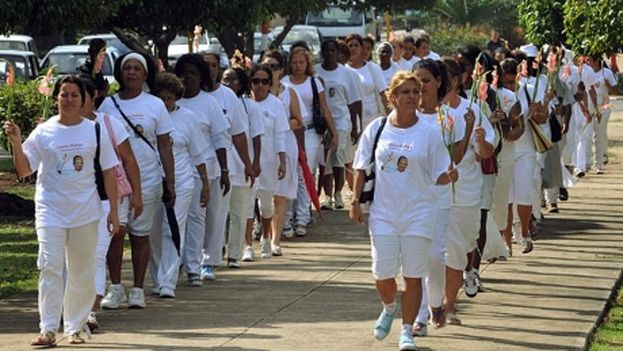
March of the Ladies in White from Havana. (EFE)

14ymedio bigger14ymedio, Havana, 2 November 2015 — Arbitrary political arrests continue to trend upward in Cuba, according to Monday’s denouncement from the Cuban Commission for Human Rights and National Reconciliation (CCDHRN). In its report for the month of October, the independent entity reports “at least 1,093 arrests of this nature,” the vast majority “performed or supervised by the secret political police.” This is the highest figure in the past 16 months, exceeding the previous record reached in September of this year with 882 arrests.

Among the issues the CCDHRN views with greatest alarm is that “not all of the regime opponents arrested have been returned to their homes.” Among them are Hugo Damian Prieto Blanco and Wilfredo Parada Milian, who “have already spent eight days in provisional detention as a reprisal for having participated, in the last month, in separate peaceful demonstrations in front of the Ministry of Justice and the Attorney General’s Office,” the introduction of the report states. continue reading

The commission, focused on reporting on human rights, also notes that the artist Danilo Maldonado, known as El Sexto (The Sixth), was released at the end of October after ten months in “provisional detention” without having been taken to trial. A category of detention, they warn, that is “used by the Government with the intention of undermining and intimidating peaceful opponents.”

With regards to the conditions of the Cuban prison system, the organization warns that it is continuing to receive reports that “reveal a greater deterioration of the conditions of internment, characterized by the prevalence of cruel, inhumane and degrading treatment.” However, the government “persists in not accepting the disinterested cooperation of the International Red Cross to improve conditions of internment.”

The commission, headed by the activist Elizardo Sanchez, cites a prison population of “between 60,000 and 70,000 prisoners, mostly for common crimes or ‘pre-criminal attitude,’ who survive in the midst of filth and every kind of insecurity.” The organization details that “there are in Cuba between 150 and 200 high severity prisons, correctional centers and labor camps.”

Cuba’s Bahia Honda Coffee Farmers Denounce Lack Of Equipment / 14ymedio, Jorge Luis Guillen Garcia

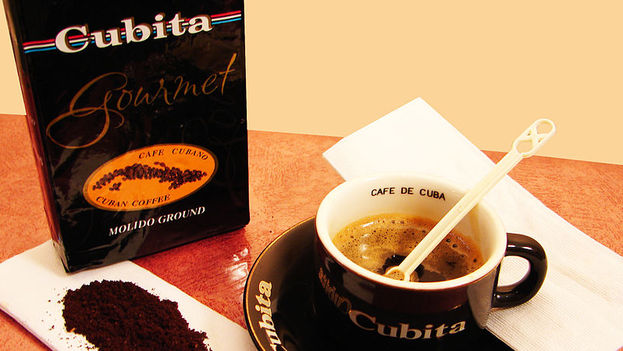
Café 'Cubita' gourmet variety. (Wikipedia)
Café ‘Cubita’ gourmet variety. (Wikipedia)

14ymedio bigger14ymedio, Jorge Luis Guillen Garcia, Bahia Honda (Artemisa), 2 November 2015 — In Bahia Honda the coffee tastes much more bitter lately. The farmers of the Castro Brothers Credits and Services Cooperative of this Artemisa town are losing 2,840 pesos for each quintal (220 pounds) of green coffee, due to a lack of transport to take the product to the de-pulping machine, which separates the beans from the fruit. Lack of a vehicle puts at risk months of work, and the efforts of hundreds of people.

Santiago Martinez, a farmer in the cooperative, explains that the de-pulping of the beans should have started in the first week of October, but the lack of a tractor “which broke five years ago,” has prevented it. The farmer complains that the cooperative’s directors have not resolved the situation. “Clearly, it doesn’t hurt them that we are losing money and have problems fulfilling the plan, because regardless they get a guaranteed salary,” he complains loudly. “They told me to throw the coffee in the dryer until the issue is resolved,” he added. continue reading

Western Cuba is one of the most important areas for the supply of beans processed by Torrefactora Select Coffee, located in Almendares y Santa Maria, in Havana.

This company in Cuba’s capital provides coffees such as Extraturquino Especial, Turquino, Serrano Superior, Caracolillo, Alto Serra, Cubita, Arriero and other brands, both for export and for the network of hard currency stores in the country.

Field workers get a tiny share of the proceeds from the State. While, 2.2 pounds of coffee in the so-called “shoppings” costs more than 16 convertible pesos (CUC, about $17.50 US), the producer only receives some 1,000 Cuban pesos, the equivalent of 41 CUCs, for each 220 pounds of dried green choice coffee, said Maria Dolores Dominguez, a Bahia Honda farmer.

Dominguez says that “25 pounds of ripe coffee is worth 160 pesos and to get 220 pounds of green coffee, which is the equivalent of 100 pounds of clean coffee ready for roasting, you need 600 pounds of ripe coffee.” She complains that, “If we send the coffee to the de-pulper right away, they pay us 3,840 Cuban pesos for every 220 pounds, but if we dry it in the drying areas, even though it comes out prime quality, they pay us only 1,000 Cuban pesos.”

In a meeting with the coffee growers of the area on October 26, Raul Gonzalez, president of the cooperative, said he had reported the transport problem to the provincial coffee company, but so far that has not produced any results.

The problems in Bahia Honda could contribute to the coffee harvest not meeting the goals of the national plan. In 2014, the island produced 13.5 million pounds of beans, only a quarter of the annual domestic demand, which stood at 53 million pounds. However, industry directors expect to produce 51 million pounds by 2020.

More Than 100 arrested in Havana and Oriente / 14ymedio

The Ladies in White marching down 5th Avenue. (Angel Juan Moya)

14ymedio bigger14ymedio, Havana, 1 November 2015 – This Sunday was marked throughout the country by dozens of arrests, particularly against members of the Patriotic Union of Cuba (UNPACU) and the Ladies in White. The arrests began in the early hours in the Oriente (in eastern Cuba), where 91 activists were intercepted trying to reach the sanctuary of El Cobre.

The leader of the UNPACU, Jose Daniel Ferrer, was arrested along with 36 other dissidents of his organization at the checkpoint known as the Pajuin, on the outskirts of the Santiago capital to prevent them from reaching the church dedicated to the patron saint of Cuba. Hours later this newspaper was able to confirm that all those arrested had been released.

We have gone “without hiding ourselves,” said Ferrar to 14ymedio. The former prisoner of the 2003 Black Spring said that “in the five eastern provinces a total of 91 people were detained, all members UNPACU.”

In Havana, about 51 Ladies in White and 29 other activists managed to gather outside Santa Rita parish, before undertaking their traditional Sunday march down Fifth Avenue. Then, opponents gathered at Gandhi park to take stock of the week.

After the meeting and as they headed toward Third Street, a police operation was waiting for the activists who were arrested and taken to detention centers outside the capital. They were then being released.

Gulliver Against Twelve Thousand Dwarves / 14ymedio, Carlos Alberto Montaner

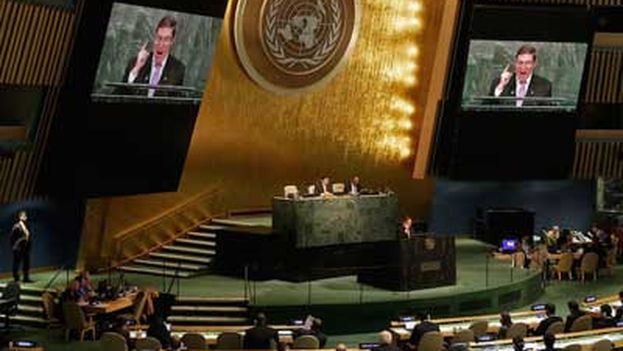
Cuban Foreign Minister Bruno Rodriguez, in his address to the 70th UN General Assembly. (MFA)

14ymedio bigger14ymedio, Carlos Alberto Montaner, Miami, 31 October 2015 – Cuba 191, United States 2. This is called a diplomatic beating. One-hundred-ninety-one countries at the United Nations voted in favor of a resolution presented by Cuba against the commercial and financial restrictions imposed by the United States on the Castros’ government in 1961. Only two nations opposed it: The United States and Israel.

It has been happening for a long time. The novelty is that this year Obama’s government secretly celebrated it, although the law and common sense oblige American diplomacy to reject the resolution. The president himself has urged Congress to repeal the measure.

In any case, the United States, truly, was not defended. At the end of the day, these UN resolutions are not binding. It is pure propaganda within an organization so discredited that it chose Venezuela and Ecuador to belong to a committee that monitors the observance of Human Rights, which is like putting the fox to guard the henhouse. continue reading

What is interesting is how the Castros’ dictatorship consequently diverts attention from the real heart of the matter – the persistence of a Stalinist dictatorship derived from the Soviet model eradicated in the West a quarter of a century ago – and creates a fabricated perception: a poor island besieged by the greatest power on earth. David against Goliath.

How does it do it? To understand this we have to know that this small island, unproductive and mistreated, impoverished and beggared, who pays no one because it wastes its resources, has an exterior outreach of great power learned from the KGB: some 12,000 people dedicated to the task of promoting the causes chosen by Fidel Castro and inherited and continued by his brother Raul.

What are those causes? Essentially, the denouncing of the United States and of evil and exploitive capitalism. Everyone who opposes this common enemy is welcome: Iran and the ayatollahs, Gaddafi’s Libya in the past, today Putin’s Russia, “21st Century Socialism.” Everything. Anything.

Who are these 12,000 functionaries, the driving force of the Pharaonic diplomacy of Fidel, narcissistic, like so many, with the grandiose urgency to impose his will on the world?

First of all, the Directorate General of Intelligence, with its 1,500 officials, very well trained, scattered throughout the world. Every one of them seduces, recruits or manages a dozen local contacts. The members of the Cuban Institute of Friendship with the Peoples (ICAP), another intelligence arm, present in every country and all international organizations. The 119 Cuban embassies, with 140 cities and 21 consulates general, all managed by State Security. The academic, literary or artistic institutions that have contacts abroad and travel and receive visitors. Whatever piece fits into the puzzles: a Silvio Rodriguez concert, a conference in Panama. Whatever.

Total: Thousands of people directly or indirectly linked to the political life and the communications of most of the nations of the world – and especially, those of the major Western countries – who are responding to the dictates of Havana.

I am not counting, of course, counterintelligence. That system, forged in the image of the East German Stasi, has in its ranks 0.5% of the population, some 60,000 people dedicated to the task of infiltrating and controlling “enemy groups
within the island, among whom are not only democrats asking for freedoms, but also Freemasons, Christian churches, suspicious collectives such as the LGBT, or the self-employed who are trying to run small home businesses to survive in the midst of so much repression and stupidity.

As soon as the message goes out about taking the annual resolution to the UN, this immense mechanism is set in motion to achieve the objective. There are always ties with the foreign ministries and the seats of government, even though formally they are enemies. Cuba looks after these personal relationships like gold dust.

Everything is used: From giving free medical treatment to the relative of a deputy, a general or a local police chief, to sending large sums of money to like-minded candidates for election, or cigars to heads of government, or getting a Don Juan to relieve the aching genitals of a Cuban spy of Puerto Rican origin, as happened to Ana Belen Montes.

This lady, condemned to 25 years in prison for spying, and whose pardon is now being considered by President Obama, reached a very high position in the Pentagon. Her official function was to gather all the analysis from different agencies and inform the White House about how dangerous the island was. But, in reality, she was secretly working for the benefit of Havana, revealing to the Castros the sources of American intelligence (which cost some lives) and telling the sweet story of a small and defenseless country that posed no threat to the security of the United States.

Washington, which has lost the reflexes it once had during the Cold War, does not know, cannot, or does not want to fight this enemy. Jonathan Swift, in Gulliver’s Travels, described how, shipwrecked in Lilliput, Captain Lemuel Gulliver is tied up and arrested by a legion of six-inch tall dwarfs. This is what is happening to the United States. It is not David against Goliath. It is Gulliver against 12,000 efficient dwarfs.

Carcinogenic or not, Cubans Want Red Meat / 14ymedio, Orlando Palma

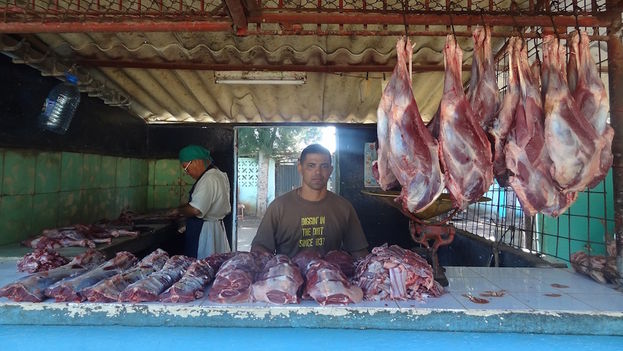
Meat for sale in the market in Camagüey. (Sun Basulto Garcia)

14ymedio, Orlando Palma, Havana, 29 October 2015 — “For me, no one can get me to quit this bad habit, I’ve tried vegetables and beans,” intones the troubadour Ray Fernandez in one of his songs. The main character in this song is named Butcher, and he spent ten years in prison for the theft and illegal slaughter of cattle.

Despite the legal prohibitions on the island that govern the raising, slaughter and sale of cattle, and the recent declarations by the World Health Organization about the carcinogenic properties of red and processed meats, Cubans do not seem willing to give up the dream of a steak, a hamburger or a nice hash on their plates.

This week, the official press reported the findings of a report by the International Agency for Research on Cancer. Backed by more than 800 studies conducted by 22 experts in 10 countries, the entity classified the consumption of red meat as “probably carcinogenic to humans.” The classification of processed meat was stricter; it was stated to be “carcinogenic to humans” and placed in Risk Group 1, along with tobacco, asbestos, arsenic and alcohol. continue reading

At the close of 2014, the island had a little over four million head of cattle. The severe drought in recent months has caused the mass death of hundreds of thousands of cattle throughout the country, so that the figure may be less at the end of this year. The number still falls short of the six million animals that existed in 1959, which at that time was one head per capita.

The progressive deterioration of cattle ranching in Cuba came along with the overvaluing of beef among diners. “Here people dream in red,” jokes Migdalia Fuentes, a retired doctor who specialized in oncology. “The tradition of eating meat is very difficult to eradicate, because for decades it has been the ideal food, the dreamed of meal,” she emphasizes.

The specialist agrees with the WHO report, adding, “Many cases of colon cancer that I treated during my working life were related to the out-of-control consumption of meat.” She adds that, “if people knew the damage it does, they wouldn’t desire it so much.”

In 2014, cancer, diabetes, cerebrovascular diseases and chronic respiratory disease accounted for 67.7% of total deaths in Cuba. For WHO, each serving of 50 grams (0.11 pounds) of processed meat consumed daily, the risk of colorectal cancer increases by 18%, according to findings published in The Lancet Oncology.

However, the information has been received with reluctance and ridicule among Cubans. “You have to die of something,” say the majority of those surveyed by this newspaper. Others question the publication of the news in the national media. “They are trying to convince us that meat is bad and we shouldn’t eat it because there isn’t any,” says Ismael, a father of two who, this Tuesday, bought a package of processed hash in the central Carlos II market in Havana.

Private and state restaurants have not yet noticed a decline in orders for meat since the WHO announcement. “Here, people who have money still prefer a good cut of beef, while those with fewer resources have to settle for pork or chicken,” said an employee of the restaurant located in the Sociedad Cultural Rosalia de Castro in Old Havana.

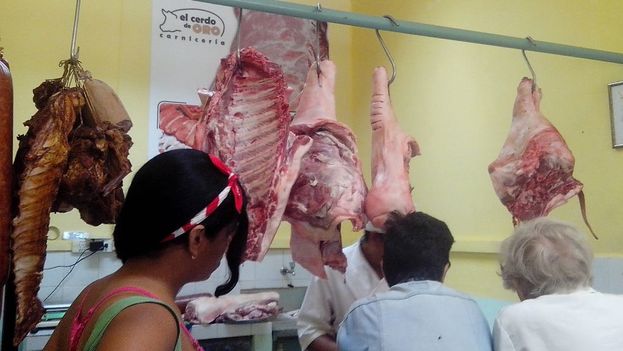
The Golden Pig butcher shop pig in Havana. (14ymedio)
The Golden Pig butcher shop in Havana. (14ymedio)

“Beef is connected in the popular imagination with good health,” says the oncologist Fuentes. “When I was little and I felt bad, my grandmother made me a meat soup or gave me a good steak. That remains in the collective subconscious and it is very difficult to convince people otherwise.”

Bertico’s story is much like that of the butcher who inspired Ray Fernandez’s song. He served twelve years in prison for leading a gang that was dedicated to killing cows on the plains of Villa Clara. His clients were mainly people living in Havana who risked a penalty of up to one year of imprisonment for the crime of receiving. “Here cows are sacred, as in India,” jokes this peasant hardened by illegal slaughter and imprisonment.

“There are those who eat it and don’t go to prison,” Ray Fernandez also satirizes in his song, in reference to those who have a better supply of beef as a privilege related to their proximity to power. For people without a ministerial portfolio, nor the rank of a high lieutenant colonel, the only legal option is to acquire it in the hard currency market. A little over two pounds of beef top round can run to 20 convertible pesos (over $20 US) in those places, the equivalent to the average monthly salary.

Those sentenced for the crime of illegal slaughter rarely have their sentences reduced, nor are they released on humanitarian grounds. Among the 3,500 prisoners pardoned for Pope Francis’s September visit to the island, there were those convicted of murder, manslaughter, rape, pederasty with violence, and the corruption of minors. But there were none sentenced for the theft or illegal slaughter of cattle.

The few vegetarians who maintain a meat-free diet are seen as “freaks” in this country. “People get upset when they invite me to eat and find out that I don’t eat beef, or chicken or even fish,” says Maura, 36, who has been a vegetarian for at least a decade. For this native of Cienfuegos living in Havana, “It is more expensive sometimes, and more difficult, to buy vegetables than it is to get meat.” However, she feels happy with her decision, “I wake up every day very healthy.”

Most Cubans feel very attracted to the red fiber, perhaps because it represents the forbidden, or because of a culinary tradition that celebrates meat. The World Health Organization will have to work very hard to convince them otherwise.