The Press That Disinforms / Ivan Garcia

For Castroist ideologues, the activists in Kiev and the Venezuelan students are fascists, Kim Jong-un doesn’t traffic in weapons with Havana, and Beyoncé never visited the Island.

There is an abysmal gap between everyday reality and the information provided by a clueless official press.

News of the Castro regime’s blatant arms smuggling with North Korea, in violation of the UN embargo against the Pyongyang dynasty, was never reported in Granma, Juventud Rebelde, Workers, or any of the 15 provincial press organs.

To date, the boring and disoriented national media—print, radio and television—have not reported on the space opened for dialogue with the Catholic Church. Or about local news that has had national repercussions, such as the protest in Havana by self-employed workers, or the unusual walk of a nude woman in the city of Camagüey.

They also overlook less controversial topics, such as the visit to Cuba of major leaguers Ken Griffey Jr. and Barry Larkin, or celebrities such as Beyoncé and her rapper husband Jay Z.

Nor are they interested in letting their readers or viewers know that Cuban artists and musicians living abroad are visiting the island and performing, such as Isaac Delgado, Descemer Bueno, and Tanya, among others.

Thye are not willing to publish a single article analyzing the insane prices of auto sales or internet services.

On international matters, the old trick is to tell only part of the story. For those who only read the official media and do not have access to other sources, the protesters in Ukraine, Venezuela, and Turkey are terrorists and fascists.

The official Cuban media have never reported that the dictator Kim Jong-un summarily executed his uncle. They have also remained silent about the atrocities taking place in the concentration camps in North Korea. And about the degrading treatment of women in Iran.

Newspaper space is usually filled by low-key commentaries on culture and sports, television program notes, upbeat news about national agricultural production, or the smooth progress of the economic reforms dictated by Raul Castro and his advisers.

Apparently it is considered inappropriate to inform Cubans of the talks between the Cuban-American sugar millionaire Alfonso Fanjul and Foreign Minister Bruno Rodriguez. Nor is it believed desirable for ordinary people to know that Antonio Castro, son of Fidel Castro, is playing in golf tournaments.

Or that businessmen with bulging wallets recently paid $234,000 for a handcrafted humidor filled with Montecristo cigars at the XVI Festival del Habano, where the most famous guest was British singer Tom Jones.

Local information is governed by inflexible ideologues who presume that behind the vaunted freedom of the press hides a “military operation of the U.S. secret services.”

And they take this seriously. As if it were a matter of national security. So the official journalists are soldiers of information. Disciplined scribes.

For the Talibans of the Communist Party, the internet and social networks are modern means of promoting capitalism from a distance. The new times have caught them without many arguments. They claim to have the truth, but they are afraid to let their citizens see for themselves.

The readings of certain information should be presented by the magnanimous State. They think, and believe, that their naive compatriots are not prepared for, nor sufficiently inoculated against, the propagandistic poison of the world’s media.

Not even Raul Castro has managed to break the stubborn censorship and habitual sluggishness of the official press. For years, Castro talked about turning the press into something credible, entertaining, and appealing. But nothing has changed.

For external consumption—by outsiders interested in Cuba and, above all, two million exiles scattered around the world—they have opened official websites and blogs, trying with their own voice to promote the illusion of an opening.

For internal consumption, the soldiers of the word remain.

Iván García

Translated by Tomás A.

From Diario de Cuba, 17 March 2014

The Dictatorship’s Gift / Angel Santiesteban

February 28, 2013, the day that the Castro brothers’ totalitarian regime jailed me, was not a day chosen randomly by the political police.

That day, several events happened simultaneously, and it was significant for many reasons in my case.  Firstly, that day was the birthday of my partner, and they well knew it because they had interviewed her several times on television; it was also the culmination of the Book Fair in Havana and its continuation in the rest of the country’s provinces.

But not even those two dates indicate the bigger joke, the cynicism in the face of not only the dissidence but the world, principally the UN agency, because that day marked five years since the initial signing that the Chancellor Felipe Perez Roque — in 2008 — accepted the respect of human rights with the UN Covenants.  What they perhaps did not know and is most important for me is that that day celebrated the anniversary also of the birth of the great Cuban writer Cirilo Villaverde.

The Cuban government joined me on a date memorable to the island’s writers with a distinguished writer and fighter for Cuban liberty, a coincidence that makes me proud with the love of literature and the need for liberty. For his political ideas, he was jailed and sentenced to death, which he was able to circumvent thanks to the complicity of his jailer.

In homage to his sublime figure, I now in prison began a novel that takes place in 1808, on the eve of the anniversary of his birth, and my characters travel that Havana that he describes in his novella Cecilia Valdes or the Angel’s Hill; it has also inspired in me a script for a telenovela, which I am working on currently, writing the scenes for more than 100 episodes.

According to the writer, blogger and fighter for Human Rights, Luis Felipe Rojas, by taking advantage of my time in prison, it could appear to be a conspiracy between my readers and State Security.  The truth is that if that February 28 was intended to be a mockery of any of the “coincidences,” I have tried to reverse it and make it transcendent, at least for my future work Fear and Truth.  Such is the fear inoculated by the dictatorship since its birth, that later — as much as we exorcise it — it remains hidden, lurking in our guts.

Recognizing the fear in the Cuban citizens is simple and part of the idiosyncrasy of a people engulfed in dictatorship.  To demand rights, convinced by reason, is unacceptable for the majority when they infer the cost they would have to pay.  By telling the truth one is accused as a traitor, of pandering to our neighbor to the north.

In this year of incarceration, many have dared to send me their solidarity verbally, recognizing that to declare it publicly would be to pay a price that they are not ready to sacrifice.

But the most difficult thing has been to accept that that engendered fear also permeates the opposition as is demonstrated in several ways.  Some have given witness to having been threatened by State Security, which would not pardon them the defense of my case, to the point of intimidating them by prohibiting for them the possibility of travelling abroad, now that this has become the fashion.

That corroborates my fear that many of them gave their word to stay at my side, but once I was sent to prison, they distanced themselves, forgot their commitments, coming to allege that my “accusation” is hard to defend because of the international propaganda against “domestic violence.”  If that is not called striking a deal, I don’t know the word to define it.

Of course State Security searched for the most sensitive accusations in the public view in order to try to some extent to be defended; for example, running over a child in the road and fleeing, rape, attempted murder, among others — coincidentally all erroneous — for which I was formally accused.

In the first Prosecutor Petition I published on the internet, it sought 54 years incarceration, which was only truncated thanks to the hidden interview — recorded on video — that we did of a false witness that the prosecution, police and complainant prepared with the intention of corroborating their lies.

I will always ask myself what would have happened if the “witness” had not been caught telling the truth!  Today I would be sentenced to more than a decade of incarceration and with almost all the opposition to the government turning its back on me because they would see me as indefensible.  The fear speaks for itself.

As if that were not enough, the forensics specialists admitted that the “witness for the prosecution” was telling the truth, in terms of unmasking the ruse against me, because he thought that the person who interviewed him was part of the prosecution, as he was introduced, and was unaware that he was being filmed by a laptop camera that he had before him.  In that video the witness admits that he is uncertain that I was in the place where I was accused of being and for which I was sentenced to five years in prison, now finishing the first year behind bars.

Simply, when it comes to officials or opponents who accept or put in doubt my innocence, I do not rely on their transparency.

Angel Santiesteban-Prats

Lawton Prison Settlement. February 2014.

Lawton prison settlement.  February 2014.

To sign the petition for Amnesty International to declare Angel Santiesteban a prisoner of conscience, follow the link.

Translated by mlk and LW

27 February 2014

RWB: The Castro Regime Has Developed an Original Model of Control / Angel Santiesteban

Reporters without Borders: Cuba prohibits a free Internet

All content considered “antirevolutionary” is automatically blocked. All information that is published in the media is filtered, according to the criteria of the Party.

Cuba continues preventing the majority of its population from having access to a free (i.e. uncensored) Internet, even though the submarine fiber-optic cable, ALBA-1, coming from Venezuela and the unblocking of some web sites constitute a ray of hope. The Castro regime has developed an original model of control, based on the existence of a local Intranet. Access to the Internet is excessively expensive. The prices are prohibitive. Add to that the omnipresence of the government institutions.

The country’s organ of censorship, the Department of Revolutionary Orientation (DOR), filters all the information that is published in the official communication media, according to the Party’s criteria. They automatically block all content considered “antirevolutionary.” This censorship, that applies not only to the web, it is based on the Penal Code in force that criminalizes “disrespect,” “defamation,” “slander,” “insults,” and “offenses against the authorities, the institutions of the Republic, and the heroes and martyrs of the nation,” among other things.

 The Ministry of Computing and Communications

It was created in the year 2000 with the goal of ensuring respect for the Revolutionary ideology defended by the DOR on the Internet. There is very little information available on the technology that the Cuban authorities employ in terms of censorship. The University of Computer Sciences (UCI), as well as the Telecommunications Company of Cuba (ETECSA) — the national provider of access to the Internet — work with the departments of surveillance and censorship that back up the actions of the Ministry. The blockade of Internet content is carried out by ETECSA.

The year 2011 was marked by certain concessions of the government, like the unblocking of some web sites. This is the case with the sites Desde Cuba and Voces Cubana (From Cuba and Cuban Voices), where numerous opposition blogs are posted, among them Generación Y (Generation Y), whose author is Yoani Sánchez. continue reading

However, the detention of a dozen bloggers and netcitizens at the end of 2012, among them Calixto Ramón Martínez, who was freed seven months after being in prison, counteracted this small advance. Although these interruptions were more sporadic in 2013, it’s accurate to note that the changes in Cuba are millimetric and that the situation remains stagnant.

In 2008, the percentage of connectivity to the Internet was about 1.2 percent of the population. Since then, the number of public points of access to the Internet has increased: According to the authorities, in June 2013, 118 new cyber-salons were inaugurated.

However, the price of connecting continued to be prohibitive: the equivalent to one-third of the average monthly salary of a Cuban (some US $21). The authorities claim that in 2013, four out of ten Cubans accessed the Intranet regularly, which allowed them to read their email, as well as some pages of official sites. According to the independent bureau of information, Hablemos Press, this figure is reduced to two out of 10. It’s possible to get on the Internet in the international hotels, but the usage is reserved for tourists, who can allow themselves to spend US $10 (two weeks of salary for a Cuban, on average).

Furthermore, the connections are surveilled almost systematically. To get on the national network, Cubans must present their identity cards; they surf below the vigilant eye of cameras and the surveillance agents in the cyber-cafes.

Also, the computers are equipped with programs like Avila Link (a link in English), developed in Cuba, that can cut off the connection at the least suspicion of “some violation of the norms of ethical behavior that the Cuban state promotes.” Independent informative Cuban web sites hosted outside Cuba, like Cubanet, Martí Noticias, Cuba Encuentro, Payo Libre and Hablemos Press, are on the black list, and it’s not possible to have access to them, even from the Internet in international hotels.

For a long time the Cuban authorities have attributed the difficulties of connecting to the Internet to the U.S. embargo. However, now that Cuba has the ALBA-1 fiber-optic cable, this argument becomes obsolete and makes it obvious that the authorities want to control the Web, showing their fear of Cubans being able to have free access to the Internet. The use of the high-speed Internet, which is now possible with ALBA-1, is mainly restricted to government officials.

If we believe the official declarations, 2014 should be a good year for accessing the Internet in Cuba. ETECSA forecast that it would begin to install DSL lines at the end of 2014 in zones that have the adequate technology. It’s cruel, but the country lacks infrastructure and the necessary funds to install it. The telephone network is not developed for this type of connection and is under total control of the national service provider, ETECSA. Under these conditions it’s difficult to imagine that the arrival of DSL on the island would have a big impact.

Last January they also announced that Cubans could access the Internet from their mobile phones, thanks to the vigorous entry of a measure that permits telephone bills for users on the island to be paid by people in the Exterior. But the cost of the foreign recharge, more than an opening for Cubans, is an economic strategy to get hard currency into the country.

In spite of this, some analysts observe that there is a tendency toward opening. The informative website Cubanet, based in the U.S., made seven technological predictions for Cuba in 2014. Among them were access to the Internet through mobile phones, the development of WiFi on the island, and even the possibility that the activists could travel outside the island, and acquire knowledge and education in computer science useful for their security online: all this thanks to the immigration and travel reforms that entered into force on January 14, 2013.

 The bloggers, those “mercenaries”

In the report on the “Enemies of the Internet” in 2012, Reporters Without Borders denounced the Cuban propaganda, which “didn’t stop attacking the bloggers who were critical of the regime, whom they accuse of being mercenaries in the service of the ’U.S. Empire’.” The bloggers “have been victims of campaigns to discredit and defame them in the State media, on propaganda sites outside the island, and in blogs like Blogueros y Corresponsales de la Revolución (Bloggers and Correspondents of the Revolution) and Las Razones de Cuba (The Reasons of Cuba).

The cable from the U.S. government — spread by WikiLeaks in 2009 — that suggested that the Regime feared the bloggers more than other types of dissidents, is more real than ever. During her world tour, Yoani Sánchez announced that she would launch a digital daily newspaper in Cuba. “The first day that we do it could be the worst; they could shut it down and attack all of us by blocking us from the web,” she said. “But it could also happen that we are sowing some seeds of a free press,” she added.

By contrast with the obstacles to access the Internet, information passes from hand to hand through USB flash drives. Some also try to create illegal points of access to the Internet. But government agents are in the streets to detect and destroy satellite antennas, so that there are real risks for people who try to have them.

Furthermore, they have positioned antennas to block the signals every five square kilometers. The netcitizens sometimes can use Twitter to send an SMS, without being sure that their messages will appear on Twitter. This microblogging frequently is not detected by the blockades orchestrated by ETECSA, which sometimes last for months.

The bloggers and collaborators of opposition websites like Hablemos Press or Payo Libre, are obliged to turn to certain diplomatic locations in order to publish their writings on websites outside the island.

Others, like the group Martí Noticias, located in Miami, count on correspondents on the island. The purveyors of information found there often are victims of raids in the communication media where they work, or of arbitrary detentions.

Such was the case with Mario Echevarría Driggs, David Ágila Montero, William Cacer Díaz, Denis Noa Martínez and Pablo Morales Marchán, detained for several days in October 2013.

The writer and author of the informative blog, Los hijos que nadie quiso (The Children Nobody Wanted), Ángel Santiesteban, was imprisoned, and his lawyer was suspended, so that she couldn’t practice law in the courts for a period of six months. The blog continues informing us about the situation of Ángel Santiesteban Prats, thanks to the work of activists who collaborate outside Cuba.

, 12 March 2014

Translated by Regina Anavy

13 March 2014

It’s Always the Weakest Link in the Chain that Breaks / Juan Juan Almeida

According to the newspaper Granma, five directors of state-owned chains of shops have been suspended from their posts, and five others have been disciplined because of illegalities in the sale of cooking tools to customers and distorting the credit policy implemented by the Cuban government.

The disciplinary measures implemented by the Minister of Internal Commerce, Mary Blanca Ortega Barredo, were applied to executives of the CIMEX corporation, the TRD Caribe chain and the Union of Business and Cookery of Havana. Up to that point, everything’s fine. But I would like to know who punished the person behind the ridiculous national energising campaign, which obliged many Cubans to buy Chinese refrigerators which don’t refrigerate, electric saucepans which don’t cook, and hotplates which never worked. These people are now up to their eyes in debt. That is what, in Cuba, and in China, is called getting swindled.

Translated by GH

15 March 2014

The Amazing Resistance of Reinaldo Arenas / Rafael Lemus

1.  March 12, 1965, an open letter by Ernesto Guevara to his friend Carlos Quijano is published in the Uruguayan weekly Marcha.  The text, “Socialism and the New Man in Cuba,” is perhaps Guevara’s most significant theoretical writing, and at the same time an emphatic declaration of the regime’s objectives emanating from the Cuban Revolution, then already declared Marxist and in the full process of converting the island to socialism.

Maybe nowhere else is the regime’s intention to intervene in all segments of Cuban society enunciated so clearly, to radically transform the mental and physical life of its citizens and to produce a new subject: the New Man.

That desire to regulate the existence of individuals and to act on the biological functions of life — even regardless of political action — is not, of course, exclusively of the Cuban regime and not even of socialist systems. As Michel Foucault discovered, it has to do with a fundamental characteristic of the power of modern western societies.

After the 18th century, as Foucault details in Security, Territory, Population, power “takes into consideration the fundamental biological fact that man constitutes a human species” and creates a series of disciplinary mechanisms and standardization — from hospitals and colleges to camps and prisons — that pursue “the eventual transformation of individuals.”

Then still leading the Cuban Ministry of Industry, Guevara writes in that letter:  “In order to construct communism, simultaneously with the material foundation, one must make the New Man.” The job, he warns, is not simple: “The defects of the past are transferred to the present in the individual conscience” and, in order to eradicate them, individuals “must be subjected to stimuli and pressures of a certain intensity.”   continue reading

Those stimuli and pressures may be of “moral character” or well managed, sometimes brutally, by the revolutionary institutions, that “harmonic collection of well oiled channels, steps, dams, devices” that guarantee “the natural selection of those destined to walk the vanguard.”

In that “dictatorship of the proletariat, exercising not only over the defeated class but also, individually, over the victorious class,” of special importance is the educational machinery of the State, now that it acts directly on the youth, “malleable clay with which it may construct the New Man without any of the previous defects.”

One of those youth is named Reinaldo Arenas, and he is not, in spite of his last name, “clay” and even less “malleable.”  Then, when “Socialism and the New Man in Cuba” is published, Arenas is 21 years old and is about to enter for the first time into conflict with the Revolutionary regime. That year the State creates the Military Units to Aid Production — rehabilitation and forced labor camps for “social misfits” — and stirs up its homophobia.

That same year Arena finishes his first novel, Singing From the Well, and tenders it to a national competition where he receives honorable mention — the beginning of his difficulties, acrimonious relations with the cultural bureaucracy of the island.

It is then–when the radicalization of the Castro repression and the emergence of Arenas as a public figure coincide–that the frictions begin between the writer and regime, frictions that soon evolve into a full and asymmetric confrontation, whether because Arenas is homosexual, whether because he publishes his works abroad, whether because he resists the disciplining processes sponsored by the State.

During the next 15 years Arenas will endure the harassment and punishment of the devices of state power: He will be forced to work on a sugarcane plantation, will be locked away in a prison, forced to sign a public retraction and will see his repeated efforts to leave the island frustrated, until 1980 during the Mariel exodus, he manages to leave for the United States.

It is there–at odds with the Miami Cuban exiles, first encouraged and then stunned by life in New York and finally sick with AIDS–where he finishes writing Before Night Falls, the memoirs that he began to write one day in 1973 in the culverts of Lenin Park while hiding from the regime’s security forces.

2.  “All dictatorship,” writes Arenas in a passage from Before Night Falls, “is cold and anti-life:  every manifestation of life is in itself an enemy of any dogmatic regime. It was logical for Fidel Castro to chase us, to not allow us to fornicate and to try to eliminate any public display of life.”

This image of the State that censors the “public display of life” and toils to control the physical existence of its citizens, is repeated time and again throughout the 343 pages of the book.

Whether the regime grants itself “the power to instruct how men should dress,” or proposes “to break ties of friendship” through organization, street by street, of the Defense of the Revolution Committees or penalizes homosexual relations, the image that emerges here is that of a power for which the life of its citizens does not represent the boundary of the political but precisely its center and objective.  In other words, a biopower, that, in order to continue being such, must intervene in and regulate all vital aspects of the population.

Not coincidentally Arenas lingers, in Before Night Falls, on the description of three of the disciplinary and standardization devices of the Cuban regime: education, forced work and prison. A member of the first generation of university students educated by the Revolutionary State, Arenas recreates those years not as a period of formation but rather of indoctrination in a college that, in agreement with his words, was a “monastery where new religious ideas prevailed and, therefore, new fanatical ideas” and where “it was not easy to survive all those purges that had a moral, religious and even physical character.”

Years later, in 1970, Arenas is sent to a sugarcane facility, the Manuel Sanguily Center in Pinar del Rio, in order to cut cane and write an elegy of the Ten Million Ton Harvest. There he comes across a new generation of youth, no longer indoctrinated in college but peons in a forced labor campaign: “those young men of sixteen, seventeen years, treated as beasts of burden, had no future to await nor a past to remember. Many gave themselves a machete blow to the leg, or cut off a finger, any barbarity so long as they did not have to go to that cane plantation.”

Instead of “ideologically guiding” that youth, Arenas is accused of perverting it. More specifically:  in the autumn of 1973, he is accused of having abused, together with another friend, two minors, charges that he denies.  In order to avoid being arrested, he hides for four months in the most unexpected places (behind a buoy in the sea, in the crown of a tree, under a bed, in the culverts of Lenin Park), in a series of misadventures almost worthy of Brother Servando Teresa de Mier that he had reclaimed and re-invented years before in the novel Hallucinations (1969).

When finally he is detained, in January 1974, he is locked away in the Morro prison and two months later is transferred to Villa Marista, headquarters of State Security, where he is forced to sign a retraction in which he “repents” equally his homosexuality and his literary works and promises “to rehabilitate himself.” Immediately he is returned to Morro and a little later taken to an “open” prison on the outskirts of Havana until the beginning of 1976 when he is finally “freed.”

These events, from when Arenas is accused until he is set “free,” occupy two and a half years of his life but almost a fourth of his autobiography.  It is in those pages where the most repressive edges of the Cuban state appear, as in this passage about the torture in Villa Marista:

“One day I began to sense in the next cell a strange kind of noise that was as if a piston were releasing steam; after an hour I began to hear piercing screams; the man had a Uruguayan accent and was screaming that he could stand no more, that he was going to die, to stop the steam. In that moment I understood what that tube next to the toilet of my cell–whose meaning I had ignored–consisted of; it was the conduit through which they supplied steam to the prisoners’ cell which, completely closed in, became a steam room. Supplying that steam became a kind of inquisitorial practice, like fire; that closed place full of steam made the person almost die of asphyxia.”

3.  Images like this are repeated throughout the central pages of Before Night Falls and make one think, often, of typical scenes of prison literature.  That is not, however, the most surprising thing in this autobiography:  not the sordid portrait of the Cuban regime Arenas paints but the way in which he himself confronts that power.

Said another way:  the most singular thing about Before Night Falls is not so much the denunciation of Castroist repression — present after all in the texts of many other writers and in the reports of various human rights agencies — as the characteristics of Arenas’ resistence, very different from the usual opposition of liberal societies and little akin to that liberal platform from which critics of the Castro regime usually shoot.  In a sentence:  Arenas’ resistance — alive, corporeal, erotic — shares not a few of the notions of the same biopower that he confronts, and thus could be characterized, if one wishes, as a biopolitical resistance.

Reading the first volume of the History of Sexuality by Foucault, Thomas Lemke notes that “the processes of power that seek to regulate and control life provoke forms of opposition that frame their claims and demand recognition in the name of the body and of life itself.”  That is to say, and Foucalt himself indicates:  “Against that power […] the forces that resist support themselves on the same thing that is at stake, that is to say, life and man as a living being.”

It no longer has to do with a resistance that happens exclusively in the public sphere, or that concentrates its action in the electoral processes, or that pursues a realignment of institutions or portion of the power at stake.  It has to do with a resistance that takes place everywhere all the time, that employs as a principal tool the bodies of those who resist and who oppose, fundamentally, the policies of normalization and discipline dictated by power.

It suffices to review once again the pages of Before Night Falls in order to notice that the resistance of Arenas is, without doubt, of that type. One must see: although decidedly opposed to the regime, Arenas does not try to defeat it through political means nor to suggest the possibility of organizing a political group against it. In the same way, he seems to disbelieve in the value of the dialog of ideas and even reproves those dissidents who declare themselves in favor of dialog with the Cuban authorities.

Maybe even more revealing is that there is not in all his autobiography a single moment of nostalgia for that political order in which life was the limit, the “other side,” the “outside,” of politics.

To the contrary:  that troubled partnership between life and politics provides the body and its eroticism an intensity that Arenas extracts in exile, now in New York, where homosexual relationships seem to happen routinely without transgressing any rule.

In the same way, Arenas does not seem interested in restoring autonomy — always relative — to the literary field or in distancing literature from political struggles. Neither does he seem to want to restore the old limits between the public and the private and still less to return sexuality to the side of the private sphere.

If he did desire it, he would do it: would reserve stories about his erotic life for himself and write literary works — dense, difficult, proud of his “autonomy” — distant from political circumstances.  It is clear that he does not do it: he writes, almost without exception, works that are bellicosely political and publicizes in them his homosexual experiences.  That is, in fact, his most effective political strategy: the repeated exhibition of himself.

The first image of the first chapter from Before Night Falls is that of a healthy and one would say almost new body: “I was two years old. I was nude, standing; I leaned over the ground and ran my tongue over the earth.” The last image is of a sick body, infected with AIDS and sapped by cancer, that contemplates the moon while awaiting death: “And now, suddenly, Moon, you explode into pieces before my bed. I am alone. It is night.”

Between one moment and another many other images of Arenas occur, of Arenas’ body, almost all textual but also, in the middle of the book, some photographic. In almost all of them Arenas’ zeal to present his body stripped of metaphors is evident, outside the categories with which states and ideologies usually dress bodies.

He exhibits his body to show the arbitrariness of all those labels — bird, dregs, proletariat, male, Cuban — to which they have wanted to reduce it. He exhibits it, also, as if dealing with a trophy: the proof that his body, in spite of repeated efforts to repress and standardize it, remains volatile and desirous.

So he remains today also, 23 years after the disappearance of that body, the ghost of Reinaldo Arenas: disobedient, incorrigible, amazing.

From El Universal, 14  December 2013

 Translated by mlk

Homage to the Cuban Press / Juan Juan Almeida

This March 12th, commemorating Cuban Press Day, the ex-head of culture, Dr Armando Hart Dávalos (who a while ago went off his rocker) offered an award to the Cuban journalists. During the solemn proceedings, Señora Magda Resik, director of Havana Radio, came out with an over-the-top, “The most important obligation for Cuban journalists is the immense task of appraising the work of Jose Martí, and it is…”

I am sorry to interrupt the sentence, which is certainly very journalistic; but I think that the obligation of the press is nothing to do with Martí, but rather it is toward the Cuban people who, thanks to the disastrous work of the press, continue to be misinformed and have cataracts in their eyes.

Translated by GH

15 March 2014

SOS Venezuela: The Cruelty of Some, and the Indifference of Many / Juan Juan Almeida

A year after his death, it would be unjust to deny that the ex-president Hugo Chávez had the ability to be a leader, and a most convincing negotiating weapon: oil.

Supported by this, and with the Cuban government as co-conspirators, he was able to put together a kind of Latin American integration, which turned into a monolithic, geopolitical and economic bloc, whose principal role was, and continues to be, to assist him in the regional context.

The cost of all this expansion, was national division. Partition which he master-minded using his well-known ability to confront internal problems with arrogant creativity and the power to manage people.

After he died, Maduro’s big objective, as successor, was to reunify the nation; but it’s a difficult job, Venezuela has turned into an apparent democracy within one of the most unequal societies in America, with the added twist of having lost all sense of tolerance.

The time bomb exploded. The official forces repressed, and the young people were not afraid. Venezuela is splitting again, and expresses it in demonstrations, many against and a good many others in favour of Nicolás Maduro’s government.

The country’s situation is critical, and it is shameful to see how some social network pyromaniacs and followers and “likers”, making out to be heroic “patriots”, try to avoid dialogue and with total irresponsibility (from the comfort of their homes), with a coca-cola in hand, encourage confrontation, as if the followers of Twitter and Facebook were more important than the victims of the conflict.

I believe the prospects for the Venezuelans are predictable, and I can’t imagine that there will be–in the very short term–a national move back toward democracy. All the more so following the delayed and timid OEA (Organisation of American States) resolution adopted by a 29-3 vote, and not a consensus, because, as expected, the ALBA bloc countries and CARICOM had a majority and opposed the adoption of a stronger and more effective resolution.

Thanks to the sophistries of the then president Hugo Chávez, with the benefit of advice direct from Havana, the senior secretary general of the OEA, José Miguel Insulsa, without detracting from his demonstrated experience in affairs of state,  lost part of his leadership within the organisation he presides over.

It has become evident that the OEA has structural problems, that it needs an overall review, has ceased to be an entity for valid dialogue for this hemisphere, and  today is simply the governments of Caracas and Havana, which, without belonging to it (Cuba was suspended until 2009) and, like María Ramos’ kitty [a Cuban prostitute’s cat, which she blamed for the death of her pimp], have a majority of votes among the member states of this organisation.

Insulsa, as an additional post-diplomacy move, should ask, even if his request is rejected, to visit Venezuela to see personally on the spot what the situation is and in that way be able to avoid the different very biased versions of what happened put forward by one side or the other.

In this crucial moment, the important thing is not the cruelty of some, but the indifference of many. Politics is very serious, and we are all responsible, and cannot just leave it up to the politicians.

Translated by GH

11 March 2014

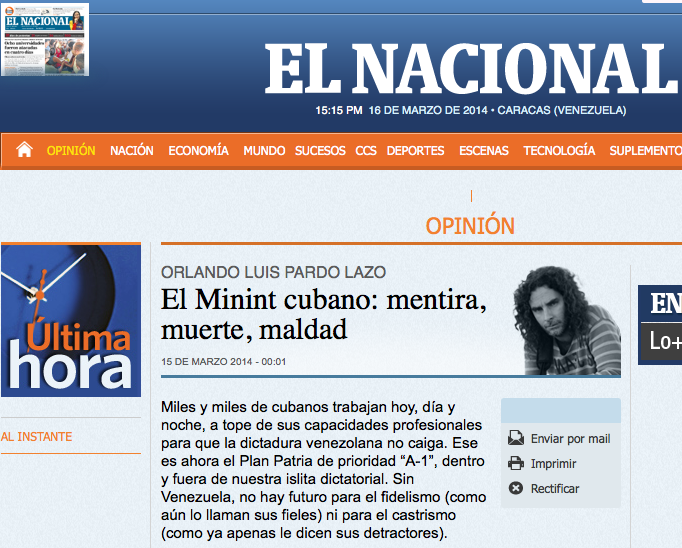
The Cuban MININT: Lies, Death, Evil / Orlando Luis Pardo Lazo

Click on image to go to original article.

Thousands and thousands of Cuban are now working, day and night, to the peak of their professional abilities, so that the Venezuelan dictatorship won’t fall. This is now the number one priority of Plan Fatherland, inside and outside our little dictatorial island. Without Venezuela, there is no future for Fidelismo (as its faithful still call it), nor for the Castrismo (as its detractors now call it).

It’s calculated that the Cuban Ministry of the Interior (MININT) with a terrifying number of agents, collaborators, informants and military. There are analysts – and also deserters – who have even put six zeros after the final number of paid and volunteers from the omnipotent MININT.

Indeed, for decades Cuba has ceased to be a country that behaves statistically like a military camp, like a totalitarian one-man bastion. This is the essence of Real Socialism, far beyond theories of equity and obligatorily free social programs. This is the essence of what the Latin American Communist parties don’t know, or don’t know how to distance themselves from.

In principle, of course, everyone is invited to the revolutionary avalanche that immediately unhinges the civil logic of our societies. But, woe unto those who are not enthusiastic or don’t feign enthusiasm for the “process”: sooner rather than later they will have to choose – totally democratically – between shutting up or leaving or ending up in prison or dead. Havana or Managua or Santiago de Chile or Caracas: the scenarios and obscenities repeat themselves.

MININT is the Revolution itself. Cuba might well be called the Minitarian Republic of Cuba. So as not be extinguished with the deaths of the octogenarian Castro brothers, the shock wave of the thousand and one Minints needs to impose itself as soon as possible on the continent’s sister republics, Venezuela being the victim that has most dramatically resisted our interference: an invasion that went from being silent to being murderous, but that, murderous or not, still continues complicitly condoned by international indolence.

For Cuba’s geopolitical – geophagic – interests, the forging of a supranational bloc is imposed that is as monolithic as each one of its communist parties. An alliance whose tactic and even syntactic axis comes from the Plaza of the Revolution’s marble obelisk itself. Hence the megalomaniacal charisma of Hugo Chavez that so disturbs the Cuban hierarchy; hence the pertinence of a proletarian dandy with a presidential sash. It is a question of life and death, the infamous instinct of self-perseveration (because someone who makes the lives of others unlivable shouldn’t have the right to life).

And so the Cuban Ministry of the Interior kills and orders killings in Venezuela with impunity, as it killed and ordered killings with impunity in Cuba and in Chile and in Nicaragua, to name just a sample of the puppet regimes in the region that came to power through the guerrillas or the ballot boxes.

However, all this comes packaged in a rhetoric that shines in the naïve imagination and on the silly T-shirts of the new generations. We all hate capitalism from capitalism. We all want to be justice-seeking subversives and rebels-with-a-cause. Like the slogan we repeat in all of the Island’s schools from the time we’re five years old, “Pioneers for communism, we will be like Che!” (Castro Hood in the barbaric forest of his Merry Men.)

The worst thing is that this violence is irreversible. Castroism is not escaped through peaceful means. The Castro regime ensures that in practice there is no peaceful, nor palatable, way out. They have loaded their weapons with death and have the narrative behind which they disguise themselves as victims of imperial aggression. There is no legitimate opposition to continental Castroism. There is no decent dialog with continental Castroism. They came to power through the violence of ballots or bullets. And they will only leave power through greater violence.

In this sense, it has been the only honest dictatorship in history: “Socialism or Death!” as in the morbid closing phrase of official Cuban speeches. As the founding leader of the Christian Liberation Movement, the martyr Oswaldo Payá Sardiñas said, this slogan makes it clear than anyone seeking liberation in Cuba will find death. As it was true for him, when they killed him on a Cuban highway on 22 July 2012, in an extrajudicial execution for which there is a surviving witness in Spain, the young politician Ángel Carromero.

Venezuelans: an army of Cubans is now working day and night, probably threatened with death by the counterintelligence agents of their own regime—as the Bolivarian elite maybe threatened with death—so that the Venezuelan dictatorship won’t fall. It is MININT against MININT. It is a war to the death for life. Venezuelans must know this, in your historic struggle in the streets, if you don’t want to abort this new independence for your country, if you want to finally put an end to your status as a military camp. And I say this ashamed of being Cuban.

Venezuelans: MININT is not authorized to concede defeat; it must be imposed on them even at the price of sacrifice. And I say this ashamed of being Cuban.

From El Nacional, Venezuela, CLICK HERE FOR ORIGINAL IN SPANISH

15 March 2014

Why Don’t I Want to be “Federated”? / Yoani Sanchez

Photo: Silvia Corbelle

The Congress of the Cuban Women’s Federation (FMC) ended a few days ago. At its closing ceremony, a man uttered the final words. But this wasn’t the only, nor the last, mistake of an antiquated organization marked by ideology.

After listening to the sessions in the Palace of Conventions, I affirm my decision not to be “federated.” Why?

Here are my reasons:

  • I reject the creation of an “eternal president” in the figure of Vilma Espín, Raúl Castro’s deceased wife, because this whole display of perpetuity in a position seems to me, at the very least, ridiculous.
  • I don’t want to be part of an organization whose flag shows a uniformed individual. I am not a soldier, I don’t see myself represented in a gun-carrying militia member.
  • I don’t believe that a woman’s organization should have as its principles fidelity to an ideology, a party and a man.
  • I suspect that a part of the four million women who make up the FMC have entered its rank purely automatically, as a mandatory process that takes place when you turn fourteen.
  • I distrust a federation that benefits from the lack of freedom of association which prevents Cuban from creating other organizations.
  • I’m aware of the double standards of the FMC, which says it rejects violence against women but which has never condemned the acts of repudiation against the Ladies in White.
  • I consider inefficient the work of an organization that, in its 50 years of existence, hasn’t managed to place women in the positions of power where the decisions that affect the country are really made.
  • I’m tired of women being reduced, in these female congresses, to beings concerned with pots and pans, soldiers who are willing to offer up their children as cannon fodder or production parts… selfless, beautiful and obedient.
  • I am a woman of the 21st century, I carry my ovaries not with victimhood but with pride, and I can’t be a member of an organization that transmits the directives of power to women.
  • Of course, when it is legal to associate according to one’s beliefs, affinities, genders and many other points of similitude, I will be there with my progesterone and my demands for a true female federation.

16 March 2014

Blemishes in Calixto Hospital / Fernando Damaso

A few weeks ago I was “driven” to Calixto García General Hospital by a doctor friend who, like the Orisha deity Elegguá, opened doors for me. The purpose of my visit was to receive medical attention. I have no complaints about the professionalism of the medical staff who, in spite of the difficulties and shortages with which they must deal, work hard to provide a good service to their patients, whom they treat with kindness and concern. This experience allowed me to see first-hand the current state of the above-mentioned hospital, which for some years now has been subjected to a prolonged series of unending repairs after decades of neglect.

Construction activity is evident everywhere: dilapidated medical wings, demolitions in-progress, building materials stored outdoors and inside the hospital, mechanical equipment being moved, construction workers going back and forth without doing anything, people shouting and other signs of activity. In the few areas that have been completed, one can see details such as sloppy plaster work on the walls and crooked tiles on the floors, signs that the repairs will not last long.

I do not know who came up with the brilliant idea of putting the various medical departments’ outpatient clinics in the basements of their respective wards, both the ruined and the repaired. Access to these clinics is either along broken sidewalks and pathways, or through steep, narrow exterior stairs. There are no ramps provided for the physically handicapped so wheelchairs cannot be used, forcing families of the patients to cart them up and down in a dangerous and embarrassing display.

The clinics’ waiting rooms, which are without air-conditioning or good ventilation, are veritable saunas, making them unbearable for the patients seeking treatment.  It would be better to not even mention the older buildings, which suffer from roof leaks, flooded floors, peeling walls and broken doors. Dirt and decay abound and seem be be everywhere in the health service’s facilities. It is hard to imagine how services can continue to be offered in such wretched and unsanitary conditions.

Physicians lack even the most basic clinical tools such as light panels to view X-rays and computers to read test results. They often have no more than a table, two chairs and, at best, a stretcher, all in a state of deterioration.

One can observe a shortage of specialists to treat patients, which causes significant backlogs and wasted time for the clinics’ medical and nursing staffs, who carry on long conversations about problems in their personal lives, often using inappropriate language, while patients wait to be treated.

Those who manage to get into the waiting rooms quickly become bored reading the extensive propaganda slogans lining the walls, which remind them of the fallacy that “medical care is provided free at the expense of the State.” (In reality it is provided at the expense of its citizens.) They seem like commands, ordering everyone to accept it all with resignation. Meanwhile, others mill around outside, sitting on the sidewalks, fences and even the grass while awaiting their turns.

If there is an operation planned, then the process stretches out interminably. First there are various tests and analyses to be performed. Waiting for test results drags it out further. Then there is the wait to be admitted to the hospital, which can take months and often ends in bitter disappointment if tests have to be repeated because they are out of date.

Operating rooms show signs of an advanced state of decay. In recently renovated wings where post-operative patients are held, there is an obvious absence of a responsible administration as evidenced by a shortage of sanitary fixtures. Only one out three sinks is operable and showers lack their necessary hardware.

The situation is no better when it comes to janitorial services, which are performed by unqualified staff, who simply spread the dirt around by trying to clean an entire wing with one bucket of water. Even then, everything is done reluctantly, accompanied by constant complaining.

It should also be noted that those working in food service, which in general is badly prepared, do so in their street clothes, without using gowns, masks, hair coverings or gloves. During the day food vendors proliferate throughout the hallways, selling sandwiches, peanuts, coffee, chocolates, cookies and other items in clear violation of the regulations that should govern a health facility.

It seems that, in spite of all the construction activity and resources invested, there are still some blemishes in Calixto. Despite good medical care, in the end its hospital services leave that patients with bad memories. They are forced to put up with them because, unlike foreigners and VIP patients, they do not to have access to the specialized centers which are featured in news reports and shown to visitors who still believe in the myth of “Cuban medical prowess.”

8 March 2014

The Loyal Opposition / Reinaldo Escobar

Photo: Silvia Corbelle

I recently attended an academic event at the Felix Varela Chair. Lay Space magazine opened the doors of the old San Carlos and San Ambrosio Seminary for the public to freely participate in an exchange of ideas about the reforms undertaken by the Cuban government. I would have had a lot to say about the high scientific level with which they were addressing the problems discussed there, but for now I prefer to focus on a detail brought to light by a question posed by my colleague Iván García.

How is the “Loyal Opposition” defined? Loyal to whom, inquired the independent journalist. According to the panelist Arturo López-Levy, this concept finds its antonym in apostasy.

Although I collect them, I hate to fall into the facile habit of quoting dictionaries, but I have no choice but to refer to the first meaning of the term “apostasy” which is “the repudiation of Christ by those who have been baptized.” In a wider sense it’s appropriate to use it for a very wide range of meanings from resignation to treason. The trouble with synonyms is that the equivalence of meaning between the two depends on the context.

When the academic López-Levy attributes the adjective “loyal” to a certain kind of opposition and uses “apostasy” to refer to those who place themselves at the polar opposite of the opposition milieu, he is crossing a frontier in which those belonging to one or the other group end up identifying the loyal as traitors and the apostates as loyal… and vice versa.

The blame for this confusion lies not with semantics, but with history.

When opponents from exile or from the island support the blockade-embargo, including the Helms-Burton Act; when they receive financing from the “black beast” which is the Cuban American Foundation, or talk with that arch demon Carlos Alberto Montaner, they automatically fall into the list of on apostates from the loyal opposition.

The same can happen to anyone using the microphones of Radio Martí, visits the United States Interests Section in Cuba (SINA), or meets with some representative of the U.S. government, the only one in the world that has a legally structured program to overthrow the government of Cuba. They are betraying the Fatherland! And are denounced by the loyal opposition.

What Fatherland? The other side responds. The one that finds Socialist Revolution synonymous with the Communist Party and with the person of Fidel Castro himself? Will it perhaps be this fatherland that those on the other list claim to be loyal to? Does being a member of the loyal opposition mean belonging to a group of people who are not insulted or beaten by “the outraged people,” people who have never experienced a repudiation rally, who have always been able to enter and leave the country, and even give speeches at foreign universities?

People who have probably never been fired from their jobs, nor expelled from their classrooms, nor even been visited by the “friendly compañeros from State Security’s Section 21″? The ones who can count on an untouchable space and aspire to one day be designated as legitimate interlocutors from the powers-that-be?

Admission to this fiesta bears a high price, especially having the prudence that, once accepted, to never bother the landlord by warning him that out there are others dissatisfied, others with many issues to bring, claims, demands. Political correctness is to ignore this populace that fails to shed the nauseating odor of the dungeons and, better yet, from the prestige conferred by the condition of academic blamelessness, to accuse them of apostasy.

A socialist revolution is not a religious faith, “Revolution and Religion don’t rhyme,” the poet Herberto Padilla warned us. The first is the work of men, the second — I’ve been given to understand — has a divine origin. Those who deny their faith don’t fear going to hell, because they no longer believe in its existence. Those who disagree with ideological convictions that once embraces are simply exercising a civil and intellectual right that in my well-thumbed dictionaries is defined as to rectify. What can we say about those who never believed and from the start chose a different path.

I’m very familiar with another opposition that exercises a loyalty that has nothing to do with the submission of pets. Loyalty to the most pressing desires of their people, loyalty to justice and freedom.

14 March 2014

When Freedom Becomes Agony / Angel Santiesteban

“Thank you Fidel, for all you give us…”

Prisoners curse their freedom

Convicts say that when they get a pass for almost 72 hours every 10 days, their worries increase. They experience a major agony in the sense of feeling useless before the economic situation of their families. The little money they earn as slaves of the Regime that keeps them captive barely lets them satisfy the shortages that exist at home. They find their families without food, the children without shoes to go to school, and the electrical appliances broken, among other calamities.

In the first hours at home, already they have exhausted their savings, seeing themselves obligated to loan or offend, with the goal that at the end of their days on pass, their families remain with the minimum of needs guaranteed.

Once back in their beds in prison, they recognize that it’s preferable to be a prisoner, since they suffer less when they don’t have to confront the everyday reality and the constant pain of not knowing how to find a solution, how to stay on top of the poverty, without the familiar temptation of breaking the law.

“At least while we’re in prison we’re not suffering. We don’t see how poor our kids are,” they assert. “And we avoid crime, because we also know that it’s the only possible way to solve things,” says a convict, with whom the rest agree, and he affirms that “it’s preferable to be a prisoner, eat the acid, dirty rice with picadillo, to be beaten and put in a cell each time you feel like venting, than to see your loved ones looking at you like sparrows with open beaks, waiting for us to do a magic act and get some food to fall into them,” he says, and he keeps silent for a bit.

“Outside things have gotten worse. We feel fear when we leave because surely we’ll commit some misdeed,” someone affirms from the door, “and the hard part is to start another more severe sentence,” adds another. “We will never have the chance to be those ’citizens’ they want us to be, because society and the laws forget that we don’t have the least possible chance of surviving without stealing, and if we don’t, we would die of hunger.”

Ángel Santiesteban-Prats

Lawton Prison Settlement, March 2014.

Please follow the link and sign the petition to have the Cuban dissident Angel Santiesteban declared a prisoner of conscience by Amnesty International.

Translated by Regina Anavy

12 March 2014

Putin Looks to Cuba / Miriam Celaya

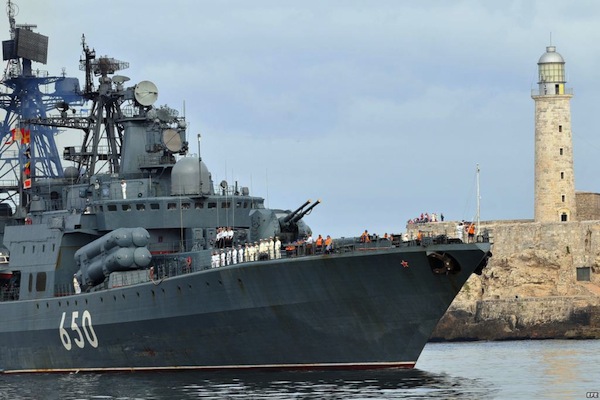
Barco-MorroHAVANA, Cuba.-The crucial dispute in which the geopolitical, economic, and military interests of major world powers are played is the most relevant one in escalating individual conflicts that have been taking place in other regions–the Syrian and Venezuelan crises are two examples–perhaps of lesser effects globally, but where hegemonic interests also have some influence. Thus, in numerous media, alarms have gone off heralding the Cold War, an old ghost which many believed had been banished.

Review Notes

The term “Cold War ” was coined during the late 1940s to define tensions of multiple natures (economic, political and ideological, military, scientific, technological, etc.), that characterized the relations between the communist bloc, under the aegis of the dominant USSR, and the capitalist, led by the U.S., after the end of World War II.

The ongoing power struggle between the two axes to achieve global hegemony constituted a permanent threat to world stability and peace, branding many of the major events of the second half of the twentieth century up to the time of the elimination of the Berlin Wall (1989) and the disappearance of the Soviet Union (1991).

The US bloc and its allies had won the game; however, tensions between East and West have never really been overcome. Currently, competing interests go beyond the ideological aspect that defined that almost 50-year span, but the global threat of conflicts between the powers remains intact.

[WELCOME TO CUBA HONORED RUSSIAN PRESIDENT, VLADIMIR PUTIN] Havana street sign, 2000
[WELCOME TO CUBA HONORED RUSSIAN PRESIDENT, VLADIMIR PUTIN] Havana street sign, 2000
Meanwhile, those countries under the influence of the super powers continue as test sites in the show of force of world power centers, and also as blackmail scenarios of the worst of dangers, just as the 1962 Russian nuclear threat against the U.S. from the Cuban mainland. No wonder, then, that the mere mention of the Cold War can be a source of apprehension to many Cubans, especially now, when there are surges of the unmistakable signs of intentions of using our region, and in particular, our country, as platform for Russian imperialist expansion in this hemisphere, in full defiance of the U.S.

Good and Evil Empires?

At first glance, it might seem that the Russian intervention in the Crimea, the Russian arms sales to Venezuela, and the presence of a Russian spy ship in Havana, are unconnected events. However, declarations by the Russian Defense Minister, Sergei Shoigu, about their intentions to open military bases in Venezuela, Nicaragua and Cuba (in the latter case these would “reopen”), information which was not published by the Cuban official media, show that Mr. Putin, seasoned in intrigue and sordid affairs since his days in the KGB, is ready to step up the tone, moving his historical adversary’s line of dispute in Latin America which, despite everything, remains an American sphere of influence.

Meanwhile, “leftist” governments in this region are sounding the alarm against “Yankee Imperialism”, but at the same time they meld alliances with the Russian Empire, whose importance might not be wise to underestimate, despite its post-Soviet era of decline, while others remain indifferent to these events.

Thus, Russia, with its culture and history completely unrelated to ours, and with a lack of traces in our national emotional memory, today has the enthusiastic connivance of the same old Cuban conspirators and their regional disciples, and the acquiescent silence of our Latin American brothers/step-brothers.

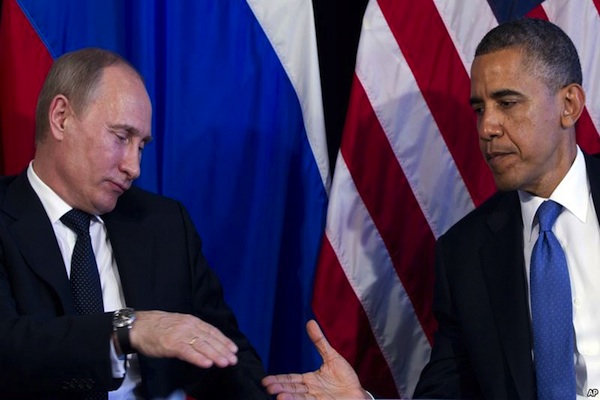
Obama and Putin, Mexico 2012

For Cubans, such a plot could not be taking place at a worse time, when the military power cast holds the monopoly of the economy, and the gerontocracy has been consolidating its international political legitimacy–though not its prestige–thanks to the collusion of governments that met in late January at that aberration called CELAC, and of other international organizations that decided to give the Havana regime a boost, thereby increasing the defenselessness of Cubans against the power’s game for political gains.

For now, some Russian entrepreneurs have begun to invest in sectors of economic interest on the Island, such as tourism, and reportedly also in the Special Development Zone in Mariel, indicating that Cuba remains a point of strategic interest for “the Northern Bear”, the only empire that, at a time when it was Cuba’s “ally”, at the goriest time of the Cold War, placed us in the epicenter of what had the potential to become a global conflagration which, in a matter of minutes, could have wiped us from the face of the earth.

It is terrifying to remember that there were Cubans back then, to whom the government denied the existence of those dangerous Russian artifacts on Cuban soil, who, immediately and massively, got up “in arms against the US imperialist threat”. Such a sad paradox, the enemy was, and continues to be, at home.

More than 50 years later, the scenario is different but some facts are repeated, creating–due to lack of information–the most diverse speculations. The same irresponsible government retakes up the affair with its former allies, perhaps with the collateral intention of indirectly pressuring for the repeal of the U.S. embargo, among other possible plans. Concerns abound, because, if the first part of that forced marriage was bad, we can bet that a second part could even be worse.

Translated by Norma Whiting

Cubanet, 12 March 2014, Miriam Celaya