The Massacre in Canimar River: 34th Anniversary / By Enrisco in the Blog of Luis Felipe Rojas

By Enrisco

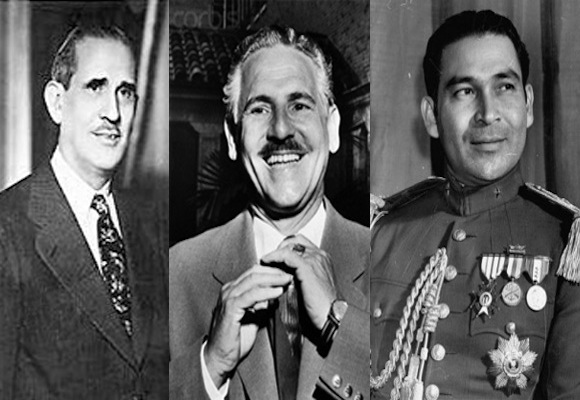
Today, July 6th, is the 34th anniversary of what is regarded as (only by a few certainly) as “The Massacre in Canimar River” because 14 years before the sinking of the “March 13th” tugboat there was an almost identical event in which the Cuban regime was left further unscathed than in the crime of 1994. In the same days as the exodus from Mariel three youths attempted to seize a tourism boat in the area near the Matanzas bay carrying 60-100 people.

While they attempted to escape they were persecuted and machine-gunned by the authorities and later drowned. The exact number of victims is still unknown although they were approximately 50 people of whom some where women and children. (“The precise number of victims remains a secret, but it is at least 56, including children of the ages 3, 9, 11, and 17 years old” according to the Cuba Archive). Only 10 people survived and 11 bodies were retrieved.

Its “historical” importance is to serve as a reminder that the sinking of the tug boat “March 13th” tugboat was not an isolated incident, but one of the most salient characteristics of the political system whose aim was to repress through all venues — including assassination — people who attempted to escape the island.

The other point is to better explain the sinking of the tugboat as a sort of general rehearsal: whomever made the decision to sink the tugboat (and given the transcendence of the decision the most logical answer is, Fidel Castro) had to remember the scarce international repercussions from the massacre that occurred 14 years earlier and reflect that, effectively, it would serve as an intimidating gesture in the domestic sphere without the price to pay in public relations being too costly.

If there remain doubts on the level of involvement of the country’s higher authorities in the crime, it should be known that Julian Rizo Alvarez, who was secretary of the Communist Party of Matanzas gave the order to machine-gun, was promoted 5 months later to Secretary of the Communist Party at a national level in the 2nd Congress of the PCC.

The original post appears in “el blog de Enrisco,” on Sunday, July 6, 2014.

Translated by: Bianca Martinez

7 July 2014

Fury and Delirium / Orlando Luis Pardo Lazo

The Books on the Cuban Death by Orlando Luis Pardo Lazo

There is a literary genre more popular than the rest of Cuban literature, which, by the way, has become a dying phenomenon since a few decades ago.

That genre is the “books on death,” the books written by the serial killers in the island (who spread to Latin America), as if they were perverse characters from an ideological thriller called the Revolution.

Today, 15 years late, I felt the spontaneous urge to read one of the vital and monumental works on Cuban deaths: “The Fury and the Delirium” (Tusquets, 1999), by the killer son of killers and earning wages from killers Jorge Masetti, whose destiny to become a depressing or best-selling star I ignore, but whose prose I will always admire for its morbid monstrosity. continue reading

This grotesque genre has no limits, which is why it is superior to all those who can publish the self-censured Cuban writers. It combines an odd Oedipus with the Macho-Chief (or the Mafia in Chief) with a frigidity that, so as not to be recognized as suicidal, becomes criminal.

On the one hand, the horror (more than fury) of failing the totalitarian state. On the other hand, the disaster (more than delirium) in which the narrator’s life is summed up, turning in circles like a shark thirsty for blood, in exchange for some kind of feeling for his sterile and devalued life. Without worth or meaning. Death as a moral.

In this line of reasoning, whoever is capable of killing, is good and beautiful and was right. Those who let themselves be killed are fragile and ugly and out of place and because of that they left the world.

These serial killers act out of a solipsistic atrocity, but not for a moment do they cease having contact with the rest of the world. And this is where the vulgar genre shines for its sinister sincerity: there are no politics, or art, or sport, or disease, or accident, or fame, or frontiers, or nations, or history, or memory, or identity, or anything that isn’t agreed upon a priori by the heroes of pure action, by the pre-political slaughters in this case the international Castroism (whatever the sign is: Castroism is the pluribus unum of our time).

Jorge Masetti thus narrates from the dark holes that we Cubans, like a lost nation, never suspect that without works like these. In this book we endlessly hear the idle chatter of power. We spy the parliamentary halls of the evil ministries, who voluntarily administer mass murder. We intuit the insidious intelligence, that traces the puppet show that is our biography of citizens who serve as props, as grim. We realize unspeakable things in “The Fury and the Delirium” and its agonizing analyses. Things that are literally unspeakable.

In this book, finally, is the nation’s inner voice, its unlivable novel, its intimate and intimidating corpse-like groan. And thanks to this genre we understand, much more than the author (who only thinks he created catharsis), that we Cubans who are still alive are always complicit or at fault, because at some dead point in our lives we have been forgiven by State Security.

On more than one level, and of this Jorge Masetti is perfectly aware, he who survives is a traitor. His options are now simple (perhaps he already chose in these 15 years of delay in my re-reading): insanity or holiness.

After the Cuban Revolution, death will again become meaningless. Castroism has, well, a role to endlessly fulfill: dose the evil that men freely do unto other men, and if possible, precipitate the evil hand of God, his fury is brittle for those who are still alive with so many enemies intermixed.

Translated by: Bianca Martinez

7 July 2014

The Tribal Unity of the Dissenters / Angel Santiesteban

I want to mention the appearance of laziness inside the Cuban opposition, because — in my opinion — this is what most corrodes our political force and does the lamentable work of the common enemy.

And I’m not even referring to those who must be sprinkled among us doing the terrible and cowardly work of the satraps, but also to that partitioning of ideas and movements, where each one thinks he’s better and more important, and that his work will be most recognized.

I have listened to those who talk about themselves and their work, and — even recognizing their merits — later I have seen how they end up lowering themselves, diminishing themselves as human beings. They leave much to be desired from those feelings that — I take for granted — all fighters for human rights should have.

Comprehension and respect are important to co-exist with others and above all, you know what, not thinking you’re better than anyone else… Just as there are a lot of people who don’t like me… it makes sense to assume that I can’t like a ton of imbeciles… no?

Sometimes, the daring of confronting a regime isn’t sufficient when we ignore common sense and let them impose that mechanism educated in misery that they have imposed on us since birth. continue reading

We will always fail when we show that we are isolated tribes, those on the Island as well as those in exile, and on that subject, the Patriotic Union of Cuba (UNPACU) has taken a laudable step, uniting people in the whole national territory; today, together with the Ladies in White, it’s one of the most constant and effective coalitions against the dictatorship.

To attack each other, to envy and criticize any initiative, work, and recognition of others, and to not support and make known the sacrifice of others, turns us away from that dialogue with the regime that — in some moment — we will have to have by sitting down at the table of political negotiations for a better and democratic Cuba.

When we understand and assume that all of us are no more than grains of sand dissolved on that beautiful beach of our dreams, then we will understand that only if we remain joined and united will we be capable of constructing the wall that can support the calamities that totalitarianism still strikes us with and makes us suffer.

A political conscience, a soul like José Martí, and a respective dose of humility will be the only formula that makes us visible and respectable before the Regime of the Castro dynasty. Otherwise, let’s prepare to continue with the tyranny for half a century more.

We pray to God that He grants us the wisdom to form a national conscience that summons us to political unity, while we maintain and respect individual paths and objectives to accomplish the CHANGE that we all yearn for.

Angel Santiesteban-Prats

Lawton prison settlement. May 2014.

Please follow the link and sign the petition to have Amnesty International declare the Cuban dissident Angel Santiesteban a prisoner of conscience.

Translated by Regina Anavy

30 June 2014

They Direct the Machinery of Harassment Against a Cancer Researcher / Lilianne Ruiz

Young Oscar Casanella is threatened in the public roadway by “factors” of the revolution. State Security wants him fired from his work.

HAVANA, Cuba. — Someone must have heard the telephone conversations of Oscar Casanella.  Those days he was organizing a party with his friends to welcome back Ciro, the guitarist for the punk rock band “Porno for Ricardo,” who had returned from abroad.

Unexpectedly, on Thursday December 5, 2013, at 9:15 pm, just across from his house (at 634 La Roas between Boyeros and Ermita, Plaza de la Revolucion, Havana), four unknown people, two men and two women about 60 years old, blocked his path to tell him:  “Oscar, you cannot do anything these days and if you do, you are going to suffer serious consequences. People unknown to you can harm you, and even we can hurt you a lot.”

This was the preamble to a Kafkaesque story:

Some neighbors told him later that among those who had threatened him was one named Gari Silegas, and that the four were members of the communist party, which met in something known as the “Zonal Nucleus,” a group of militants retired from various “Committees in Defense of the Revolution” (CDR). continue reading

The next Saturday, the day of the party, Oscar went to the Police Station at Zapata and C to make a complaint.  But there they referred him to the Sector Chief, named Eusebio, who operates in the streets surrounding his house; which meant that Eusebio, the police and Silegas, the communist, knew each other and even worked together. Let’s remember that in Cuba that work group is known as “neighborhood factors.”

“They asked Gary Silegas not to threaten me again.  It was all a prophylactic work, they told me.  I tried to make a complaint but they dismissed it,” explains Oscar.

That same day there appeared a Suzuki motorcycle with a blue (i.e. state-owned) plate. The intimidation increased in tone. Two individuals dressed in civilian clothese refused to show him their identification but presented themselves to him as agents of State Security. Oscar narrates:

“They threatened to put me in jail. They told me that I could think whatever I want but I could not say it to anyone, and I could not meet my friends at my house. They also told me that I should leave the country and that they were going to ’fuck up my life and my family.’ Having committed no crime or infraction that harms anyone, I feel threatened. They mentioned also my attendance, as a spectator, at Estado de SATS, which is held in Playa township at the home of Antonio Rodiles. Witnesses to those events were practically all the neighbors.”

That night the party took place. Oscar’s neighbors, active CDR members, to give him more “flavor” of the process, dedicated themselves to copying the plates of cars that were parked in the street without it mattering if their owners attended. There were more than fifty invitees, the majority young graduates of the University of Havana. Oscar played records by Juan Luis Guerra and the 440 and Ciro’s punk music, but everyone spoke the same language and spent the night dancing and having fun.

The reaction was swift

On December 9, a surprise was waiting for Oscar at his workplace, the National Institute of Oncology and Radiobiology (Cancer Hospital), where he works as a researcher. His doctorate thesis is about sporadic colon cancer. He also works as an adjuct professor at the Biology School without receiving any salary for this latter work.

A colleague of his, Pedro Wilfredo Fernandez Cabezas, was waiting to tell him that by continuing to attend activities with counter-revolutionary groups, “mercenaries, annexationists and neo-liberals” — a cocktail of amazing accusations — he could suffer negative consequences in his work.

Oscar answered him that he has friends who express themselves against the government but they are not mercenaries or annexationists*. Calmly, he explained to him that he did not believe that they were of a neo-liberal tendency, although he thought that if that were so, it did not justify any action against them.

We return to the starting point

“Wednesday December 11, 2013, I tried again to make a complaint about these threats at the PNR Station at Zapata and C. The first lieutenant Abad refused to write the complaint because, according to him, the threat is registered and attended to only when it is a death threat, not when they threaten to hit me or put me in prison or take my job,” continues Oscar in this absurd saga.

And last April an official from the National Revolutionary Police left a citation at his home for him to appear the next day at the Zapata and C Unit. The reason? An interview with Captain Jose A. Blasco.

“But when I presented myself at the Unit, Captain Jose A. Blasco directs me to an office and immediately withdraws. There was never an interview with the said captain. Three men younger than I were there, dressed in civilian clothes, only one of whom identified himself as Marcos, although the others said they were from State Security.

In short, they told me that they were going to take me out of my job, where I have worked for 10 years without any work problem, and put me to work in a less important center or in a polyclinic. They told me they could hurt me and my family even more, because State Security says that I cannot keep communicating with some friends, like Ciro, the one from Porno para Ricardo, whom I have known since before the university,” continued Oscar.

His alternatives were clear, and there were only two, in his case complementary. Talk with this reporter and complain to the institutions of the State.

The young researcher wrote letters to everyone. He gathered signatures from many of his friends and students. He took them to all possible institutions and delivered minted copies to each of those who supported him.

The Kafkaesque machinery seemed to stop at one point, but in reality it continues. All this has stolen many hours of research from him. He has had to dedicate them also to studying the law and trying to understand why a regime dedicates itself to interrupting the people and discouraging the talents themselves of people that interest it, above all, providing knowledge. Oscar still is not a dissident.

Lilianne Ruiz, July 4, 2014, Cubanet

*Translator’s note: “Annexationist” is an accusation made against opponents to the regime which implies that they want the United States to annex Cuba.

Translated by mlk

5 July 2014

A Light for My Loved Ones / Estado de Sats

Una luz por los míos” / Collective Action

To all Cubans

July 13 marks the 20th anniversay of the 13th-of-March* tugboat crime against a boat that carried 72 Cubans, sunk by the Cuban regime off the Havana Bay to prevent their escaping to the United States coast. This criminal action cost the lives of 41 people, among them 10 children.

The collective action “A light for my loved ones” will be a tribute to the victims of the 13th-of-March tugboat and to all Cubans who have lost their lives in the sea, trying to escape a suffocating realitythat has lasted for 54 years. It is also a tribute to the Cuban family and a call to hope and the spiritual rebuilding of our nation.

On July 12, at dusk on the eve ofthis anniversary, Cubans, wherever you are in the world, take a candle to the sea, a bridge, a lake, a river, your doorway, balcony, or in the privacy of your home (in case repression in Cuba is doubled on this date).

Given the disconnection of Cuba from the world, Cubans who live abroad can help to promote this symbolic action, inviting families and friends on the island to participate and sharing, in turn, photos and images of the tribute on social networks.

Let’s light this candle on 12 July to remember a friend, a family member, who didn’t make it, a child who never appeared.

A candle as a complaint.

A candle against forgetfulness.

A candle for the future.

A light for my loved ones.

*Translator’s note: The tugboat was named after the day in 1957 when students launched an attack on the presidential palace in Havana.

Go Around / Regina Coyula

It’s an ordinary apartment in a quiet Havana neighborhood. You have to knock and go inside to find out if owner knows about the recommendation you have been given. There are no introductions. A girl leads you straight to a room in the apartment that is not a room but rather a little store, well-organized and well-stocked, given what it is.

“How much is this wallet?”

“Um, I don’t know if they told you but I don’t sell, I rent,” she says.

Huh?

“Yeah, I have a license to rent party clothes. What you have to do is leave a deposit for the full value of the article. If you don’t return it after ten days, I deduct it from my inventory.”

“Ten days, right?”

I leave with my wallet and a smile. “If you can’t go over, go around.”

9 July 2014

Cuba: Is Varadero for People of Another Social Class? / Ivan Garcia

Under a brightly colored umbrella, a representative of Gaviota, a tourism chain, the property of businessmen in the Cuban military, offers an inclusive leisure package for the summer.

The bureau of reservations is nestled in an old parking lot of a strip mall in 5th Avenue and 42nd, Miramar, to the west of Havana.

It is Saturday. There is a festive atmosphere: Kiosks selling popcorn, sandwiches, and frozen pizzas that are heated in the microwave and taste like plastic. Meanwhile, flat screen televisions are airing the World Cup soccer matches in Brazil.

There has to be music. Randomly situated speakers amplify too loudly the current hit, Bailando, by Enrique Iglesisas, Descemer Bueno, and People of the Zone.

In the tourism bureau everything is a hustle. Over a table, public pamphlets of “all-inclusive” hotels in Varadero, Cayo Coco, or Santa Lucia.

Past nine-thirty in the morning they begin to see clients. The personnel are friendly with Colgate smiles and a commercial diction learned through quick marketing courses. continue reading

The representatives of each chain wear differently colored shirts: Gaviota, green; Cubanacan, red; Havanatur, yellow, and Isla Azul, white. Why speak of the price? Two nights in the hotel Bella Costa de Varadero, 240 CUC. A weekend in the beach Ancon, Sancti Spiritus, 380 cuc. Recall that the average monthly salary in Cuba is 20 convertible pesos.

Like anywhere else in the world, the hotels cost according to their glamour and five-star rating. In a queue to make reservations of nine people  there is only one black woman.

The rest are white. Two foreigners with Cuban “girlfriends” with extremely long nails, tiny shorts, and high heels, probably prostitutes, choose the Pesquero Beach, in the eastern province of Holguin, where they hope to drink mojitos and relax in beach chairs.

A Cuban-American residing in Coconut Grove, Miami-Dade, wishes to rent in a four-star hotel in Varadero for a week. “My family is from a mountainous area in Santiago de Cuba. Everything is going well for me in the United States. There is no one better with whom to share my vacations than with them.”

When it is his turn, the shrewd representative of Gaviota makes an offer: “Almost impossible, this is a hotel that specializes in family services. It is ranked second in preference within Varadero. You will thank me,” signals the vendor with engrossing confidence.

It has been ten years since she has visited Cuba and she debates between the unplanned expenses and her poor parents, who spend their vacations watching TV and relieving themselves from the heat with a chinese fan. She gives in to the commercial coaxing of the type of expert who draws money from clients.

“By the end I wasted two thousand CUC for eight nights and four rooms in El Patriarca, a five-star hotel. It is worth distracting my family. Cuba is not doing well. Whatever one does for the family will be too little,” she says, and stores away her reservation in her bag.

Natacha, from the Cubanacan chain, knows how to handle all types of clients. “We win our commission for every sold package. The cheapest are the Spanish, they always have been, but now with their financial crisis they like to buy cheaply. The Canadians and the Russians pay without joking. The Cuban-Americna or other American we attract once in a while, will even leave tips.”

Two married doctors who worked for two years in South Africa, while drinking Corona beers, are enthralled while listening to a tourism operator who proposes an offer in Cayo Coco, Ciego de Avila, 500 kilometers from Havana.

“After working in such alienated places we deserve a good vacation. With the money we collected we could repair the house and buy appliances for the house. We thought of acquiring a car, but after the government annulled the special right to doctors, it is impossible to buy a car with the current prices. We therefore decided to rent 4 nights in Cayo Coco,” recounts the married couple.

The black woman is an engineer. Since 2010 she tends to stay two or three days in an “all-inclusive” hotel in Varadero. This season she could rent 5 nights in Melia Marina Varadero. This cost here 822 cuc.

“With my salary of 500 Cuban pesos and 27.50 CUC monthly I would never be able to. Thanks to the grandmother of my daughter who resides in Europe and my husband, who is working for himself, we can spend some time in a hotel in Varadero,” she expresses.

If you leave the commercial complex in 5th and 42, Miramar, and arrive at the center of Havana, in corners within dangerous neighborhoods you will see young people chatting about soccer or making plans to make money.

They are hardened by their marginal existence. They know where drugs are sold and often spend nights throwing dice in an illegal gaming house. They are also experts in proposing sex with boys or girls and sell fashionable clothes. When you ask them where they will spend their vacations they look at you as if you were an alien.

“Are you kidding, brother? Vacations for us mean having money in our pockets, drinking beer, talking about nothing or going out with an American. If we can lunch or dine as God wishes we are happy. We entertain ourselves watching sports on the television and when it is hot we go the beaches in the east, we take a shower and down a whole liter of white rum. Neither Varadero or Cayo Coco is in our plans. That is for people of higher social standing.”

Ivan Garcia

Notes by Tania Quintero

The five-star Hotel Melia Marina Varadero was inaugurated in July 2013 and included in its attractions is a harbor with a capacity to dock 1,200 yachts, which will grow to 3,000 boats of small, medium, and large sizes.

Situated in the Hicacos Peninsula, Matanzas, 150 kilometers east of Havana, expect 423 rooms and one condominium with 126 one- and two-bedroom apartments.  This hotel is the 26th establishment by the firm Melia Hotels International, which in May 10 1990 inaugurated in Varadero as its first hotel in Cuba, the Sol Palmeras. Melia is the foreign hotel chain with greatest presence in Cuba. In 2016 it will open a hotel in the colonial city of Trinidad, in the central south of the island.

Currently, 60 hotels are administered by 16 foreign chains, among which is the Portuguese Pestana, which in August 2013 started its operations in Cuba with the opening of Pestana Cayo Coco Beach Resort, a four-star hotel located in the Jardines dle Rey, keys which are north of the province, Ciego de Avila.

The last one to join the list is the Swiss empire, Kempinski Hotels, founded in 1897, and with more than 80 luxury hotels in the world. Kempinski acquired the rights to administer and commercialize the hotel that was constructed in the old Manzana de Gomez, in the heart of Havana, to be inaugurated in October 2016.

The main national operator is the Group of Tourism Gaviota S.A., property of the Ministry of the Armed Services. As of 2008, the Cubans can stay in any hotel or tourism facility…. as long as they pay in Cuban convertible pesos, the Creole hard currency. Three years later, in 2011, BBC World informed that after the Canadians, the main group of tourists in Cuba were the Cuban citizens from the islands and the immigrants who visit.

We recommend the lecture series in 10 posts dedicated to Varadero, that during October 7-28, 2013 was published on “The Blog” by Ivan Garcia and his friends, among these the last two, “Memories” and “Varadero, where Benny found peace.”

Translated by: Bianca Martinez

25 June 2014

School Violence and Social and Legal Indiscipline in Cuba / Dayanara Vega, Cuban Law Association

By Dayanara Vega

School violence is considered an intentional act or omission that is hurtful and practiced among members of the educational community (students, professors, parents, entry-level employees) and that is done within the physical space of school facilities and other spaces directly related to the school (areas surrounding the school or places where extracurricular acitivies are carried out).

An extreme and characteristic form of school violence present among students is school bullying.

Scientific studies mark the following as principal risk factors that give rise to school violence in the lives of members of the educational community: continue reading

– Social exclusion or the feeling of being excluded

– The absence of boundaries for proper social behavior

– The constant exposure to violence reflected in social media, which in Cuba is observed in TV serials and certain novels that superficially touch on the theme.

– The integration into gangs that use violence as a form of ordinary behavior.

– The justification of violence in society or in the social atmosphere to which that person belongs.

– Family problems such as violence (divorce, domestic violence)

School bullying can become physical.

School assault (also known as school harassment or by the English term, “bullying”) is any form of psychological, verbal, or physical mistreatment repeatedly practiced among members of the school for a certain amount of time.

Statistically, the dominant form of violence is emotional and is mainly in the class and the courtyard of the school. The protagonists tend to be boys and girls on the verge of entering adolescence (12-13 years), with a slightly higher percentage of girls being the victims.

School bullying is a type of torture, methodical and systematic, in which the agressor abuses the victim often with silence, indifference, or with the complicity of other schoolmates.

This kind of violence is characterized by a repetition that aims to intimidate the victim, implicating an abuse of power exercised by a more powerful aggresor (the strength may be real or perceived). The mistreated subject is left physically and emotionally exposed before his aggresor, generating a series of psychological consequences (although these do not form part of the diagnosis); it is common for the victim to be afraid to attend school and to demonstrate nervousness, sadness, or loneliness in his or her daily life. In some cases, the difficulty of the situation can give rise to suicidal thoughts and their materialization, as consequences of harassment.

In our country we customarily blame external sources for social indiscipline and do not look within ourselves to see how we have lost values that are at the core of the family; the fundamental unit of society.

The state does not take responsibility since the Geneva Convention exists to protect youth and adolescents and Cuba forms a part of it yet does not enact real judicial actions whose aim is to put the brakes on this social evil.

Translated by: Bianca Martinez

7 July 2014

El Sexto Facing Trial / 14ymedio

El Sexto at his home in Havana (14ymedio)

14ymedio, Havana, 9 July 2014 – The graffiti artist Danilo Maldonado, known as “El Sexto” (The Sixth), has been in custody for five days charged with “violation of domicile and injury” and will be prosecuted, according to several friends and Cuban activists. Interviewed by the newspaper just two weeks ago, the artist is being held incommunicado and will be tried this week, according to reports from his family on Wednesday.

This newspaper was able to contact the photographer Orlando Luis Pardo Lazo who, in speaking of El Sexto, said, “he has no attorney, no money, no one left free in Cuba who is able to help him.” The young man has spent several years in the sights of the Cuban political police for a series of graffiti and expositions where he questions the powers-that-be and gives voice to outlawed civil society. His friends believe this could be a “settling of accounts.”

Several witnesses say that a domestic incident and a complaint from the father of El Sexto’s wife have “served as a reason for the police to charge his and to remove him from the streets where he realizes his art.” There is still no official version of events and the authorities are not providing clear answers to the several phone calls made to investigate the situation of the detainee.

In late 2012, the writer Angel Santiesteban Prats was convicted on similar charges and still remains an inmate of a forced work center on the outskirts of Havana. As a general rule, people critical of the government are not judged on political grounds but rather for “common crimes” with the objective of reducing solidarity and international pressure.

Somos+ Launches a Project to Save History / Eliecer Avila

Among the first victims of January ’59 was the history of Cuba, especially the phase of the Republic. A radical rupture caused the immediate divorce of the new generations with a past that was reduced to four lines in scholarly books. (From Somos+)

La Havana, Cuba – “Puppet State, governing mafias, corruption, and poverty” are the only emblems, according to the official version, of the first half of the twentieth century in Cuba

A tour of eight libraries in Havana, while inquiring whether there existed some available texts on the Republic, resulted in only one book in two libraries dedicated to the theme: “The Republic of Cork” by Rolando Rodriguez.

The disconnectedness from the Internet worsens the situation. It is such that the access to documents, testimonials, videos, statistics and serious studies, are reduced to such a small number of people that they do not rely on a platform to discuss the contents.

To this situation we are already working on a series of testimonials, with people who lived, worked, fell in love and started families, and dreamed during the Republic. Men and women who are a living treasure because of their accumulated experiences and unprejudiced vision of the different realities that nuanced a whole era.

We want to investigate, from the household perspective, how that society felt. How was the health, the education, the exercise of democratic participation (when it existed), the press, the architecture, the cost of living, the markets, the music, the recreational activities, the institutions, the problems of the moment . . . finally, everything that can provide understanding about a tumultuous period, but one that was productive in the construction of the Cuban nation.

We also seek to shed light over many deeds and historical circumstances that have been strongly manipulated or distorted. The objective is not to establish truths or impose visions, but to enrich the debate and provoke a flourishing of knowledge and vital analysis for the current age.

The people who wish to participate in this historical series can contact us through email, by phone, or through mail.

Eliecer Avila, Engineer, (Somos+)

Cubanet, 13 June 2014

Translated by: Bianca Martinez

Spanish post
14 June 2014

Are We In Transition? / 14ymedio, Yoani Sanchez

Seminario-transiciAn-espaAola-Madrid_CYMIMA20140709_0006_13

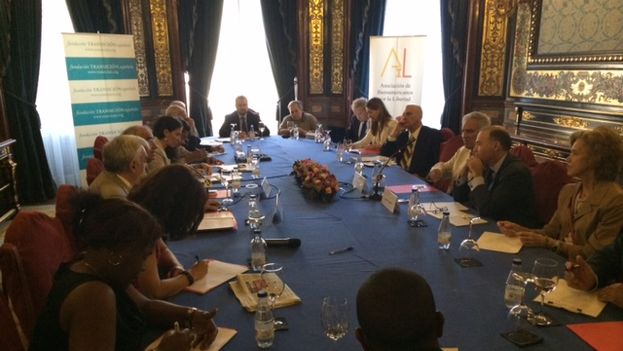
Yoani Sánchez, Madrid, 9 July 2014 – Right now I am taking part, along with several Cuban activists, in a seminar on the Spanish transition being held in Madrid. Organized by the Association of Ibero-Americans for Freedom and the Spanish Transition Foundation at the Casa de America, the event includes the participation of nine activists from within the Island from many different sectors, such as law, citizenship, human rights and journalism. An opportunity for us to meet with each other without the police cordons or acts of repudiation.

While I listened to several speakers, I remembered when, in 2011, I watched the series The Transition, with the voice of Victoria Prego. Coincidentally, the morning I started to watch the excellent scenes of that documentary and the analysis that accompanied it, a friend from Madrid visited me. She looked at the TV screen and said to me, “I experienced many of those events, but at that time I didn’t know we were in transition.” Her phrase has stayed with me as solace and hope all these years. Today, in the Casa de America, I remembered it.

Are we Cubans living in the transition? Just asking this question is enough to annoy some people and excite others. A transition – the experts and analysts tell me – needs more political, social and economic evidence. A word of such magnitude requires real substance, not just desires, others warn me, also with very good arguments. If it turns out that an irreversible and defining change has occurred within Cubans, could we see that as the transition? In this case, the micro look beats out the macro analysis.

Every day I meet more people who are no longer collaborating, who no longer believe, who no longer support the system. I also stumble upon people who aren’t interested in watching official TV, or taking part in official events, or accepting official perks. What do we call that? May the transition theorists forgive me, but if that is not a change, what is it? “Pre-transition” perhaps?

“Cuba’s problem is within Cuba” / 14ymedio

Speaking at the Atlantic Forum, Yoani Sánchez tells Mario Vargas Llosa that help is needed to move the center of the discussion to the island.

Vargas-Llosa-Yoani-SAnchez-Madrid_CYMIMA20140709_0001_11

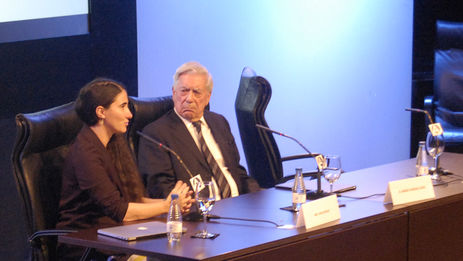
14ymedio, Madrid, 8 July 2014 — “Cuba’s problem is within Cuba. The locus of the discussion needs to be moved to the island.” This was the powerful message from Yoani Sanchez, 14ymedio director, to Nobel prize winning writer Mario Vargas Llosa at the VII Atlantic Forum, at the Casa de América in Madrid, Spain. Vargas Llosa had asked Sánchez how the Cuban opposition could be aided from the outside, whether there might be some common themes to emphasize, such as the embargo. “The embargo, tourism…all of that is just transferring the problem outside. To the White House, to the airports…” said the journalist and blogger, stressing that the way to push for a transition in Cuba from outside the island is not to turn attention elsewhere.

This exchange took place during the event organized by the International Foundation for Liberty, whose theme this year is the economic and institutional consolidation of Ibero-America. Vargas Llosa, foundation president, started off the proceedings by asking Yoani Sánchez about the actual scope of the so-called “Raulist” [for Raúl Castro] reforms on the island. The journalist qualified them as “small transformations caused by necessity and not by political will”, meaning that they do not correspond to the real changes that the country needs. continue reading

However, there are differences between Raúl and his brother, Fidel Castro. “The repression hasn’t ceased,” Sánchez said. “It’s just that the current version of it is more continuous, it’s in every minute, it leaves no evidence so the victims can defend themselves. Fidel was more media-savvy.”

Vargas Llosa also inquired about the birth of 14ymedio, remarking that, because of the many barriers it might face in Cuba, he never thought it would actually be created and maintained. “It’s a digital project because the printing houses in Cuba are under more surveillance than the barracks,” Sánchez explained, leading to a discussion of 14ymedio’s objectives. “Who is our readership? I think of people like my mother who, when I speak to her of injustice and human rights I don’t get her attention, but when I point out that this year she’ll have to double her spending to just maintain her current level of purchasing power, she is interested and exclaims, ‘this needs to change’.”

Sánchez spoke of the diversity of opposition movements on the island, although she emphasized that their principal limitation continues to be the state’s communication media monopoly. “In Cuba there is a great underground market for information,” she said, adding that technology is key to overcoming this barrier.

The Forum also included the writers Plinio Apuleyo Mendoza, Álvaro Vargas Llosa y Carlos Alberto Montaner, who presented their latest book, “Últimas noticias del nuevo idiota iberoamericano (Ed. Planeta)” [Latest News from the New Ibero-American Idiot, (Planet Publishers)]. The three authors — Colombian, Peruvian and Cuban, respectively — returned to analyzing the changes that have occurred in various Latin American countries and Spain, almost 20 years after the publication of their “Manual del perfecto idiota latinoamericano” [Guide to the Perfect Latin American Idiot].

Carlos Alberto Montaner pointed out that “the idiot is now also part of political life in Spain” and that the stability of Spain’s democracy is endangered by the presence of radical groups. “If that strange popular front were to become institutionalized and politically powerful, the country would head towards economic folly and alienate investors”, he added.

Nine Cuban activists travelled from the island to attend the Forum. However, Venezuelan opposition member María Corina Machado was unable to attend, having been barred from travelling outside the country because of her alleged implication in a plot to destabilize the government of Nicolás Maduro.

Translated by Alicia Barraqué Ellison

Tomorrow, July 10: 20 Minutes of Silence for 20 Years of Impunity

CUBA: Young Leaders Group, Center for a Free Cuba and the Cuban Democratic Directorate Call for Twenty Minutes of Silence for Twenty Years of Impunity

Washington DC. July 8, 2014. Human rights and civil society organizations have called for a symbolic nonviolent protest action in honor of the twentieth anniversary of the murder of 37 Cuban passengers of the “13 de Marzo” Tugboat, who on July 13, 1994 were killed by agents of the Cuban government for trying to escape the island.

The demonstration will take place on July 10 at 12:00 noon outside of the Cuban Interests Section located on 2630 16th Street NW in Washington DC.

Human rights activists, members of international civil society and Cuban exiles will gather in front of the embassy in order to hold twenty minutes of silence for each of the twenty years that this crime has remained unpunished. continue reading

Rudy Mayor Director of the U.S. Cuba Democracy PAC’s Young Leaders Group outlined what happened and what is being remembered: “On this 20th anniversary of the Cuban tugboat massacre, we are again reminded of the cruelty of the Castro regime and its willingness to kill innocent men, women and children to deny them the chance of freedom. It is important for all of us who value and cherish liberty to remember those who have given the ultimate sacrifice in their search for freedom from oppression.”

Jose Luis Garza of the Cuban Democratic Directorate explained the purpose of the demonstration: “We are holding this nonviolent activity to remind the Castro regime that their crimes will not remain in impunity, and that both Cuban civil society and the international community remember the brutal manner in which they killed men, women and children. Today we stand in solidarity with our brothers and sisters in the Island to tell them they are not alone.”

On July 13, seventy two Cubans tried to escape the island on board the “13 de Marzo” tugboat at 3:00am. The boat used for the escape belonged to the Maritime Services Enterprise of the Ministry of Transportation. Upon leaving the port two boats from the same state enterprise began pursuing it. About 45 minutes into the trip, when the tug was seven miles away from the Cuban coast two other boats belonging to said enterprise appeared, equipped with tanks and water hoses, proceeded to attack and sink the tug.  “Polargo 2” blocked the “13 de Marzo” tug in the front, while the other, “Polargo 5,” attacked from behind, splitting the stern.  Two other government boats positioned themselves on either side and sprayed everyone on deck with pressurized water, using their hoses.” According to survivors another vessel that appeared to be directing operations was believed to belong to the Cuban Coast Guard, which is part of the Ministry of the Interior. Sergio Perodin, one of the survivors who lost his wife and young son during the incident, explained how the massacre ended in a 1998 Nightline program: “We saw in the distance a boat with a Greek flag that appeared to be what stopped them. lt looked like the boat was watching what they were doing, the murder they were committing. So they stopped and decided to pick us up.”

Thirty seven people were slain that day, including 13 women and 10 children.

“Twenty years after the killing of innocent men, women, and children who were seeking freedom, the Castro regime continues to deprive its citizens of their basic rights. The victims must not be forgotten and those responsible for their deaths should be held accountable”, stated Frank Calzón, Executive Director of the Center for a Free Cuba.

Twenty years after the events, and despite the exhaustive reports and conclusions of the Inter-American Commission on Human Rights and other international organizations on the responsibility of the Cuban State in the massacre, the authors of this crime continue enjoying absolute impunity while both the victims who survived and the families of the dead have been denied justice, and any kind of moral compensation.

Contact:

Frank Calzon, Center for a Free Cuba 202- 427-3875

Jose Luis Garza, Cuban Democratic Directorate 305-220-2713

Rudy Mayor, U.S. Cuba Democracy PAC’s Young Leaders Group 786-393-9068

Secrets and Illnesses Among Cuban Doctors in Venezuela / Juan Juan Almeida

The Cuban government, as a tactic, is entrenched in silence, compartmentalization and secrets. This is the reason why, even today, in the age of the internet and despite several defections, it is not common to find real news that described the medical mission in Venezuela from inside.

The subject is “top secret.” The island’s government prefers to hide problems, instead of preventing them with information. Any data that concerns the medical collaboration is considered “classified” and, consequently, remains guarded by the Cuban and Venezuelan special services.

So, weeks ago on the publication of an article titled, “Cuban mission in Venezuela in danger,” the bloodhounds got all upset and lost their cool, and with the momentum of hunters set off in chaotic pursuit. But, on not finding those guilty of “leaking information,” they decided to grab the most likely bidder as a scapegoat so as not to face the resounding echo of their own incompetence. continue reading

Arrested and sent to Havana, an innocent aid worker traveled handcuffed and guarded, carrying as baggage as a sheet of paper where he is accused of being a spy; without trial but with judgment. Such slander is the work of an inquisitorial tribunal chaired by Roberto Gonzalez, national chief of the Cuban Medical Mission in that country.

Somewhere I read that to see an injustice and to remain silent is like committing it. So it is my duty to clarify that the information published did not come from any foot soldier, but an upper crust official who, with his high sense of greed, tried to live in a world beyond the sky.

I do not think any cooperator would risk breaking the barrier of imposed compartmentalization without some guaranteed escape. Something that I believe justifies the innocence of the arrested. Those below don’t possess the information, nor have the desire; it’s enough to have to the responsibility to save lives and to be sheltered in a country where few people want us; because despite our good, bad or ulterior motives, much of the Venezuelan population, sees us as mere invaders.

But back to the subject at hand, and with more information than I had last week; on Monday,June 30, in Anzoategui, Aragua, Bolivar, Carabobo, Lara, Miranda, Sucre and Zulia 330 Cuban collaborators were reported with acute respiratory infections; 37 of them in the last week. In Nueva Esparta, Trujillo, Monagas, Yaracuy, Sucre, Miranda, Lara and Barinas, there is an increase of collaborators with dengue fever (nine, to be exact).

I am not given to putting figures in writing, but sometimes, like this is necessary. I must also add that in the Amazon, Trujillo, Nueva Esparta, Apure, Guarico, Anzoategui, Lara, Falcón, Barinas, Delta Amacuro and Zulia, 98 Cubans were diagnosed with ADD (acute diarrheal diseases).

Also, in the Amazonas, Apure, Monagas, Guarico, Nueva Esparta, Bolivar, Vargas, Cojedes, Sucre, Merida, Barinas and Zulia, 248 Cuban professionals (79 doctors, 80 nurses, 55 dentists and 34 laboratory technicians) are under observation after suffering some kind of occupational accidents involving exposure to blood and body fluids.

The Cuban medical mission in Venezuela has serious problems; besides manifest rejection and disease, the exodus of physicians is increasing.

I was told that the opening of offices in areas of extreme poverty is stagnant due to the lack of cooperation of community leaders, and Venezuelan students are reluctant to participate as extras in this circus. And to make it more surreal, there is a lack of medications, even basic ones. They say there is a delay in delivery. I will also speak about this.

8 July 2014

Remnants of History: Cubans in the Independence of the United States / Angel Santiesteban

Many Cubans are unaware, although living in the United States, that we were participants in the independence of the Thirteen American Colonies.

When in 1776 the conditions were given for the confrontation with England, commercial relations between Cuban and the North had already reached a mutual development and interest, independent of their cities. In 1764, England cut off commerce with the Spanish and French Antilles which affected thirty distilleries that produced the coveted “Anitillean Rum.”  This was one of the reasons for the separatist movement, recognized by John Adams, second president of the United States.

After that event, Havana became a supplier for the independence army.  A commercial fleet was in charge of bringing resources while in Havana shipyards and arsenals American ships were repaired and mounted with cannon.

Part of the rebel force was made up of Cuban Creoles and brown and moreno battallions. On the Pensacola Site, April of 1781, the Havana forces that had arrived as reinforcement were the first to enter the city. continue reading

In revenge, England attacked Havana, attempting another capture like that of 1762 but — this time — they found different circumstances. Twenty years later, the defenses were impregnable and their forces were strategically positioned. The harassed Admiral Rodney, then, beat a retreat. The Cuban forces continued their contribution to the American cause and managed to evict the English from control of the Mississippi River, guaranteeing the provisioning of the rebels through that route.

One of the great moments of Cuban collaboration for the independence of the Thirteen Colonies was the delivery — to aid General George Washington when he was without resources — by the native Cuban general and first Creole named governor of the Island, Juan Manuel Cagigal y Monserrat, of his loyal collaborator, intimate friend and personal aide — the Venezuelan Francisco de Miranda — to meet with Washington.

On his return, they gathered resources through public fundraising and jewelry donations by Havana ladies. Thanks to that contribution, Washington began the attack against the troops of British General Cornwallis in Yorktown, Virginia. After intense fighting, he achieved the surrender of the English.

Particularly, Havanans had the opportunity to clear their honor after the loss of The Havana, taken by the English in 1762. With their contribution to the independence of the Thirteen Colonies, Cuban natives fought for the first time to liberate another country.

Thereafter, America began to be the largest trading partner of the archipelago and the second home.

Angel Santiesteban-Prats

Lawton prison settlement.  June 2014.

Follow the link to sign the petition for Amnesty International to declare Cuban dissident Angel Santiesteban a prisoner of conscience.

Translated by mlk.
4 July 2014