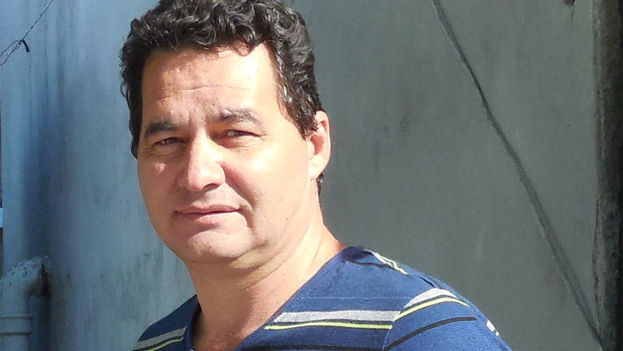
S.O.S.: Angel Santiesteban Transferred and His Whereabouts Unknown

Since yesterday, July 21, Angel Santiesteban Prats is in an unknown location.  I will now relate the events that preceded this new arbitrariness on the part of Cuban State Security.

Joining him in his helplessness is his younger son, Eduardo Angel Santiesteban Rodriguez, 16 years old, the son of Angel and the woman who plotted against him with State Security in order to incarcerate him.

The youth — once old enough to escape from the clutches of his mother — asked to tell the truth about what had happened and how he was manipulated by her and by the Castro regime State Security to testify against his father.  Here is the link to his statements.

Obviously, we are very worried about the fate that may await the boy, for we already know through Angel’s own experience that no apologies are made for harassing and incarcerating minors.  In fact, Angel learned the drama of prison at 17 when he was jailed for saying goodbye to his three older brothers who were planning to leave the Island on a boat.  The escape was thwarted, the three “deserters” were captured, along with the youngest (Angel) for “harboring” them.  After a year and a half of incarceration, he was freed because saying goodbye to his brothers was deemed “not a crime.” continue reading

But no one gave him back the lost time and the hard experience he lived through, which – justifiably – became prime material for his prizewinning literature widely regarded for its unflinching realism and strong condemnation of the prison system, among other criticisms.  Angel has already well-explained how the Regime endured this literature without taking much action, awaiting the opportunity to attack him directly, which happened in 2008 by opening the blog and publicizing everything that was of the public domain.

Now the son, Eduardo Angel Santiesteban Rodriguez,  worthy seed of a valiant one such as Angel, runs grave risk of going through what his father did, or even worse. Eduardo Angel already has told what State Security did in collusion with his mother, Kenia Rodriguez Diley.

With regard to Angel’s own situation, the Regime continues to punish him for his upright position against it, and does not back down in its efforts to complicate all the judicial interventions to which he has a right by law.  The objective is to eventually water down his claims because they do NOT have any argument that can sustain all the false accusations hanging over him, now that his own son told the truth, unmasking the dictatorship’s judicial farce.

Angel declared on the blog:

“My family has just, coincidentally, found out that the Review Department has sent a letter to my lawyer Lourdes Arzua, who substitutes for Amelia Rodriguez, who was cut from service for six months, where they informed her that I have asked not to have legal representation, which is completely false.  I suppose that the “misunderstanding” is due to my call to that Department, in order to find out if the file had arrived in their hands, after the tribunal denied the number and my name matched.  My lawyer appeared in order to clarify that the number and my name were correct.  Although it appeared a joke, because that number — 444 — was that of a police serial that in 2012 was shown on Cuban television.  I suppose it has to do with some joke that the bosses played with my case.

I was assisted in the call by Chief Oslaydi, who has just been ousted, perhaps for assuring me that she “would correct it and that she would pass the verdict to the Ministry of Justice, which was who, definitively, would determine what measure to take in my case.”  The last time that I spoke with her, her affable and polite manner had changed.  Her behavior was coarse.  I supposed that she had already been visited by State Security officials, and they dictated to her what to write in my case, just as they did with the tribunal that “judged” me, then on Appeal and now on Review.

I always say, I am not naive, that the procedures to restore justice in my case are not for the government to straighten out, because they have never done it, they have never recognized an error, the “Revolution” is not mistaken, thus, its governors are perfect; complaints are made in order to continue sliming people and one day the truth may be known.  Justice demands it because that is our reason for being, what has us jailed, therefore, we must continue forcing them to grow their institutional evil, which they do by refusing to accept the truth as justice.

For my file to arrive at the Review Department more than a year has passed, when normally, and according to their laws, it should take no more than three months to issue an answer.  Once they had to accept the Review, six months from the filing, they invalidated my lawyer Amelia Rodriguez; now they send a letter to the office in a new effort to invalidate my representative and, as in the “trial,” leave me once more “legally defenseless,” as attorney Miguel Iturria, who was my defender then, recognized.

In recent days my lawyer inquired about the course of the file, and they informed her that a document “of the cause” is missing, which the tribunal must present; which contradicts what the ex-chief told me, that the file had already been delivered to a specialist who was working on his exhausting review.

All this foolishness by State Security, I feel it like the kicking of the hanged man.  If they thought that once I was incarcerated they were going to sap my strength, I cannot think anything other than that they calculated this as if they themselves were in my place, but in my case, my strength to fight for the liberty of my country has increased.”

The day after denouncing this new judicial hoax, he declared:

In the most extreme example of “the secretiveness of the State,” State Security is preparing my transfer to a border patrol unit.”

For days now a rumor has been circulating that is now taken as fact, given that the prison authorities await my transfer to be completed so that they can transport a Minister and a Vice-Minister of Construction who are serving sentences for “diversion of resources”.  There is no way that officials will allow these prisoners to coincide with me, fearing that I will obtain information from them and later divulge it on my blog. 

Following the escape of a prisoner and his arrival on the coast of Miami, State Security ordered a reinforcement of the surveillance being conducted on me. They established a 24-hour command post and they’re watching every move I make within the settlement.

A few minutes ago, they just ordered some bars to be soldered to secure the place where they will take me, and they said these had to be in place before tomorrow at the aforementioned border patrol unit.

Evidently, they will keep me there more watched and isolated. Thus begins another chapter in this journey of injustice, all for my my dangerous crime of thinking differently.

I reaffirm that I have more strength than on the first day of my incarceration. It is an honor that they commit these extreme acts against me, for exercising the faculty of thinking and expressing my opposition to the dictatorial regime that has been subjugating our country for more than half a century. Meanwhile, they tolerate murderers, drug traffickers and rapists, barely even harassing or watching them, as they do in my case.

Long live live Cuba, and may She Live Free.

 Sunday, June 20, 2014. Lawton Prison Settlement, 10:30pm. 

 The rumor became a reality

Ángel was transported yesterday, illegally, without his next of kin being notified nor him being permitted to make a telephone call. Since then, he has been held at an unknown location.

The recent confession by Ángel’s son regarding his father’s innocence, and the fact that just a year ago (2 August, 2013), Ángel was transported illegally and arbitrarily, without his family knowing, to the settlement where he currently resides — and that he was held for four days at a location unknown until his relatives investigated the matter outside of official channels, causes us to think that this time the punishment could be more severe.

The sadism of this Regime is enormous, and they are hitting him where it hurts the most: his son. Evidently they’re trying to punish the father for the courage shown by his son, isolate him even more, and prevent him from continuing to denounce to the world the reality of how it is with him and with Cuba.

Now, we are not speaking solely of accusations of human rights violations committed against an adult who is dedicated to his country’s liberty. We are now dealing with a grave violation of the rights of the child during the Kafkaesque proceedings visited upon the father. They used the child as cannon fodder to falsely incriminate a dissident courageous enough to call Raúl Castro a dictator. Now, this child become an adolescent – who has provided a tremendous lesson in courage and honesty to the world – is at the mercy of State Security and its sadistic system for punishing those who dare express themselves freely. The boy’s helplessness is further increased by his father being not only encarcerated, but in a unknown location.

It is not an exaggeration to sound an international alert in support of Ángel and Eduardo Ángel. It is enough to witness the numerous cases publicized by the media regarding the abuses and punishments of the children of dissidents, including their incarceration. One such is the case of the three Alexei brothers, Vianco and Django Vargas Martín , who were jailed starting in late 2012, when the twins Vianco and Django were only 16 years old. They are the children of the dissident Miraida Martín Calderín, a member of the UNPACU [Patriotic Union of Cuba] and the Ladies in White. There is the case of an eight-year-old girl, Yanisleidis Olivier Reve’, daughter of Damaris Rodríguez Revé, member of the Ladies in White, who was held back a grade in school because of her mother’s activism.

From this post I call upon the international community to support Angel and his son, and I emphasize, once again, that the life and health of both are the exclusive responsibility of Raúl Castro. The world is watching and there is no longer any hiding it, even less in the sham accusations against Ángel, ripped apart by a mere boy.

 –The Editor

Translated by mlk and Alicia Barraqué Ellison 

22 July 2014

Soldiers of Information / Rosa Maria Rodriguez

 Graphic for “Spokespersons United”

March 14 turned out to be yet another Cuban press day with more shame than triumph. As in previous years there were media warriors who committed themselves to forging a more critical form of journalism. I ask myself, With whom? With society and its leaders? That doesn’t work! Criticizing anything except those responsible for Cuba’s devastation seems to be the currency of today’s media soldiers, none of whom want to risk their perks and privileges, which in post-1959 language means “letting someone else take the fall.”

In general the key problem is the fifty-five-year-old Castro dictatorship, or more specifically the forty-seven year rule of its original dictator, a caudillo who has left a scar on the nation with his “do as I say” mentality. It has been a period marked by verbal violence, disrespect and discrimination against anyone who thinks differently. So, what or who is there to criticize? Capitalism and the United States, of course, as well as anyone who does not fall in line or sympathize with its so-called revolution.

The group in power has always been sensitive to its own interests but deaf to the real demands of society. The monopoly on information in Cuba is in the hands of the state, which officially prohibits the circulation of independent publications, freedom of association and a multiparty political system.

The most chilling example occurred on camera sometime around 2005, after the price of electricity had gone up, and featured the journalist Arleen Rodriguez. During a visit by Fidel Castro to the program Mesa Redonda (or Roundtable), in which Rodriguez participated, she raised complaints about the increase in electrical rates. With obvious annoyance, he issued a veiled threat: “Your husband is a friend of mine.”

On the following day she was forced to appear at the start the program with a prepared text — written so to avoid any mistakes and to be read without so much as one letter more than what was proscribed — to clarify that “what she meant to say was …”

Then there was the writer and poet Heberto Padilla, founder of the organization Origenes (Origins). In the 1960s he was forced to publicly denounce his colleagues and made to commit hara-kiri with the well-worn blade of extortion.

As I have said on other occasions, I personally believe that our communication professionals neither have nor feel the freedom to express what they truly desire or what is of concern to much if not all of the population. Thus there can be no true transparency of information to facilitate and encourage freedom of expression for industrial workers or for society in general.

Unless they themselves turn away from the violence that destroyed Cuba’s democratic institutions, which now exist to perpetuate power and to maintain a dependent and manipulated press, they will not be able to achieve what government leaders have wanted for a long time. By “resorting to political flirtatiousness” when talking about the current system, as is routine in the Cuban media, they rely on theatrical props to give the false impression that in Cuba there is freedom.

25 March 2014

Campaign for Another Cuba Delivers Request to UN Secretary General Ban Ki-moon

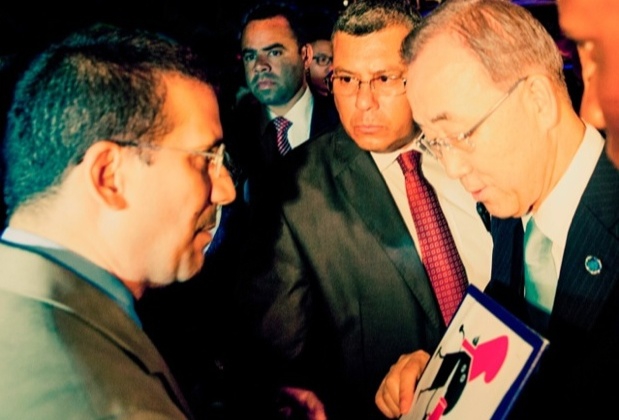
Antonio Rodiles delivers Campaign for Another Cuba documents to Ban Ki-moon

The director of the independent project Estado de Sats, Antonio Rodiles, delivered documents for the Campaña por Otra Cuba (Campaign for Another Cuba) to the United Nations Secretary-General Ban Ki-moon this Wednesday in Costa Rica. The Campaign demands that the Cuban regime ratify and implement the Covenants on Civil and Political Rights and on Economic, Social and Cultural Rights signed by the regime at the United Nations in 2008.

The meeting between Rodiles and Ban took place at the National Theater, where the UN Secretary-General was attending a dinner with the with the president of Costa Rica Luis Guillermo Solís and his wife Mercedes Peñas, according to activists of the Campaña por Otra Cuba.

They added that Ban received the documents “with interest.”

During his visit to the Island last January, during the Second Summit of the Community of Latin American and Caribbean States (CELAC), Ban called on Raul Castro to ratify the Covenants.

Complaint and Petition

The activists of campaign, on the other hand, have asked that the implementation of the human rights covenants to be included in the current negotiations between the European Union and Havana for a bilateral agreement.

Campaña por Otra also promotes the use of legal action of complaint and petition on the part of Cuban citizens, as a way of demanding a response from their government

“Cuban citizens can file the complaint and petition the State Council, either personally or by certified mail. Those who reside outside the Island can also participate in the campaign by directing their complaint to the nearest Cuban Consulate,” activists explained in a note sent to Diario de Cuba.

Interested parties can use a model complaint and petition posted online by the campaign in PDF format.

Activists who have submitted a demand to the regime can also send a copy to info@porotracuba.org.

Mailing address for the campaign:
Por otra Cuba
www.estadodesats.org
Estado de SATS
La Habana 11300
Cuba

31 July 2104

Nostalgia for “The Special Period”? / 14ymedio

Puercos_CYMIMA20140730_0022_13
Pigs (14ymedio)

, Havana, 31 July 2104 — I knew about nostalgia for the colonial era, the Republican era and even for the “marvelous” eighties, what I never could imagine was that anyone could be nostalgic for the Special Period. But everything is possible on this island and if you don’t believe me, then read the June 23rd article in Juventud Rebelde, “The happiest children in the world,” by Glenda Boza Ibarra.

This young Cuban from the east recounts with great candor her childhood full of “good and nice” times, in which she dedicated herself – as a form of entertainment – to counting the few cars circulating in her neighborhood. Eventually, the journalist says: “I can’t complain, because I was born in this country, a place where children have everything they need to be the happiest in the world.”

To a great extent the conditions we are raised in determine our tastes, needs and aspirations. A native indigenous to our island would have perceived the disgusting Paris of 1492 as a dazzling paradise, and a pigsty like the suite of a three star hotel.
The aspirations, tastes and evaluation criteria of this young woman from Las Tunas were curtailed by the circumstances in which her childhood unfolded in the midst of the Special Period, particularly bleak in eastern Cuba. It is precisely because of these circumstances that she no longer sees the barefoot children who once again occupy our streets, terraces and paths, nor the tremendous cultural decline that has occurred between my generation and hers.

However, there seems to be a glimmer of hope for Glenda. Nostalgia is nothing more than the desire to escape a troubled present to a past in which we had not yet suffered the difficulties we are now subject to. She confesses the strange naivety of her childhood when she writes “we weren’t worried about the fall of the Berlin Wall, nor the disintegration of the USSR,” a reflection that she has already begin to expand her range of expectations, that her new circumstances have raised her cultural level and her aspirations.

Will there be such a change that Glenda will reject, outraged, the pigsty, or on the contrary will she become one more member of the sect of pig farmers? Only time will tell.

What the Soviet Union Left Cubans / Ivan Garcia

Pro-Soviet books by the English Dean Hewlett Johnson (1874-19xx). Photo from Havana, 1945.

To this day, in the universal history books in junior high or high schools in Cuba, the Soviet theme is handled with kid gloves.

They recall its founding father Vladimir Illych Lenin, the epic of the Second World War with its 20 million dead (old data, it was 27 million and more than a few died from a bullet in the neck from their own comrade, or in a dark Gulag), and the selfless help of the USSR in the first years of the olive green revolution.

To Zoraida, a third year high school student and a lover of history, when I ask her about that nation made up of fifteen European and Asian republics, without hardly taking a breath, let loose with a tirade right out of the school books.

“The October Revolution was founded in 1917 by Lenin, and despite the aggression of the western nations, it established itself as a great world power. It was the country with the most deaths in World War II, 20 million (the error persists), and it had to fight alone against the fascist hordes. The United States and its allies were forced to open the Second Front in Normandy, faced with the rapid advance of the Red Army,” she responds with the usual pride of a student who applies herself. continue reading

She doesn’t know what her future vocation will be. But, in he,r the Party has a good prospect of a political commissar. Wanting to investigate other aspects less publicized in the national media, I posed the following questions.

What could you tell me about Stalin’s brutal purges, that cost the Soviet people millions of lives? Did you know that the application of agricultural collectivization caused a famine and between 7 and 10 million deaths in Ukraine, the so-called Holodomor? Have you read about the Molotov-Ribbentrop non-aggression pact where in a secret clause Hitler and Stalin shared out the Baltic republics and the Eastern European zone?

Have you read or heard about the Katyn Forest massacre of Polish soldiers by elite Soviet troops. Did you know that the writer Aleksandr Solzhenitsyn, winner of the Nobel Prize in Literature in 1970, like many other intellectuals, was imprisoned in the Gulag just for thinking differently?

Don’t you think that the Soviet Union was an imperialistic nation, because it occupied a part of Eastern Europe as a trophy of war and installed puppet governments? Have you studied the Soviet aggression in Czechoslovakia in 1968, or Afghanistan in 1970?

Did they ever tell you that by the decision by Nikita Kruschhev and Fidel Castro, 42 medium-range atomic missiles that would have provoked a nuclear war were installed in Cuba? Did you know that, just like the United States has a military base against the will of the Cuban people, Fidel Castro without consulting the people authorized a military training center with Soviet troops and an electronic espionage base on the outskirts of Havana?

To each of the questions, the young woman answered evasively, “No, I don’t know that. No, I haven’t read that or they didn’t teach us that in school?”

It’s well-known that the teaching methods in Cuba try to equip its students with a Marxist vision and exalt Fidel Castro and his Revolution. In rigorously tested subjects, the method used is not lying, but no admitting that you have the information or not telling the whole truth.

Although the Soviet Union disappeared from the map more than 20 years ago, and said adios to its bizarre ideology, the education on the island continues to zealously hold to the Soviet narrative.

Manuel, who graduated in philosophy, recognizes that in his university history studies there was no emphasis on Perestroika and Glastnost. “The teachers slide over that stage. They tell us that Gorbachev was a traitor, that he dismantled the Soviet power and influence stone by stone. Communism’s undertaker. A pariah.”

In the Cuban power structure there is a powerful nucleus that still remembers the Soviet period with nostalgia. General Raul Castro, at the head of Cubans’ destiny, is a great admirer of Russian communism.

In a visit to the apartment of Juan Juan Almeida, soneof the guerrilla commander, when he lived in Neuvo Vedado, Juan Juan told me that in the anteroom of General Castro’s office at the Ministry of the Armed Forces, there was a painting of Stalin, the butcher of Georgia.

In the discourse of the old “apparatchiks” (leaders), raised in the severe Party schools, the old Soviet Cuba persists.

Joel, a retired officer, longs for the trips to Moscow and visit the Kremlin mausoleum, where Lenin lies embalmed. At his house, on a wooden shelf, there’s a collection of books by Boris Polevoi, Nicolai Ostrovski and Iliá Ehrenburg, among others who wrote about the exploits of the Red Army in the Great Patriotic War.

Carlos, sociologist, considers “that the Soviet Union might seem like an old newspaper, but it is not dead yet. People no longer remember the corned beef, the applesauce or the nesting dolls. It is in the power structure where the Soviet era is missed.

The love story toward the USSR among the intellectual and political sector is long-standing in the country. Many who swear to be nationalists standing firm, accuse people who admire the lifestyle and institutional structure of the United States of being annexationists.

But where annexationism really exists is in Communism. Not only did they import the ideology, they also tried to clone the Soviet model in a Caribbean archipelago 6,000 miles away.

And those who applauded the theory of a Soviet Cuba weren’t stupid or illiterate. Among them were intellectuals of stature like Nicolás Guillen, Salvador García Agüero and Juan Marinello, members of the People’s Socialist Party.

With the coming to power of Fidel Castro, the political opportunism of the bearded ones coupled with the communist imagery of skilled men in labor unions and the Marxist proselytizing in various academic and intellectual sectors of the nation.

Despite the Cuban government’s affinity for the Soviets, among a wide segment of the citizenry, the Russian culture doesn’t go down well. Nor are they cool with their fashions and customs, their food and religious beliefs.

What the Soviet Union left was were hundreds of marriages between Russians and Cubans. And names like Ivan, Tatiana, Vladimer, Irina, Boris, Natasha… Little else.

Although the stale political dinosaurs treat Russia royally in the media, and the nomenklatura endeavors to reactivate new pacts, the Eurasian company remains a distant and exotic music for ordinary people.

But, by geography and culture, Cubans continue to look north.

Ivan Garcia

Photo: Pro-Soviet books by the English Dean Hewlett Johnson (1874-1966) and the American communist politician Earl Browder (1891-1973), on sale in bookstores in Havana, taken in Cuba in 1945

25 July 2014

What We Don’t Talk About / Regina Coyula

My husband has dengue fever. Or chikunguya, what the difference is can only be known after a long-awaited test. We needed to find our family doctor because he kept going from house to house inquiring of people with fever or other suspicious symptoms. The doctor, after a physical examination and posing a series of questions, filled out a paper and referred him to Fajardo Hospital.

“Don’t worry, you don’t have to wait in line for this.”

At 11:30  Alcides went to the hospital with one of our daughters who arrived at just the right time. I stayed at home cooking, so they could eat lunch after returning from the hospital.

At four in the afternoon, my brother arrived and took me to Fajardo. At that hour the shift doctor still had not seen the urgent test results. Alcides had to wait for a long time because the line that he “didn’t have to wait in” was much bigger than the line for people who arrived for other reasons. Finally, it was his turn. A young Guinean doctor with enviable patience attended each case, filled out a stack of papers and still had the Hippocratic spirit to be friendly.

I signed a paper to take responsibility for Alcides. What worries the doctors (at the hospital as well as at the neighborhood clinic) is that his platelets are very low and his leucocytes very high, but I’d rather go to the clinic every day to have the follow-up analysis than to leave him in the hospital. I don’t like anything about the Emergency Room, disorganized and lacking in hygiene, and I have no reason to suppose that the rest of the hospital would be any different.

In the waiting room the patients never stop complaining. Why if you come with a referral directly from your clinic do you have to repeat the same procedures with the doctor on duty instead of going directly to the lab? No one knows what the “guidelines” say. Later, there were only two doctors and they were overwhelmed. Those missing must be on overseas missions like Barrio Adentro or Mas Medicos; to the claim of our being a “Medical Powerhouse” should be added: … “for export.”

Having a case of dengue fever in the house isn’t news. The list of patients in the four surrounding blocks fills two pages in a school notebook. “We haven’t found the source,” my family doctor tells me with concern. I comment, “They shouldn’t focus so much on individual homes, rather they should clean up the neglected lot on the corner, and if they haven’t found the source, there they’re going to find all those who haven’t appeared yet.

As the situation is worsening (I would speak of an epidemic, but the health authorities seem not to have received “the orientation”) the priority is the source. Yesterday they came and fumigated and asked about home sources (if you have vases, plants in water, drinking bowls for pets, water deposits in the house, and I already know the list by heart and can recite it). Later the supervisor showed up to ask about the program to check for sources in homes; later the supervisor’s boss came by to ask about the program to check for sources in homes.

And at the lush wilderness on the corner? No one asks about the sources there.

28 July 2014

A Morning at the Courthouse / Rebeca Monzo

After having had to find out on my own — and wearing out the soles of my shoes in the process — what and where the registrar’s office for my area was in order to request a certificate that, in addition to other documents, was required to have the deed to my house certified, I finally found it. The premises, located on one of the most intricate and disrupted streets of Old Havana, were dark and unventilated. The very precarious furniture caught my eye. There was only one telephone, secured with a lock like those used on suitcases to prevent employees from making calls.

Luckily for me I had kept an old copy of the document in question. Otherwise, according to the employee — who treated me very politely, by the way — I would have had to look through those massive books, their bindings unglued and held together with string, under the same employee’s watchful eye, something which would have taken me all day. The books themselves were not particularly old but bore the hallmarks of long-term abuse. continue reading

Having completed the application, I then had to wait two weeks to pick up the document at the Courthouse. Imagine my surprise when on the appointed date I was allowed to go up to the office in question only after going through the annoyance of being forced to leave my purse and my belongings in a cubicle on the ground floor.

I did this under strong protest since I have never understood and still do not understand why one must leave one’s most personal articles in the hands of strangers. I let my displeasure be known, telling them that the same mistrust they displayed towards their customers — or users, as they like to call us — by making us turn over our purses, I felt towards them, adding that the only fair thing to do would be for them to provide a checklist of the belongings inside our bags so that we could confirm that nothing was missing when we later picked them up. Apparently, they did not like this idea.

I finally went up to the office where they had told me to go, but it turned out that the person who was supposed to give me the document had not yet arrived due to personal problems, so they suggested I take “a little stroll” and come back later. I spent the time taking photos of dilapidated buildings adjacent to the court.

By the time I returned, the employee in question had finally arrived, but the document that she was supposed to give me on the designated date was still not ready, so I had to wait in the office for almost two hours for her to prepare it.

During that time I witnessed situations that, as an outsider, should not have transpired in my presence. A pleasant one was when a worker from another department came to make an appointment to do some volunteer work the following day, but none of the five employees there took note of him.

Similarly, I witnessed the distasteful and loud protests of a woman claiming her son was still being held in detention in spite of her having paid his bail two days earlier. In a loud voice she threatened officials both present and absent and said that, if her problem was not resolved immediately, she would throw herself from the fifth floor window and those present would be responsible for her death.

Once they had handed me the document with its duly approved seals and relevant stamps, I headed downstairs as soon as I could and, in what was not a complete surprise, saw the woman who was having the problem with her son.

She was downstairs in the reception area, lying on the floor, very pale and barely breathing as the custodian and other employees were trying to revive her by providing first aid. Apparently, the pressure had been too much for her.

28 July 2014

Days to Turn Off the TV / 14ymedio, Yoani Sanchez

Woman watching TV (14ymedio)
Woman watching TV (14ymedio)Days

YOANI SÁNCHEZ , Havana, 29 July 2014 There are days when it’s better not to turn on the TV. Right now, just pushing a button can dump us in an avalanche of official propaganda for the birthdays of Hugo Chavez and Fidel Castro. From July 28 to August 13, the boring national programming will be filled with the cult of personality, ideological kitsch and political sentimentality. Children’s choirs will sing to the “Eternal Commander,” people who barely saw them pass by on the street will share anecdotes, and endless biographical scenes will bombard us from all sides.

“Right now the news has no news,” complained a neighbor who wants to know what is happening in the world and can’t see anything but processions of red and olive green. I felt the same today with the first news of the day. An hour after it started I couldn’t extract the least national or international information, only praise for the “immortal warrior of the race of Bolivar,” and the “wise guerrilla who loved him like a son.” I tend to have little patience with this overdose of flattery, so I turned off the TV and began calling several friends so they could tell me what was going on here and there. At least we have “Lip Radio”!

The ruling party continues to confront the distribution of information, serials and movies in the so-called “combos” or “packets.” However, it makes no real changes in its television programming to attract young people. Instead, the small screen becomes a loudspeaker for slogans and boring material that viewers find annoying and reject. Thus, they can never regain the ground they have lost to illegal satellite dishes, content copied onto USB sticks, and hard disks full of documentaries. If they continue with the ideological excesses of recent days, official TV will, very soon, become a monologue that few listen to.

Angel Santiesteban is Being Held at the Acosta and Diez de Octubre Police Station / 14ymedio

100_heroes_de_la_libertad_de_prensa-RSF_CYMIMA20140511_0004_13

14YMEDIO, Havana, 28 July 2014 – Since July 23 Angel Santiesteban’s family has denounced his disappearance from the Lawton Prison Settlement. That day the prize-winning author was taken from the place where he was serving a five-year sentence for an alleged crime of violation of domicile and injury. Until this morning his whereabouts were unknown.

This newspaper investigated, calling 18806, the police service number, and learned that Santiesteban is currently detained at the Acosta Station on Avenues Acosta and Diez de October. The duty officer there told 14ymedio that the writer is accused of the crime of “escape.”

The family has denied this accusation and his sister, Maria de los Angeles Santiesteban, in a statement to Diario de Cuba said, “My brother has never had an idea like that. He never agreed to leave Cuba and he had the opportunity, he was in the United States three times and he traveled the world.”

This coming Wednesday morning Angel Santiesteban may receive visits from relatives, according to what14ymedio learned. Today, however, they did not allow a fellow journalist to deliver a package personal hygiene products.

Ángel Santiesteban has received major literary awards, including the Casa de las Americas Prize in 2006. Just two days ago his novel The Summer God Slept was presented in New York, and he won the Franz Kafka Prize for Fiction 2013.


The night has witnesses: a simpler poetry / Luis Felipe Rojas

On the evening of June 5th, I had the opportunity of presenting Janisset Rivero’s book “Testigos de la noche”  (“Witnesses of the Night”) (Ultramar 2014).  Casa Bacardi opened its doors so as to let us share this lady’s work along with the poet Angel Cuadra. Rivero read entries from her wonderful book of poems. These are the words I wrote for the occasion:

Poetry books always bring me new hope. After time spent reading poetry that leaves me cold, there are poets who emerge to refresh my thoughts and point the way to understanding the mysteries of universal poetry.

Janisset Rivero has written a book that continues the narrow hereditary line of verse in Spanish, that line which unhealthy experimentations and abuses of the language have tried to erase by force. Simple versification, without needless displays and literary artifice, is perhaps the best decision, an expression of talent and the force of poetry macerated by eyes that see above the crudest reality. continue reading

“The shadows lift themselves/ from the same path/ where once was born/ that rare flower; / and the wind breaks through to cut/ the voice of some history.”

There is a flavor here of Machado, a thread connecting us to Paul Eluard, but it is La Avellaneda and Gabriela Mistral who season the bundle of words with which “Testigos de la noche” shows us Janisset, while the publisher Ultramar takes a mature step on its path of promoting literature. We see here a book that stands out through its modesty and economy of resources, both achievements boding well for the poetic profession as well as that other dying star, the readers of poetry, who upon entering the 21st century are seen as odd creatures.

An old poem is a new poem

Would that nothing human were foreign to us. It is like a canticle, a voice emerging from the deep thoughts of someone wiser than we. Nothing human is foreign to me, responding to that poetic subject that Janisset Rivero utilizes to traverse that broad plain that is Testigos.

The expression of love, desperation and fear of death surrounds us since the dawn of the world. Articulated anew by the momentum of Janisset Rivero’s verses, the realization of these timeless themes seems renewed: “The cry of the night/ charges the word/ and later silences…” Thus says one of her perhaps most accomplished compositions. But, is it death? Is it life? Is it the flowering of the fears of all times? We don’t know – Janisset Rivero leaves nothing assumed, and thus we witness another example of how insinuation is perhaps the surest shot.

Contemporaries as we are, we now face the dilemma that all that we poets touch has been touched by others, but the intimism revived in this work becomes addictive and pleasurable. To again read poems of love, hatred, human fears (which by virtue of being human we have all had them), is a good enjoyed by the most cultured.

No one tires of reading letters, messages, cries. No one – human as he may be – can simply walk by the weeping or the smiling rain of a woman. And we have here, readers and listeners, attentive to that voice that has emerged from JR to insert itself as a matter of course, in the skin of the poetic subject that she has utilized to narrate the ancient canticle of her work.

This, is it a new book or an old one? We, are we new or old readers of poetry? I believe that two words, two concepts have brought us together on this night of celebration: friendship and love. JR treats both with the same intensity – “Testigos” shows it.

Poetry without compromise

I do not believe in literary compromises. Somebody said that we writers are gravediggers by birth. We kill a writer to ride his glory, we bury an author because we want to throw off his powerful influence. For this reason, the mentions that JR makes here of her compatriots, of her brethren who have preceded us in death and of the glory of their heroic achievements, are a natural act of gratitude, and not an archetypal “compromise”. At least that is how I have read it and her, and this convinces me more than any instruction or qualification made on the surface, or under pressure.

Why were there not appearing here the shadows or the lights of (Pedro Luis) Boitel or Orlando Zapata Tamayo? “Redeemed at last/ in battle./ They fear still…/ and you shine, Pedro/” … and I would add, OZT, Antonio Maceo, Virgilio Campaneria, Marti, Eusebio Penalver, Zoila Aguia, The Girl (the lovely girl, I would say) of Placetas. The verses in “Testigos…” are not accusations. They are tollings of a bell to remember, they are antidotes to apathy and greetings of a new time that is today and not tomorrow. This manner of greeting without weeping, of remembering without the frigid and obligatory applause, renew a poetry that refuses elegies. The verses of JR are a flower-word-wind, a herald, and for that, poetry is ever grateful.

JR chose the difficult path of touching her dead without placing a banner at the door to the house. This is a happy thing, because it makes her intimate as well as plura; it makes us participants in all that she touches, in all to which she invites us, on this night, and tomorrow.

Miami, June 5, 2014

Yusimí Sijo (L) and the rapper Raudel Collazo (C), Luis Felipe Rojas (R)


Janisset reads portions of her work.

Archived under Cuba.

Translated by GH; and Alicia Barraqué Ellison

6 June 2014

Leopoldo Lopez and Angel Santiesteban: Two Lives and One Destiny

If we paused to observe Leopoldo Lopez and Angel Santiesteban-Prats for one moment, we see two very different physical types. One is very slim, the other sturdy. One is a lawyer, the other a writer. One is Venezuelan, the other Cuban; both are the father of a girl and a boy. Both share the same gift: a great charisma accompanied by enormous generosity, and a desire to change the difficult reality of their countries: Leopoldo, from his active political participation, and Angel, through his civic opinion passed through his books and writings, with the cutting edge of the truthful word.

Beyond the similarities and differences, they appear to be cut from the same cloth. It is hard to find such men with such composure to dare tell two dictators — Cuban and Venezuelan — calling things clearly by their name and speaking directly, without euphemisms. Angel and Leopoldo did this and they continue to do it. For this reason, they both also share the terrible situation of being political prisoners of these two regimes brought together by the greed and evil of their rulers.

This week, Leopoldo has been a victim of a “violent requisition,” the same way that Daniel Ceballos and Enzo Scarano, opposition mayors dismissed and imprisoned for designs of political power, using an “armed wing”: a justice that is corrupt and sold.

When we read the news about what is going on in Venezuela, we have to assure ourselves that we are reading news about Venezuela because, really, it appears copied from the news that independent journalists bring us in Cuba.

This week, Angel Santiesteban has been transferred in an illegal manner from the prison he had been in, a military facility in Lawton, Havana. Today is the sixth day of anguish and desperation without having received any news. This week we have also heard about how violence against those in the Venezuelan opposition is intensifying and how, not being satisfied with locking them up, the authorities enjoy punishing them with the same sadism of the Castro regime.

Angel already expressed his solidarity with Leopoldo Lopez in an open letter; today, Angel’s whereabouts remain unknown and isolated, probably tortured, and is oblivious to what is happening right now with Leopoldo. However, knowing full well Angel’s sentiments, from here we send all his solidarity in his name and in my own name, because I know that in the difficult moment he is going through, this is what he would have written in a new post.

And of course, our deepest affection to Lilian Tintori and her children. She, like the dignified Ladies in White of Cuba, exalts the word love.

I share here the brave letter that Leopoldo sent to his compatriots. In this letter one can see how – same as in the case of Angel – Maduro’s regime actually ends up strengthening Leopoldo. Without a doubt, as long as men like this exist, the liberty and peace of Venezuela and Cuba will arrive soon.

The Editor

Letter from Leopoldo Lopex Mendoza: I Accuse the Venezuelan Dictatorship

I have been politically persecuted under the “Chavista” regime for more than ten years. There have been more than 20 proceedings, political trials, homicide attempts dully reported and never resolved, moral assassination on behalf of the means of communication of the State and two political disqualifications, despite obtaining a favorable sentencing from the Inter-American Court of Human Rights for the violation of my rights and in defense of my political participation. continue reading

For over a year, beginning in January of 2013, Nicolas Maduro publicly expressed, on national radio and television channels, his desire to put me in prison for the opinions issued against his government. It was in this context of permanent persecution and explicit threats made by Maduro that an order for my arrest was made on February 12 of this year.

I am in prison for denouncing the Venezuelan state as corrupt, inefficient, repressive, and anti-democratic. I am in prison for denouncing in a loud voice that in Venezuela there is no democracy, that public authority has been kidnapped by a corrupt elite, inefficient and anti-democratic, responsible for the serious social, economic, and political crisis that all Venezuelans suffer from today.

I am in prison for having denounced that in Venezuela we live in a dictatorship.

I am in prison for having proposed a profound change that can occur by replacing those that are in charge of all public authorities. I am in prison for having solicited the resignation or replacement of Nicolas Maduro as President of Venezuela through constitutional means.

I am in prison for having made a call to the Venezuelan people to go out to the streets to protest, making use of our historic and constitutional right of protest, until obtaining a political change that would guarantee peace, well-being, and progress for all Venezuelans.

I am in prison for having put forth ideas, opinions, and proposals that today a majority of Venezuelans share, who since their indignation have asked for a profound change that will set the nation on the right path.

I am physically in prison, they keep me isolated and with severe restrictions on visitors, but now or never will they be able to imprison my absolute conviction that we have the right and the duty to struggle to obtain democracy and liberty for Venezuela.

Thank God that I am not alone in these ideas, we are millions, we are in the majority, those of us who are willing to struggle for a change toward democracy. They might be able to imprison me and thousands more but will never be able to imprison the spirit of struggle that, with the young people at the vanguard, today runs through the streets of the towns, neighborhoods, and cities throughout the country.

Venezuela has already decided to change, therefore, my imprisonment and that of others is nothing but the face of a dictatorship that daily becomes weaker and weaker and has less popular support, that intends to stay in power by repressing, silencing critical voices, and criminalizing protest.

The accusation against me, based off of several speeches that I made between January 23 and February 12, has as it best defense the very speeches, read or seen from beginning to end, without edit or any form of manipulation. In these speeches, based on a critical analysis of the present crisis, I proposed a way out, a definitive political change, activated from the streets with nonviolent actions and embodied by a popular call to one of the four alternatives that the Constitution offers to bring about a change of government.

On January 23 we made a call to awaken our conscience, to lift the optimist spirit of the Venezuelan people, convinced that we can have a better Venezuela. A call to go out to the streets made on the anniversary of January 23, 1958, celebrated by the government and the opposition, is the date on which the Venezuelan people rose up against the dictatorship of Marcos Perez Jimenez.

On that day we had the celebration, February 2, of Popular Assemblies throughout Venezuela to discuss all of our options for overcoming the social, economic, and political crisis that we are now in.

On February 2, hundreds of gatherings were held throughout Venezuela, some big, some small, some in plazas, others in houses or  on the streets. At these gatherings, many different organizations, people, and parties with different proposals participated.

The conclusion was to commit to peaceful protests out on the streets for a better country, choosing February 12 as the date on which we would organize our first protest.

In that opportunity I said: “These struggles, sisters, brothers, have to have a clear direction and methodology based on nonviolence. Nonviolence has been the most effective method of struggle that oppressed peoples have created. Nonviolence does not mean passivity, nonviolence does not mean to hang one’s head low, nonviolence does not mean retreat. Nonviolence is to not have fear, it means to challenge, nonviolence means to be out on the streets, nonviolence means having a state of conscience where we do not allow manipulation.”

On February 12, as we had summoned, thousands of people came out to the streets in all of Venezuela. In Caracas, the protest began in Plaza Venezuela. From there we marched toward the headquarters of the Public Prosecutor’s office, just as we had notified the authorities. There we protested, in peace and without violence, for more than two hours, and we then left in peace. The violent acts occurred after our departure and in those, Nicolas Maduro’s government is to be held accountable.

Certainly, what calls the most attention with respect to the narrative of the facts by the government in its indictment against me is that they completely omit the most relevant act that occurred on that day: the murder of two Venezuelan citizens, Juan Montoya and Bassil Da Costa, executed by officials of the political police of the government. The government also remains silent about the fact that since that day, 42 Venezuelans have been murdered in the street protests, that thousands have been detained and subject to trial, and that more than one hundred are still deprived of their liberty for exercising their constitutional right to protest.

In my case, I have nothing that I have to rectify in word or deed. If it is a crime to denounce corruption, inefficiency, the loss of liberties and the anti-democratic calling of those who govern, I assume my responsibility. I further declare myself responsible for having summoned the protests in the streets with the intention of going out to conquer democracy and liberty for all Venezuelans.

I am innocent from the charges that they level against me, but I do not expect anything from a justice system composed of courts, a Public Prosecutor, and an Ombudsman highly corrupted, hijacked, and manipulated by the government of Nicolas Maduro. I am, along with hundreds of companions, a political prisoner, a prisoner of conscience.

Leopoldo Lopez Mendoza, Ramo Verde Prison. Los Teques, Venezuela

For complete information about repression in Venezuela: http://www.accionporlalibertad.com

Please sign so that Amnesty International declares the Cuban dissident Angel Santiesteban a prisoner of conscience.

26 July 2014

Descriptive Penury / Rosa Maria Rodriguez

An acquaintance of mine swapped his apartment of a room and a half for a smaller one and “some chump change on top of that” to relieve his alcoholism and misery.  I never entered his home and that’s why I was unaware of his poverty. His furniture had the appearance of shabby knick-knacks, which probably — as in the majority of Cuban homes — were bought before the triumph of this guerrilla model which installed itself in power in 1959 and has been there ever since.

A matte oil painting, covers the surface of a dresser that perhaps once was covered in formica, the quite ramshackle wardrobe tells a story of age and overuse, the hollows of his three-quarter mattress, the remains of his sofa and of his Russian half-washing machine — they had to amputate the dryer — that accuse like the speeches of the rulers of Cuba, are words blurred by abandonment and demagoguery.

During the move, he got from a yellowish nylon bag a bunch of black and white photographs to show to his companions how beautiful the apartment was when his father first moved into it in 1958. Then the furniture seemed alive and the walls still wore an attractive and aesthetic coat of paint. Monochromatic feelings showed the nostalgia on his face buffeted by frustration and liquor. continue reading

His party friends helped him get the old junk and they had it in the sun for close to an hour awaiting transport. There were a dozen “solidarity” addicts summoned and encouraged by the rum, which at times served as fuel to keep up enthusiasm.  A truck from the ’30’s took part of the “skinny” heritage to the “new house,” that for sure also was built before the Castro government and which will host, as in many other Cuban homes, the alcohol scandals of that part of society that plunges its disappointments and misery in cheap and sulphuric homemade rum, which is what they can afford.

The solidarity and drunken brigade remained on site to care for the liquid treasure that remained in the bottle. Its emptying was the starting shot towards their own contraptions and penuries accumulated through decades of governmental injustices, apathy, anti-democratic subjugation and social fatigue. The delirium tremens or terrible delirium of trying to deceive societies all the time with drunken ideological and economic theories has failed all over the world.

Maybe in the tranquility of their houses and before the knockout punch of the drink, they will get out their own yellowish nylon bags of history, testimonial photos of what they once were — when addiction did not have them bound by the neck — of what their houses once were and of what this country was, before this bad government brought it to ruin.

 Translated by mlk.

17 April 2014

Routine and the Past Star in this 26th of July / 14ymedio, Ignacio Varona

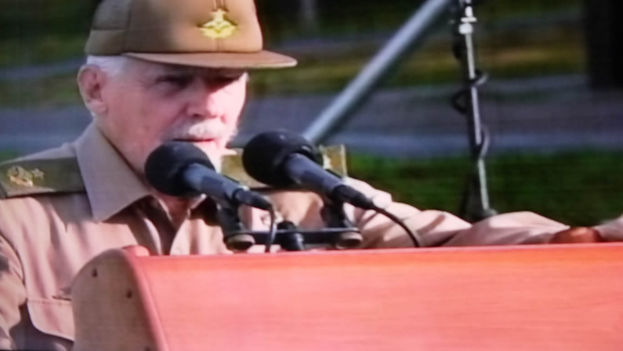
Ramiro Valdes
Ramiro Valdes

14yMEDIO, Ignacio Varona, Camaguy, 26 July 2014 – Very early this Saturday many of us observed a new event for the 26th of July. The strict codes of ritual demanded that the commemoration of the 61st anniversary of the assault on the Moncana Barracks in Santiago de Cuba and of the Carlos Manuel de Cespedes Barracks in Bayamo, be celebrated this year with moderate pomp. If the “important” anniversaries are commemorated in style, in Santiago de Cuba or Havana, the intermediate ones happen in provinces with fewer resources.

The choice of the newly created province of Artemisa to host the main event, obeys the fulfillment of this liturgy. Also an experiment has been developing in it to streamline the administrative functions which it has taken on because the Port of Mariel megaproject is in its territory.

In the era in which Fidel Castro had the capacity to stand for four to six hours in front of a microphone, those events were anticipated as time to summarize accomplishments and to announce the news. In 1989, in one of his long speeches he warned of the possible disappearance of the Soviet Union. The last great surprise on the 26th of July was the day in 1993 that the Commander in Chief announced the dollarization of the Cuban economy. Since then, especially after 2007, his brother Raul has had very little to promise and has delegated the speech on several occasions to Mr. José Ramón Machado Ventura, second secretary of the Communist Party. continue reading

This time the opportunity was given to Ramiro Valdes who, besides being a native of Artemisa, is a member of the Politburo, vice president of the Councils of State and Ministers, Hero of the Republic of Cuba, and the only survivor of the Moncada attack who holds high positions in the party and the government with Raul Castro. It’s enough to know the name of the main orator, the hypothesis of a “half-baked” 26th of July was confirmed. Plus the fact that there were no festivals in Havana on the eve of the event, no commemorations in every neighborhood, not even the typical soup that was served on other occasions. Routine has ended up destroying all the excitement around the event.

A speech without surprises or charm, larded with slogans without any news, revelations of critiques

Ramiro Valdez read a speech—badly, of course—based exclusively in the past. He repeated the thesis of the calamitous yesterday that won’t return and declared that in his “vocabulary, the word ‘defeat’ is erased.” A speech without surprises or charm, larded with slogans without any news, revelations of critiques. The man who once called for “taming the wild pony of technologies,” dedicated today to a new diatribe against them, asserting that “the new technologies are used as an element of subversion.”

After the ceremony, when the official announcer for national television said that the cameras and microphones were returning to the central studios in the capital, most of the audience immediately returned to their provincces, while the rest of the citizens, TV viewers or not, regretted that this Day of National Rebellion had fallen on a Saturday, so that one of the few opportunities for a holiday was lost.

26 July 2014

Remembering the Tugboat Massacre of 1994 / Orlando Luis Pardo Lazo

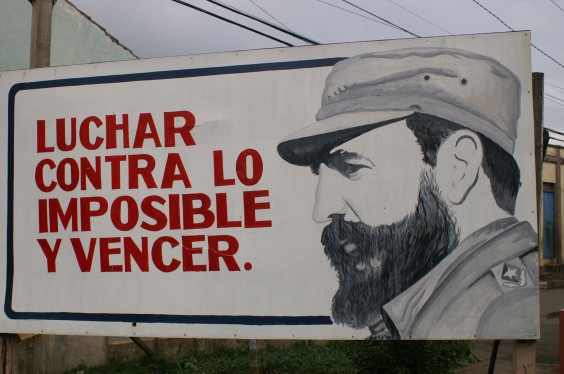
Castro sign

During the summer of 1994, death ruled with impunity in my country. During that period, Cuba, which had been a civilian graveyard for decades, more closely resembled the gallows.

In the early hours of July 13, the whirlwind of violence to which the Cuban state was subjecting its citizens came to its criminal climax. The Revolution needed to prevail over the people through blood and fire. Raúl Castro summed it up in a televised speech from the Colon Cemetery: “He who lives by the sword dies by the sword.”

We were in the middle of the so-called Special Period in the Time of Peace. The repression was ferocious, but so too was the people’s resistance. So too was the corruption of public servants. So too was the vandalism. There were robberies and grisly killings on every block. Family men went mad and wound up murdering their loved ones. Electricity was a luxury that we enjoyed for just a few hours a day. It was vox populi that the police had been ordered to shoot to kill. So too had the paramilitaries of the Rapid Response Brigades who wielded clubs rather than firearms.

On the early morning of July 13 a stolen tugboatfull of civilians attempted to escape the Bay of Havana. The boat was named the March 13. It was a state-owned boat, but no violence took place during the theft. In fact, it was the port workers themselves who took the boat and headed for the US. continue reading

Just a few miles off the coast, the March 13 was rammed by four other boats that had pursued it out of the harbor. Both civilians and the crew were swept off the decks by jets of water fired from the other boats. Once the March 13 was sunk, the survivors weren’t offered any immediate aid. The perpetrators wanted as few witnesses as possible. Only when a Greek boat arrived did they proceed to rescue those who were still afloat in the water. Out of a total of 72 people on board, 37 died, including a dozen children and babies.

As usual, the state press placed the blame for the tragedy on the victims. Thesurvivors were pressured by State Security forces, several were put on trial, all were stigmatized, and in the end they were ostracized and forced into exile. Since then some claim that they’ve been attacked by motor vehicles or that they have been subjected to medical torture in an attempt to wipe their memories. Fidel Castro himself decreed that the workers had the right to defend their means of production. It was a warning to anyone else in Cuba who had any intention of running away from him. In fact, a month later more than 30,000 Cubans escaped en masse when the government stopped patrolling the coastline, thus opening a pressure valve which would avoid the impending social unrest.

Twenty years have passed since the massacre. The men who rammed the March 13 have never been brought to justice. Nobody ever tried to recover the bodies (or else they did it in secret and later destroyed them). At least let me pull those 37 names out of the macabre anonymity to which Castroism has condemned them in Cuba.

1. Hellen Martínez Enríquez, 5 months

2. Cindy Rodríguez Fernández, 2

3. Ángel René Abreu Ruiz, 3

4. José Carlos Nicole Anaya, 3

5. Giselle Borges Álvarez, 4

6. Caridad Leyva Tacoronte, 5

7. Juan Mario Gutiérrez García, 10

8. Yasser Perodín Almanza, 11

9. Yousell Eugenio Pérez Tacoronte, 11

10. Eliecer Suárez Plasencia, 12

11. Mayulis Menéndez Tacoronte, 17

12. Miladys Sanabria Cabrera, 19

13. Joel García Suárez, 20

14. Odalys Muñoz García, 21

15. Yaltamira Anaya Carrasco, 22

16. Yuliana Enríquez Carrazana, 22

17. Lissett María Álvarez Guerra, 24

18. Jorge Gregorio Balmaseda Castillo, 24

19. Ernesto Alfonso Loureiro, 25

20. María Miralis Fernández Rodríguez, 27

21. Jorge Arquímedes Levrígio Flores, 28

22. Leonardo Notario Góngora, 28

23. Pilar Almanza Romero, 31

24. Rigoberto Feu González, 31

25. Omar Rodríguez Suárez, 33

26. Lázaro Enrique Borges Briel, 34

27. Martha Caridad Tacoronte Vega, 35

28. Julia Caridad Ruiz Blanco, 35

29. Eduardo Suárez Esquivel, 38

30. Martha M. Carrasco Sanabria, 45

31. Augusto Guillermo Guerra Martínez, 45

32. Rosa María Alcalde Puig, 47

33. Estrella Suárez Esquivel, 48

34. Reynaldo Joaquín Marrero Álamo, 48

35. Amado González Raíces, 50

36. Fidencio Ramel Prieto Hernández, 51 años.

37. Manuel Sánchez Callol, 50 años

From Sampsonia Way  — Original in English

21 July 2014