Starting on the morning of Tuesday August 12th, we have the International Youth Day celebrations all over Cuba; but, in view of the fact that, in the words of José Ángel Maury, who is responsible for the UJC (Young Communist League) International Relations, “We have the happy coincidence that it takes place on the eve of the Commander-in-Chief Fidel’s birthday,” the climax will be a huge chorus of Cuban young people and artists singing Happy Birthday Fidel at dawn on August 13th.
And if that doesn’t seem enough, in order to make it up to three, the communist organisers have contrived to combine the festivities of the 12th with the “Yes I have a Brother” day, to commemorate the 60th birthday of the dead President of Venezuela, Hugo Chavez, and Fidel’s 88th. It seemed to me I was hearing my talkative grandmother when she said “If anyone doesn’t like soup, they give him three cups of it.”
In recent weeks the Palestinian issue, and specifically what is happening in the Gaza Strip, has captured the attention of the media. Over here the image shown is that of poor peaceful Palestinians attacked and brutally slaughtered by the bellicose Israelis.
Violence is good for no one and should be avoided, because it only causes pain, suffering, destruction and death, wherever it comes from. The solution of settling differences and contradictions through peaceful means has always been more intelligent, although it is much more complex. Unfortunately, in the Middle East historically, that has been very difficult if not impossible. This land has been prodigious in expulsions, returns and new expulsions. The blame is equal on all sides. continue reading
As long as it is not accepted that two nations with different customs, cultures and religions can live in the same territory, peacefully and with mutual respect, there will be no solution and the victims of both sides will continue to increase, because the impact of a Palestinian rocket on Israel is lethal, as is an Israeli bomb dropped on Palestine. Both kill and both kill adults, old people and children of both sexes equally and without discrimination.
The reality is that during the many years that the Israelis have been working tenaciously to live in a civilized way on the arid ground beneath their feet, the Palestinians have been engaged in war not only in this region but in other regions of the world. The examples of their combatants enrolled in foreign wars are well-known, although they try to hide it.
Today the Palestinian economy doesn’t exist because it has never been created and the majority of its resources come from Israel, where thousands of Palestinians flock each day to work in the companies and factories, or to provide various services. Israelis need peace to continue to develop and so as not to have to spend so many resources on armaments, but the Palestinians also need peace if they want to survive as a people and a nation.
To achieve this it is essential to stop fanatically following so many fundamentalist messianic leaders whose only objective is to maintain themselves in power on the pedestal of martyrs.
The images of Palestinian children confronting Israeli tanks with stones has been spread far and wide and has been cleverly used as propaganda, while hiding the image of the Palestinian rockets falling on Tel Aviv and other cities along with the bombings in malls, discotheques and public transit, as well as the kidnappings and assassinations
The cause of a helpless victim confronting a powerful aggressor, despite the years, still generates sympathy, but the terrible thing is that there is much that is false and confusing in that image.
It was all much easier when we did not have names for things and you simply had to point with your finger. Back then, the difference between “this” and “that” was merely a gesture. But with the advent of letters, words, paragraphs and know-it-alls it is now more difficult to describe with any precision what the future Cuban landscape will look like.
Throughout our history we have all wanted the same thing: a lasting change that will bring about what is best for Cuba; a pluralistic, diverse, democratic country brimming with happiness. It is worth remembering that it was for this that young men fought one August 4 — on a day like today but in 1955 — in a failed assault on the Presidential Palace. But back to the topic at hand, if things continue as they are now, this “yes but no” and “more of the same” will remain constant features of national life. It is not simply a matter of trying to express what we want but of achieving a better understanding of the way to go about it.
When I set aside emotion and rely on reason, I am saddened to see that the Cuban opposition — and I say this with all due respect — is inclined to reject social reality in favor of literary fiction. Yes, they are courageous people who risk their lives in the streets, but by pursuing parallel agendas and defending personal initiatives, they make it hard to believe they can coalesce into an alternative political force or become a significant or successful social movement which, at this point in time, could encourage unanimity. continue reading
This is not impossible but first they must acknowledge the overwhelming need to come together and organize themselves. More than a union, they must form a pact. Competing to demonstrate acquired leadership skills, as they now do, is like swimming in a make-believe desert to feed one’s ego. While this may be laudable, it does nothing to help one’s country.
Meanwhile, as time marches on, those on the island and those in exile express conflicting opinions. The kings of prevarication who currently make up Cuba’s governing clique are looking like heirs-in-waiting.
All indications are that — barring a miracle or a cataclysm, which are unlikely — Cubans will be presented with a souvenir: the imposition of a governmental succession that transfers power from the current office holders to their children, friends, in-laws, cousins and/or close associates.
But it is not I who is saying this. Sir Isaac Newton himself expressed it in his laws of motion and universal gravitation: “The apple does not fall far from the tree.” There are those who do not want to acknowledge this because they are too invested in a funerary transition, or because they spend their time being fascinated with themselves.
The heirs to power, the leading players, will almost certainly be family members of current leaders who already hold strategic positions, party officials who have amply demonstrated their loyalty, and military men such as Raúl Rodríguez Lobaina, Lucio Juan Morales Abad and Onelio Aguilera Bermúdez whose devotion was formed in the heat of battle in places such as Angola, Ethiopia and Nicaragua.
They are the new Caesars, people who, like water, have the ability to go around any obstacle and adapt to any circumstance. Their task will be to restructure the country, guiding it towards “who knows what.” They are certainly willing to fight to stay in power and one day Cubans — worn down by time and memory — will give in and agree to live in oblivion, allowing victims and victimizers to coexist. One fortunate aspect of a laboratory run by pirates is that, instead of eye patches and gold chains, they sport embroidered guayaberas and treat “the Fatherland” as their personal inheritance.
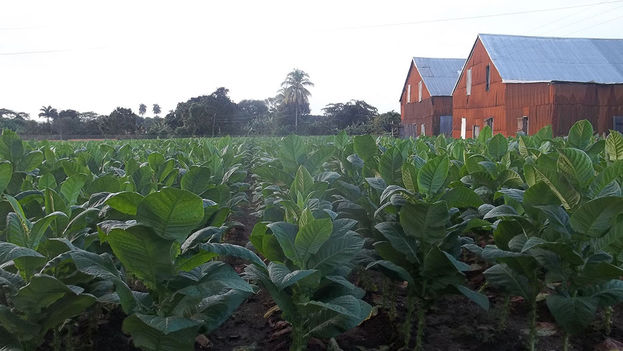
14YMEDIO, Reinaldo Escobar, Havana, 8 August 2014 – In the land of San Juan y Martinez, Bernabé Pérez Gutiérrez planted his first crops and fathered fourteen children. It was during the last years of the 19th century, and the immigrant baptized his farm The Islander, in memory of the Canary Islands where he’d come from. Today, his great-grandchildren are trying to keep one of the most important tobacco plantations in Pinar del Rio running, with the their great grandfather’s same stubbornness and his love for the furrow.
The Islander is a family cooperative inserted into a larger entity called “Rafael Morales Credit and Strengthened Services Cooperative (CCS-F),” consisting of 64 tobacco producers, occupying over 250 acres. It also includes dairy and pig farmers. Only ten of these farmers lease their land (under usufruct), while others jealously hoard their property titles.
What distinguishes The Islander is not only the quality of their tobacco, their fruit or their flowers, nor even the hard work of the members of the Pérez González family. Its hallmark is that this site has been, since the time of Barnabas an example of a sustained endeavor that refuses to be subjugated, neither by the misfortunes of nature nor the whims of the bureaucracy.
continue reading
During the time of the Canary Islander grandfather, the Islander operated as a consultancy where the farmers came for advice. His son Pragmacio, who became the head of the farm with the death of its founder, converted a part of the house into an area for discussion groups where they analyzed newspaper articles with news of the Second World War and the evolution of the communist regime in Russia.
The layout of the estate is also unique in the area. In 1955, Bernabé’s children built a shrine to their father, who was devoted to the Virgin of Charity. Their religious fervor reached the point where during a drought they organized a procession with the image of the Patroness of Cuba in order to summon the rains. Under the small belltower, the priests of the area have baptized and married many members of the family and their neighbors.
Family denounces the unjust relationship between the producers of snuff and state monopoly that sells
However, the greatest peculiarity of The Islander lies not in its enormous ceiba tree, nor in the small chapel, but in its people. In the current times, where being an entrepreneur and defending the autonomy of the farmers generates suspicion and incomprehension, the Perez Gonzalezes are known in the area for being “grumpy.”
In a country where the established leadership obeys and doesn’t question the powers-that-be, the progeny of that immigrant have had to overcome many obstacles. The family obstinately denounced the unjust relationships between the tobacco producers and the State monopoly that trades in it. Often it’s not about demanding new prerogatives, but demanding that the directors and agricultural officials meet the standards they themselves have set.
Sitting in the doorway, where a sweet breeze blows, some descendants of the obstinate Canary Islander started listing their demands. Bushy eyebrows one and all, they bear the unmistakable family stamp that marks them as stubborn. They relate that among the most insistent of their demands is questioning the calculations of the Tabacuba Company in determining the tobacco growers’ costs for each bushel of leaves. Included in the formula are inputs such as fuel, fertilizer and herbicides, plus adding the wages paid to the workers engaged in planting, cultivating and harvesting and selection of tobacco.
“Every year it’s more expensive, particularly the wages, because nobody wants to work for four pesos,” commented Alfredo Perez, the current head of the family. “However, the company seems to live in another dimension far from reality, and the data they use for what they call the cost sheet.” Times have changed and the costs of living have skyrocketed, but the agricultural bureaucracy continues without updating their old numbers.
With his hat in his hand, Juan Pablo, with a degree in agricultural engineering, complains, “As if it were great news that they now tell us they will pay a little better for every bushel of tobacco, but for every percentage point they raise the schedule, the costs go up six or even ten percent.”
The floor passes from person to person, until it is Nestor Perez’s turn; Nestor dreamed of being a lawyer but they expelled him from the “university for Revolutionaries” for being too confrontational. With regards to the problems of the company, the young man has realized that “when the specialist comes to determine the quality of our offerings, they find a lot of irregularities, and categorize as ‘affected’ a tobacco the produces ample dividends for the company. That’s where the farmer has to stand firm and not accept the impositions. Ultimately we are the ones producing the leaves and we have to learn to set conditions.”
A family cooperative since the late nineteenth century
In the middle of the conversation, with the coffee cups now empty, another battle these farmers have waged comes up: the demand for proper electrification of the cooperative. In the late sixties they had provisional access to an alternative electrical line, installed illegally. This is what is commonly called a “clothesline” because it lacks adequate poles and transformers. Since then, and due to the increase in consumer appliances during the last 45 years, the low voltage affects not only domestic energy use, but also production. The Perez Gonzalezes have written letters to all the institutions involved and never stop raising the issue in public assemblies.
Technical problems directly affect performance. “There is a group of producers in the area who average over 15 tons of tobacco every year,” argues Nestor, while putting fruit in a basket. “With stable electricity we could reach 25 tons. We’ve proposed to the State that they open a line of credit for doing this work and we pay for it, but they haven’t accepted this proposal, which makes us think they they are intentionally trying to marginalize us for our way of thinking.”
Alfredo, the youngest of the family—but by no means the least tenacious—says that “although the cooperative is supposedly autonomous, in real life it is subordinate to the Tabacuba Company. For example, we’ve asked for disks for plowing, but when these items arrive, it’s the company that decides how to distribute them according to their own criteria. We can’t buy those any other way because there is no free market offering them.”
The oldest of the all the Canary immigrant great-grandchildren is named Ariel and speaks in direct sentences. While he’s talking, a lean dog with a sharp look sits under the chair where he is sitting. “The cooperatives were left without any batteries for their tractors,” says Ariel. “They have to sell them to us because we order them properly, but these are the things they do to isolate us from the rest of the cooperative. They say we’re a bad example.”
The afternoon advances, but the heat doesn’t let up. A part of the shadow of the great ceiba reaches the doorway. Juan Pablo summarizes the conversation with perfect clarity, “We know that in meetings where we haven’t been invited they warn the cooperative members that they should stay away from us because we are counterrevolutionaries. Someone always comes to tell us about it, because everyone knows that the only thing we want is to work.”
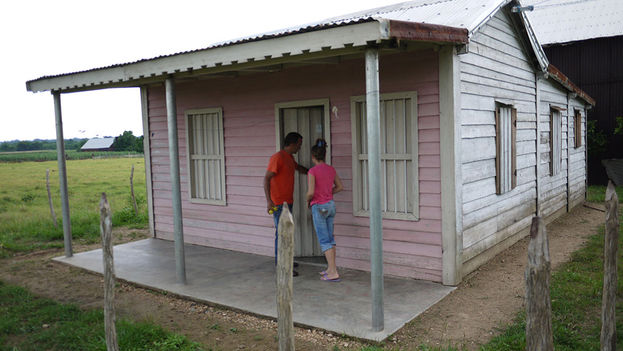
It’s time to go back to the fields, so the five men take up their tools and return to the furrows. Before saying goodbye, they raise one of the biggest pieces of nonsense they have to deal with. “For a farmer to receive a document of ownership for their home, they first have to donate to the State what they built with their own efforts and resources. And so then the State charges you for what you gave it. If you don’t give them the land, you can’t build your house legally.”
14YMEDIO, Yoani Sanchez, Havana, 13 August 2014 – Evening falls and the sound of the sieves in the rolling hills trails off. The three men collect their belongings. They’ve finished the first day in their arduous search for gold. Tomorrow they will wake up early and with the first light of day return to dig, wash, sift and find the little nuggets among the mud and sandstone. “If I find at least one gram, I’m going to finish the roof of my house,” says the most experienced of the stealth miners.
The Rafael Freyre area in Holguin province attracts hundreds of people every year who dream that a mine will help them out of their economic difficulties. Is it need? A hobby? Or a real gold rush? Everyone experiences it in their own way, but the oldest people in the area say that when “people have gold in their eyes it’s like a demon that will never leave.”
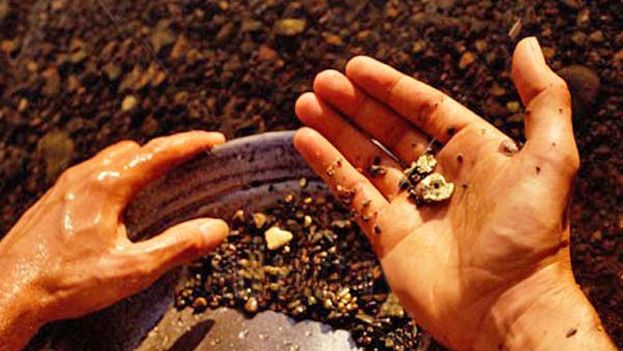
The stealth miners have created their own working tools from few resources. Among the most important is the “car,” a sieve with a piece of rubber where the mud is deposited, that then falls through the screen. It is a team effort, requiring at least three strong men. While two shake the sieve, the other pours water over the mud collected in the excavations. “Then the gold dust is left, in particles like a kind of pea hull, although there can also be nuggets,” says Fernando Ramón Rodríguez Vargas who lives in Levisa, Mayari municipality, and for years has dedicated himself to the pursuit of the precious metal.
Those who spend a lot of time in these tasks have developed and eye for finding where the gold is, they don’t believe in metal detectors. “They aren’t very effective because they go off everywhere, in this area there can be a little piece anywhere. The most commonly used method is the same as it is used by industries. I take a sample of the dirt and I wash it to check how much gold it contains just so I will know if it’s worth the trouble,” Veredia Elcok says, revealing his secrets. He has participated in numerous fortune hunting expeditions. He claims that the Cuatro Palmas area in Holguin is the most famous for the size of the pieces found, and because the gold “is at ground level.” continue reading
The second day of work is when your bones ache more. So the three men bathe in a creek early in the day to relieve the little punctures all over their bodies, and resume their excavations. The main symptom of “gold fever” is working and working almost to the last light, without eating. They go along making holes, because they aren’t in an area of surface tailings, the layer is deeper. The gold itself marks the path to follow, from the amounts they come across.
At one point they detect another group of searchers. That can cause problems, quarrels and strong competition.
Everybody wants to take your seam, then they start to dig deeper around the hole and come in from underneath,” says Verdecia Elcok, who has dug with several friends and neighbors working together. You have to go faster, the hands sinking full speed into the earth and the sieve never stopping its “swish swish swish.”
The technique for finding a seam is to test and test. Consistency is key to this work, and perhaps because of this the stealth miners take on an obsessive look, incapable to letting themselves be deterred by defeat. Normally they look for the tracks of rivers that no longer exist. They’re like scars in the hills where water would have once swept along the mineral. There are also muddy areas on the banks of still running rivers that are good places for findings.
The third working day. The bread they brought is full of mold because of the humidity. On getting up, the three men have numb hands, and the skin on their fingers is cracked. Every muscle aches, but they have to keep going. Perhaps today will be their lucky day. The first hours on the site they work with more energy, but exhaustion returns and slows the pace as noon approaches. The whole time their feet are damp with the water flowing through the “car.” One hurt his hand another coughed all night. Around lunch time a 0.8 gram nugget restores their hope and they decide to continue.
They’re picking up tiny pieces, or “lice” as they call them. They hope to have a breeze to start the melting. One brings a little mercury. They put it in a pot and apply heat. It gives off a poisonous gas and the men stand upwind to avoid breathing the smoke. It’s a dangerous process, but almost magical. In the bottom of the vessel the gold gleams. Every 24 carat gram they sell will bring a price of between 25 and 27 convertible pesos, a little more than a dollar.
Gold fever can also become gold death. Verdecia Elcok knows this well. “Over in the La Canela area a lady—they call her Mimi—found the largest piece of the mineral ever found in that area, four-and-a-half-ounces. Now the woman has developed cancer from using so much quicksilver.” The mercury is taken from state industries, diverted from laboratories and chemical plants. It is a product that should be controlled, but it hits the streets and gets into the hands of miners and jewelers.
A lady found a four-and-a-half ounce piece. Now, she has developed cancer from using so much quicksilver
If they get lucky, the three “seekers” will have to be cautious. If they’re seen to be spending a lot of money in town, people will start to investigate where it came from. Someone could follow them to their place and find the exact site of the mine they’ve found. Everything has to be handled with a lot of discretion. There is also the danger of the Forest Guard, which imposes fines of up to 1,700 pesos. According to the Mining Act “the subsoil is the property of the State, the only entity authorized to extract minerals and to exploit it for research purposes.”
However, the State isn’t interested in many of the small deposits. The costs of exploitation would be greater than the earnings, so it isn’t done.
Sometimes it is not gold that glitters. “I have found old coins and indigenous remains,” says Rodríguez Vargas. The biggest frustration for those who pick through these hills is having to leave the area with no results.
Gold fever infects everyone equally, regardless of age, gender or education. “You can find a doctor who, in his spare time, is on the bank of the river, a teacher, a young student, a pregnant woman or one with a kid,” says Verdecia Elcok. “Because in the end it’s just like the fisherman, who always has to return to the sea.
The official institutions categorize these miners as a real “invasion of prospectors.” They accuse them of harming the environment, especially the topsoil because they remove and wash it. The streams and water reservoirs of the area are also affected by turning over and carrying the sediments. Verderia Elcok admits that “the waters are polluted and the farmers’ animals have fallen in the holes that are dug. There have also been accidents in the area, but this is a question of necessity, not avarice.”
A study by researchers at the Institute of Geology and Paleontology concludes that the “organization of this activity under business structures including State, cooperative and self-employed,” should be encouraged. The report suggests “local governments should provide the knowledge and power necessary to enhance the usefulness of the rocks and minerals present in their regions.” However, for now, the decision whether or not to exploit a site depends exclusively on the highest levels of government.
The days of searching are over. The stealth miners return home. They will return to the hills in a couple of weeks. The youngest of them sold his refrigerator to buy a half liter of mercury. “You’ll see, the next time we’ll find more gold and even a pirate’s treasure,” he says with the golden glint in his eyes that everyone in the area knows very well.
With regards to the Cuban hack living in Miami, I’ve decided not to write any more, but it seems that drinks were passed around (in a letter he declared his love for them) and in one of his last writings he dismisses representative democracy.
He complains that in the United States you can’t but a business wherever you want, it has to be in a commercial area. That you are subject to inspections, forced to follow regulations and ordinances. You have to pay taxes. You can’t paint your house whatever color you want or put up fences without authorization. You have to have a permit for a rally or protests, and journalists can only publish what newspaper owners approve.
The hack seems to want to practice anarchism in an organized society. From his arrogance he asserts: Cubans don’t understand anything about this, they haven’t the least idea about the implacable et cetera.
It seems that this gentleman, when he travels to Cuba to deal with his work and have a little fun, hasn’t realized that here, after some time and overcoming the anarchy stage of years back, there are also all the regulations he criticizes and much more, and they are enforced through big fines, demolitions and even seizures without it being a democracy, much less a representative one.
On the subject of protests and demonstrations it’s more radical; they are forbidden and, if you hold one, you will be severely reprimanded by the authorities.
In the case of the press it’s simple: all the media are state-owned and the only articles approved by the authorities appear in them.
I think the hack knows this well, since he writes for one.
I don’t know how much they pay him for his weekly diatribes on the same topic: how bad it is living in Miami. Nor do I know if he is paid in dollars or Cuban Convertible Pesos, but it would be nice if he would be a little more serious, and stop thinking that we Cubans over here are stupid enough to believe what he writes.
14YMEDIO, Havana, 12 August 2014 — The Patriotic Union of Cuba (UNPACU) and the Pinero Autonomous Party (PAP) formalized an alliance Monday in Santiago de Cuba.
Speaking to 14ymedio, José Daniel Ferrer, executive secretary of UNPACU said that both organizations share a commitment to strengthening the activities of the nonviolent struggle and invite smaller groups to join the alliance.
The Patriotic Union of Cuba is the now largest and most active Cuban opposition group. Started in 2011, the organization brings together more than two thousand members in the East, says Ferrer. There would be a similar number in the central and western areas, according to UNPACU’s own estimates.
The merger with PAP was based on the Declaration of Altamira—a reference to a region of Santiago de Cuba—whose key points include the autonomy of those who join UNPACU, collaboration in the training of members, and dissemination of activities that are undertaken together.
The trend to consolidate alliances and agreements among the Cuban opposition has accelerated in the past two years under the leadership of the Patriotic Union. The most important of these confluences happened last year with the merger of the United Antitotalitarian Front (FANTU), represented by Sakharov Prize winner Guillermo Fariñas, and UNPACU.
Cuban writer and blogger Angel Santiesteban-Prats disappeared from the jail at San Miguel del Padron on July 21, 2014. Authorities at first said that he had escaped; nevertheless, ten days later his daughter managed to speak with him briefly at a police precinct. His whereabouts are still unknown.
After having denounced the disappearance of Angel Santiesteban-Prats from the jail where he had been since April 2013, his relatives are worried about the accusation of attempted escape.
They have not yet been able to learn the Cuban writer and blogger’s version, but his family suspects that this new complaint is unfounded and its only purpose would be to increase his sentence to captivity. continue reading
The only person who has been able to see Angel Santiesteban-Prats since his disappearance has been his daughter. The interview only lasted ten minutes and was in the presence of a police agent; during this time the father, therefore, had no opportunity to speak freely. Since the said encounter occurred, the authorities have reported nothing about the writer’s situation, and rumors grow.
“Reporters Without Borders exhorts the Cuban authorities to explain clearly the current situation of Angel Santiesteban-Prats,” said Camille Soulier, head of the Americas’ Office of said organization. “The risk increases for the blogger each day that passes without news of him. We demand his immediate liberation and the withdrawal of all and each of the accusations brought against him. The repressive methods of the Cuba regime increasingly resemble those days of the ’Black Spring.’”
It has been more than a year since the author of the blog “The Children Nobody Wanted” found himself behind bars by virtue of his ostensibly critical position towards the Cuban government. In December 2012 after an expedited trial he was found guilty of “home violation and assault” and was sentenced to five years in prison. In April 2013 he was transferred to the prison center of San Miguel del Padron where he suffered torture and mistreatment.
His recent disappearance conincides with an interview given by his son last July 15 on Television Marti, a news channel with headquarters in Miami. In that interview, he affirmed that he had been forced to corroborate the false accusations against his father. Also, according to Eduardo Angel Santiesteban, the “hero of the report” has never assaulted his ex-wife, and the judgement is a mere sham.
Cuba is in place number 170 among 180 countries in the 2014 edition of the World Classification of World Press Freedom by Reporters Without Borders, occupying the last place among countries of the American hemisphere.
Every now and then the Cuban Authorities mount the spectacle of ’external subversion’ against the regime. As if it were a ’blue plate special’ it’s seasoned with a press statement from a second or third rate official, articles on the subject from some government journalists, a session on the Roundtable TV Show with energetic participants, an anecdote about an alleged event that took place in a cultural forum, and statements about some media junkie being a double agent.
It happens that, despite the political events they participate in, a great part of Cuban youth don’t believe in the country’s current political, economic and social project, and try to abandon the country by any means possible to pursue their lives in other lands.
If the constant defections of athletes, artists and professionals weren’t enough, along with the illegal departures on boats, rafts and other methods by hundreds of Cubans, you only have to talk honestly with the young people in any neighborhood in our towns and cities to know what they really think.
The double standard is well-rooted here, right along with the invasive marabou weed, and you shouldn’t give much credence to what is said in an assembly or mass event, or in front of a microphone or camera. At those times, most of the young and not so young say what the authorities want to hear, so as to avoid trouble.
The solution is not ’blue plate specials’ every now and then, but the adoption of profound measures to resolve the current critical situation and to offer, rather than a long delayed future, a prosperous and dignified present.
Big Brother stands as judge of journalistic “objectivity.” [The text says that CPI can temporarily or permanently cancel press credentials for “lack of journalistic ethics… or objectivity.’” Minrex is the Foreign Ministry]A few years ago I met a foreign correspondent based in Cuba who related an absurd and revealing anecdote. The International Press Center (CPI) had called him in to warn him about the content of an article. Receiving the summons didn’t surprise him, because warning calls like that were a common practice of this agency in charge of registering and controlling foreign journalists living on the Island. Nor could he refuse to appear, because he depended on the CPI for his credentials to report on a nature reserve and even to interview a government minister. So there it was.
The reporter arrived at the centrally located building on 23rd Street, where the CPI is headquartered, and was led to an office with two annoyed looking men. After bringing him coffee and talking about other things, they got to the point. They reproached the journalist for a report where he had referred to Cuba as “the communist Island.” This was a huge surprise to the correspondent because previous warnings he’d received were for “reporting only on the bad things about the Cuban reality,” or “not treating the leaders of the Revolution with respect.” But he never imagined that this time he would be scolded for the complete opposite. continue reading
But yes, the censors who minutely examine the cables written by foreign agencies had not been at all pleased with the use of the adjective “communist” to characterize our country. “But the Communist Party governs here, right?” asked the incredulous reporter. “Yes, but you know the word looks bad, it doesn’t help us,” responded the higher-ranking official. The man stood there in shock for a few seconds while trying to comprehend what they were saying to him and think of a response other than laughing.
The correspondent knew that annoying the CPI could bring more than just a slap on the wrist. Also in the hands of this institution is permission for foreign journalists to import a car, rent a house and—at that time—even to buy an air conditioner for their bedroom. The dilemma for the reporter was to give in and not write “the communist Island” any more, or to engage in conflict with the institution, where he had everything to lose.
The mechanisms of control over the foreign press go far beyond warning calls from the CPI. Should a correspondent get married on the Island, start a family in this land, his objectivity comes into doubt. The intelligence organs know how to pull the strings of fear to cause damage or pressure to a loved one. Thus, they manage to temper the level of criticism by these correspondents “settled” in Cuba. The perks are also an attractive carrot to keep them from touching on certain thorny issues in their articles.
I know one foreign journalist who, every time she writes a press release about the Cuban dissidence, adds a paragraph where she declares, “the Government considers this opposition to be created and paid from Washington”… But her texts lack the phrase she could add to give the readers another point view, briefly communicating, “the Cuban dissidence considers the Island’s government a totalitarian dictatorship that has not been subjected to scrutiny at the ballot box.” This way, those who consult the press release could draw their own conclusions. Sadly, the objective of correspondents like her is not to inform, but to impose an opinion framework that is as stereotyped as it is false.
Press agencies need to strengthen and carefully review their codes of ethics when dealing with Cuba. They should control the time their representatives spend on the Island, because as the long years pass here emotional bonds are created that the regime can use for blackmail and pressure. An objective examination—every now and again—wouldn’t be a bad thing, given the possible coercion and Stockholm Syndrome their employees might suffer. The credibly of an information giant sometimes depends on whether a new imported car, or a beautiful young Cuban partner, is valued more than a commitment to journalism.
Take care foreign press agencies! Your representatives in these parts are always in danger of becoming hostages, first, and then collaborators, of the ruling regime.
14ymedio, Orlando Palma, Havana, August 11, 2014 – “Very soon the best businesses in Cuba will be trash and old people,” blurts out the owner of an old age home, without blushing. Places like hers aren’t recognized at all by the law, but they have emerged to meet the demand of an increasingly aging people.
It is estimated that in a decade that more than 26% of the Cuban population will be over 60. The needs of these millions of seniors will be felt in Public Health, social security, and the network of old age homes available in the country. Throughout the Island there are only 126 homes with room for fewer than 10,000 elderly, a ridiculous figure given that the demands are increasing. With regards to specialized doctors, the country has fewer than 150 geriatric specialists.
Housing problems are forcing more families to entrust the care of their grandparents to state or religious institutions. That, coupled with the economic problems and low pensions, make caring for the elderly ever more complicated for their relatives.
There is no welcome sign and if someone calls to ask for details she responds cautiously.
“My father of almost 90 got sick,” says Cary, a entrepreneur who offers services as a caregiver to the elderly. “I didn’t want to send him to a nursing home, so I had to devote myself to taking care of him full time. Then it occurred to me I could do the same for other old people.” The woman has a thriving business, where she offers clients, “breakfast, lunch, dinner and even snacks.” continue reading
Cary’s home is advertised online, costs at least 70 CUC a month and, its owner says, “Here we have a hairdresser, barber, pedicures; they can even stay from Monday to Friday. We treat our clients with kindness and like family.” There is no welcome sign on the pleasant home, if someone is interested and calls to ask for details, she responds cautiously. Potential clients must come recommended or be the friend of a friend.
On the list of self-employment professions permitted, is “caretaker of the sick, disabled and elderly,” but the license only allows attention, without other benefits. Cary should take out several additional licenses, as a dispenser of food—because the elderly eat in her house—and a license to rent rooms, which authorizes overnight guests. The cost of the three licenses would make her business unprofitable. She already has problems with the police and now she has to tell the neighbors that she is taking care of some of her father’s “brothers and cousins.”
Despite the high prices, these initiatives are in great demand, due to the limited capacity of the state asylums and their deteriorating installations. Getting into these official places is not easy. You need to go the family doctor, who will refer the case to a social worker. The decision may take years, although some accelerate it by paying a “stimulus” to get the paperwork in record time. Then you have to way for a space to open in a place in the municipality or the province.
The situation reached a point of deterioration that the State was forced to delegate the care of the Catholic Church
The old age homes hit bottom during the economic crisis of the 90s. The situation got to the point where the State was forced to delegate part of the care and hygiene tasks to the Catholic Church. Many of the old age homes were almost completely overseen by religious congregations, such as the Servants of the Abandoned Brothers, the Daughters of Charity, the Sisters of St. Joseph, and the Brothers of St. John of God. Thanks to this collaboration complete collapse was avoided, although they barely built and readied new sites.
Self-employed people have began to take a position in this sector: private homes that are rebuilt to fit a hospital bed, the doors widened for wheelchairs, and accessories are added to bathrooms to support older people. All this is done with great discretion, without anything noticeable from the outside of the house that would suggest a conversion to a private asylum.
“Most of the cases we take care of come from far away,” explains Angelica, a retired nurse who has opened her own old age home. She has competitive prices, around 60 CUC, and it includes clinical services and physiotherapy, physical exercises and excursions to Saturday work parties.
The responsibility is great, but the families of the elderly are very demanding, given the high price they pay. The majority are people with a child who has emigrated who pays, from afar, for care for the father or mother. “Sometimes they make first world demands, like an electric bed, or putting cameras in the rooms to monitor what the old people do all the time,” Angelica complains.
I’ve had to accompany some of my clients in their last moments,” the lady says, who despite also being elderly herself is strong and agile. “I can’t advertise it, but I also offer the service of being with the old man in his death throes, holding his hand, reading and talking to him, so he doesn’t feel alone at the moment of death.”
“If my children continue with the business, soon I will be a client of my own old age home,” she says with a certain pleasure. A bell rings and while she goes to feed a ninety-year-old sitting in front of the TV, Angelica reflects outloud, “Don’t let anyone send me to one of the State’s ‘old folks warehouses.’ I want to stay here.”
Yesterday, July 28, I read in the Trabajadores [“Workers”] newspaper about the speech given by 6th grade pioneer Wendy Ferrer during the main event of a celebration in Artemisa marking the 61st anniversary of the attacks on the Moncada and Carlos Manuel de Cespedes Barracks. I could not help feeling shame and indignation over the vile manipulation that was so evident in the discourse read by this child.
To my understanding, the words and phrases used were not typical of a school-age child. If they were so, it would only be an even more lamentable proof of the terrible distortion fed to our students, a political manipulation that takes precedence over the true history of our country, and over true education. This is truly unfortunate. I believe that it is a civic duty to clarify for this girl, or actually for her teachers, some of the very sensitive aspects of her speech:
I completed my primary school studies — starting with a marvelous and unforgettable Kindergarten, as we then called what are today known as children’s camps — up to 6th grade in a public school, No. 31 of the Los Pinos suburb. Never, in our humble school, did we go without a school breakfast, as was provided in all public schools of that time. Nor did we ever lack notebooks — which I can’t forget included an imprint on the back of the tables for multiplication, addition, subtraction and division — or pencils, which were provided to all students at the start of — and midway through — each term. At that time, public education accounted for 22.3% of the national budget. There was also a private education sector, with wonderful schools founded and directed by great educators. continue reading
The Cuban educational system during the 1950s was made up of 20,000 credentialed teachers and 500,000 students. These figures are documented in the census and statistics of the era and confirmed internationally. Never in the public education sector was there discrimination against a student on the basis of race or religion. If a seeming dearth of black or mixed-race students is evident, this was only due to the fact that in those years, according to the 1953 census (which would be the last until almost 30 years later), 72.8% of the Cuban population was white, 12.4 was black, and 14.5 was mixed-race. At that time our population was six million inhabitants. The private schools were the only ones who had the prerogative to implement selective admissions.
According to my aunt, a great and respected educator and a public school director, the best teachers were to be found in the public schools because the government paid better salaries than the private schools. Also, many of these professors, above all those with specialties in music, art and languages, would also teach classes in private schools. For my lifelong love of music I credit — in addition to my family — those marvelous professors who I had in this subject throughout the course of my primary school studies.
To ignore these facts would be to cast aspersions not only on the Cuban educational system of that time, which was considered one of the best in Ibero-America along with those of Argentina, Uruguay and Mexico, but also on all those great Cuban educators who conferred lustre and prestige on our country. Among them, to mention only a few, for the list would be interminable, we can name the following:
José de la Luz y Caballero, Rafael María Mendive, Enrique José Varona (youth educator), Max Figueroa, Camila Enrique Ureña, Mirta Aguirre, Gaspar Jorge García Galló, Raúl Ferrer, Carlos Rafael Rodríguez, Vicentina Antuña Tavío, Aurelio Baldor (whose texts are still utilized in Latin America), Ana María Rodríguez, Añorga, Valmaña, and many more who were the mentors of our most celebrated professionals.
For all this, I cannot leave unmentioned that, after 1959, government decrees so pressured the teaching profession that private schools closed down and a massive exodus of educators ensued, damaging the educational system to such a degree that new teachers had to be credentialed on the fly to educate “the new sons and daughters of the homeland”. The result was a deterioration and decline of education in our country, what with it taking second place to politics. Many of our professionals, in exile today, cannot forget the discrimination they endured in the universities, due to their religious beliefs or sexual orientation, following the triumph of the revolution.
For this and many other reasons, I would suggest to this young pioneer – and to all the children of our country – to fearlessly seek answers from capable persons to clarify their doubts, gathering as much information as they can independently, and taking a bit more responsibility for their own education. Sadly, in our schools today, politics and government orders take precedence over knowledge.
This week I invited to lunch a couple who are friends of mine. I have among the more “respectable” pensions in this country: 340 CUP (Cuban pesos) — the type of currency which is also used to pay salaries.
I set out early in search of the necessary elements and ingredients to prepare for my friends a “criollo” [traditional Cuban] menu. They live outside the country, and I wanted to treat them to a home-cooked meal. Since there would be four of us to feed, I purchased the following:
Four plantains to make tostones, 10 CUP for the four; 1lb onions, 30 pesos; 1lb peppers, 20 pesos; two small garlic heads, 6 pesos; one avocado, 10 pesos; 2lb rice, 10 pesos; 1lb black beans, 14 pesos; 3lb pork steak, 120 pesos; one large (3lb) mango, 7.50 pesos. After that, I stood in line to buy one loaf of Cuban bread for 10 pesos.
As you might have noticed, a simple luncheon for four cost me “only” 257.50 Cuban pesos. My guests brought a bottle of wine.
The meal was a success and we had a great time, but as you can imagine, my pockets are wobbling until my next pension check. Now you see what a simple meal costs on my planet!
14ymedio, HAVANA, Ignacio Varona, 4 August 2014 – When she died they erected a life-size marble statue of her, and when they milked her she liked to listen to music. The entire country lived attentive to the milk given by Ubre Blanca (White Udder), the most famous cow in Cuba. She was an animal that not only left her name in the Guinness Book of World Records, but also left a trail of people who remembered her, either with affection or with derision. A new documentary by Enrique Colina recreates the life of this ruminant creature, and the political and social delirium that was generated by her prodigious milk production.
In the space of less than fifty minutes, his documentary “La Vaca de Marmol” (The Marble Cow) recounts those moments in which the entire future of the country depended on the milking of those prodigious udders. With humor and occasional moments of true drama, the director and movie critic tackles a story that appears taken more from mythology than from reality. The story of Ubre Blanca is told by those men who cared for her, milked her and cured her of her diseases on the Isle of Pines, but also by the voices of ordinary people who grew up hearing of a future when milk “would run in the streets” as a result of the increase in production, for which this cow was supposed to be the vanguard.
continue reading
Colina is a creative genius who needs no introduction. His program 24 y segundo for years has produced the most intelligent critical cinematography and entertainment on Cuban national television. Also, he has ventured in the direction of documentaries, producing classical pieces such as Jau, Vecinos (Neighbors), and Chapucerías (Shoddy Work). In 2003, he made his debut in fictional cinema with the film “Entre Ciclones” (Between Cyclones). His work has been noted in the Cuban film panorama for its good humor and its incisive criticism of social problems.
On this occasion Colina has turned his talents towards reintroducing us to Ubre Blanca. One of the most amazing testimonies that this documentary is that of Jorge Hernández, the veterinarian who attended to the celebrated cow for a good part of her life. Through the statements of this man we see the atmosphere of pressure and vigilance over those who attended directly to the world-record milk producer. “You cannot allow this animal to have even a cold,” Fidel Castro had pronounced on his first visit to the dairy farm. And so it had to be
With humor and certain moments of true drama, Enrique Colina tells the story of Ubre Blanca – White Udder
Linda Arleen, a cow in the United States, had previously inscribed her name in the Guinness Book of World Records for her milk production. Exceeding that record became a personal battle for Fidel Castro against the United States, his archenemy from the north. Ubre Blanca therefore began to be milked as much as four times a day, surrounded by conditions unequaled anywhere else in the world, and by an attentive team that dared never to make a misstep, nor skip a single task.
Care for the cow included having its food tested by being first given to another animal, so that Ubre Blanca wouldn’t be poisoned, as that was an obsession of El Comandante Castro. The dairy workers lived practically quartered with the cow so that she would lack nothing. “The milkings themselves were good, but we ourselves were treated as if we were crap,” one of the caretakers said decades afterwards. Thus it went day after day, until finally Ubre Blanca was found to have broken the world record and was elevated to the title of the new world champion, as a result of her having produced 110.9 liters of milk in a single day.
Surrounded by photographers and journalists, with three milkings daily and with the pressure of a high-ranking athlete, Ubre Blanca became sick, diagnosed with cancer of the skin, and had to be sacrificed. Her rapid deterioration pointed to an excessive exploitation of the animal, and to all the stress that she was submitted to in the last years of her life. Her name would, in the end, serve to thicken the large list of failed projects that were ascribed to Fidel Castro. There would never be another Ubre Blanca, and the entire Cuban cattle industry fell off the precipice of apathy and inefficiency.
With mastery and a certain touch of humor, Enrique Colina also reviews all the worship of the cow that occurred subsequent to her death. This worship ranged from the work of the taxidermists to maintain her skin, to the marble sculpture of Ubre Blanca that even today is located at the entrance of La Victoria farm, where that production miracle occurred. The jokes in the street, and the suspicion left by that illusion also have a place in the documentary.
A certain apprehension can be seen to overcome the caretaker who believes that the ghost of Ubre Blanca still walks through the beautiful stable that they created for her. With air conditioning, special pastures and 24-hour-a-day monitoring, that cow ended up being a prisoner of her fame, and of an obstinate man who believed that a country could be governed in the same way he ordered a dairy to be.
Translator’s Note: This documentary reportedly was shown in Cuba only once, when it was entered into a film festival, and has not been shown since.




 Published Wednesday, August 6, 2014
![Big Brother stands as judge of journalistic "objectivity." [The text says that CPI can temporarily or permanently cancel press credentials for “lack of journalistic ethics… or objectivity.’”]](https://generacionyen.files.wordpress.com/2014/08/periodismo-censura_cymima20140812_0002_16.png)