Amidst Rumors and Disinformation, Angel Santiesteban Continues Missing

{*Translator’s Note: Angel disappeared from prison on July 21, 2014. As of today he has not been heard from for 29 days.}

Five days* have passed now since the disappearance of the writer Angel Santiesteban in Havana, barely hours after he wrote a post from Lawton prison,  in which he announced to the world that there were strong rumors that the Regime’s prison authorities would transfer him to a higher security prison.

After his disappearance from said prison last July 21, without the Cuban authorities informing family members of anything, another rumor started circulating: supposedly, Angel Santiesteban had escaped. In a telephone call that the writer’s son, Eduardo Angel Santiesteban, made to the prison, worried at not knowing anything about his father, a minor official confirmed the rumor. “I don’t know if they did it to scare me, to make me more nervous than I am,” said the 16-year-old, on the Columbian television program, Night, Channel NTN24. In conversations with family and friends he has said that he feels this lie by the regime’s prison officials is a bad sign. continue reading

Maria de los Angeles Santiesteban Prats said the same thing, from Miami: “The telephone harassment I’m suffering since my brother disappeared in Cuba, and other information we have obtained and that can’t now be revealed in order to protect some people on the island and in exile, make me think that this is another maneuver of the dictatorship: Spreading this rumor about my brother’s escape serves only to deflect attention from something big they are doing to him and that they don’t want known.” In a conversation with the NeoClub Press agency, she affirmed that “They are blackmailing me; last night, for example, I received an anonymous call coming from Japan. They call me and tell me that it’s better that I shut up, that I’m going to end up losing.”

A simple analysis of the facts preceding Santiesteban’s disappearance is enough to confirm the family’s suspicions.

After many months without responding to the Request for Review of the judgment against Angel, undertaken by the defense attorney last year, the Cuban judicial authorities (as they have now demonstrated in this case, manipulated by the Cuban political police) received a hard blow which totally undid the judicial farce they prepared to condemn the lauded Cuban writer to five years for a supposed crime of domestic violence. One of the principal prosecution witnesses, the writer’s own son, Eduardo Angel Santiesteban, granted an interview to Television Marti, in which he explained that being a minor he was forced and manipulated by his mother – Kenia Diley Rodriguez – at the urging of Castro’s State Security, forcing him through psychologists and other specialists, to declare against his father.

In this interview, and in a later one on the television program Colombia Night, he confessed that he never saw anything like what his mother said Angel did, and that the political police took advantage of “amorous” problems between his parents, inciting Kenia Diley Rodriguez to collaborate in a plot to punish Angel’s dissident stance and the international denunciations that he made in his blog, The Children Nobody Wanted. This evidence, which exposed the dirty strategy of State Security, makes it logical to think that the regime would want to punish the writer and his family with this disappearance. It’s not an isolated fact, since every Cuban dissident who has been incarcerated can tell similar stories.

Another detail that casts doubt about the rumor of flight is the same post the writer sent from prison, hours before his disappearance, in which he made known that one of the possible reasons of his transfer was the fact that two high government officials, condemned for corruption, would be sent to Lawton prison, where he was located. Logic imposes itself: It was necessary to transfer Angel to avoid his making contact with these officials and thereby getting first-hand information about the corruption in high spheres of the island’s government.

A third event to take into account would be the constant threats that Angel received in the last months to stop writing denunciations in his blog. In spite of these threats, in spite of the fact that he had to hide in order to write and look for different ways of eluding the vigilance to get his writing out of prison, they didn’t manage to shut him up; so that, in communication with his friends and family, he had shown his suspicion that they would transfer him to a higher security prison (thereby violating the established legal procedure for cases with his sanction), if only to avoid his continued denunciation of the most sinister face of a dictatorship that pretends to show itself to the world as a truly human system.

Finally, as Angel Santiesteban’s international prestige has grown, the repressive forces of the regime have become more rabid and impotent. Its murderous blindness doesn’t permit them to digest the fact that important intellectual and international human rights institutions have their eyes on the writer, unjustly imprisoned on the island; that this world recognition has allowed him to receive the Jovenaje 2014 award, which is granted every year for the work and life of an important Cuban intellectual, and that Reporters Without Borders has included him on the list of the world’s 100 Information Heroes.

“Something big has happened and they are hiding it,” said Maria de los Angeles, Angel’s sister, in several interviews these last days. “I demand that they show my brother alive and well, because he never has had the intention of escaping.”

We have mentioned it many times but it’s good to remember it again: The little time he has been in prison, Angel was visited by agents of State Security to offer him his freedom in exchange for abandoning his antagonistic position and testifying about this compromise in a video. After roundly refusing, they told him he should look for a friendly embassy to arrange his deportation, something Angel also roundly refused. It’s also good to remember again how many times they threatened him with death, in prison or before.

Obviously they don’t make such proposals to a simple “home invader”; if anyone knows something about home invasions it’s the regime; it’s a daily practice with which they try to intimidate the valiant and peaceful opposition. And they know about maltreating women, which we can add to everything the world knows and consents to with its complicit silence. The Castro regime takes the prize for its duplicitous discourse, now charging Mariela Castro to “sell” the image of an open government that respects gender diversity. It’s enough to see the brutal images of aggression against the Ladies in White, to know their testimonies, along with that of other dissident women and LGBT activists who don’t conform to the designs of the dictatorship, to know how much falsity there is in that Castrista discourse.
Angel has spent five days* in an unknown location, and WE DEMAND HIS IMMEDIATE APPEARANCE IN PERFECT CONDITION. We demand that finally justice be done, and that after the Revision of the judgment, with all its procedural guarantees, he be freed because HE IS INNOCENT.

RAUL CASTRO is absolutely responsible for what can happen to Angel, and WE WARN THAT THERE ARE NO POSSIBLE ACCIDENTS to justify what they can do. The international community is witness to all this horror happening to Angel, and NOW THERE IS NO PLACE FOR IMPUNITY. The same goes for his minor son, EDUARDO ANGEL SANTIESTEBAN RODRIGUEZ.

The Editor

Maria de los Angeles Santiesteban, in the name of the whole family

Amir Valle

Lilo Vilaplana

Translated by Regina Anavy, August 18, 2014

26 July 2014

Investment in Cuba? What for? / Orlando Luis Pardo Lazo

Investment in Cuba? What for?
ASCE XXIV / 2014 Annual Conference, Miami Hilton Downtown Hotel, Florida, USA
Panel 12. Concerto Ballrom B – Friday, August 1st, 2:45-4:15pm

1.

In Cuba during the 1970s, historian Manuel Moreno Fraginals challenged poet Jose Lezama Lima with his trendy scientific notions about the laws of objectivity and the transition to a colonial/pseudo republic/revolution from the slave mills to the Slavic sugarcane cutters; the now forgotten Soviet KTP. Exhaling an asthmatic counterpoint through his cigar, Lezama Lima responded to Moreno Fraginals without foregoing the Marxist irony of a convenient Catholic: “Ah… But when will we have a history that is qualitative?”

Are we Cubans lacking the type of analysis that at the margins of academic exactitude and author-centered erudition would also require ethicality? Is a qualitative economy that can escape the comparisons of percents and profits and the tendency to always side with the expounder at all conceivable? Is a qualitative political system that rises above the lowbrow politics practiced in our country unthinkable? How about a qualitative sociology without ideological determinism and infallible founders? When all is said and done, is the anthropology of a quality Cuban one that is multidimensional, subjective, and liberated from the consensus imposed upon on us with the rhythm of a conga drumbeat?

No wonder the Professor did not answer the Master’s question. Today, when it comes to Raul Castro’s reforms that in an ever-changing and capricious landscape that hides a clan’s control while a new image of legitimacy is created, would Moreno Fraginals rely on the laws of objectivity in a transition from communism to capitalism? And would Lezama Lima respond to him with an “Ah… And when we will Cuba have a history of qualitative capitalism?” Poetry asks impossible questions that history can answer, though it finds it inconvenient to do so. continue reading

2.

Today, by either vocation or duty, Cubanologists discuss their theories about the island. They have placed their bets for quantitative changes on the seat of power, avoiding any consultation with the will of the Cuban people. For many of them the Revolution is a victim, not the victimizer, and as such is granted the right to not disappear. Because of this, throughout all of American academia, an anti-Castro stance is practically considered intellectual harassment.

Therefore, Cubans are supposed to have no other alternative than to collaborate with the government in the construction of controllable capitalism that is already irreversible while the country’s socialistic constitution remains “irrevocable.” In this scam of a transition, borne of short memories where horrors become simply errors, liberty becomes an encumbrance threatening to make everything end in a debacle. And it is this astute death threat that forces us to be loyal as a post-socialist substitute for legality.

“A country is not run like a campsite,” another poet once told to another general. But those who once dressed in olive-green uniforms and now as the new generation wear business suits, have turned the country into a campsite so as not to fully contradict Jose Marti’s words to Maximo Gomez. Citizens are abundant, but soldiers are saviors: the disinterest of the former is secondary to the discipline of the latter. The year 2018 is being called the new 1958. After 60 years of solitary power, biology finally brings us a calendar without the Castros. But after waiting for so long, we Cubans can now wait a little more. We have become accustomed to the family legacy that leaves us the choice between a parliamentarian sexologist and a colonel –like Putin– from the Ministry of the Interior. One is in charge of reproduction and the other of repression; she is in charge of pleasure, he of power; academia and military; diplomacy and impertinence; masquerade and malice.

The inverted logic behind investing in such a Cuba is that after the profits, it would precipitate a multi-party political system: vouchers that will promote voting; underdevelopment erased by cash flowing through banks; from Che to checks. Like dissidents without God, layman Lenier Gonzalez might call them “wolves in sheep’s clothing,” because the nation teeters on collapse between a war of economic action from the outside and peaceful resistance from the inside.

Perhaps to sidestep such suspicions, foreign investors avoid showing off the profit gained from a captive and insular market. They seem to invest with almost-humanitarian intentions, although their “good deed” will be repaid by having their property seized and not a few of them will end up deported, imprisoned, or dead from a heart attack during interrogations performed by State Security. As for Cuban exiles, they are not even given the right to live in their own country. And the illusion of investing in the island — out of nostalgia or some kind of labor therapy — is justified by the notion that money can make a dictatorship dynamic much more effectively than dynamite. If we cannot live in a democracy, at least we will be able to live in a dictocracy. One-party companies and a tinsel opposition. Like a person who draws a North Korean doodle and ends up with an exquisite Chinese calligram. Or like in those childhood cartoons where a tyrant is defeated by a golden antelope that drowns the villain by throwing gold coins at him and when he can no longer take the weight screams “enough!”

3.

When I hear the word “economy,” I reach for my gun.

First-world paradoxes: The possible Democrat party candidate for the White House mumbles something to President Obama in the latest of her hard choices: “Lift the embargo on Cuba because it’s holding back our broader agenda across Latin America”. And from the Chamber of Commerce, its president travels to a country that is presided over by a general that for decades has denigrated chambers of commerce, and tells him: Yes, you can.

The economy is too important to be left in the hands of economists.

Executives from the goliath Google land in David’s kingdom of ruins and are received at the University of Computer Sciences, a bunker of digital censorship, the cradle of Operation Truth, where there is daily smearing of those Cubans convinced that it is still possible to live a life of truth. How do you google a government that like the dog in the manger will not allow us to connect to the internet or allow anyone else to connect us?

 Within the economy, everything.

The president of a hemispheric organization who since 2009 has been begging Cuba to rejoin the international community goes to Havana and does not dare to ask the reason behind Cuba’s snub of the world. He is accompanied by a Secretary General who gets a haircut there but does not question why there were dozens of illegal detentions taking place during his visit.

Outside the economy, nothing.

Former brigadier generals of the military and intelligence agencies, ambassadors to NATO, the OAS, and the Interests Section in Havana (in their heyday categorized by Castro propaganda as torturers, coup instigators, agents of the anti-Cuban dirty war, and other extremists etc.). Hawks now clothed in sheep feathers who advocate an ultimatum not to their archenemy in the continent, but to the President who extended his open hand and in return received a closed fist, including weapons smuggling, the kidnapping of an American to trade as a hostage for Cuban Talibans, agreements with enemies of democracy and the free market, and the State-run attempts on our Sakharov Prize winners for Freedom of Thought: Laura Pollan and Oswaldo Paya.

Economy or death; we will sell.

Contrary to the stampede of Cubans mentioned in Wendy Guerra’s novel Everyone Leaves, everyone is going to Cuba, everyone is investing in the first opportunity that presents itself. No one wants to miss out on their slice of the despotic pie that is on the brink of transition.

4.

Investment is critical for the material development of the country, but investment should not come regardless of the political price. It would be a shame to fall into an economy that would leave us dependent on foreigners and no less vulnerable to domestic impunity. Under those conditions, sovereignty is nothing more than a joke.

Foreign capital has not brought democratization to the island, but neither has denying investment been a fountain of political liberty. Although they are opposite concepts, investments are just like the commercial embargo the United States has against Cuba: they have had no influence on the blockade imposed by the Castro regime on Cuban citizens. Oswaldo Paya believed in a human personal redemption that would transcend the State as well as the market. And that simple but ethical vision proved to be qualitatively impracticable for a perpetual seat of power that relies on complicity by the majority of the nation. Because if a people elect a single leader and a single party, that single leader and single party have a moral obligation to downplay that quantitative blindness, not enthrone themselves upon it. Along with the Anglicism of a “loyal opposition,” Cubans deserve a government faithful to the people that will step down according to logical legislation, even if it goes against the popular will of the people.

For now, the private investment initiative in Cuba does nothing to obtain or guarantee rights to association, property, participation, expression, or the means of production. Self-employed Cubans exhibit their implausibility even in Washington D.C., but in the Plaza of the Revolution, they can only march en masse with their propaganda banners. For that very reason they are not invited to invest in Cuba and their self-employment licenses are nothing more than economic privileges. As soon as they achieve some type of cash liquidity, they will escape without much noise or fuss, as our population pyramid tends to do since that is always preferable in a transient nation: post-totalitarianism is the same as post-trampolinism. That plebiscite with one’s feet is unstoppable, with investments or sanctions, with lack of solidarity or interference. After spending so much time exporting guerillas and wars, we learned to make our living at the expense of someone else, allowing ourselves to be exploited by taxes rather than enjoying state security (or suffering it if the words are capitalized).

At the start of the Revolution, throughout the paternalistic lying during the march to power, Fidel Castro strictly applied his repetitive slogans: “Elections? What for?”; “Guns? What for?”; Amnesty? What for?” These were among the other “What for?” slogans that emptied out all the common sense that previously existed in our nationality. The Revolution not only installed itself by decree as the source of all rights, it also made itself the arbiter of reason. Everything else became an afterthought: money, for example. We should then publicly confront that same philanthropic octogenarian before senility turns him into ashes and ask him: “Investment? What for?”

And maybe he will respond with that European fascist plagiarism of himself in 1953: Invest in Cuba, it does not matter, history will confiscate you.

Translated by Alberto de la Cruz from Babalu blog.
1 August 2014

The Day the People of Havana Protested in the Streets / Ivan Garcia

1000472_474759539275644_1332749336_n1994 was an amazing year. The fall of the Berlin Wall and the disappearance of the USSR had been the trigger for the beginning in Cuba of the “Special Period in Times of Peace,” an economic crisis which lasted for 25 years.

We returned to  a subsistence economy. The factories shut down as they had no fuel or supplies. Tractors were replaced by oxen. And the power cuts lasted 12 hours a day.

The island entered completely into an era of inflation, shortages and hunger. To eat twice a day was a luxury. Meat, chicken and fish disappeared off the menu. People ate little, and poorly. Malnutrition caused exotic illnesses like beri-beri and optic neuritis. continue reading

The olive green government put contingency plans into action. Research institutes patented garbage food such as meat mass, soya soup, and oca paste, which were used to fool the stomach.

The government considered an extreme project called “zero option,” against the time when the people would start to collapse in the street due to hunger. It was a red alert, when military trucks would hand out rations neighbourhood by neighbourhood.

“Zero option” did not get implemented. The dollar ended up worth 150 Cuban Pesos, and a pound of rice, if you could get one, cost you 140 pesos, the same as an avocado.

That’s how we Cubans lived in 1994. A hot year. Many people launched themselves into the sea in little rubber boats, driven by desperation and hardship, trying to get to the United States.

I was 28 and four out of every five of my friends or people I knew were making plans to build boats good enough to get them to Florida. We talked of nothing else. Only about getting out.

In the morning of 5th August it was still a crime to be a boat person. If they caught you, it meant up to 4 years behind bars. In spite of the informers, the blackouts helped people build boats of all shapes and sizes. Havana looked like a shipyard.

In my area, an ex-sailer offered his services as a pilot to anyone setting out on a marine adventure. “It’s a difficult crossing. You could be a shark’s dinner if you don’t organise your expedition properly,” he said.

At that time there were red beret soldiers carrying AK-47s patrolling the streets in jeeps. The capital was like a tinderbox.Any friction could touch off a fire. Hardly a month and a half before, on 13th July, the fateful sinking of the tugboat 13 de Marzo had occurred.

In order to teach would-be illegal escapees a lesson, the authorities deliberately sunk an old tug 7 miles out from the bay of Havana.

72 people were on board. 37 of them died, among them, 10 children. According to the survivors’ testimony, two government tugs refused to help them. It was a crime.

At eleven in the morning of Friday August 5th, a friend of mine came up to a group of us kids who were sitting on a corner in the neighbourhood, and, stumbling over his words, said: “My relatives in Miami have phoned up. They say four large boats have left for Havana, to pick up anyone who wants to leave. There are lots of people in the Malecon, waiting for them.”

A route 15 bus driver, who now lives in Spain, invited us to ride in his bus, to get there faster. He turned off his route. And as he went along, he he picked up anyone who stuck out his hand.

“I’m going to the Malecon” he told people. Every passenger who got on had new information about what was happening. “They’ve broken shop windows and they’re stealing food, toiletries, clothes and shoes. They’ve overturned police cars. Looks like the government’s fucked.”

There was a party atmosphere. The bus was stopped by the combined forces of the police, soldiers and State security people, near the old Presidential Palace.

A group of government supporters was trying to control the antigovernment protesters and the disturbances that were breaking out. It was bedlam.

We got off the bus and we walked down some side streets going towards the Avenida del Puerto. There were lots of anxious people in the avenue with their eyes on the horizon.

There was a police car which had been smashed up by having stones thrown at it near the Hotel Deauville. Paramilitaries were arriving in trucks, armed with tubes and iron bars. They were casual construction workers hired by Fidel Castro who had been rapidly mobilised.

For the first time in my life I heard people shouting Down with Fidel, and Down with the Dictatorship. What had started off as a lot of people trying to escape to Florida had turned into a popular uprising.

The epicenter of what came to be called the Maleconazo were the poor mainly black neighbourhoods of San Leopoldo, Colón and Cayo Hueso. Places where people live in tumbledown houses and with an uncertain future.

Those areas breed hustlers, illegal gambling and drug trafficking. And the Castro brothers are not welcome there.

After 6:00 in the evening of 5th August 1994, it seemed that the government forces had taken control of the extensive area where the people had filled the streets to protest, rob, or just sit on the Malecon wall to see what happened.

Anti-riot trucks picked up hundreds of young men, nearly all of them mixed race or black. A rumour went round that Fidel Castro was having a look round the area. The soldiers had released the safety catches on their AK47s, ready to use them.

By the time it began to get dark, the disturbances were already under control. We walked back, talking about what had happened. That night, because they were afraid another revolt might break out, there was no power cut in Havana.

Iván García

Translated by GH

6 August 2014

Brochure Warns Travelers About New Customs Rules / 14ymedio

14YMedio, Havana, 16 August 2014 – As of this morning a brochure titled “Customs Regulations Every Traveler Should Know” is on sale at all the newsstands. This is the fourth edition which, at a price of 2 Cuban pesos, includes the new customs regulations that will take effect September first.

The General Customs of the Republic (AGR) issued Resolution 206/2014 which limits the quantities of the same item that can be imported, and details the cost to bring it into the country. Among the most affected products are food, jewelry, toiletries, clothing—including underwear—plus appliances and computers.

In an interview with the official press, the deputy chief of the AGR, Idalmis Rosales Milanes, justified the move based on “a study that confirmed the high volumes imported by certain people are destined for marketing and profit. Computers and communications tools will be particularly affected.

The brochure available at the newsstands contains some of the clarifications that Customs has been posting on its website. The text answers general questions about what will change and what will not change as of the first of September.

The measure has caused concern among Cubans who consider these imports a way to alleviate shortages, high prices and the poor quality of the products offered in the retail trade network. The self-employed are demanding the implementation of commercial import rules that allow them to bring into the country the raw materials and products to do their jobs.

The Bad Seed / Fernando Damaso

 Photo by Rebeca

Getting two Cubans to agree is more difficult than getting an Israeli and a Palestinian to agree. When it gets complicated is when you have to get several to agree. Historically, this has been one of our great defects. The Ten Years War failed to achieve its objectives, not only because of the push by Spanish troops, but mainly because of the divisions within the insurrection.

The same thing happened with the War of Independence, and if the Americans hadn’t intervened we would still be a Spanish colony. There were divisions within the Council of Government, within the Army and between the Council of Government and the Army. Although we don’t like to admit it, given our cheap nationalism, it’s the truth. continue reading

During the Republic, many important political projects failed because of existing divisions. Divisions ended the so-called Revolution of 1933, making it into a farce and, in more recent times, divisions destroyed the Orthodox Party, after the death of Eduardo Chibas, leading to the coup d’etat of March 1952.

What’s more, during the Batista dictatorship, divisions liquidated any possible of a peaceful solution within democratic canons, and led the country to violence.

There were also divisions among those who carried out the insurrection, although now they try not to speak or write about them. Perhaps that is why, once they assumed power, the new authorities imposed a single point of view to which everyone had to submit, without discussion of any kind and, in addition, with unconditional and unanimous support.

This has continued for fifty-six years and constitutes the false unity celebrated by the government.

Now, on the eve of the physical disappearance of its principal authors, dooming the country to an urgent and necessary change, the divisions return and begin to manifest themselves, even in the new generation of political actors. What a shame!

The only time we’ve been capable of civilized discussion, in a democratic atmosphere and leading to wise conclusions, was during the Constituent Assembly for the drafting of the 1940 Constitution. This happy event has never been repeated.

It seems that we Cubans can’t put aside our divisions. It’s our way of living in society. We don’t learn from the mistakes of the past. The present and immediate future, with this deadweight, are complicated and place the Nation in a very dangerous situation where anything could happen, for good or evil. As my elderly neighbor says: “May God take us confessed!”*

*Translator’s note: An expression referring to a sacrament of the Catholic Church, it expresses a hope to die in a state of forgiveness having just confessed one’s sins and been granted absolution.

16 August 2014

The Associated Press Calls Us ‘Mercenaries’ / 14ymedio, Manuel Cuesta Morua

US sends Latin Americans as subversive agents, according to AP

14ymedio, Havana, Manuel Cuesta Morua, 14 August 2014 — Two separate reports from the American Associated Press (AP) agency, published urbi et orbi, reproduce a syndrome of certain US media in relation to Cuba, at least in the last 55 years.
The syndrome began in 1958 with the New York Times journalist Herbert Matthews, and his sympathetic tale of the bearded ones in the Sierra Maestra; it could be called the Syndrome of the Ultimate Thule, that mythical and distant place in classic antiquity beyond the borders of the known world, where the sun never sets, and the reign of the gods is behind the customary events occurring on the world stage.

In this undisturbed world, inaugurated by the myth, there is no external influence—and if there is, it’s called ‘interference’—its inhabitants can be treated like idiots, that is they don’t think about freedom for themselves, and certain common words acquire another meaning.

Above all, it’s about a world that should not be altered, and any attempt to do so could only be a conspiracy; generated, naturally, by external forces. The role of the media is exactly this: to transform facts, to endorse the vocabulary of those who rule in the name of good, and show evil as banal. continue reading

The Associated Press reports on Zunzuneo and the programs developed by USAID, an agency of the US government to promote a possible version of development and democracy, are modeled on the template of this syndrome and follow its procedures.

If we accept what is put forward by the medium, the promotion of social networks and civic courses in a territory captured by a dictatorship are demonstrably illegal acts, not according to the ordinary law ruling the interior of the kingdom, but according to the discourse of the dictators.

Nothing in Cuban legislation punishes the use a citizen makes of a digital or educational tool provided from the exterior, whether by a government or another institution, for legitimate purposes. But with the enmity between the Cuban autocracy and the democratic providers we have the necessary ingredient for the AP reporters to mount a case for conspiracy, harassment and overthrowing, where the only thing that exists is a project to promote democracy. Nothing else. And this toward a country–I don’t know why AP doesn’t report on it—where democratic ideas and freedom have more roots and antecedents than the “protoideas,” we could argue, of the Castro regime.

The AP reporters mount a conspiracy case where there is only a project to promote democracy

The fundamental questions, far beyond the ‘expertise’ of USAID, are whether it is legitimate to promote democracy—it turns out it’s less cynical to argue that you can bring in money from the outside, but not ideas—and if Cuban citizens consider the Internet or a couple of prohibited books as interference and manipulation of their brains. And this latter, judging by the constant police raids prohibiting everything that can be prohibited, doesn’t appear to be the case.

Which the Associated Press can’t talk about, unless it is willing to discuss the existence of USAID itself, which it has the right to do but that would lead it to question the very legitimacy of democratic changes anywhere in the world, supported in every case from outside, including by governments, and reported on by AP.

However, the AP doesn’t risk criticizing the legitimacy of the social purpose of USAID, it only suggests that it designs bad secret projects. And it lies, using the techniques of the complex lie. How? Through a report classified as secret that doesn’t previously appear published by the AP.

Certain press engage in the vice of recognizing as public only what is published, a media tautology that circumscribes the real world to the newsrooms; for the rest, they’re either not aware of it, or it only exists in the hidden labyrinths of the games of power. It so happens, however, that USAID programs and funding are exposed to view by anyone who wants to know about them or criticize them. And indeed they are, for certain sectors, by their very nature public.

When it feeds the conspiracy theory, the AP has no other choice than to assume the terminology of the Cuban penal code. For a Cuban, the term ‘subversion’ that the AP so happily uses in its reports, has made a long journey from violence to public and peaceful demonstrations of popular discontent with the brutality of an abusive regime. Thus, it tries to criminalize the extreme right that helps the people to shake off their oppression; this time solely through tweeting and civic leadership; a demonstration, by the way, that people can behave themselves in a more civilized way than those who oppress them.

Here the AP establishes an equivalence between a dictatorship and a democracy, as if the criminal codes between the two regimes were interchangeable

Here the AP establishes an equivalence between a dictatorship and a democracy, as if the criminal codes between the two regimes were interchangeable and the punishments they mete out are within the same category. From the depravity of pandering to the rhetoric of the dictatorship, the press in democratic countries wants to appear aseptic and condemns people like Alan Gross to ostracism by omission and journalistic trivialities, and this a man whom everyone knows was not in a condition to subvert any regime.

Hence the banalization of evil the AP always incurs referring to the pro-democracy activists. It’s odd that in all their reports the term “mercenary” appears, a term the Government assigns to its opponents in its periodic table. But doesn’t the AP know that “a mercenary” is a figure in the Cuban penal code but that that section of the code cites are none of the actions for which the Government calls us mercenaries.

Dictatorships are not rigorous with words, an imponderable for its specious domination over its citizens; but the free press should use the language of the dictionary and not the neo-language of the autocrats.

We are still waiting for a report from AP that concludes by saying, “The dissenters consider the Government to be despotic,” to achieve that balance. Something closer to the facts. In any event, I would like to record that, according to the penal code, we can be where many of us are: working for democracy in Cuba, although according to the rhetoric of power we are mercenaries fighting to subvert the regime. Does the AP have any objective opinion?

And the money? Well there it is. Money from the American people, both private and public—not from the Government—that public and private agencies in the United States destined to dissimilar projects all over the world, for the benefit of the organizers and governments, with few exceptions, which don’t include the Cuban government, much less its associated institutions.

In this whole issue of AP and Cuba I have a hypothesis: we are facing a conflict in the centers of power between the media groups, and those of the establishment. Which is settled from time to time on the periphery. Once resolved, Cuba will once again be a dictatorship for the AP, neither of the left nor the right, but infamous. As are all dictatorships, in the words of a wise politician.

Four Cardinal Points / Reinaldo Escobar

puntos-cardinales_CYMIMA20140814_0005_13

They are difficult to count, not to mention uncountable, the projects carried out in order to find alternative solutions to Cuba’s problems. When I say “alternatives” I’m obviously referring to a broad set of programs, documents, statements not coming from governmental institutions, but from that disjointed amalgamation of opposition parties and civil society entities, both within and outside the Island.

Many of these platforms have tried to encourage an essential unity, few have managed to do so. One of the reasons for the failure of this unity of purpose is the inclusion of one or another point that has led to disagreements. Another reason is the effect of what could be called “strongman rule in reverse,” which consists in opposition leaders refusing to support a specific program because of the presence among its signatories of others with whom they have differences. continue reading

In an effort to find the minimum consensus, without any specific organization trying to open the umbrella of leadership, four cardinal points have arisen in which, so far, the majority seem to agree. Best of all is that they don’t aspire to be the four cardinal points, simply four points, lacking the definite article. Their principal merit is not that everyone agrees with them, but that no one appears to be against them.

If we made the incalculable error of saying that these were the only important points and there were no others, we could be sure that there would be more detractors than defenders, particularly given our infinite capacity to add new elements to the list of what needs to be done, of what must be demanded of the government, or of what motivates citizen dissatisfaction.

This is the reason why other just demands, which enjoy undisputed sympathy but no broad consensus, do not appear on the list. One could mention, for example, the prohibition of abortion, the acceptance of marriage between same-sex couples, the elimination of military service, the return of confiscated properties, the opening of judicial processes against violators of human rights and the ensuing investigation of crimes committed, the immediate celebration of free elections, the dissolution of Parliament, the annulment of the Communist Party, or the rebate of taxes.

There are thousands of demands which, like mushrooms after the rain, will arise at the instant that political dissent in Cuba is decriminalized and when, happily, Cuba will be a difficult country to govern

The absence of particulars does not take away from the effectiveness of these four points which, far from attempting a neutrality to facilitate their assimilation, constitute a clear commitment to democracy and human rights, the proof of which is in the enthusiasm that has awakened in our civil society, and the obvious aversion this is caused among those who rule.

Although they have already been divulged I reproduce them here:

  1. The unconditional release of all political prisoners including those on parole.
  2. The end of political repression, often violent, against the peaceful human rights and pro-democracy movement
  3. Respect for the international commitments already signed by the Cuban government, and ratification—without reservations—of the International Covenants on Human Rights and compliance with the covenants of the International Labor Organization on labor and trade union rights.
  4. Recognition of the legitimacy of independent Cuban civil society.

14 August 2014


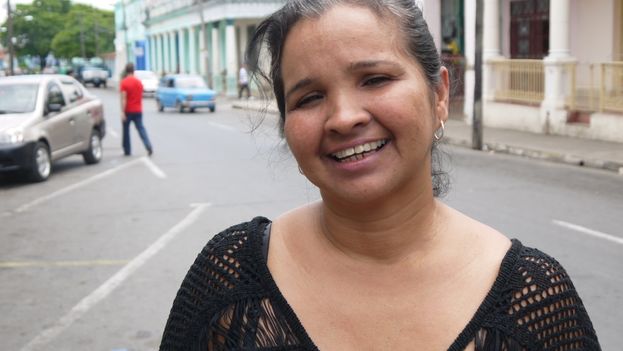
“I am optimistic I will see prosperity in Cuba” / 14ymedio, Reinaldo Escobar

Karina Galvez Chiu (14ymedio)

14ymedio, Havana, 8 August 2014, Reinaldo Escobar – Pinar del Río born and bread, and a member of the editorial board of the magazine Convivencia (Coexistence), Karina Gálvez has made some important decisions in her life. She wants to continue to live in Cuba, to help change the country from civil society and some to recover the piece of patio that the authorities confiscated from her parents’ house. Today she talks with the readers of 14ymedio about her personal evolution, the Cuban economy, and her dreams for the future.

Question: Isn’t it a bit contradictory to be an economist in Cuba?

Answer: When I graduated, the final subject of my thesis focused on the economic effectiveness of the use of bagasse (sugar cane stalk fiber) for boards. The result of the investigation was negative, because making boards in those conditions was expensive and the product quality was very bad. But they ignored us.

Q: Since the conclusion of your studies you have dedicated yourself to teaching. Did you ever instill in your students that socialism was the best way to manage an economy? continue reading

A: Thank God, I have taught subjects that are technical rather than economic theory. Still, I’ve gotten into trouble. In the course on economic legislation, I did research in the school where I included many examples of economic crimes. The “problem” was that I wanted to separate what was criminal according to current laws, from what was immoral. For example, one could say “that to kill a cow is a crime, but it’s not immoral if the cow belongs to you and wasn’t stolen.”

Q: What was your personal transformation to get to where you are today?

A: I was a member of the Union of Young Communists (UJC) and in the late eighties I knew what was happening in Eastern Europe and the former Soviet Union. That helped me open my eyes a little. Criticizing within the ranks of the UJC, I had several penalties, arguments and problems.

Along with these disappointments and my departure from the UJC, I met with a group of people who were in opposition in Pinar del Río. I started to hear something different from them and it got me excited. Later, I learned that the main coordinator of that group worked with State Security. A friend had lent me her typewriter to write some papers and then the political police called her in to interrogate her. When she got there, on the other side of the desk—like one more official—was the man who ran our opposition cell. Imagine the surprise!

Q: So is that what turned you around?

A: Not at all. In the end the balance was positive because in the almost clandestine meetings of that group I met a college professor. His name was Luis Enrique Estrella and he had been fired from his job because of political problems. He was the person who first took me to the Parish of Charity where I met Dagoberto Valdés. He was already running a Civic Center group and that night they debated the subject of the Constitution.

Q: So the Civic Center was already in existence?

A: Yes, it had been founded a few months before, at the beginning of 1993. This initiative was just starting out and once I’d been there the first time I couldn’t let it go. One day Dagoberto asked me to go to a slum in Pinar del Río with him, to offer the simplest course there, which was “We are people.” So I started out as a cheerleader. In the Center for Civic Development we came to have computer classes, music, groups of professionals, educators and computer scientists. Later I joined the editorial board of the magazine Vitral [Stained Glass] until it was taken over and in June 2008 along with other colleagues we founded the magazine Convivencia.

Q: What economic model do you think Cuba needs?

A: I wouldn’t like to name a model, but there are issues that are essential to get Cuba out of this situation in which we find ourselves now. One of these issues is recognition of the right to economic initiative, and the right to private property. We need a financial system that circulates money, which is the “blood” of any economy. Today in Cuba it’s not possible to develop this, given that all the banks are state-owned, the companies are state-owned, and the citizens have no right to invest.

As a third point, and here I turn more to the social, we need a tax system that is efficient and fair, or as fair as possible. We know that in economics, always with fairness, “we have to cut our suit to fit the cloth,” because we still haven’t invented the Kingdom of God. So yes, we must move towards fairness.

Q: That’s the economy. What about politics? What are your preferences?

A: I cannot give it a name, but a political model that is inclusive and admits of dialog. I’m not talking about complacency, but real dialog. In Cuba, where we have such a history of caudillos, sectarianism and authoritarianism, those qualities I just listed would be very important.

Q: Are you optimistic? Do you think you will get to see the change?

A: Yes, and also I will see prosperity in Cuba. I think Cubans have the ability to make this a prosperous nation in a short time.

Toward a New Constitution / Rosa Maria Rodriguez

A group of Cubans in Cuba and its diaspora agreed to promote a roadmap for a constitutional consensus. Organizations and public figures from different generations, all ideologies, religious creeds and interests, we believe it’s good that, first, we agree on what kind of constitution we want that is established and take it as a reference for the new constitution, according to our time and reality.

The management group of this project is made up of Rogelio Travieso Pérez, Rafael León Rodríguez, Manuel Cuesta Morúa, Fernando Palacio Mogar, Eroisis González Suárez, Veizant Voloi González, Wilfredo Vallín Almeida and Rosa María Rodríguez Torrado.

continue reading

We want to end the vicious and corrupt circle of the elite which, for decades, has set the course of our country without taking into consideration the opinions of its citizens. The constitutional road map has also been created to bring down the perverse myth born with the ruling political model, in which Cuba is only a part of its children: that extends a hand to take money from emigrants and with the other hand pushed them away and separates them from the environment to which, by right, they belong.

Therefore, we are working together to seek a consensus and constitutional and legal order emanating from the citizens, their diversity, their place of residence and their plurality.

Thousands of Cuban have signed the call for a constituent assembly in Cuba and we continue to call on all our compatriots, wherever they may be or reside, to join this effort, to arm ourselves with a new civilized shield of coexistence. In this course, we invite Cubans to offer their ideas on how to finally manage a Cuba for all within the law.

To promote this effort, compatriots abroad created the site consensoconstitutional.com, where there is an update on this project.

We drafted a methodology in which we encourage Cubans interested in participating are invited to submit papers in which they argue, in about ten points, the reasons why they defend this or that constitutional proposal as a point of departure toward changing the law of laws as we embark on the democratization of our nation.

In May 2014, Cubans inside and outside of Cuba will begin to hold meetings in which we will discuss ideas about the process of promoting consensus. Right now, we are waking to create initiative discussion groups on the island and this design is just the beginning of a long road to justice, equity and the rule of law for all Cubans.

10 April 2014

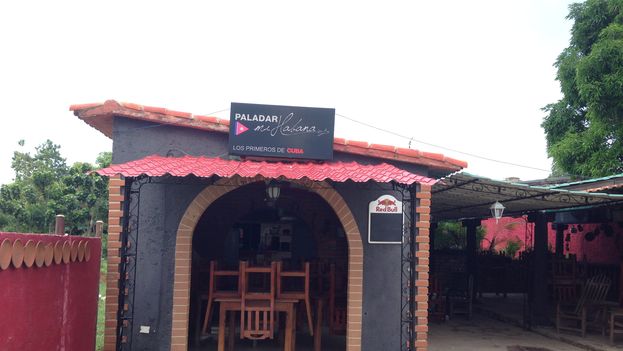
Private Cafes Near the Airport Closed / 14ymedio

Private snack bar shut down (14ymedio)

14YMedio – Half a dozen privately-owned snack cars and restaurants across from Jose Marti International Airport Terminal 2 were ordered to cease operations despite meeting all the tax, commercial and health requirements imposed by law.

The measure affects the large number of people who come to this terminal to drop off or pick up their family members who travel between the United States and Cuba. In the airport there are two state-run snack bars which, in the opinion of the visitors, lack the variety and quality offered by private facilities. continue reading

According to statements to 14ymedio from several of the owners of the closed premises, officials showed up three months ago who imposed the closure measure without giving any explanation Some of the snack bars and restaurants had been open for more than three years and the owners had invested heavily, especially in furniture and kitchen facilities.
José G., one of the self-employed, said that after much paperwork and appeals it appears they will allows them to reopen, but in another place at the back of an alley with very little commercial visibility and difficult access, since the street is not paved.

“They say right here, between our doors and they street, they will erect a separating wall,” says José, who has also complained for years, that “they haven’t even wanted to build a sidewalk for pedestrians. I don’t know if it’s hatred or envy, but the truth is that they’re trying to strangle us.”

At the end of 2013, Cuba 444,109 people were registered as self-employed in Cuba, mostly in food services, passenger transport, renting rooms, and in the production and sale of household items.

The self-employed complain about high taxes, lack of a wholesale market, the inability to independently import and export, and the excessive controls and restrictions placed on them by the inspectors.

Temperamental Old Coots / Anddy Sierra Alvarez

The issue is not just about winning the argument with the United States. It’s also about a legacy created 55 years ago. Of what use to us are their perspectives, when ambitions fade with the passage of time”

The leaders of Cuba are well past working age. Small changes occur at the hands of his brother, Raúl Castro, another long-lived individual who has lived his life and realized the goals he set for himself. What are his ambitions today?

The Cuban desires progress and is at the mercy of old men. Are they perhaps different from others of their age group? As far as I know, an old man does not have the same drive as a young person who is just beginning to face the challenges of the future. continue reading

We are held captive by the arbitrariness of a bunch of geezers…grandfathers once restless in their youth, who now penalize behavior such as they once exhibited…backed up by a poorly-told history that makes heroes out of many, mercenaries out of others, and of those who were not part of their elite group, not even in the shadows are they mentioned. These were members of their beloved and novel revolution.

Their rhetoric is one of equality, yet those who surround them enjoy a level of prestige difficult to achieve. They play at showing solidarity with other peoples, while they trample on their own citizens…self-elected, with no regard for the wishes of their constituents…identified with power, owners of the Island, governing with an ideology that only they believe in…but supported by fellow-travellers, else they would not still be there.

Obsessed with the actions of successive presidents of the United States, to discredit them – and monitor their popularity – is part of their sense of aliveness.

Ready to cease existing when Nature decides, so go the whims of one-time youths who today are in their terminal phase. In the meantime, their legacy has elapsed – in caprice, and much political pride.

Translated by: Alicia Barraqué Ellison

15 August 2014

Soy Yogurt Meant for Children Ends Up Feeding Pigs / Moises Leonardo Rodriguez

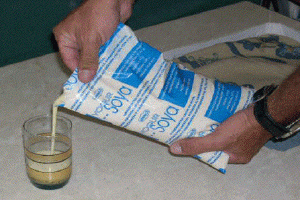
A bag of soy yogurt
A bag of soy yogurt

ARTEMIS, Cuba, Moises Leonardo Rodriguez — Soy yogurt, the sale of which is regulated and intended for children, was received in a spoiled state over the last two weeks in the outlets in the town of Cabañas. In the city of Mariel in the Artemisa province, in contrast, the opening of a new production plant for yogurt destined for Havana and Mayabeque provinces was just announced.

The regulated amount is three one-liter bags a week for every child between 7 and 12 years, replacing cow’s milk, the sale of which is restricted to children under age 7.

Many believe that the priority should be to ensure the technical means so that the product arrives in good condition, before producing more.

Ileana de los Ángeles Iglesias, speaking from Central Havana in the capital, said that the bags bought off the ration book in recent weeks were also spoiled.

A nutritionist, speaking on a recent National Television News broadcast, said that the product should be stored at 2 to 8 degrees Celsius, which appears to explain the deterioration of the yogurt during its delivery in unrefrigerated vehicles in hot weather months, as well as in the warehouses and places of sale.

On 11 August, the yogurt was sold outside the rationing system and a group bought dozens of bags to be fed to pigs, while the children are left waiting for a solution.

Cubanet, August 15, 2014 |

Cholera Situation Worsens in Ciego de Avila / 14ymedio

Worker combating dengue fever (14ymedio)

14YMEDIO – An increase in the number of patients hospitalized for cholera indicates that the unfortunate epidemiological situation in the province of Ciego de Avila is worsening, causing alarm among the population.

After several months of experiencing the illness in this territory, “the last two weeks have seen a growing number of people infected,” according to a small article appearing on the last page of the provincial weekly Invador, under the title “Increase in Cases of Cholera,” written by Moisés González Yero.

Fernando Bravo Fleites, director of the Provincial Center of Hygiene, Epidemiology and Microbiology, states that currently contagion is found in at least 19 places in the province and says that the most critical municipalities are Primero de Enero, Majague, Florencia, Venezuela and Morón.

One of the latest steps has been the temporary closure of the The Charcazo campground in the Primero de Enero municipality.

In an unusual request that is evidence of the decline in the quality of life, the director of the Provincial Center of Hygiene advises Avilanians to redouble “the attention to drinking water that is adequately clean.”

Health authorities also “call on people not to defecate in the open, an act that represents a great danger of disease transmission and, in cases like the present, is a violation severely punished by law.”

Alan Gross: Trapped in a Cold War Tale / Ivan Garcia

Alan Gross (b 1949, NY) before his detention and now.

In the Zamora neighbourhood, next to the Carlos J. Finlay military hospital, in the Marianao Council area, in Eastern Havana, many of the neighbours don’t know anything about the background of Allan Gross, the US contractor, who is stuck there.

It’s a poor district, with little houses, dusty streets and broken pavements. The midday heat finds it deserted. Not even the street dogs can bring themselves to walk over the hot asphalt.

People there take shelter from the mid-day sun inside their houses, or, inside a bare private cafe, put together in a house entrance hall, they talk about the latest TV serial, José Dariel Abreuthe’s 31st home run with the Chicago White Sox, or Barcelona’s next sign-ups.

Around here is where you find out about the latest violent crime which happened the previous night and, if the person you are talking to trusts you, he’ll take you round to the house where one of the neighbours will discreetly sell you some trashy industrial bits and pieces and Chinese cell phones. continue reading

People don’t know Alan Gross, who is kept in a cell in the hospital, just a stone’s throw from the neighbourhood. As far as Ernesto, one of the neighbourhood kids, is concerned, he has heard the name somewhere. “He’s the gringo who they locked up for spying in Cuba”, he says, but he doesn’t know any details of the case. Another kid, who shows off about being well-informed, tells some of the details:

“I found out on the antenna that the American has staged a hunger strike and he says that, dead or alive, he’s going to leave this year (the antenna is an illegal construction — usually made of a metal tray and some Coke cans — and is used as a communication medium in many poor Cuban poor neighbourhoods). I don’t know why Obama doesn’t exchange him for the “three heroes” (Castro spies in jail in the States).

That is what the Cuban man-in-the-street — many of them — know about Gross, the contractor. A spy who came from the north to subvert things on the island.

Not many of them know what it was that he tried to bring into the country. And, when they know that Alan Gross had with him in his briefcases and backpacks two iPods, eleven Blackberrys, three MacBooks, six 500GB discs, three BGAN satellite phones, among other things that Castro’s government considers “illegal,” they look a bit stupid.

“But they sell all this stuff on Revolico (an on-line site condemned by the government). What was the Yank up to, setting up a spy ring with commercial toys,” is what Arnold says, smiling (he is the owner of a little workshop that fixes punctures on your bike or car).

The crime that the olive green State accused him of: “assembling parallel networks to gain illegal access to the internet,” is only an offence in countries with eccentric laws like Cuba or North Korea.

The official media, sporadically offer brief comments, edited in a cleaned-up kind of style, by the hacks at the Foreign Relations Department, who disinform, rather than inform.

People hear about it in the news on the radio and television and it is the main news item in the newspaper Granma. And it all backs up the Cubans’ opinion that Alan Gross was caught carrying out espionage.

Cuba is a nation that scatterbrained foreigners do not know. There are two currencies and the one which is worth more is not the one they pay to workers.

The press assures us that five decades ago they “got rid of prostitution and other capitalist scourges”, but an elderly foreigner on a beach receives more sexual proposals than Brad Pitt.

In order to understand the story put together by the Havana government’s communication experts, we need to have in mind one of its key features: from 1959, the United States is the public enemy number one.

Everything bad stems from that. Six hundred supposed attempts on Fidel Castro’s life: from planning to assassinate him by a bullet through the  temple, to injecting him with a strong poison which would make his beard fall off.

The eleven Presidents who have occupied the White House during Castro’s 55 years are far from being angels. They have hatched attacks, subversions, and assaults on the first Castro. But the regime exaggerates them.

In that context, Alan Gross was a useful pawn for the island’s special services. Gross visited Cuba four times with the idea of giving unrestricted internet access to the small local Jewish community.

On December 3, 2009 the US contractor was sentenced to 15 years in jail by a Cuban tribunal. Gross was not the “stupid innocent taken in by USAID,” as they said at his trial.

He was aware of the risk he was running bringing in information equipment into a totalitarian nation, where parallel communication is a crime against the state.

According to a 2012 article from the AP agency, the reports about his trip indicate that Gross knew his activities were illegal, and he was afraid of the consequences, including possibly being expelled from the country. One of the documents confirms that one of the community’s leaders “made it absolutely clear that we are playing with fire.”

On another occasion, Gross commented “There is no doubt that this is a very dangerous business. It would be catastrophic if they detected the satellite signals.”

It would be possible to appeal to  Raúl Castro’s government’s better nature, asking that they set free an unwell 65-year-old man, who is mentally “out of it,” following the death of his mother the previous 18th of June in Texas.

But the criollo (Cuban) autocracy in playing its own game with the USAID contractor. There are still three spies from the Wasp network locked up in US jails, two of them on life sentences.

Alan Gross was the perfect pretext for a negotiation which the Obama administration finds morally unacceptable, as it would place the elderly Jew on the same level as the Cuban spies.

Gross is an authentic laboratory guinea pig, stuck between the United States’ ambiguous politics and Castro’s attempts to get his agents back home. An exchange which the White House is unwilling to accept.

Iván García

Photo: Alan Gross (b. New York, 1949), before his detention, and now, although he is probably thinner and weaker after his last hunger strike and his depression over his mother’s death last June 18th. Taken from The Cuban History.

Translated by GH

10 August 2014