Four Cubans Among the 50 Most Influential Latin-American Intellectuals of 2014 / 14ymedio

14YMEDIO, Havana/November 19, 2014

The Spanish political magazine Esglobal has included four Cubans in its list of 50 most influential Latin American intellectuals of 2014 published this Wednesday: historian and essayist Rafael Rojas, economist Carmelo Mesa-Lago, professor emeritus at the University of Pittsburgh, blogger and manager of 14ymedio Yoani Sanchez, and the writer Leonardo Padura.

The ranking, developed in collaboration with the Latin-American Faculty of Social Sciences (FLASCO), has as its objective “highlighting the enormous talent and variety of viewpoints that are generated in Spanish and Portuguese, as languages capable of offering alternatives to the hegemonic English in the contemporary world’s dissemination.

To select the intellectuals, the magazine used some basic criteria, like choosing living and active people who perform at least part of their work in Spanish or Portuguese with influence in the Latin-American or international setting.

Among the other intellectuals chosen by Esglobal are Chilean writer Isabel Allende, Pope Francis, Mexican economist Jorge Castaneda, Spanish sociologist Manuel Castells, Mexican activist and journalist Javier Sicilia and Nobel Prize for Literature winner Mario Vargas Llosa.

Translated by MLK

Reporting from San Diego / Ivan Garcia

The Institute of the Americas is located on the campus of San Diego State University

There are Cuban dissidents and independent journalists who, since the emigration and travel reform was enacted by Raul Castro in 2013, have already accumulated some trips abroad. This has not been the case with Ivan, who agreed to travel to the United States because it was for a workshop about investigative journalism, organized by the Institute of the Americas in La Jolla, San Diego, California. And he accepted because it was a short stay of one week. We offer the first of three reports sent from San Diego. (Tania Quintera [Ivan’s mother]). 

Monday, November 10

I made the trip from Havana to Miami without problems. The Miami is airport is a city, I had to walk nearly a kilometer from the gate to passport control. At both customs I was treated well. At the Miami airport I met a former neighbor from La Vibora who worked there.

I took advantage of having to wait three hours for the flight to San Diego to buy a laptop at one of the airport stores (I left mine in Cuba because it is defective). It cost me $200, has Windows 8 and an English keyboard.

The flight to San Diego was long. The plane, a little uncomfortable. The seats were too close together. This is the best way I’ve found for airlines to make money: put people in a tube as if they were cattle. Although the service and food were good. continue reading

I found the San Diego Airport more functional than Miami’s. What I liked best so far is San Diego. A gorgeous city, with clean streets and well cared for houses. For those who have been accustomed to living in a barely lit capital, I was impressed with the great amount of light.

The temperature was 66F degrees, but there was little humidity, the climate was agreeable.

In the hotel rooms there is free internet, but there are computers only in the lobby. The rooms are comfortable. A television with a lot of channels, large bathroom, microwave, dryer, iron, coffee maker, refrigerator and an air conditioner I had to turn down.

Tuesday, November 11

Since the Institute of the Americas started these workshops in 2009, it’s the first time a reporter from Cuba came. The professors’ curriculum is very high level. Yesterday in the afternoon there was a debate about the difficulties of engaging in journalism. It was enriching. The 25 participating journalists are anti-Castro, Venezuelans stand out, with whom I have very good chemistry.

There’s little time for writing. The agenda is packed. When I return to Havana I have thought of writing a dozen stories. I was wrong about what I might expect from the workshop. For years to come, they will think to include subjects related to Cuba. It happens that our country is the ugly duckling of the continent.

The breakfast is too much. In matters of food, the gringos overdo it. We had a good time on Coronado, an island that was and still is a military base, they have a World War II aircraft carrier that is a museum. We dined there. The pizzas gigantic, and the servings of shrimp, it was painful to toss them out when there is so much hunger in the world.

We are going to visit the weekly newspaper Zeta in Tijuana, where in the last 14 years the drug cartels have murdered five journalists.

Wednesday, November 12

Tijuana is a city bordering San Diego and two million people live there. The border crossing seems like a maximum security prison. It is a bad copy of San Diego. There are developments with the same architecture as their neighbors, with the difference that in Tijuana there six thousand well-capitalized factories and businesses.

The interior streets are dark and pot-holed, like Havana. From the border crossing the border the difference is notable. You can smell it in the air. On a narrow boulevard there is a cluster of shops and fast food joints.

I didn’t like the city. It looks like a stage set. It seemed to me that people hide more than they say. You walk the streets and they look at you like you’re a freak. There are many unemployed with apparently nothing to do, but they are doing something: selling a devastating drug called Crystal. It’s a drama. The poor and hopeless people use it to the point of madness. A dose costs some four dollars.

We had lunch at a top restaurant. Excellent food, slow service. By late afternoon we were in a “tolerant” neighborhood. We went with a police patrol and city official. Prostitution is legal. There are around ten blocks of nightclubs and brothels. The prostitutes pay taxes and have to keep their health cards current. In the clubs there are a lot of Chinese, spending dollars on go-go girls.

I was the only one in the group who had to stumble back to San Diego. The immigration official didn’t understand why I presented several gringo visas and was entering the United States from Tijuana. I suppose it must have been a red alert, as nearly 15,000 Cubans a year enter the United States through Mexico.

I replied that if I had wanted to stay I would have done it in Miami and not gone to San Diego. “I like your country, but I have one, it’s called Cuba, I was born there and my family is there,” I told him, and asked him if would have abandoned his.

The guy smiled and answered, “All journalists are the same, they love to turn the tables, but the reality is that Cubans in Mexico stay at the first opportunity.” “I’m not one of those,” I answered. “I think the United States is at fault, they should repeal the Cuban Adjustment Act to end that problem.”

He waved goodbye cheerfully and told me he hoped I wouldn’t write a report accusing him of racism (I’m black) or intolerance towards Latinos, because, “I’m also of Latino descent, it’s nothing personal, but it is my work.”

Colleagues who were waiting in the bus to take us back to the hotel applauded when I got in. In a few days they have learned certain Cuban realities they didn’t know. After the myth of Che Guevara, healthcare for all and good education, here is an autocratic regime.

Iván García

13 November 2014

A New Anniversary / Fernando Damaso

It’s 495 years since the founding of Havana. Celebration after celebration is being held, however, the serious problem of lack of housing grows every day, without any real chances of a solution. The causes of it are many and the results extremely well-known.

According to official data there are 33,889 nuclear families in Havana who need housing, a total of 132,699 people. To these they should add that many of those families have spent 10, 15, 20 and more years living in shelters with and without minimal conditions, where children and even grandchildren have been born.

Lately there’s been a plan to resolve the situation with the construction of urban settlements in different parts of the city, consisting of groups of affordable apartment buildings.

In 2013, 746 of these apartments were built, and in 2014, 817 have been completed, and in the rest of the year 566 are expected for a total of 1,383. In 2015 it’s estimated that 1,480 will be built in that and following years, in line with the economic possibilities and the availability of materials and labor.

As the figures, are sometimes confusing, it is necessary to apply mathematics to understand them: 33,889 nuclear families between 1,500 annual apartments means it will take at least 22 years to resolve the problem.

If to this we add that, according to official data, every day in the city three buildings collapse, for a total of 1,095 annually, so in reality it would leave 405 of the estimated 1,500 buildings, because the other 1,095 would simply compensate for those that disappeared.

With this new data, it would then take 83 years. So this alone is not the solution.

So if you add to these affordable apartments come with a cement floor and the kitchen and bath aren’t completely tiled, leaving in the hands of the tenants, according to their personal means and interests, to improve the level of finishing, adding to that the construction defects that they present (cracks in the floors, damp walls, leaks, etc), the problem increases.

While domestic and foreign private investment in real estate is not authorized, and citizens, because of their low salaries and the high cost of building materials, lack the opportunities of building their own homes, it will be more of the same, and next year Havana will celebrate the anniversary of its founding in worse conditions than today.

17 November 2014

Dissident Cuesta Morua Now Can Travel Abroad / 14ymedio

Manuel Cuesta Morua, spokesman for Progressive Arc (CC)

14ymedio, Havana, 15 November 2014 — Activist Manuel Cuesta Morua, spokesman for Progressive Arc, has been informed that his legal case was dismissed, and he can now travel abroad whenever he desires. The information was made known to him by a lawyer from the Law Collective of Central Havana, who noted that the measure has “no conditions,” according to the dissident’s statement to this daily.

The government opponent had been precluded from travelling outside the country through an interim measure that was imposed on him at the end of last January.

Cuesta Morua, 51 years of age, tried to organize a forum parallel to the Second Summit of the Community of Latin American and Caribbean States (CELAC) then being held in Havana.

The police arrested him to prevent his participation in the meeting, and after that point he had to sign in every Tuesday at the police station where he was arraigned, which prevented him from leaving the country.

In those months, Morua could not attend numerous invitations from international agencies and foundations, like that of this past October for the 25th anniversary of the fall of communism in Poland, which was held by the Lech Walesa Institute.

“Technically they have kept me from travelling with this absurd measure on the part of the authorities; this has been my punishment for my position regarding the Cuban government,” said Morua at the time.

Now in his new situation, the activist is preparing to fulfill several international invitations that include participation in forums, debates and academic meetings, as recounted to 14ymedio.

Translated by MLK


Raul Castro’s Migratory Reform Falters / 14ymedio, Eliecer Avila

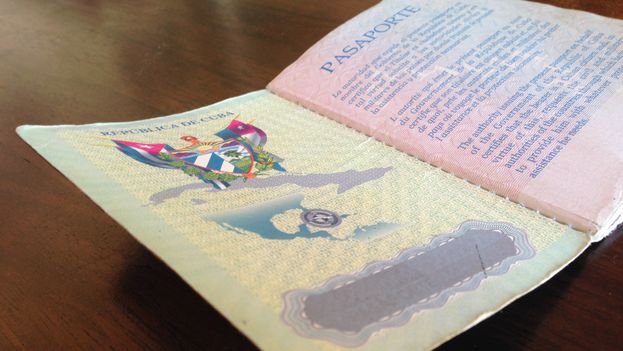
Cuban passport (CC)
Cuban passport (CC)

14ymedio, ELIECER AVILA, Las Tunas/November 15, 2014 — Officials, opposition and public opinion in general have recognized as positive the implementation of the Migratory Reform (covering emigration and travel) promoted by the Cuban government at the beginning of 2013.

In spite of the fact that the trips for many dissidents continue to be marked by abuse, delays and confiscations by Cuban customs authorities, the truth is that until now, only people subject to some kind of legal process, whether invented or not, have been prevented from travelling.

But this may be starting to change. Signs of a sudden regression, in regards to the new rules, come to us from the eastern part of the country.

Two officials, the Major “Oliver” and the Lieutenant Colonel “Vilma,” from State Security Management and Immigration and Alien Status Management (DIE), respectively, have communicated categorically to young Hanner Echavarria Licea that “it has been decided that you are not going to travel.”

To that end, today they retain his certified criminal record document, which the Peruvian embassy demands, so that he cannot participate in the conference “Civic Conscience and Citizen Participation” which will take place in Lima.

The youth, a teaching graduate, self-employed and son of a retired official of the FAR, is a serious and educated young man who enjoys high standing in his community. Precisely the kind of person that State Security cannot bear to see fighting for profound change in Cuba.

Echavarria Licea joined the political movement SOMOS+ and was elected by its members to be its leader in Las Tunas. This seems to be the reason for the current reprisal of not letting him leave the country.

His case could be palpable evidence that even today, someone without prior criminal history or any legal entanglement whatsoever, may be prevented from exercising his right to leave the country. Which would mean the end of the more or less serious application of the Migratory Reform.

Translated by MLK

Audiovisual Education / Regina Coyula

The concerns of cultural and UNEAC officials over the potentially dangerous ideological content of the paquete* (package) is also causing me some concern. I am not an avid consumer of either the paquete or of television in general, but a furtive look, a stolen glance, a scan across the horizon raises serious doubts about the ammunition these Cuban organizations have to counter the barrage of audiovisual material coming from this package.

Are they trying to educate us with soap operas like Avenida Brasil (Brazil Avenue), in which the growing middle class does not make the connection between economic prosperity and good manners or good taste?  Or, alternatively, is Paraíso Tropical (Lost Paradise), which is currently being broadcast, now considered to be the model?

Are they betting on Cuban soap operas, rejected as “ugly” because they portray the current reality or labeled as “sci-fi” because they sugarcoat that same reality?

Do the latest South Korean soap operas (where nothing is ugly and everybody is an idiot) have some deeper meaning that escapes me?

Are they thinking of getting rid of many of their musical programs in which triviality, vulgarity, sexism and bad taste exert a pull over producers as well as musicians?

Is education going to be achieved through interview programs, whether they deal with politics, addiction, entertainment or public services?

Will cinematic education disrupt the profile of their programming, turning the Saturday Movie into a different version of the Sunday Matinee and Midnight Cinema by replaying B movies?

All of this is making me wonder if officials are really as concerned about quality as they are that the paquete continues its expansion unchecked by state supervision. Nah! it doesn’t matter how many operations they carry out. Like the Hydra, for every distributor that is eliminated, two more show up. And if they are trying to counteract its effects with the above-mentioned content or other similar programming, the education of the citizenry will continue to decline. On the other hand, the future success of the paquete, in which everyone chooses what he or she wants, is guaranteed.

Translated by Corriver

*Translator’s note: The paquete, or package, is a selection of foreign entertainment programs distributed informally throughout Cuba. In July, 2014 the national television broadcaster, TVC, admitted it could not compete with its selection of programming. UNEAC is the Spanish abbreviation for the Artist’s and Writer’s Union of Cuba.

17 November 2014

TEDx Lands in Havana / 14ymedio, Rosa Lopez

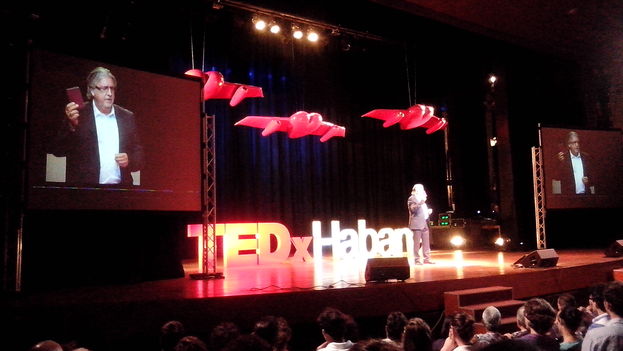
Herman Portocarrero, ambassador of the European Union Delegation, in Havana during his talk, “Borders Without Borders,” during TEDx Havana (Photo: 14ymedio)

For some time, TEDx Havana had been cooking. Those of us who for years have followed the trail of this event, which mixes science, art, design, politics, education, culture and much ingenuity, were counting the days until we could hear on our national stages its stories of entrepreneurship, progress and creativity. Finally, that day arrived, to the gratification of many and the dissatisfaction of many others.

TED is a non-profit organization founded 25 years ago in California, which is an acronym for Technology, Entertainment and Design. Its annual conference has become a feast of ideas and proposals, while the famous “TED Talks” provide a microphone to speakers who inspire their listeners to take on new projects. These talks have, over time, been sneaked into the alternative information networks in Cuba, and they have sparked a desire among the public to see these screen personalities in-person, in the here and now.

For these reasons, there was great anticipation at the news of the imminent landing in our city of that independent – and equally inspiring – part of TED, which is TEDx. The event, named InCUBAndo [“InCUBAting”], took place in the Covarrubias Hall of the National Theatre this past Saturday afternoon. Among the organizers credited in the printed program were the singer Cucú Diamante, the actor Jorge Perugorría, and Andrés Levin, music producer.

We almost did not learn of the arrival of TEDx until 24 hours prior to the curtains being drawn back at the National Theatre.

So, yes, the arrival of this program was literally a landing. The set design in the hall included some little allegorical pink airplanes – the meaning of which many in the audience wondered about – but which turned out to be part of a plastic art installation. Besides which, we almost did not learn of the arrival of TEDx until 24 hours prior to the curtains being drawn back at the National Theatre.

Some flyers distributed at the University of Havana and around the La Rampa cinema last Friday were the first signs to the Havana public that TEDx would arrive in our capital city. Actually, prior to this, the British ambassador to Cuba, Tim Cole, had already announced it on Twitter – but the news only got through to those with Internet access – of which there are very few in this “disconnected city.”

Regardless, as long as we could have TEDx, we were ready to forgive all: the haste of the arrangements, the lack of advertising, and even the “secrecy.” If the event had to occur under these conditions, well, so be it. At any rate, hundreds of Cubans arrived at the scene to hear these exceptional people who were here to tell us their life stories. One of the best presentations was the one titled “Borders Without Borders,” by the diplomat Herman Portocarrero, European Union representative in Cuba.

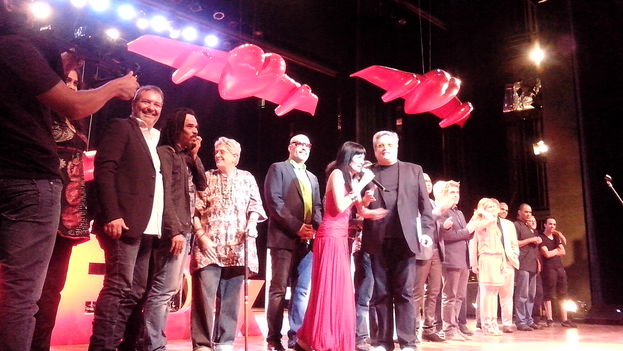
TEDx Havana participants greet the public at the conclusion of the presentation (Photo: 14ymedio)

The energy in the X Alfonso Hall could be felt also from Portocarrero’s story of the birth and first steps of the Cuban Art Factory. Meanwhile the founder of the famous La Guarida restaurant tackled the difficult but gratifying path of the entrepreneur. As host, a dynamic and subtly humorous Amaury Pérez was a good link betweeb some parts of the program. Missing, however, were the voices – further away from the worlds of show business and diplomacy – of others whose ingenuity helps them to survive every day, negotiate the commonplace difficulties, and unbuckle themselves from the straightjacket of our reality.

I do not know the process that was employed to select speakers for TEDx Havana, but what I saw on the stage left me a taste of incompleteness and partiality. The dance music seemed intended to fill those voids and distract an audience that mainly had come to hear anecdotes, testimonies and life stories.

Some of the guest speakers politicized the proceedings, favoring, of course, the official line.

The worst moment was without a doubt the segment of extemporaneous versifiers Tomasita and Luis Paz – who in the middle of their improvisations sang praises to the five Cuban spies, of which three are still in prison in the United States. Up until that moment, many of us accepted the rules of TEDx Havana. Faced with the evident absences at those microphones, I believe that we had convinced ourselves that “it was all right that spaces not be politicized that way.” However, as it turned out, some of the guest speakers politicized the proceedings – favoring, of course, the official line.

Even with all the shambles, TEDx Havana leaves a good taste in the mouth – at the least a feeling that there are people not only with much to tell, but with expressiveness and composure in telling it before hundreds of attentive eyes. The experiences of this first edition will serve to better the second opportunity this event will have to take place among us.

If the organizers are open to suggestions for future TEDx events, it would be good to emphasize better and greater promotion prior to this feast of creativity and entrepreneurship. In addition, let us have transparency in the process of selecting the speakers, so that they may compete and audition in advance, from those who have created a small cottage industry of homemade preserves, to even those who, with ingenuity, laugh at censorship or dream of a Cuba where success in accomplishment is not something extraordinary, but commonplace.

Translated by: Alicia Barraqué Ellison

The Island of the Long Shadows / Angel Santiesteban

Screen Capture – Moment in which Angel Santiesteban was arrested in front of Section 21, after being violently beat up by agents (8/11/12).

Section 21, as this Department of State Security is known, works to track the political activities of the opposition in the Cuban archipelago.  They are the omnipotent masters of the destinies of those who seek democracy and freedom.

In my case, it was the official Camilo, the same one who on November 8th, 2012, after a beating in plain view of the public, told me that they were putting me in jail for 5 years [before Angel’s trial was concluded].

Three months later, I went to prison, convicted by a rigged jury, where they didn’t show a single bit of evidence against me, except that joke by the lieutenant colonel graphologist, who acted as something like a fortune-teller and said that given “the height and inclination of my handwriting*,” I was guilty. Of no value were the five witnesses I presented who corroborated my statement. Not even justice is an impediment to the designs of the political police.

Since I entered prison, it has been the State Security officials who have manipulated my incarceration. The prison officials have always let me know that “they are there to keep me enclosed,” but that they have no rights over my person.

If I fall ill, whether they are to approve or not the pass** that is provided every sixty days for those serving less than 5 years, transfers, disciplinary measures, or for any other motive, they are to call Section 21 and there they will be instructed as to what is to be done with me.

Of course, it was those authorities in that very same Section 21 who gave the go-ahead for my transfer from the Valle Grande prison to La Lima camp, in keeping with my sentence (as I am not supposed to be in prison); from there to prison #1580 (in a new violation of my rights); later, to the Lawton settlement; and now, to the Guardafronteras (Border Patrol) unit, where I am currently held.

According to the prison officials, they are supposed to consult with the officials of Section 21 at each step in my process. They have retained the appeal of my case, delivered at the Ministry of Justice on July 4, 2013, for more than a year. This is because if justice were to be applied, they would have to release me immediately, as requested by my attorney, given my proven innocence. Instead, they gather an extensive list of flagrant violations that, as my defense attorney at the time said after the trial, left me “in a state of utter defenselessness.”

I have stated before that murderers, drug traffickers, pederasts, and others who have committed grave crimes, are treated with the utmost mercy compared to the stance the authorities have taken toward my person, for they treat me according to the strictest of their laws.

At this time they have me cloistered inside a Border Patrol Troops unit, in a small apartment with two rooms and a bath. It is completely barred and there is a guard at the door who records in a log the hour at which I rise, if I take exercise, if I write, etc.

In addition, this small apartment made into a prison cell includes a patio that, in my honor, was completely enclosed in bars – even on the roof – just hours before they decided to transfer me to this place.

However, even while bearing every suffering that their impediments cause, I feel proud to be treated thus. Not even the worst of their measures against me will cause me to back down from my struggle for a more just country — a country in which free expression against the politics laid down by the powers-that-be will not be cause for imprisonment.

Ángel Santiesteban-Prats

Border Patrol Unit Prison. Havana. October, 2014.

Translator’s notes:

*A handwriting expert literally testified at Angel’s trial that his “too slanted” handwriting proved he was a guilty person.

**In an earlier post Angel explained the Cuban penal system that allows prisoners with shorter sentences to leave prison every so many days for extended (overnight) home visits. He was granted one of these passes when he was in the Lawton Settlement, a work camp, but future passes were withheld. 

Translated by: Alicia Barraqué Ellison, and others.

10 November 2014

Havana, how you hurt me! / Yoani Sanchez

Collapsed building in Havana (Photo: Sylvia Corbelle)

Yoani Sanchez, Havana, 16 November 2004 – To be a Havanan is not having been born in a territory, it’s carrying that territory on your back and not being able to put it down. The first time I realized I belonged to this city I was seven years old. I was in a little town in Villa Clara, trying to reach some guavas on a branch, when a bunch of kids from the place surrounded my sister and me. “They’re from Havana! They’re from Havana!” they shrieked. At that moment we didn’t understand so much uproar, but with time we realized that we had come by a sad privilege. Having been born in this city in decline, in this city whose major attraction is what it could be, not what it is.

I am totally urban, a city girl. I grew up in the Cayo Hueso neighborhood where the nearest trees are more than 500 yards away. I am the child of asphalt, of the smell of kerosene, of clotheslines dripping from the balconies and sewer pipes that overflow from time to time. This has never been an easy city. Not even on the tourist postcards, with their retouched colors, can you see a comfortable and comprehensible Havana.

Sometimes now I don’t want to walk it, because it hurts me. I am heading up Belascoaín, my back the sea that I know so well. I arrive at the corner of Reina Street. There is a Gothic-style church, which as a little girl I perceived to be lost in the clouds. I saw my first Christmas tree there when I was seventeen. I walk though the doors, skipping a little to this side and that. Water trickles down some stairs and a woman tries to sell me some milk caramels that are the same color as the street.

I see the traffic light at Galiano, but the pace slows because there are so many people. A cop turns the corner and some hide themselves behind the doors or slip into stores as if they were going to buy something. When the officer leaves, they return and offer their merchandise in undertones. Because Havana is a city of cries and whispers. Those immersed in their own blather may never hear the whispers. The most important things are always said with a nod, a gesture or a simple pursing of the lips that warns you, “be careful,” “coming over there,” “follow me.” A language developed during decades of the clandestine and illegal.

Neptune Street is nearby. I hear an old couple in front of a façade saying, “Hey? Wasn’t it here where there was…?” but I didn’t manage to hear the end of the sentence. Better that way, because Havana is a sequence of nostalgia, memories. When you walk, it’s like you’re traversing the path of the lost. Where a building collapses into rubble that remains for days, for weeks. Later, the hole is made into a park, or a metal kiosk is built to sell soap, trinkets and rum. A lot of rum, because this is a city that drowns its sorrows in alcohol.

I reach the Malecon. In less than half an hour I’ve walked the slice of the city that in my childhood seemed to contain the whole metropolis. Because I was a “guajira de Centro Habana,” an urchin of downtown, one of those who thinks that “the green zones” start right after Infanta Street. With time, I understood that this capital is too big to know the whole of. I also learned that those born in the neighborhoods of Diez de Octubre, el Cerro, el Vedado or Marianao, shared the same sensation of pain. In any event, Havana shows its wounds in any neighborhood.

I touch the wall that separates us from the sea. It is rough and warm. Where are those kids who, in my childhood, in a remote little village, looked at me in astonishment because I was a Havanan? Will they want to bear this burden? Have they also ended up in this city, living among its dumpsters and lights? Does it pain them like it pains me? I’m sure it does, because Havana is not just a location inscribed in our identity documents. This city is a cross that is carried everywhere, a territory that once you have lived it, you cannot abandon.

Some Seven Thousand Cows ‘Disappear” in Villa Clara Province / 14ymedio, Orlando Palma

Cows in Cuba (CC)
Cows in Cuba (CC)

14ymedio, Orlando Palma, Villa Clara, 15 November 2014 – Around 7,000 head of beef cattle were presumed disappeared in the space of a year during a count carried out in ten cattle ranches in the province of Villa Clara, according to a report by the newspaper Juventud Rebelde.

The inspection, carried out by the province’s Department of Livestock Registration and revealed by the official newspaper, was carried out in a group of agricultural production cooperatives where 51 animals were found missing, whereas the State sector counted around 6,900 “not found,” which means the loss of practically the total inventory of these ranches.

Among the explanations the ranchers offered their inspectors are: deaths that could not be reported for lack of a veterinarian to issue the relevant certificate; statistical errors; and – not ruling out! – the possibility that the disappeared cows were victims of theft and illegal slaughter.

To add a touch of science fiction to the matter, as if it had to do with some kind of abduction carried out by extra-terrestrials, the possibility was mentioned that some of the vanished cattle might reappear, maybe because it will be less dangerous to get them from their hiding places without much explanation than to face up and confess where the innocent animals were kept.

Most of the missing heads of cattle were from the townships of Manicaragua, Encrucijada and Sagua La Grande.

Translator’s note: Cows in Cuba belong to the State and it is against the law to kill and eat them. This post from Miguel Iturria Medina — Is Killing a Cow Worse Than Murder — discusses the relative penalties for murder of a human being versus slaughter of a cow. This post from Yoani Sanchez — Male Heifers and Cow Suicide — discusses a creative ways to get around the law.

Translated by MLK

My Encounters With Popieluszko / Mario Lleonart

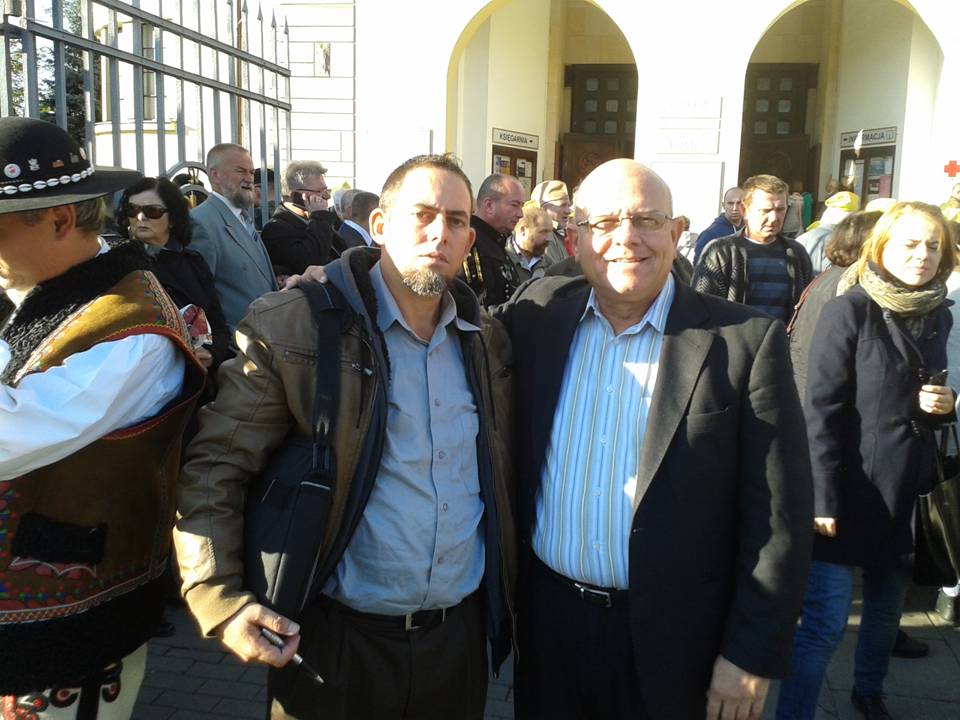
With my brother in Christ Dagoberto Valdes during the homages to Jerzy Popieluszko

In June of 2013 I travelled for the first time to Poland and made an inevitable visit to the tomb of the Polish martyr Jerzy Popieluszko. All the way from distant Cuba, Popieluszko for me embodied the logical challenge of faith in the face of a totalitarian system that is an enemy of God.

If in life Popieluszko more than fulfilled his pastoral duty of defending his fold against the wolf, in death he showed the world the utter impotence of a regime capable of resorting to assassination to silence a prophet, and clearly put in contrast the borders between good and evil in the Poland of 1984.

My return to Poland in October 2014 coincided with the 30th anniversary of the crime agains Popieluszko, and constituted a theological lesson on the implications of the martyrdom of the saints – in particular, the eschatological truth of the Resurrection and the Christian hope that celebrates as ever-living those exceptional beings such as Popieluszko, even though their remains still rest in their tombs.

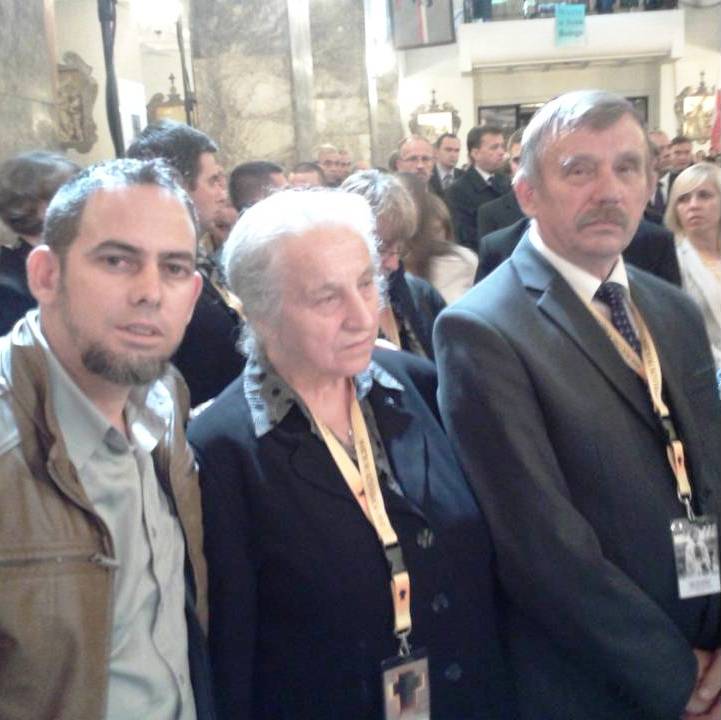
Here I am in the church with the sister and brother of Popieluszko

This time my pilgrimage was not in solitude in search of a site of mystical quietude, as in 2013. It was more like a grain of sand among compact multitudes who were expressing our admiration and remembrance of the good pastor who did not flee when he saw the wolf approaching. At the same time, we were celebrating the fruit of his sacrifice: democracy and liberty in today’s Poland.

Among the first changes evident after 1989, perhaps imperceptible among many enormous and transcendent transformations, was the inclusion (a happy initiative of Lech Walesa’s) of a chapel in no less than the symbolic Presidential Palace – which would have been inconceivable during the period of totalitarian misrule.

Expression of liberties gained constitutes proof that the physical death of the martyr Popieluszko, rather than rendering him invisible, immortalized him to his people and amplified the values and virtues that he preached and practiced in life.

A radiant sun on Sunday, October 19, provided an extraordinary setting — as if in respite from the harsh, quasi-wintry days of autumn — to thousands of Poles and hundreds of citizens from the world over gathered at the place that guards the remains of the martyr who awaits his resurrection.

It was the natural testimony of the celebration in heaven and on earth honoring the the life that Death did not cut short, an evangelical reaffirmation that there are some who kill physical bodies, but they cannot kill souls. Blessed Poland that has her Popieluszko as a sign that in her, the wolves could not — without pastoral resistance — attack the sheep, who in fact chased away the wolf that attacked their pastor.

Multitudes at the tributes to Popieluszko

Happy Poland for not accepting the lament (in other contexts a fitting one) in “Ring Them Bells” by Bob Dylan: “Oh the shepherd is asleep/ where the willows weep/ and the mountains are filled with lost sheep.” God willing that in any part of the world where, as in Cuba, wild beasts have their lair, there be pastors like Popieluszko capable of facing them down, true to their calling, even — were it necessary — unto the sacred privilege of martyrdom.

Translated by: Alicia Barraqué Ellison

29 October 2014

Birthday / Regina Coyula

I can’t forget the first time I saw my blog. I’d gone several weeks making posts through friends, but thanks to a web-connection gift card, finally I could feel the vertigo that comes with peering out from the abyss of the internet. The two hours of that memorable connection were consumed by a virtual onanism; I spent them looking at my own blog, …from the outside.

I couldn’t remember my password in my nervousness. Nervousness joined with the feeling of transgressing a very real internet access restriction which in those days was enforced discretionally and arbitrarily. Nervousness, also and above all, for doing something suspect; that stamp in the Cuban psyche that says that what is not expressly authorized must be prohibited.

It is now five years since those experiences. I’ve become, if not a privileged user, at least an able and avid user of the tools of the web. The blog I began with an urgent feeling is today more sedate, but it has granted me two important things. The first, to take myself on as citizen –which to anyone can be inferred, but we are in Cuba– to learn of projects like the Asociación Jurídica Cubana (Cuban Law Association) or the campaign for the signing of UN covenants on basic human rights. The second, to receive invitations for collaboration with online news sites, particularly with BBC, on the subject of Cuba.

Malaletra (Bad Handwriting) has paid the consequences. I post sporadically and I have lost readers. The comments section, once effervescent, now languishes with one or two notes (which I am grateful for and take into account as I did since the first day).

I also have the impression that after the boom of the Cuban blogosphere, the water level has sunk, but these details I leave to the specialists, because the importance that this virtual space has had for freedom of thought and expression (or quite the opposite) will be part of the history of this strange age in which we’ve been thrown.

Five years later, I continue imagining myself before a screen into the future, always ready to supply opinion.

Now I blow out the little candles.

 Translated by: Ana Diaz

14 November 2014

Exodus, “Modernization,” Solutions and Demands from Democratic Socialism / 14ymedio, Pedro Campos

We democratic socialists have made many proposals for overcoming “State socialism.” We are ignored in spite of our disposition towards dialogue. The past is not the solution for the present, nor for the future.

14ymedio, PEDRO CAMPOS, 4 November 2014 — It is no secret to anyone that in the last year, Cuba has experienced a considerable increase in departures abroad, particularly to the United States, by all possible avenues and, unfortunately, by the most dangerous, in improvised vessels through the Florida Straits and cross-country through Central America, crossing Mexico to arrive at the northern border. Some time ago the topic was broached by the independent and international press. In Cuba…silence.

The problem is, and it must be said loud and clear: The Raulist “modernization,” which offered hope and an interlude of awaiting better times, is not producing the economic, political or social results that it at first awoke among a good number of Cubans. And that is the fundamental cause that is provoking this exodus that threatens to become massive.

Raul Castro’s government itself, without clearly saying it, has recognized it with the announcement of that meager 0.6% growth in the first six months and with the measures taken in the last meeting of the Council of Ministers.

Cuban economists here in Cuba, including some who qualify as official, have publicly manifested their dissatisfaction with the limits and obstacles of the “modernization” measures. This is not about blaming or attacking anyone in particular. But any government, in any part of the world, is responsible for taking necessary measures to guarantee the well-being and contentment of its people.

This silent exodus requires all of us who are interested in the good of the Cuban people to think of solutions, throwing aside all prejudice, mottos, or slogans like that of “without rest but without hurry,” in order to try to find and apply quick, practical and effective solutions.

The Cuban government again blames the imperialist blockade for all ills. But it does nothing even to support the anti-embargo campaign that the New York Times is leading.

The practical measures that it takes do not wind up freeing productive forces, as Raul Castro himself has called for, and they maintain all kinds of obstacles against self-employed work, against the expansion of small business, and especially against autonomous cooperatives, without which post-capitalist society, socialism, is an illusion. continue reading

The State, by various bureaucratic mechanisms, keeps monopolizing internal trade and increasingly restricts the least chance for citizens to import small-scale consumer media that the state-military monopoly TRD* stores are incapable of offering.

Even though opposition politics and thought are peaceful and inoffensive, their repression continues.

The internet continues to be inaccessible for the great majority of the population, unaware of its importance and meaning for the broad development of individual and collective abilities, for the market between different sectors and areas of production, for culture and scientific-technical growth.

The supposed decentralization of state enterprises has been nothing more than a simulation with the creation of the Superior Organization of Entrepreneurial Leadership (OSDE), an intermediate link subordinate to the ministers who neutralize the announced entrepreneurial autonomy and, instead of reducing bureaucracy, increase it.

On the other hand, there is not a single movement in the modernization that points to the direct participation of workers in ownership, leadership, management or profits in the businesses that the State considers most important and productive.

Nevertheless, it organizes “cooperatives” in unprofitable state service workshops that are in crisis, with a series of conditions and dependencies that seem more devoted to demonstrating the failure of cooperative business forms than searching for socialist solutions.

What is the consequence? The entrepreneurs, young technical and professional workers who in some way hope to see positive results from the “modernization,” do not see in practice any real rectification of the statist, bureaucratic, and centralized course and, simply tired, they have decided to undertake the adventure of exile.

Raul said that the mindset had to change. And that is absolutely true. But it is also true that a true process of rectification may be hard to carry out by the same ones who for half a century have been working and living with the mentality that has to change.

That philosophy that continues in force is seen every day in the Party press, where the statements of high leaders continue blaming workers and low-level bureaucrats for the country’s serious problems and low productivity, when we all know that the only thing responsible is that salaried, centralized and bureaucratized state model that pretends to change without changing essentially anything.

If Raul does not want to pass into history as a failed follower of willfully traditional policies, he himself will have to produce a change in his mentality, open himself to new times, forget the worn out “Marxist/Leninist” theories of a single-party leader of a dictatorship of the proletariat and of non-democratic centralism, and end up achieving true changes guided by democratization and socialization of politics and the economy.

This demand does not come from Miami, from the traditional opposition to socialist ideas or from any organization financed by “the enemy.” It comes from the last deprived step of the pyramid—“the low man on the totem pole”—with barely a crust of bread on the table, by the right of having sacrificed and delivered the best years of our lives to a revolutionary process into which we poured the great majority of our hopes.

We do it from that generation that today, courting 60 or 70 years of age, has to invent for itself a means of living because the miserable pensions do not cover food for a week; the generation that did not hesitate to step to the front when called upon for Girón (the Bay of Pigs), El Escambray, the Literacy Campaign or the Militias or when they asked us for the unconditional delivery of thousands of hours of voluntary work in the cane, coffee and tobacco fields.

We do it from the right given us for having completed international missions in which life left us, not occasionally but almost daily, for years and on the enemy field.

How to come out from this?

We democratic socialists from Cuba and all over the world have written quite a lot about how to overcome the model of “State socialism” which masks a monopolistic State capitalism. They have never wanted to hear us, or our proposals have been applied in a skewed and incoherent manner although we have always been open to dialogue. But some cheesy bureaucrats have labeled us even as enemies and agents of imperialism.

For ourselves, old now, many sick, veterans of uncounted battles, we ask for nothing; but we do demand with all the strength of our voices, semi-muffled by the years and by intolerance, that they finally taking practical steps, effective for getting the Cuban people out of this situation, so that our children and grandchildren do not have to keep risking their lives in the waters of the Caribbean or crossing Central American borders and so that we do not have to repent on our death beds for having served causes that have turned out to be ignoble.

We also know that there is more time than life and that the past is not the solution for the present but for the future.

For a society of free workers.

*Translator’s note: The State-run stores selling only in hard currency are called “TRDs” – an acronym for the phrase: Currency Collection Stores. In other words, they are designed to ‘collect’ the income some Cubans receive from remittances sent by their family and friends abroad, by selling products otherwise unavailable at hugely inflated prices.

Translated by MLK

Poland’s Solidarity With Cuban Civil Society / Intramuros, Dagoberto Valdes

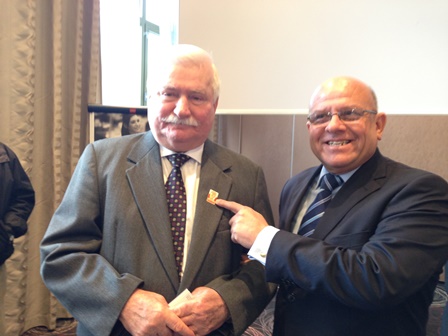
Former Polish President Lech Walesa and Dagoberto Valdés


by Dagoberto Valdés Hernández

A year ago I was able to realize one of my lifelong dreams: to visit Poland, a country that remained loyal to its faith and liberty. This past October 20, I had the honor and joy of my second encounter with President Lech Walesa. Just before midday, we arrived at the Warsaw Hotel following a fruitful and cordial meeting with Poland’s vice minister of foreign relations, Mr. Leszek Soczewica.  There we learned that solidarity does not necessarily have to be at odds with an ethical pragmatism.

President Walesa, energetic and affectionate in manner, arrived with quick greetings for everyone, then took his seat to address some urgent words of attention to Cuba and conveying a transcendent message of affection and exhortation toward courageous and responsible action.

Upon concluding his wise words, he expressed his desire to listen to us to better learn first-hand the actual reality of the Cuban people. Various of those present were able to express our concerns for Cuba and we asked him to support the four points of consensus identified and claimed by a growing and significant civil society group in Cuba. President Walesa expressed his support for the four points and encouraged us to strengthen the structure of civil society.

Others also presented their projects and agendas. The wife of Mr. Manuel Cuesta Morúa asked Walesa to support and request the total liberation and exoneration from charges of her husband. She received backing for her cause from the leader of Solidarity and his countrymen. Mr. Walesa expressed, with fervent devotion to Cuba, that he concurred with the four points and also that he desired to travel to Cuba when conditions were right for him to do so.

Each participant was able to have his or her picture taken with President Lech Walesa, grateful for his time and commitment to Cuba.

Director of Convivencia (Coexistence) Project and Magazine

Translated by: Alicia Barraqué Ellison

30 October 2014

Fortunate Accidents / Rebeca Monzo

Some of the most spectacular recipes in gastronomy have been the result of accidents that occurred during their preparation.

I remember that during the second half of the 1960s, while fulfilling diplomatic duties in Paris, I would frequently visit the Cuban embassy and there I met and established a lovely friendship with Chef Gilberto Smith, his wife, and children. Smith, knowing my fondness for culinary pursuits, would invite me to participate in the finishing and presentation of his famous dishes.

During one of these exchanges, he shared with me how his exquisite and famous recipe for “Lobster au Café” (coffee-infused lobster) came to be: “Some lobsters I was cooking were sticking to the pot, almost burning, and all I had on-hand was a big jugs of fresh-brewed coffee reserved for guests. I emptied the jug’s contents, firefighter-style, over the lobsters, and from this emerged the famous recipe that I later perfected.”

A few days ago, this story was on my mind as I worked in my kitchen from early morning on, preparing dessert for a luncheon to which I had invited a couple who are friends of mine. My mother always used to tell me that she liked to make dessert first, just in case something came up that interrupted the proceedings.

I had left on the double boiler a very soft pudding I make that many people confuse with flan. I got busy doing other things when suddenly I detected an aroma coming from the kitchen that was like a cake baking. I ran to see what was happening and noticed that all the water in the double-boiler had evaporated. I quickly removed the top pan so that the pudding could cool and, upon turning it over, part of the pudding remained stuck to the caramelized sugar on the pan, ruining the look of the pudding.

I couldn’t serve it that way to my guests, but neither could I discard it. I immediately set to preparing another dessert. This time, using a bit of cornstarch I had in my pantry, I made a type of soft “floating islands” custard. On this go-round there were no problems. It was then that I got the idea to present both dishes together as one.

I found some deep, wide-mouth crystal water glasses. On the bottom of each I placed a bit of the pudding, filled the rest with the soft custard, crowning each with a bit of burnt meringue, a mint leaf, and grinding some cinnamon over the top to give it a more pleasing appearance.

The dessert was a success, enjoyed and much-praised – but when they requested the recipe and asked what the dish is called, I could think of no other name than “Copa Rebeca” (Rebeca Goblet).

 Translated by: Alicia Barraqué Ellison

14 November 2014