Armandito’s wheels / 14ymedio, Reinaldo Escobar

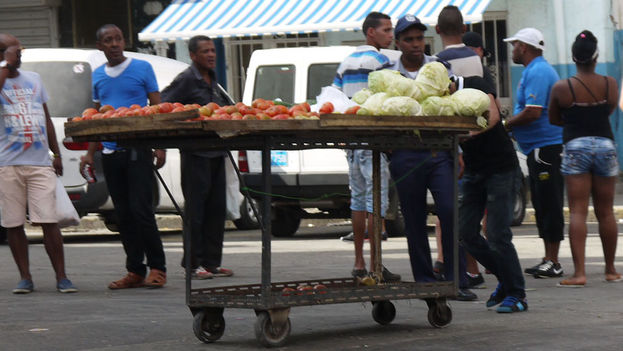
Police approach the portable stand with illegal wheels (14ymedio)

14ymedio, Reinaldo Escobar, Havana, 5 January 2014 – With the authorization of mobile vendors, among the new forms of self-employment, an unexpected problem has arisen: the wheels. I’m not going to wear myself out here talking about the intimate relationship that exists between translational movement and this circular mechanical piece that rotates around an axis. The lack of foresight is as obvious as it is surprising, on the part of the bureaucrats who did not take into account something so elemental. If there isn’t a good supply of wheels suitable to move certain volumes of merchandise, those who use a cart, a scooter, or a wheelbarrow will take them where they find them. continue reading

Dumpsters are the most frequent victims of this depredation. The extraction is not always done in a friendly way, that is undoing the screws that connect the rolling mechanism to the base of the trash container, because on many occasions it is more practical to rip them out by force or to take the whole container and sell the rest of the structure as raw material for the manufacture of clothespins.

The wheels are often taken from the containers, though sometimes the remaining structure is also used. (14ymedio)

A few yards from Prado and Neptuno, the mythical corner of the song, “La Engañadora,” [The Deceiver] the police have detained Armandito, a vegetable seller. Pushing his cabbages, tomatoes and onions, piled on a metallic structure that surely also qualifies as of doubtful origin. The law enforcement agents have examined the wheels and have determined they are illegal. Around the scene several bystanders intercede, asking for clemency. “This boy is working… Why can’t you leave him in peace,” a gray-haired man tells the officer.

“They’re ruining the dumpsters,” the cop replies, and the mobile vendor has no option but to let himself be taken to some police station to make a statement, where he might end up in a cell for hours or days. In the interrogation they will want to know how he acquired the wheels for his transport, who supplied them to him and at what price. A fine, a forfeiture, and if he’s a repeat offender it won’t end there.

Not far from where they caught the vendor, someone has installed the mutilated corner of a garbage container over a doorjamb. Still, full of holes and broken it will continue providing service to unsuspected limits and could be a victim of other thieves, who might rip off the remaining wheels. Will Armandito confess where he got his?

Political repression increases in Cuba during the month of December, according to CCHRNC / 14ymedio

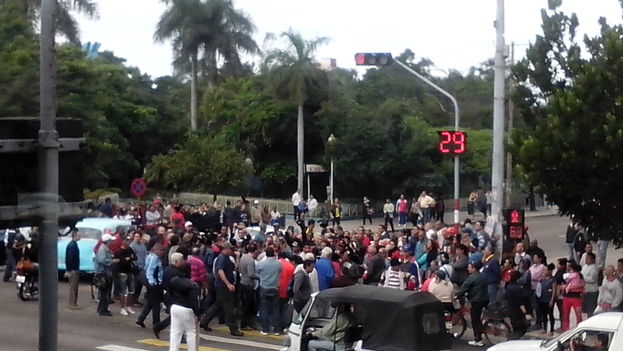
People gathering in Havana on Human Rights Day in December. (14ymedio)

14ymedio, Havana, 5 January 2015 — According to its monthly report, during the month of December the Cuban Commission for Human Rights and reconciliation (CCDHRN) registered at least 489 arbitrary arrests for political reasons, closing out 2014 with at least 8,899 arrests for the year. continue reading

The commission, based in Havana, said that despite the reestablishment of relations between Cuba and the US, “The situation of civil and political rights and other fundamental rights in Cuba continues to be the worst in the entire Western Hemisphere.”

The month of December was marked by two events that produced a large number of arrests. The first occurred on December 10, World Human Rights Day. That date was marked by a wave of, “At least 234 arrests at the hands of the Cuban government, often with violence, of peaceful dissidents,” according to the CCDHRN report.

The second wave of arrests occurred on 30 December, the date of the ‘performance’ scheduled by Tania Bruguera for the Plaza of the Revolution. At least 70 people, including several reporters from this digital newspaper, were arrested by the political police for attending or trying to attend the Tatlin’s Whisper performance, which was intended to exercise the right of free expression. These detentions lasted, in some cases, up to 72 hours.

The CCDHRN also warned that, compared with November, in December there was an increase in, “The victims of physical aggression, acts of vandalism and harassment, and acts of repudiation.” Furthermore, three new political prisoners were jailed in December: Danilo Maldonado, Sonia González and Marcelino Abreu.

Tania Bruguera leaves UNEAC and returns her National Culture Award / 14ymedio

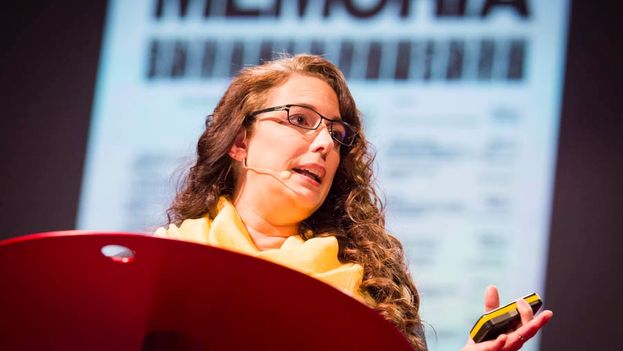
Tania Bruguera at TEDGlobal 2013. (James Duncan Davidson)

14ymedio, Havana, 5 January 2014 – This Monday, the Cuban artist Tania Bruguera returned the National Culture Award (Distinción por la Cultura Nacional) she received in 2002, and decided to renounce her membership in the National Union of Writers and Artists of Cuba (UNEAC).

“I can not receive recognition from, nor be part of, an institution that speaks for all but only through the presidency of the organization. Cultural institutions which, instead of opening a dialogue and a space for aesthetic analysis criminalize and judge, reduce the response to a work to generating fear of the work, and on top of it, distance themselves from it,” says the letter addressed to Cuba’s Deputy Minister of Culture, Fernando Rojas, and delivered Monday to the headquarters of the Ministry of Culture. continue reading

Bruguera was released last Friday after her attempt to stage a ‘performance’ in the Plaza of the Revolution in Havana, which would have given one minute at the microphone to any citizen who participated. The artist could not reach the Plaza because she was arrested before leaving home and twice more in the following days. “To peacefully present yourself and speak for one minute is an example of political art and of the function of art in society. It is what is called ‘Art Made for a Specific Political Moment,’ which can be translated as a work undertaken for a specific political context and situation,” she added.

The text of the letter:

Compañero Fernando Rojas
Vice Minister of Culture
Republic of Cuba

Upon my return from Documenta11, on 27 November 2002 the Ministry of Culture gave me, along with other young artists, the National Culture Award (Distinción por la Cultura Nacional). For years I did not give importance to this event because it did not change anything in my life or in my thinking. In fact, I didn’t remember if I had saved it, or if it had been lost. After recent events, this Award has taken on another meaning for me.

Today I return the Award to the Ministry of Culture, I put it in the hands of the vice minister with whom I previously have had ideological discussions about censorship. Today I also renounce my membership in the National Union of Writers and Artists of Cuba (UNEAC). I can not receive recognition from, nor be part of, an institution that speaks for all but only through the presidency of the organization. Cultural institutions which, instead of opening a dialogue and a space for aesthetic analysis criminalize and judge, reduce the response to a work to generating fear of the work, and on top of it, distance themselves from it.

I have heard many times in Cuba that this is not the appropriate time to criticize or to use a metaphor or to stage a work. Many times I have censored myself in the face of these words that magically cast blame on a doubt or an opinion. Today I know that the appropriate time for an artist is ALWAYS, but especially when the ways of evaluating the social or the human are suspended, but the appropriate moment cannot be a government directive because this makes it propaganda and not art. The artist would be in service to a government and not to a society. Opinion and art cannot exist only when they are permitted by the institution. I believe that it was the appropriate moment to make a work of art because all the decisions about what Cuba is going to be are still not implemented. There is still hope, many believe that undefined spaces exist within which all of we Cubans could be a part.

The changes in Cuba cannot be real if the decision comes from above and is reported and must be accepted. The changes in Cuba cannot be real if a different opinion is given when the government invites it. The changes in Cuba cannot be real if Cubans are afraid to know certain words, for example Human Rights. The changes in Cuba cannot be real if Cubans fear that having an opinion will leave them without a job. The changes in Cuba cannot be real if what is of interest to the government about Cubans is their money and not their ideas.

How sad is a government that sees a threat to the state in allowing regular Cubans one minute in which they can say what they think without government control! How sad is a government that jails the audience of a work of art!

Un abrazo,

Tania Bruguera

Havana, 5 January 2015.

The Children of Melchior / Reinaldo Escobar

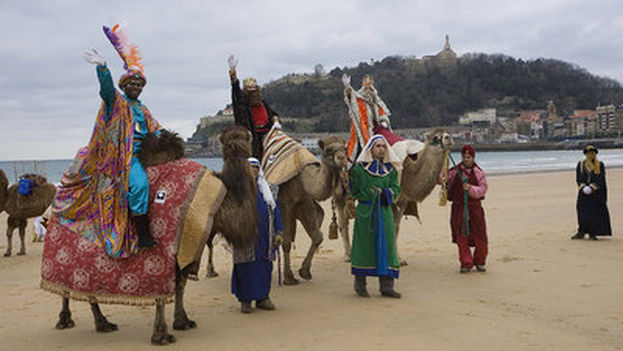
The Magi, the Three Kings

Reinaldo Escobar, Havana, 4 January 2015 – January 5, 1957. Under the enormous tamarind tree in the yard of my house in Camaguey, my cousin Alcibiades looked at me incredulously when I read a letter I intended to leave for the Three Kings. We were both 10, but he knew everything about life: where babies came from, how to light a cigar, and the basic differences between a Ford and a Chevrolet.

With his usual insolence he said, “Are you bonkers? Don’t you know it’s your father who puts the presents under your bed tonight?”

“Yeah, of course,” I said, confused, and put the letter in the pocket of my shirt. continue reading

I looked at my father and he returned the look; I couldn’t believe it. He had to be Melchior, even though he didn’t have a beard. I was the son of one of the Three Kings! There was no other explanation.

Years later I learned all the details. Not even their names were in the Bible, where Saint Matthew told how they were astrologers following a star and that they candidly alerted King Herod to the coming of the Messiah and he, in order to prevent it, unleashed the slaughter of the innocents.

Even today I bump into the same naiveté of my early childhood.

The difference is that now I am the infidel Alcibiades, revealing to the gullible that what happened in Cuba in the last half century isn’t even based on a myth, but a scam.

But there will always be another son of Melchior believing that “this” is justice and when I reveal to him that the system prevailing in Cuba isn’t even the socialism described by the classics, he will conclude that my description must be wrong because the country is on the right track.

Far from the Island, the stars continue to follow their imperturbable course.

The Thousand Ways to Conjure a New Year / Yoani Sanchez

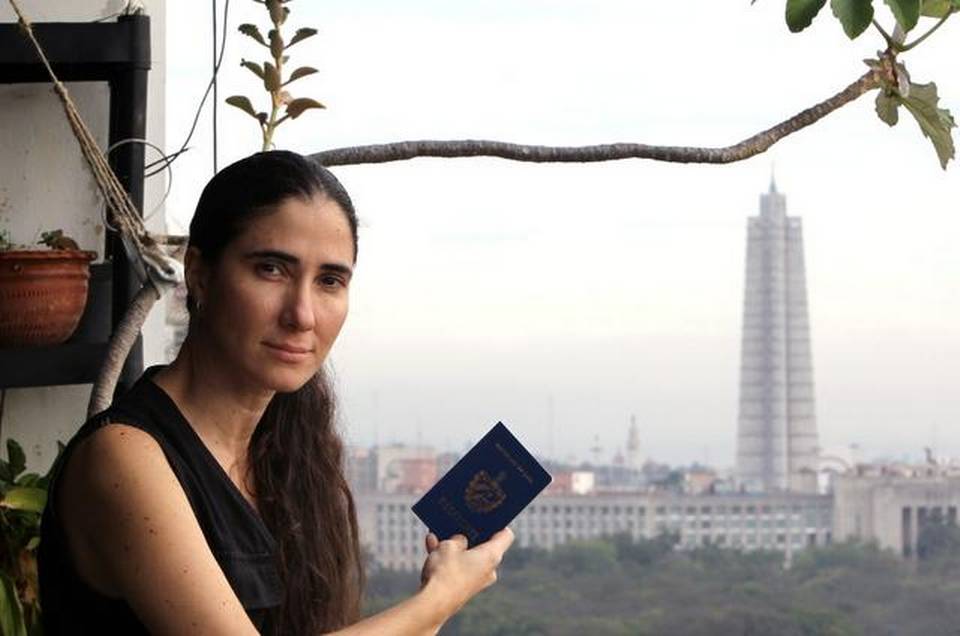
Yoani Sánchez in January 2013, showing her new passport at home in Havana (Cuba). ALEJANDRO ERNESTO (EPA) EFE

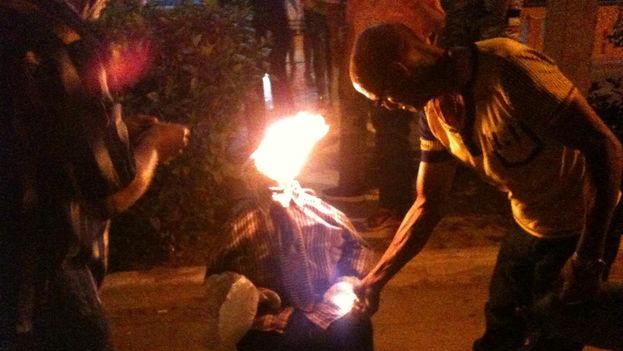
El Nuevo Herald, Yoani Sanchez, 3 January 2015 – In the afternoon they started to assemble a doll. An old shirt, a straw hat and the dirty pants of a neighbor who repairs cars. In the end, it had a sad face and some straw sticking out through the eye holes. A few minutes before the arrival of 2015, they set it on fire. Everyone laughed and danced around the slowly-burning puppet. “We are scorching the bad that happened to us in 2014,” the principal organizer of the pyre said smugly. The flames lasted long enough for the many curious to arrive and join the hubbub. continue reading

With buckets of water thrown from the balconies, suitcases for a walk around the block, or a burning scarecrow, Cubans try to conjure a better year and leave behind the setbacks of the previous one. A visa to emigrate, prosperity in business, economic development, better housing, love and good health, were the most requested desires. Above all, the Island gravitated to the most incredible hopes and predictions. They asked, and they even asked for the impossible. How many of these dreams and illusions can come true in the coming months? Many and very few, would be the enigmatic response.

Those who continue to place their hopes outside the Island, know that with every day that passes it will be harder to get a visa to emigrate. On the other hand, launching yourself on the Florida Straits continues to be dangerous and uncertain. The fear that 2015 will see the end of the Cuban Adjustment Act has made many rush their departure or choose another destination. However, despite the obstacles, in the coming 12 months the exodus trend will continue, unless an unexpected and miraculous turn of events allows Cubans to realize their personal and professional dreams here at home.

Exhausted by the economic hardships, Cubans wait for the basic market basket to get cheaper and the shortages to end. Throughout 2014 they saw the price of food increase significantly, and the promises of better supplies never materialize. Now, they hang all their hopes on the recently announced normalization of relations between Cuba and the United States bringing a quick improvement to their pockets and their plates.

Self-employed business owners focus their prayers on the opening of wholesale markets, lowering of taxes, and the ability to get bank loans. They could be one of the sectors most benefitted by the expansion of imports from the United States, better access to telecommunications technology, and the increase in Americans traveling to the Island. At midnight on 31 December, the desires of many of these small entrepreneurs, as well, focus on the neighbor to the north.

The government itself has also established priorities. The figure of Fidel Castro will be there for commemorations, panegyrics and yesterday. Raul Castro will try to maintain iron political control while expanding the pockets of economic autonomy, although in a very controlled fashion. He will try to get the most out of relations with his old adversary, but every step closer negates his own system. It’s clear that the official discourse is left without much to hold onto, the unraveling of the conflict that nurtured his complaints, campaigns and slogans.

The dissent, meanwhile, is facing one of the greatest challenges of its long-suffering trajectory. It must take advantage of every crack that opens, finding space for its demands in some negotiations that so far have included only the two governments, and preparing itself to move from the heroic phase to the political phase. The search for consensus will become vital to the survival of the critical sector. Important steps have been taken in this direction with the identification of four demands around which a growing and representative number of activists have come together. All this under a repression that will not ease in the short-term, and in a terrain still adverse to the exercise of free association and free expression.

The youngest, those who were born during the Special Period and who have grown up watching shows off the illegal satellite dishes and consuming the audiovisuals now arriving in the “packets,” are those with the greatest expectations for 2015. Cosmopolitan and insatiable, they want more, much more. They dream that this year they will finally become internauts with access to the great World Wide Web from their own homes. They are anxious to interact with the world without restrictions, to be up-to-date, form associations based on their affinities, organize chats with people at the far reaches of the planet, and participate in legal videogame tournaments. In short, they want to behave as citizens of the twenty-first century.

All of them have projected their hopes, some more simple, and others truly surreal. But it remains to be seen if 2015 will be another year of frustrations or this longed-for moment when dreams begin to be realized.

Translated from El Nuevo Herald

Cold War, Hot Motors / Cubanet, Camilo Ernesto Olivera Peidro

autos-chevrolet-cover1

  • Is the Cuban government considering declaring as “heritage assets” the classic cars that roam the streets?

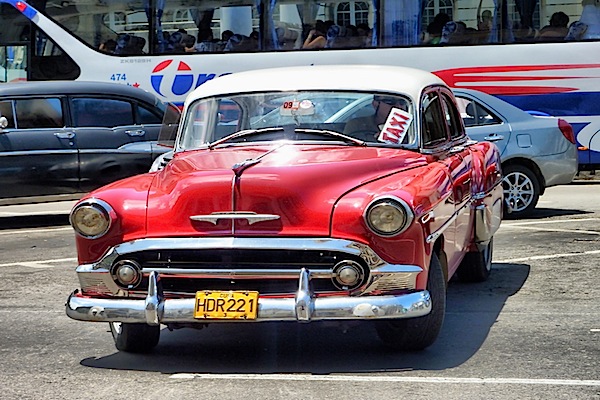
cubanet square logoCubanet, Camilo Ernesto Olivera Peidro, Havana, 2 January 2015 — Apropos of the imminent reestablishment of relations between Cuba and the US, General Motors (GM) recently expressed interest in exploring the possibility of doing business on the Island. Perhaps they see it as a promising market to sell parts and pieces for the cars that this automotive super-company produced during the 1940s and ‘50s.

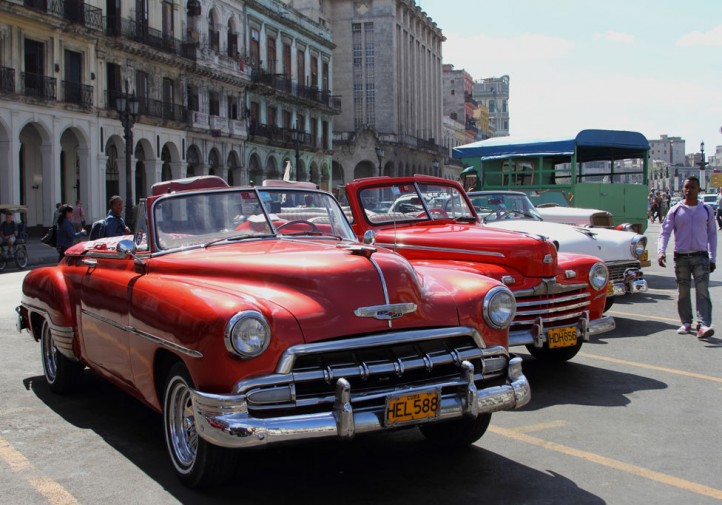
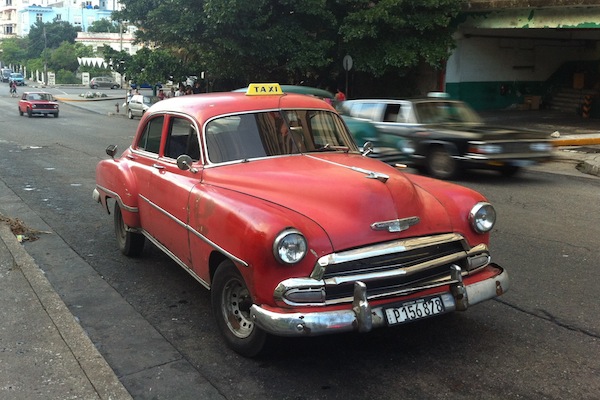
As the old-timers tell it, US car manufacturers would test their products in Cuba, assessing whether the cars could withstand the harsh conditions of our tropical climate. American cars of such makes as Cadillac, Buick, Chevrolet, Pontiac, Chrysler, Dodge, Plymouth, Packard and Ford, rolled around – and continue rolling today – throughout the cities and towns of the Island. continue reading

Although the US and Cuba broke diplomatic relations in January, 1961, there had been no new vehicles or replacement parts entering the Island directly from the North for at least a year prior.

A half-century later, American-made autos are vital to the transport of passengers on the Island. In the US, they are “classic cars,” high-priced collectors’ items. In Cuba, they are called almendrones.*

Cold War vs. Hot Motors

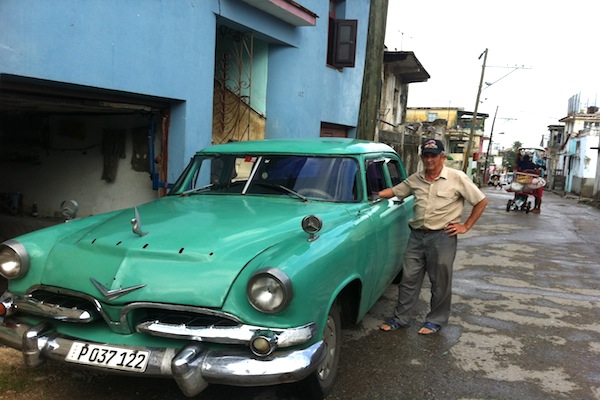
Agustín Godínez bought his first car, a ’55 Chevrolet, in 1970. In 2002 he acquired a Dodge. For years, only those vehicles that arrived in Cuba before 1960 could be bought and sold via a transfer of ownership outside State control. That was until recently.

“The American cars have continued rolling along, thanks to the inventiveness of our mechanics and machinists,” Agustín explained. “These fellows retool parts harvested from other cars. American cars can function with parts from the Soviet Volga, made in the ‘60s and ‘70s. They also work with parts from the Chaika (GAZ-M13), manufactured by the Russians in the ‘50s and ‘60s, which copied elements from the American autos Mercury, Chrysler and Dodge.”

Agustín Godínez and his 1955 Dodge (Photo by the Author)

Godínez added another crucial fact, regarding the resistance of these cars to the ravages of a tropical and salty climate. “During that period the bodies of these cars were made of heavy steel which included lead amalgam,” Godínez explained. “On top of that, you had the proper paint and maintenance.”

Today They Are Taxis, Yesterday They Were “ANCHAR”

In the second half of the 1970s, the Ministry of Transport created an association of private taxis. It admitted for membership only drivers of cars manufactured prior to 1959.

ANCHAR (National Association of Transport Drivers and Vehicles) guaranteed fuel at low cost. It also ran a store that stocked parts and pieces for those cars. The establishment was located in the capital suburb of Mónaco. The association regulated the fares charged by the carriers: basically, 50 centavos [based on the Cuban peso – CUP] per passenger, or up to 5 Cuban pesos per party, to travel to any point in the city.

In the 1980s, a trip to Guanabo Beach from the Havana train terminal would cost up to 2 pesos per person. The vehicles were identifiable by their orange-and-black paint jobs.

What Does a Classic Car Cost in Cuba?

In 1971, a vehicle manufactured in the second half of the 1950s could be had at a price that ranged between 1000 to 1200 pesos CUP. Other models, built in the late 1940s, could cost up to 600 or 700 CUP.

Currently, the private buying and selling of these cars is conducted in CUC [Cuban convertible peso], a national currency equivalent to the US dollar. The value of the autos depends on the model, year, and condition. For example, a Chevrolet from the late ‘50s could cost the buyer, at minimum, 7,000 CUC. At the exchange rate of 1 CUC for 24 CUP, this would be 168,000 Cuban pesos CUP.

At this moment it is unknown whether the Cuban government plans to declare as “heritage assets” the classic cars that exist in Cuba.

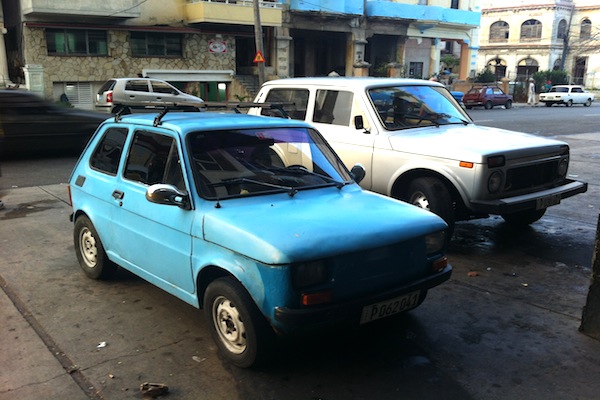
They stand out to any visitor: the streets of Cuba are a veritable rolling museum. One can spot specimens ranging as diverse as a Ford from 1929 and a 1950s Chevrolet, to the miniscule Polski, nicknamed “the little Pole.” The latter was copied from a model patented by Fiat, as well as the Soviet Lada Niva.

Since 1990 there have been no massive imports to the Island of parts and pieces for Eastern European-made autos. Even so, the Moskvich, and also the Lada models 1600, 2107, and Samara, are still circulating.

At the halfway point between East and West, 50 years are summarized in this Cuban motorized ajiaco** which has not ceased from rolling up to today.

Photos by author:

ADAPTACION-DEL-TIMON-DE-AUTO-FIAT-AL-DODGEFOTO-CAMILO-ERNESTO-OLIVERA-Copy
A Fiat Steering Wheel on a 1955 Dodge

AUTO-POLSKICOLOR-AZUL-EN-SEGUNDO-PLANO-LADA-NIVA-1600FOTO-CAMILO-ERNESTO-OLIVERA-1autos-cover-722x505CHEVROLET-1952-EN-SEGUNDO-PLANO-DE-COLOR-NEGRO-CHAIKA-M-14URSS-1977-

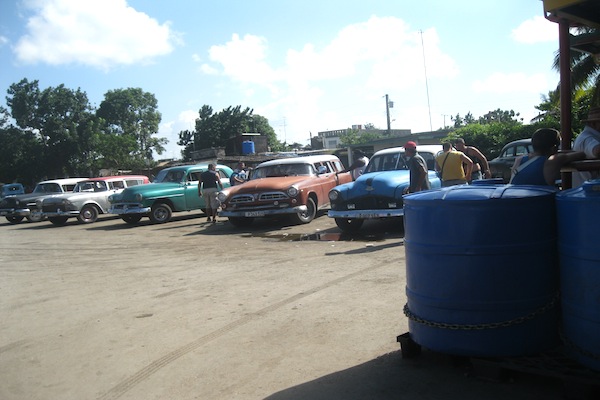
Fleet of private transport vehicles

Translator’s Notes:
*The nickname refers to the almond shape of these antique cars.
**
Ajiaco is a traditional Cuban stew. The term is often used to convey great diversity or miscellany – similar to the idiomatic use in the US of the term, “pot pourri.”

Translated by Alicia Barraqué Ellison

An Independent Legal Group Files a Habeas Corpus Petition on behalf of El Sexto / 14ymedio

The artist Danilo Maldonado, El Sexto (Luz Escobar)

14YMEDIO, Havana, 29 December 2014 — On Monday, the independent group CubaLex filed a petition for habeas corpus in the case of artist Danilo Maldonado, El Sexto. In a document addressed to the Provincial Tribunal of Hanvana, the lawyers urge that the arrestee’s rights be respected and also that he be permitted a proper defense. Police have informed the relatives of the prisoner that all trials scheduled for the upcoming days, including that of the artist initially scheduled for next Wednesday, the last day of 2014, are delayed until the new year.

El Sexto was arrested December 25 shortly before carrying out a performance which consisted of releasing two pigs with the names of “Fidel and Raul” in a public square. He is charged with contempt. continue reading

Although the artist had told several friends of his desire to keep the exact date of the performance discreet, the police managed to find out and stopped the car in which he was traveling to the site. At first he was taken to the 4th Precinct Police Station at Infanta and Manglar, and then they transferred him to Zapata and C Station in Vedado, where he remains now.

Lawyer Laritza Diversent in conversation with 14ymedio has emphasized that she believes that “in this case they chose the date of December 31 with a malevolent intention because it is difficult to find a lawyer who wants to participate in a trial.” Nevertheless, Cubalex is advising El Sexto’s relatives to hire a lawyer from a collective firm as soon as possible. If they do not manage it in the next few hours, El Sexto would run the risk of being tried without the presence of his defender.

Habeas corpus is a legal institution that seeks to “prevent arbitrary arrests and detentions.” Its fundamental principal is the obligation to bring all arrestees before a judge within a short time period. In the case of El Sexto, today, Monday, marks four days since his arrest and incarceration.

Translated by MLK

Different Disputes / Fernando Damaso

The initiation of changes in the historical dispute between the Cuban government and the different government administrations of the United States that has begun with the reestablishment of diplomatic relations, should address, as has been pointed out by both leaders, other issues that may not be so easy to resolve.

Despite this first step and the others to come influenced from within Cuba, this does not mean that the other important dispute will be solved: that between the Cuban government and its citizens.

This dispute has become more complex because for too many years power has been exercised by only two people, supported by their closest generational followers, who have committed multiple and costly political, economic and social errors, which were never addressed in time and which have affected the entire country, precipitating a too prolonged crisis, due to which they have lost credibility with the citizens. continue reading

For some time, despite the fact that the authorities do not want to recognize it and continue to bet on a national unity that we all know to be in form only, a great number of Cubans demand changes, not only economic but also political and social. They demonstrate it with their families, friends and even neighbors, although they still don’t dare to express it out loud.

Those who think that economic reforms will not generate demands for political reforms are mistaken. The Cuban nation needs to renew itself and catch up with the times. Will this be facilitated by the few living representatives of the historic generation in the time they have left to them, or will it be done by representatives of new generations, who still, perhaps, remain unknown to the majority of the people?

On officially letting go of the “external enemy,” the authorities will find it very difficult to continue to use it as a pretext to block the exercise of the individual rights of every citizen. They can continue talking about general rights, as they have done up until now, but they cannot ignore the others. Resolving the external dispute requires them to begin to resolve the internal one.

31 December 2014

The Death of “Fidelism” and the Collapse of the Embargo / Dimas Castellano

The decision of the president of United States to reestablish diplomatic relations with Cuba, the interruption of which was so negative for the Cuban people, such that everything that happened in the last 53 years is related to this event, especially the setbacks suffered in material well-being, freedom and rights, which returned the country to a situation similar to that which existed on the island before 1878.

The antecedents to the rupture date back to 1959, when the revolutionaries replaced in 1940 Constitution with the Fundamental Law of the Cuban State, the prime minister assumed the duties of the head of government, and the Council of Ministers the functions of Congress, together marking the start of the concentration of political and military power in one person, the concentration of property in the hands of the state, and the dismantling of civil society.

The result was a totalitarian system which we call Fidelismo, characterized among other things by volunteerism, economic inefficiency, and hostility toward the United States; a system that began it decline starting in 2006. continue reading

The escalation had as a starting point the nationalization of American properties and the response by the United States to break diplomatic relations and implement the embargo; the confrontation of over half a century that brought material losses and armed conflicts with tens of thousands of deaths, pain and suffering.

The reestablishment is the result of multiple factors, among them:

1 – The unworkability of Fidelismo, incapable of satisfying the most basic needs of the people.

2 – The failure of Venezuela, multiplied by the sharp fall in the price of oil and its effect on the subsidies to Cuba.

3 – The frustration of American policy intended to promote changes within the island.

4 – The use made by the Cuban government of mistakes in this policy to affect relations between the United States and the other countries in the region.

5- The use of the dispute by the Cuban government to justify the failures of it model.

6 – The shift in American policy since the first term of Barack Obama.

7 – The changes introduced since Raul Castro assumed the leadership of the state.

As an external conflicts tend to demobilize internal conflicts, the Cuban government utilized the dispute to block the rearmament of civil society, excuse the inefficiency, and avoid any commitment to human rights, and 18 years after taking power it institutionalized Fidelismo.

In the image and likeness of the Soviet Union it approved a the Constitution which endorsed the Communist Party as the leading force in society and of the state, and created a unicameral parliament that confirmed Fidel Castro as chief of state and the government.

The collapse of socialism in Eastern Europe unveiled the failure. The government had to introduce a package of short-term reforms that were paralyzed as soon as they begin to give birth to a middle-class.

The inefficiency resulting is reflected in the loss of any relationship between wages and the cost of living, the growth in the activities outside the law to survive, the massive exodus and the decline in population.

In this context General Raul Castro assumed leadership of the state and implemented a package of measures that demonstrated the exhaustion of Fidelismo, because the efficiency to conserve power turned out not to be transferable to the economy.

Worsening conditions and despair begin to march at a rhythm faster than that of the changes, one of its manifestations was the growing exodus, which represented a potential danger for the United States

To this we add a foreign-policy deployed by Cuba toward Latin America that managed to affect American influence in the region. As a result of these and other events the dispute became detrimental for both parties. The Cuban government failed in the attempt to manage an efficient economy and the United States government failed to yield to Cuba: Fidelismo failed and the embargo failed.

This no-win situation led to indirect contacts which led to direct and secret conversations, accelerated by various factors, the most decisive of which was the danger that the American citizen Alan Gross would die due to the worsening of his health.

Without ignoring the major obstacles to be overcome, the reestablishment will prevent an exit strategy that threatened violence and a massive immigration to the United States, and at the same time will remove the bases that allowed the totalitarian model to decide the fate of the country and each one of its inhabitants.

Because of this, the decision is useful to the interest of the United States; useful to the Cuban government, to whom it provides a “decent” exit; and above all, useful to Cubans in creating an environment favorable to their empowerment

The intention of the Cuban government, more than renouncing the confrontation, consisted in forcing in the United States to relax the American measures without undertaking internal changes that threaten the power of the Cuban government. However President Obama’s speech and the communication from the White House do not respond directly to this intention.

What’s more, the US president did not mention the Government, but rather Cuba and its people, announcing together with the instructions to reestablish relations, a package of measures directed to create conditions for citizen empowerment, in a context characterized by the end of the Fidelismo and growing discontent among Cubans.

Obama’s speech, although it doesn’t directly require the Cuban government to reestablish civil liberties, places it in an awkward position in its own country and before the international community. With that in place, the “enemy” is in the foreground of the Cuban government’s conduct with its own people. The rest is up to us.

Although the government and its press tried to make us believe that what happened was a limited exchange of prisoners and the reestablishment of relations, going forward attention will focus on the relationship between the people and the government, such that the news of this December 17 is the death certificate of Fidelismo and the event of greatest political significance in Cuba since 1959.

More important than agreeing or not agreeing with what happened, is taking advantage of the positive brought by the new scenario to fight for the recovery of the condition of citizenship. The success of the measures announced by the White House depend not so much on the will of the regime but on that of the Cuban people; something that cannot be brought by Obama or any external force, but only by ourselves.

The controls on a people lacking the arms of civic institutions will slow the effects, but they cannot avoid them. The government’s first manifestations of resistance was to remain silent about the measures proposed by the White House and to simply say that with a people like ours we can reach the 570th year of the Revolution.

However, the transformations that are happening in the economy will move inexorably to other sectors of society. And in this process, the speed, the rhythm and the direction, which were defined by the Cuban government before the normalization of relations, will suffer serious alterations, among others the emergence of a middle-class, the rebirth of civility, and the recovery of the condition of citizenship.

Published in Diario de Cuba

2 January 2015
Hip-Hop in the Spotlight / Fernando Damaso

I love information / I need an airplane / I need information / I love information

Allegations continue in the Cuban official press about the subversion organized by USAID against the ruling regime in the country. Now it touches the hip-hop musical movement. I will not devote time to whether or not it is true or a fictional plot released by the Associated Press news agency, because I prefer the episodes of “Homeland.” I will address some unpublished questions which I consider more important and which constitute the genesis of the problem.

It is no secret that in the Cuban musical world there are groups and performers cheered on by the authorities who enjoy economic privileges and dissemination, those popularly called “officialistic.” These participated in a repudiation rally organized by the Pineapple Festival in Ciego de Avila, to offer just one example. They are abundant and we see and hear them in many Government political activities. continue reading

Currently they will be present on Christmas Eve, Christmas, or New Year’s, not to make these events any more agreeable, but to celebrate the 56th anniversary of the Triumph of the Revolution. I don’t remember that during the Republican Era musical groups and performers answered to the government or to political parties.

There are others who, while addressing the acute social problems that plague the country, are questioned by the authorities, enjoy no privileges, and have to fend for themselves to survive, primarily in “underground” spaces. They have emerged and do emerge, not because USAID creates them, but as a result of the absurd government policies maintained for 56 years, which have destroyed the lives of thousands of Cubans and the country, leaving young people with no hopes in their own land.

Protesting musical groups and performers have existed and do exist in every country, including the United States, and have not been created by USAID. They are respected and form part of the musical world of those with equal rights. To suggest that events in Serbia or Ukraine were promoted by USAID through groups of this type is not only a laughable, it shows a lack of respect for the intelligence of readers.

When will our authorities stop blaming the “enemy” for the problems they themselves created? When will they accept their fault?

Respect for differences and preferences refers not only to the sexual, but also to the political, religious, musical and many others. Until there is full freedom for all Cubans, there will be musical and other types of protesters. USAID is not to blame.

15 December 2014

Entropy of Eliecer Jimenez at Brown University / Orlando Luis Pardo Lazo

THE COPY-PASTE OF REVOLUTIOPHRENIA

Orlando Luis Pardo Lazo

Before Facebook, I met Eliécer Jiménez only once, in an alternative cultural debate in Camagüey, three years ago. He was somewhat shy, but resolute in his urge to be creative in cinematographic terms. No money, no contacts, no political pedigree. A dreamer in a province that looked so asleep. Hope in Cuba today usually depends precisely on awakening in the middle of hopelessness.

We were in the house of Henry Constantín, a common friend and social activist that holds the record of being expelled from different Cuban universities three times, from Santiago de Cuba to La Habana, as despotism is quite equitable throughout the Island. Those public meetings in private are still being held there, with the name of Hora Cero / Zero Hour, a concept that connects with the notion of starting from zero in a society so afraid of citizen initiatives. Zero Hour is in fact an independent space with a lot of communicating vessels with my literary generation called Year Zero, of which I have recently compiled a narrative anthology translated into English by O/R Books in New York. continue reading

During some time I confess that I forgot completely about Eliécer Jiménez. His first films, short and sharp, reached me before I had the chance to remember that he was the same brilliant young man of the autumn of 2011, coincidentally around this date.

I still do not know whether I liked or not his bold visual improvisations. “Free cinema” (or maybe freak cinema, just one minute of a version of our own wall of wails); “Usufruct” (about the limitations in the once solvent Camagüey of the reforms imposed by Raul Castro, also known as Raulforms), “Ice Age” (a naturalistic estrangement filmed inside a domestic freezer), “The face of water” (reflecting on the reflections caused by waste waters running or stagnated on the asphalt), “Wet feet, dry feet” (another documented-in-detail minute focused on floors and social inertia), “Ideological deviation” (a close-up to a rather erotic pair of lips chewing a most likely American gum), “Verdadero Beach, the people’s beach” (not the touristic Varadero but “verdadero”, which means “the real thing” and immediately remits to “vertedero”, that is: a rubbish dump where pigs and humans share a happy bath in the Caribbean), and, of course, the climactic confusion that we are going to sufferenjoy today, Entropy, where the script-writer and director and editor, all in one in the conception of Eliécer Jiménez, decide not to film at all, but to bring provocatively together one hour of fragmentary light and sound from our audiovisual memory, in a virtual cut-up or unpredictable patching of pixels and collage of clicks, among other anachronistic notions in a nation without internet.

Eliécer Jiménez has an underground personal producer that is identified as Ikaik, with two uncommon K’s, in a Kafkaesque allegory to ICAIC, with two Cuban C’s, and this could perfectly be the only one producer in the planet without other budget than his own pockets full of illusion. Nevertheless, many of his documentaries have obtained national awards, like those granted by the Cine Plaza in Havana, by the Sur Imagen film festival in Cienfuegos, by SIGNIS the World Catholic Association for Communication, by the extinct Poor Cinema Festival in Gibara (province of Holguín), and by the quasi-extinct International of School of Cinema and TV in San Antonio de los Baños (Havana province), gone with García-Márquez as one of the tokens of the Castrozoic Era.

Graduated from that school, but much in the style of the Renaissance film-maker named Miguel Coyula (the director of Memories of Overdevelopment, which will join us on November 12th to present his -in my opinion- masterpiece), Eliécer Jiménez is what we call in Cuba “un hombre orquesta” or a do-it-all-by-yourself. The alternative that has frustrated many of my colleagues would be: do-nothing. But luckily Eliécer Jiménez refused to see no entropy, hear no entropy, speak no entropy. And today we will pay the consequences.

His esthetics establishes an obvious dialogue with another Cuban documentary by Armando Capó Ramos entitled “The Revolution is…”. Although we must recognize that, in general terms, younger generations in Cuba are fascinated by a past that it was sacred to their predecessors in art (usually their censors at the same time), but that for them now it’s only useful as raw material for deconstruction (including destruction) and to expose a history that began epical to end up ridiculous. It really seems that no one knows the past that waits for us.

Eliécer Jiménez worked for several boring Cuban radio and TV stations. He published in several not so boring intellectual magazines, like Cuban Cinema. And he is member of some obsolete cultural organizations, like the Saíz Brothers Association and the Cuban Audiovisual Association. All of them are not only State-run, but dependent of the Communist Party, the only one legal in the Island of Liberty. He was tolerated until a point, fortunately. And next year 2015 he will be able to travel abroad to look for some opportunities in the United States, in this unavoidable invasion of asphyxiated Cubans artists and activists than threatens to saturate this country from coast to coast.

Some of his documentaries have been shown in France, Spain, Argentine, Venezuela, Perú, and last April in New York, thanks to the Cuban Cultural Center, and now here at Brown University, thanks to the Center for Latin American and Caribbean Studies.

I will not say much about the 66 minutes of Entropy, that thermodynamic symptom of the degree of disorder of a system (and, please, this is not a political definition). The promotional note refers to Entropy as a docu/mental about a disantropological country, or maybe a clowntry. A remix with no copyrights that goes beyond our backyard tradition of Titón and Tabíos, and Elpidio Valdés and Nicolasito Guillén Landrián, just to vibrate with the Brownian motion of a mass media molecule, from Vertov to Tarkovsky, from Orson Welles to Eisenstein, from Chaplin to Fritz Lang, from Coppola to Spielberg, from Scorsese to Tarantino, in an schizoid cycle from delirium to paranoia.

Cuban cosmogony of the Big Crunch. Youtubrevolution. Counter-clockwork orange designed by an apocryphal Stanley Cubic. In the beginning, it was the Beast. 66 as an apocopation of 666: Cubapocalypse now.

So, one more warning in order to avoid anaphylaxis and that’s all folks. Attention: Castro is a constitutional customary character of our Entropy, his Rolex fluttering in his hand in order to demand from us silence and subjection to his time to talk. Because, time is running out not only for him, but for we the audience that applauded him during endearing and decadent decades. This is why Fidel’s initial invitation echoes like a farewell to the fidelity we professed to ourTyrannosaurus Rev, when he whispers as a phantom father:

“Distinguidos invitados, queridos compatriotas.”*

*Translator’s note: With the exception of this phrase — Distinguished guests, beloved compatriots — the remainder of the post is in English in the original.

1 November 2014

2015 could be a different year for Cubans / Ivan Garcia

Havana Street

Although Yaumara, a psychologist, spent three nights in line at the food fair in the municipality of 10 de Octubre, to see if she could buy a small turkey for 170 Cuban pesos (eight dollars) for her end of year dinner, she expects great things from 2015

Amid the bustle of street vendors, portable canvas stalls selling pork sandwiches, toilet paper or paint, surrounded by rusted shelves with sweet potatoes, yuca and other tubers, and a floor of red earth, Yaumara does not lose faith in her ability to buy a turkey and to celebrate the New Year with her family.

“If we didn’t have this market, I couldn’t buy a turkey. In the hard currency stores a frozen turkey costs between 42 and 55 CUC (44 and 60 dollars), which represents two and a half months of my wages. I’m optimistic, I think things are going to change for the better in 2015. It can’t get any worse.” continue reading

Among several ordinary Cubans consulted, no one could offer a coherent narrative for why the next 12 months will be different. Perhaps a conditioned reflex. A hunch.

A fat and sweaty truckdriver, shirtless and sitting on his vehicle’s fender offered a clue. “In 2015 things change or we’re fucked. I believe that what happened on December 17 is the certification of the death of the revolution. I don’t know how the pieces fit into place. But Socialism and the New Man are on their way to the cemetery. Capitalism arrived, sneakily, and administered by the usual suspects. In the coming year important things will happen,” he predicts. He takes a sip of Mayabe beer and bets 20 CUC with a friend, that his premonition will come true.

The majority of Cubans are overflowing with optimism. Unlike December 2013, the principal topic of conversation is not the unattainable pork, at 35 pesos a pound, the Spanish nougat at 3.50 and four CUC, and a bottle of red wine costing of week’s wages.

According to Anselmo, retired military, “We are heading to democracy. I don’t know what the road will be. But Raul Castro is the undertaker of a system that didn’t work. There will be no more disproportionate army and spending so much money on the defense of the country for a supposed threat from the United States. The day after the door opens, I promise you they will not be able to close it.”

Nancy, economist, draws the future in her mind. “The coming year they are going to unify the two currencies. 90% of the service units (government enterprises) will become private sector or cooperatives. According to the level of foreign investments, a portion of the workers will receive six times their current salary. It’s still not perfect, But what matters is that we are starting to move. The stage of everything being a disaster and blaming all the economic failures on the Yankee blockade (embargo) is over.”

Despite the expectations, many Havanans continue working on the paperwork for their final departure from the country. Even more urgently than before. Sergio, self-employed, is one of them. “In 2015 Obama can repeal the Cuban Adjustment Act. Then we are going to be up the creek without a paddle. If it is the will of the government on the island, things can get better. But I prefer to be on the other side looking back at the scene. If the Cuban reality changes and there are options created to progress, I will return. I hope that the regime will change some of the immigration laws. And that we will never lose our status as Cubans.”

Evening falls in Havana. And the movement of people buying gifts, drinks and food to celebrate 2015 with their families continues. It has always been this way

What’s new is that for the first time, the new year could bring a positive turn to their lives. You can judge it according to how you see it. For some the glass is half empty. For others half-full.

The sensation that is palpable when you walk through the city and talk with people is that hope has returned.

Iván García

A different end of year / 14ymedio, Juan Carlos Fernandez

Pinar del Rio returned to the custom of burning a doll symbolizing the old year  (Juan Carlos Fernández)
Pinar del Rio returned to the custom of burning a doll symbolizing the old year (Juan Carlos Fernández)

Despite all that has to change, Pinar del Rio greets the year with something new: hope

14ymedio, Juan Carlos Fernandez, Pinar del Rio, 2 January 2015 – The New Year was welcomed in the city of Pinar del Río very differently from before. For a long time it seems that we experienced more of a wake then a celebration. Wallets were thin, tempers heated, social violence was almost daily news. The predominant feeling was one of suffocation and a desire of many in Pinar del Rio to go to any other country, provided they could leave this quagmire called Cuba.

However, something changed this year. There is no noticeable improvement in the basic market basket, nor do we enjoy fundamental freedoms. The economy is touching bottom, the housing situation is terrible, and corruption undermines all levels of society. And yet, what motivated the sudden happiness and the signs of hope at this year end in a people who have almost nothing to cling to? continue reading

Many, among whom I count myself, point to December 17 as a turning point to begin the countdown to the opening of spaces for progress and well-being. It is not a magic wand but, undoubtedly, the news has cheered and breathed new hope into the lives of a great number of Cubans.

The reestablishment of diplomatic relations between Cuba and the United States has caused the few vehicles circulating on the streets of our city to blow their horns for the celebrations of December 31. It has been many years since the sirens of the Pinar del Rio Fire Department have been sounded with such emphasis on January 1. Even the popular tradition of burning dolls – made from cloth and straw and symbolizing the old year – was readopted on a massive scale. To the desires for prosperity, peace, tranquility and good health are added the omens of development for businesses and investments.

The passing of the old year and the welcoming of the new have taken on a great intensity in the city, along with the joy of seeing people feel like things will change for the better.

We don’t know whether this will be realized with more or less speed but, although we are not satisfied, we should be happy that this year end has been the one in which the countdown has begun.

Latent Concern / Fernando Damaso

Whenever the Cuban authorities, meet to discuss new laws, decrees, dispositions, or regulations, we citizens find ourselves overcome with worry and uncertainty. It happens that, after the legislation is approved, the only thing they have done is to restore rights arbitrarily violated for years (for example, to possess hard currency, to buy or sell homes or cars, to travel abroad, to enter and to stay at a hotel, etc.), and soon new adaptations which limit or hinder their application appear.

This situation creates a climate of instability, which does not help the measures adopted to take root and become a part of national life, because they lack what is commonly called “a fixative”: at any moment they can be changed and, for the most part, rarely for the better. continue reading

Previously, so as not to have to comply with the established legality, they simply argued that this or that article was frozen, that is, it had no application. This allowed them to violate the legislation without having to modify it. As now, they pretend that everything is legislated and complied with, the fashion is to change it every now and again, according to the convenience of the authorities.

Laws must be made, even in our changing times, to remain in effect for at least 15, 20 or more years. This allows us to get to know them and to gain experience in their application. To change them every year demonstrates the inability of those who write them and the irresponsibility of those who approve them.

The Constitution of the United States is a good example: it is almost 300 years old and has never been changed, adapting only through a few amendments. Because of this it is known by its citizens and used in daily life.

Our constitution of 1940, undoubtedly the best that has been written until now, only lasted 18 years. Currently in Latin America the first thing every president does on taking power is to change the Constitution that brought them to power, to suit their own interests, which is a harmful practice. If this happens with the Constitution, which is the fundamental law, what happens to the rest of the laws.

Unfortunately, between experiments and changes in laws, there appears to be no time to accomplish concrete work to solve serious national problems that affect the economy, politics and society.

The laws themselves, while necessary, do not solve problems: they simply constitute the legal framework within which they can be resolved.

7 December 2014

Adios, San Diego / Ivan Garcia

san-diego-de-noche-f-620x330The San Diego international Airport is not as excessive as that of Miami or New York. Everything is fast. When you check in they welcome you with friendly service and an attempt at fractured Spanish: Bienvenido a San Diego!

If you arrive on a weekend you notice the nightlife in the center and the old part of the district. On weekdays San Diego is a quiet town. Nothing like Miami, where the bars, the casino on Indian territory, and the discotheques spill over the beach area.

Around 10 at night the streets of San Diego’s suburbs are desolate. The bars close at that time. Near the Holiday Inn Hotel a liquor store sells beer, rum and Scotch. The owner is Iraqi. continue reading

A sympathetic guy who spoke horrible Spanish. When he learned we were journalists, four from Venezuela and one from Cuba, he said: “Chavez, Fidel Castro and Saddam Hussein what characters.”

On weekends the city comes to life. Downtown San Diego is beautiful, well-lit and active. At the entrance to the Old Spaghetti Factory a beggar with a long beard and a military coat calmly ate a serving of boiled spaghetti without tomato sauce or cheese.

“He likes it like that. He is a man who barely speaks. Probably a crazy war veteran. We give him food and at the end of the shift he takes out the trash,” and Argentinian who has spent five years in San Diego tells me.

Not far from Petco Park, the fabulous baseball stadium, site of the San Diego Padres, there are businesses, bars and a boulevard. At a sports shop you can buy caps and shirts from this club. The shirt of the Cuban pitcher Odrisamer Despaigne cost $96.

The seller, a Padres fan, believes that Despaigne will be a lethal weapon in the upcoming season. “He has everything. A good fastball, a change-up and intelligent command of pitching. His style and balance is like Duque Hernandez’.”

He wanted to know Odrisamer’s numbers in Cuba. And all the possible information about future baseball stars on the island. Cuban baseball players, after the performance of Yasiel Puig and José Dariel Abreu, are all the rage in major-league baseball.

After the workshop in investigative journalism at the University of California San Diego, we Latin American colleagues wanted to say goodbye with a toast. That night I forgot my passport in the hotel. At every bar we were asked, in the correct manner, to show our IDs.

In the United States you are only allowed to drink alcohol if you’re over 21. “But I am clearly over 21 (I am 49),” I told the clerk, but he was unfazed. “Those are the rules. And if there is something this society has it is citizens who comply to the letter,” an American journalist told me.

This respect for the rules is evident in everyday life. People wait for the light to indicate when pedestrians can cross. Drivers respect the rules of the road.

“On all the highways there are electronic surveillance systems. If you’re caught drinking while driving, in addition to losing your license, you can go to jail, because it is considered extremely dangerous. When you exceed the speed limit, the next day they send you a $500 fine with the radar photo where you can see your car. People follow the rules: the penalties are severe and hit your wallet,” a San Diegan explained to me.

I was struck by the pride toward military institutions. In a café in the old part of the city a group of sailors entered. On seeing them, people started to clap. The owner of the café treated them to a drink.

When you tour the battleship Missouri, now a museum docked in the bay, you know the interest of people towards the armed forces. There is a United States Naval base in San Diego. Also an institution that takes care of war veterans.

In Balboa Park, on the outskirts of the city, an area of 100 acres, is the fabulous San Diego Zoo, one of the most important in the world. At the entrance there is a life-sized sculpture of an elephant covered in grass. The zoo has more than 4,100 animals of 800 different species. Some like a giant panda, in danger of extinction.

A little further south is the beach. It is the several mile-long stretch of sand with dark-toned water and unpredictable waves. In its favor, San Diego has a Mediterranean climate and the infrastructure of a first-world city.

Notable is the architecture of the University of California San Diego located in La Jolla, or that of the Petco Park Stadium. But its beach, which kisses the Pacific Ocean, falls short compared to a Cuban beach. Varadero compares favorably to the beach of San Diego

Iván García

Photo: Ariel view of San Diego California. Taken from the website: El Latino de San Diego

Notebook of a Journey (V)

29 December 2014