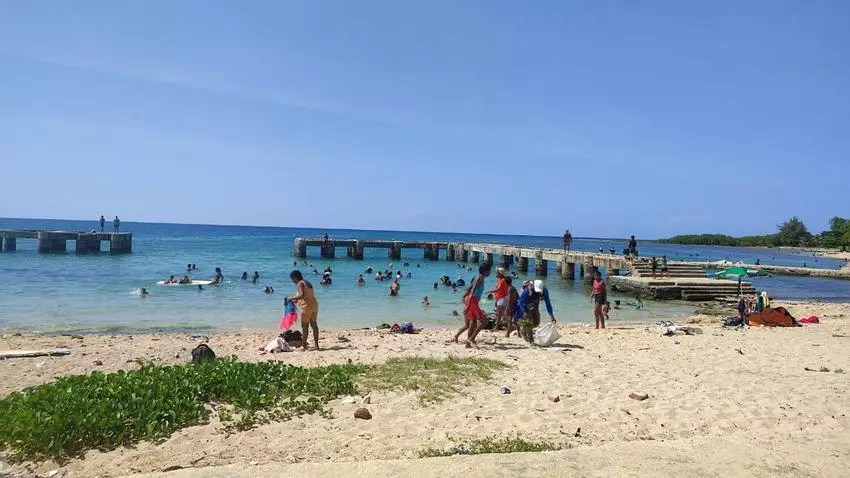
Several residents told the official press that maggots, mosquito larvae and snails come through the pipes.
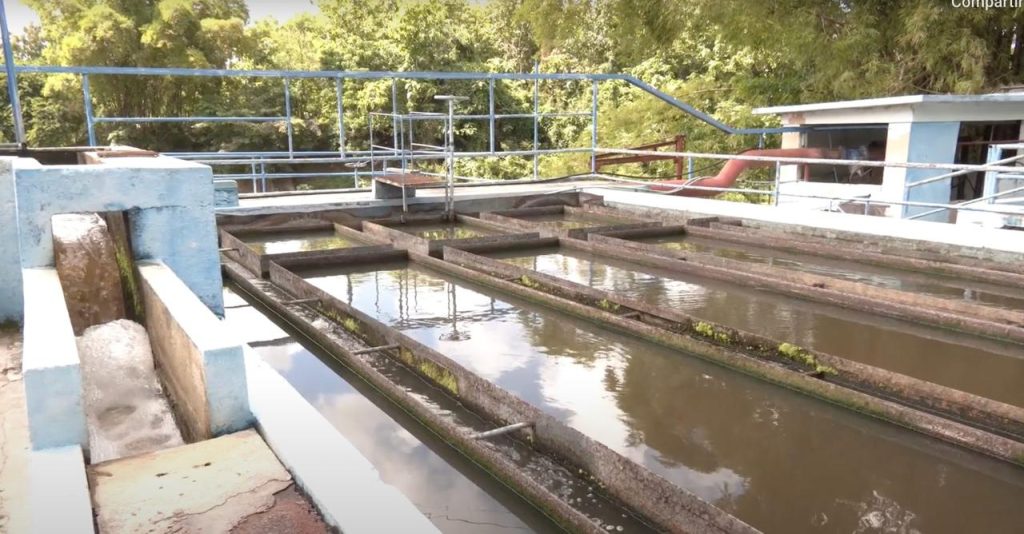
 14ymedio, Havana, 8 August 2025 — Earth, maggots, mosquito larvae and even snails have arrived in recent days in the homes of the residents of Sancti Spíritus through the water pipes. With the reservoirs at minimum capacity due to drought, the Aqueduct and Sewer company scrapes the bottom of the reservoirs and has had to increase chlorination of the water so that it remains, as the service requires, “potable.”
In a news report from Escambray, the local newspaper, residents of the city went so far as to say that the water even arrives with a bad smell. “In my house the water -I’m not kidding- comes out black,” said one of the interviewees. Others even explained the problems that the water quality has brought. “Sometimes a company worker comes to a house, checks the tanks and says, ‘You have bugs” and wants to impose a fine, but those bugs already arrived in the same water,” said one lady.
Another resident confirmed the report: “We have noticed at the educational institution where I work that it comes with bugs. There are times when the water is just arriving; we put it in a clean tank, and there are bugs and it’s very dirty.”
In the worst cases, however, the residents said they received water of “poor quality” with “maggots coming through the pipe, snails and all kinds of mosquito larvae.” continue reading
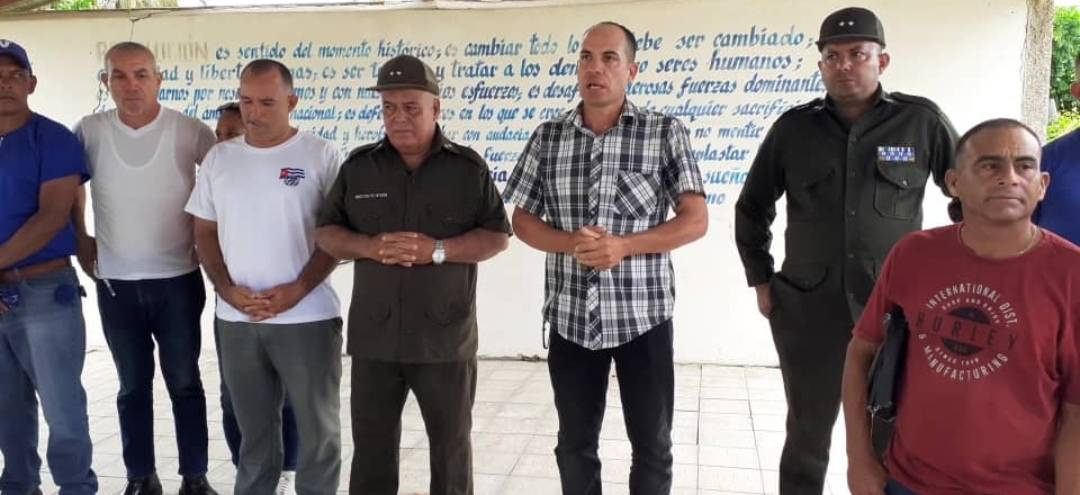
In the Aqueduct and Sewer company, director Roberto Nápoles did not deny the claims. “There have been many reports that are true.”
In the Aqueduct and Sewer company, director Roberto Nápoles did not deny the claims. “There have been many reports that are true.” The complaints, he said, have forced the company to visit homes where the water arrives with very poor quality, especially in the Kilo 12 neighborhood. The solution has been to drain the pipes, clean them and increase chlorination, a method that “has had a good response.”
The director, however, dismissed some popular claims that even live fish have come through the pipes. “That is uncertain. No live fish can come out of a reservoir; it’s impossible.”
“We are going through a crisis in the two supply sources of Sancti Spíritus due to the drought. At the moment we have the water treatment plant of Yayabo pumping only 100 liters per second of the 283 it has of maximum capacity,” explained the director.
As for the poor quality of the water, he added that the company works with the management of Hygiene to address critical points in the city, which has the worst situation in the province, especially in the south. In the main municipality, he added, “water is not distributed through wells but through dams and rivers.” As a result, he explains, the rivers do not increase and are not clean because of the low rainfall, so the water in homes arrives dirty and “has a bad smell.”
The company is carrying out a “differentiated chemical treatment” on the water in order to “improve service” and increase the dose of chlorine.
According to Nápoles, the company is carrying out a “differentiated chemical treatment” on the water in order to “improve service” and increase the dose of chlorine, something that the official said is not harmful, at current levels, for consumers.
The authorities have acknowledged that in August, a month of low rainfall, the situation is not expected to improve. When asked by Escambray what measures the company intends to take to guarantee the supply, Nápoles explained that it is not a situation that is in the power of “human beings” but rather is a “matter of nature.”
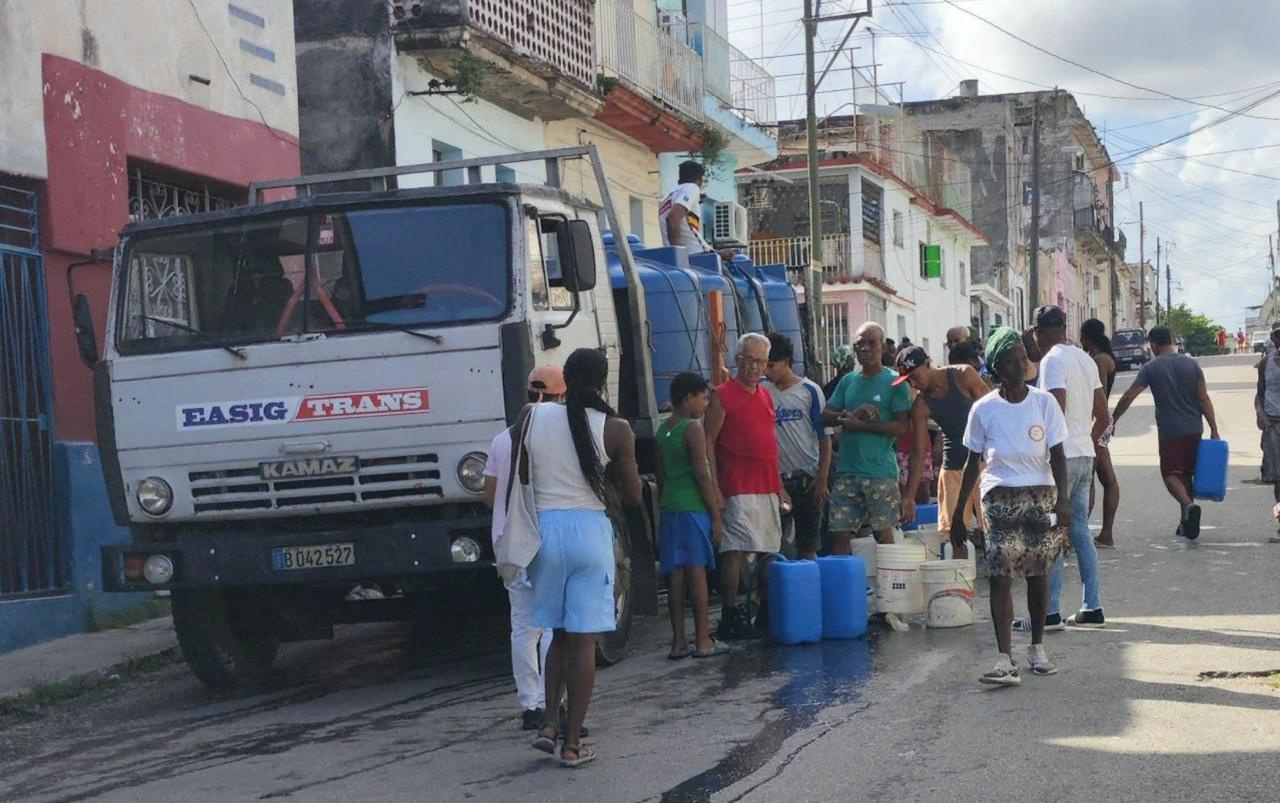
Water has indeed been distributed in tanker trucks to the most critical areas, he said, but an extra fuel allocation had to be made by the government because the company “does not have enough fuel to support that activity.”
The official press of Sancti Spíritus has warned on several occasions about the low level of water reserves in the province. In an article published this Thursday, Escambray regretted that the rains of the first half of the year had barely reached 47.7% of the forecast for the territory, with La Sierpe being the municipality most affected by the low rainfall.
The rains of the first half of the year barely reached 47.7% of the forecast for the territory.
“At the end of July, with little accumulated and taking into account that historically August does not have significant rainfall figures, the province is not expected to considerably improve its hydrological situation, so the severe drought category in the territory will be maintained,” said Yusliadys Lorenzo Coca, technical director of the provincial delegation of Water Resources.
Among the nine reservoirs in the province, including Zaza, the country’s largest dam, Sancti Spíritus has only 200 million cubic meters of water, just over 19% of its capacity. Seven of them, she told the newspaper, are below 50%.
When we compare the volumes stored at the same date of the previous year, all the reservoirs in the province have lower levels, except Higuanojo,” added Lorenzo.
The authorities avoided talking about the particular state of Zaza, which not only supplies Sancti Spíritus but also Villa Clara, and its water is also used largely for agriculture. In May, the reservoir was below 12% of its capacity, an even worse situation than in 2024, when levels were also very low, recording its most critical level in the past five years.
Since then, contrary to the saying, it has rained little, so that it is foreseeable that of the largest reservoir in the country only a puddle remains.
Translated by Regina Anavy
____________
COLLABORATE WITH OUR WORK: The 14ymedio team is committed to practicing serious journalism that reflects Cuba’s reality in all its depth. Thank you for joining us on this long journey. We invite you to continue supporting us by becoming a member of 14ymedio now. Together we can continue transforming journalism in Cuba.